Monday, January 19, 2009

Can't Get Enough Nana in Your Comics Diet: "Nana" 2 Review

Nana vol. 2
Publisher: Shojo Beat/Viz Media
Writer/Artist: Yazawa Ai
English Adaptation: Allison Wolfe
Translation: Goto Koji


What happens when one girl named Nana meets another girl named Nana? Will physics allow two Nanas to occupy virtually the same physical space, or will the universe die screaming as anti-matter and matter collide, ripping apart the space-time continuum? Actually, all potential problems are solved when punk Nana Osaki notices girly Nana Komatsu’s personality resemblance to a famous dog and renames her friend Hachi. Thus reducing the Nana surplus by one and saving reality as we know it.

The fun starts when Shoji, Nana K’s long distance boyfriend, sends her a special text message: “Cherry blossoms R blooming!” and tells her he finally got into art school. So she quits her video store job, runs through the snow in her monster lace-up platform boots, jumps the shinkansen for Tokyo for their long-awaited reunion. She’s saved her money, waited ever so patiently and now all her dreams are coming true…

If only Nana K can be patient for a few hours more. The shinkansen’s delayed due to snow and there’s only one empty seat- empty but for a sinister looking black guitar case guarding the sleeping girl in the window seat next to it. This girl is nothing like Nana K; she’s all dressed up in black, looks like an erotic vulture in her leather jacket, thigh-high fishnets and clunky engineer boots.

Nana K’s decision to take the seat changes both of their lives. And her name!

You know, with the comic series emerging as one of Japan's top-selling titles of all time and the 2005 film adaptation spawning even more Nanamania, a sequel became inevitable:
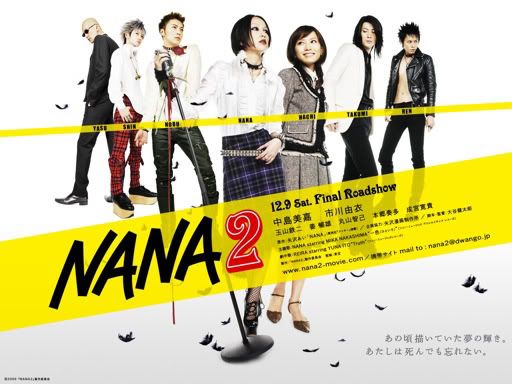
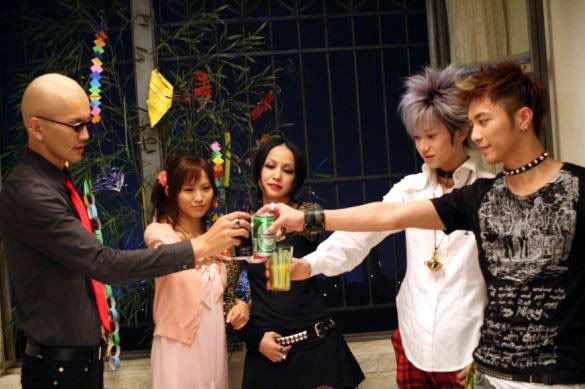
Nana 2 debuted in 2006. Again, Nakashima Mika starred as Nana O, the fame hungry punk rocker. But Miyazaki Aoi didn't reprise her role as Hachi. Why? What do I look like, Japan Film Insider? Whatever the reason, Ichikawa Yui took over the role. The sequel wasn't as big a hit as the first, and a few people I've talked to about it recently expressed their disappointment with both movies, and their preference for the animated series. Oh well, at least Nose Anna returned as Junko!

Anyway, back to the comic review.

And so Yazawa Ai finally brings our two Nanas together, on a snowbound train aimed at Tokyo. Through various circumstances and perhaps the machinations of Nana K's personal deity/devil the Demon Lord, the girls end up as roommates in a funky Tokyo suburb along what I’m guessing is the Sumida River. I base this on my own scientific Nana research, consisting of going to Tokyo and looking for a river. I wanted to go to Kojima-cho to look for Jackson Hole and have a Jackson Burger (Hachi's favorite food), but a nasty cold and frequent chilly downpours caused me to limit myself merely to reading about it, and having Wendy's in Shibuya instead.

Yazawa also begins weaving together the supporting casts. At first it seemed as though we were going to be treated to parallel narratives but Yazawa skillfully mixes the very different characters to create dramatic tension and humor.

Nana K’s impulsive nature comes to the fore as she falls head over heels in platonic love with her slightly sinister, definitely mysterious doppelganger. If fate and coincidence are to be recurring themes, then it certainly seems that Nana K’s intuition serves her well. Because the story cannot happen unless she appends herself to Nana O’s life, works her way into the center despite their differing backgrounds and outlooks. Failing that, both characters and all their friends would be out of work and they'd end up hanging around Junko's snack bar all day. And we would have nothing to read.

Nana K is a reckless romantic, while Nana O is coolly self-possessed. But how will her punk rock façade hold up when living with a girl who loves Trapnest, the very band her own lover abandoned her to join (to the point of adorning their shared pad with a massive fannish poster of the group)… with her love crazed, puppydog-like-in-her-clumsy-enthusiasm roomie? That’s the origin of the name Hachi.

Hachiko was a dog who waited at Shibuya Station every day for her college professor owner even after he died. A symbol of loyalty, she’s immortalized in a statue outside the station, and the exit to that area is named after her: the Hachiko Exit. People say if you stand there long enough, the one you’d most like to see will eventually walk by. You can speed up the process by simply text messaging that person and arranging a rendezvous beforehand. But given the mob usually lounging around the Hachiko statue, you should probably wave a flag.

Nana, meet Hachi, your very own loyal, loving pet girl friend.
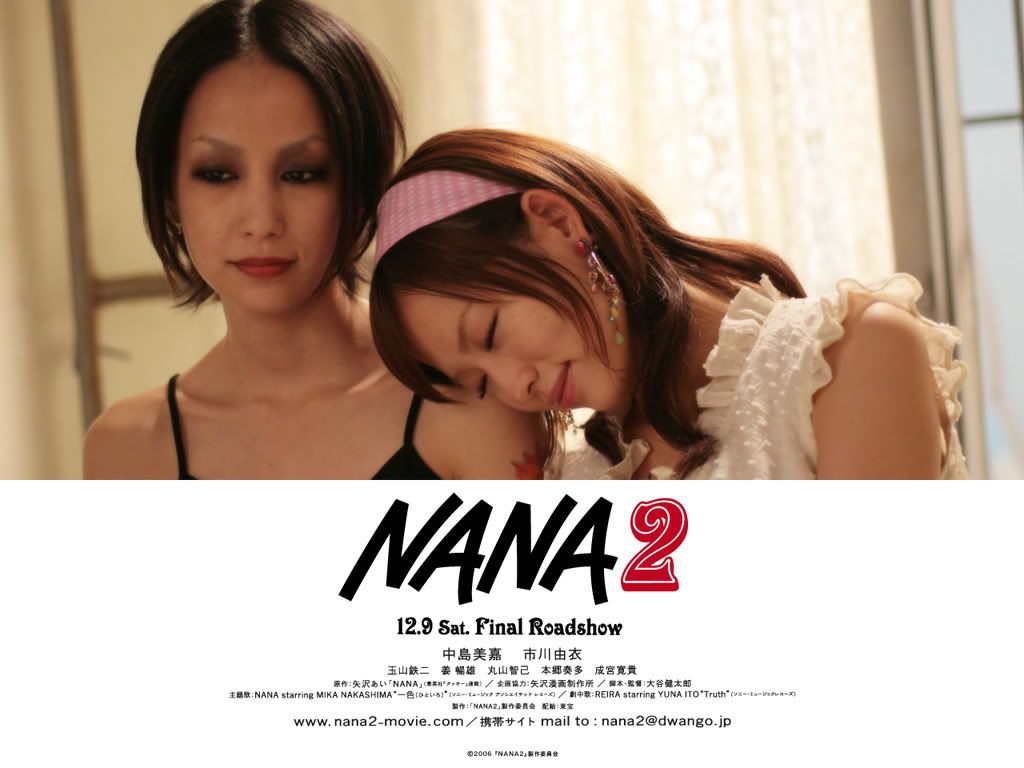
I think we can all agree Nakashima Mika is perfect as Nana O. She's also a big-time singing star in her own right, and released an album called The End: Nana starring Mika Nakashima that features her songs from the second film. Her comics connection continues- last fall she had a hit song with the theme to the TV drama adaptation of the comic Life.

And despite falling victim to the law of diminishing returns, the movie certainly looks like the comic:

Volume 2 is where the story really gets going, where Yazawa sets up Hachi’s fascination with Nana’s shadowy past. It’s strongly character driven, with Hachi’s manic energy linking her with her namesake, entangling them both in each other’s lives. Things don’t so much happen as Hachi makes them happen, from wheedling her way into her dream apartment with Nana, to finding a job at a hip vintage clothing store, to spending all her money getting set up in Tokyo.

Beyond the addictive charms of the lead story, Yazawa gives us the fun and frivolous “Junko’s Place” backup story, where the Nana cast break the fourth wall while remaining totally in character. Their awareness not only of their existence as fictional comic book characters but also of the cast hierarchy is hilariously meta. As much as I love the narrative, as I accumulated volumes I found myself flipping back to "Junko’s Place" to catch up on Jun and her boyfriend and their little area of the Nana world. Every time Yazawa hints that Junko’s restaurant might close due to lack of business only intensified my obsession. What if Junko’s Place does close? What will she do? What will we do?

Good god… Nana is a drug. You should have to get a doctor’s okay before buying it. A prescription or something, and your health should be carefully vetted before they hand it out. On the other hand, some stressed out, over-worked mothers here are actually turning over all their parental responsibilities to the Nana comic series and allowing it to raise their children:

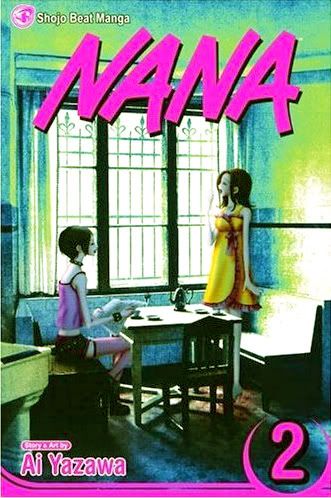
PS- Note how the covers actually tell a wordless little story of a day in the lives of the two Nanas. On the cover of volume 1, Nana O wakes first and reads the paper in their cozy little dining alcove, Hachi takes longer to get dressed but appears on volume 2, they have breakfast, go downstairs on volume 3, and on subsequent covers do some shopping, have lunch, ride the trains...

Pretty sneaky, Yazawa Ai!

Sunday, January 18, 2009

Bad Things Come in Threes: “Batgirl" 3 review

Batgirl 3
Publisher: DC Comics
Writer: Adam Beechen
Penciller: Jim Calafiore
Inker: Mark McKenna

Colorist: Nathan Eyring

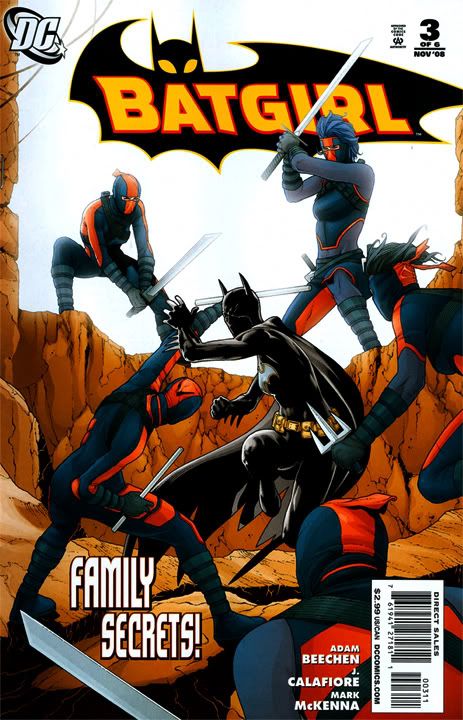
Capsule review: Batgirl issue 3... A couple of pages of boring exposition followed by a couple of pages of standard-issue fight scenes do not a story make. You'd also think the writer might've taken time to... you know... actually read some of the main character's previous title in order to develop a characterization more consistent with... Oh to hell with that-- you'd also think the writer would at least give the main character a personality worth reading about. But three issues in, that'd be expecting too much of this paltry, hackish miniseries.

The pointy people come out to play courtesy of J. Calafiore’s jagged artwork in Batgirl #3. Why bother to threaten people with a sword when you could just slice them open with the side of your face, or the edge of your shoulder?

With a decidedly mediocre script by Adam Beechen and Calafiore’s spiny art and “widescreen” layouts, this issue is the very definition of "filler." Crimefighter comic book generica. We know there’s a big confrontation coming between Batgirl and David Cain, but it takes place in issue 6 so Batgirl has to do something between the first issue and the last. And what that is, apparently, is swipe the storyline of the old Street Fighter video game. Lots of henchpeople for Batgirl to toss around while her energy bar gets lower and lower until she reaches the big Boss Fight at the end, interrupted by clumsily written cut scenes.

In this outing, Batgirl has teamed up with some chick in a costume from the Tron reject pile to find and kill David Cain, her biological father. But first they have to deal with Ravager, who's also angry at her own father and a small army of girls who broke into the Marvel universe and stole Deadpool’s dirty laundry. Daddy issues might make for an interesting subtext in a story about a young woman who wants to kill her old man, and you can imagine what a more inspired writer would do with the concept. But that would require effort, and the Batgirl miniseries is apparently all about doing the least a writer can do and still call it writing.

Actually, the biggest problem isn't the lame overly familiar plotting and yawn inducing "action" sequences. It's the stilted characterization. Beechen shows once again why he’s the Batgirl fan’s writer of last resort. It's not bad enough that he opens the issue with an on-the-nose fantasy sequence that hamfistedly puts his inability to grasp Batgirl on full display, but later he injects an unwelcome whiny note into Batgirl’s narration:

“It shouldn’t be like this. Nothing in my life should be like this. It’s not fair.”

You know, it’s nice that Batgirl has finally found a voice. It’s just too bad it’s such a wimpy, boring one and comes at the cost of all her other chops. Evidently a year as an ESL student teaches you mainly to be a bland costumed mope.

I remember a time when "fair" or "not fair" didn't enter to her thinking, when all Batgirl wanted was to be Batgirl. To kick ass and not worry about taking names because she wouldn’t have understood them anyway. When she exulted in her abilities to an extent that frightened her confidant Barbara Gordon. If she was having emotional problems, she punched and kicked some evil minion half to death and Batman would have to pull her off and lecture her with his own fists and feet.

Now the girl who once exposed her face to government agencies so she wouldn't have to mess with all that "secret identity" crap just wants that tired old cliché, the “normal life.” What a comedown for a formerly bad-ass character. With this miniseries, Beechen seems determined to strip away everything that made the character vital and replace it with standard-issue teen super-person emo borrowed from other, much more entertaining, sources.

What happened to the girl who frequently went toe-to-toe with Batman (in issue #50 of her old series she and Bats almost killed each other), who defeated the deadly Lady Shiva? It's a good idea to make things difficult for your protagonist, but in this issue, she has trouble fighting a cadre of characters so perfunctory they don't even have names or faces. Hell, she looks like Robin would give her a run for her money these days. Back in her original series she’d have cut a bloody swath through all these costumed geeks.

Oh, and by the way, at one point Batgirl was unique. A freak. Her father had to start her assassin training practically from birth and deny her language in order to channel it into physical expression. It worked that one time, and the end result was an isolated, emotionally stunted young woman who was so alone in the world she'd embrace even Batman's version of tough love.

Now it seems anyone at any age can learn to be Batgirl. All they have to do is pump iron and wear tights. And you might think someone brilliant enough to create an army of assassins would find a more secluded area for their training. According to this book, they practice down at the local gym inside some nondescript brick building that looks like it came out of a poorly-written and illustrated "How To Draw Boring Superhero Comics" instructional book. But with writing this dull, why expect the settings to be interesting? Early in the book, there's even a fight on a... yawn... decrepit urban basketball court complete with not-very-believable grunge and weathering.

I suppose it's conducive to a revenge-quest when the target spends his time being nefarious right there in your own hometown. Hey, even an otherwise colorless supporting character (who Batgirl apparently has fallen head over heels for despite only talking to him once or twice in the narrative) gets to travel to Indonesia. Batgirl, on the other hand, has to pursue her "Redemption Road" through local settings that wouldn't have taxed an old Apple IIC computer's graphic capabilities running a Scott Adams Questprobe adventure game. I don't know how comic book accounting works; maybe having Batgirl's target hiding out in some exotic locale would've strained the penny-ante budget and thought put into this... this... I almost hesitate to call it a "story."

I've always felt you told a story because you had to, because it was bursting to escape your imagination. That the story itself would justify the telling. Batgirl #3 is a comic that doesn’t justify anything, unless it's keeping Adam Beechen the hell away from telling anymore Batgirl stories.

Saturday, January 17, 2009

When the Cream Rises to the Top, Skim It Off: "Skim" Review from Last Year

Skim
Writer: Mariko Tamaki
Artist: Jillian Tamaki
Publisher: Groundwood Books

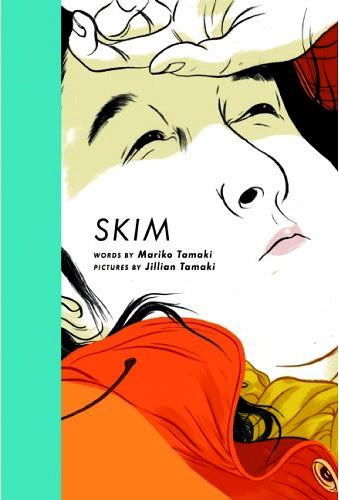
I wrote this last year, before Skim jumped onto all the "Best of 2008" lists. Well, at least one I know of. And it richly deserves its place there. I want to revisit it as I refocus this blog's direction.

Ahhh... the joys of being smart enough to see through the bullshit, but not so self-assured you can do anything about it or rise above.

It’s 1993, a Canadian suburb and Kimberly Keiko Cameron is 16 years old and depressed. Which- if I remember my own 16th year correctly- is almost a redundant statement. She's an alien among her peers and her friends and enemies at her all-girls school call her Skim because, as she explains, she’s not. Skim and her best friend Lisa are novice witches, and protect themselves (poorly) against the psychic bruising of high school life with pentacles, cynicism and sarcasm.

After a classmate’s boyfriend commits suicide, Skim finds herself under scrutiny as a “gothic” and an individualist. Almost everyone seems to think she’s next. Lisa expresses her contempt for the whole affair and everyone involved, while others opportunistically try to pad their school resumes and no one seems to care how the girl involved feels about this outpouring of well-intentioned but partially sham sympathy.

Skim herself has more on her mind than suicide and the sympathy fads of the herd-minded. She’s become interested in Ms. Archer, the exciting, free-flowing English teacher who tells her she has the eyes of a fortune-teller and fires her imagination.

Mariko Tamaki limns a first person narrative through Skim’s diary entries as the whole mixed-up drama unfolds. She presents Skim as a fully-realized protagonist, an introspective, occasionally self-doubting yet incredibly intelligent and perceptive young woman. Mariko handles this narration with skill, especially in scenes where Skim’s diary entries provide ironic counterpoint to the on-panel action. Early in the story, Lisa asks Skim how she broke her arm. “I fell off my bike,” Skim replies.

The truth? She tripped on her Wiccan altar and fell on her mom’s candelabra.

Throughout Skim, Mariko explores the myriad ways life's dumb realities confound our expectations, even if they're less than grandiose. It's not just that people say one thing and do another. It's also that it's tough to take photos of the cast on your right hand with your left when you're right-handed, just as difficult to illustrate broken-heartedness on the backs of your hands for similar reasons. Skim's first coven doubles as an AA group. Friends disappoint, parents fall out of love, the people we love prove to have their own agendas and leave us wanting our tarot cards back.

Skim may be down, she may be overly critical of herself and her classmates, but she's a thoughtful, intriguing human being, able to accurately question the motives of others even while her own judgment is somewhat clouded by her burgeoning teacher-crush, which plays out with an intensity that any of us who has ever loved someone too much will recognize (and perhaps feel thankful we've outgrown... hopefully). Despite granting her protagonist self-awareness, Mariko Tamaki never lets Skim become preternaturally wise beyond her years. Instead, Skim's narrative voice remains that of a believably bright teen, still unformed. Her dialogue and diary entries ring true. In fact, the dialogue throughout is fresh and naturalistic and Mariko shows a keen ear for the way teens and adults alike talk, think and express themselves.

At the same time, Skim’s something of an iconoclast as she demonstrates with a startlingly reductive view of Romeo and Juliet. This is in contrast with her pal Lisa, who talks independence and free thought but seems to constantly court acceptance.

In a hilarious scene, Lisa has talked Skim into accepting a double date with a couple of private school boys who appear dressed in their school uniforms and show nothing but contempt for Skim’s Shakespearean critique. Revealingly, their own view is informed solely by conventional wisdom and it's doubtful they’ve even read the play themselves.

Mariko’s cousin Jillian defines Skim’s world with loopy, swooping lines that give the illusion of movement, with furry drybrush and areas of deep black, plus lots of well-placed gray tones. Her storytelling is superb. This is a book of deeply felt emotions, of quiet moments, of conversations and silences. Jillian frequently looks away from the characters to focus on the minute, mundane yet keenly observed details of their surroundings in fragmentary still lifes, all those mood-building aspects. Jillian's figure work is gestural, active and energetic and she has an almost superhuman ability to find visual poetry in commonplace activities. Watch Skim’s mom crack pasta in half while making dinner, see the girls light cigarettes, argue in the bathroom or gleefully dance when cracking themselves up with the cruel humor of too-smart-for-their-own-good teenagers.

When was the last time you saw a comic book character twist open an Oreo to lick the cream filling? Jillian makes sure Skim moves and emotes in a distinctly different way than Lisa, than her mom. Each character is individualized and completely thought-through.

There are also single page images and double page spreads that freeze important moments- such as a momentous kiss- or else express narrative themes subjectively. Skim and Lisa attempt to invoke the spirit of the dead boy. They appear in silhouette on the spread’s lower right corner while trees created with bold brush strokes loom over them, a ghostly figure sitting on the left. Jillian uses more gray tones to give the illusion of depth, but also to give the scene a haunting, dreamlike quality. One of my favorite pages has Skim stomping out "I HATE EVERYTHING" in the snow after a false start. Another freezes a sequence of events involving a gaggle of ballerinas tossing a young Skim (dressed at the Cowardly Lion from The Wizard of Oz) and another girl (a soldier) out the door of a costume birthday party.

Skim's bitterly funny retrospective insight:

After a little while, Hien left. Hien's parents adopted her from Vietnam two years earlier and she never got invited to parties. Maybe she thought that's how people left parties in Canada. Asians first.

The cousins also deftly recreate 1993 with small details without allowing the book to become a nostalgia piece. Skim remembers giving a U2 tape as a birthday gift to the lead ballerina, her mother makes it a point to watch the TV show Sisters, and Skim dons a Nine Inch Nails t-shirt to attend the coven/AA meeting. There’s even a mocking reference to a guy with “80’s rocker hair and a turtleneck,” one of those style straggling holdovers from the previous decade. The concept of goth is so new, no one even knows what to call it. It's almost quaint to recall a time when we were more concerned about high schoolers harming themselves rather than massacring their peers.

Skim is an affecting, assured and impressive literary effort that doesn’t make me feel like an asshole for calling it a “graphic novel,” as well as a gorgeous hardcover full of lush art. It's my early pick for best of the year, but to be honest I don't know how many other graphic novels I'll actually read that aren't just collections of monthly books. I doubt any of those will sate the hunger for quality fiction about human beings and the amusing ways life disappoints and thrills the way Skim does.

Friday, January 16, 2009

Nananananana NaNAAAA: "Nana" 1 Review

Nana vol. 1
Publisher: Shojo Beat/Viz Media
Writer/Artist: Yazawa Ai
English Adaptation: Allison Wolfe

Translation: Goto Koji

When my Nana
Stands next to your Nana
I can’t define Nana
When it’s not Nana

I’ve got two Nanas
I’ve got two Nanas
And they go tweet tweet tweet tweet tweet like little birds…

Yeah, I could’ve gone with something even lamer, like a David Letterman flopping at the Oscars riff: “Nana, meet Nana. Nana, Nana. Nana, Nana.” But no, I felt like breaking out some Talking Heads. It’s more appropriate.

My mental dysfunctions aside, I have gathered you here today, dearly beloved, to talk about Nana, the lively Japanese comic series where two young women both named Nana wind up cohabiting apartment 707 while chasing their dreams, living their lives and occasionally eating Jackson Burgers.

But before we get to all the fun stuff that makes up the actual story, we have to travel westward along the Tokkaido Line rails for volume 1, the two-part prelude where Nana Komatsu (eventually she’ll be known as Hachi, but for now she’s still just Nana K) has just graduated high school and broken up with her married boyfriend. Acting on the advice of her best friend Jun, this Nana decides to stop objectifying men. Good idea, because the result is something approximating true love with guy-pal Shoji. But how can it last when Jun, her laid-back boyfriend Kyosuke and Shoji are all moving to Tokyo to attend art college, with Nana stuck in their Podunk hometown?

In another city, another Nana is also being left behind. Lead singer of Blast (short for Black Stones), Nana Osaki has had a hard-luck life; not as bad as orphan Annie’s but still pretty rocky. She’s a high school dropout thanks to a trumped-up prostitution scandal, thinks she killed her grandmother and now her band is falling apart.

Despite sharing given names, the Nanas are definitely a study in contrasts. The first Nana is scatterbrained and immature, barely capable of making it through the day without falling madly and foolishly in love with some unwitting guy, forever exasperating the more together Jun with her silliness and seeming amorality. The other Nana is a Vivienne Westwood-loving rocker who hides her insecurity behind tough talk and an evil demeanor.

Writer/artist Yazawa Ai Yazawa gives each of her characters depths that become apparent as the story progresses. Nana K is flighty and immature, but also blisteringly self-aware and capable of personal growth. Nana O is tough and cynical, but also vulnerable. Even the supporting characters have a welcome richness. Best friend Jun is sensible but often frustrated with Nana, while Shoji shows flashes of a temper and a love of drinking that keep him from being merely the pretty boy love interest. And Kyosuke? It’s all good to him.

Yazawa’s artwork is quite appealing but not mindblowingly cute like something by Takahashi Rumiko. While it’s certainly not realism, it is fairly natural at times, even with those Japanese visual tropes- you know, stock depictions of facial expressions and emotions, the happiness face with half-circle eyes, no nose and a big triangular mouth. Lots of tone effects that have more meaning for Japanese readers than they do for ignorant me. Yazawa’s figures have spindly, elongated bodies that make them look fashionable, elegant even. They're romanticized, sophisticated.

Let's take a break and look at an image from the wildly popular Nana film adaptation, starring the exquisitely cast Nakashima Mika as Nana O, and the almost-as-well-cast Miyazaki Aoi as Nana K:

Actually, they might be equally perfectly cast, but since the film isn't available here in Japan with English subtitles (you can order the region 1 DVD from Amazon.com, though), I haven't been able to see it. But from the publicity stills I've seen and the trailers I've watched, Nakashima looks as if she somehow stepped off Yazawa's drawing board directly into our world.

Now, back to the review...

Backgrounds are sparse, and Yazawa relies heavily on dot-screened photos for outside environs, so occasionally the reader will recognize a real-world location, as in the scene where Nana K and Shoji walk through a neon-lit cityscape that could possibly be Shinjuku. The end result is even more focus on the characters. Which is fine, because Nana is such a character-driven narrative. What’s really interesting about the art is Yazawa’s mastery of costuming; I’m guessing the stretched fashion art figure work isn’t accidental. All her characters are very outfit-specific, from Nana K’s girly-girl late 90s combos complete with platform-soled shoes (the story opens in 1999, after all) to Nana O’s Vivienne Westwood gear.

Oh yeah, the movie version. It was such a huge hit the Japanese staff at my job were briefly Nanafied. I don't mean they dressed like Nana O. But during the film's initial run, their break room suddenly became absolutely littered with copies of Nana comics! In Japanese, of course. I mean, when The Dark Knight came out, did American offices suddenly disappear under an avalance of DC mags? I sincerely doubt it. Ah, Japan, where millions of people actually read comics and love them.

Here's a photo of a Nana movie photobook. When a movie comes out in Japan- much like in America- it's accompanied by tons of ancillary merchandise. My favorites are always the "making of" books, because they come loaded with photos:

Also, Japanese punk is somewhat different than Western punk, at least the modern iteration. To me, Nana O is more goth than punk, although she's heavy on the punk flourishes. Seems like a more purist punk would be a little less name-brand conscious. If anything, I’d put her more in the visual-kei subculture, further evidence of which is provided later in the series when her gosu-rori superfan Misato shows up. Visual-kei is a gothic pop/rock music style beloved by the gosu-rori tribe, and features androgynous or downright feminine-looking guys and… well… Nana-looking girls. Look up bands like Glay, L’Arc-en-Ciel and Dir en grey to see what I’m yakking about.

Still, if you were interested in dressing exactly like either Nana, Yazawa provides enough visual reference to make it easy. To turn yourself into Nana O, all you have to do is hit Hysteric Glamour or some of the other “punk” shops along Takeshita-dori in Harajuku where the Vivienne stuff is readily available; for Nana K, one of the suburban malls will do…

Actually, the Shitoro Aeon mall in my city of Hamamatsu would be perfect for any would-be Nana K’s out there. I could see her shopping there for looks to impress, outfits she thinks of as sophisticated or mature that end up showing just how naïve she really is about love and life in general.

Her hometown actually reminds me a lot of the first place I lived here in Japan, a small, blue collar city called Toyohashi, in Aichi prefecture- Japan’s industrial heartland, where the cyberpunk unreality of the Tokyo skyline is almost as foreign or distant as it is to your average American. In these places life is more workaday, less magical. Bisected by an ugly gash of train and shinkansen tracks, hugged to the north by mountains and to the south by the polluted Pacific, Toyohashi is a pleasant and unpretentious city of just plain folks (Japanese variety), the kind of place where cute but average girls like Nana K dream of escaping to a better life via marriage or work in Tokyo as a flight attendant or fashion store employee.

Hey, I forgot to tell you- not only did Nana inspire a hit film and its hit sequel, but also an animated series. As you can see from this still, the character design draws heavily on Yazawa's artwork. Fittingly so:

That Nana O has the characteristic Yazawa angular look. In the stylistic home of large eyes, Yazawa's are standouts. She imbues them with an emotive intensity not generally found in the work of other Japanese artists.

That was the final aside. I promise.

Although certain story clues seem to place Nana K’s little hometown as further north than Toyohashi, these smaller cities are pretty much the same, nowhere places lying along the shinkansen lines between somewhere places like Osaka and Tokyo. You see them flashing by, identical stations, McDonald’s and Jusco department stores.

You pass them by, hoping for a better life, a romantic dream come true… until you’re something of a Nana yourself.

Nana is compulsively readable, with characters getting themselves into situations that Yazawa Ai devilishly leaves a-cliffhangin'. She's a wicked one, all right. The translation is nicely done- a few usages like "It's piss cold" and "What a sarcastic bastard" give it a bit of a spicy kick. Congratulations...


Warning: The Food and Drug Administration has determined that Nana is one of the most addictive substances known on earth. Buy this book at your own risk and don’t tell the DEA I told you to. A friend of mine bought me this in Kyoto and I’ve been obsessed with the Nanas and all their friends for about two weeks now. Run! For the love of God, run away from Nana before it hooks you and you end up like me, turning tricks in Kabuki-cho to feed the habit!

I’m so ashamed…

Thursday, January 15, 2009

Batman's Had an Accident... So May You All...

I thought about the silliest thing at today at work. My job is easy, so I tend to think about... eh... whatever. Lately, I've been really into reading Robert Graysmith's Zodiac Unmasked, so that's on my mind a lot. Arthur Leigh Allen-- was he the Zodiac? I tend to agree with Graysmith that he was. I've had Nana on my mind, too, because I recently picked up volumes 12 and 13 of that delightful and addictive series. Today, in between classes (and sometimes during them because my mind is great at multi-tasking), I pondered that jackass Batman and his latest zany predicament. Wow, this Bat-thingy story has really gotten people talking! My oh my. It sure dropped like a bomb on everyone, didn't it? A smart bomb or one of those ordinary stupid kind... only time will tell.

But given a few moments during the day to collect my thoughts about what this means to me as a comic book reading dork, what I came up with was this--

First, the Batman I used to enjoy reading died a long time ago. Frank Miller killed him and replaced him with a uber-fascist in bad need of anger management classes. And that story was actually compelling in a Leni Riefenstahl kinda way. Inspired by that success and all the press that went with it, lesser writers have really done a number on Bats' rotten corpse over the years since, culminating in what I think was his stupidest moment, the time he snarled at Blue Beetle and smashed a coffee cup in his petulant, childish rage. I mean, really, Batman has been a joke for years.

Second, and most importantly, I'd be way more upset if Yazawa Ai suddenly killed off Hachi or Nana. Or if Jaime Hernandez bumped off Hopey. Although I'm sure either creator would do those things in amazing ways, any of those deaths would certainly bum me out. More than just bum me out; they'd cut out my living heart for any number of reasons no standard-issue mainstream superhero bullshit can. To read Nana or Love & Rockets is to delve into rich and nuanced worlds where choices matter. Their storylines are way more compelling than the ongoing DC narrative, and much more dramatically and fictionally satisfying. Also, I know none of those characters would be coming back when it becomes financially advantageous to the authors for them to do so. Except maybe in flashback form.

So this new development? I feel pretty blase about it.

And don't forget-- there's always the Christian Bale Batman; his movie last summer was the best Batman story in decades. I also truly adore the Batman in the Batman: The Animated Series Batman from the 90s. Gotta get those DVDs! And even better, I have my Batman: Illustrated by Neal Adams books so the real comic book Batman can live again whenever I open the pages. These are what I've turned to time and again over the years as the ongoing monthly Batman increasingly lost his luster. Dead, schmead. If he's what you truly want, don't worry.

He'll be back in a year or two (at most, probably sooner), as dickish as ever.

But if Nana, Hachi, Maggie or Hopey die? I shudder to think about it! Losing them would be almost like losing actual human beings!

Tuesday, January 6, 2009

The Best Graphic Novels of 2008...

PW Comics Week just released their third annual critics' poll. Here are their picks for the best of 2008:

Bottomless Belly Button Dash Shaw (Fantagraphics) I haven't read this, but now I'm intrigued.

Disappearance Diary Hideo Azuma (Fanfare Ponent Mon) The title alone makes me think of Murakami Haruki. It just has that "feel."

The Education of Hopey Glass Jaime Hernandez (Fantagraphics) Oh hell yes! I did read this and thoroughly enjoyed its Hopey-centric storyline. It's an especially important work now that Love & Rockets' format has changed and it's going to be a few years of Jaime's charming but perhaps self-indulgent superhero stuff before we get back to Maggie, Hopey and Ray. Sorry, Jaime-- I like the new storyline but I LOVE this one.

The Great Outdoor Fight Chris Onstad: (Dark Horse)

Omega the Unknown Jonathan Lethem and Farel Dalrymple (Marvel) Usually I avoid superhero stuff, but PW Comics Week's description of this has me rethinking my initial rejection of it on those grounds. Not very fair of me.

What It Is Lynda Barry (Drawn & Quarterly) When I first saw this title, I was hoping it was a comic adaptation of the --- film What Is It?

Zot! Complete Black and White Stories 1987-1991 Scott McCloud (Harper Collins) Weird that a 2008 best graphic novel would be reprint stuff from 20 years ago. But I've read and enjoyed McCloud's book about comics, so perhaps I should pick this up sometime in 2009.

Acme Novelty Library #19 F.C. Ware (Drawn & Quarterly)

Alan's War Emmanuel Guibert (First Second) I've been meaning to pick this up (it's been in my Amazon.co.jp shopping cart for quite a while now), but in the meantime I've been reading non-graphic novel WWII memoirs and personal accounts. Those are also interesting. I would love to see a sort of anti-Sgt. Rock ultra-realistic take on the Good War, though. Not that I'm dissing Rock and Easy Company; it's just that no one in their right mind would walk all the way across Europe with the same .30 caliber bullets over his shoulders.

Aria Kozue Amano (Tokyopop) The art looks inviting!

Aya of Yop City Marguerite Abouet and Clement Oubrerie (D & Q)

Black Jack Osamu Tezuka (Vertical) More ultra-old school stuff. I guess reprints on this list are even more excusable when it's only recently been made available to U.S. markets.

Cat Eyed Boy Kazuo Umezu (Viz)

Essential Dykes to Watch Out For Alison Bechdel (Houghton)

Kramer's Ergot #7 Edited by Sammy Harkham (Buenaventura Press) The title is off-putting for me. I keep thinking it's something to do with Seinfeld.

Local Brian Wood and Ryan Kelly (Oni)

Red Colored Elegy Seiichi Hayashi (D & Q)

Skim Mariko and Jillian Tamaki (Groundwood Books) I bought this as soon as it was released and I've been trumpeting it ever since. A truly remarkable little story, insightfully and movingly written, gorgeously illustrated. Finding it on PW's list really makes my day.

Tamara Drewe Posy Simonds (Houghton)

Three Shadows Cyril Pedrosa (First Second)

Travel Yokoyama Yuichi (Picturebox)

The "Honorable Mentions" include such books as Astonishing X-Men by Joss Whedon and John Cassady (one of my few superhero indulgences and worth it), Astro City: The Dark Age, Book 1 by Kurt Busiek and Brent Anderson (probably worth it as well, although it's fallen off my "must have" list over the years as my tastes have changed), Joker by Brian Azarello and Lee Bermejo (probably fine but what I've seen of it hasn't really impressed me and the Joker has long since worn out his welcome and supposed "menace"), Love and Rockets New Stories No. 1 by Los Bros Hernandez (I thought it was good, especially the Duke and Sammy story by Gilbert, but it didn't grab me the way some of their other works have) and Nana by Ai Yazawa. Plus a lot more.

I'd put Nana near the top of any "Best of" list. Nana, Nana, Nana. If you don't like Nana... den to hell wid you, Crom!

Friday, January 2, 2009

The Tokyo Comics Report 2009: Now More Then Ever!

I just got back from Tokyo and boy are my thighs tired. There's no joke there; my thighs are aching from all the walking around I did. I managed to buy comics in Tokyo on my first night while in Harajuku to hit H&M for some happenin' new threads so all the chicks will dig me.

As far as I know, there's only one place in Tokyo to buy monthly comics. And that's what I bought, monthly comics. I know I swore I wouldn't but the monkey was on my back and he started gnawing my neck dangerously close to the jugular and I had to go to the hospital for some stitches and a tetanus shot. But before I went to have my artery sutured by expert surgeons, I performed my own emergency monkeydectomy at Tokyo's only American comic source worth a damn, Blister.

Here's what I bought along with mini-reviews based on my first readings:

Batgirl #6: I only bought this to complete the set and so I could rag on it later. Adam Beechen takes Batgirl down the "Redemption Road," but it's more like he takes her down a sewer pipe even with the sappy feel-good ending. Wait, was that a spoiler? Can you spoil something that's already rotten? Also, J. Calafiore draws the pointiest people. Or else Jack Purcell inks them pointy. Whoever is to blame for these razor-edged figures, don't brush up against anyone in this book because you might get your skin abrased, as if you'd rubbed a shark's hide the wrong way.

BPRD #5: Mike Mignola, John Arcudi and Guy Davis are doing something but I don't know what it is because I missed the first four issues of this story. It's cool, though and I could look at Davis' loose and lively renderings all day. And I frequently do.

Hellboy: The Wild Hunt #1: Finally, I buy a Hellboy book at the story's beginning; that's something I hadn't accomplished in years. Hellboy goes to jolly ol' England to join a bunch of noblemen in their giant hunt. Giant hunt, as in hunting giants. Duncan Fregedo turns in some Mignola-esque artwork with a lot of jagged shadows and geometrical figures. You know why this works, whereas Calafiore's doesn't? Well, partially because he actually has a story worth illustrating, and he knows how to pace a page. And also because he can draw stuff other than grimacing steroid-junkies punching each other in a generic cityscape. Sorry... that was more ragging on Batgirl #6.

Poor Batgirl. She certainly deserves better. But holy shit, that miniseries stinks. Did I say that already? The Wild Hunt is about a billion times fresher and more interesting.

Gen13 #24: Why the hell did I buy this? Maybe nostalgia. Why did they print this? For that, I have no answer.

Will Eisner's The Spirit #23: Too bad about Frank Miller's evidently shitty movie version. This comes much closer to the true... er... Eisnerian spirit. It's by Sergio Aragones and Mark Evanier, two people I believe hung the comic book moon. I haven't even read it yet but Aluir Amancio's art looks neat-o. At first glance, it appears clean and inviting, with clear storytelling and some Eisner-style clothing wrinkles.

And it's got a Joe Kubert cover!

Will Eisner's The Spirit #24: I bought this because of the Aragones and Evanier names on the cover. No Kubert this time, though. I haven't read it yet but I'm willing to bet you anything it's better than Batgirl #6.

Hell, I blew my nose this morning and it was... Sorry!

Chad Hardin and Wayne Faucher do the art this time and it's more clean, cartoony adventure stuff a la Will Eisner. I don't think I would ever want to draw a comic based on an Eisner character. How can you ever hope to measure up? Hat's off to the artists who give it their best, though.

Madman #11 and #12: Note to DC/Wildstorm's Gen13 crew-- I've missed a ton of issues in this series and yet I picked up #11 and pretty quickly got up to speed. Read this and learn how Mike Allred does it. Mike's art is gorgeous and Laura's coloring may be the best there is in comics right now. In #11, Madman confronts a spirit in a haunted house, and in #12 he runs back to the laboratory to see if Dr. Flem has actually succeeded in something for a change. Then a crazed bald, blue psycho attacks. Cool!

Astonishing X-Men #27: Cyclops says the f-dash-dash-dash word while helping the Old Man change the tire... I've enjoyed Warren Ellis' work and he's entertaining me here but I'm getting really tired of all these X-people joking about their sex lives in front of their friends and all the post-ironic smart-assery. But mostly I'm worn out by the smarmy sex jokes. They were cute when Joss Whedon used them to mock the Scott Summers and Emma Frost coupling, but now that the Beast and that green haired S.W.O.R.D. person are screwing each other and everyone is giggling about it to their faces (and ours), this vein of humor has been thoroughly mined. Strip-mined.

Get it? Strip as in "to strip," meaning to remove one's clothes and... with the... sex and then... Oh to hell with it. Lots of heady concepts here. Almost too many what with the spaceship graveyards and the oh-no-more-alternate-universes stuff. But the smirking characterizations undermine the sci-fi and the urgency.

Conan the Cimmerian #6: I'm not a Frank Cho fan by any means but the man can draw and his covers for this series have been the best stuff I've seen from him. This one is a static pose that's a little boring but he rendered the bejeezus out of it. I haven't read this yet, either, but Tomas Giorello is already one of my favorite post-Marvel Conan artists. As an extra bonus, you get some Richard Corben! Evidently, there's just one more issue of this snowy Cimmerian wasteland stuff and then maybe we'll get some high adventure in some decadent Hyborian urban landscape.

Showcase Presents: Batman and the Outsiders 1: I got this because I love Jim Aparo's art. Also I enjoy the succinct, sincere but somewhat silly storytelling. I also love alliteration.

Not really. I loathe alliteration. These are mid-80s/post-Uncanny X-Men comics so you get Batman putting together a team of international misfits. His reasoning for this is suspect and so are many of the plot points. But it's still better than Batgirl #6!

Also, this is a book I found at Tower Records in Shibuya on New Year's Day. Blister was closed. Tower has a good selection of Fantagraphics, by the way. Lots of Love and Rockets and Dan Clowes stuff, plus much much more.

Astonishing X-Men: Unstoppable: Joss Whedon and John Cassaday wind up their X-run with an outer space epic. Usually I hate outer space epics, but this one is gorgeous to behold and the pay-off is truly huge in scope yet imbued with human tragedy. The last couple of pages are blistering. It's only missing end credits and a symphonic score.

Nana 12 and 13: I haven't read these yet but I'm confident these are the best two comics I bought this time out. It's Nana! f you're not reading Nana... den to hell wid you, Crom!

I bought Astonishing X-Men and Nana at Kinokuniya, behind Takashimaya Times Square in Shinjuku because I only had about 30 minutes to shop before heading back to my hotel to pick up my suitcase. I saw the Emperor's New Year's greeting and that killed my entire morning schedule; culture trumps comics.

Kinokuniya has every volume of the Fantagraphics The Complete Peanuts series. I almost bought the first one, but then I'd become a junkie and those babies ain't cheap!

Hey... Fantastic Four: Rise of the Silver Surfer is coming on one of my movie channels. Finally, something that makes Batgirl #6 look good! Time to pop in that David Fincher Zodiac DVD I bought for 1350 yen...