The Japan Times Online has an article about the recent Japan Media Arts Festival. It's going on right now through February 15th in Roppongi and seems like it would be a blast to catch. High-tech, digital media, Miyazaki Hayao-phobia, creators on the cutting edge and all that neat-o super-keen stuff the beatniks and teddy boys are into these days when they're not playing bongos and hanging out at the malt shoppe. With my economic status it's doubtful I'll get to make even a one day jaunt to Tokyo to catch it, but here are my favorite bits of comic-related info gleaned from the article:
Music-themed manga are now popular in Japan, thanks to artists such as Akira Sasou. His "Maestro," about an orchestra revived by an enigmatic conductor, won a second-place prize. A professor at Kyoto Seika University, Sasou hopes to publish the first Japanese university textbook on creating successful manga.
"High-quality drawings are important, but the story needs to pull the audience to the next page," he said.
That's news to me and I live here in Japan! I do know that Nodame Cantabile remains a favorite and just mentioning it to some of my students usually lights up their faces. And I don't just mean teeny-boppers. I'm talking all ages, from teens to middle-aged women who, if American, probably wouldn't read a comic book with your eyes. I wish music-themed comic books were all the rage in the United States and comics themselves were as mainstreamed there as they are here. And:
Of the 35 manga winners, only 10 were women. Critic and festival judge Yukari Fujimoto recommends "shojo" (girl) manga as a way for overseas women artists to enter this male-dominated arena. Shojo manga is targeted at a female audience.
It seems women have more inroads both as creators and as readers here in Japan than they do in the States, so I'm surprised at these numbers. I'd kind of assumed a more 50-50 split. But I'm pretty stupid when it comes to this kind of analysis and I don't have the patience or the time to go digging through the numbers. Then again, if a comic book festival were handing out thirty-five awards in the U.S., do you think as many as 10 women would win, or even receive nominations? Ten?
And shojo manga may be targeted at a female audience, but when the book is as groovacious as Yazawa Ai's Nana, there's no reason its popularity can't cross gender lines. I'm addicted to Nana, and weather some funny looks whenever someone asks me what Japanese comics I like and that's the first thing out of my mouth. I'm proud of my ability to recognize something superior despite its being aimed at an audience I'm ostensibly not a member of.
I think if the story quality is there (as per Sasou Akira's quote above), the audience for a book can grow beyond its intended demographic. That's one thing that seems to be missing in a lot of the "what can we do to make American comics appeal more to female readers" discussion (which I think needs to be broadened to a more general "how can we get more people buying comics period" movement)-- quality will generally draw readers and quality itself will generally replace all those problematic tropes, cliches and dramatic failings we always complain about.
My answer will always be to challenge our creators to produce better books. And if that idea fails, I seriously doubt there's more you can do to get anyone into comics.
Lastly:
"Shojo manga is booming," [Fujimoto] said.
What's the American equivalent of shojo manga? Hmm... probably actual shojo manga. Is that booming back home as well?

Thursday, February 5, 2009


Wednesday, February 4, 2009
The Many Styles of Hopey Glass: "Love and Rockets Volume 1" Edition
Love and Rockets by Los Bros Hernandez is a strange beast-- a serialized comic book narrative that extends seemingly into infinity, but where the characters actually age and change, and sometimes die. The protagonists and the supporting cast evolve organically over time the way actual human beings do (only more colorfully, because it's fiction). And few human beings were ever as engaging or as dangerous to know as Esperanza Leticia Glass. That's Hopey to you and me, Russ.
During the first volume of Love and Rockets, Hopey undergoes several fashion transformations. Let's take a look at that glorious punk tornado, La Hopita. Keep your arms and hands inside the car at all times.
Since Jaime Hernandez makes frequent use of flashbacks, in order to get the fullest understanding of Hopey's many transformations, we have to start near the end of the first volume, in the "Wigwam Bam" storyline. Here Jaime's leads Hopey and Maggie separate after an argument. Indeed, Jaime cuts Maggie out of the narrative completely, focusing instead of Hopey's misadventures in an East Coast city where she falls in with a former TV star who is now an aged, prune-faced perv engaging in some kind of club for other aged, prune-faced pervs where they dress prostitutes as little girls and engage in who knows what.
And it's during this story that Jaime gives us a glimpse of child Hopey:

Biographical details such as these give some much-needed vulnerability to the otherwise seemingly invincible Hopey. It also supplements an even earlier flashback from the "Jerusalem Crickets"/"Flies on the Ceiling" period, in a brilliant little story that focuses on Hopey's mentor and discarded lover Terry Downe, "Tear It Up, Terry Downe." Here, Jaime presents a pre-punk Hopey as an introverted teen, terrified of the new girl in class who would soon change her life irrevocably:
 Generally, throughout the narrative, Hopey's motivations are either somewhat obscure (what causes her to womanize and generally keep love at arm's length) or else patently transparent (she cannot stop hitting on women in the most blatant of fashions). Consequently, she often comes across as person almost without inhibitions. Here Jaime hints at Hopey's inner complexity and discovers the wounded psyche that births the independent and charismatic persona she adopts. Because by the end of that story, Hopey (under Terry's tutelage) has fully metamorphosed into a raging hardcore punk with a shaved head. It's around this time that she first meets Maggie. This initial encounter-- engineered by Maggie's friend Izzy-- evidently does not go as planned:
 But it proves a momentous event. Jaime revisits this Hopey a few more times, including once in volume two.
Now we come to what I think of as "Classic Hopey." This is how Hopey first appears on the pages of Love and Rockets:
 She sports a spiky boy's haircut and lots of androgynous punk gear. Jaime's art style-- while certainly very pretty-- is a bit unformed here, but Hopey herself is already in full-swing as she makes comic book history. Jaime's artwork becomes slicker and more controlled over time, but Hopey maintains this basic look throughout the middle period Love and Rockets and through several pivotal storylines, albeit with some minor variations.
Here's one: bleached blonde Hopey wearing what appears to be secondhand clothes of a more traditionally feminine mode. A head scarf like a Hitchcock film heroine, what looks like someone's old letter sweater, various belts as accessories, a calf-length pleated skirt and some torn tights:
 Can't tell much about her footgear there, but they appear to be some generic black sneakers.
Blonde Hopey breaking the "fourth wall" to get even with fangirl Maggie:
 This is the basic hairstyle Hopey wears during her infamous grafitti battles against Officer Sado, her arch-nemesis. One of my favorite aspects of Hopey's style during this period is the way Jaime shows her willing to actively challenge the gender dichotomy of "straight" society. While Maggie occasionally derides her as a "boy-looking peesashit," Hopey seems to delight in otherwise challenging gender expectations, as when she pairs her butch haircut with a very feminine 1950's style sundress, complete with bow detail. She has a kind of Jane Wiedlin/Go-Go's look going on here:
 I can't help but picture the dress as pale pink. Of course, she sports a very phallic prop, her bass guitar. With Hopey, femininity comes with an edgy quality. This is also expressed via Hopey's fearless sexuality and erotic adventurism. Here she's practically falling out of an unbuttoned shirt-dress, adopting an aggressively open posture and it seems she couldn't care less:
 I tend to assume Terry's nonchalance here is a bit of a put-on. But why shouldn't Hopey flaunt it a little? Jaime often makes Hopey the fought-over object of desire by any number of would-be lovers, and gives Hopey a full awareness of her physical and emotional impact on others. In fact, she seems to delight in it and frequently takes advantage, as shown in the "Wigwam Bam" sequence where she plays various people against each other in order to secure places to crash for days or weeks at a time.
Here's an interesting look at Classic Hopey in a more boyish punk state. This is from the bizarre fantasy "Easter Hunt," (based on a story Jaime's brother Gilberto wrote as a child) where Maggie and Hopey revert to earlier visual states in order to eat Easter eggs, fly around in a UFO and murder Julie Wree. She's wearing a torn DOA tee and pegged punk pants probably in black denim, although Jaime doesn't add any surface detail and instead opts for a bold all-black silhouette. Earlier in the story, she's barefoot, but in these panels is foot-clad in black high top Chuck Taylors:
 Quite androgynous. Note her unbuttoned fly and visible underwear. And here's Classic Hopey in her long, black pea- or trenchcoat. Full-on punk tomboy mode:
 Planning payback against Officer Sado. Oh, Hopey, will you never learn? Those are some fierce looking buckled shoes/boots. No doubt Jaime could tell us the exact make. This follows a charming sequence in which Hopey gets her haircut in that most masculine of style-environs, the old school barber shop. She emerges with a slicked up boy-cut that she musses into spikes.
Hopey sports this look consistently thoughout the "Jerusalem Cricket" stories in which she embarks on an ill-fated cross country tour with the punk band La Llorona. It's here that Jaime begins to depart from the series' status quo. He also embarks on more extended and complex narratives. Here it appears she's wearing a peacoat:
 That's a gorgeous panel by Jaime. He has always had a reporter's eye for detail and a masterful way of reducing an image to essentials. Your mind fills in a lot of what Jaime has deliberately left out of the drawing. From the drummer's expression, I'd imagine Hopey has once again managed to fuck up the bass line.
While the characters undergo emotional development and changes, Jaime echoes this with visual changes. Maggie rapidly gains weight, becoming more curvaceous. And Jaime realistically depicts the effects of touring on Hopey, in various seedy venues and run-down motels, as her clothes grow shabbier and her hair longer. Jaime teases the readers by keeping Maggie and Hopey apart for hundreds of pages and various misadventures. Eventually, Hopey is gone from Hoppers and the narrative for so long, she becomes almost legendary. Here, Maggie speculates on Hopey's appearance:
 What Maggie has no way of knowing at this point is that Hopey now looks like this:
 They meet in a police station and react to the physical transformations each has undergone:
 But Jaime does not allow the two to enjoy their reunion for long. He almost immediately puts them into conflict with each other and now it's Maggie who vanishes from the narrative, leaving a changed Hopey adrift in a world of perversity and violence. This, then, is "Wigwam Bam," the penultimate storyline of volume one. In it, Hopey emerges briefly as the central character, and sports a wild plume of cropped hair. I call this look "Crazy Hair Hopey," and it's actually one of my favorites. I love the little shout outs to bands from Jaime via Hopey's tee's:
 The Damachers are a fictional band in which Hopey eventually plays bass following the demise of La Llarona and at least one other band she's fired from. But this next band is quite real:
 After concluding "Wigwam Bam," Jaime returns Maggie to her familiar role as central protagonist and embarks on the emotional "Chester Square" storyline to conclude Love and Rockets volume one. Here we find a more girly-girl Hopey still playing bass for the Damachers, but constantly distracted by Maggie-centric daydreams. She sports a very feminine hairstyle and look here, kind of like a compact Audrey Hepburn (who Jaime would later reference more overtly when Penny Century styles Hopey's hair into a kind of neo-Holly Golightly 'do):
 A stylish a-line cloth (tweed? wool?) coat hints at a more sophisticated Hopey. But if you look closer, you see the material is frayed and worn; Hopey is still a punk at heart, and still living fast. Her thin, bare legs give her a fragile quality that seems at odds with her edgy personality. This is Jaime giving us visually the characterization a lesser creator would have to do with prose narration or dialogue.
And with that final Hopey style transformation, Jaime brings Love and Rockets volume one to a close. Still, I wonder what hardcore punk Hopey would say if she knew she exists merely as a fictional character whose various clothing choices not only reflect her growth as a person, but also entertain us as readers:

Saturday, January 24, 2009
Destroy All Superheroes: "Nana" 5 Review
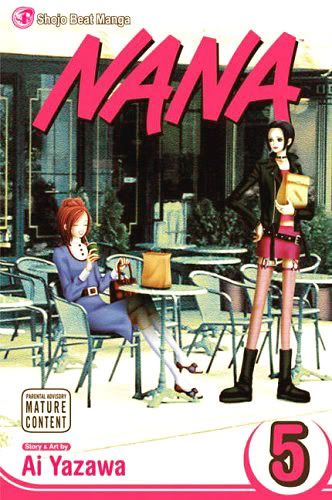 Nana vol. 5
Publisher: Shojo Beat/Viz Media
Writer/Artist: Yazawa Ai
English Adaptation: Allison Wolfe
Translation: Tomo Kimura
Capsule review: Hotel room trysts bookend Nana 5 as Nana and Hachi chase rock & roll fantasies and true love. Yazawa Ai's elegantly angular work gives the drama a fashion magazine gloss as new characters rise to prominence in the narrative and wishes fulfilled promise complications galore in this gripping, pivotal outing.
I had an epiphany during the recent Internet brouhaha over a certain caped crusader’s sudden passing. With stark clarity, I realized I have absolutely no emotional investment in that character, nor in any of his costumed compadres. Their lives, their deaths, their conflicts mean nothing to me after all these years. I remember as a teen I moped all day when I read about Jean Grey’s death. When DC killed off Superman in the 1990s, I was somewhat interested. Then I read the story and found it severely lacking except as a nakedly obvious publicity ploy and sales gambit.
And now, at this late hour, the bloom is definitely off the funeral lily. Because they constantly die and resurrect, because their stories seemingly have no end and the conflicts, plots and subplots endlessly repeat in a self-contained loop, because ultimately they’re nothing more than brand names and corporate logos, mainstream superheroes have achieved a flattening of effect. Or perhaps it's merely another example of the Law of Diminishing Returns. There are only so many times you can exploit the familiar, and there’s little drama or excitement amidst this colorful (or sometimes murky) frenzy, even when scripted by skilled writers. It’s meaningless. I’d be about as sad if someone murdered the Trix Rabbit.
So what fictional comic book characters do I care about? Thanks to the insanely appealing creative work of mangaka (that’s “comic book writer/artist” to you and me, Russ) Yazawa Ai, I’m absolutely obsessed with the soap operaish world of Nana, Hachi and all their friends. It’s all goopy, lovey-dovey drama queen stuff, but it’s compelling and addictive and fresh in a way Bat-this and X-that haven’t been in years. It’s happening as you read it!
I could say as much about Robert Kirkman’s The Walking Dead, but instead of “goopy, lovey-dovey drama queen,” substitute the words “gory, gut-wrenching horror zombie freak.” When Kirkman kills a character, it’s as if he came to your house and personally punched you directly in the stomach.
Yazawa hasn’t killed any of her cast so far, but volume by volume, she shows no reluctance to torture the reader with each new story development. In Nana 5, she places Nana and Hachi in the front row for a Trapnest concert back in Hachi’s little hometown. On guitar for Trapnest? None other than Nana’s ex-boyfriend Ren, the spike-haired Sid Vicious of J-Pop. As Hachi sends desperate mental commands for Ren to take notice of Nana, Trapnest completes their set and exits the stage. No reaction, at least as far as Nana and Hachi are concerned.
Backstage, it’s a different matter entirely. Bassist Takumi takes the usually perfect Ren to task for screwing up a song, and Ren rushes for some private time to make a quick cellphone call to his old friend Yasu: “Yasu?! Why’s Nana here?!”
In Yazawa’s glamorous version of Japan, even drug abusing rock gods have tender hearts. And a fierce, Vivienne Westwood-wearing punk rock girl, as hard and as vulnerable as any stray cat or Holly Golightly, finds herself looking foxy in sunglasses, black cami tank and ragged blue jeans (Yazawa clothes all her characters in exquisitely specific outfits; you could hit a hip shop in Kichijoji or Harajuku and put together any of the cast’s exact looks), making her way to Ren’s hotel for one final confrontation, and to return the key that unlocks the chain around Ren’s neck…
Things in Nana, as in life, seldom go as planned. But Yazawa takes these moments and turns them into page-burning cliffhangers. And it’s here, in volume 5, major events change both Nana’s and Hachi’s lives forever. And this is because when she's not meddling in Nana's love life, Hachi assigns herself to a "secret mission" she's all too eager to tell everyone about-- finding a boyfriend for herself. Candidates abound. Bald lawyer Yasu, Nana's sweet natured but somewhat naive bandmate Nobu, underage man-whore Shin, and the Trapnest fangirl's idol, Takumi. Hachi is forever plagued by selfishness, indecision, unrealistically romantic notions and a flighty nature, and yet Yazawa makes her a sympathetic charmer.
As Hachi says, "It's been a roller-coaster, but what an amazing day!"
But still, there's a strange melancholy that hangs over the series' signature “Hey Nana” narration:
Hey, Nana… I totally adored you. I wanted to be like you. I still feel that way to this day. So please… Sing for me one more time.
What happens down the line to Nana and Hachi that separates them and gives birth to this sad, dreamy reverie? Do the pressures of rock star fame alienate Nana from Hachi? Or... does something even worse tear their platonic love apart?
Vivid characters and heartbreaking situations and no idea whether we’re bound for joy or despair. Now that’s how you make a reader care about your protagonists. Sorry, superheroes, for all your sturm und drang and your plastic crap on clearance at Wal-Mart, you just can’t compete with Nana. And its plastic crap at Animate and Mandarake.
No Music, No Life: "Nana" 4 Review
 Nana vol. 4
Publisher: Shojo Beat/Viz Media
Writer/Artist: Yazawa Ai
English Adaptation: Allison Wolfe
Translation: Tomo Kimura
Let me tell you right now the outfit that Sachiko wears in scene where she inadvertently faces off with Hachi outside the restaurant where she and Hachi’s boyfriend Shoji work just absolutely kills me! What is that… some kind of fleece Alpine bonnet? With dangling puffballs? And her backpack matches her full-length skirt; obviously, she made both of them herself… she’s a fashionista with a pixie cut!
Sorry, I have a weakness.
On a cold night, Nana Osaki keeps her hapless-in-love friend Nana company as they wait in the parking lot outside for Shoji to get off work. Hachi learns Nana is from some frigid prefecture where snow is common, and listens as her punk friend sings some soft song to the night….
That’s when Yazawa Ai brings Hachi, Shoji and Sachiko together for a tearful confrontation where the painful truth emerges. The build-up is exquisite, as is the payoff. Nana sticks up for her friend, ready to pound the two-timing Shoji right in the face with one of her ring-laden fists. And Hachi? She’s the one who’s been betrayed, and this after waiting a whole year, saving every yen for the move, sacrificing everything to live her dream for both of them. How does she react?

Nana volume 4 is like an emotional elevator for Hachi and the hapless readers. Up- Hachi’s growing fascination with Nana. Down- Shoji. Up- tickets front row center for a Trapnest concert in her hometown. Down- no one to go with. Up- Black Stones’ first Tokyo show. Down- Nana’s gosu-rori groupie Misato.
The middle section depicts the show itself, and Yazawa throws in a lot of little reportorial details. The place only holds a limited number of standing-room-only bodies, the cover includes a ticket for a free drink. I once ordered a Coke at one of these shows and the bartender looked at me like she’d just met Forrest Gump live and in person. Oh yeah, I’ve been to quite a few shows here in Japan; only we don’t call them “shows” or “concerts” here. The preferred term is “live.” You might tell a friend the next day, “I went to Black Stones’ live last night.”
“Where was it?”
“At the live house.”
Doyyyyy…
 The show takes place in a small venue somewhere in Shinjuku (Check out local landmark, the Epson building, as Junko and Kyosuke drive past on their way to the show). After the first band, the crowd’s ready to split, but Hachi and Misato (in sausage roll hair, her floral and petticoated skirt and knee-socks, she looks like a living doll) perform a little impromptu sketch:
Hachi: Ya wanna know what? This next band is, like, the best band in the world!
Misato (shouting): I totally agree! Doesn’t Blast just totally rule?! The singer, Nana, is amazing! Her voice is so strong and beautiful!
Their interest piqued, a few curious onlookers filter back into the live house. Yazawa makes even the extras stand out. There’s the tall girl in the spiky, modified-ducktail haircut and star print tee who wants to know if the band’s all girls, her friend in the plaid beret, the buzz cut dude wearing a slick motorcycle jacket and his pal with the rolled-up sleeves and sweatband on his wrist. Everyone seems to be fully accessorized. It must be a blast for her to come up with these distinct and accurate hipster looks. I’ve seen these people! At lives!
And then Blast takes the stage, Nana tying a rose to the mic stand.
 There's even a chance the show might've taken place in Shin-Okubo, a neighborhood just a stop from Shinjuku on the Yamanote Line. It's certainly close enough for Junko and Kyosuke to drive there, and there are a few live houses just outside the station within easy walking distance. In fact... here's one now. You've seen the Nana version of a live show in Japan, now here's the real thing. Melt-Banana at Earthdom, September 2007:


 What it lacked in Nana-like elegance and fashionability, it more than made up for in energy and power. Melt-Banana's total sonic attack destroyed eardrums and the crowd moshed with frantic intensity. I ended up hobbled like an oldster, leaning on my umbrella as if it were a cane, my body sore, but my heart soaring. Welcome to my world!
That’s at least one of the many ways this book gets its addictive hooks in you- presenting the familiar and the ultra-dramatic side-by-side. Like the semi-similar Love & Rockets, Nana presents a heightened reality filled with situations that are similar to things you’ve been through, only amplified for fictional effect. Nana is an unrepentant soap opera, in comics form. And that Yazawa Ai is a fiend. Pure evil, I tells ya! She created these characters, all the cute girls and pretty boys, put them in a fun milieu and set them into motion with Nana and Hachi as the story’s beating, bleeding, loving hearts, their every action creating emotional chaos, making the readers want more, more, MORE.
Pure wickedness.

Thursday, January 22, 2009
Batman and S.E. Hinton, Together Again-- "Showcase Presents Batman and the Outsiders" 1 Review!
 Showcase Presents Batman and the Outsiders
Publisher: DC Comics
Scripts: Mike W. Barr and Marv Wolfman
Art: Jim Aparo, George Perez, Bill Willingham, Steve Lightle, Dan Day, Jerome Moore, Alex Saviuk, Jan Duursema, Rick Hoberg, Trevor Von Eeden, Romeo Tanghal, Mike DeCarlo, Sal Trapani, Pablo Marcos, Bill Anderson
Capsule Review: Batman quits the Justice League and forms a new team with Black Lightning, Metamorpho and a group of would-be heroes he conveniently finds lying around somewhere. They all learn to love and share and care while battling less than menacing villains, then team up with the Teen Titans and Ronald Reagan in this fast-paced artifact from a kinder, gentler time when samurai could kill at will and Batman would just mildly disapprove.
Batman stewards a group of outcast greasers as they fight for respect against the socs in a small Oklahoma town. When Johnny Cade accidentally kills head soc Bob Sheldon, he and Ponyboy take it on the lam, and Batman must make a desperate choice between justice and his new friends. This massive black and white volume reprints some of S.E. Hinton's finest, most moving works of young adult/superhero fiction.
Actually, in this collection, Batman can’t get any of the stupid, jerky Justice League for Jerks to help him invade Markovia, a fake-ass sovereign nation along the lines of Latveria, the Grand Duchy of Fenwick or Mipos to rescue a key Wayne Enterprises employee, so he throws a bat-hissy and quits the group, then runs off to take care of business himself. Coincidentally enough, Markovia is absolutely crawling with B-list super-powered weirdos eager to join an overly emotional basketcase in a bat-costume on his highly personal quest for whatever he thinks justice is this month.
And that’s how Batman forms the Outsiders. OUTSIDERS ROLE CALL!
Cambot... Gypsy... Tom Servo... Crooooowwww...
No, no, no. No more silliness. There's Geo-Force, a super-powered prince with a name like a forgotten Ted Turner-produced 1980s pro-environmental cartoon for kids; Halo, a perky amnesiac whose brainlessness would overwhelm even Melody of Pussycats fame; Metamorpho, the zombie-faced guy who can change into anything as long as his own leering face remains attached; Black Lightning, whose lightning isn’t black but who gets that name because that’s how we identified our African American heroes back in the day; and Katana, the fierce sword-wielding Japanese woman made up of about a thousand samurai clichés and a bad haircut.
What’s funny about Katana is her sword isn’t actually a katana. I mean, she code-named herself after a weapon she doesn’t even use! That’s almost like Batman wearing his bat-guise and calling himself the Great Canadian Grizzly Bear.
While fondly remembered, none of the stories here are exactly classics. The villains lack interest and threat (Agent Orange? Force of July?), the dialogue tends toward the clichéd or expository, the personal conflicts aren't particularly compelling. And the entire justification for Batman’s quitting the Justice League is pretty arbitrary. Conveniently, the State Department asks the League to stay out of Markovia, and that means not only can’t they help Batman, but also Batman can’t take covert action on his own. But don’t Superman and the others regularly act against various threats without Justice League sanction? Don’t they have some kind of plausible deniability? Is anyone going to be fooled if Batman quits the League, completes his mission, then rejoins his buddies in their little super-club a year or two later (as he apparently did)?
And even though his close friend is involved, it seems Batman is suddenly interpreting his anti-crime mandate pretty liberally. Suddenly, it's imperative that he save everyone on Earth from everything. And he just as whimsically narrows it again when Black Lightning tells him Katana’s killed three people in cold blood—she immediately admits as much-- and Batman shrugs it off. Just eggs and omelets, I guess.
Come to think of it, it’s amazing how lightly Katana gets off in this more genteel 1980’s comic. If this were “re-imagined” for today’s audience, the killings would’ve been lovingly rendered in photo-realism but digitally colored with blood everywhere and a lot of murkily rendered shadows. And then she’d brood over her justifications for the next five issues and Batman would snarl at her in between disembowelments. And bowel movements. Nowadays Batman gets pissed when Batgirl stops a guy’s heart temporarily, but just twenty years ago, slashing them to death with a razor-sharp sword was okey-dokey.
It also makes no sense Batman would attempt to hide his civilian identity from his teammates, yet constantly hang out with them as Bruce Wayne and tell them about all the stuff Batman makes him buy. With Superman, the whole “Clark Kent wears glasses” disguise is part of the willing suspension of disbelief, but here there’s really no logical narrative reason Bruce Wayne (depicted as a dorky ass by Barr, more like Clark Kent played by Christopher Reeve than the familiar drunken playboy version) has to be so solicitous of Batman’s new allies. I can understand why the dimwitted Halo can't figure it out, even when Bruce Wayne is constantly taking her on shopping trips (which, by the way, is more than a little disturbing; she’s about 15 and looks 25 and he’s roughly twice her age and it comes off as a Pretty Woman kinda thing which is just… it’s... it's gross).
But what about Katana and Geo-Force, who have the capacity for higher thought? It stands to reason they’d notice Wayne and Batman are the same guy at some point.
Logic problems aside, each issue of the Outsiders comes across as an action-packed, streamlined example of mid-80s comic book entertainment efficiency. Barr keeps the narrative moving and moving fast. There are subplots galore, such as the secret of Katana’s blade and Halo’s amnesia, but the main stories themselves rarely last more than an issue or two. The abrupt scene changes can make for some choppy reading for those of us now accustomed to slow-moving, drawn out origin arcs full of post modern self-referential dialogue ripped off from Joss Whedon and Quentin Tarantino, but also makes these condensed comics crackle.
Jim Aparo’s clean art scans like Neal Adams lite, with a few Alex Toth touches. Just simple, straightforward, easy-to-follow visual storytelling. No funky shaped panels or jumbled pages, no relying on “widescreen” panels to avoid drawing backgrounds. Here's what happens when you take Aparo's art and sculpt it:
You get something that's a reasonable facsimile of an actual human being. Believable proportions, yet still recognizably heroic. Not every comic book artist translates so well into three dimensions.
Aparo contributes one of the few halfway decent Tokyo backdrops in Western comics when the Outsiders head to Japan to pursue all of Katana’s personal mysteries. As someone who’s lived in Japan for almost five years, I’m very sensitive to visual verisimilitude whenever superheroes make the Pacific leap to my adopted home. Aparo’s Tokyo streets are somewhat wider than in the real city, but he makes up for it by carpeting them with little dots accurately representing the teeming, urban crowds. You are rarely alone in Tokyo. Aparo also makes an attempt to carbuncle the buildings with advertising. It’s been a while since I read the Chris Claremont/Frank Miller Wolverine miniseries, but I don’t remember being nearly so convinced the characters were actually where the story claimed they were. Jim Aparo does at least as good a Tokyo as the TV show Heroes; not perfect, probably not exact if you’ve actually lived here, but close enough for superhero work.
Visual verisimilitude is one thing, characterization is another. Katana is one of a long line of arrogant, angry Japanese in American comics, probably dating back to the blatant propaganda of WWII. She's very much in the mold of Sunfire, the second Dr. Light and Silver Samurai. It’s like half the people in comic book Japan are angry yakuza or members of ancient ninja clans clinging to a devotion to Bushido via Hollywood and Michael Crichton. And the other half are their innocent victims. I don't think I've ever read a Japanese character in an American comic book that made me believe the author had done anything more in terms of research than watching Charles Bronson and Toshiro Mifune in The Bushido Blade, or part of the Shogun miniseries.


And yet, I still find her engaging. She's the Wolverine of the group, a welcome antidote to Geo-Force's blandness and foil to Halo's dippy blonde routine, especially once Barr sticks the two of them together in a surrogate family relationship.
On a related note, now that I've learned Buffy the Vampire Slayer devotes a few issues to Japanese settings, I'm going to be checking that out soon.
About halfway through the book, there’s an Outsiders/Teen Titans crossover with bucktoothed turncoat Terra as a major player. I quit reading Teen Titans just prior to the Terra storyline, having pledged my loyalty to their competition, Uncanny X-Men. Thus I have no idea of the importance of this brattish bowl-cut kid in Titans lore. In the 1980s, you weren't allowed to read both books and blood-drenched rumbles between fans were commonplace at conventions. I remember one time Sodapop...
So I want to ask longterm Titans fans-- was Terra always so obnoxious? She’s like the uncute mutant offspring of Lauren Tewes during her coked-up Love Boat days and Molly Ringwald during the first season of The Facts of Life, but with Jo Polniaczek's worst tendencies and none of her good points. Wolfman even gives her some faux tough girl dialogue about only giving her friends her "name, rank and serial number."
It’s no coincidence Geo-Force and Terra have similar powers and costumes, and George Perez fills lots of tiny panels with dozens of leaping, punching figures with surprising clarity. Maybe not so surprising considering that’s Perez’s reputation after all these years, but it’s still impressive to come across it almost by accident in a book about the Outsiders. Dr. Light, once and future rapist, makes an appearance and, thanks to the soul-crushing, plot-hole-riddled slop that was Identity Crisis, he has a retroactive creep-out factor that threatens to spoil every page he’s on. Finding him in an old comic like this is like finding someone’s soiled underwear when you turn back the covers on your supposedly clean and unslept in motel bed. Can't fault Wolfman or Barr for another writer's drippy doings years after the fact.
The book's happiest surprise is the Trevor Von Eeden issue. It’s jarring to see Von Eeden’s expressionistic drawings after hundreds of pages of Aparo old school formalism. The collision of Barr’s stripped-down script and this almost avant-garde art approach makes for some fascinating creative dissonance that might’ve propelled this book to A-list status. After all, the 80s were a time of artistic experimentation and super-star pencillers. Just think of Frank Miller on Daredevil as his art turned uglier and uglier (he contributes the cover to Outsiders Annual #1, reprinted here, and it looks almost stodgy) over the years, Bill Sienkiwicz tossing around oceans of black ink on New Mutants after a deathly dull Sal Buscema run almost killed that book, and the amazing Steve Bissette/John Totleben run on Swamp Thing back home at DC.
And I don’t mean to kick Bill Willingham while he’s taking so many shots lately, but his art here comes off like the poor man’s John Byrne, minus a lot of the appeal. It's adequate and probably worked better in color, but in the reprint it looks like lots of tiny tic-tac lines that give everything the same monotonous texture. It probably worked better in four-color than here in black and white, but von Eeden’s thick-thin edginess and heavy spotted blacks pop off these pages much more powerfully than Willingham’s bloopy Byrneisms. Much more to my taste is the Dan Day/Pablo Marcos Paul Gulacy rip-off from Outsiders issue #13, even with the wonky, distorted figures.
Well, it probably sounds as if I hate Batman and the Outsiders, but actually this book is a lot of fun. There’s even a guest appearance by Ronald Reagan at the 1984 Los Angeles Olympics. How’s that for a straight-from-the-time-capsule moment? Willingham probably loved drawing that story.


Tuesday, January 20, 2009
Nana's Putting the Band Back Together and This Time, They're on a Mission from God: "Nana" 3 Review
 Nana vol. 3
Publisher: Shojo Beat/Viz Media
Writer/Artist: Yazawa Ai
English Adaptation: Allison Wolfe
Translation: Goto Koji
Is apartment 707 cursed? Who was killed there and just how did this bloody murder go down? Nana O, relaxing in her bubble bath with a cigarette would certainly like to know, and a freaked out Hachi would love to tell her- if only she could stay on topic and stop digressing into speculation about Ms. Yamada's gruesomely old and wrinkly love life...
Oh, never mind- it’s just Hachi’s (the comic character formerly known as Nana Komatsu) imagination running away with her again. You know, like when she talks about the Demon Lord who’s intent on destroying her and her boyfriend Shoji’s secret lover, Sachiko. Even Shoji plays along with the last one; it’s one of Hachi’s adorable personality quirks that she invents imaginary people from time to time.
Yeah, that Hachi is a quirky person all right. She’s flighty, insecure, energetic, outgoing and loyal, especially where her new friend Nana Osaki is concerned. When Nana’s ex-bandmate Nobu hits town and the two put on an impromptu concert in the apartment, Hachi’s smitten with the idea they should form a new group and challenge rock stars Trapnest for musical supremacy. She’s also obsessively reflective and secretly picks apart her self-perceived flaws mercilessly. After sending Shoji one too many text messages, she lambastes herself as a selfish jerk…
Then it turns out there really is a girl named Sachiko. And if anything, she’s even cuter than Hachi. She just started working at the Denny’s-like restaurant where Shoji’s employed. Hachi had better watch out!
Now Yazawa Ai’s turning the drama volume knob up to 11 on the Marshall stack that is Nana. Lost jobs, mysterious bald lawyers with multiple ear-piercings, potential extracurricular love interests, new jobs that flat-out suck due to imperious office seniors. And just when everything was going so well for the girls.

No one’s trapped in a burning building are they? Are the Nanas safe?
Because that would be too much… Whew! That’s what becoming a Nana addict does to you. You start staying up late nights worrying about Nana and Hachi, about Shoji and Sachiko. The only people you don’t worry about are Junko and Kyosuke; they’re too self-possessed and rock steady to cause concern. In fact, they’re so together Kyosuke can talk freely about the past love who broke his heart and all Junko will do is laugh at his pain and tell him, “Nice teen years, dude.”
Junko and Kyosuke are cool, but if Yazawa had to write a series about their lives, it'd be pretty snoozeworthy and wouldn't inspire film adaptations, like the two Nana flicks, starring Nakashima Mika:

A true master of delicious character (and reader) torture, no sooner does Yazawa establish a status quo than she starts tearing it (and our souls) apart. Not just with the appearance of Sachiko, but the also the joining of the cast of Shin, the underage kid with a string of lovers that would be the envy of a Lothario twice his age and further developments in Nana’s and Hachi’s growing platonic love affair. Some of the plot points you can spot before the characters do- calculatedly fascinating nonetheless, perhaps even more so because of the “slow motion train wreck” aspect- others are more surprising.
And her art continues to grow on me. I’m not so sure the gray-toned photo backgrounds work every time, but we’re not here for a Tokyo travelogue. With the plots growing primarily out of the character’s choices and decisions, internal and external conflicts (the emotional kind), the elegant, angular figure-drawing carries the story visually rather than the settings. Not that Yazawa doesn’t give a sense of place; after all, apartment 707 is almost a character in itself, and the stylish Nanas need equally fashion-forward environments in which to love and hate. That's where Jackson Hole (home of the Jackson Burger- Hachi swears by them) and Sabrina, the funktacular vintage store where Nana finds her first Tokyo job, come in.
As I’ve written in my previous reviews, one of my favorite aspect of Yazawa’s artwork is the specificity of outfits. I’m a huge fan of Japanese street style, and I’m always buying FRUiTS, CUTiE (it's for independent girls!) and sometimes even Zipper magazines to check out the latest fashion trends here. I mean, you can’t always take a trip to Shibuya, Harajuku or Omotesando, so you have to absorb this stuff somehow!
Here's Nakashima Mika in full-on Nana regalia:
Hachi is sort of hime-gyaru, “princess girl,” a femmy look usually sported by women in their late teens or early 20s. It’s like big sister to the gyaru style bursting out of the 109 building in Shibuya. Check out her belted blue dress on the comic’s cover- vaguely 50s style, sort of timeless but with the cutesy touches of knee socks and open-toed pumps with high heels. And then there are the Blast boys, wearing creepers while they back Nana musically during their practices. No matter which character, Yazawa’s art must be a boon to cosplayers.
In the bonus story, “Junko’s Place,” Yazawa continues to blend the supporting cast as bald cat Yasu and the androgynous Nobu visit Hachi’s friend at her snack bar, only to find it’s closed. Ambitious gal, that Junko. Probably working another job or guest starring in another comic for some extra bucks or something.
And here's a bonus for you- movie Nana Nakashima Mika singing her 2007 hit, "Life," the theme song to a TV drama adaptation of another comic series called... Life. Probably launching a billion late night drunken karaoke renditions, although many of the people I know pop in to sing a few songs in the middle of the day:
Yazawa Ai is my own Demon Lord... Demon Lady... she has me hooked on this series, hooked madly. I haven't fallen this hard for a comic since the day I picked up Love & Rockets on a whim. In fact, there's a superficial similarity between the soap opera-ish doings in Nana and those in Love & Rockets. You know, two young women living their lives, some punk rock and... er... there it pretty much ends.
PS- Nana cosplay is pretty popular. Here is a link to a couple of Taiwanese girls doing just about the best Nana/Hachi duo I've seen. See? Yazawa's specificity of costuming makes it easy!
HIGHLY RECOMMENDED
Monday, January 19, 2009
Can't Get Enough Nana in Your Comics Diet: "Nana" 2 Review
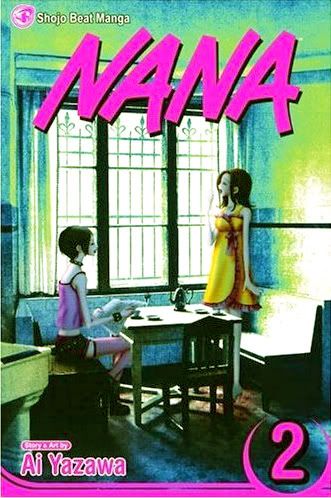 Nana vol. 2
Publisher: Shojo Beat/Viz Media
Writer/Artist: Yazawa Ai
English Adaptation: Allison Wolfe
Translation: Goto Koji
What happens when one girl named Nana meets another girl named Nana? Will physics allow two Nanas to occupy virtually the same physical space, or will the universe die screaming as anti-matter and matter collide, ripping apart the space-time continuum? Actually, all potential problems are solved when punk Nana Osaki notices girly Nana Komatsu’s personality resemblance to a famous dog and renames her friend Hachi. Thus reducing the Nana surplus by one and saving reality as we know it.
The fun starts when Shoji, Nana K’s long distance boyfriend, sends her a special text message: “Cherry blossoms R blooming!” and tells her he finally got into art school. So she quits her video store job, runs through the snow in her monster lace-up platform boots, jumps the shinkansen for Tokyo for their long-awaited reunion. She’s saved her money, waited ever so patiently and now all her dreams are coming true…
If only Nana K can be patient for a few hours more. The shinkansen’s delayed due to snow and there’s only one empty seat- empty but for a sinister looking black guitar case guarding the sleeping girl in the window seat next to it. This girl is nothing like Nana K; she’s all dressed up in black, looks like an erotic vulture in her leather jacket, thigh-high fishnets and clunky engineer boots.
Nana K’s decision to take the seat changes both of their lives. And her name!
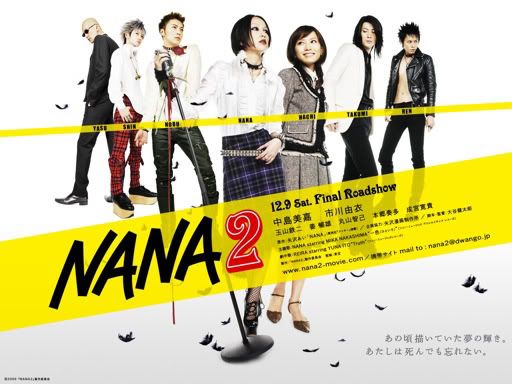
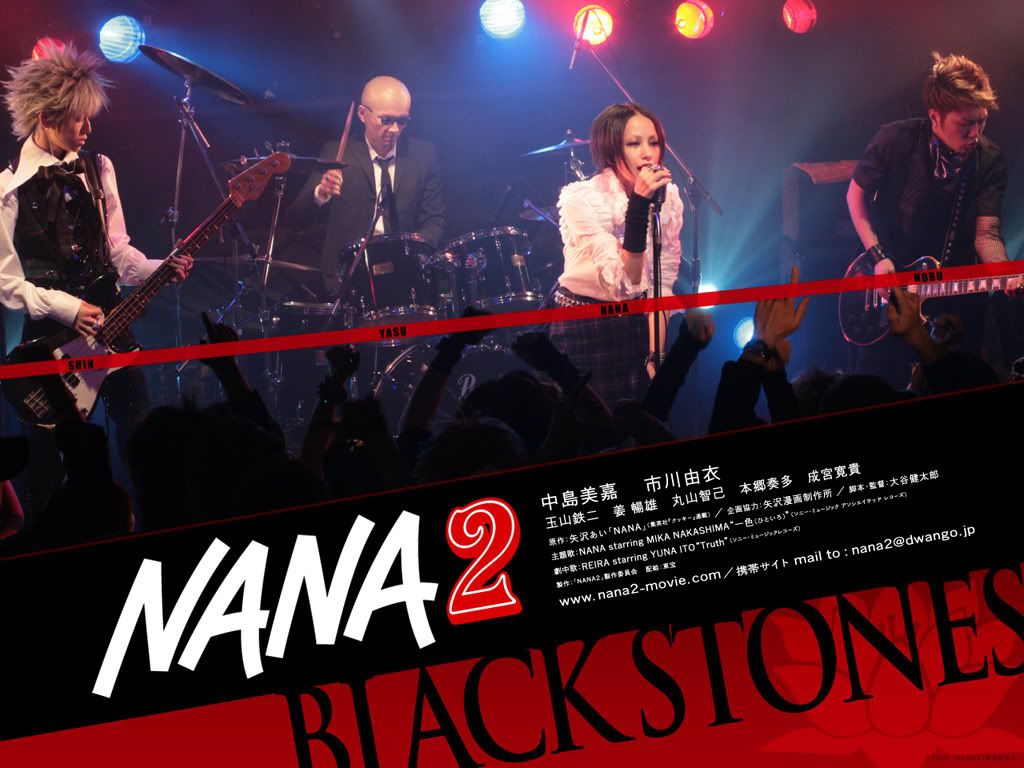
You know, with the comic series emerging as one of Japan's top-selling titles of all time and the 2005 film adaptation spawning even more Nanamania, a sequel became inevitable:
Anyway, back to the comic review.
And so Yazawa Ai finally brings our two Nanas together, on a snowbound train aimed at Tokyo. Through various circumstances and perhaps the machinations of Nana K's personal deity/devil the Demon Lord, the girls end up as roommates in a funky Tokyo suburb along what I’m guessing is the Sumida River. I base this on my own scientific Nana research, consisting of going to Tokyo and looking for a river. I wanted to go to Kojima-cho to look for Jackson Hole and have a Jackson Burger (Hachi's favorite food), but a nasty cold and frequent chilly downpours caused me to limit myself merely to reading about it, and having Wendy's in Shibuya instead.
Yazawa also begins weaving together the supporting casts. At first it seemed as though we were going to be treated to parallel narratives but Yazawa skillfully mixes the very different characters to create dramatic tension and humor.
Nana K’s impulsive nature comes to the fore as she falls head over heels in platonic love with her slightly sinister, definitely mysterious doppelganger. If fate and coincidence are to be recurring themes, then it certainly seems that Nana K’s intuition serves her well. Because the story cannot happen unless she appends herself to Nana O’s life, works her way into the center despite their differing backgrounds and outlooks. Failing that, both characters and all their friends would be out of work and they'd end up hanging around Junko's snack bar all day. And we would have nothing to read.
Nana K is a reckless romantic, while Nana O is coolly self-possessed. But how will her punk rock façade hold up when living with a girl who loves Trapnest, the very band her own lover abandoned her to join (to the point of adorning their shared pad with a massive fannish poster of the group)… with her love crazed, puppydog-like-in-her-clumsy-enthusiasm roomie? That’s the origin of the name Hachi.
Hachiko was a dog who waited at Shibuya Station every day for her college professor owner even after he died. A symbol of loyalty, she’s immortalized in a statue outside the station, and the exit to that area is named after her: the Hachiko Exit. People say if you stand there long enough, the one you’d most like to see will eventually walk by. You can speed up the process by simply text messaging that person and arranging a rendezvous beforehand. But given the mob usually lounging around the Hachiko statue, you should probably wave a flag.
Nana, meet Hachi, your very own loyal, loving pet girl friend.
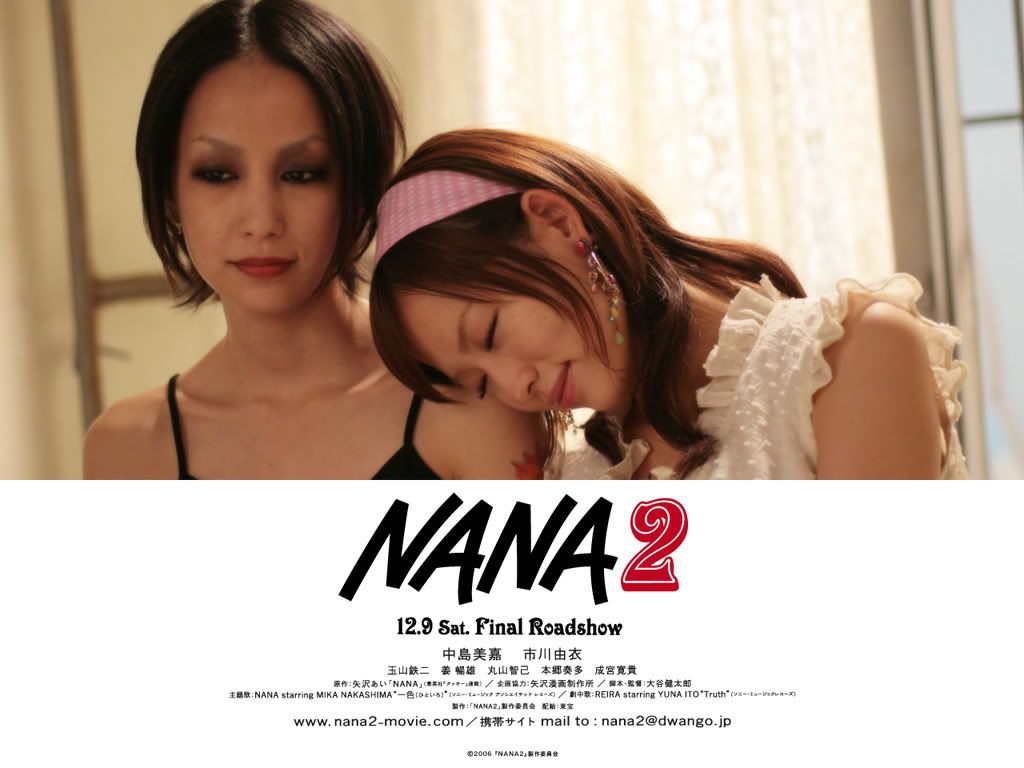
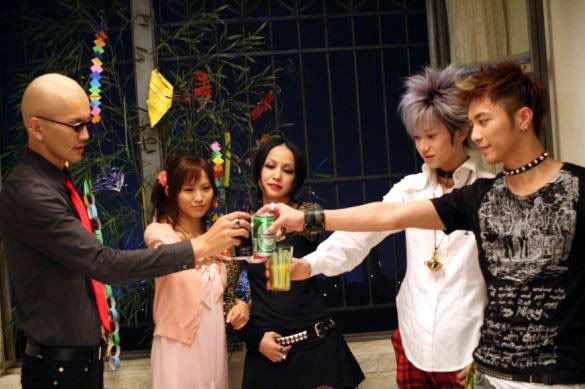
And despite falling victim to the law of diminishing returns, the movie certainly looks like the comic:
 Beyond the addictive charms of the lead story, Yazawa gives us the fun and frivolous “Junko’s Place” backup story, where the Nana cast break the fourth wall while remaining totally in character. Their awareness not only of their existence as fictional comic book characters but also of the cast hierarchy is hilariously meta. As much as I love the narrative, as I accumulated volumes I found myself flipping back to "Junko’s Place" to catch up on Jun and her boyfriend and their little area of the Nana world. Every time Yazawa hints that Junko’s restaurant might close due to lack of business only intensified my obsession. What if Junko’s Place does close? What will she do? What will we do?
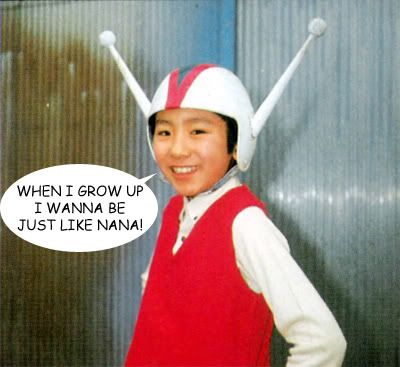
Good god… Nana is a drug. You should have to get a doctor’s okay before buying it. A prescription or something, and your health should be carefully vetted before they hand it out. On the other hand, some stressed out, over-worked mothers here are actually turning over all their parental responsibilities to the Nana comic series and allowing it to raise their children:
PS- Note how the covers actually tell a wordless little story of a day in the lives of the two Nanas. On the cover of volume 1, Nana O wakes first and reads the paper in their cozy little dining alcove, Hachi takes longer to get dressed but appears on volume 2, they have breakfast, go downstairs on volume 3, and on subsequent covers do some shopping, have lunch, ride the trains...
Pretty sneaky, Yazawa Ai!
Subscribe to:
Posts (Atom)