Thursday, February 19, 2009

The Many Styles of Daffy Matsumoto

Daphne Matsumoto, known to her friends as Daffy, is one of the original protagonists along with Maggie, Hopey, Penny Century and Izzy in Jaime Hernandez’s Love and Rockets epic "Locas." A Japanese-American from either a wealthy or at least upper middle class family, Daffy is kind of a hanger-on and interested observer, just outside the group's inner circle. At one point, she's important enough to rate a small headshot ("I love Curly!") among the strip's stars. But over the course of the series Daffy’s appearances grow more infrequent, and these days she appears to have dropped out of the current narrative altogether.

Major character or supporting player, like all of Jaime’s creations in this long-form tale, Daffy changes quite a bit visually during her fictional lifespan. And because Jaime uses the flashback technique pretty often in his stories, to fully document all of Daffy’s various styles, we have to begin with an image from late in volume one, during the “Wigwam Bam” storyline:

This is Daffy as she appears when she first meets Maggie and Hopey. Note Daffy’s Go-Go’s sweatshirt. The Go-Go’s began as a punk-related act but soon courted mainstream success with a softer, more pop-oriented New Wave/rock sound influenced by various girl groups of the 1960s. By giving her a more conventional suburban teen look, Jaime has visually marked Daffy as a softy within the social boundaries of the hardcore punk world Maggie and Hopey inhabit. Indeed, the two proceed to play a cruel trick on her, taking her to a house where she’s terrified and threatened with violent sexual intercourse by one of Jaime’s most outrĂ© minor characters, an angry female wrestling fan who sports hardcore S&M gear and a spiked… toy… of some kind.

Here you can see Daffy transition from naive teenybopper to only slightly less naive young woman in two panels marking the end of that sequence:

Despite her new friends' initial viciousness towards her—or because of it—Daffy becomes obsessed with Maggie and Hopey and allows them to use her and her rich girl trappings to their advantage.

Under their influence, Daffy quickly adopts an edgier image. With her hair bleached blonde and spiked wildly, she could almost be Hopey’s equal in terms of radical appearance. Here she is from one of the series’ earliest issues:

The stories from this era feature science fiction and superhero trappings. Maggie sometimes visits exotic, pulp mag-like locations while she pursues a career as a "pro-solar mechanic," helping the dashing Rand Race repair spaceships. Jaime frames these sequences with interludes depicting Daffy and Hopey as they hang out waiting for Maggie's latest letter from Zymbodia or parts unknown. One wonders if perhaps these letters are creative fancies on Maggie's part as she accompanies her aunt on professional wrestling junkets, or endures fractious family vacations.

During this period, Daffy's and Hopey's personal styles sometimes overlap. Here, they both appear to have shopped at the same secondhand store, heavy on 1950s items:

Turbulent Hopey and ditzy Daffy make for a strange, uneasy coupling. Fortunately, Hopey's self-interest and Daffy's need for some sort of connection and purpose in the group often coincide:

At other times, Hopey seems to delight in challenging or attacking Daffy's more Middle American hopes, dreams and aspirations. Here’s an image from "At the Beach," where Daffy sunbathes with Maggie, and looks quite fetching as she broils away in her bikini:

Daffy tells Maggie how when she's married to some rich guy, they'll sail together on a yacht to the islands every weekend. Within moments, Izzy and Hopey arrive dressed in vampiric black, a disconcerting image of noncomformity on the sunny sands, and Hopey gleefully goads Izzy into destroying Daffy’s romantic notions with a grotesque story that sends the poor girl fleeing back to her safe suburban enclave. Perhaps this incident is indicative of why Daffy no longer hangs out with Maggie and Hopey; she just doesn’t quite fit, as much as she’d love to.

At one point Daffy begins to metamorphize into the most fashion-forward of the original Locas, increasingly appearing as a chic young woman capable of taking chances with her outfits. Here's a panel detail from the 1987 story (just two years after "At the Beach"), "The Night Ape Sex Came Home to Play:"

Here’s a sequence from "In the Valley of the Polar Bears, Part 2," in which she seems to be channeling Hopey with a more hardcore look. Ape Sex is a fictional band frequently referenced in the stories, apparently a local punk act that hit the big time:

Here, Daffy allows her hair color to revert to its natural state and teases it up to almost Phyllis Diller-like proportions. This is Daffy during her sexy punk chica phase:

Here’s a gorgeous panel depicting Daffy and her sister Nami, with friend Itsuki. Daffy wears a stockperson's smock, but notice her sweet buckled, fat-treaded boots or perhaps monk shoes adding a little edge. After years on the fringe music scene, she’s developed a personal sense of style that’s quite unique even while working a minimum wage job. The smock almost becomes an ironic accent piece here, similar to how hip kids of my generation sometimes wore gas station shirts:

Check out the language footnote. Jaime and Gilberto frequently employ those to fill in cultural aspects of their casts readers might not be familiar with. Oba-chan is Japanese for "grandmother,” but Nami’s a typical American teen with typical American suburban ideas and substitutes a California permutation. Interesting also that Daffy's sister has a Japanese given name while Daffy's is European in origin.

Home on college break, Daffy begins an obsessive search for news about Maggie. At one point, she goes to Izzy's house in Hoppers. In this panel from "Wigwam Bam" part four, Daffy is quite striking with her short, teased hair and her all black ensemble, a cropped a-line coat, short-shorts, thigh high stockings and high-heeled pumps:

One of Jaime's most startling and alluring Daffy drawings. This represents a stylistically confident Daffy, her mature appearance somewhat at odds with her continued over-identification with Maggie and Hopey. If only her personality were as forceful as her fashion sense, she’d be quite the strong young woman.

After Love and Rockets volume one gives way to the incredible (and much-missed) Penny Century series, Daffy’s appearances become even more sporadic. She's as rare and elusive as a cryptid cat. Here, in a panel from the first issue story "Locas," she seems to have taken a job in a research lab, a doctor’s office, or a dentist’s:

Tellingly, Jaime never bothers to inform the readers of Daffy’s professional status. Since the unnamed coworker in the background refers to a “Doctor Ziff“ and addresses Daffy more informally, we can infer she is not a doctor herself. Perhaps she’s a medical technician, or a nurse. The scissors in her pocket indicate some level of technical proficiency.

Daffy’s next appearance is in the flashback-driven tale "Everybody Loves Me Baby," from Penny Century #7, where she appears only to impart Hopey with some vital exposition. Other comic book writers should take note of how Jaime handles this; it’s not as direct or as clumsy as you’ll find in many other books. Instead, Jaime has it naturally flow via character business between Daffy and Hopey. The truly inspired work of a master storyteller at the top of his game:

Here, Daffy appears in a classic black shift dress. Slick and grown up, impeccably groomed even hanging out with the more casually tomboyish Hopey, Daffy has achieved a fully mature style befitting a young professional with taste. Her short, spunky hairstyle even hints at a slight bit of uconventionality. Evidently, Maggie and Hopey have affected her for life.

Who knows what future Jaime storylines will bring? Perhaps he’ll return Daffy to the narrative fold in some form or other. After Jaime wraps up the superhero stuff he’s onto now in Love and Rockets volume three, I would love to see a Daffy-centric storyline, perhaps one that recapitulates the series in its entirety via flashbacks from Daffy’s point of view. With the change to the new book format, it’d be a fantastic way to get new readers up to speed on who these people are, and Jaime could also update those us few Daffy fans in the audience on what she’s doing these days while Maggie continues to spin in place and Hopey gropes towards a belated sense of responsibility.

But I'm sure Jaime has better things a'-cookin'.

In the meantime, here’s a scene from Daffy’s lone appearance in Love and Rockets volume two. It's yet another flashback, and in her one line of dialogue, Jaime says a lot about her status within the gang:

Poor Daffy. Only she could take something like a pissing contest over who was molested the most and the earliest and turn it into a personal crisis about her place among these fascinatingly flawed characters. Don’t sweat it, Daffy, you’re doing all right kid!

Monday, February 16, 2009

Oh, Wikipedia, You Say the Dumbest Things!

I was doing a little Wiki-reading about Cassandra "Batgirl" Cain and came across this little gem in her entry:

Batman no doubt disappeared because he was thoroughly confused. As stupid as the recent Batgirl miniseries is, it doesn't feature any plot developments as wacky as that. Actually, Wiki's version would have been more interesting than anything that did happen in the book.

Sunday, February 15, 2009

Let's Shan-cercise: How to Get Yourself Into Shape the Xi'an Coy Manh Way!

Looks like Marvel is giving those fabulous new mutants, the New Mutants, a... new... book. Set to star are our classic friends Dani, Sam, Xi'an, Roberto and Illyana and I couldn't be more excited. Dani and Xi'an are perhaps my two absolute favorite Marvel characters. Suck on that, Wolverine! Now's the perfect moment to stoke the New Mutants-mania with a smart ass deconstruction of a classic tale.

Ladies and gentlemen, children of all ages, I give you... the story of how Xi'an went from blob to bad-ass in the pages of New Mutants Special Edition #1 by Chris Claremont and Art Adams.

One of the subtexts of the New Mutants series is the forcible undressing and redressing of its female characters-- usually Dani-- in bizarre, fetishy outfits. In this story from circa 1985, the subtext overwhelms the text as the entire New Mutants team undergoes a plethora of strange clothing changes and physical transformations.

In fact, this book is in such a hurry to get to the skin, it opens with the gang frolicking on a beach, their nubile teen bodies on display in skimpy swimwear. In this way Claremont and Adams prefigure the 1990s "bad girl/good girl" art craze. Comic readers might have criticized later books such as Gen13, Lady Death, Witchblade and Fathom for gratuitous cheesecake, but these comics merely extended concepts present in New Mutants practically from the first issue. And nowhere is this more apparent than in this particular tale.

While her pals have fun in the sun, the morbidly obese Xi'an hides out wearing a muumuu in what appears to be some kind of dingy housing project apartment. If you'll recall, world-class gourmand Amahl Farouk had stolen Xi'an's body a while back.

Hello, Bonnie Grape! Not only did Farouk ruin Xi'an's youthful physique, but he also impaired her abilities to put her pink undies away in the bedroom where they belong, instead of in the drawers in the living room. But this is an action-packed Marvel mag, not an issue of Love and Rockets. Within a page of this personal drama, the Enchantress and her flying Viking horde attack.

And since Claremont's plot demands the kids end up in Asgard so he and Adams can work them over, they're ridiculously defeated within the narrative captions of a single tier of panels! It's a plot development every bit as contrived and arbitrary as something in a Jackie Treehorn epic starring Karl Hungus and Bunny LaJoya. This book should be subtitled Mutantjammin'.

Once in the mystic realm of Asgard, we get to what this story is really all about. Dani becomes an armor-clad valkyrie; Amara drinks some kind of magic mead and turns into a faerie who looks like a cross between an Elfquest character and one of the sex-nymphs from Ralph Bakshi's Wizards; and the Enchantress turns Illyana first into a baby (trapped in bondage-y wall chains no less, and still wearing her white bikini from the beach scene... shudder), then into an evil avatar of herself in chain mail and a Darth Vader helmet. Tragically unfunny comedic relief character Warlock changes himself into all sort of stupid things in a vain attempt to induce deliberately the kind of laughter the rest of the story causes inadvertently. Uh... with love.

But most dramatic and happiest of all is what happens to Xi'an. Thanks to one of Illyana's transporter spells, Xi'an ends up in a desert wasteland. But as one of those relentlessly verbose Chris Claremont characters, she retains her ability to state the obvious. Out loud. To nobody:

The problem with deserts is, while they may seem lifeless, they're actually home to all sorts of dangerous fauna. For example:

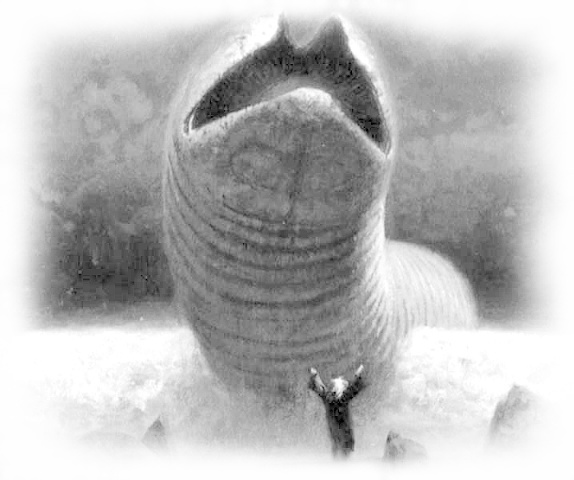
Giant snake-like monsters! Fortunately for Xi'an, her powers are still working. She can even possess shai hulud! Xi'an Coy Manh no longer needs the weirding module, Stilgar! Long live the fighters, Maud'Dib! Yikes! Too many apostrophes! And as you might expect by now, Xi'an will also soon display copious amounts of bare flesh. Months in the desert leave her muumuu in tatters:

Strategic tatters. Because after a few more months of desert-tracking and sweating and eating only tiny lizards, she has the body of an Olympic swimmer and her rent garments conveniently lend themselves to Xi'an's adapting them into a sexy, savage desert princess bodysuit:

She still has that Claremontian ability to tell, not show. Despite having been so incredibly obese, she displays nothing in the way of stretch marks or excess skin. And she must have somehow had with her an impressive selection of lady's shavers, shaving gel and moisturizers to maintain smoothness in her underarms, legs and bikini area.

Finally, she runs into some friends who are shocked not only by her advanced hygiene but also the recapitulation of her former svelteness. Doug proves himself a master of the obvious as well:

Thanks, Doug. Without your genius for observation, we stupid readers might not have picked up on the subtle differences in the way Adams drew Xi'an at the beginning of this epic and how he depicts her on this page. Well, whatever. It's lucky she's back in fighting shape, because no sooner have they reunited than they're set upon by some human-shaped screentones mounted on what appear to be horse-shaped screentones and she's going to start kicking ass:

Kicking ass and reverse-stabbing people, Hong Kong cinema-style. This is where Butch Coolidge got the idea for killing that one guy with a katana in Pulp Fiction:

Yes, thank heaven you only wounded him, Xi'an. Because an injury caused by a broadsword being driven completely through the small intestine, a kidney and out the back heals quickly and easily and leaves scarcely a scar. Being a war orphan and thus underexposed to pop culture, Xi'an thinks the Black Knight scene in Monty Python and the Holy Grail is from a documentary.

Hmm... Pulp Fiction. I've always thought it was kind of odd that such a crappy pawn shop would have an actual katana on display, rather than one of those cheap-ass knock offs shops here in Japan generally sell. Those things wouldn't cut butter, but the sword Butch uses goes right into a man's torso with little effort on Butch's part. And I've always wondered what happened to the Gimp after that scene. Butch just leaves that freak chained and unconscious as he hightails it out of there. I imagine Marcellus Wallace and some of his men killed the Gimp soon after they completed their medieval workout with "Mr. Soon-To-Be-Living-The-Rest-of-His-Short-Ass-Life-In-Agonizing-Pain Rapist." But I bet the Gimp enjoyed it. He would've been right at home in this comic book story.

There. That's how the New Mutants got naked and Xi'an got herself back into shape. And killed some people. Now you can do the same thing. Get fit, get healthy, backwards stab your enemies. Get the new New Mutants book when it comes out in May! I mean, if you're interested. I'm enthusiastic and definitely going to give it a try, but I don't want you to think I'm mindlessly shilling for it. At the very least visit the Marvel.com announcement and check out the sweet preview images by original New Mutants artist Bob McLeod and superstar painter Alex Ross.

Imagine that. Marvel is actually producing a book I want to buy.

A New Comic Book Toy: Triad's "Lone Wolf and Cub" Figures

Toy maker Triad Toys is making figures based on the classic manga series Lone Wolf and Cub (or Kozure Okami in Japanese). Which means 1/6th scale toys of ronin Ogami Itto and his son Daigoro. There's a little discussion on the Sideshow Freaks forum (a message board for fans of Sideshow Toys and pop culture collectibles) on whether they should be based on the movies or the original comic book series. Movie-version backers want a realistic figure and fear a "manga-style" sculpt.

But I disagree. Kojima Goseki's art would lend itself to a really nice-looking sculpt, and it could still look like a real person. His art style is of an older vintage than some of the newer, ultra-slick, stylized stuff that most people associate with Japanese comics. The supporting or incidental characters can be kind of caricatured or cartoony, but Ogami Itto himself is a steely-eyed killing machine.

To me, the real Lone Wolf and Cub are the comic versions. I'd love to see the movies someday (they look super-cool and the guy who plays Ogami Itto also plays the Japanese coach in The Bad News Bears Go to Japan), but Kojima was the best storyteller in comics, period-- and I'd prefer to see a figure that honors the original inspiration.

Evidently, Triad isn't basing their figures on the movies or the comic. And this kid probably won't get to play with them:

Sunday, February 8, 2009

Hawaiian Eyes: Magnum Meets the New Mutants!

Picture, if you will, America in the early 1980’s. Ronald Reagan is in the White House after defeating former president Jimmy Carter in a vicious knife fight, Michael Jackson is in his early twenties and yet to enter puberty, Steven Spielberg is about to unleash his most adorable creation since Bruce the Shark, a wrinkled creature from another world soon known far and wide as Dr. Ruth Westheimer. And in Hawaii, a lanky, dimpled, mustachioed hunk of a man by the name of Thomas Sullivan Magnum IV fights crime while wearing a Detroit Tigers baseball cap, a colorful Hawaiian shirt and khaki shorts.

Even without shoes, Thomas Sullivan Magnum IV cut a dashing figure in the early 1980s.

Across the United States, billions of TV viewers have fallen in love with Tom Selleck’s affable gumshoe character, and the students at Professor Charles Xavier’s School for Gifted Youngsters are no exception. Boys and girls alike nurse crushes on handsome star of Magnum, P.I., pop corn and gather ‘round the school’s lone television set on Thursdays at 8PM for their weekly ritual of ogling prime beefcake and his adventures in a tropical paradise.

Stop comforting each other! It's TV time! A typical Thursday night at the X-Mansion.

"Hey, you guys, Magnum's on. You watching it with us or not?" Because we wouldn't want you interacting socially or bonding emotionally. Not while Magnum, Rick and T.C. have a case to solve! Notice how Sam also changed from a plain white tee to his scarlet "Magnum-watchin' shirt." This was as close as the impoverished boy from the hardscrabble coal-mining regions of Kentucky could come to a Hawaiian shirt of his own:

Xi'an is faking interest in the show. A Vietnamese national unfamiliar at the time
with American pop culture,she would not become a fan of a TV program until the
2004 debut of The L Word on Showtime.

I’m not sure what Sam Guthrie means here by exhorting the others to “look at that man move.” Move? It’s not as if Magnum were the second coming of Bruce Lee. Mostly, Magnum walked around annoying Higgins and his two evil-faced Doberman pinschers (Zeus and Apollo), or drove Robin Master’s Ferrari 308 GTS. Sometimes, during his Vietnam flashbacks, he wore face paint and tiger-stripe camo fatigues while creeping though the jungle, but Sam must be the only viewer to define any of these activities as “moves,” watchable or otherwise.

While Selleck was athletic enough in real life to eventually portray a convincing big league first baseman in the mildly amusing fish-out-of-water comedy Mr. Baseball, his fighting style as Magnum consisted mostly of punching people. Or shooting them. These also aren't really the stuff of “moves.” Perhaps Guthrie is referring to one of the many scenes where Magnum seduced a female guest star by offering her one of his patented “swimming lessons,” or jogged shirtlessly on the beach, or emerged dripping wet from a swimming pool to shake a spray of diamond-like droplets from his tousled mane and mustache, then toweled off his broad shoulders and hair-covered chest.

Sam’s frequent fan letters to Selleck garnered him-- in those more innocent times-- an invite to the TV show’s Hawaiian set, but Professor Xavier forbade him to go due to a conflict with the school’s SAT preparatory course schedule. A heartbroken Sam received something of a consolation prize a few years later when he worked as a production assistant on Three Men and a Little Lady, but by then the bloom was off the hibiscus, so to speak.

Even Illyana Rasputin proved susceptible to Magnum’s virile charms. No sooner had she emerged from her interdimensional magical limbo than she began plastering her room with Selleck posters:

This is a panel from the cult online comic "New Mutants Plus Garfield," in which, in a whimsical act of post-modern deconstruction, some brilliant person has painstakingly added lasagna-loving feline Garfield to every single panel of a New Mutants issue.

“Sam gave it to me,” Illyana told her instantaneous best friend Danielle Moonstar when asked where the poster came from. It’s heartening when a girl born on a collective farm in the Soviet Union-- who’s spent her pubertal years hanging out with a maniacal demon and a giant beast ripped off from a Dave Sim comic in an unearthly realm existing in a timeless void somewhere beyond reality-- can so quickly assimilate the media fancies of suburban America, almost as if her netherworld prison featured cable TV jacked right into the CBS network.

For a time it seemed as if everyone in the Marvel universe was somehow caught up in what editor-in-chief Jim Shooter called "Magnum-mania." Several young slumber party guests at the X-mansion summoned forth the Mustachioed One (as Stan Lee dubbed Magnum during this heady era) as part of a quartet of teen-girl sexual fantasy figures:

At one point during Magnum P.I.'s run, the Impossible Man stopped by the X-Mansion to catch an episode with the gang. Unfortunately, their intense worship of all things Magnum caused them to crowd around the TV set so much Impossible Man was unable to see the screen. He was able, however, to get a really great view of Dani's and Sam's asses in tight jeans:

While Warlock's rapt attention demonstrates how Magnum's charms were a universal constant, affecting even techno-organic lifeforms from other worlds, notice how Rahne has lost interest in both Magnum, P.I. and her friend's denim-clad asses. This prefigures her leaving the team for a stints in X-Factor and Excalibur.

Hmm... Magnum-mania seems to be contagious! And the only antidote is... another look at Thomas Magnum in all his masculine glory:


Way t'go, Magnum, indeed!

Thursday, February 5, 2009

The Japan Media Arts Festival: Where Comic Books and Cartoons Win Big Awards!

The Japan Times Online has an article about the recent Japan Media Arts Festival. It's going on right now through February 15th in Roppongi and seems like it would be a blast to catch. High-tech, digital media, Miyazaki Hayao-phobia, creators on the cutting edge and all that neat-o super-keen stuff the beatniks and teddy boys are into these days when they're not playing bongos and hanging out at the malt shoppe. With my economic status it's doubtful I'll get to make even a one day jaunt to Tokyo to catch it, but here are my favorite bits of comic-related info gleaned from the article:

Music-themed manga are now popular in Japan, thanks to artists such as Akira Sasou. His "Maestro," about an orchestra revived by an enigmatic conductor, won a second-place prize. A professor at Kyoto Seika University, Sasou hopes to publish the first Japanese university textbook on creating successful manga.

"High-quality drawings are important, but the story needs to pull the audience to the next page," he said.

That's news to me and I live here in Japan! I do know that Nodame Cantabile remains a favorite and just mentioning it to some of my students usually lights up their faces. And I don't just mean teeny-boppers. I'm talking all ages, from teens to middle-aged women who, if American, probably wouldn't read a comic book with your eyes. I wish music-themed comic books were all the rage in the United States and comics themselves were as mainstreamed there as they are here. And:

Of the 35 manga winners, only 10 were women. Critic and festival judge Yukari Fujimoto recommends "shojo" (girl) manga as a way for overseas women artists to enter this male-dominated arena. Shojo manga is targeted at a female audience.

It seems women have more inroads both as creators and as readers here in Japan than they do in the States, so I'm surprised at these numbers. I'd kind of assumed a more 50-50 split. But I'm pretty stupid when it comes to this kind of analysis and I don't have the patience or the time to go digging through the numbers. Then again, if a comic book festival were handing out thirty-five awards in the U.S., do you think as many as 10 women would win, or even receive nominations? Ten?

And shojo manga may be targeted at a female audience, but when the book is as groovacious as Yazawa Ai's Nana, there's no reason its popularity can't cross gender lines. I'm addicted to Nana, and weather some funny looks whenever someone asks me what Japanese comics I like and that's the first thing out of my mouth. I'm proud of my ability to recognize something superior despite its being aimed at an audience I'm ostensibly not a member of.

I think if the story quality is there (as per Sasou Akira's quote above), the audience for a book can grow beyond its intended demographic. That's one thing that seems to be missing in a lot of the "what can we do to make American comics appeal more to female readers" discussion (which I think needs to be broadened to a more general "how can we get more people buying comics period" movement)-- quality will generally draw readers and quality itself will generally replace all those problematic tropes, cliches and dramatic failings we always complain about.

My answer will always be to challenge our creators to produce better books. And if that idea fails, I seriously doubt there's more you can do to get anyone into comics.

Lastly:

"Shojo manga is booming," [Fujimoto] said.

What's the American equivalent of shojo manga? Hmm... probably actual shojo manga. Is that booming back home as well?

Wednesday, February 4, 2009

The Many Styles of Hopey Glass: "Love and Rockets Volume 1" Edition

Love and Rockets by Los Bros Hernandez is a strange beast-- a serialized comic book narrative that extends seemingly into infinity, but where the characters actually age and change, and sometimes die. The protagonists and the supporting cast evolve organically over time the way actual human beings do (only more colorfully, because it's fiction). And few human beings were ever as engaging or as dangerous to know as Esperanza Leticia Glass. That's Hopey to you and me, Russ.

During the first volume of Love and Rockets, Hopey undergoes several fashion transformations. Let's take a look at that glorious punk tornado, La Hopita. Keep your arms and hands inside the car at all times.

Since Jaime Hernandez makes frequent use of flashbacks, in order to get the fullest understanding of Hopey's many transformations, we have to start near the end of the first volume, in the "Wigwam Bam" storyline. Here Jaime's leads Hopey and Maggie separate after an argument. Indeed, Jaime cuts Maggie out of the narrative completely, focusing instead of Hopey's misadventures in an East Coast city where she falls in with a former TV star who is now an aged, prune-faced perv engaging in some kind of club for other aged, prune-faced pervs where they dress prostitutes as little girls and engage in who knows what.

And it's during this story that Jaime gives us a glimpse of child Hopey:


Biographical details such as these give some much-needed vulnerability to the otherwise seemingly invincible Hopey. It also supplements an even earlier flashback from the "Jerusalem Crickets"/"Flies on the Ceiling" period, in a brilliant little story that focuses on Hopey's mentor and discarded lover Terry Downe, "Tear It Up, Terry Downe." Here, Jaime presents a pre-punk Hopey as an introverted teen, terrified of the new girl in class who would soon change her life irrevocably:

Generally, throughout the narrative, Hopey's motivations are either somewhat obscure (what causes her to womanize and generally keep love at arm's length) or else patently transparent (she cannot stop hitting on women in the most blatant of fashions). Consequently, she often comes across as person almost without inhibitions. Here Jaime hints at Hopey's inner complexity and discovers the wounded psyche that births the independent and charismatic persona she adopts. Because by the end of that story, Hopey (under Terry's tutelage) has fully metamorphosed into a raging hardcore punk with a shaved head. It's around this time that she first meets Maggie. This initial encounter-- engineered by Maggie's friend Izzy-- evidently does not go as planned:

But it proves a momentous event. Jaime revisits this Hopey a few more times, including once in volume two.

Now we come to what I think of as "Classic Hopey." This is how Hopey first appears on the pages of Love and Rockets:

She sports a spiky boy's haircut and lots of androgynous punk gear. Jaime's art style-- while certainly very pretty-- is a bit unformed here, but Hopey herself is already in full-swing as she makes comic book history. Jaime's artwork becomes slicker and more controlled over time, but Hopey maintains this basic look throughout the middle period Love and Rockets and through several pivotal storylines, albeit with some minor variations.

Here's one: bleached blonde Hopey wearing what appears to be secondhand clothes of a more traditionally feminine mode. A head scarf like a Hitchcock film heroine, what looks like someone's old letter sweater, various belts as accessories, a calf-length pleated skirt and some torn tights:

Can't tell much about her footgear there, but they appear to be some generic black sneakers.

Blonde Hopey breaking the "fourth wall" to get even with fangirl Maggie:

This is the basic hairstyle Hopey wears during her infamous grafitti battles against Officer Sado, her arch-nemesis. One of my favorite aspects of Hopey's style during this period is the way Jaime shows her willing to actively challenge the gender dichotomy of "straight" society. While Maggie occasionally derides her as a "boy-looking peesashit," Hopey seems to delight in otherwise challenging gender expectations, as when she pairs her butch haircut with a very feminine 1950's style sundress, complete with bow detail. She has a kind of Jane Wiedlin/Go-Go's look going on here:

I can't help but picture the dress as pale pink. Of course, she sports a very phallic prop, her bass guitar. With Hopey, femininity comes with an edgy quality. This is also expressed via Hopey's fearless sexuality and erotic adventurism. Here she's practically falling out of an unbuttoned shirt-dress, adopting an aggressively open posture and it seems she couldn't care less:

I tend to assume Terry's nonchalance here is a bit of a put-on. But why shouldn't Hopey flaunt it a little? Jaime often makes Hopey the fought-over object of desire by any number of would-be lovers, and gives Hopey a full awareness of her physical and emotional impact on others. In fact, she seems to delight in it and frequently takes advantage, as shown in the "Wigwam Bam" sequence where she plays various people against each other in order to secure places to crash for days or weeks at a time.

Here's an interesting look at Classic Hopey in a more boyish punk state. This is from the bizarre fantasy "Easter Hunt," (based on a story Jaime's brother Gilberto wrote as a child) where Maggie and Hopey revert to earlier visual states in order to eat Easter eggs, fly around in a UFO and murder Julie Wree. She's wearing a torn DOA tee and pegged punk pants probably in black denim, although Jaime doesn't add any surface detail and instead opts for a bold all-black silhouette. Earlier in the story, she's barefoot, but in these panels is foot-clad in black high top Chuck Taylors:

Quite androgynous. Note her unbuttoned fly and visible underwear. And here's Classic Hopey in her long, black pea- or trenchcoat. Full-on punk tomboy mode:

Planning payback against Officer Sado. Oh, Hopey, will you never learn? Those are some fierce looking buckled shoes/boots. No doubt Jaime could tell us the exact make. This follows a charming sequence in which Hopey gets her haircut in that most masculine of style-environs, the old school barber shop. She emerges with a slicked up boy-cut that she musses into spikes.

Hopey sports this look consistently thoughout the "Jerusalem Cricket" stories in which she embarks on an ill-fated cross country tour with the punk band La Llorona. It's here that Jaime begins to depart from the series' status quo. He also embarks on more extended and complex narratives. Here it appears she's wearing a peacoat:

That's a gorgeous panel by Jaime. He has always had a reporter's eye for detail and a masterful way of reducing an image to essentials. Your mind fills in a lot of what Jaime has deliberately left out of the drawing. From the drummer's expression, I'd imagine Hopey has once again managed to fuck up the bass line.

While the characters undergo emotional development and changes, Jaime echoes this with visual changes. Maggie rapidly gains weight, becoming more curvaceous. And Jaime realistically depicts the effects of touring on Hopey, in various seedy venues and run-down motels, as her clothes grow shabbier and her hair longer. Jaime teases the readers by keeping Maggie and Hopey apart for hundreds of pages and various misadventures. Eventually, Hopey is gone from Hoppers and the narrative for so long, she becomes almost legendary. Here, Maggie speculates on Hopey's appearance:

What Maggie has no way of knowing at this point is that Hopey now looks like this:

They meet in a police station and react to the physical transformations each has undergone:

But Jaime does not allow the two to enjoy their reunion for long. He almost immediately puts them into conflict with each other and now it's Maggie who vanishes from the narrative, leaving a changed Hopey adrift in a world of perversity and violence. This, then, is "Wigwam Bam," the penultimate storyline of volume one. In it, Hopey emerges briefly as the central character, and sports a wild plume of cropped hair. I call this look "Crazy Hair Hopey," and it's actually one of my favorites. I love the little shout outs to bands from Jaime via Hopey's tee's:

The Damachers are a fictional band in which Hopey eventually plays bass following the demise of La Llarona and at least one other band she's fired from. But this next band is quite real:

After concluding "Wigwam Bam," Jaime returns Maggie to her familiar role as central protagonist and embarks on the emotional "Chester Square" storyline to conclude Love and Rockets volume one. Here we find a more girly-girl Hopey still playing bass for the Damachers, but constantly distracted by Maggie-centric daydreams. She sports a very feminine hairstyle and look here, kind of like a compact Audrey Hepburn (who Jaime would later reference more overtly when Penny Century styles Hopey's hair into a kind of neo-Holly Golightly 'do):

A stylish a-line cloth (tweed? wool?) coat hints at a more sophisticated Hopey. But if you look closer, you see the material is frayed and worn; Hopey is still a punk at heart, and still living fast. Her thin, bare legs give her a fragile quality that seems at odds with her edgy personality. This is Jaime giving us visually the characterization a lesser creator would have to do with prose narration or dialogue.

And with that final Hopey style transformation, Jaime brings Love and Rockets volume one to a close. Still, I wonder what hardcore punk Hopey would say if she knew she exists merely as a fictional character whose various clothing choices not only reflect her growth as a person, but also entertain us as readers: