Thursday, March 5, 2009

"Nana 14" Has Arrived!

On my way to work I stopped by my little mailbox and there it was, a slim package from Amazon.jp containing the latest volume of Nana. I'd been waiting for almost two weeks and it completely made my day.

Forget All-Star Infinite Crisis of the Secret Invasions... Nana is the hardcore comic book junk you've been jonesing for ever since you first mainlined the weaker stuff straight into your brain via your eyeballs. I'm almost hesitant to recommend it to anyone in the current economy, because you're going to end up skipping the breadlines to read it, spending whatever crinkled, greasy dollar you can wheedle from some other hardluck story with a soft heart on Nana until you and your family starve to death in a coldwater flat somewhere in the Bronx.

It's too late for me. All you can do is pray for my soul. I have my fix now and it's so good. But because the translated version of Nana 14 features a story from late 2005 and the Japanese series is already up to volume 20, with 21 available for pre-order, we English-reading Nana addicts are a bit behind on the latest developments. And this can be a problem when you actually live in Japan.

See, I made the mistake of sharing my newest Nana with a student who's also a Nana fan, and she flipped a few pages, said, "This is so strange. It's so difficult... Can you read this?"

Then she abruptly squealed out a potential spoiler: "OH! ---'S STILL ALIVE!"

Yikes! When you're dealing with Nana, it's already difficult containing the anticipation involved in turning a page. And now I know a major plot point that's several volumes away! And one of the great, agonizing joys of Yazawa Ai's writing is you never know what to expect. Oh, she's foreshadowed this development quite a bit-- much like something similarly tragic was completely predictable in hindsight in my own life-- but still...

I need to be more careful in the future.

Wednesday, March 4, 2009

When Life and Comics Collide: The Misako Rocks! Case File...

I'm endlessly fascinated by all the ways my life in Japan seems to crash into my love for comic books. Surfing by a certain comic book blog, I found out Misako Rocks!, who I knew solely as the ace illustrator for the The Onion A/V Club of "Savage Love" (Dan Savage's not to be missed sex advice column), is writing for Archie Comics. And doing her own manga. I'm so behind on this stuff!

Her "Savage Love" drawings always tickle me. She takes the essence of whatever dilemma the most interesting letter presents and renders it in a cheerfully perverse way. I checked out her site and her blog and added a link to my "artists" link here at my own stupid little corner of the comic book fan blogosphere.

Actually, this led to something of a dilemma for me. She's an artist and a writer. Where to link her? What to do? In the end, I arbitrarily chose "artist."

Wow... Archie Comics. I haven't read an Archie story since I was about 14 or so. And I think it was a Little Archie, at that. One where Archie, Jughead and the gang found an alien a la then-current mega-sensation E.T. and took it home. If I remember correctly, the story included barfing. Barfing in an Archie comic. So I found the official Betty & Veronica blog with info about Misako Rocks!'s Archie stories in Betty & Veronica Digest numbers 190 and 192, in which new cast member Kumi comes to Riverdale from Japan.

And, interestingly enough, Rocks! (as I like to call her) has Kumi and her family face in reverse many of the things ex-pats like myself experience making the opposite move, from the U.S. (where I was indeed a comic book character inhabiting Archie's universe... now it can be revealed) to Japan. In much the same way she artistically boils down all those sexual dilemmas and produces singularly hilarious images for "Savage Love," Misako Rocks! knowingly expresses the newness of Kumi's experiences with a few well-chosen details.

For example, Kumi and her sister Ami delight in all the crazy American snacks in the same way we tend to freak out over all the bizarre Japanese snacks, and then marvel at the huge size and high ceilings of their new American digs. Yes, houses are generally smaller in Japan than in the United States, but I suppose it depends on the architectural style. I've been in tiny Cape Cods back home and roomy places here. This kind of culture shock is universal. And very entertaining. Comforting, even. If Kumi and Ami seem well-prepared for their cultural encounters, chalk that up to the popularity of American movies and TV dramas (The OC is a phenomenon here among high school girls currently) in Japan.

In another story, Betty, Veronica, Jughead and Archie visit Kumi's house for some traditional Japanese snacks. Kumi warns the gang that her mother is something of a neat freak, and the first cultural tidbit Rocks! offers is that yes, people do take off their shoes before entering Japanese houses. I'm not sure how Kumi and her family are handling this in their American-built house which no doubt lacks the little entrance... er... shoe-removal area and step-up into the house proper, but I'm sure Misako Rocks! has them coping quite capably.

The one little hiccup is the art makes it kind of difficult to tell whether they're inside or outside both at Riverdale High and at Kumi's house. I wish they'd had Misako Rocks! draw the stories as well; her style might've added that little something extra the Archie Comics publishers seem to be looking for with their "new look" experiments. But no matter; these story snippets are super-charming. I've been involved in sending lots of people abroad for homestays or company transfers since I moved to Japan, and it's fun to see the Archie-universe version of what I've imagined life is like when they get to my home country.

Hopefully their real-life experiences are as delightful and gentle as Misako Rocks! Archie Comics stories!

Monday, March 2, 2009

"Coraline" review

Coraline
Publisher: Harper Collins
Adapted and illustrated by P. Craig Russell
Colors: Lovern Kindzierski

Capsule review: P. Craig Russell adapts a Neil Gaiman children's book into a delight for readers of any age. And... it's a hardcover comic published by an actual book publisher! Why aren't there more of these? And more specifically, what do we have to do to get more of these?

When childhood dies, its corpses are called adults and they enter society, one of the politer names of hell.-- Brian Aldiss.

P. Craig Russell visually references Miyazaki Hayao’s masterpiece Tonari no Totoro (That's My Neighbor Totoro to you and me, Russ) in one panel, and Coraline's story is certain reminiscent of that particular animated film. The move to a wondrous new house, nature all wild yet strangely inviting and close at hand, fantastical elements creeping into the sunlight of the banal. But it’s much closer in particulars to Miyazaki’s other great film, Sen to Chihiro no Kamikakushi. And that's Spirited Away to you and me, Russ.

Russ... Russ... your feet...

Like Miyazaki’s Chihiro, Coraline is a girl beset by uncertain circumstances, uneasy with the changes in her life. A new house, a new school, parents who are seemingly becoming self-absorbed as they begin to rely on her growing abilities to look after herself. Parents snatched away to a parallel reality, a distorted version of our own and ruled harshly by a sinister female power, leaving the young protagonist to puzzle it out on her own and save her family.

And the story has all the conventions of all those beloved literary magical children's adventures from Wonderland to Narnia to Terabithia, neatly in place with a few modern flourishes. A plucky lass on the verge of puberty, just brave enough to get herself into trouble and—hopefully—more than clever enough to get herself out. A dangerous well in the overgrown, neglected garden, a bricked-up door to nowhere. Weird, confusing neighbors to mystify and offend our protagonist—is that an echo of T.H White in the crazy old man’s “All the songs I written for the mice to play go oompah oompah. But the white mice will only play toodle oodle, like that?” A hint of Stan Lee in the cat's assertion, "Now, you people have names because you don't know who you are. We know who we are, so we don't need names?"

After all, as the Impossible Man declares to the Fantastic Four, “We Poppupians have no names! We know who we are!”

Once in Other Mother’s power, Coraline has to choose between her former, banal life (with bad cooking and boredom and seldom being the center of attention) or a new life as Other Mother’s beloved and obedient daughter (with delicious food, all the crazy costumes she could ever hope to wear and freaky black rats to play with). Other Mother’s offer comes with a price; first, Coraline must give up her eyes in favor of shiny black buttons and second, Other Mother’s love leads to a living death over time. Our real families can appear neglectful at times, especially to the self-centeredness of youth; that kind of love is frequently dull but seldom fatal.

Eventually, Coraline competes with Other Mother in a game to free herself, her parents and the lost souls of Other Mother's previous child-victims. It involves the strange logic of dreams and certain loopholes Coraline must overcome with smarts and growing wisdom. And such is Coraline's metaphorical take on the process of growing up.

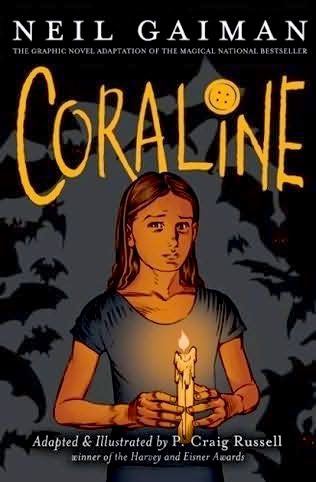
I have no idea how faithfully Russell has adapted the original novel, because I haven’t read it. To be honest, I’ve hardly read anything of Neil Gaiman’s. But I am a Miyazaki fan, and the little hint of his influence here, along with Russell’s art—of which I’m an avid collector—and the hardcover book format attracted me to Coraline. I’m sure the publicity surrounding the animated film version didn’t hurt, either. And it’s a beautiful effort, from the choice of hardcover in a kind of schoolbook finish, to the mysterious cover (Coraline with candle, surrounded by bats, evoking a Halloween mood)

Which brings me to one other point. If there's anything that bothers me about Coraline, it’s that imaginative works like this rely on just that—the reader’s imagination. Things described in prose can reveal themselves in amorphous yet clear-enough form in the mind’s eye. The film adaptation goes for a creepy, Tim Burton-esque aesthetic, all stylized weirdness and cartoony figures with giant heads and pointy noses. That, to me, matches the abstraction of personal imagination and complements it, rather than replaces it.

Russell’s art, however, makes the strangeness a bit too concrete, a bit too literal. Other Mother also has a disconcerting resemblance to Tea Leoni. Despite her button eyes, evil smirk and blood-red claws, she really doesn’t come across as either attractive enough to temp Coraline, or repulsively dangerous enough to really darken the book’s delicate sensibilities or become a truly menacing presence to the girl until nearly the very end.

Either your sensibilities and Russell's visual specificities jibe or not, but once you see his versions of the characters, settings and some of the magical events, they're apt to replace yours. So be prepared.

Still, Coraline is a lovely book to look at and read. The finely-balanced prose finds its match in Russell's ornate lines, and Lovern Kindzierski's rich coloring (gorgeous use of neutrals, nothing garish or over-modeled). Russell can seemingly draw anything, from nearly photo-realistic characters (I wonder how much he relies on photo-reference or if he just makes this stuff up all out of his head... I imagine it's a combination of both) to lush, overgrown gardens to fabulous dreamscapes tinged with mist and mystery.

I really wish comics in general would move towards this format, and more publishers would take chances on literary, self-contained works like Coraline. Between this and the very different Skim, we're starting to see the growing potential of Western sequentials freed from serialization and genre limitations.

Thursday, February 26, 2009

The Savage Sword of Coraline

This morning the Amazon.jp delivery guy-- middle aged, tousled black hair, short and stocky, all bundled up against the late winter rains but as cheerful as ever-- just dropped off my most recent purchases: Coraline, adapted from the Neil Gaiman novel by P. Craig Russell and The Savage Sword of Conan volume one, reprinted by Dark Horse from the old Marvel b&w magazine, apparently beloved by our president.

At first glance? Coraline is gorgeous. P. Craig Russell draws the mundane as beautifully as he draws the fantastic, and this story seems to allow one to bleed into the other. A very handsome book; I can't wait to dig in and get to reading it. This is the kind of book I'm generally talking about when I talk about "comics." A book book. Hardcover, nice slipcover, a self-contained story of the kind you could give to just about any non-comic reader and say, "Check this out and let me know what you think."

There's an odd visual dissonance to this book, though. When you see the animated movie Coraline, and it's all stylized and cartoony and moodily lit, something like black buttons for eyes creates a different effect than when you see the same concept rendered semi-realistically and frozen on the page in fairly brightly-colored comic book panels. Not that this is a bad thing; it's just really creepy. The pages with "Other Mother" give me same queasy feeling even the mild moments in those old Clive Barker short stories used to. Other Mother looks disconcertingly like Tea Leoni, as well.

But wow, what a lovely book.

The Savage Sword of Conan is an obese, economical volume with a lot of fantastic artists trapped inside its pages. Barry Windsor-Smith, John Buscema (frequently inked here by Pablos Marcos), Neal Adams, Jim Starlin and... strangely enough... Alex Nino, an artist whose work I've always admired but never associated with sword and sorcery. The most breathtaking pages are the ones where Alfredo Alcala inks Buscema. As a team, they blow all the other couplings apart. It looks like fine book illustration, lots of etching-style fine line work. Wondrous. Windsor-Smith's work doesn't fare as well. A lot of the lines just don't seem to have reproduced well here, and I'm guessing they didn't have the resources to gather the original artwork (if it still exists) and instead shot from old issues of the magazine itself, losing some resolution in the process. Too bad. It's not enough to wreck the whole book, unless you're pretty exacting. And I'm not. Not all the time, anyway.

The Boris Vallejo cover painting is about what you'd expect if you grew up in the 70s era of custom vans and airbrushed murals-- sun-bronzed Conan looks fierce in his horned helmet, wielding a blood-splattered scimitar while a nearly-naked woman in chains kneels helplessly behind him. They appear to be in two different light-sources, which is certainly intentional on Vallejo's part, and there's a mighty phallic spire rising directly behind the woman in what must be some blatant sexual symbolism. It's easy to admire the technique but then feel more than a little uncomfortable the subtext. Or, in this case, the text. It's not exactly subtle.

I noticed on Amazon.com a few hardcore Savage Sword and/or Conan fans criticizing this book for not being of archival quality. I can understand their point of view; I'm just not as into it or in the same way as they are. I dig this old stuff, but it's also the sort of material I prefer to get at a low cost (bear in mind I'm paying inflated import prices here in Japan, too, even with the more favorable exchange rate I'm getting these days).

In the U.S., you can get three of these fat bastards for under forty bucks and considering the page count (over 1500) and the artists represented, that's a freakin' bargain. And I seriously wish Dark Horse would do the same thing for the Marvel-Curtis Planet of the Apes magazine. "Terror on the Planet of the Apes" and the "Future History Chronicles" are just begging for reprints. The world must see these again! Do it big and cheap, just like Savage Sword and I'll love you for days.

With money!

The other book I received is Patton: Ordeal and Triumph by Ladislas Farago. According to the cover copy, Military Bookman has declared this to be "the best Patton biography," and it's one of the sources for the classic 1970 George C. Scott film. But it's beyond the scope of this li'l comic book blog...

Tuesday, February 24, 2009

"If I Ran DC" by Dr. Seuss, Jr.: My Dan Didio Power Fantasy Gone Horribly Awry...

My plan vould necessitate the abandonment of the so-called monogamous comic book
reader relationship... Regrettable, yes. But it is, you know, a sacrifice required for the future of the sequentially-obsessed segment of the human race.

Recently, over at Occasional Superheroine, Valerie D'Orazio asked her readers what they would do if they were in charge of DC. I answered her there, but my response was off the cuff and under-developed. And who wants to write a novel-length comment to someone’s blog? So, because no one demanded it, I’m expanding my answer and developing it further right here in my own li’l secret corner of the comics fan blogosphere.

Where no one will ever see it.

My strategy is threefold. First of all, I'm not at all worried about alienating and losing longtime comics readers as I am interested in tapping the potential market for people who haven't been reading them. Current readership for these kinds of mainstream products is a shell of what it was in the 1990s and I think that's a state of affairs that has to be addressed rather than accepted as the norm. Actually, I can't imagine putting out a product where you're merely interested in carving a piece out of a very limited demographic, accepting gains and losses on a temporary, short term scale, when ideally you should be attempting to increase the overall pool of consumers for a healthier industry overall. And greater profits for your shareholders. Secondly, I think slavish adherence to long term continuity-- and especially the current form of "company-wide crossover"-- can, and often does, cripple creative storytelling. And thirdly, as we all know, currently there are also major economic considerations.

Basically, I want to build readership, cut costs, increase profitability and produce better quality stories. Those are my primary concerns.

I can't take full credit (or blame as the case may be) for these ideas. Some were suggested by others at Occasional Superheroine and I latched onto them because they fit my strategy and just seemed like excellent ideas.

1) Digital Comics. Nothing new here. This has been bandied about forever, and I think the time is ripe. My initial plan was to phase out the monthlies entirely and end the overall "DC Universe narrative" completely, as dinosaurs who have been obsoleted by evolution but still haven't realized they're extinct. Then someone else suggested digital comics, and it seemed a worthy compromise: Put the monthlies online-- offering them in full color-- instead of printing them on paper.

In this way, we could placate the current readers by keeping their precious ongoing DC narrative and save everyone a lot of money which will help appeal to new readers. After all, 3.99 is a ridiculous amount to pay for a flimsy 24-page comic book, no matter how glossy the pages or overworked the computer coloring. Already newspapers are starting to abandon print editions in favor of strictly online content. Like it or not, this kind of change is rapidly becoming commonplace, especially in the current economy. You either control your fate and extend your life, or the marketplace buries you.

To go digital, we'd have to figure out which online model works best. Free stuff with advertising (similar to The Onion), or subscription stuff you could download. A Kindle-style system available through Amazon.com. Or a combination of all of those methods. As editor-in-chief or CEO, it wouldn't be up to me to come up with the delivery system; that's what I'd be paying others to do. Believe me, we'd come up with something workable.

Failing that, I'd employ...

2) The Manga-esque Solution. The other idea, which is one that I sort of half-assedly wrote about at Occasional Superheroine and Torsten Adair fleshed out brilliantly, is combine all the monthlies into massive Shonen Jump-style phonebooks. I like this idea more than the digital comics one, but both could be linked together.

In the interval between my comment and Torsten's, I thought more about this and came up with a variation on what he suggested. I’d do two of these!

One, I’d call The Brave and the Bold and it’d have all of DC’s second tier characters. The other I’d call World’s Finest and it would feature Batman, Superman and Wonder Woman plus the Flash and Green Lantern or some other front rank character that fits. There'd be all kinds of reader involvement items too... fan profiles and drawings (an in-print DeviantART, if you will), creator info, contests, connections to our online content. Things that make readers feel involved with the company, part of a culture.

I’d have these books printed on super-cheap paper, in black and white with just a few color pages, and they’d be completely disposable, which would also solve the storage problem. My idea is for the reader to read it then recycle it. Recycle, recycle, recycle. Good for the environment.

Shonen Jump hits readers with over three hundred pages of material for 4.99. If we kept production costs down we could probably price these things at 7.99 each for five hundred pages. Under ten dollars, anyway.You’d get all your seventy-odd years of continuity and massive crossovers, but they’d be all in two easily affordable books. And they wouldn’t come out on the same day. One would come out the second week of the month and the other on the fourth.

These would be the place for all your journeyman writers and artists and all the pedestrian ongoing DC universe narrative junk I’m about as interested in as I am in following the storylines of Days of Our Lives. Maybe work a superstar in there once in a while in case things get boring, but the idea would be to tell the stories efficiently… and cheaply. And, as Torsten Adair also wrote, these could be colored and offered online a la point the first above, and collected into trades.

I know this is problematic. Some people prefer to buy twenty color magazines they can hold in their hands each month, damn the costs. There's also tradition and comic readers seem notoriously reluctant to mess with the familiar. Still, I believe they'd gripe and complain and go Internettishly ballistic, and then they'd come back.

They might not like sharing their little pop culture esoterica with a few hundred thousand or more new readers who are part of the heathen uninitiated, but eventually new alliances would be formed and they'd have a larger pool from which to draw their lynch mobs and effigy-burners whenever we screwed up their favorite characters.

Retailers would probably hate this, too. These manga-style books would be big, bulky products. Difficult to display, difficult to store. But I imagine they’d hate not having any comics in their shops at all even more, if we went entirely digital. Oh, and I suppose it would also kill the back-issue collectible market as we know it.

Still, I think the trade-offs are more than worth it.

3) The Kirby Book Model. Now we come to the meat. The entrée, if you will. The big hamburger a la Grant Morrison. Jack Kirby should get credit for this because he posited something similar in interviews years ago when he was doing his Fourth World stuff at DC.

The other thing I’d do in conjunction with these changes is to start printing stand-alone creator-driven graphic novels, just like a real book publisher. In these, there'd be no company-wide continuity and they could be in any style or take place in any era. For example, when you buy a Dan Brown novel you don’t expect it to relate to one of John Grisham's. Why do comics automatically have to be interrelated to the point of forcing buyers to buy 20 books a month just to keep up?

Here’s how it’d work: You’re an industry leading writer and/or artist. The toppermost of the poppermost, as the lads from Liverpool used to say. You have an idea for a great story featuring Superman. You pitch it. If I like it, we publish it as a book. You’re not bound by page counts or someone else’s massive epic. It would involve abandoning continuity as we know it, and the emphasis would be on the story and how you tell it rather than its place in some enormous yet turgid narrative involving seventy years of people flying around in tights punching each other. The only continuity that would matter would be the story’s internal continuity.

And the sky would the limit on plot, tone and subject matter. If your Superman story involves his grisly demise, then so be it. Why should that interfere with another writer’s graphic novel about Superman the super-dog catcher? You want to write a Barbara Gordon Batgirl story? Fantastic! We’ll put it on the schedule alongside the Cassandra Cain book. Adult, juvenile, whatever. We’ll sort that out on the cover and make sure it gets into the right part of the bookstore.

From inception to final product, these would be handled exactly like prose novels. The only difference would be the sequential artwork.

The idea would be to get these babies on the New York Times Best Sellers list, sell a few million, have complete, self-contained stories that could then be optioned off to Hollywood (or not, if you don’t think it should be) and everyone can have a big slice o’ the pie.

That’s what I’d do if I ran DC Comics.

Saturday, February 21, 2009

Let's Celebrate Xi'an Coy Manh Why Don't We?

Karma. Besides being the thing that snaps back on you when you do bad things and controls the fate of Earl J. Hickey on My Name is Earl, Karma is the codename of that nearly forgotten yet quintessential New Mutant, Xi'an (Shan) Coy Manh. She is older than the other New Mutants, a bit uptight, and with her dumpy bob style, has the group’s third worst haircut… next to Rahne’s pre-Sinead buzzcut and Sam's yokel... er... buzzcut.


Shan's hair was so central to her character concept,
Chris Claremont has the team's ballet teacher Stevie
Hunter spend the first two pages of issue 1 giving her
a haircut and washing her hair while all the other kids
watch and make fun.

I think subconsciously, Claremont must’ve hated Shan. Which is why we must love her.

Along with Dani Moonstar, Shan generally gets the worst of Chris Claremont’s dialogue. But while Dani says exciting and stilted things like, “Oh, Black Eagle, why didn't you tell me?! We could have faced them together! Whoever they are, I will make them pay for your life. I will have vengeance," Shan says dull and yet equally stilted things like, “All this sounds wonderful, Professor, but I have a problem. I must care for my brother and sister. Between my job and your school, I shall have no time left for them.”

Significantly, we never actually see her brother or sister, or anything of Shan's life outside the team. For all we know, her siblings don't even exist and are just an excuse for her to get the hell away from Chris Claremont from time to time.


A typical Dani moment. In his 1980s prime,
Chris Claremont thought 14-year-old Native
American girls talked like this. Well, to be fair,
Claremont thought everyone talked like this...
except hicks and foreigners.

Even in his best stories (and he wrote some dandy ones back in the day), Chris Claremont’s characters are forever making pretentious self-justifying speeches-- or laboriously describing themselves and their recent histories in internal monologues-- that bear little or no relationship to things an actual human being would say in similar circumstances. There's no such thing as a "simple answer" in a Chris Claremont story.


Typical Shan moment. Look at Rahne's reaction. Even she can't believe
Chris Claremont is forcing Shan say all this in one panel. And "There's a
great deal she isn't telling us?" What the hell's left to tell? Well, it later
turns out there's one thing...

The only time they seem to have a voice apart from Claremont’s, or even each other’s, is when they’re from one a’ them funny-talkin’ countries in Europe and Asia. Like Nightcrawler, who speaks standard Claremontese but when startled exclaims things like “Unglaublich!” or “Mein Gott!” and Colossus, who goes around calling people “tovarisch,” and shouting “Lenin’s ghost!” Or Sam, who speaks in Claremont's idea of Southern redneck dialect... er... Appalachian English.

If they actually speak in a language other than English, they get less-than and greater-than signs around their dialogue… which is again in standard Claremontese… and an asterisk leading to a small caption where an editor informs the readers “*Dialogue translated from Japanese.” Saves money on translators and Cyrillic or katakana/kanji typefaces, I guess.

However, in Shan's case, when she speaks Vietnamese, they do away with the word balloons and mathematical symbols altogether and just have her pal Roberto say, "She's speaking Vietnamese-- I can't understand her!" I'm not kidding. That's how Claremont handles it.

Way to spectate Shan!

Almost... almost... come on, Shan! You can do it! She's either going to
possess that guy or pass a canteloupe trying!

Screw it! A machine gun is much more direct and effective than psychic
possession powers.


Or not.

Claremont allows Dani to expound on her Cheyenne heritage and possible vengeance against whitey; she just never does it in the Cheyenne language. Poor Shan appears to have learned English just to discuss her many responsibilities as a surrogate parent or to advocate "caution." With contrasting takes like that, Dani is so obviously the most interesting character, the one with the most personality, she quickly takes over New Mutants and pushes Shan to the side.

Probably because Claremont found Dani fascinating and Shan and her maturity boring, which is exactly how he wrote both of them.

Dani gets a cool subplot where she thinks
she's going crazy and Professor X is trying
to kill her. Shan gets a subplot about misplacing
her car keys.

I always think it’s funny when a writer complains about the boring characters they create. For example, Stan "The Man" Lee always compares Gwen Stacy unfavorably to Mary Jane Watson and apologetically concludes, “We just couldn’t make Gwen Stacy interesting.” Yeah... because that would require writing. But I pick on Mr. "The Man" because that’s the only example of this phenomenon I can come up with now, on the fly, without buying every back issue of Comic Scene magazine or The Comics Journal.

But there's really no objective proof Claremont ever felt this way about Shan; I’m just projecting unfairly because she seems so underserved as a character.

Yeah, Claremont features her prominently in the opening pages of #6,
but by the end of the issue some mysterious voice in her mind tells her,
"I have come to claim you, body and soul!" and she gets blown to hell
when Silver Samurai pushes a button on a festively colored death yacht.

No shit, Charlie! You ARE a psychic!

I like to poke a lot of fun at them, but I seriously believe the first four issues of The New Mutants are carved from a solid block of frozen amazing floated down from the Arctic amazing fields at great personal risk by wildcat amazing miners. Unfortunately, around issues #5 or #6, after the resolution of Dani's psychotic reaction plot, things grind to a halt with bizarre and lame-ass guest stars like Team America taking over the stories.

And, soon enough, what to do with drab ol' Shan-- at 19 she's already a legal adult and therefore not as exciting to undress... er... write about as the other New Mutants-- is solved handily when the secret villain base she's inside blows up real good, James Bond-style. Everyone mourns her for half the next issue before jetting off to Brazil so Dani can wear a sexy carnivale outfit… kind of odd and more than creepy considering her friend has just died a day or two before and Dani herself is maybe 15 at the time.

Her New Mutant friends mourn
Shan's tragic loss.

Then The New Mutants seemed to into a dull holding pattern with mediocre art and uninspiring storylines. I briefly dropped the title, feeling a sad for poor Shan and a little fannishly betrayed. Suddenly, fracturing my mind the way an exploding Mount St. Helens tore apart the earth's crust, Bill Sienkiewicz signed on as artist, reigniting my interest.

Splashing pints of black ink as if he were a brush-wielding Sweeney Todd, Sienkiewicz helps a reinvigorated Claremont send Dani into dreamland to kill a demon bear while Alfred Hitchcock makes a cameo appearance. The stories become darker, with plots about black magic, drug abuse and teen runaways, insane kids with multiple personalties and-- in a sudden burst of cross-cultural confusion-- Dani becomes a valkyrie in Asgard because of her mystical, Native American connection to the animal kingdom (all Native Americans have mystical connections to nature, especially wolves and horses and winged faery folk... just ask the fine people at The Bradford Exchange)...

Dammit! Dani’s even taking over this blog entry! Shan! Come back, Shan!

Okay, deep breath and let's get back on chronological track to just before all the valkyrie junk happens...

Through the early Sienkiewicz issues, the voice in Shan's head remains unexplained, a completely fogotten subplot lost in a bubbling magical cauldron of dark Illyana-Dani team-up weirdness until the long-awaited The New Mutants #31, where Shan makes her triumphant return as a Macy’s Thanksgiving Day Parade balloon:

What a fantastic cover. Interesting color palette, striking symbolism
of the story's plot, a little bit of Gustav Klimt thrown in to increase the
graphic interest... But wow! Isn't that the nastiest, cruelest caricature
possible? Shan looks horrible. She saw this and cried for days. The slanty
eyes and buck-teeth really disturb me. I think you can guess why.

It turns out poor, forgotten Shan has spent the intervening years as the psychic host for this nasty scumbag guy, who apparently used her body for a new lease on life. And to eat. To humiliate, confuse and complicate her even further, and maybe undo the physical damage, her friend Illyana accidentally teleports Shan to some kind of desert where she walks off her weight using the Jared Subway plan of one 6-inch sand lizard sub a day and some light aerobics.

Karma during the phase when her powers consisted solely of writing
Buffyverse Angel/Spike slash fic.

I’m not sure in what issue she had all the loose flesh surgically removed, but at the end of the process it was as if none of it had ever happened. Oh yeah, years later, she comes out as a lesbian, but I haven't actually read that story yet.

Evidently, at one point she suddenly also has pink hair and a devil-may-care attitude. While that might arguably be more interesting than how Claremont wrote her in The New Mutants, it seems pretty arbitrary and contrary to her original personality. Why couldn't they just acknowledge her timid past and write her as a smart, serious, sensible young gay woman... who is also interesting... and leave out the "dork-ass comic writer tries to understand hipster subculture" bullshit? Mainstream comics are never so uncool as when they self-consciously try to be cool.

She remains an underused character, and one undeservedly neglected even in the stories in which she appears. Maybe her new writer, Zeb Wells, will give her a little more of the spotlight she deserves. I don't know, but I hope so. All I know is, Dani's been depowered and Shan hasn't, but beyond that she's elusive and opaque, because info on Shan is difficult to come by.

Xi'an Coy Manh, Karma, as she currently appears pending the arrival
of the new The New Mutants series.

In fact, I probably more than trebled it just by writing this blog entry about her. Wherever you are, and in whatever form you return, Xi'an "Shan" Coy Manh… the forgotten mutant… we salute you!

Now, let's get back to talking about Dani…

Friday, February 20, 2009

And Then Dani Went All Weird On Us...

With the new... The New Mutants series forthcoming and a pre-order in with Amazon Japan for The New Mutants Classic volume four, I'm on sort of a Dani Moonstar kick again these days. The New Mutants was one awesome-ass series in its day, and it's still a fun read now, twenty-five or so years later. Dani was my favorite mutant then, and she remains so to this day. But now I want to broach a serious... perhaps even delicate... topic relating to her.
Why the hell did they keep changing her powers?

Take the events in The New Mutants Annual #4, for example. I'm not ready to blame writer Louise Simonson. Chris Claremont had already added a layer of ridiculous to Dani Moonstar, our Favorite Mutant, by pointlessly turning her into a valkyrie in The New Mutants Special Edition #1. This left Dani able to see a "death glow" above those in mortal peril and gave her as a pet Brightwind, a winged white stallion with a mohawk. Quite a bizarre turn of events for a Native American teen from a Colorado reservation, a kind of cross-cultural fusion that fizzled.

And the X-editorial group still wasn't satisfied. Because as a result of the so-called "Evolutionary War," Dani's powers take an even stranger turn. And it starts with a cover pulling the "ol' bait and switch." Or, as Waylon Jennings might have said while narrating an episode of the Dukes of Hazard, a little "shuckin' n' jivin'."

Purple rain... purple rain... I just wanna see Amara screaming in the purple rain...

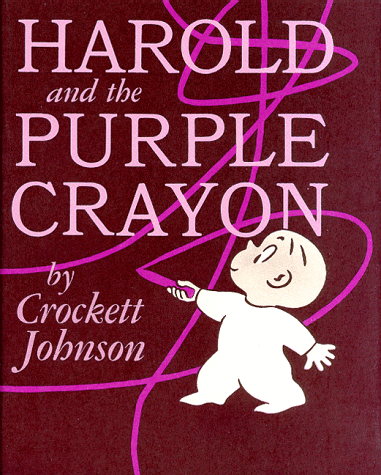
Well, the cover copy is correct: a New Mutant is changed forever. But it's not Amara. Her appearance is just a clever deception. So sneaky! But this cover is ugly. Ugly! It's so unbearably purple I'm looking around for a little bald kid with a crayon. And if he didn't do the colors, who did? Prince? Yellow, red and various shades of lavender and purple, and some kind of green dentist tool dangling there in the middle. Prince after eating about five pounds of habanero-laced guacamole.

June Brigman is generally a fine artist. But here? This cover is kind of slick, the open spaces and lack of contrast make her figures look weirdly hollow and the poses aren't very dynamic. But the real problem is the design team didn't do her any favors by weighing it down with that massive title and text block above. How could any self-respecting artist pull off any kind of interesting composition when space is so cramped and badly cropped?

This is Marvel's late 80's look at its worst. Brigman's interior art, inked by New Mutants artist emeritus Bob McLeod, is much better. There she gets to showcase a deft touch with body language, facial expressions, and youthful characters. She and McLeod are the perfect art team for a New Mutants story.

The story inside is fairly standard, a mix of characterization and fight scenes. And people with dumb names like "Purge," foreshadowing some of the worst Image character codenames. But then what of Marvel in the '80s-- specifically the X-books-- didn't prefigure Image in the '90s?

Louise Simonson gives us reams of dialogue and a plethora of cutesy teen character business in the Chris Claremont style, and it's pretty decent stuff for its time. She was following the Great X-Creator, after all. Her dialogue is still overly awkward and largely expository ("In truth, I am more sickened by these humans' persecution than I am the hazardous waste which surrounds our domicile" and the examples in the illustrations I chose for this blog), but no more so than usual during its era, and not nearly as stilted or pretentiously poesy as Claremont's got on this title.

But lord, Simonson foreshadows like nobody's business.

As the story opens, there's some comedic relief where Dani's powers cause Sam to crashland while he's cannonballing around, and then the other kids interrupt, setting up this Magneto lecture:

Poor Dani. Magneto is pretty harsh with her here. While the art's "press box" composition looks a bit ridiculous (just how short are Magneto's legs anyway?), and there's a bad tangent where the upper panel border meets Dani's hair, Brigman puts the girl front and center where we can see and feel every bit of the awkwardness as Magneto calls her weak and worthless in front of her friends, followed by Warlock's innocently dismissive, "Bye..." making Dani's teen years just a little more traumatic.

But what's really happening with this sequence is Simonson giving us our first story clue after the cover's misdirection ploy. At this point, you still think something really terrible's going to happen to Amara. The kids discuss her repeatedly, worry about her plight (her dad's got her back in Nova Roma, the archaic Roman civilization hidden away in the Andes, where he's betrothed her to someone politically advantageous and she's in love with a guy may or may not have brainwashed her), and soon the scene shifts to Nova Roma itself where Amara's causing earthquakes and shooting lava in her anger.

And sure enough, some generic-looking armored assholes kidnap Amara. They're part of a plot to strip her and all mutankind of their powers. One mutant at a time. Evidently, their boss, the High Evolutionary (the purple armored geek on the cover), has some sort of schedule and if you're not on it, you just have to wait your turn. When the baddies snatch Amara, they leave her boyfriend Empath... because he's not on the list. With the way mutants were proliferating on Marvel-Earth in those days, going about their plan this way seems akin to trying to sweep the waves back into the sea with a pushbroom.

And isn't it comically easy to kidnap or disable the New Mutants? This is like the fouth annual in a row where one or more of them has been captured or held prisoner. That's a The New Mutants formula- they're easily defeated in the story's opening, then overcome all odds as a team in its conclusion. Kind of like the Harlem Globetrotters cartoon where the Globetrotters invariably lose in the first half, then score 100 points in the second to win.

No matter. The target is Amara, not Empath. Only it's Dani, during the rescue mission, who ends up falling onto the "power removal machine" (as it's actually called). I'm no geneticist, but it seems unlikely anyone could develop a machine to remove characteristics imparted to you by your DNA. At least not with this kind of lightshow:

It seems like extracting DNA-based powers would involve radically rewriting a person on practically a molecular level. It's like trying to change your height or remove your Dutch heritage. The short explanation is-- it's magic! Mutant powers are a kind of magical energy mutants possess, and that energy can be drained by other forms of magic. Science content of this annual? Zero!

Some plug-ugly muscle guy named Bulk breathes his last turning the power-removal lever back to the opposite setting. How convenient. You make a machine to remove mutant powers that also has a setting to amplify them. Dani comes forth with her former image-projecting abilities enhanced to the point where she can make those images solid and "real." But she can only make one thing at a time. Make another wish and the first object disappears. The best she can come up with on short notice is a spear she calls her "spirit lance.

Since the spirit lance is the embodiment of her power, she feels she has to tote it around everywhere on the off chance she'll need to fight evil or protect herself. This leads to a scene where she's bummed because it'll be a hassle dragging it to parties. And to clear her mind and forget her troubles, she hops on her living My Little Pony from Asgard and takes a flight in a lovely splash image:

The big red block letters frighteningly conflict with the otherwise dreamy atmosphere, but the soft sunrise (or sunset) and the bold sweep of Brightwind's wings, plus Dani's beatific expression give this image a lot of soul. A little adjustment and this might've made a better cover than that purple monstrosity I've already abused. While frolicking across a sky of pastel pinks and golds, Brightwind spots an available female horse and bucks Dani off, causing her to fall 1000 feet and... No more to use the sky forever but live with famine/And pain a few days...

Actually, she only sprains her ankle; Dani has supple bones. Not knowing where Brightwind is, and needing a way back to the X-Mansion, she changes her spirit lance into a sweet sportscar:

It would've been much cooler and more appropriate to the series if this car had been an exact replica of Thomas Magnum's Ferrari 308 GTS. Dani hops into the driver's seat and goes tear-assing down the road, and a cop pulls her over. Since she's out in the countryside, the cop is a stereotypical smokey-bear hatted oaf. Unfortunately, Dani doesn't have a driver's license. Wait! With her new powers, that's no problem. She can just summon one out of thin air:

Oops! Now the cop (I think it's Sheriff J.W. Pepper, on loan from the 1973 Bond film Live and Let Die) believes Dani's an alien and drags her to his patrol car. And then salvation arrives in the form of Brightwind the Horny Horse, back from making sweet sweet love to his lady friend. As if disappearing sports cars weren't enough to send him reeling, the sight of a winged horse causes the cop to freak out. Dani escapes into the sky once again:

And the driver's license incident has taught her that she doesn't need to carry around a giant spear. She can wear a cute little one around her neck. I'm not sure if all of this spear/lance/winged horse stuff is some sort of phallic/sexual metaphor. Actually, I am sure and I'm preparing a ten thousand word blog entry analyzing it, for which this is merely a preview.

As we fade out, big daddy Magneto finally has some kind words for worthless, useless, not very helpful Dani-- he likes her new necklace:

Awwww!

And exactly what we want most is more Dani Moonstar! And I think we're gonna get it!