And I drew and wrote it in all of about five minutes. Hey Mr. DiDio, with that speed, I'm available to draw ALL your comics! You'll have to assign your top inkers and colorists, though. Nothing but the best for my masterworks.
Saturday, March 7, 2009
"Hey Kids! It's Batman vs. the Nerdy Guy!"
And I drew and wrote it in all of about five minutes. Hey Mr. DiDio, with that speed, I'm available to draw ALL your comics! You'll have to assign your top inkers and colorists, though. Nothing but the best for my masterworks.
Friday, March 6, 2009
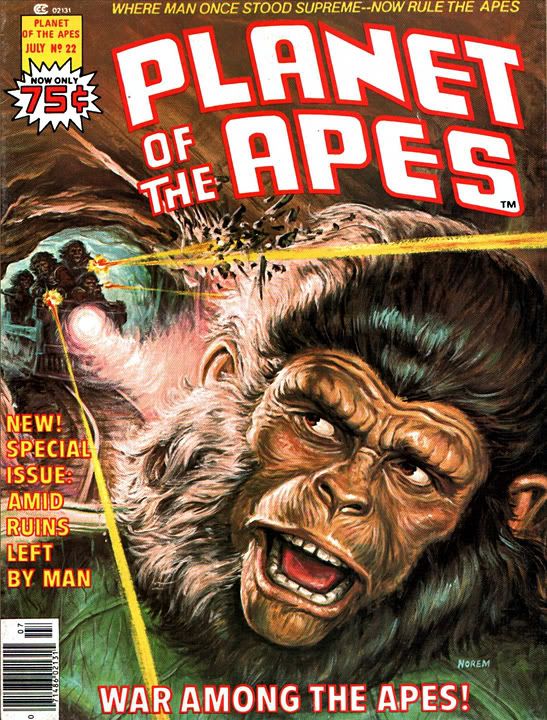
Ape-Quest '09: "Quest for the Planet of the Apes" Edition!
Actually, the more than adequate Rico Rival drew part one of the story we're about to dissect. However, the beyond awesome Alcala did draw part two. We'll be getting to him in the next installment.
I own a ton of these crazy magazines. Oh the glories of discovering EBay and finding out I could own again the oversized, phantasmagorical stories that frequently caused me to sleep with the light on as a child. I bought them (about 15 or so, including multiples of #1) back in the late 90s before Timothy Burton's brain-dead reimagining and the comics grading services drove the prices sky high, like ol' Colonel Taylor's arrow-shaped spaceship. I'm still waiting for them to pass through a Hasslein Curve and re-emerge into normal space at a price point I can afford.
I'll just forget #29. That one suffered from limited distribution and due to the laws of scarcity commands obscene prices these days. However, if you want to send one to me because you're a nice person, just email me for my address. I do accept gifts. I do indeed!
Anyway, once again, Rico Rival drew this. At some point in the 70s, American comics editors looked to the Philippines and discovered the Filipino comic artists had created some sort of time-space vortex with their pencils and subsequently were capable of drawing entire books in a matter of moments, coalescing them out of nowhere like a scene from Koyaanisquatsi, if Godfrey Reggio turned his time-lapse camera on funny books. Guys like Rival, Alcala, Nestor Redondo and others regularly cruised past the Kirby Barrier, laughing all the while. All they were lacking was Philip Glass to provide the soundtrack.
And Doug Moench wrote the script. Moench wrote all the Marvel Apes stories, and if you ask me, he exceeded his mandate. To Kurtzian levels. He went to mad in the jungle and Marvel should've sent Archie Goodwin upriver on a steamboat to bring him back and be held accountable. His methods were unsound. Imagine being an 8-year-old and expecting Roddy McDowall in an ape mask and instead getting buckskin-clad mountain-man type chimps fighting giant, mutated frogs, disembodied brains that talked like 30s gangsters, magical future hippies, an all-gorilla branch of the Ku Klux Klan and city-ships plying dead seas, their banks of oars manned by human slaves. Kids were mentally scarred for life reading these unholy things.
Oh, I kid Moench. I kid because I love. Doug Moench brilliantly took the basic Apes premise and expanded it in ways startling and lurid, occasionally, downright ridiculous. The latter is best exemplified by the bionic apes Moench introduced as sales flagged and the magazine slowly died. Yeah, that's not nearly as ludicrous as the story about the guy who's so obsessed with rescuing Taylor he hypnotizes himself into the future and ends up becoming a knight on a special island where apes and humans have recreated Camelot...
The Sir Thomas Malory Camelot, not the JFK one. Although it'd be really cool to see chimps in gray suits with razor-thin ties discussing what to do about the Cubans erecting missile launchers and Soviet ships bringing in the nuclear missiles for them to vaporize anti-Casto hotspot Miami.
When Moench wasn't alternately frightening children (me) into wetting their (my) pants or inverting Mark Twain, he was adapting the 20th Century Fox film series. He managed to serialize all 5 films, but the most interesting oddity has to be Quest for the Planet of the Apes, where he takes characters from Conquest of the Planet of the Apes and Battle for the Planet of the Apes and provides an interim tale that fills in some of the story gaps between the movies. Even if some of his ideas were a little oddball and outside of the film series' continuity. Let's take a look at the splash page...
Ho hum. Just another boring day of abusing the elderly, loin cloth-wearing human denizens of Ape City. That's General Aldo- that most vicious of ape soldiers- played in the movies by Sheriff Lobo himself, classic character actor/heavy Claude Akins. Aldo took leadership classes taught by Naomi Campbell at the Leona Helmsley Institute for Labor Management Theory. Graduated at the top of his class.
To Aldo, the problem isn't so much the quality of the humans' labor as it is the speed at which they work:
You want it done fast, or do you want it done right? Aldo prefers fast. Maybe if Aldo relied on a younger labor pool, things would get done to his satisfaction. But in a world where nuclear weapons have erased most of modern civilization, able-bodied employees are difficult to find. And also proper business attire. Unless this is Casual Friday. Very Casual Friday. Things have degenerated from slobs who think it's funny to wear Hawaiian shirts to creaky old bastards in soiled diapers.
Luckily for Grandpa Loincloth (of the South Bend Loincloths), upper management drops by to check on progress:
Moench was working from the original scripts, rather than from the films themselves. According to the film version of Battle, Governor Breck was long since dead, killed during WWIII. So Don Murray was spared the indignity of having to grow a grizzled beard and wearing a loin cloth to recreate his villainous role. The original MacDonald also vanished, replaced by his brother, also called MacDonald. Both MacDonalds were interchangeably sympathetic to the apes' plight. This is the first one:
I also have to point out that in Battle, the humans didn't wear leather diapers. They actually wore normal clothing, kind of a mix of Land's End and Outdoor Outfitters. Khakis, earth tones, but recognizably modern in a 1970s kinda way. Not even the homespun stuff they wore in the Apes TV series. In Rico Rival's imaginative take, they're outfitted by Botany 5000BC. Rae Dawn Chong flashed less skin in Quest for Fire.
It's not a 1970s comic without tons of navel-gazing characterization expressed in some awkward, on-the-nose dialogue that sounds like nothing a human being or talking ape would ever say:
Oh, come on! "So I noticed, dear, from all your tossing and turning -- but did you have to light a candle to stress the point?" At this point in the story, Lisa had only been speaking for a couple of years or so. Evidently, she learned how to do this from watching episodes of Dragnet 1967. I think she would've referenced Caesar's cow mouth and whore's heart, but really it's Moench's call. I'm sure he steeped himself in Apes lore, watching the films endlessly until he internalized Lisa's personality and motivations so much so that in his imagination he actually became her while writing this moment, and I'm totally full of shit.
"I almost wish I'd never even led that revolt!" Here Caesar shows his emo side, moaning his discontent to his wife the way a generation of kids on an alternate earth would someday whine in frighteningly narcissistic and solipsistic video blogs on YouTube. Yeah, your people would've been much better off staying under humanity's yoke. Remember when Governor Breck's assistant Kolp strapped you to the torture table and electrocuted you? You were pretty cocky then, weren't you, Caesar? Ready to shake the earth, eh?
"I almost wish I'd never even met you!" "I almost wish I'd never even loaned Brad the keys to my car!" "I almost wish I'd never even drank that last beer and driven over the neighbor's dog!"
As you can no doubt guess, someone tries to blame the humans for firebombing Caesar's tree house. Humans get blamed for everything. Who polluted the earth? Humans. Who initiated the thermonuclear war that destroyed civilization? Humans. Who produced the film Patch Adams? Humans.
Here Moench sets up the Caesar-Aldo rivalry Roddy McDowall and Claude Akins would so ably limn in the movie. Aldo thinks a warlike gorilla should be the boss; Caesar thinks a mopey, insomniac, finger-pointing chimp would do a better job. Thankfully, we here in America have a representational democracy and never have to worry about the lesser of two evils being foisted on us by events beyond our control.
Aldo's solution is for both apes to test themselves:
A veritable quest. A literal quest. Hence the story's title. There's nothing for master politician Caesar to do but pose heroically and pretend it was his idea all along:
Here's where things become epic. The cool thing about comics is, there's no need to budget for special effects or locations. It's just as cheap to draw Caesar on location in a destroyed metropolis that stretches from irradiated horizon to irradiated horizon as it is to stick him on the old Fox Ranch in front of some shabby treehouses. Moench could've typed, "Caesar builds a rocketship shaped like a mechanical spider and makes a speech via television from his magical toy store on the dark side of the moon," and Rival would've drawn it exactly as described at virtually no cost whatsoever to Marvel. So when Moench calls for a scene were Caesar surveys the collossal wreck of humanity's aspirations, Rival rises to the challenge with a huge panoramic panel:
Yeah... uh... nevermind that in the film Battle, set years after this, Caesar would disavow all knowledge of these ruins and his first glimpse of them there is just as shocking to him as shown on this page.
Another thing Rival could do the film series couldn't match is give his apes actual facial expressions. McDowall and his original co-star Kim "Zira" Hunter discovered that, in order to create the illusion of ape faces rather than masks, they had to contort their own faces almost constantly and overplay their emotions. This kept the masks in motion. And they did a wonderful job under the constraints of relatively primitive prosthetics. Rival, unhandicapped by make-up technologies, gives his apes wild eyes and wide, screaming mouths.
He's also free to give them subtler expressions, such as the second panel here where Aldo looks dopey:
Aldo finds an armory, conveniently labeled "Armory," (although I doubt he can read) and decides to take a proactive stance vis-a-vis the question of Ape City leadership:
Aldo repeats himself. The lonely gorilla, with his clumsy, powerful body, talks to himself like a small child. Actually, repetition was a hallmark of his speech-making style in Battle: "We need guns! Guns mean power! We need guns! Guns mean power!" And so on and so forth. Aldo believes if you take a simple, strong idea and create a catchy aphorism for it, it will catch on fire!
The future belongs to Aldo, baby! Bring on the guns! Up with apes, down with people! I believe gorillas are our future/Give them lots of guns and let them lead the way/Show them all the beauty they possess insiiiiide...
Oops... I mean- Hi, Governor Breck! So nice of you to join us! Go humans! Woo! Humanity rocks!
Thursday, March 5, 2009
"Museum of Terror: Tomie 1" Review
Publisher: Dark Horse
Script and Artwork: Ito Junji
Translation: Naomi Kokubo
I believe the sales for this series have been somewhat disappointing for Dark Horse, which confounds and confuses me to no end. Ito Junji's deliciously repulsive work just doesn't seem to have found the audience it deserves in North America. A curious lapse in taste by manga consumers. But forget that for now. Instead, let us praise Tomie... both the manga and the character!
Tomie. Who or what is Tomie, exactly? She wears the shape of an extraordinarily beautiful young girl, one so alluring that men are driven to obey her every whim until the pain of loving her becomes so strong they must kill her and chop her into tiny bits. But each piece of Tomie has the power to regenerate into a completely new Tomie.
It's difficult to know what to make of Tomie. She's both victim and victimizer. She views men as playthings, is possessed of both an extreme narcissism and a complete ruthlessness. But due to the serial nature of her stories, and their relative lack of continuing protagonists, Tomie becomes the centerpiece and so goes from inhuman monster to anti-hero.
Our first glimpse of Tomie is
this innocent "snapshot" pose.
She's even sympathetic. While Tomie's siren-like gift/curse frequently proves her own undoing, it's something she didn't ask for. It may even be something she can't control- maybe this ability drove a perfectly decent human being completely over the edge. She destroys lives, but frequently does this out of revenge. Many of her victims come to grief because they themselves occupy a sort of moral gray area.
You'd do this for your best friend,
too... wouldn't you?
Think about what life must be like for Tomie, the girl with only one true friend. What would you do if you had an affair with a teacher behind your boyfriend's back and the the two of them not only caused your death but then involved your entire high school class in a grisly cover-up? While the girls keep a look out, Tomie's teacher has the boys strip and saw her into forty-two pieces. They then wash away their guilt in a nearby river, and everyone takes a part of Tomie home to dispose of.
Tomie's best friend, Reiko, gets the heart, which she tosses from a bridge. Imagine everyone's surprise the day following Tomie's funeral when she shows up for class, no worse for wear, apologizing, "Sorry I'm late."
It's really hard for me to feel too much sympathy for the teacher when he's carted off to the mental hospital that very same day.
Why didn't this happen to me
when I was in the hospital as
a teen?
Writer/artist Ito Junji presents a relatively benign Tomie in the first tale, simply titled "Tomie." He uses one of his signature storytelling devices by having it narrated by the elfin, short-haired Reiko. By the second story in this volume, "Tomie Pt. 2 (Morita Hospital Episode)," Tomie's personality becomes more manipulative and sinister.
Tomie demonstrates a novel
way of cleaning your home
aquarium.
Here, we find Tomie involved in a love triangle that includes a severely ill classmate (another elfin, short-haired girl) and her semi-boyfriend. When the boyfriend murders Tomie, her kidney is transplanted into the sick girl... with horrific results.
Tomie, take 3!
The crazed teacher from the first story makes a reappearance, this time claiming to be Tomie's father. Ito's nasty shorts are true horror tales in there's rarely a chance for happy endings. He also proves himself a master of foreshadowing. Discovering that Tomie is the unfortunate girl's organ donor provides the reader with a dreadful sense of anticipation... something Ito skillfully pays off with a nightmarish sequence involving an emergency Tomie-dectomy.
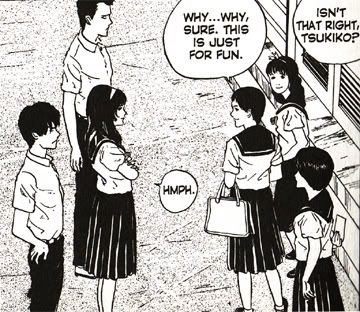
Tsukiko and customers face down
Tomie and her henchmen.
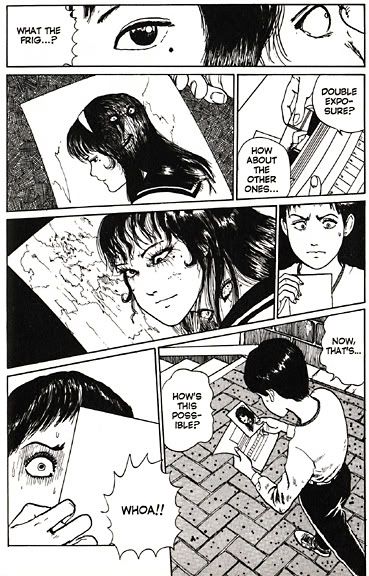
As grisly as that story is, the whole saga really blossoms with the next sequence starting with "Photo." Easily the best story in the book, "Photo" features a ethically compromised protagonist, a budding photographer who cheerfully and matter-of-factly explains:
I'm Tsukiko Izumisawa. I hang around with the photo club. I also sell dreams to the pathetic and lovesick. My friends tell me which boys they're into. I snap their pictures, then charge through the teeth.
That's Tomie... lovely in person,
but not particularly photogenic.
Tsukiko is yet another elfin, short-haired girl! And unfortunately for her, her little racket falls afoul of the school's new Ethics Club president, the mysterious and lovely Tomie. Tomie begins this story as a very straight-laced (if somewhat conniving) character, always attended by her two bodyguards/fellow club-members.
Oh, Tomie! You so crazy!
It doesn't take long for things to morph from an accurate reportage of teen age angst in a sort of pre-Ghost World mode to murder and mayhem... kind of like the movie Heathers, if the title trio weren't just bitchy rich chicks but instead were a single girl with supernatural regenerative powers and a icy heart.
The Tsukiko saga continues for two more installments: the horrific "Kiss," and then the Grand Guignol finale, "Mansion," where we learn of Tomie's origins as Tsukiko confronts her nemesis at her dark, gothic house. It comes complete with moving suits of medieval armor (European-style for that classic haunted house touch) and a mad scientist... plus a secret in the attic. The story ends in a sort of H.P. Lovecraft homage featuring some of the sickest drawings I've ever seen.
Remember... when pursued by
lovesick killers, hide in a small
room with only one, easily-blocked
exit.
Her story told, Ito abandons the charming Tsukiko for three stand-alone tales of Tomie horror. The first, "Revenge," is a fast-paced tale of mountain climbing adventure that turns cannibalistic when Tomie gets involved. The second is the dreamlike "Waterfall Basin," and the volume concludes with "Painter," where once again we see the maliciously manipulative Tomie putting her skills to bad use.
Ito is a skilled draftsman, working in a unique style. It's moody stuff, completely without those ever-popular manga visual cliches-- the giant eyes, the single sweat droplet, the super-deformed emotionalism. Instead, Ito's art approaches a comics universality. This is a book even the most diehard anti-manga hater could pick up and enjoy. Ito grounds his characters and their looks in solid reality, which amplifies the "special effects" moments. For the most part, Ito's cast looks natural and realistic. You know, until they morph into grotesqueries.
Ito's line quality is sometimes dithery, especially in the earlier stories. But as the book progresses, he becomes more artistically assured. By the time he's drawing mutated monsters and fetal Tomie-creatures that cackle gleefully as they attempt to seduce even from within experimental jars, Ito proves himself a modern master of horror imagery, easily the equal of such popular American horror artists as Graham Ingels and Bernie Wrightson.
You know you're supposed to
read this stuff from right-to-left,
right? Go back and read the previous
pages and they'll finally make sense.
If he has a flaw, it's in the stiffness of his posing and reliance on similar body types. Most of his male characters are spidery, spindly guys with longish arms and legs. And of course, he seems obsessed with those elfin, short-haired girls.
Those minor points aside, Ito is one of comics' finest genre writers, and his plotting abilities are second to none, especially in these short-form stories. Skillfully using narrative framing devices and flashbacks to enhance the horror, Ito keeps his stories moving at a rapid pace. Horrors build on horrors, but Ito also slips in little moments of humor, such as when Tomie's Ethics Club (that in itself is a delicious irony) henchmen tie Tsukiko to a table in her room, then have to perform impromptu surgery on their goddess, only to botch it. In a uniquely Japanese touch, they carry the results from the bedroom in one of the ubiquitous plastic combini (convenience store) bags Tomie earlier used to tote snacks.
It's also a good idea to confess
your love to the guy who's about
to garrote you. He'll still kill you,
but at least he'll feel guilty about it
later.
The Tomie 1 stories are disturbing yet fun, shot through with the freaky yet compelling logic/illogic of dreams. And because there's no continuing central character beyond Tomie (or to a lesser extent, Tsukiko), the reader becomes drawn to the monster-girl, imbuing her with qualities and depth beyond mere villainess. Especially since we never really learn which Tomie is the real Tomie; for all we know, the primary Tomie was a perfectly normal girl despite her mutation and it's merely the trauma of being murdered and reborn repeatedly that causes her to lash out and destroy men.
The translation by Naomi Kokubo and Eric-Jon Rossel Waugh (who did the localization) deserves a special mention because it is absolutely superb, giving the characters believable and distinct voices without relying on slang or cutesy verbal devices. The teens sound like teens, the doctors sound like doctors and Tomie sounds like nothing you've ever encountered- by turns charming, devious, innocent and then completely inhuman and monstrous. Chris Claremont wishes he could write dialogue this natural.
An ideal translation doesn't simply substitute one language for another; it amplifies and complements the source material and the author's original intent. I wish I could read this in the original Japanese, but I can hardly imagine it to be any finer than Kokubo's work here.
Ahhh... Tomie... how I love your stories. Now please don't kill me!
"Nana 14" Has Arrived!
Forget All-Star Infinite Crisis of the Secret Invasions... Nana is the hardcore comic book junk you've been jonesing for ever since you first mainlined the weaker stuff straight into your brain via your eyeballs. I'm almost hesitant to recommend it to anyone in the current economy, because you're going to end up skipping the breadlines to read it, spending whatever crinkled, greasy dollar you can wheedle from some other hardluck story with a soft heart on Nana until you and your family starve to death in a coldwater flat somewhere in the Bronx.
It's too late for me. All you can do is pray for my soul. I have my fix now and it's so good. But because the translated version of Nana 14 features a story from late 2005 and the Japanese series is already up to volume 20, with 21 available for pre-order, we English-reading Nana addicts are a bit behind on the latest developments. And this can be a problem when you actually live in Japan.
See, I made the mistake of sharing my newest Nana with a student who's also a Nana fan, and she flipped a few pages, said, "This is so strange. It's so difficult... Can you read this?"
Then she abruptly squealed out a potential spoiler: "OH! ---'S STILL ALIVE!"
Yikes! When you're dealing with Nana, it's already difficult containing the anticipation involved in turning a page. And now I know a major plot point that's several volumes away! And one of the great, agonizing joys of Yazawa Ai's writing is you never know what to expect. Oh, she's foreshadowed this development quite a bit-- much like something similarly tragic was completely predictable in hindsight in my own life-- but still...
I need to be more careful in the future.
Wednesday, March 4, 2009
When Life and Comics Collide: The Misako Rocks! Case File...
Her "Savage Love" drawings always tickle me. She takes the essence of whatever dilemma the most interesting letter presents and renders it in a cheerfully perverse way. I checked out her site and her blog and added a link to my "artists" link here at my own stupid little corner of the comic book fan blogosphere.
Actually, this led to something of a dilemma for me. She's an artist and a writer. Where to link her? What to do? In the end, I arbitrarily chose "artist."
Wow... Archie Comics. I haven't read an Archie story since I was about 14 or so. And I think it was a Little Archie, at that. One where Archie, Jughead and the gang found an alien a la then-current mega-sensation E.T. and took it home. If I remember correctly, the story included barfing. Barfing in an Archie comic. So I found the official Betty & Veronica blog with info about Misako Rocks!'s Archie stories in Betty & Veronica Digest numbers 190 and 192, in which new cast member Kumi comes to Riverdale from Japan.
And, interestingly enough, Rocks! (as I like to call her) has Kumi and her family face in reverse many of the things ex-pats like myself experience making the opposite move, from the U.S. (where I was indeed a comic book character inhabiting Archie's universe... now it can be revealed) to Japan. In much the same way she artistically boils down all those sexual dilemmas and produces singularly hilarious images for "Savage Love," Misako Rocks! knowingly expresses the newness of Kumi's experiences with a few well-chosen details.
For example, Kumi and her sister Ami delight in all the crazy American snacks in the same way we tend to freak out over all the bizarre Japanese snacks, and then marvel at the huge size and high ceilings of their new American digs. Yes, houses are generally smaller in Japan than in the United States, but I suppose it depends on the architectural style. I've been in tiny Cape Cods back home and roomy places here. This kind of culture shock is universal. And very entertaining. Comforting, even. If Kumi and Ami seem well-prepared for their cultural encounters, chalk that up to the popularity of American movies and TV dramas (The OC is a phenomenon here among high school girls currently) in Japan.
In another story, Betty, Veronica, Jughead and Archie visit Kumi's house for some traditional Japanese snacks. Kumi warns the gang that her mother is something of a neat freak, and the first cultural tidbit Rocks! offers is that yes, people do take off their shoes before entering Japanese houses. I'm not sure how Kumi and her family are handling this in their American-built house which no doubt lacks the little entrance... er... shoe-removal area and step-up into the house proper, but I'm sure Misako Rocks! has them coping quite capably.
The one little hiccup is the art makes it kind of difficult to tell whether they're inside or outside both at Riverdale High and at Kumi's house. I wish they'd had Misako Rocks! draw the stories as well; her style might've added that little something extra the Archie Comics publishers seem to be looking for with their "new look" experiments. But no matter; these story snippets are super-charming. I've been involved in sending lots of people abroad for homestays or company transfers since I moved to Japan, and it's fun to see the Archie-universe version of what I've imagined life is like when they get to my home country.
Hopefully their real-life experiences are as delightful and gentle as Misako Rocks! Archie Comics stories!
Monday, March 2, 2009
"Coraline" review
Publisher: Harper Collins
Adapted and illustrated by P. Craig Russell
Colors: Lovern Kindzierski
Capsule review: P. Craig Russell adapts a Neil Gaiman children's book into a delight for readers of any age. And... it's a hardcover comic published by an actual book publisher! Why aren't there more of these? And more specifically, what do we have to do to get more of these?
When childhood dies, its corpses are called adults and they enter society, one of the politer names of hell.-- Brian Aldiss.
P. Craig Russell visually references Miyazaki Hayao’s masterpiece Tonari no Totoro (That's My Neighbor Totoro to you and me, Russ) in one panel, and Coraline's story is certain reminiscent of that particular animated film. The move to a wondrous new house, nature all wild yet strangely inviting and close at hand, fantastical elements creeping into the sunlight of the banal. But it’s much closer in particulars to Miyazaki’s other great film, Sen to Chihiro no Kamikakushi. And that's Spirited Away to you and me, Russ.
Russ... Russ... your feet...
Like Miyazaki’s Chihiro, Coraline is a girl beset by uncertain circumstances, uneasy with the changes in her life. A new house, a new school, parents who are seemingly becoming self-absorbed as they begin to rely on her growing abilities to look after herself. Parents snatched away to a parallel reality, a distorted version of our own and ruled harshly by a sinister female power, leaving the young protagonist to puzzle it out on her own and save her family.
And the story has all the conventions of all those beloved literary magical children's adventures from Wonderland to Narnia to Terabithia, neatly in place with a few modern flourishes. A plucky lass on the verge of puberty, just brave enough to get herself into trouble and—hopefully—more than clever enough to get herself out. A dangerous well in the overgrown, neglected garden, a bricked-up door to nowhere. Weird, confusing neighbors to mystify and offend our protagonist—is that an echo of T.H White in the crazy old man’s “All the songs I written for the mice to play go oompah oompah. But the white mice will only play toodle oodle, like that?” A hint of Stan Lee in the cat's assertion, "Now, you people have names because you don't know who you are. We know who we are, so we don't need names?"
After all, as the Impossible Man declares to the Fantastic Four, “We Poppupians have no names! We know who we are!”
Once in Other Mother’s power, Coraline has to choose between her former, banal life (with bad cooking and boredom and seldom being the center of attention) or a new life as Other Mother’s beloved and obedient daughter (with delicious food, all the crazy costumes she could ever hope to wear and freaky black rats to play with). Other Mother’s offer comes with a price; first, Coraline must give up her eyes in favor of shiny black buttons and second, Other Mother’s love leads to a living death over time. Our real families can appear neglectful at times, especially to the self-centeredness of youth; that kind of love is frequently dull but seldom fatal.
Eventually, Coraline competes with Other Mother in a game to free herself, her parents and the lost souls of Other Mother's previous child-victims. It involves the strange logic of dreams and certain loopholes Coraline must overcome with smarts and growing wisdom. And such is Coraline's metaphorical take on the process of growing up.
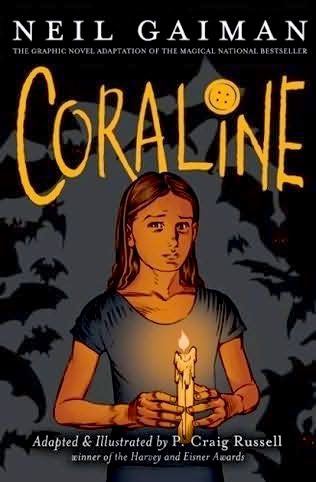
I have no idea how faithfully Russell has adapted the original novel, because I haven’t read it. To be honest, I’ve hardly read anything of Neil Gaiman’s. But I am a Miyazaki fan, and the little hint of his influence here, along with Russell’s art—of which I’m an avid collector—and the hardcover book format attracted me to Coraline. I’m sure the publicity surrounding the animated film version didn’t hurt, either. And it’s a beautiful effort, from the choice of hardcover in a kind of schoolbook finish, to the mysterious cover (Coraline with candle, surrounded by bats, evoking a Halloween mood)
Which brings me to one other point. If there's anything that bothers me about Coraline, it’s that imaginative works like this rely on just that—the reader’s imagination. Things described in prose can reveal themselves in amorphous yet clear-enough form in the mind’s eye. The film adaptation goes for a creepy, Tim Burton-esque aesthetic, all stylized weirdness and cartoony figures with giant heads and pointy noses. That, to me, matches the abstraction of personal imagination and complements it, rather than replaces it.
Russell’s art, however, makes the strangeness a bit too concrete, a bit too literal. Other Mother also has a disconcerting resemblance to Tea Leoni. Despite her button eyes, evil smirk and blood-red claws, she really doesn’t come across as either attractive enough to temp Coraline, or repulsively dangerous enough to really darken the book’s delicate sensibilities or become a truly menacing presence to the girl until nearly the very end.
Either your sensibilities and Russell's visual specificities jibe or not, but once you see his versions of the characters, settings and some of the magical events, they're apt to replace yours. So be prepared.
Still, Coraline is a lovely book to look at and read. The finely-balanced prose finds its match in Russell's ornate lines, and Lovern Kindzierski's rich coloring (gorgeous use of neutrals, nothing garish or over-modeled). Russell can seemingly draw anything, from nearly photo-realistic characters (I wonder how much he relies on photo-reference or if he just makes this stuff up all out of his head... I imagine it's a combination of both) to lush, overgrown gardens to fabulous dreamscapes tinged with mist and mystery.
I really wish comics in general would move towards this format, and more publishers would take chances on literary, self-contained works like Coraline. Between this and the very different Skim, we're starting to see the growing potential of Western sequentials freed from serialization and genre limitations.
Thursday, February 26, 2009
The Savage Sword of Coraline
At first glance? Coraline is gorgeous. P. Craig Russell draws the mundane as beautifully as he draws the fantastic, and this story seems to allow one to bleed into the other. A very handsome book; I can't wait to dig in and get to reading it. This is the kind of book I'm generally talking about when I talk about "comics." A book book. Hardcover, nice slipcover, a self-contained story of the kind you could give to just about any non-comic reader and say, "Check this out and let me know what you think."
There's an odd visual dissonance to this book, though. When you see the animated movie Coraline, and it's all stylized and cartoony and moodily lit, something like black buttons for eyes creates a different effect than when you see the same concept rendered semi-realistically and frozen on the page in fairly brightly-colored comic book panels. Not that this is a bad thing; it's just really creepy. The pages with "Other Mother" give me same queasy feeling even the mild moments in those old Clive Barker short stories used to. Other Mother looks disconcertingly like Tea Leoni, as well.
But wow, what a lovely book.
The Boris Vallejo cover painting is about what you'd expect if you grew up in the 70s era of custom vans and airbrushed murals-- sun-bronzed Conan looks fierce in his horned helmet, wielding a blood-splattered scimitar while a nearly-naked woman in chains kneels helplessly behind him. They appear to be in two different light-sources, which is certainly intentional on Vallejo's part, and there's a mighty phallic spire rising directly behind the woman in what must be some blatant sexual symbolism. It's easy to admire the technique but then feel more than a little uncomfortable the subtext. Or, in this case, the text. It's not exactly subtle.
I noticed on Amazon.com a few hardcore Savage Sword and/or Conan fans criticizing this book for not being of archival quality. I can understand their point of view; I'm just not as into it or in the same way as they are. I dig this old stuff, but it's also the sort of material I prefer to get at a low cost (bear in mind I'm paying inflated import prices here in Japan, too, even with the more favorable exchange rate I'm getting these days).
In the U.S., you can get three of these fat bastards for under forty bucks and considering the page count (over 1500) and the artists represented, that's a freakin' bargain. And I seriously wish Dark Horse would do the same thing for the Marvel-Curtis Planet of the Apes magazine. "Terror on the Planet of the Apes" and the "Future History Chronicles" are just begging for reprints. The world must see these again! Do it big and cheap, just like Savage Sword and I'll love you for days.
With money!
The other book I received is Patton: Ordeal and Triumph by Ladislas Farago. According to the cover copy, Military Bookman has declared this to be "the best Patton biography," and it's one of the sources for the classic 1970 George C. Scott film. But it's beyond the scope of this li'l comic book blog...