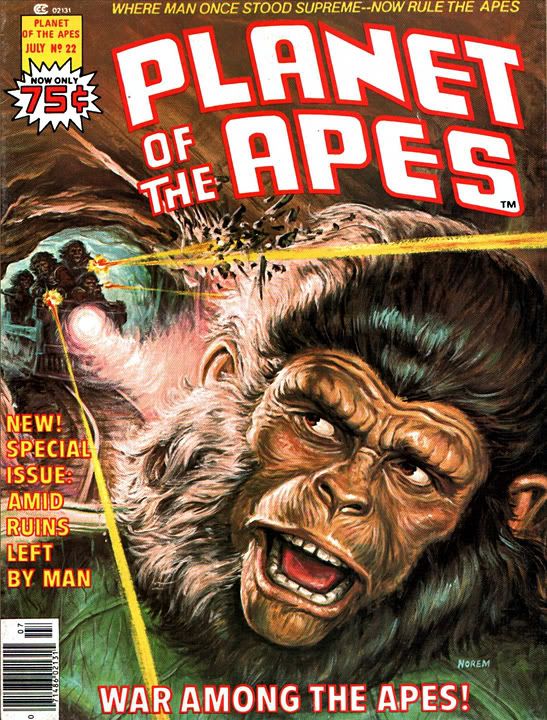
Wow! I think I really captured the true essence of Batman in this one, which took about ten minutes to draw. I forgot to put Superman in it, though.
Monday, March 9, 2009
"Batman vs. Superman"
Wow! I think I really captured the true essence of Batman in this one, which took about ten minutes to draw. I forgot to put Superman in it, though.
Sunday, March 8, 2009
Batman: The Brave and the Bold 1 Review
Publisher: DC ComicsWriter: Matt Wayne
Pencils: Andy Suriano
Inker: Dan Davis
A huge Yajimaya bookstore opened on the eighth floor of May One here in Hamamatsu. MayOne is part of the train station, and train stations in the larger Japanese cities tend to be more than just transportation hubs; they're downtown central and major shopping destinations. People call May One a department store, but it's made up of a lot of semi-independent shops with individual names. Upscale clothing shops, an import goods place called Plaza (it used to be called Sony Plaza), an art/stationery store, and now a sort of Japanese Borders, complete with an Excelsior coffee shop attached. And shelf after shelf of manga. You never see anything like this in big American bookstores. Sure, you get a shelf of graphic novels and then one of translated manga. Here, there were five or six... maybe more... complete shelves of comics, arranged by age and gender demographics. They tend to be more upfront about the gender stuff here. Shojo manga and shonen manga. Girl's comics and boy's comics.
The world's economy may be tanking, but you'd never know it by the crowd at Yajimaya. The employees worked at least four registers, and buyers lined up five and six people deep to take part in a personal economic stimulus.
Yajimaya lured me with the promise of English-language books and magazines. First I grabbed Hell's Angels by Hunter S. Thompson (a longtime fave), 1984 by some guy named Eric Arthur Blair (that's George Orwell to you and me, Russ) and Sputnik Sweetheart by Murakami Haruki. Then it was periodical time.
This Yajimaya actually carries Wizard magazine. I'm not sure how well that's going to go over with the English reading population here. I'm probably the only foreigner in town who would actually even consider buying it, and even I've long since given up on Wizard. This issue slightly tempted me because it has a Watchmen movie cover feature, but I haven't been part of Wizard's fart-joke loving/hetero-panic target audience since about 1997, and I can't imagine the writing or copy editing has improved to anything close to professional standards after all the Wizard staffing turmoil. And with an import price tag of around 2300 yen (that's about $23USD!), I just couldn't see myself buying it.
Just to the left of Wizard, Yajimaya actually had a few American comics on sale. X-Men Legacy, which didn't interest me in the least (if it had been Astonishing X-Men, I probably would've bought it), a Superman issue with the Parasite (don't know who that is, don't care) and a couple of Batman titles. These I bought just as an experiment. One was Batman: The Brave and the Bold number one.
Check out the price I paid:
Talk about sticker shock! I paid 798 yen, or about $8.12USD! Notice what it says on the price tag, though: Blave & Bold. You try learning kanji and see how easy that is.
Anyway, here endeth my digression and here beginneth my review of this neat little find. I so rarely get to read first issues of anything. As the cover copy says, this Batman comic is based on the “new hit cartoon,” which I haven’t seen. Old school Batman with the yellow oval around his bat-symbol and capsules on his utility belt. Remember that Batman, when he was merely serious and determined, rather than a teeth-gritting, “grim avenger of the night” jerkface with a Batmobile stuck up his Bat-ass?
This is a colorful kid’s comic with some of our favorite heroes given slightly sillier characterizations. Take Aquaman, for instance. He has a regal beard and countenance, but writer Matt Wayne turns him into a pompous windbag fond of giving on-the-nose titles to his adventures. And unashamedly sharing them with Batman.
Batman then jets off to London to help a conveniently located Power Girl (here sporting a costume minus the boob-window, creating a successful visual argument for its gratuitous nature) battle a giant monster amalgamated from innocent Britishers by Lex Luthor. I can’t imagine why the Prime Minister of the UK would ask for Batman, when this is obviously more a Superman-style caper. But he wants Batman, so Batman he gets.
In this more cartoony Bat-world, Batman cracks a few jokes and Lex Luthor has a nose like an unsuccessful boxer’s. He’s also one of the dimmest geniuses you’ll likely to encounter and loves to pontificate at length about his evil schemes: “One blast of my concatenation ray let me shape every human within six city blocks to the form of my choosing! Soon, it will break your pathetic bonds, complete its task and return to me! And then I’ll have it deal with you!”
Quite an optimist, to boot. Wayne’s attempt at British dialect? I’m guessing it’s meant to be part of the humor-oriented approach. Towards the end, there are a couple of really cute moments, one of which is a clever call back to an aphorism Batman coins early in the issue: “Every criminal makes one mistake.” Seems like a hasty generalization or some foolish absolutism on first blush, but not so fast my eager young friend!
Suriano’s and Davis’ art is clean and easy to follow, but has organic curvilinear lines mixing uneasily with square fingers out of a Powerpuff Girls episode. These harsh angular moves are the current trend and work fine with the hyper-stylized and geometrical Powerpuffs; I mean, their heads are almost perfectly round, so why not have people with square hands as their friends and neighbors? Here the elements are in collision and the pointy knees and shoulders seem like a lazy attempt to add "edginess" or "style" when solid drawing dynamics should suffice. Certainly the art team had to hew to the animation model sheets, so it’s difficult to fault them for matching the show's creaky designs. However, compare the interior art to James Tucker’s livelier, looser cover art, which looks like the dynamic love child of a three-way marriage between Jack Kirby, Gilberto Hernandez and Bruce Timm.
All in all, this Batman-via-Cartoon-Network vibe is bright fun for the wee lads and lasses; they're not going to share my nitpicking qualms. What matters is, there's lots of action, both Power Girl and Lex Luthor learn valuable lessons and there’s a plea for actual mail to a physical address in the back. How retro! Do they even make envelopes anymore? And despite its being printed on cheaper paper with flatter, less modeled coloring, I don’t feel much has been lost in the way of overall quality. It looks completely fine to me and just proves glossy colors and all that computer painting and rendering stuff is completely unnecessary. More grown-up comics should be formatted this way.
I still think the American suggested retail price of $2.50 is a bit steep for any flimsy monthly comic, though. And this is coming from a person who paid eight dollars for it!
"Hey Kids! It's Batman vs. Robin!"
A serious post, then a ridiculous one. That's the When Comic Books Ruled the Earth Way! This is another five minute page. In my previous post, I asked why we couldn't have a non-asshole Batman, but there's a lot to be said for a complete asshole Batman, too. Sadly, I think my version is about equal in charm to the official one.
Saturday, March 7, 2009
Hard Times for the Japanese Animation Industry and How Does This Affect Superman and Spidey and All the Other Supercats and Kittens?
It's definitely sad to think of young Japanese animators giving up their dreams of being the next Miyazaki Hayao. So much creativity and energy lost.
The article ties some of the animation erosion to shifting demographics. Animation viewers are skewing older and demanding content that limits its mainstream appeal especially in Western markets. According to the article, this leads to increased inroads into the industry by video-sharing sites. It seems almost a paradox-- animation fans are getting older and want sexier, more violent cartoons that then alienate... animation fans. There are perhaps some parallels to the current state of mainstream American comics. Demographics show comics fans older than their traditional presumed readership of kids and teenagers, these fans seem to want darker, more sexually-oriented material, potential new readers are alienated.
Occasional Superheroine describes the average (or is that mean... I can never keep these things straight) mainstream comic reader as "Male, 20-25, video-game player, disposable income, 'techie,' single." Which is cool. Nice guys and all that, not to seem too patronizing. Sounds a lot like the description of the typical otaku, the Japanese "fanboy." Or, his more cuddly, slightly more socially acceptable brother, the akiba-kei. Although some of these otaku and akiba-kei take their fannish ways to extremes that would shock even the most hardened unfairly generalized parent's-cellar-dweller stereotype genre geek.
But getting back to the American comic fan. These guys are only a small segment of the overall national population and therefore only a smidgen of the potential audience for comics. I'm not going to argue mainstream comics need to be taken away from them, or changed from what they enjoy. Comics for them, comics for me, comics for everybody. But what I am concerned with are limited choices creating a limited readership. Limited genres, limited story choices, limited character presentation, limited aesthetics.
Why not another Batman, one who's less of an asshole? Why not more stuff along the lines of DC's All-Star titles, a more condensed, iconic version of various characters? I'm sure more people think of Spider-Man as Tobey Maguire than they do of him as Peter Parker. Why not construct something along those lines, capturing Spidey's essence, without getting too bogged down in his history? Why not... and this is my biggest, fondest wish... a greater selection of genres? In Japan, you can read about comics about sports, about relationships, about little old ladies, aspiring musicians, doctors... just to name a few. And these are mainstream, not niche. They're in bookstores, right out in the open. The new Yajimaya here at MayOne has shelf after shelf of comic books, arranged by age and gender. I don't see an American equivalent to that, just a shelf of mostly superheroes in a Borders or Books-A-Million... half the space filled with these delightfully diverse Japanese imports!
Are we shutting out readers to cater to a limited market, or is this audience all we can realistically expect for comics? Comic book movies are all the rage (or so I'm led to believe) and must be selling tickets to a wide spectrum of people in order to rack up those impressive box office figures each year. So I tend to think the larger audience is there, somehow, somewhere. But would broader-appeal comics actually sell? I wonder in a market that's seen audience-grabs like DC's Minx imprint falter.
Could be it's all a matter of perception. In Japan, you generally don't want to be seen as an otaku. Perhaps a similar resistance to comic reading will always exist in Western markets, by which I mean primarily the United States and Canada. There may simply be readers who will never read comics in the same way there are millions of people who rarely read anything, including newspapers. The Western otaku may be comics last best hope... but I tend to doubt it. Certainly he's part of it, but not the whole.
Well, I'm touching the surface and that only generally. There must be more factors involved, things like economics, competition from other media, perceived quality, things beyond my meagre abilities to analyze. The list could go on and this is mostly a blog for making fun of stuff I like. Talk about your paradoxes! So I'll leave you, my much smarter (and possibly better looking) reader, to figure out what it all means and where it's going.
"Hey Kids! It's Batman vs. the Nerdy Guy!"
Friday, March 6, 2009
Ape-Quest '09: "Quest for the Planet of the Apes" Edition!
Actually, the more than adequate Rico Rival drew part one of the story we're about to dissect. However, the beyond awesome Alcala did draw part two. We'll be getting to him in the next installment.
I own a ton of these crazy magazines. Oh the glories of discovering EBay and finding out I could own again the oversized, phantasmagorical stories that frequently caused me to sleep with the light on as a child. I bought them (about 15 or so, including multiples of #1) back in the late 90s before Timothy Burton's brain-dead reimagining and the comics grading services drove the prices sky high, like ol' Colonel Taylor's arrow-shaped spaceship. I'm still waiting for them to pass through a Hasslein Curve and re-emerge into normal space at a price point I can afford.
I'll just forget #29. That one suffered from limited distribution and due to the laws of scarcity commands obscene prices these days. However, if you want to send one to me because you're a nice person, just email me for my address. I do accept gifts. I do indeed!
Anyway, once again, Rico Rival drew this. At some point in the 70s, American comics editors looked to the Philippines and discovered the Filipino comic artists had created some sort of time-space vortex with their pencils and subsequently were capable of drawing entire books in a matter of moments, coalescing them out of nowhere like a scene from Koyaanisquatsi, if Godfrey Reggio turned his time-lapse camera on funny books. Guys like Rival, Alcala, Nestor Redondo and others regularly cruised past the Kirby Barrier, laughing all the while. All they were lacking was Philip Glass to provide the soundtrack.
And Doug Moench wrote the script. Moench wrote all the Marvel Apes stories, and if you ask me, he exceeded his mandate. To Kurtzian levels. He went to mad in the jungle and Marvel should've sent Archie Goodwin upriver on a steamboat to bring him back and be held accountable. His methods were unsound. Imagine being an 8-year-old and expecting Roddy McDowall in an ape mask and instead getting buckskin-clad mountain-man type chimps fighting giant, mutated frogs, disembodied brains that talked like 30s gangsters, magical future hippies, an all-gorilla branch of the Ku Klux Klan and city-ships plying dead seas, their banks of oars manned by human slaves. Kids were mentally scarred for life reading these unholy things.
Oh, I kid Moench. I kid because I love. Doug Moench brilliantly took the basic Apes premise and expanded it in ways startling and lurid, occasionally, downright ridiculous. The latter is best exemplified by the bionic apes Moench introduced as sales flagged and the magazine slowly died. Yeah, that's not nearly as ludicrous as the story about the guy who's so obsessed with rescuing Taylor he hypnotizes himself into the future and ends up becoming a knight on a special island where apes and humans have recreated Camelot...
The Sir Thomas Malory Camelot, not the JFK one. Although it'd be really cool to see chimps in gray suits with razor-thin ties discussing what to do about the Cubans erecting missile launchers and Soviet ships bringing in the nuclear missiles for them to vaporize anti-Casto hotspot Miami.
When Moench wasn't alternately frightening children (me) into wetting their (my) pants or inverting Mark Twain, he was adapting the 20th Century Fox film series. He managed to serialize all 5 films, but the most interesting oddity has to be Quest for the Planet of the Apes, where he takes characters from Conquest of the Planet of the Apes and Battle for the Planet of the Apes and provides an interim tale that fills in some of the story gaps between the movies. Even if some of his ideas were a little oddball and outside of the film series' continuity. Let's take a look at the splash page...
Ho hum. Just another boring day of abusing the elderly, loin cloth-wearing human denizens of Ape City. That's General Aldo- that most vicious of ape soldiers- played in the movies by Sheriff Lobo himself, classic character actor/heavy Claude Akins. Aldo took leadership classes taught by Naomi Campbell at the Leona Helmsley Institute for Labor Management Theory. Graduated at the top of his class.
To Aldo, the problem isn't so much the quality of the humans' labor as it is the speed at which they work:
You want it done fast, or do you want it done right? Aldo prefers fast. Maybe if Aldo relied on a younger labor pool, things would get done to his satisfaction. But in a world where nuclear weapons have erased most of modern civilization, able-bodied employees are difficult to find. And also proper business attire. Unless this is Casual Friday. Very Casual Friday. Things have degenerated from slobs who think it's funny to wear Hawaiian shirts to creaky old bastards in soiled diapers.
Luckily for Grandpa Loincloth (of the South Bend Loincloths), upper management drops by to check on progress:
Moench was working from the original scripts, rather than from the films themselves. According to the film version of Battle, Governor Breck was long since dead, killed during WWIII. So Don Murray was spared the indignity of having to grow a grizzled beard and wearing a loin cloth to recreate his villainous role. The original MacDonald also vanished, replaced by his brother, also called MacDonald. Both MacDonalds were interchangeably sympathetic to the apes' plight. This is the first one:
I also have to point out that in Battle, the humans didn't wear leather diapers. They actually wore normal clothing, kind of a mix of Land's End and Outdoor Outfitters. Khakis, earth tones, but recognizably modern in a 1970s kinda way. Not even the homespun stuff they wore in the Apes TV series. In Rico Rival's imaginative take, they're outfitted by Botany 5000BC. Rae Dawn Chong flashed less skin in Quest for Fire.
It's not a 1970s comic without tons of navel-gazing characterization expressed in some awkward, on-the-nose dialogue that sounds like nothing a human being or talking ape would ever say:
Oh, come on! "So I noticed, dear, from all your tossing and turning -- but did you have to light a candle to stress the point?" At this point in the story, Lisa had only been speaking for a couple of years or so. Evidently, she learned how to do this from watching episodes of Dragnet 1967. I think she would've referenced Caesar's cow mouth and whore's heart, but really it's Moench's call. I'm sure he steeped himself in Apes lore, watching the films endlessly until he internalized Lisa's personality and motivations so much so that in his imagination he actually became her while writing this moment, and I'm totally full of shit.
"I almost wish I'd never even led that revolt!" Here Caesar shows his emo side, moaning his discontent to his wife the way a generation of kids on an alternate earth would someday whine in frighteningly narcissistic and solipsistic video blogs on YouTube. Yeah, your people would've been much better off staying under humanity's yoke. Remember when Governor Breck's assistant Kolp strapped you to the torture table and electrocuted you? You were pretty cocky then, weren't you, Caesar? Ready to shake the earth, eh?
"I almost wish I'd never even met you!" "I almost wish I'd never even loaned Brad the keys to my car!" "I almost wish I'd never even drank that last beer and driven over the neighbor's dog!"
As you can no doubt guess, someone tries to blame the humans for firebombing Caesar's tree house. Humans get blamed for everything. Who polluted the earth? Humans. Who initiated the thermonuclear war that destroyed civilization? Humans. Who produced the film Patch Adams? Humans.
Here Moench sets up the Caesar-Aldo rivalry Roddy McDowall and Claude Akins would so ably limn in the movie. Aldo thinks a warlike gorilla should be the boss; Caesar thinks a mopey, insomniac, finger-pointing chimp would do a better job. Thankfully, we here in America have a representational democracy and never have to worry about the lesser of two evils being foisted on us by events beyond our control.
Aldo's solution is for both apes to test themselves:
A veritable quest. A literal quest. Hence the story's title. There's nothing for master politician Caesar to do but pose heroically and pretend it was his idea all along:
Here's where things become epic. The cool thing about comics is, there's no need to budget for special effects or locations. It's just as cheap to draw Caesar on location in a destroyed metropolis that stretches from irradiated horizon to irradiated horizon as it is to stick him on the old Fox Ranch in front of some shabby treehouses. Moench could've typed, "Caesar builds a rocketship shaped like a mechanical spider and makes a speech via television from his magical toy store on the dark side of the moon," and Rival would've drawn it exactly as described at virtually no cost whatsoever to Marvel. So when Moench calls for a scene were Caesar surveys the collossal wreck of humanity's aspirations, Rival rises to the challenge with a huge panoramic panel:
Yeah... uh... nevermind that in the film Battle, set years after this, Caesar would disavow all knowledge of these ruins and his first glimpse of them there is just as shocking to him as shown on this page.
Another thing Rival could do the film series couldn't match is give his apes actual facial expressions. McDowall and his original co-star Kim "Zira" Hunter discovered that, in order to create the illusion of ape faces rather than masks, they had to contort their own faces almost constantly and overplay their emotions. This kept the masks in motion. And they did a wonderful job under the constraints of relatively primitive prosthetics. Rival, unhandicapped by make-up technologies, gives his apes wild eyes and wide, screaming mouths.
He's also free to give them subtler expressions, such as the second panel here where Aldo looks dopey:
Aldo finds an armory, conveniently labeled "Armory," (although I doubt he can read) and decides to take a proactive stance vis-a-vis the question of Ape City leadership:
Aldo repeats himself. The lonely gorilla, with his clumsy, powerful body, talks to himself like a small child. Actually, repetition was a hallmark of his speech-making style in Battle: "We need guns! Guns mean power! We need guns! Guns mean power!" And so on and so forth. Aldo believes if you take a simple, strong idea and create a catchy aphorism for it, it will catch on fire!
The future belongs to Aldo, baby! Bring on the guns! Up with apes, down with people! I believe gorillas are our future/Give them lots of guns and let them lead the way/Show them all the beauty they possess insiiiiide...
Oops... I mean- Hi, Governor Breck! So nice of you to join us! Go humans! Woo! Humanity rocks!
Thursday, March 5, 2009
"Museum of Terror: Tomie 1" Review
Publisher: Dark Horse
Script and Artwork: Ito Junji
Translation: Naomi Kokubo
I believe the sales for this series have been somewhat disappointing for Dark Horse, which confounds and confuses me to no end. Ito Junji's deliciously repulsive work just doesn't seem to have found the audience it deserves in North America. A curious lapse in taste by manga consumers. But forget that for now. Instead, let us praise Tomie... both the manga and the character!
Tomie. Who or what is Tomie, exactly? She wears the shape of an extraordinarily beautiful young girl, one so alluring that men are driven to obey her every whim until the pain of loving her becomes so strong they must kill her and chop her into tiny bits. But each piece of Tomie has the power to regenerate into a completely new Tomie.
It's difficult to know what to make of Tomie. She's both victim and victimizer. She views men as playthings, is possessed of both an extreme narcissism and a complete ruthlessness. But due to the serial nature of her stories, and their relative lack of continuing protagonists, Tomie becomes the centerpiece and so goes from inhuman monster to anti-hero.
Our first glimpse of Tomie is
this innocent "snapshot" pose.
She's even sympathetic. While Tomie's siren-like gift/curse frequently proves her own undoing, it's something she didn't ask for. It may even be something she can't control- maybe this ability drove a perfectly decent human being completely over the edge. She destroys lives, but frequently does this out of revenge. Many of her victims come to grief because they themselves occupy a sort of moral gray area.
You'd do this for your best friend,
too... wouldn't you?
Think about what life must be like for Tomie, the girl with only one true friend. What would you do if you had an affair with a teacher behind your boyfriend's back and the the two of them not only caused your death but then involved your entire high school class in a grisly cover-up? While the girls keep a look out, Tomie's teacher has the boys strip and saw her into forty-two pieces. They then wash away their guilt in a nearby river, and everyone takes a part of Tomie home to dispose of.
Tomie's best friend, Reiko, gets the heart, which she tosses from a bridge. Imagine everyone's surprise the day following Tomie's funeral when she shows up for class, no worse for wear, apologizing, "Sorry I'm late."
It's really hard for me to feel too much sympathy for the teacher when he's carted off to the mental hospital that very same day.
Why didn't this happen to me
when I was in the hospital as
a teen?
Writer/artist Ito Junji presents a relatively benign Tomie in the first tale, simply titled "Tomie." He uses one of his signature storytelling devices by having it narrated by the elfin, short-haired Reiko. By the second story in this volume, "Tomie Pt. 2 (Morita Hospital Episode)," Tomie's personality becomes more manipulative and sinister.
Tomie demonstrates a novel
way of cleaning your home
aquarium.
Here, we find Tomie involved in a love triangle that includes a severely ill classmate (another elfin, short-haired girl) and her semi-boyfriend. When the boyfriend murders Tomie, her kidney is transplanted into the sick girl... with horrific results.
Tomie, take 3!
The crazed teacher from the first story makes a reappearance, this time claiming to be Tomie's father. Ito's nasty shorts are true horror tales in there's rarely a chance for happy endings. He also proves himself a master of foreshadowing. Discovering that Tomie is the unfortunate girl's organ donor provides the reader with a dreadful sense of anticipation... something Ito skillfully pays off with a nightmarish sequence involving an emergency Tomie-dectomy.
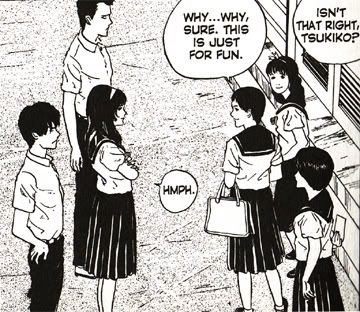
Tsukiko and customers face down
Tomie and her henchmen.
As grisly as that story is, the whole saga really blossoms with the next sequence starting with "Photo." Easily the best story in the book, "Photo" features a ethically compromised protagonist, a budding photographer who cheerfully and matter-of-factly explains:
I'm Tsukiko Izumisawa. I hang around with the photo club. I also sell dreams to the pathetic and lovesick. My friends tell me which boys they're into. I snap their pictures, then charge through the teeth.
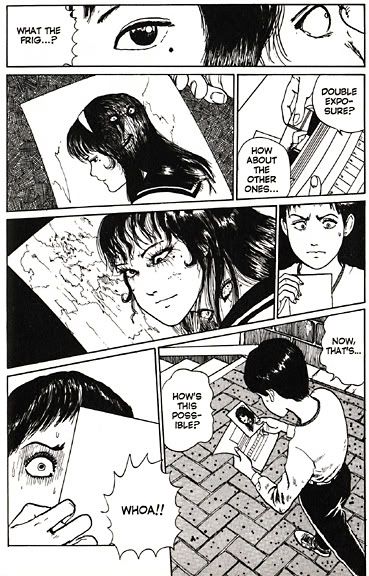
That's Tomie... lovely in person,
but not particularly photogenic.
Tsukiko is yet another elfin, short-haired girl! And unfortunately for her, her little racket falls afoul of the school's new Ethics Club president, the mysterious and lovely Tomie. Tomie begins this story as a very straight-laced (if somewhat conniving) character, always attended by her two bodyguards/fellow club-members.
Oh, Tomie! You so crazy!
It doesn't take long for things to morph from an accurate reportage of teen age angst in a sort of pre-Ghost World mode to murder and mayhem... kind of like the movie Heathers, if the title trio weren't just bitchy rich chicks but instead were a single girl with supernatural regenerative powers and a icy heart.
The Tsukiko saga continues for two more installments: the horrific "Kiss," and then the Grand Guignol finale, "Mansion," where we learn of Tomie's origins as Tsukiko confronts her nemesis at her dark, gothic house. It comes complete with moving suits of medieval armor (European-style for that classic haunted house touch) and a mad scientist... plus a secret in the attic. The story ends in a sort of H.P. Lovecraft homage featuring some of the sickest drawings I've ever seen.
Remember... when pursued by
lovesick killers, hide in a small
room with only one, easily-blocked
exit.
Her story told, Ito abandons the charming Tsukiko for three stand-alone tales of Tomie horror. The first, "Revenge," is a fast-paced tale of mountain climbing adventure that turns cannibalistic when Tomie gets involved. The second is the dreamlike "Waterfall Basin," and the volume concludes with "Painter," where once again we see the maliciously manipulative Tomie putting her skills to bad use.
Ito is a skilled draftsman, working in a unique style. It's moody stuff, completely without those ever-popular manga visual cliches-- the giant eyes, the single sweat droplet, the super-deformed emotionalism. Instead, Ito's art approaches a comics universality. This is a book even the most diehard anti-manga hater could pick up and enjoy. Ito grounds his characters and their looks in solid reality, which amplifies the "special effects" moments. For the most part, Ito's cast looks natural and realistic. You know, until they morph into grotesqueries.
Ito's line quality is sometimes dithery, especially in the earlier stories. But as the book progresses, he becomes more artistically assured. By the time he's drawing mutated monsters and fetal Tomie-creatures that cackle gleefully as they attempt to seduce even from within experimental jars, Ito proves himself a modern master of horror imagery, easily the equal of such popular American horror artists as Graham Ingels and Bernie Wrightson.
You know you're supposed to
read this stuff from right-to-left,
right? Go back and read the previous
pages and they'll finally make sense.
If he has a flaw, it's in the stiffness of his posing and reliance on similar body types. Most of his male characters are spidery, spindly guys with longish arms and legs. And of course, he seems obsessed with those elfin, short-haired girls.
Those minor points aside, Ito is one of comics' finest genre writers, and his plotting abilities are second to none, especially in these short-form stories. Skillfully using narrative framing devices and flashbacks to enhance the horror, Ito keeps his stories moving at a rapid pace. Horrors build on horrors, but Ito also slips in little moments of humor, such as when Tomie's Ethics Club (that in itself is a delicious irony) henchmen tie Tsukiko to a table in her room, then have to perform impromptu surgery on their goddess, only to botch it. In a uniquely Japanese touch, they carry the results from the bedroom in one of the ubiquitous plastic combini (convenience store) bags Tomie earlier used to tote snacks.
It's also a good idea to confess
your love to the guy who's about
to garrote you. He'll still kill you,
but at least he'll feel guilty about it
later.
The Tomie 1 stories are disturbing yet fun, shot through with the freaky yet compelling logic/illogic of dreams. And because there's no continuing central character beyond Tomie (or to a lesser extent, Tsukiko), the reader becomes drawn to the monster-girl, imbuing her with qualities and depth beyond mere villainess. Especially since we never really learn which Tomie is the real Tomie; for all we know, the primary Tomie was a perfectly normal girl despite her mutation and it's merely the trauma of being murdered and reborn repeatedly that causes her to lash out and destroy men.
The translation by Naomi Kokubo and Eric-Jon Rossel Waugh (who did the localization) deserves a special mention because it is absolutely superb, giving the characters believable and distinct voices without relying on slang or cutesy verbal devices. The teens sound like teens, the doctors sound like doctors and Tomie sounds like nothing you've ever encountered- by turns charming, devious, innocent and then completely inhuman and monstrous. Chris Claremont wishes he could write dialogue this natural.
An ideal translation doesn't simply substitute one language for another; it amplifies and complements the source material and the author's original intent. I wish I could read this in the original Japanese, but I can hardly imagine it to be any finer than Kokubo's work here.
Ahhh... Tomie... how I love your stories. Now please don't kill me!