Monday, March 16, 2009

Comics That Destroyed My Mind 2: Weird War Tales #32!

Hmm… another war comic. No, I wasn’t a little war-monger in 1974; I was merely an imaginative kid steeped in the martial traditions of my country. America’s direct military involvement in Vietnam had ended the year before with the signing of the Paris Peace Accords, and in the coming year the war itself would conclude with a victory for the communist North and that infamous scene with the helicopter taking off from the roof of a Saigon apartment building.

I’ve read about soldier-boy toys like GI Joe losing their popularity as America’s disillusionment with the military-industrial complex grew in the early 1970s, but you would never have known it if you lived in south Georgia suburbia, where we fought massive battles with the Marx Toys “Guns of Navarone” playset, watched syndicated re-runs of The Rat Patrol on TV and un-selfconsciously waged war amongst ourselves with plastic rifles and kid-sized army uniforms.

And we read war comics unapologetically and even semi-patriotically; the Americans were always the good guys and always won, and while we might sympathize with individual German or Japanese soldiers (like Enemy Ace or the kamikaze pilot from the famous U.S.S. Stevens tale by Sam Glanzman), we also expected them to die at the story's end. We read of Sergeants Rock and Fury, and also DC's bizarre hybrid of war and horror, perfectly poised to fit whatever peacenik zeitgeist was supposedly floating in the air of the Me Decade, Weird War Tales, the comic hosted by Death.

But more important to me personally, Weird War Tales #32 is yet another comic containing a single panel so shocking to my six-year-old self it’s come back to haunt me time and again over the years. But, as I learned while rediscovering Our Army at War #271, memory is a very tricky thing. It’s faulty, very subjective, especially as the chronological gap grows between initial observation and later remembrance.

Once again, I have no idea how I came to own this comic. Maybe my parents bought it for me. I loved Godzilla movies when I was a kid, and who can argue with the cover-- a giant, fire-breathing beast killing the snot out of a bunch of Nazis? It looks a little like something out of Marvel's pre-Fantastic Four monster titles. Too bad there's nothing remotely resembling this image anywhere inside the comic. It would've made one helluva story.

The two things I actually thought I remembered about Weird War Tales #32 were the robotic Japanese soldiers... and the general who made a deal for immortality and paid a horrific price for it. But my brain really did a number on those stories over the years, twisting them all out of shape like those ink images we used to pick up from the newspaper funny pages on Silly Putty, then bend and stretch until Dick Tracy or Charlie Brown looked even more like sideshow freaks. Obviously, I'm not one of those eidetic memory people, although some of my friends seem to think I am.

No, I may have Rainman's social skills, but I'll never have his card-counting abilities. No trips to Vegas for this kid.

Take, for example, how my brain mish-mashed the story “Mission Into Madness.” It’s just a two-pager. Two measly pages! But over the years, I really embellished it. I remembered it being much longer, with the US Marines hitting the beach of a Pacific island in a massive amphibious assault only to run into much stronger resistance from the Japanese than they’d expected. And in the end, they get a shock when they discover they’re fighting not men, but robots. About the only thing I remembered correctly were the Japanese robot soldiers. Actually, a mere three OSS agents paddle a rubber raft onto the beach, and from the dialogue, they’re very much aware they’re tangling with mechanical men.

Well, that was a cool little tale, but hardly frightening, even with its implication future iterations of the war-robots will be more effective. The story that scared the shit out of my six-year-old self was “Glutton for Punishment” by Jack Oleck, with art by someone named Jodloman. And even that one wasn't safe from the ravages of my creaky brain-waves. The way I remembered it was some Greek general from Alexander’s army makes a deal with Satan for immortality so he can conquer his own empire.

Actually, the protagonist is a Crusader knight, a fat gourmand at the head of a large company of men who hate his guts. I’d completely forgotten the food aspect, as the commander and his men haven’t eaten for several days as the story begins.


Instead of Satan, a ghostly Saracen named Ibn Said-- is he demon, sorcerer or djinn? The story never tells us-- comes to the commander's tent and offers a feast, but with a catch. If the commander accepts, he can live as long as he wants, until he requests to die, after which he’ll be Ibn Said’s slave in the afterlife for eternity. Being a fat pig, the commander can hardly resist and digs into the food with relish, sneers at Ibn Said’s terms. After all, who would ever ask to die?

His courage bucked up by his seeming invincibility, the commander throws himself into the campaign with surprising vigor… only to lose an ear to a Saracen’s scimitar. Shocked and in pain, he orders his men forward, then confronts the spectral Ibn Said. The commander shouts, “You! How-- Trickster! You lied to me! You promised me I wouldn't be hurt! Liar!" And Ibn Said gently replies, “Liar? I promised that you would live until you asked to die, Commander, nothing else. Remember? I regret your injury, of course, but-- ”

No matter, it’s just an ear. The knights attack another Saracen city, and this time, the commander loses his left eye. Now he’s really getting pissed at Ibn Said, and his troops are starting to think he's not only an asshole but an insane asshole.

One thing that makes this story so effective is Oleck’s use of the traditional motif of threes. You know how that goes—in folktales and jokes, the third time is always the charm. The first odd prime number, Dante's Divine Comedy has three parts of thirty-three cantos each, the Three Little Pigs, Three Billy Goats Gruff, the Holy Trinity, the original Star Wars trilogy, their crappy prequels, Three's Company starring the late John Ritter as Jack Tripper, good things and bad news come in threes, three is the magic number. After the commander receives two wounds, Oleck has foreshadowed something nasty. What body part comes next? What loss will cause the haughty commander to beg for death, giving him his richly-deserved comeuppance?

The greedy, hateful bastard meets his doom trying to get to safety at Jerusalem, after allowing the Saracens to wipe out his army. Forced to take shelter in some ruins, the commander and his few remaining knights suffer bombardment from Greek fire (the half-remembrance of which I think altered the story’s time period in my mind over the years). The smarter knights flee, but the enraged commander chooses to stay. After all, he’s immortal now. Ibn Said taunts him as the Saracens score a direct hit on our livid fatso with their fiery weapon…

And here’s where things get gruesome. In the aftermath, we see Ibn Said standing triumphantly over what’s left of the commander… a burnt, limbless hulk. Hair singed off, naked and in excruciating pain. But his mind is still working. He manages to argue his way into an alteration of the original bargain and has Ibn Said “put [him] back together.”

The result resembles an overcooked baked potato that somehow rolled behind the refrigerator, picking up dust bunnies and cobwebs, a thing with no arms but with over-sized hands sticking out of its buttocks. The commander begs for Ibn Said to kill him, but the ghostly Saracen is walking away. Death, the narrator, gloats that the commander can still eat, “If he finds someone to feed him, that is.”

Now that last page scared the living shit out of me as a six-year-old. The hideously deformed commander is bad enough, but the thought that Ibn Said just left him alive and immortal and in that condition gave me nightmares that night. For weeks afterwards, I had this fear that one day, I might actually meet the commander, perhaps in my own bedroom. He’d be standing there on his gnarled hands, his flabby body naked and crawling with scar tissue under the incandescent light that ordinarily seemed so comforting but now offered only a brightly illuminated view of the follies of both gluttony and war.

But the way I long remembered the last panel was as a full-frontal shot of the commander’s new form. Instead, it’s a shadowed rear angle. You get to see his burnt ass, though. And we all love burnt asses, right?
I don’t really understand why Ibn Said didn’t take his soul. There's nothing in the dialogue suggesting they changed that part of the deal. Ah well, it's just a small plot hole, not enough to ruin the story. Or prevent me from carrying its final panel in some form or other around in my mind for more than thirty years.

Sunday, March 15, 2009

Comics That Destroyed My Mind 1: Our Army at War #271!

Summer, 1974.

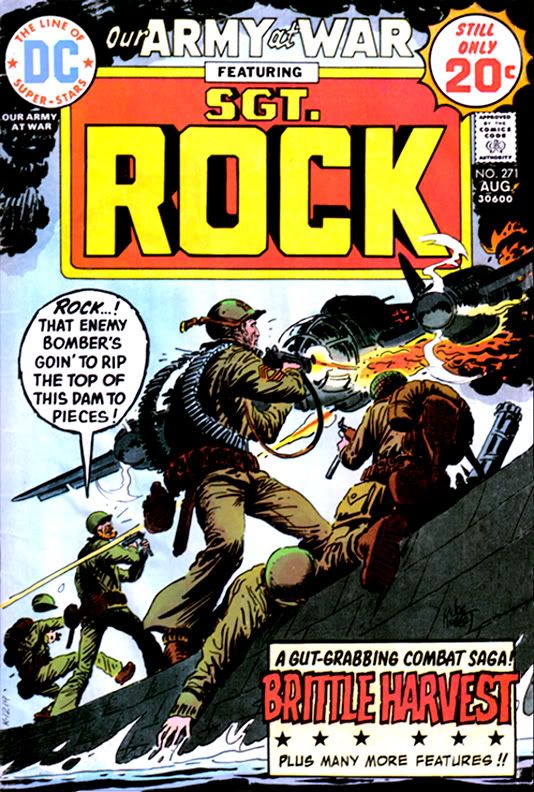
As far as I can remember, this was the first comic book I ever read, perhaps the first narrative as well. Family lore has it I was reading street signs and things like "Season's Greetings" on holiday decorations as early as age four. But I was around six years old when this comic came out, it's the earliest comic I have distinct if untrustworthy memories of, and after all these years, I’m not even sure how it came into my possession.

Perhaps my mom bought it for me as a reward for not acting like a little bastard (for once) on one of our grocery store trips. Or maybe I inherited it from one of my brothers’ friends. My oldest brother was sixteen and more into sports and funk music than comics; in fact, he was never into comics. My middle brother, then only fourteen, was similarly inclined, but leaning more towards cars and girls. They both had some buddies who had outgrown comics, and sometimes as the little tag-a-long, I was the beneficiary of their largess. But I can’t imagine any of them owning a brand new comic book, or admitting it if they had.

In my mind’s eye, I picture myself reading Our Army at War #271, sprawled face-down on one of our folding beach loungers, the one with the backings made of thin vinyl tubing in white and green, on the back patio of our red-brick ranch house on Forest Glen, every neighbor a friend. My dad built the patio cover himself out of sturdy wood and roofed it with these strange, corrugated white and yellow tiles that let some of the sun’s glare through while still providing shade.

In the summer of 1974, the patio was the ideal place to relax, hot and humid as the south Georgia summer always was, grass neatly cut, the birdbath nearby alive with splashing bluebirds and jays, Mom’s azalea bushes dark and full-leafed, and swaying loblolly pines full of squirrels. Cars passing up on 12th Avenue, their tires whirring and providing a regular tidal sound, the scene as a whole quite comfortable and soothingly womblike.

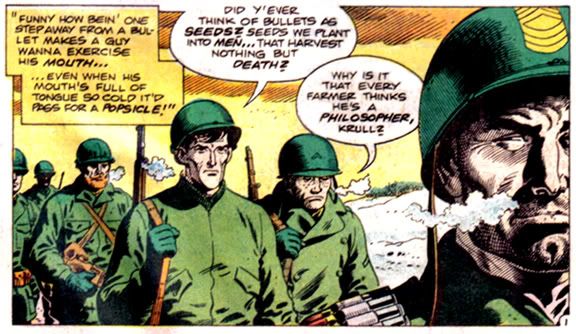
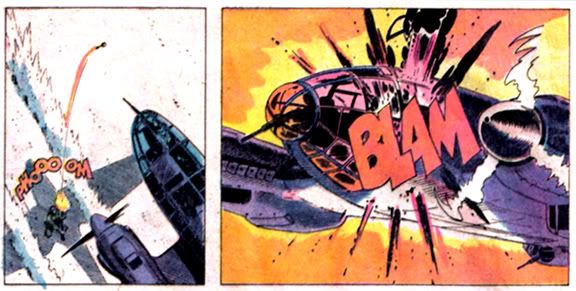
Yep, the perfect setting to read about Sgt. Rock and his Easy Company joes slogging it through some icy battlefront, their breath vaporizing into little white clouds in every panel. I never forgot that seemingly insignificant detail, nor the story’s title: “Brittle Harvest.” Certain details were lost to memory, like the farm boy soldier knocking down a Nazi bomber with a rifle grenade. Memory is fallible. It's difficult sometimes to tell which are actual memories and which are retroactive falsification, the mind trying to be helpful by filling in the blanks for you.

For example, all through the years I thought the solid if unspectacular Frank Redondo pencilled and inked this issue. After all, the elusive Redondo drew about a billion Sgt. Rock tales in the 1970s and 1980s, practically every one I read as a kid and young teen. Imagine my surprise when I discovered years later the spectacular Russ Heath drew it. Russ is one of my all-time favorite artists, and did his best work for the black & white Warren magazines, especially "Give and Take," the story he did for Blazing Combat where he combined an almost mechanical fine-line hatching that prefigured Brian Bolland by a number of years with gray ink washes that gave incredible depth and an almost sfumato quality to the imagery.

But his four-color art jobs for DC were always cleanly rendered, and with more verisimilitude in terms of uniforms and vehicles than Joe Kubert’s more Impressionistic take on Easy Company’s adventures. Oh, and as you can see above, this issue has an action-packed Kubert cover. As much as I love Heath, Kubert is the name linked to Sgt. Rock in my mind. Kubert is another favorite and I cannot get enough of his work. I always bought DC war comics hoping against hope Kubert would have some sequential stuff inside; imagine having to settle for Heath.

One thing I noticed when re-reading this recently—and this is how I remember most of the Rock tales—Easy Company almost always seems to be flat-hatting it on these endless, lonely patrols. Sometimes they have definite objectives, but usually they’re just out there, encountering seemingly random assaults by the Germans. A solo halftrack here, a Tiger or a Panther there.

Easy rarely, if ever, seems to participate in attacks on towns or strongpoints with other units. There are no fire and maneuver tactics where they lay down a base of fire then attempt to flank the enemy, rarely any armor support. In this story, they use the unorthodox method of rolling giant snowballs at a German machine gun nest, then watch as a random fly-by from a P-47 Thunderbolt finishes the job... and later, that insane “one-in-a-million” grenade shot accomplishes their entire mission for them.

I also can't remember ever reading an Easy story detailing anything about the chain of command or the company's battalion, regiment or division, although I remember Rock occasionally discussing things with a “looey.” Also, the mountainous yet tree-less terrain in this story doesn’t seem to correspond to any place the US Army fought over during the winter of 1944-45 in the ETO. It certainly doesn’t look like Belgium or France. Maybe Easy’s in Finland for some damned reason known only to their absentee CO.

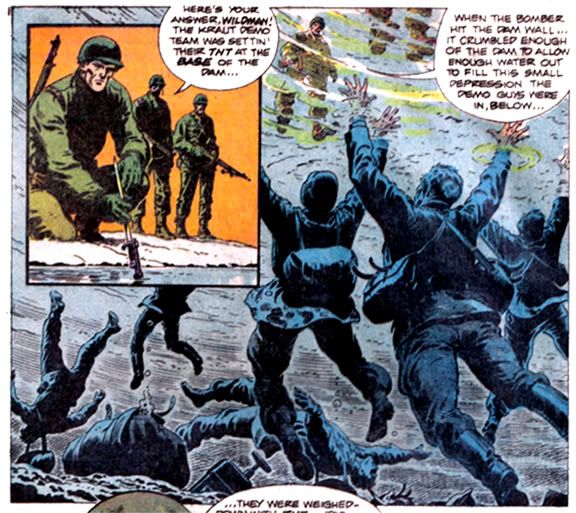
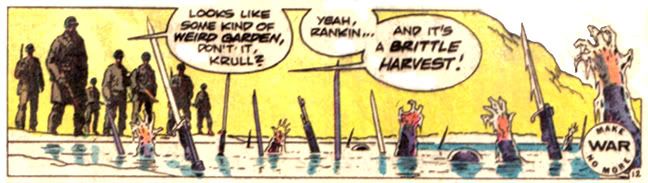
Don’t let anybody con you into believing Bob Kanigher’s war stories are the ultimate in comic book realism. They aren't as wacky as Stan Lee's Sgt. Fury and His Howling Commandos, but they aren't Band of Brothers or even Norman Mailer's Naked and the Dead. What they have going for them rather than any kind of reportorial quality is a vaguely downbeat, depressing mood, more truthful in spirit than fact or documentary-like detail, I guess. They say more about the general human condition than educate readers about how it really was for an infantryman during WWII. And they frequently have impressive hooks, like this story’s hauting final image, beautifully realized by Heath… the clutching hands of the frozen German soldiers poking through the ice at the base of a wrecked dam.

As untrustworthy as memory is, that’s a comic book panel I’ve never forgotten, not since that summer day so long ago when words on the page began making sense and I first understood a comic book about some GI named Rock. "Make War No More."

Friday, March 13, 2009

"Renaissance Fools! Once I Remove This Accursed Brick From My Mouth, I, Dracula, Lord of the Undead, Will Laugh to Scorn Your Ineptitude!"

Archaeologists working in Italy recently uncovered the remains of a particular type of vampire called a "shroud-eater." Shroud-eaters were vampires who, for some reason, ate holes in their burial shrouds and could cast powerful magic spells. Hopeful yet backwards 16th century vampire slayers buried the poor woman with a brick shoved into her mouth, thus providing still more irrefutable proof people once believed vampires to be not only a menace, but also as dimwitted as themselves.

After all, how difficult would it be for one of the undead to pull a simple brick from her mouth? If the brick goes in, the brick must also come out. Especially if it's in the mouth of someone who can rise from the grave and cast magic spells. That thought never occurred to vampire slayers in the 1500s.

Many traditional defenses against vampires play on this notion the undead are idiots. For example, one way you can defeat a vampire is by scattering poppy seeds around its grave. The arithmomaniacal bloodsucker will be so distracted counting them all, it will never notice the impending sunrise until it's too late. Poof! Apparently, if you can't find poppy seeds, you can just use millet. Another method is to bury the potential vampire (suicide, criminal, anti-social what have you) at a crossroads. This will confuse the vampire and it won't know which way to go until dawn. Again, POOF!

But if comics have taught me anything, it's that some vampires are too highly cerebral to fall victim to bricks in the mouth, or poppy seed counting, or geographic confusion. That's why the best way to defeat your genius-level vampire is to shoot it with an "arrow of white thorn wood:"

Rachel van Helsing. She knew vampires were too smart to fall for any of those dumb Renaissance tricks. Vampires require a more direct, violent approach. You can also defeat a vampire by jabbing it with a silver spoke from your explosives-laden wheelchair, and if that fails, simply by stabbing it with a silver knife then blowing yourself and it to smithereens.

Vertigo Pop! Tokyo

Japan, a cold, rainy Friday night in March. I'm thinking tumultuous thoughts of mortality and art. I spent all day giving out White Day choco a day early in a "one for you/two for me" ratio and now I'm crashing hard from the sugar rush, a headache forming on the left side of my skull. Rain and sugar and romance go together, but when you have the wrong two out of three, you have little or no use for any of them.

Instead, what you need, what I need and what I've pre-ordered from Amazon.co.jp is the trade paperback Vertigo Pop! Tokyo Days and Bangkok Nights, collecting two Vertigo minseries about Americans in trouble in Asian countries. Pre-ordered the Titan Books version, because it's due on my birthday.

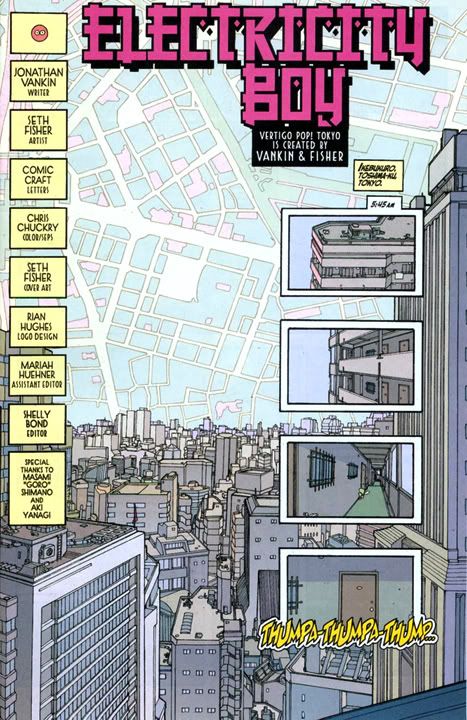
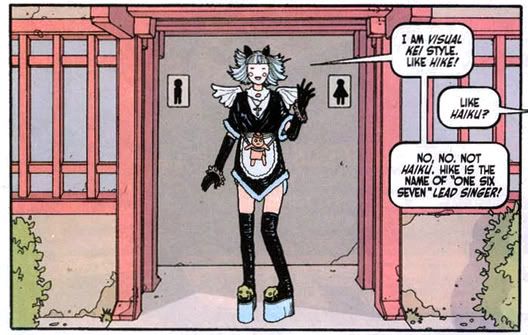
Both stories were written by Jonathan Vankin, but the only one I'm really interested in is the one set in Tokyo, the one with art by Seth Fisher. This one I read years ago before I ever set foot in Japan, when my mind was still filled with William Gibson electric nightscapes of neon and Harajuku girls bedecked colorfully, antic in mismatched stripes and dots and checks that somehow flowed from visual dissonance into harmony, willed that way by some fashion fusion that must be equal parts nurture and nature in the poptastic scenes of big big Toyko, because it's unequaled elsewhere, though many try. Although nowadays, I'm not so sure it even exists here anymore. Certainly not in the way it continues its shadow-life in the minds of American otaku.

Oh, I've been to Tokyo and seen it by day and night, had a naked Venezuelan stripper-- obviously a few years past her prime-- in my lap in a club run by Nigerian gangsters in association with the yakuza.

She kept grabbing my groin and shouting, "Anaconda!" and I paid the equivalent of twenty bucks to dirty dance with her and a similarly unclad associate on the tiny stage.

My friend and I had about an hour and a half to drink up as much as we could, and speed matters in such situations. I have no idea how many beers we tossed down before I got to that point where kissing a Kabuki-cho stripper seemed like a good idea. It was a memorable night that ended with a visit to the steamy bathroom of a capsule hotel where a salaryman clad in a white yukata lay face down puking his sushi and sho-chu into the millimeter or so of lukewarm water that collected on the tiled floor, while his embarrassed coworkers kept a close watch for signs of choking.

I've been to live shows where people thrashed me so hard I left leaning on an umbrella like a cane, the pain in my back aging me prematurely into a Methusalean wreck on the train platform.
Watched distant lights blinking across the Tokyo skyline. Made a tiny snowman in a Shibuya suburb for a friend. Been threatened with violence by a thug twice my size because he didn't like that I was snapping photos on Takeshita-dori in Harajuku. But my experiences are shallow and subjective. I'm more of an observer and less of a participant, and I can't claim any special knowledge. Others have gone deeper. Others understand the vibrant Tokyo tribes, whereas I remain a dilettante there.

My daily life in Japan is more suburban, white collar and timid middle class, consists mostly of bored housewives studying English just to have something different to do, kids looking at me with dubious expressions as if they think I'm conning them when I tell them the "a" sounds like an "e," the Yamaha plant, the Brazilian teens hanging out down at the station, the laughing graphic design students walking under umbrellas, the taxi driver taking a smoke break in a concrete playground near a polluted river running through a concrete riverbed.

It's not really that exotic, unless you'd consider a Des Moines where you can only understand every fifth word exotic.

But I do know Seth Fisher's art makes me feel like I'm walking the Tokyo streets again, where I cadge a little bit of the energy I first felt coming back from and afternoon spent sipping coffee and snacking on cake in a genteel department store dessert shop, then marveling at the homeless people sleeping against the tennis court fence outside the Ghibli Museum in Mitaka and finding the streets outside Shinjuku station just exploding with humanity. My nerves came alive and I was hooked. His is the only stuff I've seen that has that feel, outside of actual Japanese comics where the backgrounds are frequently screentoned photographs. In this story, Fisher gives you the dense architecture of Ikebukuro and the pedestrian overpass plus the bridge over the Yamanote Line in Harajuku with exacting detail, fine-lined work that is a marvel to behold. I really wish I could've met this guy.

None of my adventures equal the light-hearted insanity of the Tokyo story. The closest I came was when I dated a too-young fashion student briefly and she destroyed me, just absolutely laid me to waste and left me sobbing in Hotel Kent in Shinjuku, my black plastic hipster eyeglasses missing a lens. But I've never been chased by yakuza, never had to strip a kimono off a Harajuku fashionista to cover my girlfriend's nakedness. Would that I had; then I might be creating pop art about it instead of just reading other people's versions. Tokyo's fictional version of its namesake megalopolis is an exaggerated, wish-fulfillment dream of a Tokyo Wonderland... but thanks to Seth Fisher, it has the look, almost the scent of the real thing.

The energy it took to produce some of these densely rendered pages must have been close to incandescent. I can't wait to read it again and see it through Fisher's eyes.

Now that I've been here. I also pre-ordered the Fantagraphics Blazing Combat collection, because the Onion A/V Club notwithstanding, Archie Goodwin was never an "old hack." Hell, he never even got to be old; he was only 60 when he died. Like Seth Fisher, he left us too soon.

Happy birthday to me. Oh my aching head. On a weird night.

Thursday, March 12, 2009

"Dog Riders of the Open Desert"


I'm the (very) poor man's Alden McWilliams.

And a Special Poorly Foreshortened Supergirl to You, Too!


I have this concept of a more worldly Supergirl who likes to jet off to Harajuku during lunch break at her high school. I rarely draw with ink because I'm left-handed and I tend to smear it when it's wet by dragging my hand back through it.

Look! Up in my Blog! It's a Bird... It's a Plane! It's Superman Acting Like a Jerk!


Oh, brother, Superman is such an asshole. And as a special bonus, there's a tiny Batgirl waving at you from somewhere within Comicbookland.