Wednesday, March 24, 2010

The Hopey Glass Guide to Good Loving and How to Get It

Hopey Leticia Glass is a legend in her hometown of Hoppers, California. Her list of sexual conquests makes Jude Law and Colin Farrell gnaw the insides of their mouths with envy. She's what the college boys used to call an "ace bird-dogger" back in the 1940s. I'm guessing they used terminology like that; I wasn't born until 1968 so what the hell do I know about college slang from a million years ago?

Look, the point is, you-- yes, you, Mr. and Ms. Lonelyhearts-- can learn a lot from Hopey. Why sit around, idly masturbating while waiting for the phone to ring when you can get out there and make things happen? Just take a few tips from La Hopita, as written and illustrated by Jaime Hernandez in his 1997 classic Maggie and Hopey Color Fun #1, soon to be reprinted sans color in Love and Rockets Library (Locas Book 4): Penny Century from Fantagraphics.

How does Hopey do it?
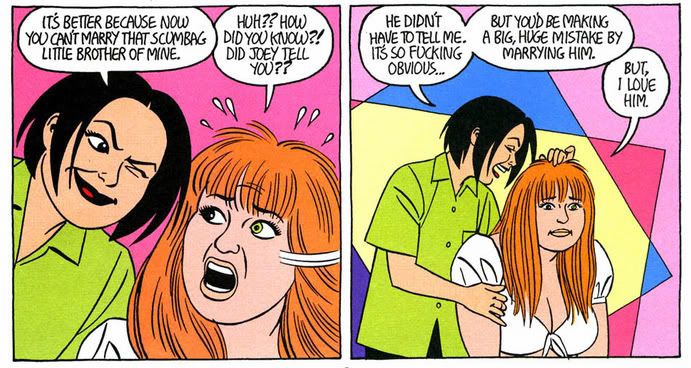
1. Set the stage. Identify your target. Begin flirtation. Make yourself useful in some way. For example, as Hopey demonstrates, it may be necessary in some cases to set yourself up as the positive alternative to some lesser choice. With ulterior motives, Hopey opens her bid for some sweet lovin' from the heterochromatic-eyed Janet Polo by pointing out what a mistake it'd be for her to marry a scumbag. In this case, the scumbag in question is Hopey's own little brother, Joey. Joey Glass's big flaw? Being as big a horn-dog as his sister Hopey.
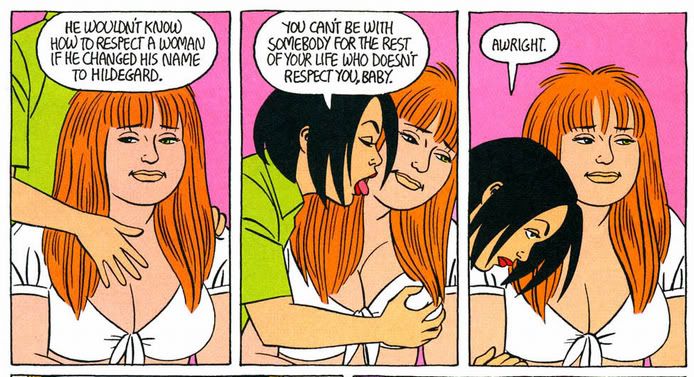
2. Direct approach. Flirting is fine. However, the problem with most people is, they tend to shrink from contact, or are too shy to make their intentions truly known. Consequently, they confuse things with mixed signals and are quickly consigned to the dreaded "just friends" category. Yes, "just friends" is fine, a wonderful thing indeed, and Daffy Matsumoto would be happy to give you tips on being bestest pals with someone. But we're strictly talking hook-ups here, the physical, one-nighters, short term, long term, you name it. Gettin' it on. Doin' the wild thang. Good clean, natural, nekkid, dirty, nasty, filthy, perverted, degenerate fun. Sexual congress between consenting adults.

Hopey, holding an advanced degree in Love Doctorology, has long since conquered her fears and consistently favors the direct approach early in the flirtation stages. While cupping someone's breast and licking her face may not be for everyone, feel free to choose a method that works for you.

Especially note how Hopey stops when she realizes she's getting nowhere. Learn the signs of non-responsiveness before attempting this method. Unless you're as skilled as Hopey and use your perceptiveness to identify the correct stopping point, you may soon find yourself receiving a well deserved open-handed slap to the mouth. So develop advanced skills by practicing alone as often as possible.
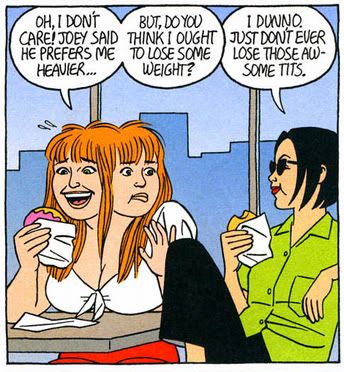
3. Compliments. Hopey knows we all want to feel sexy and desired. And she further knows the best way to accomplish this is to drop a few sincere compliments into the conversation. The key word is sincere. Choose something you genuinely appreciate about your potential mate and let him or her know it. For some people, it's that special person's wit, intelligence, style or a laboriously developed skill such as playing the piano or dancing. For Hopey, it's awesome tits.
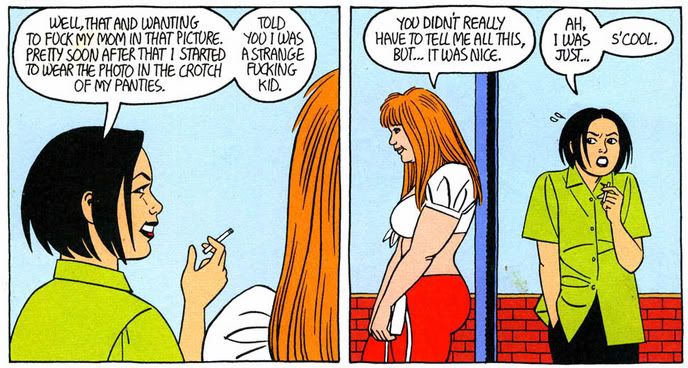
4. Reveal yourself. You know what goes a long way towards engendering sympathy and like-feelings? Telling personal secrets. In emergency situations, it can soften people's perceptions of you as possibly narcissistic or egotistical by adding a winning hint of vulnerability. And it helps bond you and your potential partner via shared experiences.
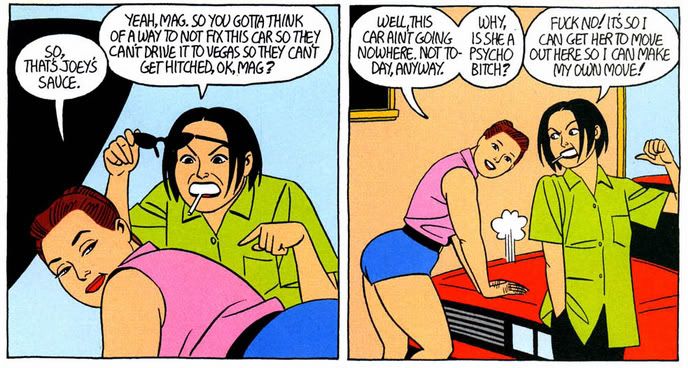
5. Enlist allies. Accept that you can't always do it alone. Talk your friends into helping you score. Are you gutsy enough to ask an ex-lover to help you get with someone new, as Hopey does here? If you are-- Damn, what do you need advice for? You should be teaching me!
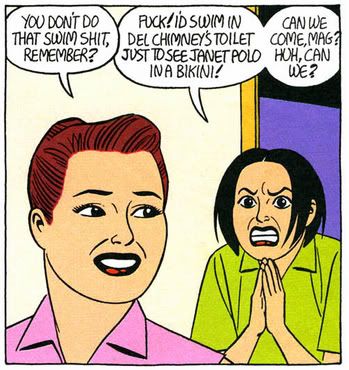
6. Beg. Sometimes you have to grovel. It's best not to beg the person you're interested in. No, instead, take a cue from Hopey and use this tactic to convince those around you to aid your cause. When it comes to matters of love or sex, there's no shame in begging.
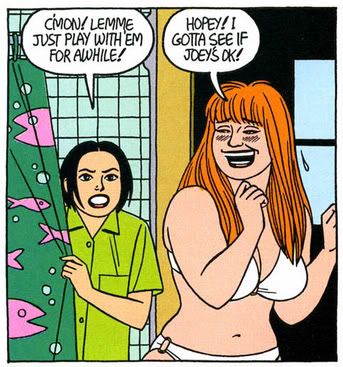
7. Be persistent. Stalking isn't cool, but persistence is. Don't just give up and walk away with slumped shoulders the first time someone snubs you. Some people like to play hard to get, and some people simply don't recognize your winning qualities right away. You have to sell yourself a little. Make yourself available, physically and emotionally. Know when to push, know when to back off. And yes, sometimes, you must know when to quit. Few people will flat-out tell you "No!" because they don't want to hurt your feelings, so it's up to you to learn when no is strictly implied and escape with your dignity-- and clean legal record-- intact. Hopey is a love artiste on a par with James Bond and Madonna, with a psychologist's keen understanding of the human mind and sexual behaviors. With hard work, you can be, too!

8. Keep trying. You got the final brush off, huh? Even super-studs like Hopey fail on occasion, as seen here. But Hopey knows-- and now you do, too-- love is a numbers game. The more often you play, the greater your odds of winning. So do what Hopey does: hit on anything or anyone that strikes your fancy. And if he or she says no, shake it off and move on to the next person. Never give up, never let rejection get you down.

And win one for the Hopester!

Tuesday, March 23, 2010

Temper, Temper, Dani!

You know who has Situational Anger Disorder? Dani Moonstar. Dani is the Marvel Universe's answer to Sean Penn, but with braids. While over at DC, no two writers ever seem to write the same Cassandra Cain, Dani has been through more powers and character iterations than anyone but the geekiest hardcore New Mutants fan (me) can keep track of... and yet the latest to script Dani's adventures Zeb Wells has somehow managed to synthesize an updated version of our (my) favorite de-powered mutant that is believably consistent with her earliest characterization, complete with rage.

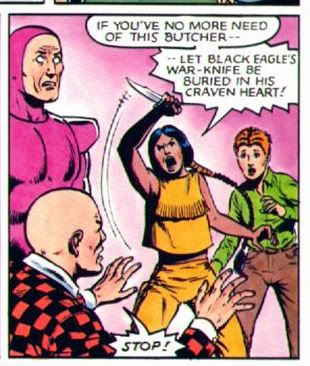
Let's take a look at ur-Dani, from her first appearance in Marvel Graphic Novel No. 4: The New Mutants. Here, young Dani's beloved grandfather has just told her he's sending her to Professor Charles Xavier's School for Gifted Youngsters:


Right away writer Chris Claremont and artist Bob McLeod set up a lifetime of stimulus response for Dani. Input situation A, output incandescent rage. And the stronger stimulus, the stronger the response. Bad news makes her snappish. Murder a loved one and she turns downright scary:


Drunk Mel Gibson scary. Married to Madonna scary. Making Naomi Campbell and Liam Gallagher nervous scary:


Did I lay-diagnose Dani with Situational Anger Disorder? This is more like Situational Anger Disorder with Aggression. After the graphic novel came the regular series and writers cycling her through all kinds of funky powers, including a bizarre stint as a Valkyrie from Asgard. As opposed to a Valkyrie from Brooklyn Heights, I suppose. She joined a pro-mutant terrorist group, turned double agent, became a teacher, lost her powers. And now she's back with her original friends, the New Mutants, in the ongoing New Mutants series.

After all of this insanity, Wells still manages to write a recognizable Dani Moonstar. She's grown up and still angry after all these years:


This is what happens when Dani finds herself thrown in jail. She's so embittered by it, she can't even accept visitors with good grace. Of course, her first visitor is a particularly self-involved, murderous personality inside a powerful mutant with plans to rub out her angry ass. Obviously, he's not going to slip her a cake with a metal file inside.

I think even I would get a wee bit upset in a similar situation, and I'm as meek as a teeny-tiny passive-aggressive church mouse.

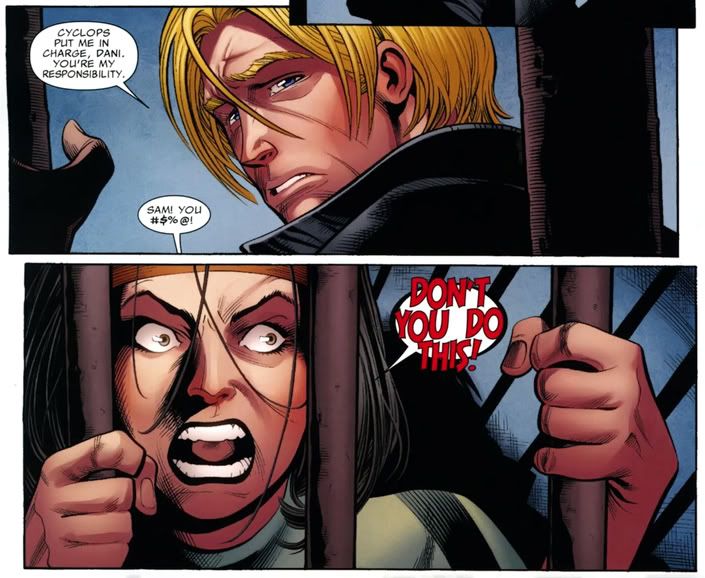
Her next visitor also does nothing to improve Dani's mood:


Jesus! Look at those eyes! In this case, it's her old pal, Sam Guthrie, who has pissed her off. Sam, compassionate soul that he is, decides Dani is safer behind bars-- or maybe it's the rest of the world he's worried about-- while the team fights Legion, the reality-bending mutant with Dissociative Identity Disorder. Apparently, multiple personalities versus a scaldingly angry Dani Moonstar would not a happy ending make. Sam's idea pleases Dani about as much as the existence of Barack Obama pleases Glenn Beck. Yes, I think we can definitively rule out Situational Anger Disorder Without Aggression at this point:


Poor Sam. He means well, but try telling Dani that. Actually, you'll probably just keep your fool mouth shut if you know what's good for you.

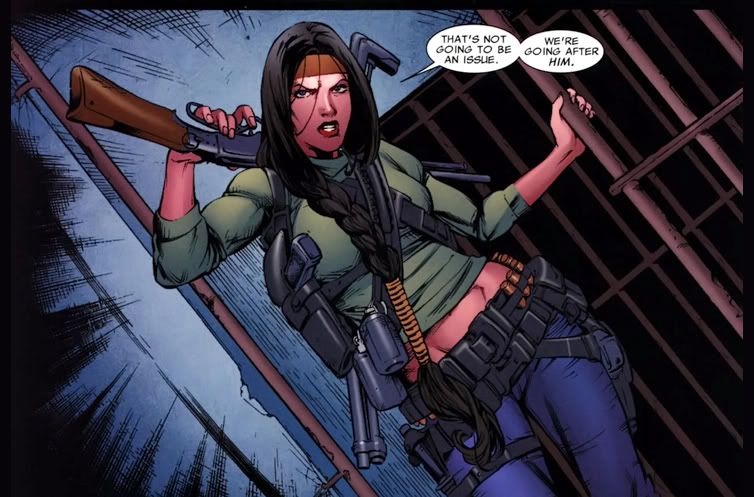
Another Dani personality trait Wells gets right is her determination. She's the unstoppable force of the New Mutants. Even though she no longer has her mutant powers, she retains command of hard-won tactical knowledge and unarmed combat skills, plus the wherewithal to put them to use. Did I say "unarmed?"


The damned T-800 Terminator packs less heat than that. What destructive maniac thought it was a good idea to teach this volatile young woman how to handle firearms? Weren't we all a lot safer when she only had Black Eagle's war knife to bury in our craven hearts? Giving Dani access to police weaponry is like giving Andy Dick the keys to your car at 3:00am; nothing good can come of it, but whatever happens is bound to be spectacular.

And that's just Dani in Wells's first storyline. Obviously, once the team settles into their comic, Dani will accept setbacks with a charitable...


In this panel, from New Mutants 5, Dani reacts to a series of slights against her by the hapless Sam Guthrie. Earlier in the issue, she learns from Cyclops Sam left her off the New Mutants roster. Right cross! Interestingly, Wells then has her goad Sam into hitting her back. That's all it takes to reestablish mutual respect between these two old friends... and sometimes rivals.

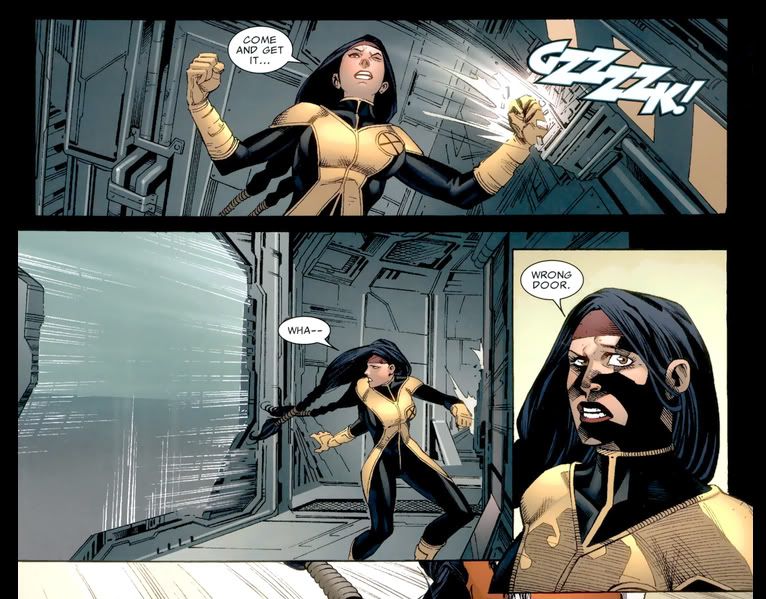
And later, during another mission, with her team status established, Dani finds that inner calm, right?


Yeah.

Special note-- Notice how many of these panels show Dani as a lefty. Yes, her right hand seems to be her craven-heart-stabbing/rifle-holding hand, but she appears use her left as her angry-fist-shaking/Sam-punching, pistol-shooting/door-control-smashing hand. I'm going to assume the single right cross is a clever tactic to throw Sam off, the same way Mickey had Rocky train to fight right-handed in order to protect his bad eye and fool the champ, Apollo Creed, in Rocky II. Do you think Dani's a southpaw? Is there perhaps a correlation between left-handedness and Situational Anger Disorder With Aggression?

Sunday, March 21, 2010

Batgirl's Ever Changing Motivation...

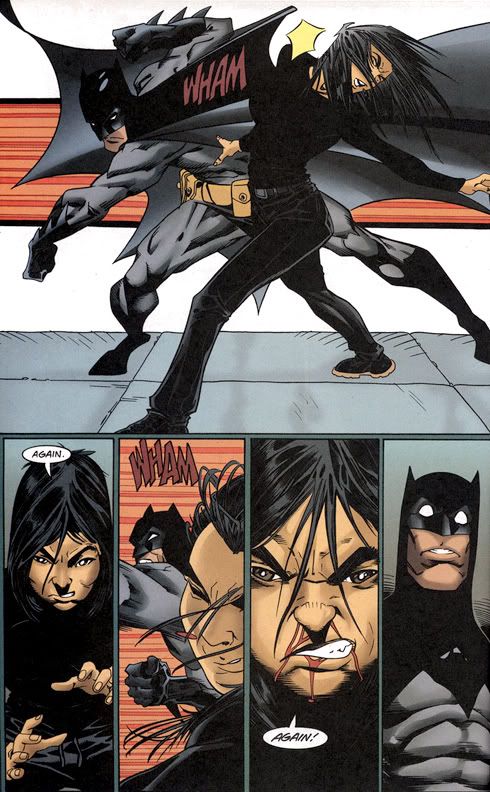
I'm still having a little trouble reconciling this characterization of the Cassandra Cain Batgirl from Batgirl (volume one) 7...


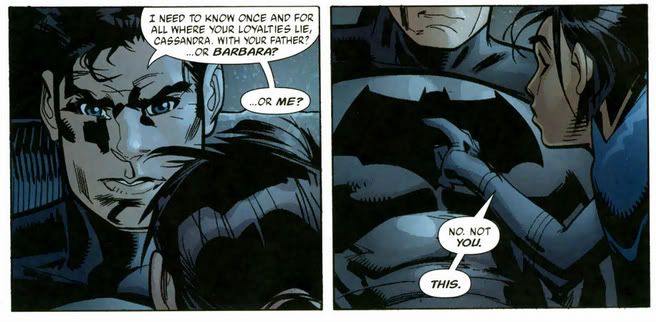
...and this one from Batgirl (v. 2) 50...


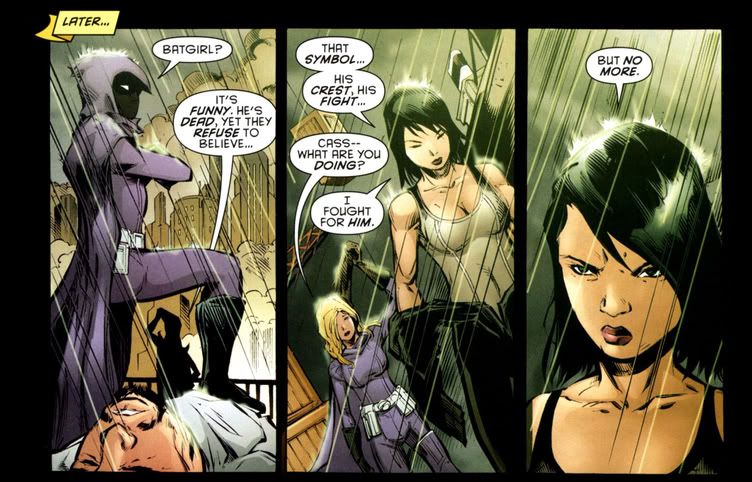
...with this one from Batgirl (volume two) 1:


Actually, I'm just being melodramatic. It's not that difficult. These scenes are the work of three different writers several years apart, with Kelley Puckett and Dylan Horrocks dealing with a purer characterization and Bryan Q. Miller taking over after the character had been warped and "developed" and pretty much ruined by editorial fiat in the interim. Writers bring their own ideas about a character to their stories; in Cassandra Cain's case, some of these writers have been less than competent and some have been the victims of terrible decisions beyond their control and did the best they could with damaged goods.

Miller also had the responsibility of getting Cass out of the new Batgirl book as quickly as possible without accidentally setting up gaping plot holes for other writers to have to fix; we've already seen what happens when lazy writers do that to Cass.

As a fan, it's disheartening to see such a driven character get beaten down to such a lowly, dispirited state. I hesitate to call this character development, but you get to the point where you have to accept this is who Cassandra Cain is, for now. A depressed namby-pamby.

She was bound to get watered down eventually. Cass had to learn to talk and once she learned that, her language skills were bound to improve, which meant writers had to make her motivations more overt; unfortunately they seemed invariably to choose the "I want a boyfriend/to be a normal girl" schema. She began her series with plenty of psychological issues relating to her abusive father and a serious death wish due to guilt; eventually she worked through all of this by repeatedly beating Daddy up and killing Mommy. Finally, Bruce Wayne literally took over the parental role he'd been symbolically filling by adopting her. At that point, writers had to find other raisons d'etre for Cass.

And that's how Cassandra Cain became a mopey quitter after Puckett set her up as a fierce little badass in her earliest stories, unconcerned with her own wellbeing to the point of frightening those around her, including Batman.

So all of that, I completely understand. I don't like it, but I understand it. But what I truly can't wrap my head around is how this character could just vanish from the Bat-family narrative as if she never existed. Not a single castmember makes any effort to locate her or see if she's all right; no one as much as thinks her name. And now there's this new "Return of Bruce Wayne" storyline brewing and here we have a young woman who apparently shifted her personally loyalties from whatever it is Batman stands for to the man himself... and yet she's nowhere to be found now that his closest friends, allies and family members seem actively to be looking for him.

Hmm... Does this mean we're not going to get Grant Morrison's take on Cass? And we're not going to see her drawn by the likes of Chris Sprouse and Ryan Sook? I call that a missed opportunity, at least for Cass-fans.

Still, I suppose there's a slim chance the next writer who takes a crack at Cass might do something that excites her few remaining fans and reminds everyone of what a cool character she used to be.

Saturday, March 20, 2010

I Went Looking For Italian Zombie Horror Comics...

And found them-- perverse though they may be-- as well as a fascinating discussion of mental transactions that occur when a reader confronts the gutters between panels. Curt Purcell-- of one of the coolest blogs I've ever encountered, The Groovy Age of Horror-- discusses one of Scott McCloud's Understanding Comics points, gets some thought-provoking comments, responds in kind, and McCloud himself weighs in on his own blog. I never took McCloud's point as literally as Purcell seems to have, but I love when people much smarter than myself dissect or deconstruct theories like this.

In fact, this is the kind of comics criticism I enjoy most, and now I have a new blog to read. It also helps there's a Pixies video as well as a review of Katherine Dunn's grotesque yet touching novel Geek Love. But if you're offended by erect zombie penises, you probably shouldn't go there.

The Comics/Music Connection 1: The Ramones Meet Dan Clowes


The Ramones and Dan Clowes go together like a velvet glove cast in iron in this video for "I Don't Want to Grow Up." Clowes's visual signature-- a view of the back of someone's head. Symbolizing alienation? A way to disassociate the reader/viewer from the character, to discourage identification? A song about a kid nervous about getting older and turning lame like the rest of the world is the perfect match for Clowes's edgy visuals.

And the original:

I Gave Away Even More Comics!

Yes, yes, everything must go. Traveling time is near and loads must lighten, possessions must divest. Dreams of leaving, dreams of movement... and the gift of comics. On Friday I finished the main phase of the Great Comics Giveaway. All that remains now are a few DC Showcase House of... books. I really tried to push those on people, but they didn't want them.

Books changing hands included Bongo Comics' Free Comics Day Free For All book from 2009, Bleach volume 18, Marvel's Essential Tomb of Dracula volume 2 (declared by its amused recipient to have "A lot of words!"), Mike Allred's The Complete Madman Comics Volume 2 with an introduction in his typical sexually-crude-yet-sentimental style by Kevin Smith and a guest appearance by the Big Guy. This last book went to a lawyer who asked, "Which do you recommend?"

"This one," I told her and slid the book down the table.

When asked directly, I always recommend Mike Allred's work. Unless the question is about food or automobiles. Then I only frequently recommend Mike Allred's work.

Thursday, March 18, 2010

Still More of the Great Comics Giveway!

It's well into its second week and going over like gangbusters. And something unexpected happened today. Last week, a high school dude chose Astonishing X-Men: Torn, so I thought I'd give him Astonishing X-Men: Unstoppable this week. Instead, he decided he would rather have Alan Moore's V for Vendetta and one of the high school girls took Astonishing X-Men because she went absolutely gaga for John Cassaday's art.

"Did you take X-Men?" I asked her, because the book seemed to have suddenly vanished.

She grinned. "Yes, because I love the art!"

Not that I blame her. Those books are lovely to look at, and Unstoppable has Cassaday's handsome versions of practically every major Marvel character. It also has a tremendous image of an inverted Spider-Man high above Manhattan. Who wouldn't love that? It should be a freakin' poster already. So rest assured, John Cassaday-- you have at least one fan in Japan now. Well, two for now and one after I leave in May.

The other student, a high school girl, decided to choose between Batgirl: Silent Running and Batgirl: Death Wish.

"Which one is better?" she asked.

"They're both pretty good," I told her. "But Silent Running is the first one. I think. Or is it Death Wish? Yeah, Silent Running is the first one."

She wisely chose Silent Running. Later, I gave Death Wish to a woman close to my age and filled her in on the whole Cassandra Cain saga, then told her, "But after that, they ruined her." She smiled because she knows I'm a fool.

"Who is the writer?" she asked.

I pointed to the names on the cover. "Puckett... Scott... Those are their last names. In America, comics are written by one person, pencilled by another, then another person inks it and one more colors it. Oh yeah, then someone else puts all the letters on it."

She nodded and glanced down at her comic-by-committee. In Japan, a lot of comic artists use teams of assistants, but the books themselves are credited to a single author. And then there are creators like Yazawa Ai who work themselves sick turning out hundreds, even thousands of pages of art and story themselves.

I also gave away volumes one and three of Miyazaki Hayao's Nausicaa of the Valley of the Wind (to two different people), Will Eisner's Best of the Spirit (to a woman who recently learned she's pregnant with twins), Mike Allred's Madman Volume 1 (to the college student already reading and enjoying John Byrne's Compleat Next Men) and Tokyo Days Bangkok Nights (cringing after I realized how much nudity it contains).

Sharing comics is fun.