Sunday, September 28, 2008

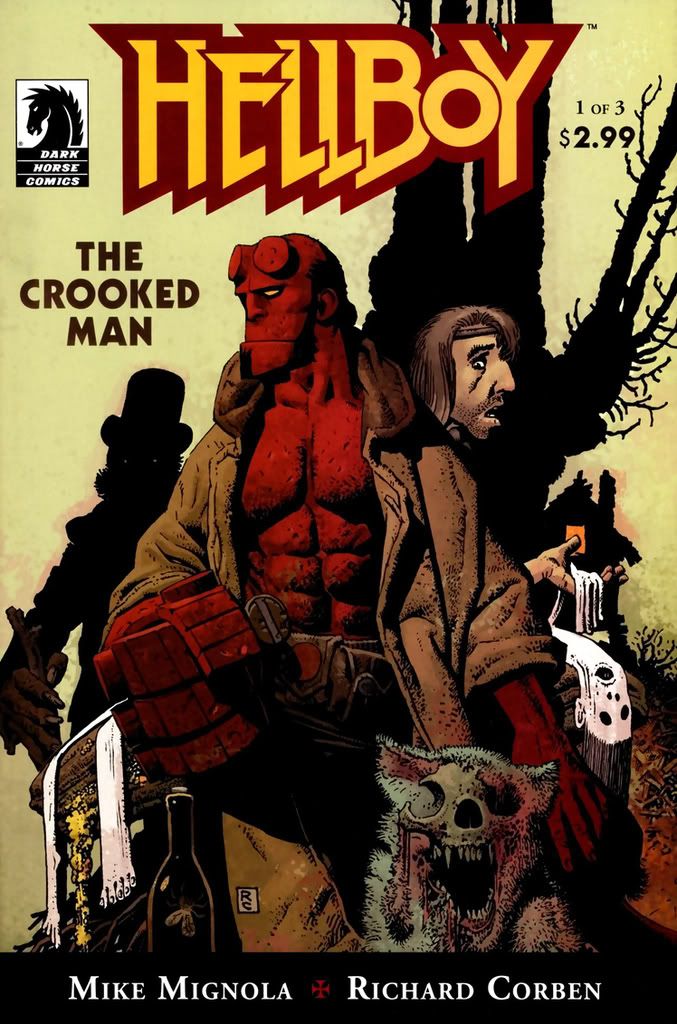
Fair was Helly Glover: "Hellboy: The Crooked Man" 1 Review

Hellboy: The Crooked Man #1 (of 3)
Publisher: Dark Horse
Story: Mike Mignola
Art: Richard Corben
Colors: Dave Stewart

Capsule review: Mike Mignola and Richard Corben take Hellboy deep into the misty Appalachian mountains where he finds himself battling a twisted (but sharply dressed) evil for the souls of a wandering hillbilly and his childhood friend. Rustic witchcraft lore and a unique setting make for one of Hellboy’s most atmospheric and affecting tales.

My list of top horror comic artists is pretty short these days. Sure, there are the old masters, the guys who did stuff for EC and Warren back in the olden days before I was born. But among today’s active artists? Not including a few from Japan, I’d put only Mike Mignola, Richard Corben and Bernie Wrightson at the top. And what a disparate trio. While I’d love to see Wrightson illustrate a Mignola strip, I think Corben is the perfect match for Mignola’s Hellboy.

Strangely enough for two artists who work together so well, Corben’s and Mignola’s art couldn’t be more different. Sure, neither adheres to classical ideas of body proportion, and they both work a kind of moody magic on the page. But Mignola’s figures are abstractly geometric, almost flat, while Corben’s are weirdly textured and more three-dimensional. You can even spot some odd Jack Kirby or P. Craig Russell flourishes in Mignola’s blocky monsters.

Corben, though?

Richard Corben is unique. I can’t think of anyone else whose art his resembles. Oddly stretched or squashed figures, shadows with a crumbly edge that make his figures pop, but also gives them strange fungoid textures. Creepy and nauseating, but in a good way. I mean, we’re talking about horror comics here.

Mignola writes to Corben’s strengths by setting The Crooked Man in the Appalachians of Virginia and peopling the hills with melancholy backwoods types. Corben can distort their bodies almost to the point of caricature and bathe them in pale light and inky shadow. Stick them in haunted dells, thickly wooded and mossy, heavy with portents of evil. Depict in full, sickly detail women who leave their rubbery, cast-off skins lying around on beds in wooden shacks, temptresses who ride on desiccated horses. And a hideously misshapen figure in a top hat who plays both ends against the middle as he does Satan’s work on earth. Or is he, himself, Satan?

Despite the weirdness of it all, Corben gives the most visually ludicrous figure, Hellboy himself, a solid muscularity that makes him almost plausible with his sawed-off horns, red skin and wrinkled trench coat.

After wreaking havoc through Lovecraftian pastiches, Celtic adventures and stock Eastern European set-tos, Hellboy plunges into the folklore of his adopted home country. It’s a more than welcome change and really invigorates this installment. There are only so many times Hellboy can bop undead Nazis or tangle with worms and tentacles from beyond space before it all blurs together. Mignola’s plot and dialogue are heavy on the southern gothic, with down-home characters solemnly intoning lines like, “So one day I found me a squashed black cat… An while my ma was out, I boiled it till it went all to pieces… Then I took that mess down to the creek to wash out the bones.”

These are superstitious earth-folk, and they have good reason to be. Their mountains are haunted places where Satan’s agent shambles through the woods and offers deals too good to be true, and none too safe for the immortal soul. These mountain people seem to approach living half in a nightmare with a tired fatalistic acceptance, and not even the sight of a muscle-bound demon wearing clothes and toting a big pistol throws them off their stride. Hellboy fits right in from the start.

It reminds me of “Jess-Belle” one of the most inventive and original Twilight Zone episodes, penned by Earl Hamner, Jr., who later went on to create The Waltons. Like Crooked Man, “Jess-Belle” is set in the Appalachians (the Blue Ridge Mountains, to be exact) and deals with witchcraft and its consequences. In it, James Best plays a young hillbilly bewitched away from his fiancee by the darkly beautiful and ultimately doomed Jess-Belle, played by Anne Francis. Between that TV story and Hellboy’s, I guess it proves cain’t nobody walk the paths of the fallen without payin’ a heavy toll. We all know whatever Faustian bargains Hellboy’s new pal Tom Ferrell made in his past will come at a similarly heavy price for both him and his childhood friend, Cora Fisher.

I’m not sure what John-Boy would make of Hellboy, but this is as close as we’re likely to come to that particular crossover. Unless Mignola and Corben are building towards a climactic scene where Hellboy bids goodnight to an almost endless stream of hard-working and good-hearted farm people with their various genders appended to their given names.

Friday, September 26, 2008

Blecchhh in Her Own Series: "Batgirl" 1 & 2 Review!

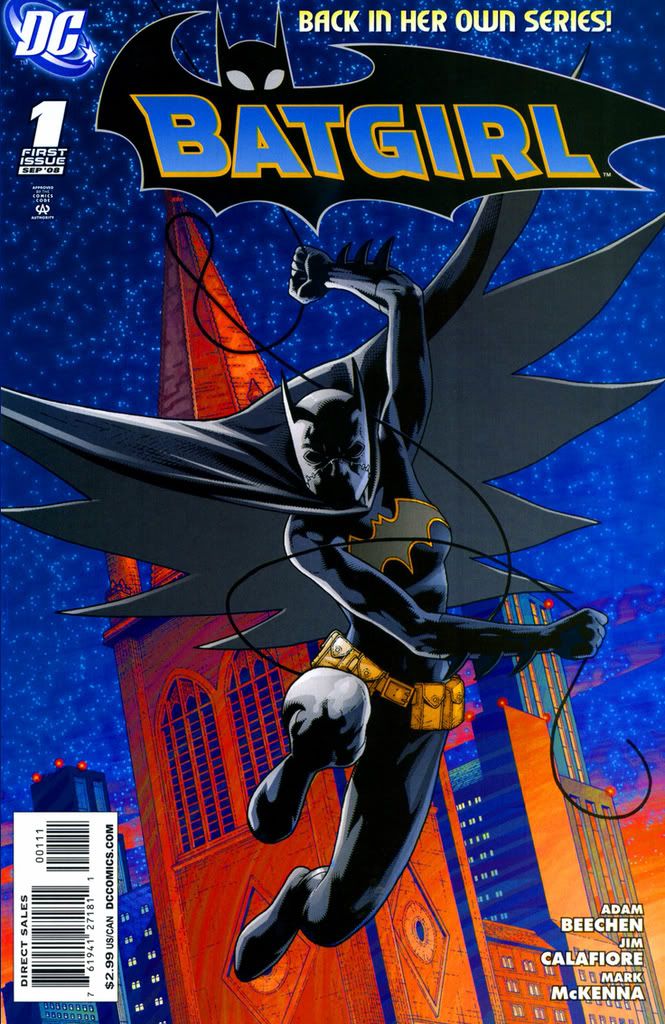
Batgirl 1 & 2
Publisher: DC Comics
Writer: Adam Beechen
Penciller: Jim Calafiore
Inkers: Mark McKenna, Jonathan Glapion and Jack Purcell
Colorist: Nathan Eyring

Capsule review: Batgirl issues 1 and 2... the perfectly-constructed 4-color vehicles for delivering ennui to a new generation of sonambulant comic book fans.

Beechen said that the story will answer all the questions from the last few years, and will address all of the questions of why Batgirl has been acting the way she's been acting, and set the stage for new Batgirl adventures to come. -- quote from some old Newsarama story that no longer exists.

You know, it's never a good sign when your writer's big plan for a new story is to tell you things you already know.

After DC screwed up the Cassandra Cain Batgirl character by turning her into a horrible Dragon Lady stereotypical villain and thereby alienated the character's very vocal fans (which is a kind of irony, I suppose), they took steps to fix things and earn back some good will. Batgirl popped up in Teen Titans, readers found out she was acting screwy because she'd been drugged, Chuck Dixon added her to his Batman and the Outsiders team and all was right with the world. And that's all we needed to know. Bad drugs as a silly, comic booky but acceptable explanation for bad writing. The end.

But here comes the new Batgirl miniseries, written by Adam Beechen and instead of moving forward, he chooses to rehash and overexplain a lot of storylines that for everyone but Beechen had already been dealt with and finished. And to do so in ways that are both boring and surprisingly inept. At one point early in the first issue, Nightwing catches Batgirl sneaking a peek at her Christmas presents and-

Actually, Nightwing finds Batgirl using the Batcomputer to foster a personal vendetta, and they discuss this for a few panels while engaging in a wussy slap-fight... before Batman and Robin come in and also start jabbering away. Talk, talk, talk. At this point, writer Adam Beechen and penciller Jim Calafiore gift the readers with a panel where an ant-sized Robin head groans under the weight of enough copy to explain the Libertarian Party’s presidential campaign platform. Twice.

The plot is your basic vengeance quest. In comic book terms, this means Batgirl gets some deus ex machina help from that old standby, the all-knowing computer, runs around at night beating up random people, then suddenly and conveniently meets strangers who either try to kill her or else offer her vital information. Or both. Take it from Batgirl: cooperative enemies make revenge a breeze!

Batgirl wants to kill Slade (the man who drugged her) and Cain (her father, who is still giving her hell despite that storyline having come to a fairly satisfying conclusion in the original Batgirl series). This is all well and good. Batgirl should be edgy and dangerous. But Beechen has her tell us this practically at the start. Goodbye surprise and suspense.

Wait! Don't close your eyes and nod off yet! I haven't told you the best part! According the Beechen, Batgirl's ultimate motivation- what truly drives her and pumps blood through the secret-bearing chambers of her heart- seems to be... I feel a Dr. Smith imitation coming on here… the pain… the pain... the desire to have a “normal" life.

Just like Buffy in the early days of her vampire slayin’ TV show. Just like cheerleader Claire in the first few episodes of Heroes. Just like so many other teen or teen-ish characters involved in the supernatural or the superheroic. And never mind Batgirl actually tossed away her civilian identity at one point- by revealing her face to a government agency- in order to become more fully Batgirl. Forget entirely this is a woman who made a metaphorical deal with the devil by taking lessons from killer mom Lady Shiva and promising a death duel in a year’s time rather than lose her fighting abilities and give up being Batgirl. And don't worry that she constantly risked Batman's wrath by trying to be Batgirl each time he fired her.

Yeah, wants to be normal. Good one, slick.

Yep, Beechen still does not have a handle on how to write this character. Hasn't a clue. Doesn't really seem to care. After all, he didn't bother to concoct an interesting plot. Out of the story’s many weaknesses and disappointments, this failure to develop a believable characterization for its protagonist is the most damning and inexplicable.

Beechen’s most clever conceit is having Cassandra reveal at one point she’s taken ESL classes. This is an attempt to explain one of the stupider goofs Beechen made in the Robin series, where a girl with hardly any verbal skills has become loquacious and fluent not only in English and Supervillainese, but also in Navaho. Within the space of a year. That must be some ESL school!

This plot element also seems a clumsy attempt to shoehorn a totally lame romance into the story. One look at some bland, nice guy we’ve never seen before and Batgirl’s already in love. And we know this not because the character registers as anything more than a plot contrivance or because Calafiore's art emphasizes anything resembling romance through reaction shots. No, we know this because Beechen has Batgirl (on patrol, no less) thinking about this dull new character’s “nice eyes” and musing that she “hasn’t felt this way since…”

Since some past romance from some other comic I haven’t bothered to read, about some character I don’t give two craps about.

Yeah, guess we’ll have to take Batgirl’s word for it, because nothing else in that sequence informs us of anything other than the ol’ “tell, don’t show” storytelling style popularized by classic Scooby Doo cartoons written for very dim suburban kids is still alive and well at Time/Warner.

Despite some blood in the early going, there’s no sense of danger, no thrill, no atmosphere. Superheroic generica starring a once-intriguing lead turned cliche. It’s fine that Batgirl has verbal chops now to go along with her fists of fury, but does she have to be so chatty? Some people can speak perfectly well but choose not to. Alternately, couldn’t she at least be sullen or moody? Garbo speaks! But has nothing of interest to say!

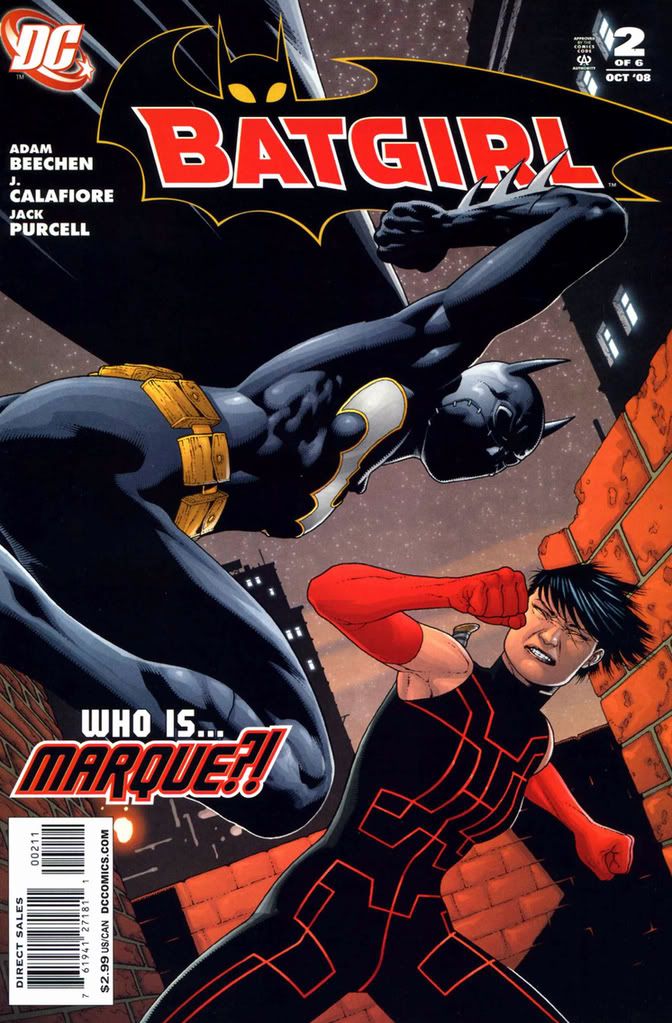
Instead, Batgirl narrates in familiar super-person style rendering her little more than an interesting costume. She could be anybody now. They should rename her "Li'l Miss Anycharacter." In fact, she is everybody because Cassandra-clones are popping up all over the place. She wasn't big daddy Cain's lone success. That would leave her unique. Interesting. No, now we have Marque. As issue 2's cover copy asks, "Who Is Marque?!"

God, who gives a shit?! She seems to exist mostly to dilute what little narrative thrust Beechen generates with Batgirl's own need for vengeance by showing up with her own, even less interesting one.

Well, I suppose at one point Beechen has Marque tell us who she is including her favorite color and what she ate for lunch each day in elementary school in one giant block of dialogue, and then she and Batgirl play Boggle, Scrabble and Super Password hosted by Burt Convy, but I missed it because I'd fallen asleep from boredom and crumpled my copy into an unreadable ball of colorful paper.

Tired, rote plot. Labored exposition. Teen emo. Perfunctory fight scenes, more A-Team than Kill Bill. Beechen and Calafiore would’ve done well to read a little of Koike Kazuo’s Lady Snowblood to learn how to depict a deadly woman on the vengeance trail. Batgirl should be scary. You should feel afraid of her and for her at the same time. To this end, they could’ve rented Crouching Tiger, Hidden Dragon, and tried to infuse Batgirl with some of Jen Yu's life rage, with the same sense of inevitable tragedy about her. There was a girl who may not have known exactly what she wanted, but it sure as hell wasn't to be "normal." Not after tasting power and independence.

But that would have imparted a little style and substance to this flimsy, thrice-told little tale.

Sunday, September 7, 2008

9th Annual International Manga Summit Concludes Comics Are Educational

Kyoto, home of the Kyoto International Manga Museum, recently hosted the 9th annual International Manga Summit. According to a story in the Japan Times, the manga summit concluded that comics can be used to educate people on a wide variety of topics, from the environment to food safety. It also noted that Finnish cartoonists are increasingly influenced by their Japanese counterparts.

Interesting developments, to be sure. But I declare comic books in general to be fun and entertaining also. Especially Nana. That is some good stuff!

Sunday, August 17, 2008

Do People Have to Be Reminded to Act Civilized?

I guess so! I created this blog to escape from issues blogging, but this is something that disturbs me. It disturbs me that you have to actually tell certain people how to act in public. You'd think parenting, school and socialization would have taken care of these things, but apparently some idiots still haven't gotten the message. Some people can't handle being out in public around human beings who vaguely look like (and in some cases, dress exactly like) those longer-haired, slightly shorter characters in their funny books and on their favorite TV shows.

You know, the not-men. What do they call those again?

In any given group situation, it really does not matter if the person in question is a woman or a man- if they don't want you touching them, if they haven't given you permission to put your hands on them, then keep your damned hands to yourself. The fact that it's a sci-fi or comics convention makes no difference.

Now, I know people wear some outrageous stuff at genre conventions. The Slave Leia costume, a Red Sonja metal bikini and what have you. There will be professional models dressed like Lara Croft or whatever video game goddess is being hyped this financial quarter. And there's a certain relaxation of societal standards to allow for free expression. You're there to geek out in ways you can't at the office. You might meet someone you could be attracted to who shares your esoteric interests. It's totally okay to try to score some phone numbers. Plus, it's during vacation time for a lot of people so cutting loose feels good.

But there are limits. Because here's the thing- clothing does not equal consent. Attendance at a convention does not equal consent. Being simply a woman at a convention certainly does not equal consent. If someone isn't interested in you, be cool about it and gracefully back off. You're not John Cusack in Say Anything.... No means no. No answer means no. An "I'm busy" or "Maybe some other time" means no. Only yes means yes. You really shouldn't have to explain that to anyone over the age of 5 or 6. Certainly not to an adult.

And yet you do. And you do. And you do.

Why do people who somehow have failed to learn this before beginning elementary school get to define fan behavior? Who arbitrarily decided that genre conventions were free-for-all zones where any kind of stupidity goes? Where it's "cool" to grab someone's ass to "see what her reaction was?"

What if I went to a convention and randomly spit in people's faces to "see what their reaction was?" Hell, if they didn't want me to spit in their faces they wouldn't have come to the convention, right?

I'm pretty sure I KNOW how they would react. They'd get upset. I'd get booted out the door. There might even be violence. And you know what? That's not even why I don't do those kinds of things. I don't go around spitting on people because it's wrong. Just as it's wrong to grope someone. Just as it's wrong to make someone afraid. It's simply wrong to abuse people.

No matter how they're dressed. Or where they are.

It's not cool to do these things; it never has been, it never will be. Doing these things makes you an asshole; always has, always will. It's mindboggling that some people don't get this, that they turn off their brains at the convention center's doors and turn into Creatures from the Dorkass Corners of the Id. It's crazy to have to explain basic human behavior to people. It's like trying to explain why you shouldn't touch fire, why you shouldn't point a loaded gun at your head, why you shouldn't eat strange things you find on the highway. Behaviors that are self-evident to everyone except these few jerks.

Who in turn define the rest of us to the world at large. Who seem to define convention etiquette and behaviors for everyone else. And who define a genre convention as a place where three or four maladjusted and misanthropic cretins get to set the standards and tone for the majority who actually know better.

Convention organizers- don't be intimidated by these crude, crass attendees. They represent the smallest fraction of convention-goers. But they make up the entirety of the group doing stupid, outrageous things to the other attendees. Evidently, many conventions DO have anti-harassment policies in place and that's as it should be.

If yours doesn't, then make one. And if it does, make sure all the attendees are very aware of it. Publicize the hell out of it. Make your convention known as a safe space, where everyone can have fun. You know, except the very few whose idea of fun include nonconsensual touching and weird verbal abuse. They shouldn't be allowed to have their kind of fun. And if they tried that at the local shopping mall, they'd be arrested.

You can make a definite statement, put it right on the tickets, right on the signs and in the advertisement, and most people will still show up. It's ridiculous that you should have to explain something that's supposed to be common sense, but spell out in simple, clear terms that sexual harassment and intimidation, that unwanted touching and violence are not tolerated there. Have a visible and clearly-marked place for women to go to (or even men) when they've been violated or harassed. Toss out the jerks. If you want to be cute about it, dress your bouncers like Imperial stormtroopers or the Justice League or something.

I also want to charge the vast numbers of responsible convention-goers not to accept these pissants' definition of who we are and what we do. When you see this stuff happening, confront the situation. You don't have to run up and act like Batman or Wonder Woman, but there are sensible things you can do without being a vigilante. If you read the essay that set this off, that's exactly what the author tried to do. That's just good old-fashioned human decency. A concerned person supporting others to have the most fun possible without ugliness and degradation.

And if your friend comes back to you laughing about pinching some girl's ass or putting his hand down her shirt, tell him outright that's shitty behavior. Don't condone it with your silence. Make him feel the shame he should feel for doing something asinine. Perhaps common sense and humanity will reassert itself and he'll finally learn the damned lesson he should have as a child.

Or, report him to whoever is in charge. Do it in a reasonable way, of course. Screaming about it isn't much of a help, but level-headed insistence that you feel uncomfortable and unwelcome in a place where they allow sexual violence in any degree.

Even if there's not a firm policy in place. Even if there isn't an actual complaint booth. Find someone in charge and let them know your feelings. Everyone do this, immediately. Don't wait until the next day or the end of the convention. Do it immediately. Firmly but politely. If the organizers feel their financial break-even point being threatened, they'll act. If enough fans get involved on a grassroots level, this behavior will stop. Or become less frequent. Hell, I'd be happy if some of the incidents I've read about ended in arrests. I know of at least one involving a creator that more than likely should have if I'm remembering the details correctly.

And if an asshole doesn't come or a groper doesn't get to grope or harass, who gives a shit? Who gave these freak losers the right to violate the human dignity and personal space of others? They can't do that shit at the circus, the carnival, a Renaissance Fair, movie theaters or ballparks; they shouldn't be allowed to do it at a genre convention.

Tuesday, July 29, 2008

Hey, They Finally Nabbed the Joke!

According to the Associated Press, police in Three Rivers, Michigan, arrested a fully grown, adult 20-year-old man dressed like the Joke. The Joke was allegedly stealing posters and other memorabilia related to a popular comic-book inspired movie of some some kind.

Disappointingly, there's nothing in the AP story to indicate if this puckish fellow arrived at the theater accompanied by gnomes or leprechauns. Also uncertain is whether or not his pockets were filled with pennywhistles and roman candles. Or even moonbeams and starlight. There are precious few hints indicating he also tried to steal lollipops or candy bars, or if he leaped into the air with elfish glee and clacked his heels together during the attempted childlike mischief.

No word about how the little pixie planned to make his getaway. Perhaps on rollerskates? In a paper airplane decorated with stars crudely drawn in crayon? Rubber-band propelled toy duck?

The young man (pictured in his police mug shot wearing his "the Joke" makeup and without) also hasn't revealed to the world why he felt he had to dress like the Joke. Personally, I think he looks more like Max Fischer from Rushmore. If only he were wearing a private school uniform jacket, we might assume he was trying to get a teacher fired.

"I don't think that's such a good idea, Max." Max Fischer is a charming, precocious character. Perhaps cosplaying as Max Fischer is overly subtle, especially when it's still almost 3 months until Halloween.

Maybe over the next few months we'll see others proclaiming themselves also to be the Joke. Lord knows, we all take our turn as the Joke. Almost all of us do stupid, silly things from time to time. Not all of us do them dressed like the Joke, though. But for now, this delightfully absurd little fellow is the closest thing to the real Joke we have in today's topsy-turvy media-crazed society. I hope being the Joke makes him happy. I hope being the Joke is every bit as fulfilling as he thought it would be.

Anyway, ladies and gentlemen... comics fans... children of all ages... I give you...

The Joke.

Sunday, July 20, 2008

Howard Chaykin's "American Flagg" as Futurology, Part One

Any useful idea about the future should appear to be ridiculous.
-Jim Dator

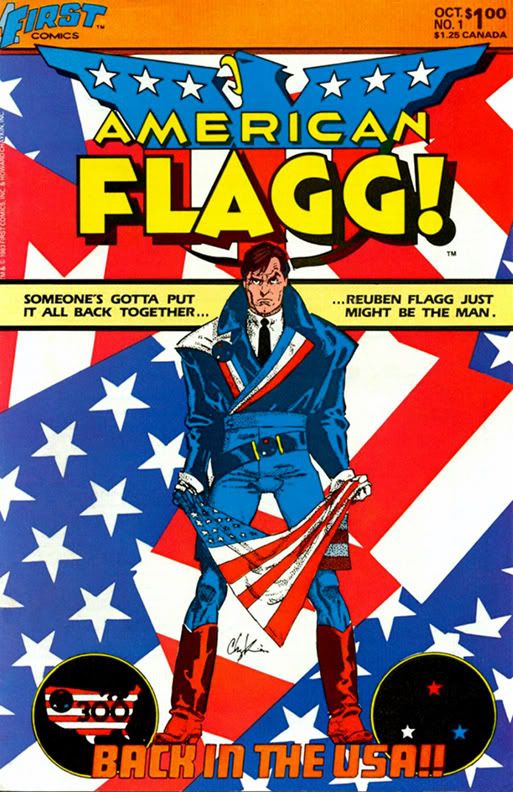
Howard Chaykin’s American Flagg was a cutting edge comic for its time. It incorporated a lot of storytelling techniques later borrowed by any number of creators. The use of television screen iconography and pop culture references to provide depth, to amplify and make ironic comment on the action would later serve Frank Miller very well indeed in his acclaimed series The Dark Knight Returns. Thanks to letterer Ken Bruzenak, who served almost as a co-illustrator, Flagg incorporated text and graphic design into the art in creative and original ways, although it can be argued Will Eisner (his Spirit title splashes) and Jim Steranko and Bruzenak (on Marvel's FOOM magazine) did some of the earlier experimentation along these lines. All that’s well and good. Very good indeed.

“Forget all that crap! What about American Flagg’s success as a work of futurology?” you ask. "How accurate are its predictions?"

Well, I’m glad you asked me that particular question because it's been on my mind lately. Futurology is fun for me because I’m a dork. And as a dork, I especially love it when we actually reach the era described in a futurological work and we can see just how accurate or not the author’s predictions were. Just for kicks, because Howard Chaykin probably intended American Flagg to be entertaining first and foremost, not a visionary work of hardcore speculation.

Because that would be stupid. So let’s be stupid. All two or three of us. Together. Being stupid is much more enjoyable in a group. Let’s examine American Flagg as an attempt to predict the future.

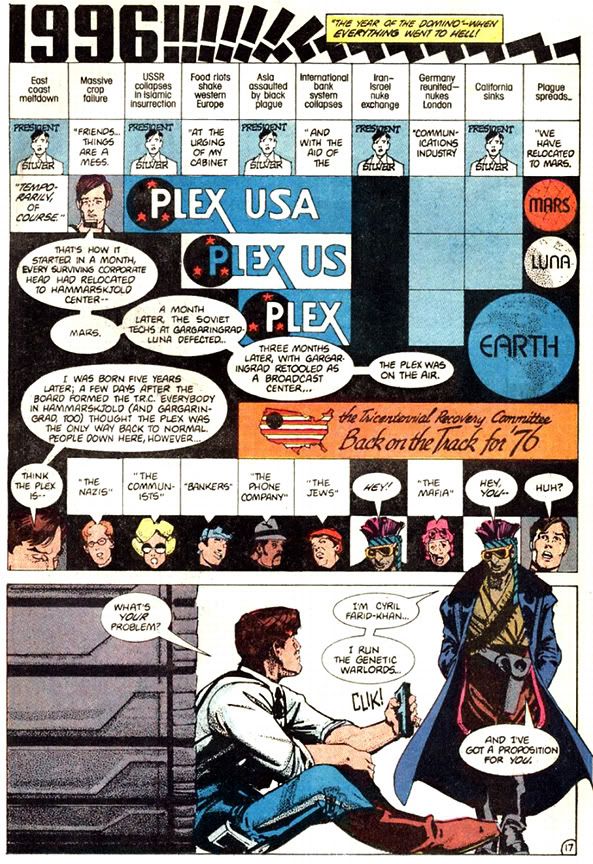
Chaykin makes it easy on us because unlike Nostradamus and his poetic vagaries that could mean damn well anything, he provides us with a specific date. 1996, called by Flagg himself “The Year of the Domino.” An anno horribilis. What happened to make it so?

In American Flagg, actor Reuben Flagg (obsoleted former star of Mark Thrust: Sexus Ranger, which seems like something that could've aired on late-night Showtime, Cinemax or even the old USA Network) comes to Earth from Mars to join the Plex Rangers. As a newcomer, he’s the perfect fictional vehicle for Chaykin to describe his futuristic setting. In the first issue, after he’s learned a bit about the PlexMall and the current state of America, Flagg sits down and records a diary entry where he tells how this all came about.

Get your scorecards ready! And… here… we… go:

East coast meltdown. Some sort of nuclear accident. In 1983, when First Comics published American Flagg, the 1979 Three Mile Island incident was still fairly recent news. That was also the year Columbia Pictures released the Jane Fonda/Jack Lemmon/Michael Douglas thriller The China Syndrome. So nuclear safety was a controversial topic around that time. But we didn't have a major nuclear catastrophe in America in 1996, or any major accident in the years since Three Mile Island. The Soviet Union, yeah, and it happened a mere 3 years after American Flagg's premiere. You should read up on the Chernobyl Exclusion Zone. Fascinating stuff. I'll bet if Chernobyl had happened before he started American Flagg, Chaykin would've incorporated something along those lines.

Massive crop failure. Nope, didn’t happen in 1996 and ideally modern growing techniques will keep us in food for the indefinite future. Have we had even a minor crop failure recently? Florida oranges? Georgia peaches? Oh the shifting fortunes of those dependent on the weather.

USSR collapses in Islamic insurrection. Now we’re getting somewhere. The USSR collapsed, only it happened in 1991, 5 years earlier than Chaykin's prediction. The same decade! That's at least as accurate as any TV psychic, right up there with that woman who predicted all the Kennedy assassinations. And even though the Soviet Union's downfall wasn't due to an Islamic insurrection, don’t forget the Soviet defeat in Afghanistan was still 5 years away when this comic debuted. Ultimately, the closest analog to Chaykin's prediction was the horrific First Chechen War, a Muslim separatist conflict which lasted from 1994 to 1996. Huh? Huh? Unfortunately for futurology-accuracy's sake, that was a post-Soviet conflict and the region remains a Russian federal subject. Still, coming that close to the correct collapse date trumps any causal considerations so I have to give Mr. Chaykin a lot of credit for this one. And also for his correct reading of some of the internal regional religio-political strains underlying the external image of Soviet solidarity. I mean, around the same time, Mike Baron and Steve Rude had a Soviet Union still existing 500 years into the future in Nexus!

Food riots shake Western Europe. Not even close. Although French farmer Jose Bove has led protests against McDonald's. Does that count?

International bank system collapses. Nope.

Iran-Israel nuclear exchange. This one is scarily prescient. It still hasn’t happened but recent events make it seem all too likely; Mr. Chaykin may merely have the date a decade or two too early. What’s amazing is that it’s specifically Iran, and not say, Syria or Jordan or some made up Trans-Arabic Alliance. But then again, likelihood isn’t actuality. So any points will have to be deferred for now.

Germany reunited, nukes London. This one is, I think, a little bit of a joke. Mr. Chaykin having a little fun. West and East Germany reunified in 1990, but throughout the rest of the decade they seemed pretty peaceful. Certainly not out for any revenge. Being a mere six years off on the political half of this 2-part event practically qualifies Chaykin as a full-fledged psychic. I also remember a David Letterman Top 10 List on France's jittery preparations for German reunification. Close enough. So partial credit for historical accuracy, partial credit for anticipating a Letterman joke.

California sinks. Physically or metaphorically? Hasn't happened. And may not unless Paris Hilton relocates there. I’ve always been skeptical about this whole notion of California “falling into the sea.” Small islands have blown themselves apart volcanically, and yes, I’ve heard practically my entire life that the Big One will one day drop California into the Pacific. But since California is anchored to a land mass and not floating on top of the water, I’m not sure what the geological mechanics of such an event would entail. Is there some sort of continental shelf drop-off directly off the California shoreline where an earthquake could tumble the entire state into the sea?

Plague spreads. What plague? A plague of annoying smart-ass comic book blogs? If so, well done, Mr. Chaykin! You were only off a few years. Other than that I don’t recall any world-shaking pandemics in 1996.

The U.S. government and major corporations relocate to Mars. Sounds like a good idea to me, but it didn’t happen.

H.G. Wells and Jules Verne tend to get high marks for some of their futurological fictions, while the Star Trek series’ background details seem more irrelevant all the time as we sweep past important dates without Eugenics Wars and WWIII. My favorite sci-fi film series, Planet of the Apes, is getting increasingly ridiculous. There were no faster-than-light interstellar launches in 1973 and where's our 1991 dog and cat plague? What if the world doesn't end in 3955 or 3978? See? Those crazy futurological fools couldn't even keep their years straight!

George Orwell meant his 1984 more as metaphor and criticism than prediction, but that didn’t stop pundits from giving it a thorough workout when that year actually rolled around. Arthur C. Clarke and Stanley Kubrick hung a specific date on their famous space odyssey, but 2001 didn’t see any monoliths excavated on the moon, or artificial intelligences going slowly psychotic in transit to Jupiter.

Actually, that last one is interesting too because it predicts defunct airline Pan Am would one day deliver space-tourists and government scientists to giant rotating space stations that haven't yet materialized and we also now know Velcro-bottomed shoes have yet to come into style for our many thousands of dedicated space flight attendants who must serve microwaved chicken and beef meals in zero gravity.

So, to answer your original question. Is Howard Chaykin the visionary equal to Verne, Wells and Clarke? Is American Flagg a startlingly prescient work of futurology? What the hell do I know? In 1983, I was a junior high kid at the time and mostly into comic books and video games. My idea of 1996 was I'd be a rock star making the fabulous sum of $30,000 a year and living in a space dome with Paulina Porizkova on the dark side of the moon. So basically, I have no idea. Sorry I wasted your time!

NOTE: In our next installment, we’ll examine the futurology of Reuben Flagg’s hyper-violent, hyper-sexualized world of 2030 and see what’s already come to pass and what seems to have been made less likely thanks to various developments in the years between 1983 and now. You know… if I get around to finishing the damned thing.

Saturday, July 19, 2008

Well, There Goes My Big Plan to Invite Alan Moore to See the "Watchmen" Move with Me!

Alan Moore is not a fan of either the book 300 or its film adaptation so he's none too pleased with Zack Snyder's handling of Watchmen. Or, more accurately, that it's being filmed at all, I guess. In that article, he also has a few choice words about DC Comics:

"I don't want anyone who works for DC comic books to contact me ever again, or I'll change my number."

Not a fan, huh? Not fond of those people, huh?

Unlike Alan Moore (and despite myself), I mildly enjoyed the atavistic violence contained in the comic book 300. Well, for the one issue I read before the brainlessness of it all tossed me out of the story. It's one of those works where you deplore the contents but feel exhilarated by certain elements of the execution.

Not the dumbed-down writing. And not the drawings themselves, because Frank Miller's art has become so ugly over the years it's like violence against the eye. Still, he can compose a panel and pace the action on a page like few others. A Miller comic usually reads like you're watching a movie. Although for my comic buying-money no one tops Kojima Goseki, from whom I believe Miller liberally swiped to learn these chops.

However, it turns out Mr. Moore and I are of one mind when it comes to the movie. Despite my mingled horror and amusement at its loud-ass spectacle and a growing desire to turn the channel to anything (even an episode of Walker, Texas Ranger), I managed to watch the entire thing. Cinematically dumb, homophobicariffically dumb and racistastically dumb. If there's a brain located anywhere within 1000 miles of that movie's production, we've been unable to detect it despite employing some of the most sensitive devices yet invented by science.

But Watchmen? I've had hopes that Snyder's slavishly faithful approach taken with superior source material might produce a superior film. But it cuts both ways, doesn't it? If the thunderous flaws of 300 were mostly Miller's, then we're in the clear. If not...

On one hand, the trailer often looks like the comic come to life. Jackie Earle Haley is an inspired choice for Rorschach. Dr. Manhattan looks like Dave Gibbons (who's a fave of mine, by the way) drew him into the movie somehow.

But on the other, now that I've seen footage and can gauge a little better some of the Snyderian aesthetics at work in Watchmen, there are a couple of nagging things that trouble me.

"Like what?" you eagerly ask.

Well, the music choice for the trailer is the same sort of heavy handed goth-metal/industrial emo oafishness that maybe appeals to the demographic 300 was aimed at.

What's the opposite of promising?

You know what would've been really inspiring? A trailer featuring snippets of the film's Vietnam imagery set to Creedence Clearwater Revival's "Fortunate Son." That song features a lot of the angry atmospherics of patriotism curdled, civic virtues betrayed and growing cynicism in the face of a hypocritical nation Moore reveals in the comic and its dystopia-disguised-as-a-utopia setting. Two minutes of blistering, angry rock and sci-fi elements intruding on a seemingly real world setting.

You know- you lull the audience into thinking they're seeing Brian De Palma's Casualties of War Redux or a prequel to Coming Home and suddenly a giant naked blue guy steps over the trees and disintegrates the Viet Cong with his mental powers.

But no one ever listens to my bright ideas.

Also, given the stoopid excesses of 300, I'm a little afraid that some of Moore's grace notes- such as Dr. Manhattan's melancholy sojourn on Mars where he creates a delicate crystalline construct reminiscent of a watch's inner workings, a moment where the character's mental state is as fragile as this thing he's willed into being- will come across as brutally plodding, leaden set pieces.

Jeez, I hope not. I tend to go with my optimistic mode. I just know my respect for Alan Moore as an artist is much higher than any similar feelings for either Frank Miller or Zack Snyder so far. Actually, I don't have similar feelings for them at all. I like Moore's work. Still, Snyder wants this to be the Moore adaptation Moore will embrace, or at least not badmouth so much. And personal quirky qualms aside, I'm still planning on seeing it at the theater.

Sigh... It's just... I guess I'll have to go alone...