Join us this Saturday at 8am (EST) on your local NBC channel for a Thanksgiving dinner with all the trimmings, featuring all of your favorite NBC Saturday Morning stars!
Wednesday, November 26, 2008
Happy Thanksgiving from the NBC Saturday Morning Cartoon Superstars!
NBC’s Saturday Morning Thanksgiving Holiday Feast!
Join us this Saturday at 8am (EST) on your local NBC channel for a Thanksgiving dinner with all the trimmings, featuring all of your favorite NBC Saturday Morning stars!
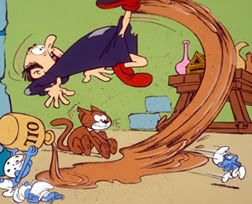
The Smurfs (8:00am EST/7:00am CT)- When that dastardly Gargamel destroys the smurfberry bushes, can Papa Smurf find the magic spell to set things right in time for the Smurfberry Harvest Feast? And what happens when the Smurflings help Brainy mis-use Mother Nature’s Horn of Plenty? Guest-starring Johan and Peewit!
It’s Punky Brewster (9:00am EST/8:00am CT)- When Glomer goofs up again, it’s up to Punky, Margaux, Cherie, and Allen to fix the holiday turkey before Henry gets home! Will Punky and pals learn a Thanksgiving Day lesson in caring and sharing?
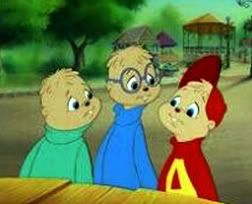
Alvin and the Chipmunks (9:30 EST/8:30 CT)- Alvin, Simon and Theodore compete with the Chipettes for a spot on a Spacy’s Thanksgiving Day Parade float. Will Alvin’s dirty tricks ruin Thanksgiving for everyone, or will he learn the true meaning of friendship and giving thanks?
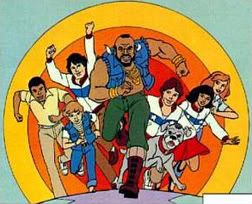
Mister T (10:00 am EST/9:00 am CT)- Mr. T and his daring yet caring gymnastics team volunteer at an inner city youth center on Thanksgiving Day. When a gang of mean punks try some rough stuff, it’s a cranberry bet that Mr. T and the kids will show them the error of their ways in time for pumpkin pie!
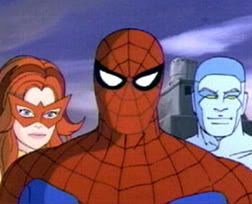
Spider-Man and His Amazing Friends (10:30am EST/9:30am CT)- Spidey, Iceman and Firestar fight the Juggernaut. Guest-starring those uncanny mutants, the X-Men!
Join us this Saturday at 8am (EST) on your local NBC channel for a Thanksgiving dinner with all the trimmings, featuring all of your favorite NBC Saturday Morning stars!
Wednesday, October 1, 2008
"Dog Eaters" is Now My Friend... and a Rumination on "Style"
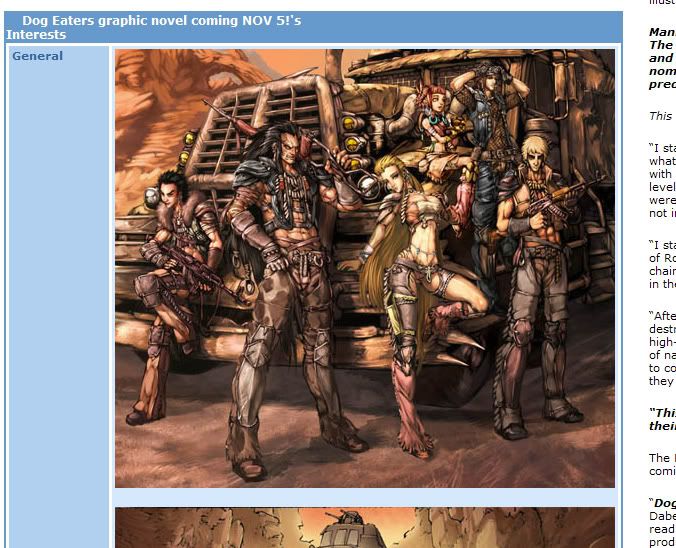
Dog Eaters is a post-apocalyptic story from Dabel Brothers Publishing, adapted by Sean J. Jordan and Guillermo A. Angel from Malcolm Wong's original screenplay. I can't really comment on the story because I haven't read it yet, but Angel's manga-infused art is colorful and inviting.
And now I'm a-gunna tell ya exactly why, pilgrim.
I'm basically old school but I tend not to judge things based on their cultural influences. Either you can draw or you can't (although I find that dichotomy way too reductive... I personally can semi-draw) and if you have the basics down, "style" will follow.
Style, as the concept is generally understood, is vastly overrated. What many of us think of as style are merely the most superficial elements of drawing. Speedlines, cross-hatching, manga-esque eyes, slightly cartooned figures, heavy shadows, scratchy lines, almost geometric figures, "realism." These are the most visual aspects that hit your eye with immediacy, and we use them to describe what certain comic book artists' works look like. We call this his or her "style."
Judging artwork solely based on these elements is like choosing our friends based only on the clothes they wear. Sure, we get a few clues about who they really are from how people dress, but that doesn't tell us if they're good people or not. Doesn't give us the deep-down identity or selfhood that raises them from mere acquaintances to lifelong friends or even lovers, those things that make the relationship more than just pleasant but a necessity for our continuing happiness. Just as personality, compatibility and our personal concept of "goodness" are deeper criteria when choosing friends, so to is the underlying structure of drawing- the bones and musculature- more important than "style."
These basics show you whether or not a person can really draw, has a clue as to what drawing is all about. Anatomy, proportion, weight distribution, line of action, hierarchy of form, perspective, appeal, storytelling. One an artist masters this stuff, style takes care of itself. Too many comic book artists have this totally backwards. They also get confused because some of the true masters- people like Joe Kubert, Kojima Goseki, Takahashi Rumiko, Jack Kirby, Frank Frazetta- tend to distort or stylize the human form to suit their needs.
And even "realists" like Neal Adams tend to use heroic proportions. Classical guy non-realist John Buscema's heroes look like the leapt out of a Renaissance sketchbook (rather than off one of the porno stills some popular "photorealists" trace from these days... photorealism is not a be-all/end-all unto it self and again falls under the category "style" as superficiality).
Even Michaelangelo began stretching the human form towards the end of his career.
I'm not comparing Guillermo A. Angel to any of these. I'm just explaining to you why I might bitch about people using manga style elements to cover up bad drawing one day, then tell you Angel's manga-esque art looks attractive to me another. I don't do the knee-jerk rejection of manga-esque art; in fact, I think that's foolishness indeed and speaks volumes of the rejecter's personal prejudices and ignorance.
Some people like Adam Warren, and apparently Guillermo A. Angel, can do the colorful, fun manga look and even use non-traditional anatomy (check out how long the legs are, how small the heads, how thin the torso is on Angel's female characters) and still show they have a solid grasp on the underpinnings. That's what I pick up on, not necessarily superficial elements like "big eyes" or "overly long legs" (these aren't automatically negatives) or my least favorite of all "details."
Also sometimes mistakenly referred to as "shading," as in, "Manga artists don't know how to do shading!"
In comic book terms "details" frequently means meaningless cross-hatched lines everywhere even though they're neither building tone or modeling shadow on the figure or creating texture and space in the backgrounds. I don't want to raise a shitstorm by giving specific examples. I could- some of them would be quite popular and successful comic book artists beloved by many, and one is almost universally reviled these days (but I don't want to dogpile the guy.) Just check out almost every secondary Image artist of the 90s to see what I'm talking about. Visual noise.
In fact, one of the Big Guns of Image once said in an instructional (destructional would be more accurate, though) video that you should throw in a lot of that kind of stuff in place of actual drawing. He said it with a kind of "those stupid kids won't know the difference and they'll think you put actual effort into your schlock" wink that made me instantly turn off the video and give up on his work entirely.
Visual noise does not detail make. Real detail consists only of what's necessary to make the image work. That's why I appreciate people like Takahashi Rumiko, Jaime and Gilberto Hernandez, Alex Toth and Mike Allred (one day I want to write an entry about Allredrian anatomy... it fascinates me). They put down exactly what's necessary and little more. They have superficial differences, of course, but the basics are there, totally internalized and they don't need to truck in false detail. Al Williamson once inked an old Jack Kirby drawing for TwoMorrows' Jack Kirby Collector (I love that magazine) and crosshatched among the famous Kirby dots in the background. His reasoning? "It needed it." And he is right- it's not exactly pure Kirby but it definitely made the foreground figures pop by making them no longer in competition with the background.
Anyway, Angel's art looks pretty cool. It works. His figures are dynamic, his art is detailed to the correct level and in the right way, and he actually draws vehicles that look like they could work. They commented on my Myspace page with a friendly, art-filled message with some action packed stuff. Cool blood effects, bodies tumbling through the air, machine guns blazing. The more I see, the more I dig it. I wish I could comment more on the story, but I couldn't read the PDF preview. I'll try again later.
Based on what I have seen and just looking at the art, I'd like to check out a few more preview pages. I'm not a big sci-fi/fantasy person. I tend to stop and start at Ray Bradbury and Kurt Vonnegut. But Dog Eaters seems to do that Mad Max punkish-motor-tribes-in-a-desert-wasteland thang I love, and it it's also another thing I tend to like- a finite story. One with a beginning, middle and end. Which hopefully means character development going from point A and coming to its logical conclusion at point Wherever without extending the story past its natural stopping point into absurdity and continuity insanity, a la most serialized comic book monthlies. Some of Malcolm Wong's political and social concerns are also my own, so I give him some credit for developing the book from those, too.
According to MySpace, besides his Dog Eaters screenplay, Malcolm Wong has directed music videos here in Japan... and he and his wife are also responsible for the rebirth of the fashion doll, Blythe. That's also pretty cool. Actually, taken altogether, that's some high-powered cool.
And the final cool thing about this? Thanks to Dog Eaters' friendship, I was able to friend Diablo Cody, kick-ass screenwriter of Juno, one of my favorite movies. In fact, in a year overrun with good superhero action movies I definitely enjoyed, Juno remains healthily ensconced on top of my list as Best Movie Released in Japan in 2008.
Thanks, Dog Eaters!
PS- One day I'll re-explain why I generally reject using the term manga as jargon specifically referring to Japanese comics or Western comics drawn in similar styles. I just use it here as shorthand and out of laziness.
Shut Your Creeping Face, Uncle Creepy: "Creepy Archives" Vol. 1 Review!
Publisher: Dark Horse
Stories: Archie Goodwin, Larry Ivie, Otto Binder and more
Artists: Frank Frazetta, Reed Crandall, Al Williamson and more
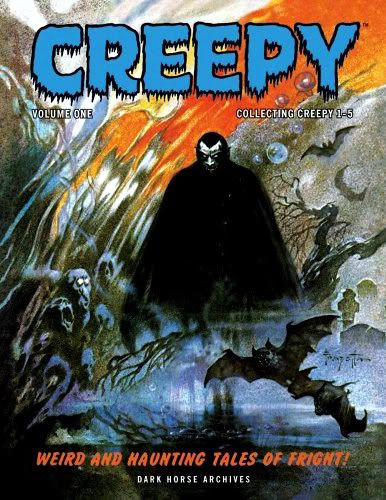
Capsule review: Collecting the first five issues of that old Warren Publishing horror mag Creepy, this book isn’t likely to scare you (unless you’re a pretty timid soul) but it is going to dazzle you with full-color reproductions of Frank Frazetta’s painted covers and the gorgeous black-and-white work of the greatest artist line-ups in American comic book history.
When I was a kid, we bought comic books from convenience stores. And we tried to get the most comic bang for our comic buck.
Which meant we only sneaked peeks at those pricey b&w titles from some company called Warren Publishing. The ones over on the magazine rack beneath Hot Rod and Field & Stream, sometimes Playboy and Penthouse. Eerie. Creepy. The Rook. Vampirella. They had lurid painted covers with lovingly rendered semi-naked women or fanged werewolves bristling with hair.
And their title logos looked like oozing blood.
To my innocent suburban eyes, the Warren magazines seemed sordid compared to the four-color DC and Marvel books. Maybe it was their location within the magazine display, inches from the pornography, down near the scuffed floor. Maybe it was the degenerate hosts. Uncle Creepy and Cousin Eerie looked decadent, decayed. Vaguely inbred. Like they’d invite you into their crumbling mansions, feed you poisoned gingerbread, then read you dirty limericks as you died.
Even on a bright summer day, south Georgia humid, with afternoon thunderstorms rolling in from the west charged with the molten July heat, school still over a month away, a surreptitious glance at a Creepy or an Eerie story gave me a Halloween night chill… frequently without my having read it thoroughly. But I was an overly imaginative boy who lived near a cemetery.
Wow, I didn't know what I was missing!
Alex Toth, Al Williamson, Alden McWilliams, Jack Davis, Roy Krenkel, Joe Orlando, Gray Morrow, Frank Frazetta, Angelo Torres and Reed Crandall contributed to Warren’s horror magazines at one time or another, and all are represented in this reprint of the first five issues of Creepy, complete with Frazetta’s moody, expressionistic covers and all the original ads for things like an LP of Boris Karloff reading "The Legend of Sleepy Hollow," a miniature Germanium radio, an 8mm projector or a giant plastic fly…
I don't know what someone might've need a giant plastic fly for but I'm a "whatever floats your boat" kinda person.
And yes, the artwork is beautifully reproduced here in a large, crisp format so you can study all the nuances of Williamson’s lithe figures, Frank Frazetta’s never-equaled inking and Gray Morrow’s creamy ink washes. I can’t imagine the original printed stories looked as good as they do on these pages. I can’t imagine any other comics of any other era looking as good as these. Reading this book is like taking an autumn holiday away from today’s tired hacks who seem content to steal stylistic elements from manga to cover poor draftsmanship, or else trace stills from porn videos of Maxim magazine to mimic “photo-realism.”
There’s a mix of old school horror and sci-fi stuff, with each artist well-chosen. Al Williamson and Roy Krenkel visualize an undersea kingdom, the kind of thing they excelled at, and Williamson later playfully and self-deprecatingly casts himself in “The Success Story” as murderous hack cartoonist Baldo Smudge (who gets a zombie-fied comeuppance), but the revelation here is Reed Crandall. He’d done solid work at EC, but in Creepy his art looks like 19th century etchings, fine-lined and sharply delineated, the perfect match for some of the antiquated settings.
As gorgeous as Crandall’s work is, the single most strikingly illustrated story has to be Morrow’s “Incident in the Beyond.” Modeled in lush levels of black and gray wash, it anticipates Richard Corben’s airbrush work during Warren’s latter days.
Worthy of special note as well is Frazetta’s final comic book story, “Werewolf!” Writer Larry Ivie atypically sets it in Africa rather than Transylvania or the Scottish moors, and Frazetta gives brutish “white hunter” Demmon a hulking, almost simian appearance to match his bullying personality. Demmon’s werewolf quarry is little more than a scratchy blob of black brushstrokes with eerie white triangles for eyes and fangs. I can see where Mark Schultz got some of his drybrush techniques.
Alex Toth’s “Grave Undertaking“ rounds out the volume; Toth’s use of inky silhouette and flat fields of gray-tone is almost abstract, making his work here feel experimental compared to the more classical approach of Crandall, Williamson, Morrow and others.
Beyond their art, the tentative, fairly tame stories don’t quite live up to the promise in Frazetta’s covers- especially his issue 4 phantasmagoria, which has to be one of the most delightfully dark and iconographic werewolf images ever. A big orange full moon looming over a castle, fluttering vampire bats, and an oversized wolf-creature eyeing some hapless goober with slicked-back hair, wearing a Sherlock Holmes cloak. A neat touch is the skull and vertebrae lying in the foreground, foreshadowing our friend’s fate.
Most of these eight pagers are cliched (some readers thought so even back then, if the letter pages are to be believed... oh, and look out for at least one name familiar to horror comics fans for his work on a certain swampy thing in the early 1970s), not the least bit frightening and not particularly gory despite the lack of Comics Code Authority oversight.
With heavy usage of Eastern European vampire and werewolf motifs, these initial issues of Creepy come across as quaint. Some tales seem oddly like adaptations of lesser known Universal or Hammer Studios films; lots of 19th century police inspectors and bobbies discovering bloodless corpses, torch-bearing mobs and the like. The settings often look like the same Hammer backlots (assuming they had some) Peter Cushing and Christopher Lee stalked, shot day-for-night on the cheap but in gruesome color. And some, like “Bewitched,” don’t really make a whole lot of sense and hinge on ridiculous chains of events, or conclude unsatisfyingly with clumsy exposition.
You can almost imagine Count Floyd showing up at the end instead of Uncle Creepy, dripping flop sweat and desperately trying to inject some energy into the disappointment: “Wasn’t that some… scary exposition, kids? I don’t know about you, but I find… er… explanations reeeaaalllly scary! Information… it’s… it’s frightening, I… um… tell you… ARRROOOOOOOOO!!!!”
While they (fortunately) don’t feature the sexual imagery common in the Creepy’s from my era, they also lack the visceral impact of those latterday stories. I mean, Bruce Jones’ repellently effective “Jenifer” still makes me feel sick more than 20 years after I first read it, but there’s nothing approaching that level of revulsion here. You could give this volume to an monster art-loving older kid without any worries.
And you should. But don't give that kid anything reprinting "Jenifer" before his or her 21st birthday. Yikes!
This is what horror was before people like Robert Bloch, Richard Matheson and Stephen King updated it to take place in the 20th century, in suburbs with supermarkets and liquor stores.
Best are the tales written by none other than the legendary Archie Goodwin. His plots are tight and well-constructed for this short format and invariably feature an effective little EC twist at the end.
Even his adaptation of Edgar Allen Poe’s “The Tale-Tell Heart” isn’t satisfied with the gruesome spectacle of a man cutting out another’s heart and going mad from guilt. Nope, Goodwin audaciously appends a further O. Henry-like element. “Monster Rally,” featuring the surprise birth of Uncle Creepy (and some of Angelo Torres’ finest work), reads like an homage to the similarly-themed Haunt of Fear tale “A Little Stranger,” the origin of the Old Witch. Goodwin seems to have internalized the EC formula, and his shock endings rarely have to be explained through dialogue because he runs out of pages. No wonder he maintains such a monumental reputation in the decade after his passing.
This is a huge, heavy hardcover that takes its archival mission seriously. It’s expensive (although compared to some of the recent books from DC and Marvel, it’s more than reasonable), but if you’re a fan of classic comic book art from the days when artists could actually draw and seemed intent on blowing readers away with their skills, this one is a must. I’m not sure how many more volumes this series will run before they get to the sex and gore, but until then just enjoy these relics of a more cheerfully horrific time.
Fortunately, now that I'm independently wealthy, I have plenty of yen to throw away on Creepy. Well done, Dark Horse.
Sunday, September 28, 2008
Fair was Helly Glover: "Hellboy: The Crooked Man" 1 Review
Publisher: Dark Horse
Story: Mike Mignola
Art: Richard Corben
Colors: Dave Stewart
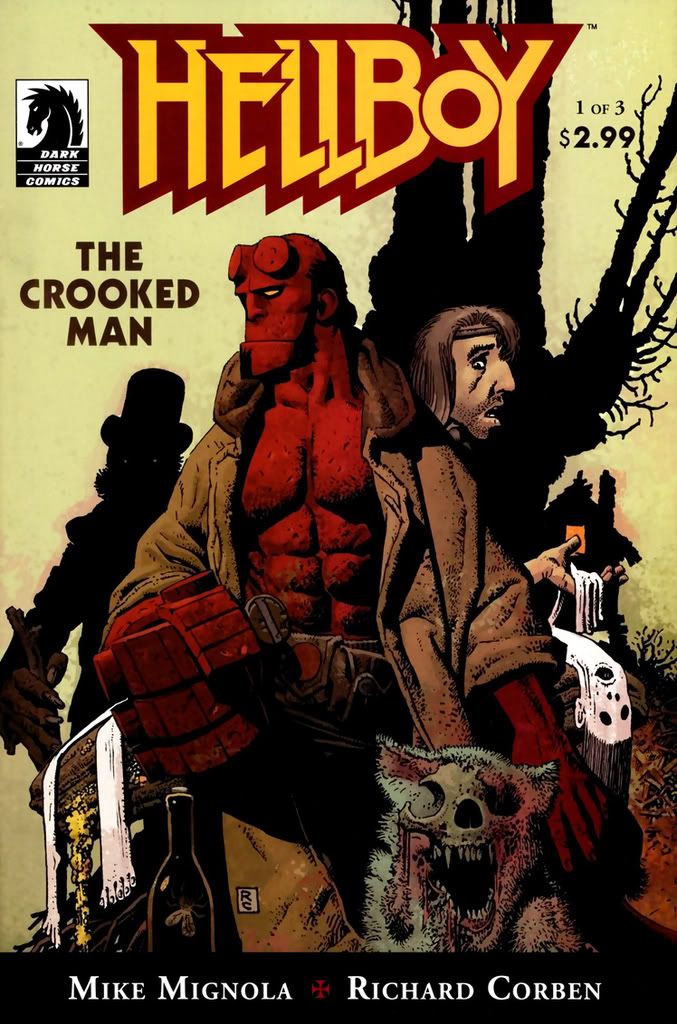
Capsule review: Mike Mignola and Richard Corben take Hellboy deep into the misty Appalachian mountains where he finds himself battling a twisted (but sharply dressed) evil for the souls of a wandering hillbilly and his childhood friend. Rustic witchcraft lore and a unique setting make for one of Hellboy’s most atmospheric and affecting tales.
My list of top horror comic artists is pretty short these days. Sure, there are the old masters, the guys who did stuff for EC and Warren back in the olden days before I was born. But among today’s active artists? Not including a few from Japan, I’d put only Mike Mignola, Richard Corben and Bernie Wrightson at the top. And what a disparate trio. While I’d love to see Wrightson illustrate a Mignola strip, I think Corben is the perfect match for Mignola’s Hellboy.
Strangely enough for two artists who work together so well, Corben’s and Mignola’s art couldn’t be more different. Sure, neither adheres to classical ideas of body proportion, and they both work a kind of moody magic on the page. But Mignola’s figures are abstractly geometric, almost flat, while Corben’s are weirdly textured and more three-dimensional. You can even spot some odd Jack Kirby or P. Craig Russell flourishes in Mignola’s blocky monsters.
Corben, though?
Richard Corben is unique. I can’t think of anyone else whose art his resembles. Oddly stretched or squashed figures, shadows with a crumbly edge that make his figures pop, but also gives them strange fungoid textures. Creepy and nauseating, but in a good way. I mean, we’re talking about horror comics here.
Mignola writes to Corben’s strengths by setting The Crooked Man in the Appalachians of Virginia and peopling the hills with melancholy backwoods types. Corben can distort their bodies almost to the point of caricature and bathe them in pale light and inky shadow. Stick them in haunted dells, thickly wooded and mossy, heavy with portents of evil. Depict in full, sickly detail women who leave their rubbery, cast-off skins lying around on beds in wooden shacks, temptresses who ride on desiccated horses. And a hideously misshapen figure in a top hat who plays both ends against the middle as he does Satan’s work on earth. Or is he, himself, Satan?
Despite the weirdness of it all, Corben gives the most visually ludicrous figure, Hellboy himself, a solid muscularity that makes him almost plausible with his sawed-off horns, red skin and wrinkled trench coat.
After wreaking havoc through Lovecraftian pastiches, Celtic adventures and stock Eastern European set-tos, Hellboy plunges into the folklore of his adopted home country. It’s a more than welcome change and really invigorates this installment. There are only so many times Hellboy can bop undead Nazis or tangle with worms and tentacles from beyond space before it all blurs together. Mignola’s plot and dialogue are heavy on the southern gothic, with down-home characters solemnly intoning lines like, “So one day I found me a squashed black cat… An while my ma was out, I boiled it till it went all to pieces… Then I took that mess down to the creek to wash out the bones.”
These are superstitious earth-folk, and they have good reason to be. Their mountains are haunted places where Satan’s agent shambles through the woods and offers deals too good to be true, and none too safe for the immortal soul. These mountain people seem to approach living half in a nightmare with a tired fatalistic acceptance, and not even the sight of a muscle-bound demon wearing clothes and toting a big pistol throws them off their stride. Hellboy fits right in from the start.
It reminds me of “Jess-Belle” one of the most inventive and original Twilight Zone episodes, penned by Earl Hamner, Jr., who later went on to create The Waltons. Like Crooked Man, “Jess-Belle” is set in the Appalachians (the Blue Ridge Mountains, to be exact) and deals with witchcraft and its consequences. In it, James Best plays a young hillbilly bewitched away from his fiancee by the darkly beautiful and ultimately doomed Jess-Belle, played by Anne Francis. Between that TV story and Hellboy’s, I guess it proves cain’t nobody walk the paths of the fallen without payin’ a heavy toll. We all know whatever Faustian bargains Hellboy’s new pal Tom Ferrell made in his past will come at a similarly heavy price for both him and his childhood friend, Cora Fisher.
I’m not sure what John-Boy would make of Hellboy, but this is as close as we’re likely to come to that particular crossover. Unless Mignola and Corben are building towards a climactic scene where Hellboy bids goodnight to an almost endless stream of hard-working and good-hearted farm people with their various genders appended to their given names.
Friday, September 26, 2008
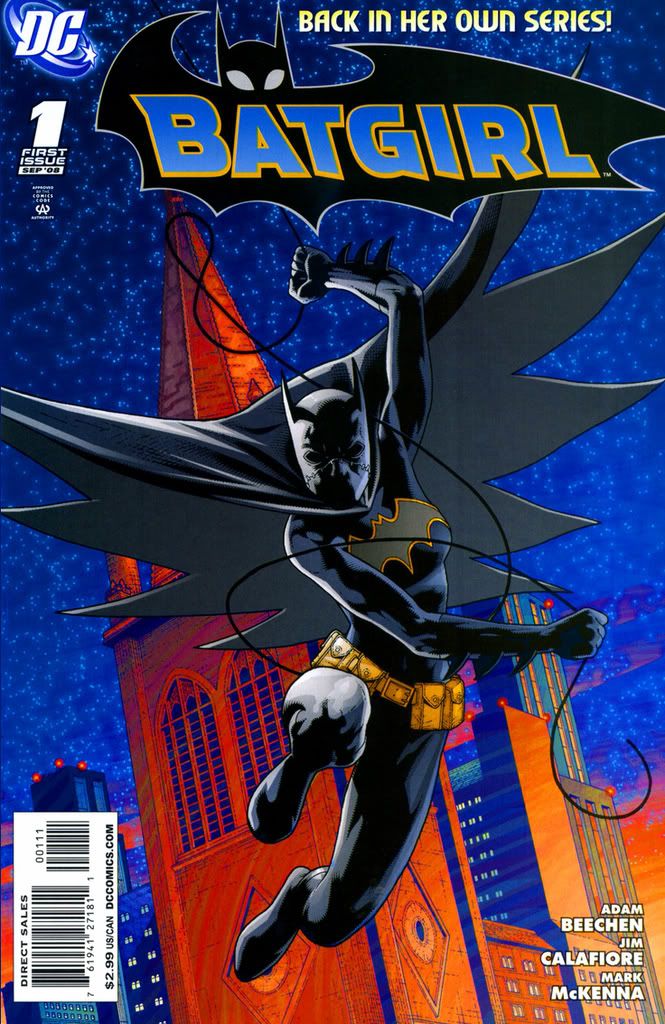
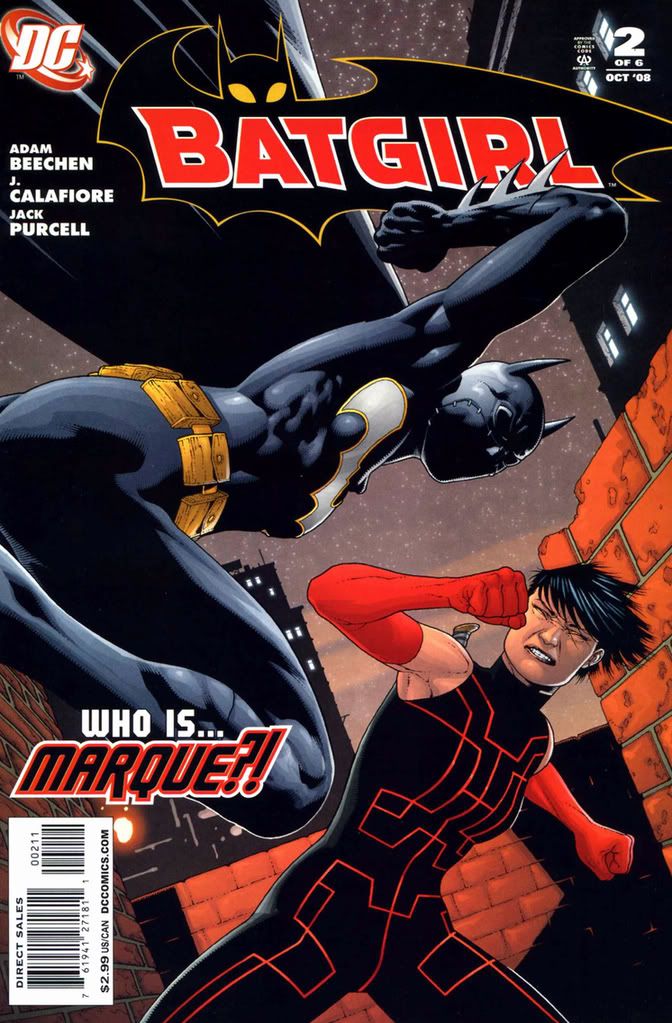
Blecchhh in Her Own Series: "Batgirl" 1 & 2 Review!
Publisher: DC Comics
Writer: Adam Beechen
Penciller: Jim Calafiore
Inkers: Mark McKenna, Jonathan Glapion and Jack Purcell
Colorist: Nathan Eyring
Capsule review: Batgirl issues 1 and 2... the perfectly-constructed 4-color vehicles for delivering ennui to a new generation of sonambulant comic book fans.
Beechen said that the story will answer all the questions from the last few years, and will address all of the questions of why Batgirl has been acting the way she's been acting, and set the stage for new Batgirl adventures to come. -- quote from some old Newsarama story that no longer exists.
You know, it's never a good sign when your writer's big plan for a new story is to tell you things you already know.
After DC screwed up the Cassandra Cain Batgirl character by turning her into a horrible Dragon Lady stereotypical villain and thereby alienated the character's very vocal fans (which is a kind of irony, I suppose), they took steps to fix things and earn back some good will. Batgirl popped up in Teen Titans, readers found out she was acting screwy because she'd been drugged, Chuck Dixon added her to his Batman and the Outsiders team and all was right with the world. And that's all we needed to know. Bad drugs as a silly, comic booky but acceptable explanation for bad writing. The end.
But here comes the new Batgirl miniseries, written by Adam Beechen and instead of moving forward, he chooses to rehash and overexplain a lot of storylines that for everyone but Beechen had already been dealt with and finished. And to do so in ways that are both boring and surprisingly inept. At one point early in the first issue, Nightwing catches Batgirl sneaking a peek at her Christmas presents and-
Actually, Nightwing finds Batgirl using the Batcomputer to foster a personal vendetta, and they discuss this for a few panels while engaging in a wussy slap-fight... before Batman and Robin come in and also start jabbering away. Talk, talk, talk. At this point, writer Adam Beechen and penciller Jim Calafiore gift the readers with a panel where an ant-sized Robin head groans under the weight of enough copy to explain the Libertarian Party’s presidential campaign platform. Twice.
Batgirl wants to kill Slade (the man who drugged her) and Cain (her father, who is still giving her hell despite that storyline having come to a fairly satisfying conclusion in the original Batgirl series). This is all well and good. Batgirl should be edgy and dangerous. But Beechen has her tell us this practically at the start. Goodbye surprise and suspense.
Wait! Don't close your eyes and nod off yet! I haven't told you the best part! According the Beechen, Batgirl's ultimate motivation- what truly drives her and pumps blood through the secret-bearing chambers of her heart- seems to be... I feel a Dr. Smith imitation coming on here… the pain… the pain... the desire to have a “normal" life.
Just like Buffy in the early days of her vampire slayin’ TV show. Just like cheerleader Claire in the first few episodes of Heroes. Just like so many other teen or teen-ish characters involved in the supernatural or the superheroic. And never mind Batgirl actually tossed away her civilian identity at one point- by revealing her face to a government agency- in order to become more fully Batgirl. Forget entirely this is a woman who made a metaphorical deal with the devil by taking lessons from killer mom Lady Shiva and promising a death duel in a year’s time rather than lose her fighting abilities and give up being Batgirl. And don't worry that she constantly risked Batman's wrath by trying to be Batgirl each time he fired her.
Yeah, wants to be normal. Good one, slick.
Yep, Beechen still does not have a handle on how to write this character. Hasn't a clue. Doesn't really seem to care. After all, he didn't bother to concoct an interesting plot. Out of the story’s many weaknesses and disappointments, this failure to develop a believable characterization for its protagonist is the most damning and inexplicable.
Beechen’s most clever conceit is having Cassandra reveal at one point she’s taken ESL classes. This is an attempt to explain one of the stupider goofs Beechen made in the Robin series, where a girl with hardly any verbal skills has become loquacious and fluent not only in English and Supervillainese, but also in Navaho. Within the space of a year. That must be some ESL school!
This plot element also seems a clumsy attempt to shoehorn a totally lame romance into the story. One look at some bland, nice guy we’ve never seen before and Batgirl’s already in love. And we know this not because the character registers as anything more than a plot contrivance or because Calafiore's art emphasizes anything resembling romance through reaction shots. No, we know this because Beechen has Batgirl (on patrol, no less) thinking about this dull new character’s “nice eyes” and musing that she “hasn’t felt this way since…”
Since some past romance from some other comic I haven’t bothered to read, about some character I don’t give two craps about.
Yeah, guess we’ll have to take Batgirl’s word for it, because nothing else in that sequence informs us of anything other than the ol’ “tell, don’t show” storytelling style popularized by classic Scooby Doo cartoons written for very dim suburban kids is still alive and well at Time/Warner.
Despite some blood in the early going, there’s no sense of danger, no thrill, no atmosphere. Superheroic generica starring a once-intriguing lead turned cliche. It’s fine that Batgirl has verbal chops now to go along with her fists of fury, but does she have to be so chatty? Some people can speak perfectly well but choose not to. Alternately, couldn’t she at least be sullen or moody? Garbo speaks! But has nothing of interest to say!
Instead, Batgirl narrates in familiar super-person style rendering her little more than an interesting costume. She could be anybody now. They should rename her "Li'l Miss Anycharacter." In fact, she is everybody because Cassandra-clones are popping up all over the place. She wasn't big daddy Cain's lone success. That would leave her unique. Interesting. No, now we have Marque. As issue 2's cover copy asks, "Who Is Marque?!"
God, who gives a shit?! She seems to exist mostly to dilute what little narrative thrust Beechen generates with Batgirl's own need for vengeance by showing up with her own, even less interesting one.
Well, I suppose at one point Beechen has Marque tell us who she is including her favorite color and what she ate for lunch each day in elementary school in one giant block of dialogue, and then she and Batgirl play Boggle, Scrabble and Super Password hosted by Burt Convy, but I missed it because I'd fallen asleep from boredom and crumpled my copy into an unreadable ball of colorful paper.
Tired, rote plot. Labored exposition. Teen emo. Perfunctory fight scenes, more A-Team than Kill Bill. Beechen and Calafiore would’ve done well to read a little of Koike Kazuo’s Lady Snowblood to learn how to depict a deadly woman on the vengeance trail. Batgirl should be scary. You should feel afraid of her and for her at the same time. To this end, they could’ve rented Crouching Tiger, Hidden Dragon, and tried to infuse Batgirl with some of Jen Yu's life rage, with the same sense of inevitable tragedy about her. There was a girl who may not have known exactly what she wanted, but it sure as hell wasn't to be "normal." Not after tasting power and independence.
But that would have imparted a little style and substance to this flimsy, thrice-told little tale.
Sunday, September 7, 2008
9th Annual International Manga Summit Concludes Comics Are Educational
Kyoto, home of the Kyoto International Manga Museum, recently hosted the 9th annual International Manga Summit. According to a story in the Japan Times, the manga summit concluded that comics can be used to educate people on a wide variety of topics, from the environment to food safety. It also noted that Finnish cartoonists are increasingly influenced by their Japanese counterparts.
Interesting developments, to be sure. But I declare comic books in general to be fun and entertaining also. Especially Nana. That is some good stuff!
Sunday, August 17, 2008
Do People Have to Be Reminded to Act Civilized?
I guess so! I created this blog to escape from issues blogging, but this is something that disturbs me. It disturbs me that you have to actually tell certain people how to act in public. You'd think parenting, school and socialization would have taken care of these things, but apparently some idiots still haven't gotten the message. Some people can't handle being out in public around human beings who vaguely look like (and in some cases, dress exactly like) those longer-haired, slightly shorter characters in their funny books and on their favorite TV shows.
You know, the not-men. What do they call those again?
In any given group situation, it really does not matter if the person in question is a woman or a man- if they don't want you touching them, if they haven't given you permission to put your hands on them, then keep your damned hands to yourself. The fact that it's a sci-fi or comics convention makes no difference.
Now, I know people wear some outrageous stuff at genre conventions. The Slave Leia costume, a Red Sonja metal bikini and what have you. There will be professional models dressed like Lara Croft or whatever video game goddess is being hyped this financial quarter. And there's a certain relaxation of societal standards to allow for free expression. You're there to geek out in ways you can't at the office. You might meet someone you could be attracted to who shares your esoteric interests. It's totally okay to try to score some phone numbers. Plus, it's during vacation time for a lot of people so cutting loose feels good.
But there are limits. Because here's the thing- clothing does not equal consent. Attendance at a convention does not equal consent. Being simply a woman at a convention certainly does not equal consent. If someone isn't interested in you, be cool about it and gracefully back off. You're not John Cusack in Say Anything.... No means no. No answer means no. An "I'm busy" or "Maybe some other time" means no. Only yes means yes. You really shouldn't have to explain that to anyone over the age of 5 or 6. Certainly not to an adult.
And yet you do. And you do. And you do.
Why do people who somehow have failed to learn this before beginning elementary school get to define fan behavior? Who arbitrarily decided that genre conventions were free-for-all zones where any kind of stupidity goes? Where it's "cool" to grab someone's ass to "see what her reaction was?"
What if I went to a convention and randomly spit in people's faces to "see what their reaction was?" Hell, if they didn't want me to spit in their faces they wouldn't have come to the convention, right?
I'm pretty sure I KNOW how they would react. They'd get upset. I'd get booted out the door. There might even be violence. And you know what? That's not even why I don't do those kinds of things. I don't go around spitting on people because it's wrong. Just as it's wrong to grope someone. Just as it's wrong to make someone afraid. It's simply wrong to abuse people.
No matter how they're dressed. Or where they are.
It's not cool to do these things; it never has been, it never will be. Doing these things makes you an asshole; always has, always will. It's mindboggling that some people don't get this, that they turn off their brains at the convention center's doors and turn into Creatures from the Dorkass Corners of the Id. It's crazy to have to explain basic human behavior to people. It's like trying to explain why you shouldn't touch fire, why you shouldn't point a loaded gun at your head, why you shouldn't eat strange things you find on the highway. Behaviors that are self-evident to everyone except these few jerks.
Who in turn define the rest of us to the world at large. Who seem to define convention etiquette and behaviors for everyone else. And who define a genre convention as a place where three or four maladjusted and misanthropic cretins get to set the standards and tone for the majority who actually know better.
Convention organizers- don't be intimidated by these crude, crass attendees. They represent the smallest fraction of convention-goers. But they make up the entirety of the group doing stupid, outrageous things to the other attendees. Evidently, many conventions DO have anti-harassment policies in place and that's as it should be.
If yours doesn't, then make one. And if it does, make sure all the attendees are very aware of it. Publicize the hell out of it. Make your convention known as a safe space, where everyone can have fun. You know, except the very few whose idea of fun include nonconsensual touching and weird verbal abuse. They shouldn't be allowed to have their kind of fun. And if they tried that at the local shopping mall, they'd be arrested.
You can make a definite statement, put it right on the tickets, right on the signs and in the advertisement, and most people will still show up. It's ridiculous that you should have to explain something that's supposed to be common sense, but spell out in simple, clear terms that sexual harassment and intimidation, that unwanted touching and violence are not tolerated there. Have a visible and clearly-marked place for women to go to (or even men) when they've been violated or harassed. Toss out the jerks. If you want to be cute about it, dress your bouncers like Imperial stormtroopers or the Justice League or something.
I also want to charge the vast numbers of responsible convention-goers not to accept these pissants' definition of who we are and what we do. When you see this stuff happening, confront the situation. You don't have to run up and act like Batman or Wonder Woman, but there are sensible things you can do without being a vigilante. If you read the essay that set this off, that's exactly what the author tried to do. That's just good old-fashioned human decency. A concerned person supporting others to have the most fun possible without ugliness and degradation.
And if your friend comes back to you laughing about pinching some girl's ass or putting his hand down her shirt, tell him outright that's shitty behavior. Don't condone it with your silence. Make him feel the shame he should feel for doing something asinine. Perhaps common sense and humanity will reassert itself and he'll finally learn the damned lesson he should have as a child.
Or, report him to whoever is in charge. Do it in a reasonable way, of course. Screaming about it isn't much of a help, but level-headed insistence that you feel uncomfortable and unwelcome in a place where they allow sexual violence in any degree.
Even if there's not a firm policy in place. Even if there isn't an actual complaint booth. Find someone in charge and let them know your feelings. Everyone do this, immediately. Don't wait until the next day or the end of the convention. Do it immediately. Firmly but politely. If the organizers feel their financial break-even point being threatened, they'll act. If enough fans get involved on a grassroots level, this behavior will stop. Or become less frequent. Hell, I'd be happy if some of the incidents I've read about ended in arrests. I know of at least one involving a creator that more than likely should have if I'm remembering the details correctly.
And if an asshole doesn't come or a groper doesn't get to grope or harass, who gives a shit? Who gave these freak losers the right to violate the human dignity and personal space of others? They can't do that shit at the circus, the carnival, a Renaissance Fair, movie theaters or ballparks; they shouldn't be allowed to do it at a genre convention.
Subscribe to:
Posts (Atom)