I watched
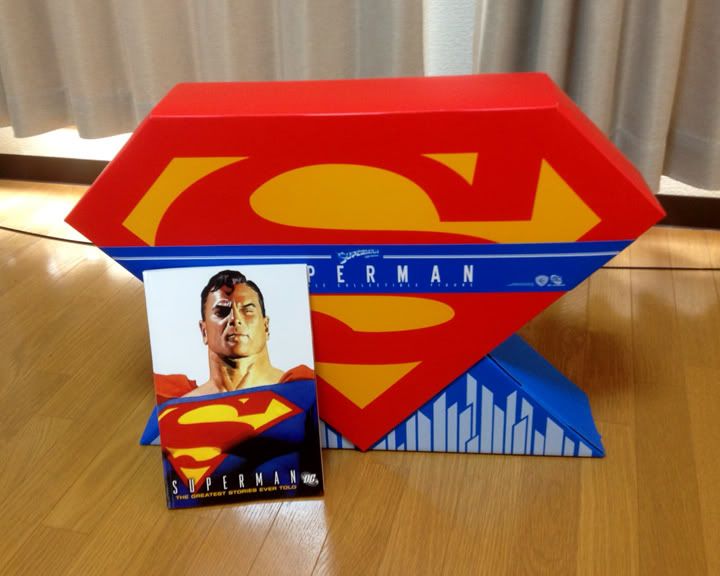
Superman the Movie, the 1978 big screen epic starring Christopher Reeve as Superman and also received a couple of fun little items. One is the trade paperback collection
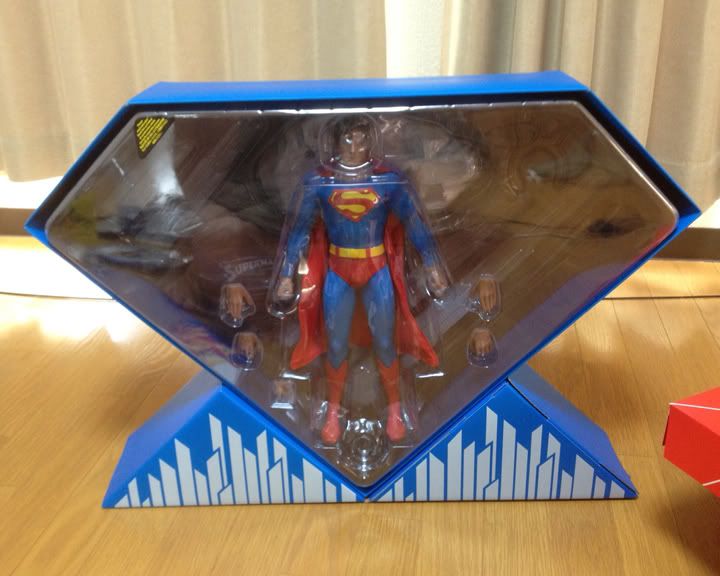
Superman: the Greatest Stories Ever Told and the other is the Hot Toys
Superman the Movie 1/6th scale Christopher Reeve as Superman action figure.
The book has a nice Alex Ross cover featuring his version of Superman looking stern and appropriately heroic, spit curl, narrowed eyes, lantern jaw, big red and yellow emblem on his chest. The stories inside feature a wide array of writers and artists, but a more appropriate title is
Superman: Some Pretty Good Stories. Alongside the origin story from
Superman #1 (June 1939) and the John Byrne revamp "The Man of Steel" from
The Man of Steel #1 (June 1986) there are some curiosities like the 1940 short story "What If Superman Ended the War?" written and drawn by Superman creators Jerry Seigel and Joe Shuster for
Look Magazine and an otherworldly pin-up by none other than Moebius himself. It's amusing to see the rudimentary yet compelling storytelling of Simon and Shuster as they pit Superman against the real world menace of both Adolf Hitler and Joseph Stalin. All it takes is a quick trip to Nazi Germany and the Soviet Union and Superman deposits both dictators in Geneva, Switzerland where they're judged for crimes against humanity and the world enters a utopian age of peace and scientific progress...

"Must There Be a Superman?" by Elliot S. Maggin explains why such a scenario probably wouldn't have occurred. In this story, reprinted from Superman #247 (January 1972), the Guardians of the Universe save Superman's life in deep space then perform a kind of brain washing on him to make him question his stunting effect on human evolution. This story comes closest to being "great," an interesting attempt at answering a question the question posed in its title. Should Superman solve everyone's problems? And if so, would that set back our advancement? It's illustrated by the legendary art team of Curt Swan and Murphy Anderson and it's a marvel of old school storytelling-- heroic anatomy that isn't overly exaggerated, easy to follow layouts and migrant workers shouting, "VIVA SUPERMAN!" as he rebuilds their shacks like a one man slightly-slower-than-lightspeed Habitat for Humanity.

My second favorite is Byrne's story borrows a few bits from classic Superman comic book lore, a little from the first movie and presents a sci-fi reworking of the planet Krypton into a barren world that looks like Monument Valley painted a sickly green, where its completely hairless population live without concepts such as love and react with shock at the sight of raw, shirtless Kansas farmhands via some kind of holography device. Always one of comics' keenest minds for explaining away the ludicrous, Byrne invents a Clark Kent who didn't come into his powers all at once-- lest he rip his adopted parents apart and perform who knows what other horrors
a la Rick Veitch's
The Maximortal-- and uses body language and actor's tricks to convince people he isn't his charismatic alter ego. Byrne's artwork looks like he's doing his best Jose Luis Garcia-Lopez impression-- very DC merchandising style, but with the characteristic Byrne cross-hatching and keen story sense. There's a poignant moment where Clark, having performed his first miracle, broods in the dark of his boyhood bedroom after finding the resultant media scrutiny terrifying. Byrne locates both the god and the man inside the superhero, but the story suffers from too much condensing. We'd like to linger a bit, but Byrne disposes of entire reams of Superman legend in just a few pages-- and a lot of this stuff would be ripped off later in
Lois & Clark: The New Adventures of Superman and
Superman Returns. Not too shabby, Mr. Byrne.
I wasn't all that impressed with "What's So Funny About Truth, Justice and the American Way," though. The late, unlamented
Wizard Magazine declared it the greatest Superman story ever, but apart from its central conceit-- quaint ol' Superman versus the British Invasion of smart but cynical and thoroughly dark characters, and by extension, the whole aesthetic of their writers-- but it's too choppy and fragmented. The Elite just come out of nowhere with little build up and as a result, there's no rising suspense before the final confrontation. Even the manner in which Superman defeats the Elite is left a little unclear, as if writer Kelly glossed over it because he was so entranced with the philosophical confrontation he never got around to working out the actual plot points. In fact, he's way too oblique throughout most of the story and sacrifices impact. He's not helped by some incredibly ugly art. Some contrast between a Curt Swan-type Superman and some Frank Quitely/Steve Dillon-style enemies would have reiterated and reinforced the story's theme, but no such luck. The pages look murky and unfinished. You can't even tell what's happening half the time. Someone apparently explodes at one point, but it's so awkwardly composed with the person's head partially cropped by another panel-- I suppose to direct our attention to the characters commenting on it in an oblique, nonsensical fashion who, for some reason, the artist has relegated to the background-- you wish it had just happened off panel and we'd only seen the reaction shots with a bit more explicit dialogue. Speaking of which, Superman's final speech to a blubbering Manchester Black doesn't deliver the goods. Sorry.
To be fair, I didn't read this story when it first came out in
Action Comics #775 way back in 2001 and in the years since we've had rapes and murders,
Identity Crisis making the regular rank-and-file of DC's caped marvels almost as nasty as the Elite are supposed to be and Wonder Dog devouring Wendy, so maybe I'm just jaded, so beaten down by the banality of all this caped decadence I can no longer feel Kelly's intended impact. You really want a Superman who's a beacon of restraint and decency, and Kelly attempts to give that to us while scoring points off guys like Warren Ellis-- who's actually a damn fine writer-- and even DC's own Vertigo line, but when you turn all your heroes morally ambiguous and then pat yourself on the back for it, ironically it turns out Superman won the battle but lost the war. This Superman doesn't even exist anymore.

There are some Silver Age amusements to be had, with Al Plastino well represented but Wayne Boring unfortunately absent. And where's Bizarro? They couldn't find an excuse to include even one single Bizarro story? Well, I guess one shouldn't complain too much when Jim Steranko and Mike Mignola make appearances.
Even at their best, none of these stories approach the magic of
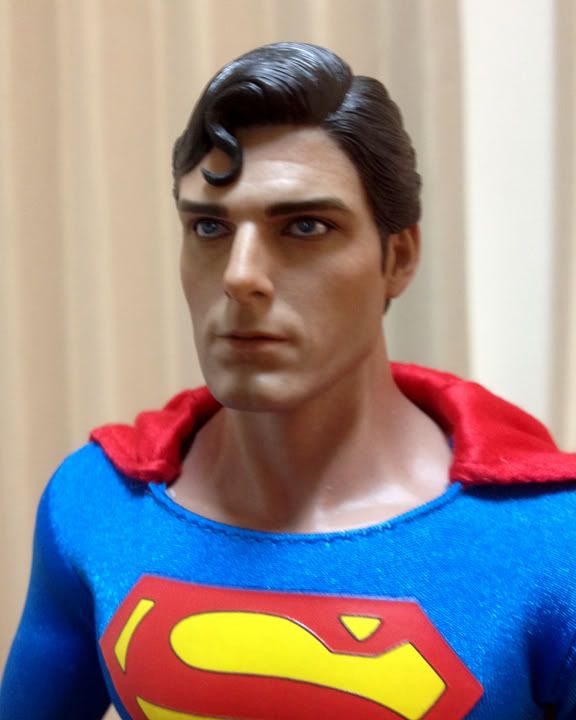
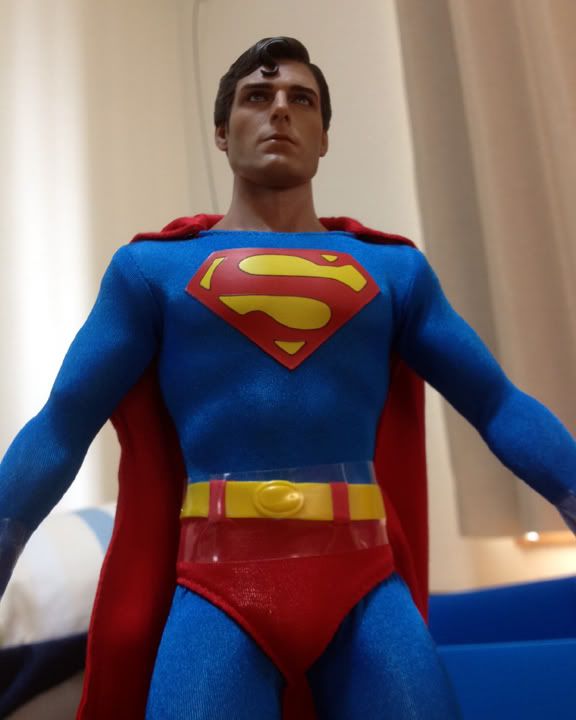
Superman the Movie, a relic of time when movie makers told stories. The Hot Toys Superman is every bit as fun as the movie itself. It doesn't scream "I'm from the 70s!" at you, though. They've accurately reproduced Christopher Reeve from the movie and managed to create a timeless image of the first and still greatest of all the super-people.
But it's a little scary, too. I showed it to my girlfriend via Skype and she freaked out over the eyes. Too intense, too real. The Reeve likeness is as close to perfect as you're likely to get, but it's got the same uncanny valley feel you'd expect to encounter in a Hollywood wax museum. The uniform is spot on, a tiny reproduction of what was already an iconic visual-- the classic blue suit with red cape, undies and yellow highlights. I paid a ridiculous amount of money for this figure but I had to have it. I've been looking for the best representation of Superman in toy form for the past few years. This is it. By Jor-El's shade, this is it! I also believe Reeve's performance as Superman to be the most perfect iteration of the character in any medium and this figure is a triumphant celebration of the role. Part of the proceeds go to Reeeve's charitable organization,
the Christopher & Dana Reeve Foundation, and the interior box lid features a poignant dedication to Reeve.