Showing posts with label DC Comics. Show all posts

Thursday, October 2, 2014

October is Spookey Month: Batman #310 (April 1979)

Batman #310 (April 1979) is a comic I bought solely for its cover.  Even back then I was a big Joe Kubert fan, and I believed the cover artist always did the interior art.  I was wrong.

Choosing Kubert as cover artist makes perfect sense because he and Robert Kanigher co-created Gentleman Ghost as a Hawkman/Hawkgirl adversary.  Gentleman Ghost debuted in Flash Comics #88 (August or October 1947, take your pick) but I’d never heard of him.  Why?  Because I never read any Hawkman comics.  Never had anything against Hawkman, just wasn’t my thing. 

Joe Kubert, on the other hand, certainly was and still is very much my thing.  Being 11 years old when this comic book came out I had no idea he’d ever done anything other than war comics and Tarzan.  A chance to see him draw a Batman story piqued my interest, but I can’t say the Irv Novick-Dick Giordano team that actually did the inside art disappoints.  They do a bang-up job.  Theirs is my ideal visual representation of Batman.  He has human proportions and he's not always gritting and grinding his teeth to the point where his molars must be just about gone.  He's a serious guy, but he has recognizably human emotions!
 
Here we are 35 years later and I’m still not particularly into Hawkman and my knowledge of Joe Kubert’s long comics career remains spotty at best.  I love his art and still adore this attractive, exciting cover, though.  I just find it odd I’d have an Irv Novick comic and never have it click with me despite coming to appreciate his solid Bat-work from all the reprints I’ve read over the years.  Maybe it’s not so odd.  I once had a Russ Heath Sgt. Rock and didn’t realize it until much later.  Same with a Rich Buckler-Bernie Wrightson Batman book.  I’m kind of an idiot.
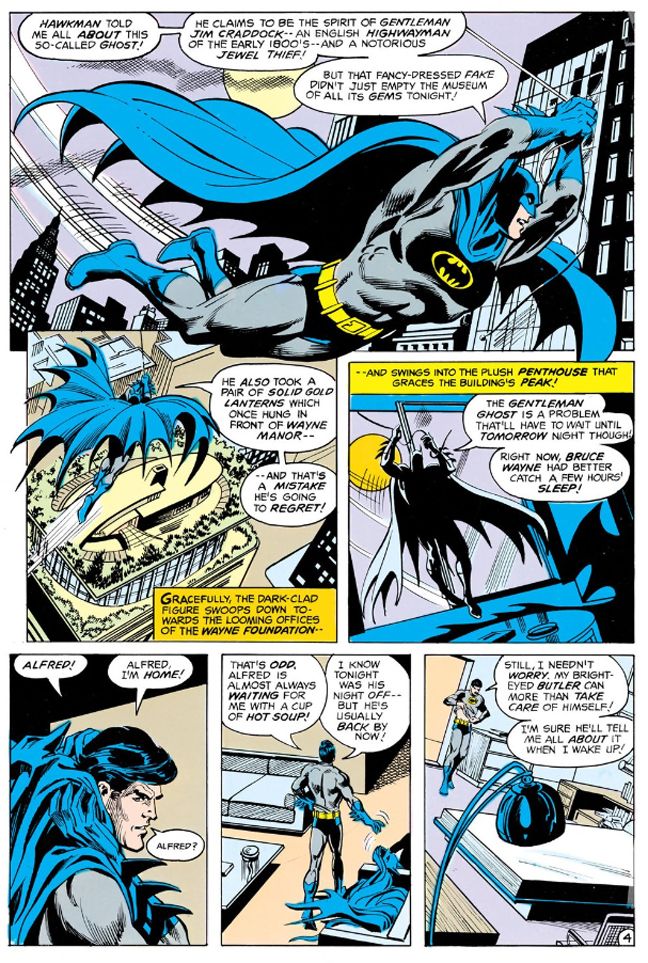

Script: Len Wein/Pencils: Irv Novick/Inks: Dick Giordano

The story, titled "The Ghost Who Haunted Batman," is a jaunty, assured effort by all involved.  It would have made an excellent episode of the 1990s Batman: the Animated Adventures TV series.  Len Wein's script sets up a neat double mystery and wraps it all up in a single issue.  One one hand we want to know why is Gentleman Ghost, known for stealing jewels, suddenly after things like antique lanterns and furniture?  And on the other, where did Bruce Wayne's loyal butler Alfred Pennyworth disappear to?  Wein also plays the whole "is Gentleman Ghost a real ghost, or is he just some clever illustionist with a gimmick?" routine to great effect.  Batman remains pretty skeptical of the supernatural throughout, and when his bat-rope falls ineffectively between Gentleman Ghost's cuffs and gloves, he's disturbed.  But not enough to stop scoffing, as when he sneers, "Mister, you're about as supernatural as my shoe."

No doubt like Batman himself, I distinctly remember expecting some kind of prosaic explanation at story's end.  A special effects artist or magician revealed in an unmasking...

What I admire about this book is how every moment moves the story forward or reinforces the then-current Batman status quo.  There's no waste.  Even for a reader like me, who bought books based on whim and might go months between Batman purchases, could pick this issue up and learn all its players and how Batman relates to each of them.  There's a quick bit of Catwoman romance, a Lucius Fox appearance and even a return visit to Wayne Manor, and yet the central plot remains at the fore.  It's a quick read and certainly no gyp for being self-contained and short.

One of my favorite scenes in this book comes when Batman disguises himself as a portly fellow butler to infiltrate a UK-themed bar where Alfred likes to hang out on his nights off and brag to anyone who will listen and buy him a pint about his awesome job with the Waynes.  In the interest of blending in, Batman goes for the old school stereotype complete with bowler and crooked little pipe.  He kind of goes from one panel in his Batman jammies staring down at the pub to the next walking-- the caption tells us it's a mere few minutes later-- in all dressed up with a waistcoat and padded suit.  I'm not sure how Batman pulls this off so quickly when he doesn't even have his Batmobile around to carry things for him, but Wein doesn't let a little detail like this slow the story's pace.
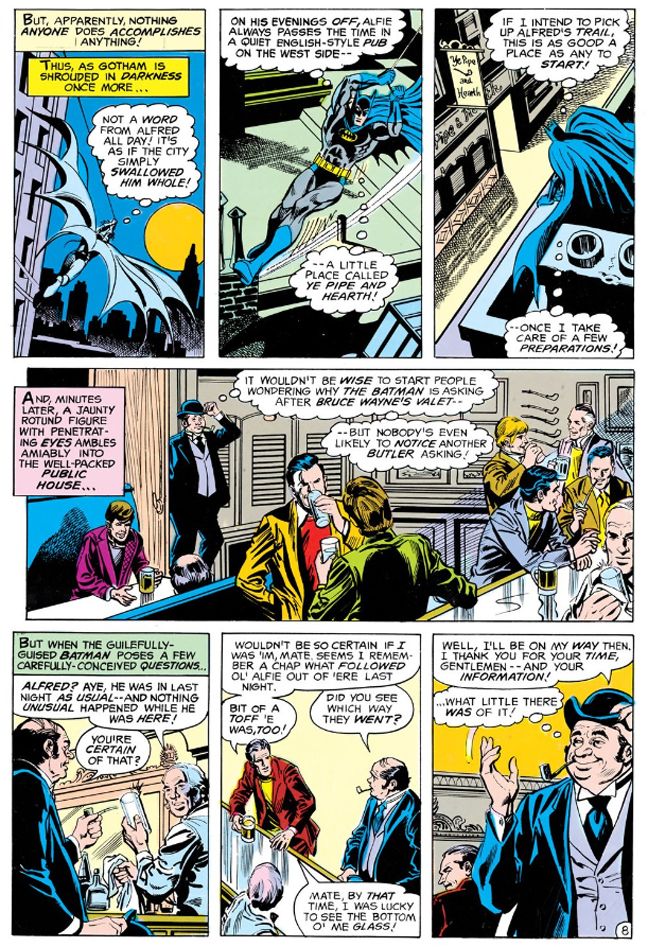
Script: Len Wein/Pencils: Irv Novick/Inks: Dick Giordano

I like to imagine Batman spouting off with a Dick Van Dyke-quality accent and all the ex-pat Brits mocking him after he leaves.  For the story's purposes, Batman probably puts on an accent not only dead-perfect for some particular region of the UK, but also a specific neighborhood.  Came up with a complete biography for this one-off character and everything.  He is a master of disguise, after all.  He's right that it would be odd for Batman to go around asking about Bruce Wayne's butler-- but why doesn't he go in as Wayne?  Because subterfuge is fun!
 
Novick and Giordano lovingly create a creepy, fog-bound mood throughout, turning Gotham City into a vast haunted house.  The atmosphere compares favorably with that ultimate night-bound comic, Marvel's Tomb of Dracula.  And Gentleman Ghost makes an excellent Batman foil.  I’ve always enjoyed Batman stories where he comes up against the supernatural and he’s left a bit befuddled in the end.  Batman benefits from being depicted as vulnerable and not as hyper-competent.  Nowadays he’d anticipate Gentleman Ghost’s every move and have some kind of pre-built anti-ghost device.  In 1979, a hypnotized Alfred could sneak up behind him and knock him out with a heavy gold lamp and he could be deked by an empty suit, then try and fail to save Gentleman Ghost from a carriage crash.  The final scene certainly lives up to the story's title as Batman is left there with the Ghost’s mocking laughter ringing in his ears in one of those ambiguous “just what the heck was that guy?” endings. 
 
Batman and Gentleman Ghost would tangle again shortly and we'll talk about that one when I get the time to read it and react to it.

Thursday, September 4, 2014

Things to be excited about: Silver Age Teen Titans, Ghosts and Dark Horse's reprints of Marvel Star Wars...

I dropped some mega-bucks on DC's Silver Age Teen Titans Archives volumes 1 and 2, Showcase Presents Ghosts and Dark Horse's Star Wars Omnibus:  A Long Time Ago... volume 4.  These four massive books are on their way to me as I type this, through wind and rain.  Yeah, it's a dark day here in Japan with changeable weather threatening to wash out any weekend activities people may have planned now that the temperatures are easing off from the sauna range they stayed in all summer long.  Of course, with dengue fever closing Yoyogi Park in Tokyo, it's probably just as well.  Yet within my heart is a bright, warm light and its source is anticipation of some classic comic book reading material.

The Silver Age Teen Titans Archives books particularly delight me, since this is one of those series I've fallen madly in love with.  I just cannot seem to get enough of Bob Haney's socially aware writing or Nick Cardy's art.  Most especially the latter.  I've bought this material both in digital form and in Showcase format.  The digitals, on Comixology, never seem to advance past the five or so comics available in Silver Age Titans Archives volume 1.  The relatively inexpensive Showcase Titans books seem to be going out of print now.  I have copies of both volumes stored back in the US, I only have one here in Japan.  No luck getting the other one for a reasonable price.   So my unreasonable solution was to complete my Haney-Cardy-Neal Adams-and-others Teen Titans collection by paying even more for hardcover full-color stories I already own in multiples.

Teen Titans is no mere comic book series.  It is a way of life.

And since I was on a classic DC kick, what better choice to complement the superheroics than yet another Showcase Presents book featuring a horror anthology?  The artist line-up in DC's old horror books reads like a list of my favorites:  Cardy, Alfredo Alcala, Frank Redondo, Nestor Redondo, Sam Glanzman, Ramona Fradon, Jerry Grandenetti, Wally Wood, George Tuska, Gerry Talaoc and so many more.  And with Halloween coming up, I need some fun and spooky reading material.

Finally, my addiction to Al Williamson inspired my purchase of the Dark Horse Star Wars Omnibus:  A Long Time Ago... book.  I have the first three, which means I have Williamson's The Empire Strikes Back adaptation.  It also means I need his Return of the Jedi work.  And I certainly am not going to complain about having to look at stories by Carmine Infantino, Walter Simonson and Ron Frenz with inks by Tom Palmer.  This book also contains Star Wars #74, "The Iskalon Effect" (August 1983), with art by Frenz and Palmer.  It's one of the few non-Al Williamson Star Wars comics I bought during Marvel's original run of books.

Tuesday, August 26, 2014

Marvel's Marvelous Movies #7: Why was there never a M*A*S*H comic book, or an E.T. adaptation?


M*A*S*H aired its final episode on February 28, 1983, less than a year after Steven Spielberg's E.T. the Extra-Terrestrial opened to boffo returns on the big screen.  These were both cultural phenomena at the time and yet neither inspired any comic book spin-offs beyond parodies in MAD and Cracked magazines.

Granted, a M*A*S*H comic book doesn't seem likely.  Then again, the show itself didn't seem very likely, either.  A thirty-minute sitcom set during the Korean War, premiering on network television as the divisive Vietnam War ground to its disappointing, confidence-shattering denouement?  Gee, I hope they fired the doofus who came up with that idea!

The series began doing its best to match its big screen inspiration, Robert Altman's groundbreaking satire (at least by CBS-acceptable standards), but eventually became more serio-comic.  Its position as a mainstream TV show in a time before cable meant M*A*S*H could never be quite as searing as some of us might have liked (unlike the movie, which openly and mercilessly mocked American traditional values like religion, patriotism and football).  But the show still gave us pause for reflection between the laugh-track outbursts with occasional episodes where the doctors work around the clock to avoid being drowned in an ever-rising tidal flow of wounded young men then collapse, exhausted, in their bunks; in its blood-spattered operating theater (no laugh track during those scenes, remember); and even in the way Hawkeye, Trapper John and later B.J., pursue boozing and pranks as a way of maintaining at least a semblance of humanity in an inhuman situation.

War has long been an American comics staple, but I can't imagine anyone at either DC or Marvel managing to strike the balance between pathos and chuckles M*A*S*H at its finest managed, though DC seems to have given it some serious consideration.  Still, in a world where Gold Key gave kids an exploding, earth-killing H-Bomb in its Beneath the Planet of the Apes one-shot, and Marvel put out comic book adaptations of movie musicals, I'm still shocked we never got a Marvel Super Special or Treasury Edition version of "Goodbye, Farewell and Amen."

After all, there were M*A*S*H dolls, for the love of Hotlips!

Okay, so maybe a M*A*S*H comic is an even worse idea than a Xanadu comic.  But you can't tell me E.T. the Extra-Terrestrial didn't deserve an adaptation.  With Marvel doing versions of just about every sci-fi flick out there, including ones that seem to defy your usual comic book storytelling techniques like Close Encounters of the Third Kind, which relied largely on internal conflict rather than fisticuffs and required artists Walt Simonson and Klaus Janson to come up with a new visual vocabulary for depicting photographic light effects with black linework and negative space and ordinary comic book coloring, the lack of an E.T. adaptation leaves a massive gap in the parade of Super Specials in the late 1970s and early 1980s.  Its as if the Snoopy balloon burst just before the Macy's Thanksgiving Day Parade took off and they didn't know what to do without it so they just marched along and left Willard Scott and Connie Chung to fill in with banter during the dead zone. 

Given their performance on Close Encounters, I'm going to stick my neck out there and declare Simonson and Janson would have done a bang-up job on E.T. 

I remember searching the spinner displays and magazine racks all over town in the months following E.T.'s June 11, 1982, release date.

Nothing.

E.T. dolls, E.T. records-- including one narrated by Michael Jackson The New Rolling Stone Record Guide (1983 edition) eventually gave 5 stars (indispensable)!-- E.T. bubble gum cards, E.T. storybooks and infamous video game cartridges.  E.T. everything.  Except a comic book.

So confused was I that I even attempted an E.T. adaptation of my own, written in faux-Marvelese.  I managed to do the first two pages.  The way I remember it, there was a large top tier panel with E.T.'s spaceship descending from a starry sky.  The pencil fill depicting night just about broke me, but I persevered.  Beneath that were a couple of panels with E.T. and his space exploring buddies collecting samples.  I partially concealed them with foliage not because I felt incompetent to draw them (obviously I felt more than capable, considering the hubris of even attempting something this idiotically grandiose), but because I made the conscious decision to ape the film's opening gambit of mystery and wonder.  Quick cut on the second page to the government researchers rushing up and scattering the aliens every which way.  I can't remember if I added narrative captions, but I do remember maintaining the government operatives' anonymous menace by framing their figures in such a way the panel rule lines chopped off their heads and other identifying anatomy.  And I think I had one of  them tersely refer to the Peter Coyote character-- the head guy with the keys-- as merely "the Man."  I got as far as painstakingly copying from photo reference the image of a forlorn E.T. gazing down at the city lights, right before the film introduces Elliott and family.

That's right.  It took me two pages to blast through the first five to ten minutes of the movie and I'm pretty sure most of those panels if I found them now would consist of an arm or a leg against a field of smeared graphite, and then a really large dialogue balloon with something stupid in it.  Archie Goodwin I was not.

Those pages stayed in the top drawer of my desk at home (always meant to do more when I found the time) until we moved to a new house and I tossed them while trying to dump as much crap as I could to avoid having to pack it.  I'd give almost anything to have them back.  Maybe I'd even finish the remaining 46 pages or so.

Monday, August 25, 2014

Rare copy of first Superman comic book fetches $3.2 mil at auction

Rare copy of first Superman comic book fetches $3.2 mil at auction

Yeah, that's a lot of money.  I guess.  I've always daydreamed about finding a mint copy of Action Comics #1 in the attic or basement.  Actually, where I find it is the least important part of the daydream.  The having it is the main thing.  Comic book dealers Stephen Fishler and Vincent Zurzolo found their copy in an eBay auction, but they had to pay for it.  Paying for it was never part of my daydreams.  Before the auction, the comic resided comfortably in a cedar chest in West Virginia where it was protected from wear, tear, sunlight and moths.  Comic book-eating moths.  Some of the $3.2 million goes to the Christopher and Dana Reeve Foundation, which adds a further bit of niceness to this tale.

We're not yet certain how Fishler and Zurzolo will handle their joint ownership.  Early reports suggest Fishler will have the comic Mondays, Wednesdays and Fridays, while Zurzolo will have it Tuesdays, Thursdays and Saturdays.  For Sundays, possession will be determined by a random number generator.  Zurzolo will take digits 1 through 5 and Fishler will take 6 through 10.  In the unlikely event of a zero, possession will be determined by a rock, paper, scissors competition, best three out of five.

Friday, June 20, 2014

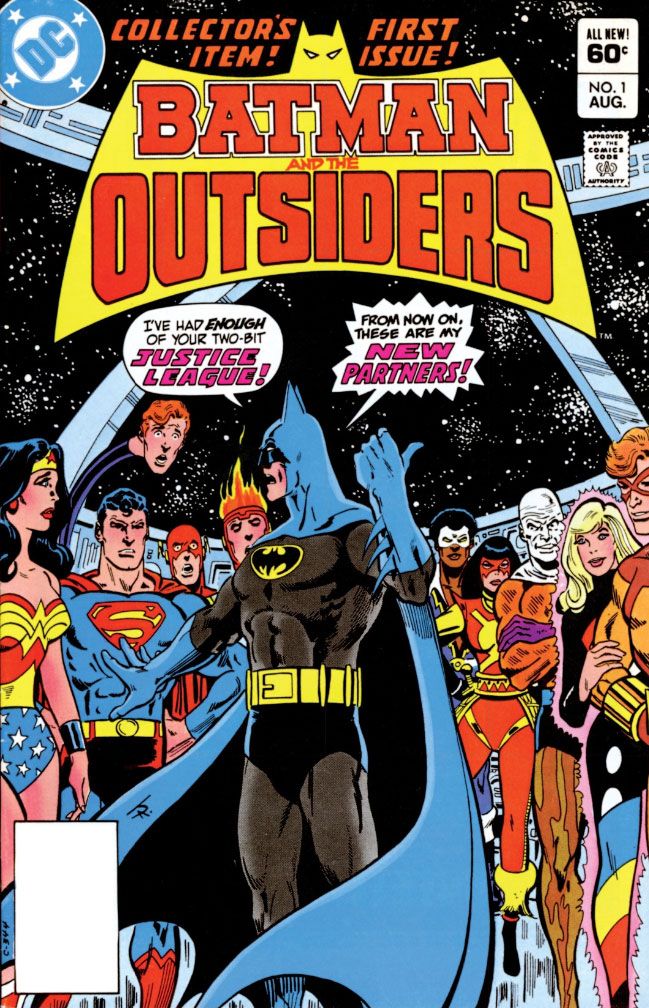
Katana's first foray: Batman and the Outsiders #1 (August 1983)

Katana’s first appearance is in the first DC Sampler giveaway comic, but for our purposes and because I no longer have that (I did all those years ago, though!), we’re going to say it was in Batman and the Outsiders #1 (August 1983).

As we've discussed before, I’ve always considered Katana a pretty cool character.  Well, except for her original ketchup and mustard color-schemed costume.  It’s really a shame what happened to her recent solo series.  Out of all the New 52 redesigns, hers is the most visually arresting and appropriate.  But we're old school hereabouts, so we're going to spend some time with the original Katana, from back in the day.  DC and Comixology just released for sale the first two issues of the 1980s Batman and the Outsiders series and, of course, I jumped at the chance to buy them again. 

The plot mechanics show through.  There's trouble brewing in made-up country Markovia, and that's where Bruce Wayne has sent trusted employee Lucius Fox (the guy played by Morgan Freeman in the Christopher Nolan Batman trilogy) there.  Rebel troops capture Fox and hold him hostage, but wouldn't you know it, Superman has told the United Nations the Justice League will sit this one out, and if you're a member of that team, his promise is legally binding.  When Batman finds out no one's going to help him rescue Fox, he flips out and quits, thus finding and exploiting the one small loophole in the United Nations charter as it relates to solemn promises made on everyone's behalf by a guy from another planet.  Even with Batman giving everyone yet another snarled recounting of his origin, this is still an all too convenient way to get Batman out of the Justice League and together with the Outsiders-- all of whom just happen to be in Markovia at the same time for their own purposes.

Well, to hell with that.  This was-- and remains-- a cool book.  You really can’t, or shouldn’t, argue with Jim Aparo’s artwork, and writer Mike W. Barr builds a strong team dynamic once he gets past the set-up.  The unique mother-daughter relationship he establishes between stone-cold killer Katana and naïve amnesiac Halo helps set this book apart from its ensemble-cast predecessors Uncanny X-Men and New Teen Titans and keeps Outsiders from becoming too generic—the DC equivalent of The Defenders.  Geo-Force is a real zero, though.  His brown costume is dull, as is his origin.  Fortunately, there’s Black Lightning and super-freak Metamorpho.  Black Lightning gives us someone badass to root for who isn’t a jerk like Batman, and Metamorpho adds visual interest.

What does Katana add besides maternal love?  Why, dead bodies by the truckload!

The all-murder-all-the-time team member element hearkens back to the early days of Uncanny X-Men and the Wolverine character arc, before he became overexposed and watered down by revealing his many origins and future demises.  I can’t get over Batman sort of standing back and letting Katana murder so many people, but it certainly makes her more interesting than blandly heroic dopes like Geo-Force.  She doesn’t have any powers to speak of, although because she’s Asian and in a comic book, she’s adept at all martial arts, and because she’s Japanese, of course she is a samurai.

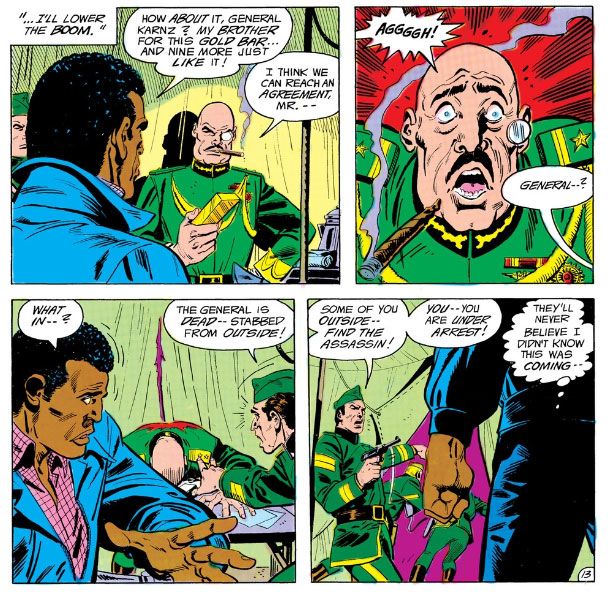
Script:  Mike W. Barr/Art:  Jim Aparo


See?  The very first thing she does is kill that general, just as a disguised Black Lighting (he's not in the JLA, so he's legally allowed to help Batman all he wants) has successfully tricked him into believing he's Fox's brother and wants to trade lovely gold bars for his lovely fake brother.  Black Lightning's thought balloon and clinched fist both show he knows this ruins Batman's scheme.  He quickly strips off his civilian clothes to reveal his super-costume and starts fighting the enemy troops. 

Okay, let's take a break from all the killing to talk about the very thing from which Katana takes her codename.  What?  You thought Katana was her birth name?  No, her parents named her Tatsu Yamashiro, but only her close friends who know her in her civilian identity call her that.  And even they don't call her that.  They call her Yamashiro-san.  Or Ms. Yamashiro. 

And a katana is a type of samurai sword.  I'm far from an expert, but I do know samurai had more than one kind.  There were longer ones and shorter ones, and they all have names which I don't know.  We say "katana" when we mean the basic samurai sword.  Unless we say "samurai sword" sword instead.  This is Katana's main weapon, her version of Green Lantern's ring, Green Arrow's bow and arrows and Green Keyboard's magic computer.  Anyway, Katana uses a katana.  You know Katana talks to her katana, right?  That’s one of her “things.”

Why would anyone do that when there's a perfectly good Batman standing right there?  I'll tell you.

Like Katana herself, Katana's katana has its own special name:  The Soultaker.  It does that.  It takes souls.  If Katana kills you with it, your soul goes into the sword with all the other souls, but Michael Moorcock doesn’t sue you or anything, so don’t worry about it.  I think a cooler codename than Katana would have been the Japanese phrase for Soultaker, which is something like 魂を取る人, or “Tamashi o toru hito,” or を盗 (“to steal the soul”) according to Google Translate.  Hm.  Maybe not.  Kind of clumsy, huh?  Looks as if Barr and Aparo had a good idea all along and I'm wrong, all right?  I'm Wrong Roy.  Toby!  You are close to death!  Come out here!

So her husband's soul is inside Soultaker.  They talk a lot.  In the new series, she sleeps with the sword as well, which is all kinds of kinky especially when you consider most of her pals don't believe her husband's soul (or anyone's) is inside the sword.  But trust me, in the original series, he's in there and she talks to him and he talks back and gives her advice.

 Anyway, she--


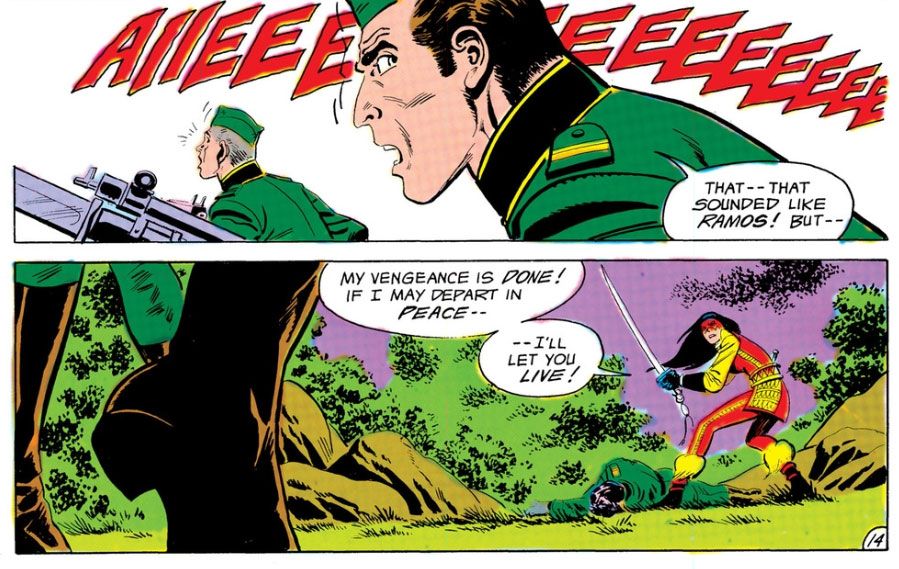
Script:  Mike W. Barr/Art:  Jim Aparo

Oh, look!  Katana's second kill.

She's not really in the first issue of Batman and the Outsiders all that much, but with two kills in two pages, she's made quite an impression.  Batman hogs most of the story space, the same way he hogs the front part of the title, as if this were one of those noisy rock combos the kids like nowadays, where the lead person has their name up front and everyone else is kind of smashed into a collective to the rear.  And then the named artist quits and starts producing music that sounds just like the original group’s, only not as inspired or interesting.  As a result of Batman’s outrageous ego, Katana barely gets into the comic, but she has an impact much greater than you’d expect given the few panels in which she appears.

Another interesting aspect of the character is--

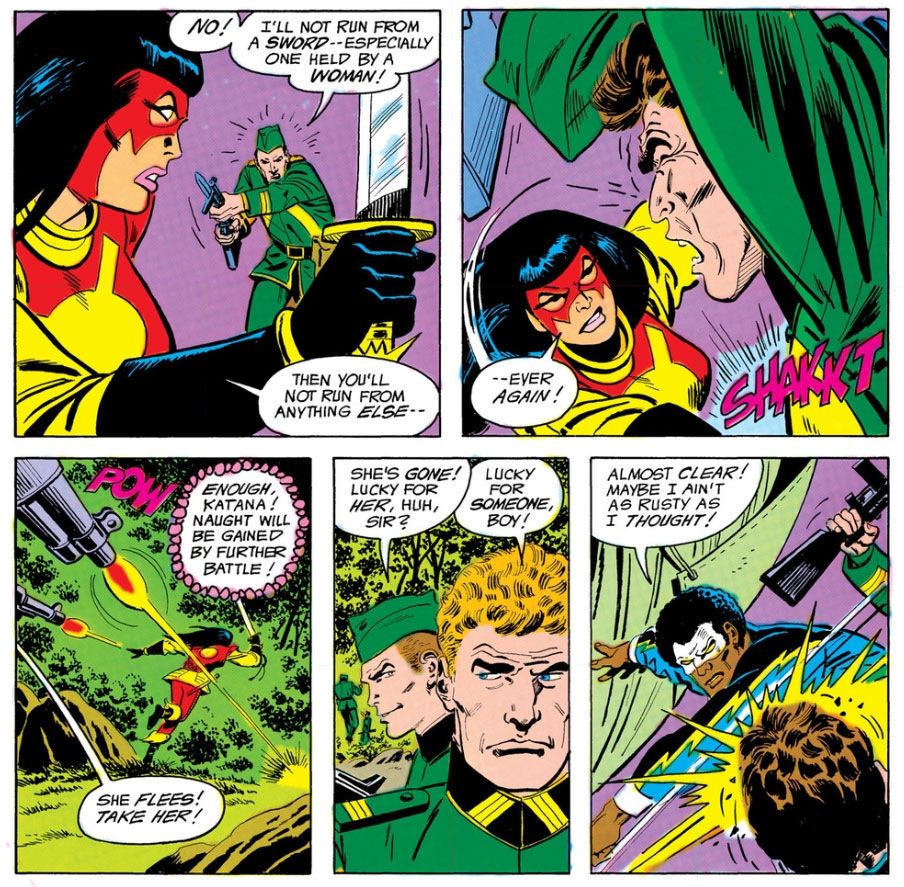
Script:  Mike W. Barr/Art:  Jim Aparo

That's our Katana!

Tuesday, June 17, 2014

Coming soon: a look at Marvel's movie adaptations!

Hola, amigos.  I know it's been a long time since I last rapped at ya, but things have been pretty crazy around here lately.  It's not as if I'm not reading comics.  I am.  I'm reading some fantastic old comics with art by cats like John Buscema and John Romita, Al Williamson, Jim Aparo and Alex Toth.  But, as I've told you, I'm also working on my own comic.  Plus I'm married and have a regular job that takes up about ten hours a day (if I'm lucky).  Man, I get home, all I want to do is read the comics, not write about them.  Or work on my own.

Anyway, what I'm here to tell you is I have a few posts coming up.  They're largely finished but I need to tweak a few things here and there, check a fact or two so they live up to the high standards for comic journalism you've come to expect from When Comic Books Ruled the Earth.  You deserve no less. 

Comixology and DC just released the first two issues of Batman and the Outsiders by Mike W. Barr and Jim Aparo.  That's one of my favorite series, and features Katana, a character I've dug for the longest time.  Well, ever since I bought Batman and the Outsiders #1 when it first came out way back in August 1983.  I've written about Katana here before, but it's time to do a closer reading of her first appearance.  DC and Comixology have made that possible, and for that, I'm happy and thankful.

I'm also very excited about one set of posts in particular.  I was writing a bit about Williamson's artwork for the Marvel Blade Runner comic when I realized Marvel has a lot of other cool movie adaptations we could pick apart and have some fun with.  Others have written beautifully about Gene Colan's killer work on Jaws 2, and I've already covered Close Encounters of the Third Kind and Dragonslayer.  You can even find a few funny articles here and there about things like Xanadu.  Well, now I'm going to take them all on, one by one, and in no particular order.  I won't be mocking them, although I'm sure there will be a few attempts at humorous deconstruction, because I'm stuck in post-modern mode and will probably never change.  Mostly I just want to appreciate some of the odder ones for attempting something different, for introducing new genres to comics even if those genres don't really translate into the format very well or comfortably.

You know, like musicals.

I'm not sure when the first post will appear, nor can I say for certain when we'll finally see the last of them.  All I can tell you is they are coming.  And maybe, down the road a ways, I'll make an official announcement of some kind about my own comic and let you know a little bit about it.  I just want to get enough done to make it more of a real thing rather than just a dream I'm chasing.  Consider that a promise.  Or a warning.  Or both.  I hope you enjoy the upcoming posts.  I think you will.

Tuesday, June 10, 2014

My Kindle is Creepy...

Getting my hands and eyes on American comics can be a bit of a hassle here in Japan.  Luckily, I'm more into vintage comics than the new stuff (except for a few titles from Dark Horse, Fantagraphics, Boom! and IDW, that is) and I can buy all the Essentials, Archives, Best ofs and Collected Editions I want from Amazon.jp.  They're a bit pricey, though, and while I love the feel of a nicely-designed hardcover archival comic collection printed on quality paper, those take up a huge amount of space and they're heavy.  Buying them digitally from the Dark Horse website or single issues from Comixology means transferring money home and keeping track of my US funds and that's a huge headache because the post office bank here isn't open on weekends for that kind of stuff.

So what to do?  Why, find a way to pay with my Japanese money.  Amazon.jp makes that easy when you want a paper version.  You can order COD, for crying out loud, a system that resulted in my receiving a box a day there for a while.  You can also go to the nearest convenience store, input your order number into a special machine and print out an invoice, then pay at the register.  A day or two later, a delivery person shows up with your package.  It's fun.  But that doesn't help now that I'm married and I have to share space.  I can't just pile up a huge library of gigantic comics reprints anymore.  Plus, we're kinda trying to save money for our future, something I never considered having before transforming myself from a single person into one half of a couple.

Switching my collection to mostly digital makes a lot of sense, but it entails a new set of solutions.  Comixology has been fantastic, but there's that bank transfer thing, and Dark Horse has its archival material exclusive to its website which involves doing that even more.  Rats.

Luckily, there's Kindle.  Dark Horse has generously provided Amazon with Kindle versions of its Creepy and Eerie books, and DC has done the same with a lot of its collected editions.  IDW even put out a Kindle version of Torpedo with Alex Toth art.  I don't have a Japanese credit card, but I can buy an Amazon gift card for myself and go nuts.  The best thing is, instead of paying the equivalent of 40 or 50 bucks for a book, I can get a digital copy for about 17 dollars.  This means even more of the Creepy and Eerie volumes become desirable, whereas before I had to cherry-pick them based on material I considered "essential."

Now the Kindle I have is the base model and it's pretty old now-- in relative terms as these gadgets go.  It won't display graphic novels.  And I should have checked to see if I could read them on my Windows Kindle app before I bought them.  That would've been the smart thing to do.  But I was so excited by the prospect of buying Creepy cheaply (say that five times fast) I jumped the gun.  The end result is I'm contemplating buying one of those full-color expensive Kindle things and I have Creepy Archives Volume 1, Torpedo 1 and DC's Jack Kirby's OMAC on my iPhone now.  That's where I'll leave things for a while.  I'm not in any big hurry to buy the new Kindle and it's the kind of thing I have to vet with my wife before I do.  Major purchase.  It's a good system we have, and luckily for us both I've inherited my dad's Depression-born reluctance to spend more than 100 dollars a year unless it's on food.  It took me two years to work up the nerve to buy the computer I usually read comics on these days and even then I felt sick to my stomach for a month.

On the other hand, I'm addicted to books and old comics.

Now with Amazon having bought Comixology, it will be interesting to see how the payment plans shake out.  Will Comixology start accepting Amazon gift cards, for example?  And will they furthermore accept them if they're bought with Japanese yen?  That doesn't seem likely, but it would certainly make my comics buying-- even of new titles-- much easier.  And what about Dark Horse?  How do they fit in since they have their own proprietary digital comics-reading engine?

Friday, May 16, 2014

Supergirl versus Darkseid revisited...


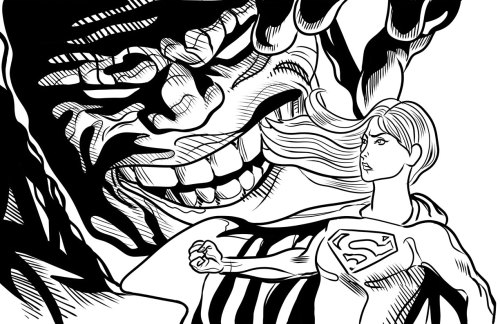
As part of my on-going self-education in comic book art making, I re-inked this image of Supergirl standing up to a symbolically over-sized Darkseid.  The inspiration comes from all of those classic comic book covers where the villain looms over the heroes in exaggerated scale.  The massive clutching hand as a frequent image.
 
I absolutely hated the way I drew the hair the first time around.  I like this slightly more.  Supergirl's face doesn't hold together as well as I'd like and I should have left her chest/torso well enough alone.  I am just not an inker.  Too fidgety, too indecisive, too forgetful of basic elements like light sources.  Actually, Supergirl here is the light source, another symbolic element.  But that doesn't explain the weird shadows on her cape.
 
A determined, heroic Supergirl.  That's what I like.  She'll keep fighting against all odds.
 
Overall it almost looks like an actual piece of comic book artwork.  It shows just enough progress to keep me chugging along, working towards who knows what end.

Wednesday, May 14, 2014

Curt Swan: Even his name is cool...

I miss Curt Swan.  Diversions of the Groovy Kind has a look at The Amazing World of DC Comics #7 (July 1975), with a Curt Swan interview and lots of sweet Swan artwork.  I was seven years old when that came out, and I never read it.  I'm trying to remember who my Superman artist of record was in those days.

Oh yeah, it was Curt Swan!

Curt Swan was THE Superman artist for me, the way I thought Walt Disney drew all those movie cartoons.  Sorry, Joe Shuster.  I know you were the original, so it should have been you, but you were long gone by the time I started reading.  And when I started reading, as far as I was concerned, you couldn't have a Superman unless he was drawn by Swan.  Later I got into Superman reprint books and discovered Wayne Boring, Al Plastino and Neal Adams, and while I liked and still do like their versions of Superman-- there's something really appealing about the beefy, barrel-torsoed Boring Supes-- practically every new Superman or Action Comics I bought had the familiar-looking Swan Superman.  So Swan Superman simply WAS Superman for me.

Swan had a way of drawing facial expressions that impressed younger me.  Like Superman eating the defunct kryptonite, or posing as Clark Kent doing his day job and making one of Steve Lombard's pranks backfire, startling and humiliating the would-be bully into making a really amusing facial expression, which Swan and whatever inker was handling the book that month rendered in characteristically clean, readable linework.

And I don't know if Swan took a lot of artistic shortcuts, because I don't know much-- if anything-- about his drawing methods.  I have a feeling he didn't, because his characters inhabited a solid, believable world.  Sure, it was generally neater and more squared-away than our own, but if Superman or Lois Lane happened to be tackling pollution as a social issue in that story, Swan would make that pollution look like the loveliest pollution you ever did see.  Municipalities across the land would be proud to fester in Swan-rendered pollution.  The Daily Planet offices, the Metropolis skyline, the studios of Galaxy Broadcasting, some alien spaceship-- whatever it was, Swan gave it all a solidity and reality.  He simply drew the hell out of it, without a lot of fuss and muss and fidgety crap and visual noise.  Swan didn't have to hide anything with flash because he could just flat-out draw, man, draw.

In the DC Comics interview, Swan says, "As the Superman character evolved, Mort [Weisenger] felt, at the time, that we should get a little more humanistic qualities into him.  We wanted people to relate to him better."  Swan was certainly successful at that.  From those facial expressions, to the body language, to the backgrounds, to the stories themselves, he worked on a Superman who had a down-to-earth quality about him.  Like a real dude, with real feelings, despite his godlike abilities.  When pro writers (and fans) say things about Superman being unrelatable because he's all-powerful, or boring because he can't be challenged, I get the feeling they never read a Superman story drawn by Curt Swan.

Also, it's pretty cool to watch the Swan Superman evolve from the early 60s into the 70s.  First he has that tall forehead, the slightly receding hairline of an older guy.  Even Superboy looks like he needs a little Minoxodil, or soon will.  By the time Clark Kent is anchoring the nightly news at Galaxy, his spit-curl has become a more full-bodied wave and his hair is creeping down over his ears.  But what doesn't change in all that time is the basic appeal of Curt Swan's art.  If you can look at it and not feel uplifted, then you are reading the wrong blog.

Well, you might be doing that anyway.  Go read Diversions of the Groovy Kind, you nut!

Tuesday, April 22, 2014

Supergirl versus Darkseid...

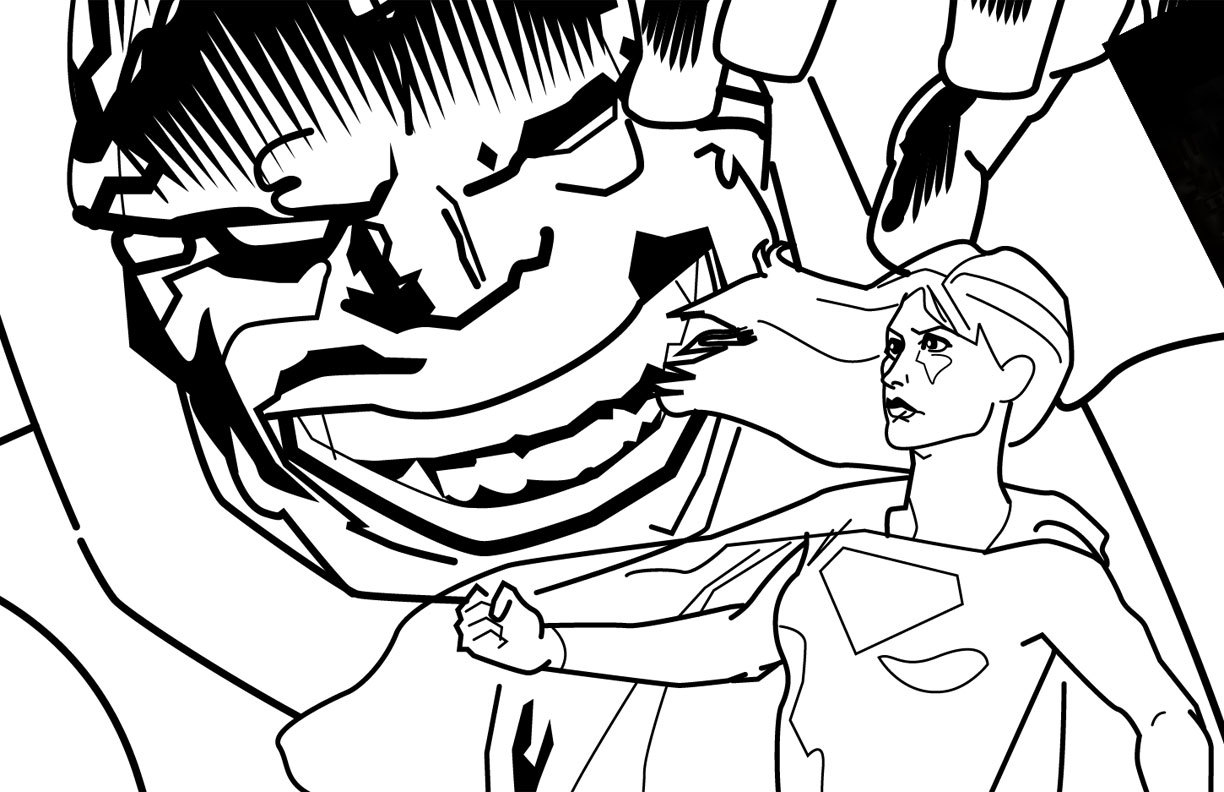
Sure, why not?  More of my silly art.  This is a detail from an early work in progress with a strangely cross-eyed Supergirl.  You know, I looked at what I'd done this morning and I felt excited and energized by it. 


"You're really getting somewhere with this art stuff, baby!" I told myself.  "You can fix those eyes and finish Darkseid's face and body and you'll really have something to brag about!"

Then I took a look at it between classes at work and all I saw were a bunch of jumbled, randomish lines refusing to coalesce into an image.  What made sense at 6am at the start of the day stood revealed as a potential disaster at 9:30.  That was a real downer.  Looking at it now, I see it's nowhere near as dire as I thought then, but I also see now I have plenty of work ahead of me yet.  My ambition may have exceeded my abilities once again.  Lots to fix in order to salvage this one.

Tuesday, April 8, 2014

More imperfect comic book memories: Ants climb the ladder of intelligence and some idiots land their spaceship on the sun...

Years ago, when I was a kid, one of my friends lived on the next street.  His house was across the alley from ours, so we used to hang out a lot in our backyards.  Either he or his older brother collected all those black and white horror and sci-fi magazines Marvel/Curtis put out back then.  I don't remember the titles after all this time, but I do have some vague memories of reading a story about some doomed astronauts who had accidentally landed their spaceship on the sun and couldn't take off again.  So they bickered for seven pages, then died on the eighth.  My takeaway from this is a feeling of claustrophobia.

I always enjoyed anthology comics, even when they creeped me out or cost me a night's sleep.  I rarely bought them, so what I'd do was furtively read them at the store, then put them back on the spinner rack.  The perfect crime!  Only every so often, my curiosity would cost me.  A story would give me a passing chill, warmed by the bright summer day outside.  Then I'd forget about it.  Sometime after dinner, when I hit the sheets and turned out the light, the story would return, its unsettling qualities magnified by my own imagination.

One such story, which I could have sworn was in the DC book Time Warp, but may have been in the brief early-80s revival of Mystery In Space, featured a luckless space traveler who crash-landed his rocket ship on some desert world where it started leaking some of his nutrient fluid.  You know, space food.  Whatever our astro-people ate up there where they couldn't get turkey sandwiches or Pop Tarts toaster pastries. 

Some space ants started drinking the stuff and would return daily with more and more advanced technology.  First, little wheeled wagons.  Later, trucks with internal combustion engines.  The astronaut, trapped in the wreckage upside down (if I remember correctly, which I doubt), watched in fascination as the ants progressed along our human scientific advancement tree.  By the time rescue approached, the astronaut had become the reluctant witness to black-on-red ant warfare, which ended in an atomic blast because the ants had invented the atom bomb.  The rescuers chalked it up to the wrecked ship's atomic powerplant blowing up, but the last panel showed them walking away, having failed to notice a teensy-tiny wagon overturned in the dirt.

Or maybe they were earth ants.  Or maybe the story was in some Marvel comic or other.  Or a Charlton.  Or perhaps it never existed at all and I only dreamed it and instead of writing it as a short story and submitting somewhere and making a billion dollars I just gave it away like an idiot.  Nah, I'm pretty sure it exists and one day I'll find it and learn the only thing I remember accurately about it is the astronaut.  And those others, the ones from the black and white magazine, actually landed on Saturn and had a picnic.

Wednesday, April 2, 2014

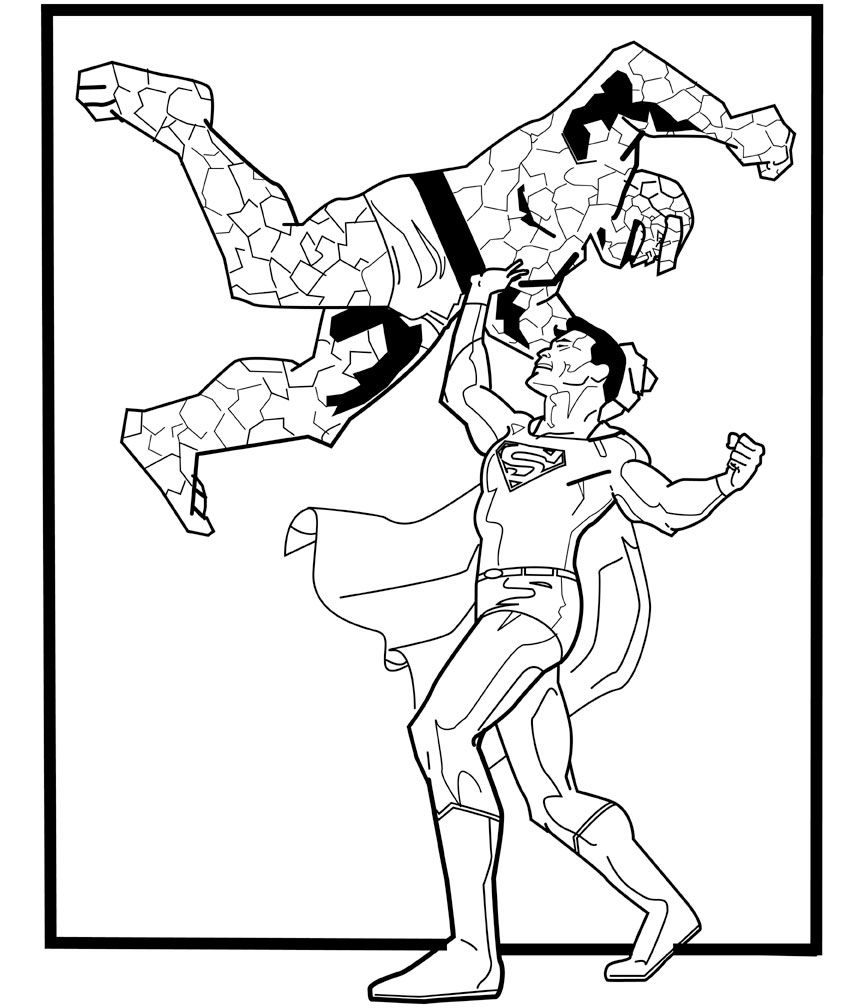
Superman versus the Thing (in color)


There!  Yet another ridiculous image I've had in my head for a while.  I imagine after Superman and the Thing settle their difference, they'll go have a meal or share a drink or something and become really good friends.

Monday, March 31, 2014

Superman versus the Thing and Spider-Man takes a swing! A couple of "in progress" drawings


Two of my favorite characters come into conflict with each other.  I'm pretty sure Superman could take the Thing.  The Superman figure is largely complete.  I need to fix his hands, right calf muscle and the cape, and I may adjust the line weights a bit.  Poor Ben Grimm needs a lot of work, though.  Not happy with the arm shadow.  It needs to be wider and extend down his chest a bit.  And all those rocky facets!
 
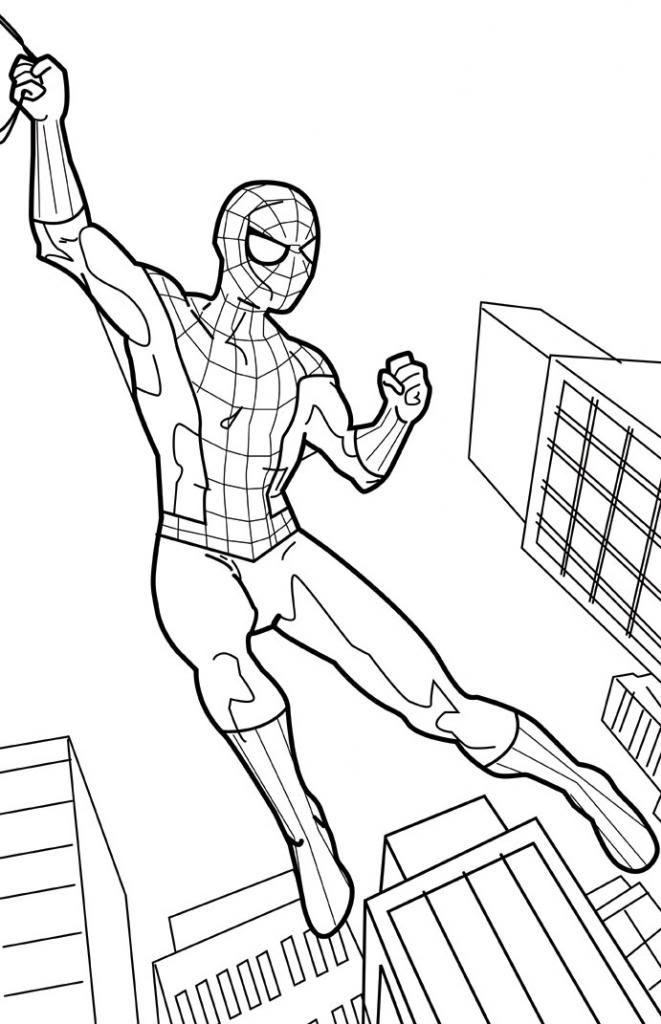
Here's Spider-Man acting more like the Spider-Man we all know and love:


The color scheme for this one is going to be more John Romita/Gil Kane era Spidey than Steve Ditko.  I have to fix the perspective (look at the wonky windows on the building under Spider-Man's right foot, just to point out something that's pretty obvious), finish the webbing on his costume (and he needs his chest emblem!) and adjust the left leg. The muscle on the outside edge near the knee isn't working for me and the foot is angled wrong. The pose itself is lacking in dynamics. I've got a rough sketch of a more exciting (I hope) one I'm going to start inking today.

These are penciled in Manga Studio 5 and inked in Adobe Illustrator.  I'm considering another work flow, though, where I print out the pencils and hand-ink them on vellum or using a lightbox or something along those lines.  Digital inking is no panacea, although it's nice for fidgety, shaky-handed fools like me.  I like being able to fiddle around with the lines and get them "just so," but the results are lacking in humanity.  I am a machine.

Other works in progress include Supergirl versus Darkseid and, for one of my other blogs, a couple of Cassandra Cain Batgirl images, one where she goes up against Wolverine and another where she takes on the Joker.

Thursday, March 27, 2014

Dude, let somebody else do the work for a change: Ken Parille on Jack Kirby and Alex Nino courtesy TCJ!

At The Comics Journal, Ken Parille contrasts the way Nick Cardy presents the story "The Burners" on his cover to Weird Mystery Tales #3 (November-December 1972) to its actual Jack Kirby written and drawn contents, then discusses Alex Nino's faces in the story "Captain Fear," from Adventure Comics #425 (December 1972-January 1973).  I've never read either of those tales, but the whole of the early 1970s DC output fascinates me.  From Kirby's Fourth World work to the gorgeous horror anthologies often featuring stories and art by some of my favorite creators not named Kirby, this era is a rich source of blogging material.  This is the kind of thing I enjoy reading.  And writing. 

 But since Parille has already done so, and quite well, why not just link to it here and go back to drawing silly pictures of Spider-Man?

Thursday, February 13, 2014

Happy Valentine's Day! Here are some of my favorite love pairs in comics...

1. Superman and Lois Lane.  No, not Superman and Wonder Woman.  Superman and Lois Lane are the couple of comic book record and trying to change that is stupid.  There is no greater comic book pairing than these two.  The demigod with the human heart and the kick ass intrepid reporter.

2. Big Barda and Mr. Miracle.  I love these two together.  Mr. Miracle is the gentle soul, Barda is the iron-willed warrior who seeks to protect him, an inversion of the expected gender roles.  However the thing I like most about these two is when they're written and drawn by Jack Kirby they have one of the most genuine loves depicted in comics.  It's warm and organic and they have a lot of chemistry.  There's is one of the few truly adult relationships depicted in superhero comics.

3. Terra and Changeling.  These two are a couple of freaks and their love is strange and wrong.  That's what makes it so fun to read about.

4. Cyclops and Phoenix.  Classic doomed pair.  Well, one of them was doomed.  Which means their love was doomed.  Who doesn't love reading about doomed love?  Even Dr. Doom loves doomed love.

5. Maggie and Hopey.  This is one that makes for some amazing reading.  I can't decide if I like them better together or apart.  Either way, good stuff.

6. Nexus and Sundra.  Another very adult relationship.  They've gone through a lot together and we've watched them grow and develop over many long years.

7. Reed Richards and Sue Storm Richards.  This is one of those relationships that-- at least in the early Stan Lee/Jack Kirby years-- is mostly what little boys think love and all that gooey junk is all about.  There's this stalwart, relatively emotionless guy who needs to get some work done and there's the flighty, childish, super-moody girl who always demands his attention.  Sue would put on a pouty scene and Reed would turn to his pal Ben Grimm and say something like, "Women.  Even with all my scientific knowledge, there's no understanding their mysteries!"  Ben would say, "They sure smell nice, though."  And Reed would conclude, "They do, old pal.  I suppose all we men can do is give up trying to figure out women and simply protect them and their silly little fantasies from the harsh realities of the multiverse."  Cut to a close-up of Sue getting a manicure or trying on a wig.

8. Buddy and Lisa.  The unfortunate pair from Hate, the perfect comic.  Buddy is kind of an asshole and Lisa is a complete mess.  Together, they're a disaster.  No wonder they got married and had a kid.

And with that, I give up!  Go read about your own favorites and leave me alone!

Friday, January 24, 2014

Kirby's Kustoms! A selection of Jack Kirby's creative conveyances...

Jack Kirby created so many wonderful characters in his long career, but he also came up with all sorts of wild contraptions to get those characters to and from their adventures.  Your typical Kirby vehicle is somewhat outlandish, certainly futuristic, but also surprisingly plausible at a glance, as if he generated detailed plans before inserting them into his stories.  You're likely to find jet fans, air intakes and plexiglass cockpits along with all kinds of valves and pipes.  A Kirby vehicle is as instantly recognizable as one of his muscular, almost steel-like heroes.

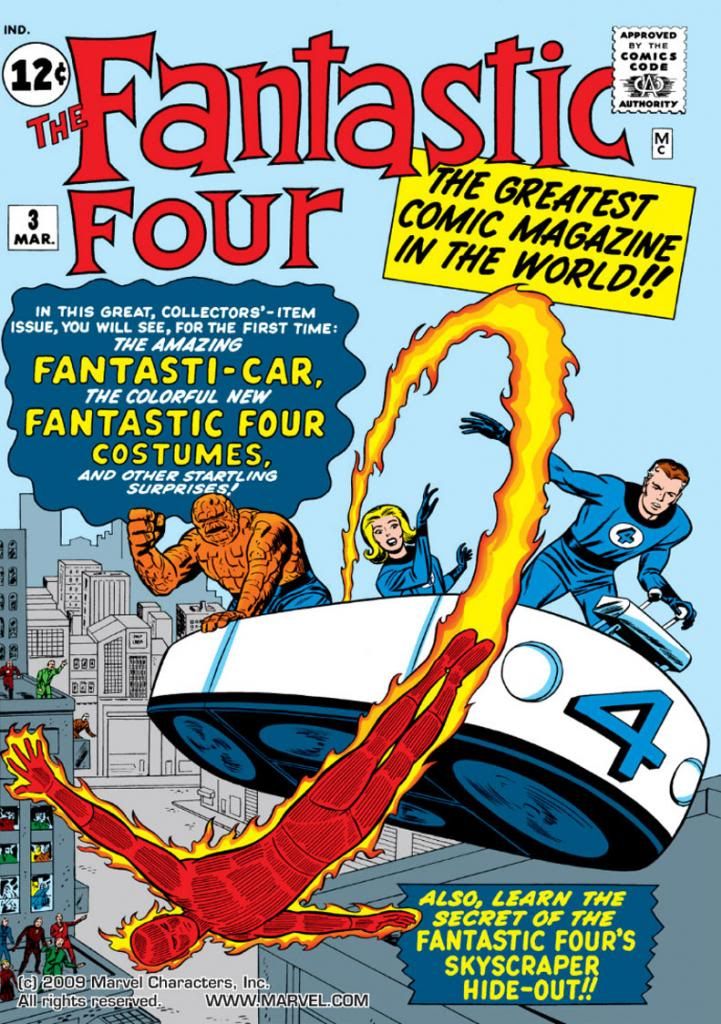
Let's start with a one of his first from the fabled Fantastic Four comic.  Whatever happened to that?  Are they still publishing it?  Anyway, here we go--

Fantastic Four #3 (March 1962), inks by Dick Ayers

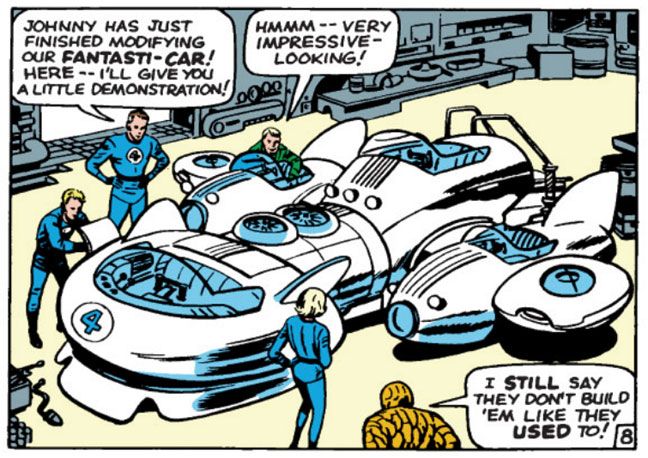
The Fantasti-Car!  The Fantasti-Car debuts in Fantastic Four #3 (March 1962), which also saw the adventuresome quartet donning their blue costumes for the first time.  Like those plain but functional-appearing duds, the Fantasti-Car is a simple design, just a tub with headlights for safety and what appear to be four fans underneath for generating lift.  I'm not sure how Reed Richards controls pitch and yaw or generates forward thrust in this version of the Fantasti-Car, but I'm sure Kirby could have explained it if I'd been around in 1962 to ask him.  Unfortunately, this isn't the most visually impressive design, and I'm guessing Kirby must have been a little dissatisfied with it, because about a year later, the Fantastic Four upgrade to a hotter version.

Fantastic Four #12 (March 1963), words by Stan Lee, inks by Dick Ayers

Yeah!  That's more like it!  The Fantasti-Car, Mark II made its debut in Fantastic Four #12 (March 1963).  This one has aerodynamic styling and possibly a much greater range.  Ignore Ben Grimm's little griping remark.  Some people just aren't pleased with anything.  The Fantastic Four use this Fantasti-Car to travel cross-country and take on the Hulk.  But what about ocean-hopping, when the team needs to cross hemispheres, date lines and other such geographic demarcations?

That's where this baby comes in--

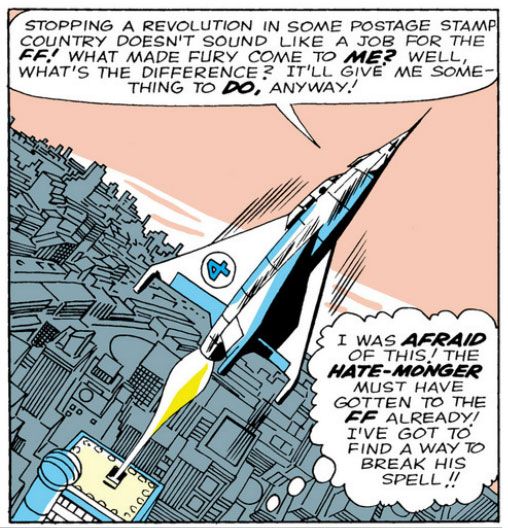
Fantastic Four #21 (December 1963),  words by Lee, inks by George Roussos

The Pogo Plane.  The Pogo Plane previously appeared in issue #3, but it really gets to strut its strato-stuff here as the FF prepare to face the Hate-Monger in Fantastic Four #21 (December 1963).  Kirby gives this aircraft a state-of-the-art appearance (at least for the 1960s), like something the USAF or NASA might have been toying around with in the early days of space exploration.  The X-51 or  the Lifting Body.  Man In Space Soonest.  The Flying Flapjack.  The Apollo Applications Program.  Somebody stop me or I'll go on forever.  I love aviation history!

This could be a wild, right-off-the-drawing-board design lifted from a Popular Mechanics article of the time.  It's got huge stabilizing fins and even flaps.  Plus it's a tail-landing VTOL aircraft.  That's "vertical take-off and landing," to you and me, Russ.  I'm no aeronautical engineer, but Reed Richards has that skill set among his many, and you can imagine he saw this one through from the initial design phase to wind-tunnel testing with a scale model to prototype production to flight test with none other than Ben Grimm at the controls.

Now that we're on the topic of his piloting skills, here's a little Ben Grimm-related aside-- Ben generally plays the fool with his gruff street-style patois, but he's actually vastly intelligent himself, the kind of guy who would have made the Mercury Seven if he'd actually existed.  Ben was a highly-regarded test pilot with a fighter background before he became a superheroic freak, which means he's got quite the expertise in engineering.  Tom Wolfe in his book The Right Stuff describes how Ben's closest real-world analog Chuck Yeager (no mean engineer himself) influenced not only aviation history but also how pilots of the era spoke-- I don't know if it's true or not, but Wolfe makes a hilarious and compelling case for airline pilots of the time doing their cockpit announcements in pseudo-West Virginia drawls in imitation of the man at flying's apex.  I can imagine in the Marvel world the same thing happening, only with pilots shouting, "It's clobberin' time!" when pushing the outside of that o' envelope, or making reference to their Aunt Petunias in put-on Brooklyn accents. 

If not for that fateful rocket flight...

Coming up next is a stripped-down sport model--

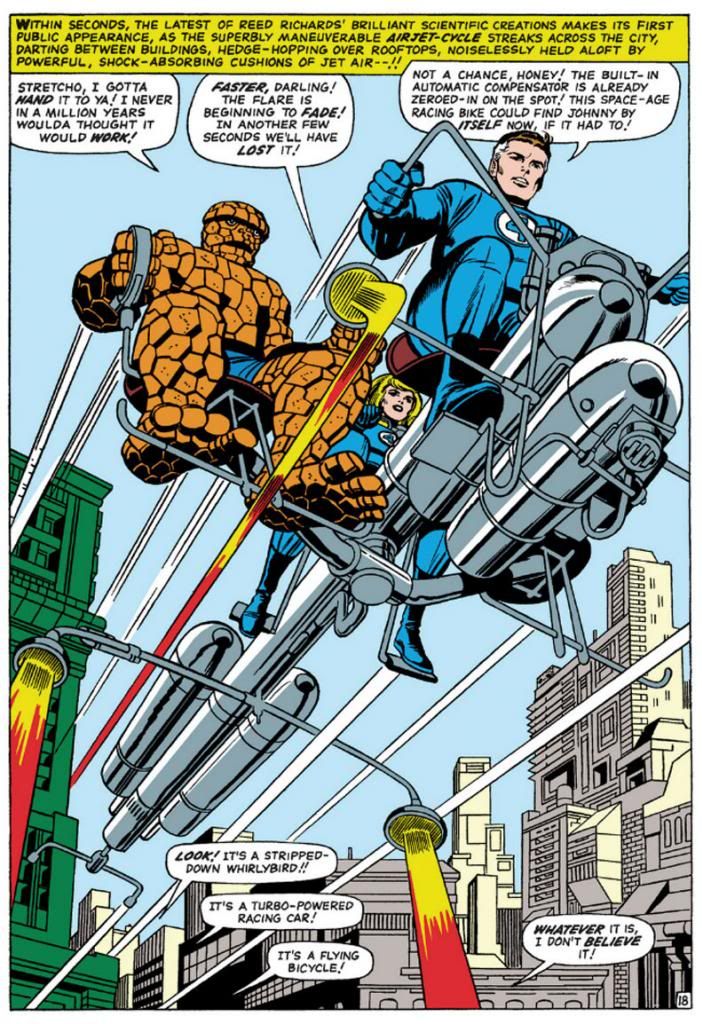
Fantastic Four #45 (December 1965),  words by Lee, inks by Joe Sinnott

The Airjet-Cycle.  This one has neat nozzles and tanks, but it's mostly just pipes and doesn't really look capable of lifting Reed alone, much less Ben and Sue as well.  Not the most practical of earthly designs, although it looks like something NASA might have considered for lunar mobility.  Leaves the passengers kind of exposed and vulnerable, too-- I love the look of sheer embarrassment on the Thing's ever-lovin', blue-eyed face as he holds on for his very life.   The Airjet-Cycle probably comes in handy for jetting to the supermarket, or getting little Franklin to school when he misses the bus.  Not as spectacular as either the Fantasti-Car or the Pogo Plane, the Airjet-Cycle nevertheless makes further appearances in Fantastic Four #46 (January 1966), #48 (March 1966) and #57 (December 1966), to name three.  The Avengers also use a version.  You can look it up.  I did!

And now--

Fantastic Four #50 (May 1966), words by Lee, inks by Sinnott

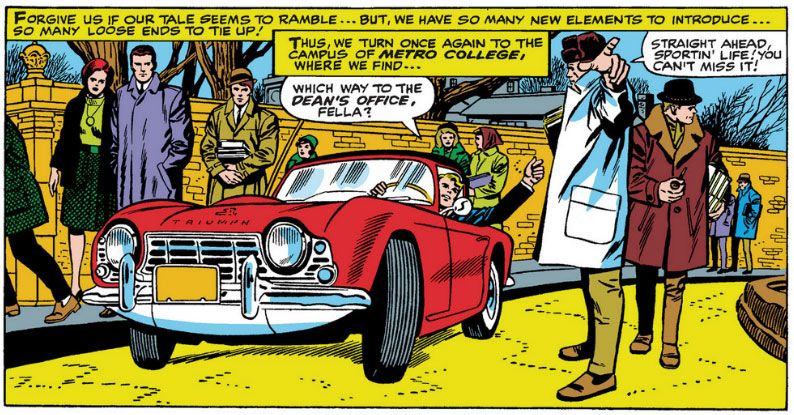
Oops!  A ringer!  Don't ever think Jack Kirby couldn't bring things down to earth (relatively speaking-- Johnny's got one unearthly ride there) and draw realistic cars.  This one reminds me of the classic 1967 film The Graduate, directed by Mike Nichols.  Dustin Hoffman actually drives a 1966 Alfa Romeo Spider 1600 "Duetto" in that movie, but Johnny Storm here has a 1966 Triumph GT6.  Yeah, a Spitfire might have been more appropriate for the Human Torch, but Triumph introduced the GT6 the year Marvel published Fantastic Four #50 (May 1966), so leave it to Johnny to pick up the latest thing in sports cars.  Maybe he's auditioning for a part in The Undergraduate.

Let's leave behind the fast and the furious for the slow and reliable--

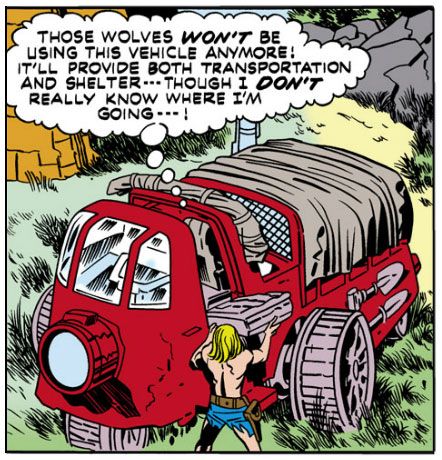
Kamandi #1 (November 1972), words by Jack Kirby, inks by Mike Royer

We're also ditching one comic company for another.  Just as Kirby and family left New York for California and Marvel for DC, in the first issue of his eponymous book (November 1972), Kamandi leaves his bunker home in this utilitarian military contraption with a very interesting outboard wheel arrangement.  They're heavy duty wheels, too.  Probably made of some kind of metal or composite alloy for years of wear.  Shovels clamped to the side, weatherproof tarp over the back.  This is a very appropriate get-about for Kamandi, and just the kind of thing you'd expect to find at a former military outpost.

Even after the Great Disaster, off-roading offers thrills and spectacle.  Witness--

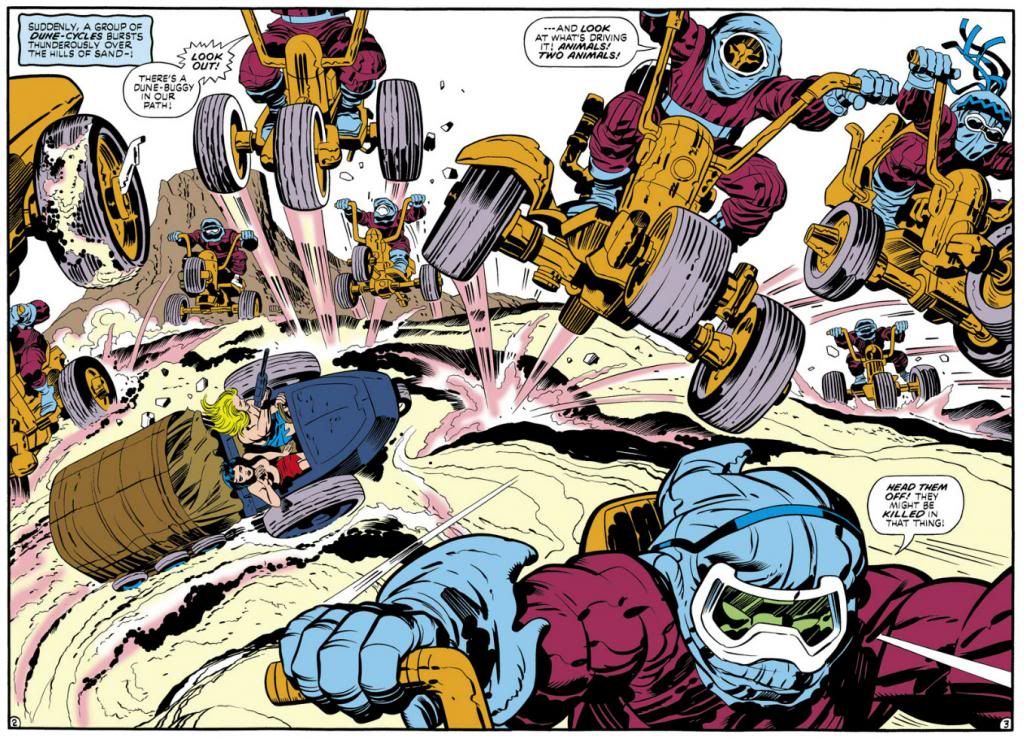
Kamandi #6 (June 1973), words by Kirby, inks by Royer

As you can see, Kirby anticipated the ATV craze.  For a while there in south Georgia, you couldn't take a drive without a three- or four-wheeler loaded with people in camouflage barreling out in front of your car from a side road or a trailer park entrance.  In fact, you still can't.  They're a menace, I tell you, and in this panel from Kamandi #6 (June 1973), you can see why.  Kamandi and his tragic girlfriend Flower have found yet another hard-working cargo carrier to explore the world, but suddenly they're capsized by a gang of three-wheeling lions!  They're huge, too.  Look how they dwarf Kamandi and Flower in their little cart.  These hot-doggin' felines think they own the dunes.  They're wrong.

Because there's one vehicle that's gonna shut 'em down, just like that little Cobra from a long ago Rip Chords song--

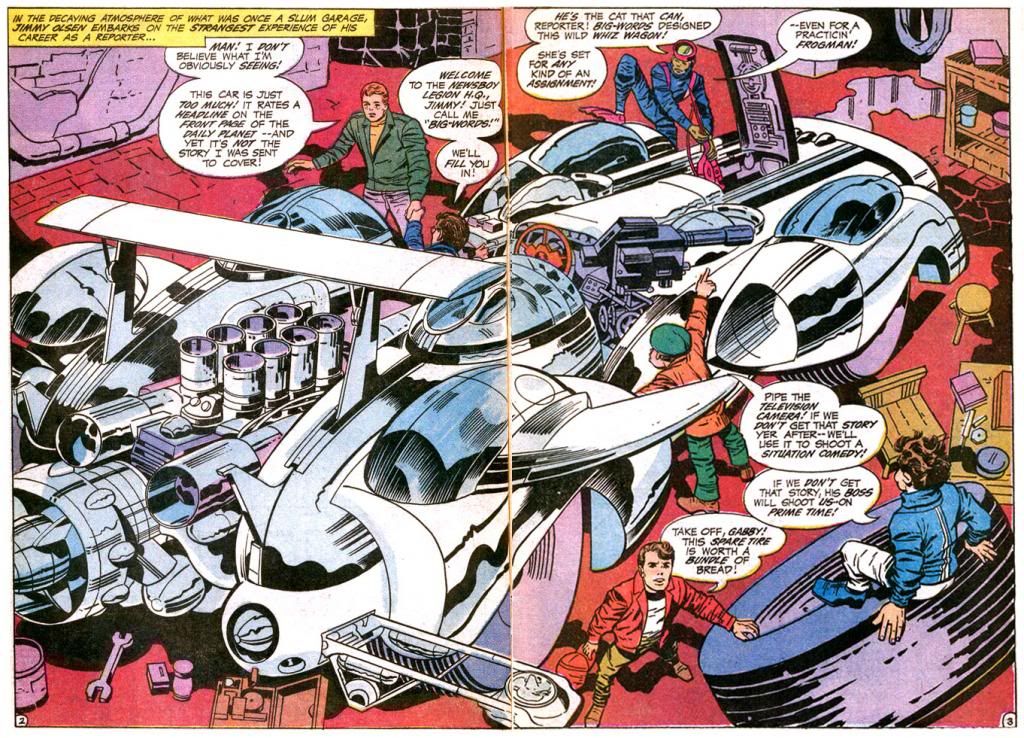
Jimmy Olsen #133 (October 1970), words by Kirby, inks by Vince Colletta

The best is last, but not for long!  In this spectacular image from Superman's Pal, Jimmy Olsen #133 (October 1970), we first greet the Whiz Wagon, custom-built by the Newsboy Legion just in time to explore the Wild Area with a certain cub reporter.  Or photographer.  Whatever the hell job it was Olsen did when he wasn't driving Perry White to distraction.  Look at the rear spoiler and those crazy intake pipes.  Is that a hint of a jet turbine beneath them?  Looking like the love child of the second Fantasti-Car and Speed Racer's fabulous Mach 5 by way of a maternity ward in the deepest, darkest, most top secret ward of Area 51, there's almost nothing the Whiz Wagon can't do.  The Newsboy Legion uses it to roar down the highway, chase after the Mountain of Judgment with the Hairies from the Habitat, fly, even travel underwater.  This is the ultimate in Kirby vehicle design. 

The Whiz Wagon by itself is an amazing visual, but Kirby doesn't simply fill two pages with a car and call it a day.  He loads this spread with details to help you believe in this phantasmagorical creation.  There's the spare tire with Newsboy Gabby perched on it (where do they buy those?), Flipper-Dipper and the forward cargo-hatch, plus tools galore and even some kind of liquid draining away in the background.  Hydraulic fluid?  Oil?  Tears from other artists who saw this and realized they'd never create anything even half so cool?

Wednesday, January 8, 2014

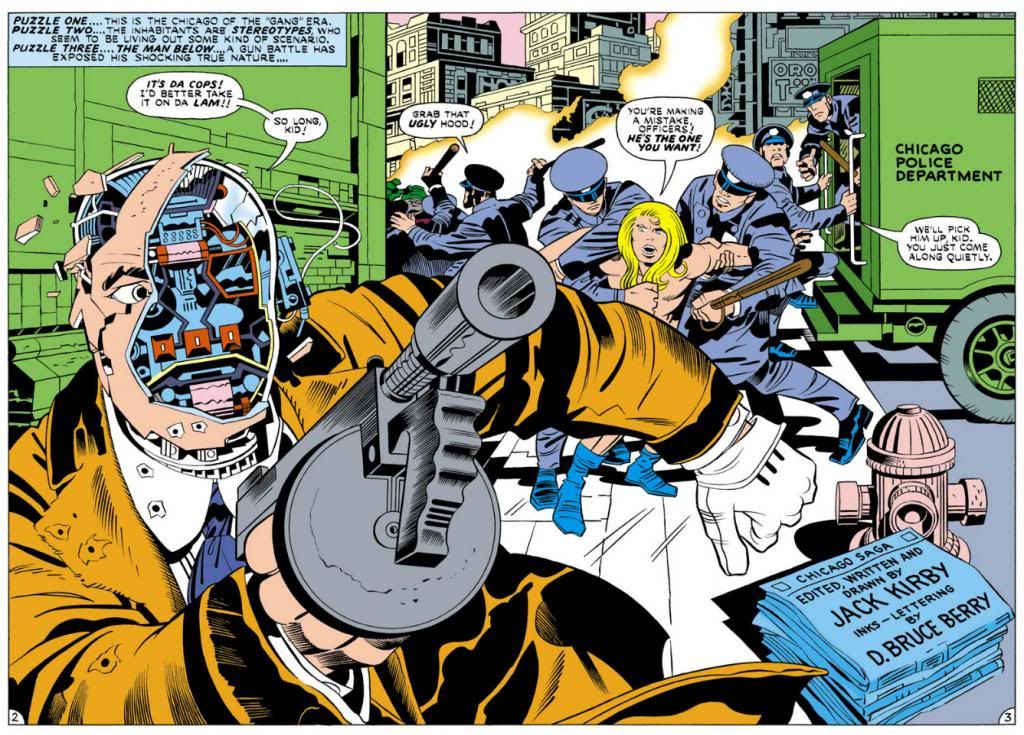
Kamandi #20 (August 1974): This is the image that made me a Kirby fan for life!


Here's a double-page spread from Kamandi #20 (August 1974), the first Kirby comic I ever owned.  I've already talked about that issue at some length here, and I'm sure you were fascinated by my commentary.  It's here again because a black and white version popped up on Facebook and I was struck by its personal significance to me as a comics fan, and also because a big name professional clued everyone into something peculiar about it.  Can you guess what it is?

That's right!  Perspective!

Did you notice how nutty the perspective is in this drawing?  Despite having studied art at a major university (I learned nothing because I'm an idiot), I never particularly gave it much thought until that pro pointed it out.  As he also commented, despite the crazy perspective (or maybe even because of it), the image still works.  Unless you make a living drawing this stuff everyday, or you're a lot smarter than I am, you probably wouldn't give two farts whether or not Kirby gets all the receding lines going to the correct vanishing points or not.  And even if you do give those two farts, the important thing is whether or not this image has impact and makes story sense.  It does!

What we glean from it, the most important information Kirby provides, is the shocking revelation that this tommy gun toting mobster is a robot.  With such a wild and wooly concatenation of figures and a startling storytelling moment, the focal points are that robot face and Kamandi's reaction.  This moment takes place during a police riot, which provides not only context but also a lot of energy and movement, like a similarly staged fight scene in a movie.  Spartacus, for example.

Notice how you're reading from left to right, so your eye goes right from the gangster's shattered visage to Kamandi's wide-eyed reaction.  The barrel of the machine gun, despite ostensibly being aimed somewhere over the reader's shoulder (involving YOU in the danger!), also serves to point to Kamandi.  The foreground is an eyeballed one-point perspective.  The lines on the green building on the left do not go to the same vanishing point as the ones on the paddy wagon on the right.  But they do serve to draw the eye back to Kamandi, creating a zoom effect within a single panel.  And check out the angle on that sidewalk.  Where is it heading?  The background mob hides its destination, but if we follow it, we'll actually end about halfway up one of those buildings in the distant background, the ones Kirby partially obscures with flames-- and which are drawn in two-point perspective!

I'd also suggest the faked perspective adds to the drunken, dreamlike quality here, on a subconscious level for the average reader (like me).  Kamandi, with his long, feminine blonde hair, is reminiscent of Alice from the Lewis Carroll stories, or at least the various Sir John Tenniel-derived versions that form our mental impression of her.  Carroll played games with language, math and logic in his prose, and Kirby does something similar with his visuals.  Kamandi, like Alice, takes an at-times rather nasty, almost psychedelic, trip through a land of talking animals, where reason and rational thought are overturned or inverted in favor of nonsense.  So it's appropriate for vanishing points and perspective planes to play tricks on our perception.  Kirby helps it along by having the figures relate to each other proportionally and because they seem to be standing on roughly the same plane.  Their environment may be illogical, but they, for the most part, are not.

The end result is a magnificent expressionist image that conveys dynamic action and provides more thrills than any six Hollywood summer blockbusters you could name.  It's also just a really cool picture.

And it's the coolness of it all that made me love Jack Kirby's work.  That, and the talking gorillas.

Sunday, January 5, 2014

Everything old is new again or ten things I'm excited about in 2014!

1.  Barbarella.  Humanoids, Inc. will publish a brand-new English language version of Jean-Claude Forest's sexy 1960s space adventure featuring the coolest 1960s space adventurer with updated and modernized whatchamallits by Kelly Sue DeConnick.  Dialogue?  Worldview?  I don't care.  Her adventures have been out of print in English for some time now, which is kind of ridiculous when you consider her pop culture significance.  There wouldn't be a Vampirella without Barbarella, and possibly not even a Red Sonja series.  As a character, Barbarella kicks much ass.  Despite her reputation as a sex kitten, in today's terms, she has what you would call "agency."  Therefore, she's a sextacularly retro space ace for today's on the go post-modern libertine!  Or something like that.

2.  Teen Titans.  With the publication of the long-awaited volume two in the Teen Titans DC archives hardcover series, it's just a matter of time before individual issues pop up on Comixology.  And this means more Wonder Girl with art by Nick Cardy.

3.  Pepper.  Last week I bought an Archie Comics digital exclusive containing 100 pages of gorgeous Dan DeCarlo-drawn pre-"ears for hats" She's Josie comics, which led me to discover the star's witty erstwhile best pal Pepper.  Pepper didn't make the transition to rock stardom with Josie and Melody, and that's a real shame because she's super cool with her cynical attitude and wild cat-framed glasses.  Those would have been so appropriate for the band.  Don't get me wrong-- Valerie is great.  But why couldn't the Pussycats perform as a quartet?  You know, Pepper on bass?  She could have been their Kim Deal, for crying out loud!  Anyway, 2014 is the year I bore you to tears celebrating Pepper.

4. X-Men.  Marvel has been dropping John Byrne-drawn issues on Comixology like they're on fire (that cliché worries me-- is this a good quality or a bad quality for something to have?), which means we're about one or two away from having a complete run available stretching from the initial Dave Cockrum issues (glorious) all the way to the celebrated "Days of Future Past" storyline that's being adapted into the latest film in the X-Men movie franchise (as my wife says, "I don't give a shit about that," but you might, so there!).  They'll probably get to the second Dave Cockrum run, which suffers from lackluster scripting but looms large in the early days of my initial fandom because those were the ones I bought in convenience stores and newsstands as Marvel published them.  I subscribed during the Paul Smith days, which saw Chris Claremont return to form.  Those should be on Comixology this year, too.

5. Fantastic Four #51.  Marvel and Comixology have every issue of Jack Kirby's legendary company-building stint on Fantastic Four through #50, which is the overall narrative's natural climax.  But it's in its anti-climax Kirby and Stan Lee produced the humanistic "This Man, This Monster," which is as close to superhero comic perfection as you are ever likely to find.  Kirby and Lee turned out a few solid stories and even some classics after this, but this is Marvel's 1960s apogee.

6. Samurai Executioner Omnibus.  Dark Horse is putting out a single book containing 798 pages of ultra-violent samurai slashing action from masters Kazuo Koike and Goseki Kojima.  A guy named Frank Miller would mine their stuff for his own reputation in the 1980s, but this is the 1972-76 original from a couple of legitimate geniuses.  Their Lone Wolf and Cub is essential, but Samurai Executioner is pretty darn close to necessary, with plenty of cinematic, evocative storytelling at its finest.  Oh, and it's only $19.99 for something that provides a meatier reading experience (as in the meat that Yamada Asaemon carves from his foes) than its equivalent in monetary (if not aesthetic)value-- about 5 flimsy 32-page issues of any given new monthly from Marvel or DC that will take you about 5 minutes to read and forget.  Okay, I admit I'm being unfair.  But even the best current series from either of the Big Two cannot hope to measure up to this work and you're paying less per page for it.  This should be the Event Comic of the Year.  Trust me-- you will never forget Yamada Asaemon.

7.  Lone Wolf and Cub Omnibus Volume 4.  Speaking of... here it is.  As I wrote above, these are essential.  Everything I gushed about with Samurai Executioner goes double for these.  This one is 696 pages for $19.99 and it's simply one of the greatest comics ever published.  I will be purchasing all of these in 2014.

8. The EC Archives:  Vault of Horror Volume 3.  Dark Horse does it again!  This is a very pricey book, but it's the continuation of Dark Horse's deluxe reprints of EC classics.  The Archives series started at Gemstone (I own several of them as well), but hit a rough patch.  Dark Horse re-launched the series in October 2013 with Tales from the Crypt Volume 4.  Fantagraphics is putting out books spotlighting individual artists (and those are beautiful), but here's your chance to see their work in context, with colors recreated from Marie Severin's originals.  Volume 1 of their Weird Fantasy reprints follows in April.  I'm more of a horror and Weird Science freak when it comes to EC, but any of these archives would be a welcome addition to my library.  And yours.

9. Warren horror.  Yeah, I know I'm going to sound like a Dark Horse shill, but they consistently put out products I love!  They're not only giving us EC and influential manga, but they're also continuing their long-running Creepy and Eerie Archives series this year.  I received Creepy Archives 10 for Christmas, and I'm certain 2014 will see me adding to my collection.

10. New discoveries of amazingly cool old stuff.  Like Pepper up there.  A couple of weeks ago, I had no inkling she even existed.  My knowledge of comics doesn't extend much farther than the ones I read when they were new and the artists and writers I grew up admiring, so I'm discovering wonders almost daily.  Certainly there are Jack Kirby stories out there and more I haven't read that I'm looking forward to uncovering and sharing with you, the reader of this blog!

Note:  Oh yeah, there are some new comics coming out this year that I'm also looking forward to.  Fantagraphics has Love and Rockets books coming out and their reprinting of Takako Shimura's heartbreaking Wandering Son.  Plus a whole lot more from Dark Horse, Image and even Marvel and DC I'll be checking out.  And there's a slight chance for some more Nana-related artwork from Ai Yazawa.  She revisited "Junko's Place" last year and apparently produced a Christmas card for Cookie magazine.  And even if we don't see new Nana, my big wish for Ms. Yazawa in 2014 (and in the future) is recovery, health and happiness.

Tuesday, December 10, 2013

Sunday, November 10, 2013

Part Two: "Kirby’s Unfinished Opera" by Gary Chapin (another guest essay!)

(Here's the second part of Gary Chapin's epic look at Jack Kirby's Fourth World...er... epic.  Part one is here.  You're really going to enjoy this!)

Now’s the Time

Mark Evanier, in the closing essay for Volume 3 of the Kirby’s Fourth World Omnibus, points out the critical reaction to Kirby’s treatment of Deadman. Kirby, said this critic (I paraphrase), clearly did not get the Neal Adams Memo. Graceful lines, art school realism, and noir subtlety “were” the way of “now.” Kirby represented “the past.” Adams and company represented the future. This is a point of view I would have heartily, and stupidly, embraced at the time.  “The future” is not a fixed point, however. And even the present is a bit slippery.  My “now” is different from your “now.” There’s a joke that says, “The golden age of music is 12.” My golden age of Kirby is 45. This is my “now.”

But Then Was Not

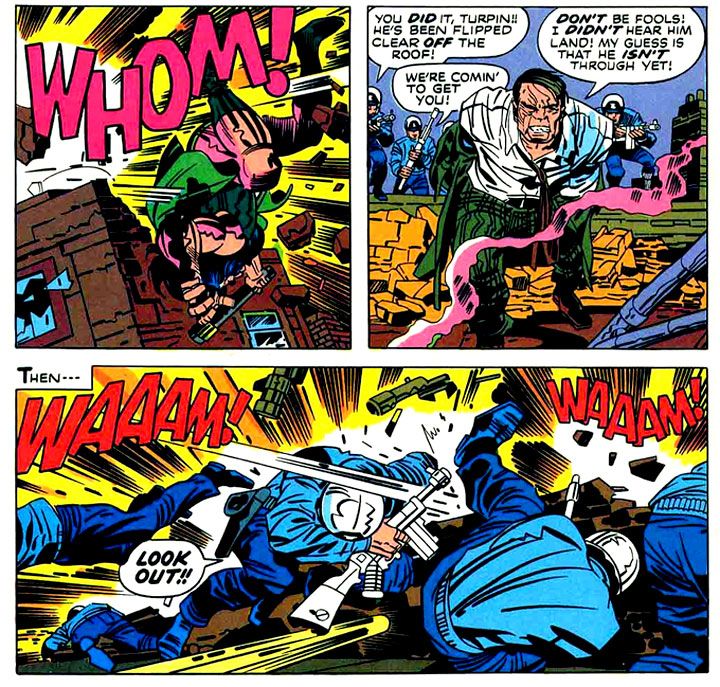
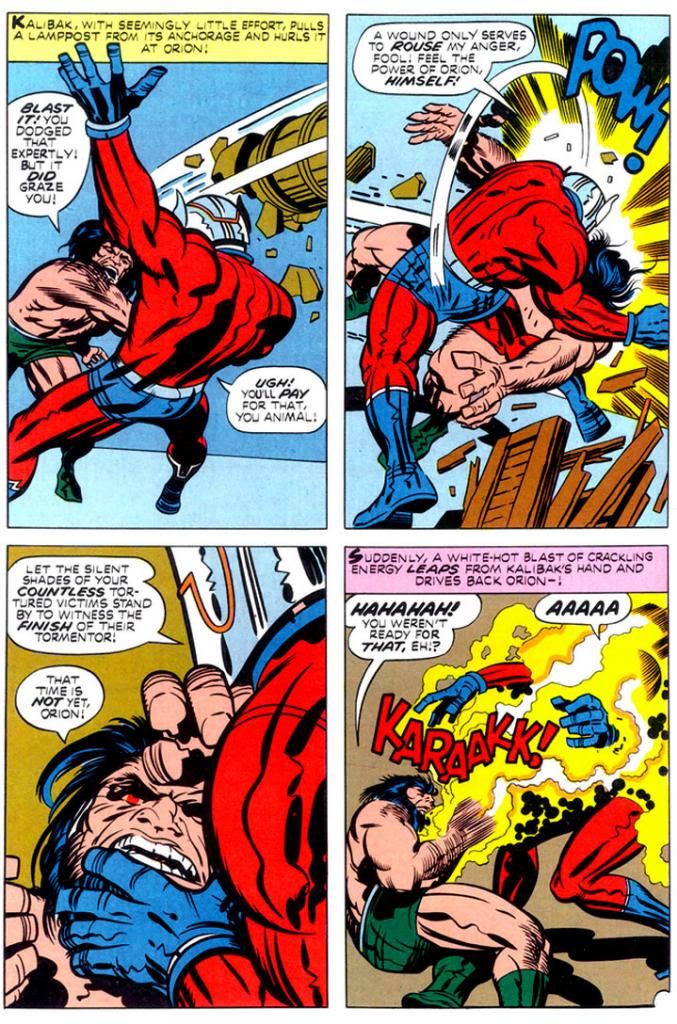
After around a year, the wheels came off the bus (or super cycle) of the Fourth World. Sales dipped, and books were canceled. The remarkable achievements that were “The Pact” (New Gods #7) and “Himon” (Mister Miracle #9) and “The Death Wish of Terrible Turpin” (New Gods #8) were not seen as masterpieces at the time.  The combat between Orion and Kalibak in the Turpin story will remind you what sort of glory can be found in a slugfest. 

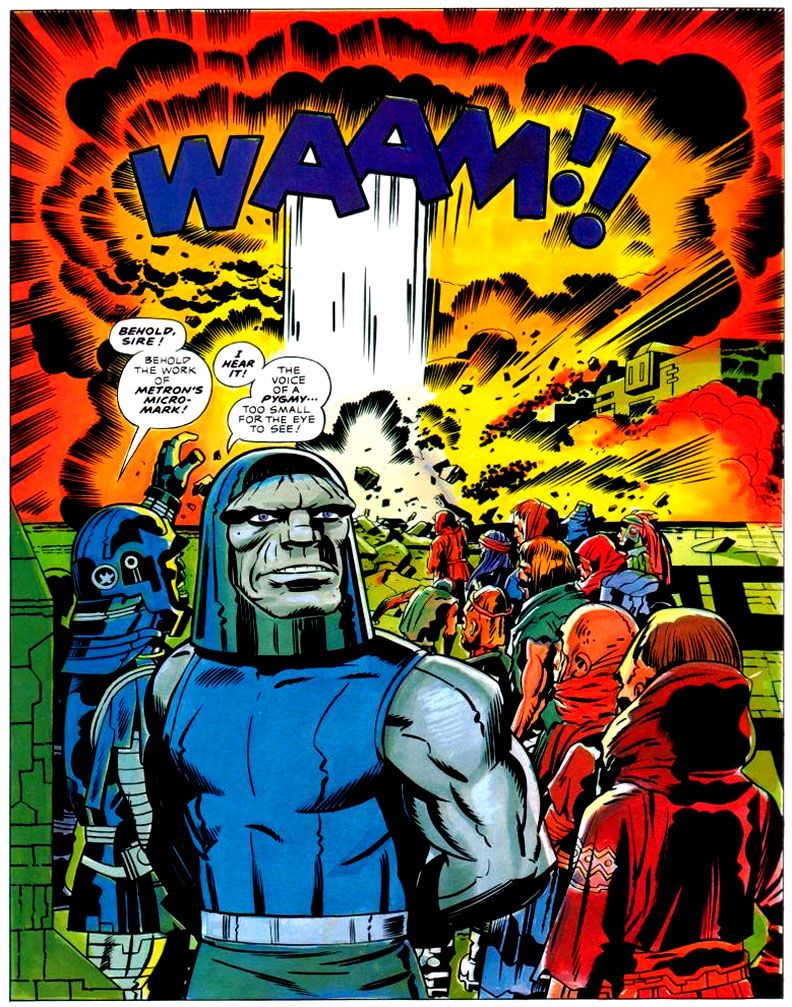
New Gods #7, March 1972 (Jack Kirby with inks by Mike Royer)
 
But then it ended. The last issue of the New Gods (“Darkseid and Sons,” #11) was, in fact, brilliant (the run from #7 through the end is worth everyone’s time). The story didn’t end as Kirby wanted it to, but it was a very effective stopping point with a lot of “What?? What just happened???” moments. It was very satisfying. The end of the Forever People was much more of a mess, possibly because their action was always peripheral to the New Genesis/Apokolips story being told in NG and Miracle.  “The Kids” end up stranded on a paradise planet in a faraway dimension when the Pursuer’s lance blows up, “destroying” the Infinity Man. While it technically makes sense, the pretext is as weak as it sounds.

Mister Miracle lasts a bit longer than the other two, but when the Big Story falls away, it becomes a series of one-off monster stories. This didn’t have to be a problem. Kirby spent the ‘50s being the master of one-off monster stories.

New Gods #8, May 1972 (Jack Kirby with inks by Mike Royer)

According to Evanier’s essay, though, Kirby was feeling demoralized and his heart wasn’t quite in it. You only have to notice that one of the stories begins with Miracle and Barda stumbling on a “haunted” house while walking in the woods near their house. Yeah, time for a new direction (which took him to the Demon, Kamandi, et many al., so one can’t entirely complain).

The Problem with Endings

Kirby’s vision from the beginning of the Fourth World was an enclosed story that reached through a number of books and ended in a Fourth World Ragnarok, closing the book on these characters for good. I don’t know how he ever thought that was going to happen. 

New Gods #11, November 1972 (Kirby with inks by Mike Royer)
 
It seems almost quaint, looking back from the other side of the graphic novel naissance, but in 1972, DC Comics was not going to let Kirby develop amazing properties – which is what he was brought in for – and then have them succumb to irrevocable destruction.

This may have been the one place where Kirby – a man preternaturally in synch with comic book aesthetic – may have had an ambition for something that can never exist in the superhero-comic book medium: an ending. This wasn’t a function of the times Kirby was writing in, but a function of the medium. Just consider the New Gods. We’ve had The Hunger Dogs, Kirby’s own imperfect – but beautiful! – attempt at an ending. We’ve had Death of the New Gods. We’ve had Final Crisis, where Darkseid is “finally” killed. 
 
Wait, who was that who was featured in the new Justice League 23.1?
 
To butcher Fitzgerald, “There are no last acts in comic book superhero lives.” Even characters who are never brought back, are constantly being brought up (e.g., Jor-El, Gwen Stacy). I wouldn’t be the first to suggest that while Crisis of This, That, and the Other Thing had all the hallmarks of a Ragnarok, they lacked the one key element:  the end of the world. They weren’t resetting the DC universe, they were resetting the DC stylebook.

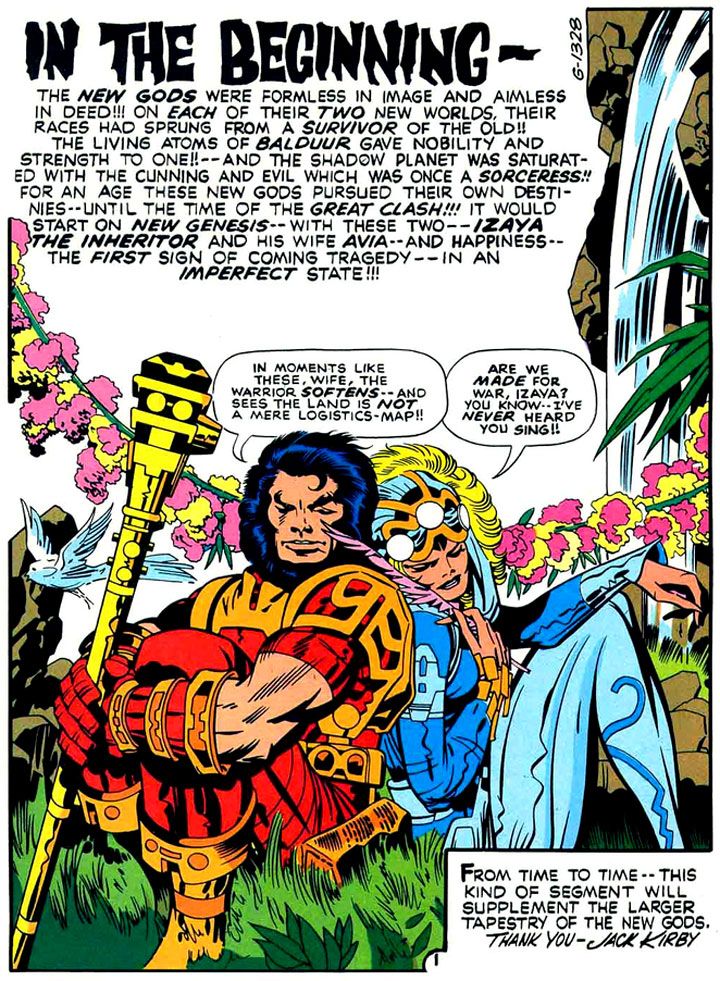
DC Graphic Novel #4: The Hunger Dogs, January 1985 (Kirby with inks by D. Bruce Berry)

I think Kirby really wanted the end of the world for his characters. He had the Wagnerian urge. But like so many great creators he was an inventor, not a destroyer. He began things. He began great things. And not a single one of them – not Cap, not the FF, not the New Gods – has ended. And even if they fall into a space where they seem to have ended – books get cancelled – there is always a new issue coming down the line.

But this is not the problem with endings. The problem with endings is that our experience of the work is shaped by “how things turn out.” Forget how things turned out. These are astonishingly rich stories, executed to a ridiculously high degree; the creation of a visual aesthetic that’s analogous to Tolkien’s linguistic aesthetic. This will always be true, no matter how things turn out. Kirby could not achieve his operatic ambition, but that’s irrelevant. I love these books.

Gary Chapin usually blogs about French accordion music over at www.accordeonaire.blogspot.com.