I can't help shilling for Comixology from time to time. But sometimes I have to. I really, really do. I mean, I run a blog largely dedicated to old comics-- which I liberally define as "anything published prior to the year 2000"-- and a big part of that includes yakking at length about Uncanny X-Men back when Chris Claremont was writing it and Wolverine was but a hairy, beer-swilling pup. Or whatever it is you call baby wolverines. Right now they're selling 45 classic issues of Uncanny X-Men for .99 each. I already bought them all for 1.99 apiece, and I considered that a bargain at the time. If you haven't experienced the foundation of practically everything people love about Marvel Comics these days, this is your big chance to catch up.
The art is outstanding throughout, with Dave Cockrum and John Byrne pencilling most of the issues and a few guest art teams here and there. And wow, beyond the visual treats, these are fun comics to read. They're occasionally goofy, but they have all the theatrics and high drama you could possibly want in a superhero comic, with in-depth characterization of even the least-loved and lowliest of cast-offs. You know, like Banshee. Poor guy. And the long-simmering "Dark Phoenix" storyline is one of those seminal comic book events, an era-defining tale, as is "Days of Future Past," which seems to have inspired a movie recently with a lot of familiar characters. Where have we seen them before?
Anyway, Marvel can't seem to leave this stuff alone. They must have retold all of Claremont's stories more times than DC has redone "Crisis on Infinite Earths." Even Marvel movie guru Joss Whedon couldn't resist dipping into the Claremont well when he wrote his own much-lauded run not so long ago.

Showing posts with label John Byrne. Show all posts
Showing posts with label John Byrne. Show all posts
Friday, May 16, 2014


Sunday, December 29, 2013
Uncanny X-Men #118 (February 1979): Bad New Mutants Go To Japan!
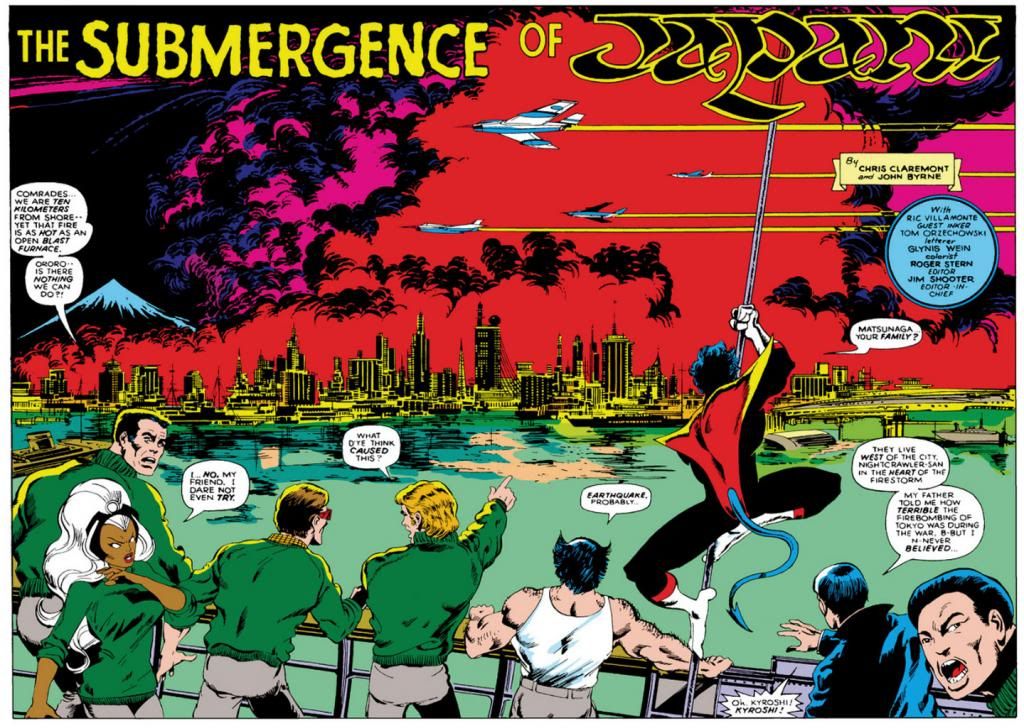 |
| Script: Chris Claremont; Art: John Byrne and Ric Villamonte |
Enjoy this spectacular double-page spread from Uncanny X-Men #118 (February 1979), pencilled by John Byrne and inked by Ric Villamonte. Maybe Terry Austin was off that month. Agarashima, the city on fire here, is completely fictional but the visible architecture in Byrne's rendition is plausible enough.
Except for Mt. Fuji in the background. An online source tells me Agarashima is in Miyagi prefecture, which is way up north along the eastern coast of Honshu. Actually, that same source reports the city to be "300 kilometers north of Tokyo" and misspells the prefectural name as "Miyago." This may be a fictionalized flourish on Chris Claremont's part, freeing him to use his imagination and create a fanciful Marvelized Japan.
Fake Miyago or very real Miyagi, it's a likely location for a medium-sized port city, which is what Agarashima appears to be here. Mt. Fuji is much farther west, so there's no way if this city resides 300 kilometers north of Tokyo you would see it looming that large in the background because it would be about 500 kilometers away. I live in a city in the same prefecture as Mt. Fuji, about 116 kilometers away, and even when we can see it from here (it's visible from several vantage points on clear winter days when it's wearing its snow cap), it's only about the same size as my thumb. So this is more than likely a little artistic license on Byrne's part as well. We just need some cherry blossoms blown out to sea by the conflagration to achieve perfection.
So, with all that in mind (or better yet, out of it), let's just admire this glorious drawing, huh? Unfortunately, after this image, there's not a lot of travelogue imagery in this story. Much smaller panels, and a lot of the action confined to interiors. By the next issue, the X-Men are on a volcanic island off the coast where they fight a pissed-off nutjob named Moses Magnum, who wants to sink Japan, so we're denied more John Byrne-drawn vistas of late 1970s Japan. Think what he might have done with Tokyo. I would love to have seen it.
You know, not on fire.
Wednesday, October 9, 2013
October is Spookey Month: Uncanny X-Men #143 in which Kitty Pryde recreates the movie "Alien" just for kicks
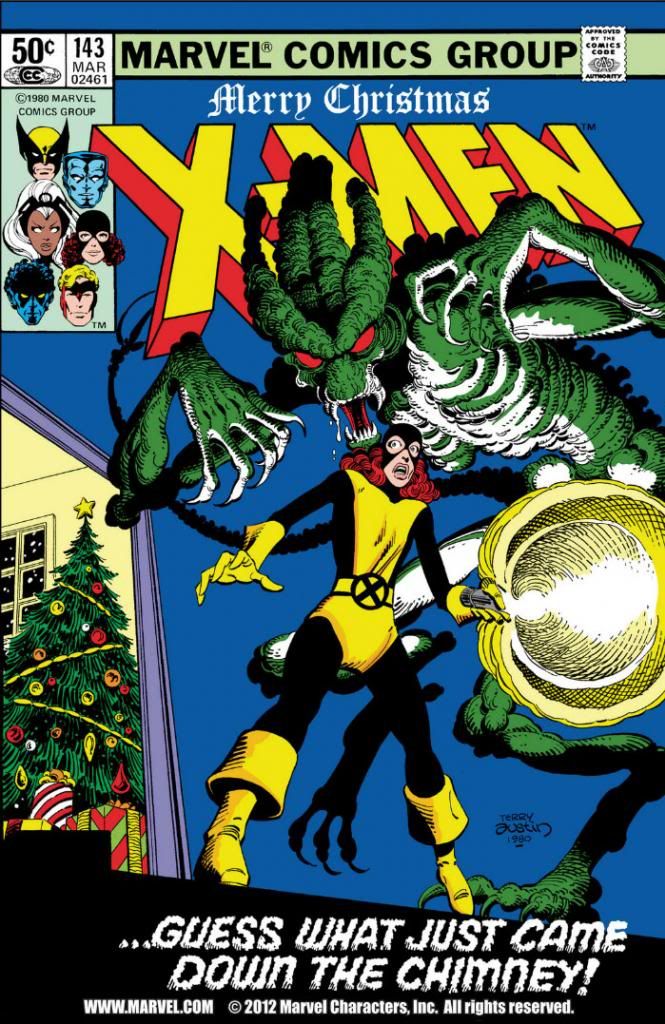
One Christmas Eve the rest of the gang leave her home alone, just like in that fun holiday movie about being left home alone. The title escapes me. Oh yeah-- It's a Wonderful Life. Unknown to everyone but Chris Claremont and John Byrne (those scamps!), it turns the portal to the N'Garai dimension is still slightly ajar. One of them, or a close relative, pops out, having visited Swiss surrealist H.R. Giger for a makeover sometime during the intervening years. The first thing the new, Alien-style N'Garai does is shred an unfortunate couple out poaching a small Christmas tree for their apartment. Then the poor, lost little demon, as lonely and in need of companionship as Kitty, goes looking for a friend. After all, it's no fun to be by yourself during the holidays. Kitty knows this, because this is the first Chanukah she's spent away from home herself. Unfortunately, thanks to various cultural differences, things don't go the way the demon planned. Kitty is less than appreciative of its presence, they don't get along, there's a misunderstanding, a fight and a blast from a white-hot jet engine.
 This story, called simply, "Demon," ran in Uncanny X-Men #143 (March 1981) a pretty minor work compared to the galaxy-spanning drama that made up the
recently-concluded "Dark Phoenix Saga," and it lacks the influence of
"Days of Future Past," which took up the previous two issues It's kind of the
Claremont-Byrne team's last little laugh before the team split, and from its title to its monster and most of its plot, it's openly cribbed from Ridley Scott's sci-fi/horror masterpiece. You know, White Squall. Claremont
must have enjoyed using Scott as much as he did H.P. Lovecraft in the prequel to this issue; he'd later re-homage Alien with his Brood creatures,a kind of otherworldly insect species with a
life-cycle that resembles a toned-down version of the Giger creature's.
I don't know if Byrne tried again. He seemed to content himself with
mining Marvel's own history for ideas when he moved over to Fantastic
Four as writer and artist. And tossing in a little Twilight Zone or
Invasion of the Body Snatchers for good measure-- remember that issue
with the town that drank the cow-Skrull milk and turned into evil
shapeshifters? That one was disquieting in a way this one can't quite match.
This story, called simply, "Demon," ran in Uncanny X-Men #143 (March 1981) a pretty minor work compared to the galaxy-spanning drama that made up the
recently-concluded "Dark Phoenix Saga," and it lacks the influence of
"Days of Future Past," which took up the previous two issues It's kind of the
Claremont-Byrne team's last little laugh before the team split, and from its title to its monster and most of its plot, it's openly cribbed from Ridley Scott's sci-fi/horror masterpiece. You know, White Squall. Claremont
must have enjoyed using Scott as much as he did H.P. Lovecraft in the prequel to this issue; he'd later re-homage Alien with his Brood creatures,a kind of otherworldly insect species with a
life-cycle that resembles a toned-down version of the Giger creature's.
I don't know if Byrne tried again. He seemed to content himself with
mining Marvel's own history for ideas when he moved over to Fantastic
Four as writer and artist. And tossing in a little Twilight Zone or
Invasion of the Body Snatchers for good measure-- remember that issue
with the town that drank the cow-Skrull milk and turned into evil
shapeshifters? That one was disquieting in a way this one can't quite match.The monster itself tries its best, but falls a little short because neither Claremont nor Byrne seem particularly interested in it. Their main concern is putting Kitty through her paces and making readers adore her.
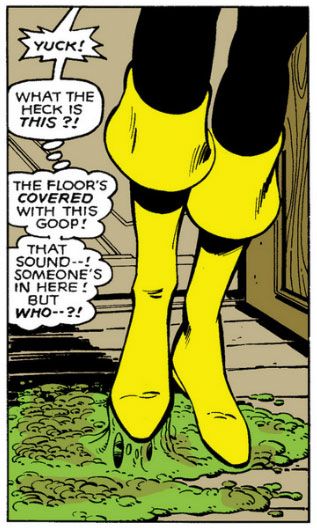
Let's examine our N'Garai for a moment. In X-Men #96, the story makes the point these smaller demons consist of smoke, and Dave Cockrum makes them more bug-eyed. Storm is even able to wave one of them away with her hand. They do, however, sometimes use long spears or lances with which they can stab someone and inflict pain and perhaps drain away life force like Kierrok does with his very presence. Claremont is almost out of pages with no time to explain it fully, and Storm herself only says something about pain and possible death if she's stabbed again. In this issue, the lone N'Garai is definitely made up of solid matter of some kind, albeit demonic, and it uses its claws and teeth on the young marrieds before eating their bodies and their souls. It also leaves Alien slime wherever it goes and crashes through walls. Essentially, it's an unauthorized guest appearance by the movie monster without any of the icky bio-mechanical sexual reproduction connotations.
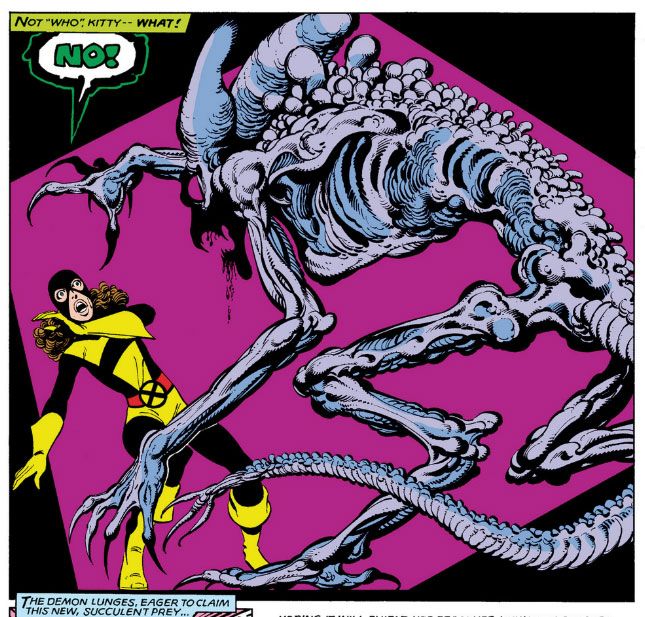
Confined within the pages of a single issue and the limits of what the Comics Code would approve, the poor beastie doesn't really get to cut loose and terrify us. The chase it inspires is chaotic but not as frightening as it needs to be. Byrne smudges Kity's face and draws some sweat droplets on her brow and Claremont has her tell us through a thought balloon she's scared but "coping," but she comes across as a bit too unflappable throughout most of the comic.
Sigourney Weaver's redoubtable Lt. Ellen Ripley-- for whom Kitty acts as a stand-in and occasionally physically resembles here-- is self-possessed throughout the majority of the film, but frazzles during her frantic escape attempt. Then she just about loses her shit when she discovers she's accidentally taken the alien with her in her little life pod before she pulls herself together. Weaver's iconic performance helps, as she's able to convey both Ripley's palpable fear and her agency simultaneously. This crucial element is missing in Uncanny X-Men #143, despite the tear in Kitty's eye in one close-up. Also, we haven't really seen the demon do a whole lot beyond kill two people-- both taken by surprise and, as civilians, without even Kitty's ghostly phasing powers-- and a room full of plants.
The story comes close to its full Alien-esque horror potential when the creature jumps out at Kitty and slashes through her, causing her pain and the temporary loss of feeling in one arm even though she's in her incorporeal "phase state," and in the hyper-kinetic Danger Room sequence as well, but there's no real feeling Kitty's in serious jeopardy. After all, this entire issue is more or less a love letter to her, so we seriously doubt from the get-go Claremont and Byrne plan to kill off this kid so soon after the start of her comic book career.
So what we're left with is more a puzzle situation, and the interest is in watching how courageous and clever Kitty solves it. Which, I suppose, makes it kind of akin to one of those Quinn Martin detective shows. Barnaby Jones or something. We see the criminal commit the crime right at the outset and instead of a whodunnit, we get a how-solve-it.
Speaking of how Kitty solves things-- well, if you've seen Alien, you know how it all ends. Byrne even borrows heavily from the film's visuals to show it, a kind of acknowledgement of just how baldly he and Claremont are riffing on Scott. To set it up, there's a neat bit of foreshadowing right at the start when we see Professor X teaching Kitty how to start the Blackbird. I find it really fun to see a young hero's education in process, and who would have thought the day's lesson would pay dividends so quickly? This premise-- how superheroes learn to be superheroes within a school setting-- is a lot more interesting to me than the demon/Alien stuff. It's a precursor to The New Mutants and it's almost as if we're watching Claremont inspire himself along those lines, with the genesis of that series appearing right here on these pages.
The weirdly saccharine denouement also foreshadows Claremonts of future past when the team returns to the mansion only to find a tired but otherwise unshaken Kitty sipping hot cocoa in front of the fireplace. That's right-- she has barely escaped death or even worse at the demon's claws, has no way of knowing if this was a one-time event or the harbinger of a full-scale monster invasion, isn't expecting anyone home for hours... and Claremont has her drowsily lounging about in her robe, as if nothing at all out of the ordinary had happened.
Okay, so Kitty's much tougher than I'd ever imagined, and she's recently returned from the future where she watched everyone die, but don't you think almost being killed by a demon warrants some kind of emotional response beyond the slight embarrassment one gets from denting the family car? And even if Kitty is too cool to worry, you'd think the older superheroes who almost died fighting Kierrok and supposedly have years of combat experience would do some kind of reconnaissance or go into a defensive posture on the chance there are more demons or enemies lurking around. They don't even spend much time trying to debrief Kitty. Storm just gives her the concerned mom act. After all the mayhem, it turns out nothing more is at stake here than in any given episode of Facts of Life.
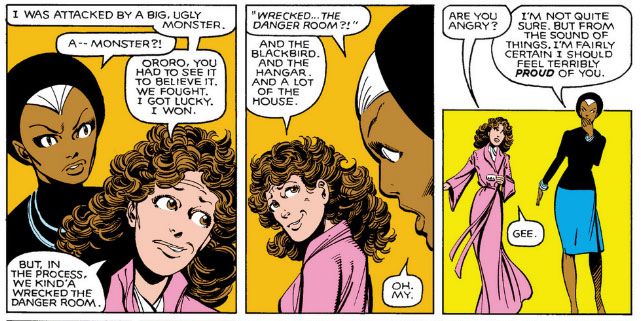
This comes dangerously close to making the whole "spunky teen girl joins the team" aspect insufferable. I guess my tolerance for this stuff was a lot higher when I was Kitty's age. The New Mutants, which came out a mere year or two later, would consist almost entirely of this kind of tonal dissonance, and I ate it up. And still do, but then my outright hero worship-love for Dani Moonstar has always overshadowed my liking of Kitty Pryde. As it is here, everyone's muted reaction further undermines any peril Kitty might have been in earlier in the story and reveals a Claremont a little too in love with his cast. While it's nice to show Kitty as a teen character able to pull herself together and save herself (a trait she's going to need when the team rockets into space or faces down Dracula himself later on), if you're going to take your superhero story the sitcom route, a better, more appropriate gag for the ending would have been the team coming back to find a pumped up Kitty toting around a baseball bat or that M16 rifle Moira MacTaggert used on Kierrok when these demons first appeared.
And one more thing, gosh darn it-- it's really too bad this wasn't set at Halloween.
Thursday, June 13, 2013
I just bought some old Superman comics for .99 each
Yeah, digital at Comixology. They're running a Superman sale which I'm sure has a lot to do with a certain Time-Warner flick that's coming out this summer. Or has already come out; I'm in Japan and our release schedule is different here. For whatever reason-- call me foolish, call me irresponsible-- but it occurs to me I bought nothing but Action Comics. Action Comics #1 (I'm relieved I didn't have to pay $175,000 for it, although I could have afforded it quite easily) plus one by Curt Swan and several by John Byrne.
It's fashionable these days to mock Byrne, but I won't hear a bad word said against Curt Swan. And once I get some time to read these comics, I'm going to spend a little time exploring them here while giving Byrne a fair shake. I don't mean the kind of shake a shark gives its prey. I mean a truly fair reading of the four comics I bought, although that's surely too small a sample size to make any kind of accurate assessment of what he accomplished.
I may clown around a lot here but this is a pro-Superman blog. I've got an incredibly expensive Hot Toys figure of Christopher Reeve back home to prove it. Superman and Babe Ruth. That's all I ever think about.
It's fashionable these days to mock Byrne, but I won't hear a bad word said against Curt Swan. And once I get some time to read these comics, I'm going to spend a little time exploring them here while giving Byrne a fair shake. I don't mean the kind of shake a shark gives its prey. I mean a truly fair reading of the four comics I bought, although that's surely too small a sample size to make any kind of accurate assessment of what he accomplished.
I may clown around a lot here but this is a pro-Superman blog. I've got an incredibly expensive Hot Toys figure of Christopher Reeve back home to prove it. Superman and Babe Ruth. That's all I ever think about.
Tuesday, October 9, 2012
October is Spookey Month: "Hellboy," yet another Halloween reading recommendation
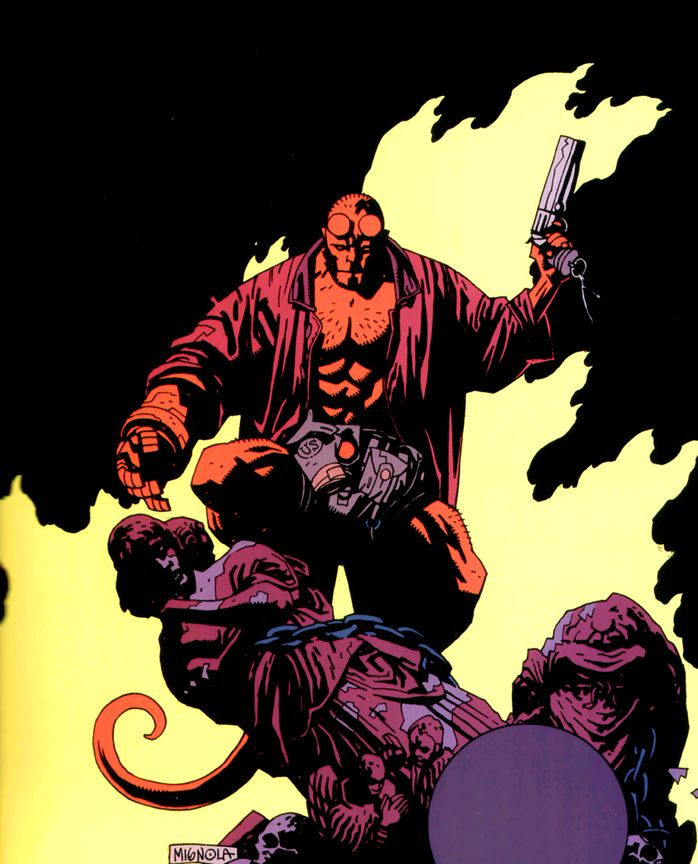 |
| Mike Mignola (1994) |
After two decades and so many miniseries and titles it can be hard to know where to start with Hellboy. It doesn't help matters Mignola's chronology jumped around depending on whatever inspired him to write and draw a particular story. In one book, Hellboy could be in Ireland in 1959 or 1961, then show up in Japan in 1967 for the next, then guest star in an issue of The Goon telling the story about Japan. Or something like that. Working it out this way, Mignola and his later collaborators have built a massive narrative spanning decades, continents and even the galaxy, with characters dying and other joining, menaces burbling up from the background, others springing full-blown into the foreground plot.
From his earliest days fighting un-frozen Nazis and their spiritual leader Rasputin-- yes, the historical Rasputin, the one Prince Felix Yusupov, Grand Duke Dmitri Pavlovich and some concerned friends poisoned, shot, beat and drowned in 1916-- to various creatures from European myth, with an underpinning of H.P. Lovecraft, Hellboy now inhabits a sharply defined world with all kinds of incidents and epics. So how do you jump into this world?
Sorry, I'm not much help there. I'm not a continuity junkie or obsessed with minutia. All I ask is whatever story I'm reading to be internally consistent. And I tend to prefer Mignola's moody, sometimes peculiarly random one-offs with Hellboy himself to the longer apocalyptic tales generally starring the BPRD cast (althought these are good, too). That's why I say, "Don't worry about a reading order with Hellboy." My advice is just buy the Seed of Destruction collection and start there. Move on to whatever story catches your fancy.
In short, you must do as you see fit.
For me, Hellboy pushes a number of buttons. Let's examine four of them in detail. Mignola's art is the first. I love bold, heavily stylized art, the kind where you say, "Now there's a nice drawing, just the essentials" rather than take in something that looks like it was traced from a still frame out of a movie, or a swimsuit magazine. Mignola's work has become more essentialist and geometrical over time and that's my bag.
The second is my love of the weird and fantastic. Since earliest childhood, I've read books about cryptid animals, UFOs, alternate dimensions, the Bermuda Triangle, ghosts, urban legends and the like. I've always loved stories where teams of people investigate the unknown and come to grief, from Kolchak to Venkman, Stantz, Spengler and Zeddmore to Mulder and Scully to Hellboy and company. I'm a friend to them all.
Folklore and myth make the third. Mignola draws heavily on European traditions and Lovecraft, but he has broken with this on a few memorable occasions. Two are team-ups with horror art legend Richard Corben-- Makoma, informed by African folktales and The Crooked Man, set in the Appalachian Mountains of the good ol' U.S. of A. Both are lovely and strange. How can anyone not read these?
And the fourth is a specific story. As an ex-pat living in Japan, "Heads," set in Kyoto, is a lot of fun in a very personal way. Mignola claims in his introduction to the story not to know a whole lot about Japan. Yeah, but his art, as influenced by Alphonse Mucha, who himself drew on Japanese ukiyo-e and their extremely linear forms as it is by European woodcuts, Jack Kirby or P. Craig Russell, makes him particularly apt for this kind of material. I wish Hellboy would revisit Japan sometime in the near future. If Mignola or any of his collaborators need some first hand experience and reference-- or just want to hang out while doing a research trip-- well, now, I know just the blogger to volunteer his services!
Thursday, July 12, 2012
I did it! I ordered Ghost World!
I know you're fascinated by this Ghost World saga and relieved to know I'll have a brand new copy sometime in the next two weeks thanks to my good friends at Amazon Japan and Sagawa Transport. I also ordered New Mutants Classic volume 4, two Marvel Masterworks Uncanny X-Men books and John Byrne's Compleat Next Men 1. What a dork!
Along with those I sent for Alas, Babylon by Pat Frank and On the Beach by Nevil Shute. I'm not just a sucker for comics about disaffected youth and mutated super-beings with soap opera-ish personal issues but also for the nuclear combat toe-to-toe with the Russkies. I'm a big fan of the apocalypse. When you grow up party to a murder-suicide pact involving you, your government, its chief ideological rival and every other higher order of life on the planet, you tend to find such concepts as missile gaps, fallout, mega-deaths and half-life fascinating and fun. My first words were, "Mein Fuhrer! I can valk!"
So I've read On the Beach multiple times, but I read Alas, Babylon only once, when I was a child. All I remember about it is someone gets blinded by staring at an atom bomb blast. Probably some punk teenager. Teenagers are always staring at things.
I remember that, and Chef Boyardee's Little Pizzas, which were a staple of my summertime diet in those days. The rich, probably artificially-flavored with chemicals later proven to be carcinogenic tomato taste of Chef Boyardee's Little Pizzas is forever linked in my mind with Alas, Babylon and the novelization of George Lucas's early film THX-1138, my copy of which apparently had a few pages missing. I assume the movie has a happy ending like most of Lucas's other films, right? I stole Alas, Babylon from my older brother who read it for a high school class and THX-1138 came courtesy a used book sale at the public library.
Holy moley, I'm like Proust with brain damage.
Along with those I sent for Alas, Babylon by Pat Frank and On the Beach by Nevil Shute. I'm not just a sucker for comics about disaffected youth and mutated super-beings with soap opera-ish personal issues but also for the nuclear combat toe-to-toe with the Russkies. I'm a big fan of the apocalypse. When you grow up party to a murder-suicide pact involving you, your government, its chief ideological rival and every other higher order of life on the planet, you tend to find such concepts as missile gaps, fallout, mega-deaths and half-life fascinating and fun. My first words were, "Mein Fuhrer! I can valk!"
So I've read On the Beach multiple times, but I read Alas, Babylon only once, when I was a child. All I remember about it is someone gets blinded by staring at an atom bomb blast. Probably some punk teenager. Teenagers are always staring at things.
I remember that, and Chef Boyardee's Little Pizzas, which were a staple of my summertime diet in those days. The rich, probably artificially-flavored with chemicals later proven to be carcinogenic tomato taste of Chef Boyardee's Little Pizzas is forever linked in my mind with Alas, Babylon and the novelization of George Lucas's early film THX-1138, my copy of which apparently had a few pages missing. I assume the movie has a happy ending like most of Lucas's other films, right? I stole Alas, Babylon from my older brother who read it for a high school class and THX-1138 came courtesy a used book sale at the public library.
Holy moley, I'm like Proust with brain damage.
Monday, June 25, 2012
What a super weekend!
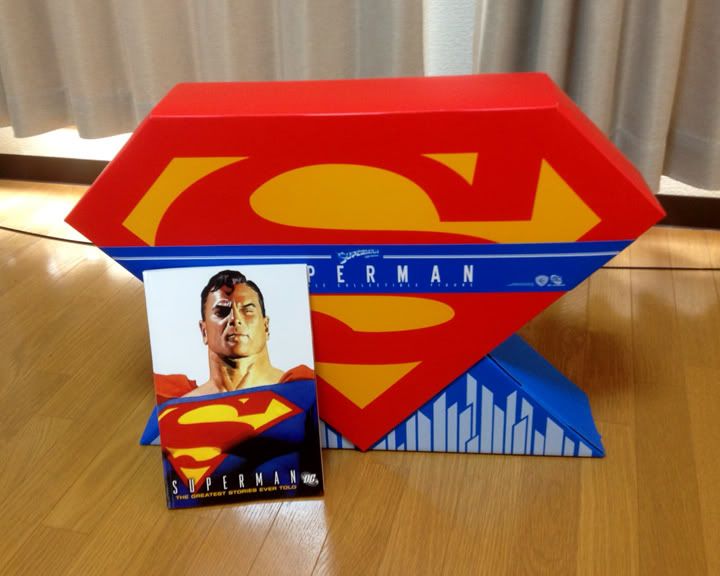
The book has a nice Alex Ross cover featuring his version of Superman looking stern and appropriately heroic, spit curl, narrowed eyes, lantern jaw, big red and yellow emblem on his chest. The stories inside feature a wide array of writers and artists, but a more appropriate title is Superman: Some Pretty Good Stories. Alongside the origin story from Superman #1 (June 1939) and the John Byrne revamp "The Man of Steel" from The Man of Steel #1 (June 1986) there are some curiosities like the 1940 short story "What If Superman Ended the War?" written and drawn by Superman creators Jerry Seigel and Joe Shuster for Look Magazine and an otherworldly pin-up by none other than Moebius himself. It's amusing to see the rudimentary yet compelling storytelling of Simon and Shuster as they pit Superman against the real world menace of both Adolf Hitler and Joseph Stalin. All it takes is a quick trip to Nazi Germany and the Soviet Union and Superman deposits both dictators in Geneva, Switzerland where they're judged for crimes against humanity and the world enters a utopian age of peace and scientific progress...

To be fair, I didn't read this story when it first came out in Action Comics #775 way back in 2001 and in the years since we've had rapes and murders, Identity Crisis making the regular rank-and-file of DC's caped marvels almost as nasty as the Elite are supposed to be and Wonder Dog devouring Wendy, so maybe I'm just jaded, so beaten down by the banality of all this caped decadence I can no longer feel Kelly's intended impact. You really want a Superman who's a beacon of restraint and decency, and Kelly attempts to give that to us while scoring points off guys like Warren Ellis-- who's actually a damn fine writer-- and even DC's own Vertigo line, but when you turn all your heroes morally ambiguous and then pat yourself on the back for it, ironically it turns out Superman won the battle but lost the war. This Superman doesn't even exist anymore.
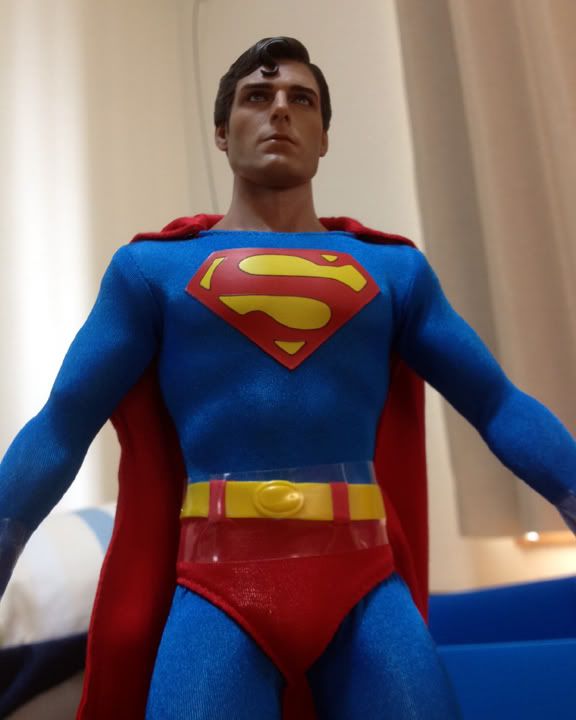
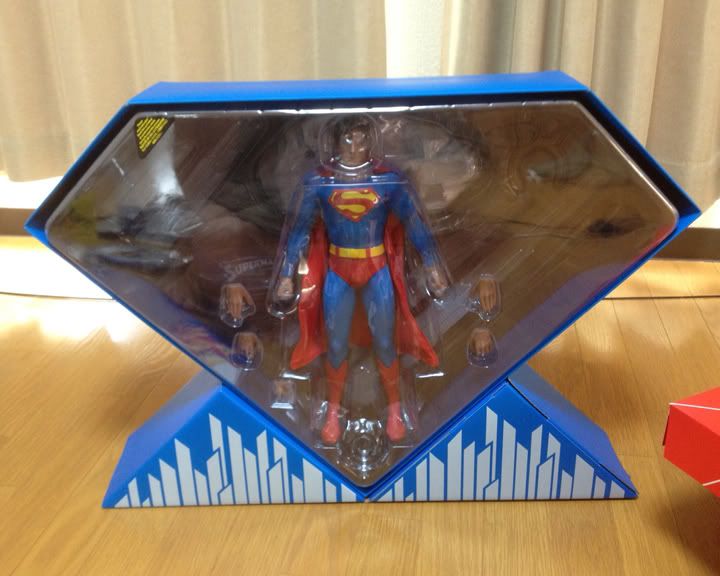
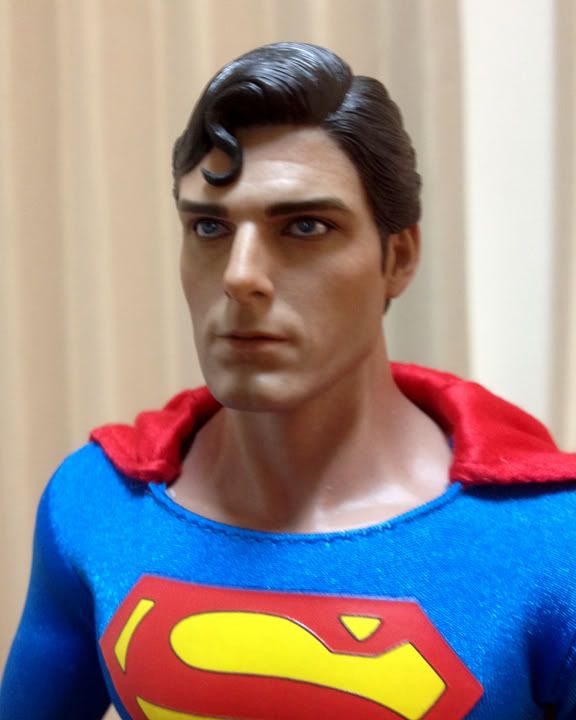
Even at their best, none of these stories approach the magic of Superman the Movie, a relic of time when movie makers told stories. The Hot Toys Superman is every bit as fun as the movie itself. It doesn't scream "I'm from the 70s!" at you, though. They've accurately reproduced Christopher Reeve from the movie and managed to create a timeless image of the first and still greatest of all the super-people.
But it's a little scary, too. I showed it to my girlfriend via Skype and she freaked out over the eyes. Too intense, too real. The Reeve likeness is as close to perfect as you're likely to get, but it's got the same uncanny valley feel you'd expect to encounter in a Hollywood wax museum. The uniform is spot on, a tiny reproduction of what was already an iconic visual-- the classic blue suit with red cape, undies and yellow highlights. I paid a ridiculous amount of money for this figure but I had to have it. I've been looking for the best representation of Superman in toy form for the past few years. This is it. By Jor-El's shade, this is it! I also believe Reeve's performance as Superman to be the most perfect iteration of the character in any medium and this figure is a triumphant celebration of the role. Part of the proceeds go to Reeeve's charitable organization, the Christopher & Dana Reeve Foundation, and the interior box lid features a poignant dedication to Reeve.
Friday, May 27, 2011
Today's lesson: Buying comics is an expensive habit!
Yeah. I'm thinking about giving up comics and taking up cocaine again. Just kidding. I've never used cocaine. As far as you know. But today was payday, so I went to JJ's Comics & Cards, my local comic book store, looking specifically for comics featuring Cassandra Cain in her new costumed identity of Blackbat. Which means-- choke!-- I bought a few DC Bat-books! I even bought some I wasn't sure she was in just to make certain I didn't miss even a fleeting glimpse or hint!
But I spent close to 40 bucks. They had stuff there I didn't even know I wanted until I saw it on the shelves. Here's what I ended up buying:
Batman: Gates of Gotham #1: Cass in civilian clothes, towards the end of the issue, just as promised. The way artist Kyle Higgins draws Cass-- her anatomy, her clothing, her body language-- and the way writer Scott Snyder handles her mode of speech do nothing to define her as anything more than just another generic superhero person, which lead to something of an anti-climax. Here's hoping a closer reading proves me wrong.
Batman Incorporated #5: No discernible traces of Cass in civvies or otherwise, but lots of Batwoman. I like Yanick Paquette's art with these Michel Lacombe inks. Solid figurework, nice facial expressions.
Batman Incorporated #6: Chris Burnham's art combines the thin, scribbly lines of Frank Quitely with the deranged facial expressions of Ito Junji. I'm not sure I like Bruce Wayne looking kind of crazed, but there's Cass as Blackbat more than making up for it with a nearly silent action sequence. Leave it to Grant Morrison to give us Cass doing what she does best-- whomping on people and leaving no room for discussion. Liking the pointy little mask and cape, can't tell much else about her costume.
Conan: Road of Kings #5: I passed on King Conan to pick this up. No Cass whatsoever, just Conan in his warrior prime as written by Roy Thomas. Which reminds me-- I need to turn to the back for "The Adventures of Two-Gun Bob," the biographical Robert E. Howard strip by Jim & Ruthe Keegan. It's always excellent. Cass's appearance in this book cancelled due to licensing difficulties between Dark Horse, Time-Warner and Conan Properties International. Too bad. Thomas's take on her would have been interesting, to say the least.
Hellboy: Being Human: Mike Mignola script, Richard Corben art, complete story in one issue. Of course I bought this! No Cass appearance, Cass not referenced in dialogue.
John Byrne's Next Men #6: The return of one of my favorite-- yet somehow frustrating-- titles from years past. Byrne's telling a convoluted time travel mystery but the story feels somehow beefy. I get that same full-belled satisfaction from reading it I used to get from comics, rather than the sense I've eaten a single cookie a lot the flimsy, underwritten books give me these days. Not saying Next Men is gourmet fare so far, but it does hit the spot. Will I be able to keep it down? Cass appears briefly disguised as a Union soldier. Sure, the figure's tiny and consists of just a couple of ink swirls, but I'd recognize her anywhere.
New Mutants #25: "New Direction!" huh? How about A direction? This is a book I've stuck with because I like Dani and Xi'an so much, but it's been nothing but fragments of crossover stories, frequently with the New Mutants team barely appearing on the pages of their own book. And it got off to such a decent start before being consumed by the needs of modern epic storytelling. I'm not quite ready to give up on it yet, but if this book is just going to be a bump on the ass of the greater X-franchise with no stories to tell of its own, then I'll be bailing soon. Very soon. Rumors of Cass taking over as team leader in this issue prove unfounded.
Red Robin #23: Another false alarm. No Cass.
The Rocketeer Adventures #1: The lead story is all about Cass and explains how she came to choose "Blackbat" as her new super-name. Yeah. I didn't make that up. It's... really... I bought "cover 8," the Dave Stevens variant. I also hate multiple covers. But this one is a beauty. And inside there are stories by Mike Allred, John Cassaday and Kurt Busiek. Busiek's just happens to be illustrated by Michael Kaluta. Are there really people who have to collect each and every variant cover of a single issue? Do those kinds of stunts really help publishers? Or do readers just choose their favorite one and go with that? If it's the latter, I'm all for it because it's kind of interactive. If it's the former-- YUCK. But what a gorgeous book! John CASSaday, but no Cass Cain.
X23 #10: I've always hated this X23 character. Well, not the character, just the concept. To me, you need one Wolverine, one Batman, one Superman, one Wonder Woman, one Spider-Man. Not clones and extras. Which may sound strange coming from someone who bought a bunch of comics based on the erroneous assumption a former Batgirl would be in each and every one of them. And I've always been indifferent towards Jubilee. Then a funny thing happened. One day the comic store had nothing I particularly wanted so I picked up the first issue of the Wolverine and Jubilee miniseries. Jubilee as a vampire? DOUBLE YUCK. DOUBLE SURPRISE! It turned out to be a pretty compelling story, quite well-written by Kathryn Immonen and nicely drawn by Phil Noto. It made me care about Jubilee for the first time. So when I saw a comic featuring vampire Jubilee fighting X23 with art by Sana Takeda? I felt perfectly willing to climb off my high horse and--
Cassandra Cain is back in action!
I'm happy with all these purchases, and I'd openly shill for JJ's Comics & Cards because of the royal treatment the owners have always given me-- and they're just so nice-- but these books cost me around 36 dollars. Actually, if I want to keep up my comic book reading habit, I'm probably going to have to give up a lot of other little things. Like electricity, clothing and food. Or I may have to resolve once again to stick only to collections, trades and archives, and then only very selectively.
But there's that Cass factor. Yes, there is.
But I spent close to 40 bucks. They had stuff there I didn't even know I wanted until I saw it on the shelves. Here's what I ended up buying:
Batman: Gates of Gotham #1: Cass in civilian clothes, towards the end of the issue, just as promised. The way artist Kyle Higgins draws Cass-- her anatomy, her clothing, her body language-- and the way writer Scott Snyder handles her mode of speech do nothing to define her as anything more than just another generic superhero person, which lead to something of an anti-climax. Here's hoping a closer reading proves me wrong.
Batman Incorporated #5: No discernible traces of Cass in civvies or otherwise, but lots of Batwoman. I like Yanick Paquette's art with these Michel Lacombe inks. Solid figurework, nice facial expressions.
Batman Incorporated #6: Chris Burnham's art combines the thin, scribbly lines of Frank Quitely with the deranged facial expressions of Ito Junji. I'm not sure I like Bruce Wayne looking kind of crazed, but there's Cass as Blackbat more than making up for it with a nearly silent action sequence. Leave it to Grant Morrison to give us Cass doing what she does best-- whomping on people and leaving no room for discussion. Liking the pointy little mask and cape, can't tell much else about her costume.
Conan: Road of Kings #5: I passed on King Conan to pick this up. No Cass whatsoever, just Conan in his warrior prime as written by Roy Thomas. Which reminds me-- I need to turn to the back for "The Adventures of Two-Gun Bob," the biographical Robert E. Howard strip by Jim & Ruthe Keegan. It's always excellent. Cass's appearance in this book cancelled due to licensing difficulties between Dark Horse, Time-Warner and Conan Properties International. Too bad. Thomas's take on her would have been interesting, to say the least.
Hellboy: Being Human: Mike Mignola script, Richard Corben art, complete story in one issue. Of course I bought this! No Cass appearance, Cass not referenced in dialogue.
John Byrne's Next Men #6: The return of one of my favorite-- yet somehow frustrating-- titles from years past. Byrne's telling a convoluted time travel mystery but the story feels somehow beefy. I get that same full-belled satisfaction from reading it I used to get from comics, rather than the sense I've eaten a single cookie a lot the flimsy, underwritten books give me these days. Not saying Next Men is gourmet fare so far, but it does hit the spot. Will I be able to keep it down? Cass appears briefly disguised as a Union soldier. Sure, the figure's tiny and consists of just a couple of ink swirls, but I'd recognize her anywhere.
New Mutants #25: "New Direction!" huh? How about A direction? This is a book I've stuck with because I like Dani and Xi'an so much, but it's been nothing but fragments of crossover stories, frequently with the New Mutants team barely appearing on the pages of their own book. And it got off to such a decent start before being consumed by the needs of modern epic storytelling. I'm not quite ready to give up on it yet, but if this book is just going to be a bump on the ass of the greater X-franchise with no stories to tell of its own, then I'll be bailing soon. Very soon. Rumors of Cass taking over as team leader in this issue prove unfounded.
Red Robin #23: Another false alarm. No Cass.
The Rocketeer Adventures #1: The lead story is all about Cass and explains how she came to choose "Blackbat" as her new super-name. Yeah. I didn't make that up. It's... really... I bought "cover 8," the Dave Stevens variant. I also hate multiple covers. But this one is a beauty. And inside there are stories by Mike Allred, John Cassaday and Kurt Busiek. Busiek's just happens to be illustrated by Michael Kaluta. Are there really people who have to collect each and every variant cover of a single issue? Do those kinds of stunts really help publishers? Or do readers just choose their favorite one and go with that? If it's the latter, I'm all for it because it's kind of interactive. If it's the former-- YUCK. But what a gorgeous book! John CASSaday, but no Cass Cain.
X23 #10: I've always hated this X23 character. Well, not the character, just the concept. To me, you need one Wolverine, one Batman, one Superman, one Wonder Woman, one Spider-Man. Not clones and extras. Which may sound strange coming from someone who bought a bunch of comics based on the erroneous assumption a former Batgirl would be in each and every one of them. And I've always been indifferent towards Jubilee. Then a funny thing happened. One day the comic store had nothing I particularly wanted so I picked up the first issue of the Wolverine and Jubilee miniseries. Jubilee as a vampire? DOUBLE YUCK. DOUBLE SURPRISE! It turned out to be a pretty compelling story, quite well-written by Kathryn Immonen and nicely drawn by Phil Noto. It made me care about Jubilee for the first time. So when I saw a comic featuring vampire Jubilee fighting X23 with art by Sana Takeda? I felt perfectly willing to climb off my high horse and--
Cassandra Cain is back in action!
I'm happy with all these purchases, and I'd openly shill for JJ's Comics & Cards because of the royal treatment the owners have always given me-- and they're just so nice-- but these books cost me around 36 dollars. Actually, if I want to keep up my comic book reading habit, I'm probably going to have to give up a lot of other little things. Like electricity, clothing and food. Or I may have to resolve once again to stick only to collections, trades and archives, and then only very selectively.
But there's that Cass factor. Yes, there is.
Subscribe to:
Posts (Atom)