
When we speak of “Command D,” what is it we’re talking about? Specifically, the underground bunker in which Kamandi grew up, raised by a white-haired man he believes to be his grandfather. Given their relative ages there must have once been younger people in the bunker-- Kamandi’s parents. Kamandi doesn’t mention them, so it’s likely they died when he was an infant, leaving him in the elderly man's care. I'm immediately reminded of Pitcairn Island of HMS Bounty fame, when an American whaling ship found John Adams (sole male survivor of the mixed group of English mutineers, Tahitian men and women who sailed into legend) as aged patriarch of a small society there.
I take writer/artist Jack Kirby at his
word when he describes Kamandi as the old man's grandson, at least in terms of the boy's belief they're related. Kamandi refers to him as Granddad at the story's outset and Grandfather the rest of the way, and while these may simply be culture-based honorifics, the narration calls him Kamandi's grandfather so have no reason to doubt he is biologically rather than simply functionally. Whatever the true nature of their relationship, someone named the boy after the bunker, either
his parents, grandparents, simply the man known as Grandfather, or some other subsequently deceased co-survivor
(Kamandi’s dialogue doesn’t hint at such, so that doesn’t seem likely). Spelling seems not to have mattered, or else this mysterious person or people decided Kamandi seemed more appropriate for a boy's name than Command D.
The story begins with Kamandi having emerged from his namesake domicile and received massive culture shock— Grandfather with his memory tapes and micofilm has inadvertently acted as an unreliable teacher and has not only failed to prepare Kamandi what he encounters in the post-Cataclysmic world, he also imparted in the boy certain goals that at first glance seem unattainable. Kamandi has been trained, if not disciplined. That Grandfather has passed on some mistaken assumptions is to be expected.

Because his knowledge of the story's settings approximates ours, Kamandi acts as our masking agent, and we are meant to identify with him and his solitary plight. Positing the typical comic book fan who might be attracted to Kamandi: The Last Boy on Earth as approximately the character’s age and gender, or perhaps younger and able to imaginatively inhabit the protagonist’s role, that is. So it’s necessary at this point in the story for Kamandi to possess a naiveté so that we might experience the story surprises and twists along with him. It’s an age-old gambit in fiction (Stephen Crane and Horatio Alger would probably approve) and Kirby, being a born storyteller and a past master of the “kid gang” comic, appropriates it.
The story begins with Kamandi having emerged from his namesake domicile and received massive culture shock— Grandfather with his memory tapes and micofilm has inadvertently acted as an unreliable teacher and has not only failed to prepare Kamandi what he encounters in the post-Cataclysmic world, he also imparted in the boy certain goals that at first glance seem unattainable. Kamandi has been trained, if not disciplined. That Grandfather has passed on some mistaken assumptions is to be expected.
Because his knowledge of the story's settings approximates ours, Kamandi acts as our masking agent, and we are meant to identify with him and his solitary plight. Positing the typical comic book fan who might be attracted to Kamandi: The Last Boy on Earth as approximately the character’s age and gender, or perhaps younger and able to imaginatively inhabit the protagonist’s role, that is. So it’s necessary at this point in the story for Kamandi to possess a naiveté so that we might experience the story surprises and twists along with him. It’s an age-old gambit in fiction (Stephen Crane and Horatio Alger would probably approve) and Kirby, being a born storyteller and a past master of the “kid gang” comic, appropriates it.
Grandfather expects Kamandi singularly to “reclaim”
a shattered world for humanity.
Unfortunately, given the ruins Kamandi encounters, the feral and mute nature of the first humans he encounters and the rule of
talking animals with their mastery of firearms and motor vehicles and firmly-established feudal kingdoms and small empires, one boy—indeed,
the “last boy”—seems to have little chance at re-establishing humanity’s
dominance. And should humanity, the
species responsible for the current topsy-turvy nature of the planet, be
allowed this second (or third, or fourth) chance? Might the world be better off, or at least no
worse off, in the hands of various tigers, lions and gorillas, all of whom seem
to have inherited humanity’s various vanities and prejudices?
Fortunately, in all other aspects, the Grandfather’s tutelage was more than enough, as we’ll see when Kamandi adjusts psychologically to his changed circumstances and shattered belief system.
Fortunately, in all other aspects, the Grandfather’s tutelage was more than enough, as we’ll see when Kamandi adjusts psychologically to his changed circumstances and shattered belief system.
What is the nature of “Command D?” Who built it?
At this point in the narrative, Kirby is content to leave us with hints. This is all set-up. The point is getting Kamandi out of his
comfort zone and to thrust him into adventure so we might experience his world
and encounter its mysteries along with him.
For now we may assume Command D to be some
sort of military safe-place. The name
suggests so. Command D. Kirby, having shaped by his combat experience
in the European Theater of Operations during WWII, was familiar with this type
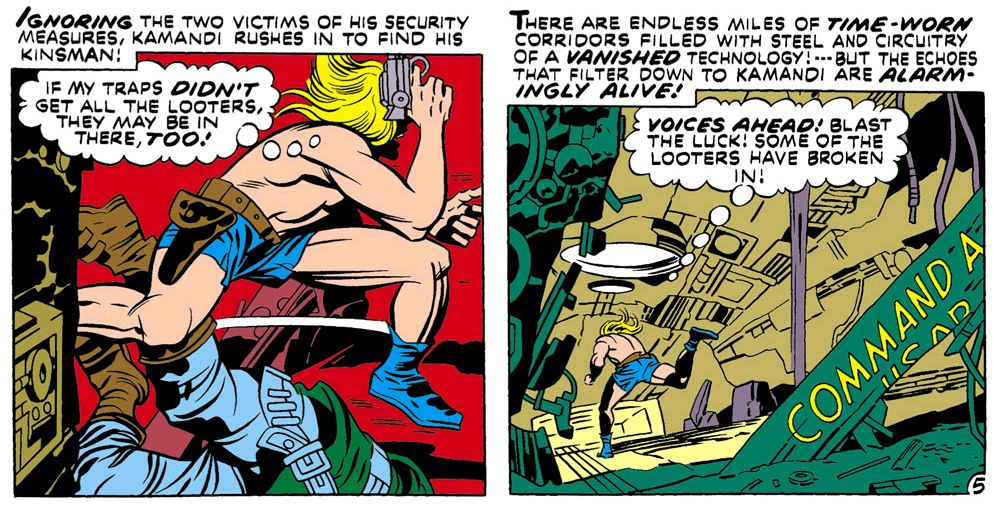
of militaristic nomenclature. We can't be sure which service branch operated the bunker. On the outside, Kirby places what appears to be a United States Air Force insignia, but within we find the partially obscured words "US AR" (or perhaps even "US AP"), which suggests it might have been an army facility.
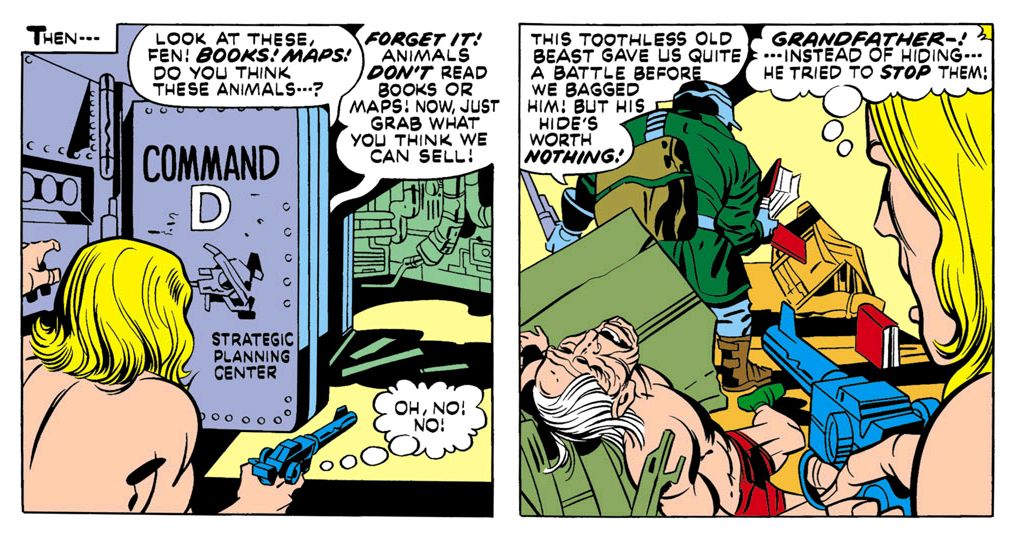
From its alphabetical coding, and thanks to a sequence where Kamandi returns from his initial surface foray to discover his home invaded and runs through them, we know there are other Commands, with A being the closest to the surface; Command D features a door labeling it the "Strategic Planning" section. From whence the great military and scientific brains of the past held forth, no doubt.
Someone from this class realized things were beyond the tipping point and descended into this vast underground complex of heavy safe-like doors where they seem to have kept certain martial traditions and at least a few elements of 20th century (i.e., contemporary) culture and mores. Kamandi possesses a complete body of knowledge from that era and speaks as any mid-1970s teen might (albeit minus period slang, fortunately). As we also see, he's very handy with firearms and skilled in hand-to-hand combat.
But what became of the others who dwelt in the complex? The
inhabitants dwindled and vanished. Other
“last children” might have made journeys like Kamandi’s, only to come to
grief. It’s a dangerous world out there,
post-cataclysm, as Kamandi soon discovers.

