Showing posts with label Kamandi Month. Show all posts

Friday, June 7, 2013

Every month is Kamandi Month: A brief on Ben Boxer

Not long after his capture by Great Caesar's tiger troops in Kamandi #1 (October 1972), Kamandi meets and befriends Dr. Canus, a dog with an advanced degree of some kind and his good pal, the apparently human Ben Boxer.  Except Boxer has to wear an old NASA spacesuit to keep from going Chernobyl and killing thousands.  Kamandi decides beggars can't be choosers when they're looking for people to talk to and tags along with Boxer for an adventure among the rats who scavenge along the outskirts of the Tiger Empire.

Since Kamandi is subtitled "The Last Boy on Earth" rather than "The Last Boy Sidekick on Earth," his relationship with Boxer proves intermittent.  They're always finding themselves separated.  Kind of like Gene Wilder from the train in the movie Silver Streak.  You hope poor Wilder would just stay on the damned thing for once, and that Kamandi and Boxer would stick together for Kamandi's sake because this book is downright scary when he's alone against all kinds of talking animals and weird little rat-things that want to kill him just for having incredible hair.  I can't imagine any of their other adventures topping their second escapade, though.  It reduces Syd Barrett's post-Floyd lyrics to the banality of corporate sales reports by comparison.

Before that happens, Boxer and his companions Steve and Renzi take a powder in Kamandi #4 (March 1973).  They leave our hero to fend for himself (and read old Kirby comics he finds lying around outside Las Vegas) and for the next few issues we follow along as Kamandi finds a new friend in Prince Tuftan, falls in love, loses said love, battles apes, lives through Kirby's take on the classic 1933 film King Kong and then runs into Ben Boxer and buddies again in #8 (August 1973).  This time they take Kamandi along with them to their home and things become epic. Not Internet epic, but truly epic.  Behold:
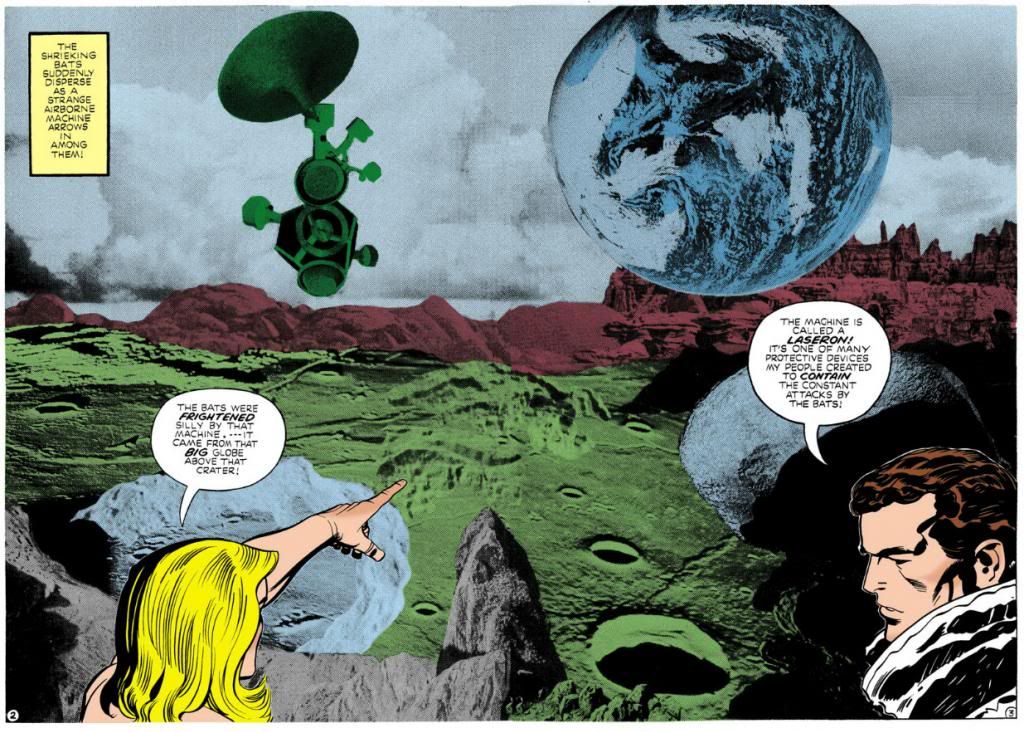

We find out in Kamandi #9 (September 1973) Boxer, Steve and Renzi live in a floating sphere called simply Tracking Site, no definite article.  Like Boxer, Steve's a clean-cut guy who looks like he should be playing first base for the 1961 New York Yankees.  Renzi, however, resembles a refugee from Swingin' London with his Paul McCartney pudding bowl hair and George Harrison beard.  They don't live at Tracking Site alone, however.  They share the immediate neighborhood with a lot of rabid human-sized bats who wear clothes but otherwise appear to be completely feral.  And for some reason there's a freaky little homunculus called the Misfit (he gets a definite article) who rooms there with them, too.

About the Misfit.  His name recalls Flannery O'Connor's short story "A Good Man is Hard to Find," but in appearance and behavior he also seems related in some way to Phillip K. Dick's malignant mutant character Hoppy Harrington in his novel Dr. Bloodmoney, or How We Got Along After the Bomb (1965).  In a flashback from Kamandi #10 (October 1973), we see Boxer, Steve, Renzi and the Misfit (their brother?) as youngsters.  The Misfit lives inside some kind of artificial external womb and begs to be freed.  As an adult, with his stunted arms, his blue skin and stunted limbs hint at some oxygen-deprived gestation period-- but that doesn't explain his fuzzy orange cranium.
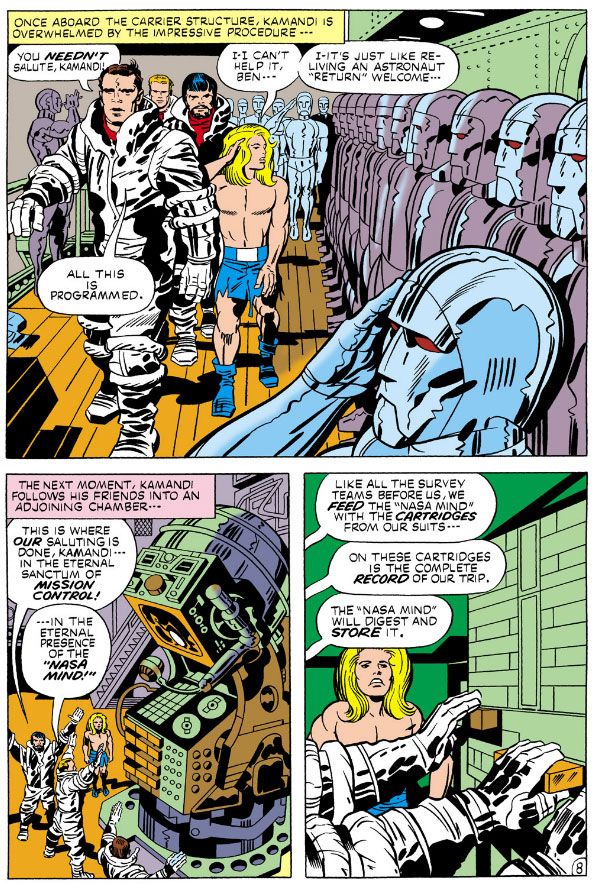

How does one get to Tracking Site?  By balloon.  Tracking Site hangs suspended over a cratered area that once was Central America.  The three amigos travel the world gathering info and plugging it into the NASA Mind, a huge computer charged with collating this data (for reasons Kirby never completely goes into) and they always come back by balloon.  Their return from these each of these missions invariably involves an elaborate recreation of an Apollo-era splashdown, complete with a replica aircraft carrier and an all-robot welcome from the Serviteks, humanoid robots who see to the daily operations of Tracking Site.  It's to honor their NASA ancestors, according to Boxer.
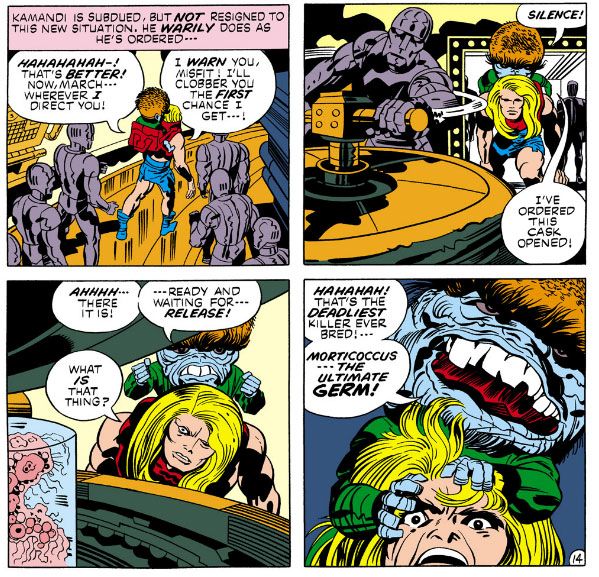
But all is not well at Tracking Site and we see Kamandi has picked the wrong time to visit.  The Misfit has reprogrammed the Serviteks into his personal army and sics them on Kamandi and chums.  He has the most adorable little baby-carrier strapped to Kamandi's neck and hops right in.  At the same time he hectors Kamandi with a sinister monologue and lasciviously paws his captive's luxuriant golden locks.  Obviously, with a name like the Misfit, he was predestined to create problems.  In fact, his plan is to make life not just difficult but literally impossible for everyone on earth by releasing the Morticoccus germ, a huge slimy organism responsible for wiping out all the NASA scientists who once lived at Tracking Site, including Boxer's father.  Then the bats break in and things degenerate into the comic book equivalent of the LSD-fueled (was there ever any other kind?) Hunter S. Thompson road trip to the Mint 400 from Fear and Loathing in Las Vegas.

I wonder if Kirby hadn't meant Boxer, Steve and Renzi for a book of their own and decided to plug them into Kamandi.  You know, just some idea he'd been toying around with before putting it back in the pile of about ten thousand others.  Somehow it caught his attention again one day and he couldn't contain himself.  There's certainly more than enough set-up here for a series, yet Kirby confidently disposes with it in two issues before making up even more wild situations and talking critters.  Think about it-- three radioactive astronauts with technology so advanced it could almost pass for magic.  Plus they can turn themselves into metal.  They live in a floating super-science wonderland and spend their days searching the world for even more knowledge.  That's a solid concept with a lot of story potential.  Of course, Kirby had already done something with at least a passing similarity in New Gods, but with quasi-mythical/sci-fi demi-gods instead of astronauts.  Maybe Kirby felt astronauts were too prosaic to carry their own book even if they do have hearts that emit pure atomic energy.
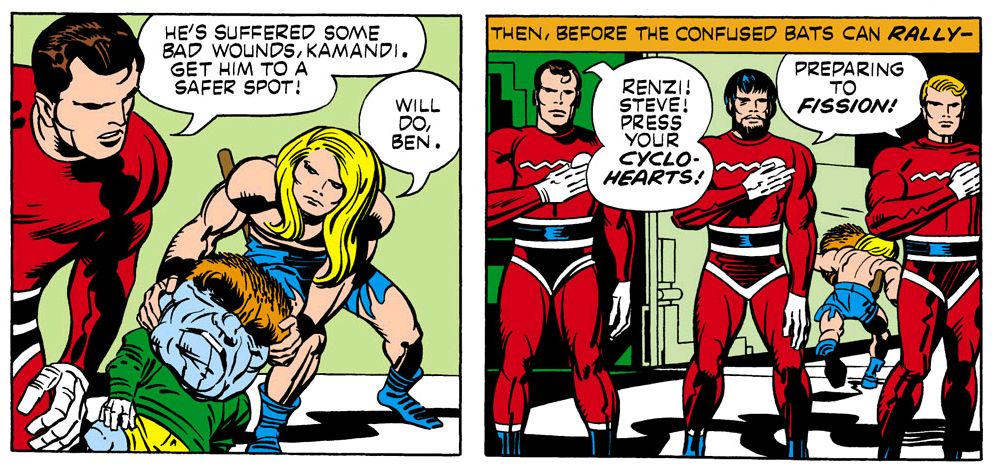

Anyway, with the end of the Morticoccus story, Ben Boxer and Kamandi part ways for a while.  But we haven't seen the last of Boxer.  There's a little matter of Superman's underwear Kirby would have the two of them investigate in a later issue of Kamandi.

Saturday, June 1, 2013

June is also Kamandi Month: Here Come the Tigers

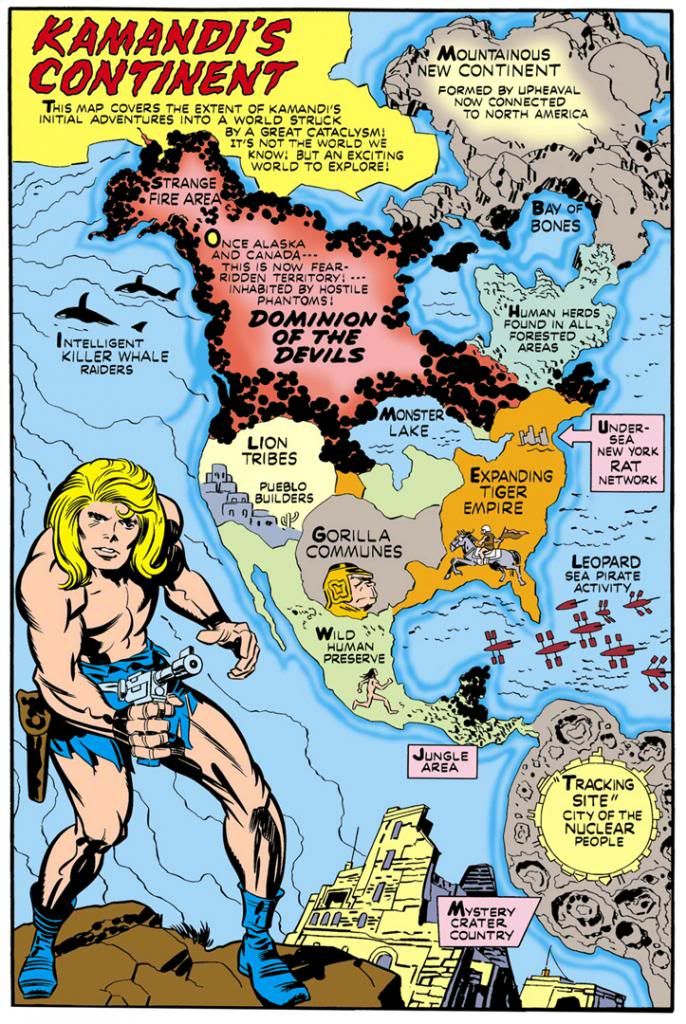
If you'll get out your well-worn copy of Kamandi #1, you'll find a map of the post-Great Disaster western hemisphere, containing all of North and parts of South America.  Oh, here it is.


Pretty different from today, huh?  Now look at the east coast.  Notice how Kirby labels it not just the "Tiger Empire," but the "Expanding Tiger Empire."  Look out, Gorilla Communes!  Lead by the appropriately-named Great Caesar, the tigers aren't content just to consolidate their rule over everything from what was once the New England states to where New Orleans used to be.  They're aggressively expanding, waging war against the leopards and, eventually, the gorillas.  And the gorillas are communists? What gives, Kirby?

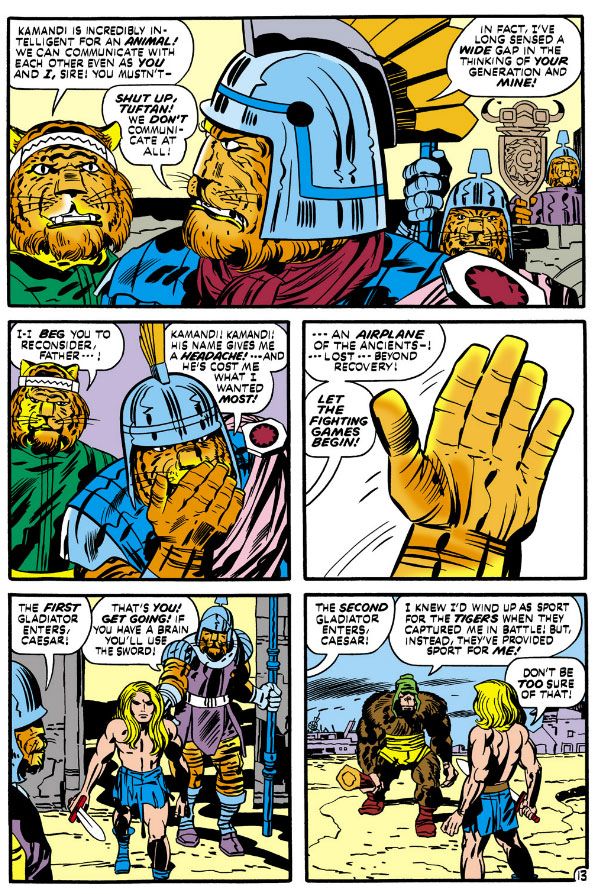
Kirby's feline warriors are all visually striking, but the tigers are the most impressive.  They're clad in Romanesque armor and the first time we see them, they're launching a huge cavalry charge against the leopards.  Their war sweeps Kamandi up in its wake and he ends up a prisoner of Great Caesar, then a pampered pet (for about a page).  Dr. Canus helps our hero and his glorious hair escape.  Great Caesar isn't through with Kamandi by any means.  I don't know about you, but the last thing I want is an entire Tiger Empire on my ass day and night.  I don't think I'd sleep a wink.

Great Caesar has a teenaged son named Prince Tuftan.  Tuftan, like many teenagers of all species, is a burr in his father's fur.  You know, one of the worst things about being a parent is when your kid starts hanging around with the wrong crowd.  My son got involved with certified public accountants, and the next thing my wife and I knew, he'd cut his hair, donned a suit and tie and started going all over the town with his gang auditing company accounts and offering sound financial advice.  Because his father is anti-Kamandi, Tuftan's youthful rebelliousness requires him to become pro.

They meet in the shattered remnants of Las Vegas (in Kamandi #4, March 1973).  It's the 60s-70s Vegas, so feel free to imagine the bones of the Rat Pack lying somewhere in the detritus of the American dream.  Tuftan takes a few pot-shots at Kamandi before they both end up captives of the gorillas.  Kamandi does his best Andy Defresne impression and ends up crawling directly into Tuftan's cell via the ventilation system.  The human seems about to lose his mind, but the young cat appears content to chill.  After a single conversation, Kamandi and Tuftan become good friends.  They still bicker and spar, but when Great Caesar shows up, Kirby shows us those 20th century problems between parents and kids are eternal.


Poor Great Caesar.

Kirby liked to throw generational conflict into his stories.  Remember "The Glory Boat" from New Gods #6 (January 1972)?  Of course you do.  It's only my single favorite issue of that title, so I'm assuming you hold it in similarly high regard.  Lots of father-son angst in that one.  For that matter, how about almost the entirety of the New Gods series?  The generation gap is a major theme, with the sins of the fathers being visited upon the children and all kinds of parental nightmares running throughout all the Fourth World books.  And that includes Superman's Pal Jimmy Olsen.  On covers Jimmy was forever knocking the crap out of the older mentor-figure Superman, usually in the company of a bunch of drop-out culture types.  Hippies, motorcycle gangs, newsboys.  You can find age-based clashes in Fantastic Four and more than likely in at least one or two of those kid gang books Kirby did with Joe Simon.  So it's only natural Kirby would revisit this in a comic starring a teen and give the would-be conqueror Caesar a kid like Tuftan.

This helps give nuance to Kirby's animal characters.  Along with Dr. Canus, Tuftan proves Kamandi isn't going to be a book simply about a lone boy fighting against talking animals.  It's evidence of Kirby's humanism.  Even his exotic furred people are just that-- people.  Recognizable in their complexity, their strengths and frailties.  We can fault his expository dialogue and occasionally corny humor, but there can be no doubt of Kirby as a superior storyteller and observer of human behavior.  I'd argue these elements are often under-appreciated in his work in all the focus on the bombast and other elements that make Kirby so uniquely Kirby.

Tuesday, April 16, 2013

April is Kamandi Month: Who gash? Ugash!

Script/pencils:  Jack Kirby, inks: D. Bruce Berry
(
Kamandi #18, June 1974)
That's Sgt. Ugash to you, ya lousy animal!  Jack Kirby must have had a love for angry tough guys.  I imagine he knew some real life versions of these bombastic characters growing up on the Lower East Side in New York, and he must have encountered more than a few during his wartime army stint.  Look at all the variations on this theme he created or co-created-- Brooklyn, from the Boy Commandos; Scrapper, of the Newsboy Legion; Dum Dum Dugan, one of Sgt. Fury's Howling Commandos; Ben Grimm, the Thing; Detective Dan "Terrible" Turpin, with a death wish in New Gods #5 (later revealed by other sources to be a grown-up Brooklyn, a truly terrible idea and one we'll ignore since we operate under the "If Kirby Didn't Write It, It Never Happened Theory" around these parts).

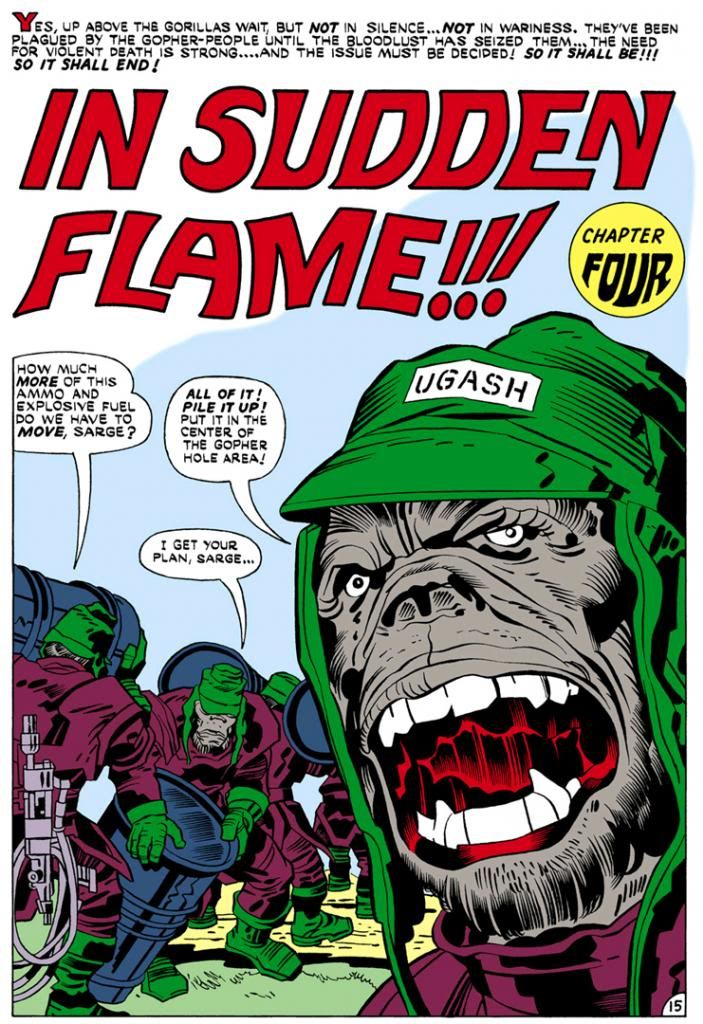
Those are just the ones I know by heart.  You could usually identify these guys by their ubiquitous derby hats or well-chewed cigars, or both.  Or, in the case of Sgt. Ugash, a green cap (with his name printed on it!), purple jumpsuit and lots and lots of hair.

Sgt. Ugash first appears in Kamandi #17 (May 1974) and he's as rambunctious from the get-go as any of those other classic Kirby creations.  He's not only fighting the tiger army, but he's also having trouble keeping his troops supplied because the gopher people keep tunneling up under the ape bivouac and stealing everything they can get their clawed hands on.  Pumping water, bullets and fire into the holes doesn't solve the problem, so Ugash sends Kamandi down like a ferret with bombs strapped to his back.  That rascally Kamandi, of course, turns on Ugash, so the sergeant and his ape soldiers spend the next couple of issues pursuing the Last Boy on Earth, who fights back using a giant worm, the likes of which would make Maud'Dib's mouth water at the thought of riding it against the Harkonnen hordes.  We might consider this some kind of phallic symbolism.  If big apes represent masculinity run amok, then it takes a really big dick to beat a really big ape.

By Kamandi #20 (August 1974), however, Kirby has abandoned the tiger-gorilla war and forced Sgt. Ugash and Kamandi into an unfriendly alliance against the Roaring Twenties-style robots inhabiting Chicagoland.  Some chump years before the Great Disaster decided it would be a hoot to build a theme park based on Chicago's violent Prohibition days and equip the various factions with real bullet-spraying tommy guns.  This theme park-designing asshole must not have watched Westworld; I'm guessing Kirby did, or at least absorbed a little of it from television commercials.

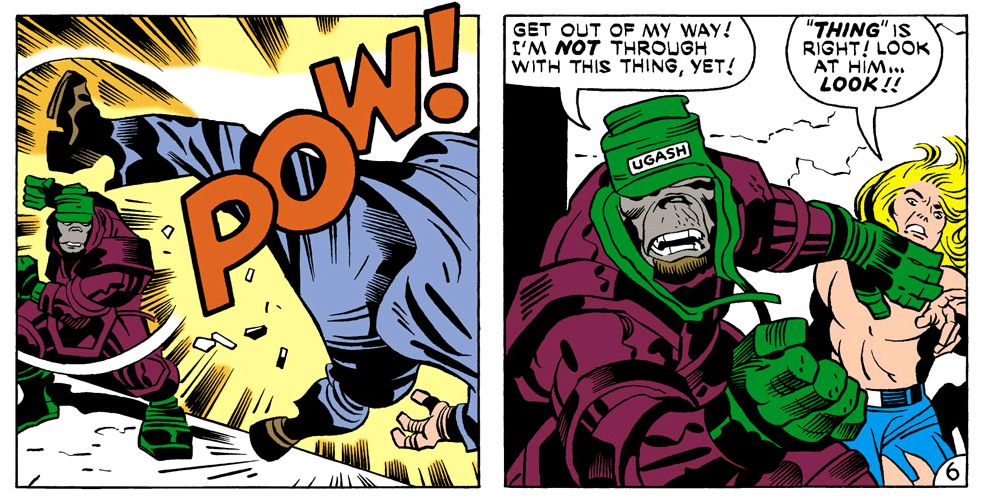
Kamandi #20, "The Electric Chair!!!"  This was my first Kirby comic, my first encounter with Sgt. Ugash.  This single issue of Kamandi came my way and as far as I knew, Ugash co-starred in all the others as well.  As a Planet of the Apes fan, I immediately liked him more than the kid who gave his name to the comic.  Plus, Kamandi reminded me of the filthy hippies we saw on the news, or one of my oldest brother's baseball teammates who sometimes teased me or got drunk at our house and barfed in my bedroom when my parents went away for the weekend.  Throughout the story, Kamandi tries to use reason and puzzle out what's happening, a rational but-- to a child reader-- unsatisfactorily unassertive way of dealing with the situation.  Ugash couldn't care less about the whys of Chicagoland; he simply starts smashing the place.  But for me, Ugash had another thing going for him besides ape-appeal and hands-on approach to problem solving.

Kirby/Berry (Kamandi #20, August 1974)
The pre-programmed robots ram Ugash through a nightmare parody of the US justice system as if he were just another anachronistic hoodlum, and the gorilla's baffled rage at this railroading by mysterious, implacable authority figures who will not listen to reason was an all-too-familiar experience for a lot of us who were about to start elementary school.  Adults and their bizarre ideas and arbitrary rules!  We were already sick of them.  As a comic book reading six-year-old, it made more sense to go down swinging like Ugash.  Ugash got his licks in for all us kids, even though he could never win.

Even then, we understood the futility of those kinds of grand gestures (rebellion in the 1970s meant spankings both at home and at school, or at least the dreaded "writing lines" in the principal's office, which kept us trapped well past the final bell), but what Kamandi did seemed shameful.  In retrospect, it makes a lot more sense--  Kamandi splits.

Sunday, April 14, 2013

April really is Kamandi Month: Sorry for the delay!

Yeah, Kamandi Month has run into its own Great Disaster.  This one is made up of several mini-disasters:  1) the school year just started and I have more classes to teach, 2) my fiancee was ill all last week with a stomach virus and I had to take care of her and 3) I'm working on my own comic (spoiler alert-- it sucks!).  But there will be some Kamandi posts.  Some of them are finished, some are in rough draft form and all are waiting for me to get some of that elusive free time that I feel wouldn't be better spent drawing.  Oh yeah-- and I don't like to post things about Kamandi unless they're illustrated with some cool Jack Kirby art.  That way there's at least one positive thing about each.

I know millions of Kamandi fans are waiting for what I have to say about the series and I hate to disappoint them.  Sorry!

Saturday, April 6, 2013

April is Kamandi Month: On Command D


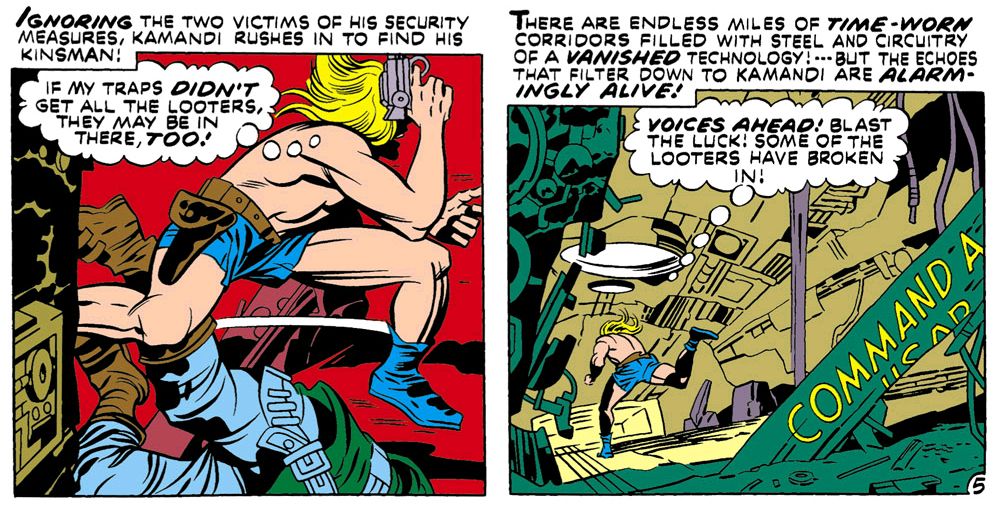
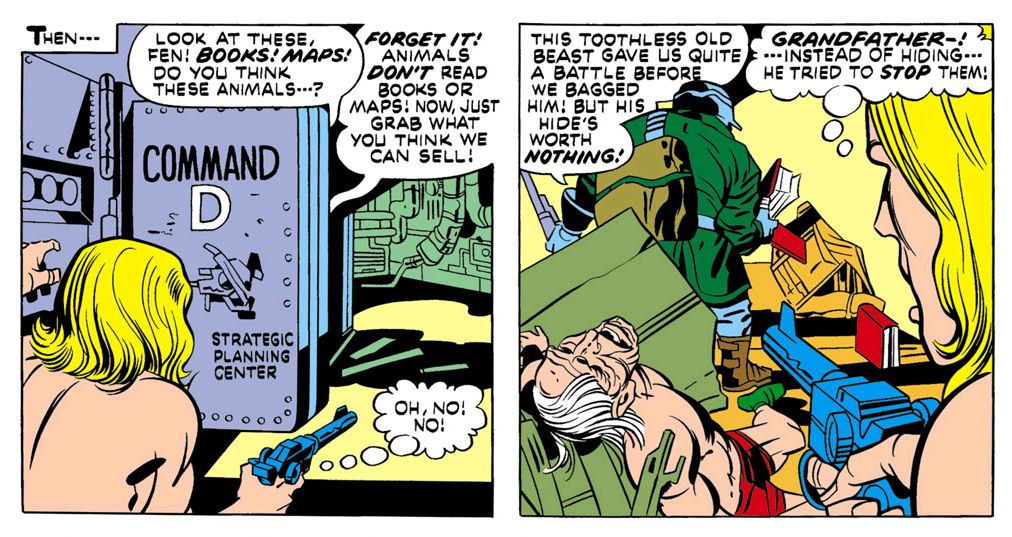
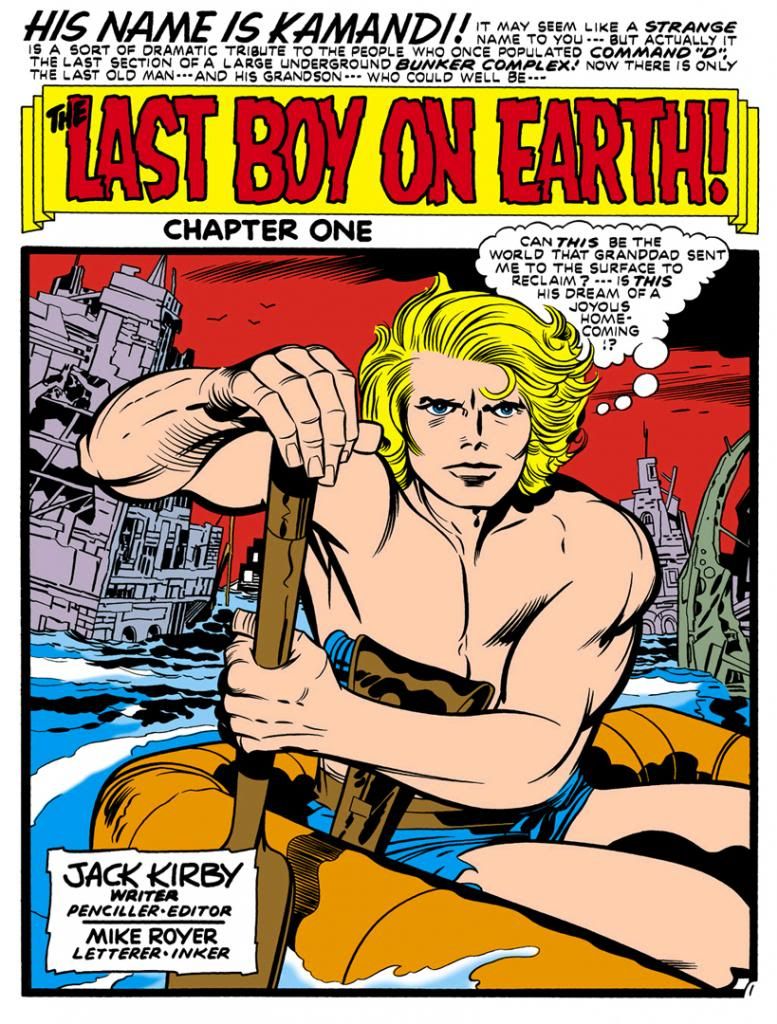
When we speak of “Command D,” what is it we’re talking about?  Specifically, the underground bunker in which Kamandi grew up, raised by a white-haired man he believes to be his grandfather.  Given their relative ages there must have once been younger people in the bunker-- Kamandi’s parents.  Kamandi doesn’t mention them, so it’s likely they died when he was an infant, leaving him in the elderly man's care.  I'm immediately reminded of Pitcairn Island of HMS Bounty fame, when an American whaling ship found John Adams (sole male survivor of the mixed group of English mutineers, Tahitian men and women who sailed into legend) as aged patriarch of a small society there. 


I take writer/artist Jack Kirby at his word when he describes Kamandi as the old man's grandson, at least in terms of the boy's belief they're related.  Kamandi refers to him as Granddad at the story's outset and Grandfather the rest of the way, and while these may simply be culture-based honorifics, the narration calls him Kamandi's grandfather so have no reason to doubt he is biologically rather than simply functionally.  Whatever the true nature of their relationship, someone named the boy after the bunker, either his parents, grandparents, simply the man known as Grandfather, or some other subsequently deceased co-survivor (Kamandi’s dialogue doesn’t hint at such, so that doesn’t seem likely).  Spelling seems not to have mattered, or else this mysterious person or people decided Kamandi seemed more appropriate for a boy's name than Command D.  

The story begins with Kamandi having emerged from his namesake domicile and received massive culture shock— Grandfather with his memory tapes and micofilm has inadvertently acted as an unreliable teacher and has not only failed to prepare Kamandi what he encounters in the post-Cataclysmic world, he also imparted in the boy certain goals that at first glance seem unattainable.  Kamandi has been trained, if not disciplined.  That Grandfather has passed on some mistaken assumptions is to be expected.


Because his knowledge of the story's settings approximates ours, Kamandi acts as our masking agent, and we are meant to identify with him and his solitary plight.  Positing the typical comic book fan who might be attracted to Kamandi:  The Last Boy on Earth as approximately the character’s age and gender, or perhaps younger and able to imaginatively inhabit the protagonist’s role, that is.  So it’s necessary at this point in the story for Kamandi to possess a naiveté so that we might experience the story surprises and twists along with him.  It’s an age-old gambit in fiction (Stephen Crane and Horatio Alger would probably approve) and Kirby, being a born storyteller and a past master of the “kid gang” comic, appropriates it.

Grandfather expects Kamandi singularly to “reclaim” a shattered world for humanity.  Unfortunately, given the ruins Kamandi encounters, the feral and mute nature of the first humans he encounters and the rule of talking animals with their mastery of firearms and motor vehicles and firmly-established feudal kingdoms and small empires, one boy—indeed, the “last boy”—seems to have little chance at re-establishing humanity’s dominance.  And should humanity, the species responsible for the current topsy-turvy nature of the planet, be allowed this second (or third, or fourth) chance?  Might the world be better off, or at least no worse off, in the hands of various tigers, lions and gorillas, all of whom seem to have inherited humanity’s various vanities and prejudices?

Fortunately, in all other aspects, the Grandfather’s tutelage was more than enough, as we’ll see when Kamandi adjusts psychologically to his changed circumstances and shattered belief system.

What is the nature of “Command D?”  Who built it?  At this point in the narrative, Kirby is content to leave us with hints.  This is all set-up.  The point is getting Kamandi out of his comfort zone and to thrust him into adventure so we might experience his world and encounter its mysteries along with him.

For now we may assume Command D to be some sort of military safe-place.  The name suggests so.  Command D.  Kirby, having shaped by his combat experience in the European Theater of Operations during WWII, was familiar with this type of militaristic nomenclature.  We can't be sure which service branch operated the bunker.  On the outside, Kirby places what appears to be a United States Air Force insignia, but within we find the partially obscured words "US AR" (or perhaps even "US AP"), which suggests it might have been an army facility. 
  From its alphabetical coding, and thanks to a sequence where Kamandi returns from his initial surface foray to discover his home invaded and runs through them, we know there are other Commands, with A being the closest to the surface; Command D features a door labeling it the "Strategic Planning" section.  From whence the great military and scientific brains of the past held forth, no doubt.  

Someone from this class realized things were beyond the tipping point and descended into this vast underground complex of heavy safe-like doors where they seem to have kept certain martial traditions and at least a few elements of 20th century (i.e., contemporary) culture and mores.  Kamandi possesses a complete body of knowledge from that era and speaks as any mid-1970s teen might (albeit minus period slang, fortunately).  As we also see, he's very handy with firearms and skilled in hand-to-hand combat.

But what became of the others who dwelt in the complex?  The inhabitants dwindled and vanished.  Other “last children” might have made journeys like Kamandi’s, only to come to grief.  It’s a dangerous world out there, post-cataclysm, as Kamandi soon discovers.

Wednesday, April 3, 2013

Don't Ask: Just Read It! April is Kamandi Month!


There are many things I love and two of the things I love most-- as close friends know-- are Jack Kirby and Planet of the Apes. Sometimes the things I love don't quite fit together, like Kirby layouts and Alex Toth pencils on X-Men #12.  But every so often they combine into a third thing I also end up loving.  So it was when Cornelius met the King.  Kind of.

I've always heard Kamandi resulted when Carmine Infantino asked Kirby to do something like Planet of the Apes.  And no wonder-- the films set off a huge merchandise boom that pre-figured the one for Star Wars-- action figures, playsets, garbage cans, board games, coloring books; everything an Apes-happy kid could want.  So it's easy to see why Infantino would want to put DC in the talking ape business (also, DC has a long history with apes).

Eventually, Marvel landed the Apes license and produced eleven issues of a monthly series and twenty-nine of a black and white magazine.  Neither book drew more than a cultish following, but on another DC-style earth (Earth-K), Infantino worked a deal with 20th Century Fox and Kirby drew the first five or so issues of DC's Planet of the Apes (along the lines of the 2001 adaptation he later produced for Marvel here in our reality) before handing it off to Mark Evanier and a rotating cast of artists.

Go seek out that black hole that's spinning almost at the speed of light.  It'll take you right to this fabulous universe, where Kirby's Fourth World epic went exactly as he'd planned it and his Planet of the Apes ran for 150-odd issues and witnessed the art debuts of both Michael Golden and Frank Miller and an annual written by Alan Moore.  Bring some of those comics back with you, too.  I'd like to read them!

But here in our world, things didn't work out that way.  Denied by 20th Century Fox but stuck on his idea, Infantino cancelled Forever People, ripping a hole in the Fourth World, and then put Kirby to work on a derivative tale of talking apes and the end of the world.

How lucky for us Kirby could never contain himself to mere imitation.  Instead, he took some old concepts he had rattling around and worked them into a post-apocalyptic tale in his own style, with a rambunctious long-haired teen as its lead and more than just talking apes as villains.  In Kamandi's world, not just apes but animals of all kinds talk.  They have little kingdoms of their own and wage interspecies war against each other with Kamandi frequently caught between the furred factions.

Marvel's Apes tales, written by Doug Moench and initially drawn by Mike Ploog, went beyond the meagre budgetary considerations of the movie series and gave us all kinds of weird vistas.  Giant brains floating in tanks, apes acting like 19th century mountain men, an adventure inside Mount Rushmore, bionic apes.  And those crazy city-ships.  Kirby's vision was even more expansive, covering the entirety of North and parts of South America, germs from space, radioactive astronauts, Kamandi as a jockey on the back of a horse-sized grasshopper, the fevered paranoia of Richard Nixon and my favorite-- Chicagoland, a Prohibition-era museum city populated by robots enacting all the classic gangster stereotypes of the era.

While Moench's "Terror on the Planet of the Apes" opus features Jason, one of comics' true assholes, as its human lead, Kirby's book stars a young man billed as "The Last Boy on Earth."  His name comes from the bunker in which he lived with his grandfather, but his looks and personality are made up of purest Kirby.

Actually, Kamandi resembles any number of young dudes who used to terrify me back when I was a kid in the deep south.  I mean, obviously we had modern swimming pools way down there in Georgia, but these guys-- and their girlfriends-- also liked swimming in rivers, lakes and "blue holes," where underground aquifers bubbled up in the form of cold springs.  Or tubing down creeks.  And their swimwear of choice was usually cut-off blue jeans just like the ones Kamandi sports.  Like those guys, Kamandi's a roughneck who takes no guff from anyone.  Not from lion kings, panther princes, or angry ape sergeants.  With his quick temper and shirtless style, Kamandi would fit right in with these Lynyrd Skynyrd-loving southern boys.

He's prettier, though.  Look at his glorious hair, the kind even Farrah Fawcett-Majors would have envied in her Charlie's Angels heyday.

And a heck of a lot smarter.  Kamandi's got brains.  He doesn't just experience his world and fight against it; he searches for answers to all its mysteries.  The "Last Boy on Earth" (as the book's subtitle calls him), Kamandi journeys largely alone through Kirby's madcap future, always on the lookout for others like himself and the ultimate answer to how things got so mixed up in the first place.  Cortexin, huh?

For the next few weeks, we're going to spend some time with Kamandi and really get to know him, his friends and his world.  Come along with me, won't you?  Let's close our eyes, drift into comas for hundreds of years and awaken in the future, after the Great Disaster.  Humanity has abandoned its cities and fled into the forests.  The ascendency of animal-kind has arrived.

Now-- open your eyes.

What do you see?