On his own, Milius has made a number of romantic adventure films laced with a lot of his personal philosophy, which is somewhere to the right of right wing. He's got kind of a sketchy commercial record, but he's never bored me with his movies. At its best, his work achieves a kind of powerful macho poetry and beauty, and I find myself exalted by themes and moments I wouldn't ordinarily celebrate. The Wind and the Lion, Big Wednesday and Rough Riders come to mind.
Sometimes his movies are just sort of silly. Red Dawn.
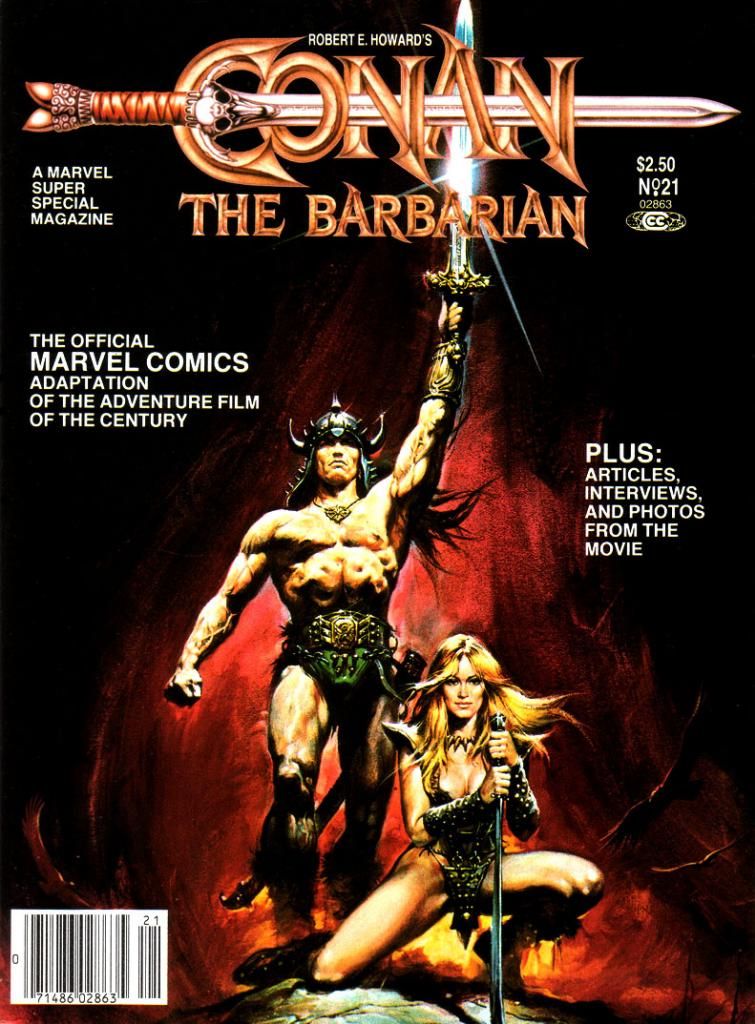
Or poetic and silly at the same time. Which brings us to Conan the Barbarian (Marvel Super Special #21, August 1982).
Other than the rough outlines of its fantasy setting and few names and incidents here and there, this movie has little to do with Robert E. Howard's most famous creation. Milius and co-screenwriter Oliver Stone (yes, THAT Oliver Stone; Milius doesn't seem to let ideology affect his choice in collaborators, which is another reason I respect him) reinvent Conan to suit their revenge story and also because of Arnold Schwarzenegger, in just his second dramatic role (his first being as Hercules in a low-budget comedy with Arnold Stang), didn't have the acting chops to carry the film's narrative. This reduces the title barbarian himself to kind of a passive meathead thoroughly out-charismaed by his partner-in-crime and lover Valeria, played with scene-stealing verve by Sandahl Bergman.
 |
| Script: Michael Fleisher/Story and art: John Buscema |
But Arnold as Conan-- Schwarzenegger, not Stang-- probably contributes the largest portion of the public's perception of the character. Thick accent, not a lot to say, and most of that borrowed from Genghis Khan. The rest more than likely comes from Marvel's comic book series starring Conan, which hews closer to Howard's version without quite getting it right, either. And since Marvel was also in the business of adapting movies, their doing a Conan the Barbarian film comic was inevitable.
Who better to adapt and draw it than John Buscema, the top Conan comic artist of the day? As a geek, I tend to associate Buscema with the character almost as much as I do Robert E. Howard himself. Buscema has Michael Fleisher provide the words for his adaptation, which may or may not have been a smart move. I say this only because I wish we could have read something even more purely Buscema just to experience what his word choices and tone might have been like. Together, Buscema and Fleisher reduce the naked sex and sexy naked parts and expurgate most of the gore to produce a newsstand-ready Conan magazine that's Marvel and Milius at the same time.
 |
| Script: Michael Fleisher/Story and art: John Buscema |
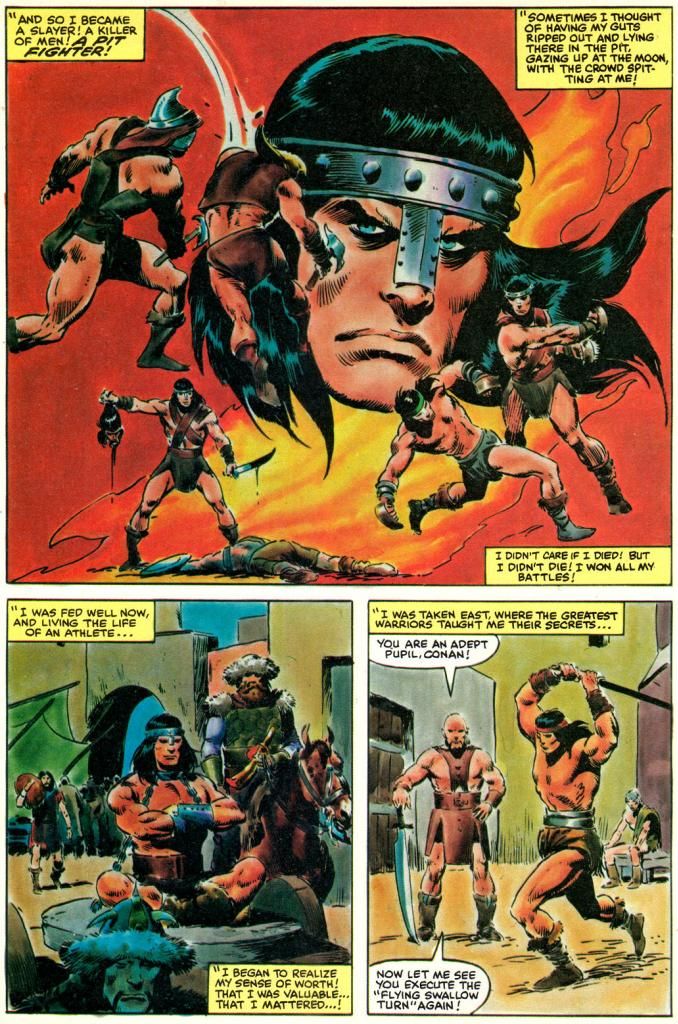
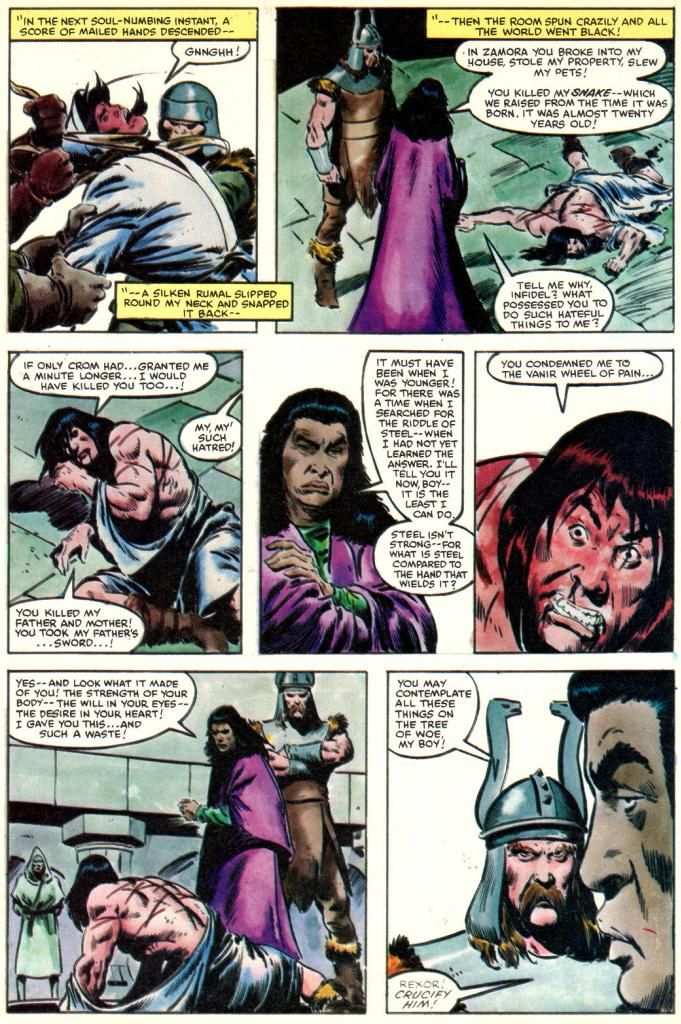
Buscema draws Conan how he was used to drawing him in the Marvel comics rather than try to depict him as Arnold. In fact, Buscema makes no attempt to caricature anyone other than James Earl Jones as villainous Thulsa Doom. And even his Doom is more or less a general likeness, aided by Jones' distinct look as the character.
Doom is a mean guy with a Bettie Page hairdo and a pack of horseback raiders who follow him around in search of money and murder. They slaughter everyone in Conan's village and then Doom hypnotizes Conan's mom and chops off her head. The orphaned Conan spends a number of years pushing a stone wheel around until he's as big as a bodybuilder. Sold as a gladiator, he learns swordplay and Nietschean philosophy while also providing stud services. Freed, he sexes up a werewolf witch, meets pro surfer Gerry Lopez and soon learns Doom has reinvented himself as head of a cult that sells snake-worship franchises throughout the land. Conan also meets Valeria, who doesn't dominate the story in the comic quite as much as she does in the movie. Buscema draws Valeria as the standard Buscema beauty, with thick eyelashes and high cheekbones. Like Bergman, she's statuesque and blond, but that's where the resemblance ends.
And that's really enough. If I wanted the characters to look exactly like the actors, I'd just watch the movie again or look at some photos. I love when an artist does caricatures or likenesses, but it's not always necessary. If likeness is an artist's strength, then he or she should focus on that. If not, then filling the pages with a lot of off-model faces poorly copied from stills and publicity material is simply a distraction. Some can do both, but either way the storytelling is much more important. Things like pacing and clarity of sequence. Vigor. You don't find many storytellers more vigorous than John Buscema in sword-and-sorcery mode.
 |
| Script: Michael Fleisher/Story and art: John Buscema |
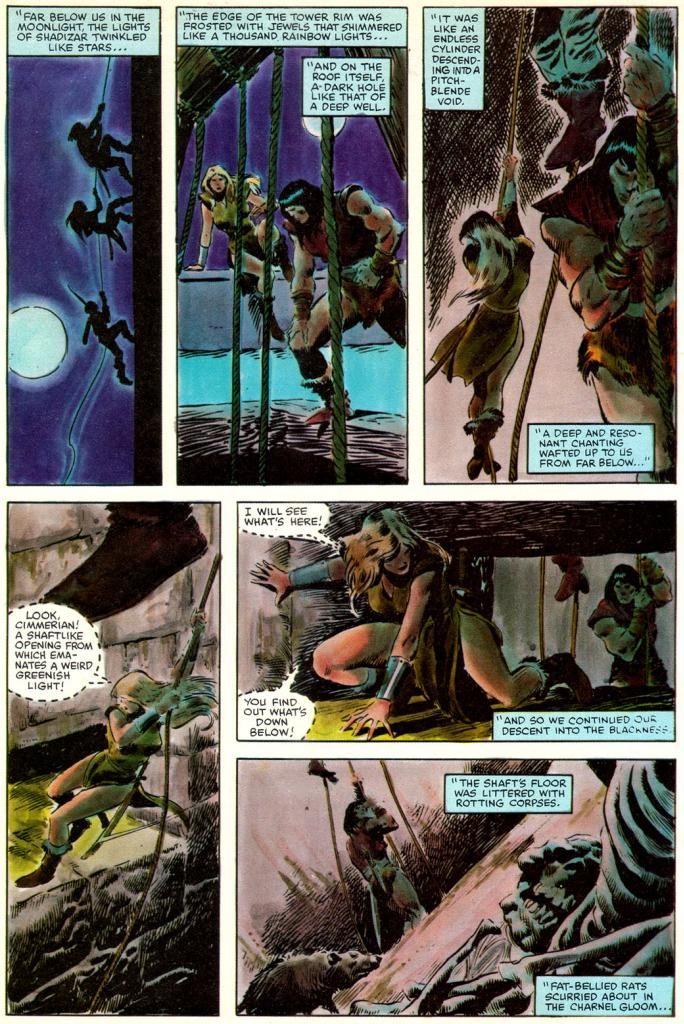
And in contrast with the disappointing Raiders of the Lost Ark, Buscema inks himself this time. He's well within his comfort zone, and, as with Al Williamson on Empire Strikes Back, we've got an artist perfectly matched to the material. Whoever made the decision to return to the painted color style of some of the earlier Super Specials needs singling out for praise, too. D. Pedler (sorry, I don't know who this is, but I wish I did) and the legendary Lynn Varley do a sensational job here, giving Buscema's already gorgeous art a luminous quality, giving each location a rich look full of depth and atmosphere. Snowy woods look cold, the barren wastes look hot and dry. This Super Special is a visual treat with a richness a few of the preceding issues sorely needed. The result? It's classic Buscema Conan guest-starring in the Milius movie
The writing preserves many of the movie's best lines except for my favorite part, which is Conan's prayer, which it truncates to get to more action. Conan's prayer is probably the most bad-ass prayer ever capture on film next to the ones for George Bailey at the beginning of It's a Wonderful Life.
And I must quote the film here:
Crom, I have never prayed to you before. I have no tongue for it. No one, not even you, will remember if we were good men or bad. Why we fought, or why we died. All that matters is that two stood against many. That's what's important! Valor pleases you, Crom... so grant me one request. Grant me revenge! And if you do not listen, then to HELL with you!
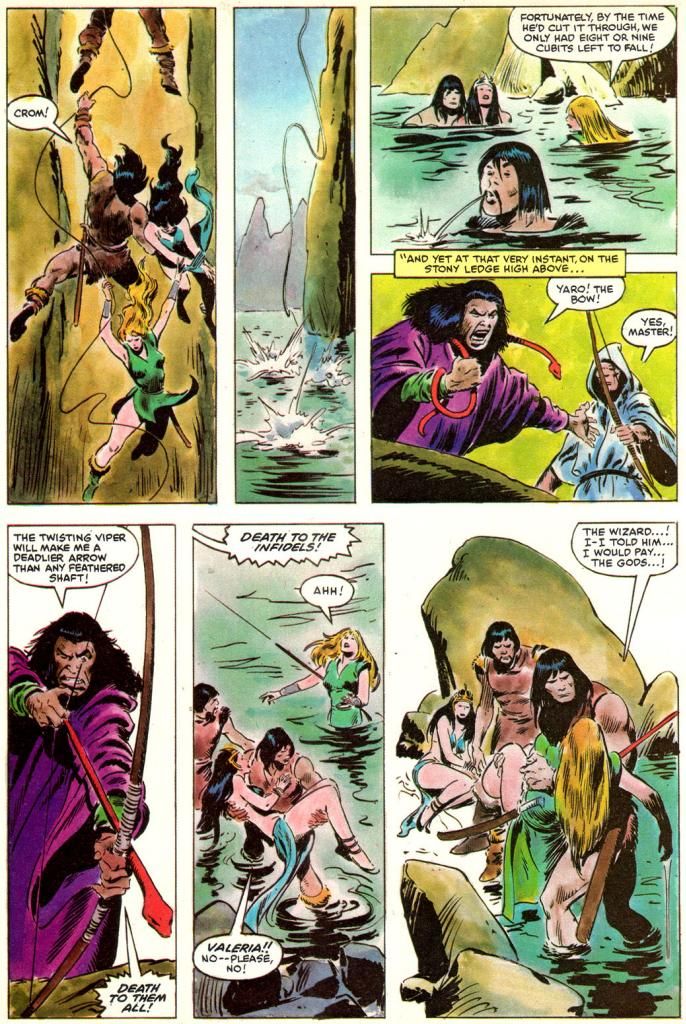
Before we toddle off to Crom's mountain where we'll laugh at the four winds, here's a page with a funny panel a Buscema group I'm in on Facebook hashed over recently. Look at the middle panel of the bottom tier:
 |
| Script: Michael Fleisher/Story and art: John Buscema |
"Valeria! No-- please no!"
Neither Howard's nor Milius' Conans spend half a second begging like that. Where the word balloon arrow points is to the rescued princess, but considering her ungrateful characterization the rest of the way (and the fact she didn't know who the hell Valeria even was) make me believe this is Conan speaking. Hardly the stuff of the guy who tells his own god to grant him revenge or go to hell.
Who gets the blame for this?
Fuck it, Dude. Let's go bowling.