Showing posts with label good art. Show all posts

Wednesday, February 19, 2014

Uncanny X-Men #172 and #173: Bad News Mutants in Breaking Training So They Can Go To Japan... Yet Again!

As anyone who's read this blog knows, I live in Japan and I love American comics with this country as their setting.  Imagine my delight when Comixology delivered up Uncanny X-Men #172 (August 1983) and #173 (September 1983), a couple of thrill-filled Nihon-centric issues originally delivered right to the mailbox of my childhood home and featuring a glimpse of my current home, Marvel-style.

Come to think of it, Uncanny X-Men writer Chris Claremont may be one of the reasons I moved here.  If so, I owe him a huge debt of thanks not just for the entertainment his writing provided me when I was kid about Dani Moonstar's age, but also because here in Japan, I live a life every bit as exciting as Wolverine's.  Okay, not really.  I'm boring.  I've only fought ninja or Yakuza thugs on rare occasions, and only once did I love and have my heart broken by someone as regal and unattainable as Lady Mariko.  I'd love to tell you all about it, but we have important things such as comics to discuss!

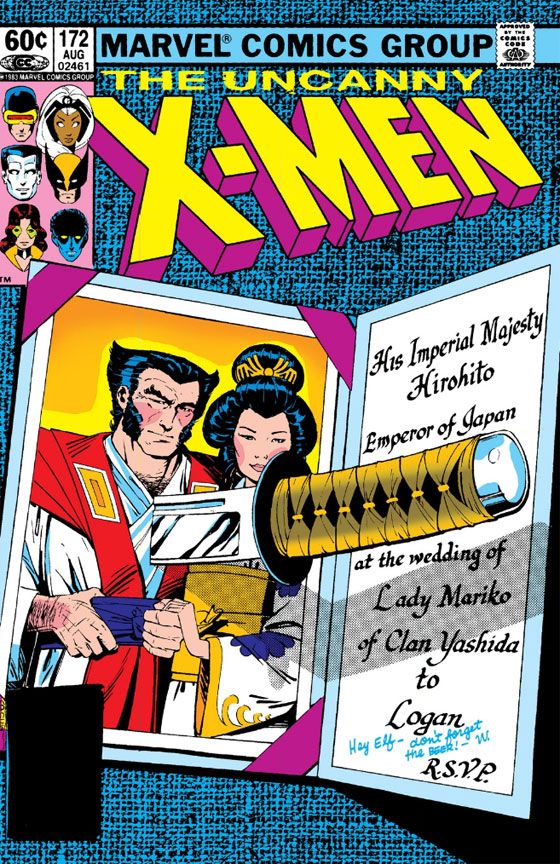
It's been years since I last read these two issues.  I plan to give them my full literary attention someday, but for now we're going to confine our discussion to Smith's images of Japan and bits of narration and dialogue in the pages I chose to illustrate this blog entry.  Just from looking at these very pretty pictures, I can tell this story is a direct sequel to 1982's four-issue Wolverine miniseries by Claremont and Frank Miller.  Wolverine Miller's influence runs all throughout their visuals, so much so the cover to #172 features the invitation Wolverine sent his friends at the end of Wolverine #4.  Paul Smith recreates Miller's original image, and even includes the cute handwritten little note from Wolverine to Nightcrawler about bringing beer.

"His Imperial Majesty Hirohito, Emperor of Japan."  He is now referred to as the Emperor Showa, and if you want to place this book within its era here in Japan it would be the Showa 58, the 58th year of the Showa Era.  Imagine receiving an invite from an emperor!  That is one heavy-duty invitation.  Lady Mariko, Wolverine's fiancĂ©e, is from a powerful family, apparently.  I love the fanciful Miller-designed attire the loving couple wear in the photo, too.

By the way, beer is readily available in Japan and has been for quite some time, so either Wolverine means bring any decent local brand Nightcrawler can pick up at a convenience store on the way to the ceremony or else pack in his suitcase some favored Canadian label he can't get there.

For this story, Claremont and Smith don't waste any time with flights or airports.  They immediately open with a "widescreen" cityscape and tell us it's Tokyo.  Certainly looks like Tokyo to this ex-pat.  Smith appears to have used a high-contrast photo paste-up to create this image, so what we have is a very convincing night view of the huge concrete and steel electrified wonderland we call Tokyo.

Then we zoom in for a closer view to establish exactly where in...
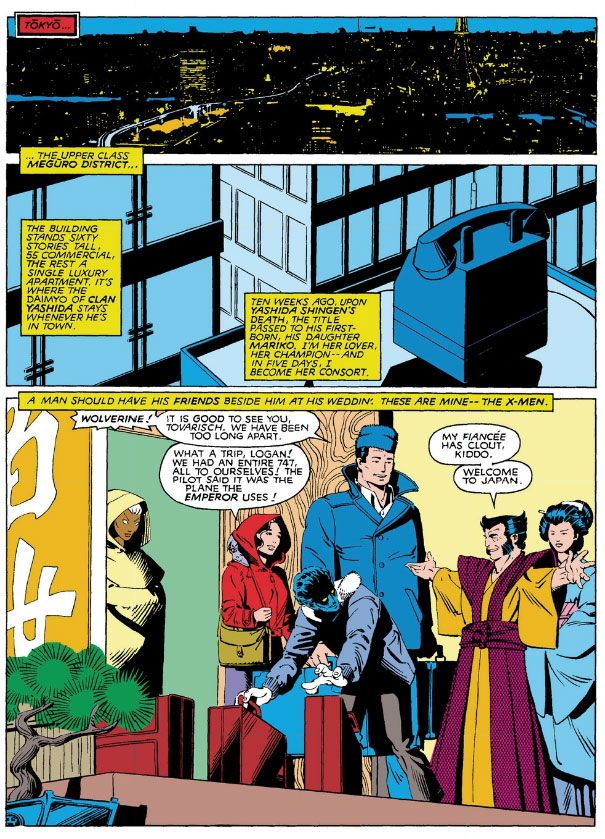
Uncanny X-Men #172 (August 1983), script: Chris Claremont, pencils: Paul Smith, inks: Bob Wiacek


And there it is!  That telephone-topped building again!  Frank Miller used it in Wolverine, Jim Aparo followed suit in Batman and the Outsiders.  Al Milgrom would also draw it in Kitty Pryde and Wolverine, yet another sequel to or continuation of this storyline.  In this issue, we get to see Smith's super-clean rendering of same. 

Was this telephone an actual Tokyo landmark?  I've been researching this online, but either it wasn't so special people have memorialized it or else it's a figment of Miller's imagination.  Even if this is the case, I think a Tokyo building with a big telephone on top is much more plausible than the existence of a Frank Miller movie that doesn't make Ed Wood weep the tears of artistic validation.  Tokyo is the place for all kinds of outdoor advertisement.  I don't know of any building currently topped with an old-fashioned telephone, but I do know of one topped with what the locals refer to as the "Golden Shit."  It's supposed to be a droplet of beer.  I have to agree with its more scatological nickname.

Anyway, you know you're in 1980s comic book Tokyo if you see the giant telephone.  You know you're in today's real Tokyo if you see a big, gilded turd.

Meguro, as Claremont informs us here, in the voice of his character Wolverine, is indeed an upper class district.  Celebrities and the like live there in expensive high-rise apartments.  It's just the place Mariko's family, the Yashidas, might maintain in Tokyo for their visits there.

Since this is an adventure comic, most of the outdoor scenes take place on the rooftops of those apartments, at night.  That's where the ninja sneak around so they can disrupt wedding plans when they take a notion to do so.  Wolverine and his pal Nightcrawler are pretty good at sneaking around up there, too.  As is Wolverine's erstwhile lover, the thrill-crazed Yukio.

Well, kind of...
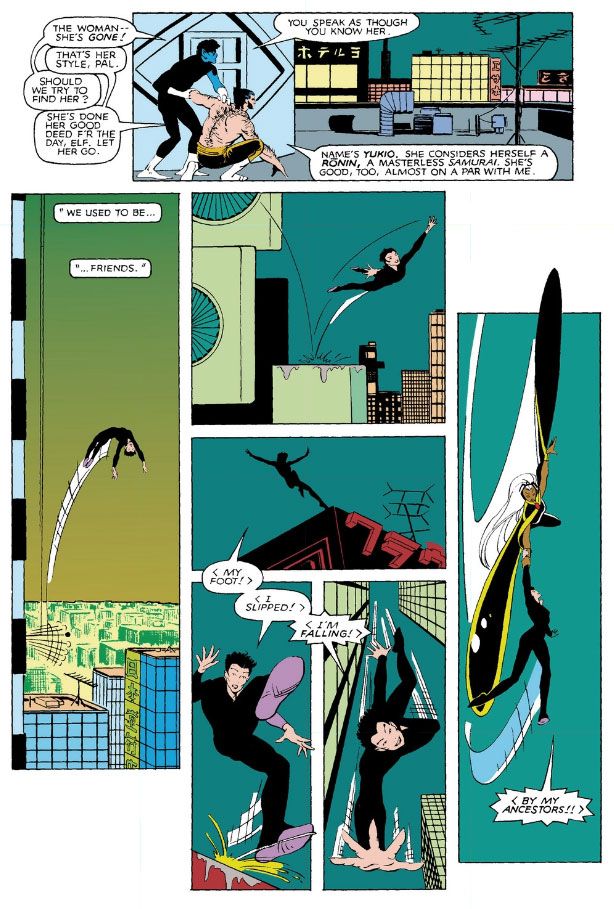
Uncanny X-Men #172, Claremont, Smith, Wiacek


"I slipped!"  That would have been a pretty stupid way for Yukio to die, huh?  Lucky for her, Storm was out flying around.

As you can see from this page, Smith constructs his buildings very simply.  Even so, he and inker Bob Wiacek toss enough katakana or hiragana up and down their sides to make things convincing.  His kimono-clad women are the real visual draw in this story.  There's something about the Smith-Wiacek clean-line look, with things pared down to sleek minimalism that goes well with traditional Japanese clothing.  It also helps that Smith and Wiacek draw amazingly beautiful women.  Unfortunately, they also tend to draw them so they resemble each other, except for Yukio and her punk-rock hair.  Smith and Wiacek give her a face with more sharply defined cheekbones and it individualizes her.
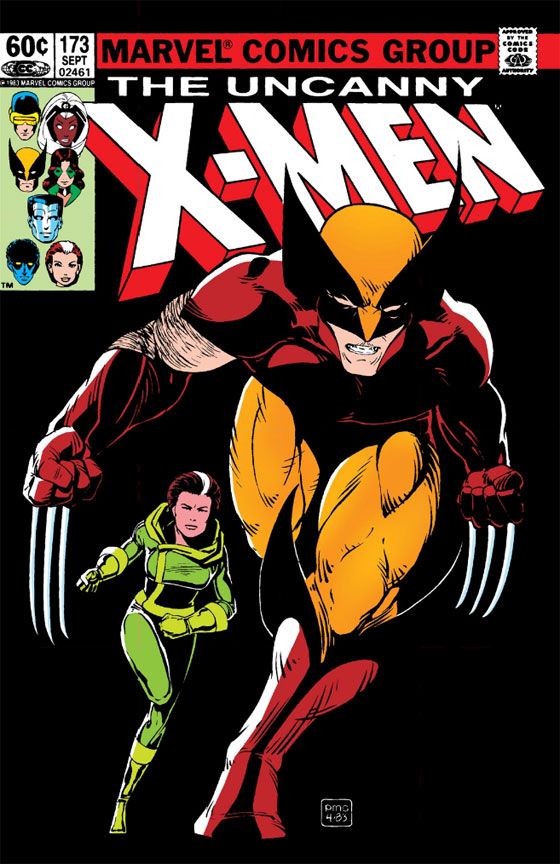
The fun extends to the next issue where Wolverine reluctantly teams up with new team member Rogue to fight the villains.  As I've said, I haven't re-read these in detail, so all I know about the plot is the Silver Samurai and Viper want to stop Lady Mariko from marrying Wolverine.  And Storm debuts her Mohawk after hanging out with Yukio.  No doubt spending any amount of time with someone as uninhibited as Yukio would inspire you to drastic style changes.  We'll get into all of this in the future, but for now you don't really need to know the specifics to enjoy our Claremont-Smith travelogue.

Uncanny X-Men #173, the story starts in "the Ginza."  Claremont has Wolverine tell us guide books recommend "the Ginza" for a "good time."  Wolverine's idea of a good time is getting drunk and into a bar fight.  So that's where we find him. 

I really think Wolverine has read the wrong guide books, because Ginza (minus the definite article) is more a shopping area.  And not just any shopping area.  Ginza is where the rich go to drop the big money on Rolex watches, Chanel and Louis Vuitton couture and bags and other luxury goods, many of which cost more each than I make in a month.  There may have been dive bars there in the 1980s.  There may be now.  But I doubt it.  I rather think Wolverine's destination of choice would be the wilder, woolier environs of Golden Gai in Shinjuku's Kabuki-cho neighborhood.

That's where I went when I wanted to pretend to be Wolverine and act all tough.  Whenever I told people I hung out in Kabuki-cho, they'd smile and shake their heads and tell me, "Don't go there!  It's dangerous!"  Dangerous to the tune of the thousands of yen you blow in the kinds of bars Wolverine would more than likely spend his nights. 

No one has ever said anything like that to me about Ginza.  They just told me to go to this famous chocolate shop, which I could never find the one time I tried, way back in 2008.  I did find a toney toy store selling Indiana Jones and the Kingdom of the Crystal Skull actions figures, the ones with amblyopia.  Some Wolverine, huh?

If you take a closer look at that first vertical panel, notice how Smith includes a puddle in the gutter.  Nice work on the reflections there.  It rains a lot in Japan, so that's a little detail that goes a long way to establishing the setting's bona fides as well.  That image has an impressive sense of place.  That's the Tokyo I've seen with my own eyes.
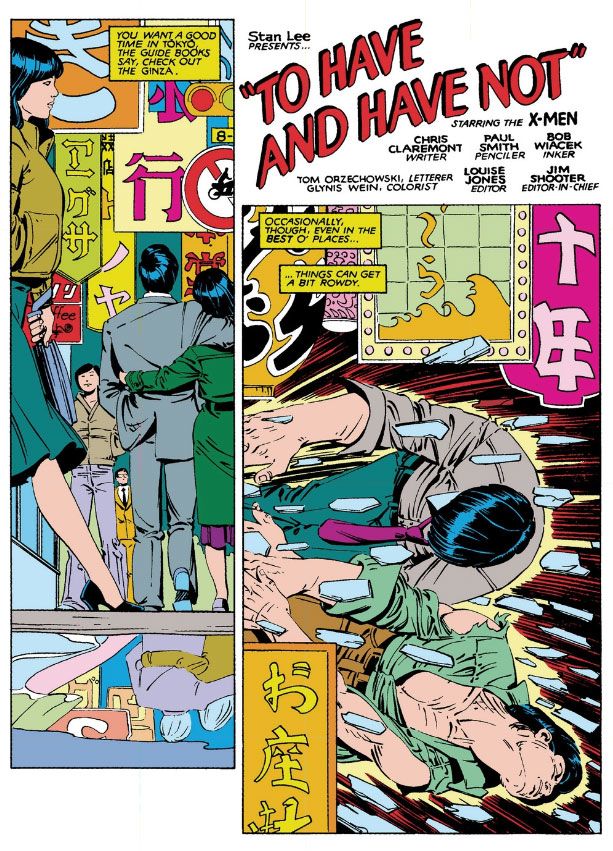
Uncanny X-Men #173 (September 1983), Claremont, Smith, Wiacek


I'm not too certain about those guys Wolverine's launched through the window.  He does a lot of stuff like that whenever he's in Japan.  Things like this may or may not happen here.  I have a feeling if a foreigner started tossing locals through bar windows, we'd hear about it on the NHK news.  Even more so in the early 80s when we were a rarer breed.  If I had to guess, I'd say this is a more likely to happen in Okinawa where the US military always seems to be stirring things up and causing trouble.  But then, as I've already proven, I'm not Wolverine. 

The worst incident I've ever been involved with was having a guy repeatedly scream, "Pearl Harbor say 'Fuck you!'" at our little drinking group until the bar-owner kicked us out for causing trouble.  I don't blame her.  He was a regular and we were just passing through.  I still wonder what set him off, though.  He approached us in what we thought was a friendly way.  We made small talk in Japanese and tried to use the little abdomen exercise wheel when he asked.  Maybe he felt patronized, or someone said something to offend him when I wasn't paying attention to the conversation.  Perhaps he just hated whitey.  I still don't know what was in his heart.  But I do know he was drunk.

You might read worse stories from other ex-pats here and there around Japan.  Some people attract negativity and bad scenes.  I suppose I've been very lucky in all my years here.  Despite the occasional run-in with Sunfire, mine has been a smooth, laid-back kind of life.  But once again, I don't have adamantium-coated bones or a mutant healing factor.

Marvel Japan is a pretty fun place to visit, isn't it?

Monday, February 17, 2014

Uncanny X-Men #168 (April 1983): My first subscription comic!

Did you ever love a comic so much you subscribed to it?  Sure, people have "pull lists" these days.  We had those back in the antediluvian days of comic book fandom, too.  I mean, my antediluvian days, which were the early 1980s.  I had a pull list at two different comic book shops, but both of them went out of business fast.  There were not enough people like me to support them in our small southern town.  So to primitive me, subscribing to a comic for a year and getting issues in the mail was the sign of true love.  Like offering a sweater or a ring to that special someone.  My special someone was Uncanny X-Men.  And Uncanny X-Men #168 (April 1983) was the first issue that came straight from Marvel to my mailbox.  What a day that was!  I was always the first person home, so my responsibilities included running out and checking the mail.  And there was a brown wrapper with a battle-damaged Kitty Pryde inside.
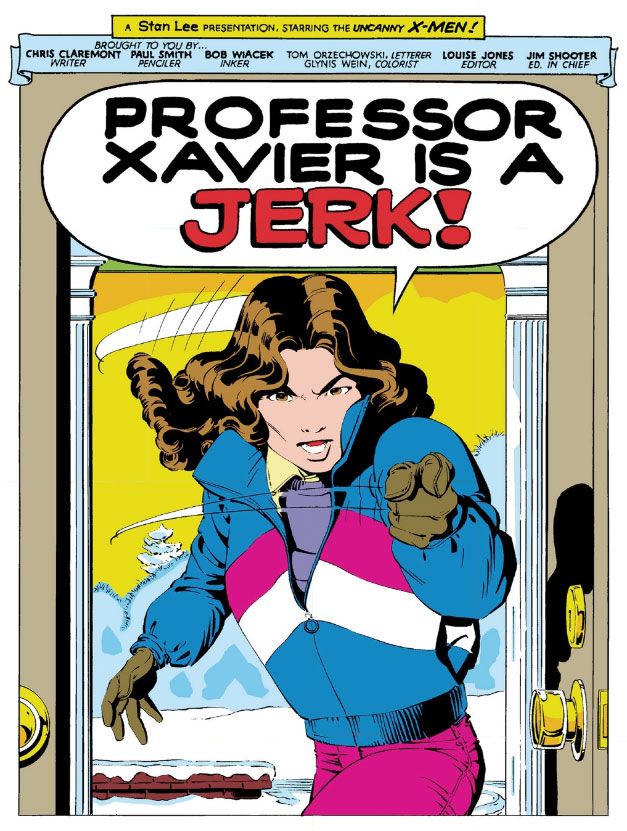
"PROFESSOR XAVIER IS A JERK!" Kitty exclaims in the splash panel, pointing accusingly back at the readers as if we don't believe her. 

I remember this as a shocking moment, a new, upstart character badmouthing an old school stalwart.  Apparently, others felt the same about it because Joss Whedon and John Cassaday would recreate it as a Kitty memory when she returns to the mansion during the first moments of their initial Astonishing X-Men story arc.  What had Xavier done to piss off Kitty?  He refused to let her be an X-Man because it was too dangerous.  To add insult to injury, he also forced her to join the New Mutants trainee team, which is like being demoted from the Majors to low A ball in the middle of the season.

Uncanny X-Men #168 (April 1983), Script: Chris Claremont, Pencils: Paul Smith, Inks: Bob Wiacek

Kitty does her best to prove Xavier wrong throughout the issue, but at first, her attitude is pretty much what you'd expect from a disappointed fourteen year old.  She flips.  Her calmer, cooler friend Illyana immediately calls her out for acting like the child Xavier already thinks she is.  And Illyana should be the one to show maturity.  She and Kitty are roughly the same age, but Illyana is also the demon queen of the Limbo dimension.  Being a demon queen gives one a more advanced perspective. 

Ah, the art!  There is some excellent acting throughout this book and it's all just so clean, so slick, so easy on the eyes.  Paul Smith took over Uncanny X-Men after Dave Cockrum left the book for a second time to write and draw his own property, The Futurians. While I really dug his return, Smith immediately piqued my interest with his ultra-sleek linear style.  With Bob Wiacek finishes, practically everything in the book seems made of polished metal.  Okay, I'm exaggerating, but Kitty's hair certainly has a metallic look.  And good portions of the story take place in the X-Mansion's lower levels where the walls actually are polished metal.  The Smith-Wiacek team is my third art team on this book and the last to capture my imagination.  I copied their Kitty-hair and style of drawing noses for months, but the Smith-Wiacek Storm is the character at her most goddess-like.  Absolutely beautiful.  Then they gave her a Mohawk.

Dubious fashion choices aside, the father-daughter dynamic Chris Claremont works in this issue is a lot of fun.  Professor Xavier has the dad role, of course, and Kitty is the typical teen who wants to prove to her parents she's grown up enough to make her own choices about risk taking.  For most of Kitty's contemporaries, this would mean going un-chaperoned to a Duran Duran or Michael Jackson concert.  Everyone else is going!  Why can't I?  Since Illyana is apparently Kitty's only age-appropriate friend and the rest of the people she hangs out with rarely attend pop concerts but instead have superpowers and enjoy dressing in colorful leotards to launch into space and fight insectoids, that's what she wants to do.

After she realizes throwing a tantrum isn't going to help, Kitty calms down and puts her intellect to work on the problem.  She tries various strategies to change the Professor's mind, from whipping him at chess while explaining her considerable advantages to shouting to shameless brown-nosing.  The progression Claremont presents is just so believable.  Who hasn't tried each of these with parents?

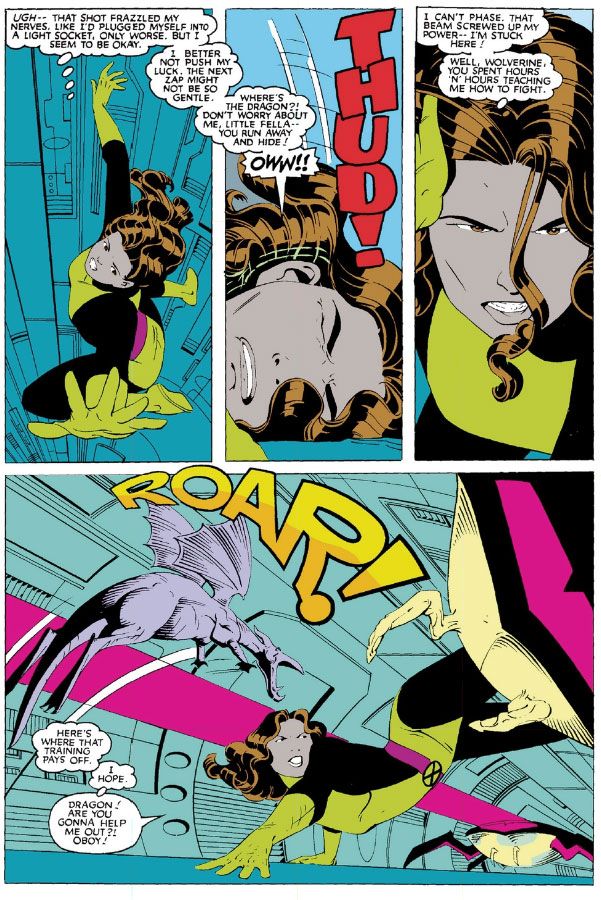
Then, unlike those of us who never got to see the Go-Gos or the Replacements until we were out of the house and in college, Kitty gets lucky, because some space cockroaches who shoot magenta ray beams from their eyes have infiltrated the mansion's creepy-crawly basement.  This is all very reminiscent of the time Kitty faced off against a N'Garai demon by herself, but provides another, very convenient way for Kitty to present her case.  And out of all the things Kitty's tried, it's the most effective, because she gets to showcase a number of her intrinsic capabilities and all those extra things she's learned so far from people like Xavier, Cyclops, Storm and even Wolverine.  Yeah, as if Wolverine knows anything about fighting.

Claremont, Smith, Wiacek

And that brings us back to the cover, because fighting these bugs is how Kitty ended up in the bruised, ripped and still defiant pose I first saw after slipping the comic out of the wrapper.  Colossus turns up just in time to save our gutsy Kitty, but she's finally made her point.  Professor X puts her back on the team, with a probationary proviso which Kitty sensibly agrees to.  She also gets a pet dragon, which is like the ultimate wish fulfillment fantasy.  Imagine for a moment what it's like to be Kitty Pryde.  You're young, you're a genius, you're spunky and heroic, you've got hair so shiny people in shampoo commercials turn weepy with envy, you get your fondest wish... and you get to have the coolest pet ever.

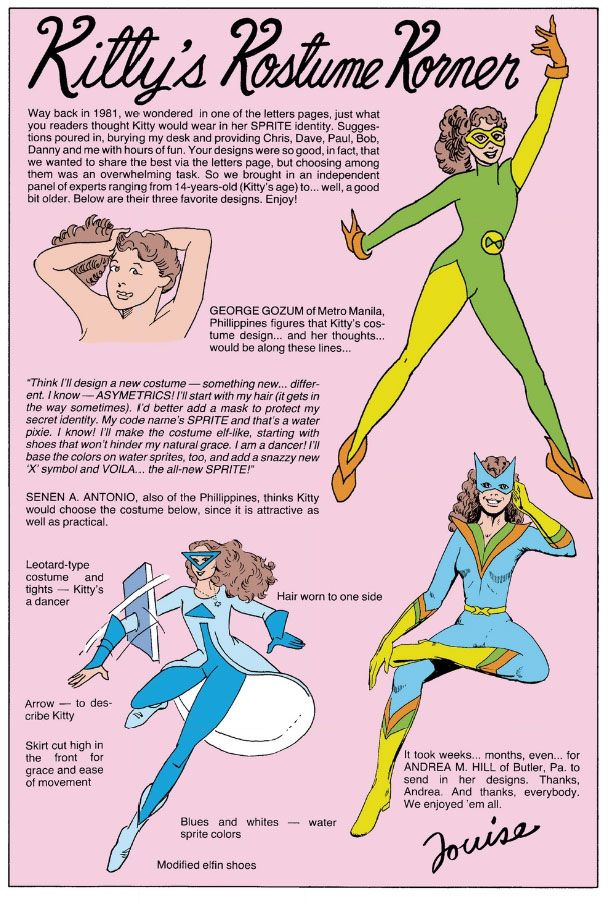
As an added bonus, you also get your own fan page:

Uncanny X-Men #168 (April 1983):  Alliteration sometimes leads to adverse accidental acronyms


Nobody did all that for me when I was 14!  Oh well, shoot, after all that, she deserves it.

Sunday, December 29, 2013

Uncanny X-Men #118 (February 1979): Bad New Mutants Go To Japan!

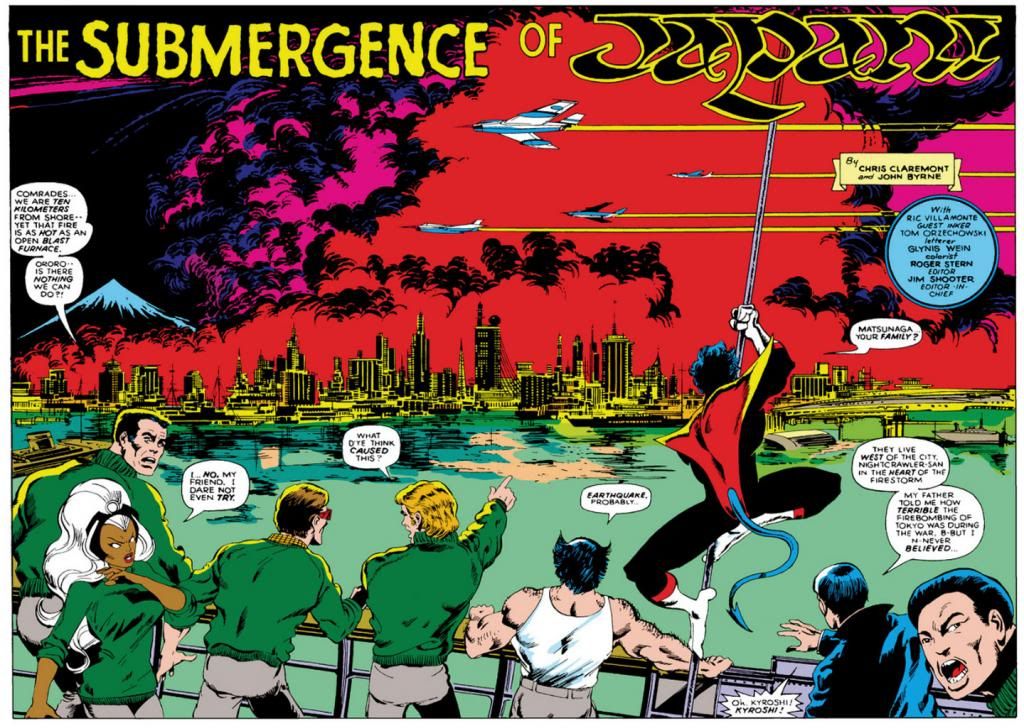
Script: Chris Claremont; Art:  John Byrne and Ric Villamonte

Enjoy this spectacular double-page spread from Uncanny X-Men #118 (February 1979), pencilled by John Byrne and inked by Ric Villamonte.  Maybe Terry Austin was off that month.  Agarashima, the city on fire here, is completely fictional but the visible architecture in Byrne's rendition is plausible enough.

Except for Mt. Fuji in the background.  An online source tells me Agarashima is in Miyagi prefecture, which is way up north along the eastern coast of Honshu.  Actually, that same source reports the city to be "300 kilometers north of Tokyo" and misspells the prefectural name as  "Miyago."  This may be a fictionalized flourish on Chris Claremont's part, freeing him to use his imagination and create a fanciful Marvelized Japan.

Fake Miyago or very real Miyagi, it's a likely location for a medium-sized port city, which is what Agarashima appears to be here.  Mt. Fuji is much farther west, so there's no way if this city resides 300 kilometers north of Tokyo you would see it looming that large in the background because it would be about 500 kilometers away.  I live in a city in the same prefecture as Mt. Fuji, about 116 kilometers away, and even when we can see it from here (it's visible from several vantage points on clear winter days when it's wearing its snow cap), it's only about the same size as my thumb.  So this is more than likely a little artistic license on Byrne's part as well.  We just need some cherry blossoms blown out to sea by the conflagration to achieve perfection.

So, with all that in mind (or better yet, out of it), let's just admire this glorious drawing, huh?  Unfortunately, after this image, there's not a lot of travelogue imagery in this story.  Much smaller panels, and a lot of the action confined to interiors.  By the next issue, the X-Men are on a volcanic island off the coast where they fight a pissed-off nutjob named Moses Magnum, who wants to sink Japan, so we're denied more John Byrne-drawn vistas of late 1970s Japan.  Think what he might have done with Tokyo.  I would love to have seen it.

You know, not on fire.

Wednesday, December 25, 2013

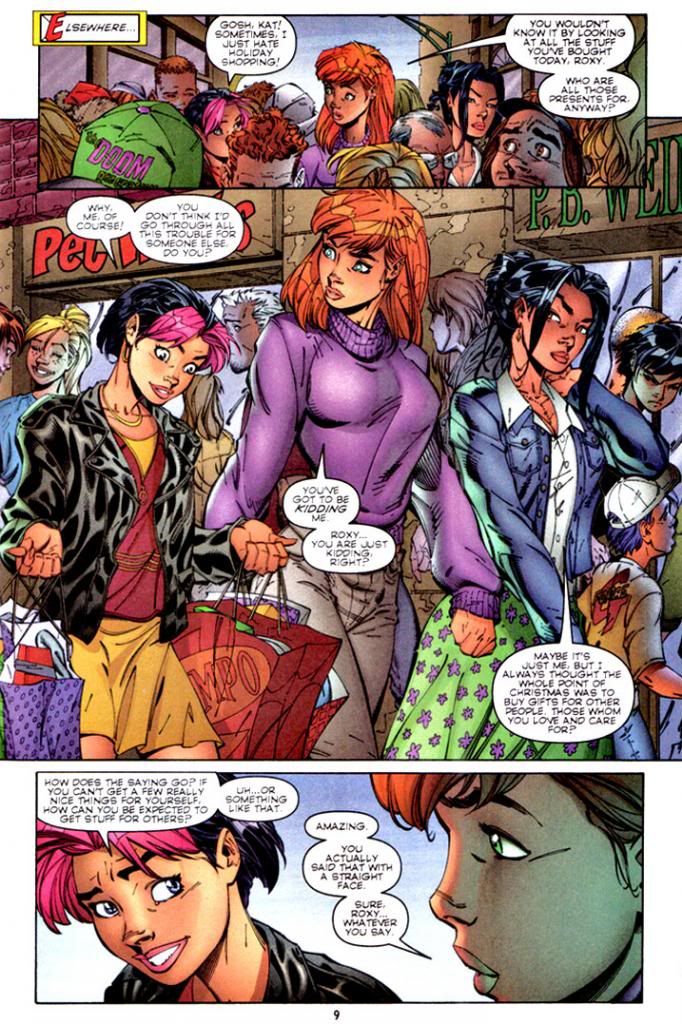
The Roxy "Freefall" Spaulding philosophy of holiday getting...

Gen13 #16; words by Brandon Choi, J. Scott Campbell and Jim Lee; art by Campbell and Alex Garner with Tim Townsend and Tom McWeeney; colors by Joe Chiodo


Season's greetings!  Actually, when I suddenly remembered this moment existed, I was hoping it was within the context more of a holiday-themed Gen13 I could toss at you, but this is the only part of the story in Gen13 #16-17 (January-February 1997) that directly references Christmas.  The rest involves the Roxy, Caitlin and Sarah being captured by a fellow "Gen-active," a genius toy company magnate who happens to look and dress like Max from Where the Wild Things Are and will never grow up.  So he can mate with them.  I'd... uh... forgotten that part.

No, Roxy does not learn a seasonal lesson about how it's wrong to be selfish or that it's the "thought that counts."  She doesn't find out what life would have been like for her friends if she'd never been born.  She doesn't fly off to the North Pole to save Christmas by rescuing jolly ol' St. Nick from his evil twin brother.  She doesn't help recover a small town's presents from the anti-Christmas troglodyte who lives just north of there on the top of a mountain with his put-upon animal companion.

She learns she doesn't like wearing teddies.

Monday, December 23, 2013

New Mutants Winter Holiday Extravaganza starring Dani Moonstar!

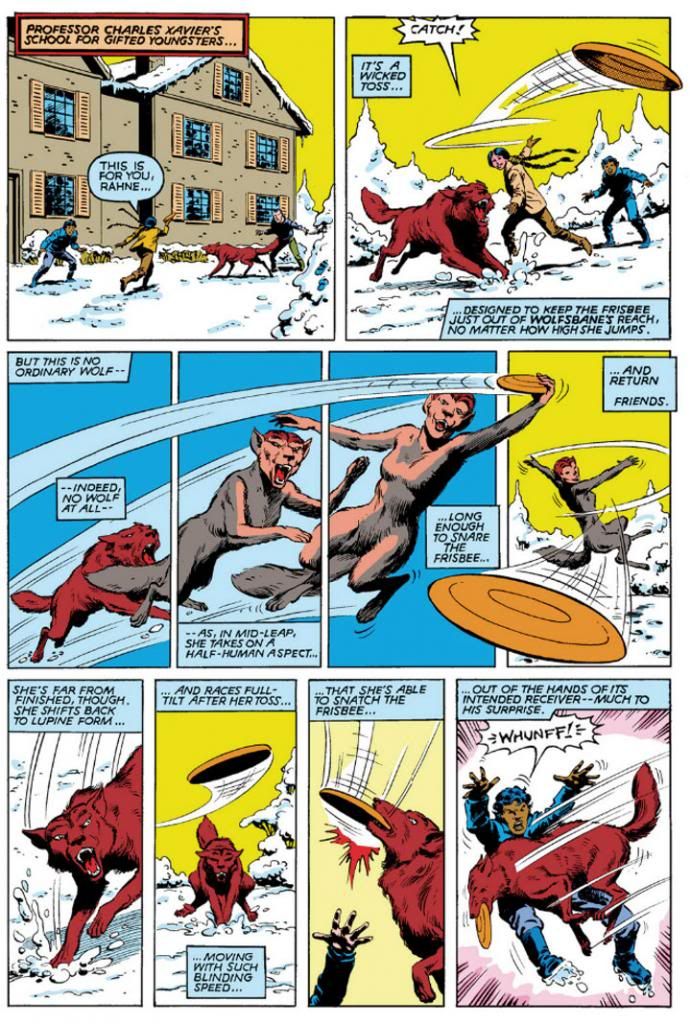
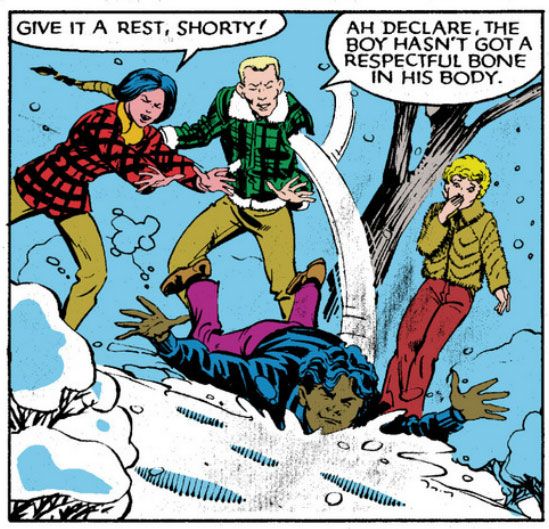
If there's anything the New Mutants love more than ostracizing Kitty Pryde or cuddling up together on the sofa with some popcorn to watch Magnum, P.I., it's enjoying seasonal hijinks in the snow.  Let's take a moment to share a few holiday memories with Dani, Sam, Roberto, Rahne, Xi'an and all the rest.

The snow love starts as early as New Mutants #4:

New Mutants #4 (June 1983); words: Chris Claremont; art: Sal Buscema and Bob McLeod

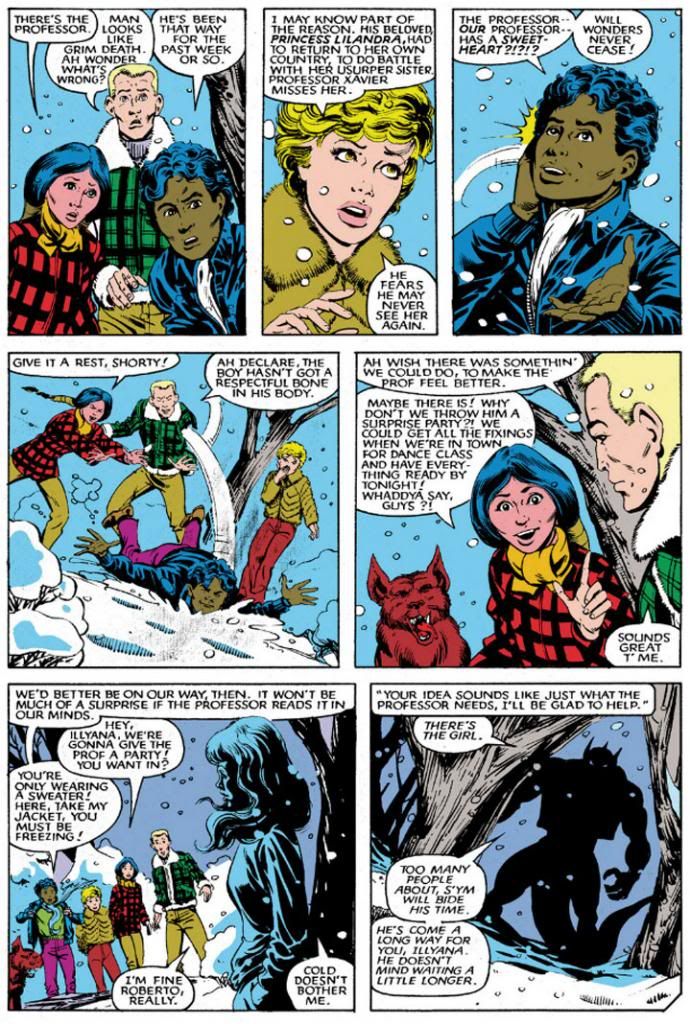
These sequences are useful for showcasing each kid's powers or personality, and for comedic relief.  Outdoor frolicking later helps the team quickly recover from the apparent death of leader Xi'an Coy Manh and welcome new additions Amara Juliana Olivians Aquilla and Illyana Rasputin to the team roster.  Amara shows her holiday spirit by helping plan a surprise party for a moping Professor Xavier.  Did you realize the Xavier School for Gifted Youngsters allows its students to get out of class early during inclement winter weather, even though they both live and study inside the school itself?  I didn't, either.  Here's proof, though:

New Mutants #14 (April 1984); words: Claremont; art: Buscema and Tom Mandrake

We all know how Dani shuns clothing in favor of what Xi'an jokingly calls l'aventures naturelles.  Leave it to the coolest mutant around to don a winter ensemble consisting of assless chaps and a loincloth even as the mercury dips below zero...

New Mutants #17 (July 1984); words: Claremont; art: Buscema and Mandrake

As someone who grew up in the Colorado mountains, Dani has probably developed a greater tolerance for low temperatures, but this is a bit much even for her.  After a quick hallucination as frostbite sets in, it's time to repair to the mansion to warm up with some hot cocoa and possibly a long inner monologue about recent events. 

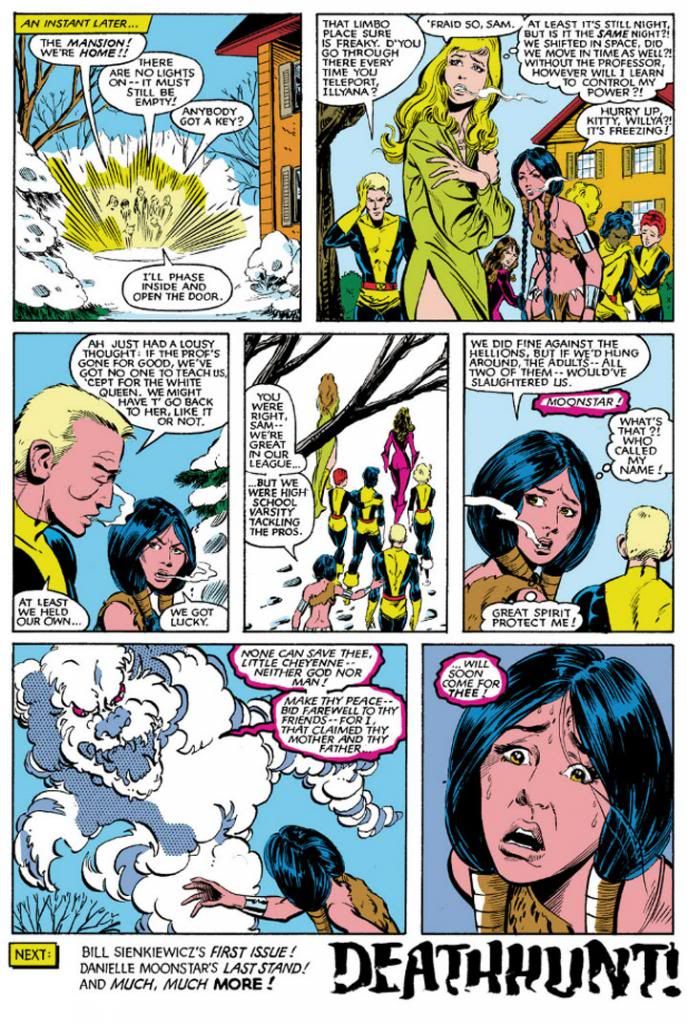
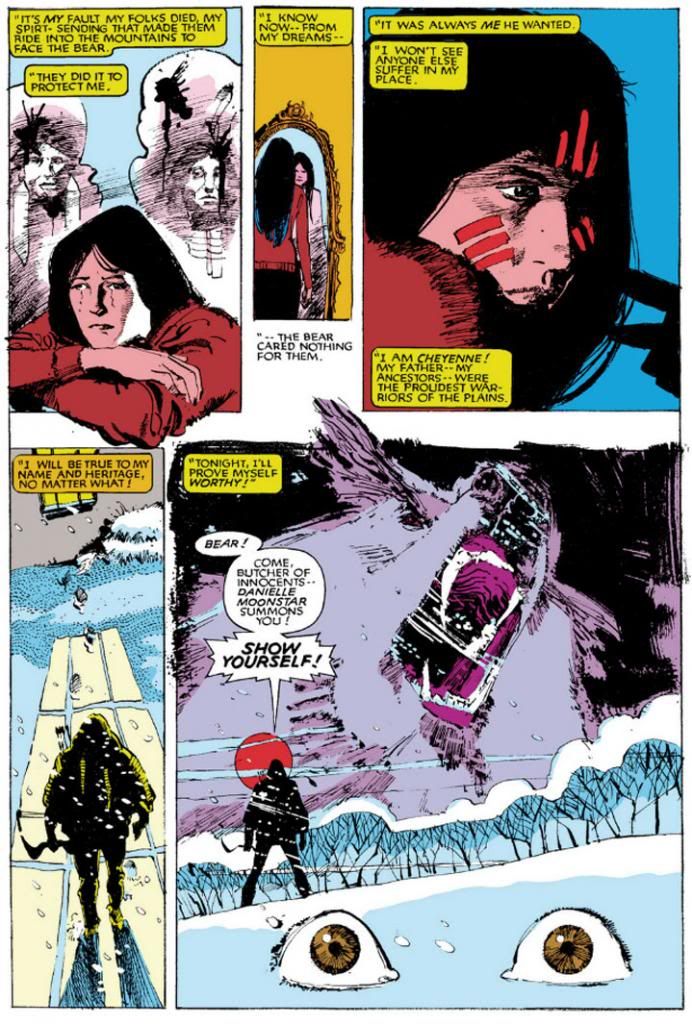
This next example isn't so much fun and festive as it is moody and menacing.  For Dani, snow isn't just about having fun and walking around half (or wholly) naked.  It's also about undertaking spirit quests.  Here's a dark and troubling page by Bill Sienkiewicz from New Mutants #18, where Dani goes solo against the demon bear that consumed her parents.

New Mutants #18 (August 1984); words: Claremont; art: Bill Sienkiewicz

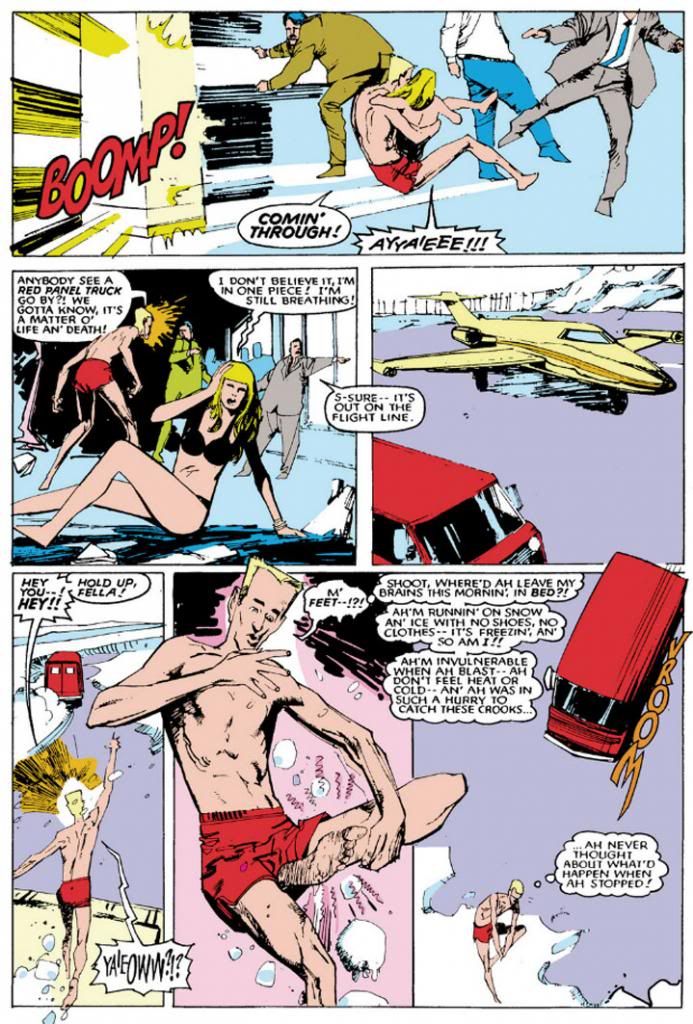
With Chris Claremont's genius for involving characterization, New Mutants rarely goes wrong when the story focuses on Dani, the best of all its characters.  But what's this?  Looks like Dani's not the only New Mutant trying for a membership in the Polar Bear Club.  Check out Sam Guthrie and Illyana in this slapstick sequence set at a local airport.

New Mutants #29 (July 1985); words: Claremont; art Sienkiewicz

Okay, so they're not just flying around in swimsuits because they enjoy it.  They do.  But more importantly, they're chasing after kidnappers who have just spirited away Roberto and Amara.  This happens while Dani and the others are fighting for their lives in a wartorn dreamscape inside a kid's mind.  No snow there, though, which is why I left it out.

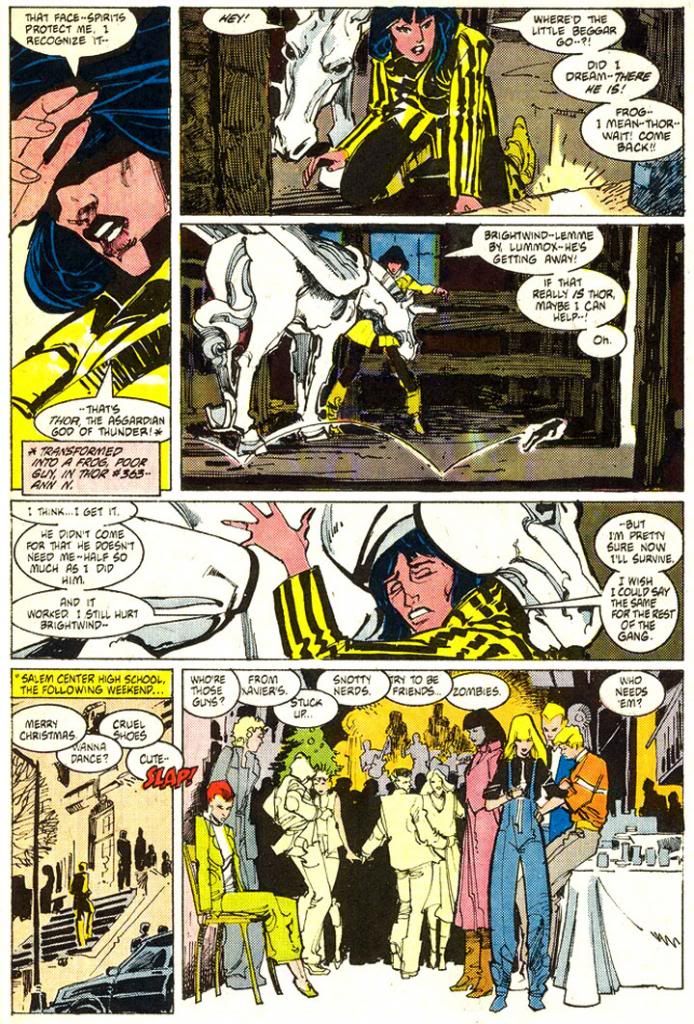
I'd hoped to find an issue with the team decorating a Christmas tree, lighting Chanukah or Kwanzaa candles, with Rahne doing her best Tiny Tim impression and Amara sharing a few Saturnalia traditions, but the only overt reference to a winter holiday comes in New Mutants #38, where the kids attend a party at Salem Center High School.  Dani, despite wearing a sweet party-appropriate black and yellow striped winter coat, decides to hang out in the Xavier school stables with Brightwind, her winged horse from Asgard.  Instead of the ghosts of Jacob Marley and Christmases Past, Present and Future, she gets a visit from what I believe is Thor in the guise of a frog.

New Mutants #38 (April 1986); words: Claremont; art Rick Leonardi and Sienkiewicz

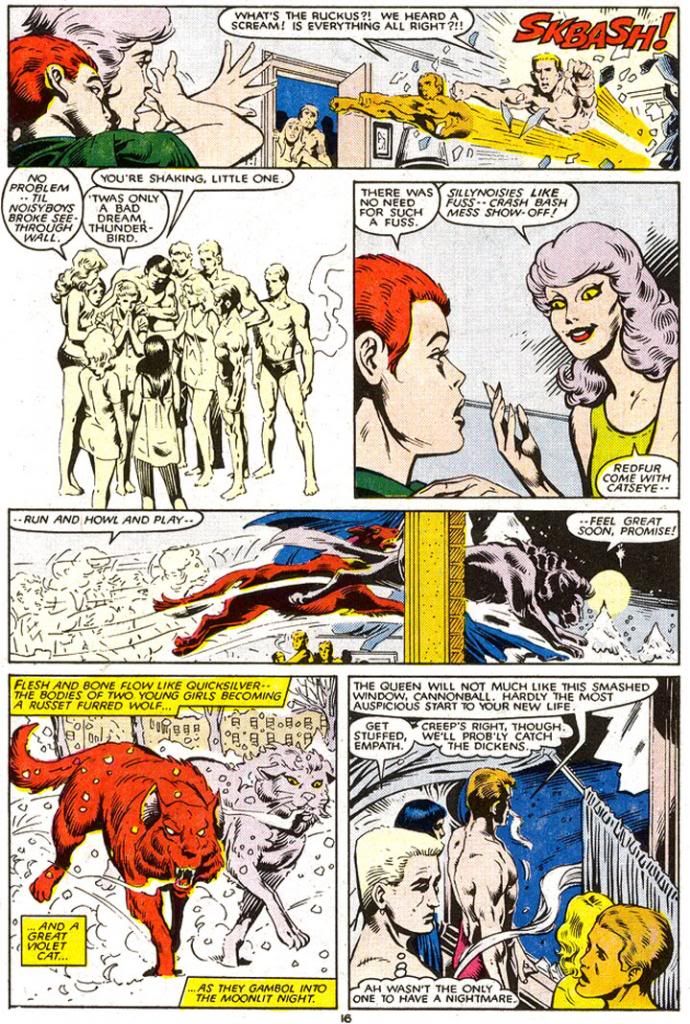
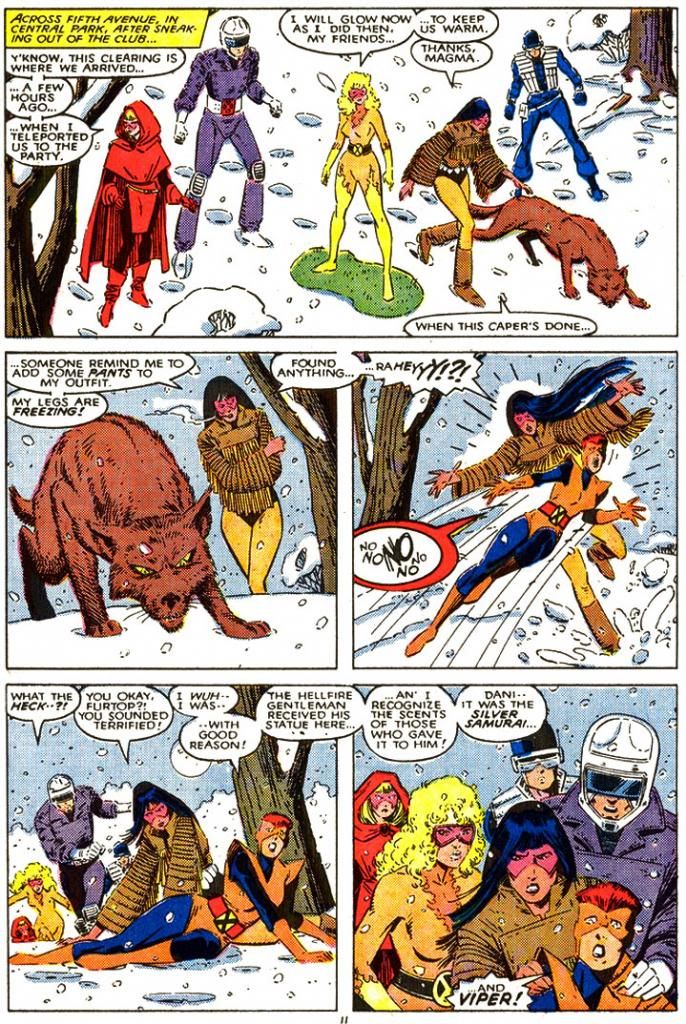
While Dani proves largely impervious to cold due to her upbringing and frequent nudity, her young pal Rahne Sinclair has the natural advantage of being able to transform into a wolf.  Each time she and Catseye (a member of the Hellfire Club's off-brand version of our heroes they call the Hellions), meet, they shapeshift into their "furforms" and go do lord knows what together.

New Mutants #39 (May 1986); words: Claremont; art: Keith Pollard and Del Barras

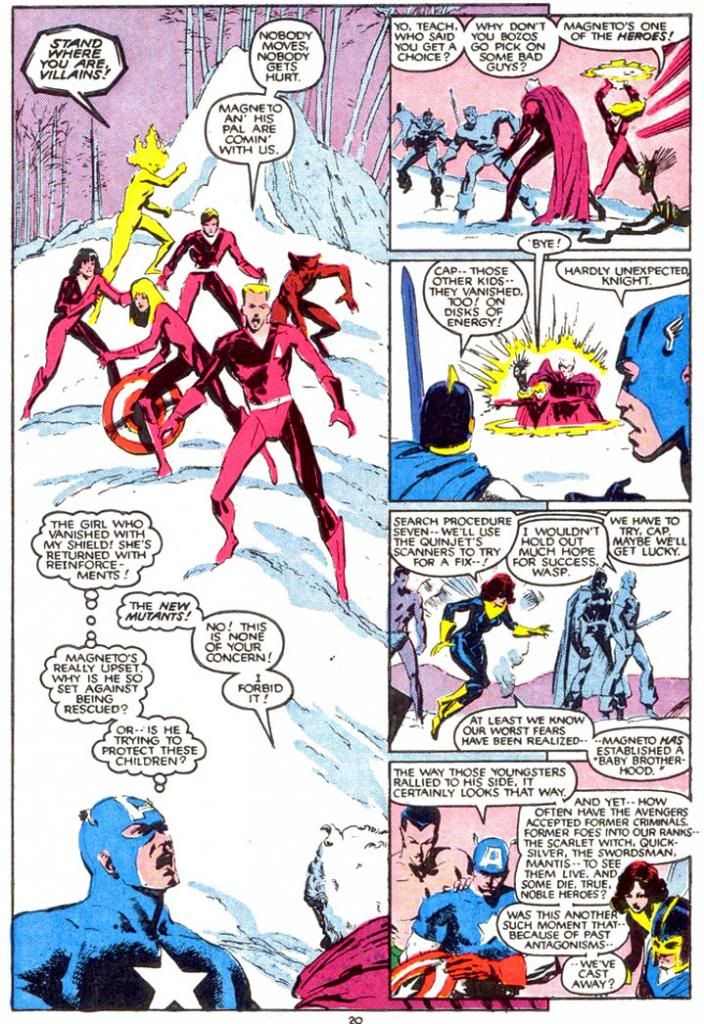
Around this time, new school headmaster Magneto decides it's better for his charges to become Hellions themselves, which leads to an extended run of issues where practically everyone wears magenta costumes.  And also to conflict with some of the Avengers.  Which, appropriately enough for today's theme, takes place in a scenic snow-frosted wilderness.

New Mutants #40 (June 1986); words: Claremont; art: Jackson Guice and Kyle Baker

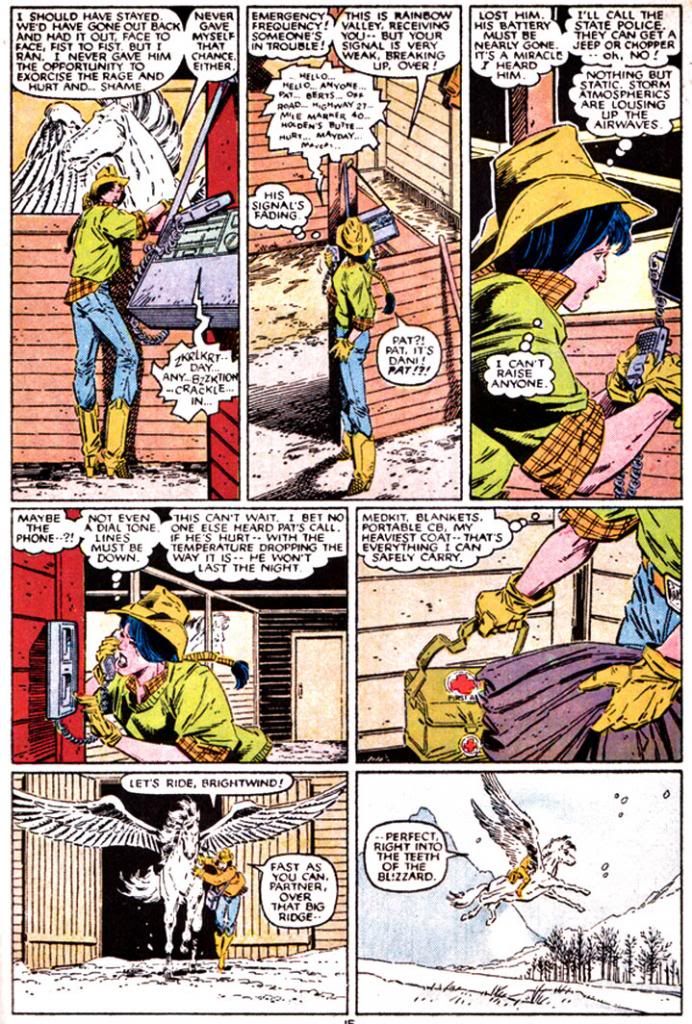
But what of the most important of all the kids, Dani Moonstar?  Not wanting any part of this magenta nightmare, she bugs out for her hometown in Colorado where she spends a lot of time...  you guessed it... in a stable with Brightwind.

New Mutants #41 (July 1986); words: Claremont; art: Guice and Terry Austin

I've never been, but I imagine with the Rocky Mountains being right there and all Colorado must have some beautiful winters.  During this particular story, a would-be boyfriend from Dani's past turns up and she has to engage in a fast draw duel with the personification of Death itself to save the guy's life (even though he's a complete creep).  It's your typical "guy likes girl, girl wants to be just friends, guy gets drunk and crashes his truck then goes into insulin shock, girl gunfights Death to save guy's life" story.

As if the Hellions costumes weren't bad enough, the team received their "graduation" uniforms soon after.  Poor Sam gets stuck in a purple and white jumpsuit with some kind of rejected prototype helmet left over from the Robocop pre-production phase and kneepads and Dani, much to her horror, has to wear a top that seems to have been woven from an old carpet Professor X had stored in the mansion's attic.

New Mutants #54 (August 1987); words: Claremont; art: Buscema and Austin

Amara looks like she just came from the Jem and the Holograms concert, or else she's splitting the visual difference between Spider-Man's animated friend Firestar and one of Santa's elves.  But with Rahne providing the perfect fifty-issue bookend by once again knocking over one of her teammates in the snow we've reached an appropriate stopping point.

Happy Holidays and a joyous 2014 to our reader!

Wednesday, December 4, 2013

The Worm of Thrace That Makes Things Worse or the Art by Marie Severin That Makes Everything Better

First we're going to talk about 1981's Dragonslayer and the Marie Severin-illustrated comic book based on it, and then I'm going to tell you why I'm including Eddie Deezen (who had nothing to do with the making of either) in this sentence

Dragonslayer is, I suppose, a cult favorite these days.  Maybe it was a little too obvious the spawn of Star Wars (naĂŻve young man on a hero's quest, spunky love interest, old mentor, pre-dating George Lucas but owned by him after May 1977) ever to strike box office riches.  But ten of us like it.  We don't have any cultish rites as yet, but we're working all that out at our monthly meetings that always take place at the stroke of midnight during the new moon period. 

Dragonslayer has so many wonderful qualities, it's long overdue for nostalgia-hungry Internet people to brave its shadowy, flame-scorched lair and bring it forth into the dawn of its new age of popularity.  There are winning performances from Peter MacNicol (later one of the best things about Ghostbusters 2, and an absolute riot as an enthusiastically boneheaded camp counselor in Addams Family Values), Caitlin Clarke and, in the role of wise wizard, Sir Ralph Richardson (doing that Obi-Wan thing Star Wars made a requirement of older British actors in the 70s and 80s).  It has a powerful score by Alex North (a movie music master who also scored Stanley Kubrick's Spartacus and worked on the director's 2001: A Space Odyssey before Kubrick decided to use classical pieces).  Not the least among all these estimable qualities is its dragon, the mighty Vermithrax Pejorative, brought to fierce, fiery life by Phil Tippett and a lot of talented special effects geniuses at ILM through the magic of their "go motion" process and some full-sized body parts.  Vermithrax Pejorative is the movie dragon by which all others must be judged and found wanting.

The story takes place in the Dark Ages (which weren't really as dark as modern myth makes out; we prefer to call those days the early Middle Ages).  A kid named Galen is a sorcerer's apprentice and Urland, a nearby kingdom, has a nasty dragon infestation consisting of our friend Vermithrax and her babies.  The king there has instituted a lottery whereby they randomly choose a maiden to dress like a bride and feed the dragon.  As in, the dragon feeds on her.  A deputation from Urland comes to visit Galen's boss, the renowned wizard Ulrich.  A mouthy boy Valerian in the party turns out to be a spunky girl in disguise and it's not long before she and Galen are making goo-goo eyes at each other.  Eventually, the youngsters have to confront Vermithrax and put an end to the death and destruction even if it means also eliminating the last vestiges of magic and fun in the world.

Let's wait for a minute or two while pop culture rights itself and this movie gets the acclaim it deserves.  There.  Now Dragonslayer has ascended to its rightful place as one of the great films.

After striking riches Jed Clampett-style with its Star Wars adaptation, Marvel wasn't about to let any other comic company join in the fun and profit so they started licensing practically every sci-fi or fantasy movie out there and releasing them in deluxe magazine format they called the Marvel Super Special.  The bigger, prettier print jobs favored instant classics like my beloved Close Encounters of the Third Kind and the lushly beautiful Archie Goodwin-Al Williamson adaptation of The Empire Strikes Back


This also led to some really strange and wonderful comic freakshows like Marvel Super Special #17:  Xanadu, the Illustrated Story.  Imagine that-- a whimsical Olivia Newton-John musical as a comic book!  I guess having missed out on the Grease lucre really burned Marvel's collective bums.  Too bad Xanadu became a notorious flop as a film and an oddity of a comic book. 

Dragonslayer, on the other claw (whoa, steady there, boy, don't get too stupid too fast), was a natural choice to make into a comic.  For one thing, it has few, if any, song and dance numbers to translate into pen and ink and scattered prose.  And for another, witness Marvel's success with fantasy properties like Conan the Barbarian, Kull the Conqueror and Red Sonja.  Conan was making semi-regular appearances in Marvel Super Special and Marvel had previously devoted three whole issues to their homegrown Doug Moench fantasia Warriors of the Shadow Realm, also known as Weirdworld.

Denny O'Neil's charming script hits the proper story beats, as expected.  But what O'Neil also does so well is illuminate the film's underlying themes of changing ages.  He doesn't miss the subtle tragedy of both Ulrich and Vermithrax being the last of their respective kinds.

But here's the best part.  Marie Severin is an absolutely inspired choice for art duties on Dragonslayer.  Among her many scattered Marvel art jobs penciling and inking characters like Namor and Spider-Man, Severin had already provided interiors for Marvel's Kull comics, and covers for that series and Conan the Barbarian.  Strong prep for Dragonslayer.

This art is pure joy.  Maybe it's due to her humor comics background, but Marie Severin absolutely aces the "acting," which I find many artists ignore or else botch completely.  In comics, true masters of acting are rare.  Comic book artists tend to pose their characters in weird, inhuman ways with every muscle tensed rather than develop unique body language.  And blank expressions when nothing much is happening, or downcast eyes when characters feel sad, or clenched teeth with neck tendons and veins bulging to the point of bursting for every other emotion.  Big, simplistic takes on big, simplistic feelings.  There are action scenes and plenty of screams and curses in Dragonslayer, but there are also a lot of moments where quirky people simply talk to each other.  If the characters turn into blank-faced nothings seemingly reproduced from clothing store mannequins, readers miss out on the mood and character personalities.  An artist is responsible for this stuff, too, not just the punches and kicks.

On Dragonslayer, Severin takes time to draw individual expressions and well-observed poses for every character on the page and really brings them to life.  Especially vivid is the unearned cockiness Galen displays right before the king tosses him in a dungeon as a big phony.  But even the kids Galen entertains at a celebration each have unique facial expressions that tell us what they're thinking and enrich the moment.  Some are delighted, some are a bit more dubious.  Are they important?  Maybe not, but Severin apparently felt it was necessary to go above and beyond, and I applaud.


She also does a lot to build the world these people inhabit.  Aided by some ornate inking by John Tartaglione, Severin packs the pages with images that recreate in two dimensions the film's funky, lived-in production design.  Dragonslayer's Dark-- er-- early Middle Ages were not those of fairy tale or chivalrous legend, despite the scaly menace of Vermithrax and the magical story elements.  It's more like the one from Monty Python and the Holy Grail:  dirty and smoky, with tumble-down castles falling to ruin.  Especially spectacular are the pages inside Vermithrax's lair-- Severin colored the book as well, and the lighting effects she manages on these pages raise the room temperature.  You can almost feel the heat and smell the stink of burning oil and sulphur. 

The only flaw in her storytelling is she tends to minimize Vermithrax.  We get one massive head as the dragon glares at Galen but for the most part Severin confines the great beast to smaller panels.  A full-page panel of Vermithrax in flight, spewing flame, would have been perfection.  As if to make up for that, Severin and Tartaglione do a knock out job on Vermithrax's baby dragons.  Valerian calls them basilisks, but I prefer the term kittens.  Dragon young should be called kittens.  The artists render the dragon kittens in loving close up so we get to see every bump and scale. 

Anyway, it's a good looking book.  The Earl Norem triptych cover pretty much sums up the magic that is Dragonslayer.  Maybe if they'd used it as the movie's one sheet it might have fared better at the box office.  Or not.  Such visual riches shouldn't be hoarded and hidden away by dragons-- it needs a reprinting at once.  Casiordorus Rex demandeth it!  Snap to it, people!  Chop chop and lickety-split!  Handle it, Roy, handle it!  Handle it!   As long as there isn't a joyless, rote, CGI-heavy remake with Sam Worthington as Galen and Megan Fox as Valerian.  Or some CW Network refugees.  There's no way some sullen-faced former underwear models could compete with the charms of MacNicol and Clarke.

Okay, back to Eddie Deezen.  Dragonslayer director Matthew Robbins also directed 1978's Corvette Summer, the movie where Mark Hamill builds a custom Corvette Stingray only to lose it to a sleazy auto shop owner/car theft ringleader played by Kim Milford, who essayed lead schlub Billy Duncan in Laserblast, a low-budget sci-fi revenge flick (mocked impressively by Mystery Science Theater 3000 at the end of its seventh season).  Laserblast is where Eddie Deezen made his film debut. 

Marvel Super Special #4 The Beatles Story is a comic book biography of those four lads from Liverpool.  Eddie Deezen knows more about the Beatles than you and I put together ever will.  Eddie Deezen turned down a role in the Bill Murray-starring hit Meatballs for a part in the John Belushi-and-Dan Akyroyd-starring flop 1941.  Eddie Deezen voiced Mandark on Dexter's Laboratory


The Beatles, Marvel Comics, Laserblast, Corvette Summer, Dragonslayer, Dexter's Laboratory:  they all come around in the end to Eddie Deezen.  We like Eddie Deezen as much as we like Marie Severin.

Thursday, November 21, 2013

Dani Moonstar versus Sarah Rainmaker (or How I learned to stop worrying and love Gen13)

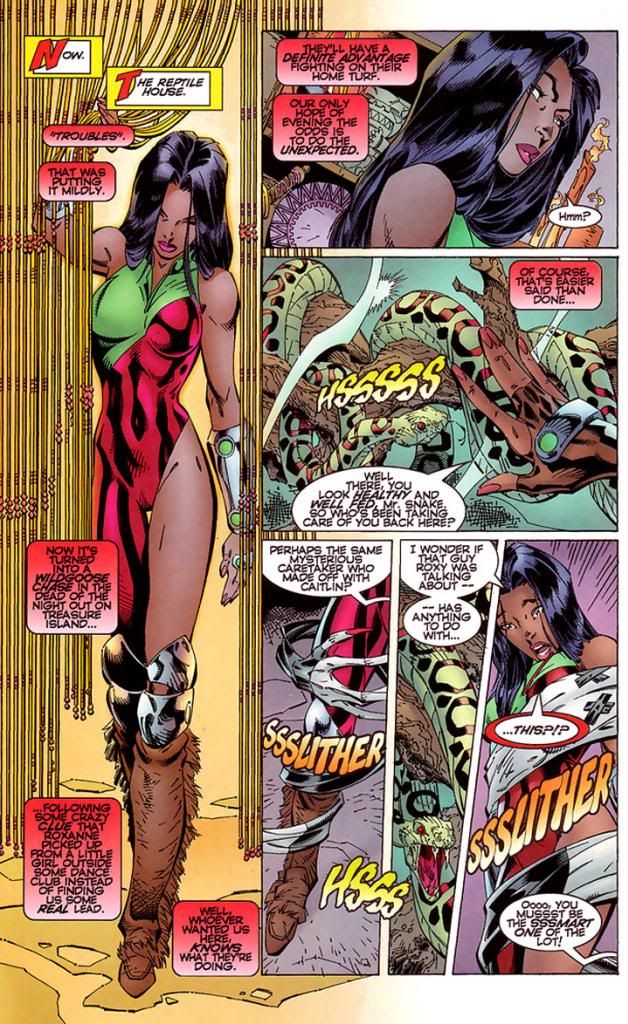
Epitomizing 90s fluff, Gen13 was a kind of MTV Real World look at superheroics on one hand, an excuse for near-nudity and fart jokes on the other, and just some guys good-naturedly riffing on their favorite New Mutants and Uncanny X-Men storylines, plus throwing in a Trent Reznor clone as a villain for good measure on the third.  Or one of your feet, if you're not an alien or mutant creature.  Outrageously derivative, cluttered with pointless storylines that go nowhere, at times little more than a vehicle for J. Scott Campbell's "good girl" art-- and also so light and breezy entertainment I couldn't get enough of, so much so I even wrote a fan letter.  That's something I had done only once years before, to the fine folks responsible for making Sgt. Rock

And a lot of other readers felt the same way, at least for a while, because Gen13 inspired Gen13 Bootleg, a spin-off series with stories and art by the likes of Alan Davis, James Robinson, Walt and Louise Simonson, Adam Warren and even a two-issue miniseries by Adam Hughes which I think of as a largely forgotten near classic.  No less than Warren Ellis himself took a hand at writing the team's adventures in one regular series annual and one for Bootleg.  Image/Wildstorm also published DV8 and a number of mini-series.  Then the fun stopped.  Writer Brandon Choi and Campbell decamped and new creative teams came aboard.  They tried to use the comic's powers for good, but its zeitgeist had passed and subsequent attempts at revival in the years since have failed.

But back in those days, most Gen13 readers wanted to read about super-strong, super-smart, super-bodied team leader Caitlin Fairchild and the various ways she would lose her clothes, the "youngest and spunkiest member of the team" Roxy Spaulding and gross-out comedic relief -- with a code name dated even then-- Percival Edmund "Grunge" Chang.  There was also Bobby "Burnout" Lane, who had kind of an emo personality and a soul patch but otherwise made little impression on anybody.

But I, being forever contrary, preferred little-regarded Sarah Rainmaker, who was slightly more popular than Burnout only because, well, the main purpose of Gen13 wasn't beefcake.  I liked her because the creative team didn't seem to, and because she was more than a little similar to my beloved early-teens hero Dani Moonstar.  I mean, besides both being Native Americans. 

Poor Sarah Rainmaker.  The original writers used her mostly as a straw-figure to mock feminism, campus activists and also to do a bit of that MTV-style "amorphous sexuality tease aimed at hetero boys" stuff that later made such a star of Kate Perry.  But written sympathetically by Hughes in Gen13: Ordinary Heroes a more interesting, deeper character comes through and makes me wish they'd tweaked Rainmaker in the monthly to something a bit less... well... insulting.  Sometimes they did.  Often they didn't.  Anyway, maybe what I really I liked all along was this alternate Hughes-inspired version of Sarah Rainmaker I had in my mind.  One more righteous and less of a strident punching bag with a lot of "Take that, Political Correctness!" dudebro-humor wear and tear. 

Still, if you're going to do your own version of The New Mutants, of course you're going to do your own version of that book's most vital character and obvious star.  You know who I'm talking about from the title of this post, so with no further ado, here are some Dani Moonstar moments echoed by Sarah Rainmaker.

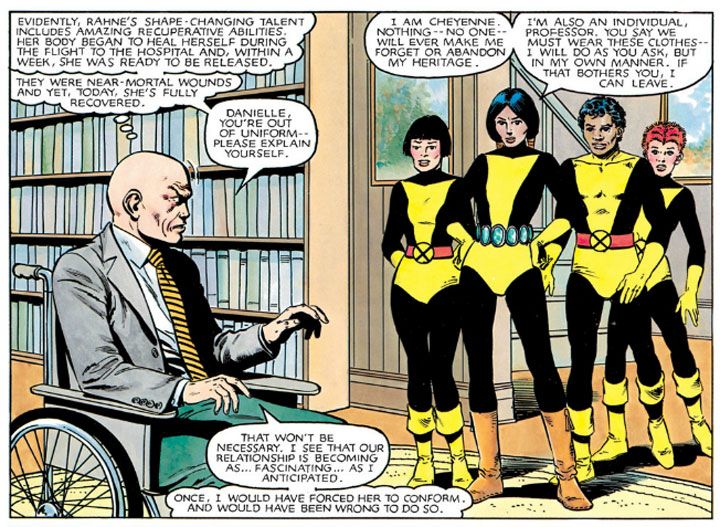
1.  Fabulous footwear.  In Marvel Graphic Novel #4 New Mutants (September 1982), Dani makes damn sure Professor X recognizes not just her individuality but her cultural heritage by accessorizing her one-size fits all uniform to something more unique.  The Gen13 kids received their own super suits right from the start, but obviously Rainmaker was paying attention when Dani set a precedent.  Because I'm about as Native American as Vladimir Putin, I have no idea how appropriate Rainmaker's boots are-- Dani is Cheyenne, Sarah is Apache and those are two distinct cultures-- but I do know when things look similar because I watched Sesame Street growing up.

Dani:

Marvel Graphic Novel #4: Script by Chris Claremont, art by Bob McLeod

Sarah:

Gen13 #8: Script by Brandon Choi, Jim Lee and J. Scott Campbell, art by Campbell and Alex Garner... or Richard Friend!

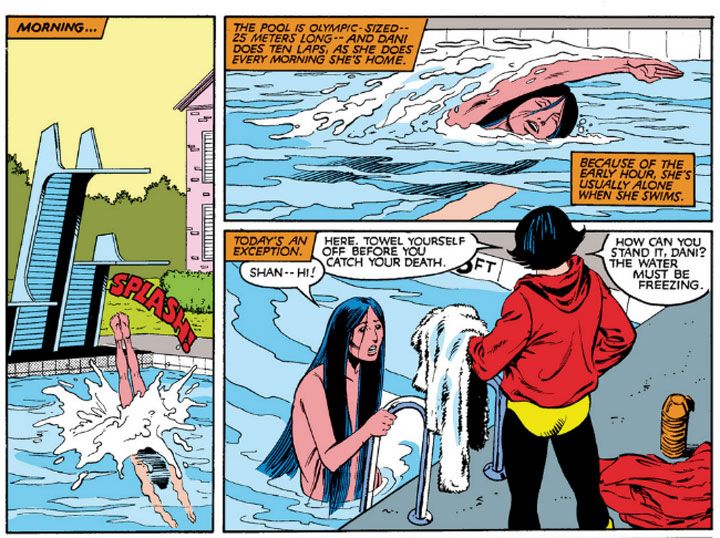
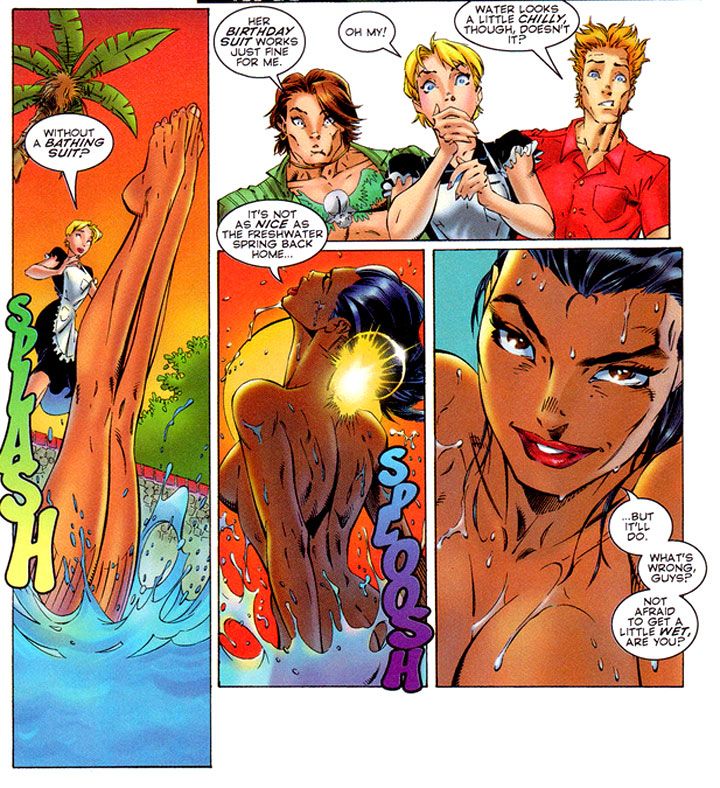
2. Swimming nude.  Dani makes a point to swim au natural in New Mutants #3 (May 1983) and Rainmaker follows (birthday) suit in Gen13 #1 (March 1995).  Chris Claremont treats this moment seriously and tastefully and it leads to a revealing (personality, not body) moment between Dani and her friend Xi'an Coy Manh where they bond and we get to know both of them better.  When Rainmaker takes a dip, Choi and Campbell play it as a striptease and while we do get to know a little more about the cast from this (Sarah likes to show off, the guys are pantingly hetero-sexist), the characterizations are roughly at the level of a beer commercial.

Dani:

New Mutants #3: Script by Claremont, art by McLeod and Mike Gustovich

Sarah:

Gen13 #1: Script by Choi and Campbell, art by Campell and Alex Garner... or Sandra Hope!

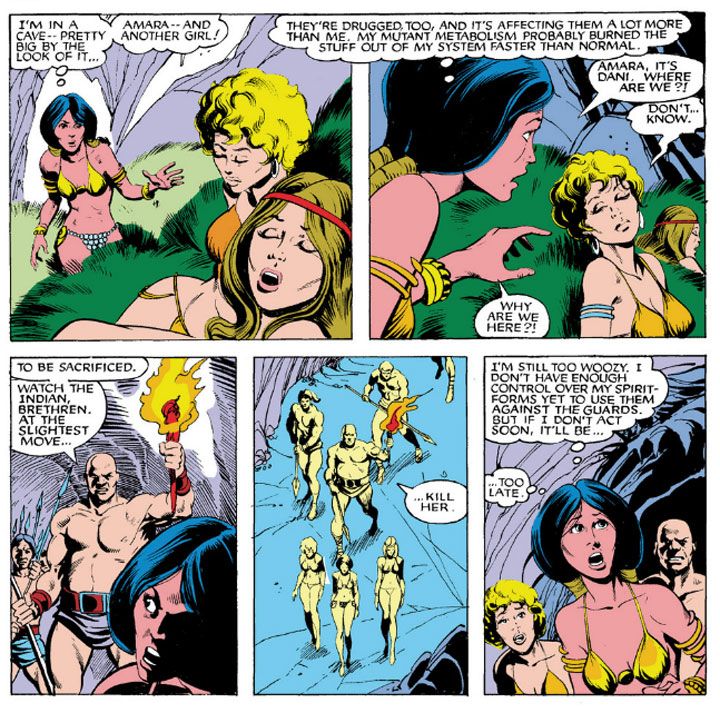
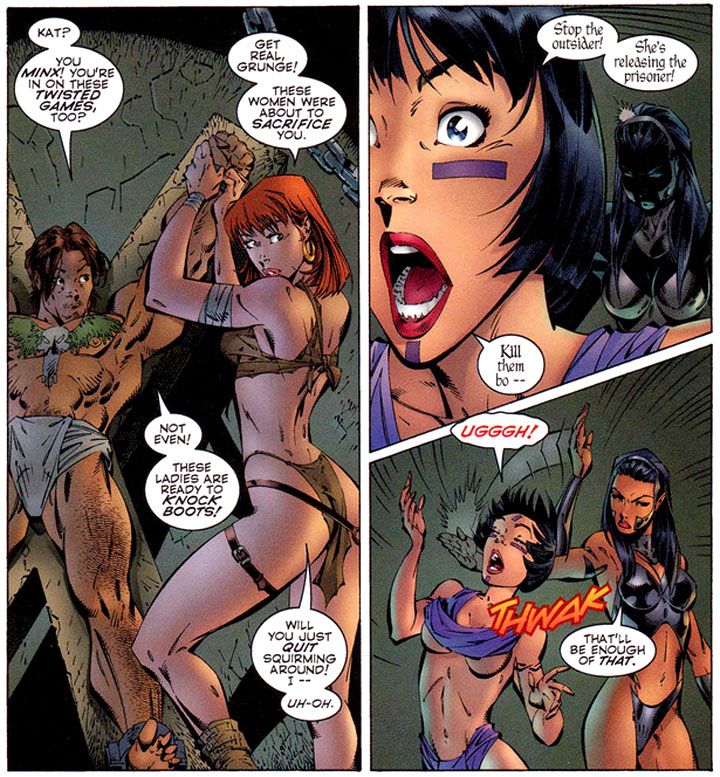
3.  Jungle adventures with anachronistic cultures that result first in wearing rags and then even more revealing outfits.  In New Mutants #8 (October 1983), the kids travel to the Amazon rainforest, have a lot of misadventures in which Dani first has to wear a swimsuit and then torn clothing.  When she and the rest of her team end up in Nova Roma, a hold out from the days of Imperial Rome, they adopt cultural-appropriate clothing.  Then a sorceress shows up and tries to sacrifice Dani, which requires her to wear a chain-mail bikini outfit stolen from a Red Sonja comic and then a low-cut evil sorceress gown.  When the Gen13 gang takes a similar journey to Africa in issues 3 through 5 of their comic (July-October 1995), they come across an all-female society of supermodel Amazonians who favor skimpy metal swimwear of their own.  Rainmaker quickly goes from ragged prisoner to shiningly metallic masturbatory fantasy warrior before you can say "Psyche-Mirage-Moonstar-Spellbinder-Dark Rider."

Dani:

New Mutants #10: Script by Claremont, art by Sal Buscema and Tom Mandrake

Sarah:

Gen13 #5: Script by Choi, Lee and Campbell, art by Campbell and Garner, Friend and Scott Williams 

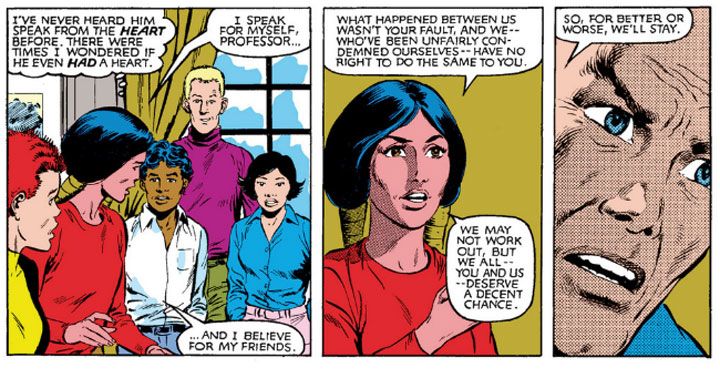
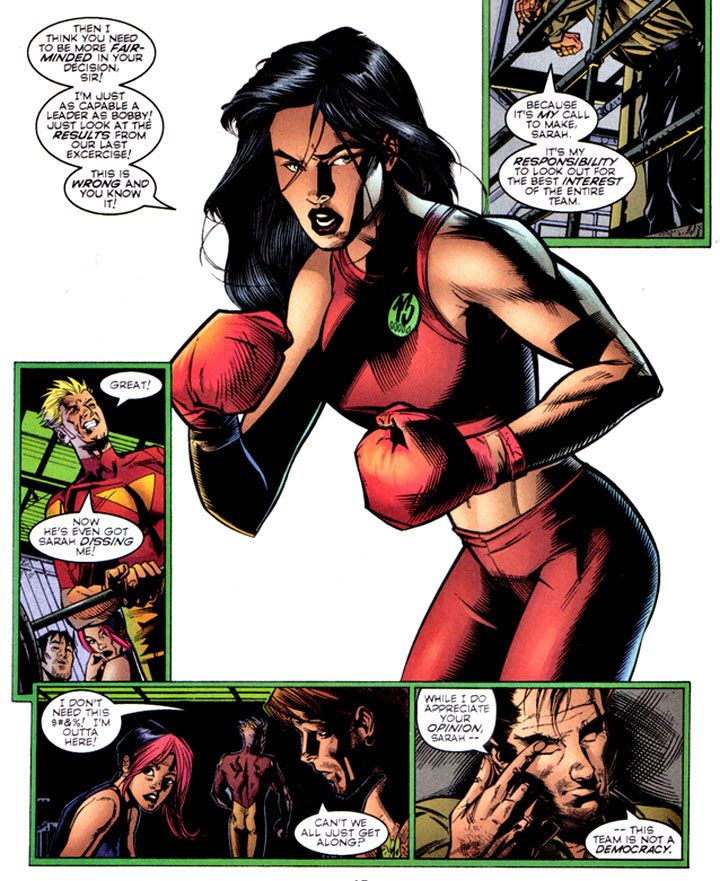
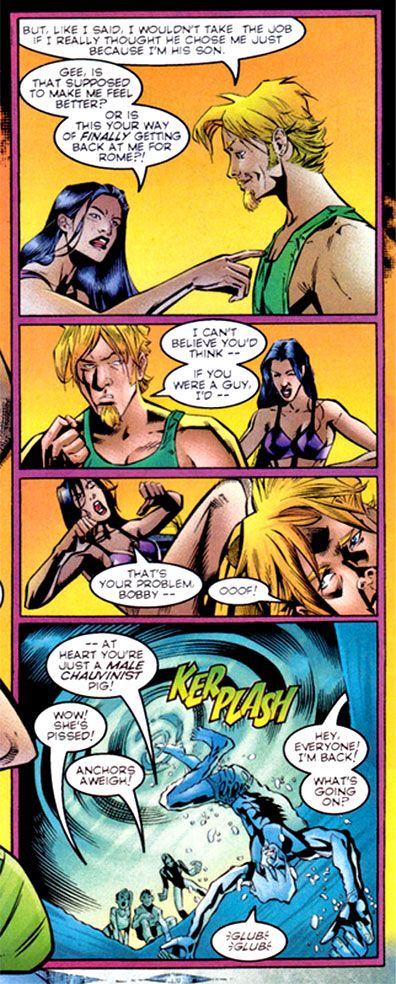
4.  That leadership thing.  Despite being a year or two younger than Sam Guthrie, the more capable Dani quickly takes over the top spot in the New Mutants team after first leader Xi'an Coy Manh goes missing.  In fact, she's already pushing Xi'an out of the top slot as early as New Mutants #4 (June 1983), with her friend standing right beside her!  When leader Caitlin Fairchild temporarily quits, Rainmaker makes an attempt to do the same in Gen13 #12 (August 1996), only to have mentor John Lynch (supposedly this ultra-tough black ops veteran) appoint his own dopey son over the smarter, more mature and combat-skilled Rainmaker in what's obviously a decision based solely on nepotism.  Burnout has shown absolutely zero leadership skills to that point, and kind of a mopey, shrinking-violet personality, while Rainmaker's intelligence is second only to Caitlin's, plus she's much wiser and more self-assured in many ways.  No wonder she reacts unfavorably to Lynch's completely illogical move (although in Lynch's defense, he may be pitting the two against each other in a "survival of the fittest" competition-- although that could also wreck team morale and field effectiveness in the long run as well, so maybe he is an idiot after all).  This also positions Sarah as the Dani-style team rebel.  In the same vein, both characters seem to have an innate talent for combat tactics, as well, with the New Mutants becoming more of a fighting force to be reckoned with under Dani's command, and with Sarah frequently barking out orders of her own during the many confrontations in Gen13.

Dani:

New Mutants #4: Script by Claremont, art by Bucema and McLeod

Sarah:

Gen13 #12: Script by Choi, Lee and Campbell, art by Michael Lopez and Troy Hubbs (I think) 

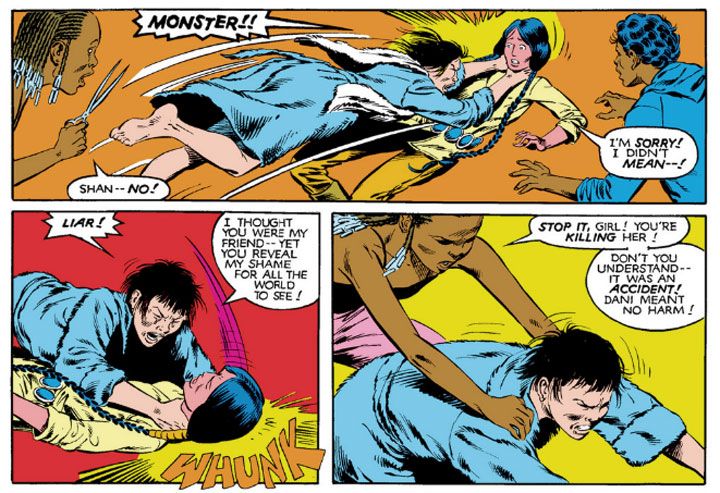
5.  Tussles with teammates.  I seem to remember Dani doing this a lot more, but I must be more than a little mixed up and fully conflating her with Sarah at this point.  I'm surprised Dani didn't beat up those two idiots Sam and Bobby two or three times a day with that temper of hers.  Instead, she seemed to take out her aggressions more on inanimate objects.  And despite frequently referencing the martial heritage of her Cheyenne people, she wasn't all that adept at fighting.  Oddly enough, in New Mutants #1 (March 1983), it was Xi'an who first went fisto-a-fisto with Dani-- well, actually, she choked the hell out of Dani and slammer her head against the floor with good reason: Dani had accidentally used her powers to pull images of her Xi'an's violent, tragic past out for all to see.  While the New Mutants had their share of inter-team arguments, it would be more than a year later, in New Mutants #14 (April 1984), before we'd see another instance of Dani-on-friend violence, this time a playful shove into the snow for Roberto DaCosta.  Sarah, on the other hand, goes full on kung fu queen on Bobby Lane after he made a poorly-timed snide remark at her expense during their leadership crisis. It happens in Gen13 #12.

Dani:

New Mutants #1: Script by Claremont, art by McLeod and Gustovich
New Mutants #14: Script by Claremont, art by Buscema and Mandrake

Sarah:

Gen13 #12: Script by Choi, Lee and Campbell, art by Lopez and Hubbs (I still think)

Okay, now I'm obviously reaching.  But I believe I've made my point-- there are certainly parallels, enough so Sarah Rainmaker became my favorite Gen13er.  What's been fun for me looking for these little moments is contrasting the writing on both series.  While Claremont's dialogue is sometimes stilted and a bit advanced for his characters' ages, his stories and characterizations are nothing if not sincere.  He genuinely cares about his cast and immersing the readers in their world.  Plus he displays the literary chops of a true writer's writer, someone in love with language.  If any of his work here is derivative, it's of real life or novels.  And occasionally movies.

By comparison, the Gen13 characters-- scripted by no less than two writers at a time!-- usually speak casually and naturally (unless there's need for some hard expository dialogue, that is). Actually, their dialogue is almost exclusively made up of then-current catchphrases and youth lingo.  While as individuals they're amusing enough, they're more tongue-in-cheek, broadly-sketched types owing most of their personalities to television shows and other comics (and not just New Mutants).

There are some interesting comic book characters in Gen13, but it would take other writers to flesh them out into real characters, especially under Warren who managed to make the book as smart as it was funny and sexy.  And, oddly enough, that's when the Gen13 finally died.

Saturday, November 9, 2013

Fantastic Four Annual #3: Stan and Jack can't catch a break

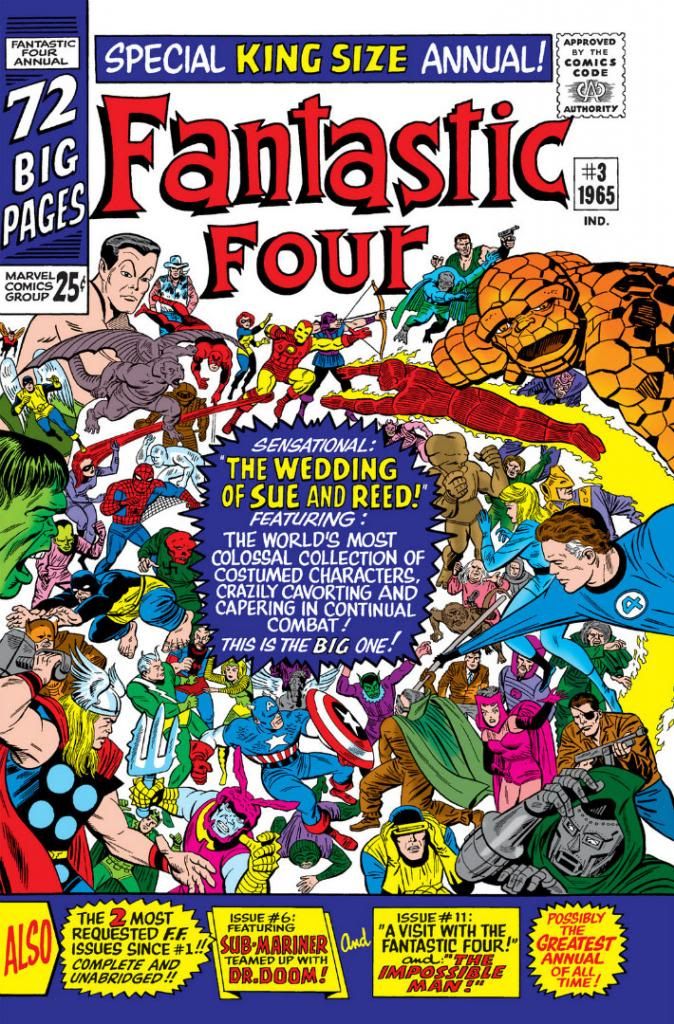
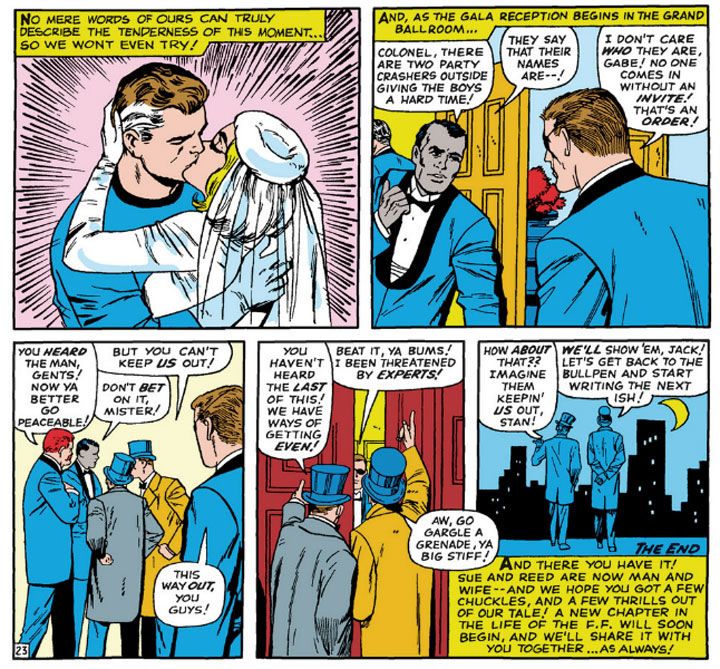
I've always felt ambivalent about annuals.  The best are the ones where the regular creatives use the extra room to tell an epic story that's either too large an idea for an ordinary issue or else climaxes a storyline, or someone you've wanted to see handle the characters shows up to write or draw the book.  The worst are when some ill-suited guest team butts in with crap that's essentially filler or else it's simply part of a storyline from some other book.  Back in the 1960s, the gang at Marvel really knew how to put together an annual, although Fantastic Four Annual #3 (October 1965) consists of a regular-length story and some "most requested" reprints.  It's just the main story is nothing less than the long-awaited wedding of Reed Richards and Sue Storm.

And lemme tell ya, brothers and sisters, everyone who is everyone shows up and it is fun, fun, fun from panel one!  Captain America, Thor, Iron Man, Spider-Man, Daredevil, Dr. Strange and all the X-Men, plus Patsy and Hedy, (at least rumor has it) Millie the Model and possibly Irving Forbush headline a stellar guest list, with Nick Fury and SHIELD providing security.  The only problem is, with such a major event there are bound to be crashers.  The Puppet Master, the Red Ghost and his apes, Mole Man and the Super-Skrull all cause problems, because Dr. Doom himself has some kind of crazy emotion ray controlling their minds.

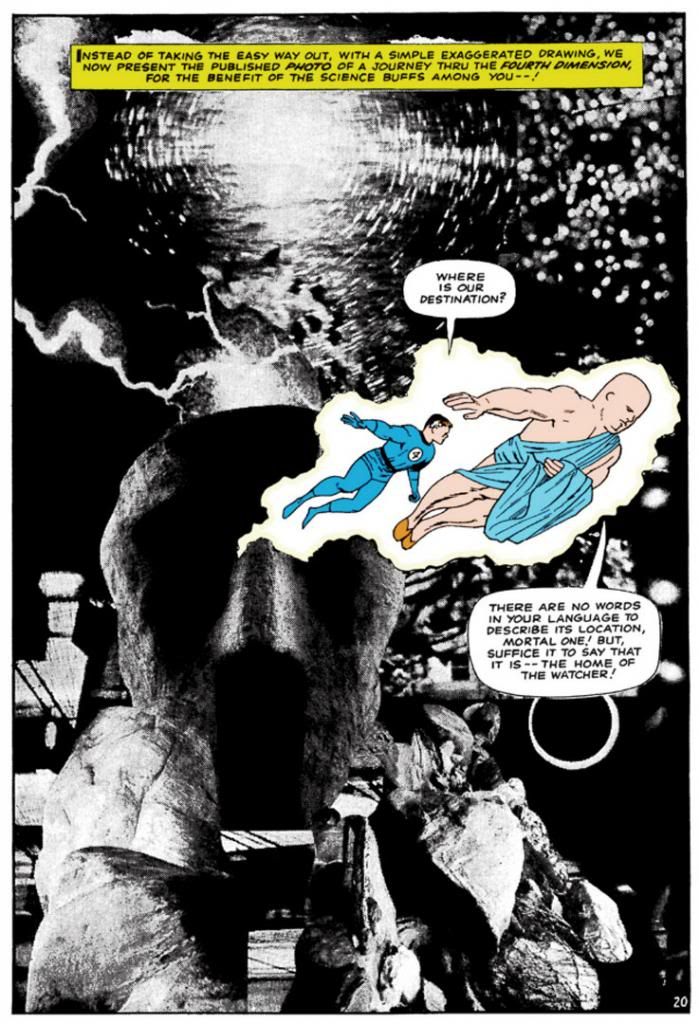
The heroes prove capable of handling the initial wave, but more and more villains attack so we get the like of the Mandarin and Hydra plus a lot of other clowns whose names escape me barging in and smashing up the place (kind of like Owen Wilson's mescaline-addled Eli Cash in The Royal Tenenbaums only without the death of a single Buckley), giving Fury a raging headache.  When Attuma and his Atlantean armies emerge from the harbor (Doom meant to call Namor, but the King himself was on some deeper quest according to Stan Lee's little editor's note; he also tells us why the Hulk isn't there) and Richards puzzles out what's behind it all, even the Watcher has to take a hand.  He takes Richards on a dazzling yet possibly superfluous trip through the "fourth dimension" (isn't that time?) to retrieve a device that beams all the baddies backwards in time to a moment where they would forget the whole thing happened.

Kirby uses one of his patented collages to depict the dimensional trip and we have to take a moment to gaze upon its wonders.


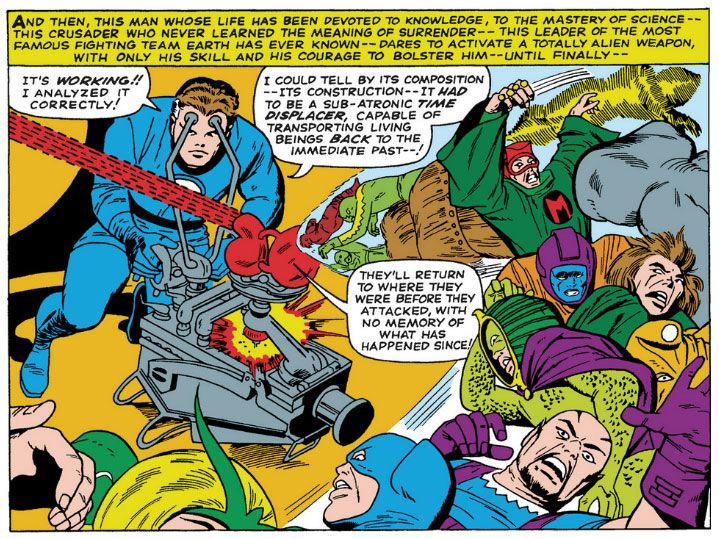
And here's that aforementioned device in action.


My god, Reed Richards is so smart, he could tell just by looking at it what it is and what it's used for!  I'm looking at it and all I can think is maybe I could use it to project transparencies onto some kind of fabric screen or perhaps even the wall itself as a visual aid for one of my classes.

This panel sums up the whole of the rather jangled plot, which is almost entirely given over to fight scenes, as you can imagine.  Kirby's on fire with some incredibly energetic poses as he presents practically an encyclopedia of Marvel's contemporaneous characters and we get a lot of villainous monologues and heroic wise-cracks from Lee.  Vince Colletta's inks are typically scratchy and rushed-looking, but I also recognize the herculean task faced by the art team here in working with this many characters on deadline.  They're serviceable finishes and a few odd figures and faces actually have a becoming elegance (others look kinda haphazardly slapped together), but certainly this book would have looked slicker with Chic Stone doing the honors, or Joe Sinnott.  Then again, Reed and Sue might have had to delay their ceremony another year or two waiting for this issue.

Another thing to consider is we're looking at restored art here.  I'm not sure what process Marvel puts their back catalog through to produce these color reprints, but I doubt they used the original inked pages or old separations (if any of that still exists).  I'm guessing they cleaned up some stats or decent-quality printed books as best they could,  retouched things here and there but said, "Eh, good enough" at the loss of finer lines after the digital coloring.  And these lines look like they were thin enough to begin with.

On with the wedding!  Here comes the--

Stop the music!  Stop the music!  Hold the sub-atronic time displacer!  What's this?  Two more wedding crashers?


In the immortal words of a certain bashful, blue-eyed boy, "Wotta revoltin' development!"

Friday, November 1, 2013

October is Spookey Month: Swamp Thing fights male and female werewolves!

To end our month-long celebration of Halloween, horror comics and all-girl Japanese pop punkers Spookey, here are a couple of stories where Swamp Thing fights that old school monster favorite, the werewolf.  Male and female varieties.

The first one, Swamp Thing #4 (May 1973) is by Len Wein and  Bernie Wrightson.  They lean on the familiar Universal Studios style, setting their tale in the Scottish moors and within a creepy old mansion.  Their werewolf is the tragically cursed son of some very worried parents.  They're in luck when Matt Cable and Abby Arcane crashland their plane close to their ancestral home, but definitely unlucky in that Swamp Thing is also on board.  This means their plans to use Cable's blood to cure their boy of his lycanthropy (and give it to Cable; but isn't this what any concerned parents would do for their child?) is doomed from the start.

While the werewolf on the cover looks more like a satyr to me, inside the comic itself Wrightson uses heavy black silhouetting for its first appearance, which gives his beastie a very Frazetta-ian touch, almost amorphous in the night fog.  It's very reminiscent in its first appearance of Frank Frazetta's aptly-titled "Werewolf!" from Creepy #1 (1964).  Kind of impressionistic.  Shoot, why am I telling you all this when I can just shut my fool mouth and show you?  Here:


There is nothing not to like about this comic and its classical approach. 

But what a difference a decade makes!   We hear a lot of talk about the "curse of the werewolf," and writer Alan Moore and his merry art crew of Steve Bissette and John Totleben set out to explore what this means both literally and metaphorically-- because there's also this other monthly thing sometimes referred to as a curse.

In Swamp Thing #40 (September 1985), Brit Moore unspools an episode in "American Gothic," an extended story arc where Swamp Thing battles traditional horror creatures suffused darker elements of the United States' national narrative-- the unintended consequences of progress, the preponderance of gun violence, the genocide of Native Americans and the lingering effects of slavery and the Civil War.  This time, perennial fan favorite character John Constantine pits Swamp Thing against something more personal-- the perpetual state of war between the genders, specifically the daily battles waged by a typically American suburban couple.

As with the Len Wein-Bernie Wrightson werewolf tale, "The Curse" is very concerned with blood.  It's just Moore is interested in a deeper exploration of this sanguine symbolism.  Our werewolf this time is a modern woman so empathetic to the anger and resentment felt by long-ago Pennamaquot tribeswomen sequestered in a special lodge (she and her husband live in a house built on the site) while they menstruate she turns into a massive wolf creature and goes on a rampage.  Male privilege has finally loosed a beast, and after a brief fight, Swamp Thing comes to as much of an understanding of the woman's plight as a male-gendered plant elemental can.

Tragically, our tragic werewolf is a stand-in for all of womankind, so she learns there's another aspect to this blood curse-- women are bound by it to men and vice versa.  As a result, she cannot bring herself to kill her husband (even though she contemptuously notes he's "soiled himself" from fear).  Giving in completely to her primal, savage anger, she crashes through the front window of a pornography shop where a customer has just asked the cashier to show him something he euphemistically refers to as more "unusual."  Perhaps as a matter of tastefulness, we aren't permitted to see the resulting carnage.  In the end, Swamp Thing cannot offer succor and the werewolf impales herself on the knives in a supermarket display, ironically labeled, "Here's good news for housewives!"  The supermarket setting itself represents the sterilizing effect consumerism has on our lives and its place in the continuing subjugation of female power, having been referenced satirically in the same vein by Ira Levin's 1972 novel The Stepford Wives and its 1975 film adaptation.


And with our tale of two lycanthropes, we bring this year's Spookey Month to a close!

Saturday, October 26, 2013

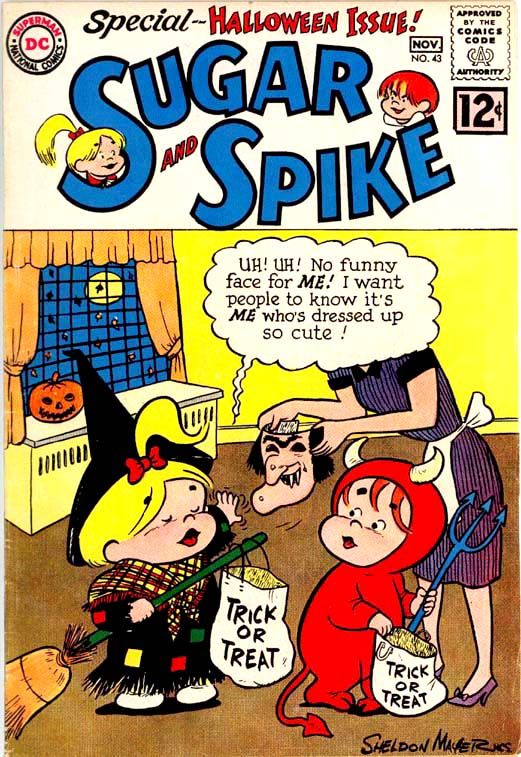
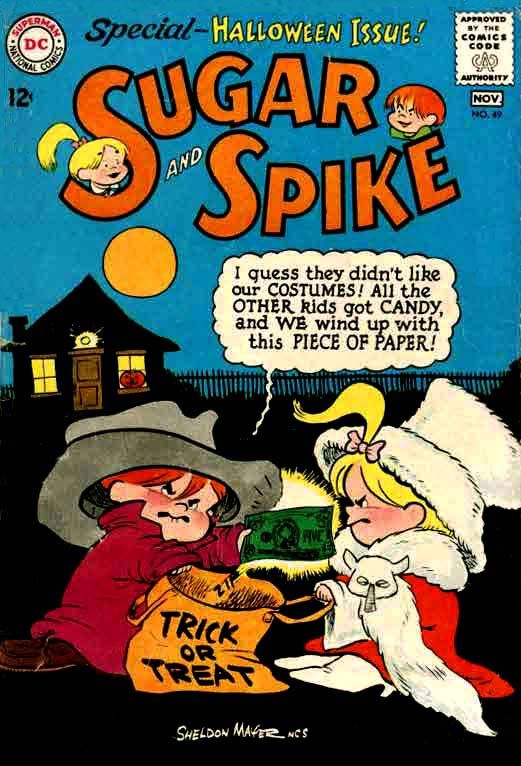
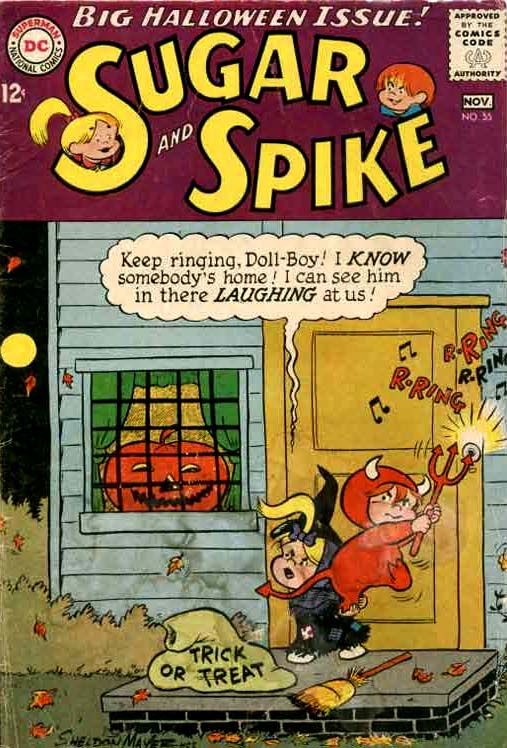
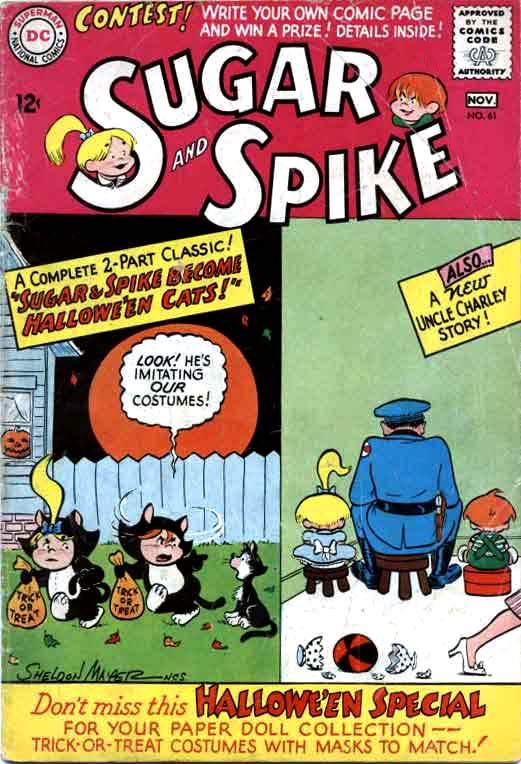
October is Still Spookey Month: Sugar and Spike's Halloween-themed covers!

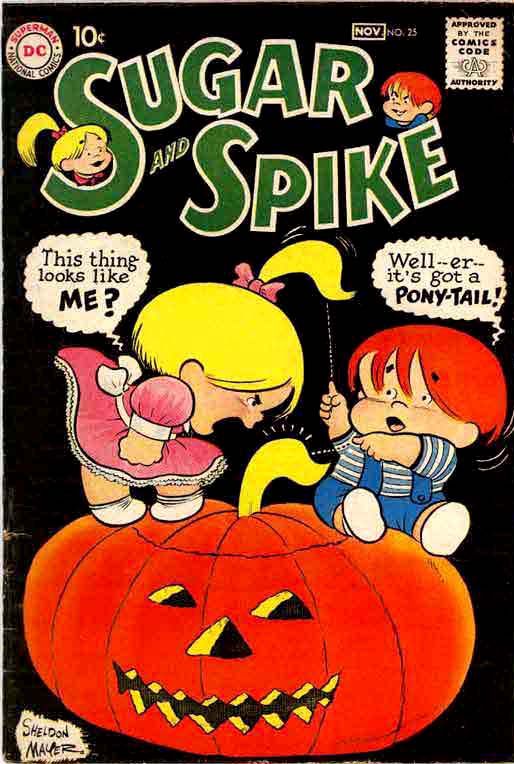
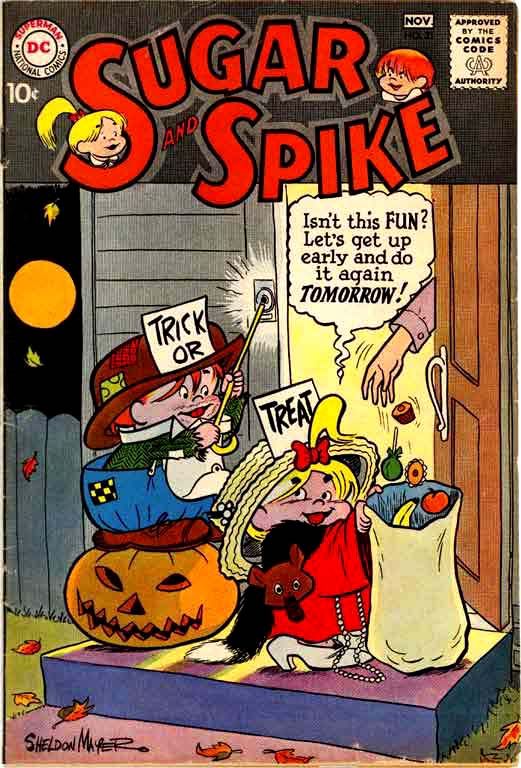
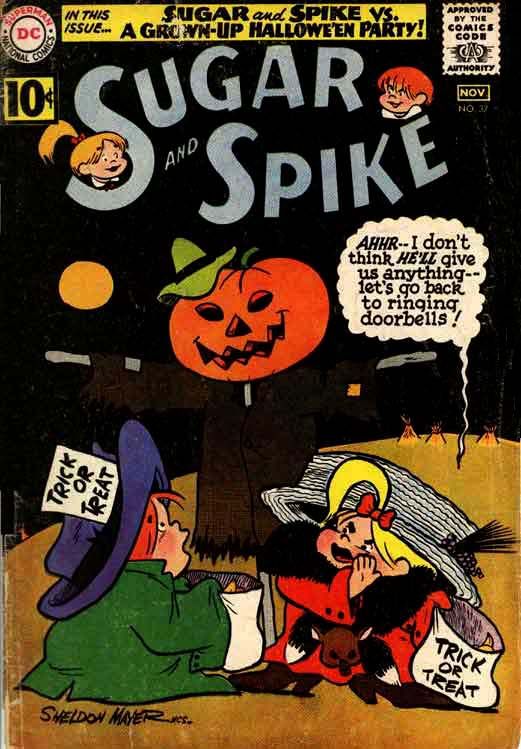
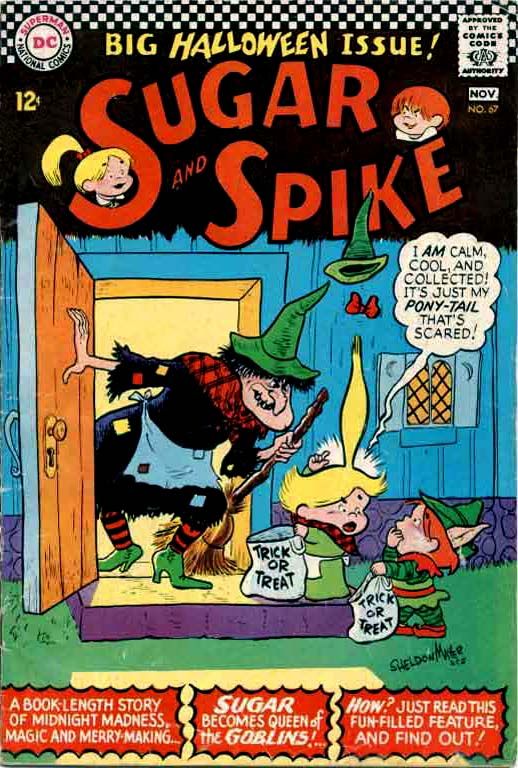
These are pure joy.  I really don't have anything to say about any particular cover in this collection, so we'll let Sheldon Mayer's work speak for itself and fill you with the spooky, fun Halloween spirit.

Sugar and Spike #25 (Oct.-Nov. 1959)


Sugar and Spike #31 (Oct.-Nov. 1960)

Sugar and Spike #37 (Oct.-Nov. 1961)

Sugar and Spike #43 (Oct.-Nov. 1962)

Sugar and Spike #49 (Oct.-Nov. 1963)

Sugar and Spike #55 (Oct.-Nov. 1964)

Sugar and Spike #61 (Oct.-Nov. 1965)

Sugar and Spike #67 (Oct.-Nov. 1966)

There!  I'm ready to go trick or treating and it's only October 27th.  I've only read one or two Sugar and Spike stories, but the Comic Book Artist #11 (January 2001) flip side devoted to Mayer and his kids made me a believer.  I wish DC and Comixology would make this entire series available so I could put up some better scans instead of ones I had to scour the web to find and then clean up a little for you.  I did as good a job as time (little) and money (zero) would allow and it's our good fortune Sugar and Spike fans put them out there for all of us to enjoy.

And now you also enjoy my favorite Spookey video!