I don't write a great deal about Hellboy, because I tend to think of it and its related titles as "new" comics. That's how fresh it is. But the first issue came out way back in March, 1994, which is well within the timeframe for this particular nostalgia-leaning blog. And I'm a big fan of the property and a lot of the people who've worked on it, creator Mike Mignola foremost among them. Man, I dig that cat's art and the weird pacing and tone of his writing.
Mignola is the reason I picked up a Hellboy book in the first place-- and it was the Seed of Destruction collection. At the time, I really didn't care what the story was about or the characters in it. I just wanted to look at Mignola's drawings.
Mignola first entered my particular radar through his work on the Topps comic book adaptation of Francis Ford Coppola's overwrought vampire flick Bram Stoker's Dracula. I picked it up out of curiosity because I'd enjoyed the movie in a campy kind of way and I've always appreciated a Dracula story, any Dracula story. I didn't realize I was actually about to encounter a new artist with whose work I'd become obsessed in the way I had with people like Jack Kirby, Joe Kubert, Al Williamson, Alex Toth and Mark Schultz over the years. The comic book, written by Roy Thomas and drawn by Mignola and inker John Nyberg, blew the movie away, not the least reason being you don't have to deal with the hammy acting and outrageously bad accents when you read it. Hooked on Mignola from that point, I started copying his art and looking for his other comics. But I went about it in a kind of leisurely fashion, because I didn't buy Seed of Destruction until probably around 1999 or 2000...
And wow, oh wow, when I finally got around to it, I found it was full of stuff that fired up the endorphin-receptors in my brain for a full-on rush of pleasure and good feelings. And from then on, I had to buy every single Hellboy and Hellboy-related comic book I could get my hands on. Nowadays there are so many to choose from, too. The cast has grown over the years and there are spin-offs and off-shoots and even "other world" type, out-of-continuity stories. Two movies, a cartoon. Toys. Other people are involved in the writing and drawing of Hellboy and his friends, but it's still Mignola's world. He has the knack of choosing the best and most appropriate collaborators, too. There are stories I've enjoyed more than others, but I can't think of one that's a real misfire or mistake. Twenty years of quality entertainment.
I think this is the ideal model for how to handle comic book characters, creators and publications. Kudos to Dark Horse for letting Mignola run with this and not trying to screw it up and put their imprint on it the way some other companies might have. When you think of what could have happened to Hellboy if Mignola had been more successful pitching it to a certain other company before landing at Dark Horse... YIKES.
I should have blown up this blog with a major Hellboy write-up back in March, and I should definitely write more about the 1990s-era Hellboy books here. And post some art from them because it's so damned cool to look at.

Showing posts with label Roy Thomas. Show all posts
Showing posts with label Roy Thomas. Show all posts
Monday, May 12, 2014


Wednesday, March 12, 2014
Tales to Astonish #82 (August 1966): I bought this for Gene the Dean, found Jack the King!
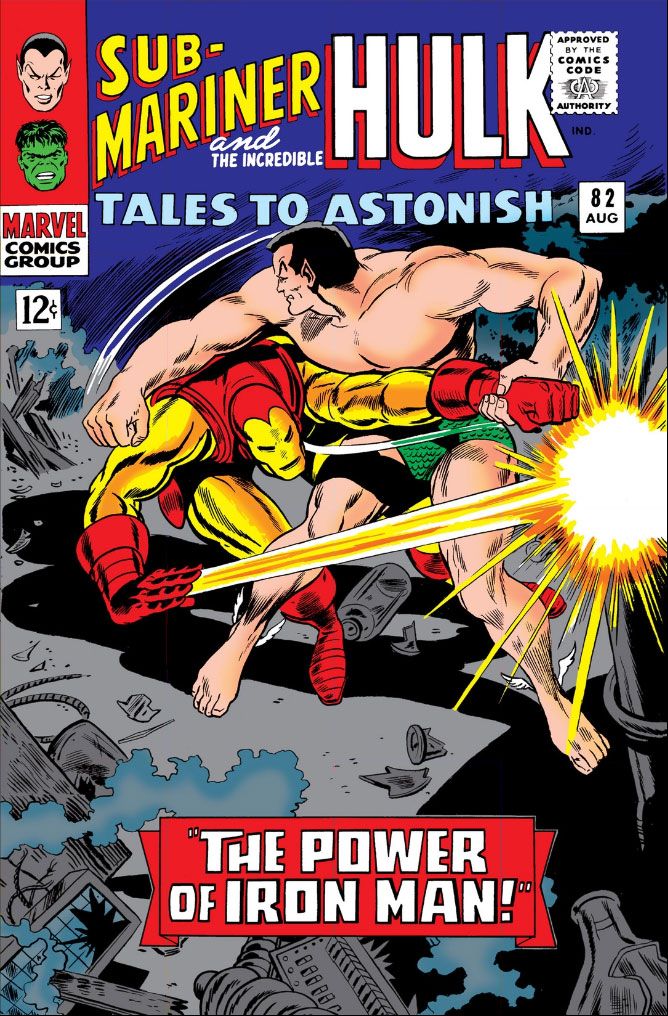 |
| Tales to Astonish #82 (August 1966) Pencils: Gene Colan, Inks: Dick Ayers (according to Comic Vine) |
Anyway, my appetites aside, Gene Colan is one of my top five or six all-tme art heroes, a guy I've tried to imitate in my own art however futilely. While I own a DC hardcover full of Batman stories by Colan, and I know he was responsible for a storied run on Daredevil, I tend to think of Colan as more of a horror artist because of his stellar art on Marvel's Tomb of Dracula and for Warren Publications. After reading all that jazz from people way more knowledgeable than I about this stuff, I decided it was time to fill a gap in my education and study up on his superhero work.
Well, I already knew Colan for a horror master. Love his moody, shadowy imagery and the extreme figure foreshortening because he chose very unusual "camera" angles. He was incredibly cinematic, with a strong feel for intense drama and noir-ish lighting. So I was really looking forward to reading this and seeing how he put that to use in one of those two-character long-underwear dust-ups printed before I was born. I opened to the splash, scanned the credits to see who inked it (inking interests me lately) and got a surprise. After the cover, there are only two pages of Colan in this book! But we're not going to complain because after those two pages it's none other than Jack Kirby the rest of the way.
Tales to Astonish #82 (August 1966) has a Stan Lee plot and a Roy Thomas script, and it's a continuation of a fight started in another title, which is easy to confuse with this one, especially since their numbering runs so close together. I'm talking about Tales of Suspense #80, which also has Lee's and Kirby's famous "He Who Holds the Cosmic Cube!" I say it's famous because it's a Captain America story I read many years ago in the book Captain America: Sentinal of Liberty. All the stories in that book are famous because Stan Lee says so.
Anyway, Captain America isn't in this. It's just Iron-Man and Namor. Their story starts over there, continues here in this one, then goes of into another comic. I haven't had time to sit down and really give Tales to Astonish #82 a reading, but just from staring at the art, this story, called "The Power of Iron Man!," is a frenzy. Just two characters duking it out. I have no idea why, don't really care all that much. I'm downloading it into the Comixology iPhone app as I type this, so I'll read it in those scant free moments I'm not shaking the earth and building a better future or whatever the hell it is I do. I don't really wax nostalgic over things like two characters having a fight, or that this is "the first real inter-book crossover." I'm more interested in the artwork by Colan and Kirby.
Despite Dick Ayers' inking, it would be obvious we've got two very different pencillers even if we haven't read the helpful credit boxes on the splash page which tell us Colan came down with the flu and Kirby had to take over. I wonder if that's really the case, or if this is one of those cute jokey things Stan and Roy liked to use as an easy explanation for some other chain of events they didn't want us to know. Seems likely enough, much more so than Kirby drawing the book then asking who the Sub-mariner is, but that's the claim here, too.
Here's where Iron Man hits Namor the Sub-Mariner so hard they both turn from Gene Colan figures...
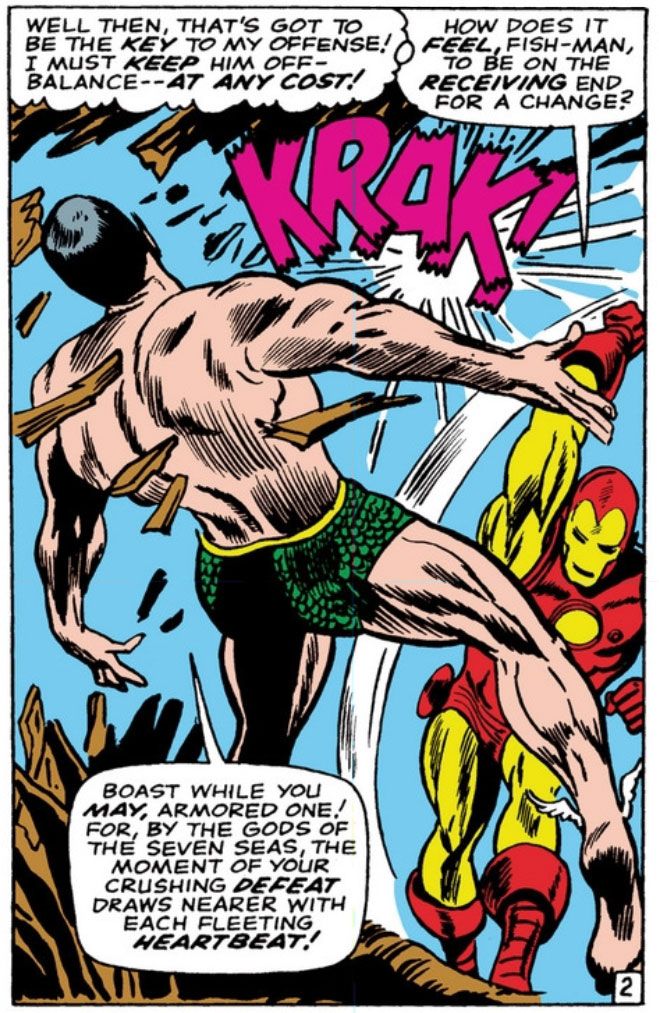 |
| Script: Roy Thomas, Pencils: Gene Colan, Inks: Dick Ayers |
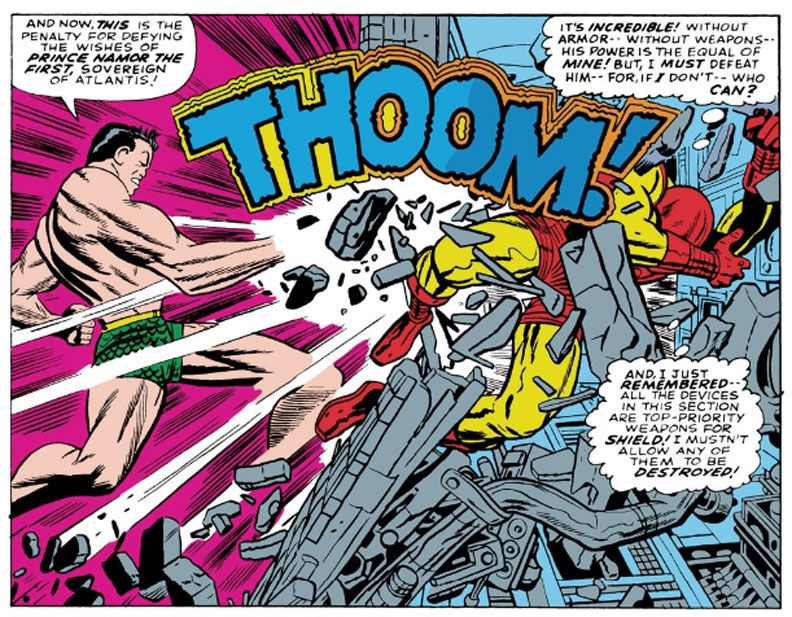 |
| Thomas, Pencils: Jack Kirby, Inks: Ayers |
Jagged purple "KRAK!" is the sound of metal-clad fist striking flesh and bone chin. Earthquake-like yellow and blue "THOOM!" is what happens when fish-guy knocks armor-guy through a wall.
In the Colan panel, notice how Iron-Man's weight is planted on that front foot. Most of his body is moving towards Namor in the foreground because he's put everything into one massive hay-maker of a blow, which landed a split-second or so before Colan "photographed" this moment. Even though he's still able to talk, Namor is flying upwards and backwards with his right foot dangling loosely. This is follow-through, the impact completed, an interesting split-second between the moments of collision and release and much closer to the latter so the figures are opening up, becoming loose-limbed and extended, although I imagine Iron-Man's left thigh is clenched because he's planted that foot and is stopping his forward momentum with it.
Now look at Kirby's panel. This isn't follow-through. This is the exact moment of impact. Namor has punched Iron-Man with a more compact body-blow. Notice the rigidity of Kirby's figure drawing here. Namor lowers and draws in his chin, which means his chest and abdominal muscles are clenched, tense. He's still performing the action itself. In Colan's, taking place nano-seconds after the action, we see Iron-Man's fist. In Kirby's, at the moment of impact, Namor's fist has vanished in a white starburst. And Kirby either gives us two time differentials here or else that punch is so powerful, the transfer of kinetic energy has already thrust Iron-Man through the wall in exact moment Namor landed it! It seems impossible, two states at one time, but there you have it. Also, like Namor before him, Iron-Man flies backwards from blow, but Kirby puts his upper body into a kind of defensive posture, arm raised to protect his face, while the other arm goes limp and he appears to be drawing his legs up so that he can land in a ball on the other side. Or the fetal position.
Colan's is kind of athletic and even graceful, Kirby's is as hard and bone-shattering as two cars in a head-on collision.
These panels come a couple of pages apart. I just wanted to show you one of Namor's answering blows because it wouldn't have been fair to give Iron Man two consecutive shots. The art switch is just this abrupt, though. You get that Iron Man punch at the end of one page-- and I find very entertaining Thomas's characterization of Namor as the kind of cool customer who can fall backwards after a sock to the jaw and still find it in himself to make a sneering speech about how Iron Man's "crushing defeat draws nearer with each fleeting heartbeat"-- then the very next page starts with a Kirby-drawn panel of Iron Man shooting his "repulsor rays" right at us, the readers!
What gives? Aim those things elsewhere, buddy!
Since I was born a generation later than the kids who bought these issues new off the stands, stories like these were hard to find unless they popped up as a back-up feature in an annual or else in one of those hardcover collections at the library. The ones that were constantly checked-out and never available. Or that Sentinel of Liberty book I was just telling you about, which I bought at Waldenbooks at our mall along with one about Dr. Strange.
We didn't have all the archive reprints and essentials and, of course, digital comics had yet to be invented. I didn't have the disposable income to buy swanky back issues, and I probably wouldn't have been inclined to even if I did. There were always new comics to buy. And living in a small southern town, I was largely isolated from fandom at large and things like fanzines and mailing lists.
This means I don't have an encyclopedic knowledge of storylines predating my interest in comics, nor do I know a whole lot about the inner workings of Marvel or DC or who drew or wrote what when or where. It also means every time I go on a Gene Colan or Jack Kirby rampage, I'm liable to find stuff completely new to me. I like that. The joy of discovery! The joy of turning a page drawn by Gene Colan and finding the next one drawn by Jack Kirby!
Oh, and there's a Bill Everett-pencilled Hulk story as the back-up feature, and that looks pretty cool, too.
Tuesday, August 21, 2012
Conan's elephant friend
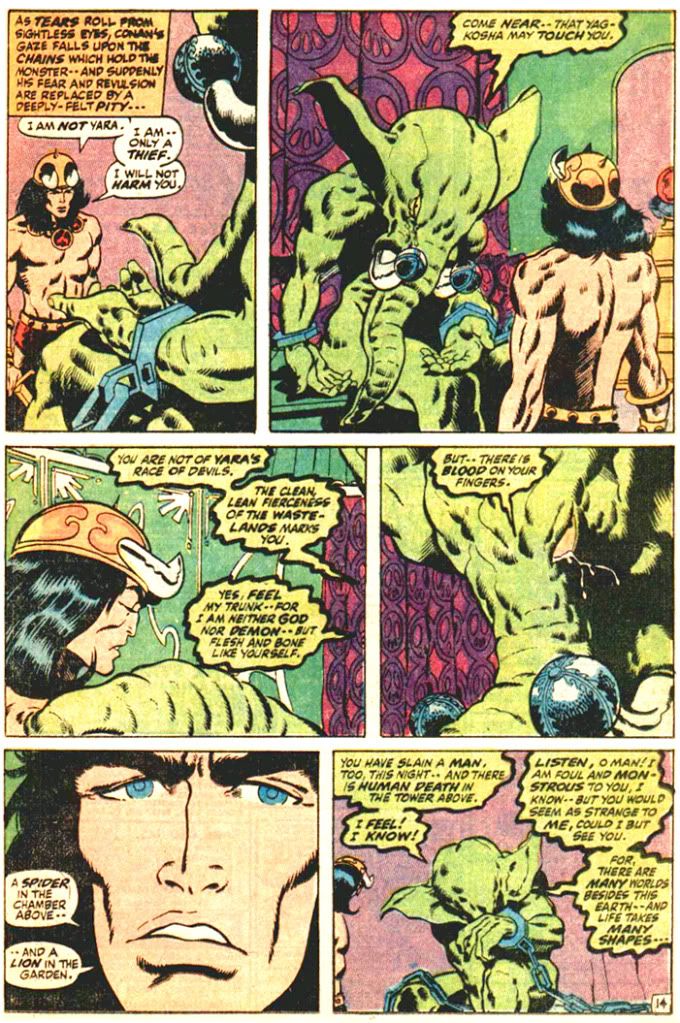
In this story, we find a younger, slimmer Conan just starting his adventuresome career. It's right after he quit McDonald's, but before he studied accounting at the local two-year community college. Like a lot of young Hyborian dudes on the make, Conan spends a lot of time in the taverns of Arenjun, the "thief-city of Zamora." There he overhears a big blowhard spouting off about the Tower of the Elephant and its fabulous treasure, the Heart of the Elephant. Someone really likes elephants. Probably Yara, the priest who lives in the tower. He used to collect clown figurines, but his mom got him this little elephant carving for his birthday one year and he was never the same after that.
Anyway, the mouthy braggart has a Conan-type accident, and our favorite barbarian slips out to snag that fancy jewel for himself. He's a little nervous about it-- this Yara guy is some kind of magician, and magic is the one thing that gives Conan the shivers-- but he climbs the walls, meets another thief with the unlikely name Taurus. Taurus proves useful when a couple of lions show up. A quick puff of the ol' black lotus and it's good bye, lions. Taurus doesn't last long, either. They manage to shimmy up a slender rope Taurus thoughtfully brought along, right to the top of the tower-- itself made itself of jewels of incredible value-- but then the ever-prepared Taurus dies from a spider bite. Guess that's one thing he didn't see coming. Conan kills the spider, then makes his way down into the tower only to meet this green elephant.
Yag-Kosha is his name. Yara's blinded him and kept him in torment for 300 years while trying to learn all his elephantine magical secrets, such as the special ingredients to his famous chocolate chip cookies.
It's really kind of a melancholy story, the kind that proves Howard had more on his mind than just pulpy action. It resists cliche. Thomas, taking his cue from Howard, treats the first killing almost coyly. We don't see it, just its aftermath. Then there's Conan's palpable fear as he undertakes his thievery; he's not just a stolid, dull-minded hero. Rather than have Conan fight his way into the tower, the story has him just a moment or two behind the action as Taurus else dispatches the guards and the first few lions for him. Conan does get to fight a lion a little later, which is pretty sweet, but Thomas and Windsor-Smith don't dwell on it. It's over in four panels, the first being a small silhouetted image. Windsor-Smith crops the killing blow so we actually don't get to see it.
Yag-Kosha could easily have been a monster for Conan to fight, but instead he's treated sympathetically. He simply tells his sad story-- which fills Conan with shame at being human-- and uses the barbarian as a vessel for his vengeance against Yara. Which also doesn't involve violence, but a strange transformation that freaks poor Conan right the hell out. Conan doesn't gain a treasure and comes away with nothing but an interesting story. And that's what I've always liked about it.
Friday, May 27, 2011
Today's lesson: Buying comics is an expensive habit!
Yeah. I'm thinking about giving up comics and taking up cocaine again. Just kidding. I've never used cocaine. As far as you know. But today was payday, so I went to JJ's Comics & Cards, my local comic book store, looking specifically for comics featuring Cassandra Cain in her new costumed identity of Blackbat. Which means-- choke!-- I bought a few DC Bat-books! I even bought some I wasn't sure she was in just to make certain I didn't miss even a fleeting glimpse or hint!
But I spent close to 40 bucks. They had stuff there I didn't even know I wanted until I saw it on the shelves. Here's what I ended up buying:
Batman: Gates of Gotham #1: Cass in civilian clothes, towards the end of the issue, just as promised. The way artist Kyle Higgins draws Cass-- her anatomy, her clothing, her body language-- and the way writer Scott Snyder handles her mode of speech do nothing to define her as anything more than just another generic superhero person, which lead to something of an anti-climax. Here's hoping a closer reading proves me wrong.
Batman Incorporated #5: No discernible traces of Cass in civvies or otherwise, but lots of Batwoman. I like Yanick Paquette's art with these Michel Lacombe inks. Solid figurework, nice facial expressions.
Batman Incorporated #6: Chris Burnham's art combines the thin, scribbly lines of Frank Quitely with the deranged facial expressions of Ito Junji. I'm not sure I like Bruce Wayne looking kind of crazed, but there's Cass as Blackbat more than making up for it with a nearly silent action sequence. Leave it to Grant Morrison to give us Cass doing what she does best-- whomping on people and leaving no room for discussion. Liking the pointy little mask and cape, can't tell much else about her costume.
Conan: Road of Kings #5: I passed on King Conan to pick this up. No Cass whatsoever, just Conan in his warrior prime as written by Roy Thomas. Which reminds me-- I need to turn to the back for "The Adventures of Two-Gun Bob," the biographical Robert E. Howard strip by Jim & Ruthe Keegan. It's always excellent. Cass's appearance in this book cancelled due to licensing difficulties between Dark Horse, Time-Warner and Conan Properties International. Too bad. Thomas's take on her would have been interesting, to say the least.
Hellboy: Being Human: Mike Mignola script, Richard Corben art, complete story in one issue. Of course I bought this! No Cass appearance, Cass not referenced in dialogue.
John Byrne's Next Men #6: The return of one of my favorite-- yet somehow frustrating-- titles from years past. Byrne's telling a convoluted time travel mystery but the story feels somehow beefy. I get that same full-belled satisfaction from reading it I used to get from comics, rather than the sense I've eaten a single cookie a lot the flimsy, underwritten books give me these days. Not saying Next Men is gourmet fare so far, but it does hit the spot. Will I be able to keep it down? Cass appears briefly disguised as a Union soldier. Sure, the figure's tiny and consists of just a couple of ink swirls, but I'd recognize her anywhere.
New Mutants #25: "New Direction!" huh? How about A direction? This is a book I've stuck with because I like Dani and Xi'an so much, but it's been nothing but fragments of crossover stories, frequently with the New Mutants team barely appearing on the pages of their own book. And it got off to such a decent start before being consumed by the needs of modern epic storytelling. I'm not quite ready to give up on it yet, but if this book is just going to be a bump on the ass of the greater X-franchise with no stories to tell of its own, then I'll be bailing soon. Very soon. Rumors of Cass taking over as team leader in this issue prove unfounded.
Red Robin #23: Another false alarm. No Cass.
The Rocketeer Adventures #1: The lead story is all about Cass and explains how she came to choose "Blackbat" as her new super-name. Yeah. I didn't make that up. It's... really... I bought "cover 8," the Dave Stevens variant. I also hate multiple covers. But this one is a beauty. And inside there are stories by Mike Allred, John Cassaday and Kurt Busiek. Busiek's just happens to be illustrated by Michael Kaluta. Are there really people who have to collect each and every variant cover of a single issue? Do those kinds of stunts really help publishers? Or do readers just choose their favorite one and go with that? If it's the latter, I'm all for it because it's kind of interactive. If it's the former-- YUCK. But what a gorgeous book! John CASSaday, but no Cass Cain.
X23 #10: I've always hated this X23 character. Well, not the character, just the concept. To me, you need one Wolverine, one Batman, one Superman, one Wonder Woman, one Spider-Man. Not clones and extras. Which may sound strange coming from someone who bought a bunch of comics based on the erroneous assumption a former Batgirl would be in each and every one of them. And I've always been indifferent towards Jubilee. Then a funny thing happened. One day the comic store had nothing I particularly wanted so I picked up the first issue of the Wolverine and Jubilee miniseries. Jubilee as a vampire? DOUBLE YUCK. DOUBLE SURPRISE! It turned out to be a pretty compelling story, quite well-written by Kathryn Immonen and nicely drawn by Phil Noto. It made me care about Jubilee for the first time. So when I saw a comic featuring vampire Jubilee fighting X23 with art by Sana Takeda? I felt perfectly willing to climb off my high horse and--
Cassandra Cain is back in action!
I'm happy with all these purchases, and I'd openly shill for JJ's Comics & Cards because of the royal treatment the owners have always given me-- and they're just so nice-- but these books cost me around 36 dollars. Actually, if I want to keep up my comic book reading habit, I'm probably going to have to give up a lot of other little things. Like electricity, clothing and food. Or I may have to resolve once again to stick only to collections, trades and archives, and then only very selectively.
But there's that Cass factor. Yes, there is.
But I spent close to 40 bucks. They had stuff there I didn't even know I wanted until I saw it on the shelves. Here's what I ended up buying:
Batman: Gates of Gotham #1: Cass in civilian clothes, towards the end of the issue, just as promised. The way artist Kyle Higgins draws Cass-- her anatomy, her clothing, her body language-- and the way writer Scott Snyder handles her mode of speech do nothing to define her as anything more than just another generic superhero person, which lead to something of an anti-climax. Here's hoping a closer reading proves me wrong.
Batman Incorporated #5: No discernible traces of Cass in civvies or otherwise, but lots of Batwoman. I like Yanick Paquette's art with these Michel Lacombe inks. Solid figurework, nice facial expressions.
Batman Incorporated #6: Chris Burnham's art combines the thin, scribbly lines of Frank Quitely with the deranged facial expressions of Ito Junji. I'm not sure I like Bruce Wayne looking kind of crazed, but there's Cass as Blackbat more than making up for it with a nearly silent action sequence. Leave it to Grant Morrison to give us Cass doing what she does best-- whomping on people and leaving no room for discussion. Liking the pointy little mask and cape, can't tell much else about her costume.
Conan: Road of Kings #5: I passed on King Conan to pick this up. No Cass whatsoever, just Conan in his warrior prime as written by Roy Thomas. Which reminds me-- I need to turn to the back for "The Adventures of Two-Gun Bob," the biographical Robert E. Howard strip by Jim & Ruthe Keegan. It's always excellent. Cass's appearance in this book cancelled due to licensing difficulties between Dark Horse, Time-Warner and Conan Properties International. Too bad. Thomas's take on her would have been interesting, to say the least.
Hellboy: Being Human: Mike Mignola script, Richard Corben art, complete story in one issue. Of course I bought this! No Cass appearance, Cass not referenced in dialogue.
John Byrne's Next Men #6: The return of one of my favorite-- yet somehow frustrating-- titles from years past. Byrne's telling a convoluted time travel mystery but the story feels somehow beefy. I get that same full-belled satisfaction from reading it I used to get from comics, rather than the sense I've eaten a single cookie a lot the flimsy, underwritten books give me these days. Not saying Next Men is gourmet fare so far, but it does hit the spot. Will I be able to keep it down? Cass appears briefly disguised as a Union soldier. Sure, the figure's tiny and consists of just a couple of ink swirls, but I'd recognize her anywhere.
New Mutants #25: "New Direction!" huh? How about A direction? This is a book I've stuck with because I like Dani and Xi'an so much, but it's been nothing but fragments of crossover stories, frequently with the New Mutants team barely appearing on the pages of their own book. And it got off to such a decent start before being consumed by the needs of modern epic storytelling. I'm not quite ready to give up on it yet, but if this book is just going to be a bump on the ass of the greater X-franchise with no stories to tell of its own, then I'll be bailing soon. Very soon. Rumors of Cass taking over as team leader in this issue prove unfounded.
Red Robin #23: Another false alarm. No Cass.
The Rocketeer Adventures #1: The lead story is all about Cass and explains how she came to choose "Blackbat" as her new super-name. Yeah. I didn't make that up. It's... really... I bought "cover 8," the Dave Stevens variant. I also hate multiple covers. But this one is a beauty. And inside there are stories by Mike Allred, John Cassaday and Kurt Busiek. Busiek's just happens to be illustrated by Michael Kaluta. Are there really people who have to collect each and every variant cover of a single issue? Do those kinds of stunts really help publishers? Or do readers just choose their favorite one and go with that? If it's the latter, I'm all for it because it's kind of interactive. If it's the former-- YUCK. But what a gorgeous book! John CASSaday, but no Cass Cain.
X23 #10: I've always hated this X23 character. Well, not the character, just the concept. To me, you need one Wolverine, one Batman, one Superman, one Wonder Woman, one Spider-Man. Not clones and extras. Which may sound strange coming from someone who bought a bunch of comics based on the erroneous assumption a former Batgirl would be in each and every one of them. And I've always been indifferent towards Jubilee. Then a funny thing happened. One day the comic store had nothing I particularly wanted so I picked up the first issue of the Wolverine and Jubilee miniseries. Jubilee as a vampire? DOUBLE YUCK. DOUBLE SURPRISE! It turned out to be a pretty compelling story, quite well-written by Kathryn Immonen and nicely drawn by Phil Noto. It made me care about Jubilee for the first time. So when I saw a comic featuring vampire Jubilee fighting X23 with art by Sana Takeda? I felt perfectly willing to climb off my high horse and--
Cassandra Cain is back in action!
I'm happy with all these purchases, and I'd openly shill for JJ's Comics & Cards because of the royal treatment the owners have always given me-- and they're just so nice-- but these books cost me around 36 dollars. Actually, if I want to keep up my comic book reading habit, I'm probably going to have to give up a lot of other little things. Like electricity, clothing and food. Or I may have to resolve once again to stick only to collections, trades and archives, and then only very selectively.
But there's that Cass factor. Yes, there is.
Monday, May 16, 2011
Star Wars/Nothing but Star Wars/Trying to forget/Those Star Wars of love...
My, what a crowded galaxy! It's stuffed to the rim with your Ahsoka Tanos and your Anakin Skywalkers (both Jake Lloyd and Hayden Christiansen variety), characters who seem deliberately designed with their insipid tweeness to drive us geeks insane with futile fan-rage. Ah, Star Wars! For every Boba Fett, a Watto, a Wicket W. Warrick.
Perhaps their purpose is to cull us from the Warsian fan-herd; after all, if you don't like Jar Jar Binks and his slapstick antics, perhaps the Star Wars universe isn't meant for you. You can't blame it all on George Lucas and the legendary decision he made to retain the merchandising rights to his cinematic creation. I doubt Lucas's involvement with the comic went much beyond cashing whatever checks Marvel sent his way, yet nowhere will you find a more impressive hive of fun and villainy than in these ancient comics as reprinted by Dark Horse in their Star Wars Omnibus A Long Time Ago.... Volume 1 collection.
Good lord, just typing that wore me out. Let's check out a few of the various Roy Thomas and Archie Goodwin contributions to the Star Wars cast.
 He likes to wear Juliet Prowse's (no relation to Dave) used leotard he bought off Ebay.
Who are you to judge? Crimson Jack will beat you to death with his mighty lumberjack beard.
Crimson Jack (first appearance Star Wars #7): A red-haired, bearded bear of a man, a space pirate who struts about wearing what appears to be a dance leotard or some kind of body suit, plus folded down buccaneer boots. With his physique, his crew of hearty cutthroats and an entire Imperial Star Destroyer at his command, are you going to mock his sartorial choices? I'm sure not. When Han Solo leaves the Rebels to return to Tatooine and pay off Jabba the Hutt (remember that reward he got in the first movie-- a reward so large, he had to load it onto the Millenium Falcon in several crates?), it doesn't take Crimson Jack long to show up and rob Solo. What a humiliation. All that money, lost to a guy who wears Danskins.
 Misandrist fashionista, somewhat competent space-pirate Jolli shows
Han Solo what the five fingers said to the face. All because she suddenly feels
sexual attraction for the first time after being raised by a pack of violent criminals.
Jolli (first appearance Star Wars #7): Crimson Jack's right-hand woman, Jolli is equally as scantily clad. She favors a big green beret, a yellow choker and a red two-piece bikini. Plus a couple of blasters in yellow holsters strapped to her hips. With her quick temper and itchy trigger finger-- plus purple pageboy haircut-- Jolli makes a formidable foe for Princess Leia and Han Solo. At first eager to kill Han, Jolli finds herself conflicted between feelings of murderous rage towards the entire male gender and desire for that one roguish Corellian in particular thanks to an offhand remark by Leia regarding Solo's kissing prowess. This leads to an amazing scene where Crimson Jack has to stop Jolli from killing her fellow crewmembers, because as she says, "Just because a person talks about something doesn't mean she's ready to go at it!" Poor Jolli. Her sexual awakening comes surrounded by a bunch of crusty, unsympathetic space jerks and they're all she has to unburden herself to! She's so embarrassed explaining her outburst, she slaps Solo.
 Overture, curtain, lights/This is it, the night o' nights/No more rehearsing and
nursing our parts/We know every part by heart... Han Solo enters the
Friz Freleng Zone.
Hedji (Star Wars #8): Solo's first recruit for his mission to save a small village from bandits is Hedji, a tall purple porcupine with buck-teeth. Hedji can shoot his quills with deadly accuracy, much like James Coburn and his switchblade in The Magnificent Seven. I remember when I was 9 years old, sitting in the darkened theater marveling at the science fantasy world unreeling before my wide eyes and thinking, "What this story needs are more anthropomorphic woodland creatures right out of Looney Tunes and Merry Melodies." Little did I know we'd get not one but two of them in short order, thanks to comic scripter Roy Thomas!
Jaxxon (Star Wars #8): A green bipedal bunny of the "lepus carnivorus" species. Others have already described him at length, so I don't need to go into him here except to note writer Archie Goodwin later gave him a couple of foils named Dafi and Fud.
 Another strong yet scantily-clad female. You don't mess with Amaiza, who is so
obviously a Howard Chaykin-designed character.
Amaiza (Star Wars #8): It seems every woman in the Star Wars universe not named Leia goes around flashing flesh. Amaiza is the former leader of the Black Hole Gang and wears a red bra with pink fur shoulder trim and matching panties along with red thigh-high heeled boots. With a rose in her silver hair, Amaiza is another woman-- like Jolli and Leia-- with whom one definitely should not trifle. She wields twin blasters and a sharp tongue, the latter of which leads to one of the more memorable quips in the book, courtesy writer Thomas. When Solo asks her, "Did anybody ever tell you that you talk too much?" the wickedly witty Amaiza replies, "One guy... once. Last I heard, his widow was living it up on Bestine with his death benefits." And she apparently has cat eyes for some reason.
 I'm just happy he's not brown and furry, named Don-Wan Coyote and enjoys catalog shopping for overly complex mechanical devices he uses in various failed attempts at catching a fast-moving avian creature.
Don-Wan Kihotay (Star Wars #8): Thomas loves to borrow stories and characters from other sources, many of which are actually appropriate to whatever story he's telling. Don-Wan Kihotay is an obvious swipe of Miguel de Cervantes's famous literary creation, plugged into the plot from Shichinin no Samurai by way of The Magnificent Seven. Thankfully, he's fully clothed, first in Jedi robes and later in what appears to be a suit of 15th century European jousting armor, complete with a lance. With his bald head, disheveled gray hair and long van dyke beard, he's the very image of classic portrayals of Don Quixote.
 As you can see, Jimm is easy to mistake for Luke Skywalker. In fact, I made that
very mistake the first time I read Star Wars #8 and #9 as a child... and it infuriated me!
Freckles? The wrong costume? No chin dimple? Who is this guy? Now I know. Adding
to the confusion, his real first appearance is in Star Wars #7 where he's a middle-aged
Asian man wearing green monk's robes!
Jimm, the "Starkiller Kid" (Star Wars #7/#8): Jimm is a young farmer who looks like a freckle-faced Luke Skywalker wearing a bucket hat with goggles. He's even stolen Luke's farmboy outfit of a karate gi, trousers and puttees. Jimm has such a Luke Skywalker obsession, he's nicknamed himself after Luke's original surname. It's a good name, so Thomas must have figured he might as well get some use out of it. He's young and inexperienced and reminds me of the Schofield Kid from Clint Eastwood's masterful Western Unforgiven, but really the impetuous kid character is timeless. There's one in Shichinin no Samurai, and then there's Luke himself. In #10, Jimm drops the Luke-pants for a woman's white one-piece swimsuit with a wrap-around bodice and some matching motorcycle boots. Later arrested for impersonating Luke and defrauding a Manhattan art dealer and his wife out of thousands of dollars.
 His name and appearance are based on Mad and Groo artist Sergio Aragones. With affectionate humor one would hope! And don't worry-- those stitches will be out and his scar completely healed by the very next issue.
Serji-X Arrogantus (Star Wars #8): The bandit leader Solo and his ragtag group must defeat in order to save Jimm's village. This is a guy with a luxurious mane of jet-black hair and a magnificent handlebar mustache. Plus stitches running in a nasty slashed line down the middle of his forehead, although those vanish by the time he makes his second appearance. The Arrogantuses were always known for their fast healing. As villainous as he is arrogant (hence his surname), Sergi-X sports a double-breasted leather jacket with puffy shoulders and a sunburst emblem on the chest. He also slings a couple of space six-shooters he keeps in a wide, double-holstered gunbelt. Then for some reason, he accessorizes with actual spurs on his cowboy boots. Despite looking like an escapee from a spaghetti western, Serji-X leads the Cloud Riders, a gang of vicious desperadoes. He provides some generic menace and survives about as long as he deserves.
Merri (Star Wars #9): A blond teenaged girl who-- because, once again, her name isn't Leia-- runs around her imperiled village wearing nothing more than a bikini swimsuit. Han, who is probably twice her age, acts more than a little creepy around Merri, gazing at her and declaring, "Maybe this is a place worth saving after all." Turns out she's Jimm's girlfriend, and views Solo as more or less a grandfatherly presence in her life. She does thank him for "[B]ringing out the man in the Star-Killer "Kid!" Han rides off on a bantha, moping but consoling himself for his near-miss at sex offender status by musing that he "got a little feeling of what it's like-- --to be a Jedi Knight!"
Governor Quarg (Star Wars #12): The obese ruler of a ship-dwelling society of scavengers on a water planet. He wears what appears to be a WWII-surplus army helmet complete with camo-netting, a ragged Napoleonic-era field marshal's jacket and an ermine-trimmed king's robe.
Valance (Star Wars #16): A bounty hunter with wavy brown hair going gray just above his ears and a weathered, lived-in looking face. He runs around in a bulky suit of blue armor emblazoned with a small white skull on the right chest. A nasty customer created by Archie Goodwin and illustrator Walt Simonson, Valance turns out to be a cyborg-- his secret revealed in in the final panel of his debut story, a gruesome portait of a man with torn skin hanging down over one of those T800 Terminator endoskeleton thingies. He's a tough guy, but he makes the same mistake a lot of readers probably did: at first glance, he mistakes Jimm the Starkiller Kid for Luke Skywalker. Only a true jerk would do such a thing!
Commander Strom (Star Wars #18): The Imperials were always very Nazi-like and Strom makes it official-- he's basically a refugee from a 1940s war movie, complete with a German word for a surname. He's got an Erich von Stroheim-type bald head and the stiff Prussian attitude of a true stereotype. But what more could you ask of your basic Imperial officer antagonist? All he has to do is show up, sneer a bit and strut around in his jackboots. Practically writes himself!
Senator Greyshade (Star Wars #18): An older, still quite virile-looking gentleman, his iron-gray hair cut and combed into 1970s winged style, with a pencil-thin mustache for extra sexiness. He likes to parade about in an orange space leisure-suit with a high-collared black vest. But instead of a disco medallion and an open-front tunic with chest hair spilling out, Senator Greyshade goes the more dignified route of donning simply a gold sunburst at his collar, which is alternately crew- or turtle-necked depending on which panel you're looking at on any given page. Make up your mind, Greyshade! Princess Leia's former senate rival, Greyshade now runs a giant orbiting gambling resort known as The Wheel. Since his casinos provide the Empire a great deal of revenue, Greyshade feels confident enough to insult Commander Strom openly, mocking him as a "military man... and a fool!"
 Master-Com was known for frequently holding one-sided conversations with
his own conscience. He claimed it helped him "make decisions and work my way
through difficult thought problems. As opposed to drinking myself into a stupor like you
loser meatbags."
Master-Com (Star Wars #18): Senator Greyshade's personal assistant, a brawny-looking droid. Master-Com is the ambulatory control system of The Wheel itself. He and Greyshade are such good pals, it freaks out a bunch of stormtroopers and they react... violently. Doesn't much matter to Master-Com; he's got a lot of spare bodies lying around The Wheel.
Jorman Thoad (Star Wars #25): A heavset bald man in a blue tunic and red cape and the personality of a flamboyant used car dealer-- fitting, since he's a used spaceship dealer. Different galaxy, same thing. He trades ships with Luke and Leia on the planet Centares, allowing them to ditch Senator Greyshade's yacht (something tells me the Senator won't be needing it anymore anyway), then tells them some important information. His most significant physical trait is that his head looks about to pop, like a big pink zit. Thoad really should have that checked out.
Baron Tagge (Star Wars #25): A wealthy galactic entrepreneur and asshole-for-all-seasons, Tagge (with his severe widow's peak hairstyle and triangular chin decoration-- a substitute for the goatee he can't grow?) loves to practice with a lightsaber. Why does he do this? Because Darth Vader blinded him. Now Tagge has to wear a pair of Devo glasses to hide his eerie iris-less eyes. When we first meet him, Tagge is using his mining operations as a cover for his combat strikes against the Rebel base on Yavin IV. And why does he do this? For the petty motivation of showing up Darth Vader. Well, maybe making a fool of the guy who took your sight isn't such a petty excuse for acting like a fascist goon. Just don't let Luke Skywalker anywhere near your-- TOO LATE!
Skinker (Star Wars #27): Yet another bald bad guy! I'm beginning to think Goodwin and Infantino have it in for us hair-impaired people. Perhaps jealousy because we are indeed quite sexy. Skinker is one of those guys who was either unfortunately and presciently named by his parents, or else came by his creepy handle after a lifetime of double-dealing and shady activities. But what he lacks up top, he's cultivated on his chin-- some kind of silver fringe that makes him look as if he's been eating the tinsel out of the Christmas decorations box. Skinker runs a scrap yard on a backwater planet, but also works for Valance. Every time Valance comes into a little money, he pops over to Skinker's, buys whatever droids the guy has lying around-- then blasts them. The man loves to blast droids, and Skinker doesn't seem to mind; Valance pays the going rate and it saves the junkman from having to fix them up. I call that win-win.
Perhaps their purpose is to cull us from the Warsian fan-herd; after all, if you don't like Jar Jar Binks and his slapstick antics, perhaps the Star Wars universe isn't meant for you. You can't blame it all on George Lucas and the legendary decision he made to retain the merchandising rights to his cinematic creation. I doubt Lucas's involvement with the comic went much beyond cashing whatever checks Marvel sent his way, yet nowhere will you find a more impressive hive of fun and villainy than in these ancient comics as reprinted by Dark Horse in their Star Wars Omnibus A Long Time Ago.... Volume 1 collection.
Good lord, just typing that wore me out. Let's check out a few of the various Roy Thomas and Archie Goodwin contributions to the Star Wars cast.
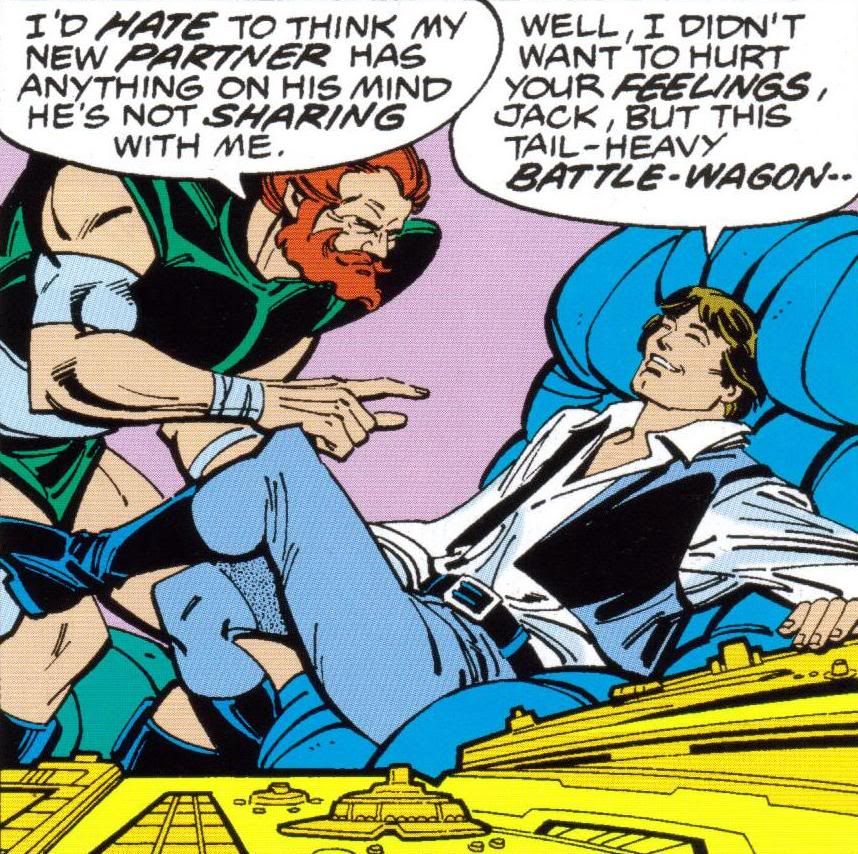 He likes to wear Juliet Prowse's (no relation to Dave) used leotard he bought off Ebay.
Who are you to judge? Crimson Jack will beat you to death with his mighty lumberjack beard.
Crimson Jack (first appearance Star Wars #7): A red-haired, bearded bear of a man, a space pirate who struts about wearing what appears to be a dance leotard or some kind of body suit, plus folded down buccaneer boots. With his physique, his crew of hearty cutthroats and an entire Imperial Star Destroyer at his command, are you going to mock his sartorial choices? I'm sure not. When Han Solo leaves the Rebels to return to Tatooine and pay off Jabba the Hutt (remember that reward he got in the first movie-- a reward so large, he had to load it onto the Millenium Falcon in several crates?), it doesn't take Crimson Jack long to show up and rob Solo. What a humiliation. All that money, lost to a guy who wears Danskins.
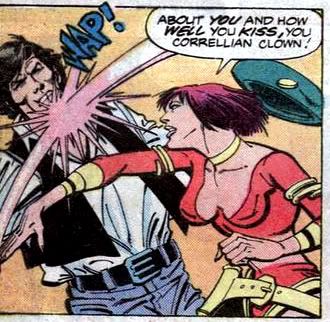 Misandrist fashionista, somewhat competent space-pirate Jolli shows
Han Solo what the five fingers said to the face. All because she suddenly feels
sexual attraction for the first time after being raised by a pack of violent criminals.
Jolli (first appearance Star Wars #7): Crimson Jack's right-hand woman, Jolli is equally as scantily clad. She favors a big green beret, a yellow choker and a red two-piece bikini. Plus a couple of blasters in yellow holsters strapped to her hips. With her quick temper and itchy trigger finger-- plus purple pageboy haircut-- Jolli makes a formidable foe for Princess Leia and Han Solo. At first eager to kill Han, Jolli finds herself conflicted between feelings of murderous rage towards the entire male gender and desire for that one roguish Corellian in particular thanks to an offhand remark by Leia regarding Solo's kissing prowess. This leads to an amazing scene where Crimson Jack has to stop Jolli from killing her fellow crewmembers, because as she says, "Just because a person talks about something doesn't mean she's ready to go at it!" Poor Jolli. Her sexual awakening comes surrounded by a bunch of crusty, unsympathetic space jerks and they're all she has to unburden herself to! She's so embarrassed explaining her outburst, she slaps Solo.
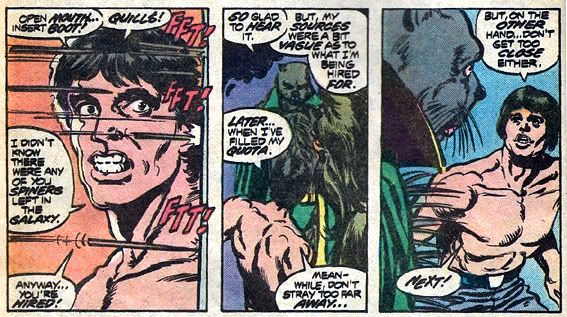 Overture, curtain, lights/This is it, the night o' nights/No more rehearsing and
nursing our parts/We know every part by heart... Han Solo enters the
Friz Freleng Zone.
Hedji (Star Wars #8): Solo's first recruit for his mission to save a small village from bandits is Hedji, a tall purple porcupine with buck-teeth. Hedji can shoot his quills with deadly accuracy, much like James Coburn and his switchblade in The Magnificent Seven. I remember when I was 9 years old, sitting in the darkened theater marveling at the science fantasy world unreeling before my wide eyes and thinking, "What this story needs are more anthropomorphic woodland creatures right out of Looney Tunes and Merry Melodies." Little did I know we'd get not one but two of them in short order, thanks to comic scripter Roy Thomas!
Jaxxon (Star Wars #8): A green bipedal bunny of the "lepus carnivorus" species. Others have already described him at length, so I don't need to go into him here except to note writer Archie Goodwin later gave him a couple of foils named Dafi and Fud.
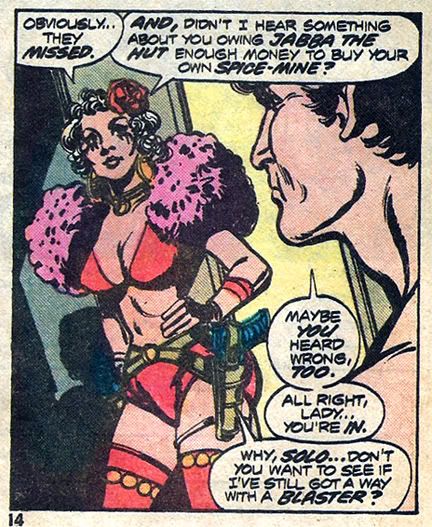 Another strong yet scantily-clad female. You don't mess with Amaiza, who is so
obviously a Howard Chaykin-designed character.
Amaiza (Star Wars #8): It seems every woman in the Star Wars universe not named Leia goes around flashing flesh. Amaiza is the former leader of the Black Hole Gang and wears a red bra with pink fur shoulder trim and matching panties along with red thigh-high heeled boots. With a rose in her silver hair, Amaiza is another woman-- like Jolli and Leia-- with whom one definitely should not trifle. She wields twin blasters and a sharp tongue, the latter of which leads to one of the more memorable quips in the book, courtesy writer Thomas. When Solo asks her, "Did anybody ever tell you that you talk too much?" the wickedly witty Amaiza replies, "One guy... once. Last I heard, his widow was living it up on Bestine with his death benefits." And she apparently has cat eyes for some reason.
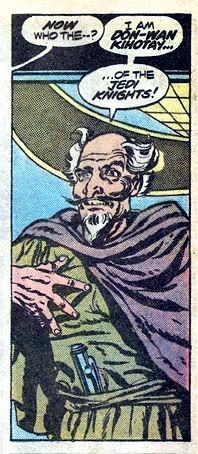 I'm just happy he's not brown and furry, named Don-Wan Coyote and enjoys catalog shopping for overly complex mechanical devices he uses in various failed attempts at catching a fast-moving avian creature.
Don-Wan Kihotay (Star Wars #8): Thomas loves to borrow stories and characters from other sources, many of which are actually appropriate to whatever story he's telling. Don-Wan Kihotay is an obvious swipe of Miguel de Cervantes's famous literary creation, plugged into the plot from Shichinin no Samurai by way of The Magnificent Seven. Thankfully, he's fully clothed, first in Jedi robes and later in what appears to be a suit of 15th century European jousting armor, complete with a lance. With his bald head, disheveled gray hair and long van dyke beard, he's the very image of classic portrayals of Don Quixote.
 As you can see, Jimm is easy to mistake for Luke Skywalker. In fact, I made that
very mistake the first time I read Star Wars #8 and #9 as a child... and it infuriated me!
Freckles? The wrong costume? No chin dimple? Who is this guy? Now I know. Adding
to the confusion, his real first appearance is in Star Wars #7 where he's a middle-aged
Asian man wearing green monk's robes!
Jimm, the "Starkiller Kid" (Star Wars #7/#8): Jimm is a young farmer who looks like a freckle-faced Luke Skywalker wearing a bucket hat with goggles. He's even stolen Luke's farmboy outfit of a karate gi, trousers and puttees. Jimm has such a Luke Skywalker obsession, he's nicknamed himself after Luke's original surname. It's a good name, so Thomas must have figured he might as well get some use out of it. He's young and inexperienced and reminds me of the Schofield Kid from Clint Eastwood's masterful Western Unforgiven, but really the impetuous kid character is timeless. There's one in Shichinin no Samurai, and then there's Luke himself. In #10, Jimm drops the Luke-pants for a woman's white one-piece swimsuit with a wrap-around bodice and some matching motorcycle boots. Later arrested for impersonating Luke and defrauding a Manhattan art dealer and his wife out of thousands of dollars.

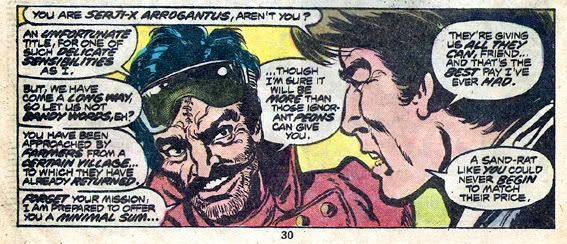 His name and appearance are based on Mad and Groo artist Sergio Aragones. With affectionate humor one would hope! And don't worry-- those stitches will be out and his scar completely healed by the very next issue.
Serji-X Arrogantus (Star Wars #8): The bandit leader Solo and his ragtag group must defeat in order to save Jimm's village. This is a guy with a luxurious mane of jet-black hair and a magnificent handlebar mustache. Plus stitches running in a nasty slashed line down the middle of his forehead, although those vanish by the time he makes his second appearance. The Arrogantuses were always known for their fast healing. As villainous as he is arrogant (hence his surname), Sergi-X sports a double-breasted leather jacket with puffy shoulders and a sunburst emblem on the chest. He also slings a couple of space six-shooters he keeps in a wide, double-holstered gunbelt. Then for some reason, he accessorizes with actual spurs on his cowboy boots. Despite looking like an escapee from a spaghetti western, Serji-X leads the Cloud Riders, a gang of vicious desperadoes. He provides some generic menace and survives about as long as he deserves.
Merri (Star Wars #9): A blond teenaged girl who-- because, once again, her name isn't Leia-- runs around her imperiled village wearing nothing more than a bikini swimsuit. Han, who is probably twice her age, acts more than a little creepy around Merri, gazing at her and declaring, "Maybe this is a place worth saving after all." Turns out she's Jimm's girlfriend, and views Solo as more or less a grandfatherly presence in her life. She does thank him for "[B]ringing out the man in the Star-Killer "Kid!" Han rides off on a bantha, moping but consoling himself for his near-miss at sex offender status by musing that he "got a little feeling of what it's like-- --to be a Jedi Knight!"
Governor Quarg (Star Wars #12): The obese ruler of a ship-dwelling society of scavengers on a water planet. He wears what appears to be a WWII-surplus army helmet complete with camo-netting, a ragged Napoleonic-era field marshal's jacket and an ermine-trimmed king's robe.
Valance (Star Wars #16): A bounty hunter with wavy brown hair going gray just above his ears and a weathered, lived-in looking face. He runs around in a bulky suit of blue armor emblazoned with a small white skull on the right chest. A nasty customer created by Archie Goodwin and illustrator Walt Simonson, Valance turns out to be a cyborg-- his secret revealed in in the final panel of his debut story, a gruesome portait of a man with torn skin hanging down over one of those T800 Terminator endoskeleton thingies. He's a tough guy, but he makes the same mistake a lot of readers probably did: at first glance, he mistakes Jimm the Starkiller Kid for Luke Skywalker. Only a true jerk would do such a thing!
Commander Strom (Star Wars #18): The Imperials were always very Nazi-like and Strom makes it official-- he's basically a refugee from a 1940s war movie, complete with a German word for a surname. He's got an Erich von Stroheim-type bald head and the stiff Prussian attitude of a true stereotype. But what more could you ask of your basic Imperial officer antagonist? All he has to do is show up, sneer a bit and strut around in his jackboots. Practically writes himself!

Senator Greyshade (Star Wars #18): An older, still quite virile-looking gentleman, his iron-gray hair cut and combed into 1970s winged style, with a pencil-thin mustache for extra sexiness. He likes to parade about in an orange space leisure-suit with a high-collared black vest. But instead of a disco medallion and an open-front tunic with chest hair spilling out, Senator Greyshade goes the more dignified route of donning simply a gold sunburst at his collar, which is alternately crew- or turtle-necked depending on which panel you're looking at on any given page. Make up your mind, Greyshade! Princess Leia's former senate rival, Greyshade now runs a giant orbiting gambling resort known as The Wheel. Since his casinos provide the Empire a great deal of revenue, Greyshade feels confident enough to insult Commander Strom openly, mocking him as a "military man... and a fool!"
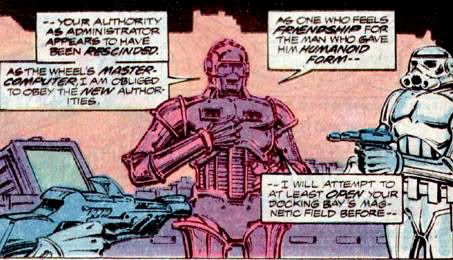 Master-Com was known for frequently holding one-sided conversations with
his own conscience. He claimed it helped him "make decisions and work my way
through difficult thought problems. As opposed to drinking myself into a stupor like you
loser meatbags."
Master-Com (Star Wars #18): Senator Greyshade's personal assistant, a brawny-looking droid. Master-Com is the ambulatory control system of The Wheel itself. He and Greyshade are such good pals, it freaks out a bunch of stormtroopers and they react... violently. Doesn't much matter to Master-Com; he's got a lot of spare bodies lying around The Wheel.
Jorman Thoad (Star Wars #25): A heavset bald man in a blue tunic and red cape and the personality of a flamboyant used car dealer-- fitting, since he's a used spaceship dealer. Different galaxy, same thing. He trades ships with Luke and Leia on the planet Centares, allowing them to ditch Senator Greyshade's yacht (something tells me the Senator won't be needing it anymore anyway), then tells them some important information. His most significant physical trait is that his head looks about to pop, like a big pink zit. Thoad really should have that checked out.
Baron Tagge (Star Wars #25): A wealthy galactic entrepreneur and asshole-for-all-seasons, Tagge (with his severe widow's peak hairstyle and triangular chin decoration-- a substitute for the goatee he can't grow?) loves to practice with a lightsaber. Why does he do this? Because Darth Vader blinded him. Now Tagge has to wear a pair of Devo glasses to hide his eerie iris-less eyes. When we first meet him, Tagge is using his mining operations as a cover for his combat strikes against the Rebel base on Yavin IV. And why does he do this? For the petty motivation of showing up Darth Vader. Well, maybe making a fool of the guy who took your sight isn't such a petty excuse for acting like a fascist goon. Just don't let Luke Skywalker anywhere near your-- TOO LATE!

Skinker (Star Wars #27): Yet another bald bad guy! I'm beginning to think Goodwin and Infantino have it in for us hair-impaired people. Perhaps jealousy because we are indeed quite sexy. Skinker is one of those guys who was either unfortunately and presciently named by his parents, or else came by his creepy handle after a lifetime of double-dealing and shady activities. But what he lacks up top, he's cultivated on his chin-- some kind of silver fringe that makes him look as if he's been eating the tinsel out of the Christmas decorations box. Skinker runs a scrap yard on a backwater planet, but also works for Valance. Every time Valance comes into a little money, he pops over to Skinker's, buys whatever droids the guy has lying around-- then blasts them. The man loves to blast droids, and Skinker doesn't seem to mind; Valance pays the going rate and it saves the junkman from having to fix them up. I call that win-win.
Tuesday, May 10, 2011
Star Wars Omnibus: A Long Time Ago.... Volume 1: A Comic Review
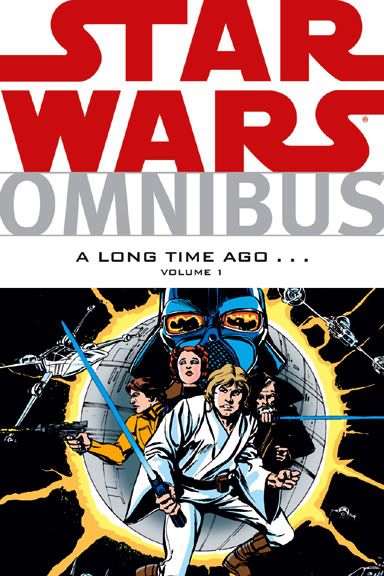 Star Wars Omnibus: A Long Time Ago.... Volume 1
 Publisher: Dark Horse Writers: Roy Thomas, Don Glut, Archie Goodwin, Mary Jo Duffy Artists: Howard Chaykin, Carmine Infantino, Alan Kupperberg, Herb Trimpe, Allen Milgrom, Walt Simonson, Steve Leialoha, Rick Hoberg, Bill Wray, Frank Springer, Tom Palmer, Bob Wiacek, Terry Austin and Gene Day
Despite being-- like most of my friends-- a complete freak about all things Star Wars in the late 1970s, I rarely bought the Marvel comic series unless they were doing an adaptation of one of the movies. I'm pretty sure the only complete storyline I owned from this title was a small black and white paperback of the first six movie-based issues from Ballantine, which I began coloring with Crayolas and markers. My impressions of the Marvel version of George Lucas's creation are strobe-like glimpses of random moments in any given plot. Who's this guy who wasn't in the movie? How did Luke get to this planet? Where's Darth Vader? Why is Han hanging out with a giant green bunny, who's something of an asshole to boot?
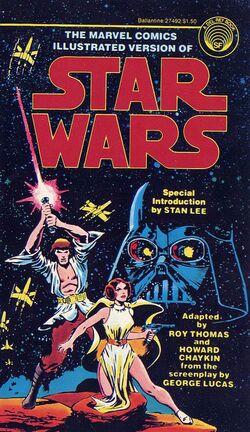
Face it, few of these early stories are classics. This volume showcases Roy Thomas's skills in adaptation and pastiche, but also his taste for the silly. He immediately casts Han Solo into the Takashi Shimura role in a comic book version Kurosawa’s classic film Shichinin no Samurai (That's The Seven Samurai to you and me, Russ), with Han and Chewie recruiting some fighters to help space-villagers fight space-bandits. Or maybe it's The Magnificent Seven, but with a porcupine guy instead of James Coburn's knife fighter. Considering how much Lucas borrowed from Kurosawa, Thomas has the right idea. But he can't resist introducing Bugs Bunny into the mix. Meet Jaxxon, the infamous green rabbit. Roughly as popular as the reviled Jar Jar Binks, but mercifully obscurer, Jaxxon never got any screen time in the prequels or any of the spin-off animated series, and neither Kenner nor Hasbro ever produced him as an action figure.

Other Thomas touches include Don-Wan Kihotay, a straight lift of Miguel de Cervantes’s famous creation and a villain named Serji-X Arrogantus, apparently an affectionate parody of artist Sergio Aragones, complete with Aragones's magnificent black mustache. What kind of name is Arrogantus? I know the various Darths often chose wicked-sounding surnames-- Sidious, Maul, Vader-- in order to frighten. But what else could someone named Arrogantus become other than a throwaway creep in a hastily written comic book? What kind of family could he have come from? Still, Thomas's script for the movie adaptation is filled with punchy descriptions and clever ideas like the explosion that destroyed the Death Star taking days to burn and providing a spectacular if temporary tombstone marker for Grand Moff Tarkin's great failure. If George S. Patton was right and fixed fortifications are monuments to the stupidity of man, so then are giant space stations with unshielded exhaust ports.
Plus I have to give him credit for another cool idea. At issue #6's conclusion, Thomas corrects one of George Lucas's most egregious mistakes (prior to conceiving and producing the prequel trilogy, that is) and prefigures MTV’s efforts by twenty years when he mentions in a caption that, yes, Chewbacca will also receive a medal. Hayden Christensen and Natalie Portman, unfortunately, are beyond repair.
Second scripter Archie Goodwin's settings and situations owe more to Flash Gordon, with an appropriately swashbuckling feel. Goodwin has Luke visit an all-water planet to hang out with a young Kevin Costner (inspiring Costner's notorious 1995 flop Waterworld) and sends the whole gang to an orbiting satellite of casinos that would make Futurama's Bender drool if he were programmed for that sort of thing. And so it goes for the rest of this volume. Star Wars characters sort of cut and pasted into comic book plots lifted from all the familiar sources.
Since there were no “Expanded Universe” tales or overall continuity to these adventures back in 1977, the Marvel writers were free to make up all kinds of wild characters, planets and situations. Besides the ridiculous Jaxxon and the amusing Serji-X, there's a cool and conflicted bounty hunter named Valance with a hideous secret, bald Yul Brynner impersonator Commander Strom (an evil Imperial officer), roguish Senator Greyshade and his pal, the chunky droid Master-Com. My favorites are Crimson Jack, the pirate king who commands a stolen Star Destroyer, and his first mate Jolli, the tragic, man-hating ass-kicker with a purple pageboy haircut and a cute green beret. These two repeatedly bedevil Han Solo.
Howard Chaykin’s art in the first issue is shaky and rushed, but things improve rapidly with fine ink work from Steve Liealoha and Tom Palmer. As a kid, my favorite was the issue featuring the Death Star attack. Assisting Chaykin are Rick Hoberg and a pre-Ren and Stimpy/fine art Bill Wray-- as the X-Wings and TIE fighters zip and zing (and explode), the ink team goes nuts with the feathering and cross hatching. They also fix Chaykin’s likenesses so Han looks more like Harrison Ford and Luke looks less like a middle-aged Kirk Douglas with a California surfer cut. I used to love the artists' depictions of the reflections in the rebel pilots’ goggles and the final panel of all the heroes together at the awards ceremony.
Most of the art in this volume is by the legendary Carmine Infantino, inked with an almost mechanical cleanness by Terry Austin and then more organically by Gene Day and Bob Wiacek. I did not dig Mr. Infantino’s angular, stylized faces and heroically proportioned figures (Han and Luke put Arnold Schwarzeneggar to shame) when I was a 10 year old, but his art has aged much better than most of the stories it supports. If you can get past such bizarre scenes as Han and Chewie floating around in space and Chewie’s orange monkey face, you’ll find page after page of vigorous storytelling. While his facial expressions and body poses aren't subtle, Infantino excels at putting figures into motion and depicting action, and both Thomas and Goodwin make sure he has plenty of that to draw. Fisticuffs and light sabre battles abound, plus giant sea monters and space dogfights. All those spaceships must have been real bastards to draw, too, but Infantino and the rest don't scrimp on the machinery and planetary vistas. Like Chaykin before him, Infantino goes “off-model” quite often, but his art here is dynamic and fun. That's what matters most. I’d rather see artists like Chaykin and Infantino adapting a property to their strengths rather than relying on tons of photo reference and ending up with a lot of static tableaux. Al Williamson (who apparently did use a lot of photo reference and even traced them at times) and Michael Golden were more natural fits for Star Wars, but I’ve really come to appreciate Infantino’s Marvel-ized approach as well.
While this reprint volume’s dimensions are smaller than the original comics, it’s attractively designed, impressively fat and reproduces the original colors by Marie Severin, among others. I paid less than 17 dollars for my copy via Amazon.com, which means with 27 issues, more than 500 pages-- and considering just how enjoyable these wacky, more than likely out-of-continuity stories are-- this Omnibus book is a bargain. I’d love it if Dark Horse got the rights to publish some of Marvel’s other licensed properties if they did them exactly like this. Come to think of it, Dark Horse is an amazing source of classy reprints—they’ve got old Gold Key titles, Nexus, Creepy and Eerie coming out in expensive hardcover formats as well as fat black and white collections of Savage Sword of Conan. And these chunky little Star Wars books that will make you want to pull out your vintage Kenner toys and head to the backyard.
Or create a custom Jaxxon action figure.
Subscribe to:
Posts (Atom)