Showing posts with label Marvel. Show all posts

Tuesday, September 24, 2013

X-Men #94: Nefarious Nefaria and how he blew a fortune

X-Men #94 (August 1975) was the first X-comic I owned.  A friend's mother worked for a regional magazine distributor and he got the leftovers.  This kid had piles of comics in his room, but he kept the X-Men issues in a cabinet in the living room for whatever reason.  Probably anti-mutant bigotry on his part.  After all these years I can't remember why he decided to sell some comics to me that day, nor can I remember why I wanted to buy them.  I liked comics, knew the difference between Jack Kirby and Alex Toth, loved Joe Kubert's art and had already discovered Al Williamson.  I just don't remember being comics crazy, but I was a junior high sequential art connoisseur of sorts because I loved drawing.

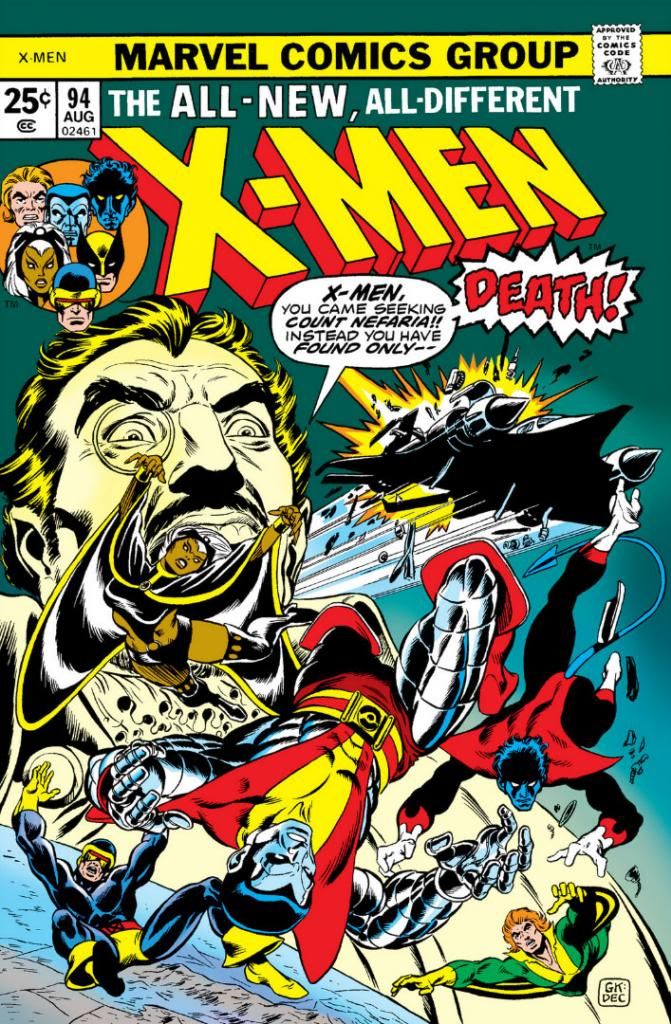
So years later, I'm going to claim it was the Gil Kane/Dave Cockrum cover that caught my fancy.  Even now, this cover impresses with its high (literally) drama and contorted heroes hurtling earthward to their deaths.  Well, except for Banshee, who seems to be flying to the rescue.  Poor Storm has completely forgotten she knows how to ride the winds-- and note Wolverine and Thunderbird don't even rate appearances!  Even without those two adding to the excitement, it looks kind of like Count Nefaria (the guy with the giant white head) is barfing mutants.  That characteristic Kane up-the-spout shot of Nefaria's face influenced the heck out of me for the next few years and I drew noses from that angle blacked in so I wouldn't have to work out the difficult low-angled perspective of the various nasal planes.  It seemed an elegantly simple solution to a drawing problem that had me stumped.  And you absolutely cannot beat the energy of Colossus in the foreground, boldly sporting primary colors of red and yellow.  Barfed or falling, that figure practically bursts from the picture plane and lands in your lap.  I probably bought the comics because I wanted to draw this particular cover.  I still do.  Good gravy, I love me some Gil Kane! 

My friend and I worked out a little deal where I paid him all the money I had in my pocket with a promise for more.  I think the original deal was supposed to be twenty bucks for a stack of books that, amazingly (or uncannily, if you will) included the first five or six issues of the "All-New, All-Different" X-Men.  In the end, I forked over a grand total of fourteen dollars and  the use of my left-handed baseball glove in P.E. a couple of weeks later.  By the time my pal and I completed the transaction on that long-ago spring day, I was in completely in goo-goo-ga-ga love with comic books in general and X-Men in particular.
 
Enough biography.  Let's read!

"The Doomsmith Scenario" introduces us to a man who has access to a matter transporter (maybe he invented it; the story never says where it comes from) and has also used some kind of genetic technology to mutate humans into anthropomorphic animal weirdos (which, admittedly, is a process that has fewer immediately-apparent practical applications).  Rather than launch a second Industrial Revolution by transforming the travel, transportation and medical industries and reaping billions, if not trillions, in ongoing profits, all he can think to do with this technology is invade a military base to hold the world hostage for a one-time payoff.  Granted, that involves each nation paying as much as it's capable, but it's still taking a huge risk versus a guarantee of unprecedented wealth if he just patents his tech and sells, sells, sells.


His name is Count Nefaria, and he is one of the most visually boring antagonists I’ve ever seen.  I believe these days he's some kind of immortal energy being, but when this book hit the spinner racks, Nefaria was just a goateed twerp in a suit with a ruffled shirt and evening cloak, a second-rate Bela Lugosi impersonator.  Off-the-rack, ready-to-wear, one-size-fits-all villainy.  His name essentially means Count Bad Guy, just to further illustrate how little effort went into his creation.  We can argue that dumb names are a hallmark of ol' Marvel.  I certainly will... Doctor Doom.  But to look at the magnificent Doom is to understand Nefaria's generic quality.  The Avengers dealt with the Count in #13 (February 1965) of their own book-- the synopsis of which makes the story seem completely interchangeable with just about any found in other Marvel team titles of the era-- and the unfortunate X-Men get stuck with him in the first regular issue of their revamped title. 

Our kid Nefaria and his Ani-Men invade Valhalla Mountain, home of NORAD’s super-sensitive defense center.  Despite looking like refugees from a line of He-Man knock-off toys, the Ani-Morphs or Ani-Men (one of whom is female, by the way) quickly subdue thousands of armed soldiers and military police who don’t simply shoot them on sight. 

The Ani-Men have the advantage of surprise for a few minutes, plus they're fast and strong.  That's more than enough to defeat the first bunch of uniformed slackers.   After that the entire base is on alert, yet the troops commit themselves piecemeal and not one soldier or airman gets off a shot despite being armed to the hilt.  They don't even try to shoot.  They must have been trained to use their rifles as clubs, and badly at that.  After this inexplicably incompetent response by our armed forces, Nefaria gasses everyone else to sleep.  It's just that easy for our tuxedo-wearing criminal genius.  I understand that in 1975, our armed forces were doing some serious soul-searching as the country emerged from the prolonged humiliation of the Vietnam War, but even the Mayaguez incident had a more satisfying military conclusion than this Nefaria deal. 

Of course, if we closed this plot hole we'd have a five page story where the X-Men watch a news report about a strange incident where Nefaria and the Ani-Men died in a hail of gunfire, and the rest of the comic would consist of pre-Thor Journey Into Mystery reprints.  That would never do, so the men and women guarding the United States' most important and secure military installation allow themselves to get their asses handed to them and, with the Avengers conveniently shelved, it’s up to our new X-Men to fly in and try to save the world.

Which they eventually do, but not before Cyclops spends an entire night roaming the halls of the mansion and bellowing his despair to the world, the original X-Men say a tear-filled farewell and a training montage where Thunderbird injures himself and Cyclops plays drill sergeant.  Since Chris Claremont takes a little time in his dialogue and thought-balloons to give both men clear motivations for what they do and how they act (Thunderbird is insecure, Cyclops is seasoned professional who has seen too many deaths and injuries in his time), the conflict between them works better than the seemingly random arguments that plagued Giant Size X-Men #1, where characters sniped at each other on practically every page and with no good reason.  It also pays major dividends in X-Men #95, but that’s a story for another day.

Penciller Dave Cockrum already had experience with group books, having worked on stories featuring the Legion of Superheroes in Superboy over at DC, and he co-created Nightcrawler, Storm and Colossus for this book.  Oh, and he drew the aforementioned Giant Size.  You'd imagine drawing a living island would tax a guy's creative faculties.  Not Cockrum's.  And here?  Wow, the man just absolutely cuts loose.  He must have wrecked his drawing hand filling panels with detailed backgrounds-- his Valhalla features a gargantuan situation room with elevated walkways between digital maps that must be hundreds of feet high to judge by the teensy-tiny antlike figures teeming all over. 

I remember being especially impressed by the training sequence and a collage-like one-page panel centered around Cyclops’s giant shouting head.  I copied that head line-for-line on notebook paper dozens of times over the next few years, always hoping to glean those Cockrum art secrets.  With the fine-lined inking of Bob McLeod giving the figures a bit of roundness and generally introducing a little bit of a Neal Adams-vibe, Cockrum's dynamic art dazzles.  It's pretty.  I mean, X-Men #94 has some of the prettiest art of its era.  I look at it and I feel joy.

Part of that joy comes from the absurdity of it all.  The first half of this book tends towards the talky, which leads to what I think of as a very fun kind of dissonance, like having a company of acrobats in spangled costumes perform Arthur Miller.  At one point, angry Japanese hero Sunfire scolds Professor X starting in the X-Mansion living room, but concludes his rant thousands of feet in the air above it.  All alone.  Well, the Professor is a telepath, so he probably read Sunfire's thoughts or something.  When Dave Cockrum provides the acrobats at least you’re getting a primo Cirque du Soleil version of Death of a Salesman.  Come to think of it, I’d pay good money to see that.

Since these are by far the best and most entertaining parts of the book, I kind of get the idea Chris Claremont would have been content to have his characters actually hang out around the mansion and watch Nefaria die a pathetic death on television while carrying on various conversations about their feelings and why they're sticking with Professor X.  Cyclops may look a little ridiculous expressing his essential dilemma, but at least Claremont gives him one.  All these years later, it's easy (and fun!) to parody Chris Claremont's more precious elements (many have, including this blogger) which would eventually overwhelm the book, but the man knew how to invest his audience in the characters and their dilemmas in a way that obsessed readers as never before.  When I was 14 years old, I was more emotionally involved in Kitty Pryde and Dani Moonstar than I was in the flesh-and-blood kids of the same age surrounding me at school, and Claremont made it good to feel that way.

But oh yeah-- superheroics!  Let's get back to Count Nekot Wafer.  After the tearful goodbyes and character-building, the X-Men finally get the call to action.  With almost all the pages already used up, the story ends on a cliffhanger, the X-Men falling to their apparent deaths as the result of a “sonic disrupter” Count Nefaria finds in Valhalla’s arsenal.  A sonic disrupter is a magical death ray that can disintegrate a supersonic aircraft but leave its passengers intact.  Pretty selective!  And yet we had to settle for a tie in Southeast Asia.

You can’t tell me any country that can produce a weapon like that and surround it with thousands of armed troops is going to tumble its nuclear warfare nerve center to a ragtag group even Dr. Moreau would discard as failures.  Then again, what is Marvel paying all its mutants for?  We’ve got the colorful suits, we’ve got Colossus and Storm and Wolverine.  Might as well use ‘em!

Monday, August 26, 2013

The Amazing Re-colored Spider-Man!

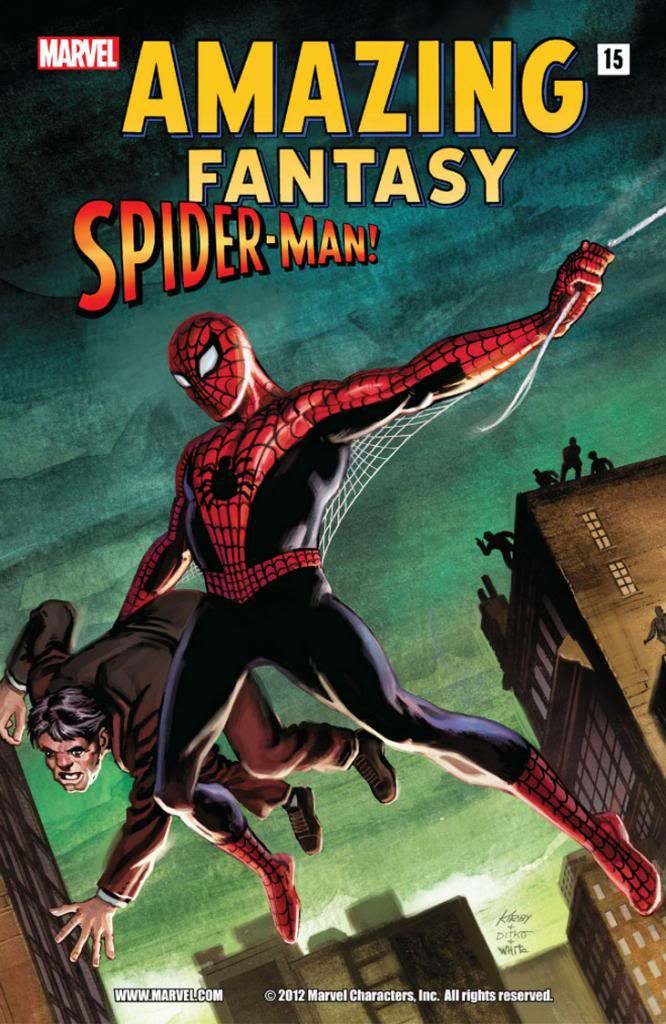
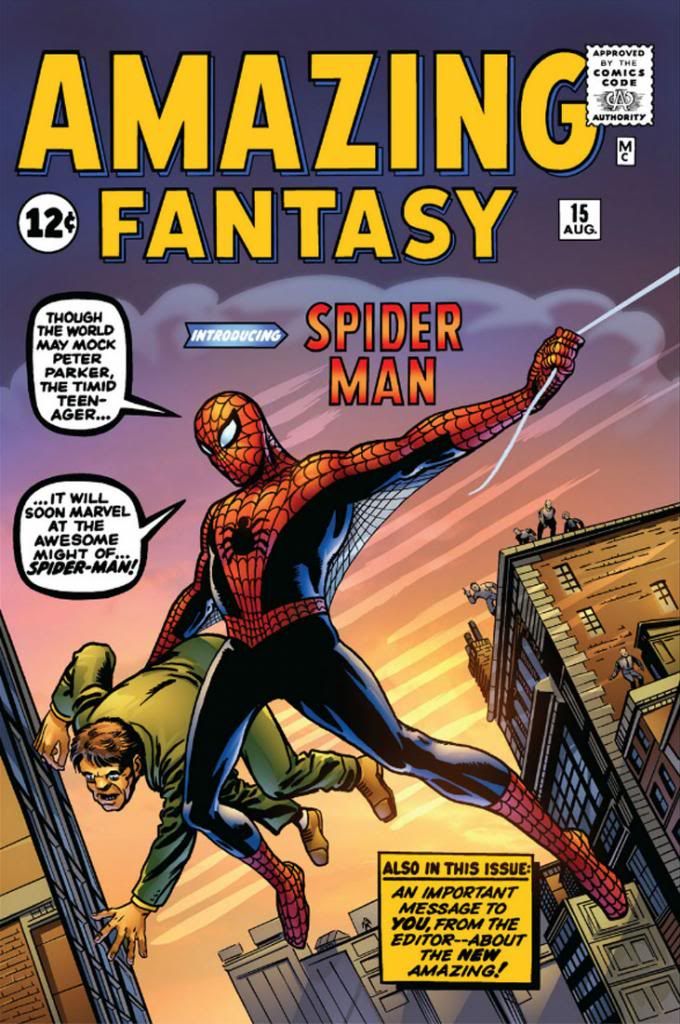
Here's the book that started it all. Sort of. While Fantastic Four was the book that inaugurated the "Marvel Age" of comics, Spider-Man was the character that became the company's Mickey Mouse. As we all know, Spidey bowed in Amazing Fantasy #15 (August 1962), which had formerly been titled Amazing Adult Fantasy, which sounds like a shop that sells sex toys and latex lingerie. Weirdly, #15 wasn't merely the debut of Spider-Man; it was also the final issue. The Amazing Spider-Man came next and ran for decades until Marvel killed it in favor of whatever it is they're doing now. I don't know, I don't wanna know. I do know this...


Painted Amazing Fantasy, huh? What about the original line work?


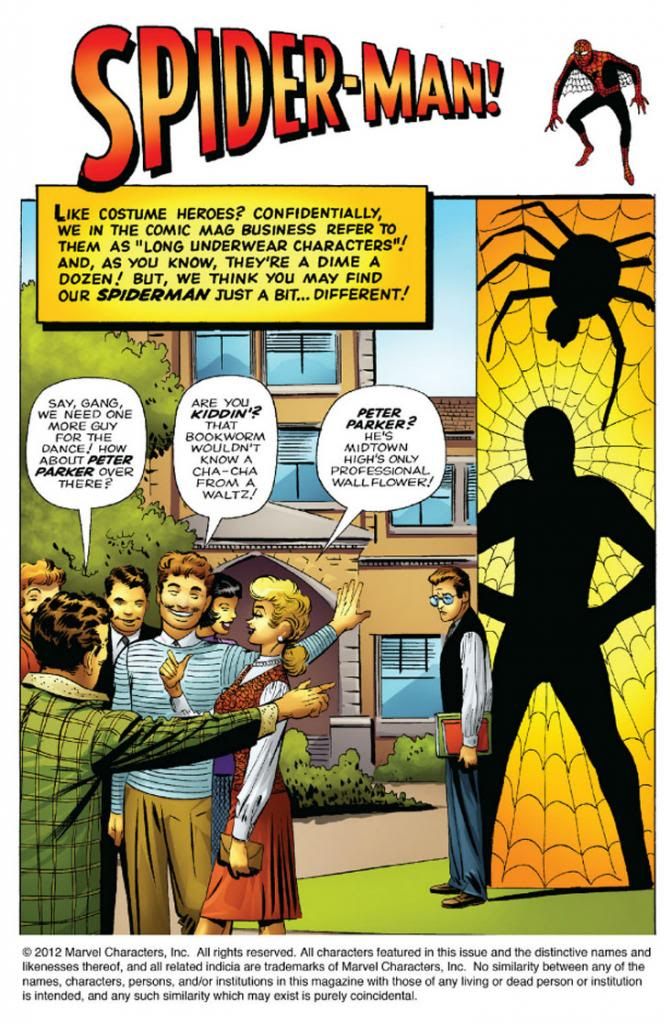
Recolored, by gum!  Did they do the same for the interior art?


Yep!  This isn't the worst recoloring job I've seen, but it's a bit too intense and the computer-generated smoothness of the gradients and color modeling (to create an illusion of roundness and depth) doesn't mesh with Steve Ditko's rough hewn finishes.  Ditko's treatment of anatomy was expressionistic and unique.  He wasn't trying to recreate the world in any kind of photorealistic way.  It's better to just leave it alone rather than try to interpret it with a lot of extra tones where you can only conflict with it or else muddy it up.  We also don't really need some latter-day color artist's impression of an artistic treatment of foliage in the trees.  Big open areas were good enough for Ditko; they're good enough for you.

On the other hand, just because something was originally printed with 100% magenta/100% yellow* to make red, or 100% red (depending on the inks used-- I worked for a newspaper that ran cyan, magenta, yellow and blue in its four-color printing process, but some substitute true red in there, and you have to adjust accordingly) doesn't mean the reprint has to follow suit.  When Marvel's reprints do that, on glossy, slick paper, the end results are often hideous, from the early days when color palettes relied largely on primary and secondary colors and even on material from the mid- to late-1980s, when the company's colorists apparently had a love affair with magenta, purple and big untouched areas.

The old schoolers needed that intensity because the paper was low-grade newsprint.  The press workers don't seem to have put much effort into registering the plates, so you ended up with floating reds or yellows or blues and characters with apparent milk mustaches.  Or pages that looked as if they were intended to be read with 3D glasses.  The paper wasn't even white.  It was slightly gray, and it yellowed or browned pretty quickly in direct sunlight.  Marvel covers from the time tend to flake or chip, as well.  These comics weren't intended as museum pieces or to compete visually with National Geographic.  Steve Ditko probably had no idea people would still be reading this book more than fifty years after he drew it, much less on archival paper or digitally.  Who could have foreseen that?

Well, now that we're reading comics on computers we're free from all those limitations.  But companies with deep back catalogs need to balance the sweet nostalgia of the historical with the flaw-fixing capabilities of modern technology.  Use naturalistic colors if you want, but mostly just try not to compete with what better artists than yourself did.  If you can't match the artist's intent, at least try not to compete with it or obliterate it.  You can make it look brand new to a certain extent, but above all, color restoration has to preserve the clarity of the original artwork.  Don't cover it up with a lot of extraneous visual noise or someone else's interpretation of anatomy or form.

Especially avoid going nuts like with some of the Neal Adams reprints I've seen in recent years where digital painting on top of the original inks has just covered them or rendered almost all the values the same--  some of those went from gorgeous to absolute mud.

*My original 50/50 formulation would have made "pure" orange, not red.  That's what being out of the game for over a decade will do to ya...

Monday, July 8, 2013

Hulk Cassidy and the Sundance Thing: The Early Days

Okay, actually it was just Butch and Sundance:  The Early Days without their surnames, but that didn't have enough of that pop culture fusion stupidity I enjoy so much (to the detriment of all my personal relationships).  And those two guys actually got along much better than the Hulk and the Thing.  The Hulk and the Thing are Marvel's two heavy hitters and their dust ups from the first few years of Fantastic Four are pure comic book fun.

First, you have the Thing.  A mouthy orange rock-man, the muscle and the ever-lovin' heart of the Fantastic Four.  The Thing was essentially nice.  Who the heck could hate the Thing?  Then, you have the Hulk.  In the 1960s, at least for a time, the Hulk had a command of language beyond simple statements in favor of smashing, or admonishments to puny humans to leave him alone.  He was an anti-hero hearkening back to Marvel's early years when they put out comics where Namor would show up pissed off for whatever reason and start tearing up the place.  Namor was the kind of dangerous character you rooted for only because he was fighting Nazis (only other Nazis root for Nazis), mad scientists or because he was like your own repressed child-id striking back at adult authority figures-- otherwise, Namor was angry specifically at you, the reader, for existing on land.  It's a similar story with the Hulk and Space Age-era Communists and outright villains.

With two opposing forces like these in a single comic book universe, it was only a matter of time before they clashed.  And clash they did in Fantastic Four #12 (March 1963) by Stan Lee, Jack Kirby and inks by Dick Ayers, from those fabled days when Kirby hadn't yet settled on the correct number of fingers and toes for the Hulk.  In this issue, the Jade Giant flaunts three of each, plus opposable thumbs for a grand total of fourteen digits.  Strangely enough, the same number sported by the Thing.  That's okay, because there's at least one instance of Mr. Fantastic showing six on one hand in a later issue.

The story opens with the Thing looking natty in a tux, out on the town with his girlfriend Alicia Masters.  Within moments, things take a tragi-comic turn as they frequently do in this old Marvel stories-- soldiers on the alert for the Hulk cause a scene, an old man accidentally pokes the Thing, the Thing reacts angrily, attracts the attention of the soldiers, there's a fight as a result of mistaken identity and the Thing is publicly humiliated once again.  Why the soldiers are out looking for the Hulk is obvious-- he's a destructive menace. But why their officers sent them out without first briefing them on what the Hulk's actual appearance is something neither Stan Lee nor Jack Kirby care to explain.  And if being mistaken for a green monster in purple pants isn't pathetic enough for our orange monster in blue pants, the Thing also forgets his key to the Fantastic Four's special elevator and has to climb up the cables to get home.

None other than General "Thunderbolt" Ross (oddly appearing in an army uniform rather than one from the USAF) then comes to the Baxter Building to recruit the team to fight the Hulk for him.  To prove the Hulk's existence, Ross screens some top secret film footage of the Hulk in action, which causes the testosterone-laden male heroes-- including ostensibly mature older genius Reed Richards-- to act out their fantasies of single-handedly defeating the Hulk, while lone female Sue Storm frets about her uselessness.  At least until the men decide she's good "for morale."  Guess the Thing isn't the only one meeting with humiliation this fine evening.

The issue features the debut of a new whiz-wagon for the gang, the Fantasticar redesigned in-story by Johnny Storm, and featuring one of the many meta-moments Lee and Kirby inserted into the book in those days-- supposedly fans of the team wrote in complaining that the old Fantasticar looked too much like a flying bathtub.  The new one is a sleek Kirby creation that gives Ross a military-industrial complex boner.  The five rocket to the western desert and fight's on.

The Hulk is actually a big green herring as it turns out-- the real villain is someone called "the Wrecker" (a likely name) who sabotages our American way of life for his Commie overlords.  I don't want to spoil the story's big secret, but the Wrecker turns out to be the guy with the membership card in a communist subversive organization right there in his wallet.  Great detective work there, Rick Jones.  This leaves the Thing wondering out loud, "Just what the heck was I fighting the Hulk for?"  No reason, really, other then the very coolness of Thing versus Hulk, Thing!  Oh, and advertising for another hero even if his own title flopped.  In their first bout, our boys seem pretty evenly matched, and it's useless Sue Storm who manages to knock out the Wrecker and save the day for everyone.  Never underestimate Sue, fellas.  The Hulk, weakened by a laser beam, gives up and slinks away to fight another day.  So after all that, we don't even get a definitive answer to the question of which hero is muscle supreme in the Marvel universe.


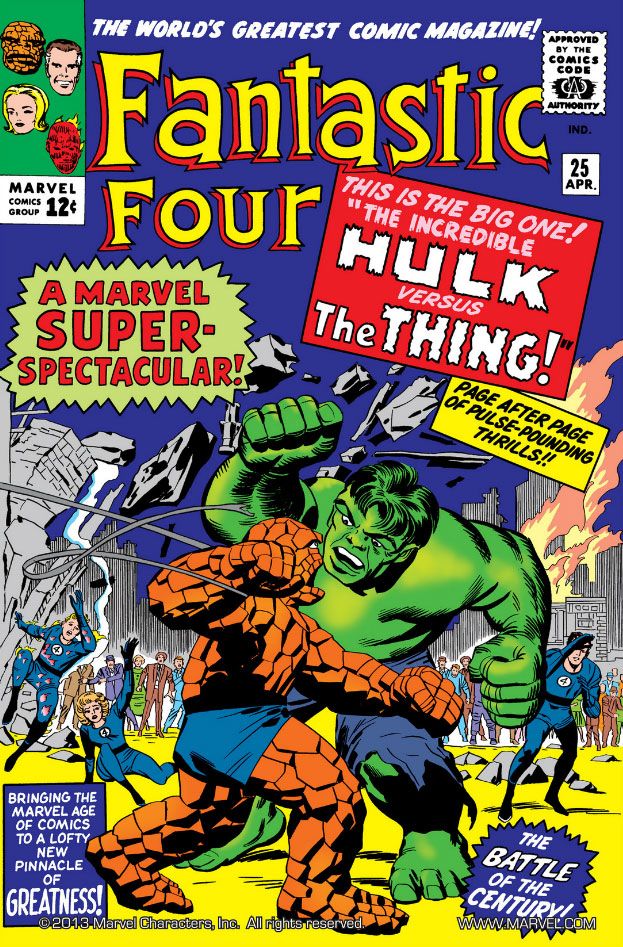
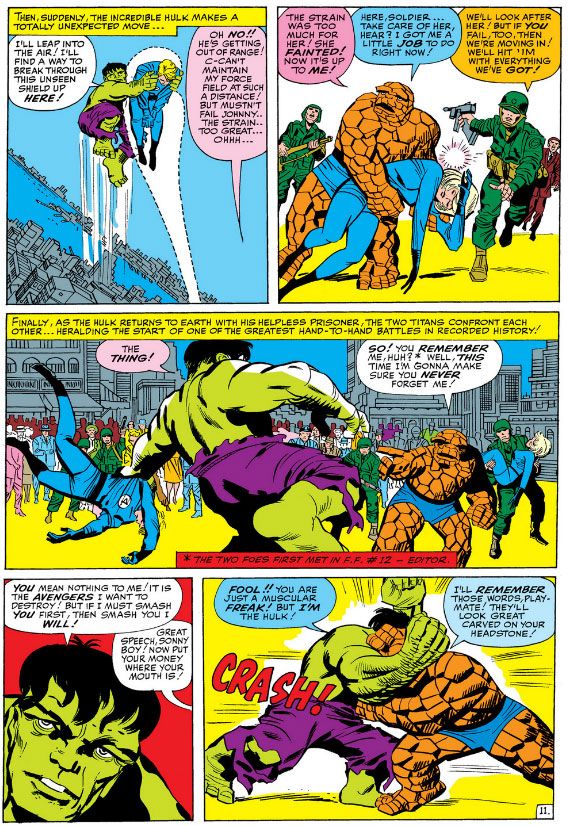
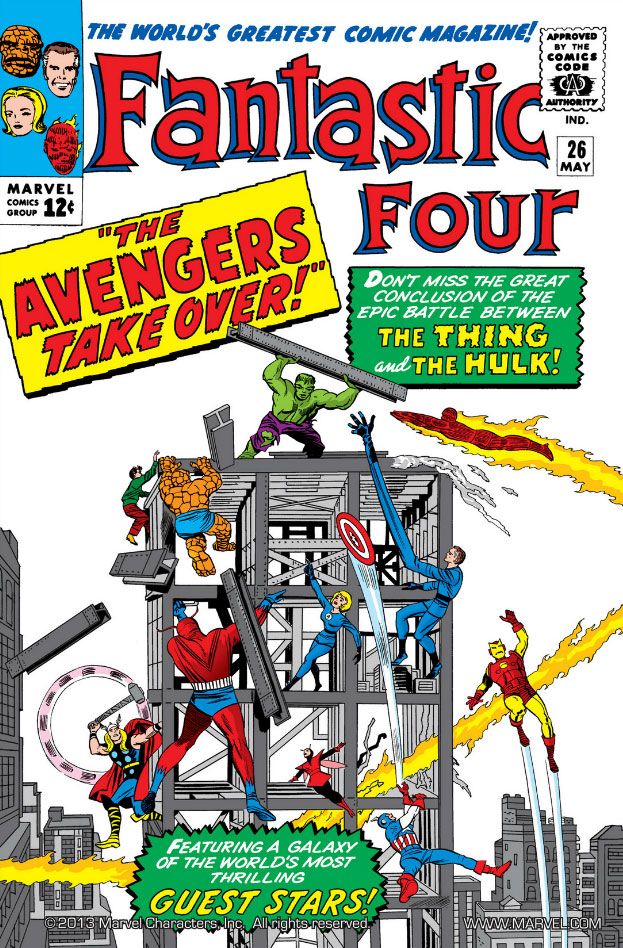
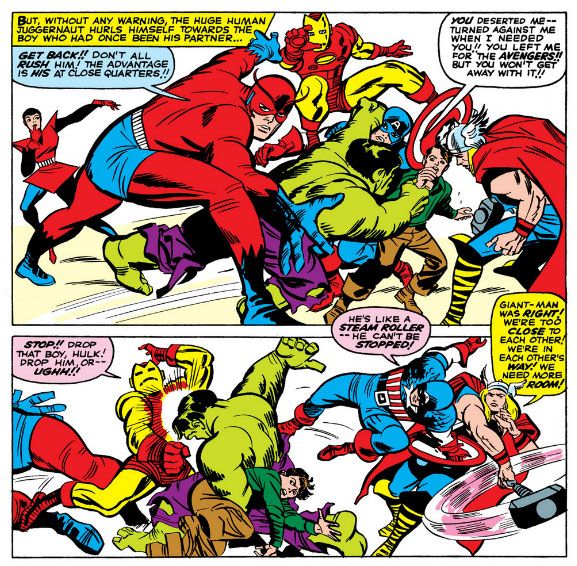
That is until a year later when Marvel published Fantastic Four #25 and 26 (April and May 1964 with George Roussos on inks this time, credited as George Bell), a story so big it sprawls over two complete issues and involves practically every other Marvel hero of the time.  I'm guessing it was Lee who crammed all the hyperbolic copy onto the cover of #25, the Man at his carnival barker's best.  This is the kind of stuff I've come to associate with the feeling of reading Marvel comics from the 60s and 70s-- a relentless barrage of overblown propaganda, indoctrinating the readers in the Mighty Marvel Mindset with phrases like "PULSE-POUNDING" and "SENSES-SHATTERING" (as if the latter was even remotely desirable).  This time the Fantastic Four don't have to go hunting the Hulk-- the big green galoot himself turns up in New York City because he's angry at the Avengers for booting him in favor of Captain America.


I can't blame the Avengers.  Who would you rather have on your team anyway-- a rational, intelligent strategist with acrobatic fighting skills and years of war-time experience, or an overly-sensitive rage-aholic with the strength to flatten entire cities?  No, you can't choose both.  Now imagine how well the Hulk takes your decision and you can see the problem this dilemma presents.  As if a vengeful Hulk weren't enough, the FF are fighting amongst themselves as well because the Thing refuses to drink Reed's newest cure for his condition-- which apparently was such a lab accident Reed doubts he can re-create it.  Shortly after that, Reed abruptly collapses into a coma and everyone is screwed.  The Hulk gives the remaining Fantastics a thorough thumping of the kind world champ Sonny Liston received from 22-year-old Muhammad Ali roughly a month before this issue hit the newsstands.  The Human Torch ends up in the hospital and Sue poops out when the Hulk's strength severely taxes her relatively-new invisible forcefield powers.  This leaves the Thing to fight alone, which he does for most of the issue until the Hulk finally grinds him down.

Never having been defeated outright before, the Thing spends a moment questioning his purpose in the world.  But he figures it out-- as a hero, his job is to take any beating necessary, even if he fails or dies as a result.  Once again, it's the Thing doing the world's dirty work, overmatched and underappreciated, a lone man against impossible odds and, unlike Liston, he decides to come out of his corner at the bell.

While poignantly scripted by Lee, this is Kirby storytelling, a moment where his contributions as a full-fledged writer-- not simply co-plotter and certainly not merely penciller-- breaks through most obviously.  You can't help but feel Kirby working autobiographically here, concerns of an intensely personal nature filtering through the fat line screens of the 1960s four-color printing process.  So characteristically Kirby is it, he'd return to it again and again-- most memorably in "The Death Wish of Terrible Turpin" from New Gods #8 (April 1972), but also as a running subtext to the entirety of his run on Kamandi the Last Boy on Earth.

Together, Lee and Kirby develop this theme over the course of #26, where we see Richards attempting to come off his sickbed to help the Thing and the Human Torch flying back into the fray despite being decked out in asbestos bandages from the beating he took in the previous issue.  Captain America shows a lot of the heroic stuff Kirby-style as he uses judo he learned in the Army against the Hulk, even though he knows he's involved in a massive weight-class mismatch.  So Captain America proves himself as an Avenger, but it's the Thing's example that inspires him and provides the story's beating heart.

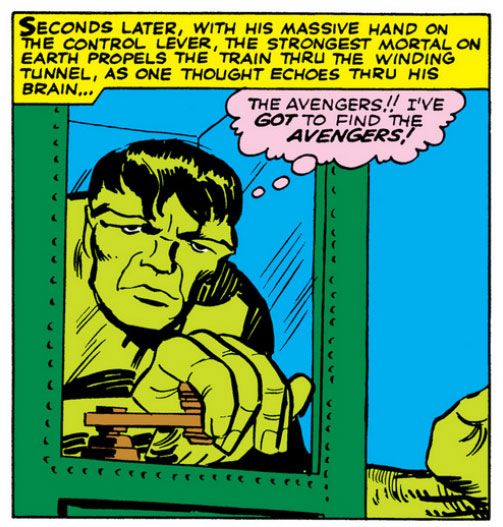
It's a fairly funny story as well, and I don't mean just inadvertently (for example, when the Hulk calls his weaker alter-ego "Bob" Banner for some reason-- we'll cut him some slack; he has a lot on his mind what with needing to file for unemployment and all that).  At one point the Thing threatens to use his powers of pathos against the Hulk.  My favorite sequence has the Hulk hijack a subway train and drive it to the Avengers' mansion.  Kirby treats us to a sweet shot of a mopey Hulk at the controls which  reminds me a lot of that Shaquille O'Neal commercial where he's too large for a sporty convertible.  I'm pretty sure Lee and Kirby got a huge kick out of tossing in this particular scene.

Speaking of the Avengers, they finally make the scene and flub their fight against the Hulk because there are just too many costumed clowns running around.  It gets worse when the fully recovered Fantastic Four pitch in, and then the two teams start a jurisdictional squabble.  Reed Richards suggest the Thing decide whether or not the two teams join forces since he's the one who's been doing most of the fighting and carrying the story on his rocky shoulders.

The Hulk and the Thing come together atop an under-construction building and trade blows.  Teenager Rick Jones pulls a Sue Storm and saves the day by tossing a gamma pill into the Hulk's mouth.  The Hulk falls into the river, but it's Bruce Banner its currents sweep away.

Two complete issues probably seemed overblown in 1964, but in our current era of drawn-out, marketing-driven storytelling I'm amazed how economically Lee and Kirby run through this plot.  Today's version would require an editor's meeting of a dozen or more thinkers to plan it (they'd spread it over an entire summer's or even a year's worth of titles priced at $2.99 or $3.99 each, interrupting whatever storylines the various writers have going), feature some supposedly-beloved secondary character like Rick Jones having his arms ripped off on-panel (the blog-o-sphere goes wild!) and climax in an over-sized special edition.  Entertainment Weekly would give it a B+ and declare it "the superhero epic of the season" while praising it for the repeated flashbacks to Bruce Banner's abusive childhood.  They'd also go nuts over the photo-realistic art, consisting mainly of pages of wide panels stacked broken by frequent full-body portraits of various involved characters, all of which would quickly show up in online auctions with hefty price-tags.


Lee and Kirby neatly pack it all into two standard-sized issues, minus any hint of gore but with plenty of action and characterization.  It also lacks today's trendy Joss Whedon-style dialogue where every character is a quip-making machine, but apologizes by having the Thing call Thor a "lantern-jawed, long-haired lummox."


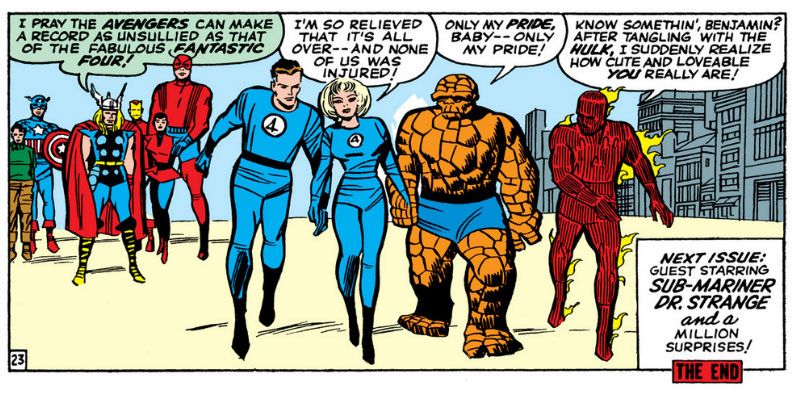
And yes, Sue, no one was injured.  Except the Thing and your brother, Johnny (twice!).  And probably Iron Man when the Hulk head-butted him right in the chest.

Thursday, October 18, 2012

October is Spookey Month: "Pavane for an Undead Princess!" (Tomb of Dracula Magazine #5, June 1980)

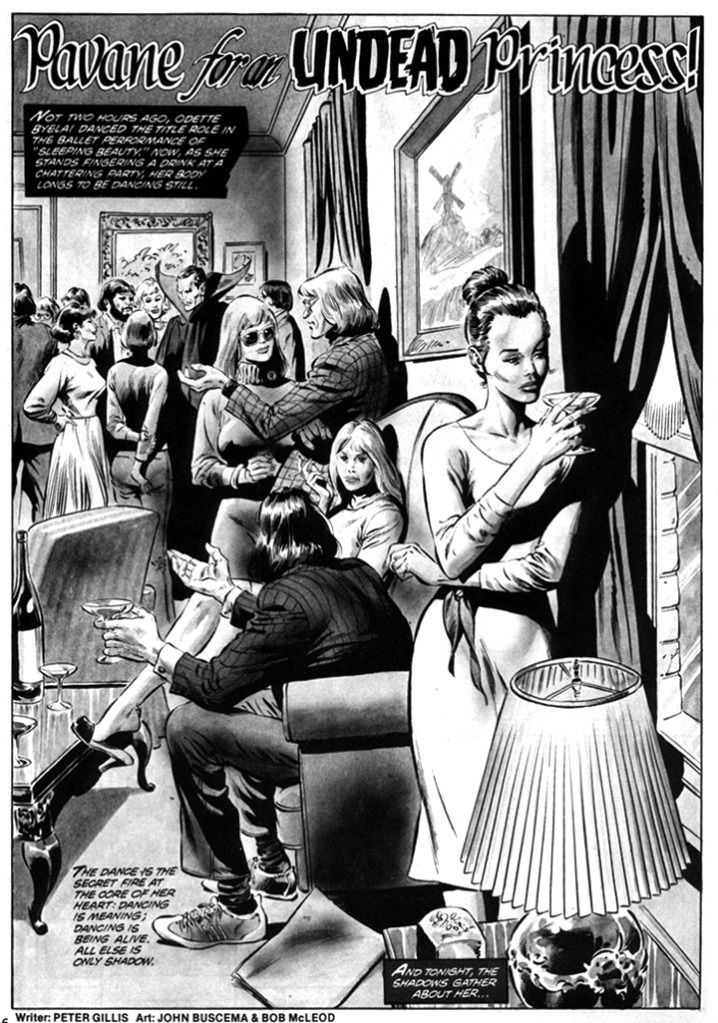
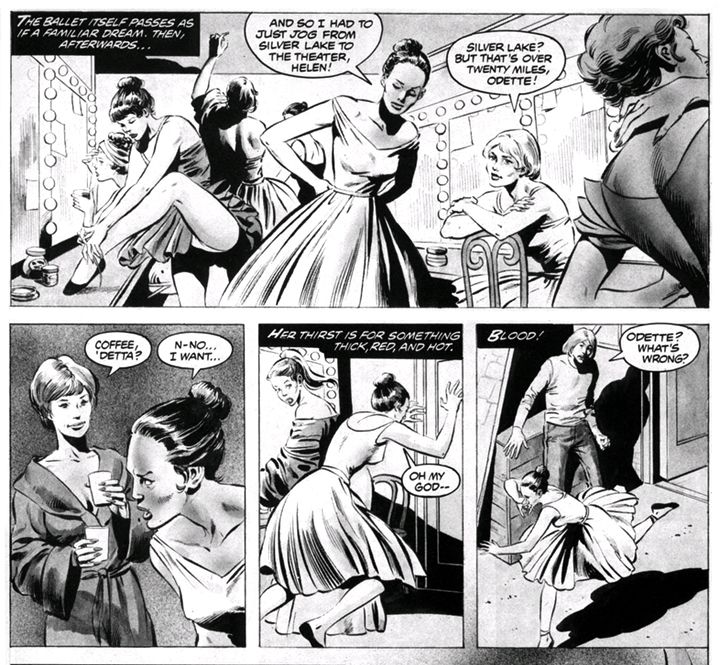
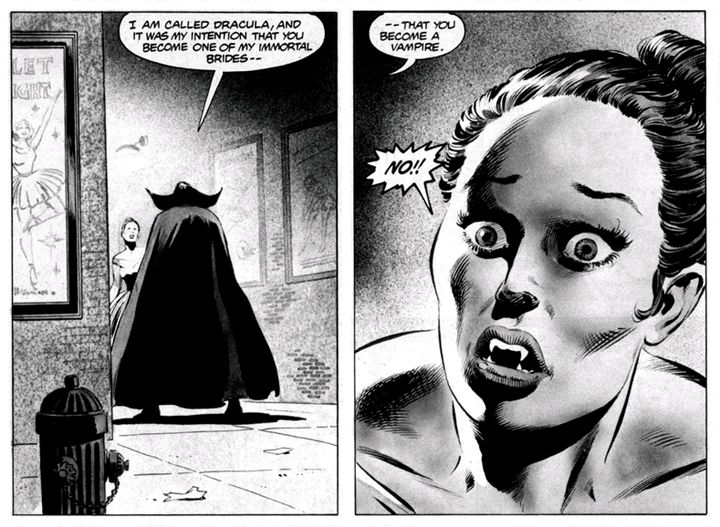
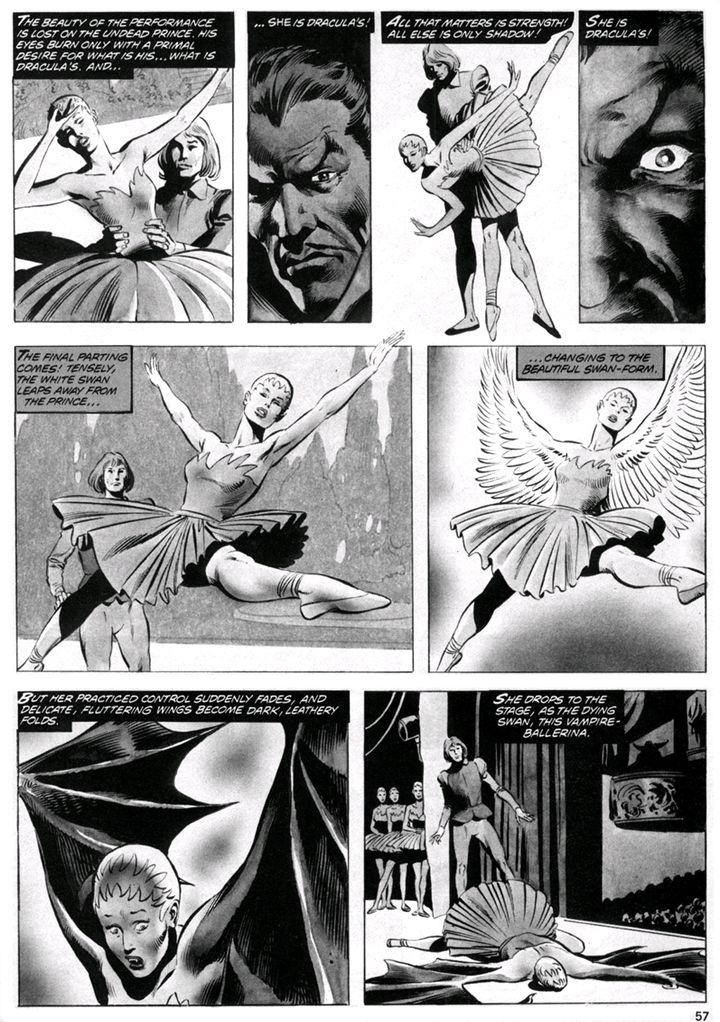
If it takes a soul to appreciate music truly and deeply, what happens when a prima ballerina, whose very being is dance and music, becomes a vampire?  That's the question brilliantly asked and answered in "Pavane for an Undead Princess!," which, despite its flaws remains a short, tragic gem.  Peter Gillis's story reminds me of a vampire Black Swan and I can easily see Natalie Portman essaying the starring role of Odette.

Yes, the ballerina character's name is Odette.

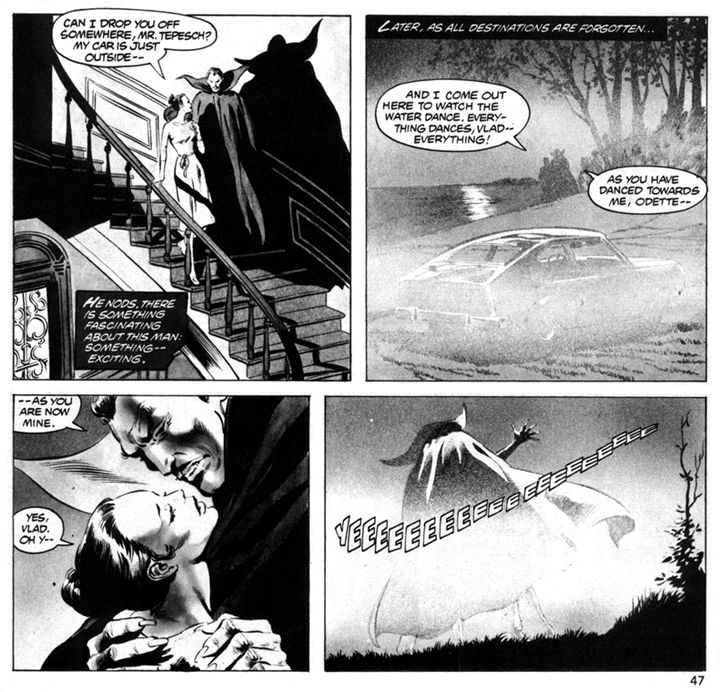
Odette, as Gillis tells us, lives to dance.  We first see her standing aloof against a windowsill, gazing moodily into the night.  She's not a snob or some sort of arrogant pseudo-princess.  It's that she can't even enjoy an after-party with her snooty artsy friends because her muscles "long to be dancing still."  Then she makes the mistake of leaving the party with a cloaked gentleman calling himself Vladimir Tepesch.  If only she'd spent more time watching In Search Of... and less time mastering her art, she might have avoided her fate-- waking up later in the woods with her car missing and having to run 20 miles back to the theater where Greg, the poor man's Alexander Godunov (who had defected from the USSR just a year before this story saw publication), gapes at her and wants to know where she's been for three whole days.  Remember those three days in case you ever find yourself in Odette's pointe shoes-- in classic vampire lore, the vampire's resurrection mocks Christ's; Gillis knows his stuff.

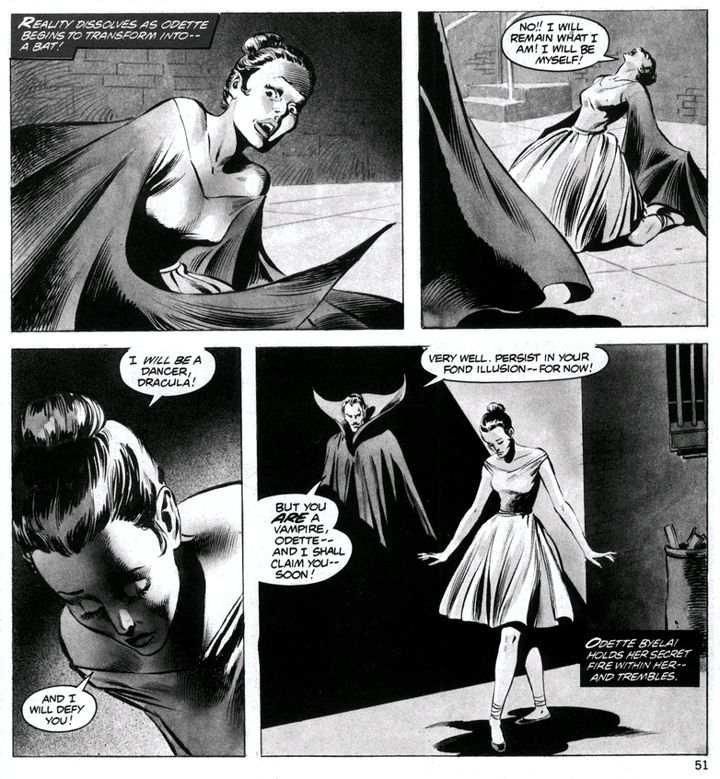
Anyway, Odette learns she's undead.  She refuses to accept it even when Dracula transforms her partially into a bat.  No, she has to spend her nights dancing rather than skulking around in the shadows sucking blood.  I'll have you know Isadora Duncan simply adored skulking and sucking.  But not our Odette.  She goes on an extended dance tour, then returns to her apartment and throws herself into practice, only to discover as a soulless monster she no longer has an ear for her favorite composers.  First Prokofiev, then Tchaikovsky devolve into "NOISE!  NOISE!  NOISE!!"  This is the kind of reaction that puts a bit of a crimp in your dance career.  Odette reminds me of some friends of mine who, when they turned 30, suddenly told me they couldn't relate to any of the new music and were becoming interested in blues and soft jazz.  In other words, "I'm old now, so I hate music."

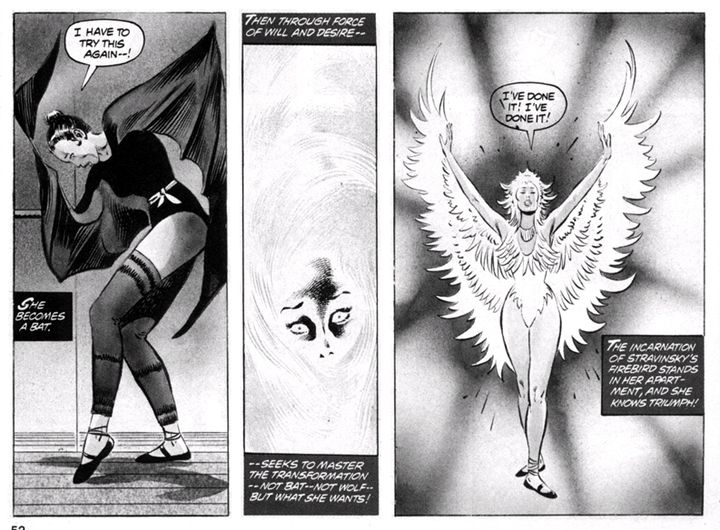
Actually, I'm a little puzzled as to how Odette was able to perform to their music for weeks before this breakdown.  Maybe this particular symptom of being a vampire takes a few weeks to present.  We never find out, but that's a relatively minor plot hole we have no time to investigate because Gillis quickly covers for himself with a brilliant inspiration, possibly the source image for the entire story:  Odette finds she can use her vampiric powers to morph not only into a bat but also into a half-swan... or even a full one.  She gets Anatoly (sounds like a Commie name if you ask me), her company's choreographer, to help her reconfigure great ballets into showcases for her amazing new abilities, but she can't escape the vampiric curse and it all ends pretty much the way Black Swan ended but with more self-impaling and none of the self-pleasuring.

And it also requires us to ignore that losing the spirit of music thing again, but maybe Odette comes up with some way to compensate.  Earplugs and strictly counted beats or whatever.  It's not as if music is all that important to dance, anyway.

While the page count reduces Gillis to telling rather than showing Odette's obsession with dance and her posthumous performance rebirth-- first a collage-like panel and later, after she starts using her metamorphic powers, a single panel with just the ballet titles-- the prima ballerina's plight still moves.  She's truly done nothing to bring this curse upon herself and then she's propelled along a tragic path similar to the characters she danced during life, damning herself in a moment of weakness and rage.  And ol' Dracula is a complete bastard.  He cares only for beauty only so much as he can possess it, but his touch inevitably corrupts and destroys.  Like the parasite he is, he'll move on to other victims.  But Odette loses more than her soul, and even her ultimate triumph is couched in death and her sad isolation from that which she loves most.

John Buscema provides his usual sold storytelling, largely confining his layouts to the three-tier format.  Each page is a little miracle of panel-to-panel continuity, but the real star here is Bob McLeod.

If I remember correctly, Buscema usually worked pretty loose and left a lot for the inkers to finish.  As a result, this art job looks a lot more like McLeod's solo work than a strictly Buscema job might, or one inked by Tom Palmer, Ernie Chua or even Big John's preferred partner, his brother Sal.  I've always admired McLeod's work on his solo efforts, and his figure construction and detail work-- such as how he deals with cheeks-- was always a bit Buscema-esque anyway, so they make a fine team here.  I don't know how much of the black-spotting Buscema indicated in his pencils, but McLeod's use of dark shadows pooling around the characters or climbing the walls behind them works wonders in creating a subtle menacing mood.  Dracula himself seems to loom out of darkness or carry his own shadows with him wherever he goes throughout this story, setting him somewhat apart as a malevolent force crawling up from Odette's own id as the vampire's power over her grows and distorts her life's work.  McLeod also lays down gray tones and creates lighting effects during Odette's transformations with what appears to be airbrush.  Reading some of these later Marvel mags, a lot of inkers seem to have been enchanted with the airbrush for tonal work as opposed to doing the traditional ink washes.  I wonder if there's some Richard Corben influence going on there, or if the airbrush lent itself to faster turnaround times, or perhaps a little of both.

Bob Mackie vampire.
Whatever the reason, the end result is lovely to look at.  A minor classic.  Kind of like that ballet I wrote back in 1994, Who's Watching the Kids, based on the 1978 NBC television comedy starring Caren Kaye, Linda Goodfriend and Scott Baio-- where Jim Belushi made his national debut.  I myself danced the Belushi role.  We would have taken it to larger venues but I pulled a calf muscle and we had to cancel the final performance.  After that, funding for the arts just dried up and it was back to working retail.  Now I'm prepping a ballet based on the Kaye-starring sitcom classic It's Your Move, where she played a scheming Jason Bateman's mom opposite Married With Children's David Garrison as her love interest.  La danse, c'est le mouvement, et le mouvement!

Friday, September 14, 2012

What's Eating Dani Moonstar?

Dani's always had issues.  Rage issues.  Mental health issues.  Comic book issues.

Her initial outings with the New Mutants in their monthly are equal parts rage and nervous breakdown.  Her mind subtly manipulated by an alien-controlled Professor Xavier, Dani reacts with fear when first confronted by the Danger Room and its virtual reality training exercises.  Consumed with self-loathing for her apparent cowardice and betrayal of her Cheyenne traditions, Dani begins to exhibit symptoms of mental illness, escalating from high-risk behavior-- attempting to defeat the Danger Room alone-- to suicidal thoughts.  Before the mind-tampering element enters the narrative, it seems Dani is on the path to severe problems.  Schizophrenia or something similar.  A huge fight alongside the X-Men against the Brood, insectoid authors of many of her problems, and Dani begins to heal, but she remains volatile.

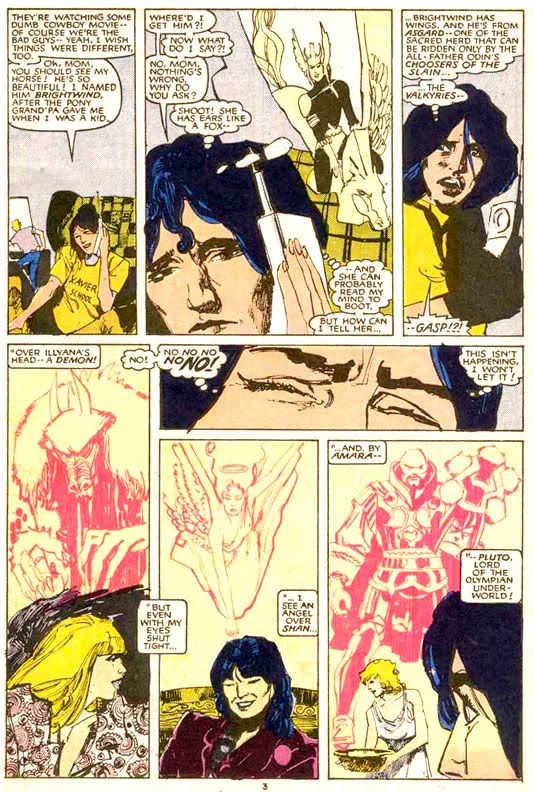
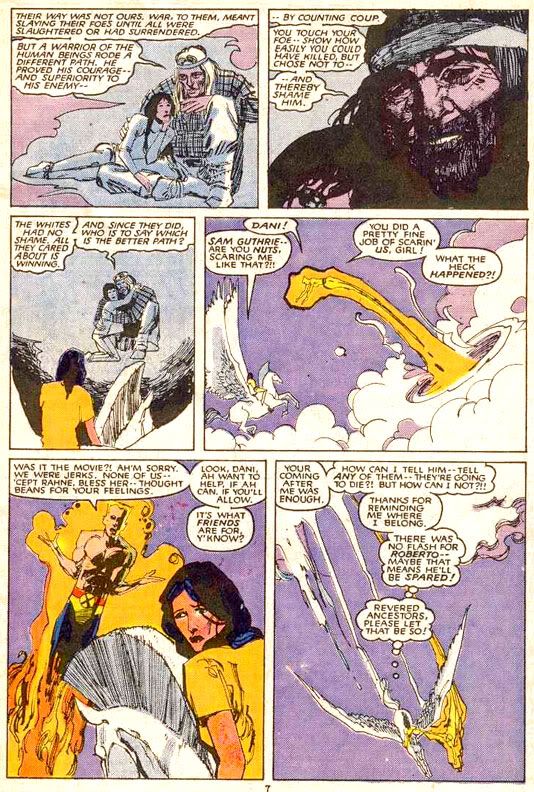
Here's an example from New Mutants #37 (March 1986).  It starts with a typical New Mutants-style scene:  the gang are all watching a Western on TV while Dani tries to ignore their insensitivity and have a long distance phone conversation with her mom.  It's a John Wayne Western, no less.  Fantastic choice, kids.  Only Rahne has presence of mind to identify Dani with the culture being so badly portrayed in the movie by various non-Native stunt people and stick up for her friend.  While Dani loves her pals enough not to act out in rage when they callously and, frankly, stupidly cheer for the cavalry to kill all those Indians-- hooray for genocide!-- something sets her off.  Something always sets Dani off.

This time it isn't so much anger as it is a psychotic break triggered by her Valkyrie power of seeing who will soon die.  This issue ends very badly for the New Mutants.  Very badly indeed.

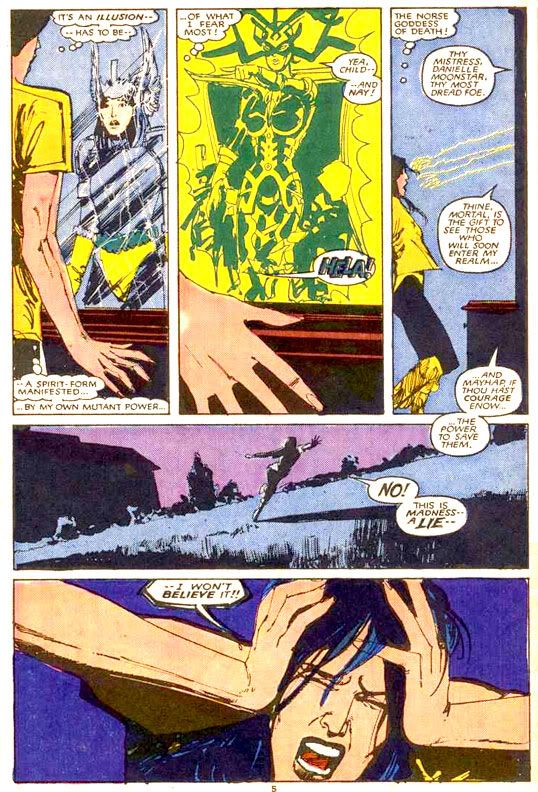
In a sequence stunningly illustrated by penciller Mary Wilshire and inker Bill Sienkiewicz, Dani sees the manifestation of death above her teammates' heads and begins hallucinating all sorts of fun things, such as herself in Asgardian armor and Hela, or Hel, the goddess of the underworld in Norse mythology.  Hel, who rules over Hel.  I'm no scholar of this stuff.  I prefer the Greek and Roman pantheons, and the Egyptian.  Personal taste.

Storytelling is key here.  Nice acting by Wilshire-- look at the shock and fear on Dani's face contrasted with the blissful ignorance shown by Illyana and Xi'an.  As an artist, you have to have an understanding of your characters as individuals and think in terms of their body language and reactions, just as an actor does during a performance.  Dani doesn't get mad the same way her hotheaded pal Roberto does, for example.  Chris Claremont writes it knowing this, but it's up to Wilshire to interpret it visually and communicate it to the readers.

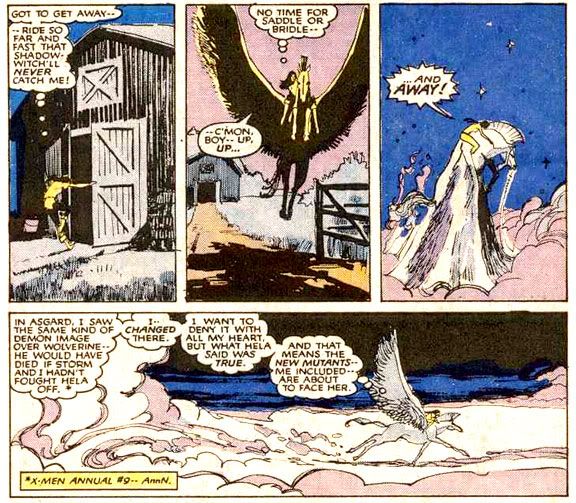
Beyond that, I also admire Wilshire's page layouts.  The panels read so easily, just a straightforward left-to-right flow, vertical top tier containing one moment, vertical lower tier with quick jump-cuts from Dani's point of view set off by a horizontal one with a close up of her eyes, then the last panel taking us to a more objective viewpoint, which continues on the next page.  Dani freaks out at her reflection in the mirror in verticals that continue the sequence inside the house before breaking into horizontals with a location change.  This isn't the only way to do this; there are probably many others, all equally effective.  Here I really like the pacing.  Those tall panels function as quick cuts, emphasizing Dani's sped-up reactionary state, while the wide ones slow things down.  She's outside, there are no doubt crickets chirping.  She runs across the mansion grounds.  The freak-out happens in seconds, it takes longer for her to reach the barn.  The three panels where she tears open the barn doors, comes riding out on Brightwind, her magical winged horse, then bursts through a cloud trailing it like gossamer each occur in roughly equal segments of time.  Finally, Wilshire draws a panel that stretches the length of the page, expanding the time frame as Dani and Brightwind-- blame that punk mane on Art Adams, I believe-- take a long gallop across the almost endless cloud tops.  This moment probably seems timeless to Dani, and yet not long enough.


Even if Chris Claremont hadn't added all the helpful dialogue and thought balloons that explain things, you'd know someone was having an episode, seeing craziness in a mirror, then running outside into the night.

Somewhere in the sky, Dani finds comfort in words of wisdom from another hallucination, this time of her dear, departed grandfather, Black Eagle.  This is the kind of thing I used to love about New Mutants-- how the book could go from a mundane moment with the kids eating popcorn and celebrating Manifest Destiny to a fantasy-tinged sequence of a teenaged girl galloping across a silvery, moonlit sky on a winged horse.  This happens in a matter of minutes in story-time.  And then an exploding yokel appears sans shirt and ruins the magic.  It's the way you wanted your life to be when you were 15 or 16 years old.  Only if you were like me, you were faced with a daily plethora shirtless yokels and none of the winged horses.

Anyway, that's Dani Moonstar all over.  You don't get half-assed reactions from this girl.  She's all in, all the time.  Well, most of the time.  She's the epitome of the Marvel character.  She has a strongly defined personality apart from her powers.  Your basic Marvel character strikes me as a human being worth reading about whether or not they're a mutant or spider-bit or an irradiated scientist and his equally-irradiated friends.  Even if she were a character in some kind of John Knowles A Separate Peace coming-of-age novel, merely a non-powered Cheyenne teen who happened to be studying at an exclusive boarding school back east, with racism, culture clash or self-expectations her major problems rather than anti-mutant hysteria and extra-dimensional kidnappings, Dani would still be touchy, angry and oh so volatile, still interesting in her own right.  Now why writers felt the need to change her powers and give her a flying horse, I'll never understand.  But that they could do that and have the core Dani remain intact is a testament to her strong conceptualizing by Claremont and Bob McLeod.

Monday, September 3, 2012

The Uncanny X-Men and the New Teen Titans, or "When Dudes in Their Underwear Shake Hands"


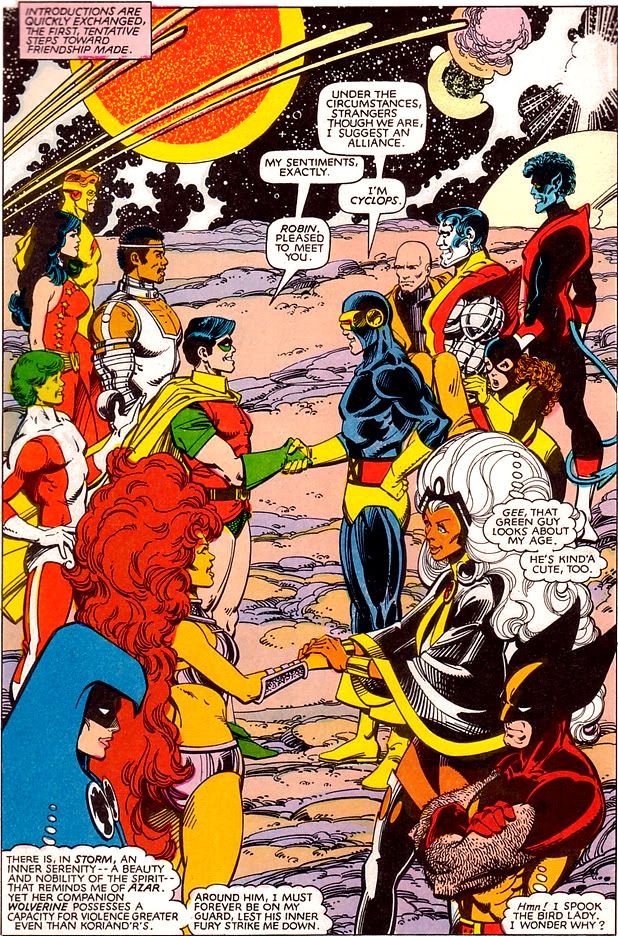
Fresh off the The X-Men and the Micronauts debacle, here's a team up more to my liking.  It's the Marvel and DC presentation of The Uncanny X-Men and the New Teen Titans (September, 1982), a fat, slick beauty of a book.  This is the pivotal moment where both teams gather with counterparts from each conveniently facing off, or grasping hands in greeting.  Well, the Raven/Wolverine moment isn't exactly a meeting of similar characters, but you get the idea.

Kitty's body is playing it smart even if her mind is unfortunately letting her down.  We need to trust our bodies more.  Sometimes the mind plays tricks on us, but the body is always honest.  In this case, Kitty is right to hide behind Colossus rather than approach Changeling.  That green freak would only make some clumsy sexual advance, and then keep it up non-stop, transforming into snakes and octopi while groping her.  And no one on either team would raise a hand to stop the little pervert.  Probably has his erect penis poking out of his waistband-- Changeling's idea of "playful flirtation"-- which is why artist Walt Simonson chose to hide the kid's crotch behind Starfire's hair.

I haven't read this in a while, but I remember it being an effective meshing of both teams' continuity, with Cyclops having to deal with the heartbreak of seeing his beloved Jean Grey resurrected in her evil Dark Phoenix form and Darkseid teaming up with Deathstroke the Terminator to kick the snot out of both teams.  As you can see from the dialogue and thought balloons in this image, it features Chris Claremont at the height of his powers doing a bang-up job capturing the essence of all the cross-company characters, throwing in little references to past events, showing his encyclopedic knowledge of then-current comic books.

You know, sort of how he was always name-dropping the good ones in Uncanny X-Men or having minor characters that parodied Cerebus the Aardvark or whatnot.  That stuff always made me feel I wasn't wasting my time reading comics, that they really were the intellectually stimulating yet action-filled pieces of sequential literature we always claimed them to be.

While I can't remember all the story details, I do know Claremont, Simonson and inker Terry Austin knocked me right out with this book when I was 14 and a fan of both teams.  It was perfection, just everything I wanted in a team-up of Teen Titans and Uncanny X-Men.  The epic climax with Dark Phoenix showing up and sacrificing herself for love (I believe) and then the denouement with all the players kind of hanging out in their civilian clothes left me feeling for Cyclops in a wistful sort of way for a couple of hours, but I read it ten to twenty times in two days and that kind of spoiled the mood.  I still have it, along with a run of the original "Dark Phoenix" issues of Uncanny.  I should re-read this comic and see if it holds up better than The X-Men and the Micronauts.

It should.  Although Changeling is probably twice the degenerate the Entity is any day of the week.

Sunday, September 2, 2012

"The Things We Think and Say Too Much" by Jerry Macomicbookdork

Allow me to wax semi-seriously here for a moment.  This morning I had an epiphany and decided to write this mission statement, just like that jackass in that movie.  Whenever I write something about vintage comics, I tend to get more readers.  Whenever I write about Cassandra Cain people go crazy with the hits.  Whenever I do something silly like post sketches or photo essays, people ignore the heck out of it.

Actually, I'm pretty sure the world at large couldn't care less what I have to say about any of those topics, or my beyond stupid takes on whatever controversy is a-brewing in comics fandom this week.  Or, as if often the case here at When Comic Books Ruled the Earth, last week because I live in Japan and while my toilet is so advanced it would confuse Luke Skywalker, my American comic book news is forever behind the times.  But I think I can do a better job of "branding" this blog if I focus on a single area of idiocy.

So I've decided to re-dedicate this lousy blog to covering old comics.  To indulging fully my obsessions with EC, Warren, Dell, Gold Key, Marvel and DC from the 60s through the 80s, the original run of Love and Rockets, obscure characters like Cindy Lee and anything else I feel falls within the category of "so old hardly anyone under the age of 40 cares anymore."

And even though my job keeps me so busy I barely have time to write this one blog, much less the one I also have about living in Japan, I have to also give into my impluse to write extensively about Cassandra Cain.  Because I'm a staunch supporter of that character as well.  To that end, I'm going to spin off a dedicated Cass blog where-- as soon as I think of a name-- I'll be spouting Batgirl/Blackbat related nonsense whenever it comes to mind, dropping little sketches and generally clowning around with everyone's favorite reformed murderer-turned hero-turned murderer-turned hero-turned nothing.

So to you, dedicated reader of When Comic Books Ruled the Earth, expect lots more on Cindy Lee, Slug from Micronauts, random flights of fancy based on single lines of dialogue in comic books decades old and nearly forgotten, plus the occasional link to Saturday morning superhero shows whenever I find them on YouTube.

And to you, my beloved fellow travelers in the fandom that dare not speak her name-- Cass (I dared)-- look for another blog to debut soon and swiftly become as obscure and ignored as this one!

Excelsior!

Tuesday, August 21, 2012

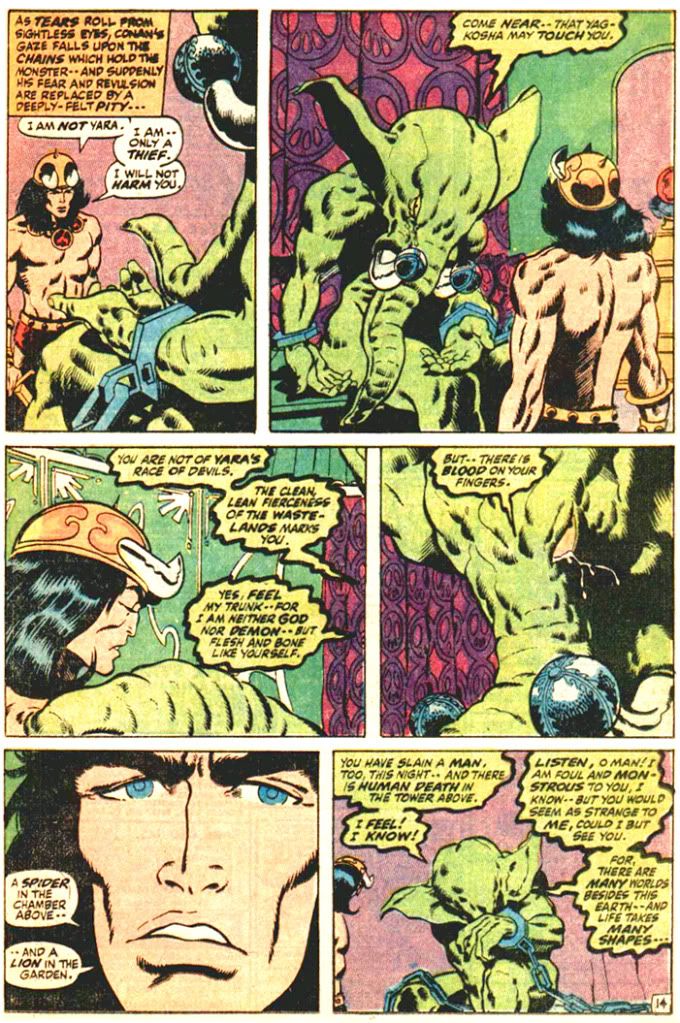
Conan's elephant friend

Here's a page from one of my favorite Conan stories.  It's from "The Tower of the Elephant," adapted by Roy Thomas and Barry Windsor-Smith (with inks by Sal Buscema) from the Robert E. Howard short story, and it appeared in Marvel's Conan the Barbarian #4 (April, 1971).  As you can see, Windsor-Smith's art is in a transitional state between his earlier clunky Jack Kirby imitations and his current ornate pre-Raphaelite look.  But his Conan is still wearing that silly horned helmet Windsor-Smith stuck on him right at the start.

In this story, we find a younger, slimmer Conan just starting his adventuresome career.  It's right after he quit McDonald's, but before he studied accounting at the local two-year community college.  Like a lot of young Hyborian dudes on the make, Conan spends a lot of time in the taverns of Arenjun, the "thief-city of Zamora."  There he overhears a big blowhard spouting off about the Tower of the Elephant and its fabulous treasure, the Heart of the Elephant.  Someone really likes elephants.  Probably Yara, the priest who lives in the tower.  He used to collect clown figurines, but his mom got him this little elephant carving for his birthday one year and he was never the same after that.

Anyway, the mouthy braggart has a Conan-type accident, and our favorite barbarian slips out to snag that fancy jewel for himself.  He's a little nervous about it-- this Yara guy is some kind of magician, and magic is the one thing that gives Conan the shivers-- but he climbs the walls, meets another thief with the unlikely name Taurus.  Taurus proves useful when a couple of lions show up.  A quick puff of the ol' black lotus and it's good bye, lions.  Taurus doesn't last long, either.  They manage to shimmy up a slender rope Taurus thoughtfully brought along, right to the top of the tower-- itself made itself of jewels of incredible value-- but then the ever-prepared Taurus dies from a spider bite.  Guess that's one thing he didn't see coming.  Conan kills the spider, then makes his way down into the tower only to meet this green elephant.

Yag-Kosha is his name.  Yara's blinded him and kept him in torment for 300 years while trying to learn all his elephantine magical secrets, such as the special ingredients to his famous chocolate chip cookies.

It's really kind of a melancholy story, the kind that proves Howard had more on his mind than just pulpy action.  It resists cliche.  Thomas, taking his cue from Howard, treats the first killing almost coyly.  We don't see it, just its aftermath.  Then there's Conan's palpable fear as he undertakes his thievery; he's not just a stolid, dull-minded hero.  Rather than have Conan fight his way into the tower, the story has him just a moment or two behind the action as Taurus else dispatches the guards and the first few lions for him.  Conan does get to fight a lion a little later, which is pretty sweet, but Thomas and Windsor-Smith don't dwell on it.  It's over in four panels, the first being a small silhouetted image.  Windsor-Smith crops the killing blow so we actually don't get to see it.

Yag-Kosha could easily have been a monster for Conan to fight, but instead he's treated sympathetically.  He simply tells his sad story-- which fills Conan with shame at being human-- and uses the barbarian as a vessel for his vengeance against Yara.  Which also doesn't involve violence, but a strange transformation that freaks poor Conan right the hell out.  Conan doesn't gain a treasure and comes away with nothing but an interesting story.  And that's what I've always liked about it.

Tuesday, August 14, 2012

Tokyo Comic Book Report: Japanese girls love Deadpool!

Majority of patrons that Saturday were women.
Well, to turn a generalization into something more accurate... at least one does.  When I visited Blister in Hamacho, one young woman was flipping through a Deadpool comic, cracking up and excitedly sharing various panels with her friend.  Before I left, she had in her hands a huge stack of American comics, at least one of which featured Deadpool.  So someone in Japan likes Deadpool, Marvel.  Take my infallible advice and start a huge marketing push centered on Deadpool over here and I'm sure it'll pay dividends!  Thank me with money.  You're welcome.

I'm not sure how I got the idea Blister was so difficult to reach, like a comic book Shangri-la.  It turns out it's pretty darned easy if you're staying in Hatagaya.  The subway train that takes you to Shinjuku will deliver you to Hamacho Station and from there it's about a five minute walk.  The first time I visited Blister I believe I went to a different platform in Shinjuku Station, but that was several lifetimes ago.  I've cheated death so many times since then, they all tend to blur together.

Blister's running on limited hours these days, but on Saturdays, they're open from 11am to 5pm, which gives you plenty of time to get in and browse.  The store is very cramped, and on this particular day there were six or seven other customers.  It felt crowded.  The store is heavily invested in Marvel and DC, mainstream stuff.  The going price for a brand new American comic magazine in Japan these days is 540 yen.  That's about 6.85 USD to you and me, Russ.  Blister does feature some bargain 100 yen comics in longboxes to your right as you enter.  The selection is hodgepodge and I long ago bought them out of every single Cassandra Cain Batgirl back issue they had.  None are to be had these days, but you can still buy issues of the Stephanie Brown series.

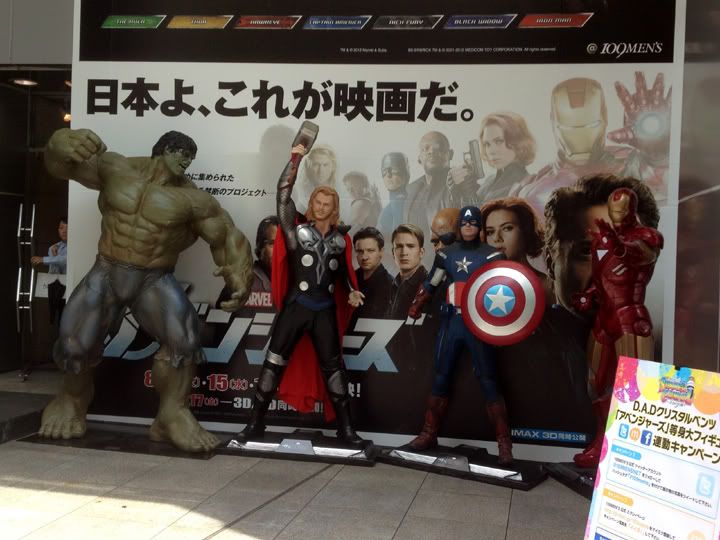
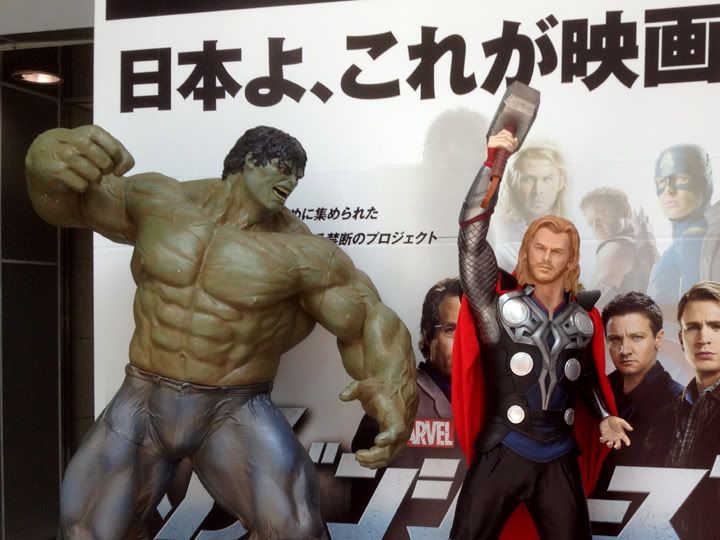
The Avengers were hanging out in Shibuya.
Speaking of Cass, I bought the very last copy of Batgirl: Fists of Fury found in the wild here in Japan, so don't look for that, either.  It cost 1800 yen (22.83 USD, quite a mark-up from the 14.95 US SRP), but it was worth it to reaffirm my position as her #1 fan in Japan.  It seems the other Cass trades like Silent Running and Death Wish are slipping out of print and going for mega-yen on Amazon.jp.  While Fists seems to be hanging in there and I could have paid 500 yen less for it online, the trouble I've had getting things like Showcase Presents Batman and the Outsiders 1 and New Mutants Classic Volume 1 means snap it up if you see it.

Besides the Cass book, I also bought Astonishing X-Men #52 (because it has a neat Xi'an Coy Manh cover), Conan #32 (a random choice because it was 100 yen and I still enjoy Kurt Busiek's run on that title), Conan the Barbarian #2 and 3 (more Dark Horse, love Becky Cloonan's art), Minutemen #1 and 2 (the pull of Darwyn Cooke proved too strong to resist), New Mutants #46 (more Xi'an, but this time with Dani Moonstar, also irresistable) and Walking Dead #100 (Robert Kirkman and Charlie Adlard-- this is the second time you've scarred me with a single horrific image!  I nearly barfed!).  No Dark Horse Presents, so no new Nexus.

Blister is stocked deep with Before Watchmen titles.  I only wanted a sample, so I didn't catalog everything they had, but I think I could have bought the entire run up to current if I'd been so inclined.  Good runs of the New 52, if you're into that.  Heavy on the Marvel mutant stuff.  They also have a lot of trades and collections, plus just about every Avengers movie action figure you could want, along with The Dark Knight Rises stuff.  The guy working the cash register was friendly enough, but we didn't chat due to the language barrier.  I think he recognized me from my last visit there, way back in 2010.  Now that I know an easier way to get there I could see myself patronizing Blister a bit more if I lived in Tokyo.  Maybe they could order more Fantagraphics and Dark Horse stuff for me, too.

Probably jet-lag, but Hulk really wanted to punch Thor.
My other comics-related activities included visits to Tower Records in Shibuya and Kinokuniya in Shinjuku.  Tower Records was having a major sale in their English-language book department so I snapped up a few bargains.  Now, Tower Records stocks a lot of Fantagraphics titles, but they seemed kind of depleted.  Coupled with the close-out type prices on other books, I'm wondering if they're overhauling things or getting out of the business.  That would truly be tragic because Tower Records has been a Tokyo destination if you want groovy things by Los Bros Hernandez, Peter Bagge and the like.

At Tower Records, I bought Lone Wolf and Cub volumes 4 (783 yen, marked down from 1565, or 9.93/19.85 USD), 19, 20, 22, 23, 25 and 26 (290 yen each, 3.68 USD).  I was tempted to go back and clean them out entirely.  I also found and bought a shelf-worn copy of Showcase Presents Batman and the Outsiders 1 (2573/32.64).  See what I mean about snap it up?

Kinokuniya has a very small section for Western comics, but it was there I managed to find and buy the elusive Perla La Loca (receipt lost, price unknown, a pearl of great value to me) to complete my Locas collection.  I'd ordered it months ago from Amazon.jp, but kept getting messages that it was delayed.  This was the only Love and Rockets book they had in stock, so apparently it was meant for me.  And now we are together at last and all is right in the comic book world.

Monday, August 6, 2012

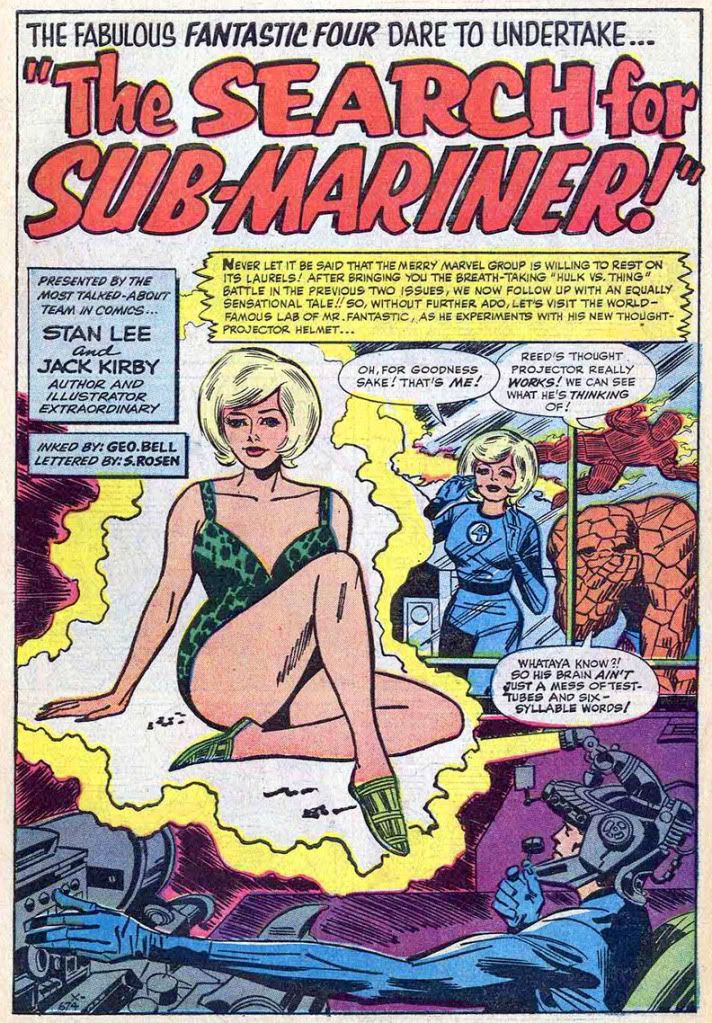
Reed Richards, what the hell is wrong with you?


He's a red-blooded heterosexual male, that's what, you filthy degenerate atheistic Commie pinko red!  Just when you're convinced Reed Richards is nothing but an unfeeling computer on legs, thinking of nothing but the square root of the Einstein Theory and the co-efficient of the hypotenuse, it turns out at heart he's all man, right?  That's one interpretation, certainly valid.

However, look again, please.  What we're seeing is the comic book embodiment of that peculiarly American cognitive dissonance where we're obsessed with sex and tumescence-inducing imagery, yet puritanical and filled with shame and anxiety over it.  Indeed, proving himself quintessentially American in this regard, Richards uses this fabulous device to manifest his girlfriend Sue Storm as a sex object, but-- ambivalent due to his lifetime's conditioning in the laboratory of Protestantism-- cannot fully unleash his id and therefore timidly clothes her fantasy image in a very modest (also hideous) green one-piece swimsuit.  And what appear to be matching metal slippers.  What a contradictory imago his classically suppressed libido draws forth!  How fearful he is of the sexual woman, a woman's sexuality, even one he makes up in his mind!

Still, within the rigors of the Comic Code, what this splash page to Fantastic Four #27 (June, 1964) proves is Stan Lee and Jack Kirby were wise enough even in those pre-Internet days to understand there is virtually no new technology that can't be used for pornography, even by squares like Richards.  Prescient in a way.  Pure pop genius.  I'm reminded of this each time I check Google search terms that bring up When Comic Books Ruled the Earth and the leading one for the day is either of the phrases "Batgirl boobs" or "Cassandra Cain nude."

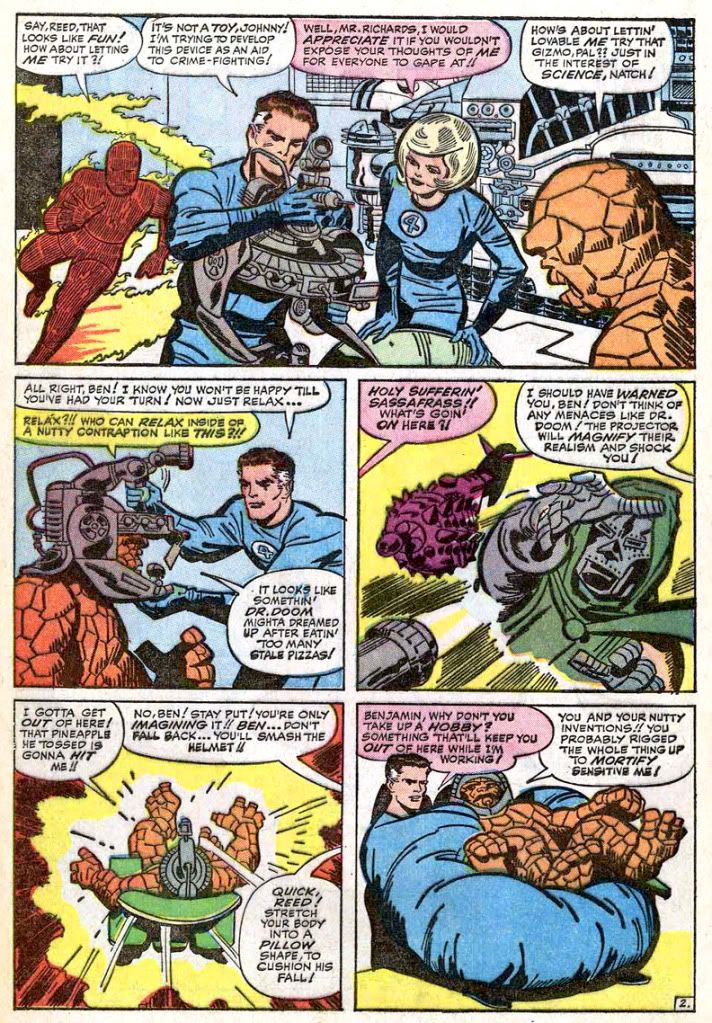
While Sue quite justifiably protests* even this fairly mild invasion of her privacy-- shades of the various "leaked" nude scandals that currently play out almost weekly online--  the boys aren't ready to put away their new toy.  Let's hook Ben Grimm up the machine and see what happens--


Oh, that poor guy!  

Note how Richards wisely refuses the hormonally-addled teen Johnny Storm (his powers incongruously activated despite the ostensibly safe domestic environment, heat amd burning both signifiers not only of arousal but of danger-- caution, don't touch, hot!) access to his incredible sex fantasy image-maker-- no doubt aware of the pimply carnal imagery that would result, and, once seen, never be un-seen-- and sticks the device on Ben's head only to have his friend conjure up a hallucinatory menace that threatens to destroy the new invention itself.  Ben, his powerful rocky form a monstrous mockery of American manhood-- as a former USAF test pilot, astronaut and college athlete perhaps a satirical comment on America's chest-thumpingly uber-masculine patriotism and over-weening pride in our Cold War martial prowess as a sublimation of our more prurient urges similarly suggested by Stanley Kubrick's dark comedy masterpiece Dr. Strangelove-- can't even summon as Richards did the mildly suggestive form of his own lover in a swimsuit.  Instead, his thoughts turn immediately to threat and violence.  Only by forming a symbolic bed for his friend to collapse onto can Richards prevent disaster, the loss of his prototype.

The type of bed symbolized depends on our reading of the Thing's pose.  Is it infantile, as if he's a baby waiting for his diapers to be changed?  In this case, Richards provides a comforting crib.  Or, continuing our linkage of this sequence to the underlying sexual repression/phobias/concerns of the American male psyche, is he spreading his legs for penetration, for intercourse, in which case Richards is providing him with a marital bed, in parody or gender inversion of a wedding night ritual?  Does this mean the imaginary "pineapple" Dr. Doom-- himself a stern father-figure which further suggests something deeply Oedipal-- throws at the Thing is phallic, or is it vaginal?

What is it the Thing truly fears, which only the embrace of his friend can relieve?  What is it the men of the United States feared most in 1964 (the year of the long-haired Beatles and the dawn of the Sexual Revolution) and possibly to this day, as evidenced by certain anti-feminist screeds so full of castration/feminization anxiety they tell more about their authors' psyches than they do the supposed goals of the movement they purport to criticize?  And doesn't he look silly with that damned thing on his head?

*Remember when Marvel used to pretend the FF were real and Stan and Jack were just transcribing their adventures?  As violated as Sue feels by Reed in this story, imagine how a real woman would feel knowing Marvel sometimes has her illustrated by an artist who literally traces pornography, frequently causing her not to look energetic or adventuresome but blatantly orgasmic.

Sunday, August 5, 2012

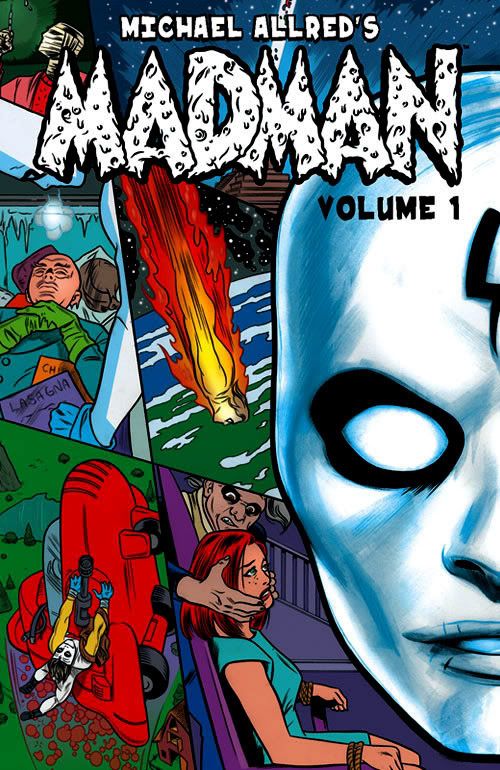
Mike Allred on the Fantastic Four?

Okay, it's not Marvel, but it's Allred!
Whereas DC's kind of like, "Nyahhh nyahhh, we don't need you!" it seems Marvel's going out of its way to solicit my hard-earned yen.  They've got Dani Moonstar practically headlining a book and now this exciting news.  Exciting to me, anyway!

I've loved Mike Allred's art for quite some time now-- and he's just such a positive, nice guy I can't help but like the man himself and his whole family, too-- and have especially fond memories of the last Marvel series other than the new New Mutants I bought with any regularity.  I'm talking the awesome X-Force/X-Statix book Allred did with Peter Milligan.  I really need to go back and re-read that.  It's been too long since I communed with the likes of Mr. Sensitive, U-Go Girl and Doop.  I can't even remember the other characters' names.  Spike?  Tike?  Man, it was gloriously weird and emotionally engaging in a way few mainstream comics ever are.

While I'd love it if Allred also happened to be writing Fantastic Four, just the presence of his artwork is a guarantee I'll be tracking this down over here, across the sea in Japan!

Excelsior!

Thursday, August 2, 2012

The Hulk has been spotted in Japan, called "incredible"

Yeah, it's a guy in a Hulk mask.  You have to scroll down a little and it helps if you can read Japanese.  Is it just me or is there something of a Mark Ruffalo likeness to it?

Friday, June 15, 2012

When Returns... the Internet!

Face front, True Believers!  We've got plenty of pulse-pounding posts in the mighty When Comic Books Ruled manner flying at you like Thor and Iron Man after a round of espressos down at the superhero kaffeeklatsch.  Jarvis brews 'em just that strong, almost as strong as our line up of lively and lilting literary laff-em-ups!  You can bet the fine folk over at the Distinguished Competition are shaking in their fuzzy bedroom slippers* while we trip the light fantastic in ties-n-tails and those ol' dancing shoes we shined up extra special just for the occasion!

What occasion, you Faithful Ones ask?  And we Hard-working Ones answer:  The return of our Internet connection, which means a never-ending stream of scintillating stories and never-trivial trivia here at When Comic Books Ruled!  To wit:

ITEM!  How many lovers has Hopey Glass had?  Sources say it's more than a few!
             Let's count them!
ITEM! Professor X once orgasmed Dani Moonstar into betraying everything she
            stood for!
ITEM!  Serial harrasser Changeling fell hard for a lass out to do him and his
             idiot friends no end of harm-- and he wooed her with tentacles!
ITEM!  It's time for a close reading of the early days of our mutant merrymakers,
             the X-Men!
ITEM!  Alex Toth-related books are even now winging their way to Japan for our
             perusal and discussion!
ITEM!  An issue-by-issue study of the Cassandra Cain Batgirl series!
ITEM!  More Creepy, Eerie and possibly EC appreciation!
ITEM!  Marvel Star Wars!  It existed!  I like it!
ITEM!  They canceled the Terror on the Planet of the Apes reprint series!  We're
             going to have to do our part to keep the dream alive!
ITEM!  Stale jokes, sloppy art and more than a few surprises in store!

Who says this isn't the When Comic Books Ruled the Earth Age of Bashful Blogging Buffoonery?  Until Xi'an Coy Manh replaces her metal leg with the lamp from A Christmas Story...  MAKE MINE WHEN COMIC BOOKS RULED THE EARTH!

*Hey, fellas, just a little friendly ribbing!  We love you guys, natch, and we'll see you on the fabled softball diamond this summer at the Big Showdown!

Thursday, June 14, 2012

Hulk NOT confused: A guest editorial

By The Incredible Hulk

Hello!  This Hulk!  Keyboard puny not good for Hulks fingers and Hulk careful not to smash but Hulk find it difficult.  But also Hulk has important thing to tell reader of this blog.  Hulk hear one person read this blog.  Hulk sorry for this person.  Hulk want say find better use for your time but Hulk know not everyone have taste in reading material.  Why adult read picture book for little kid then write about it for all to see instead of hiding fact in shame?  Hulk think he must have screw loose!

Dont worry Hulk not snob.  Hulk read Stephen King on toilet.  King no artist with words but can tell story. Hulk once read part of Tom Clancy book but put it down because bad dialogue.  Point is Hulk was willing to try and not pass judgment before reading.  Puny blogger here can only run puny mouth about things blogger only guess at and not know.  Hulk hate blogger!

Ok now Hulk have to explain something.  Recently big movie with Hulk in it come out.  There have been other movies with Hulk. Eric Bana he good in Chopper.  Edward Norton he good in Fight Club.  Hulk think human can make good Hulk movie with them as Banner.  Hulk wrong.  But Hulk get no money from them.  Hulk get no money from this one.  Hulk think to smash movie producers but Hulk too busy.  So much smashing so little time.  It old story one Hulk sure you understand.  Hulk like Mark Ruffalo though.  Did you see Zodiac?  Hulk enjoy Zodiac where Ruffalo play police man.  Hulk often fight police army navy air force what have you.  If it wear uniform and have gun Hulk fight it.  Always puny humans in uniforms hound Hulk with their weak guns.  That is why.  But Ruffalo okay guy in Hulks book.  So Hulk think this movie okay.

Hulk lose train of Hulks thought.  What Hulk mean to talk about here is this drawing stupid blogger human make of Hulk.  Hulk hear of this from Thing during fight where Hulk and Thing wreck part of Yancy Street.  Hulk interested.  Hulk beat Thing!  HULK ALWAYS BEAT THING!  THING NOT SMART CHALLENGE HULK!  THING NOT SMART TO MAKE FUN OF HULK USING BAD PICTURE BY PUNY HUMAN!

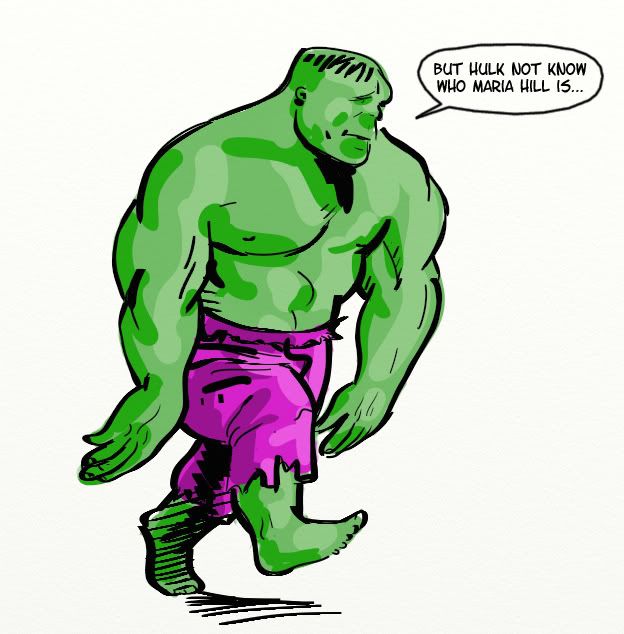
Where Hulk?  Oh yeah.  Hulk beat Thing senseless with Things own foot then leave Thing remember what Thing tell him about picture  smash open Internet cafe look online and find this stupid blog.  Who this person think Hulk?  Hulk know who Maria Hill is stupid worthless human!  You are puny!  Hulk find person.  Hulk say why you make stupid drawing?  Person say I dont know.  Hulk say you stop lying about Hulk!  Humans always lie about Hulk!  Wont leave Hulk alone!

Hulk say Maria Hill work for SHIELD.  Maria Hill important in many events happen to Captain America and Iron Man.  Blogger say it news to him.  He not know that when he make drawing and not know why he kept thinking of name.  See?  Stupid blogger not know who Maria Hill is try to pin ignorance on Hulk.  But Hulk strongest there is!  Make Hulk angry and Hulk gets stronger.  Make blogger angry and blogger turns red in face and wets pants.  It almost make Hulk laugh but really it sad.  Hulk wonder what happened to human discourse.

So Hulk tell person he should feel bad for lying about Hulk and for fooling people who look for good picture of Hulk.  Hulk say you tell them not to look at your picture!  There better pictures of Hulk for them to look at.  Looking at pictures of Hulk is good thing good for the heart.  But not this one.  It bad for Blogger persons health.  Blogger person say Hulk you tell your side of story.  One person read blog.  Chance this person have family or maybe talk to other puny humans at some point in the future.  Maybe even have job where maybe talk about Hulk sometime even if no one listen it still get in their brains.  Hulk think.  Thinking not Hulks strong point but finally Hulk decide puny human blogger have good idea!  Now Hulk finished telling Hulks side.  HULKS SIDE ONLY SIDE!

You go outside.  Enjoy day.  Dont read picture book for little children.  If you do dont write about it like this person.

Friday, June 8, 2012

Giant-Size X-Men #1: A retrospective look back in anger at a remembrance of things past!


Gil Kane and Dave Cockrum create
a classic image!

Giant-Size X-Men #1 (May 1975)
Publisher:  Marvel
Story/Script:  Len Wein
Art: Dave Cockrum

This is where it all began.  The X-Men legend.  This is where the title began its rise from obscure Fantastic Four knock-off to Marvel’s flagship franchise.  Hugely influential and source material for a lucrative film series that helped jump-start the idea of “superhero movies” as we now know the genre--  yet its characters remain fairly obscure outside the comic book world.  We insiders—damned as we are-- may know how Banshee lost his sonic scream and chuckle knowingly at the strange concept of Nightcrawler’s being able to turn invisible in shadow yet have a face that’s always shadowed, but our moms and dads probably couldn’t tell Wolverine from tangerine if you spotted them a tree, a juice squeezer and six Hand ninja.

But hoooo baby, they love that singin’, dancin’ man Hugh Jackman!

Anyway, here we are at the beginning at last.  Giant-Size X-Men #1.  Years ago I bought a run of early X-Men from a friend for the grand total of 20 dollars and the use of my left-handed outfielder’s glove one day in P.E.  In return I had X-Men numbers 94, 95, 96, 97, 98, 101, 107 and 112.  And I read them.  I took them to school, passed them around to my friends and we read them until they were wrinkled and puckered at the staples.  Take that, graded mint collectors!  But I didn’t have Giant-Size X-Men #1 and by the time I realized what I had that foolish friend of mine was on drugs and would rather trade his back issues for white powder and green leaf, neither of which I could easily obtain and transport back into the States despite possessing diplomatic clearance through customs thanks to a childhood spent overthrowing Communist-friendly regimes in Central and South America.  I was a precocious child and I will soon publish my memoirs detailing my cover story as a violin prodigy on a perpetual world tour that just happened to intersect certain geopolitical hotspots.  That is, if I’m not assassinated first!

I digress.  Eventually Marvel reprinted this story and I’ve since read it too many times.  And last night, I read it again.  The cover—by Gil Kane and Dave Cockrum—is a classic image, one copied and homage many times.  Led by—of all things—a filthy, atheistic Red made entirely of metal, including his filthy, atheistic genitalia, the new internationally stereotyped X-Men burst through the old homogenously white American X-Men.  The cover copy promises something it calls “Deadly Genesis!” but the title page introduces a story calling itself, “Second Genesis!”  What the hell?  Can’t you people get it together?  Plus, that title sounds a little like a new herbal shampoo, superior to the previous formulation.

Herbal shampoos—I mean, getting it together is what this story is all about.  I’m speaking of the super-team.  With the original X-Men missing after an ill-advised trip to a tropical island in search of an all-powerful mutant, Professor X travels the globe and recruits his new students.  There’s Nightcrawler, who finds himself pursued by angry Germans—the inverse of what my great-uncle did to the lousy Hun with one of Patton’s tanks during the Big One.  There’s Storm, who flies around topless with her startling white hair conveniently covering her breasts no matter how many howling thunderstorms of wind and rain she calls up with her magical mutant abilities.  There’s the aforementioned Red, a beefy simpleton from a collective farm.  He’s later called Colossus and wonders aloud if his powers are everything Professor X claims, shouldn’t they belong to the State?  Not on my watch, Pinko!  Professor X also recruits a trio of ringers, three characters who had already appeared in Marvel continuity.  I’m referring to the Impossible Man, Flash Thompson and Irving Forbush.

Okay, okay.  He signs Sunfire, Banshee and Wolverine.  We all know Banshee thanks to the many movies made about him in the last few years, but Wolverine remains an obscure piece of comic book trivia.  Sunfire is one of those arrogant, angry, ultra-traditional “I hate the West” Japanese guys beloved by American comic book writers.  Because you can never have too much racial animosity in your superhero group where teamwork is at a premium and cooperation can mean the difference between life or death in heavy combat, Professor X also brings in Thunderbird, an Apache who beats up buffalo with his bare hands, feels “ashamed of his people” and has to be persuaded with the old reverse psychology trick.

This is probably my favorite storytelling moment in the entire book, because artist Dave Cockrum has Thunderbird walking away in a huff, only to stop and rub the back of his neck with his hand.  It’s reminiscent of my beloved Billy Jack movies, one of those moments I used to anticipate with my little heart all a-flutter where Billy Jack finally has had enough redneck bullshit and prepares to lay aside his pacifism in favor of kung fu mayhem.  Wein’s dialogue—Thunderbird says, “Ho-kay… that does it!” and you can almost hear his slow, husky, exasperated voice—only makes the moment more Billy Jack-ish.  Billy Jack-ish? 

Anyway, the Professor’s mind game works on the proud, angry Thunderbird and soon the petty squabblers find themselves at the X-Mansion where Cyclops shows up and starts barking at them like an army officer and addressing them as “people” in a clipped voice. People, the X-Men are missing!  Only you can save them!  Cyclops is curt and snappish because he’s a professional and time is of the essence.  But despite sharing a flashback with the newcomers, he fails to explain why they should care about his problems, much less participate in them. 

Take Colossus, for example.  Two days ago, Colossus had never heard of X-Men or capitalism or honkytonk music or Peyton Place.  Suddenly, he’s expected to go off on some dangerous, possibly lethal mission with a group of strangers, all of whom appear to despise each other and aren’t exactly shy about expressing it, to risk his metal neck for another group of strangers who, to hear Cyclops explain it, are just as hateful as the ones he’s with.  If I were him, I’d be heading back to the land of vodka and women with five o’clock shadows.  If I were Storm, I’d take off my shirt and go flying back to Africa where people worship me as a goddess.  Sunfire has that sweet castle and kimono-clad wife to go home to, Banshee can score sweet seats to the Tom T. Hall concert at the Grand Ol’ Opry.  If I had their lives, I wouldn’t be mucking around with this junk, either.  As for Nightcrawler and Thunderbird…

Well, if I were either of those guys, I guess I’d be stuck because their lives seem to have the least purpose, unless being chased by angry mobs or manhandling buffalo while seething with contempt for your own tribe count as purposes.

Len Wein was and continues to be a fine writer and editor—I point you to his run on the original Swamp Thing, various stories in DC’s horror titles and hundreds of fantastic stories over the years plus his editorship of Watchmen, but reading Giant-Size X-Men #1, I’m struck by how shrill and unpleasant he makes his cast.  Character conflict is one thing—the Fantastic Four used to bicker a lot-- but having Professor X deliberately court this particular group of truly unpleasant people is quite another.  There’s no reason for their snappish behavior other than the transparent mandate they flaunt “individuality,” and because conflict adds interest.  With almost 40 years of comic book reading hindsight, I can’t think of a reason why Wein couldn’t have used a little subtlety or at least balanced out the nastiness with a little sympathy. 

In the classic days of Marvel, Human Torch would needle the Thing until they came to blows or at least fireballs and angry threats, but there was always sense of brotherly love beneath it all.  And they were likable.  You could go to the movies with them, if you could ever get them to agree on what picture to see.  Human Torch has always favored those Judd Apatow comedies, while the Thing prefers anything with Steve McQueen in it.  At this point in the X-Men narrative we barely know any of these jokers, but I can’t imagine spending more than a minute listening to their lame cracks and randomly vicious insults, if even that long.  It’d be like hanging out with the Let It Be Beatles without ever having experienced A Hard Day’s Night.

Because she only throws one fit—and off-panel at that-- Storm retains the most dignity, despite wearing a cape, a monokini and thigh-high go-go boots.  By the time they’re all fighting for their lives against the menace of a living island that calls itself Krakoa— Shocking twist!  The ISLAND is the mutant, thanks to that catch-all explanation for anything that doesn’t other make any sense, magi—er—radiation— I was just sick of them as individuals and collectively.  By the end, I was rooting for the island.

Dave Cockrum’s art on this job isn’t as slick as the guy he’s imitating, Neal Adams.  Cockrum’s characters pose dramatically but stiffly, lacking the Adams fluidity.  Adams’s superpeople might run around with every muscle in their bodies tensed, but they’re flexible and sinuous.  Cockrum’s figures here are dynamic but awkwardly constructed.  They also seem to be shouting a lot, even when they’re alone—as Cyclops does when he finds himself on the X-Jet minus his teammates and his powers, or Sunfire when he’s flying along outside the very same jet well beyond earshot of whoever it is he’s supposedly addressing.  That’s probably due to their being a bunch of jerks.  Cockrum confines himself to traditional panel shapes for the most part, and the result is a bit cramped.  He didn’t really hit his artistic stride until the regular series, especially #94 where he and Bob McLeod teamed up to produce one of the sweetest superhero art jobs I’ve ever seen, the one that made me want to draw superhero funny books for a living way back when before life sent me off on a more punk rock filled course that led me to Japan for some reason.

On the other hand, Cockrum shows the one thing that really matters—artistic charisma.  Appeal.  You want to look at these pages.  And you have to admire the man’s effort.  He even manages to draw the impossible.  There’s a very strange moment where Cockrum has to depict magnetic waves descending to the ocean floor as the team finally comes together with a typically silly comic book solution to the the Krakoa situation.  Who knew islands actually float, kind of like icebergs?  In Cockrum’s defense, it’s easy for a writer like Wein to describe this kind of thing.  I just did it, and I’m a complete idiot. 

But as an artist, I can’t think of another way to depict visually one of the prime forces of the universe which is difficult enough to account for in physics theories, much less as the work of a team of superpowered human beings.  It’s best to think of this panel as symbolic, like an editorial cartoon where the inner workings of various congressional committees are turned into a visual metaphor so the kind of idiots who still read newspapers, much less their editorial pages, can understand how they’re getting shafted this week.  Unless you disagree with the artist’s politics, of course, in which case you need to know enough to write an angry blog entry about it or at least comment on a political message board thread about it.

No one can see magnetic force itself, only its effects, and no one really knows what goes on in committee.  It’s all guesswork on the artist’s part.  I don’t know what Cockrum’s politics were at this time.  Perhaps a kind of pro-mutant, anti-sentient island stance that manifested itself in that remarkable panel. 

He certainly made the ridiculous look ridiculously cool.  I miss him.