Showing posts with label movie comics. Show all posts

Wednesday, September 3, 2014

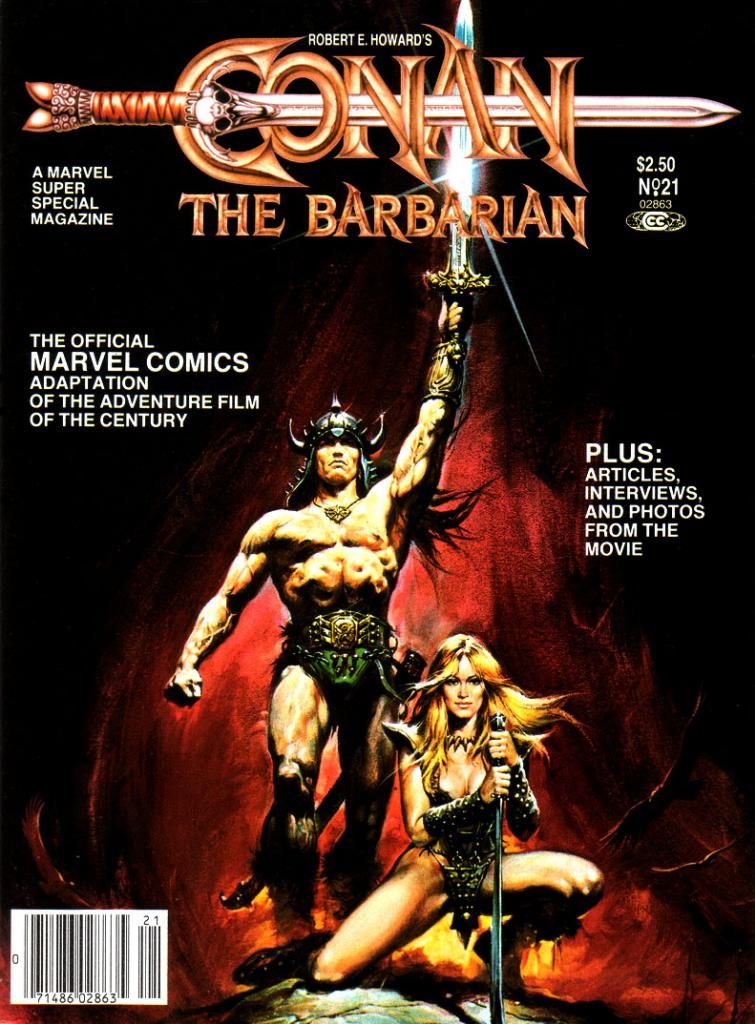
Marvel's Marvelous Movies #9: Conan the Barbarian (Marvel Super Special #21, August 1982)

John Milius and I are probably diametrical opposites politically (and in most other ways), but I have to admit I admire the hell out of him.  The guy simply fascinates me.  He's collaborated with people like George Lucas, Steven Spielberg, Robert Zemeckis and a fella name of Francis Ford Coppola on a little flick called Apocalypse Now.  Lucas based the John Milner character from American Graffiti on Milius, and he served as partial inspiration for Walter Sobchak in the Coen Brothers' Big Lebowski

On his own, Milius has made a number of romantic adventure films laced with a lot of his personal philosophy, which is somewhere to the right of right wing.  He's got kind of a sketchy commercial record, but he's never bored me with his movies.  At its best, his work achieves a kind of powerful macho poetry and beauty, and I find myself exalted by themes and moments I wouldn't ordinarily celebrate.  The Wind and the Lion, Big Wednesday and Rough Riders come to mind. 

Sometimes his movies are just sort of silly.  Red Dawn

Or poetic and silly at the same time.  Which brings us to Conan the Barbarian (Marvel Super Special #21, August 1982). 

Other than the rough outlines of its fantasy setting and few names and incidents here and there, this movie has little  to do with Robert E. Howard's most famous creation.  Milius and co-screenwriter Oliver Stone (yes, THAT Oliver Stone; Milius doesn't seem to let ideology affect his choice in collaborators, which is another reason I respect him) reinvent Conan to suit their revenge story and also because of Arnold Schwarzenegger, in just his second dramatic role (his first being as Hercules in a low-budget comedy with Arnold Stang), didn't have the acting chops to carry the film's narrative.  This reduces the title barbarian himself to kind of a passive meathead thoroughly out-charismaed by his partner-in-crime and lover Valeria, played with scene-stealing verve by Sandahl Bergman.


Script:  Michael Fleisher/Story and art: John Buscema

But Arnold as Conan-- Schwarzenegger, not Stang-- probably contributes the largest portion of the public's perception of the character.  Thick accent, not a lot to say, and most of that borrowed from Genghis Khan.  The rest more than likely comes from Marvel's comic book series starring Conan, which hews closer to Howard's version without quite getting it right, either.  And since Marvel was also in the business of adapting movies, their doing a Conan the Barbarian film comic was inevitable. 

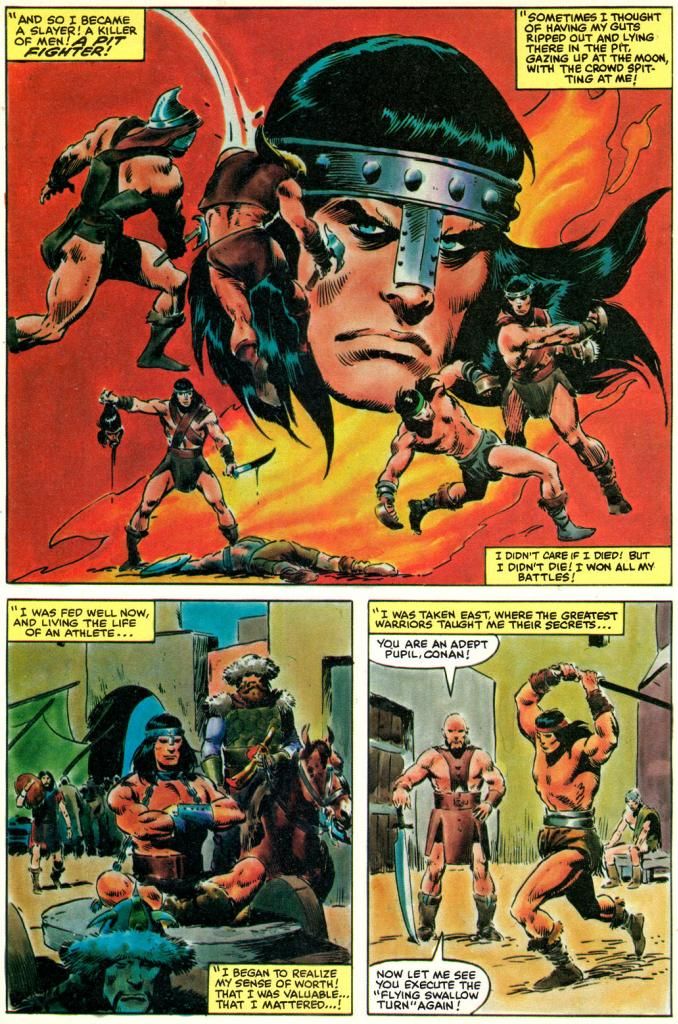
Who better to adapt and draw it than John Buscema, the top Conan comic artist of the day?  As a geek, I tend to associate Buscema with the character almost as much as I do Robert E. Howard himself.  Buscema has Michael Fleisher provide the words for his adaptation, which may or may not have been a smart move.  I say this only because I wish we could have read something even more purely Buscema just to experience what his word choices and tone might have been like.  Together, Buscema and Fleisher reduce the naked sex and sexy naked parts and expurgate most of the gore to produce a newsstand-ready Conan magazine that's Marvel and Milius at the same time.
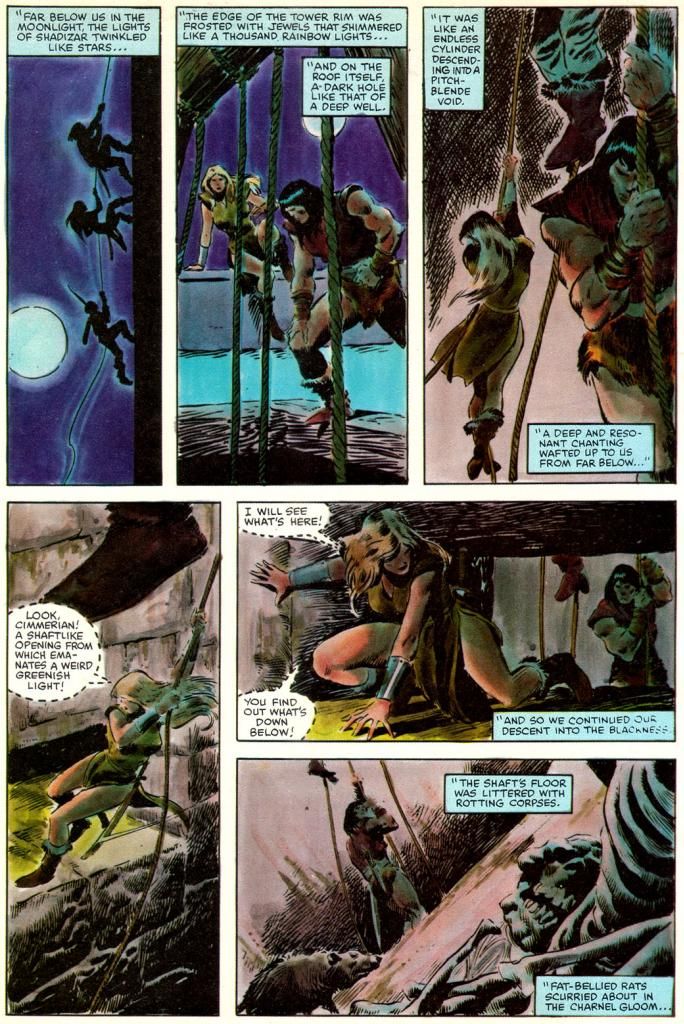
Script:  Michael Fleisher/Story and art: John Buscema

Buscema draws Conan how he was used to drawing him in the Marvel comics rather than try to depict him as Arnold.  In fact, Buscema makes no attempt to caricature anyone other than James Earl Jones as villainous Thulsa Doom.  And even his Doom is more or less a general likeness, aided by Jones' distinct look as the character. 

Doom is a mean guy with a Bettie Page hairdo and a pack of horseback raiders who follow him around in search of money and murder.  They slaughter everyone in Conan's village and then Doom hypnotizes Conan's mom and chops off her head.  The orphaned Conan spends a number of years pushing a stone wheel around until he's as big as a bodybuilder.  Sold as a gladiator, he learns swordplay and Nietschean philosophy while also providing stud services.  Freed, he sexes up a werewolf witch, meets pro surfer Gerry Lopez and soon learns Doom has reinvented himself as head of a cult that sells snake-worship franchises throughout the land.  Conan also meets Valeria, who doesn't dominate the story in the comic quite as much as she does in the movie.  Buscema draws Valeria as the standard Buscema beauty, with thick eyelashes and high cheekbones.  Like Bergman, she's statuesque and blond, but that's where the resemblance ends.

And that's really enough.  If I wanted the characters to look exactly like the actors, I'd just watch the movie again or look at some photos.  I love when an artist does caricatures or likenesses, but it's not always necessary.  If likeness is an artist's strength, then he or she should focus on that.  If not, then filling the pages with a lot of off-model faces poorly copied from stills and publicity material is simply a distraction.  Some can do both, but either way the storytelling is much more important.  Things like pacing and clarity of sequence.  Vigor.  You don't find many storytellers more vigorous than John Buscema in sword-and-sorcery mode.
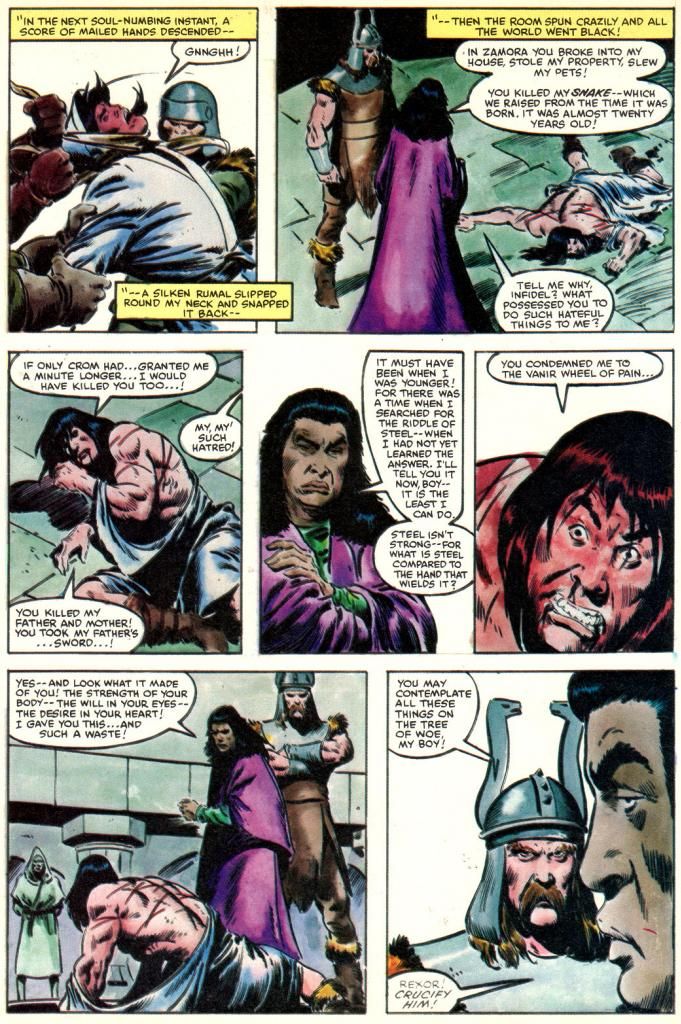
Script:  Michael Fleisher/Story and art: John Buscema

And in contrast with the disappointing Raiders of the Lost Ark, Buscema inks himself this time.  He's well within his comfort zone, and, as with Al Williamson on Empire Strikes Back, we've got an artist perfectly matched to the material.  Whoever made the decision to return to the painted color style of some of the earlier Super Specials needs singling out for praise, too.  D. Pedler (sorry, I don't know who this is, but I wish I did) and the legendary Lynn Varley do a sensational job here, giving Buscema's already gorgeous art a luminous quality, giving each location a rich look full of depth and atmosphere.  Snowy woods look cold, the barren wastes look hot and dry.  This Super Special is a visual treat with a richness a few of the preceding issues sorely needed.  The result?  It's classic Buscema Conan guest-starring in the Milius movie

The writing preserves many of the movie's best lines except for my favorite part, which is Conan's prayer, which it truncates to get to more action.  Conan's prayer is probably the most bad-ass prayer ever capture on film next to the ones for George Bailey at the beginning of It's a Wonderful Life

And I must quote the film here:

Crom, I have never prayed to you before. I have no tongue for it. No one, not even you, will remember if we were good men or bad. Why we fought, or why we died. All that matters is that two stood against many. That's what's important! Valor pleases you, Crom... so grant me one request. Grant me revenge! And if you do not listen, then to HELL with you!

Before we toddle off to Crom's mountain where we'll laugh at the four winds, here's a page with a funny panel a Buscema group I'm in on Facebook hashed over recently.  Look at the middle panel of the bottom tier:
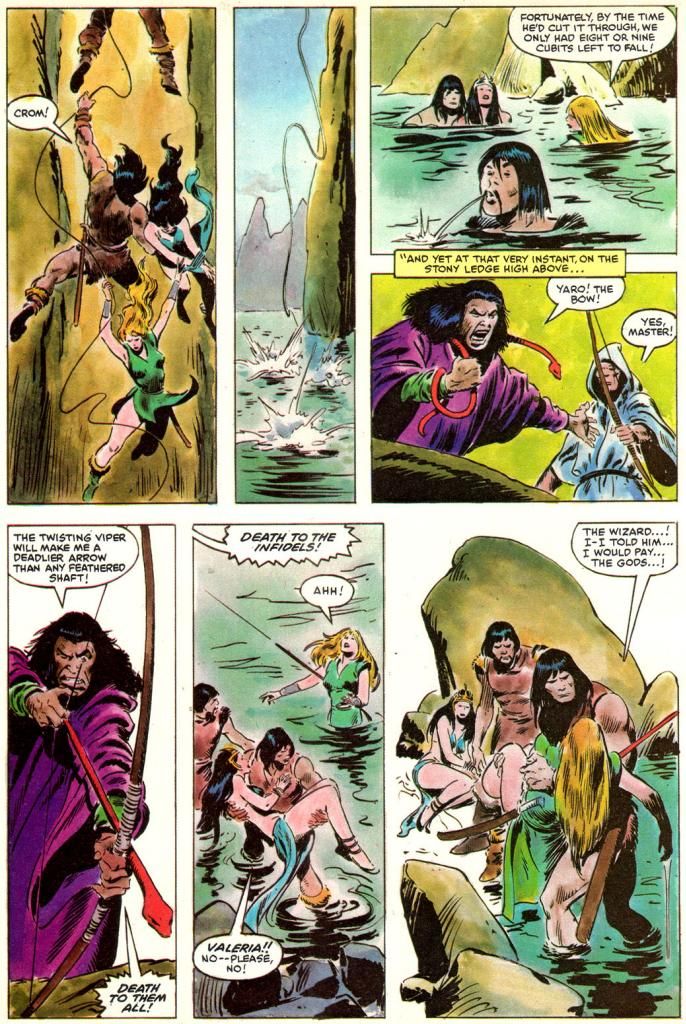

Script:  Michael Fleisher/Story and art: John Buscema

"Valeria!  No-- please no!" 

Neither Howard's nor Milius' Conans spend half a second begging like that.  Where the word balloon arrow points is to the rescued princess, but considering her ungrateful characterization the rest of the way (and the fact she didn't know who the hell Valeria even was) make me believe this is Conan speaking.  Hardly the stuff of the guy who tells his own god to grant him revenge or go to hell.

Who gets the blame for this?

Fuck it, Dude.  Let's go bowling.

Wednesday, July 16, 2014

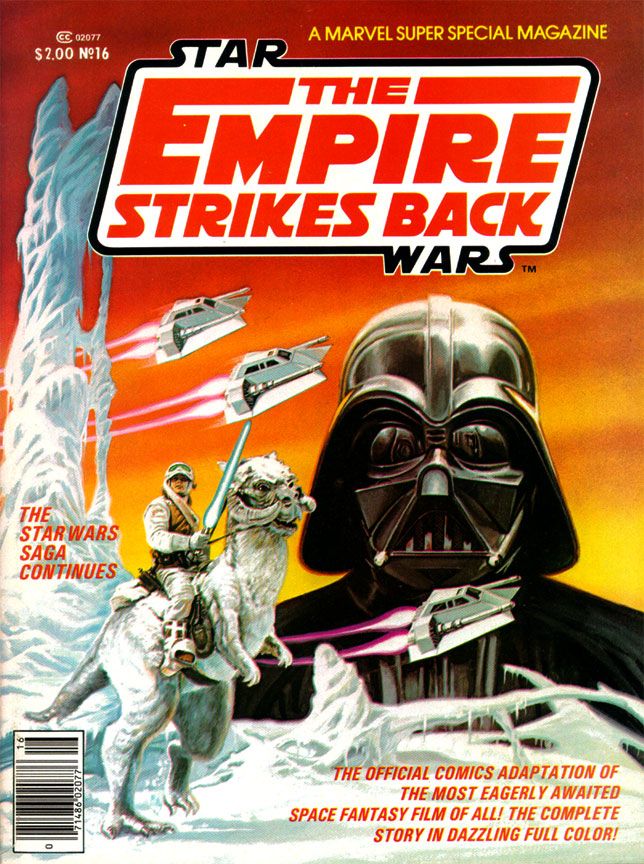
Marvel's Marvelous Movies #4: The Empire Strikes Back (Marvel Super Special #16, Spring 1980)

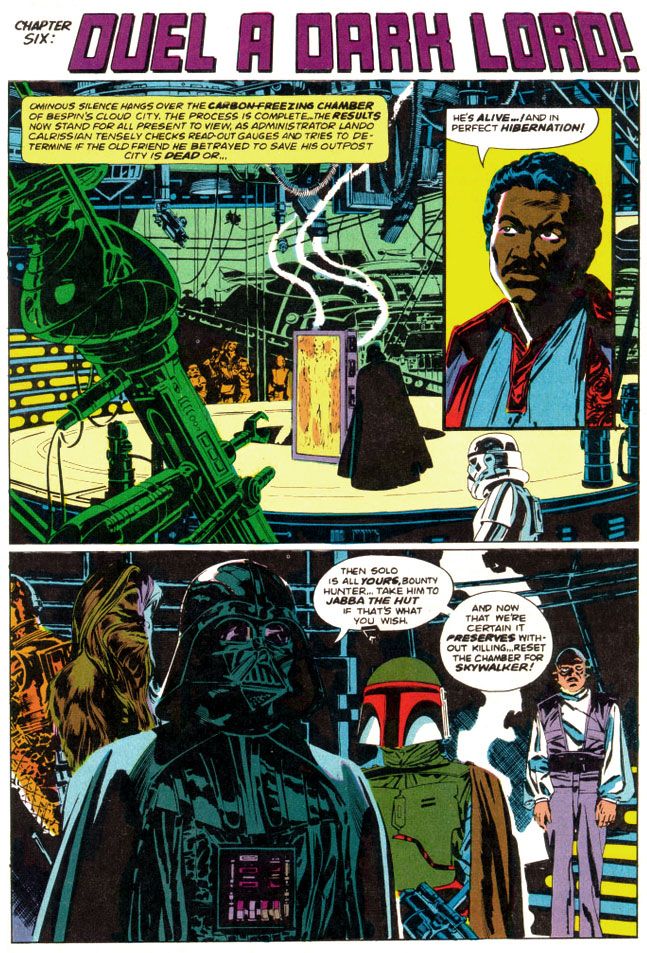
This is my pick for the best of Marvel's movie adaptations, and it's as good as mainstream comics get.  First, it's an adaptation of the best of the Star Wars movies and second, it's an adaptation of the best of the Star Wars movies written by Archie Goodwin and drawn by my all-time art dream team, Al Williamson and Carlos Garzon, and with another of those beautiful Bob Larkin cover paintings.  I'd put it up there with any other comic Marvel (or DC, for that matter) has ever published.  This comic should be taught in schools.

I reached the highwater mark of my Star Wars love in 1980.  I turned 12 that first year of the Reagan and Alex P. Keaton decade, which was about the time other things began occupying my mind.  But I was still childish enough to play with the toys and create my own Star Wars fantasy adventures with the Kenner figures and Millenium Falcon playset in the yard.  And I was adult enough to have become interested in the film making process itself, able to enjoy movies not just for their stories, but also for the craft and artistry behind the scenes.  Reading magazines like Starlog and Fantastic Films and learning the names of people like Ralph McQuarrie, John Dykstra and Richard Edlund, plus terms like “go-motion” and “blue screen,” I began to have a growing appreciation for the mechanics of its creation as well. 

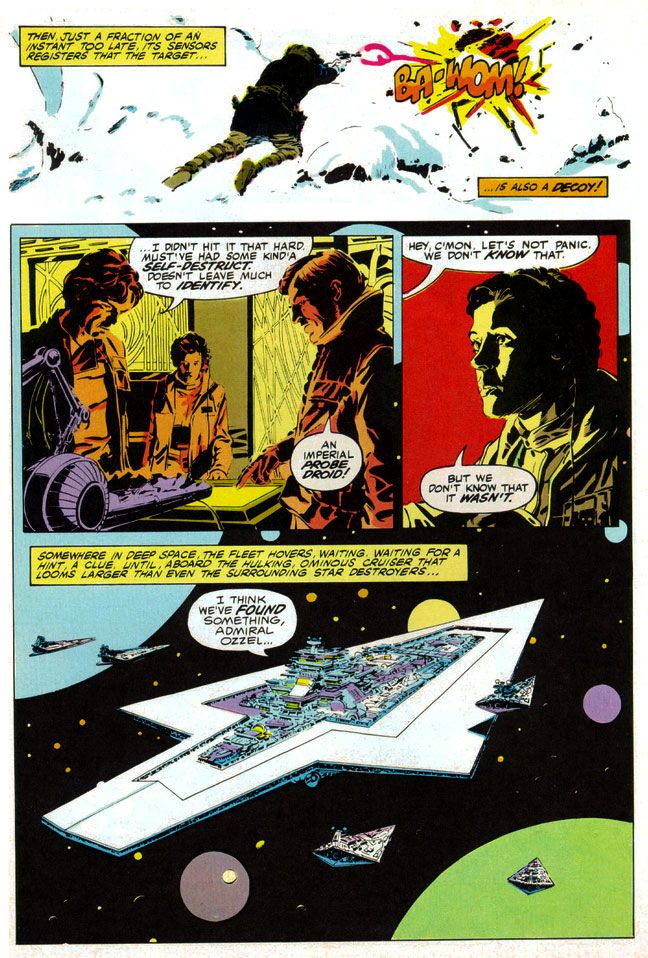
This, then, was the perfect time to discover Al Williamson and, to certain extent, Archie Goodwin.  These are two names I've come to associate with all things Star Wars as much as I do George Lucas, Mark Hamill and John Ratzenberger.  It may seem crazy to you reading this now-- at least as crazy as any dumbass thing I've written in this blog-- but I’d never even heard of Williamson or Goodwin before I saw their names in the credits of Marvel Super Special #16.  While Goodwin's script hits all the right story points at the ideal pace for a comic with this page count, with terse narrative captions to help move things along, Williamson's art literally changed my life.  My appreciation of comic book art consists of pre-Williamson and post-Williamson eras. 

All of his EC and most Warren work came before I was even born, and our local newspaper tended more towards Beetle Bailey and Garfield than adventure strips.  Or paper did run Alley Oop, Steve Canyon and Dick Tracy, the three non-gag strips they did choose to run, plus my dad got me into Gasoline Alley (not an adventure strip but still one with a narrative like those others).  So I didn’t know anything about Secret Agent X-9, or, as it came to be called, Secret Agent Corrigan.  Where would I have learned about Al Williamson?  He didn't draw the Hulk or Spider-Man, for crying out loud!

So when this book hit, as far as 12-year-old me could tell, Al Williamson came into our banal world from some magical extra-dimensional wonderland where romantic adventure and heroic action were as part of life as blood itself and made this comic just for me. 

Williamson’s art was more than a revelation.  It was a rebirth.
 
Script:  Archie Goodwin/Art:  Al Williamson and Carlos Garzon

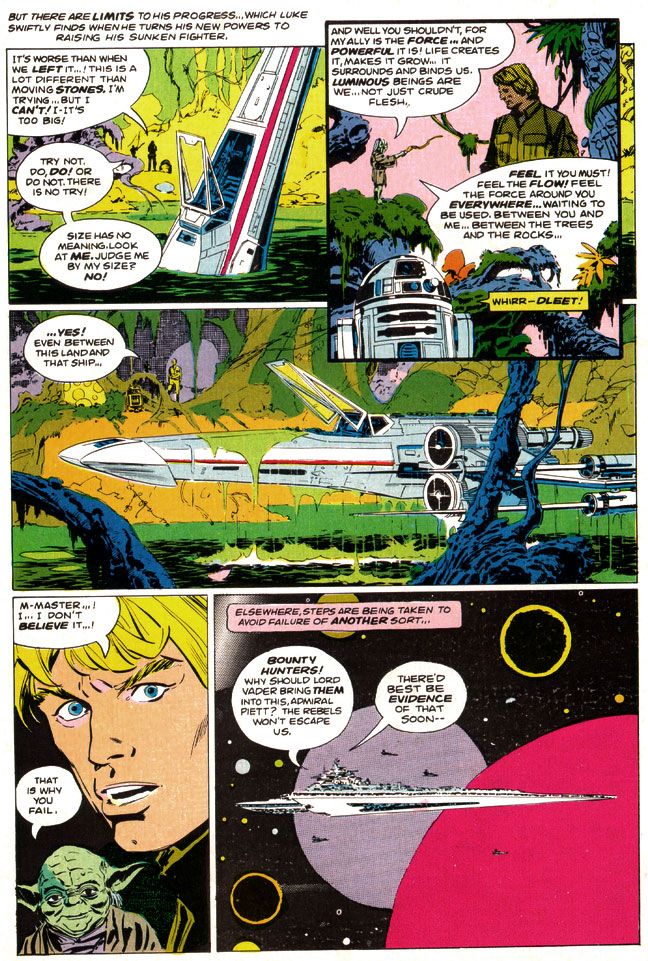
The man painted with ink.  To create the effect of reflections on metal, Williamson used blobby black strokes of varying pressure.  For atmosphere and depth in the backgrounds of different scenes, he used thin parallel lines for a sfumato-like effect.  He spotted blacks throughout, emulating the film’s cinematography, as many scenes take place inside the frozen rebel base or the industrial back-rooms of Cloud City where light comes from computer screens or from behind machinery.  He expanded on the film’s planetscapes and made them imaginatively otherworldly in a way location shooting on a glacier in Norway just couldn’t match (and Larkin wisely copies him on the cover).  Obviously, Lucas couldn't spirit his cast and crew away to Hoth in another galaxy.  But Williamson could and did.

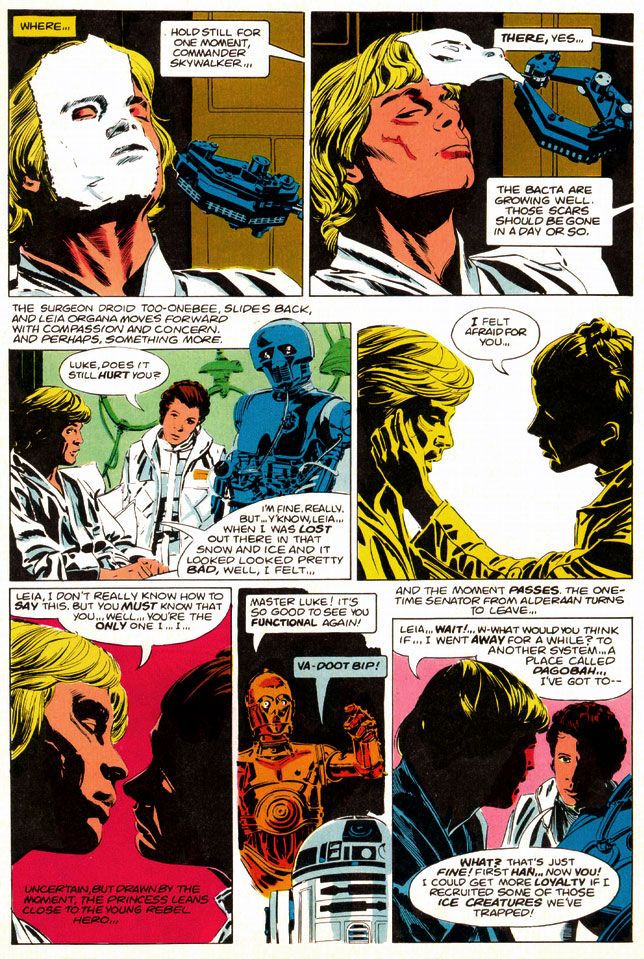
And best of all, not only did Williamson's star warriors look like the actual actors rather than their stunt doubles or stand-ins (as had the characters in many of Marvel’s previous movie adaptations, Star Trek the Motion Picture aside), but the way he posed them and placed them within all those wild environments exactingly duplicates mood and feel of the movie itself every time you read this comic. 

I’d seen movie comics full of pretty art, some of which I've praised in this blog (and justly so; they're fantastically fun) with dazzling light effects and plenty with storytelling that perfunctorily or even adequately reproduced a movie’s action without that feel, without that authenticity of experience.  Goodwin, Williamson and Garzon put all the genuine excitement of the real The Empire Strikes Back right in our hands, in the medium best suited for George Lucas’ epic.  Star Wars came full circle back to the halcyon days of Flash Gordon in the funny pages, one of its prime inspirations.

The only odd note-- and I find it charming and story-book like-- is Williamson's version of Yoda, who looks his familiar, chubby self in closeups and then becomes a tiny gnome-like creature with spindly legs in wide-angle shots.  Williamson never quite figured out Yoda's scale, but at least he made everyone's favorite sentence-reversing Jedi puppet more ambulatory than even a genius performer like Frank Oz could holding him up from underneath the swamp sets.  And more wizardly.  Merlinesque.


Script:  Archie Goodwin/Art:  Al Williamson and Carlos Garzon

You can look at the artwork and see Williamson used quite a bit of photo reference.  In lesser hands, this can freeze a comic story, especially when an artist chooses to draw from studio portrait shots rather than action scene stills.  Williamson expertly blends these images onto the page so each is like a fabulous collage when looked at as a whole, but flow naturally when read panel-to-panel.  Williamson gives us carefully crafted moments like the two-panel sequence where medical droid 2-1B pulls the pharmaceutical mask off Luke's wampa-ravaged face.  He could have rendered it as a single panel, with all of 2-1B's dialogue carrying the action, but instead he chose to give it a bit of animation.  

Notice I'm talking only about Williamson, but there's also Carlos Garzon.  To be honest, I can't tell where one ends and the other begins.  I just see this Williamson-esque art job that matches pretty much all the other ones I've seen.  Many of which probably were in collaboration with Garzon.  Anyway, whichever artist did whatever part of the artwork, it's seamless and I like it.  So let's give Garzon his props, even if  I'm too ignorant and unschooled in his contributions to point out any specific examples.  There are probably other blogs for that.  I should be reading them.  So should you.  Probably a better use of our comics-loving time, right?  Let's go!  Go!  Go!  Go!

Okay, he's gone.  I'll join him after I finish gushing about The Empire Strikes Back like a dizzy fool drunk on love.

Oh, and at this point I should also make mention of Glynis Wein's superb coloring job.  Wein used a screen-accurate palette that enhances the comic experience rather than making you smirk at oddball choices like the red lenses in Darth Vader's mask and the strange orange mottling in Chewbacca's fur from the first Marvel Star Wars comic.  Wein would make entire figures two shades of orange to recreate the spacey glow of Rebel Alliance technology when our heroes conferred in control rooms and on spaceships, and apply appropriately chilly blue shadows to the snowy exteriors of Hoth or give the swamps of Dagobah a slimy look in greens and pale oranges.  Wein's pastel planets and moons help give depth to the imagery of mighty space fleets lumbering along, but where her work really shines is during the light sabre duel between Darth Vader and Luke Skywalker.  The film bathes their battle largely in oranges and blues, at least when the two fight in the "carbon freezing chamber" where Han Solo gets encased in a block of metal.  Wein follows suit but she also adds some nice greens and yellows to make it work better in two dimensions.

Script:  Archie Goodwin/Art:  Al Williamson and Carlos Garzon

The very day I read The Empire Strikes Back, I immediately stopped copying every other artist and became simply a Williamson imitator, in as much as my clumsy hands could make me so.  Any one of my comic book art idols represents an impossible standard to which an artist can hold himself or herself, but even more so with Williamson.

I doggedly spent the next three or four years laboriously filling sketchbook after sketchbook with really shitty Star Wars drawings, thinking all the time I was getting somewhere with my art.  While I later found other artists to fail at emulating, whenever I had a sketchbook and a pen or brush, I’d still find myself pulling out some Williamson stuff and doodling away, futilely trying to match his supreme figure construction and posing, and lush, sinuous line quality.  Even in my graphic design program days at the University of Georgia my professors would look at my homework and occasionally come across something that looked as if Al Williamson had drawn it with the brush held in his teeth, or sticking out of one ear.

Script:  Archie Goodwin/Art:  Al Williamson and Carlos Garzon

Even now, Williamson remains one of those go-to guys whose work I feel compelled to collect.  Williamson, Alex Toth, Jack Kirby and Steve Rude.  Whenever their stuff appears in purchasable form, I will be there.  Right now Dark Horse keeps much of Williamson's Star Wars work with Goodwin in print both in paper form and digitally.  With the license reverting to Marvel in the wake of Disney's massive Lucasfilm purchase and upcoming new trilogy, I'm not sure how long this will be the case.  Fortunately, I've got it all.

And you know what?  I’m not even a huge Star Wars nut anymore.  The intense, religious-like fervor of its fans and the oversaturation of all things Star Wars on the Internet and on the shelves in book and toy stores across the world (and also the law of diminishing returns as it applies to the film story’s recent, tragic extension) have all tarnished the brand for me.  And brand is the right word.  McSkywalker, now serving number two billion. 

But it seems all I have to do is pull out the Al Williamson The Empire Strikes Back and I’m 12 years old again and everything is suddenly wonderful in a way it had never been before, although there had certainly been wonderment.  With Al Williamson, there's a purity to the work that ensures there will always be wonderment.

Sunday, July 6, 2014

Marvel's Marvelous Movies #3: Star Trek: the Motion Picture (December 1979)

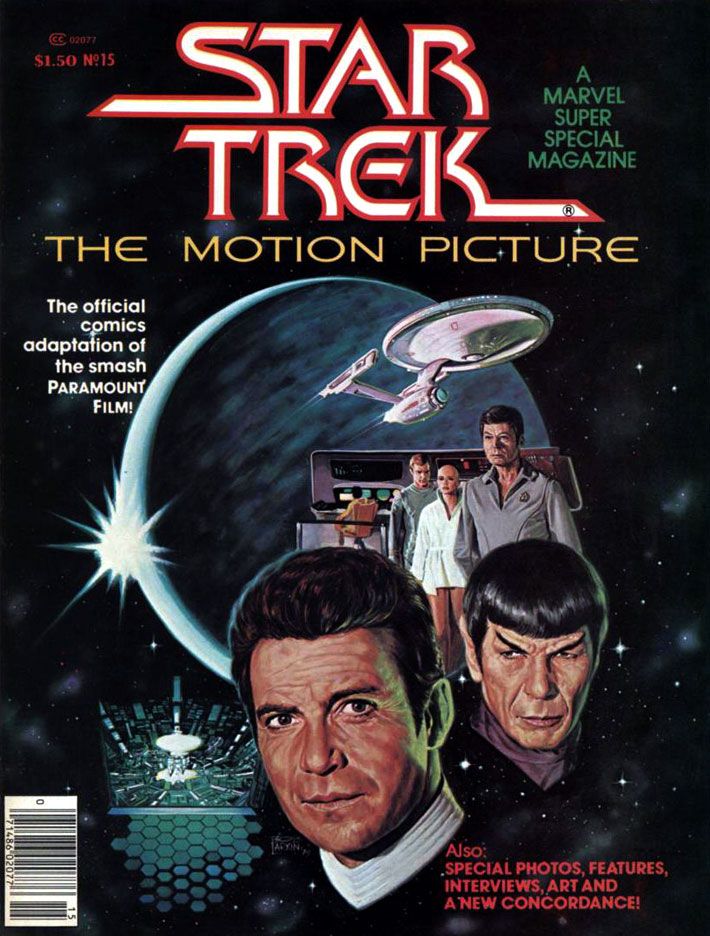
I'm going to tell you upfront this was one of my favorite individual comic book stories when I was 11 years old.  I have no idea how many times I read it.  The following year, Marvel's Empire Strikes Back adaptation would knock this one (and just about every other comic I'd ever read and loved prior to encountering Al Williamson) down a spot or two on my personal hit parade, but I still have a deep and abiding love for Marvel Super Special #15.  I'd been a Star Trek TV show fan for as long as I could remember, and this was in the wilderness years of the 1970s.  Back then, you had to find Trek at odd hours on some local station.  Ours came out of Tallahassee on Saturday afternoons, subject to atmospheric interference.  When your station dropped whatever Trek syndication package they'd licensed, you lost touch with the crew until they popped up somewhere else within antenna range.  In the interim, you could read the James Blish short story collections with episode adaptations, and the often silly Gold Key comics.  Or collect and play with the Mego action figures.  That was as Treky as we got before 1979's Star Trek: the Motion Picture came out and relaunched the franchise as a movie series.

It almost didn't.  The movie, directed by two-time Academy Award winner Robert Wise and based on a premise written by series creator Gene Roddenberry, made money, but it was expensive to produce and wasn't as big a hit as Paramount had hoped for.  It certainly looked fantastic, with a sleeker, updated Enterprise and everyone in pajamas for a sweet slumber party atmosphere.  But it suffers from endless shots of the Enterprise slowly drifting along set to repetitive music cues and people staring in awe at light shows.  It's like watching the audience at Laser Floyd: Dark Side of the Moon.  The film allows its characters to ask existential questions, but when it comes to answering them, the result is akin to a 2001: A Space Odyssey where, after boring you for more than two hours, Stanley Kubrick has the astronauts explain to each other (and the audience) exactly what the monolith represents and why it does what it does.  The cheaper, more action-oriented Star Trek II:  The Wrath of Khan turned out to be the franchise's salvation, not this glacially-paced epic.  But in 1979, for me, it was enough seeing Kirk, Spock, McCoy, Scotty, Uhura, Sulu and Chekov (along with Janice Rand, for cripe's sake!) back in action.

And, after watching this movie again on Blu-Ray recently, I've decided I'll take it with all of its flaws and dull stretches over either of the terminally stupid "reboot" flicks any day of the week.  Star Trek The Motion Picture at least has ideas and something to say about the basic human dilemma ("Is this all there is?  Is there nothing more?"), things it takes very seriously.  Can you imagine a major studio nowadays dropping this kind of money on a sci-fi flick starring a lot of middle-aged people and without any meta-humor or product placement?  There's not even a sky-diving sequence!  There's barely any sex!


But let's talk about the comic.

It must have been a daunting challenge to adapt into an entertaining comic a story that consists mostly of long sequences of nothing more than the Enterprise gliding over the giant V’Ger ship and then small groups of characters conversing about it in staff rooms and small corridors.  The comic really benefits from the deft way Marv Wolfman condenses scenes.  Wolfman ruthlessly edited down long scenes into a few panels, quickening the pace and generally tightening things up.  Wolfman uses his narrative captions-- always a strength of his writing-- to clarify character motivation and add descriptions and exposition to guide readers along.  We're engaged throughout.

For the art team, which consists of Dave Cockrum on pencils and Klaus Janson on inks, the problems are finding ways to make all the conversations work visually and reproducing the movie’s many, many special effects shots.  Cockrum, a master of crowded team compositions and action-packed superhero action, comes through with strong "acting" from the principals, downplaying the usual Marvel dynamics but upping the emotional content of various scenes.  His Commander Decker in particular comes alive with various angry faces and hand-chop poses emphasizing his frustration.  The likenesses are consistent throughout, a real plus when dealing with familiar, iconic characters.  The results aren't photographic, but Cockrum never confuses the readers.  Kirk has his poofy hair, McCoy his sharply arched eyebrows and drooping, lived-in face.  Of course Spock is easy to get right, but even more conventionally good-looking people like Uhura, Sulu and Chekov look pretty much the way you expect.  Every so often there's a dead face, but they never become a distraction.


What an ink job Janson provides, too.  While he and Walt Simonson outdid themselves on innovative lighting effects in Close Encounters, here he and colorist Marie Severin use color holds to reproduce Douglas Trumbull's lightning balls and wormholes.  This kind of stuff is easy to do these days with digital inking and coloring.  It's nothing to isolate an element and change the color channels to whatever you want.  But when Janson and Severin tackled Star Trek, they had to rely on acetate or vellum overlays.  It must have been a tedious, time-consuming process because they use one or more on practically every page.  The results are nothing less than astounding.


For all its pacing flaws, the film is effective at making space seem like an infinite frontier full of dangers.  It's not just that there are Klingons and V'Gers out there ready to zap unfortunate astronauts and Starfleet personnel.  Space itself is dark and perilous.  For one thing, the ships have to provide their own exterior lighting.  None of that Star Wars stuff where everything in space is brightly lit no matter how far away it is from an actual light source.  To the human mind, space appears largely empty, dark and vast.  Even the vaunted technology its space explorers count on for survival turns on them.  The transporter goes awry in a shocking incident and, later, the warp drive throws the ship into what the characters call a “wormhole.”  Contending with these, the Enterprise crew truly seems to be going boldly.  This isn't sailing along to some cute world where you find 1920s gangsters or the White Rabbit out of Lewis Carroll.  You could end up a data stream in a godlike machine's memory banks or transformed into a robotic copy of yourself with a lighted jewel embedded in your throat.  Or merge with the overmind into a stream of light.  Wolfman’s script reproduces each of these episodes faithfully and Cockrum, Janson and Severin provide some spectacular visuals to match them, with all the production design details faithfully reproduced.  Ultimately, this is an extremely accurate recreation of the film's look and mood, minus its shambolic tendencies.


The story also appeared in three monthly issues (Star Wars, a much shorter but action-oriented film, ran in four, which is further evidence of how Trek should have been pared down a bit) which led to a short-lived Marvel Star Trek comic.  I never read a single issue of that.  After all this time, I'm not sure why, especially considering how much I enjoyed this one.  Maybe it was enough for me Wolfman, Cockrum, Janson and Severin had already provided fabulous glimpse of what a Star Trek comic could be, one-upping its cinematic source material.  Too bad they didn't get a chance to take on Khan.


Looks like I forgot to talk about the Bob Larkin fully-painted cover.  That's just as well.  I'd have written a paragraph consisting only of superlatives.  I look at it kind of like Kirk, McCoy, Decker, Ilia and the rest gaze at Laser Floyd.

Tuesday, June 17, 2014

Coming soon: a look at Marvel's movie adaptations!

Hola, amigos.  I know it's been a long time since I last rapped at ya, but things have been pretty crazy around here lately.  It's not as if I'm not reading comics.  I am.  I'm reading some fantastic old comics with art by cats like John Buscema and John Romita, Al Williamson, Jim Aparo and Alex Toth.  But, as I've told you, I'm also working on my own comic.  Plus I'm married and have a regular job that takes up about ten hours a day (if I'm lucky).  Man, I get home, all I want to do is read the comics, not write about them.  Or work on my own.

Anyway, what I'm here to tell you is I have a few posts coming up.  They're largely finished but I need to tweak a few things here and there, check a fact or two so they live up to the high standards for comic journalism you've come to expect from When Comic Books Ruled the Earth.  You deserve no less. 

Comixology and DC just released the first two issues of Batman and the Outsiders by Mike W. Barr and Jim Aparo.  That's one of my favorite series, and features Katana, a character I've dug for the longest time.  Well, ever since I bought Batman and the Outsiders #1 when it first came out way back in August 1983.  I've written about Katana here before, but it's time to do a closer reading of her first appearance.  DC and Comixology have made that possible, and for that, I'm happy and thankful.

I'm also very excited about one set of posts in particular.  I was writing a bit about Williamson's artwork for the Marvel Blade Runner comic when I realized Marvel has a lot of other cool movie adaptations we could pick apart and have some fun with.  Others have written beautifully about Gene Colan's killer work on Jaws 2, and I've already covered Close Encounters of the Third Kind and Dragonslayer.  You can even find a few funny articles here and there about things like Xanadu.  Well, now I'm going to take them all on, one by one, and in no particular order.  I won't be mocking them, although I'm sure there will be a few attempts at humorous deconstruction, because I'm stuck in post-modern mode and will probably never change.  Mostly I just want to appreciate some of the odder ones for attempting something different, for introducing new genres to comics even if those genres don't really translate into the format very well or comfortably.

You know, like musicals.

I'm not sure when the first post will appear, nor can I say for certain when we'll finally see the last of them.  All I can tell you is they are coming.  And maybe, down the road a ways, I'll make an official announcement of some kind about my own comic and let you know a little bit about it.  I just want to get enough done to make it more of a real thing rather than just a dream I'm chasing.  Consider that a promise.  Or a warning.  Or both.  I hope you enjoy the upcoming posts.  I think you will.