
Showing posts with label Hopey Glass. Show all posts
Showing posts with label Hopey Glass. Show all posts
Monday, May 6, 2013
I'll be back...
Sorry I haven't been posting a whole lot lately. I still have a few Kamandi posts to drop here and I'm working on a look at the love life of one Hopey Glass, plus some more stuff about Micronauts. I'm working a lot and getting married this week, so the blog is a low priority matter right now.


Wednesday, February 13, 2013
Happy Valentine's Day from Hopey!

Look! She's buying something special just for you! Panel courtesy Love and Rockets vol. 2 #16 by Jaime Hernandez.
Tuesday, September 18, 2012
Identifying with Batman and Spider-Man makes you feel good about yourself...
What do you think of this report? Apparently, some men who identify with Batman or Spider-Man feel better about their bodies when they look at pictures of their heroes, but if they're indifferent, the pictures make them feel worse. A previous study found a similar effect in women who viewed celebrity photos.
I love this stuff. I'm a psychology buff, and I know just enough about it to use its jargon to make bizarre, counter-factual claims and asinine pronouncements that can't withstand close scrutiny with facts. To me, this report actually raises more questions than provides answers. Here are a few.
1) What if you identify with Dani Moonstar or Cassandra Cain? What effect does looking at drawings of Spider-Man and Batman have on your self-confidence?
2) What if you identify with Buddy Bradley?
3) Or the Crypt-Keeper?
4) Have they done this study specifically with female comic book fans?
5) Would doing the above study produce similar results? Or, given the sexualized or fetishistic nature of how many female characters are presented, would they be opposite? I'd be very interested in seeing how this plays out, because while their numbers aren't as great as with male fans, female comic fans are incredibly passionate about their favorite characters.
6) What is the nature of identification with characters involving female comic book fans? Is it the same or different than with male fans?
7) What about fans with other gender identities?
8) Related to number one, how much cross-gender identification is there? Is this common, or isolated?
9) In the study of women and celebrities, what kind of photos were used? Were they candid shots, photos from public events or sexualized photo-spreads from men's magazines? And would any of those affect the results?
10) Is identification with characters-- in effect, the reader "masking" himself or herself with certain characters-- important to creating a fan base or readership?
BONUS 11) What about fans who identify with villains?
I'm seriously interested in someone doing a study on these, and some in-depth surveying of women who read superhero comics. Isn't it a fairly common belief male characters are idealized and more inviting of identification while female characters are objectified and more involving the reader in the male gazed based on an assumption that the readership is almost exclusively male? And yet women who are into superhero comics really latch onto these characters and they're extremely vocal with their opinions. Well, maybe that's just part of being a superhero comic fan. But you know... Stephanie Brown. Oracle. Huntress. Lois Lane. You dismiss or degrade these characters at your peril.
I'm also keenly interested in the gender dynamics. As someone who easily identifies with female characters-- I have my entire life and probably pretended to be Wonder Woman, the Bionic Woman or any one of Charlie's Angels and even Cindy Lee from The Secrets of Isis as often as I portrayed Superman, the Incredible Hulk, Sgt. Rock, Batman or Spider-Man as a child, and Dani Moonstar quickly became my masking character of choice in New Mutants-- and responds strongly to their positive and negative portrayals, I'm guessing I fall somewhere outside the control group or whatever the heck they used here. So I also want to know how other fans who view gender and sexuality in ways that aren't traditionally accepted.
And, strangely enough, I also identify quite a bit with characters with ambiguous morality-- in fictional, comic book dichotomous terms, not real life. I find we have to go outside the mainstream to find these kinds of richly drawn, troublesome characters. When I read Nexus, I tend to mask myself with Horatio Hellpop, but I find myself drawn to Ursula X.X. Imada whenever she appears on the scene. Outside of genre fiction, I find Hopey Glass and Terry Downe from Love and Rockets have always fascinated me more than Maggie, the star. And I have much more in common with Buddy Bradley from Peter Bagge's Hate than I'm comfortable admitting.
When I see drawings of them, how do I feel about myself? Pretty good, I guess.
I love this stuff. I'm a psychology buff, and I know just enough about it to use its jargon to make bizarre, counter-factual claims and asinine pronouncements that can't withstand close scrutiny with facts. To me, this report actually raises more questions than provides answers. Here are a few.
1) What if you identify with Dani Moonstar or Cassandra Cain? What effect does looking at drawings of Spider-Man and Batman have on your self-confidence?
2) What if you identify with Buddy Bradley?
3) Or the Crypt-Keeper?
4) Have they done this study specifically with female comic book fans?
5) Would doing the above study produce similar results? Or, given the sexualized or fetishistic nature of how many female characters are presented, would they be opposite? I'd be very interested in seeing how this plays out, because while their numbers aren't as great as with male fans, female comic fans are incredibly passionate about their favorite characters.
6) What is the nature of identification with characters involving female comic book fans? Is it the same or different than with male fans?
7) What about fans with other gender identities?
8) Related to number one, how much cross-gender identification is there? Is this common, or isolated?
9) In the study of women and celebrities, what kind of photos were used? Were they candid shots, photos from public events or sexualized photo-spreads from men's magazines? And would any of those affect the results?
10) Is identification with characters-- in effect, the reader "masking" himself or herself with certain characters-- important to creating a fan base or readership?
BONUS 11) What about fans who identify with villains?
I'm seriously interested in someone doing a study on these, and some in-depth surveying of women who read superhero comics. Isn't it a fairly common belief male characters are idealized and more inviting of identification while female characters are objectified and more involving the reader in the male gazed based on an assumption that the readership is almost exclusively male? And yet women who are into superhero comics really latch onto these characters and they're extremely vocal with their opinions. Well, maybe that's just part of being a superhero comic fan. But you know... Stephanie Brown. Oracle. Huntress. Lois Lane. You dismiss or degrade these characters at your peril.
I'm also keenly interested in the gender dynamics. As someone who easily identifies with female characters-- I have my entire life and probably pretended to be Wonder Woman, the Bionic Woman or any one of Charlie's Angels and even Cindy Lee from The Secrets of Isis as often as I portrayed Superman, the Incredible Hulk, Sgt. Rock, Batman or Spider-Man as a child, and Dani Moonstar quickly became my masking character of choice in New Mutants-- and responds strongly to their positive and negative portrayals, I'm guessing I fall somewhere outside the control group or whatever the heck they used here. So I also want to know how other fans who view gender and sexuality in ways that aren't traditionally accepted.
And, strangely enough, I also identify quite a bit with characters with ambiguous morality-- in fictional, comic book dichotomous terms, not real life. I find we have to go outside the mainstream to find these kinds of richly drawn, troublesome characters. When I read Nexus, I tend to mask myself with Horatio Hellpop, but I find myself drawn to Ursula X.X. Imada whenever she appears on the scene. Outside of genre fiction, I find Hopey Glass and Terry Downe from Love and Rockets have always fascinated me more than Maggie, the star. And I have much more in common with Buddy Bradley from Peter Bagge's Hate than I'm comfortable admitting.
When I see drawings of them, how do I feel about myself? Pretty good, I guess.
Saturday, September 17, 2011
Thirty Years of Hopey Glass, Super Punk Badass!

Okay, I'm exaggerating a little. Hopey's probably only the third or fourth most important character in American comics. And it only took twenty-six years for Fantagraphics to publish a book with her name in the title. But this poses a question-- just how did Jaime Hernandez pack so much awesome into such a teensy-tiny character? I don't think we'll ever know. Perhaps she sprang from some real-life source, some proto-Hopey raising punk hell, throwing bottles, spray-painting walls, blowing the boys and girls away with her spiked hair and mean eyebrows. Perhaps it's a mystery best left unsolved. However, I do know I would never cross Hopey no matter how petite she may be.
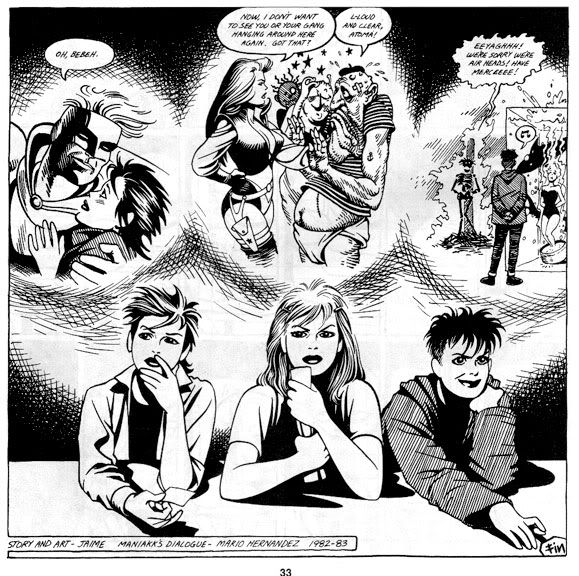
1) Hopey's gleefully violent imagination (Love and Rockets #3). When Maggie reluctantly tells a group of doubters about her brief career as a superhero's sidekick, Hopey takes a little mental revenge.
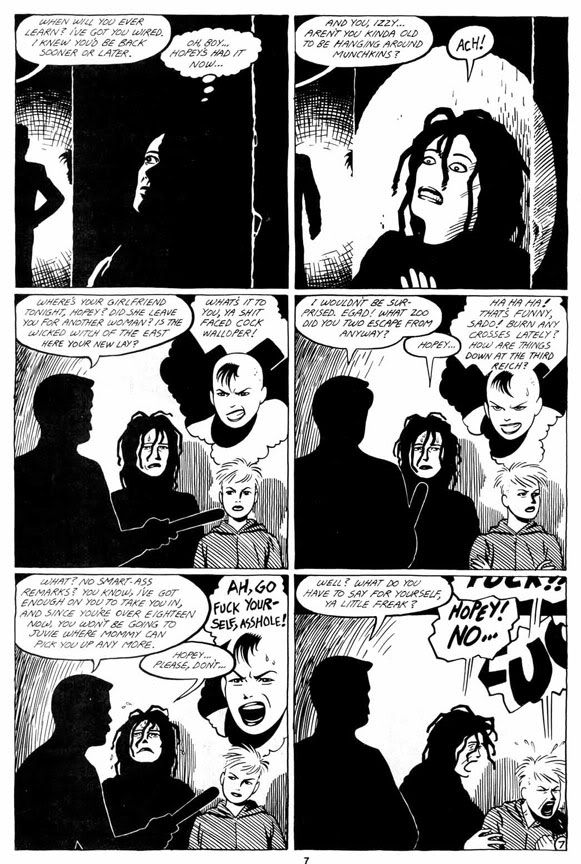
2) Hopey fights the law (LR #5). An untagged wall drives Hopey to distraction and depression. With the encouragement of her friends Maggie and Izzy, she sets out to do something about it, only to have her moment of triumph interrupted by Officer Sado, her personal nemesis-cop. She ends up doing something about that, too. Sado later made sergeant, no doubt due to his Javertian pursuit of La Hopita.
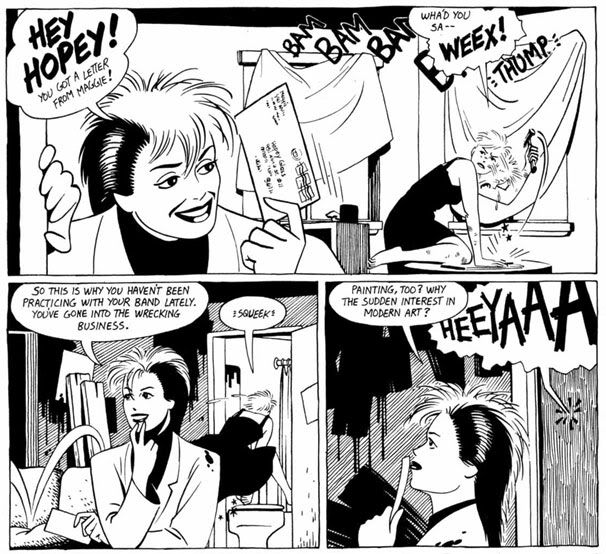
3) Hopey hits her finger with a hammer (LR #7). With Maggie away repairing spaceships, Hopey decides to go all Bob Villa and fix up their dumpy habitat. Too bad she's not as skilled with tools as she is with spraycans of paint.
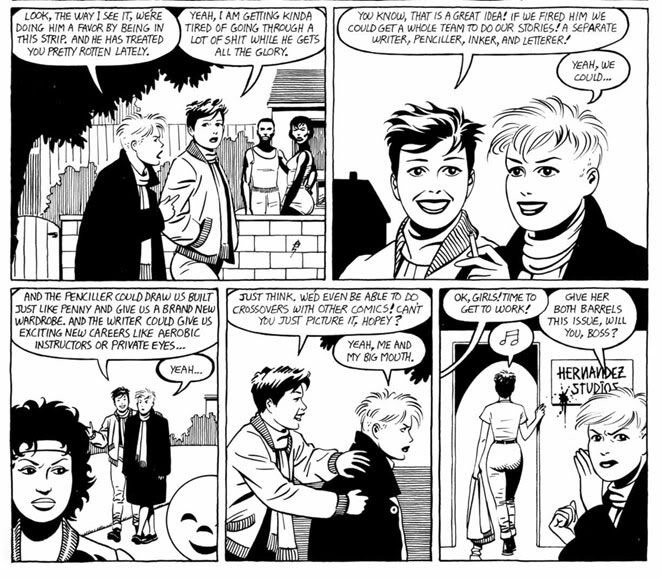
4) Hopey breaks the fourth wall (LR #10). Hopey loves Maggie, but she's not one to suffer fools gladly, even fools she's sleeping with. She has a request for the guy who created the two of them.
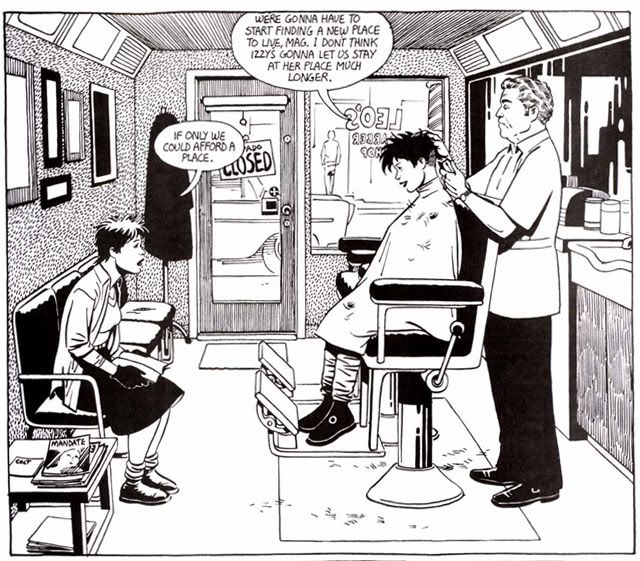
5) Hopey gets a haircut at an old school barber shop (LR #13). Where else would Hopey get her hair cut? This is one of my favorite comic book panels of all time. I love how Hernandez has Hopey's toes barely touching the barber chair's foot rest base-plate. When I was a kid, I got my hair cut in a similar place, with photos of gunfighters like Doc Holliday, Wyatt Earp and Billy the Kid on the wall. Ironically, my barber's ex-wife blew him away with a shotgun. This drawing brings back memories of that so vivid and detailed, I can almost smell the baby powder and rubbing alcohol and feel the goosebumps I'd break out in when the barber buzzed the back of my neck with the electric shaver.
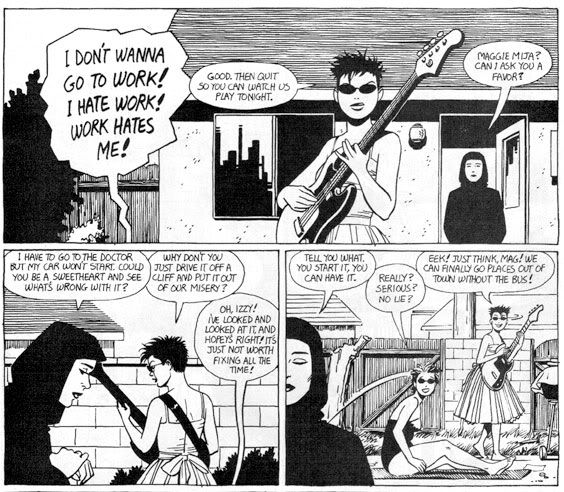
6) Hopey wears a vintage-like dress while practicing bass in the backyard (LR #14). She practices? Even a vicious little punk chick like Hopey wants to feel like a princess every once in a while. I love the way her butch hair and in-your-face personality clash with her demure girly-girl dress. Notice also her bare feet.

7) Hopey helps Izzy ruin Daffy's day (LR #15). Poor Daffy. I love her. She's really just a sweet kid with a head full of mixed-up ideas that a bit too conventional and suburban for Hopey's tastes. Looking like the long-lost sisters of Morticia Addams, Hopey and Izzy arrive on the beach pop the balloon made up of Daffy's romantic notions.
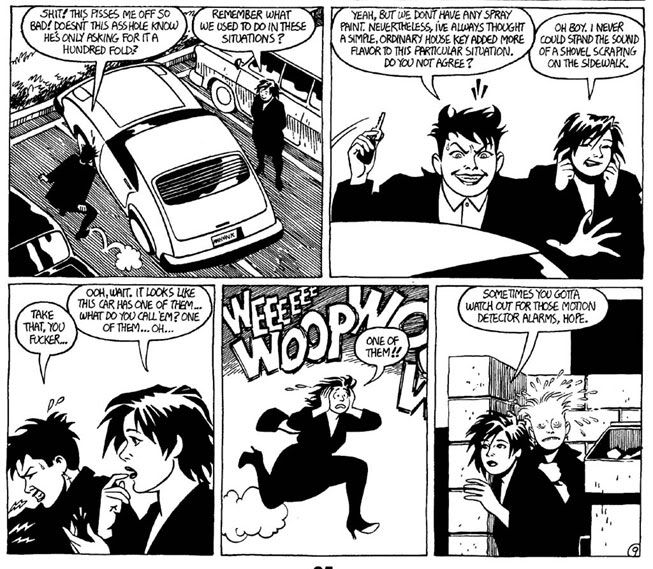
8) Hopey practices street justice (LR #18). Jaime Hernandez shows some of his humor comics influence in the second panel of this sequence where Hopey does what many of us have dreamed of doing. Take that, you rich jerk!
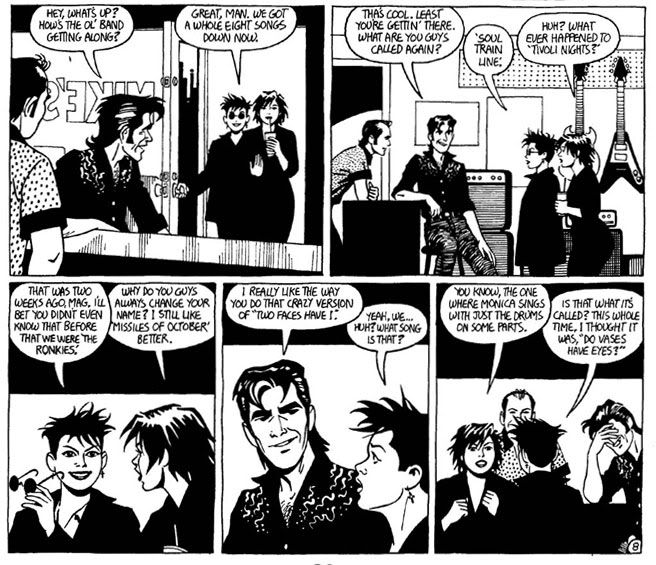
9) Hopey's famous near-homophony (LR #18). Or mondegreen, if you like. Hopey rarely gives strangers a straight answer, but even she's stumped when it comes to the names of the songs her band performs. She still hasn't lived this one down.
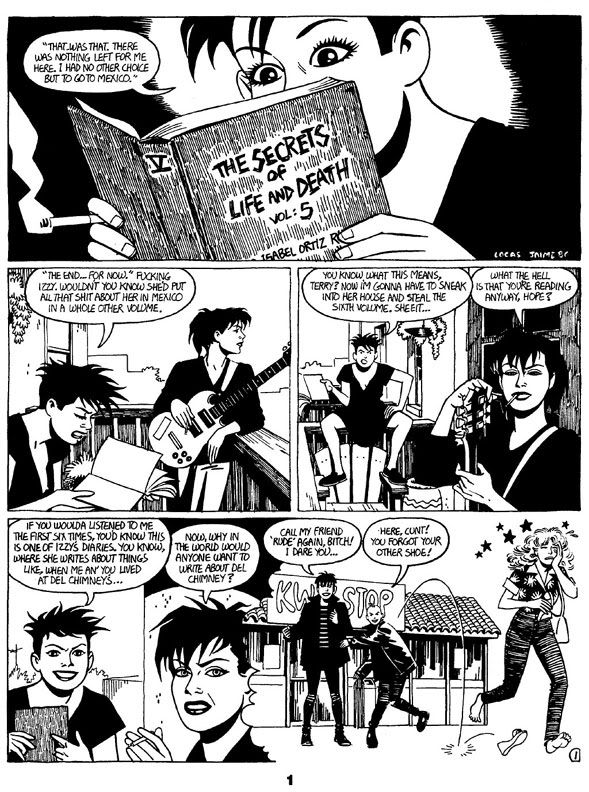
10) Hopey steals and reads Izzy's diary while Terry reminisces about beating up the hated Julie Wree (LR #19). During a break from band practice, Hopey obsesses over Izzy's diary. Terry Downe, her former lover-- and the person most interested in actually becoming a musician in the group-- takes a moment to flash back to to the good ol' days, when Hopey was hers-all-hers and they terrorized Julie Wree on a regular basis. Man, all these years later and they still hate Julie Wree!
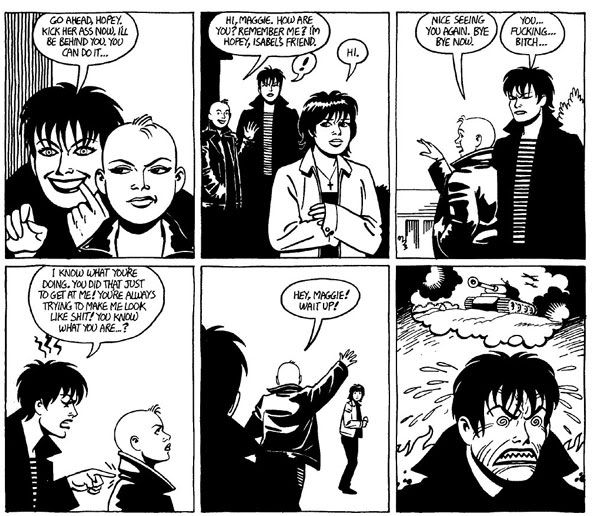
11) Hopey stabs Terry in the back (LR #19). Terry has a lot of bad memories about her brief relationship with Hopey. She learns the hard way you can never get too comfortable with Hopey because she always has her own agenda. Just when you think you're on the same side, she chooses another team. Why? We often learn Maggie's motivations, but Hopey's remain an enigma. That's just Hopey being Hopey.
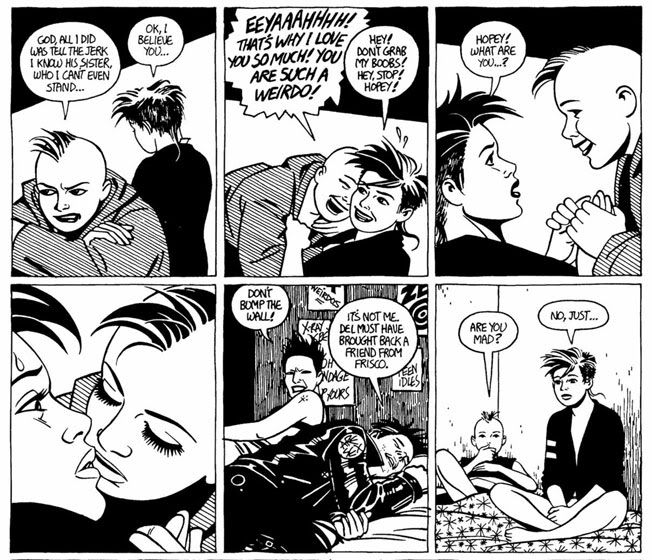
12) Hopey makes the first move on Maggie (LR #20). While they've both been with plenty of others in the decades since-- Hopey has a miscarriage as the result of a wild three-way and Maggie gets married and divorced-- one of the ongoing plot threads in the various "Locas" stories has always been their on-again/off-again love affair. Strangely enough, it's always seemed to be more off than on. Hernandez brought them together, then created long storylines that split them apart. Delicious torture for the characters (including Daffy, who's as obsessed with the Maggie-Hopey pairing as many of the series' readers) and the fans. Who knows what was really going on in Hopey's mind right here, but this is a flashback scene to their early days, showing how it started.
Subscribe to:
Posts (Atom)