1. Superman and Lois Lane. No, not Superman and Wonder Woman. Superman and Lois Lane are the couple of comic book record and trying to change that is stupid. There is no greater comic book pairing than these two. The demigod with the human heart and the kick ass intrepid reporter.
2. Big Barda and Mr. Miracle. I love these two together. Mr. Miracle is the gentle soul, Barda is the iron-willed warrior who seeks to protect him, an inversion of the expected gender roles. However the thing I like most about these two is when they're written and drawn by Jack Kirby they have one of the most genuine loves depicted in comics. It's warm and organic and they have a lot of chemistry. There's is one of the few truly adult relationships depicted in superhero comics.
3. Terra and Changeling. These two are a couple of freaks and their love is strange and wrong. That's what makes it so fun to read about.
4. Cyclops and Phoenix. Classic doomed pair. Well, one of them was doomed. Which means their love was doomed. Who doesn't love reading about doomed love? Even Dr. Doom loves doomed love.
5. Maggie and Hopey. This is one that makes for some amazing reading. I can't decide if I like them better together or apart. Either way, good stuff.
6. Nexus and Sundra. Another very adult relationship. They've gone through a lot together and we've watched them grow and develop over many long years.
7. Reed Richards and Sue Storm Richards. This is one of those relationships that-- at least in the early Stan Lee/Jack Kirby years-- is mostly what little boys think love and all that gooey junk is all about. There's this stalwart, relatively emotionless guy who needs to get some work done and there's the flighty, childish, super-moody girl who always demands his attention. Sue would put on a pouty scene and Reed would turn to his pal Ben Grimm and say something like, "Women. Even with all my scientific knowledge, there's no understanding their mysteries!" Ben would say, "They sure smell nice, though." And Reed would conclude, "They do, old pal. I suppose all we men can do is give up trying to figure out women and simply protect them and their silly little fantasies from the harsh realities of the multiverse." Cut to a close-up of Sue getting a manicure or trying on a wig.
8. Buddy and Lisa. The unfortunate pair from Hate, the perfect comic. Buddy is kind of an asshole and Lisa is a complete mess. Together, they're a disaster. No wonder they got married and had a kid.
And with that, I give up! Go read about your own favorites and leave me alone!

Showing posts with label Fantagraphics. Show all posts
Showing posts with label Fantagraphics. Show all posts
Thursday, February 13, 2014


Wednesday, May 22, 2013
Series I have loved: My comic fan biography
What titles made me the idiot I am today? Let’s take a look at some
of the series I made it a point to buy whenever I found them back there in my distant past,
the titles that entranced me the most and made me spend way too much time
thinking about and guessing what would happen next. I’m going to try to put these in
chronological order, but I’ll probably screw it up. Oh well, what the hell? Let's go!
1)
Sgt. Rock/Our Army at War. Both of the Sgt. Rock-starring titles. As far as I know—and until we get the results
of my hypnotic regression sessions-- these were literally the first comics I
read.
2)
Richie Rich. Any title with Richie. I went through an intense Richie Rich period
at one point. Also, to a lesser extent,
Casper.
3)
Archie. Any of the Archie titles. Since they all pretty much featured the same
cast of characters, I didn’t differentiate between them. But I generally preferred the digests because
they packed more value and featured cool stories from the characters’ earliest
days and I liked that art more than the newer stuff. I also got into Little Archie in a big way.
4)
Planet of the Apes. The Curtis/Marvel black and whites. I liked the color series but it didn’t last
long, while these showed up at the grocery store fairly frequently and for a
few years. Although they were pricey and
scary, I managed to talk my parents into buying them for me one a few magic
occasions. I’d have bought them all if
they’d had better distribution and we were a little better off financially.
5)
Batman. This was more off and on, but I never turned
down a chance to read either Batman or Detective Comics starring Batman.
6)
Superman. The original. The greatest of the superheroes. If you don't dig Superman, you probably should go read another blog. Or keep reading this one. Either way. I don't mind. Much like with Batman, I bought Superman and Action Comics whenever the
need to read about the Man of Steel struck me. Sometimes I could go for over a year without seeing what he was up to. When the Christopher Reeve movies came out, I started buying these whenever I could.
7)
Spider-Man. Starting with Amazing, and then, when I was a
teenager, the Spectacular. My intro was
the Gil Kane era, and I had the first appearance of the Punisher. Left it out in the rain and it fell
apart. This is a character whose books
would really catch on with me from time-to-time depending on the creative team.
During the 1980s, I had a massive run of
them, with over 100 issues at one point, including some major milestones of
that era.
8)
Star Trek. The Gold Key series. Since I was a huge fan of the TV show, I
tried to get my hands on as many of these as I could. But, like a lot of Gold Key books, they only
showed up intermittently and everyone ended up with huge gaps in their Star
Trek collections. I read the two or
three I had until they fell apart.
9)
Teen Titans. The first volume. I have vivid memories of borrowing a lot of
these from a friend of mine and reading them at dinner, forever associating the
Titans with steak and dinner rolls in my mind.
10) Justice League of America.
All the heroes in one title! A
bargain! Plus it was a little like Superfriends. When you're a kid and your income derives mainly from change found between sofa cushions or near the drain at the deep end of the local swimming pool, you tend to economize and look for more heroes for your money. Justice League was a wallet-saver. I got into this book thanks to
a reprint paperback I had of the team taking on the Adaptoids or some such
thing.
11) The Incredible Hulk. Of
course I bought this. The TV was a
must-watch weekly event.
12) Micronauts. All the coolness
of Star Wars but with better artwork.
Plus, my friends and I were really into the toys. This is one of the first books I seriously
collected, searching for back issues and new issues no matter where we were—at
home, at the beach, in the mountains.
13) Conan the Barbarian. And
Savage Sword of Conan. My middle brother
introduced me to this character and I was hooked. A monthly buy, especially when drawn by
either John Buscema or Gil Kane. Conan the Barbarian marked the beginning of my serious comic book fandom, when I began reading
comics almost obsessively and began dreaming of becoming a comic book artist.
14) Uncanny X-Men. I got into this title around the same time. A friend of mine had a run of issues starting
with #94 and I bought them all for about a buck each, plus one-time use of my
left-handed baseball glove. I had no
idea I was risking addiction. Through this comic I became a fan of Chris
Claremont, Dave Cockrum, John Byrne and Paul Smith. I didn’t like John Romita, Jr.’s art on the
X-people; I much preferred him on Spidey.
15) New Teen Titans. At one point
the new Titans were more popular than the X-Men around my parts. I started reading this title with #1 mostly
because of the slick George Perez art.
16) Daredevil. The Frank Miller
run, naturally. Friends kept telling me
about it but it wasn’t until I bought a couple of issues—including the first
one Miller wrote and drew—at a flea market that I realized what they were
talking about. The panel-to-panel
storytelling was a revelation, as was Miller’s wonky, slapdash anatomy. I decided if I could just learn how to tell
comic book stories cinematically it wouldn’t matter that I couldn’t draw for
squat.
17) E-Man. A couple of comic book
shops opened in our town at almost the same time, one in a small storefront and
the other at an indoor flea market. The
owners of the former were a middle-aged married couple, super friendly people
who often commissioned me to do artwork for their store and paid in posters and
comics. The owner of the latter was a
skinny, loud guy who wasn’t shy about mocking the other store’s name. But they all gave me sterling recommendations
for reading material and broadened my comic book horizons considerably. E-Man was the first of the indie comics I
latched onto, the First Comics version. Man, I thought it was the funniest
thing I’d ever read, especially when Martin Pasko and Joe Staton took potshots at Uncanny X-Men, a title I was still very much in love with at the time, so much so I
even enjoyed parodies of it.
18) Judge Dredd. The Eagle Comics
color versions. Could you ever go wrong
with Brian Bolland covers? His interior art
blew my mind, too, but I also came to appreciate Ron Smith and Mike McMahon as
well. The coloring on these books was
gorgeous, too. And Dredd himself, never
suspecting the joke was on him, made a compelling figure with his perpetual
scowl and his big green boots.
19) American Flagg. I probably
shouldn’t have been reading this because of all the double entendres and the
lingerie-clad women, but read it I did and I loved it. The typography was really catchy and I dug
Howard Chaykin’s art and writing. This
book made me feel smart.
20) Cerebus. This was before the
whole misogyny rap. At this point, it
was just a cleverly-written series with some laugh-out-loud moments and
obviously something deeper going on.
21) The New Mutants. The X-Men,
but my age. Dani Moonstar quickly took
over the lead spot in the book and as my favorite superhero character.
22) Alpha Flight. Byrne goes back
to his Canadian roots and puts together a pretty cool team from the crumbs
Claremont left on the table. Puck was,
and is, filled with more awesome than most characters twice his height. I really like Marina, too. When she turned into a savage version of
herself, I ached for her.
23) Fantastic Four. The John
Byrne era. It was the last book I
latched onto and very possibly the last I let go of when I decided I’d outgrown
comics. These books really captured the excitement
of the superhero genre, plus I could never grow tired of looking at Byrne’s
art. The stories were smart, too. Maybe not as smart as Byrne thought they
were, but smart nevertheless. Remember
when the moon fell apart like an anthill and that sideways issue? Byrne's issues inspired me to read the Stan Lee/Jack Kirby originals and to this day I'm a dedicated 1960s-era Fantastic Four fan.
One title I liked but didn't collect? Wonder Woman. I loved the TV show and occasionally read the comic but I considered my enjoyment of it something of an embarrassment. Why was that? It didn't come naturally; I learned it. I lived in the conservative Deep South and entertainment, as with many other aspects of life, tended to be severely gender segregated. Wonder Woman was, well, a woman, and therefore her comic was for girls. Whenever I expressed any interest in "girly" things, I got my hand slapped metaphorically by my peers and well-intentioned adults who happened to be complete dopes. So my love for Wonder Woman, just like my enjoyment of Charlie's Angels for their cool adventures rather than their physical appearance or skimpy undercover outfits, remained top secret.
And then I grew up. Kinda. Liking any comic book became an embarrassment to me, so I sold off a lot of my collection—most of those early Uncanny X-Men and New Teen Titans, plus my Cerebus and even the first two issues of Marvel’s Conan the Barbarian—which I traded for a ton of Kitchen Sink The Spirit reprints, which I still have. Reading comics in high school and junior college wasn’t considered cool, not even when the first Batman movie came out. I had to escape my hometown to shrug of the snobbery. And then came…
And then I grew up. Kinda. Liking any comic book became an embarrassment to me, so I sold off a lot of my collection—most of those early Uncanny X-Men and New Teen Titans, plus my Cerebus and even the first two issues of Marvel’s Conan the Barbarian—which I traded for a ton of Kitchen Sink The Spirit reprints, which I still have. Reading comics in high school and junior college wasn’t considered cool, not even when the first Batman movie came out. I had to escape my hometown to shrug of the snobbery. And then came…
24) EC. The Gladstone/Gemstone
reprints. When I wasn’t spending my
student money on pizza, booze and live shows, I bought every one of these I
could find.
25) Namor. Byrne again. Namor as a suit-wearing multi-billionaire? Sign me up!
26) Nexus. Post-college, with a
little spending money, I could afford to indulge myself a little. So when Dark Horse brought back Mike Baron and
Steve Rude’s Nexus with a run of fantastic mini-series, I was there. I still
am. It broke my heart when the Dark Horse run ended, so I'm thrilled Baron and Rude have taken up the story again, first as a self-published effort and then back at Dark Horse. Here's hoping we get to visit Ylum again.
27) John Byrne’s Next Men. Byrne telescoped the storytelling, which frustrated me, but I found his
science-based approach to superpowers fascinating, as well as the way he
tortured his poor cast.
28) Harbinger. Jim Shooter shoots…
he scores! Imagine the X-Men with more of a low rent real-world vibe.
29) Archer and Armstrong. More
Valiant goodness. A team book, kind of
an action comedy.
30) Doctor Solar, Man of the Atom.
Who am I to argue with Barry Windsor-Smith?
31) Xenozoic Tales. I discovered
this one via Marvel’s color Epic reprints, then started buying the black and
white albums whenever I could afford them.
Yes, I was back in college, studying graphic design this time. Mark Schultz re-introduced me to an old
friend of mine, a certain Al Williamson.
And also classic adventure storytelling and lush artwork. The stories started off as EC-rips and soon
evolved into something epic unto themselves.
32) Gen13. And then things got stoopid. This is a book that cheered me up when life
took an extended downward turn, just the kind escapist nonsense I desperately
needed at the time. Hard to believe this
book was once so popular it spun off into an experimental title where some of
the top names in comics took chances with the characters the creative team
behind the regular monthly wouldn’t dare.
But my biggest obsession was—I freely admit—with the dumber-than-dumb
but still quite fun main title. I even drew
a couple of pages of continuity with a mind towards submitting them in the hopes
of getting hired. I ended up simply
sending in a fan letter. J. Scott
Campbell’s art improved exponentially in each issue even if the plots consisted
of recycled elements of better comics.
Later writers and artists turned this into a real comic, but by then the
craze was over and nobody cared. Except me! I cared. I care.
33) Hellboy. Mike Mignola’s Bram
Stoker’s Dracula adaptation was another one of the wow moments where I knew I’d
found something I’d been missing without even being aware I’d been missing
it. So when he launched Hellboy, I was
ready. Still one of the best franchises
out there.
34) Hate. Peter Bagge’s signature
title is one of those “funny because it’s true” titles, especially if you’ve
ever lived in a music-oriented college type town. You can transpose a lot of the cast’s antics
to my friends and me. I’m not
bragging. It’s embarrassing to read this
book. Really cringe-inducing. Because we lived it.
35) Love and Rockets. Working as
a graphic designer/illustrator at a newspaper allowed me to buy a few comics
every once in a while and I chose these.
I can’t remember what inspired me to pick up Love and Rockets Volume 2
#5, but it was love at first read. I
very quickly bought all the collections and back issues. Still one of my all-time faves. Hopey is an obsession with me.
36) Kirby's Fourth World. New Gods, Mister Miracle, Forever People and, to a lesser extent, Jimmy Olsen. Love 'em to pieces. I didn't see many of these as a kid, but I've long been a Jack Kirby fan. His books just didn't come my way very often. Case in point, Kamandi. Kamandi (while not part of the Fourth World epic) is another series I'm into in a major way, but I only ever owned that single issue. Most of what I knew of Kirby I discovered in various reprint collections at the local library or bookstore. None of these were Fourth World stories, just his early work with Joe Simon or some of his Marvel creations. A few years ago, DC started repackaging Kirby and I was finally able to read some of his greatest stories in their proper order.
37) Tomb of Dracula. Gene Colan. Marvel collected a few issues as specials back in the 90s, which is when I first caught up with a book whose art I'd been in love with for years because of the panels reproduced in How To Draw Comics the Marvel Way. But it wasn't until the Essential Tomb of Dracula books came out that I was finally able to fully indulge myself in Marv Wolfman's deliciously purple prose and Gene Colan's nigh-flawless art.
38) Warren. Whether it's Creepy or Eerie or Blazing Combat, I cannot get enough of those old Warren books. Big thanks to Dark Horse and Fantagraphics for putting these babies back into print in hefty, expensive hardcover form.
And now we’ve reached the end of the list. It's longer than I expected, and I'm pretty sure I've left out a few things. Some of
them I still read, some I’ve long since given up on. I’ve gotten into a few newer titles in the
years since, but these are the ones I concentrate on in this nostalgia
blog. Anything that started post-1996
goes elsewhere!
Tuesday, July 31, 2012

Thursday, July 12, 2012
Speaking of Love and Rockets...
Fantagraphics promises a "major Love and Rockets-related announcement" to be made at the San Diego Comic-Con this year. Well, they are celebrating the 30th anniversary of the ground-breaking series from Los Bros Hernandez, and they have a lot of Hernandez-produced books coming out shortly, including Love and Rockets New Stories #5 and Gilbert's all-ages graphic novel The Adventures of Venus, the cover of which looks adorably appealing. And here's their slate of signings and what-have-you's, which I took from the email they sent, not because I'm special but because I signed up for their emails:
Wednesday, July 11th:
7:00 - 8:00 PM Gilbert & Natalia Hernandez/Mario Hernandez
7:00 - 8:00 PM Gilbert & Natalia Hernandez/Mario Hernandez
Thursday, July 12th:
12:00 - 2:00 PM Gilbert & Natalia Hernandez/Jaime Hernandez/Mario Hernandez
2:00 - 3:00 PM Esther Pearl Watson/Trina Robbins
3:30 - 5:30 PM Gilbert & Natalia Hernandez/Jaime Hernandez/Mario Hernandez
12:00 - 2:00 PM Gilbert & Natalia Hernandez/Jaime Hernandez/Mario Hernandez
2:00 - 3:00 PM Esther Pearl Watson/Trina Robbins
3:30 - 5:30 PM Gilbert & Natalia Hernandez/Jaime Hernandez/Mario Hernandez
Friday, July 13th:
10:30 - 12:00 PM Gilbert and Natalia Hernandez/Jaime Hernandez/Mario Hernandez
12:00 - 1:30 PM Dave McKean
12:00 - 2:00 PM Gilbert Shelton
2:00 - 3:30 PM Gilbert and Natalia Hernandez/Jaime Hernandez/Mario Hernandez
3:30 - 5:30 PM Justin Hall/Trina Robbins/No Straight Lines special guests
5:30 - 6:30 PM Mark Kalesniko/Shannon Wheeler
10:30 - 12:00 PM Gilbert and Natalia Hernandez/Jaime Hernandez/Mario Hernandez
12:00 - 1:30 PM Dave McKean
12:00 - 2:00 PM Gilbert Shelton
2:00 - 3:30 PM Gilbert and Natalia Hernandez/Jaime Hernandez/Mario Hernandez
3:30 - 5:30 PM Justin Hall/Trina Robbins/No Straight Lines special guests
5:30 - 6:30 PM Mark Kalesniko/Shannon Wheeler
Saturday, July 14th:
11:00 - 12:30 PM Gilbert and Natalia Hernandez/Jaime Hernandez/Mario Hernandez
3:00 - 5:00 PM Gilbert & Natalia Hernandez/Jaime Hernandez/Mario Hernandez
5:00 - 6:00 PM Mark Kalesniko/Michel Gagne
Sunday, July 15th:
10:30 - 11:30 AM Mark Kalesniko/Michel Gagne
11:30 - 1:30 PM Gilbert & Natalia Hernandez/Jaime Hernandez/Mario Hernandez
I would LOVE to meet Los Bros, but also Trina Robbins. Frankly, some of the other names are just mysteries to me. But I've always been... one step... BEHIND!
Wednesday, May 16, 2012
Still on hiatus!
It's not by choice. I still don't have an Internet connection at my apartment. I'm actually writing this from my office at work while waiting to discuss tomorrow's classes with another teacher. So while we're marking time, let's catch up a little.
I missed Free Comic Book Day in Tokyo this year. My new job splits the Golden Week holidays. We had Monday off, but had to work Tuesday and Wednesday. As it happened, Melt-Banana was playing a show that Sunday in a venue about 3 minutes by foot from my favored hotel when I'm in Tokyo. So I had to make a choice-- hit Tokyo and see Melt-Banana destroy music during my three-day weekend, or go to Blister during my four-day one. Noise won out and I don't regret it a bit. Blister does two days of Free Comic Book Day, but I couldn't justify a second Tokyo junket. So no free comic books this year, no reports on Free Comic Book Day in Japan.
But I did buy some comics while I was in Tokyo. I went to Kinokunkiya in Shinjuku and bought the first two volumes of Nana and the second volume of Wandering Son, a wonderful manga about a very girly boy and a very boy-y girl. They're possibly transgender, but I haven't read far along enough in volume one to know for sure. I'm avoiding reviews and synopses so I can figure it all out by myself. In the meantime, why should I try to define them? I'm content to let them tell me when the time comes.
Wandering Son is from Fantagraphics and it reminds me a bit of Dan Clowes's Ghost World in that its creator Takako Shimura places two characters under a microscope and peers intently at their little lives. It's also a little fragmentary, playing with time in small ways. For example, something happens to one character early in the first volume (I bought it a few months back) but we learn of the consequences before we find out what happened to her-- which made it dificult for me to follow at first. But soon enough I settled into a rhythm.
And then work and life happened and I had to put it aside for now. I work about eleven hours a day. Well, I don't work, but I'm stuck at the office for that long most days. There's nothing like spending the hours from 8am to 7pm at your office to cut down on reading time!
I missed Free Comic Book Day in Tokyo this year. My new job splits the Golden Week holidays. We had Monday off, but had to work Tuesday and Wednesday. As it happened, Melt-Banana was playing a show that Sunday in a venue about 3 minutes by foot from my favored hotel when I'm in Tokyo. So I had to make a choice-- hit Tokyo and see Melt-Banana destroy music during my three-day weekend, or go to Blister during my four-day one. Noise won out and I don't regret it a bit. Blister does two days of Free Comic Book Day, but I couldn't justify a second Tokyo junket. So no free comic books this year, no reports on Free Comic Book Day in Japan.
But I did buy some comics while I was in Tokyo. I went to Kinokunkiya in Shinjuku and bought the first two volumes of Nana and the second volume of Wandering Son, a wonderful manga about a very girly boy and a very boy-y girl. They're possibly transgender, but I haven't read far along enough in volume one to know for sure. I'm avoiding reviews and synopses so I can figure it all out by myself. In the meantime, why should I try to define them? I'm content to let them tell me when the time comes.
Wandering Son is from Fantagraphics and it reminds me a bit of Dan Clowes's Ghost World in that its creator Takako Shimura places two characters under a microscope and peers intently at their little lives. It's also a little fragmentary, playing with time in small ways. For example, something happens to one character early in the first volume (I bought it a few months back) but we learn of the consequences before we find out what happened to her-- which made it dificult for me to follow at first. But soon enough I settled into a rhythm.
And then work and life happened and I had to put it aside for now. I work about eleven hours a day. Well, I don't work, but I'm stuck at the office for that long most days. There's nothing like spending the hours from 8am to 7pm at your office to cut down on reading time!
Monday, February 13, 2012
And meanwhile, as an art form, comics have never been better!
You know what? Screw both DC and Marvel. All the talk about the health of the industry centers around whatever those two companies are doing. Well, logically so because they're the big players. And they do put out some good books here and there. They've got some great talent working for them. But screw them. I'm sick to death of discussing the future of the medium as if it totally hinges on whether or not the New 52 brought in new readers (it didn't) or The Avengers will make millions that will be forever denied Jack Kirby's family (it will).
The form itself is stronger than ever. You don't have to be concerned with whatever new books come out this month and how they sell. Step back and look at comics as a whole. You can draw from the entire history of comics for your entertainment. You can cross oceans and experience comic culture in Europe and Asia. There are millions of comic book stories out there we haven't even read yet. Dark Horse puts out some amazing books, both new and reprinted, American and international. Fantagraphics publishes all kinds of amazing titles like Love and Rockets, Buddy Does Seattle/Jersey, Wandering Son and huge books containing entire years worth of Peanuts strips. Don't forget Charles Burns's Black Hole from Pantheon. Have you read that yet? Dan Clowes's Ghost World.
There's a new book on Alex Toth coming out, but in the meantime there's Torpedo and Zorro. Viz puts out some fantastic Japanese comics like Nana to name only one. People are putting out their own comics online or through print-on-demand publishers. If you must-- and you know where to look-- you can download practically every comic ever printed for free. People are spending their free time scanning entire runs of books and putting them online and they're not charging anything for this! Others are translating and localizing Asian comics and making them available totally for free, too!
Flesk recently printed an incredible book collecting Al Williamson's entire Flash Gordon-related output, compiled and edited by Mark Schultz. There are Alex Raymond reprints. There are Creepy and Eerie archive books (or even Vampirella if that's your taste), Vanguard Productions has a massive book of Frank Frazetta strips, Fantagraphics put out a softcover version of their Blazing Combat book, there are Hal Foster books, Carl Barks books, books like the amazing Skim by Mariko and Jillian Tamaki, Wendy and Richard Pini have their entire Elfquest saga online for free, Image has tons of stuff available, Drawn and Quarterly with Kate Beaton's Hark! A Vagrant (one of the best things ever to exist in this world or any other) plus books by Lynda Barry, Oni Press, Slave Labor Graphics, Top Shelf Productions, Knockabout Comics, Archie Comics and Checker Book Publishign Group with their Gold Key Star Trek reprints and more.
And more and more and more. I'm just tossing out some things off the top of my head. I love comics. If DC and Marvel went away today, I'd still love comics and I'd still have plenty of comics to read.
The form itself is stronger than ever. You don't have to be concerned with whatever new books come out this month and how they sell. Step back and look at comics as a whole. You can draw from the entire history of comics for your entertainment. You can cross oceans and experience comic culture in Europe and Asia. There are millions of comic book stories out there we haven't even read yet. Dark Horse puts out some amazing books, both new and reprinted, American and international. Fantagraphics publishes all kinds of amazing titles like Love and Rockets, Buddy Does Seattle/Jersey, Wandering Son and huge books containing entire years worth of Peanuts strips. Don't forget Charles Burns's Black Hole from Pantheon. Have you read that yet? Dan Clowes's Ghost World.
There's a new book on Alex Toth coming out, but in the meantime there's Torpedo and Zorro. Viz puts out some fantastic Japanese comics like Nana to name only one. People are putting out their own comics online or through print-on-demand publishers. If you must-- and you know where to look-- you can download practically every comic ever printed for free. People are spending their free time scanning entire runs of books and putting them online and they're not charging anything for this! Others are translating and localizing Asian comics and making them available totally for free, too!
Flesk recently printed an incredible book collecting Al Williamson's entire Flash Gordon-related output, compiled and edited by Mark Schultz. There are Alex Raymond reprints. There are Creepy and Eerie archive books (or even Vampirella if that's your taste), Vanguard Productions has a massive book of Frank Frazetta strips, Fantagraphics put out a softcover version of their Blazing Combat book, there are Hal Foster books, Carl Barks books, books like the amazing Skim by Mariko and Jillian Tamaki, Wendy and Richard Pini have their entire Elfquest saga online for free, Image has tons of stuff available, Drawn and Quarterly with Kate Beaton's Hark! A Vagrant (one of the best things ever to exist in this world or any other) plus books by Lynda Barry, Oni Press, Slave Labor Graphics, Top Shelf Productions, Knockabout Comics, Archie Comics and Checker Book Publishign Group with their Gold Key Star Trek reprints and more.
And more and more and more. I'm just tossing out some things off the top of my head. I love comics. If DC and Marvel went away today, I'd still love comics and I'd still have plenty of comics to read.
Thursday, February 9, 2012
Fantagraphics has a Valentine for Jack Davis!
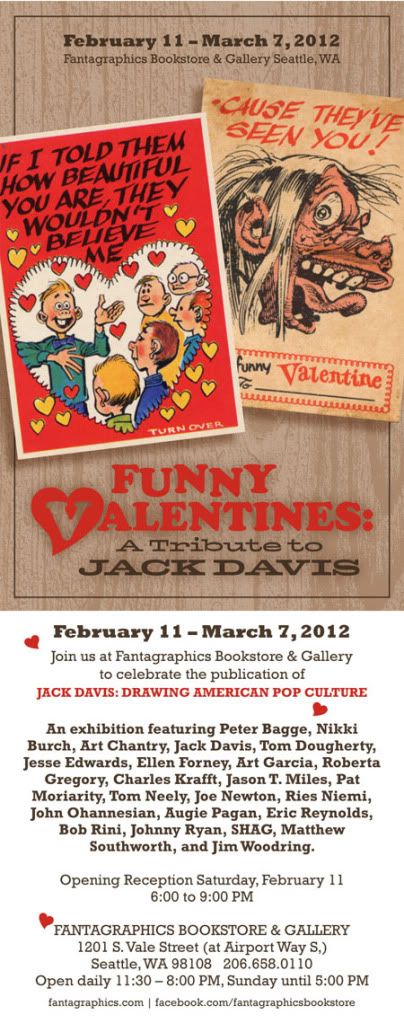
Look at that line-up of artists! This makes me wish I lived in Seattle, Washington, instead of Asahi-shi, Chiba-ken. Jack Davis is one of the nicest people ever to work in the industry and it's wonderful to see Fantagraphics showering the man and his work with well-deserved love. I'm really looking forward to their Davis art book. That along with the Alex Toth book by Dean Mullaney are musts!
On a personal note, not only did I once interview Davis by phone-- a treat for me-- but I also sent Peter Bagge an embarrassingly fannish email to which he replied in a gracious manner. He even had a nice compliment for some of my stupid art, a t-shirt I'd designed for a local Athens band. I've been pretty lucky in my interactions with various creators. I've only had one somewhat sour experience and that was due mostly to a misunderstanding. I'm one of those foolish hero worshipers and I treasure these moments when the people whose work I admire so much turn out to be genuinely pleasant types who find a moment to answer my gushy-mushy love notes with gentle good humor instead of the restraining orders or the visits from paid assassins I so richly deserve.
Tuesday, December 13, 2011
The Onion A/V Club interviews Jack Davis!
And it's amazing how closely it echoes the talk I had with Davis many years ago when I was a graphic design student, right down to the mention of the kind of brush he uses for inking. Well, for the most part. He's probably answered these same questions from people like me a thousand times over the years. We didn't get into biography all that much. He did tell me the chain gang story and how he went from the University of Georgia to the Navy in WWII and then pounded the pavement in New York city before he broke into the comics business, and we briefly touched on his time at EC. In the A/V Club interview he paraphrases what he told me about his feelings about today's Mad. I asked him what it was like to work with Wally Wood. But mostly, as an artist, I wanted to know about process and that's what I got.
Here's how I remember it: His agent faxes him jobs and he picks and chooses the ones he wants to do, otherwise he's on his boat or playing golf. His initial sketches start off as a "lot of scribble-scrabble" and he inks with a No. 3 Series 7 Winsor & Newton brush. Seeing that mentioned really brought back a lot of warm memories of our phone conversation, where he was so genial and patient with my hero-worship gushing that I walked on air for two days afterward. It remains a highlight of my checkered college career. Somewhere among all my own crappy art files I still have the notebook where I jotted down as much of what he told me as I could. If I'm ever back in the US, I could dig it up and read through it and try to recapture a little bit of that magic.
Jack Davis is overdue for widespread acclaim. Not that he hasn't had accolades and praise. The Society of Illustrators Hall of Fame, the Reuben Award and the Milton Caniff Lifetime Achievement Award from the National Cartoonist Society are certainly that.
It's just he needs to be one of those names dropped alongside people like Charles Schulz and Walt Kelly (although Davis's attempt at a syndicated newspaper strip never really got off the ground), Jack Kirby, Harvey Kurtzman, Will Eisner and Wally Wood. He needs to be right there in the forefront of your consciousness whenever you think of cartoonists and cartooning.
After all, he worked for EC's most infamous titles-- and interviewer Sam Adams brings up perhaps the most notorious story of them all, the Davis-illustrated "Foul Play"-- as well as for Mad magazine. Then he did covers for Time and TV Guide, designed the characters for the Jackson Five cartoon, created movie posters and all sorts of amazing stuff. There's a trade paperback book, now out-of-print, about the man and his art called-- appropriately enough-- The Art of Jack Davis, and it was a decent enough tribute. Considering the man's done so many high profile jobs and associated with so many other cartooning legends in his time, he really needs something more deluxe. Something spanning the entirety of his eclectic art career.
That Fantagraphics volume is a must-buy, but I'm thinking even at 208 pages it's a little light. I think he needs a hardcover series collecting all of his sequential work with color plates of his magazine covers and movie posters to round it out. Your floorboards should buckle under its weight. If only someone published, say, a collection of some of his other humor magazine work, or if you could buy a book with some of those horrifying EC stories he drew with mixed feelings but incredible skill-- what a world that would be! Oh well.
Jack Davis is an American treasure.
Here's how I remember it: His agent faxes him jobs and he picks and chooses the ones he wants to do, otherwise he's on his boat or playing golf. His initial sketches start off as a "lot of scribble-scrabble" and he inks with a No. 3 Series 7 Winsor & Newton brush. Seeing that mentioned really brought back a lot of warm memories of our phone conversation, where he was so genial and patient with my hero-worship gushing that I walked on air for two days afterward. It remains a highlight of my checkered college career. Somewhere among all my own crappy art files I still have the notebook where I jotted down as much of what he told me as I could. If I'm ever back in the US, I could dig it up and read through it and try to recapture a little bit of that magic.
Jack Davis is overdue for widespread acclaim. Not that he hasn't had accolades and praise. The Society of Illustrators Hall of Fame, the Reuben Award and the Milton Caniff Lifetime Achievement Award from the National Cartoonist Society are certainly that.
It's just he needs to be one of those names dropped alongside people like Charles Schulz and Walt Kelly (although Davis's attempt at a syndicated newspaper strip never really got off the ground), Jack Kirby, Harvey Kurtzman, Will Eisner and Wally Wood. He needs to be right there in the forefront of your consciousness whenever you think of cartoonists and cartooning.
After all, he worked for EC's most infamous titles-- and interviewer Sam Adams brings up perhaps the most notorious story of them all, the Davis-illustrated "Foul Play"-- as well as for Mad magazine. Then he did covers for Time and TV Guide, designed the characters for the Jackson Five cartoon, created movie posters and all sorts of amazing stuff. There's a trade paperback book, now out-of-print, about the man and his art called-- appropriately enough-- The Art of Jack Davis, and it was a decent enough tribute. Considering the man's done so many high profile jobs and associated with so many other cartooning legends in his time, he really needs something more deluxe. Something spanning the entirety of his eclectic art career.
That Fantagraphics volume is a must-buy, but I'm thinking even at 208 pages it's a little light. I think he needs a hardcover series collecting all of his sequential work with color plates of his magazine covers and movie posters to round it out. Your floorboards should buckle under its weight. If only someone published, say, a collection of some of his other humor magazine work, or if you could buy a book with some of those horrifying EC stories he drew with mixed feelings but incredible skill-- what a world that would be! Oh well.
Jack Davis is an American treasure.
Saturday, September 17, 2011
Thirty Years of Hopey Glass, Super Punk Badass!

Okay, I'm exaggerating a little. Hopey's probably only the third or fourth most important character in American comics. And it only took twenty-six years for Fantagraphics to publish a book with her name in the title. But this poses a question-- just how did Jaime Hernandez pack so much awesome into such a teensy-tiny character? I don't think we'll ever know. Perhaps she sprang from some real-life source, some proto-Hopey raising punk hell, throwing bottles, spray-painting walls, blowing the boys and girls away with her spiked hair and mean eyebrows. Perhaps it's a mystery best left unsolved. However, I do know I would never cross Hopey no matter how petite she may be.
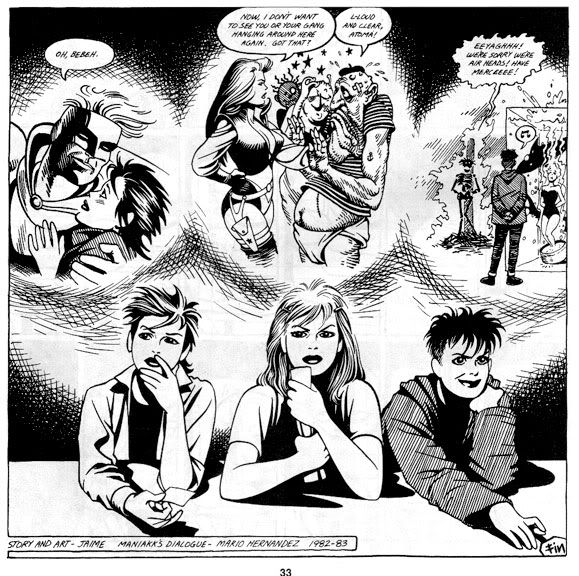
1) Hopey's gleefully violent imagination (Love and Rockets #3). When Maggie reluctantly tells a group of doubters about her brief career as a superhero's sidekick, Hopey takes a little mental revenge.
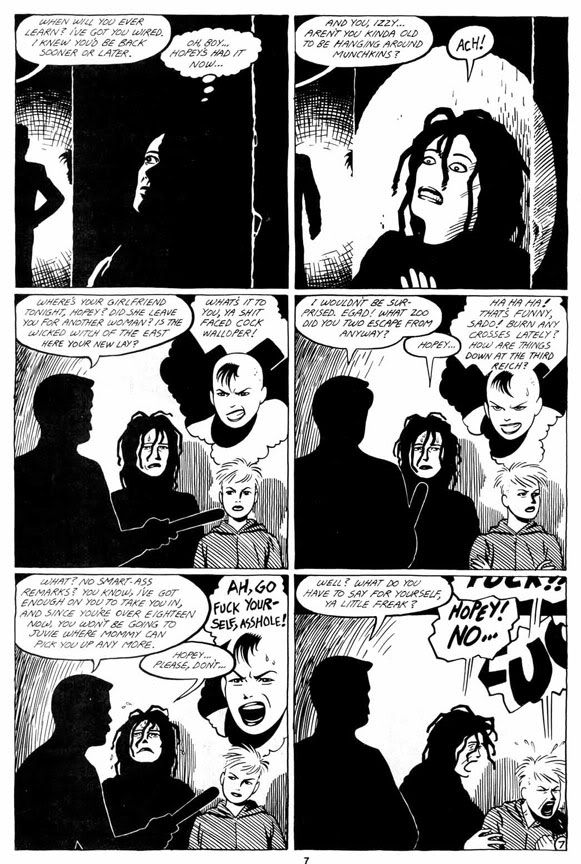
2) Hopey fights the law (LR #5). An untagged wall drives Hopey to distraction and depression. With the encouragement of her friends Maggie and Izzy, she sets out to do something about it, only to have her moment of triumph interrupted by Officer Sado, her personal nemesis-cop. She ends up doing something about that, too. Sado later made sergeant, no doubt due to his Javertian pursuit of La Hopita.
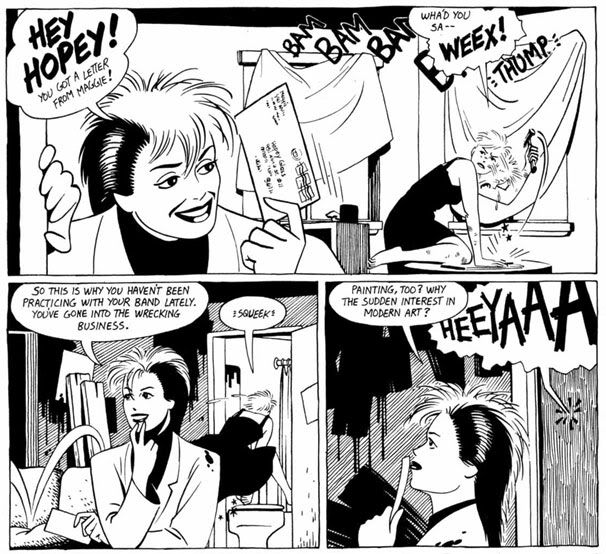
3) Hopey hits her finger with a hammer (LR #7). With Maggie away repairing spaceships, Hopey decides to go all Bob Villa and fix up their dumpy habitat. Too bad she's not as skilled with tools as she is with spraycans of paint.
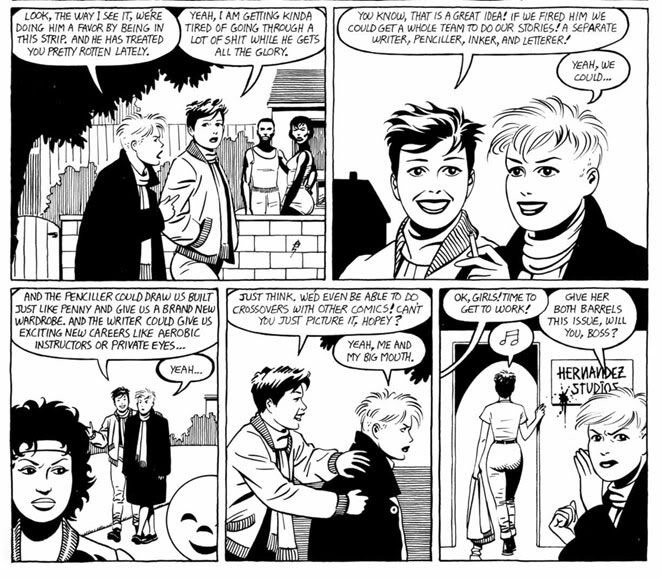
4) Hopey breaks the fourth wall (LR #10). Hopey loves Maggie, but she's not one to suffer fools gladly, even fools she's sleeping with. She has a request for the guy who created the two of them.
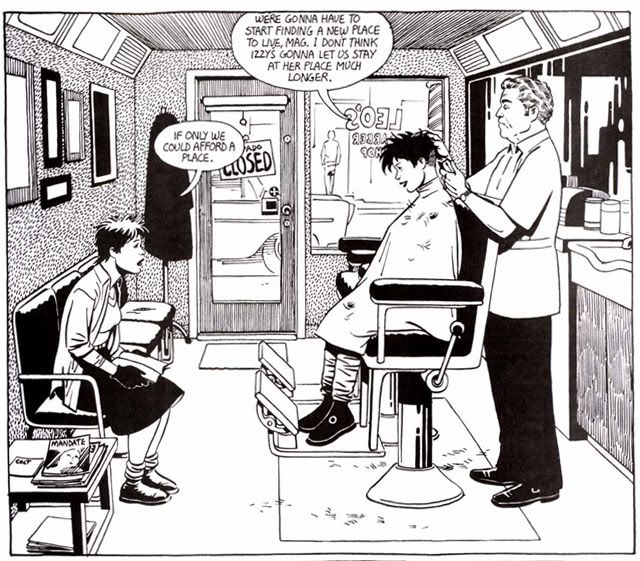
5) Hopey gets a haircut at an old school barber shop (LR #13). Where else would Hopey get her hair cut? This is one of my favorite comic book panels of all time. I love how Hernandez has Hopey's toes barely touching the barber chair's foot rest base-plate. When I was a kid, I got my hair cut in a similar place, with photos of gunfighters like Doc Holliday, Wyatt Earp and Billy the Kid on the wall. Ironically, my barber's ex-wife blew him away with a shotgun. This drawing brings back memories of that so vivid and detailed, I can almost smell the baby powder and rubbing alcohol and feel the goosebumps I'd break out in when the barber buzzed the back of my neck with the electric shaver.
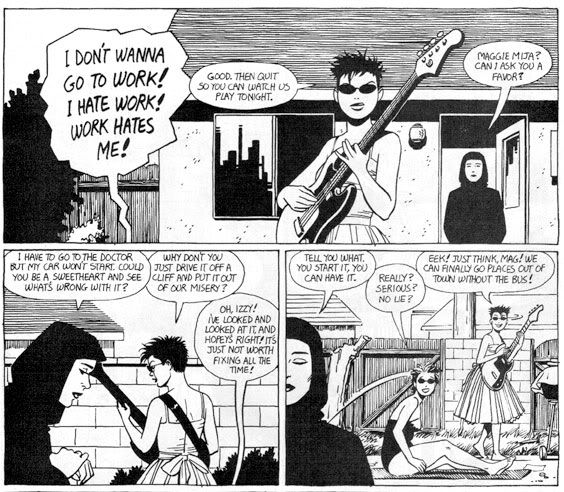
6) Hopey wears a vintage-like dress while practicing bass in the backyard (LR #14). She practices? Even a vicious little punk chick like Hopey wants to feel like a princess every once in a while. I love the way her butch hair and in-your-face personality clash with her demure girly-girl dress. Notice also her bare feet.

7) Hopey helps Izzy ruin Daffy's day (LR #15). Poor Daffy. I love her. She's really just a sweet kid with a head full of mixed-up ideas that a bit too conventional and suburban for Hopey's tastes. Looking like the long-lost sisters of Morticia Addams, Hopey and Izzy arrive on the beach pop the balloon made up of Daffy's romantic notions.
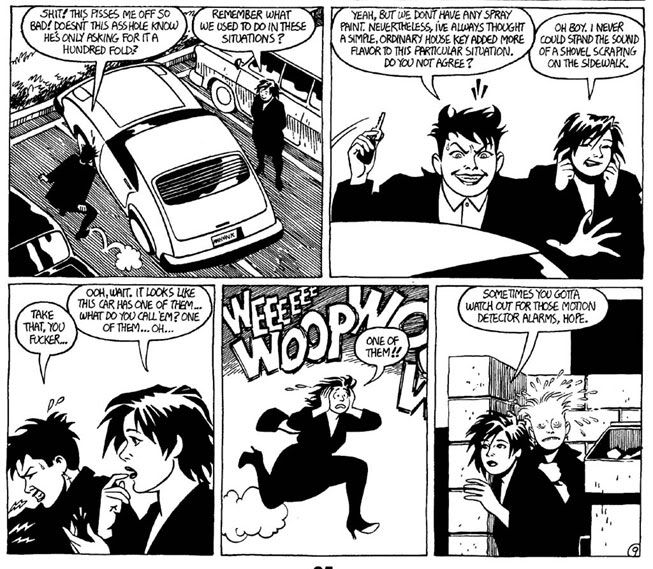
8) Hopey practices street justice (LR #18). Jaime Hernandez shows some of his humor comics influence in the second panel of this sequence where Hopey does what many of us have dreamed of doing. Take that, you rich jerk!
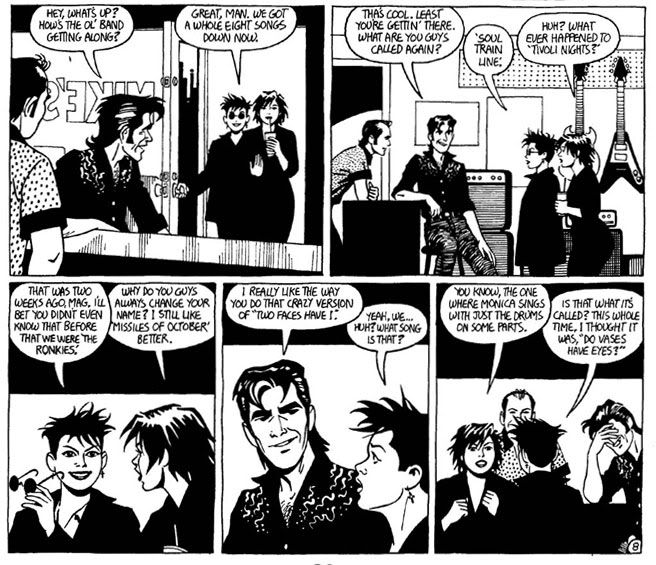
9) Hopey's famous near-homophony (LR #18). Or mondegreen, if you like. Hopey rarely gives strangers a straight answer, but even she's stumped when it comes to the names of the songs her band performs. She still hasn't lived this one down.
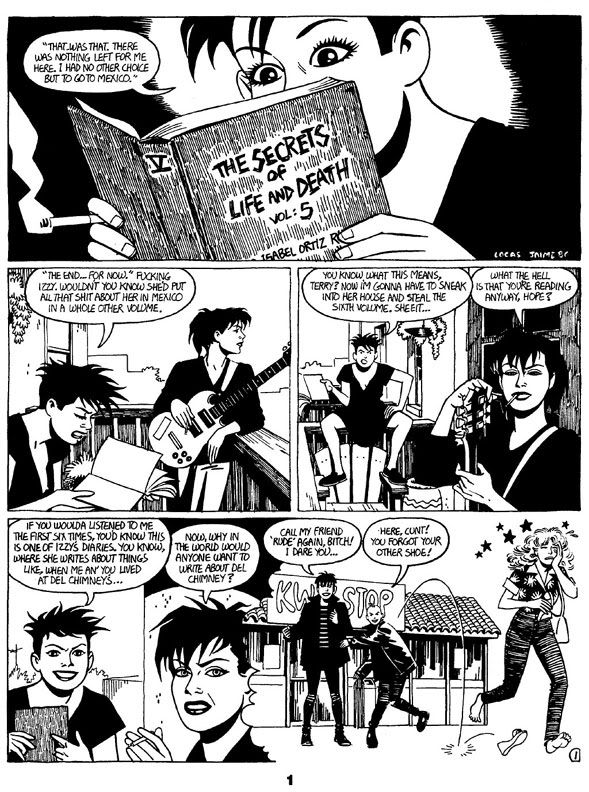
10) Hopey steals and reads Izzy's diary while Terry reminisces about beating up the hated Julie Wree (LR #19). During a break from band practice, Hopey obsesses over Izzy's diary. Terry Downe, her former lover-- and the person most interested in actually becoming a musician in the group-- takes a moment to flash back to to the good ol' days, when Hopey was hers-all-hers and they terrorized Julie Wree on a regular basis. Man, all these years later and they still hate Julie Wree!
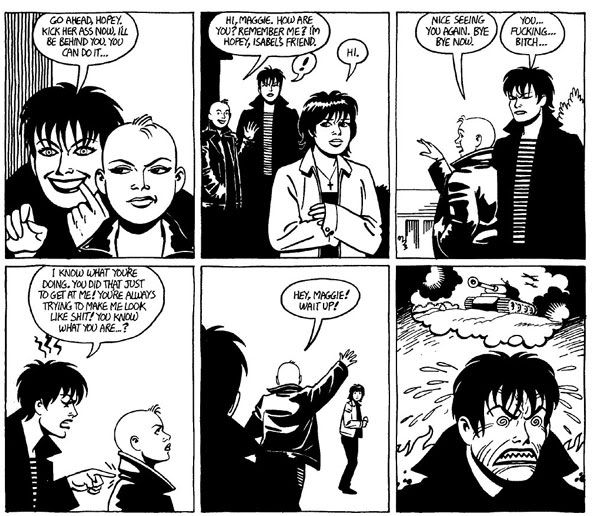
11) Hopey stabs Terry in the back (LR #19). Terry has a lot of bad memories about her brief relationship with Hopey. She learns the hard way you can never get too comfortable with Hopey because she always has her own agenda. Just when you think you're on the same side, she chooses another team. Why? We often learn Maggie's motivations, but Hopey's remain an enigma. That's just Hopey being Hopey.
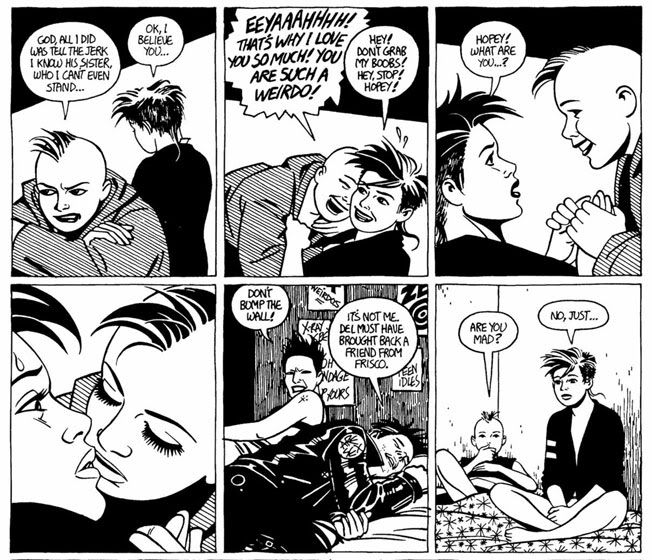
12) Hopey makes the first move on Maggie (LR #20). While they've both been with plenty of others in the decades since-- Hopey has a miscarriage as the result of a wild three-way and Maggie gets married and divorced-- one of the ongoing plot threads in the various "Locas" stories has always been their on-again/off-again love affair. Strangely enough, it's always seemed to be more off than on. Hernandez brought them together, then created long storylines that split them apart. Delicious torture for the characters (including Daffy, who's as obsessed with the Maggie-Hopey pairing as many of the series' readers) and the fans. Who knows what was really going on in Hopey's mind right here, but this is a flashback scene to their early days, showing how it started.
Friday, April 1, 2011
Alex Toth aerial combat stories from two different wars
I think it's pretty obvious Alex Toth loved drawing stories about aviation. After all, that was the hook of his best-known Batman tale, "Death Flies the Haunted Skies" (Detective Comics #442) and also of his Bravo for Adventure series-- which needs a reprinting, somebody, anywhere! For someone as important to the development of American comic book art as Toth, examples of his work can be frustratingly difficult to find.
That's why I'm eternally thankful to Image for publishing Zorro, Dark Horse for doing those Creepy and Eerie archive books and Fantagraphics for their gorgeous Blazing Combat volume. While the Zorro book is a bargain-- roughly 248 pages of prime Toth for under 15 bucks at Amazon-- culling his stories from hardcover artsy books means collecting Toth can be financially draining but spiritually uplifting, if you're that into the finest in sequential illustration. Which I am.
While there are a few books about Toth due out this year, I want big, fat trade paperback black and white reprints of everything he did in his career all in one place, or two or three. What I'm saying is... DC definitely needs to do a Toth book or two with all the western, romance, superhero, science fiction and horror stories he did for them. And we need more of his Gold Key work, mostly movie or TV adaptations like Darby O'Gill and the Little People, The Land Unknown, 77 Sunset Strip, The Wings of Eagles and... The Danny Thomas Show.
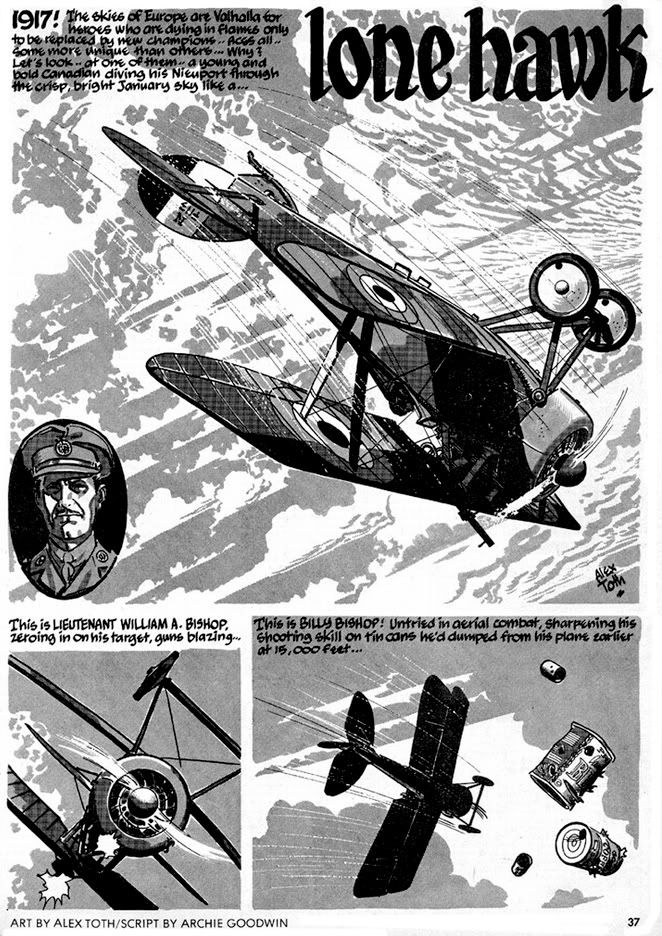
Anyway, airplanes. Toth and airplanes. That's what we're here to talk about today. Here's Toth drawing WWI flying action from Warren's Blazing Combat #2. It's "Lone Hawk," the non-fiction story of top Canadian ace Billy Bishop. Bishop downed 72 enemy aircraft (planes and balloons), making him the Allies' third highest scorer. Archie Goodwin's script plays to Toth's love affair with all things winged and powered by starting in the sky and staying there for the most part. Toth gets to draw all kinds of primitive fighters/scouts while Goodwin contrasts Bishop's victories with the deaths of other top aces such as France's Georges Guynemer and Germany's Manfred von Richthofen.
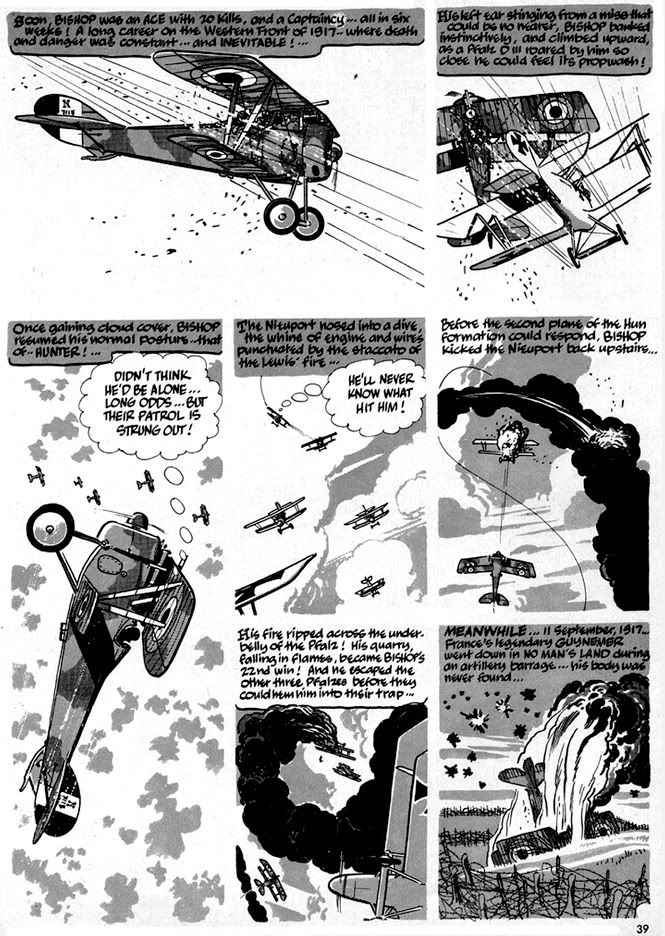
It's a powerful script showing that the price of martial glory is usually horrific death. Prose and art come together to hammer home this point in a singularly effective panel where Goodwin's caption introduces us to American Raoul Lufbery (French-American, actually) as he leaps without a parachute from his burning plane. That's how terrified even these ostensibly fearless men were of burning to death. Toth's art depicts the plane as a streaking fireball and Lufbery as a tiny, fragile figure falling away from it to his doom.
For this story, Toth uses what appears to be Craftint doubletone paper for his grays rather than washes. These planes flew and fought at relatively low altitudes, so there are masses of clouds made up of a single tone framing them and the panels themselves-- Toth eschews panel outlines. The mechanical look of the Craftint halftones gives the work a kind of antiqued, etching-like quality. All this with just two values of gray, plus black and white. And, of course, the visual storytelling is superb. Each action is clearly delineated and the aerial sequences are dramatic and dynamic but easy to follow and understand. Toth is in his element.
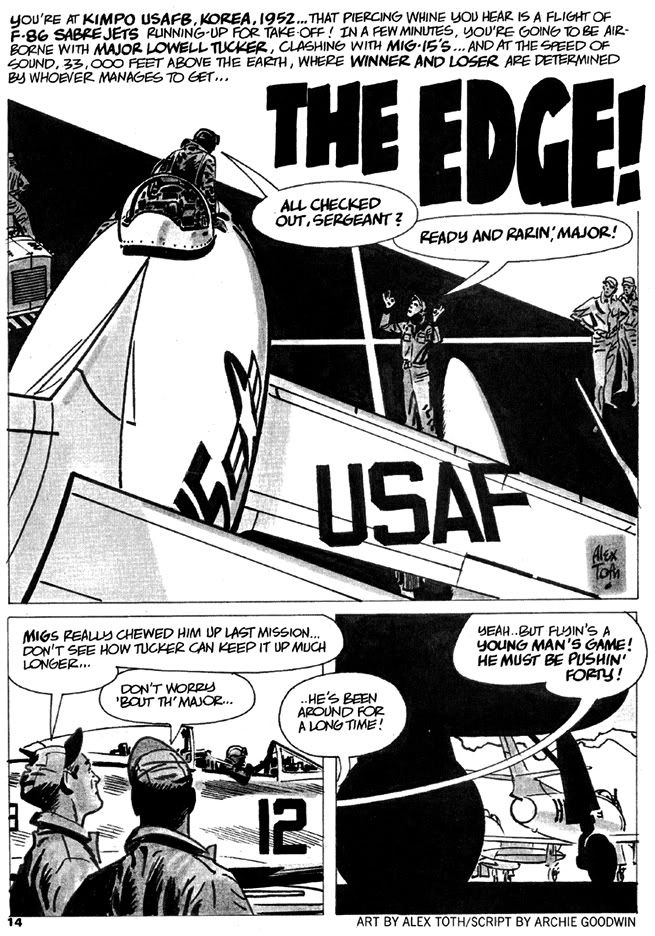
Flash forward a couple of generations and these creaking box-kite fighters have been replaced by streaking metal jets. This time Goodwin and Toth take us to the skies over the Korean peninsula. Planes now swirl around in deadly spirals in a cloudless, high altitude realm of startlingly bright sunlight, so Toth uses ruling lines to separate panels. But within these his work becomes almost abstract. F-86 Sabers and MiG-15s don't offer as much surface detail as the Sopwith Camels and Fokker Triplanes of the Great War. The fighter jet is like a steel knife in the sky, sleek and speedy with simpler lines. A quick stab and it's all over for you, as this North Korean fighter jock soon learns:
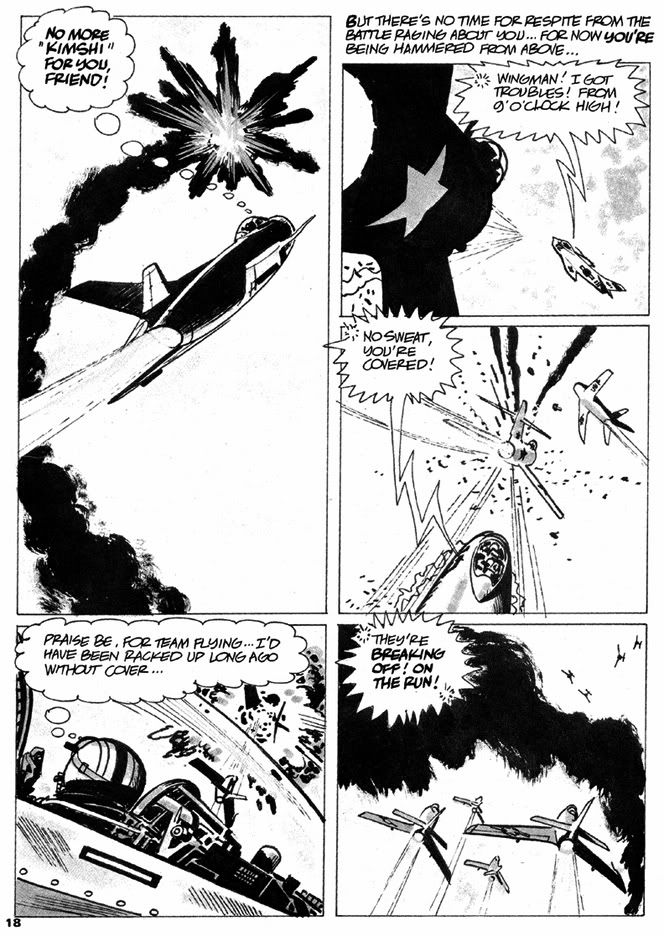
"No more 'kimshi' for you, friend!"? Hey, how do you even know that guy liked kimchi, you stereotyping jerk? Maybe he was allergic. No more kimchi for you, my friend, or taco salad or cheeseburgers for that matter! No more anything because BLAM!
Billy Bishop's primitive acrobatics over mud have evolved into the cold precision of high-tech, near-supersonic murder so Toth adjusts his art accordingly with a more contemporary approach borrowing elements from fine art. He reduces the planes and their cockpits to geometry, silhouettes surrounded by speedlines and stark white backdrops. Even the few landscapes seem abstracted to mere designs. The effect is thoroughly modern, plastic and alloy rather than wood and canvas and bereft of any lingering sense of romance. The human element, so stunningly depicted in the burning plane panel of "Lone Hawks" is almost completely absent here. We don't even see a frontal view of a face until the final panel.
I have to wonder if Toth's approach here doesn't also evince a distaste for this era. Goodwin could easily have written into his script this de-emphasis on the human element. Visually, both "Lone Hawks" and "The Edge" focus on the machines of war. I'm not about to count it up, but both more than likely feature the same number of panels devoted to airplanes. But Goodwin in the former repeatedly personalizes the various aces' deaths even if Toth doesn't draw the men all that often. The latter draws you in with that second person narration, but Toth's art keeps you effectively outside with its sleekness and finally presents you with a face that so obviously isn't your own.
I feel the WWI aerial combat and its purer contesting of man against man plus all that "knights of the air" chivalric stuff would appeal to Toth's sensibilities more so than the push-button nature of the Korean War version. Perhaps it's just Toth taking into account the differing eras, but while I admire the technical aspects of "The Edge" in a dispassionate way, I'm moved by "Lone Hawk."
There's a tension between words and pictures in "The Edge," though, that I can't leave alone. Perhaps it's also the result of an ambivalence on Archie Goodwin's part, as well. Goodwin's second-person narration isn't exactly pro-war, but it is more in the "our boys are the good guys doing a dirty but necessary job" mode rather than the more empathetic "death takes us all indiscriminately" feel of "Lone Hawk." Addressed as "you," the reader gets to be the protagonist, seemingly admired by both the writer and the ground crew characters for his prowess and hard-won expertise. Yet we know little of the enemy other than they're part of the collective horde of Communist aggressors and therefore less than human. Lessons learned fighting the Nazis must be applied against this new threat as well. Goodwin seems to suggest with this comparison while we might deplore having to kill, sometimes we must to thwart greater evils.
Or something like that. The American pilot is little more than a cipher himself. What personal details we learn about him are completely in service to the story's final gag. It's kind of an odd note to strike in the context of Blazing Combat (given its reputation) and seems a better fit as back-up in one of DC's slightly more jingoistic war books. Our Army at War, maybe.
Two creators taking on two different wars.
Subscribe to:
Posts (Atom)