Showing posts with label Batman. Show all posts

Thursday, October 9, 2014

October is Spookey Month: Batman #319 (January 1980)

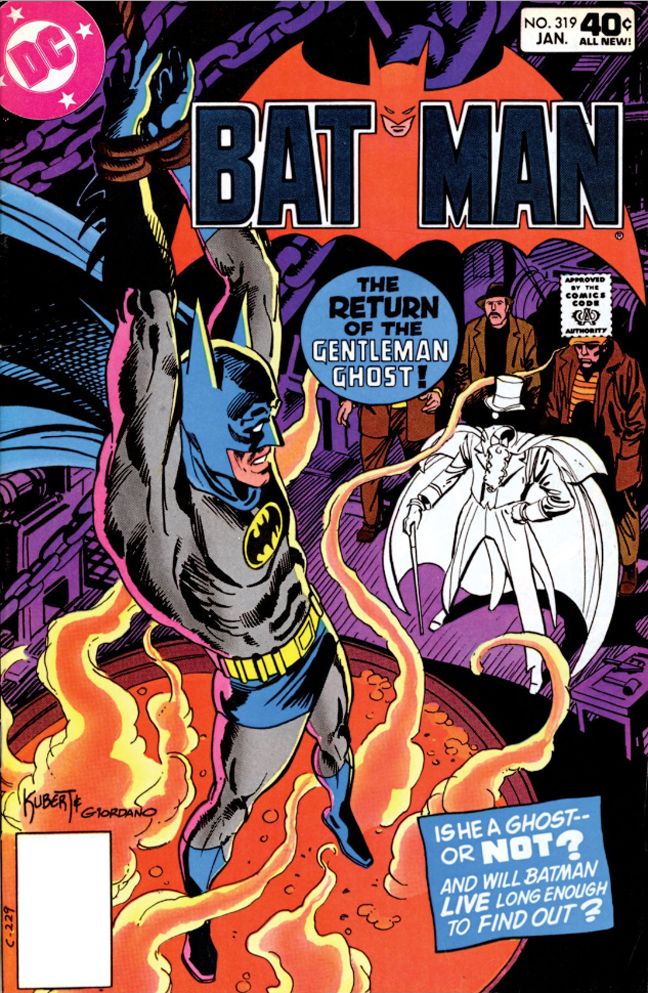
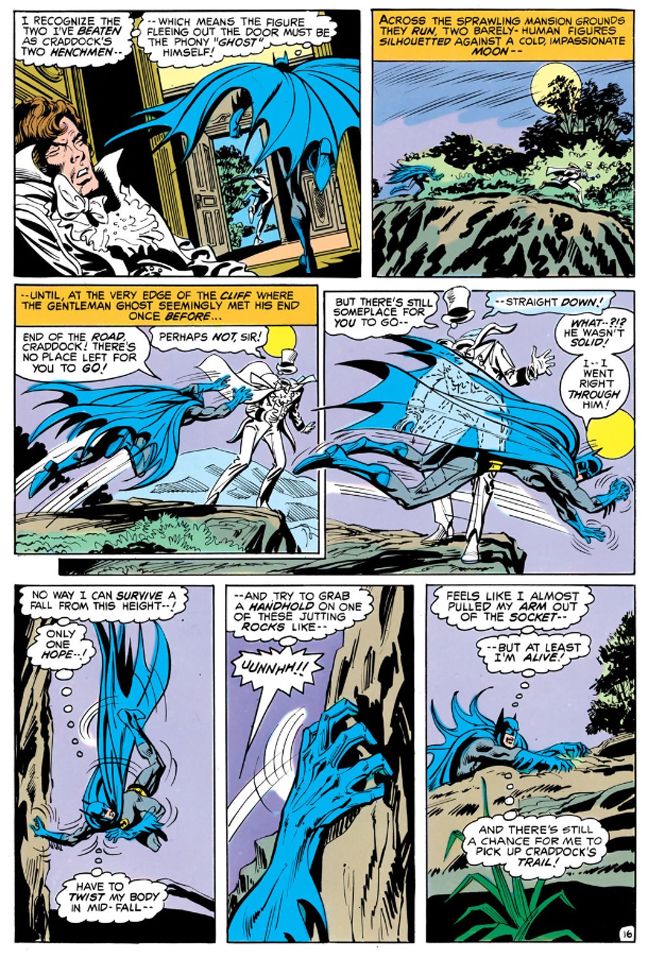
Batman #319 (January 1980) sees Batman and Gentleman Ghost battling once again.  This mean we get a Halloween treat in the form of a spectacular Joe Kubert cover with Batman in pulpy danger, suspended over a bubbling vat of wholesome Campbell's Tomato Soup with milk added.  Just like my dad loved to do!  Dick Giordano inks and the result is as rich and creamy as the soup Gentleman Ghost plans to dip Batman into.  Eerie underlighting and a line quality that's recognizably Kubert but somewhat cleaner and not as expressionistic.

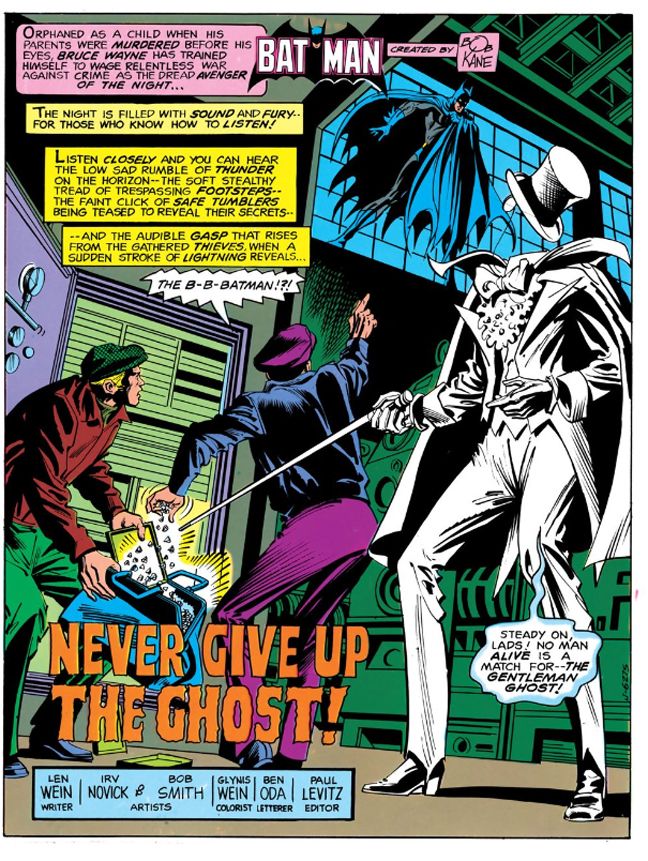
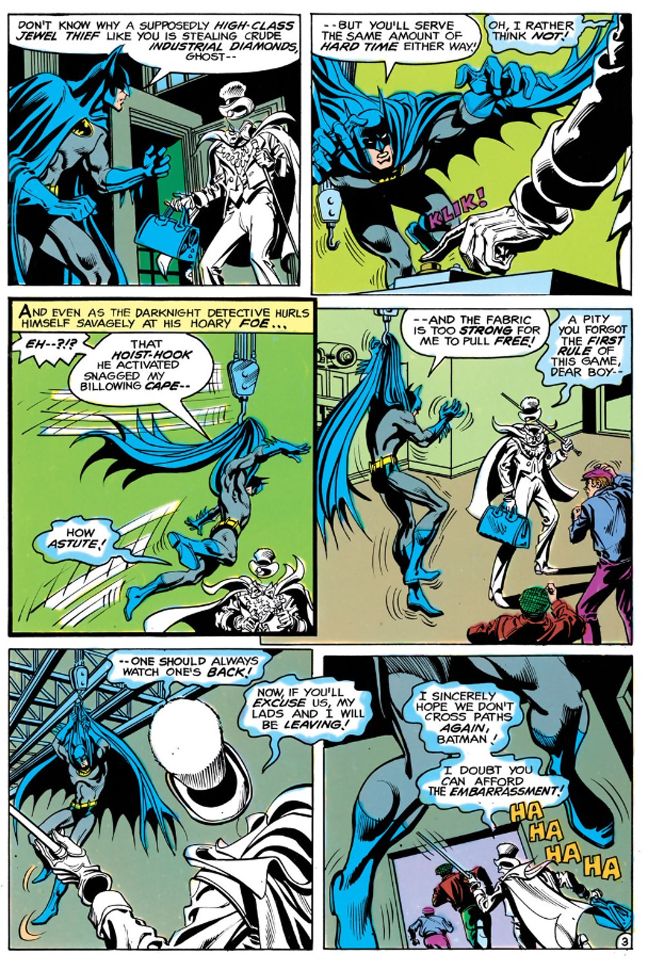
The story starts in mid-action, just like the previous Gentleman Ghost appearance.  Batman once again interrupts the Ghost and his henchpeople in mid-heist and ends up hoisted by his own cape.  While starting stories like this instantly ups the energy level and leads us to expect something rapid-fire and thrilling, there's a danger of this approach devolving into formula.  But Batman's dilemma-- which writer Len Wein points out is self-inflicted due to Batman's cape being rip-resistant, a helpful quality in most situations but not when you need it to tear so you can free yourself from a dangling hook-- proves startling and original in its details.  Wein also uses it to show that Batman, while fallibly human, is also resourceful and dangerous even when apparently helpless.  Never count out the Caped Crusader, as Gentleman Ghost finds before cleverly making his own escape.

Script: Len Wein/Pencils: Irv Novick/Inks: Bob Smith

From there we find Batman setting a trap for the Ghost, with a Halloween-appropriate setting.  He plans a costume ball at Wayne Manor with jewels on display as bait.  Gentleman Ghost finds this irresistible, and once again Batman ends up dangling from a hook.  This time over boiling soup.  I mean acid.  It's not tomato soup.  It's a vat of acid, a wicked comic book convention.  This time Wein shows us the mechanics of a Batman escape.  The story has the feel of someone working through all those classic Batman tropes.  The death traps, the fist fights, goofy henchpeople (somehow the very British Gentleman Ghost has found a couple of very British oafs to help him, one named, fittingly enough, Alfie) and another ambiguous ending.

Script: Len Wein/Pencils: Irv Novick/Inks: Bob Smith

We still never learn if Gentleman Ghost is a real ghost or not.  His lackies disguise themselves as the Ghost as a distraction and Wein suggests the headless quality is mere fakery when one of them is revealed to be merely hunching down.  That doesn't explain the floating top hats or monacles.  Later there's a bit with a convenient hologram projector which also seems to tell us the Ghost is more technological trick than supernatural treat, but Wein leaves the truth of the matter hanging, kind of like his Batman this issue.  You can have it either way.  He's a clever illusionist with a creepy gimmick or he's a creepy ghost with a penchant for high-tech chicanery.

Script: Len Wein/Pencils: Irv Novick/Inks: Bob Smith


It's up to you!

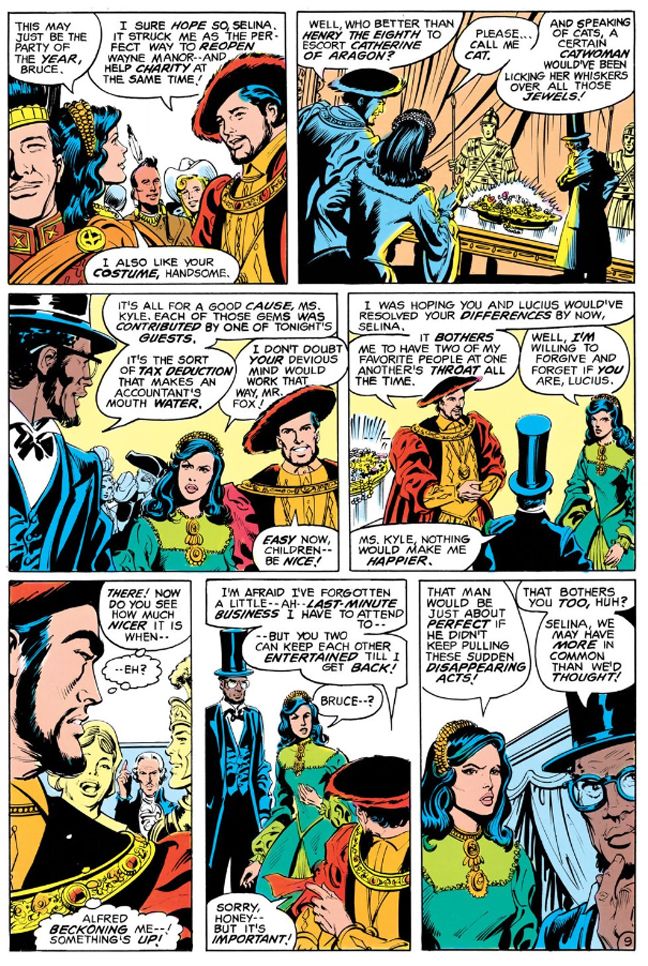
Irv Novick once again pencils, but this time Bob Smith inks.  Smith's line is thinner, sharper, more angular than Giordano's.  Well-defined figures and clarity of action make this issue very appealing throughout.  Batman is almost always on the left side of the panels, inciting things in the proper reading order so you get this forward thrust and momentum that carries through all the way to the end.  With Novick and Smith the crowded costume party has focus and detail, with one wide panel that's a treat to linger on.  Batman comes as Henry VIII, Selina Kyle as Catherine of Aragon ("Please... call me Cat," she quips) and Lucius Fox is Abraham Lincoln.  You can make out a plethora of other historical personages surrounding them and even when the Gentleman Ghost and friends gate-crash, Novick and Smith maintain a clear sense of where everyone is relative to each other.  Even when Selina Kyle and Lucius Fox abruptly switch sides so Fox can occupy the foreground with his thoughtful countenance you're not likely to freak out with the change and fall out of the story.  Good, solid stuff.

Script: Len Wein/Pencils: Irv Novick/Inks: Bob Smith

The issues I've read of this Wein run are sleekly enjoyable reads.  He drops exposition into dialogue and gives us meaty narrative captions to chew on while we enjoy the visual banquet Novick and Smith provide.  Very tasty stuff, the kind that satisfies.

Tuesday, September 30, 2014

It's October is Spookey Month time again!

I know, I know, you're excited about this annual tradition here at When Comic Books Ruled the Earth where we take all of October and examine various horror comics.  We're going to take a break from Marvel movies and spend some time chilling with some chillers.  The eccentric spelling of "spookey" is in tribute to a local rock band called SpookeyThey once did a Halloween-themed live show-- a video of which you can find on YouTube-- and I bought one of their albums after watching it.  The album features a fun cover of a fun cover of the Banana Splits Adventure Hour theme song and some other feel-good pop-punk rockers.  They don't seem to be very active at the moment but that doesn't mean we have to stop being fans of cool local music and cool local musicians.

And it has nothing to do with mylove for horror comics, but this is my blog and I can do whatever I want with it.  I haven't decided on an itinerary for this month's journey through the darker realms of four-color fantasy.  I imagine it will lean heavily on Creepy, Eerie and EC once again.  A smattering of Batman, my go-to Halloween superhero.  In fact, I have a certain issue of Batman in mind for my first Spookey Month post.  Or maybe it's an issue of Detective Comics.

Tuesday, December 10, 2013

Thursday, April 25, 2013

We interrupt Kamandi Month for a couple of Batman sketches...


You know I really had the best of intentions with this whole Kamandi Month thing but non-Great Disaster disasters have really taken a bite out of my free time.  So to make it up to you, here's an art offering.  Enjoy!

Wednesday, February 20, 2013

Teen Titans #1 (February 1966): Nick Cardy makes a splash, Bob Haney makes a point


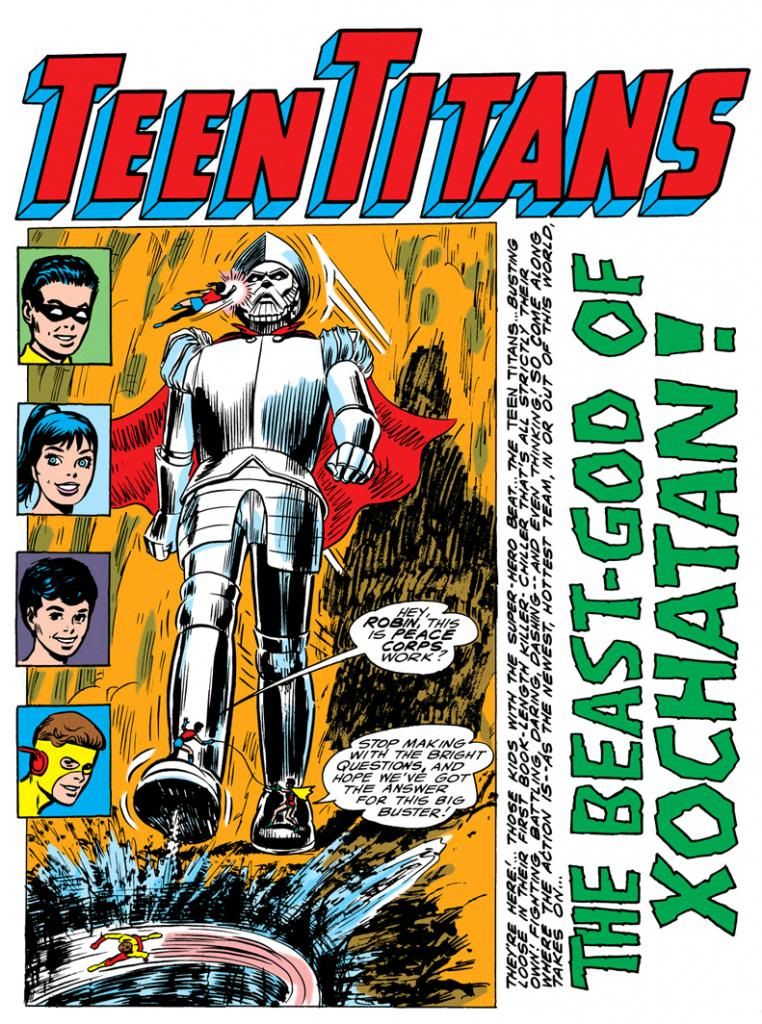
This is the colorful splash page to Teen Titans #1 (February 1966), drawn by Nick Cardy.  Written by the great Bob Haney, this first issue of Titans is essentially a positive, happy-go-lucky propaganda piece about the glories of the Peace Corps, which was a big deal for socially-conscious youngsters back in the early- to mid-1960s.

Officially established by John F. Kennedy with Executive Order 10924  in March 1961, the Peace Corps has been sending young Americans all over the globe to win hearts and minds by doing good works in developing nations ever since.  Back when the Titans made their collective bid for membership, the United States was still basking in the afterglow of having helped defeat fascism in the 1940s and taking leadership in facing down communism ever since.  World War II and the Cold War had frosted isolationism (except for a few backwards people living in mountain shacks and dank caves) in favor of internationalism, engagement on a global scale, and we Americans believed in solving humanity's problems and fostering democracy abroad by providing clean water and education.

In fact, we learn that almost every adult hero in the DC universe is some kind of Kennedy Democrat, a bunch of gaudily costumed but easily recognizable Eastern Establishment types of the kind hated and feared by Tricky Dick Nixon.  Or at least Rockefeller Republicans.  It's not enough that their young wards regularly risk their lives fighting crime.  It's joining their the Peace Corps that makes Batman, Flash, Aquaman and Wonder Woman beam with pride.  Not a single hero expresses anything but almost giddy enthusiasm for this Peace Corps thing.

We miss only Superman's reaction.  Why?  Because Superman is a god who needs no teen sidekick.  He's the father figure to all the other adult heroes, not a bunch of shirt-tail kids.  He's off trying to solve galactic entropy while they're fighting mutated fiddler crabs and giggling morons with chemical burns.  Superman does have his famous cousin, but Supergirl is probably digging canals, inoculating babies against tuberculosis and smallpox and teaching birth control and crop rotation on her own time.

Incredibly, even though he lives with Robin in palatial Wayne Manor, Batman has to learn of his ward's decision from a newspaper headline while he's scaling a drainpipe on a building in downtown Gotham City.  In the "dark of night."  Great night-vision this guy has after years of nocturnal crime-busting, hug?  The Caped Crusader may be on a case-- unless he practices urban mountaineering for fun-- but he still has time to turn, eyeball a handy newsstand through the gloom, make his discovery and loudly proclaim his joy to no one in particular.  I'm guessing he doesn't bother to buy the paper because the fabulously wealthy Bruce Wayne very wisely refuses to carry loose change in his Batman costume in case he gets into combat, kind of like Colonel "Bat" Guano in Stanley Kubrick's Doctor Strangelove.

The teen heroes let Wonder Girl choose their destination by sticking a pin in a map, which she does with an athletic flourish and characteristic joie de vivre.  So it's off to the Andes Mountains after a quick training montage to lend a helping hand to those in need.

And, as you can see from this splash page, the Teen Titans version of Peace Corps work doesn't differ all that much from the organization's directives; it's just a bit more aggressive.  They aid the needy using their personal expertise in punching, hitting and kicking things.  But that's not all they do.  They right historical wrongs, as well.  What else is toppling that giant conquistador but the defeat of  the lingering effects of European imperialism and a refutation of criticism America is merely engaging in a modified, cleaned-up twentieth century version?

In case you miss the point that America isn't like all those other old, abusive world powers, the ultimate villain turns out to be a greedy landowner run out of the village before the story even begins by the hard-working campesinos-- all your rapacious developing-world pirate capitalists out to thwart progress, one ruffle-collared bastard representing the kind of repressive guys who made communist revolutions in places like Cuba and Nicaragua necessary because the U.S. sided with them instead of doing what the Titans and the Peace Corps do here.  Of course, there's even one continuing in Peru to this day, but not for lack of Titans effort.

But this book isn't just politics.  After all, it would be a dull-ass comic with just Sargent Shriver making speeches to the Titans.  We readers demand some kind of giant menace for the kids to clamber all over (plus angry, attacking animals with human faces), and Haney knew how to deliver his patriotic, yet somewhat socialist, message in a colorful, action-packed way (like those sneaky vitamins in our chocolate-coated sugar-frosted rice puff cereals).

Looking back, it's obvious what this prescient story is telling us is the U.S. could have avoided a lot of grief in the coming decades if we'd only modeled ourselves after Wonder Girl, Robin, Kid Flash and Aqualad and taken on the real menace instead of merely replacing recalcitrant dictators with more compliant ones.  But there's none of that cynicism in this story.  Haney makes me wish I'd joined the Peace Corps back when I was a teen-aged superhero.

Tuesday, September 18, 2012

Identifying with Batman and Spider-Man makes you feel good about yourself...

What do you think of this report?  Apparently, some men who identify with Batman or Spider-Man feel better about their bodies when they look at pictures of their heroes, but if they're indifferent, the pictures make them feel worse.  A previous study found a similar effect in women who viewed celebrity photos.

I love this stuff.  I'm a psychology buff, and I know just enough about it to use its jargon to make bizarre, counter-factual claims and asinine pronouncements that can't withstand close scrutiny with facts.  To me, this report actually raises more questions than provides answers.  Here are a few.

1) What if you identify with Dani Moonstar or Cassandra Cain?  What effect does looking at drawings of Spider-Man and Batman have on your self-confidence?

2) What if you identify with Buddy Bradley?

3) Or the Crypt-Keeper?

4) Have they done this study specifically with female comic book fans?

5) Would doing the above study produce similar results?  Or, given the sexualized or fetishistic nature of how many female characters are presented, would they be opposite?  I'd be very interested in seeing how this plays out, because while their numbers aren't as great as with male fans, female comic fans are incredibly passionate about their favorite characters.

6) What is the nature of identification with characters involving female comic book fans?  Is it the same or different than with male fans?

7) What about fans with other gender identities?

8) Related to number one, how much cross-gender identification is there?  Is this common, or isolated?

9) In the study of women and celebrities, what kind of photos were used?  Were they candid shots, photos from public events or sexualized photo-spreads from men's magazines?  And would any of those affect the results?

10) Is identification with characters-- in effect, the reader "masking" himself or herself with certain characters-- important to creating a fan base or readership?

BONUS 11) What about fans who identify with villains?

I'm seriously interested in someone doing a study on these, and some in-depth surveying of women who read superhero comics.  Isn't it a fairly common belief male characters are idealized and more inviting of identification while female characters are objectified and more involving the reader in the male gazed based on an assumption that the readership is almost exclusively male?  And yet women who are into superhero comics really latch onto these characters and they're extremely vocal with their opinions.  Well, maybe that's just part of being a superhero comic fan.  But you know... Stephanie Brown.  Oracle.  Huntress.  Lois Lane. You dismiss or degrade these characters at your peril.

I'm also keenly interested in the gender dynamics.  As someone who easily identifies with female characters-- I have my entire life and probably pretended to be Wonder Woman, the Bionic Woman or any one of Charlie's Angels and even Cindy Lee from The Secrets of Isis as often as I portrayed Superman, the Incredible Hulk, Sgt. Rock, Batman or Spider-Man as a child, and Dani Moonstar quickly became my masking character of choice in New Mutants-- and responds strongly to their positive and negative portrayals, I'm guessing I fall somewhere outside the control group or whatever the heck they used here.  So I also want to know how other fans who view gender and sexuality in ways that aren't traditionally accepted.

And, strangely enough, I also identify quite a bit with characters with ambiguous morality-- in fictional, comic book dichotomous terms, not real life.  I find we have to go outside the mainstream to find these kinds of richly drawn, troublesome characters.  When I read Nexus, I tend to mask myself with Horatio Hellpop, but I find myself drawn to Ursula X.X. Imada whenever she appears on the scene.  Outside of genre fiction, I find Hopey Glass and Terry Downe from Love and Rockets have always fascinated me more than Maggie, the star.  And I have much more in common with Buddy Bradley from Peter Bagge's Hate than I'm comfortable admitting.

When I see drawings of them, how do I feel about myself?  Pretty good, I guess.

Tuesday, June 12, 2012

That's Montgomery Cliff, honey! Chip Kidd's unique "casting" in "Batman: Death by Design"

DC, you're at it again!  Hot on the heels of your possible Katana series comes ace designer Chip Kidd's graphic novel Batman:  Death by Design, and I feel like Michael Corleone.  A wimpy, geeky, not very threatening Michael Corleone.  DC.  Just when I thought I was out, they pull me back in.  Or maybe I'm Sal Tessio.

Cue ABE VIGODA


ABE VIGODA
Can you get me off the hook, DC, for old times' sake?


DC (shakes head)
Can't do it, Sally.


ABE VIGODA
Tell Didio it was only Cassandra Cain.  I always liked him.


(DC gangsters lead him away to a comic book shop)


As a failed graphic designer, I've always had an attraction to Chip Kidd's work with book cover design.  I wanted to do that myself for the longest time, but the highest level I could achieve was designing the alumni magazine for a forestry school.  It's not false modesty.  I'm a decent enough illustrator, but I don't have the talent or the discipline for Kidd-level design.  If he'd merely designed this book I'd have been intrigued enough to check it out the next time I'm in Tokyo.  But his role as writer really adds some interest.

That's not what has me jazzed about this book, though.  It's not the story, which sounds smart;  DC's got a lot of these architecturally-based Bat-stories these days and that's usually an approach that hooks me because architecture is endlessly fascinating.  But no.  And it's not the artwork by Dave Taylor, which looks spectacular-- at least in the image accompanying the PW article about it.  It's not even that I truly prefer stand-alone graphic novels to monthly continuity and would prefer it if DC got out of the magazine business altogether and published books like this exclusively.  It's none of that junk.  It's something stranger and more personal.

What has me almost trembling with excitement and the determination to buy this book despite my on-going love-hate relationship with DC? This quote:

Okay, what if Fritz Lang was making a Batman movie in the ‘30s and had a huge budget and could cast Montgomery Clift and Grace Kelly in the starring roles?

Montgomery Clift's life has held a strange fascination for me for as long as I can remember.  It's such a tragic story, one of those things that just got stuck in my head at an early age, possibly from having seen Judgment at Nuremberg one day when I was home sick from elementary school.


Then the Clash mocked him and REM eulogized him in songs, which sent me into my deep research mode, a strange state where I'd mole my way into the reference section of whatever library happened to be handy and doggedly track down whatever facts I needed to know.  Kind of like a junkie looking for a hit.  Seriously.  When I become curious about something I'm that intense and the need is almost the same as an addiction.  These days I do the same thing on the Internet, only it's a constant processing of information.  And I remember this crap.  As a result, I can, in the same conversation, adequately discuss pre-dreadnaught battleships and then tell you more than you want to know about the NBC television series C.P.O. Sharkey starring Don Rickles, Harrison Page and Richard X. Slattery.

I learned all about Clift, his early successes, his avoidance of the Hollywood scene, the supposed rivalry with fellow method actor Marlon Brando, his disfiguring car crash and subsequent decline, his friendship with Elizabeth Taylor, his early death.  So Montgomery Clift is an exhibit in the Rod Serling's Night Gallery of my mind.  So is Grace Kelly.  And Richard X. Slattery, for that matter.

In the forward to one of his Batman books, Neal Adams once cast Ted Danson as Batman.  Tim Burton bizarrely yet successfully gave us Michael Keaton in the cape and cowl.  I think Adam West's biggest role was as a guy who dies in the opening reel of Robinson Crusoe on Mars before he took the role.  But Montgomery Clift?  That's pretty darned original.

All this by way of telling you I want to see Montgomery Clift as Batman.

Monday, January 9, 2012

Every Old Katana is New Again!

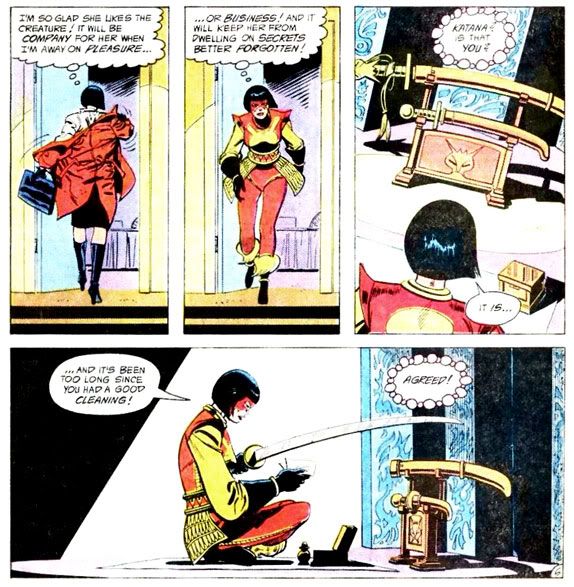
Created by writer Matt W. Barr and artist Jim Aparo, Tatsu "Katana" Yamashiro's been bouncing around the DC universe since 1983 when she debuted in the pages of The Brave and the Bold #200.  Despite his long held aversion to killing, Batman allowed Katana to join his Outsiders group, where her place was roughly the same as that of Wolverine in the first Chris Claremont-written issues of Uncanny X-Men.  Like their Marvel analogues, the Outsiders were originally an international team.  Katana as one of the few members from a real nation with a real culture to explore, even if in a somewhat superficial way.  Her code-name is the Japanese word for the main sword used by samurai, a similar situation to when I appeared as a character in a manga about dorks who blog about comics and called myself Computer Keyboard.


Strangely enough, her sword wasn't always a proper katana.  In some issues, Jim Aparo's version appears to be a no-dachi, a longer bladed weapon used for chopping down riders and horses so one might have a better chance at fileting the fallen enemy. And not just any no-dachi; it's a magical one named Soultaker because it contains the souls of all killed by it-- which gives it more of a Moorecockian lineage than anything having to do with samurai-- including Katana's dead husband. To whom she talks fairly often while... er... polishing him.  It.  I mean "it."


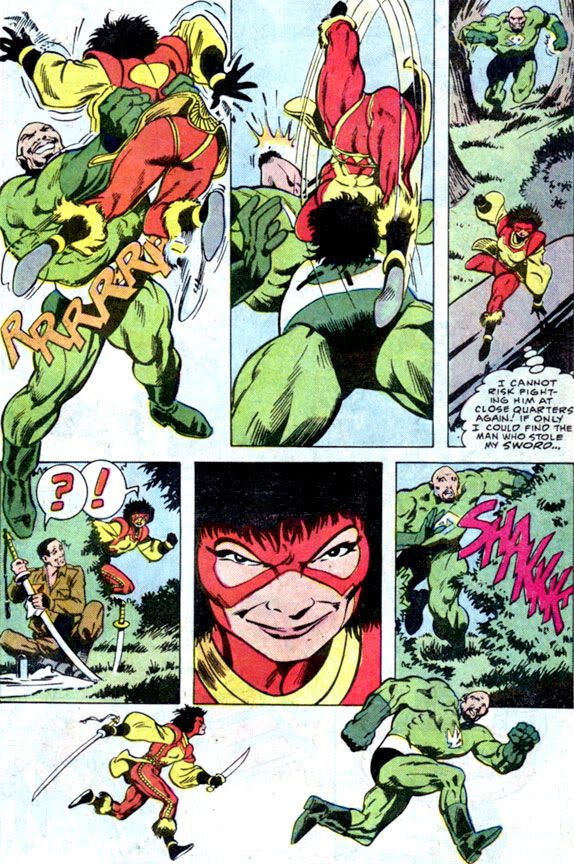
Alan Davis's sword is more the classic katana, although as you can see, its size sometimes varies from panel to panel.   "SHAKKKT" was Katana's version of Wolverine's famous "SNIKT."  But however an artist depicted the weapon, once it was in Katana's hands even the largest of enemies understood discretion as the better part of valor.  We can only imagine that quizzical guy... polishing... Katana's sword there lying in the bushes in two neatly bisected pieces, the grass covered in red slowly drying to a brown crust.  No word from Katana's dead husband on how much he enjoyed the poor fellow's loving hands, though.

Since Katana's a comic book Japanese person, writer Mike W. Barr characterizes her as secretive and largely emotionless, expert at martial arts and the ways of Bushido.  The other choice for comic book writers at the time was to write their Japanese characters as arrogant and frequently infuriated for no reason; i.e., the female Dr. Light and Sunfire over at Marvel.  And experts at martial arts and the ways of Bushido.  Katana's backstory also contains an ex-lover in the Yakuza for the customary family honor business.  Once again, this was during the era when The Uncanny X-Men and its break-out character Wolverine-- especially the version drawn by Frank Miller-- had made all things Japanese cool and hep in the superhero genre.


In Katana's case, think Wolverine's doomed fiancee Mariko Yashida, only this time she's the stone-cold killer instead of just giving someone else justification for his various murders.

Okay, so we've established Katana as an efficient martial arts-based hero with a fancy sword.  But what about her powerful maternal nature?  This is what makes her unique among comic book martial artists.  Sure Lady Shiva spends a lot of time trying to repair her relationship with biological daughter Cassandra Cain, but that's only because it's every parent's dream to fight her offspring to the death for the leadership of a secret cabal of international assassins.  Katana, however, truly embodies the classic nurturing archetype.  You know:  the extraordinarily deadly martial artist mother with a fancy soul-eating sword.

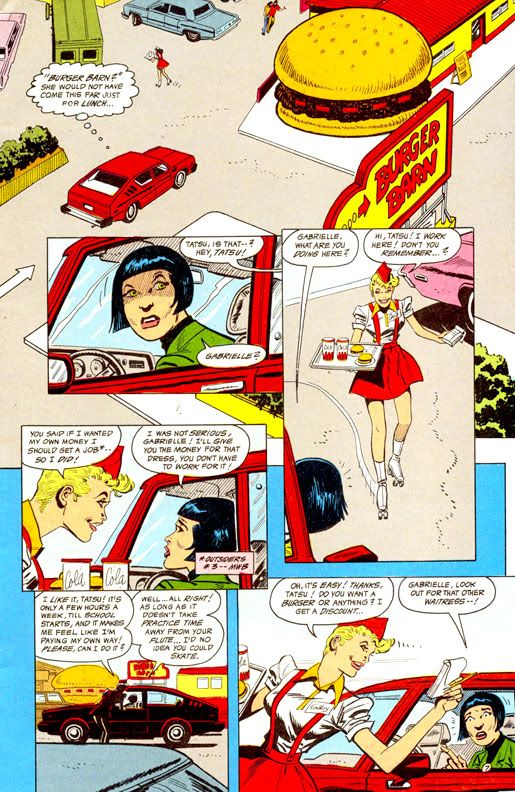
On the rare occasions when she does show emotions (I mean other than the joy that comes from bisecting an anonymous thug with with a perfect killing stroke), Katana largely directs them at her naifish teammate Halo.  During the first few issues, the two quickly form a sort of familial relationship, with Katana as the strict and occasionally insanely protective and possessive parental figure who seems obsessed with her young charge to the point of stalking her.  Finding Halo working as a roller-skating server at a fast food join in #43, Katana demands she quit and then rather desperately offers to buy the girl any clothes she wants.  Which is kind of wacky, considering Katana herself was the one initially trying to push Halo into the superhero equivalent of a "normal life."


You know, attending school, hiding your powers from your classmates, donning disguises, lying to everyone you meet, jetting off at odd hours to kill people all around the world.

Classic Katana may have been two parts stereotype to one part Faye Dunaway as Joan Crawford in the trash classic Mommie Dearest, but she was also a pretty cool and compelling character for those of us who are into Sonny Chiba movies and Koike Kazuo comics.

What about contemporary Katana, now that she's got a regular monthly gig again, but no longer with the Outsiders?  Some things about her are comfortingly familiar.  She's still a working part of a renegade team of heroes, this time the Birds of Prey alongside Black Canary, Starling and Poison Ivy.


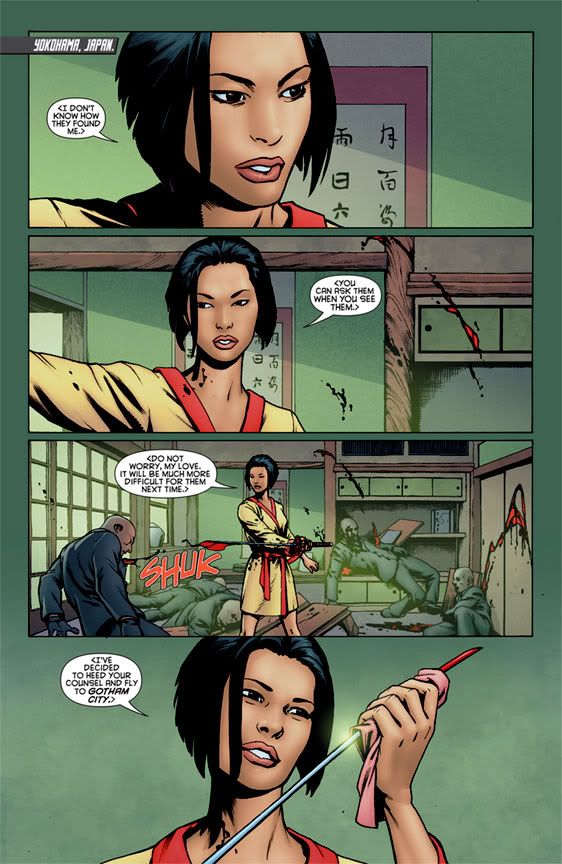
"SHUK" instead of "SHAKKKT," but Katana shows up in Birds of Prey #2 (by writer Duane Swierczynski and artist Jesus Saiz) and immediately racks up quite the body count.  On her first page, she's already diced and cubed five members of the Crazy 88s without changing her facial expression. Or even having one.  Katana kills and kills and in between killing she sometimes takes breaks to kill.

Why, I remember this one time Katana woke up, killed a couple of guys on the way to the kitchen, poured herself a bowl of Frosted Flakes, killed three more guys while getting the milk from the refrigerator, ran outside to kill a team of ninja trying to steal her morning paper, then killed a few more people on the way back to the front door before sitting down and reading For Better or For Worse while eating her cereal; a breakfast ritual for her-- she loves that strip.  She spent the rest of the day killing.

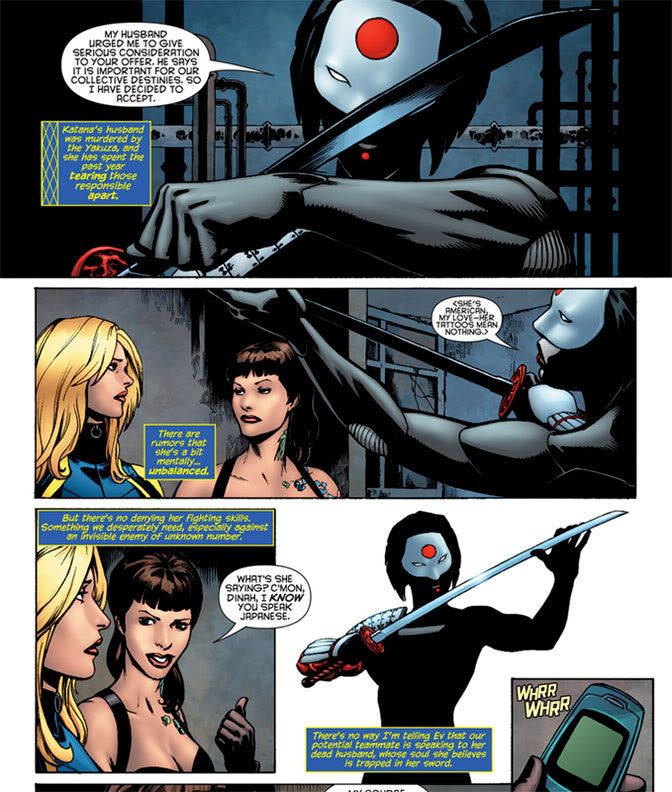
So if you're not willing to take my word for it and you're still wondering whether or not Katana uses her sword in the way The A-Team used their Ruger Mini-14s or if she swings it in earnest, I think this image pretty much settles the issue:


"SSSSSHK?"  Wrong again.  It's "SHAKKKT."  Just a flesh wound.  The flesh being the center of that guy's heart.  I don't think those two rubes in the bottom panel are going to be bouncing their children on their knees or swinging them up to the blue, blue sky anytime soon, either.  Or breathing.

No one really seems interested in stopping her murderous ways, which is kind of odd.  We all love dark stories where the murk hides the boundaries between right and wrong, but honestly, what kind of hero team amasses that many corpses and remains a hero team?  And why don't the international authorities care about due process and basic human rights?  Sure, these are villains and some of the killings can be justified as self-defense, but one has to wonder how many and what the limitations are on deadly force as they pertain to superheroes.

Hey, I'm not judging her.  I'd rather have a killer Katana than a Katana who waves around a mostly useless sword and only uses it to cut ropes and buttons off villain shirts and pants.  I'm just wondering why people like Black Canary-- and even Batman back in the day-- tolerate it, and why Interpol or the United Nations or even Amnesty International doesn't get involved at some point.  I understand why Starling doesn't; she's too busy shooting people in the face.

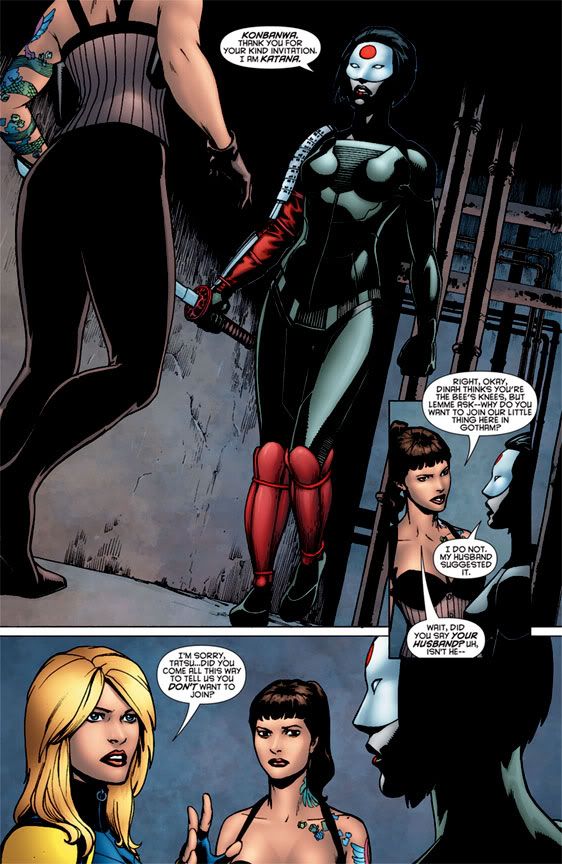
Katana has evolved on other ways over the years.  Her costume was once Ronald McDonald-esque with a vaguely Asian motif.  Now she's one of the more visually impressive heroes in DC's roster.  The new Superman flies around in a hideous cast-off that looks like a collaboration between Mr. Data of Starfleet Hills and the people who invented "Mighty Men and Monster Maker" (when he isn't wearing a bath towel, t-shirt and jeans), Batman now wears a codpiece or an adult incontinence pad, but Katana sports a sleek armored suit reminiscent of Japanese lacquer wear, with a samurai shoulder protector and greaves.  She hides her face behind a half-mask and Kabuki-inspired make up.  It's an extreme look, making her somewhat monstrous and robotic and all together menacing.  She's one of the few sensibly protected female characters in comics.

We'll probably learn later it's a plastic bikini and some kind of shiny body paint.  But until that day comes-- and perhaps it never will-- she looks fantastic.  Not someone you want to mess with.  Or sit next to on a crowded train.


Also different is her hair style.  No more bangs or Louise Brooks bob, nor does she sport the Davis-era shag.  But the change most telling of its era is that it's now ambiguous as to whether or not her sword contains her husband's soul.  She obviously still believes it does, but we readers are no longer party to their conversations.  Black Canary and Starling are presented as kind of dubious about the whole "talking to an inanimate object" thing as well.  The point is to call into question Katana's hold on reality.  Is she a little off?  A little nutty?  That makes her all the more dangerous.  And anyway, flying people and half-robot people are completely within the realm of possibility, but talking swords are only ridiculous, right?


Katana no longer uses contractions when speaking English.  As one of those EFL teachers over here in Japan, I find that kind of difficult to believe in someone who's as fluent in English as Katana.  It does give her that cold, almost inhuman feel to go along with the costume.  I have a hard time accepting a stiff, overly formal Katana knowing what I know about her relationship with Halo.  Still, as we've seen, people do change and Katana most of all.

On that note, time will tell if she's still competing for Substitute Mother of the Year.  I hope she is.  It gives her depth and humanizes her so she's not just a relentless human lawnmower-of-faceless-goons.  I hope she fixates on Starling and starts smothering her with concern and buying her clothes to cover that gothy corset top.  Or, alternately, offering to pay for more tattoos to make her arms appear more symmetrical.

Sunday, November 20, 2011

Comic Report: Japan!

After a long break back in the States, I'm in manga heaven again.  Not that I'm a fan of manga in and of itself.  I enjoy a few titles, consider myself a fan of a few creators, but I don't separate Japanese comics and Western comics.  Comics are comics.  Sure you read Japanese comics right to left and that takes some getting used to, but with the borrowing and blending of elements over the past few decades, a comic story consists of drawings and word balloons arranged in a particular order according to the creator's intent no matter where it comes from or who wrote or drew it.

If you're a regular reader of various Western monthly comics, you have to work a bit harder to find them here in Japan.  There are online sources and if you happen to live in a large enough city, you might find a few odd titles in the English language section in a bookstore.  Just be prepared to pay three to four times the suggested retail price.  I haven't tried downloading any digital comics yet, but I'll give that a try later when I'm more settled and have my own Internet connection.

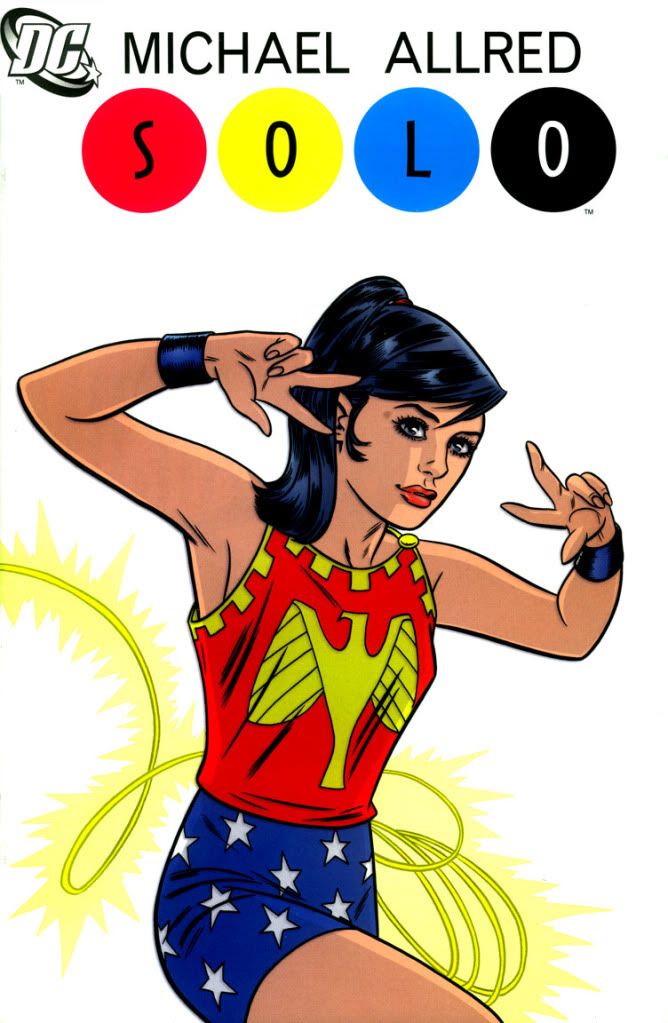
In the meantime, I'm making do with the comics I brought with me:  the superb Solo #7 (2005) by Mike Allred and family, and the award-winning Nexus: The Origin (1992) by Mike Baron and Steve Rude.

Solo #7 is one of the best things DC's published in the past ten years.  Maybe twenty.  It serves as the perfect antidote to all those gloomy, doomy negative portrayals of their own characters DC's dished up in the years since Identity Crisis, and it's a lot more fun than their similarly nostalgic Wednesday Comics.  Yeah, not every superhero comic should be this kind of poppy fun.  We like our supergods with a touch of realism these days.  But as Batman's faithful butler Alfred points out here, "Why is it the good things are never 'real life,' only the bad?"

Who can argue with Allred's winning cover depiction of Wonder Girl doing the batusi?

Nexus:  The Origin is a bit darker.  It starts with genocide, includes a starvation death and Nexus excusing his own killings by claiming self-defense.  This is the comic that hooked me on Horatio Hellpop, Sundra Peale and all the frog-like aliens and hairy Thunes that inhabit their universe.  Baron condenses the entirety of Nexus's early years into several poignant vignettes and Rude illustrates with his strong sense of anatomy and page design.  Inker Gary Martin perfectly complements Rude's pencils-- I've seen a number of inkers on the Dude, but Martin is far and away my favorite.  Rude "re-mastered" this book in 2007.

These are a couple of thick, meaty magazines that invite you to chew slowly and savor their delicious taste.  Which I suppose taken literally would mean you should eat them and enjoy some paper.  But you know what I mean-- read them over and over again.  Both were well worth dragging thousands of miles across an entire continent and ocean.

Well, I promised you a comic report, didn't I?  If you happen to be in Minami-Funabashi, Chiba prefecture, go to Vivit Square.  The Tsutaya there has a huge selection of Japanese comics, plus a teensy-weensy grouping of some translated ones in their English language book section.  Unfortunately, I can't remember which ones.  Probably Death Note and Vagabond.  The Japanese originals, though, boggle the mind.  So varied in genre and style.  Why aren't there comics about baseball and basketball teams in America?  Where are the simple stories of high school kids falling in love?

I guess they're in the manga section at your local Books-A-Million.  Which, combined with their Western graphic novel section, can't hold a candle to what they have at Tsutaya in Minami-Funabashi.

Sunday, November 13, 2011

More Cass Cain Batgirl fun times!


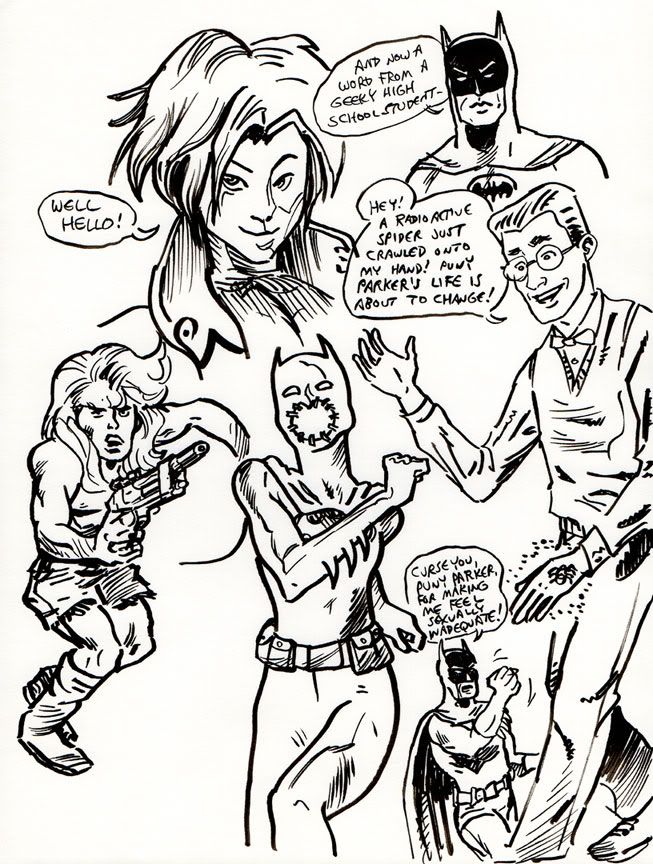
I drew this with my trusty Kuretake Fudegokochi brush pen. When I moved back to the United States from Japan, I brought a few of these with me because they're very fun to use. If all went well and we landed safely last Friday, I'm back in Japan but lack an Internet connection. So this was actually posted Wednesday before I left. Confusing, isn't it?

The clumsily constructed Kamandi figure is based on a panel from one of Jack Kirby's comics, but I added the wonky body and really went off-model on the futuristic pistol.  Peter Parker is fun to mock.  I love the character, especially during his glasses-wearing phase.  I based the Cassandra Cain Batgirl figure on a photo of a Japanese pop singer/actor.  And once again, I make fun of Batman.

I'm not sure when I'll have regular net access.  So talk amongst yourselves while I sort things out.

Wednesday, November 9, 2011

Another Batgirl-based sketchbook page...


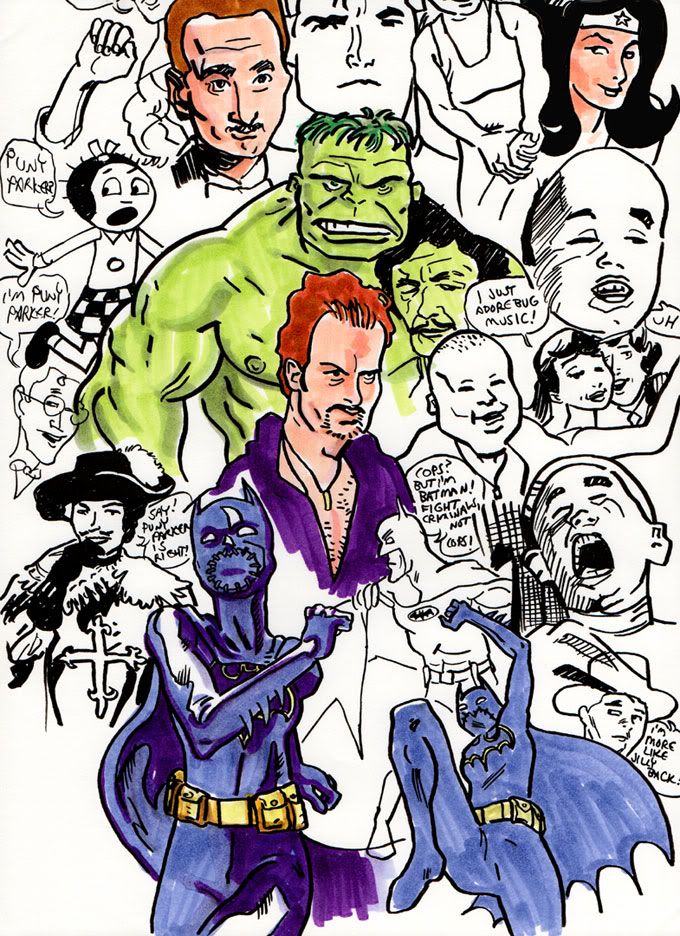
I drew this with that same Kuretake Fudegokochi brush pen I used for the previous Cassandra Cain/Batgirl sketchbook pages, but I colored it with Copic Ciao art markers.  The paper didn't fit on the scanbed, so Batgirl's legs got cut off.  But the Hulk still has his Charles Bronson pec/shoulder tattoo.  That's something, isn't it?

Wednesday, November 2, 2011

More of the same Batgirl!


Another version of the same ol' Batgirl. My theory is she had so little regard for protecting her secret identity, she would often leave her mask at home. I enjoy drawing Batman acting like a freak almost as much as I enjoy drawing Batgirl and Supergirl. Poor Robin. If you look closely, there's a Todd McFarlane-era Spider-Man picking lice out of a Neal Adams Superman's hair. Todd McFarlane-era Spider-Man loves to groom his friends!

Tuesday, November 1, 2011

Back when she was Batgirl...


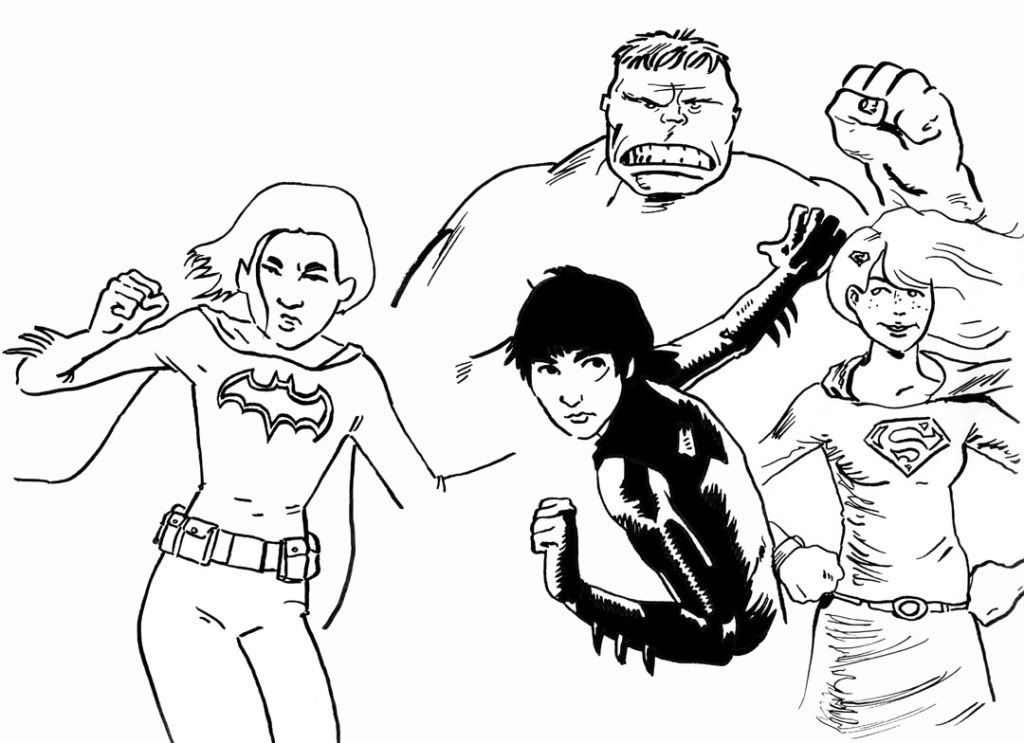
Here's another sketchbook page.  I seem to draw Cassandra Cain, Supergirl and the Hulk pretty often. I did this freehand with a Kuretake Fudegokochi brush pen on a sheet of marker paper.  Batgirl on the left is apparently pitching some kind of fit; she's really angry about something.  The center Batgirl shows a zen-like calm, but I'm not sure about the weird feathery line I gave her shadowed areas.  What inspired that?  The Hulk looms overhead like something she's dreaming.  The way I attached his hand to his beefy wrist isn't really working.  And then there's a cheerful, freckle-faced Supergirl with goofed-up shoulders.  All that modeling I did on her right side (left to us!) was my attempt at emulating the awesome Nick Cardy; it came out vaguely Dr. Seussian, though.

Cass is in her DC Batgirl suit rather than the one I made up for her.  Slap a pointed mask on her and she's practically Black Bat.  I'm happy DC has their sales up, and I'm pretty pleased Cass will "appear in Batman, Incorporated in a very big way" along with Stephanie "Spoiler/Robin/Batgirl" Brown.  Whether or not I'll bother to read it is another story.  The overall aesthetic of what they're doing these days just doesn't interest me and I find I can't really get excited about it, and we're always a year or two away from a new universe-changing Crisis.  I'll be in Japan where American monthlies are hard to come by, but maybe I'll download a digital copy of Batman, Incorporated from DC when Cass reappears.  Then again, maybe I'll forget.

Monday, September 26, 2011

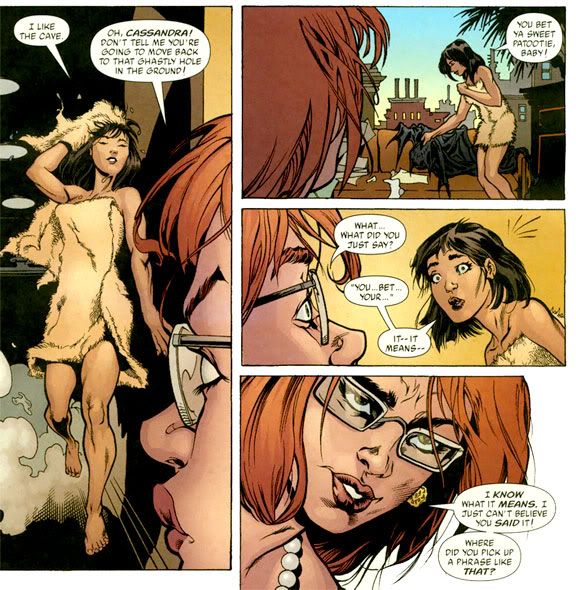
When Batgirl Said "Sweet Patootie"


Dylan Horrocks wrote some of my favorite Batgirl issues and some of my least favorite.  He often had some wonderful ideas, like Batman and Batgirl working out their father-daughter issues in the way that works best for them-- brutally beating up on each other.  These are people who believe in tough love in its most literal sense.  He also had some crappy ideas, like Barbara Gordon constantly enforcing gender stereotypes on Cassandra.  It helped a lot when he had a seasoned pro like Rick Leonardi to make solid storytelling choices; landing him on pencils was a big plus for the title.  If only some of the fill-in artists had been up to the task...

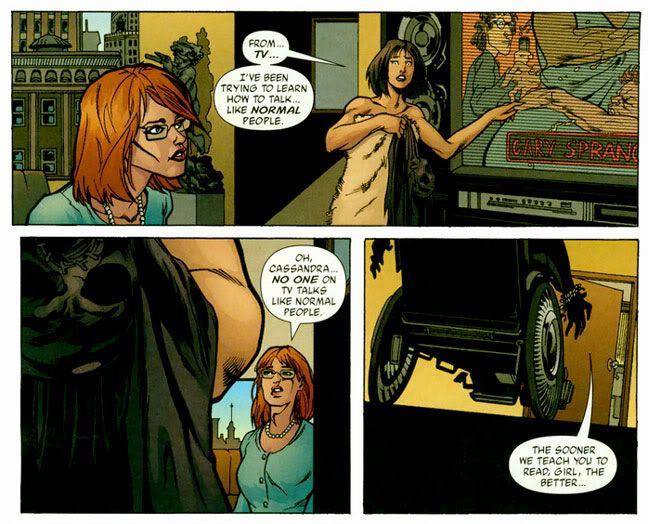
Having Cass shock her friends as she experiments with language learned from television in #51, "The City is a Garden," (2004) is a pretty clever notion.  Horrocks didn't do a whole lot to develop it in subsequent issues, and what little it appears in the comic could have been handled a whole lot better in the artwork.


The clumsy storyelling here really murders the gag.  The artist has to think in terms of acting-- read John K's blog entries about this in animated cartoons; it's almost the same thing-- and Cass's shocked, silly, scared expression, doesn't match up with Barbara's fairly mild remonstration.  It adds a forced quality to the joke.  It's oversold, and previous artists characterized her as fairly unemotional even when baldly lying face-to-face with Batman.

So this response rings false.  After all, it's not as if she's being screamed at, which would be a huge mistake on Barbara's part anyway.  Conversation with someone like Cass would be like running with scissors-- you might get away with taking chances 9 times out of 10, but that last time will spill some blood.  Why not have Cass respond with a serious, determined look on her face:  "That's what they said on TV, how could it be wrong?"  Or a mere inattentive shrug, as if to say she doesn't really care that much, talking is such a useless burden anyway.  Which would leave Barbara exasperated and at a loss, thinking over more strategies to get through to this girl.  After all, how do you deal with someone like Cass, explaining things that would be self-evident to someone more conventional in comprehension and response?

Also, I find Barbara's insistence that no one on TV talks like normal people pretty ironic coming from a character in a superhero comic.  Horrocks deserves extra points for that, at least.


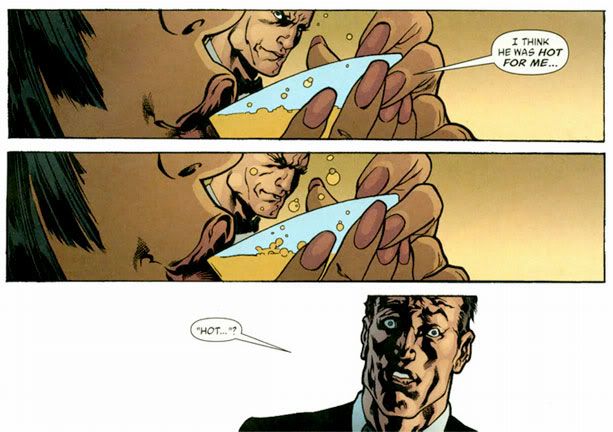
The second instance is more successful.  Instead of showing Cass's reaction, we only get Bruce Wayne's.  And he's flabbergasted.  Why does it work this time?  Because it's easy to imagine Cass, experimenting with language, not realizing the impact of word choice.  If this comic really had the strength of its convictions, she might even have said, "I think he wants to fuck me."  To that end, we really don't need to see her full face because the dialogue is enough to convey her naivete.  Batman's reaction is a little over the top-- I think it's much more likely he'd just grunt or narrow his eyes and make a mental note to have Barbara instruct Cass later-- but at least it's appropriate.

I only hope that's apple juice in that glass.  Isn't Cass only about 18 or 19 at the most in this issue?

Well, Cass-the-language-shocker is right on.  As a once-and-future ESL teacher, I often noted the difficulty English learners have with nuance.  A friend of mine-- whose English is actually pretty good-- once responded to a compliment I paid her by blurting, "It's a LIE!"  She meant it as a humble deflection of my flattery (which I meant sincerely), but it came out much stronger than she intended, without modulation.  We both ended up laughing about it.  Another time I was dating a girl with a somewhat lower fluency.  One night, we had to walk in a driving rain to a convenience store to bring back snacks for her friend.  The entire length of that walk, my semi-girlfriend griped, "Fuck the selfish bitch!  Fuck the selfish bitch!"

And that's the kind of thing I can see Cass doing without her even realizing it.  I wish writers had done a bit more thinking about this.  They really missed a chance at enriching her character, adding some comedic flourishes to her personality.  But hey, DC, it's not too late.  Fabian Nicieza handled her dialogue pretty well in two issues of Red Robin in which he got to use Cass, before the reboot.  It still works even with the more language-experienced Black Bat.  Or inexperienced, if she's going to be 5 years younger or whatever the heck's going on over there right now.

Besides picking up on the usages of friends, where else would an illiterate increase her vocabulary besides movies and TV?  Imagine if Cass gets into Batman's Complete Laugh-In DVD set.  We might get some hilarious scenes where she tells villains to "Sock it to me," or stuns Batgirl-Barbara by demanding she "Bet [your] sweet bippy."  Or catching a little TV Land and telling Damian Wayne to "Kiss mah grits!" or "Sit on it!"  What if she caught an HBO comedy special and started working a little blue?

One second thought...

Thursday, May 26, 2011

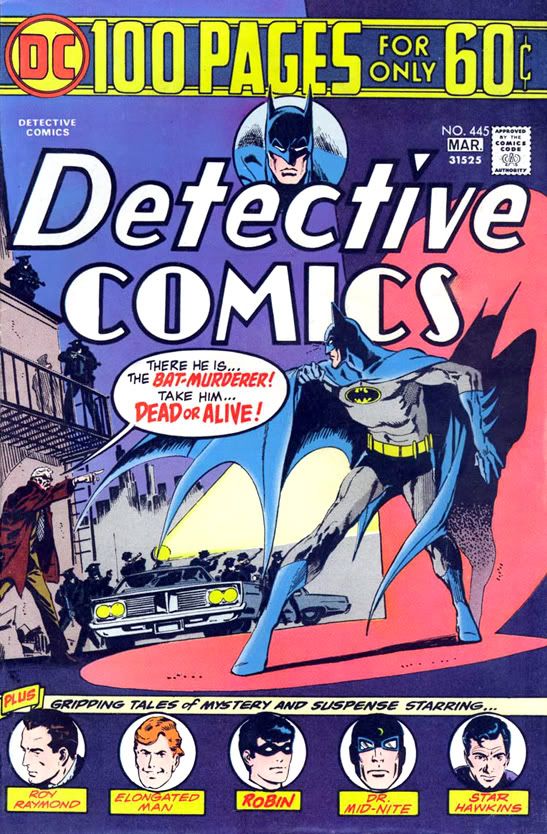
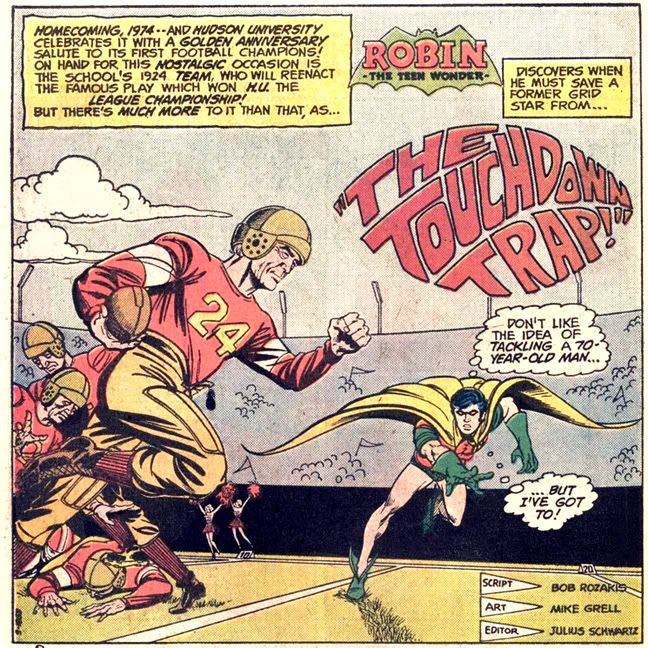
"The Touchdown Trap" from Detective Comics #445: Remember that time Robin tackled an old man and made him cough up the football?

You may be too young to remember the days before genetically engineered super-comics grew on cybertrees in all the colors of the rainbow, but when I was your age they were made of paper. In 1975, DC's Detective Comics consisted of 100 pages for 60 cents (I know! Imagine paying more than a quarter for anything less than 600 holographic pages!), and starred such iconic characters as Roy Raymond (subject of 1995's Oscar winner for Best Picture), Marty Moran (Headline Hunter) and Star Hawkins (in 1986, an act of Congress replaced Labor Day with a new holiday in Star's honor), plus those almost forgotten failures Batman and Robin, whose brief literary careers went nowhere-- aside from being occasionally unearthed and derided by nostalgia bloggers looking for obscure pop culture artifacts upon which to exercise their snide humor.

Yet at one point, this so-called Batman was a popular enough character to command the cover spot for a few issues of Detective Comics. Then again, people living in those days also loved Irwin Allen's disaster movies and belted jumpsuits. There's no accounting for taste, or so they tell me. What do I know? I'm just a clone. From the future!

1974's Robin is quite a bit different from today's version, the wretched little asshole Damian Wayne. This Robin is the original one, Dick Grayson, better known now as... well, Robin, because I doubt most people outside of comics have ever heard of Nightwing, or of Grayson's stint as Batman. I also seriously doubt they even know the name Dick Grayson. It just doesn't stick in the mind like Bruce Wayne, Clark Kent, Roy Raymond, or Marty Moran (Headline Hunter).

Here we have young Robin as a college student at Hudson University, which sounds as though it should be located in upstate New York. And perhaps it is, because Robin and his university pals frequently pop over to Rutland, Vermont, for the annual Halloween parade. Almost once a year, in fact.

I'm not sure what kind of school Hudson University is. Ivy League? Big 10? One of the Seven Sisters? All "The Touchdown Trap" tells us is it's the 50th anniversary of the school's first football championship. Ah yes, Hudson University. It's coming back to me now, the legendary Hudson University football dynasty, when the school won 5 consecutive national championships.

But that was decades after the storied 1924 season, during which their offensive attack was spearheaded by Heisman Trophy winner, "Hurricane" Hurley. As our story begins, the school has invited back the offensive squad of that storied team to recreate the play that won them the league championship (the entire defensive team having died in the interim).

The Hudson University Beavers play their home games before an appreciative crowd
of lumpy mashed potatoes turning gray with age.


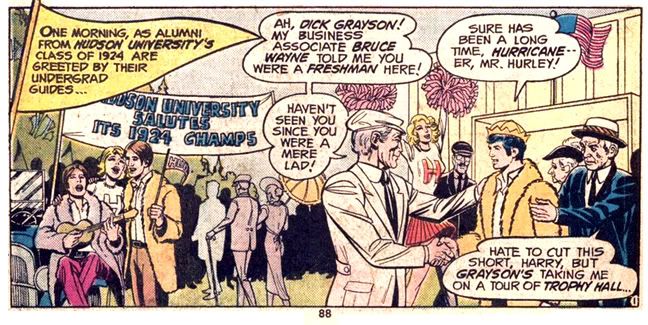
No student is more excited to see these aged gridiron warriors than our boy Dick. Hurley is an old family friend, and Dick is so thrilled to see him again, he's beaten up Jughead Jones of Riverdale and stolen his crown-like hat, then killed and skinned a goat and donned its still bloody pelt, steaming in the crisp autumn air. Hudson University, where goats are plentiful on campus and students gather around ukele-playing audioanimatronic figures to sing hymns to the coming socialist utopia.

When 23-skidoo met far freakin' out.

This is some nice dialogue. There's not the least bit of awkwardness in the way scripter Bob Rozakis has Hurricane Hurley reference his relationship to Bruce Wayne while addressing Dick by his full name and scholastic status. It's so natural and unforced, in fact, a lone cheerleader celebrates its soulful smoothness by soundlessly leaping into the air and shaking her pink pompoms. As good as his word, Dick takes straw-hat wearing Mr. Benson on a tour of the school's trophy hall. Benson's so impatient to see the trophys, he doesn't even want to drop of his bag. Or change his adult undergarments, which must be soaked after the long drive up from Gotham City. The man loves sports mementos and dampness in his personal area is not about to stop him from having fun. And it's a good thing, because as soon as Dick and Benson reach the hall, they find some fun-loving students engaged in a Hudson University tradition.

This guy entered the fight wielding a sliver of balsa wood, or a canvas stretcher stolen from some poor art student's locker.

Which is wearing white gimp masks and matching disco costumes to smash the award-laden glass displays. Careful! Those shards of glass might cut and the all the sports-related puns will stick to your shoes and make them smell something awful! Dick changes to Robin and beats up the disco kids, just as the campus cops show up. They're as timely and effective as most campus cops.

For a second I thought I was dead. But, when I heard all the noise, I knew they were cops. Only cops talk that way. If they'd been wiseguys, I wouldn't have heard a thing. I would've been dead.

"Okay, Robin... ...What the fudge is goin' on here?!" Only he didn't say "fudge." He said the "f-dash-dash-dash" word. Seems one of the "jocks" received a letter full of money with orders to smash up the trophy hall. Never one to question letters full of money, he and his friends immediately went out and spent their entire windfall on masks and matching leather jackets, then proceeded to wreak havoc. Now they're broke and in jail, but at least everyone knows they're together! A matching set. And that's what really counts. Togetherness. And Benson himself carves the roast-- actually, what Benson does is recover the game-winning football.

While Robin's trying to figure all this out, we cut to the stadium's locker room where the head coach from the 1924 squad is showing his team game film from their championship effort. Let's think about this for a moment.

The old guys behind "Coach" are all smiling because, in his senility, he forgot to wear pants. Sports teams are notorious for their cruel, mocking humor.

The former players are all in their late 60s or early 70s. Their coach was probably in his 30s or 40s when they won the championship. Which means this guy is pushing 80 or perhaps even as much as 100 years old! Look at him! Time has left him a withered, toothless wreck of a man, and deposited a gigantic carbuncle on his chin. Yet he proudly wears a dirty old crewneck t-shirt upon the collar of which he's crudely lettered the word "COACH" in red marker. A younger man would have bought a nice sweatshirt with stitched lettering, or at least used iron-ons. But not this walking mummy. Look how high those letters are. This might be because artist Mike Grell didn't trust the readers to fill in the parts of the letters the bottom of the panel cut off, but that's not it. What happened is exactly as I've described it. It's in Rozakis's original script. Writers include little details like that in their scripts even though we'll probably never read them because it helps the artists figure out the characters they're drawing.

We get to see how the winning play went down. Hurley, the quarterback, took the snap from center, then turned to hand off to fullback Benson. With the pocket collapsing around him, he decided to keep the ball. The cameraman somehow managed to get a sweet close-up of that moment, so clear you can see the shock and disappointment on Benson's face when Hurley snatched the ball away from him. Then it's 90 yards down the field and he... could... go... Okay, yeah, we already know Hurley scored the winning touchdown.

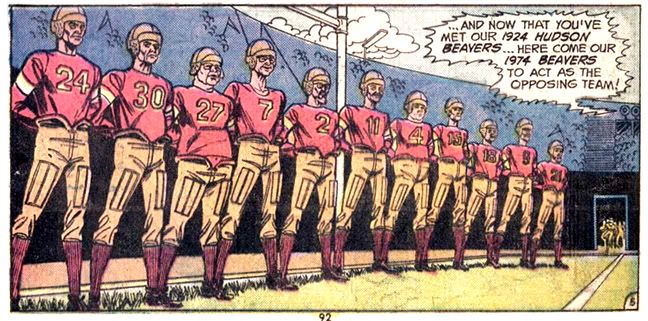
A few minutes after the old coach passes away, the players take the field, wearing their original 1924 uniforms complete with leather helmets. Luckily, they've stayed in shape all those years and everything fits perfectly.

Behind the men: a wall made of natural stone. Granite, I believe. With little flags poked into it to mark specimens of particular interest to rock hounds.

The plan is to use the original game ball for the recreation, but someone has destroyed Hudson University's most precious sports artifact. Robin learns of this from none other than a time lost Burt Reynolds as he appeared in his starring role as police officer Nick McKenna in the 1993 cinematic masterwork Cop and a Half.

Robin never had a strong grasp of meteorological phenomenon. That's why he failed so many science classes.

At which point Robin deduces the reason for all the disco-style vandalism-- a distraction while someone switched footballs. And being a superb detective trained from childhood by the master himself, Batman, Robin also knows there was only one person in position to handle the old switch-a-roo. Hurley's in danger and there's not a moment to lose! After a trip to the concession stand for a large, icy Pepsi and one of those delicious Hudson University stadium chili dogs, then an interminable wait in the line an open urinal (millions in alumni donations for luxury skyboxes and a Jumbotron scoreboard, zero for restroom facilities), Robin leaps over the retaining wall and hurls himself down the field.

He takes Hurley down with a fine open-field tackle, snapping the man's brittle tibias and fibulae as though they were merely dried twigs, old wood, dead these many winters. The substitute ball contains a time bomb, as evidenced by the muffled ticking coming from within.

"I don't care what kind of hero this moldy old chump used to be, ain't nobody crosses the goal line on Robin's field!"

I'm left wondering why someone would use a timebomb in this situation. Wouldn't some kind of remote triggering device work much better? If you're a ball-handling offensive player on a football team-- a quarterback or fullback, for example-- chances are you're going to be near the football at some point during a play. Especially if your participation is a major component of said play. Granted this is merely a recreation, but the timing on these things isn't always precise. There are delays. These are old men; they don't move as quickly as they used to. Using a timed explosive is taking a major risk. But I don't know. I have a superstition about standing too close to explosions, so I may not be the most objective person to judge.

Unfortunate timing led to the demise of all the doves released during the pre-game ceremony.

Forget all that! Not only is he a textbook tackler, but marvel at the height Robin gets with that punt! Lord have mercy! Imagine the hang time he'd have had if the ball hadn't contained a timebomb! Why isn't the current Hudson University coach trying to recruit this guy? "You can even wear the mask, kid, but we need you on special teams!"

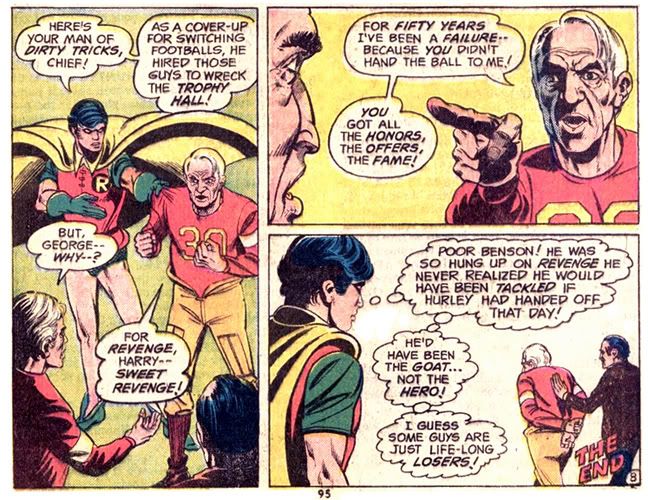
I've been poking fun at "The Touchdown Trap," but it's really an effective eight-page story, with a concise, direct plot. Rozakis probably came up with it over lunch, ran it by editor Julius Schwartz and tapped it out on an IBM Selectric II at the DC offices in less than an hour, one of many he'd write that afternoon. Grell doesn't seem to have labored over the art-- and he obviously skimped on the stadium crowd shots. Lumpy gravy? Week-old grits? But you know what? That's fine. Rozakis and Grell weren't trying to produce a masterpiece. They were just trying to tell an entertaining Robin mystery to fill a slot in the magazine. Stripped of flash, efficient, not a wasted moment, no loose ends, just enough character development to propel the narrative to its conclusion.

Written today, "The Touchdown Trap" would attempt some gross-out thrills with a few gruesome murders. Also, it would consist of a four-issue prologue mini-series, then twelve issues running across most of DC's monthlies for an entire summer, and finally, a couple of epilogue stand-alone issues and a new on-going series starring the daughter of the original Roy Raymond, also named for some reason Roy Raymond. The real culprit behind it all-- manipulating Benson and Hurley for his own nefarious ends-- would be an insane Star Hawkins with help from a brain-damaged, drug-addicted Marty Moran (Headline Hunter). And as a parting gift, Robin would also learn Hurley had molested Benson's daughter and consequently come away a Boy Wonder disillusioned with hero-worship. A few months later, and we'd all get to buy the hardcover annotated version with an introduction by some best-selling author of horror novels or techno-thrillers sold by the pound at airports, re-mastered art on super-slick glossy paper and self-congratulatory commentary from the creators. Two more years and there'd be the direct-to-DVD animated adaptation. Then the new Roy Raymond title would be cancelled, she'd show up from time to time badly mischaracterized in various Batman-related books and finally, be raped and murdered as a minor plot element in yet another multi-title crossover event.

A relic of a simpler, brighter time, Rozakis's plot would've worked beautifully as a segment of Super Friends or an episode of The New Scooby Doo Movies guest-starring the Dynamic Duo, or the Caped Crusaders. Or Sonny and Cher. All that's missing is an unmasking. We have to settle for an unhelmeting. Actually, we don't even get that much. Poor Benson. Fifty years nursing a grudge and this is the best revenge he can come up with? Like Robin notes, "I guess some guys are just life-long losers!" Luckily for Benson, he won't have long to stay in prison. Because he's so old, he's bound to die there in a month or two! Freddie, Velma, Daphne, Shaggy, Scooby, Batman and Robin all laugh heartily and...

Roll credits.

Saturday, March 26, 2011

Let's go nuts for the Superfriends!


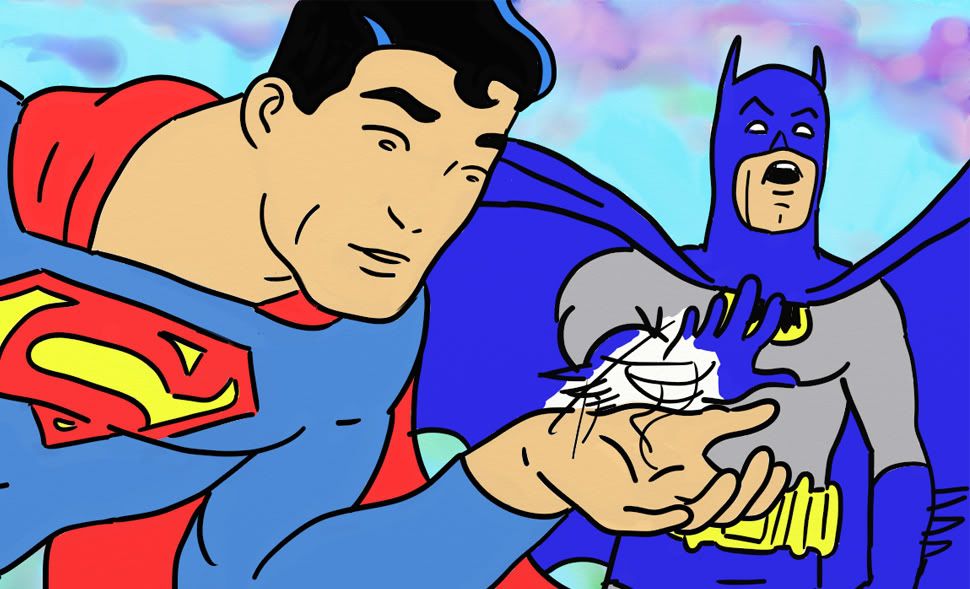
From the sublime-- Steve Rude, Syd Shores and Jack Kirby-- back to the ridiculous again. Here's Hanna-Barbera Batman trying to stop an awkwardly drawn animation-style Superman from... talking to/inhaling/talking to a scribble he holds in his palm.

The scribble came first (pen test), then I decided I'd have Superman holding it. And when he came out looking vaguely like Superfriends Superman (much to my surprise), I decided to swipe a Toth Batman head and stick it on a totally original body to produce this awkward scene. Drawing time: less than 5 minutes. Coloring time: all freakin' afternoon, baby!