Showing posts with label comic review. Show all posts

Monday, May 23, 2011

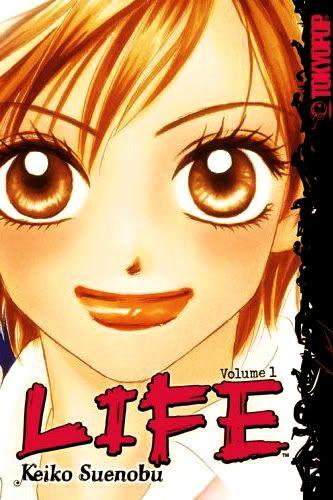
Life 1: A Comic Review

Life
Writer/Artist: Suenobu Keiko

Translation: Michelle Kobayashi
English Adaptation: Darcy Lockman
Publisher: Tokyopop

This is Life the comic, not the game. Or the cereal. And this is how life works: while in the U.S. we get assigned to high schools based on demographics and geographic location, in Japan junior high kids have to pass a test. Ayumu is an underachieving girl who latches onto high scoring smarty Shinozuka (Shii-chan for short but only if you’re close) for friendship and tutoring. As Ayumu’s grades improve, so does her outlook on life. Now she has a super-supportive best friend and if things work out, they’ll be together at the coolest school in the city, Nishidate High.

Sometimes things don’t work out. Shinozuka’s grades plummet as she expends energy on the needy Ayumu and when the big test scores come in, Ayumu’s the one going to Nishidate. Solo. This scotches the friendship and Ayumu finds herself isolated and hurting among the seemingly happy Nishidate student body. Luckily for her, she’s cute enough to catch the attention of the instantly popular Manami. Manami’s perky, pretty, has a sweet boyfriend and a sunny outlook on life. She’s everything Ayumu wants to be so she learns to bask in Manami’s reflected light. But…

Why is Ayumu still so unhappy? Losing Shii-chan’s friendship has left her with an introspective streak and the more she exercises it on Manami, the more this brightly effervescent girl proves to be spinning somewhat out of control. So out of control, Ayumu’s going to have cause to regret the pinky swear they made to always help each other out on pain of being “stabbed by a thousand needles.” And finally there’s Hatori the mysterious girl with a bad reputation who makes Ayumu’s heart pound.

Well, it may not be a game or a breakfast food but it was a hit Japanese TV drama in 2007. The show’s theme became hugely successful on the pop charts; more sequential connections here-- it was sung by Nakashima Mika, the actress who plays rocker Nana in the two films based on that comic.

Here's a link to the music video, which features scenes from the drama:


It accurately depicts how much more over-the-top the TV series is compared to the comic. While the show quickly veers into melodrama that approaches grand guignol, Suenobu Keiko’s comic series starts with a slow building and expertly observed psychological portrait of a vulnerable teen coming apart under the strains of everyday life.

The Shiiba sisters have more needs than their single mom can deal with, so as the eldest, Ayumu is left to deal with her issues alone. Status as something of an afterthought around the home combines with the intense pressure to pass those entrance exams until Ayumu resorts to desperate measures to attune herself. First she discovers the deliciousness of pain through poking herself with her compass and when Shi-chan turns on her in jealousy and disappointment, Ayumu becomes a cutter.

Suenobu deftly depicts the dynamic between Ayumu's despair and the false sense of control she gets from cutting. Each slice must be strangely comforting in a way I really can't understand, but also shameful, as when Ayumu realizes her school will soon switch to their short-sleeved summer uniforms and she has so many visible scar. When these scars intensify her feelings of isolation and freakishness if discovered, Ayumu will find herself locked in a vicious cycle.

Suenobu’s Manami is another smart sketching of a teen in crisis. Her ever-present smile and chirpy demeanor draw Ayumu to her. Manami definitely has charisma; almost everyone wants to either know her or be her. But she possesses a shocking and overt cruel streak, one that Ayumu tries to overlook as Manami draws her into a sort of codependent relationship which they consummate with the fateful pinky swear. Despite her upbeat demeanor and her perfect hair, there’s something cracked about Manami, an ugly and even helpless side that, increasingly, Ayumu finds repulsive yet compelling; she constantly reminds herself that no matter how ugly things get, she truly is Manami’s friend.

Suenobu’s artwork features clean line work combined frequently with mechanical or computer-generated gray screentones, cartooned emotions and page layouts with overlapping panels. Take away the gritty psychological realism and it could be any generic high school romance story. And like the artists of those lighter comedic tales, Suenobu opens each chapter with idealized, romanticized inkwash images that in Life belie the harshness within.

In fact, there’s an almost disturbing disparity between these fashionable, large-eyed, cutesy looking characters within their overly familiar high school setting and the stark imagery of dark beads of blood bubbling out of Ayumu’s shallow wrist cuts. It plays against the reader’s expectations of frivolity and increases the emotional impact. A powerful dissonance.

I started reading this manga because a friend turned me onto the drama and we both enjoyed its campier elements. At the time, I was actually living in Japan and teaching English to students of all ages. I tried my best not to pry into my students’ personal lives, but sometimes I saw tears and stark mood changes even in our classroom. Life may be somewhat exaggerated for dramatic effect and the reality may or may not be so dark, these kids’ lives are shaped by enormous stresses and responsibilities. Many of them are up at 6am and not home before 9pm, 6 or even 7 days a week.

Club activities; frequent exams that cover Japanese, biology, history, Classical Japanese (which they amusingly call “Old Japanese”), mathematics and English all at once; nights spent fighting sleep in favor of studying leading to somnolence throughout the day; bullying; and those looming college entrance exams… these kids rarely stand still. The pace causes break-downs.

It would’ve killed me dead. Suenobu ably sketches out all of these stresses and strains and compresses them into her narrative as background details. In one ironic scene, a radio DJ glibly exhorts hard-studying students about battling the Sandman while Ayumu viciously slaps herself to stay awake, then stabs her hand with her mechanical pencil and before upping the ante with her compass. The adult world seems only vaguely aware of its impact on Life's teens.

Throughout, Suenobu willfully eschews many tropes and clichés (there’s a girl in glasses, but she’s not a major character, confidant or comedic nerd) in favor of an earnest and emotionally affecting look at the trials of teen life that are anything but cute. With a damaged protagonist who’s obviously in store for more torture, Life Vol. 1 is an emotionally affecting and eye-opening story that despite hints of hope, ends on a desolate note. Obviously, life for Ayumu means further pain if she’s to find her way into the light.

The translation by Michelle Kobayashi and Darcy Lockman is solid. The dialogue comes off as youthful and chatty, and Ayumu's interior monologues are age-appropriately introspective. There's also an informative and sensitive essay about cutting by licensed clinical psychologist Susan M. Axtell.

Nana 2: A Comic Review

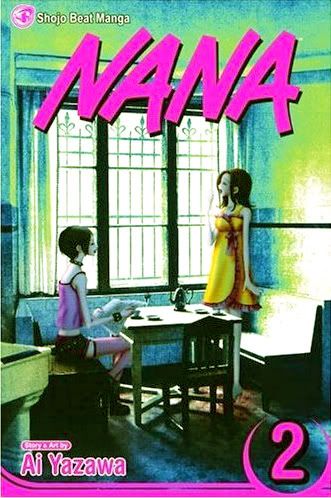
Nana vol. 2
Publisher: Shojo Beat/Viz Media
Writer/Artist: Yazawa Ai
English Adaptation: Allison Wolfe
Translation: Goto Koji


What happens when two girls named Nana meet? Will physics allow them to occupy virtually the same physical space, or will the universe die screaming as anti-matter and matter collide, ripping reality apart? Actually, all potential problems are solved when punk Nana Osaki notices girly Nana Komatsu’s resemblance-- in personality only, please-- to a famous dog and renames her friend Hachi, thus reducing the Nana surplus by one and saving the universe as we know it.

The fun starts when Shoji, Nana K’s long distance boyfriend, sends her a special text message: “Cherry blossoms R blooming!” and tells her he finally got into art school. So she quits her video store job, runs through the snow in her monster lace-up platform boots, jumps the shinkansen for Tokyo for their long-awaited reunion. She’s saved her money, waited ever so patiently and now all her dreams are coming true…

If only Nana K can be patient for a few hours more. The trains’s delayed due to snow and there’s only one empty seat- empty but for a sinister looking black guitar case guarding the sleeping girl in the window seat next to it. This girl is nothing like Nana K; she’s all dressed up in black, looks like an erotic vulture in her leather jacket, thigh-high fishnets and clunky engineer boots.

Nana K’s decision to take the seat changes both of their lives. And her name.

You know, with the comic series emerging as one of Japan's top-selling titles of all time and the 2005 film adaptation spawning even more Nanamania, a sequel became inevitable:

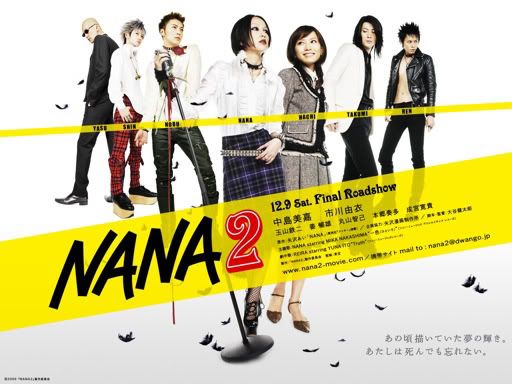
Nana 2 debuted in 2006. Again, Nakashima Mika starred as Nana O, the fame hungry punk rocker. But Miyazaki Aoi didn't reprise her role as Hachi. Why? What do I look like, Japan Film Insider? Whatever the reason, Ichikawa Yui took over the role. The sequel wasn't as big a hit as the first, and the few people I talked to about it when I lived in Japan expressed their disappointment with both movies, and their preference for the animated series. Oh well, at least Nose Anna returned as Junko!

Anyway, back to the comic review.

And so Yazawa Ai finally brings our two Nanas together, on a snowbound train aimed at Tokyo. Through various circumstances and perhaps the machinations of Nana K's personal deity/devil the Demon Lord, the girls end up as roommates in a funky Tokyo suburb along what I’m guessing is the Sumida River. I base this on my own scientific Nana research, consisting of going to Tokyo and looking for a river. During one Golden Week excursion to Tokyo, I wanted to go to Kojima-cho to look for Jackson Hole and have a Jackson Burger (Hachi's favorite food), but a nasty cold and frequent chilly downpours caused me to limit myself merely to reading about it, and having Wendy's (since closed) in Shibuya instead.

Yazawa also begins weaving together the supporting casts. At first it seemed as though we were going to be treated to parallel narratives but Yazawa skillfully mixes the very different characters to create dramatic tension and humor.

Nana K’s impulsive nature comes to the fore as she falls head over heels in platonic love with her slightly sinister, definitely mysterious doppelganger. If fate and coincidence are to be recurring themes, then it certainly seems that Nana K’s intuition serves her well. Because the story cannot happen unless she appends herself to Nana O’s life, works her way into the center despite their differing backgrounds and outlooks. Failing that, both characters and all their friends would be out of work and they'd end up hanging around Junko's snack bar all day. And we would have nothing to read.

Nana K is a reckless romantic, while Nana O is coolly self-possessed. But how will her punk rock façade hold up when living with a girl who loves Trapnest, the very band her own lover abandoned her to join (to the point of adorning their shared pad with a massive fannish poster of the group)… with her love crazed, puppydog-like-in-her-clumsy-enthusiasm roomie? That’s the origin of the name Hachi.

Hachiko was a dog who waited at Shibuya Station every day for her college professor owner even after he died. A symbol of loyalty, she’s immortalized in a statue outside the station, and the exit to that area is named after her: the Hachiko Exit. People say if you stand there long enough, the one you’d most like to see will eventually walk by. You can speed up the process by simply text messaging that person and arranging a rendezvous beforehand. But given the mob usually lounging around the Hachiko statue, you should probably wave a flag.

Nana, meet Hachi, your very own loyal, loving pet girl friend.

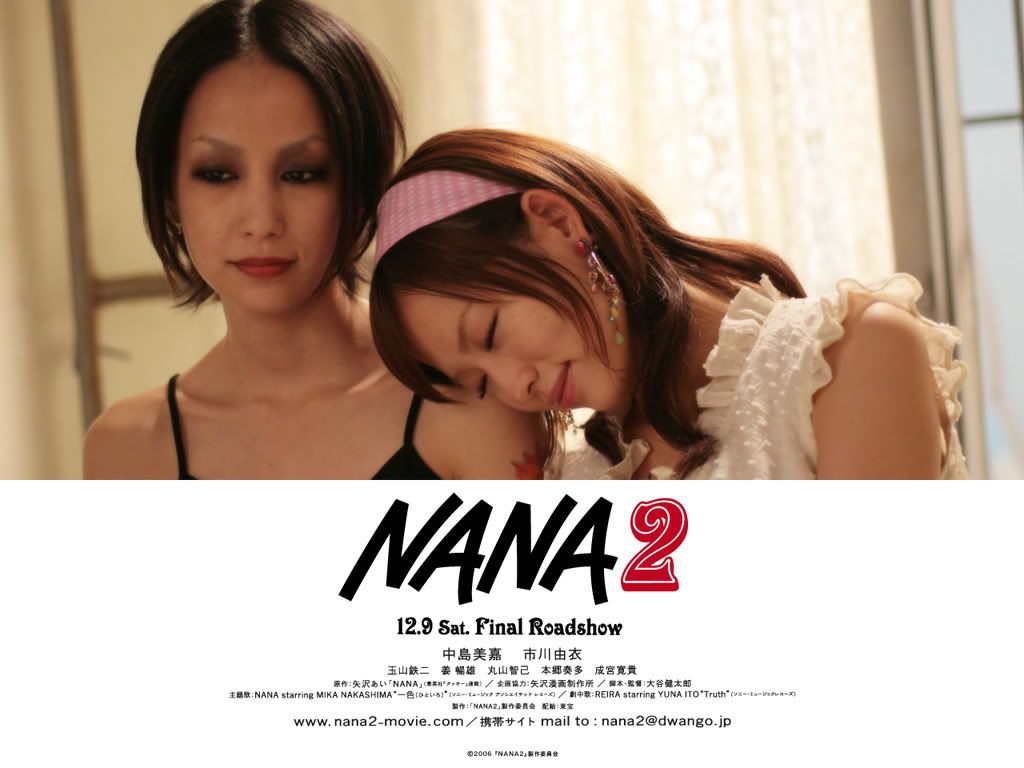
I think we can all agree Nakashima Mika is perfect as Nana O. She's also a big-time singing star in her own right, and released an album called The End: Nana starring Mika Nakashima that features her songs from the second film. Her comics connection continues- last fall she had a hit song with the theme to the TV drama adaptation of the comic Life.

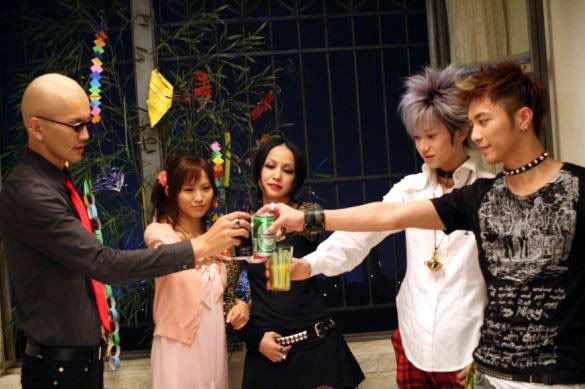
And despite falling victim to the law of diminishing returns, the movie certainly looks like the comic:

Volume 2 is where the story really gets going, where Yazawa sets up Hachi’s fascination with Nana’s shadowy past. It’s strongly character driven, with Hachi’s manic energy linking her with her namesake, entangling them both in each other’s lives. Things don’t so much happen as Hachi makes them happen, from wheedling her way into her dream apartment with Nana, to finding a job at a hip vintage clothing store, to spending all her money getting set up in Tokyo.

Beyond the addictive charms of the lead story, Yazawa gives us the fun and frivolous “Junko’s Place” backup story, where the Nana cast break the fourth wall while remaining totally in character. Their awareness not only of their existence as fictional comic book characters but also of the cast hierarchy is hilariously meta. As much as I love the narrative, as I accumulated volumes I found myself flipping back to "Junko’s Place" to catch up on Jun and her boyfriend and their little area of the Nana world. Each hint Junko’s restaurant might close due to lack of business only intensifies my obsession. What if Junko’s Place does close? What will she do? What will we do?

Nana is a drug. You should have to get a doctor’s okay before buying it. A prescription or something, and your health should be carefully vetted before they hand it out. On the other hand, some stressed out, over-worked mothers here are actually turning over all their parental responsibilities to the Nana comic series and allowing it to raise their children:

PS- Note how the covers actually tell a wordless little story of a day in the lives of the two Nanas. On the cover of volume 1, Nana O wakes first and reads the paper in their cozy little dining alcove, Hachi takes longer to get dressed but appears on volume 2, they have breakfast, go downstairs on volume 3, and on subsequent covers do some shopping, have lunch, ride the trains...

Pretty sneaky, Yazawa Ai!

Tuesday, May 10, 2011

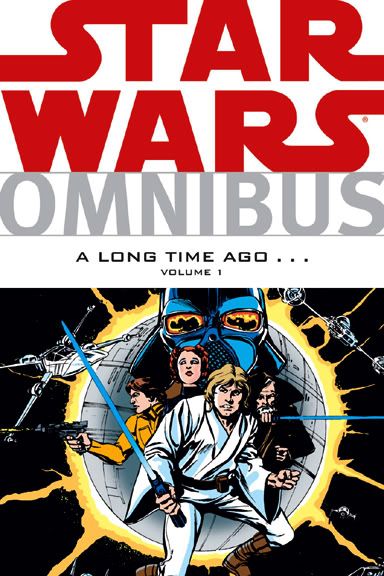
Star Wars Omnibus: A Long Time Ago.... Volume 1: A Comic Review

Star Wars Omnibus: A Long Time Ago.... Volume 1
Publisher: Dark Horse
Writers: Roy Thomas, Don Glut, Archie Goodwin, Mary Jo Duffy Artists: Howard Chaykin, Carmine Infantino, Alan Kupperberg, Herb Trimpe, Allen Milgrom, Walt Simonson, Steve Leialoha, Rick Hoberg, Bill Wray, Frank Springer, Tom Palmer, Bob Wiacek, Terry Austin and Gene Day

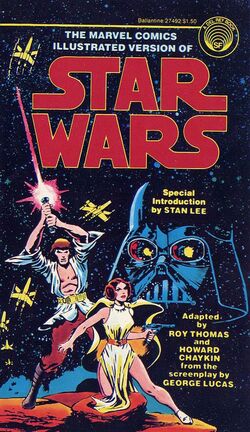
Despite being-- like most of my friends-- a complete freak about all things Star Wars in the late 1970s, I rarely bought the Marvel comic series unless they were doing an adaptation of one of the movies. I'm pretty sure the only complete storyline I owned from this title was a small black and white paperback of the first six movie-based issues from Ballantine, which I began coloring with Crayolas and markers. My impressions of the Marvel version of George Lucas's creation are strobe-like glimpses of random moments in any given plot. Who's this guy who wasn't in the movie? How did Luke get to this planet? Where's Darth Vader? Why is Han hanging out with a giant green bunny, who's something of an asshole to boot?

Face it, few of these early stories are classics. This volume showcases Roy Thomas's skills in adaptation and pastiche, but also his taste for the silly. He immediately casts Han Solo into the Takashi Shimura role in a comic book version Kurosawa’s classic film Shichinin no Samurai (That's The Seven Samurai to you and me, Russ), with Han and Chewie recruiting some fighters to help space-villagers fight space-bandits. Or maybe it's The Magnificent Seven, but with a porcupine guy instead of James Coburn's knife fighter. Considering how much Lucas borrowed from Kurosawa, Thomas has the right idea. But he can't resist introducing Bugs Bunny into the mix. Meet Jaxxon, the infamous green rabbit. Roughly as popular as the reviled Jar Jar Binks, but mercifully obscurer, Jaxxon never got any screen time in the prequels or any of the spin-off animated series, and neither Kenner nor Hasbro ever produced him as an action figure.

Other Thomas touches include Don-Wan Kihotay, a straight lift of Miguel de Cervantes’s famous creation and a villain named Serji-X Arrogantus, apparently an affectionate parody of artist Sergio Aragones, complete with Aragones's magnificent black mustache. What kind of name is Arrogantus? I know the various Darths often chose wicked-sounding surnames-- Sidious, Maul, Vader-- in order to frighten. But what else could someone named Arrogantus become other than a throwaway creep in a hastily written comic book? What kind of family could he have come from? Still, Thomas's script for the movie adaptation is filled with punchy descriptions and clever ideas like the explosion that destroyed the Death Star taking days to burn and providing a spectacular if temporary tombstone marker for Grand Moff Tarkin's great failure. If George S. Patton was right and fixed fortifications are monuments to the stupidity of man, so then are giant space stations with unshielded exhaust ports.

Plus I have to give him credit for another cool idea. At issue #6's conclusion, Thomas corrects one of George Lucas's most egregious mistakes (prior to conceiving and producing the prequel trilogy, that is) and prefigures MTV’s efforts by twenty years when he mentions in a caption that, yes, Chewbacca will also receive a medal. Hayden Christensen and Natalie Portman, unfortunately, are beyond repair.

Second scripter Archie Goodwin's settings and situations owe more to Flash Gordon, with an appropriately swashbuckling feel. Goodwin has Luke visit an all-water planet to hang out with a young Kevin Costner (inspiring Costner's notorious 1995 flop Waterworld) and sends the whole gang to an orbiting satellite of casinos that would make Futurama's Bender drool if he were programmed for that sort of thing. And so it goes for the rest of this volume. Star Wars characters sort of cut and pasted into comic book plots lifted from all the familiar sources.

Since there were no “Expanded Universe” tales or overall continuity to these adventures back in 1977, the Marvel writers were free to make up all kinds of wild characters, planets and situations. Besides the ridiculous Jaxxon and the amusing Serji-X, there's a cool and conflicted bounty hunter named Valance with a hideous secret, bald Yul Brynner impersonator Commander Strom (an evil Imperial officer), roguish Senator Greyshade and his pal, the chunky droid Master-Com. My favorites are Crimson Jack, the pirate king who commands a stolen Star Destroyer, and his first mate Jolli, the tragic, man-hating ass-kicker with a purple pageboy haircut and a cute green beret. These two repeatedly bedevil Han Solo.

Howard Chaykin’s art in the first issue is shaky and rushed, but things improve rapidly with fine ink work from Steve Liealoha and Tom Palmer. As a kid, my favorite was the issue featuring the Death Star attack. Assisting Chaykin are Rick Hoberg and a pre-Ren and Stimpy/fine art Bill Wray-- as the X-Wings and TIE fighters zip and zing (and explode), the ink team goes nuts with the feathering and cross hatching. They also fix Chaykin’s likenesses so Han looks more like Harrison Ford and Luke looks less like a middle-aged Kirk Douglas with a California surfer cut. I used to love the artists' depictions of the reflections in the rebel pilots’ goggles and the final panel of all the heroes together at the awards ceremony.

Most of the art in this volume is by the legendary Carmine Infantino, inked with an almost mechanical cleanness by Terry Austin and then more organically by Gene Day and Bob Wiacek. I did not dig Mr. Infantino’s angular, stylized faces and heroically proportioned figures (Han and Luke put Arnold Schwarzeneggar to shame) when I was a 10 year old, but his art has aged much better than most of the stories it supports. If you can get past such bizarre scenes as Han and Chewie floating around in space and Chewie’s orange monkey face, you’ll find page after page of vigorous storytelling. While his facial expressions and body poses aren't subtle, Infantino excels at putting figures into motion and depicting action, and both Thomas and Goodwin make sure he has plenty of that to draw. Fisticuffs and light sabre battles abound, plus giant sea monters and space dogfights. All those spaceships must have been real bastards to draw, too, but Infantino and the rest don't scrimp on the machinery and planetary vistas. Like Chaykin before him, Infantino goes “off-model” quite often, but his art here is dynamic and fun. That's what matters most. I’d rather see artists like Chaykin and Infantino adapting a property to their strengths rather than relying on tons of photo reference and ending up with a lot of static tableaux. Al Williamson (who apparently did use a lot of photo reference and even traced them at times) and Michael Golden were more natural fits for Star Wars, but I’ve really come to appreciate Infantino’s Marvel-ized approach as well.

While this reprint volume’s dimensions are smaller than the original comics, it’s attractively designed, impressively fat and reproduces the original colors by Marie Severin, among others. I paid less than 17 dollars for my copy via Amazon.com, which means with 27 issues, more than 500 pages-- and considering just how enjoyable these wacky, more than likely out-of-continuity stories are-- this Omnibus book is a bargain. I’d love it if Dark Horse got the rights to publish some of Marvel’s other licensed properties if they did them exactly like this. Come to think of it, Dark Horse is an amazing source of classy reprints—they’ve got old Gold Key titles, Nexus, Creepy and Eerie coming out in expensive hardcover formats as well as fat black and white collections of Savage Sword of Conan. And these chunky little Star Wars books that will make you want to pull out your vintage Kenner toys and head to the backyard.

Or create a custom Jaxxon action figure.