Showing posts with label Japan. Show all posts

Monday, January 13, 2014

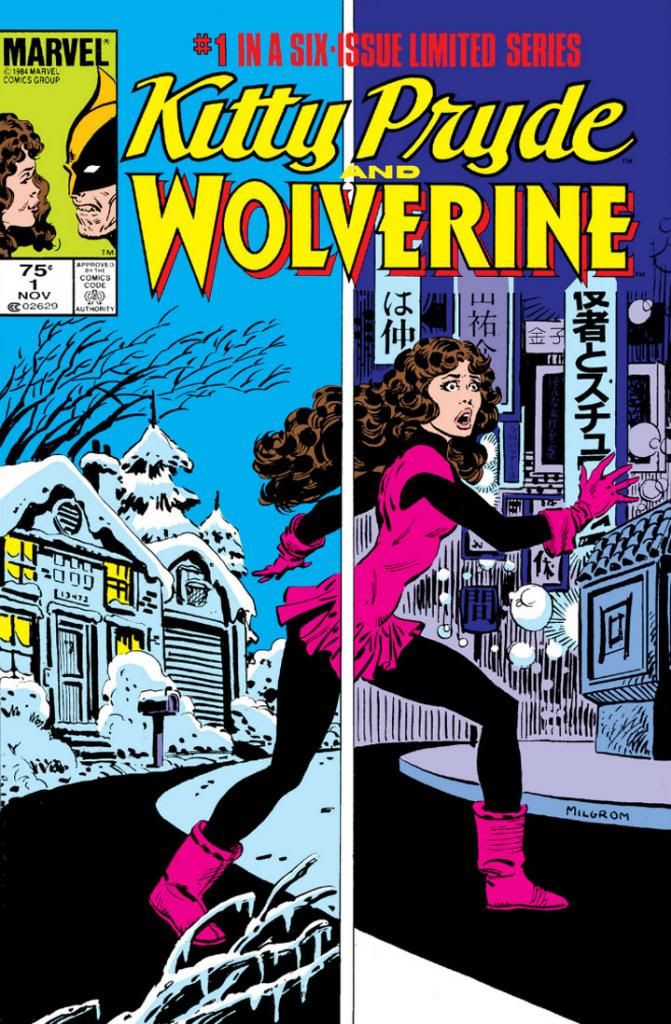
Kitty Pryde and Wolverine #1 (November 1984): Bad News Mutants Go (Back) to Japan!

When I was a much younger comic book fan Japan was mostly just that place Speed Racer and Pink Lady came from.  Then at some point, I must have gone insane because I moved there to start a new life and go to Melt-Banana shows whenever I damn well feel like it.  While it's not nearly as exciting a place as Pink Lady and Jeff would have you believe, Japan is still a pretty cool place to live.  I've had a lot of misconceptions corrected since I was a young comic book reader living in south Georgia, and I've probably formed more than a few new ones now that I'm an old comic book reader living in south Shizuoka.  This is why I love taking a look at American comics depicting my adopted home.

Marvel Japan!  I can't know for certain (since I wasn't working for them), but I get the feeling Japan was Marvel's go-to country for remaking characters back in the 1980s.  In their classic and influential 1982 Wolverine mini-series, Chris Claremont and Frank Miller sent Wolverine there, tore him apart, put him back together again and cemented his place as one of Marvel's top draws.  Along the way, they created a fabulous fantasy Japan (we've discussed this already), where the high-tech marvels of modern Tokyo form a backdrop for a lot of pseudo-mystical martial arts tough guy nonsense.  In the Marvel Japan Claremont and Miller invoked you could still encounter hordes of ninja and stoic old people still living the ways of bushido in their ancestral castles.  It's silly, but it's the best kind of silly.  I dug it, you dug it, lots of people dug it, so much so this story recently formed the basis for The Wolverine (in Japan it's called Wolverine: Samurai) starring Hugh Jackman.

In Kitty Pryde and Wolverine (November 1984-April 1985), it's Kitty Pryde's turn to visit Japan and experience life-changing events.  And you couldn't ask for a better protagonist, or one more in need of a fresh start than 1984 Kitty Pryde.  Lovingly written here by Claremont, our heartbroken yet smart'n'spunky (TM) Kitty is plenty interesting on her own to have headlined a two or three issue romp through 1980s-era Tokyo, capital of a country then enjoying a huge resurgence in economic prowess, self-confidence and cultural energy-- Shinjinrui!  Visual kei!  Para Para!  With New Wave artists already appropriating its looks and imagery, Japan's youth culture stood poised to conquer the pop culture world, and this could have provided plenty of material without anyone resorting to martial arts clichés.  Instead, in the second issue, Wolverine muscles his hairy way into the plot and the series becomes a deadly serious remake of his solo story, only with Kitty fighting ninja and yakuza for redemption.  Those aspects just don't provide the same kick or appeal the second time around. 

But rather than shoot my figurative BB gun at a comic for not doing what I want it to do, I'd rather focus a positive spotlight on the way-cool first issue, which has Kitty lost in translation all by herself, desperately in over her head.  So let's take a long, loving look at Kitty Pryde and Wolverine #1.  How do Claremont and artist Al Milgrom depict Japan?  Is it believable?  Does it make a reader feel as if he or she has been there?  That's what you're asking me right now, isn't it? 

No?  Well, okay!  I'll tell you anyway!

First, there's the trip journey itself.  To get to Tokyo, Kitty stows aboard a JAL flight from Chicago, and I can promise you there absolutely is such a flight, known as JAL Flight 9.  These days, the aircraft flying the route is a Boeing 777-300ER, but Kitty hops a 747-400 (I think).  That's the same plane I took, only I didn't phase onto it through the cargo bay.  I had a ticket, so my arrival at Narita Airport was a lot smoother (and drunker, thanks to JAL's liberal free drinks policy at the time) than Kitty's.  Not having my good luck, Kitty then spends a page or so escaping Narita.  Today's Narita doesn't look much like the one Milgrom draws, but I first visited it some twenty years after Kitty, so it probably underwent a renovation or two in the interim.  Oh, there's a funny bit where Kitty phases onto a bus and accidentally slaps a salaryman on the ass as she solidifies.  Today we're more likely to get to Tokyo proper by way of the Narita Express, because Narita is actually way out in the rice fields of rural Chiba prefecture, a fair distance from the urban neighborhoods the where the rest of the story takes place.

Now we come to the meat of this post:  Tokyo.  Godzilla's Stomping Ground.  Where the Bears played the Japanese Little League champs.  Kitty visits Tokyo in winter and let me tell you-- Japanese winters are cold!  Cold and windy!  Because her trip is on the spur of the moment with no time to pack or dress more appropriately, Kitty's skater costume is cute but hardly practical for running around outdoors here.  And to top it off, she gets soaked by the rain.
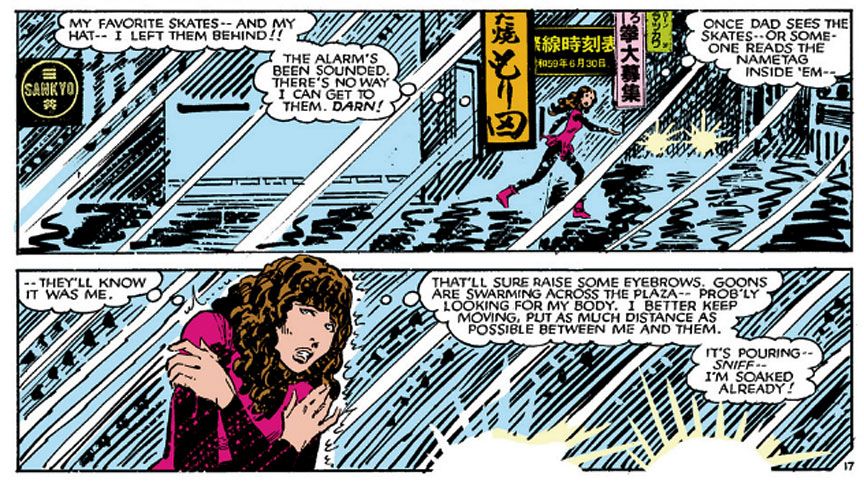
Script by Chris Claremont, art by Al Milgrom

Claremont's Kitty may be impulsive at times due to her youth and naiveté, but she's also a thinker.  During this sequence, she's sizing up her situation after receiving a pretty heavy duty system shock and already figuring out not only has she made a sizable error in judgment trying to help her dad, she'll also be lucky just to stay out of jail herself.  Then the weather takes a dump on her, too.  It actually rains a lot in Japan (while Kitty can't because she lacks money, less desperate visitors should buy a cheap umbrella at a convenience store; the wind's just going to destroy an expensive one anyway), so this vaguely Blade Runner-esque cityscape looks pretty accurate.  Milgrom inks his pencils with a bold, energetic line and spends more time on the rain shower than the surroundings, but those squiggly blacks Kitty's running across are reasonable visual shorthand for the wet streets and reflective lighting of a rainy Tokyo evening.  The vertical signage creates a convincing Tokyo look as well.

In the next sequence, the rain lets up a little so Milgrom shows us more of the city.
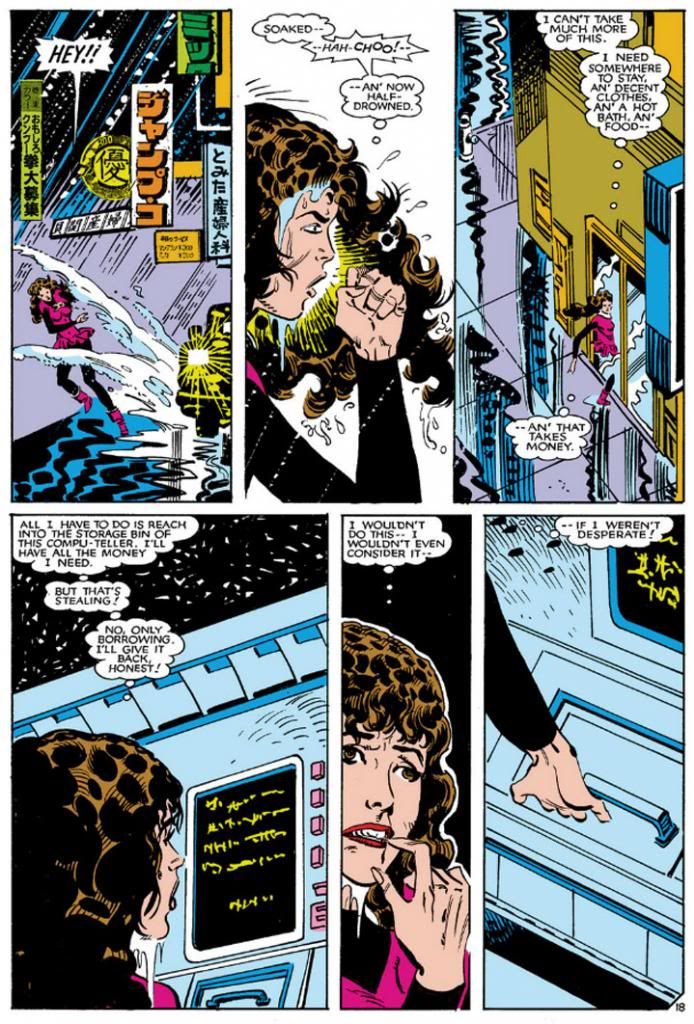
Claremont, Milgrom

It looks as though Milgrom uses some paste-up lettering here, possibly clipped from Japanese newspapers or magazines, or even actual photos of Tokyo.  That's a smart idea.  All that lettering would have been a pain for either him or the book's letterer to recreate, and they would have had to hire a translator to make sure they weren't just slapping down squiggles and squares or accidentally writing something rude.  Plus, Japanese comic book artists sometimes paste up entire pre-drawn backgrounds from special manga-tool artbooks, or use half-tone photographs.  Milgrom does the last, too, but I forgot to capture a screen image of it so you'll just have to take my word here.

Milgrom's version of a Japanese ATM is fun.  Since it's the 1980s, Kitty can't quite decide what to call it.  "Compu-teller," huh?  Now you find ATMs all over the place in Japan-- in banks, post offices, malls and convenience stores.  Inconveniently, some of them are not open 24 hours so sometimes you have to be prepared to wait until business hours the next day to withdraw money.  Imagine Kitty's dilemma here when she needs cash, it's after hours... and she doesn't have an ATM card or even a bank account.

Don't do it, Kitty!  Don't steal that money!  Not only is it illegal, but it's also not worth the guilty feelings and depression!

Milgrom waits until almost the end of the issue to give us a widescreen Tokyo cityscape.
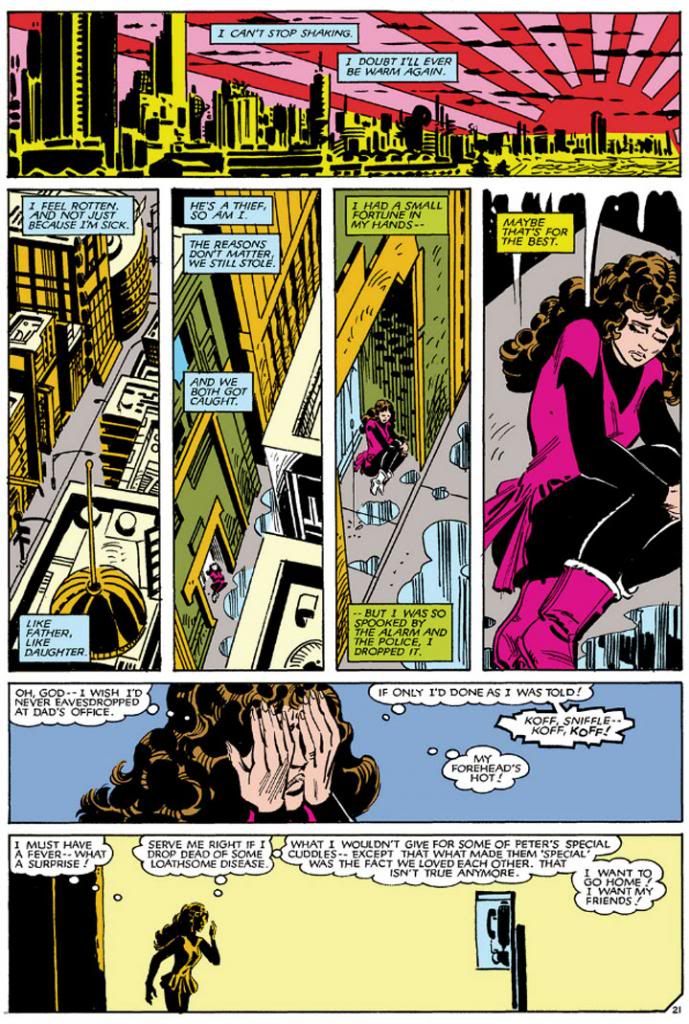
Claremont, Milgrom

Ah!  The "Rising Sun" motif!  How Buckaroo Banzai, baby!  Now we really know we're in 1980s Japan.  Milgrom enjoyed this effect so much he used it again in the fourth issue, rising behind a Japanese castle.  After a spectacular overview of the big city, Milgrom zooms in on a neighborhood, finding a sick and miserable Kitty huddles in a doorway.  And she hasn't even hit bottom yet.  Kitty's back alley/sidestreet hideaway in the second panel tier looks reasonable to me.  Granted I spend most of my time in the hip, upscale districts hobnobbing with trendsetting fashionistas like Chiaki Kuriyama and Kyary Pamyu Pamyu, but I've occasionally glanced at just these kinds of lowly city spaces as we've swept by in our motorcycle-escorted limousine motorcades.  That pay phone looks pretty generic, but a phone is a phone, I guess.

"I can't stop shaking.  I doubt I'll ever be warm again."  I get the feeling Chris Claremont visited Japan himself some winter prior to writing this.  Anyway, welcome to a country where few buildings feature insulation or central heating even now.  Think how rare that must have been almost thirty years ago when Kitty came.  These days, I pile on the layers starting with Uniqlo Heat-Tech and ending with a quilted hanten, and my wife and I run an electric heater in the mornings when we get up.  I still shiver all winter.  And Kitty spent the night outdoors with only her wet skater dress and some tights to protect her.  She also swam through a sewer pipe a few hours before.  No wonder she's in no mood to enjoy the sunrise.

The rest of the mini-series stages fights inside office buildings or on rooftops (Tokyo Tower makes a background appearance as Wolverine's friend and sometimes lover Yukio dangles an unfortunate oaf over the distant street) and martial arts training sessions at secluded castles right out of Akira Kurosawa flicks.  Claremont and Milgrom score high marks on the Japan scene-setting throughout, and while I wish they had kept things Kitty-centric and lighthearted, at least she comes out of it with a spiffy new costume (a softer version of a leather outfit she wears as part of a disguise later in the story), some boss fighting skills and a grown-up codename:  Shadowcat.

She does get an ugly New Wave haircut, though.

Sunday, December 29, 2013

Uncanny X-Men #118 (February 1979): Bad New Mutants Go To Japan!

Script: Chris Claremont; Art:  John Byrne and Ric Villamonte

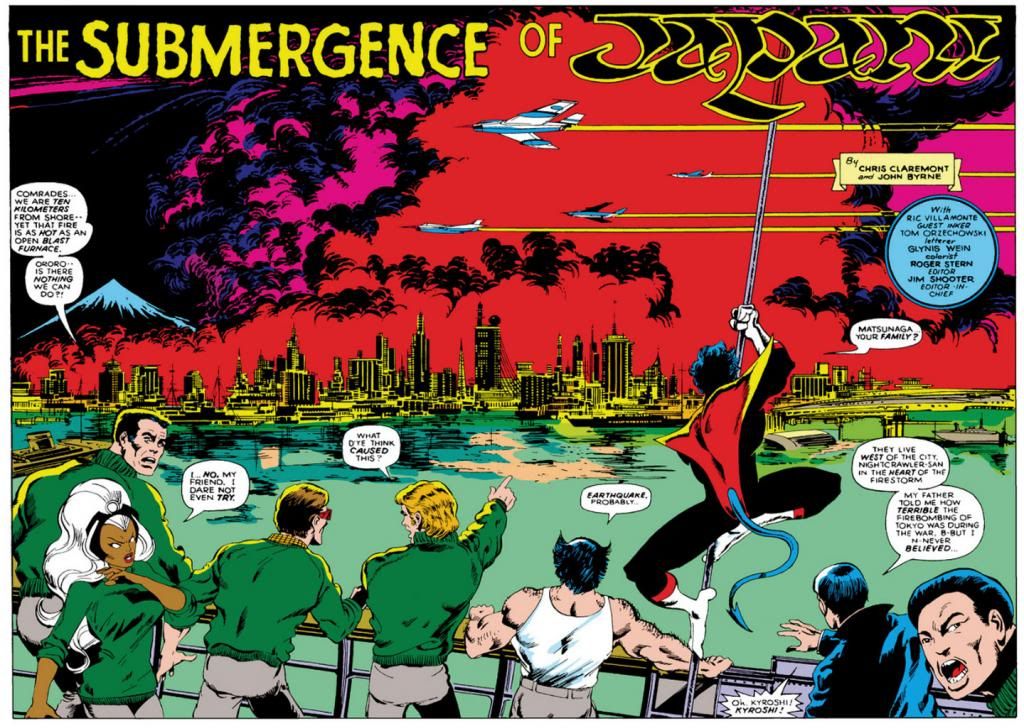
Enjoy this spectacular double-page spread from Uncanny X-Men #118 (February 1979), pencilled by John Byrne and inked by Ric Villamonte.  Maybe Terry Austin was off that month.  Agarashima, the city on fire here, is completely fictional but the visible architecture in Byrne's rendition is plausible enough.

Except for Mt. Fuji in the background.  An online source tells me Agarashima is in Miyagi prefecture, which is way up north along the eastern coast of Honshu.  Actually, that same source reports the city to be "300 kilometers north of Tokyo" and misspells the prefectural name as  "Miyago."  This may be a fictionalized flourish on Chris Claremont's part, freeing him to use his imagination and create a fanciful Marvelized Japan.

Fake Miyago or very real Miyagi, it's a likely location for a medium-sized port city, which is what Agarashima appears to be here.  Mt. Fuji is much farther west, so there's no way if this city resides 300 kilometers north of Tokyo you would see it looming that large in the background because it would be about 500 kilometers away.  I live in a city in the same prefecture as Mt. Fuji, about 116 kilometers away, and even when we can see it from here (it's visible from several vantage points on clear winter days when it's wearing its snow cap), it's only about the same size as my thumb.  So this is more than likely a little artistic license on Byrne's part as well.  We just need some cherry blossoms blown out to sea by the conflagration to achieve perfection.

So, with all that in mind (or better yet, out of it), let's just admire this glorious drawing, huh?  Unfortunately, after this image, there's not a lot of travelogue imagery in this story.  Much smaller panels, and a lot of the action confined to interiors.  By the next issue, the X-Men are on a volcanic island off the coast where they fight a pissed-off nutjob named Moses Magnum, who wants to sink Japan, so we're denied more John Byrne-drawn vistas of late 1970s Japan.  Think what he might have done with Tokyo.  I would love to have seen it.

You know, not on fire.

Friday, October 11, 2013

October is Spookey Month: And now a Spookey video!


As you know, Spookey is from my adopted hometown here in Japan and inspired this annual month-long Halloween celebration They're a lot better than my overwrought prose, right?

Thursday, February 14, 2013

Old comics on Comixology

Living in Japan, I don't have easy access to the latest American comics.  Japanese comics, yeah.  I can walk over to Lawson and buy tons of those.  But for American comics, I have to go all the way to Tokyo to visit Blister.  Fortunately, I don't buy a lot of new monthlies.  I do, however, buy lots of hardcovers of things like Nexus, Creepy, Eerie and softcovers of things like Swamp Thing, New Mutants, Uncanny X-Men and the like.  For those, I go through Amazon.jp.  Very fast and it's fun to get boxes even if I know what's in them.  The delivery guy and I have a great relationship, too.

In fact, the last time I ordered something from Amazon.jp, he recognized my name and brought it to the wrong apartment-- my old place, which is right across the street from my new place.  He thought he was doing me a snappy favor.  Poor guy was very apologetic once we got things straightened out.

Anyway, the point is, if you live in Japan, unless you happen to be in a location convenient to Blister, digital comics are your best bet for keeping up with the American sequential world.  Comixology carries almost everything.  I've been feeding my Walking Dead habit there, for example.  It's not perfect.  You don't actually own the comics even though you pay the same amount someone would if he or she went to a physical store and bought a physical copy there.  You're paying $1.99, $2.99, $3.99 or more for simply a license to read the comic on your computer (via Comixology's reader, which has its own positives and negatives), or on your iPhone (which is pretty cool if you're waiting for a doctor or a bus).  I won't kid you and say that concept doesn't suck.  If I pay for something, I want to own it outright, without limitations.

Well, I suppose I could order print copies online from other sources, but then I'd have to wait two weeks or more to read what you can read on the same day it hits the shelves.  Like I said, I live in Japan.  These are just little things I've weighed and my conclusion is Comixology is the way for me to go.  Or Dark Horse Digital, which is similar but exclusive to Dark Horse comics.  These are the ways I buy my comics.

Still, I love to read the old stuff more than the new stuff...  Well, Comixology can help you out there, too.  DC and Marvel are constantly adding their back catalog to Comixology.  It seems they focus a lot on back issues related to events in current titles so they can bundle them all together in special sales events meant to increase interest in their current product, but they're bulking up some of the ancient books I like to talk about here.

Let's see--  just recently I bought a bunch of the universe-spawning Stan Lee/Jack Kirby Fantastic Four, the complete first volume of Swamp Thing (twenty-four issues featuring Len Wein, Bernie Wrightson and Nestor Redondo, among others), the first two years or so of the Alan Moore version, the first seven issues of New Mutants plus the original Marvel Graphic Novel (a bargain at $3.99), some 1960s-vintage Teen Titans, two issues of the first volume of X-Men drawn by Jim Steranko, some Neal Adams Batman, John Byrne's Next Men, plus a lot of random stuff I can't remember right now because I'm at work and not at home where I can read my comics.  Many of these I own in collected editions and the like, but now I have a nice collection of really sweet old comics I can talk about here.

So expect a lot of Swamp Thing, New Mutants and Teen Titans coming your way.  And a lot of Jack Kirby.  Which I will analyze, deconstruct, poke affectionate fun at and generally mess around with.

You know, same crap as I always do here.  Only shinier.

Sunday, December 23, 2012

Sorry I didn't get to those Isis posts!

The week before winter vacation proved busier than I anticipated, with longer days.  Circumstances didn't leave much time for watching The Secrets of Isis, much less blogging about it.  I'm on vacation now so once again let me offer you a hollow promise of fun and frivolity to come.  But it will have to wait.  I'm about to spend a few days in Tokyo.  I'll do some comic book buying while I'm there, but most of what I find will be posted on my new blog about being an American comic book fan in Japan.  That's where I plan to talk about the latest books and news, leaving this blog for the good old stuff we all love so much.  Jack Kirby, Alex Toth, Al Williamson, Dani Moonstar, classic Marvel, Dell and EC and that sort of thing.

Happy Holidays, True Believers!

Wednesday, October 31, 2012

October is Spookey Month: Happy Halloween! I'm out of Spookey videos, you're sick of my pretentious-alternating-with-silly writing style so here are some fun horror shorts instead!

Remember that horrible clown doll from Poltergeist? You know the one I mean. This story features his trans-Pacific pen pal:


The price of these canteloupes is pretty frightening:


Here's a hard-working guy trying to be a good father. Too bad he can't get it the right way 'round:


Don't hold your breath waiting for Tommy Lee Jones and Will Smith to show up. By the way, Tommy Lee Jones is the face of Boss coffee here:


And last but far from least:


And that is that!  Enjoy your night of horrors, then join us here in November as I once again start hoppin' down the Cindy Lee trail with more Secrets of Isis reviews starring Cindy Lee.  I'm going to review every single one and toss in more fun stuff from the DC comic as well.

October is Spookey Month: Let Doug Moench and Richard Corben show you how to trick-or-treat!


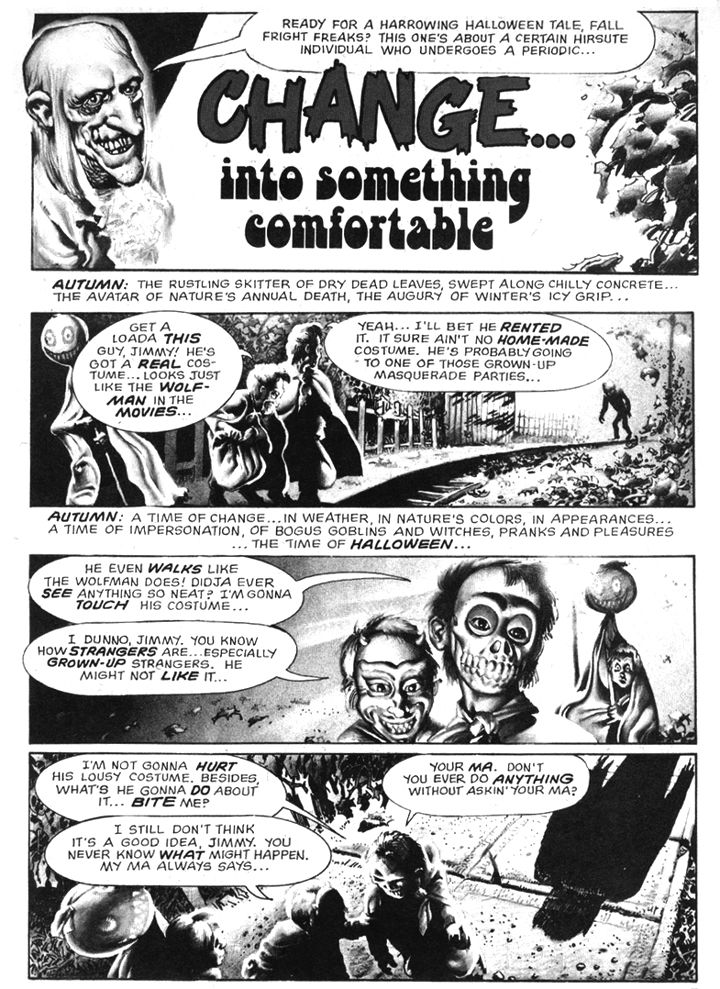
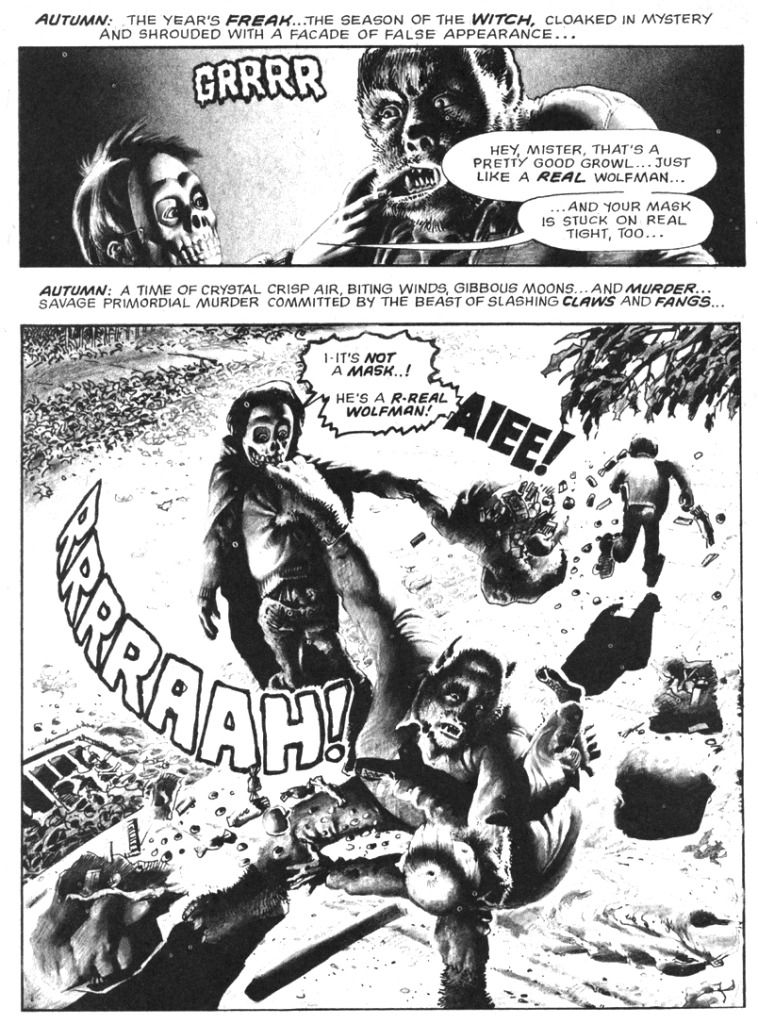
Yes, Halloween is a fun holiday, but you should exercise at least a little caution when out trick-or-treating.  Go in a group, wear a costume with reflective tape so motorists can spot you, go only to well-lit houses.  And most importantly-- don't pull on a werewolf's lip.  These are a few simple safety tips brought to you by Doug Moench and Richard Corben in their horror-comedy classic, "Change... into Something Comfortable," which appeared in Creepy #58 (December 1973), a "special Halloween horror issue" (so it says right there on the cover).  While I didn't particulary enjoy "The Slipped Mickey Click-Flick," I'm a huge fan of this little seasonal-flavored gem.

It starts with a real werewolf ripping some smart ass kids to shreds and ends with a sweet twist I find both irresistible and hilarious.  I mean if you've ever wondered what creatures of the night disguise themselves as on Halloween, here's your chance to find out.  "Comfortable" is sort of a companion piece to Corben's even more hilarious "Lycanklutz" from Creepy #56 (September 1973).  That earlier full-color romp features a somewhat luckier werewolf in a medieval setting with some surprisingly anachronistic products available for sale.  By contrast, our contemporary, kid-killing monster in "Comfortable" strays into EC territory with tragic results.  I could have hit you with "Lycanklutz," but this one is all about Halloween and disguises and has those melodramatic Moench narrative captions.  You can read it in the Dark Horse Creepy Archive Volume Twelve.

Come to think of it, you can read them both in that book.

Tuesday, October 30, 2012

October is Spookey Month: Remember when Swamp Thing visited the Winchester Mystery House?

"Bang.  Bang.  Bang."

You don't remember?  How about the time Swamp Thing visited the Cambridge Mystery House, the DC universe version of the same place?  Rings a bell, huh?  Bangs a nail.  Hammers and all that.  The Winchester Mystery House is a fascinating place, the life's work of Sarah Winchester, widow of William Winchester and heiress to the Winchester Repeating Arms fortune.  Somehow she took it in her head spirits would kill her if she ever completed the mansion where she lived, so construction went on around the clock for nearly 38 years until Mrs. Winchester's death in 1924.  Mrs. Winchester was a little eccentric (according to the Winchester House's official website, some of her employees actually thought she herself had supernatural powers), obsessed with the number 13, and her house is equally... er... original.  Stairs to nowhere, fake bathrooms, windows on the inside, liberal use of redwood because Mrs. Winchester preferred it-- although it all had to be stained or painted to look like some other kind of wood because she hated its appearance.  Given the house's origins and bizarre interior, it's no wonder the Winchester Mystery House has a reputation as a haunted mansion.

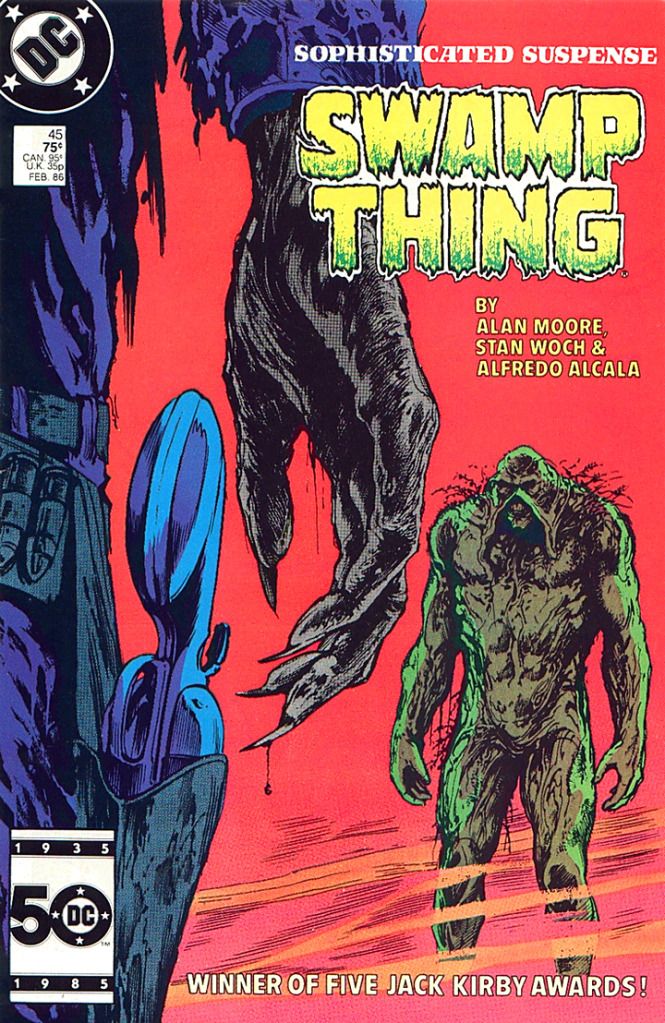
Alan Moore puts the Winchester lore to good use in "Ghost Dance" from Swamp Thing #45 (February 1986) with the help of some evocative art by Stan Woch and Alfredo Alcala.  A group of friends enter the dilapidated Cambridge House for a laugh while the reedy, Howard Sprague-with-red-hair-looking one (he proves to be as cuckolded as Jack Dodson's character in The Getaway, as well) explains the backstory, which Moore takes directly from the Winchester House.  One character even namechecks the real-life inspiration in case you had any doubts, and the NRA bumper sticker displayed on their car provides a visual clue that we're in for a lecture wrapped inside a horror yarn, one with obvious intent and an anti-gun-- or at least, anti-gun violence-- point of view, but a touch more subtle than the "Nuke-Face" environmental tale from Swamp Thing #35 and #36 (April and May 1985) with its pages full of newspaper-based collages.

This was during one of my favorite Swamp Thing story arcs, in which John Constantine, the British mystic based on Sting, takes Swamp Thing around the world to stop a rising tide of supernatural events culminating in... you guessed it... the end of the world.  Moore uses this premise to explore horror mythology, but with his characteristic brilliant improvisations on familiar material.  Swamp Thing fights vampires, but they're underwater.  He tangles with a werewolf, but it's a woman and a commentary on our patriarchal society.  In this issue, Constantine has Swamp Thing facing down the Cambridge ghosts.

And just what are these ghosts?  Apparently, they're everyone in North America who ever died from a bullet fired from a gun or rifle manufactured by Cambridge Arms.  Dead cowboys blast away at each other in the seance room (Mrs. Winchester would approve of its thirteen Victorian fireplaces), bullets whittling them both down to next to nothing while their battle rages all night.  Little girls, murdered on Christmas Day by their father, walk innocently through the spectral carnage, their wounds like red ribbons in their hair.  Buffalo stampede from a free-standing wardrobe, apparently all the way from Gunpowder Narnia.  Cowards linger in the kitchens, shamed, faces hidden in hands, each back stamped with the red badge of fear.  One especially tragic note comes when the narration points out what percentage of the ghosts are Native Americans.

"Ghost Dance" is a melancholy look at our capacity for violence and the tool that truly built our modern American society even more so than the car, the train or the rocket to the moon, as evidenced by Moore's repetition of the phrase, "The sound of hammers must never stop," fraught with double meaning.  Guns, the love of guns and gun violence are so engrained in the American psyche, we can't even have a rational discussion about them no matter how many bodies pile up.  Moore, though this fiction, might argue the victims wind up in a Mystery House of the American soul, a haunted mansion we're all still guiltily building just like Sarah Winchester and her fictional analogue Amy Cambridge, even as the sound of hammers continues to ring from coast to coast.

They have never stopped.

October is Spookey Month: Anton Arcane's Un-Men enjoy the refreshing taste of 7 Up, the Uncola

And in the interest of complete disclosure, I must admit I do, as well.  And why not?  7 Up is crisply delicious.  When one tires of those everyday, commonplace colas, it's pleasing to do what the Un-Men do and indulge one's palate with 7 Up, the Uncola, which isn't made using cola nuts.  7 Up is made using un-cola nuts:  lemons and limes.  So in this, the Un-Men and I are completely in agreement.  In all other things, however...

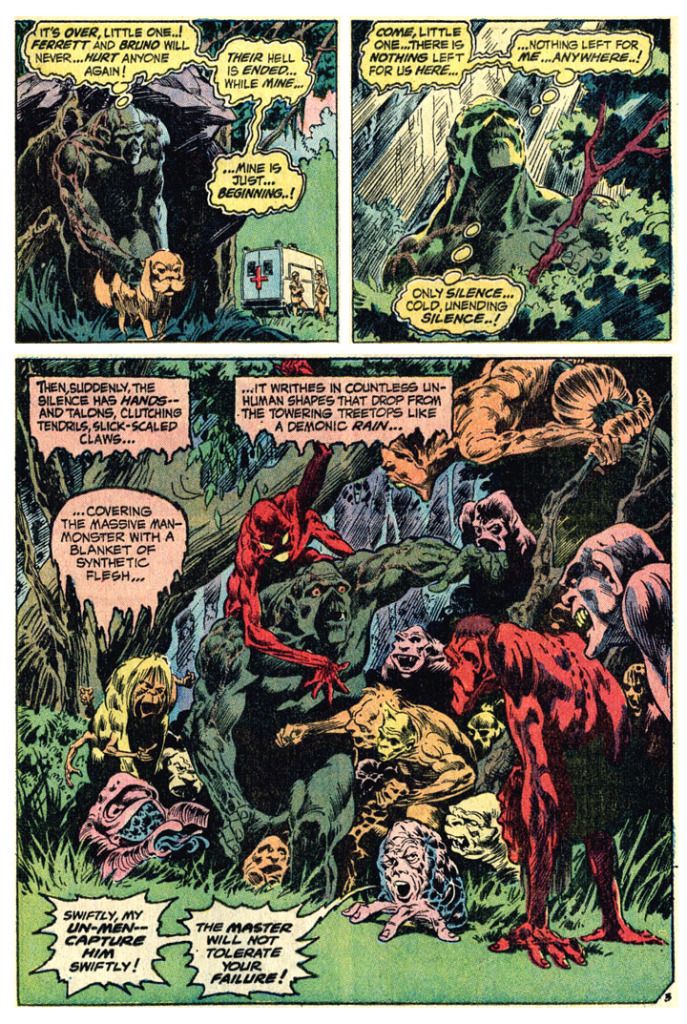
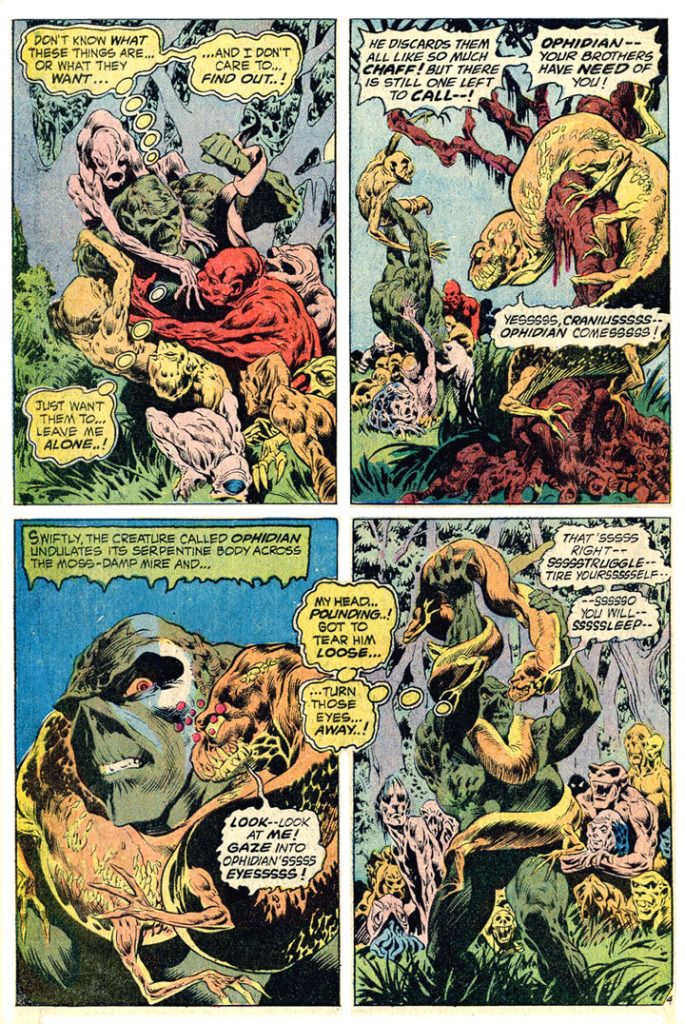
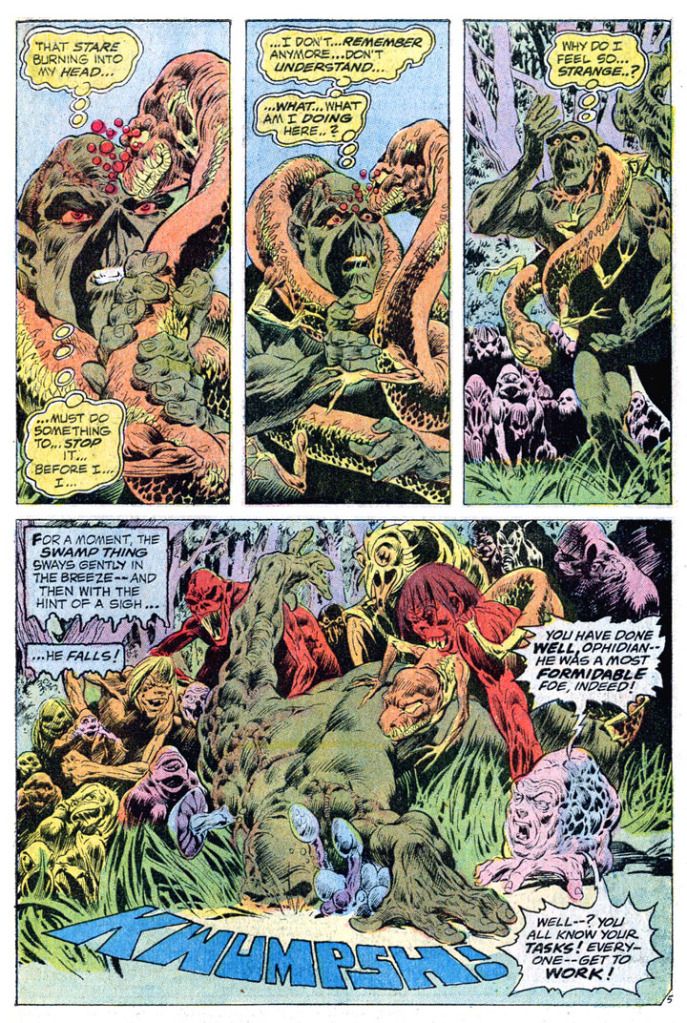
What kind of man deliberately creates monstrosities?  When Dr. Frankenstein attempted to glean the secrets of life, he meant to produce beauty but failed.  Anton Arcane, on the other hand, perversely sets out to make hideous things he then cruelly dubs the "Un-Men."  It's both a parody of the creation story-- God made perfection in 6 days, then rested-- and a misuse of science to tickle the fancy of an egotistical degenerate who wants to achieve immortality.  To this end, Arcane sends the Un-Men to the Louisiana bayou country to capture Alec Holland, who has recently become the Swamp Thing.


Marvelous!  Absolutely marvelous!  Just try making something like that out of a cola nut!  As we see in these exquisitely rendered Bernie Wrightson pages from "The Man Who Wanted Forever" in Swamp Thing #2 (January 1973), they succeed, at least temporarily.  But even this small achievement leaves the Un-Men lost in a world that never desired them.  In some ways, though, they are our children.  The unwanted, the living embodiment of our worst creative impulses, our vanity in thinking we might better nature itself, our ambivalent response to mortality.  In their nakedness, they are as newborns.  In their cruelty, they reflect their treatment at the hands of their twisted creator, as we do with our own petty crimes and misdemeanors.  Neither men nor women, they could only in the end become monsters.


Holland himself, his soul encased in plant matter and mud, provides a further tragic note.  This is before Alan Moore re-created Swamp Thing to suit his own needs-- the creature is not a transformed human, but rather a consciousness mistaken in its belief in that identity; it's a brilliant bit of revisionist storytelling that freed Swamp Thing from his ongoing quest to regain humanity and allowed Moore to take the tales along a more epic path.  But for our purposes-- and those of writer Len Wein-- this is definitely the soul of poor Holland trapped within a hulking, plant-based body, isolated not only from the humanity he desperately hopes to reclaim but also human society.  Lost in the night world of his new life, Holland now has more in common with the Un-Men than he does with Matt Cable, the human government agent searching for Swamp Thing just a few short miles away geographically, but a universe apart existentially.  Holland is also an un-man.

Now, let's all share the delicious taste of 7 Up.  The Uncola.  Why, it's even prettier than a cola.  Nuttier than a cola, actually!  HAHAHAHAHAHA!

Monday, October 15, 2012

October is Spookey Month: Few things in this world are as perfect as a Hellboy story written and drawn by Mike Mignola

Comicbook.com has a fun little interview with Mike Mignola where he talks about a variety of things including the possibility of Hellboy 3.  It seems the third installment is dependent on Mignola himself raising about $150 million.

Actually, I offered to pay for the whole thing myself if they'll write me in as Hellboy's ne'er do well brother-in-law.  Or sister-in-law.  Hell, boy, I ain't picky.  As long as this movie gets made, and as long as we keep getting Hellboy comics from Mignola and all the brilliant people he chooses to collaborate with.  Yeah, fan-type gushing.  It's been a hard day.  Just trying to end it on a positive note.

Speaking of positive things-- I was a little worried Spookey might have split, but they recently posted a message that they're still together and plan to play again in the near future.  Some sort of unspecified problem stands in the way, but I'm sure they'll lick it and get back to rocking.  It's a dream of mine to finally see them live!  In the meantime, here's another video we've probably seen before but we're definitely going to see again because it's great:

Saturday, October 13, 2012

October is Spookey Month: "The Coffin of Dracula"

Dracula didn't really cry out for a sequel, but for over a century now Bram Stoker's vampire character has proven so appealing writers have been unable to leave the poor, exhausted bastard  undead, the end result being he's so ingrained in our pop culture his image has even been used to sell chocolatey breakfast cereal.  You can imagine, if you will, his staked, beheaded bones lying in his coffin still somewhere in the mountains of Transylvania, just as he was at the end of the original novel.  Or you allow any of the later incarnations where the vampire comes back to unlife into your personal Dracula canon.  Or you can be like me and just separate them all and not really care if one is a continuation or a side story or parody or whatever.

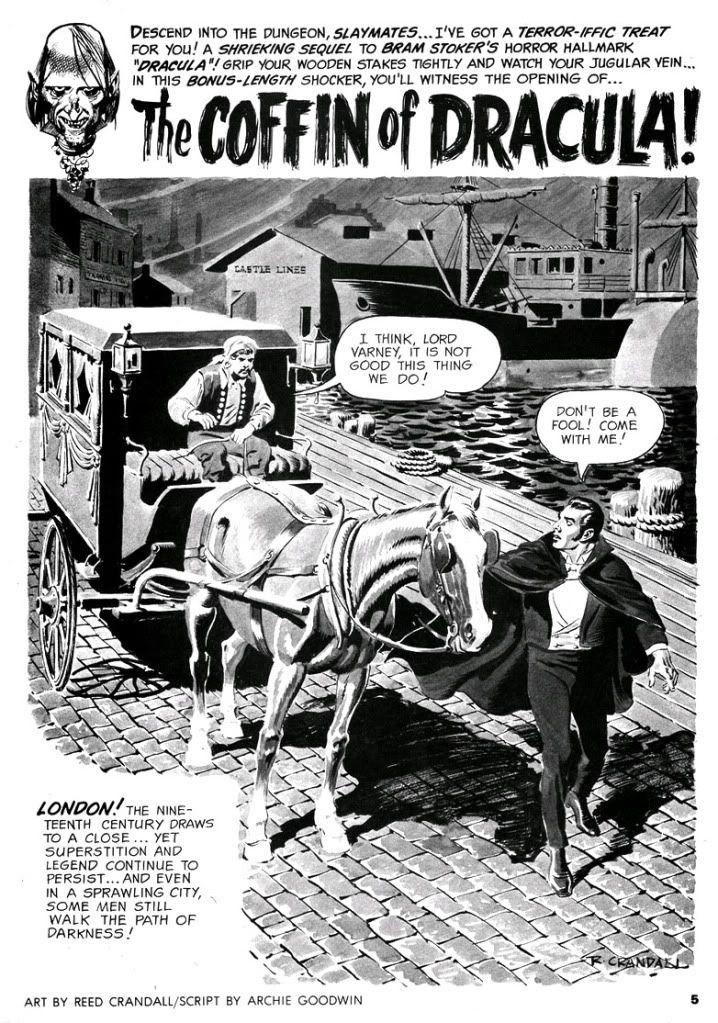
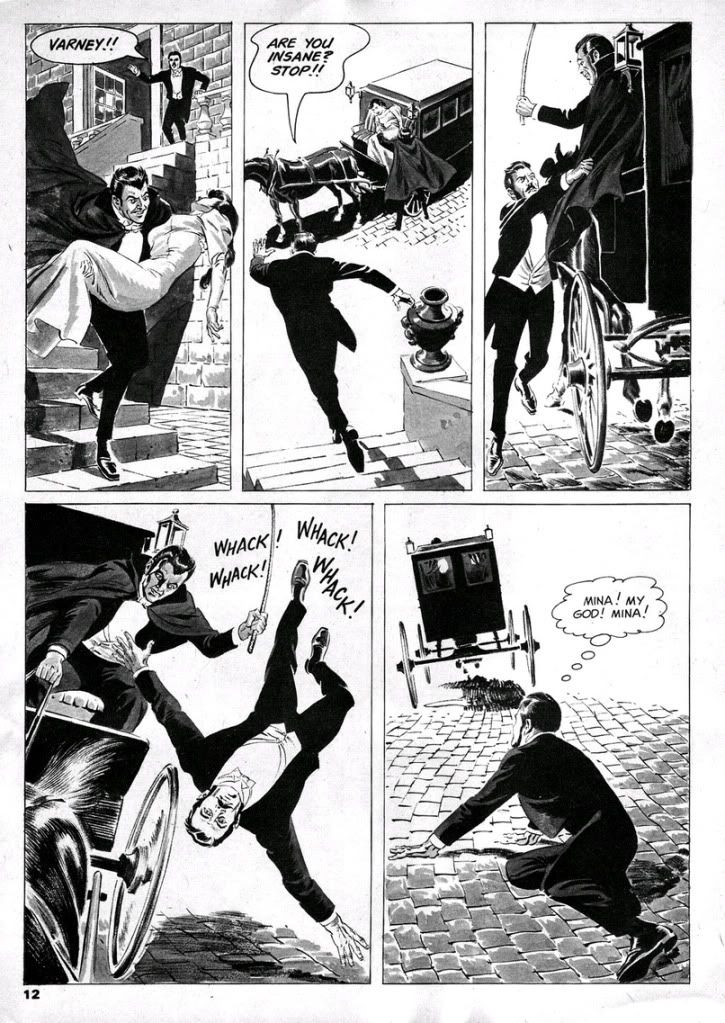
For Warren's Creepy magazine, Archie Goodwin and Reed Crandall created a two-part sequel centering on one Lord Varney (his name borrowed from one of Dracula's vampire antecedents) and his stupid misadventures with Dracula's coffin.  Not that the story is stupid.  It's not exactly a classic-- although Warren thought highly enough of it to reprint it in one of their best-of issues-- but Varney's the idiot here.  What kind of fool buys Dracula's coffin and climbs into it?  It's a bonehead move by an arrogant jackass and actually one of the most bizarre ways I've yet seen of contracting the dread disease we know as gingivitis.  I mean, vampirism.

Seriously, if you must become a vampire, have the common decency to drink the blood of one of the undead.  Get your own coffin.  Sharing coffins isn't sanitary, anyway.  And it's not true vampirism.  It's more like possession at first.  Varney can't even get that right.  Man, I hate this Varney guy!


Part one clawed its way out of the crypt in time to anchor Creepy #8 (April 196), while part two coalesced from swirling ash in #9 (June 1966).  Both segments are gorgeously illustrated by Crandall at the height of his artistic powers, "Coffin" plays like an overly abridged adaptation of the Stoker original, with Dracula more a presence than a character.  Dopey, delusional Varney kidnaps Mina, Jonathan, van Helsing and Dr. Steward pursue him back to Whitby, one of the central settings in the novel and where Dracula began his reign of terror by vamping virginal young aristocrat Lucy Westenra.  The heroes hope to kill a vampire left over from the novel and prevent Varney from truly becoming one of them.  After that, they plan to save Mina.  The plan doesn't sit too well with Harker, but he's too dim to argue with van Helsing's logic.

There's some decent violence and fully-rendered vampire-staking (tastefully sans outright gore), but Varney is a vamp-come-lately, a pale imitation of the great one and lacks charisma.  Once fully vampirized, he doesn't even have any dialogue.  Ultimately, gorgeous art or not, the story is mainly mild fun for fans of books like Alan Moore's League of Extraordinary Gentlemen, itself an extension of Dracula through the character Mina.  If you finished Dracula and hoped for more story, then here's your chance and you don't have to know 19th and 20th century literary references and pop culture to fully appreciate it.


At least Moore picked up on the nascent feminist aspects of Mina, given that ultimate compliment by van Helsing in the book of having a "man's brain."  The novel's Mina is a schoolteacher with a strong empiricist bias before she encounters the supernatural.  Moore really ran with the notion and made her a lot steelier than Stoker's Mina, but Goodwin goes the opposite route and reduces Mina to your standard damsel in distress, kind of a dishrag.  She barely has any dialogue, and none at all in the second part where we only see her unconscious before we follow Harker as he pursues Varney.

Well, Stoker puts Mina in jeopardy and in need of rescuing by men as well, but she does get in a few shots of her own, and because it's an epistolary novel, she at least had the privilege of speaking for herself.  Goodwin shifts his focus exclusively to those menfolk, here rendered as a a dull crew of stick-up-their-asses types.  When Varney kidnaps Mina, she disappears for the bulk of the story, which diminishes her plight.  Goodwin does a wonderful job of recreating Abraham van Helsing's stilted Continental dialogue, though.  Van Helsing is like a Dutch Yoda.  "Friend Jonathan," indeed.


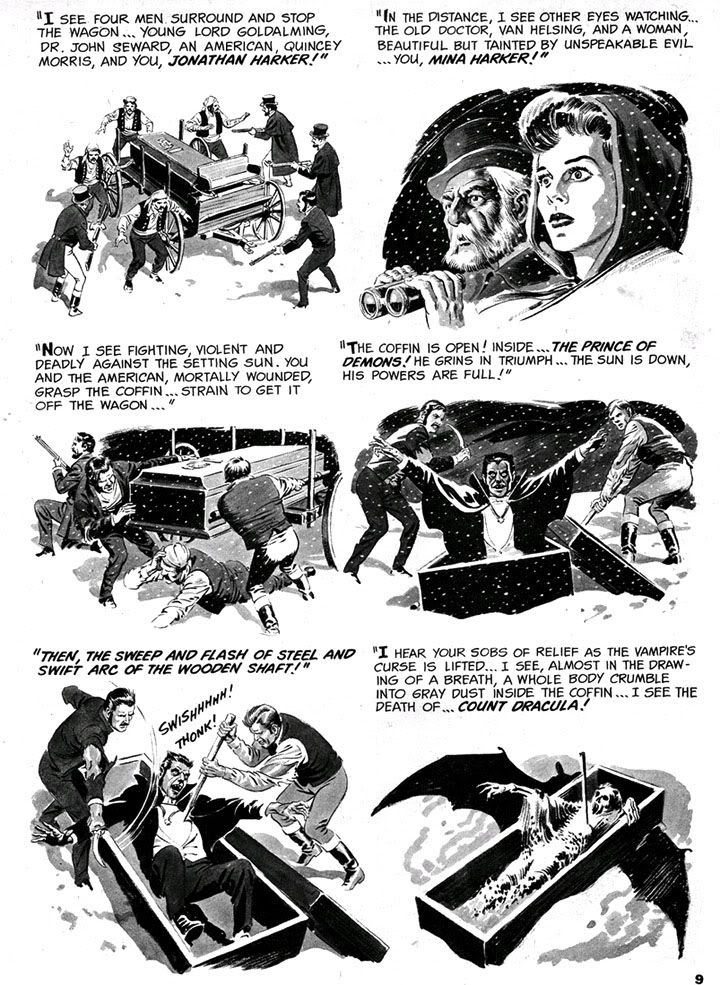
 My favorite page is the collage-like recapitulation of Dracula's climax.  I wish Goodwin and Crandall had done a full-fledged adaption of Stoker rather than this rehash, pretty as it is.

Poor Reed Crandall.  While I immediately loved what I saw when I encountered his color jobs for EC in those early 1990s Gladstone reprints (I sorely miss those), his black and white art in the Creepy archives books from Dark Horse is a revelation.  I can only describe it as beautiful, like those illustrated plates you encounter in ancient, heavy tomes from the darker corners of a library collection.  Finely proportioned and posed figures, beautiful contour lines and modeling, depth of field, absolute control and mastery of individual panels and the page as a whole.  And yet he seems to have been in competition with Wally Wood for "most tragic former EC great."  Alcohol dependency and failing eyesight robbed him of his talent and sent his output into a shockingly steep decline in quality, so much so his last few jobs seem more the work of a talented amateur trying to do a Crandall impression.  Reading them is like viewing a slow motion film of a ship sinking with a man still visible on the deck.  On the other hand, he did leave behind an impressive body of work, especially in these early issues of Creepy.

And now it's time for one of my all-time favorite videos starring Spookey:


Tuesday, October 9, 2012

October is Spookey Month: "Hellboy," yet another Halloween reading recommendation

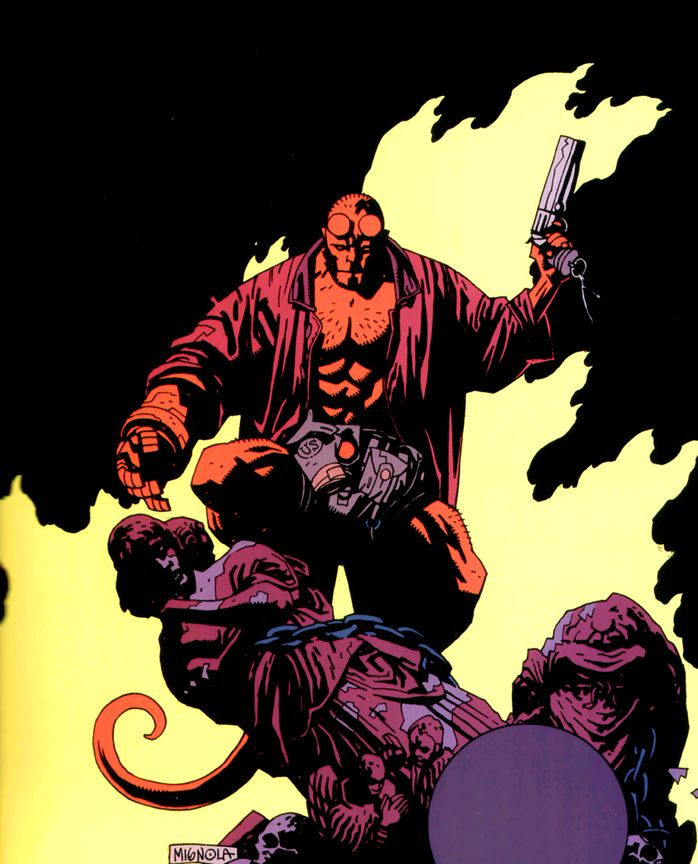
Mike Mignola (1994)
Can you believe Mike Mignola's Hellboy has been around for almost 20 years?  Dark Horse published the debut of four-issue miniseries Hellboy:  Seed of Destruction way back in March, 1994.  In this modest little monster-fighting story artist-creator Mike Mignola and scripter John Byrne introduced us to one Hellboy, the burly half-demon with sawed-off horns and a blue collar approach to the supernatural.  Gruff and something of a smart-ass, Hellboy would just wade in and punch the terror right out of whatever monster, ghost or alien turned up while his buddies at the BPRD (Bureau of Paranormal Research and Defense, the government agency Hellboy works for and housed by) would handle the brain work and clean up afterwards.

After two decades and so many miniseries and titles it can be hard to know where to start with Hellboy.  It doesn't help matters Mignola's chronology jumped around depending on whatever inspired him to write and draw a particular story.  In one book, Hellboy could be in Ireland in 1959 or 1961, then show up in Japan in 1967 for the next, then guest star in an issue of The Goon telling the story about Japan.  Or something like that.  Working it out this way, Mignola and his later collaborators have built a massive narrative spanning decades, continents and even the galaxy, with characters dying and other joining, menaces burbling up from the background, others springing full-blown into the foreground plot.

From his earliest days fighting un-frozen Nazis and their spiritual leader Rasputin-- yes, the historical Rasputin, the one Prince Felix Yusupov, Grand Duke Dmitri Pavlovich and some concerned friends poisoned, shot, beat and drowned in 1916-- to various creatures from European myth, with an underpinning of H.P. Lovecraft, Hellboy now inhabits a sharply defined world with all kinds of incidents and epics.  So how do you jump into this world?

Sorry, I'm not much help there.  I'm not a continuity junkie or obsessed with minutia.  All I ask is whatever story I'm reading to be internally consistent.  And I tend to prefer Mignola's moody, sometimes peculiarly random one-offs with Hellboy himself to the longer apocalyptic tales generally starring the BPRD cast (althought these are good, too).  That's why I say, "Don't worry about a reading order with Hellboy."  My advice is just buy the Seed of Destruction collection and start there.  Move on to whatever story catches your fancy.

In short, you must do as you see fit.

For me, Hellboy pushes a number of buttons.  Let's examine four of them in detail.  Mignola's art is the first.  I love bold, heavily stylized art, the kind where you say, "Now there's a nice drawing, just the essentials" rather than take in something that looks like it was traced from a still frame out of a movie, or a swimsuit magazine.  Mignola's work has become more essentialist and geometrical over time and that's my bag.

The second is my love of the weird and fantastic.  Since earliest childhood, I've read books about cryptid animals, UFOs, alternate dimensions, the Bermuda Triangle, ghosts, urban legends and the like.  I've always loved stories where teams of people investigate the unknown and come to grief, from Kolchak to Venkman, Stantz, Spengler and Zeddmore to Mulder and Scully to Hellboy and company.  I'm a friend to them all.

Folklore and myth make the third.  Mignola draws heavily on European traditions and Lovecraft, but he has broken with this on a few memorable occasions.  Two are team-ups with horror art legend Richard Corben-- Makoma, informed by African folktales and The Crooked Man, set in the Appalachian Mountains of the good ol' U.S. of A.  Both are lovely and strange.  How can anyone not read these?

And the fourth is a specific story.  As an ex-pat living in Japan, "Heads," set in Kyoto, is a lot of fun in a very personal way.  Mignola claims in his introduction to the story not to know a whole lot about Japan.  Yeah, but his art, as influenced by Alphonse Mucha, who himself drew on Japanese ukiyo-e and their extremely linear forms as it is by European woodcuts, Jack Kirby or P. Craig Russell, makes him particularly apt for this kind of material.  I wish Hellboy would revisit Japan sometime in the near future.  If Mignola or any of his collaborators need some first hand experience and reference-- or just want to hang out while doing a research trip-- well, now, I know just the blogger to volunteer his services!

Saturday, October 6, 2012

October is Spookey Month: "Uzumaki," another Halloween reading recommendation!

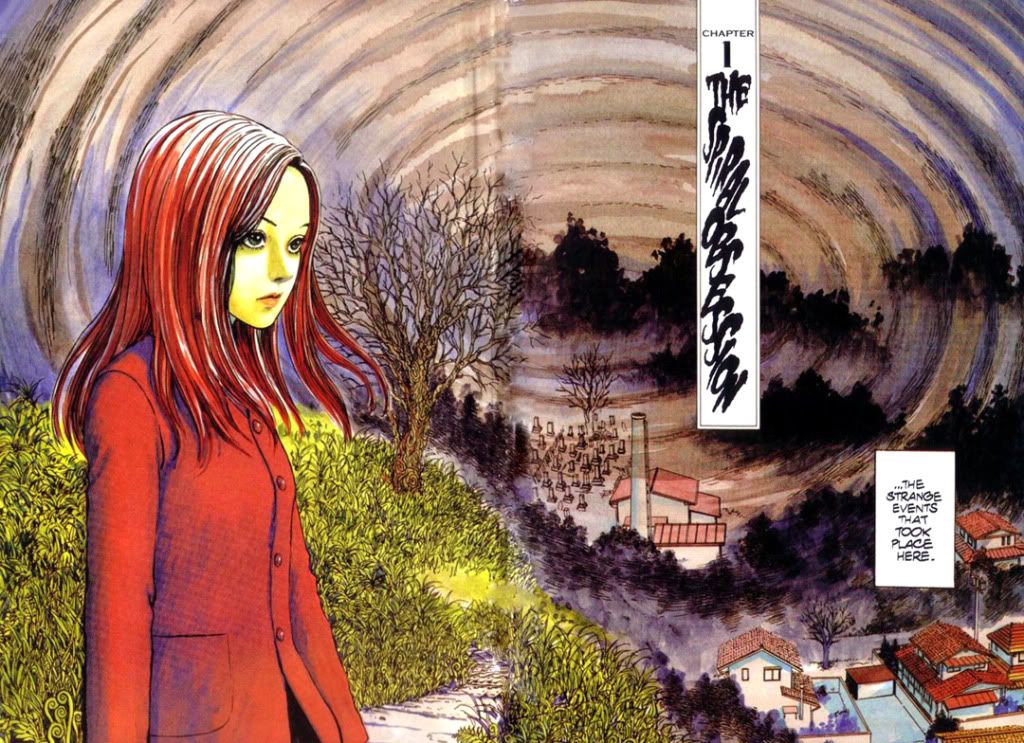
Junji Ito, Uzumaki (1998-9)
I don’t know why Junji Ito hasn’t caught on with manga fans in the Americas.  Both Viz Media and Dark Horse Comics have released very nice books collecting Ito’s work, but they don’t seem to have made much of an impact there as far as comics culture goes.  I think he should be mentioned in the same breath as Mike Mignola, but he seems largely a cultish figure, and somewhat elusive.  Dark Horse has two Museum of Terror volumes (the third seems to be out of print) and Viz offers Uzumaki, of courseGyo is worth a read, although I didn't particularly care for it.  It's about dead fish and a killer odor, neither of which inspires much interest in me.  But Museum features Ito's most well-known creation-- Tomie, the beautiful, unkillable school girl-- and inspired a hit-and-miss movie series that seems never to to die completely, just like Tomie herself.  Uzumaki also became a film, a severely truncated version with a hugely disappointing ending and played largely for laughs.  A great deal of Ito's more recent short stories and other tales-- many of which are absolutely brilliant-- haven't been made available in English other than through "scanlations."

What is Ito like in his every day life?  Probably just another hard-working mangaka.  A regular kind of guy who puts in long hours at the drawing table.  After all, before he began his comics career and started creating chills and thrills, he was a dental technician.  But in his stories, the man reveals a seriously twisted genius.  His characters inhabit a universe ruled by dream logic, by malicious forces acting either arbitrarily or for capricious reasons beyond our human understanding.  Whatever it is, it's a dark, pitiless place with little hope for escape or redemption.  Ito's work is true horror and the man doesn't really have any peers, because no one working in the genre can touch him.  

While I was an imaginative little kid who often spent sleepless nights after reading even the mildest of DC ghost stories, as an adult I’m pretty hard-boiled when it comes to printed horror.  Uzumaki, Ito’s masterpiece, gave me a serious case of the creeps.  It made my stomach churn.  Even today, years after I initially read Uzumaki, moments from the story recur in my mind, like childhood nightmares recalled time and again in broad daylight, in the most unexpected of places.  Writing this, I suddenly feel it faintly in my nervous system, on my skin, as if it Ito himself tattooed itself there, indelible.  As the old idiom goes, it's as if someone walked on my grave.

Kirie Goshima is a normal high school girl, another of Ito’s fragile, doll-like female protagonists.  She lives in Kurozu-cho ("Black Vinegar Town"), a seaside town like many here in Japan.  Sea for one border, mountains for another.  Kurozu-cho is a little cut off from the rest of Japan thanks to geography, and it has a mysterious past.  Little by little—a whirlwind here, a guy obsessed with swirling his miso soup there—Kirie discovers to her growing horror an ever-pervasive influence by the spiral.  No ghosts, no monsters, just a simple shape curving in on itself.  Kirie‘s boyfriend Shuichi has already noticed things not quite normal and is coming unraveled.  Kind of like a thread from a blanket that curls in your fingers as you try to pluck it.

And with that simple set-up, life for the two luckless teens increasingly spirals out of control.  Ito tells the story in vignettes, from Kirie’s point of view; Shuichi has introduced the girl into a world where literally anything can be perverted by the pernicious influence of the spiral.  After a couple of early chapters, each of which tends to follow a formula of developing a premise, developing it, then delivering a disgusting punchline, you begin to anticipate what the spiral will do next.  The results still shock.

Like diseased mushrooms, events grow inexorably out of each other and transformations and mutations abound.  As the spriral closes in, Kurozu-cho darkens to a place where a girl with a crescent-shaped scar on her forehead becomes a monstrous entity, a boy obsessed with pop-up surprise scares becomes a ruined jack-in-the-box figure and even the joy of birth becomes the stuff of nightmares.  The signal transformation involves a particularly slow-moving classmate of Kirie’s.  His physical and mental changes are off-putting enough by themselves, but just when you think you’ve reached the point where you can somewhat live with the memories (or at least resume your normal diet), they maddeningly recur to other characters until the situation escalates to what is arguably cannibalism—or something for which we’ll have to invent a completely new word for gastronomic crimes against humanity.  Kirie pursues these rapidly proliferating horrors towards their twisted center, where the story takes on Lovecraftian proportions and escape may prove impossible.

These are stories to read in the daytime.  If you can find them, that is.  But be warned—Ito does not flinch from reshaping his characters to suit the spiral’s whims and a lot of the imagery is extremely disturbing.  Not for tender psyches or weak constitutions.  Oh, and don't eat escargot before you read it.

Friday, October 5, 2012

October is Spookey Month: Merry Marvel monster monologue!

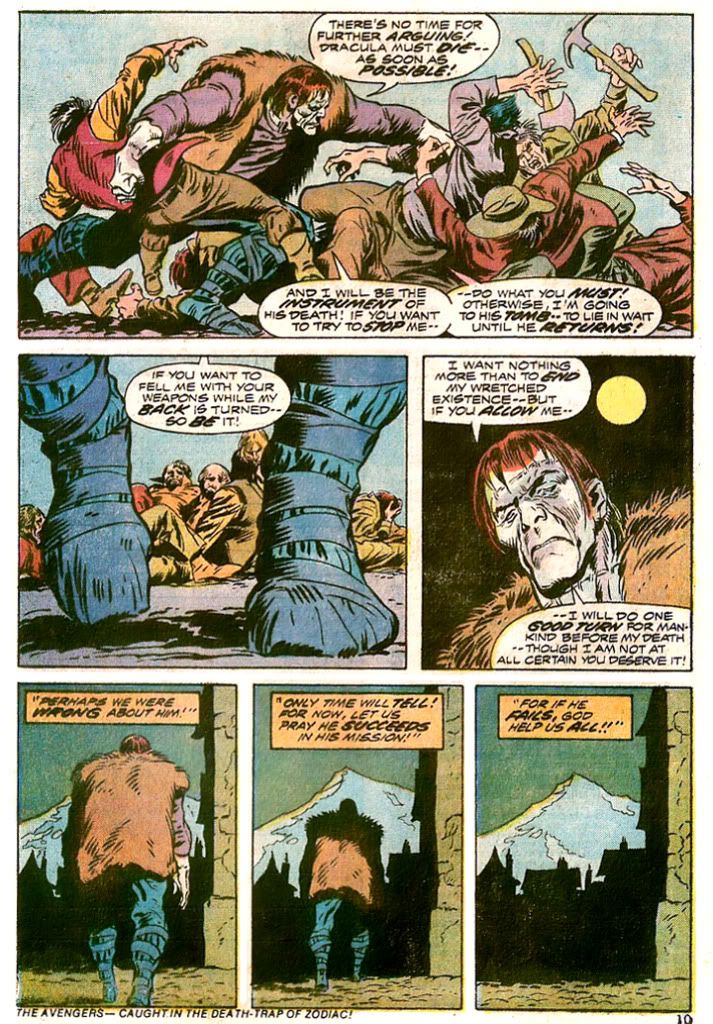
Gary Friedrich, John Buscema, John Verpoorten, The Frankenstein Monster #9 (March 1974)

One of the great things about Marvel back in the day was no matter how busy their characters were fighting multiple enemies, thanks to the intense aerobics training Stan Lee put them through as part of their contractual obligation to the company, they always had wind enough to explain their basic motivations.  Or, in the case of Frankenstein's Monster here, to protest not having enough time to do so, while doing so.

I really don't see how this sequence makes Frankenstein's Monster (although this characterization is closer to Mary Shelley's original than the more well-known Boris Karloff movie version) all that different from the Incredible Hulk or the Silver Surfer or any of those yahoos.  Yeah, Monster is more eloquent than the Jade Giant, but I'm sure they could commiserate over beers:  "I don't have time to explain myself to you idiots despite my amazing ability to multi-task."

Sunday, September 30, 2012

3rd Annual Spookey Month... and a weather-induced scheduling slip-up...

Okay, it's October here in Japan, which means Halloween.  I celebrate Halloween for the entire month.  This means watching horror movies, reading horror novels and short story collections... and horror comics.  But I also love to tie Halloween to Spookey, the all-girl punk band from right here in Hamamatsu.  The problem is, there are only so many Spookey videos available online and we've already seen all of them twice.  But because I love Halloween and I love Spookey, I'm going to trot the old familiars out again along with a series of horror comic-themed blog entries.

This interrupts my plan to post a link to and review of every single episode of Filmation's Isis TV show.  Another problem for me, less so for the millions of people who don't care about this blog or Isis.  Yesterday, I planned to post a review of the episode "Lucky," which is one of the better single episodes of any 70s kid series.  It's really quite amazing.

Then a typhoon blew through and knocked out the electricity in our neighborhood, so I didn't finish editing the review.  Since it deals with a theme related to Halloween, I'm going to slap it with a Spookey Month label, post it sometime this week and then take a break from Isis in favor of EC, Warren and other scary four-color delights.  We'll get back on track with Isis this November.

So... barring another typhoon... bring on When Comic Books Ruled's THIRD ANNUAL OCTOBER IS SPOOKEY MONTH!

Saturday, September 8, 2012

"Sengoku Batman:" Great Batman or GREATEST Batman?

I snagged this from TokyoPop's Facebook feed.  It's Sengoku Batman by Scott Wade.  DC needs to snag this concept and put it into production like yesterday, with Wade handling the art.  This is my favorite Batman since the Batman the Animated Series version, which I liked because of the sweet Bruce Timm designs and the Denny O'Neil-inspired characterization of Batman.  More human than the one in the comics and a lot more likable.

Sengoku, in case you don't know, is a Japanese word meaning the "Warring States period."  This was the nearly 200-year era starting with Hojo Soun and ending with the three unifiers Nobunaga Oda, Toyotomi Hideyoshi and Tokugawa Ieyasu, a time of high drama when various warlords vied to forge Japan into a single nation rather than a lot of fiefdoms or domains, and invaded Korea twice.  Lots of great stories from that time, plenty of intrigue, schemes, betrayals, set-piece battles and bold personalities.  This Batman would fit right in there.

Yes.  It's good!

Thursday, August 23, 2012

Anyone in Japan want a ton of great American comics?

I'm not sure how many people in Japan read this blog-- probably close to 1 or maybe even 2-- but if you're out there and hungry for some comics to read, I know someone who can hook you up at a very reasonable price.

A nice guy named Gabe emailed me the other day.  He's got a dilemma.  He owns two longboxes full of fantastic comics.  The problem is, they're in Japan and he's in the United States.  Gabe wants these comics to go to a good home, to someone who will appreciate them.  Obviously, as I'm the number one Western comics freak in Japan, I was his first choice.  Unfortunately, as tempting as the offer is, I'm not really in a position to take them myself.  I barely have enough room in my apartment for the books I've already accumulated.

So there it is.  Two boxes packed with comic book goodness, yours for the taking.  The offer is good until the end of September.  If you're interested in working out a deal, email Gabe at lostpuppyproductions@yahoo.com.

Tuesday, August 14, 2012

Tokyo Comic Book Report: Japanese girls love Deadpool!

Majority of patrons that Saturday were women.
Well, to turn a generalization into something more accurate... at least one does.  When I visited Blister in Hamacho, one young woman was flipping through a Deadpool comic, cracking up and excitedly sharing various panels with her friend.  Before I left, she had in her hands a huge stack of American comics, at least one of which featured Deadpool.  So someone in Japan likes Deadpool, Marvel.  Take my infallible advice and start a huge marketing push centered on Deadpool over here and I'm sure it'll pay dividends!  Thank me with money.  You're welcome.

I'm not sure how I got the idea Blister was so difficult to reach, like a comic book Shangri-la.  It turns out it's pretty darned easy if you're staying in Hatagaya.  The subway train that takes you to Shinjuku will deliver you to Hamacho Station and from there it's about a five minute walk.  The first time I visited Blister I believe I went to a different platform in Shinjuku Station, but that was several lifetimes ago.  I've cheated death so many times since then, they all tend to blur together.

Blister's running on limited hours these days, but on Saturdays, they're open from 11am to 5pm, which gives you plenty of time to get in and browse.  The store is very cramped, and on this particular day there were six or seven other customers.  It felt crowded.  The store is heavily invested in Marvel and DC, mainstream stuff.  The going price for a brand new American comic magazine in Japan these days is 540 yen.  That's about 6.85 USD to you and me, Russ.  Blister does feature some bargain 100 yen comics in longboxes to your right as you enter.  The selection is hodgepodge and I long ago bought them out of every single Cassandra Cain Batgirl back issue they had.  None are to be had these days, but you can still buy issues of the Stephanie Brown series.

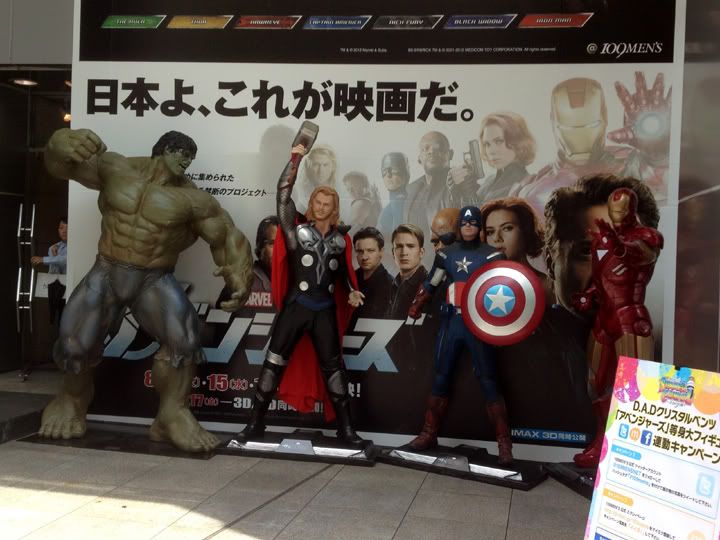
The Avengers were hanging out in Shibuya.
Speaking of Cass, I bought the very last copy of Batgirl: Fists of Fury found in the wild here in Japan, so don't look for that, either.  It cost 1800 yen (22.83 USD, quite a mark-up from the 14.95 US SRP), but it was worth it to reaffirm my position as her #1 fan in Japan.  It seems the other Cass trades like Silent Running and Death Wish are slipping out of print and going for mega-yen on Amazon.jp.  While Fists seems to be hanging in there and I could have paid 500 yen less for it online, the trouble I've had getting things like Showcase Presents Batman and the Outsiders 1 and New Mutants Classic Volume 1 means snap it up if you see it.

Besides the Cass book, I also bought Astonishing X-Men #52 (because it has a neat Xi'an Coy Manh cover), Conan #32 (a random choice because it was 100 yen and I still enjoy Kurt Busiek's run on that title), Conan the Barbarian #2 and 3 (more Dark Horse, love Becky Cloonan's art), Minutemen #1 and 2 (the pull of Darwyn Cooke proved too strong to resist), New Mutants #46 (more Xi'an, but this time with Dani Moonstar, also irresistable) and Walking Dead #100 (Robert Kirkman and Charlie Adlard-- this is the second time you've scarred me with a single horrific image!  I nearly barfed!).  No Dark Horse Presents, so no new Nexus.

Blister is stocked deep with Before Watchmen titles.  I only wanted a sample, so I didn't catalog everything they had, but I think I could have bought the entire run up to current if I'd been so inclined.  Good runs of the New 52, if you're into that.  Heavy on the Marvel mutant stuff.  They also have a lot of trades and collections, plus just about every Avengers movie action figure you could want, along with The Dark Knight Rises stuff.  The guy working the cash register was friendly enough, but we didn't chat due to the language barrier.  I think he recognized me from my last visit there, way back in 2010.  Now that I know an easier way to get there I could see myself patronizing Blister a bit more if I lived in Tokyo.  Maybe they could order more Fantagraphics and Dark Horse stuff for me, too.

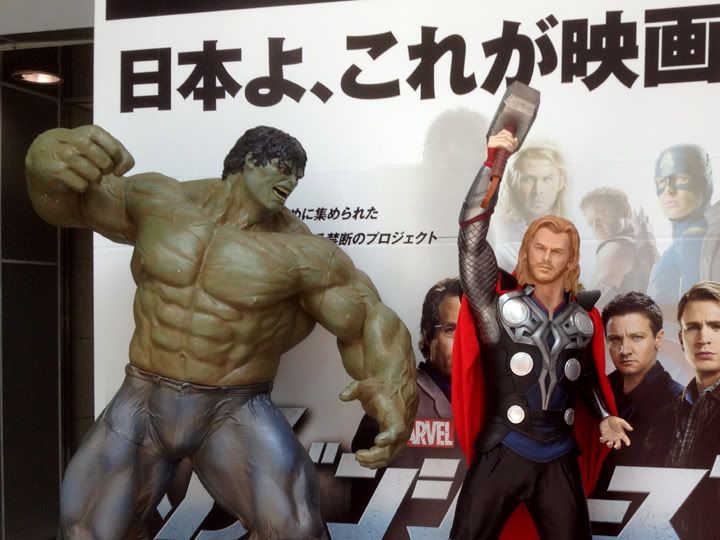
Probably jet-lag, but Hulk really wanted to punch Thor.
My other comics-related activities included visits to Tower Records in Shibuya and Kinokuniya in Shinjuku.  Tower Records was having a major sale in their English-language book department so I snapped up a few bargains.  Now, Tower Records stocks a lot of Fantagraphics titles, but they seemed kind of depleted.  Coupled with the close-out type prices on other books, I'm wondering if they're overhauling things or getting out of the business.  That would truly be tragic because Tower Records has been a Tokyo destination if you want groovy things by Los Bros Hernandez, Peter Bagge and the like.

At Tower Records, I bought Lone Wolf and Cub volumes 4 (783 yen, marked down from 1565, or 9.93/19.85 USD), 19, 20, 22, 23, 25 and 26 (290 yen each, 3.68 USD).  I was tempted to go back and clean them out entirely.  I also found and bought a shelf-worn copy of Showcase Presents Batman and the Outsiders 1 (2573/32.64).  See what I mean about snap it up?

Kinokuniya has a very small section for Western comics, but it was there I managed to find and buy the elusive Perla La Loca (receipt lost, price unknown, a pearl of great value to me) to complete my Locas collection.  I'd ordered it months ago from Amazon.jp, but kept getting messages that it was delayed.  This was the only Love and Rockets book they had in stock, so apparently it was meant for me.  And now we are together at last and all is right in the comic book world.

Wednesday, August 8, 2012

Comic book quest... begins!

I'll be gone for a few days.  I plan to find Blister, the comic book/toy store hidden somewhere in Tokyo.  I've been there before.  Come to think of it, it may not be open.  Well, here's hoping.  Wish me luck and all that.  My goal is to buy the new Dark Horse Presents with Nexus.  If I can accomplish that, it will be worth the heat, the humidity and the broiling sun of Tokyo in August.

If you want my advice-- stay out of Tokyo in summer.  Go in spring or fall.  I'm just not that bright.

Sunday, August 5, 2012

Mike Allred on the Fantastic Four?

Okay, it's not Marvel, but it's Allred!
Whereas DC's kind of like, "Nyahhh nyahhh, we don't need you!" it seems Marvel's going out of its way to solicit my hard-earned yen.  They've got Dani Moonstar practically headlining a book and now this exciting news.  Exciting to me, anyway!

I've loved Mike Allred's art for quite some time now-- and he's just such a positive, nice guy I can't help but like the man himself and his whole family, too-- and have especially fond memories of the last Marvel series other than the new New Mutants I bought with any regularity.  I'm talking the awesome X-Force/X-Statix book Allred did with Peter Milligan.  I really need to go back and re-read that.  It's been too long since I communed with the likes of Mr. Sensitive, U-Go Girl and Doop.  I can't even remember the other characters' names.  Spike?  Tike?  Man, it was gloriously weird and emotionally engaging in a way few mainstream comics ever are.

While I'd love it if Allred also happened to be writing Fantastic Four, just the presence of his artwork is a guarantee I'll be tracking this down over here, across the sea in Japan!

Excelsior!