Showing posts with label manga. Show all posts

Saturday, October 6, 2012

October is Spookey Month: "Uzumaki," another Halloween reading recommendation!

Junji Ito, Uzumaki (1998-9)
I don’t know why Junji Ito hasn’t caught on with manga fans in the Americas.  Both Viz Media and Dark Horse Comics have released very nice books collecting Ito’s work, but they don’t seem to have made much of an impact there as far as comics culture goes.  I think he should be mentioned in the same breath as Mike Mignola, but he seems largely a cultish figure, and somewhat elusive.  Dark Horse has two Museum of Terror volumes (the third seems to be out of print) and Viz offers Uzumaki, of courseGyo is worth a read, although I didn't particularly care for it.  It's about dead fish and a killer odor, neither of which inspires much interest in me.  But Museum features Ito's most well-known creation-- Tomie, the beautiful, unkillable school girl-- and inspired a hit-and-miss movie series that seems never to to die completely, just like Tomie herself.  Uzumaki also became a film, a severely truncated version with a hugely disappointing ending and played largely for laughs.  A great deal of Ito's more recent short stories and other tales-- many of which are absolutely brilliant-- haven't been made available in English other than through "scanlations."

What is Ito like in his every day life?  Probably just another hard-working mangaka.  A regular kind of guy who puts in long hours at the drawing table.  After all, before he began his comics career and started creating chills and thrills, he was a dental technician.  But in his stories, the man reveals a seriously twisted genius.  His characters inhabit a universe ruled by dream logic, by malicious forces acting either arbitrarily or for capricious reasons beyond our human understanding.  Whatever it is, it's a dark, pitiless place with little hope for escape or redemption.  Ito's work is true horror and the man doesn't really have any peers, because no one working in the genre can touch him.  

While I was an imaginative little kid who often spent sleepless nights after reading even the mildest of DC ghost stories, as an adult I’m pretty hard-boiled when it comes to printed horror.  Uzumaki, Ito’s masterpiece, gave me a serious case of the creeps.  It made my stomach churn.  Even today, years after I initially read Uzumaki, moments from the story recur in my mind, like childhood nightmares recalled time and again in broad daylight, in the most unexpected of places.  Writing this, I suddenly feel it faintly in my nervous system, on my skin, as if it Ito himself tattooed itself there, indelible.  As the old idiom goes, it's as if someone walked on my grave.

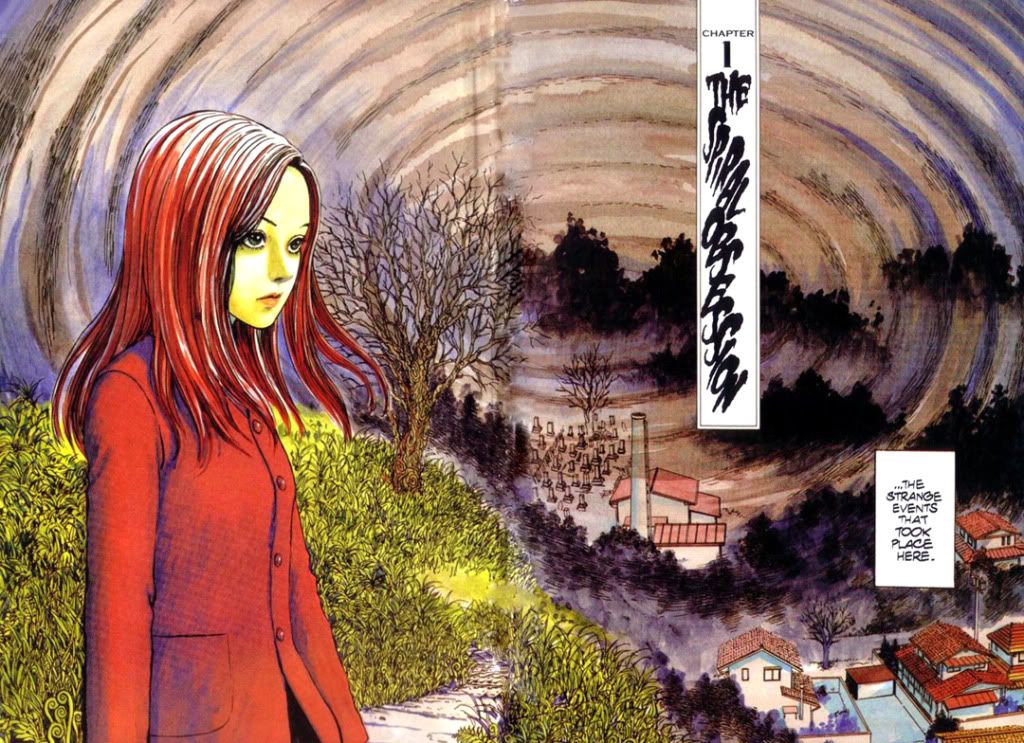
Kirie Goshima is a normal high school girl, another of Ito’s fragile, doll-like female protagonists.  She lives in Kurozu-cho ("Black Vinegar Town"), a seaside town like many here in Japan.  Sea for one border, mountains for another.  Kurozu-cho is a little cut off from the rest of Japan thanks to geography, and it has a mysterious past.  Little by little—a whirlwind here, a guy obsessed with swirling his miso soup there—Kirie discovers to her growing horror an ever-pervasive influence by the spiral.  No ghosts, no monsters, just a simple shape curving in on itself.  Kirie‘s boyfriend Shuichi has already noticed things not quite normal and is coming unraveled.  Kind of like a thread from a blanket that curls in your fingers as you try to pluck it.

And with that simple set-up, life for the two luckless teens increasingly spirals out of control.  Ito tells the story in vignettes, from Kirie’s point of view; Shuichi has introduced the girl into a world where literally anything can be perverted by the pernicious influence of the spiral.  After a couple of early chapters, each of which tends to follow a formula of developing a premise, developing it, then delivering a disgusting punchline, you begin to anticipate what the spiral will do next.  The results still shock.

Like diseased mushrooms, events grow inexorably out of each other and transformations and mutations abound.  As the spriral closes in, Kurozu-cho darkens to a place where a girl with a crescent-shaped scar on her forehead becomes a monstrous entity, a boy obsessed with pop-up surprise scares becomes a ruined jack-in-the-box figure and even the joy of birth becomes the stuff of nightmares.  The signal transformation involves a particularly slow-moving classmate of Kirie’s.  His physical and mental changes are off-putting enough by themselves, but just when you think you’ve reached the point where you can somewhat live with the memories (or at least resume your normal diet), they maddeningly recur to other characters until the situation escalates to what is arguably cannibalism—or something for which we’ll have to invent a completely new word for gastronomic crimes against humanity.  Kirie pursues these rapidly proliferating horrors towards their twisted center, where the story takes on Lovecraftian proportions and escape may prove impossible.

These are stories to read in the daytime.  If you can find them, that is.  But be warned—Ito does not flinch from reshaping his characters to suit the spiral’s whims and a lot of the imagery is extremely disturbing.  Not for tender psyches or weak constitutions.  Oh, and don't eat escargot before you read it.

Tuesday, July 31, 2012

Here's a little something about the Kyoto International Manga Museum

According to a story appearing in the Japan Times Online, the Kyoto International Manga Museum attracts "200,000 to 300,000 visitors a year, including some 30,000 from abroad."  The museum, which opened in 2006, features a "wall of manga," called, appropriately enough, the Wall of Manga.  It's about 200 meters long and features over 50,000 comics dating back to the 1970s.  There's even a computer search kiosk available so you can locate the exact manga you want to read.  Pretty helpful if you know the one you want.  But if you're not intimidated by the sheer size of the Wall, you can approach it and choose a volume at random.  Whatever catches your eye.  Yeah, you can read the manga.  Take it off the shelf, open it up, start reading.

Since the museum's website claims about 10% of its visitors come from overseas-- bearing out the Japan Times story, I suppose-- they even have a number of international manga.  That's comic books to you and me, Russ.  The largest group is made up of Japanese comics in translation:  970 in English, 670 in Korean and a whopping 1330 in Chinese!  Also represented are German, Italian, Spanish and Catalan and "other European languages."  There are around 400 volumes of homegrown North American, European and other Asian comics, too.  I wonder if they have that one Wolverine where he had an eyepatch and used his claws on those dudes...

"Summer School" at the museum just started today, August 1st, and runs through the 26th.  I'm not out to earn my PhD in manga, but I'd love to attend some of the art instruction classes.  They're in Japanese only, naturally.  The museum accepts donations of materials, as well.  If I leave Japan again that's what I'll do with my rapidly growing comic collection-- donate it to the Kyoto International Manga Museum so people from Japan and around the world can enjoy my impeccable taste in sequential literature.

Even though I've lived in Japan off and on since before this museum opened, I have to admit I still haven't made my pilgrimage.  While I've been to Tokyo and scoured Akihabara, Shibuya, Harajuku and Ikebukuro for comics so many times I've lost count, I don't go to Kyoto very often.  Twice.  And both times I encountered cold weather and nasty rain.  Kyoto and I just haven't been able to see eye-to-eye on what constitutes a pleasant visit.  One of my good friends went to the museum, though, and he's not even a comic book reader.  Before his visit, he'd read Ghost World, and that's about it.  The museum deeply impressed him.  Then he went down the street to a local bookstore and bought some English-translated manga for himself.  Knowing my love for comics he texted me while he was doing it like some kind of pervert performing some weird and gross act we won't even begin to try to imagine and having to share it to increase his sick, disgusting pleasure, and like a similarly perverted individual I jumped right in to join him and demanded he buy the first two volumes of Ai Yazawa's Nana for me.

And that's how I became addicted.  Addicted enough I need to hit Kyoto and visit this place.  Unfortunately, I can't do it during my summer break.  I'm already committed to yet another Tokyo junket, but that's mostly for business.  My passport needs renewing!  But since I recently became engaged and my fiancee is returning to Japan in October so we can start our life together-- I know, it's sickeningly sweet-- there's more than likely a Kyoto trip for two in our near future.  Now she could give a rip about manga but she cares about me, so we'll stand in front of that Wall of Manga and maybe she'll share with me the ones she read when she was a kid.


Sunday, June 3, 2012

Vandalized Namihei statue's trademark single strand of hair replaced | The Japan Times Online

Vandalized Namihei statue's trademark single strand of hair replaced | The Japan Times Online

Someone really likes Sazae-san. Or single strands of hair. Well, whatever the case may be, even here in Japan if there's something fragile about a statue, someone's going to break it or steal it.

I've been meaning to read Sazae-san. At my old school here we had a copy of The Wonderful World of Sazae-san in the lobby but I never picked it up. Reading about it just now has intrigued me. Created by Machiko Hasegawa, one of Japan's first female manga-ka, Sazae-san debuted in a local paper before launching in the Asahi Shinbun. Hasegawa wrote and drew the strip-- apparently considered leftist thanks to its feminist themes-- from 1946 to 1974. It became a TV series in 1969 and continues in production to this day, making it old enough to be The Simpsons' mother. Pretty cool, if Wiki has its facts right. I could research a bit more and report back, I suppose. That gives me yet another reason to pick up this series.

Wednesday, May 16, 2012

Still on hiatus!

It's not by choice.  I still don't have an Internet connection at my apartment.  I'm actually writing this from my office at work while waiting to discuss tomorrow's classes with another teacher.  So while we're marking time, let's catch up a little.

I missed Free Comic Book Day in Tokyo this year.  My new job splits the Golden Week holidays.  We had Monday off, but had to work Tuesday and Wednesday.  As it happened, Melt-Banana was playing a show that Sunday in a venue about 3 minutes by foot from my favored hotel when I'm in Tokyo.  So I had to make a choice-- hit Tokyo and see Melt-Banana destroy music during my three-day weekend, or go to Blister during my four-day one.  Noise won out and I don't regret it a bit.  Blister does two days of Free Comic Book Day, but I couldn't justify a second Tokyo junket.  So no free comic books this year, no reports on Free Comic Book Day in Japan.

But I did buy some comics while I was in Tokyo.  I went to Kinokunkiya in Shinjuku and bought the first two volumes of Nana and the second volume of Wandering Son, a wonderful manga about a very girly boy and a very boy-y girl.  They're possibly transgender, but I haven't read far along enough in volume one to know for sure.  I'm avoiding reviews and synopses so I can figure it all out by myself.  In the meantime, why should I try to define them?  I'm content to let them tell me when the time comes.

Wandering Son is from Fantagraphics and it reminds me a bit of Dan Clowes's Ghost World in that its creator Takako Shimura places two characters under a microscope and peers intently at their little lives.  It's also a little fragmentary, playing with time in small ways.  For example, something happens to one character early in the first volume (I bought it a few months back) but we learn of the consequences before we find out what happened to her-- which made it dificult for me to follow at first.  But soon enough I settled into a rhythm.

And then work and life happened and I had to put it aside for now.  I work about eleven hours a day.  Well, I don't work, but I'm stuck at the office for that long most days.  There's nothing like spending the hours from 8am to 7pm at your office to cut down on reading time!

Wednesday, February 22, 2012

Interested in buying American comics in Japan?

Yeah?  Well, forget about it.  The monthlies at least.  I know I've touched on this subject before, but if you're addicted to the American-style four color slender magazine we popularly refer to as the "comic book" and you live in Japan you'd better get ready for some hard cold turkey time, complete with DTs and hallucinations of Batman crawling under your skin.  Your best bets are either learn to live without, start buying digitally, order from overseas or have some sympathetic pusher-type friend mail you your fix.

Another thing you can do is make a pilgrimage to Blister.  This is problematic because it's not all that easy to get to these days and involves figuring out the Tokyo subways, being very patient while waiting for your arrival at the proper stop and then a fairly long walk through what will no doubt be unfamiliar territory to a small store that may or may not have what you're looking for.

It used to be easier.  At one point there were two comic book shops in Shibuya that sold American monthlies, with Blister being the largest and most exciting.  It was right in the heart of the shopping area just outside the station and across the famous Shibuya scramble intersection you've certainly seen in movies and in photographs.

In those days, Blister was an orange multi-story geek heaven and had one of the actual screen-worn Spider-man movie costumes on display!  All the action figures you could ever want and then comics and trades in the basement, plus a really cool young staff.  It moved to smaller digs in Harajuku and that's where I used to drop 100-200 bucks on comics and more whenever I hit Tokyo.  I experienced my first Free Comic Book Day at the Harajuku store, and it was marvelous.  So many people packed into the comic book section you had to wait your turn to flip through the longboxes.

Then Blister moved again and shrank to a less impressive storefront in a hard-to-reach neighborhood that isn't nearly so cool as either Shibuya or Harajuku, but probably leases space at more affordable rates for people selling comics apparently only I want.  My second FCBD at Blister's new location wasn't so exciting and a day or two later, I was jetting back over the Pacific Ocean, leaving Japan behind me forever.  Or so I thought.

Man, I loved Blister back in the day!  I still do, but I'm not sure I'll be making a return trip there this year.  Sorry to give you the bad news.  Now for the good.

If you love collected trades, graphic novels or English-translated manga, you're totally in luck here in Japan.  Japan's got you covered.  More than covered.  It's an embarrassment of riches, really.  You can order COD from Amazon.jp (currently my favorite source).  Sometimes you can even find things that are out of print in the US still available at Amazon.  At the very least, anything you can get from Amazon in your own country, you can get in Japan.  And the exchange rates make them comparable in price, or even cheaper.  And if you're in Tokyo, it's easy to hit up Tower Records in Shibuya and Kinokuniya in Shinjuku.  Tower Records is a straight shot from Shibuya Station and Kinokuniya is right behind Shinjuku Station. 

But don't take my word for it.  Ask Christopher Butcher, who found out in 2007 what I learned about the same time:  that Fantagraphics is majorly represented here at Kinokuniya (and also at Tower Records, although I don't think he went there).  You can also find your precious superhero books at Kinokuniya as well.  But the English-language manga section is the store's real appeal.  Butcher's right on about how large that section in Kinokuniya is.  It's large and stocked in-depth with all kinds of titles and genres.  While Kinokuniya does maintain a shelf of superhero trades, it's nowhere near as breathtaking as their English-translated manga selection.

Here's another good point he makes:

So, here’s my closing thought: A Japanese bookstore in Japan has a better selection and diversity of product for English-language graphic novels, including manga, bd, superheroes, artcomix, strip collections, etc., than 90% of comic stores in North America; if Kinokuniya can develop a market for that material then North American stores could too, and there’s nothing stopping them.

You have to understand Kinokuniya did this within the context of a market where comics are already widely accepted by a population-wide general readership, but as a business person, Butcher obviously understands the scope of what Kinokuniya offers.  I also enjoyed Butcher's photos of the Shinjuku night-scape, complete with the NOVA sign that no longer exists because that NOVA branch went belly-up along with the company not long after he shot it.

Which is to say in Japan terms, this photo essay is old news.  And also in the world of American comic book fans.  That doesn't mean it still isn't useful.  The info about Kinokuniya was still accurate as of May, 2010, the last time I set foot in the store.  I just happened to tumble across Butcher's photos this morning while thinking about whether or not American comics are popular here in Japan and if any new outlets for them had popped up since I my departure and return.  The late, lamented Journalista! once linked to it, so you may have already read it.  I didn't, much to my chagrin.  Wish I had.  Wish I'd known he was in Japan at the same time I was.

Not that he knows me or vice versa, but I could have clued him into Blister.  I miss Journalista!  Journalista! once linked to someone else's link to my angry evisceration of that overblown toilet paper-worthy book Identity Crisis and called it the "ultimate take-down" of said book.  And then I died and was no longer relevant to comics fandom!

Sunday, November 20, 2011

Comic Report: Japan!

After a long break back in the States, I'm in manga heaven again.  Not that I'm a fan of manga in and of itself.  I enjoy a few titles, consider myself a fan of a few creators, but I don't separate Japanese comics and Western comics.  Comics are comics.  Sure you read Japanese comics right to left and that takes some getting used to, but with the borrowing and blending of elements over the past few decades, a comic story consists of drawings and word balloons arranged in a particular order according to the creator's intent no matter where it comes from or who wrote or drew it.

If you're a regular reader of various Western monthly comics, you have to work a bit harder to find them here in Japan.  There are online sources and if you happen to live in a large enough city, you might find a few odd titles in the English language section in a bookstore.  Just be prepared to pay three to four times the suggested retail price.  I haven't tried downloading any digital comics yet, but I'll give that a try later when I'm more settled and have my own Internet connection.

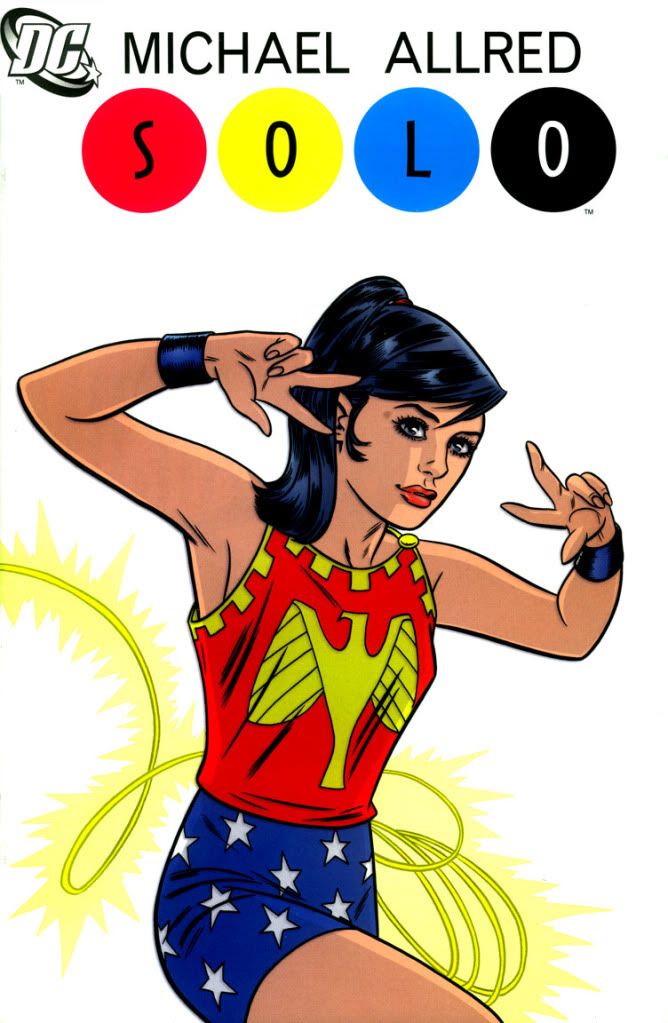
In the meantime, I'm making do with the comics I brought with me:  the superb Solo #7 (2005) by Mike Allred and family, and the award-winning Nexus: The Origin (1992) by Mike Baron and Steve Rude.

Solo #7 is one of the best things DC's published in the past ten years.  Maybe twenty.  It serves as the perfect antidote to all those gloomy, doomy negative portrayals of their own characters DC's dished up in the years since Identity Crisis, and it's a lot more fun than their similarly nostalgic Wednesday Comics.  Yeah, not every superhero comic should be this kind of poppy fun.  We like our supergods with a touch of realism these days.  But as Batman's faithful butler Alfred points out here, "Why is it the good things are never 'real life,' only the bad?"

Who can argue with Allred's winning cover depiction of Wonder Girl doing the batusi?

Nexus:  The Origin is a bit darker.  It starts with genocide, includes a starvation death and Nexus excusing his own killings by claiming self-defense.  This is the comic that hooked me on Horatio Hellpop, Sundra Peale and all the frog-like aliens and hairy Thunes that inhabit their universe.  Baron condenses the entirety of Nexus's early years into several poignant vignettes and Rude illustrates with his strong sense of anatomy and page design.  Inker Gary Martin perfectly complements Rude's pencils-- I've seen a number of inkers on the Dude, but Martin is far and away my favorite.  Rude "re-mastered" this book in 2007.

These are a couple of thick, meaty magazines that invite you to chew slowly and savor their delicious taste.  Which I suppose taken literally would mean you should eat them and enjoy some paper.  But you know what I mean-- read them over and over again.  Both were well worth dragging thousands of miles across an entire continent and ocean.

Well, I promised you a comic report, didn't I?  If you happen to be in Minami-Funabashi, Chiba prefecture, go to Vivit Square.  The Tsutaya there has a huge selection of Japanese comics, plus a teensy-weensy grouping of some translated ones in their English language book section.  Unfortunately, I can't remember which ones.  Probably Death Note and Vagabond.  The Japanese originals, though, boggle the mind.  So varied in genre and style.  Why aren't there comics about baseball and basketball teams in America?  Where are the simple stories of high school kids falling in love?

I guess they're in the manga section at your local Books-A-Million.  Which, combined with their Western graphic novel section, can't hold a candle to what they have at Tsutaya in Minami-Funabashi.

Monday, October 24, 2011

2nd Annual Spookey Month: Tomie Unlimited Introduces Tsukiko into the film series!


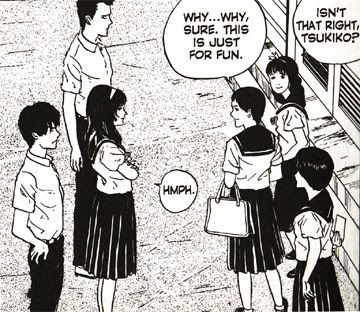
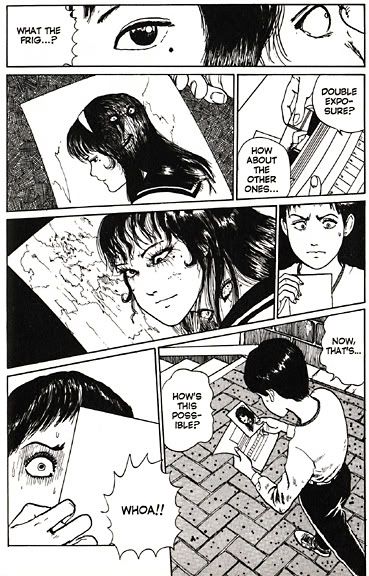
While we're on the subject of Japanese horror, the Tomie film series is apparently as unkillable as their eponymous villain. Tomie Unlimited is the newest offering from Toei Company, LTD. and it seems to be at least loosely based on the "Tsukiko" stories from Junji Ito's manga. This makes me happy, because I'm a big fan of those particular Tomie stories and of the character Tsukiko, the cheerfully amoral purveyor of candid photos of cute guys she sells to the girls who have crushes on them.

While the movie Tsukiko eschews her comic book counterpart's pixie cut and happy-go-lucky capitalist demeanor, Miu Nakamura makes quite a convincing Tomie.  Several of the scenes from the trailer look astoundingly like panels from Ito's stories.  It would be too much to ask for a completely faithful adaptation-- here, Tsukiko is Tomie's little sister rather than simply a classmate.  However, the publicity materials promising a Tomie who "reveals her true face only when she is with Tsukiko" make this the most intriguing series entry in quite some time.

In the comic, Tsukiko makes a fun and vivacious enemy for Tomie, and Tomie's position as the head of her school's Public Morality Committee provides a bit of ironic counterpoint to Tsukiko's scheme.  Just as Tsukiko abuses the privileges that come with being a member of the photography club-- access to a dark room and materials to make her illicit yet lucrative prints-- Tomie soon has her own club lackeys pursuing her unfortunate enemy.  And it becomes apparent that Tsukiko's crimes pale in the face of Tomie's monstrous true self and the bloody murders she causes during their personal war.

The stories also benefit from a unity of setting, unlike the other Tomie tales which are only loosely connected.  The idea of a beautiful yet thoroughly evil young woman who drives her lovers to madness and murder-- and yet cannot be killed herself, no matter how hard everyone tries-- is good for a few chills here and there, and benefit from Ito's trademark gross out scenes.  But by grounding her in a specific locale and taking some time to develop her victims Ito creates a cycle of stories that have no problem standing alone.  If character development is Ito's weak point as a writer, with the introduction of Tsukiko he solves this problem, and it helps bring Tomie herself into focus.

Even if you probably won't want to see what develops as a result.  Isn't that right, Tsukiko?  Tsukiko?  Oh yeah, the school officials suspended her.  Oh well.  That gives her plenty of time to get to know her new best friend, Tomie.  Here's Toy Missile, one of my favorite Japanese bands!

Sunday, October 23, 2011

2nd Annual Spookey Month: Chiaki Kuriyama in an early horror role!


Okay, okay. It's not a comic book, although Miki Rinno later did a manga adaptation-- published in the US by Dark Horse Comics. It's a scene from the original direct-to-video Ju-on (2000) that spawned the movie series, the American remake and its sequels.  I have no idea about the Ju-on mythology or back story, but I do know the American release of the first theatrical movie has a redundant title, and the Japanese release of the American version has a silly one.

While we tend to like our ghost stories set in the fall during Halloween season, Japanese culture favors the late summer during Obon time.  This scene establishes mood early with the oppressive cicada static in the background; that's the soundtrack of summer there in Japan.  They still ring in my ears and the I last experienced Japanese summer two years ago.  The school bell briefly heard brings back a lot of memories for me as well.  The cellphone is a neat plot device-- a more modern conduit for mysterious messages and voices from the other side, but its size and simplicity instantly date this movie.  It's a period piece.

The message with the repeating 4s may not seem particularly chilling to Americans like myself, but the Japanese word for 4 is "shi," which also means death, so this is a pun commonly used in J-horror.  Come to think of it, it might not be all that frightening even for a Japanese audience, because it's probably cliche by now.  Remind me to ask!

Still, four is just not an auspicious number; I used to go get check-ups at a local hospital that had examining rooms numbered 3 and 5, but not 4.  But it must be Kuriyama's lucky number, because she also appeared in a movie called Shikoku, the name of one of Japan's main islands (which uses its more benign meaning), but can also mean "land of the dead."

At least in that one, she gets to play the ghost rather than its victim.

Chiaki Kuriyama is one of the coolest people on earth.  Unfortunately, I don't find the little kid ghost anywhere near as creepy as Sadako from the Ringu series, or even Tomie. Heeeeeeeeerrrrrrre's Sadako:

Friday, October 14, 2011

2nd Annual Spookey Month: Uzumaki... spiral into... Halloween!


Ito Junji's disturbing horror manga Uzumaki was made into a film back in 2000. While the comic ended on a Lovecraftian note, the movie keeps the horror on a more personal level. Possibly because the budget for a more faithful adaptation would have been enormous. Uzumaki the movie is also pretty campy, sometimes substituting goofy comedy for the truly nauseating terror of the original. It's lots of good fun if you can stream it or Netflix it or whatever it is you youngsters do nowadays. But if you haven't read the comic, you really need to.

Unless you have a weak stomach. It made me feel queasy, but I couldn't stop myself from turning each page.  Still, I would feel terrible if I became responsible for cookies being tossed, lost lunches or even a chuck being upped.

The middle chapters are a bit formulaic, but what a formula! Ito creates the perfect atmosphere of growing dread by setting up each vignette and letting them lead to each inexorable conclusion. When Shuichi's father kills himself under the spiral's spell, his mother grows to fear and loathe the shape to the point of injuring herself to rid her body of it. At one point, Shuichi consults with a doctor and in a moment of horror, realizes there are spirals just inside our ears. At that point, he'll do anything to prevent his mother from learning of this... The beautiful girl with the crescent-moon scar on her forehead. The classmate of Kirie's with the gorgeous, curly hair. The boy who likes to spring out at people and scare them. A slow-moving classmate during snail season. Pregnancy. A typhoon. It just gets worse and worse until only Shuichi and Kirie are left to escape, or failing that-- to confront the spiral where it's most powerful.

When I lived in Japan, I had a collection of delightfully disgusting Ito stories.  I have no idea what the title was; it was all in Japanese.  I bought it simply because I recognized his art on the cover.  Inside were stories about teens with pimples, a bully who grew up into the worst mother ever, a particularly nasty circus and the absolute lousiest way to lose weight ever invented.  Because I couldn't read it, a friend of mine translated it fairly loosely for me.  It was also her first encounter with Ito's work and it cracked her up.  Or maybe she was laughing at me for liking it so much.

I don't have a new (or even an old) Spookey clip for you today, but here's something you might enjoy:

Monday, May 23, 2011

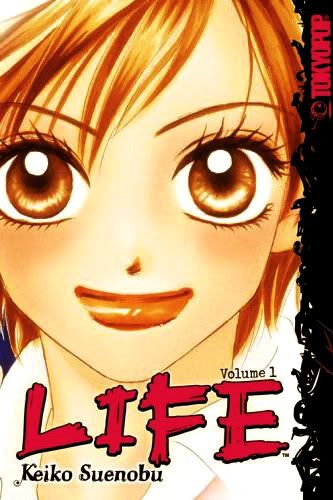
Life 1: A Comic Review

Life
Writer/Artist: Suenobu Keiko

Translation: Michelle Kobayashi
English Adaptation: Darcy Lockman
Publisher: Tokyopop

This is Life the comic, not the game. Or the cereal. And this is how life works: while in the U.S. we get assigned to high schools based on demographics and geographic location, in Japan junior high kids have to pass a test. Ayumu is an underachieving girl who latches onto high scoring smarty Shinozuka (Shii-chan for short but only if you’re close) for friendship and tutoring. As Ayumu’s grades improve, so does her outlook on life. Now she has a super-supportive best friend and if things work out, they’ll be together at the coolest school in the city, Nishidate High.

Sometimes things don’t work out. Shinozuka’s grades plummet as she expends energy on the needy Ayumu and when the big test scores come in, Ayumu’s the one going to Nishidate. Solo. This scotches the friendship and Ayumu finds herself isolated and hurting among the seemingly happy Nishidate student body. Luckily for her, she’s cute enough to catch the attention of the instantly popular Manami. Manami’s perky, pretty, has a sweet boyfriend and a sunny outlook on life. She’s everything Ayumu wants to be so she learns to bask in Manami’s reflected light. But…

Why is Ayumu still so unhappy? Losing Shii-chan’s friendship has left her with an introspective streak and the more she exercises it on Manami, the more this brightly effervescent girl proves to be spinning somewhat out of control. So out of control, Ayumu’s going to have cause to regret the pinky swear they made to always help each other out on pain of being “stabbed by a thousand needles.” And finally there’s Hatori the mysterious girl with a bad reputation who makes Ayumu’s heart pound.

Well, it may not be a game or a breakfast food but it was a hit Japanese TV drama in 2007. The show’s theme became hugely successful on the pop charts; more sequential connections here-- it was sung by Nakashima Mika, the actress who plays rocker Nana in the two films based on that comic.

Here's a link to the music video, which features scenes from the drama:


It accurately depicts how much more over-the-top the TV series is compared to the comic. While the show quickly veers into melodrama that approaches grand guignol, Suenobu Keiko’s comic series starts with a slow building and expertly observed psychological portrait of a vulnerable teen coming apart under the strains of everyday life.

The Shiiba sisters have more needs than their single mom can deal with, so as the eldest, Ayumu is left to deal with her issues alone. Status as something of an afterthought around the home combines with the intense pressure to pass those entrance exams until Ayumu resorts to desperate measures to attune herself. First she discovers the deliciousness of pain through poking herself with her compass and when Shi-chan turns on her in jealousy and disappointment, Ayumu becomes a cutter.

Suenobu deftly depicts the dynamic between Ayumu's despair and the false sense of control she gets from cutting. Each slice must be strangely comforting in a way I really can't understand, but also shameful, as when Ayumu realizes her school will soon switch to their short-sleeved summer uniforms and she has so many visible scar. When these scars intensify her feelings of isolation and freakishness if discovered, Ayumu will find herself locked in a vicious cycle.

Suenobu’s Manami is another smart sketching of a teen in crisis. Her ever-present smile and chirpy demeanor draw Ayumu to her. Manami definitely has charisma; almost everyone wants to either know her or be her. But she possesses a shocking and overt cruel streak, one that Ayumu tries to overlook as Manami draws her into a sort of codependent relationship which they consummate with the fateful pinky swear. Despite her upbeat demeanor and her perfect hair, there’s something cracked about Manami, an ugly and even helpless side that, increasingly, Ayumu finds repulsive yet compelling; she constantly reminds herself that no matter how ugly things get, she truly is Manami’s friend.

Suenobu’s artwork features clean line work combined frequently with mechanical or computer-generated gray screentones, cartooned emotions and page layouts with overlapping panels. Take away the gritty psychological realism and it could be any generic high school romance story. And like the artists of those lighter comedic tales, Suenobu opens each chapter with idealized, romanticized inkwash images that in Life belie the harshness within.

In fact, there’s an almost disturbing disparity between these fashionable, large-eyed, cutesy looking characters within their overly familiar high school setting and the stark imagery of dark beads of blood bubbling out of Ayumu’s shallow wrist cuts. It plays against the reader’s expectations of frivolity and increases the emotional impact. A powerful dissonance.

I started reading this manga because a friend turned me onto the drama and we both enjoyed its campier elements. At the time, I was actually living in Japan and teaching English to students of all ages. I tried my best not to pry into my students’ personal lives, but sometimes I saw tears and stark mood changes even in our classroom. Life may be somewhat exaggerated for dramatic effect and the reality may or may not be so dark, these kids’ lives are shaped by enormous stresses and responsibilities. Many of them are up at 6am and not home before 9pm, 6 or even 7 days a week.

Club activities; frequent exams that cover Japanese, biology, history, Classical Japanese (which they amusingly call “Old Japanese”), mathematics and English all at once; nights spent fighting sleep in favor of studying leading to somnolence throughout the day; bullying; and those looming college entrance exams… these kids rarely stand still. The pace causes break-downs.

It would’ve killed me dead. Suenobu ably sketches out all of these stresses and strains and compresses them into her narrative as background details. In one ironic scene, a radio DJ glibly exhorts hard-studying students about battling the Sandman while Ayumu viciously slaps herself to stay awake, then stabs her hand with her mechanical pencil and before upping the ante with her compass. The adult world seems only vaguely aware of its impact on Life's teens.

Throughout, Suenobu willfully eschews many tropes and clichés (there’s a girl in glasses, but she’s not a major character, confidant or comedic nerd) in favor of an earnest and emotionally affecting look at the trials of teen life that are anything but cute. With a damaged protagonist who’s obviously in store for more torture, Life Vol. 1 is an emotionally affecting and eye-opening story that despite hints of hope, ends on a desolate note. Obviously, life for Ayumu means further pain if she’s to find her way into the light.

The translation by Michelle Kobayashi and Darcy Lockman is solid. The dialogue comes off as youthful and chatty, and Ayumu's interior monologues are age-appropriately introspective. There's also an informative and sensitive essay about cutting by licensed clinical psychologist Susan M. Axtell.

Nana 2: A Comic Review

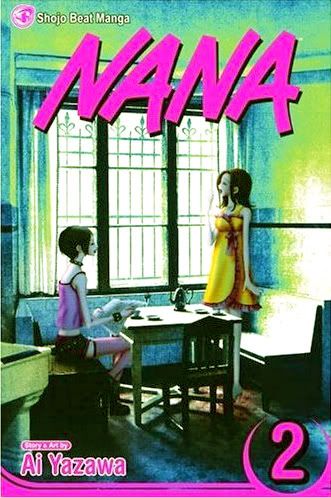
Nana vol. 2
Publisher: Shojo Beat/Viz Media
Writer/Artist: Yazawa Ai
English Adaptation: Allison Wolfe
Translation: Goto Koji


What happens when two girls named Nana meet? Will physics allow them to occupy virtually the same physical space, or will the universe die screaming as anti-matter and matter collide, ripping reality apart? Actually, all potential problems are solved when punk Nana Osaki notices girly Nana Komatsu’s resemblance-- in personality only, please-- to a famous dog and renames her friend Hachi, thus reducing the Nana surplus by one and saving the universe as we know it.

The fun starts when Shoji, Nana K’s long distance boyfriend, sends her a special text message: “Cherry blossoms R blooming!” and tells her he finally got into art school. So she quits her video store job, runs through the snow in her monster lace-up platform boots, jumps the shinkansen for Tokyo for their long-awaited reunion. She’s saved her money, waited ever so patiently and now all her dreams are coming true…

If only Nana K can be patient for a few hours more. The trains’s delayed due to snow and there’s only one empty seat- empty but for a sinister looking black guitar case guarding the sleeping girl in the window seat next to it. This girl is nothing like Nana K; she’s all dressed up in black, looks like an erotic vulture in her leather jacket, thigh-high fishnets and clunky engineer boots.

Nana K’s decision to take the seat changes both of their lives. And her name.

You know, with the comic series emerging as one of Japan's top-selling titles of all time and the 2005 film adaptation spawning even more Nanamania, a sequel became inevitable:

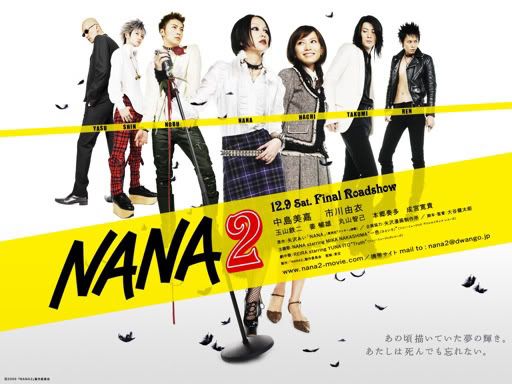
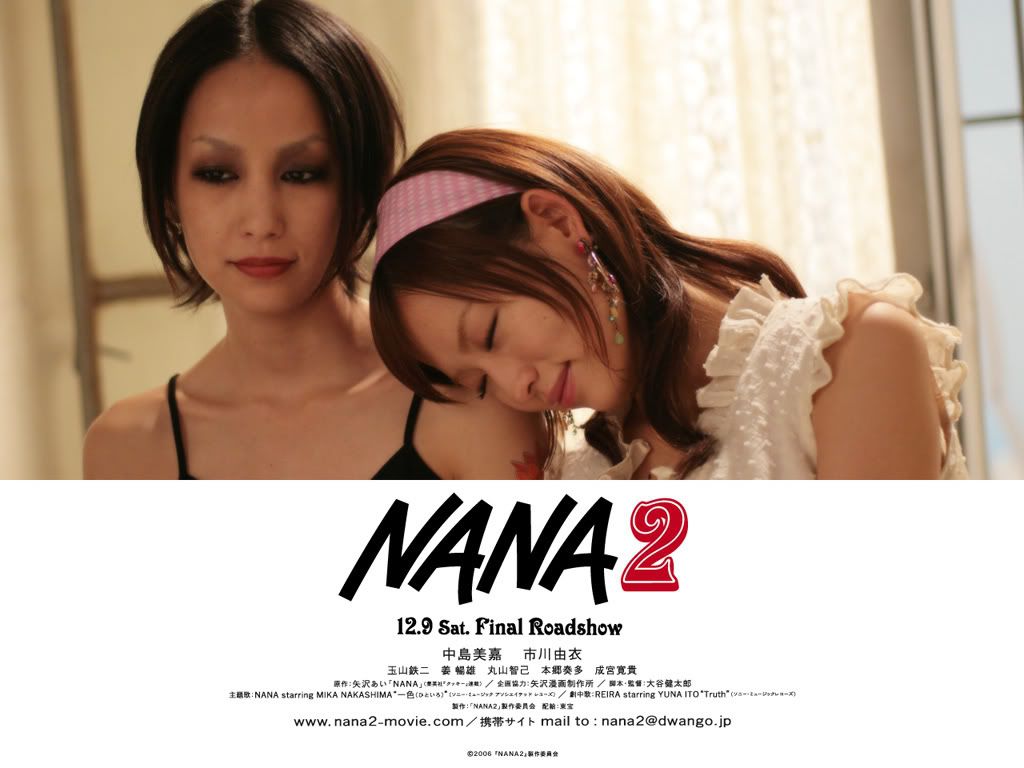
Nana 2 debuted in 2006. Again, Nakashima Mika starred as Nana O, the fame hungry punk rocker. But Miyazaki Aoi didn't reprise her role as Hachi. Why? What do I look like, Japan Film Insider? Whatever the reason, Ichikawa Yui took over the role. The sequel wasn't as big a hit as the first, and the few people I talked to about it when I lived in Japan expressed their disappointment with both movies, and their preference for the animated series. Oh well, at least Nose Anna returned as Junko!

Anyway, back to the comic review.

And so Yazawa Ai finally brings our two Nanas together, on a snowbound train aimed at Tokyo. Through various circumstances and perhaps the machinations of Nana K's personal deity/devil the Demon Lord, the girls end up as roommates in a funky Tokyo suburb along what I’m guessing is the Sumida River. I base this on my own scientific Nana research, consisting of going to Tokyo and looking for a river. During one Golden Week excursion to Tokyo, I wanted to go to Kojima-cho to look for Jackson Hole and have a Jackson Burger (Hachi's favorite food), but a nasty cold and frequent chilly downpours caused me to limit myself merely to reading about it, and having Wendy's (since closed) in Shibuya instead.

Yazawa also begins weaving together the supporting casts. At first it seemed as though we were going to be treated to parallel narratives but Yazawa skillfully mixes the very different characters to create dramatic tension and humor.

Nana K’s impulsive nature comes to the fore as she falls head over heels in platonic love with her slightly sinister, definitely mysterious doppelganger. If fate and coincidence are to be recurring themes, then it certainly seems that Nana K’s intuition serves her well. Because the story cannot happen unless she appends herself to Nana O’s life, works her way into the center despite their differing backgrounds and outlooks. Failing that, both characters and all their friends would be out of work and they'd end up hanging around Junko's snack bar all day. And we would have nothing to read.

Nana K is a reckless romantic, while Nana O is coolly self-possessed. But how will her punk rock façade hold up when living with a girl who loves Trapnest, the very band her own lover abandoned her to join (to the point of adorning their shared pad with a massive fannish poster of the group)… with her love crazed, puppydog-like-in-her-clumsy-enthusiasm roomie? That’s the origin of the name Hachi.

Hachiko was a dog who waited at Shibuya Station every day for her college professor owner even after he died. A symbol of loyalty, she’s immortalized in a statue outside the station, and the exit to that area is named after her: the Hachiko Exit. People say if you stand there long enough, the one you’d most like to see will eventually walk by. You can speed up the process by simply text messaging that person and arranging a rendezvous beforehand. But given the mob usually lounging around the Hachiko statue, you should probably wave a flag.

Nana, meet Hachi, your very own loyal, loving pet girl friend.

I think we can all agree Nakashima Mika is perfect as Nana O. She's also a big-time singing star in her own right, and released an album called The End: Nana starring Mika Nakashima that features her songs from the second film. Her comics connection continues- last fall she had a hit song with the theme to the TV drama adaptation of the comic Life.

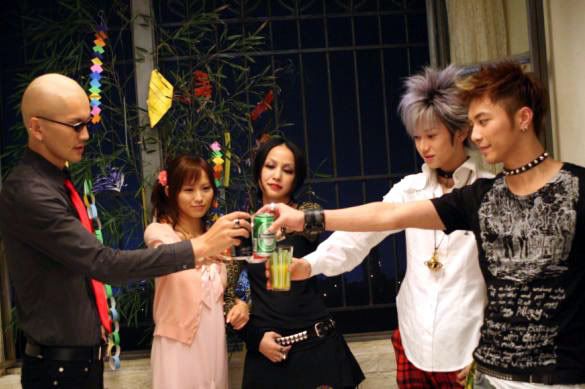
And despite falling victim to the law of diminishing returns, the movie certainly looks like the comic:

Volume 2 is where the story really gets going, where Yazawa sets up Hachi’s fascination with Nana’s shadowy past. It’s strongly character driven, with Hachi’s manic energy linking her with her namesake, entangling them both in each other’s lives. Things don’t so much happen as Hachi makes them happen, from wheedling her way into her dream apartment with Nana, to finding a job at a hip vintage clothing store, to spending all her money getting set up in Tokyo.

Beyond the addictive charms of the lead story, Yazawa gives us the fun and frivolous “Junko’s Place” backup story, where the Nana cast break the fourth wall while remaining totally in character. Their awareness not only of their existence as fictional comic book characters but also of the cast hierarchy is hilariously meta. As much as I love the narrative, as I accumulated volumes I found myself flipping back to "Junko’s Place" to catch up on Jun and her boyfriend and their little area of the Nana world. Each hint Junko’s restaurant might close due to lack of business only intensifies my obsession. What if Junko’s Place does close? What will she do? What will we do?

Nana is a drug. You should have to get a doctor’s okay before buying it. A prescription or something, and your health should be carefully vetted before they hand it out. On the other hand, some stressed out, over-worked mothers here are actually turning over all their parental responsibilities to the Nana comic series and allowing it to raise their children:

PS- Note how the covers actually tell a wordless little story of a day in the lives of the two Nanas. On the cover of volume 1, Nana O wakes first and reads the paper in their cozy little dining alcove, Hachi takes longer to get dressed but appears on volume 2, they have breakfast, go downstairs on volume 3, and on subsequent covers do some shopping, have lunch, ride the trains...

Pretty sneaky, Yazawa Ai!

Saturday, May 7, 2011

Happy Free Comic Book Day!

Today was my third time participating in Free Comic Book Day. The first two times were during my long stay in Japan (Hi, Japan! Do you miss me? I miss you!), where it conveniently fell during my annual Golden Week trip to Tokyo (Hi, Tokyo! All my love!). So this was my big initiation into FCBD, American Style. My comic shop of record is currently JJ's Comics & Cards, a store where I'm always treated as though I'm a very special person.

And I am. And so are you!

JJ's Comics & Cards put out a snack spread, offered a lot of discounts-- 10% on new comics, 25% on graphic novels (I should've bought that New Mutants Vol. 1: The Return of Legion trade, but I was trying to keep my purchases down around 20 bucks thanks to a downturn in my personal economy), 50% on action figures-- and had Georgia-based manga pro Adam Arnold on hand to sign copies of his Vampire Cheerleaders/Paranormal Mystery Squad volume 1 book from Seven Seas Entertainment. Which I missed. The signing, not the book. Oops! But more on that in a second or two.

I did buy Arnold's book. It's sexy manga fan service type stuff of the kind I usually ignore. Not that I'm a prude. What I am is pretentious. I wanted to support a local creator, though. Because I've been totally oblivious to this Adam Arnold guy, when I first heard the title Vampire Cheerleaders and the local connection, I expected something self-published and amateurish. I've seen way too much crappy manga online and in print. In fact any crappy manga is way too much. Writers farting out nonsensically random stories, art with the big eyes but awkward figures made of sritchy-scratchy line quality betraying an unsure hand. Heaps of story and visual cliches badly presented in cheap packaging.

While the subject matter may not be my thing, I was pleasantly surprised to find Vampire Cheerleaders to be a slick little book by an actual writer and artists and in no way cheap looking, with very solid manga-style artwork of its type. Well-constructed figures, nice gray tone work. I used to see tons of this stuff at konbini (convenience stores) and magazine shops when I lived in Japan. Not your spectacular Takahashi Rumiko or Yazawa Ai level stuff, but appealing nevertheless. Just from a casual perusal, I'd say if you're into sexayyy manga and vampire vixenry, this book is probably worth your time. Now I'm stoked to give it a real reading and post a review of it later this week.

And now I'm also sorry I missed the author. It would've been fun to hear his point of view and to learn a little bit about how he got started writing and editing manga, plus a little about how these "original English language" manga come about. The pro ones, as opposed to those... others.

I know, I know. "Get to the free comics, you pseudo-intellectual jackass!" you're all screaming at me. "We're dying to know which comics you chose and we really have to pee and it's getting to the point where we can't hold it anymore so if you don't get this over with and end our suspense, we're going to damage our kidneys or burst our bladders or at the very least wet our pants and it'll be all your fault!"

We can't have that! I'd never be able to live with myself! For the love of corn, go pee and by the time you get back feeling lighter and refreshed, I'll finally be telling you yes, I did choose some free comics from the store's once well-stocked but increasingly picked over FCBD display. Here's what I selected:

1. Michael Moorcock's Elric: The Balance Lost by Chris Roberson, Francesco Biagini and Stephen Downer
2. Bongo Comics Free-For-All 2011 (my traditional choice)
3. Baltimore by Mike Mignola, Christopher Golden and Ben Stenbeck
4. Super Dinosaur Super Special! by Robert Kirkman and Jason Howard

That last one? Well, I had an issue of Walking Dead in my hand and one of the store employees pointed out Super Dinosaur is also by Robert Kirkman, so I took it just to be polite. I love Kirkman's Walking Dead, but I'm not a Kirkman fan to the point where I need to have everything the gentleman writes. This looks like a comic book adaptation of the kind of Cartoon Network show I never watch, or a toy line tie-in. Those aren't necessarily bad things, but they also don't serve to attract me as a reader. But once again, I need to read it before I pass too harsh a judgment.

Also arriving at my palatial Roman villa-style estate (heavily guarded by my personal army, so don't get any funny ideas about breaking in here and stealing my fortune in diamonds and rubies and sapphires which I keep lying about like so much bric-a-brac... perhaps I should sell some and give myself an economic stimulus, huh?) via the good people at the post office today: Creepy Volume Two from the delicious Dark Horse Archives series and the surprisingly in-color Star Wars Omnibus: A Long Time Ago... Volume 1, which collects the first twenty-seven issues of the old Marvel Comics Star Wars series, including their adaptation of the first movie by Archie Goodwin, Howard Chaykin and Marie Severin (among others).

I am loaded down with comics to read!