I thought the only bad news we'd get today was the passing of Roger Ebert, that tremendously gifted film reviewer, personality and, in recent years, prolific blogger. But now comes word Carmine Infantino has also died. Infantino had as great an influence on my sensibilities as Ebert did on the way I express my thoughts about them. Which is to say, quite a lot, even though it rarely shows because I'm a stinky writer and artist. Those two guys were gigantic in their respective fields.
Infantino is partially responsible for one of my all-time favorite titles, Kamandi by Jack Kirby. That's a book I intend to celebrate all this month for no other reason than I love it. Infantino tried to land the comic book rights to the Planet of the Apes film series and when he couldn't, he smartly asked Kirby to do something similar. It turned out not all that similar, and Kamandi #20 (which does feature talking apes) introduced me to Kirby and ignited a life-long love of the man's work. At the time, I knew nothing of Infantino. Flash foward a few years and I'd become a total nut about Star Wars. Marvel had Infantino pencilling their Star Wars monthly and that was my introduction to both his name and artwork.
Because of Marvel's Star Wars, I'll always associate Infantino with sharp, jutting chins. Some artists just have a certain defining, instantly recognizable tic. Curt Swan's endlessly similar faces, Gil Kane's forehead lines and clutching hands, John Buscema's glower (and Joe Kubert's), Neal Adams's Batman or whoever shouting and pointing directly at the reader, John Byrne's crosshatched cheekbones.
Jutting chins were Infantino's thing, at least at that late stage in his drawing career. When I finally saw some of his earlier Flash and Batman work in some DC reprint digest, I was shocked. Where are the chins?
Oh, and he co-created the Barbara Gordon Batgirl. See what I mean about his influence? Without that character, I wouldn't have another of my comics faves, the Cassandra Cain Batgirl.

Showing posts with label Carmine Infantino. Show all posts
Showing posts with label Carmine Infantino. Show all posts
Thursday, April 4, 2013


Wednesday, April 3, 2013
Don't Ask: Just Read It! April is Kamandi Month!
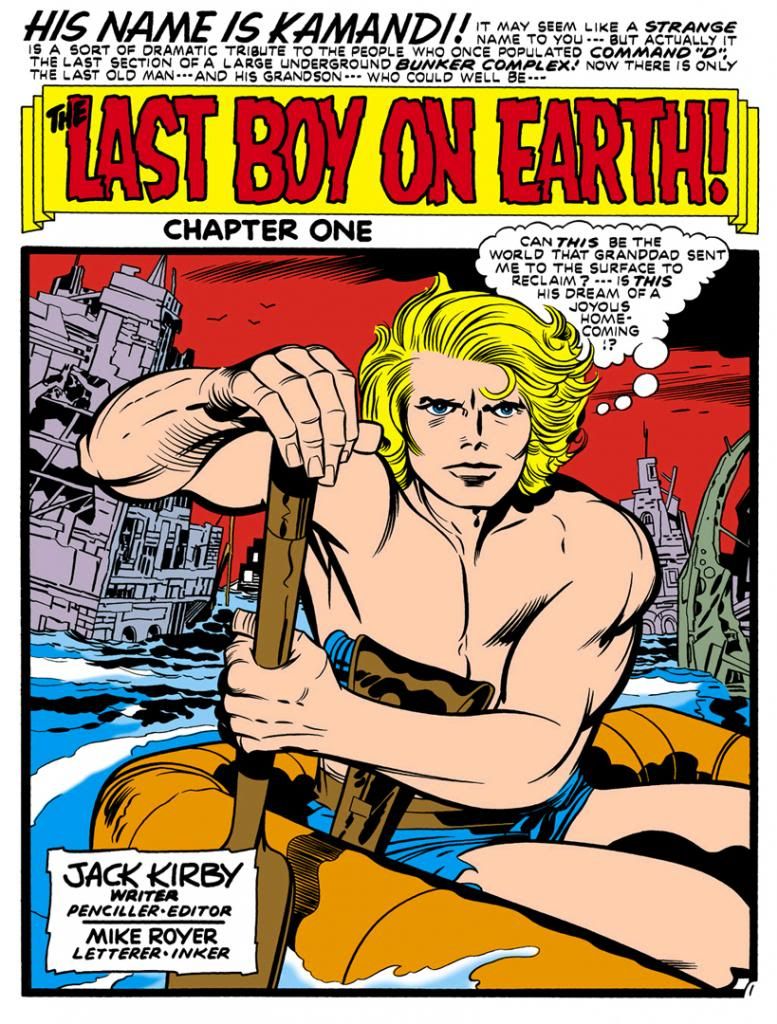
There are many things I love and two of the things I love most-- as close friends know-- are Jack Kirby and Planet of the Apes. Sometimes the things I love don't quite fit together, like Kirby layouts and Alex Toth pencils on X-Men #12. But every so often they combine into a third thing I also end up loving. So it was when Cornelius met the King. Kind of.
I've always heard Kamandi resulted when Carmine Infantino asked Kirby to do something like Planet of the Apes. And no wonder-- the films set off a huge merchandise boom that pre-figured the one for Star Wars-- action figures, playsets, garbage cans, board games, coloring books; everything an Apes-happy kid could want. So it's easy to see why Infantino would want to put DC in the talking ape business (also, DC has a long history with apes).
Eventually, Marvel landed the Apes license and produced eleven issues of a monthly series and twenty-nine of a black and white magazine. Neither book drew more than a cultish following, but on another DC-style earth (Earth-K), Infantino worked a deal with 20th Century Fox and Kirby drew the first five or so issues of DC's Planet of the Apes (along the lines of the 2001 adaptation he later produced for Marvel here in our reality) before handing it off to Mark Evanier and a rotating cast of artists.
Go seek out that black hole that's spinning almost at the speed of light. It'll take you right to this fabulous universe, where Kirby's Fourth World epic went exactly as he'd planned it and his Planet of the Apes ran for 150-odd issues and witnessed the art debuts of both Michael Golden and Frank Miller and an annual written by Alan Moore. Bring some of those comics back with you, too. I'd like to read them!
But here in our world, things didn't work out that way. Denied by 20th Century Fox but stuck on his idea, Infantino cancelled Forever People, ripping a hole in the Fourth World, and then put Kirby to work on a derivative tale of talking apes and the end of the world.
How lucky for us Kirby could never contain himself to mere imitation. Instead, he took some old concepts he had rattling around and worked them into a post-apocalyptic tale in his own style, with a rambunctious long-haired teen as its lead and more than just talking apes as villains. In Kamandi's world, not just apes but animals of all kinds talk. They have little kingdoms of their own and wage interspecies war against each other with Kamandi frequently caught between the furred factions.
Marvel's Apes tales, written by Doug Moench and initially drawn by Mike Ploog, went beyond the meagre budgetary considerations of the movie series and gave us all kinds of weird vistas. Giant brains floating in tanks, apes acting like 19th century mountain men, an adventure inside Mount Rushmore, bionic apes. And those crazy city-ships. Kirby's vision was even more expansive, covering the entirety of North and parts of South America, germs from space, radioactive astronauts, Kamandi as a jockey on the back of a horse-sized grasshopper, the fevered paranoia of Richard Nixon and my favorite-- Chicagoland, a Prohibition-era museum city populated by robots enacting all the classic gangster stereotypes of the era.
While Moench's "Terror on the Planet of the Apes" opus features Jason, one of comics' true assholes, as its human lead, Kirby's book stars a young man billed as "The Last Boy on Earth." His name comes from the bunker in which he lived with his grandfather, but his looks and personality are made up of purest Kirby.
Actually, Kamandi resembles any number of young dudes who used to terrify me back when I was a kid in the deep south. I mean, obviously we had modern swimming pools way down there in Georgia, but these guys-- and their girlfriends-- also liked swimming in rivers, lakes and "blue holes," where underground aquifers bubbled up in the form of cold springs. Or tubing down creeks. And their swimwear of choice was usually cut-off blue jeans just like the ones Kamandi sports. Like those guys, Kamandi's a roughneck who takes no guff from anyone. Not from lion kings, panther princes, or angry ape sergeants. With his quick temper and shirtless style, Kamandi would fit right in with these Lynyrd Skynyrd-loving southern boys.
He's prettier, though. Look at his glorious hair, the kind even Farrah Fawcett-Majors would have envied in her Charlie's Angels heyday.
And a heck of a lot smarter. Kamandi's got brains. He doesn't just experience his world and fight against it; he searches for answers to all its mysteries. The "Last Boy on Earth" (as the book's subtitle calls him), Kamandi journeys largely alone through Kirby's madcap future, always on the lookout for others like himself and the ultimate answer to how things got so mixed up in the first place. Cortexin, huh?
For the next few weeks, we're going to spend some time with Kamandi and really get to know him, his friends and his world. Come along with me, won't you? Let's close our eyes, drift into comas for hundreds of years and awaken in the future, after the Great Disaster. Humanity has abandoned its cities and fled into the forests. The ascendency of animal-kind has arrived.
Now-- open your eyes.
What do you see?
Tuesday, May 24, 2011
Happy Birthday Carmine Infantino!
Carmine Infantino turns 86 today. One of the all-time greats, Infantino helped launch the Silver Age of comics with his work on a more sci-fi based Flash with Robert Kanigher at DC, but eventually drew for both Marvel and Warren as well. He's one of those guys it'd be easier to list the characters he didn't draw during his career. Wolverine. The end. Heck, Infantino probably drew Wolverine. I'm just clowning around here.
But I'm being very serious when I say that it's great to know Infantino's still around, and these days I'm really enjoying his work on the Marvel Star Wars series as reprinted by Dark Horse in their Star Wars Omnibus books. I also think his re-designed costume for the Flash is one of the most visually appealing costumes worn by any superhero. It's bold, bright, simple and conveys exactly what the character is all about-- he's fast as lightning.
But I'm being very serious when I say that it's great to know Infantino's still around, and these days I'm really enjoying his work on the Marvel Star Wars series as reprinted by Dark Horse in their Star Wars Omnibus books. I also think his re-designed costume for the Flash is one of the most visually appealing costumes worn by any superhero. It's bold, bright, simple and conveys exactly what the character is all about-- he's fast as lightning.
For Kamandi -- With Love and Squalor
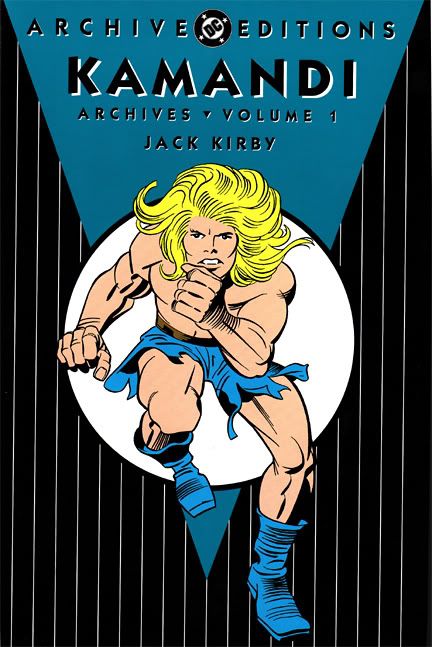 What do you get when you’re DC publisher Carmine Infantino and you float the idea that Jack Kirby should rip off Planet of the Apes? Not a Planet of the Apes rip-off, that’s for sure. If Infantino expected Kirby to content himself with mere talking simians, he was sorely mistaken. And yet that’s pretty much how it happened, and how approximately 65 million years later, we lucky fools ended up with this slick and weighty DC Archives edition of Kamandi.
Or, as I like to call it, Kamandi: The Last Boy on Earth, because that’s the series’ title and I’m clever that way.
Chapter One: The Last Boy on Earth!
Kamandi is a futuristic, roughneck young hippie in a time where barbers have gone extinct, but cut-off denim and motorcycle boots are all the fashion rage. He’s the Charlton Heston surrogate for this madhouse world where not only do gorillas talk and ride horses, but lions and tigers tool around on three-wheelers and radioactive scientists float overhead in helium balloons.
Because it’s Kirby, Kamandi can scarcely contain itself. While he was always possessed of a febrile creativity, as soon as Kirby hit DC, his imagination went into some sort of turbocharged overdrive. His Fourth World stories are over stuffed with incident and new characters, and Kamandi features a similar breathlessly paced narrative. Reading a DC-era Kirby comic like reading ten stories in one.
Kirby himself was busy then, too. I believe he was simultaneously producing Jimmy Olsen, Orion, Mr. Miracle and Forever People, spackling his living room wall in preparation for repainting it and mediating the Paris Peace Talks between the United States and the Democratic Republic of Vietnam (DRVN). And just as he saved our world in reality, Kirby destroys it in the pages of Kamandi. It's the post-apocalypse with a new status quo of underground bunker-dwelling and scavenging for food. Kirby destroys that almost as soon as he introduces it, too. When we first meet Kamandi, he's rafting through a flooded New York with a Statue of Liberty as majestically ruined as the one in the Apes film series, its obvious antecedent. Kirby leads with a splash page followed by a double-page spread no less!
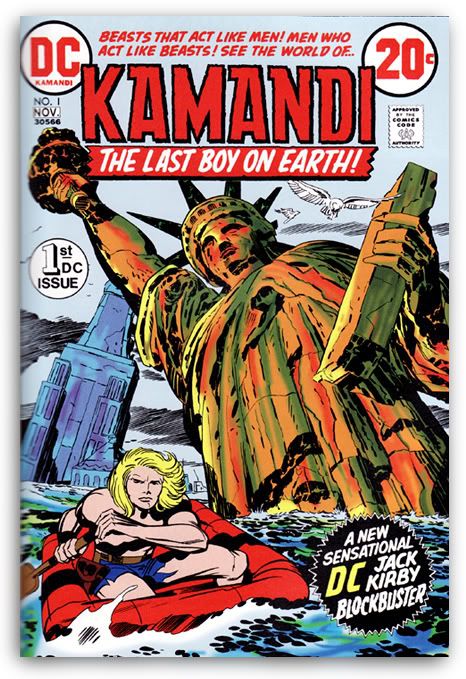
DC... next time you destroy
the Statue of Liberty in a story,
do it the Kirby way.
Six pages in and Kamandi’s guardian/mentor is dead (he barely gets any dialogue), Kamandi’s battling a talking wolf who foolishly beckons, “Here! Give me that gun! --- Come on ---! I won’t hurt’cha!” and then Jolly Jack decides he needs to do something to pick up the pace before reader ennui sets in.
The second sees Kamandi’s new-found radioactive buddy Ben reminding him “Don’t forget Ben Boxer, boy! I’m not like the other humans you’ve seen!” As if Kamandi or the readers could forget- Ben Boxer is a man who has to wear an astronaut suit in order not to kill everyone around him with deadly radiation. Oh, and he turns into steel then deals out ass-whuppin’s. Just like the X-Men's Colossus, only not Russian. And a couple of years earlier.
Then we get yet another double page spread, this time of anthropomorphic rats looting the wreckage of the George Washington Bridge.
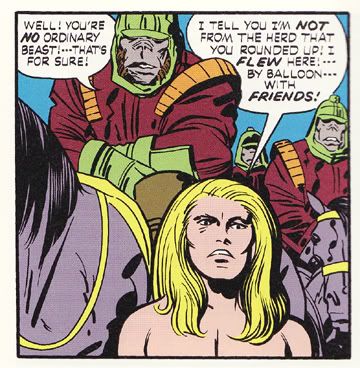
Kirby's gorillas are cooler than
the ones from 20th Century Fox.
Just keep Timothy Burton away
from them.
the ones from 20th Century Fox.
Just keep Timothy Burton away
from them.
It’s not until #3 that the Planet of the Apes similarities fully emerge as roughneck gorillas (are there any other kind?) in green hunting caps and purple jumpsuits capture Kamandi. The cover blurbs come backing more hyperbolic bombast than a decade’s worth of today’s comics:
Welcome to a buried Las Vegas! Once a playground for men – now, a sinister hunting ground for gorillas!
So the apocalypse didn’t change much. And then this:
Complete in this issue! “The Thing That Grew on the Moon!”
A thing! And it grew… on the moon! As if the loincloth-sporting gorilla on the cover wasn’t enticement enough. Comics today could use more of this kind of cover copy-- at once hucksterish and tongue-in-cheek, and instantly appealing.
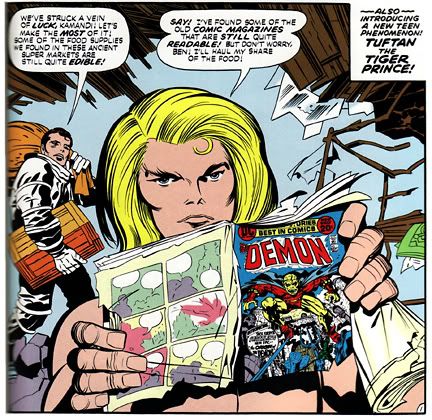
Who says this isn't the Age of
Kirby Self-Promotion? Kirby
works in a little plug for another
of his comics. "Quite readable,"
Kamandi? Quite readable indeed!
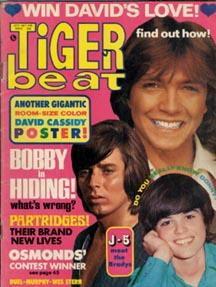
I think Kirby may have had bigger plans for Tuftan, the Tiger Prince. He comes on the scene in #4, heralded by a splash page text box labeling him a “new teen phenomenon.” I’m not sure if Kirby means Tuftan is a teenager (and more to the point, a tiger), or that he hopes Tuftan catches on with 70s teens the way David Cassidy and his half-brother Sean did, or Kristy McNichol, or skateboarding, or discotheques or feathered hair. After all, the kids loved Tiger Beat magazine; how could they not love Tiger Prince?


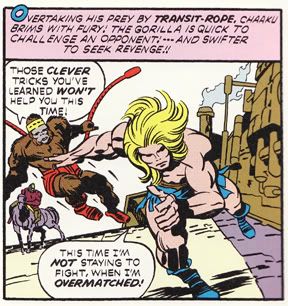
In the post-apocalyptic future,
half-naked neo-hippies will frolic
with headband and loincloth wearing
gorillas on transit ropes!
Kamandi and Tuftan get caught between the warring tiger and gorilla armies, and Kamandi gains a talking human girlfriend named Flower… who shamelessly goes around shirtless! Which is only fair, since Kamandi also flaunts bare-chestedness. Flower’s hair gives her some Lady Godiva-style modesty but Kirby’s notion of upper-body nudity is amazingly egalitarian.
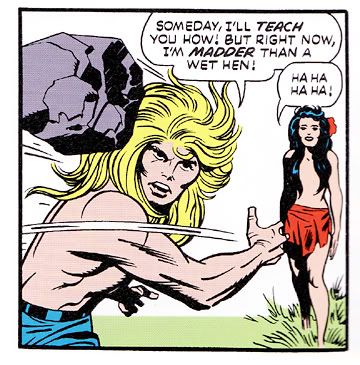
In Kirby's future anyone may go
topless without shame! Viva la difference!
topless without shame! Viva la difference!
Almost as soon as Kirby establishes the romance between Kamandi and Flower and hints at the eventual reestablishment of some sort of humancentric society, tragedy strikes our young lovers. Kirby examines its aftermath in Kamandi #7, with a chapter intriguingly titled “The United States of Lions." Surprisingly, it has little if anything to do with unions, states and only tangentially features lions. Beginning with a funeral and ending with a skyscraper battle, it's actually Kirby’s parody of King Kong, substituting a massive gorilla; Kong’s equal in stature but superior in conversational skill.
And that’s just a quick overview of the first seven issues! I’m too exhausted to tell you all the details about the last three in this book, in which we visit “Tracking Site,” battle the savage flying bats and the freakish, sinister homunculus who dwells there, intent on unleashing a world-ending bacterium for some obscure reason Kirby can barely take time to explain to us in the breathless rush of his futuristic narrative.
Chapter Two: The Waiting Secret!!
If you haven't guessed by now, Kirby goes pretty far afield, given the series’ original mandate. And while Kirby wasn’t above rehashing classic movie plots he never failed to add twists the original wouldn’t dare. Imagine how insane Beneath the Planet of the Apes would’ve been if, instead of skinless mutants, the gorilla army had encountered talking lions on three-wheelers.
While suffering from an over-reliance on capture, escape and evasion plotting (it becomes repetitive), Kamandi is a sterling example of Kirby’s off-the-wall and unrestrained storytelling, honed over decades of professional work. While he may not have been as interested in the book as he was in his New Gods, the fact remains the man just could not half-ass things even if he tried.
Who else would engineer an entire future Earth, populate it with talking animals of nearly every species, continually hint at a central mystery that unravels intermittently throughout the adventures and introduce brand new characters practically on a page-by-page basis?
From reading these, I can’t help but see Kirby as a mostly intuitive storyteller. Certainly the man was a sponge, soaking in bits of science, legend and myth, and good old Hollywood movies; all of this he'd combine and alter to suit his story needs. Mike Evanier's recollections give me the impression Kirby would frequently come up with a particular direction for a story... then produce something almost totally counter to his original intent. Creating on the fly, always bubbling over with ideas. With that in mind, I don’t see an overall plan here, just incidents piled on incidents.
Groovy incidents. With the intent to entertain the bejeezus out of anyone who buys Kamandi.
And while Kirby may never have written the Great American Novel, it’s probably no accident Kamandi’s adventures take place in the western regions of the former United States. As soon as he departs his underground bunker near New York, Kamandi becomes the classic American pilgrim, sojourning in locales near Las Vegas, Yellowstone Park, even ranging as far as South America in a tip of the hat to Butch Cassidy and his partner in crime, the Sundance Kid.

From James Fenimore Cooper to Mark Twain and Brett Hart, to the relatively more recent Jack Kerouac and Thomas Berger plus many others, American novels frequently explore western migration as related to rugged individualism, which Kamandi certainly personifies. In fact, this is probably the most important defining traits of what we characterize as American literature, at least in the 19th century, and much of the 20th.
The west is the quintessential setting for American literature, with Kamandi the descendant of Huckleberry Finn by way of Col. George Taylor. And like Huck, and Berger’s Jack Crabb, Kamandi rebels against unjust societal expectations, cannot tolerate a life in either literal or figurative captivity. He must remain in motion, forever restless, the personification of our nation in its youth. Unable to relate to most surviving humans, Kamandi remains apart from each culture he encounters. Kirby reinforces this by repeatedly separating Kamandi from Ben Boxer's scientists and having Kamandi assert his human identity and equality to his animal overlords who insist on treating him condescendingly as either a pet, a mascot or an enemy.


As science fiction, technological themes abound in Kamandi, but these are traditionally conflated with western ones in more mainstream American literature as well. While Cooper might bog down the narrative of his 1823 novel The Pioneers to describe a stove in almost Luciferian terms, Kirby, the once and future king of his four-color milieu, creates bizarre flying vehicles and war machines with a gestural whim, yet never slackens the story's pace.

The series has a strange dichotomy-- for humans, advanced technology is of the past, and there’s a nostalgia for what humanity has lost, but along with it, an implied criticism of the queasy, mindless consumerism and complacency that led to this outcome in Kirby’s use of imagery featuring the detritus of a lost civilization: familiar shopping mall signage and weathered sculptures of American presidents (even significantly including one of Richard M. Nixon, never a Kirby favorite) whose identities have been lost to history.
Still, in order to reclaim mastery over the world, which Kamandi sees as a human birthright, he must solve these archaeological mysteries. To this end, Ben Boxer and his scientific comrades are forever seeking the lost “Apollo Project” in an effort to understand this disordered reality.
And while technology is used to destroy (being a Kirby action-fest, violence and weapons-based imagery predominate), there’s also a hopeful quality. If one can defeat the barbarian bat-creatures and the horrific human-created bacterium that can kill all life… one might at the very least, as in "The United States of Lions," find a peaceful place where one might belong.
If, that is, Kamandi can overcome his temper and tendency towards violence. Then again, to Kirby these were also human qualities. To create and destroy, our recurring pattern, even among animals with anthropomorphic qualities. Kamandi lives in a world ruled by violence, both casual and institutionalized- rowdy fistfights, warfare and gladitorial games coexist. Kirby might remind us these, too, are human inventions.
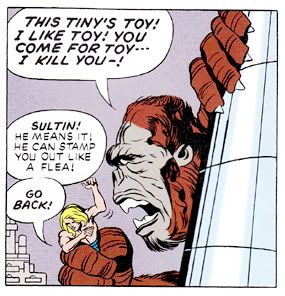
Kirby does Kong. Get Peter
Jackson on the phone! We need
an epic Kamandi movie!
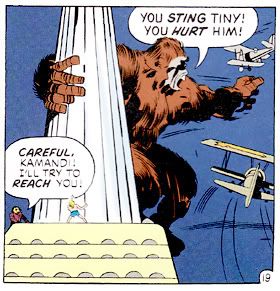
Franklin Schaffner never thought
to put his apes in biplanes, but it
would've been cool if he did. These
are actually lions. Lions in biplanes,
attacking a giant, talking ape who
calls himself Tiny. God, we need
another Jack Kirby.
Chapter Three: The Monster Fetish!
We’re lucky enough of the art exists for DC to gather it all into this hefty and cleanly-designed hardcover. We can enjoy its prime Kirbyness, where his stylistic flourishes, unhindered by the slick ink work from Joe Sinnott at Marvel and the scratchy, unfinished line of Vince Colletta at DC, erupt. Kirby's use of splashes backed by innovative gutter-crossing double spreads on pages 2 and 3 gives the stories a wide-screen feel, opening up the scope and dazzling the reader with Cineramic imagery like a ruined Nevada town, preserved for animal archaeologists by the dry desert air, an Ozymandian image at once humorous and melancholy.
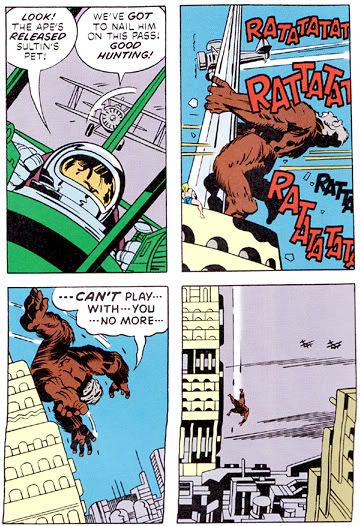
Sic semper Tiny! "Can't play---
with --- you --- no more." He's not
even angry at the lions who killed him.
Isn't that the saddest comic panel ever?
In the Kamandi Archives reprint, the blacks are crisp, the colors smooth. The reconstruction is akin to looking at a restored print of a Cecil B. DeMille epic. These stories were originally printed on grey-toned newsprint which almost immediately began to yellow. And they featured line screens that were practically planet-sized compared to today’s. Now we can see the art on glossy white, with screens so fine they allow the color fields to appear as smooth, flat areas. While this takes away some of the immediacy and ephemeral quality of the originals, it allows us to study the line work unobscured by cheap paper and indifferent printing.
This is especially educational because Mike Royer’s inks always bring out the Kirbyness of Jack Kirby’s pencils. From interviews I’ve read with Royer in the Jack Kirby Collector (a product of the wonderfully nice people at TwoMorrows), it seems his intent was always to preserve the pencils as much as possible. I love this approach, because the attraction of a Kirby comic is its uniqueness. He’s oft-imitated, but no one has ever fully captured the intangibles of the true Kirby.
The most others can do is provide the bombast and overkill, without the humane qualities. Kirby strikes me as having a genuine love for people, be they the shirtless, blonde hippie kid type or the kind hidden in an animal’s fur and sinew.
Monday, May 16, 2011
Star Wars/Nothing but Star Wars/Trying to forget/Those Star Wars of love...
My, what a crowded galaxy! It's stuffed to the rim with your Ahsoka Tanos and your Anakin Skywalkers (both Jake Lloyd and Hayden Christiansen variety), characters who seem deliberately designed with their insipid tweeness to drive us geeks insane with futile fan-rage. Ah, Star Wars! For every Boba Fett, a Watto, a Wicket W. Warrick.
Perhaps their purpose is to cull us from the Warsian fan-herd; after all, if you don't like Jar Jar Binks and his slapstick antics, perhaps the Star Wars universe isn't meant for you. You can't blame it all on George Lucas and the legendary decision he made to retain the merchandising rights to his cinematic creation. I doubt Lucas's involvement with the comic went much beyond cashing whatever checks Marvel sent his way, yet nowhere will you find a more impressive hive of fun and villainy than in these ancient comics as reprinted by Dark Horse in their Star Wars Omnibus A Long Time Ago.... Volume 1 collection.
Good lord, just typing that wore me out. Let's check out a few of the various Roy Thomas and Archie Goodwin contributions to the Star Wars cast.
 He likes to wear Juliet Prowse's (no relation to Dave) used leotard he bought off Ebay.
Who are you to judge? Crimson Jack will beat you to death with his mighty lumberjack beard.
Crimson Jack (first appearance Star Wars #7): A red-haired, bearded bear of a man, a space pirate who struts about wearing what appears to be a dance leotard or some kind of body suit, plus folded down buccaneer boots. With his physique, his crew of hearty cutthroats and an entire Imperial Star Destroyer at his command, are you going to mock his sartorial choices? I'm sure not. When Han Solo leaves the Rebels to return to Tatooine and pay off Jabba the Hutt (remember that reward he got in the first movie-- a reward so large, he had to load it onto the Millenium Falcon in several crates?), it doesn't take Crimson Jack long to show up and rob Solo. What a humiliation. All that money, lost to a guy who wears Danskins.
 Misandrist fashionista, somewhat competent space-pirate Jolli shows
Han Solo what the five fingers said to the face. All because she suddenly feels
sexual attraction for the first time after being raised by a pack of violent criminals.
Jolli (first appearance Star Wars #7): Crimson Jack's right-hand woman, Jolli is equally as scantily clad. She favors a big green beret, a yellow choker and a red two-piece bikini. Plus a couple of blasters in yellow holsters strapped to her hips. With her quick temper and itchy trigger finger-- plus purple pageboy haircut-- Jolli makes a formidable foe for Princess Leia and Han Solo. At first eager to kill Han, Jolli finds herself conflicted between feelings of murderous rage towards the entire male gender and desire for that one roguish Corellian in particular thanks to an offhand remark by Leia regarding Solo's kissing prowess. This leads to an amazing scene where Crimson Jack has to stop Jolli from killing her fellow crewmembers, because as she says, "Just because a person talks about something doesn't mean she's ready to go at it!" Poor Jolli. Her sexual awakening comes surrounded by a bunch of crusty, unsympathetic space jerks and they're all she has to unburden herself to! She's so embarrassed explaining her outburst, she slaps Solo.
 Overture, curtain, lights/This is it, the night o' nights/No more rehearsing and
nursing our parts/We know every part by heart... Han Solo enters the
Friz Freleng Zone.
Hedji (Star Wars #8): Solo's first recruit for his mission to save a small village from bandits is Hedji, a tall purple porcupine with buck-teeth. Hedji can shoot his quills with deadly accuracy, much like James Coburn and his switchblade in The Magnificent Seven. I remember when I was 9 years old, sitting in the darkened theater marveling at the science fantasy world unreeling before my wide eyes and thinking, "What this story needs are more anthropomorphic woodland creatures right out of Looney Tunes and Merry Melodies." Little did I know we'd get not one but two of them in short order, thanks to comic scripter Roy Thomas!
Jaxxon (Star Wars #8): A green bipedal bunny of the "lepus carnivorus" species. Others have already described him at length, so I don't need to go into him here except to note writer Archie Goodwin later gave him a couple of foils named Dafi and Fud.
 Another strong yet scantily-clad female. You don't mess with Amaiza, who is so
obviously a Howard Chaykin-designed character.
Amaiza (Star Wars #8): It seems every woman in the Star Wars universe not named Leia goes around flashing flesh. Amaiza is the former leader of the Black Hole Gang and wears a red bra with pink fur shoulder trim and matching panties along with red thigh-high heeled boots. With a rose in her silver hair, Amaiza is another woman-- like Jolli and Leia-- with whom one definitely should not trifle. She wields twin blasters and a sharp tongue, the latter of which leads to one of the more memorable quips in the book, courtesy writer Thomas. When Solo asks her, "Did anybody ever tell you that you talk too much?" the wickedly witty Amaiza replies, "One guy... once. Last I heard, his widow was living it up on Bestine with his death benefits." And she apparently has cat eyes for some reason.
 I'm just happy he's not brown and furry, named Don-Wan Coyote and enjoys catalog shopping for overly complex mechanical devices he uses in various failed attempts at catching a fast-moving avian creature.
Don-Wan Kihotay (Star Wars #8): Thomas loves to borrow stories and characters from other sources, many of which are actually appropriate to whatever story he's telling. Don-Wan Kihotay is an obvious swipe of Miguel de Cervantes's famous literary creation, plugged into the plot from Shichinin no Samurai by way of The Magnificent Seven. Thankfully, he's fully clothed, first in Jedi robes and later in what appears to be a suit of 15th century European jousting armor, complete with a lance. With his bald head, disheveled gray hair and long van dyke beard, he's the very image of classic portrayals of Don Quixote.
 As you can see, Jimm is easy to mistake for Luke Skywalker. In fact, I made that
very mistake the first time I read Star Wars #8 and #9 as a child... and it infuriated me!
Freckles? The wrong costume? No chin dimple? Who is this guy? Now I know. Adding
to the confusion, his real first appearance is in Star Wars #7 where he's a middle-aged
Asian man wearing green monk's robes!
Jimm, the "Starkiller Kid" (Star Wars #7/#8): Jimm is a young farmer who looks like a freckle-faced Luke Skywalker wearing a bucket hat with goggles. He's even stolen Luke's farmboy outfit of a karate gi, trousers and puttees. Jimm has such a Luke Skywalker obsession, he's nicknamed himself after Luke's original surname. It's a good name, so Thomas must have figured he might as well get some use out of it. He's young and inexperienced and reminds me of the Schofield Kid from Clint Eastwood's masterful Western Unforgiven, but really the impetuous kid character is timeless. There's one in Shichinin no Samurai, and then there's Luke himself. In #10, Jimm drops the Luke-pants for a woman's white one-piece swimsuit with a wrap-around bodice and some matching motorcycle boots. Later arrested for impersonating Luke and defrauding a Manhattan art dealer and his wife out of thousands of dollars.
 His name and appearance are based on Mad and Groo artist Sergio Aragones. With affectionate humor one would hope! And don't worry-- those stitches will be out and his scar completely healed by the very next issue.
Serji-X Arrogantus (Star Wars #8): The bandit leader Solo and his ragtag group must defeat in order to save Jimm's village. This is a guy with a luxurious mane of jet-black hair and a magnificent handlebar mustache. Plus stitches running in a nasty slashed line down the middle of his forehead, although those vanish by the time he makes his second appearance. The Arrogantuses were always known for their fast healing. As villainous as he is arrogant (hence his surname), Sergi-X sports a double-breasted leather jacket with puffy shoulders and a sunburst emblem on the chest. He also slings a couple of space six-shooters he keeps in a wide, double-holstered gunbelt. Then for some reason, he accessorizes with actual spurs on his cowboy boots. Despite looking like an escapee from a spaghetti western, Serji-X leads the Cloud Riders, a gang of vicious desperadoes. He provides some generic menace and survives about as long as he deserves.
Merri (Star Wars #9): A blond teenaged girl who-- because, once again, her name isn't Leia-- runs around her imperiled village wearing nothing more than a bikini swimsuit. Han, who is probably twice her age, acts more than a little creepy around Merri, gazing at her and declaring, "Maybe this is a place worth saving after all." Turns out she's Jimm's girlfriend, and views Solo as more or less a grandfatherly presence in her life. She does thank him for "[B]ringing out the man in the Star-Killer "Kid!" Han rides off on a bantha, moping but consoling himself for his near-miss at sex offender status by musing that he "got a little feeling of what it's like-- --to be a Jedi Knight!"
Governor Quarg (Star Wars #12): The obese ruler of a ship-dwelling society of scavengers on a water planet. He wears what appears to be a WWII-surplus army helmet complete with camo-netting, a ragged Napoleonic-era field marshal's jacket and an ermine-trimmed king's robe.
Valance (Star Wars #16): A bounty hunter with wavy brown hair going gray just above his ears and a weathered, lived-in looking face. He runs around in a bulky suit of blue armor emblazoned with a small white skull on the right chest. A nasty customer created by Archie Goodwin and illustrator Walt Simonson, Valance turns out to be a cyborg-- his secret revealed in in the final panel of his debut story, a gruesome portait of a man with torn skin hanging down over one of those T800 Terminator endoskeleton thingies. He's a tough guy, but he makes the same mistake a lot of readers probably did: at first glance, he mistakes Jimm the Starkiller Kid for Luke Skywalker. Only a true jerk would do such a thing!
Commander Strom (Star Wars #18): The Imperials were always very Nazi-like and Strom makes it official-- he's basically a refugee from a 1940s war movie, complete with a German word for a surname. He's got an Erich von Stroheim-type bald head and the stiff Prussian attitude of a true stereotype. But what more could you ask of your basic Imperial officer antagonist? All he has to do is show up, sneer a bit and strut around in his jackboots. Practically writes himself!
Senator Greyshade (Star Wars #18): An older, still quite virile-looking gentleman, his iron-gray hair cut and combed into 1970s winged style, with a pencil-thin mustache for extra sexiness. He likes to parade about in an orange space leisure-suit with a high-collared black vest. But instead of a disco medallion and an open-front tunic with chest hair spilling out, Senator Greyshade goes the more dignified route of donning simply a gold sunburst at his collar, which is alternately crew- or turtle-necked depending on which panel you're looking at on any given page. Make up your mind, Greyshade! Princess Leia's former senate rival, Greyshade now runs a giant orbiting gambling resort known as The Wheel. Since his casinos provide the Empire a great deal of revenue, Greyshade feels confident enough to insult Commander Strom openly, mocking him as a "military man... and a fool!"
 Master-Com was known for frequently holding one-sided conversations with
his own conscience. He claimed it helped him "make decisions and work my way
through difficult thought problems. As opposed to drinking myself into a stupor like you
loser meatbags."
Master-Com (Star Wars #18): Senator Greyshade's personal assistant, a brawny-looking droid. Master-Com is the ambulatory control system of The Wheel itself. He and Greyshade are such good pals, it freaks out a bunch of stormtroopers and they react... violently. Doesn't much matter to Master-Com; he's got a lot of spare bodies lying around The Wheel.
Jorman Thoad (Star Wars #25): A heavset bald man in a blue tunic and red cape and the personality of a flamboyant used car dealer-- fitting, since he's a used spaceship dealer. Different galaxy, same thing. He trades ships with Luke and Leia on the planet Centares, allowing them to ditch Senator Greyshade's yacht (something tells me the Senator won't be needing it anymore anyway), then tells them some important information. His most significant physical trait is that his head looks about to pop, like a big pink zit. Thoad really should have that checked out.
Baron Tagge (Star Wars #25): A wealthy galactic entrepreneur and asshole-for-all-seasons, Tagge (with his severe widow's peak hairstyle and triangular chin decoration-- a substitute for the goatee he can't grow?) loves to practice with a lightsaber. Why does he do this? Because Darth Vader blinded him. Now Tagge has to wear a pair of Devo glasses to hide his eerie iris-less eyes. When we first meet him, Tagge is using his mining operations as a cover for his combat strikes against the Rebel base on Yavin IV. And why does he do this? For the petty motivation of showing up Darth Vader. Well, maybe making a fool of the guy who took your sight isn't such a petty excuse for acting like a fascist goon. Just don't let Luke Skywalker anywhere near your-- TOO LATE!
Skinker (Star Wars #27): Yet another bald bad guy! I'm beginning to think Goodwin and Infantino have it in for us hair-impaired people. Perhaps jealousy because we are indeed quite sexy. Skinker is one of those guys who was either unfortunately and presciently named by his parents, or else came by his creepy handle after a lifetime of double-dealing and shady activities. But what he lacks up top, he's cultivated on his chin-- some kind of silver fringe that makes him look as if he's been eating the tinsel out of the Christmas decorations box. Skinker runs a scrap yard on a backwater planet, but also works for Valance. Every time Valance comes into a little money, he pops over to Skinker's, buys whatever droids the guy has lying around-- then blasts them. The man loves to blast droids, and Skinker doesn't seem to mind; Valance pays the going rate and it saves the junkman from having to fix them up. I call that win-win.
Perhaps their purpose is to cull us from the Warsian fan-herd; after all, if you don't like Jar Jar Binks and his slapstick antics, perhaps the Star Wars universe isn't meant for you. You can't blame it all on George Lucas and the legendary decision he made to retain the merchandising rights to his cinematic creation. I doubt Lucas's involvement with the comic went much beyond cashing whatever checks Marvel sent his way, yet nowhere will you find a more impressive hive of fun and villainy than in these ancient comics as reprinted by Dark Horse in their Star Wars Omnibus A Long Time Ago.... Volume 1 collection.
Good lord, just typing that wore me out. Let's check out a few of the various Roy Thomas and Archie Goodwin contributions to the Star Wars cast.
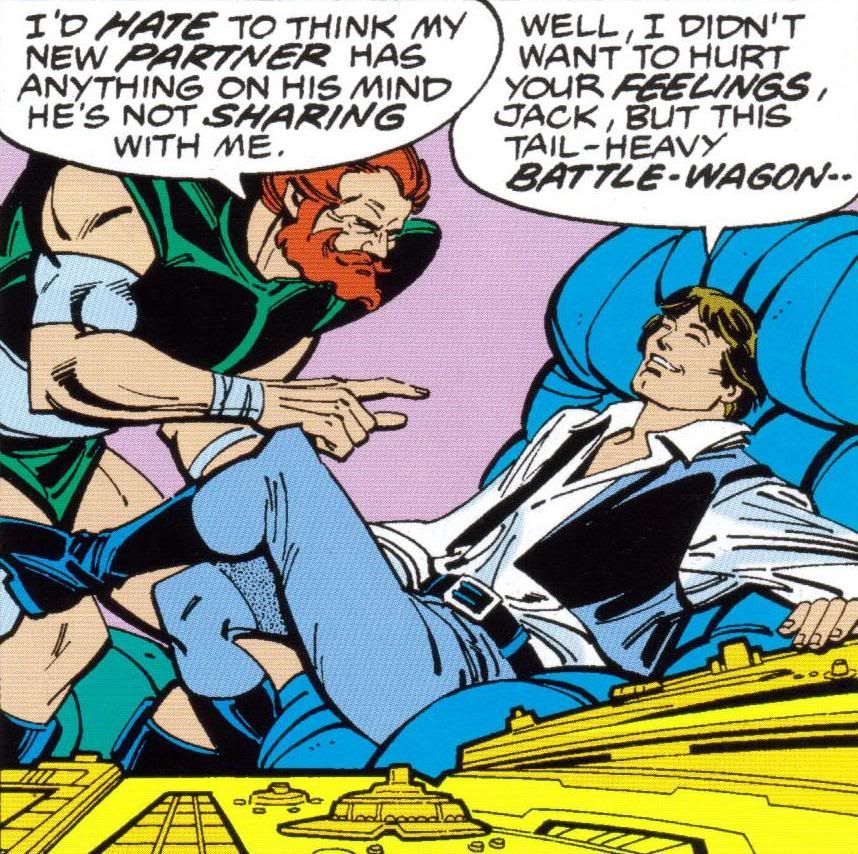 He likes to wear Juliet Prowse's (no relation to Dave) used leotard he bought off Ebay.
Who are you to judge? Crimson Jack will beat you to death with his mighty lumberjack beard.
Crimson Jack (first appearance Star Wars #7): A red-haired, bearded bear of a man, a space pirate who struts about wearing what appears to be a dance leotard or some kind of body suit, plus folded down buccaneer boots. With his physique, his crew of hearty cutthroats and an entire Imperial Star Destroyer at his command, are you going to mock his sartorial choices? I'm sure not. When Han Solo leaves the Rebels to return to Tatooine and pay off Jabba the Hutt (remember that reward he got in the first movie-- a reward so large, he had to load it onto the Millenium Falcon in several crates?), it doesn't take Crimson Jack long to show up and rob Solo. What a humiliation. All that money, lost to a guy who wears Danskins.
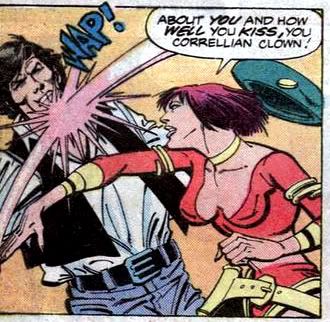 Misandrist fashionista, somewhat competent space-pirate Jolli shows
Han Solo what the five fingers said to the face. All because she suddenly feels
sexual attraction for the first time after being raised by a pack of violent criminals.
Jolli (first appearance Star Wars #7): Crimson Jack's right-hand woman, Jolli is equally as scantily clad. She favors a big green beret, a yellow choker and a red two-piece bikini. Plus a couple of blasters in yellow holsters strapped to her hips. With her quick temper and itchy trigger finger-- plus purple pageboy haircut-- Jolli makes a formidable foe for Princess Leia and Han Solo. At first eager to kill Han, Jolli finds herself conflicted between feelings of murderous rage towards the entire male gender and desire for that one roguish Corellian in particular thanks to an offhand remark by Leia regarding Solo's kissing prowess. This leads to an amazing scene where Crimson Jack has to stop Jolli from killing her fellow crewmembers, because as she says, "Just because a person talks about something doesn't mean she's ready to go at it!" Poor Jolli. Her sexual awakening comes surrounded by a bunch of crusty, unsympathetic space jerks and they're all she has to unburden herself to! She's so embarrassed explaining her outburst, she slaps Solo.
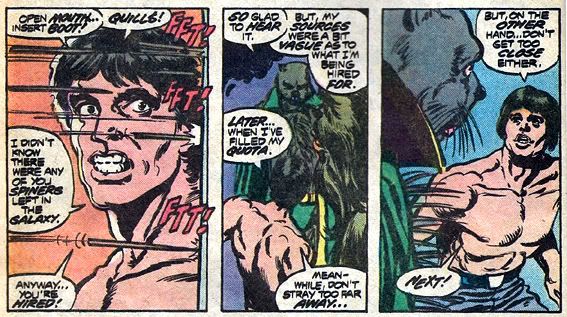 Overture, curtain, lights/This is it, the night o' nights/No more rehearsing and
nursing our parts/We know every part by heart... Han Solo enters the
Friz Freleng Zone.
Hedji (Star Wars #8): Solo's first recruit for his mission to save a small village from bandits is Hedji, a tall purple porcupine with buck-teeth. Hedji can shoot his quills with deadly accuracy, much like James Coburn and his switchblade in The Magnificent Seven. I remember when I was 9 years old, sitting in the darkened theater marveling at the science fantasy world unreeling before my wide eyes and thinking, "What this story needs are more anthropomorphic woodland creatures right out of Looney Tunes and Merry Melodies." Little did I know we'd get not one but two of them in short order, thanks to comic scripter Roy Thomas!
Jaxxon (Star Wars #8): A green bipedal bunny of the "lepus carnivorus" species. Others have already described him at length, so I don't need to go into him here except to note writer Archie Goodwin later gave him a couple of foils named Dafi and Fud.
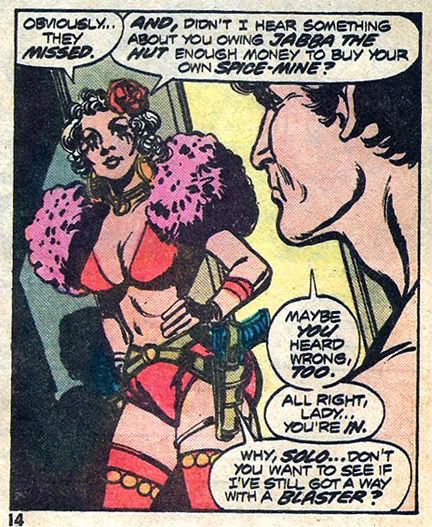 Another strong yet scantily-clad female. You don't mess with Amaiza, who is so
obviously a Howard Chaykin-designed character.
Amaiza (Star Wars #8): It seems every woman in the Star Wars universe not named Leia goes around flashing flesh. Amaiza is the former leader of the Black Hole Gang and wears a red bra with pink fur shoulder trim and matching panties along with red thigh-high heeled boots. With a rose in her silver hair, Amaiza is another woman-- like Jolli and Leia-- with whom one definitely should not trifle. She wields twin blasters and a sharp tongue, the latter of which leads to one of the more memorable quips in the book, courtesy writer Thomas. When Solo asks her, "Did anybody ever tell you that you talk too much?" the wickedly witty Amaiza replies, "One guy... once. Last I heard, his widow was living it up on Bestine with his death benefits." And she apparently has cat eyes for some reason.
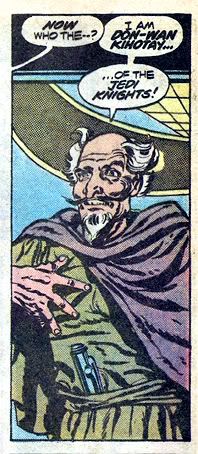 I'm just happy he's not brown and furry, named Don-Wan Coyote and enjoys catalog shopping for overly complex mechanical devices he uses in various failed attempts at catching a fast-moving avian creature.
Don-Wan Kihotay (Star Wars #8): Thomas loves to borrow stories and characters from other sources, many of which are actually appropriate to whatever story he's telling. Don-Wan Kihotay is an obvious swipe of Miguel de Cervantes's famous literary creation, plugged into the plot from Shichinin no Samurai by way of The Magnificent Seven. Thankfully, he's fully clothed, first in Jedi robes and later in what appears to be a suit of 15th century European jousting armor, complete with a lance. With his bald head, disheveled gray hair and long van dyke beard, he's the very image of classic portrayals of Don Quixote.
 As you can see, Jimm is easy to mistake for Luke Skywalker. In fact, I made that
very mistake the first time I read Star Wars #8 and #9 as a child... and it infuriated me!
Freckles? The wrong costume? No chin dimple? Who is this guy? Now I know. Adding
to the confusion, his real first appearance is in Star Wars #7 where he's a middle-aged
Asian man wearing green monk's robes!
Jimm, the "Starkiller Kid" (Star Wars #7/#8): Jimm is a young farmer who looks like a freckle-faced Luke Skywalker wearing a bucket hat with goggles. He's even stolen Luke's farmboy outfit of a karate gi, trousers and puttees. Jimm has such a Luke Skywalker obsession, he's nicknamed himself after Luke's original surname. It's a good name, so Thomas must have figured he might as well get some use out of it. He's young and inexperienced and reminds me of the Schofield Kid from Clint Eastwood's masterful Western Unforgiven, but really the impetuous kid character is timeless. There's one in Shichinin no Samurai, and then there's Luke himself. In #10, Jimm drops the Luke-pants for a woman's white one-piece swimsuit with a wrap-around bodice and some matching motorcycle boots. Later arrested for impersonating Luke and defrauding a Manhattan art dealer and his wife out of thousands of dollars.

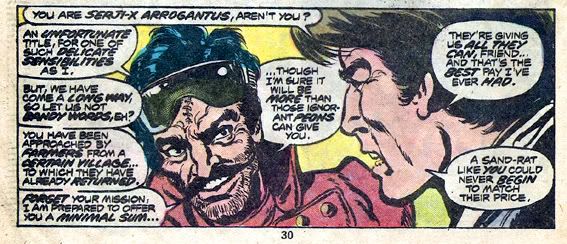 His name and appearance are based on Mad and Groo artist Sergio Aragones. With affectionate humor one would hope! And don't worry-- those stitches will be out and his scar completely healed by the very next issue.
Serji-X Arrogantus (Star Wars #8): The bandit leader Solo and his ragtag group must defeat in order to save Jimm's village. This is a guy with a luxurious mane of jet-black hair and a magnificent handlebar mustache. Plus stitches running in a nasty slashed line down the middle of his forehead, although those vanish by the time he makes his second appearance. The Arrogantuses were always known for their fast healing. As villainous as he is arrogant (hence his surname), Sergi-X sports a double-breasted leather jacket with puffy shoulders and a sunburst emblem on the chest. He also slings a couple of space six-shooters he keeps in a wide, double-holstered gunbelt. Then for some reason, he accessorizes with actual spurs on his cowboy boots. Despite looking like an escapee from a spaghetti western, Serji-X leads the Cloud Riders, a gang of vicious desperadoes. He provides some generic menace and survives about as long as he deserves.
Merri (Star Wars #9): A blond teenaged girl who-- because, once again, her name isn't Leia-- runs around her imperiled village wearing nothing more than a bikini swimsuit. Han, who is probably twice her age, acts more than a little creepy around Merri, gazing at her and declaring, "Maybe this is a place worth saving after all." Turns out she's Jimm's girlfriend, and views Solo as more or less a grandfatherly presence in her life. She does thank him for "[B]ringing out the man in the Star-Killer "Kid!" Han rides off on a bantha, moping but consoling himself for his near-miss at sex offender status by musing that he "got a little feeling of what it's like-- --to be a Jedi Knight!"
Governor Quarg (Star Wars #12): The obese ruler of a ship-dwelling society of scavengers on a water planet. He wears what appears to be a WWII-surplus army helmet complete with camo-netting, a ragged Napoleonic-era field marshal's jacket and an ermine-trimmed king's robe.
Valance (Star Wars #16): A bounty hunter with wavy brown hair going gray just above his ears and a weathered, lived-in looking face. He runs around in a bulky suit of blue armor emblazoned with a small white skull on the right chest. A nasty customer created by Archie Goodwin and illustrator Walt Simonson, Valance turns out to be a cyborg-- his secret revealed in in the final panel of his debut story, a gruesome portait of a man with torn skin hanging down over one of those T800 Terminator endoskeleton thingies. He's a tough guy, but he makes the same mistake a lot of readers probably did: at first glance, he mistakes Jimm the Starkiller Kid for Luke Skywalker. Only a true jerk would do such a thing!
Commander Strom (Star Wars #18): The Imperials were always very Nazi-like and Strom makes it official-- he's basically a refugee from a 1940s war movie, complete with a German word for a surname. He's got an Erich von Stroheim-type bald head and the stiff Prussian attitude of a true stereotype. But what more could you ask of your basic Imperial officer antagonist? All he has to do is show up, sneer a bit and strut around in his jackboots. Practically writes himself!

Senator Greyshade (Star Wars #18): An older, still quite virile-looking gentleman, his iron-gray hair cut and combed into 1970s winged style, with a pencil-thin mustache for extra sexiness. He likes to parade about in an orange space leisure-suit with a high-collared black vest. But instead of a disco medallion and an open-front tunic with chest hair spilling out, Senator Greyshade goes the more dignified route of donning simply a gold sunburst at his collar, which is alternately crew- or turtle-necked depending on which panel you're looking at on any given page. Make up your mind, Greyshade! Princess Leia's former senate rival, Greyshade now runs a giant orbiting gambling resort known as The Wheel. Since his casinos provide the Empire a great deal of revenue, Greyshade feels confident enough to insult Commander Strom openly, mocking him as a "military man... and a fool!"
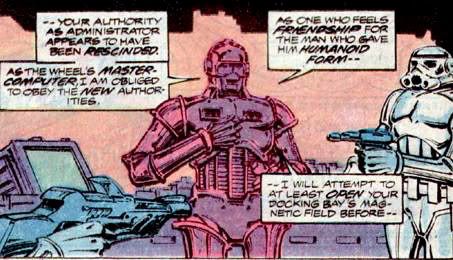 Master-Com was known for frequently holding one-sided conversations with
his own conscience. He claimed it helped him "make decisions and work my way
through difficult thought problems. As opposed to drinking myself into a stupor like you
loser meatbags."
Master-Com (Star Wars #18): Senator Greyshade's personal assistant, a brawny-looking droid. Master-Com is the ambulatory control system of The Wheel itself. He and Greyshade are such good pals, it freaks out a bunch of stormtroopers and they react... violently. Doesn't much matter to Master-Com; he's got a lot of spare bodies lying around The Wheel.
Jorman Thoad (Star Wars #25): A heavset bald man in a blue tunic and red cape and the personality of a flamboyant used car dealer-- fitting, since he's a used spaceship dealer. Different galaxy, same thing. He trades ships with Luke and Leia on the planet Centares, allowing them to ditch Senator Greyshade's yacht (something tells me the Senator won't be needing it anymore anyway), then tells them some important information. His most significant physical trait is that his head looks about to pop, like a big pink zit. Thoad really should have that checked out.
Baron Tagge (Star Wars #25): A wealthy galactic entrepreneur and asshole-for-all-seasons, Tagge (with his severe widow's peak hairstyle and triangular chin decoration-- a substitute for the goatee he can't grow?) loves to practice with a lightsaber. Why does he do this? Because Darth Vader blinded him. Now Tagge has to wear a pair of Devo glasses to hide his eerie iris-less eyes. When we first meet him, Tagge is using his mining operations as a cover for his combat strikes against the Rebel base on Yavin IV. And why does he do this? For the petty motivation of showing up Darth Vader. Well, maybe making a fool of the guy who took your sight isn't such a petty excuse for acting like a fascist goon. Just don't let Luke Skywalker anywhere near your-- TOO LATE!

Skinker (Star Wars #27): Yet another bald bad guy! I'm beginning to think Goodwin and Infantino have it in for us hair-impaired people. Perhaps jealousy because we are indeed quite sexy. Skinker is one of those guys who was either unfortunately and presciently named by his parents, or else came by his creepy handle after a lifetime of double-dealing and shady activities. But what he lacks up top, he's cultivated on his chin-- some kind of silver fringe that makes him look as if he's been eating the tinsel out of the Christmas decorations box. Skinker runs a scrap yard on a backwater planet, but also works for Valance. Every time Valance comes into a little money, he pops over to Skinker's, buys whatever droids the guy has lying around-- then blasts them. The man loves to blast droids, and Skinker doesn't seem to mind; Valance pays the going rate and it saves the junkman from having to fix them up. I call that win-win.
Tuesday, May 10, 2011
Star Wars Omnibus: A Long Time Ago.... Volume 1: A Comic Review
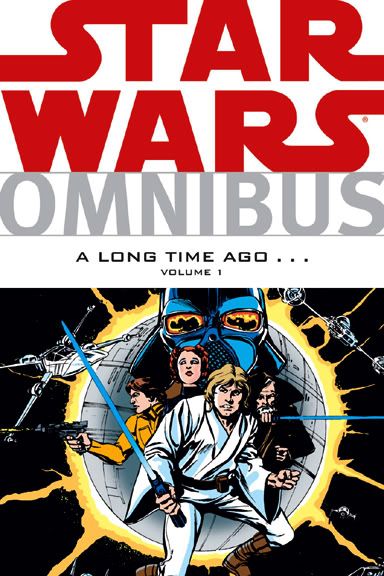 Star Wars Omnibus: A Long Time Ago.... Volume 1
Publisher: Dark Horse Writers: Roy Thomas, Don Glut, Archie Goodwin, Mary Jo Duffy Artists: Howard Chaykin, Carmine Infantino, Alan Kupperberg, Herb Trimpe, Allen Milgrom, Walt Simonson, Steve Leialoha, Rick Hoberg, Bill Wray, Frank Springer, Tom Palmer, Bob Wiacek, Terry Austin and Gene Day
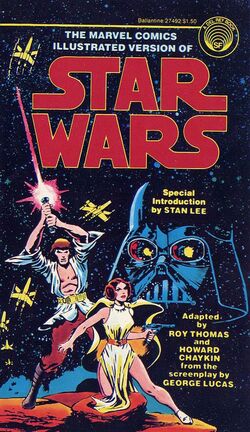
Despite being-- like most of my friends-- a complete freak about all things Star Wars in the late 1970s, I rarely bought the Marvel comic series unless they were doing an adaptation of one of the movies. I'm pretty sure the only complete storyline I owned from this title was a small black and white paperback of the first six movie-based issues from Ballantine, which I began coloring with Crayolas and markers. My impressions of the Marvel version of George Lucas's creation are strobe-like glimpses of random moments in any given plot. Who's this guy who wasn't in the movie? How did Luke get to this planet? Where's Darth Vader? Why is Han hanging out with a giant green bunny, who's something of an asshole to boot?
Face it, few of these early stories are classics. This volume showcases Roy Thomas's skills in adaptation and pastiche, but also his taste for the silly. He immediately casts Han Solo into the Takashi Shimura role in a comic book version Kurosawa’s classic film Shichinin no Samurai (That's The Seven Samurai to you and me, Russ), with Han and Chewie recruiting some fighters to help space-villagers fight space-bandits. Or maybe it's The Magnificent Seven, but with a porcupine guy instead of James Coburn's knife fighter. Considering how much Lucas borrowed from Kurosawa, Thomas has the right idea. But he can't resist introducing Bugs Bunny into the mix. Meet Jaxxon, the infamous green rabbit. Roughly as popular as the reviled Jar Jar Binks, but mercifully obscurer, Jaxxon never got any screen time in the prequels or any of the spin-off animated series, and neither Kenner nor Hasbro ever produced him as an action figure.

Other Thomas touches include Don-Wan Kihotay, a straight lift of Miguel de Cervantes’s famous creation and a villain named Serji-X Arrogantus, apparently an affectionate parody of artist Sergio Aragones, complete with Aragones's magnificent black mustache. What kind of name is Arrogantus? I know the various Darths often chose wicked-sounding surnames-- Sidious, Maul, Vader-- in order to frighten. But what else could someone named Arrogantus become other than a throwaway creep in a hastily written comic book? What kind of family could he have come from? Still, Thomas's script for the movie adaptation is filled with punchy descriptions and clever ideas like the explosion that destroyed the Death Star taking days to burn and providing a spectacular if temporary tombstone marker for Grand Moff Tarkin's great failure. If George S. Patton was right and fixed fortifications are monuments to the stupidity of man, so then are giant space stations with unshielded exhaust ports.
Plus I have to give him credit for another cool idea. At issue #6's conclusion, Thomas corrects one of George Lucas's most egregious mistakes (prior to conceiving and producing the prequel trilogy, that is) and prefigures MTV’s efforts by twenty years when he mentions in a caption that, yes, Chewbacca will also receive a medal. Hayden Christensen and Natalie Portman, unfortunately, are beyond repair.
Second scripter Archie Goodwin's settings and situations owe more to Flash Gordon, with an appropriately swashbuckling feel. Goodwin has Luke visit an all-water planet to hang out with a young Kevin Costner (inspiring Costner's notorious 1995 flop Waterworld) and sends the whole gang to an orbiting satellite of casinos that would make Futurama's Bender drool if he were programmed for that sort of thing. And so it goes for the rest of this volume. Star Wars characters sort of cut and pasted into comic book plots lifted from all the familiar sources.
Since there were no “Expanded Universe” tales or overall continuity to these adventures back in 1977, the Marvel writers were free to make up all kinds of wild characters, planets and situations. Besides the ridiculous Jaxxon and the amusing Serji-X, there's a cool and conflicted bounty hunter named Valance with a hideous secret, bald Yul Brynner impersonator Commander Strom (an evil Imperial officer), roguish Senator Greyshade and his pal, the chunky droid Master-Com. My favorites are Crimson Jack, the pirate king who commands a stolen Star Destroyer, and his first mate Jolli, the tragic, man-hating ass-kicker with a purple pageboy haircut and a cute green beret. These two repeatedly bedevil Han Solo.
Howard Chaykin’s art in the first issue is shaky and rushed, but things improve rapidly with fine ink work from Steve Liealoha and Tom Palmer. As a kid, my favorite was the issue featuring the Death Star attack. Assisting Chaykin are Rick Hoberg and a pre-Ren and Stimpy/fine art Bill Wray-- as the X-Wings and TIE fighters zip and zing (and explode), the ink team goes nuts with the feathering and cross hatching. They also fix Chaykin’s likenesses so Han looks more like Harrison Ford and Luke looks less like a middle-aged Kirk Douglas with a California surfer cut. I used to love the artists' depictions of the reflections in the rebel pilots’ goggles and the final panel of all the heroes together at the awards ceremony.
Most of the art in this volume is by the legendary Carmine Infantino, inked with an almost mechanical cleanness by Terry Austin and then more organically by Gene Day and Bob Wiacek. I did not dig Mr. Infantino’s angular, stylized faces and heroically proportioned figures (Han and Luke put Arnold Schwarzeneggar to shame) when I was a 10 year old, but his art has aged much better than most of the stories it supports. If you can get past such bizarre scenes as Han and Chewie floating around in space and Chewie’s orange monkey face, you’ll find page after page of vigorous storytelling. While his facial expressions and body poses aren't subtle, Infantino excels at putting figures into motion and depicting action, and both Thomas and Goodwin make sure he has plenty of that to draw. Fisticuffs and light sabre battles abound, plus giant sea monters and space dogfights. All those spaceships must have been real bastards to draw, too, but Infantino and the rest don't scrimp on the machinery and planetary vistas. Like Chaykin before him, Infantino goes “off-model” quite often, but his art here is dynamic and fun. That's what matters most. I’d rather see artists like Chaykin and Infantino adapting a property to their strengths rather than relying on tons of photo reference and ending up with a lot of static tableaux. Al Williamson (who apparently did use a lot of photo reference and even traced them at times) and Michael Golden were more natural fits for Star Wars, but I’ve really come to appreciate Infantino’s Marvel-ized approach as well.
While this reprint volume’s dimensions are smaller than the original comics, it’s attractively designed, impressively fat and reproduces the original colors by Marie Severin, among others. I paid less than 17 dollars for my copy via Amazon.com, which means with 27 issues, more than 500 pages-- and considering just how enjoyable these wacky, more than likely out-of-continuity stories are-- this Omnibus book is a bargain. I’d love it if Dark Horse got the rights to publish some of Marvel’s other licensed properties if they did them exactly like this. Come to think of it, Dark Horse is an amazing source of classy reprints—they’ve got old Gold Key titles, Nexus, Creepy and Eerie coming out in expensive hardcover formats as well as fat black and white collections of Savage Sword of Conan. And these chunky little Star Wars books that will make you want to pull out your vintage Kenner toys and head to the backyard.
Or create a custom Jaxxon action figure.
Monday, May 2, 2011
Best wishes and speedy recovery to Carmine Infantino!
According to an update from Vanguard Productions on Facebook, J. David Spurlock (Infantino's agent) just announced the comic book legend is recovering from surgery for carpal tunnel syndrome. Carmine Infantino retired from comics in 2005, but not before drawing practically every character out there for Marvel, DC and Warren. He's best known for his work redefining the Flash and touching off the Silver Age, but he also drew a pile of Star Wars comics and Spider-Woman among others. Somewhere in there, he became DC's publisher and brought Jack Kirby to that company where the King's Fourth World epic-- deemed something of a financial failure at the time-- eventually became part of the underlying myth/narrative for all their superhero books.
At one point in the 1960s, Infantino apparently handled the art for some sort of character with a kind of "bat" theme, but nothing came of it and not much is known about that obscure property. They can't all be winners, even for the greats. Much more influential on the industry was Infantino's pencil work on Marvel's Star Wars #15, one of the many comics I read until they disintegrated during the early days of my comic book fandom. Many of you are no doubt huge fans of the characters Crimson Jack and Jolli.
Get well soon, Mr. Infantino!
Subscribe to:
Posts (Atom)