Wednesday, September 4, 2013
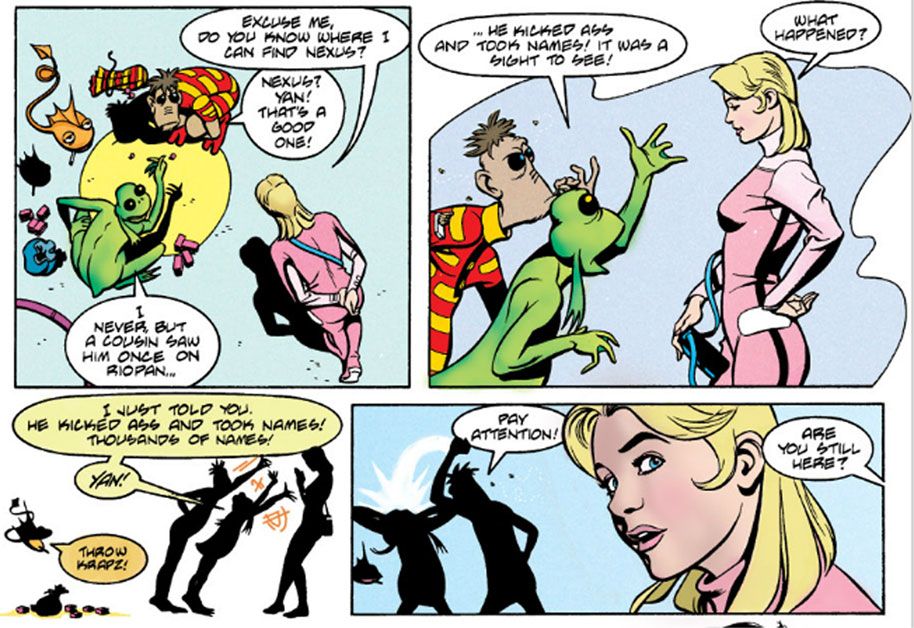
Nexus: The Origin, the book that hooked me on Nexus
And so it is with Nexus: The Origin, which brought their much-lauded creation back for another go-around. The new Nexus series-- actually broken up for some reason into smaller mini-series, each telling a complete story unto itself but also containing a shadow numbering related to the overall Nexus saga-- produced a number of memorable moments but didn't exactly top the sales charts. At the end of the arrangement, Dark Horse reverted the character rights back to Baron and Rude, a class move if there ever was one. A few years later, Rude started Rude Dude Productions, a self-publishing venture that sadly couldn't find a profitable niche in the then-current marketplace. It was with Rude Dude this new version of Nexus: The Origin came out, recolored and spiffed up-- although I was fine with the first one, which won the 1993 Eisner for Single Best Issue.
I'd say since I can't remember the specifics of any other single comic book I read that year and since this one made me a confirmed fan of its characters and overall series, then it's my Single Best Issue for 92-93 as well. But it wasn't my first encounter with Nexus and his world.
Years before, when I was a junior high kid hooked on The New Mutants and Judge Dredd, I used to do pin-up artwork for a local comic shop, and the owners-- a gentle married couple who always treated me royally-- paid me with autographed posters. One of these was a print of a painted Nexus cover. While Rude's art impressed me a great deal-- I'd read a bit about him in Comics Scene and Amazing Heroes magazines so I knew who he was and all about his drawing capabilities-- Nexus looked too much like Cyclops from Uncanny X-Men and I just couldn't wrap my pea-brain around what I thought was a slick Marvel rip-off. Not that I objected to anyone doing such a thing; I had notebooks full of derivative ideas of my own. I just didn't want to participate in someone else doing the same.
Or so I thought then. Later, I learned how wrong I was and if anyone's going to time travel and whup up on my skinny butt for being an idiot, it's me. Still, I like to think then-me had some precociously refined taste even when he was too timid to sample. As with A Distant Soil, something about Nexus stuck with me over the next eight or so years as I grew up into the weirdo who writes foolishness here. Comic stores came and went and so did my interest in comics, but somehow I got hooked again in the early '90s and one of the hookers was Nexus: The Origin.
I don't even know why I bought it after such a history not buying Nexus, but I distinctly remember the first time I read it (of many). I was sitting on the toilet in the bathroom at my parents' house where I lived while I worked at a two-year college teaching developmental English. I read it from cover to cover, just amazed at how perfectly, how skillfully Baron and Rude presented each moment, just slices in time. It has everything you need to know about the character Nexus and his life, features the series' tonal variety and stands alone as a compelling story. The overall sense of generational tragedy-- a recurring Nexus theme-- was probably my major emotional take away.
Well, that and falling in love with yet another comic book. Oh, and yes, I washed my hands before I picked the book up off the very clean white tile floor where it lay. In my mind, I haven't really put it down since.
Wednesday, October 31, 2012
October is Spookey Month: Let Doug Moench and Richard Corben show you how to trick-or-treat!
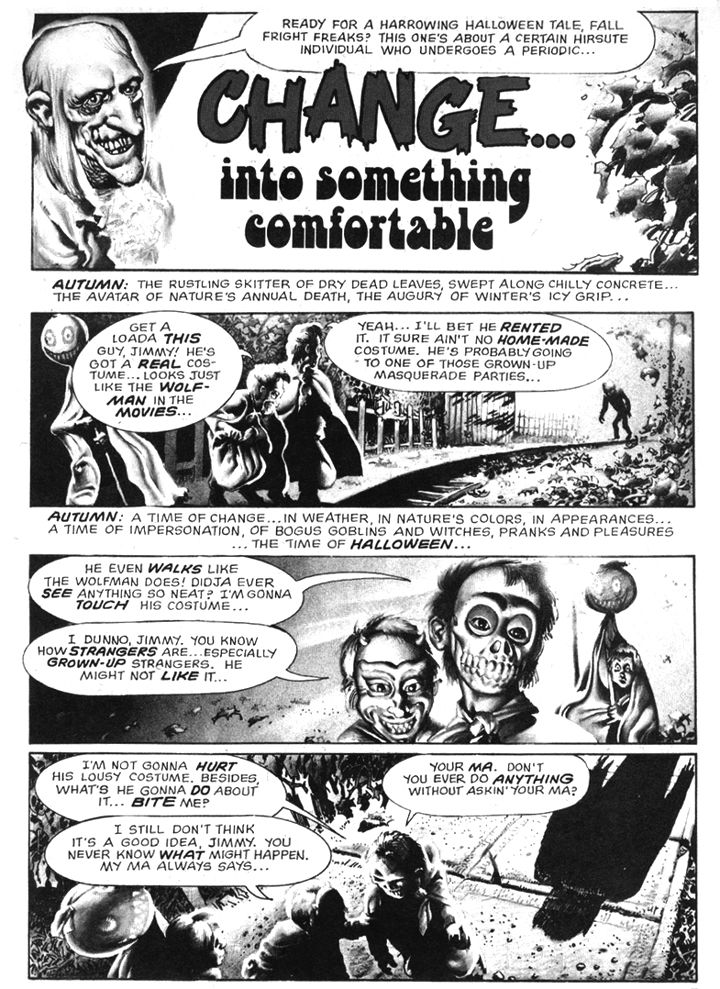
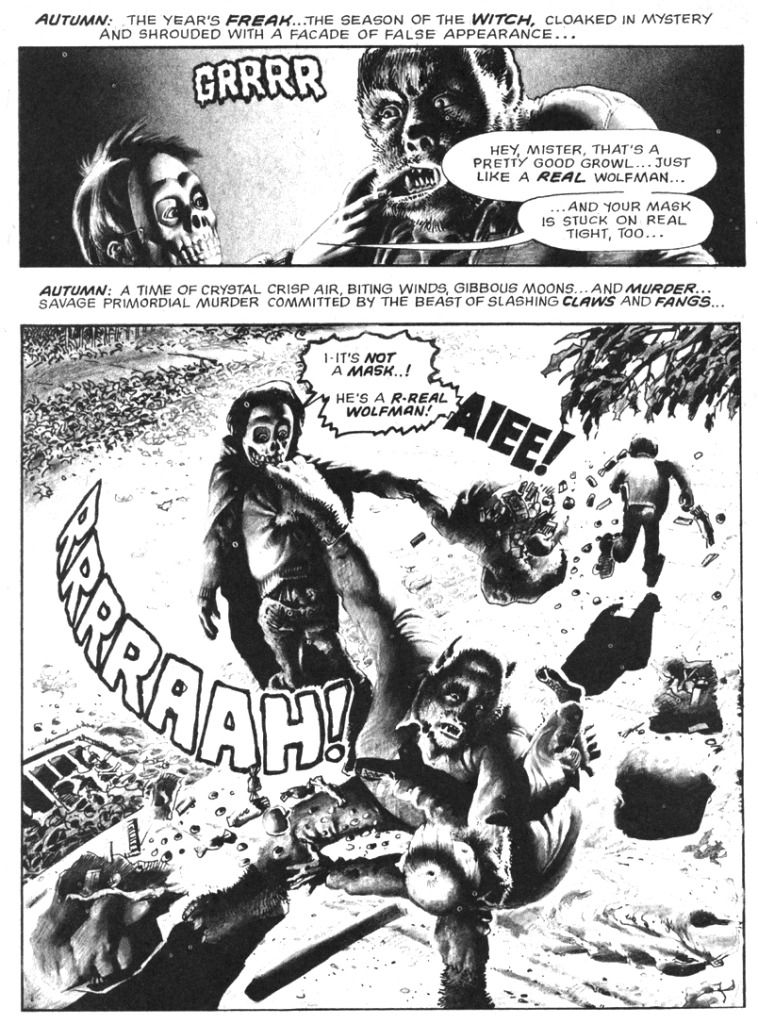
Yes, Halloween is a fun holiday, but you should exercise at least a little caution when out trick-or-treating. Go in a group, wear a costume with reflective tape so motorists can spot you, go only to well-lit houses. And most importantly-- don't pull on a werewolf's lip. These are a few simple safety tips brought to you by Doug Moench and Richard Corben in their horror-comedy classic, "Change... into Something Comfortable," which appeared in Creepy #58 (December 1973), a "special Halloween horror issue" (so it says right there on the cover). While I didn't particulary enjoy "The Slipped Mickey Click-Flick," I'm a huge fan of this little seasonal-flavored gem.
It starts with a real werewolf ripping some smart ass kids to shreds and ends with a sweet twist I find both irresistible and hilarious. I mean if you've ever wondered what creatures of the night disguise themselves as on Halloween, here's your chance to find out. "Comfortable" is sort of a companion piece to Corben's even more hilarious "Lycanklutz" from Creepy #56 (September 1973). That earlier full-color romp features a somewhat luckier werewolf in a medieval setting with some surprisingly anachronistic products available for sale. By contrast, our contemporary, kid-killing monster in "Comfortable" strays into EC territory with tragic results. I could have hit you with "Lycanklutz," but this one is all about Halloween and disguises and has those melodramatic Moench narrative captions. You can read it in the Dark Horse Creepy Archive Volume Twelve.
Come to think of it, you can read them both in that book.
Monday, October 15, 2012
October is Spookey Month: Few things in this world are as perfect as a Hellboy story written and drawn by Mike Mignola
Actually, I offered to pay for the whole thing myself if they'll write me in as Hellboy's ne'er do well brother-in-law. Or sister-in-law. Hell, boy, I ain't picky. As long as this movie gets made, and as long as we keep getting Hellboy comics from Mignola and all the brilliant people he chooses to collaborate with. Yeah, fan-type gushing. It's been a hard day. Just trying to end it on a positive note.
Speaking of positive things-- I was a little worried Spookey might have split, but they recently posted a message that they're still together and plan to play again in the near future. Some sort of unspecified problem stands in the way, but I'm sure they'll lick it and get back to rocking. It's a dream of mine to finally see them live! In the meantime, here's another video we've probably seen before but we're definitely going to see again because it's great:
Tuesday, October 9, 2012
October is Spookey Month: "Hellboy," yet another Halloween reading recommendation
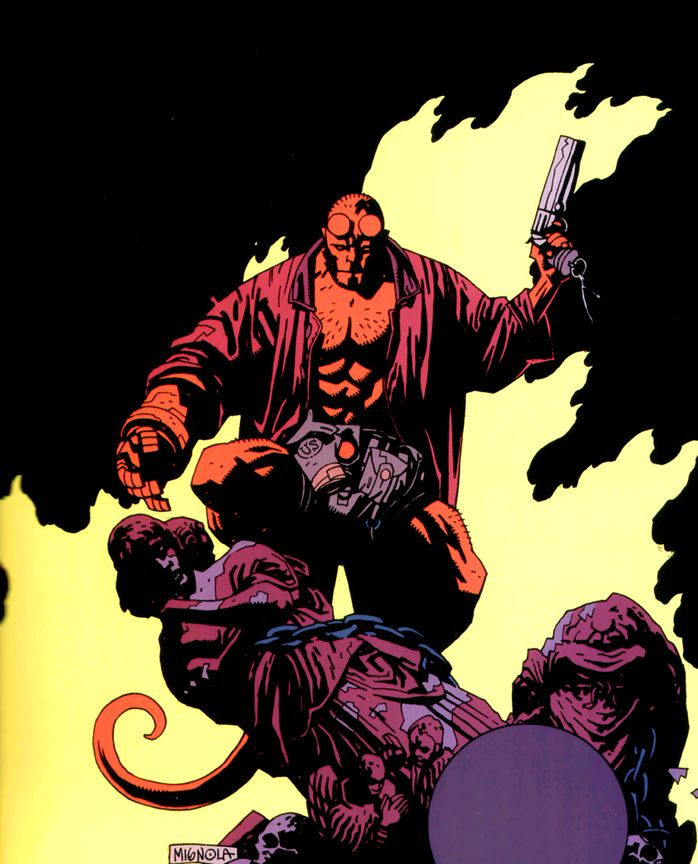
| Mike Mignola (1994) |
After two decades and so many miniseries and titles it can be hard to know where to start with Hellboy. It doesn't help matters Mignola's chronology jumped around depending on whatever inspired him to write and draw a particular story. In one book, Hellboy could be in Ireland in 1959 or 1961, then show up in Japan in 1967 for the next, then guest star in an issue of The Goon telling the story about Japan. Or something like that. Working it out this way, Mignola and his later collaborators have built a massive narrative spanning decades, continents and even the galaxy, with characters dying and other joining, menaces burbling up from the background, others springing full-blown into the foreground plot.
From his earliest days fighting un-frozen Nazis and their spiritual leader Rasputin-- yes, the historical Rasputin, the one Prince Felix Yusupov, Grand Duke Dmitri Pavlovich and some concerned friends poisoned, shot, beat and drowned in 1916-- to various creatures from European myth, with an underpinning of H.P. Lovecraft, Hellboy now inhabits a sharply defined world with all kinds of incidents and epics. So how do you jump into this world?
Sorry, I'm not much help there. I'm not a continuity junkie or obsessed with minutia. All I ask is whatever story I'm reading to be internally consistent. And I tend to prefer Mignola's moody, sometimes peculiarly random one-offs with Hellboy himself to the longer apocalyptic tales generally starring the BPRD cast (althought these are good, too). That's why I say, "Don't worry about a reading order with Hellboy." My advice is just buy the Seed of Destruction collection and start there. Move on to whatever story catches your fancy.
In short, you must do as you see fit.
For me, Hellboy pushes a number of buttons. Let's examine four of them in detail. Mignola's art is the first. I love bold, heavily stylized art, the kind where you say, "Now there's a nice drawing, just the essentials" rather than take in something that looks like it was traced from a still frame out of a movie, or a swimsuit magazine. Mignola's work has become more essentialist and geometrical over time and that's my bag.
The second is my love of the weird and fantastic. Since earliest childhood, I've read books about cryptid animals, UFOs, alternate dimensions, the Bermuda Triangle, ghosts, urban legends and the like. I've always loved stories where teams of people investigate the unknown and come to grief, from Kolchak to Venkman, Stantz, Spengler and Zeddmore to Mulder and Scully to Hellboy and company. I'm a friend to them all.
Folklore and myth make the third. Mignola draws heavily on European traditions and Lovecraft, but he has broken with this on a few memorable occasions. Two are team-ups with horror art legend Richard Corben-- Makoma, informed by African folktales and The Crooked Man, set in the Appalachian Mountains of the good ol' U.S. of A. Both are lovely and strange. How can anyone not read these?
And the fourth is a specific story. As an ex-pat living in Japan, "Heads," set in Kyoto, is a lot of fun in a very personal way. Mignola claims in his introduction to the story not to know a whole lot about Japan. Yeah, but his art, as influenced by Alphonse Mucha, who himself drew on Japanese ukiyo-e and their extremely linear forms as it is by European woodcuts, Jack Kirby or P. Craig Russell, makes him particularly apt for this kind of material. I wish Hellboy would revisit Japan sometime in the near future. If Mignola or any of his collaborators need some first hand experience and reference-- or just want to hang out while doing a research trip-- well, now, I know just the blogger to volunteer his services!
Wednesday, September 12, 2012
If you're looking for an economical way to hop aboard the Nexus bus...
Epic storylines, tender moments. A hero struggling with his mission. A cast of hundreds, if not thousands. Occasional background appearances by Jack Kirby, Capt. Kirk and Mr. Spock. Humor, heartbreak. Thunes. Quatros. Ursula X.X. Imada. The Loomis Sisters.
Well, hold on. The Loomis Sisters don't appear until Nexus #25, so they won't be in this book. But if you buy it, you'll be hooked and become filled with anticipation at their inevitable appearance. The Dude's art starts a little crude and unformed, but very quickly develops into the recognizable brilliance that once made him a top name mentioned alongside all those other top names back when being a top name in comics meant something. I'd buy this myself, but I'm already locked into collecting the hardcover Nexus Archives series, which is much pricier. I'd give it up in favor of this more affordable option but I already have the stories in this thing, plus I don't want my bookself to look disorganized or poorly planned. Consistency. That's what I want. But to you, who have been champing at the bit to get into Nexus only to suffer from sticker shock or price intimidation, this is your chance.
Read it from the beginning. And maybe Dark Horse will see fit to collect all those Nexus issues they put out in the 1990s, plus the more recent Rude Dude Productions books, into one fat volume as well. Oh, and the series running in Dark Horse Presents which I haven't read because I'm in Japan without a credit card.
This series won SIX Eisner Awards. That's six more than I've even been nominated for. Buy it this November. You won't regret it.
Tuesday, September 11, 2012
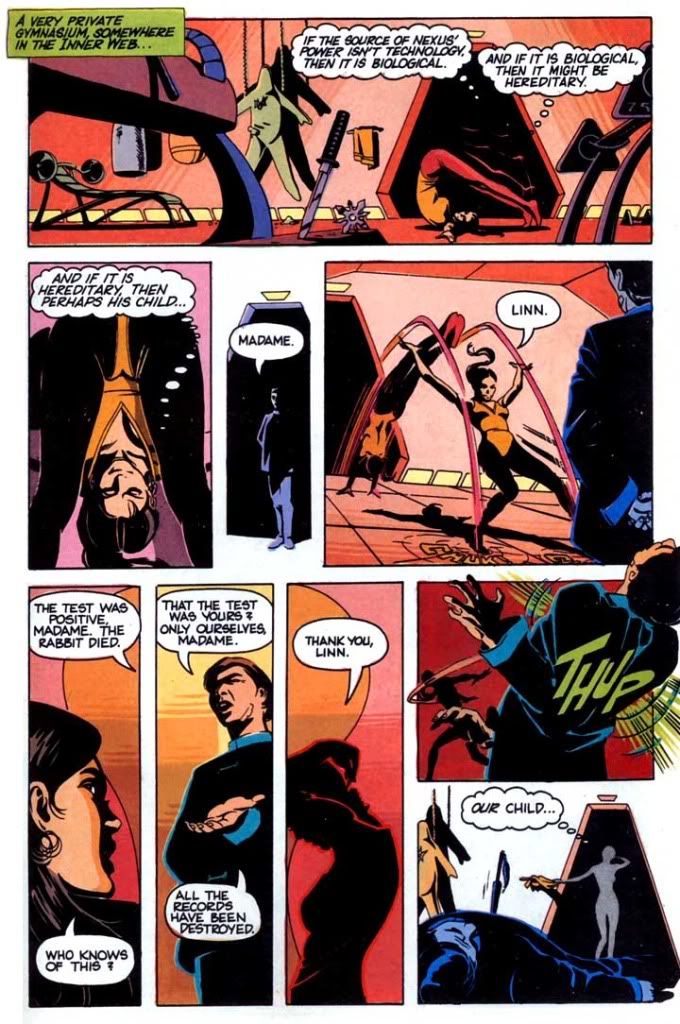
Ursula X.X. Imada: Motherhood Hall of Fame Inductee for 2512!
| Steve Rude, Nexus #4 (Capital, Nov. 1983) |
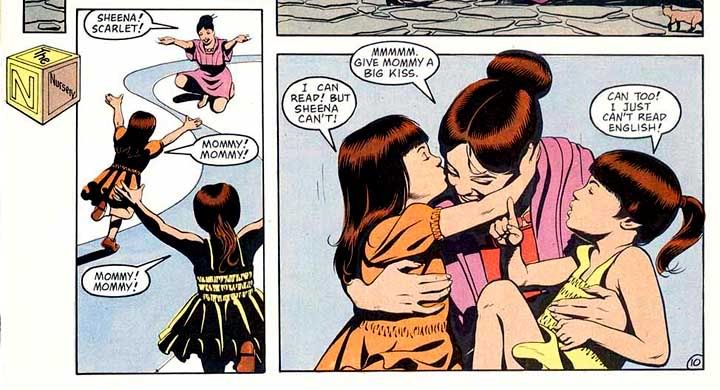
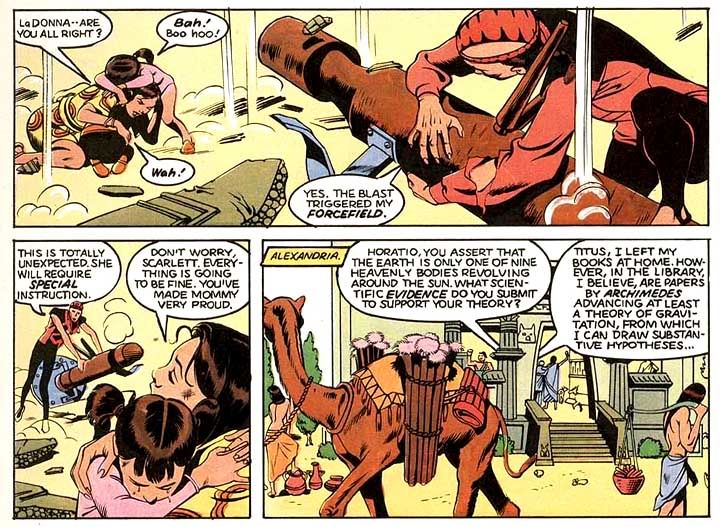
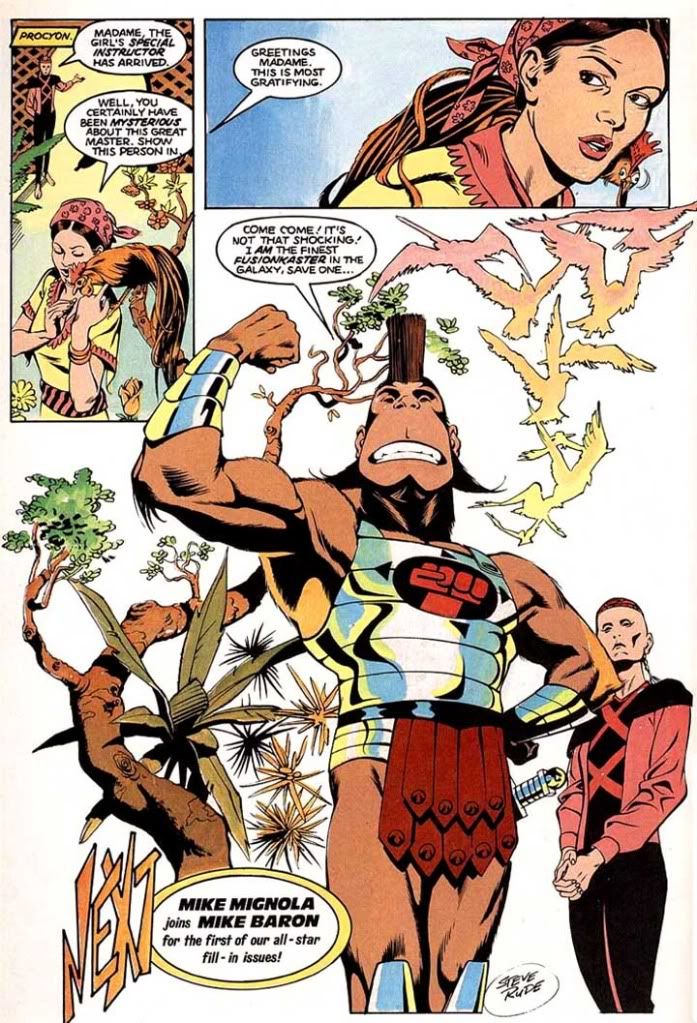
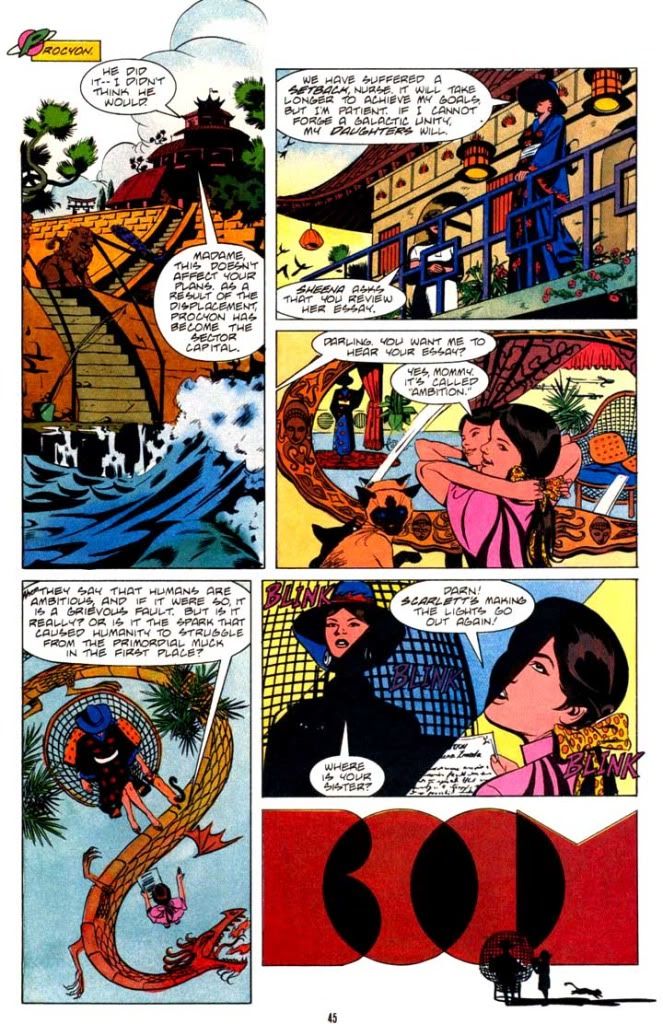
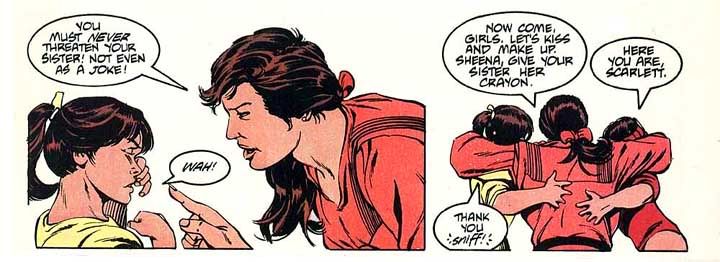
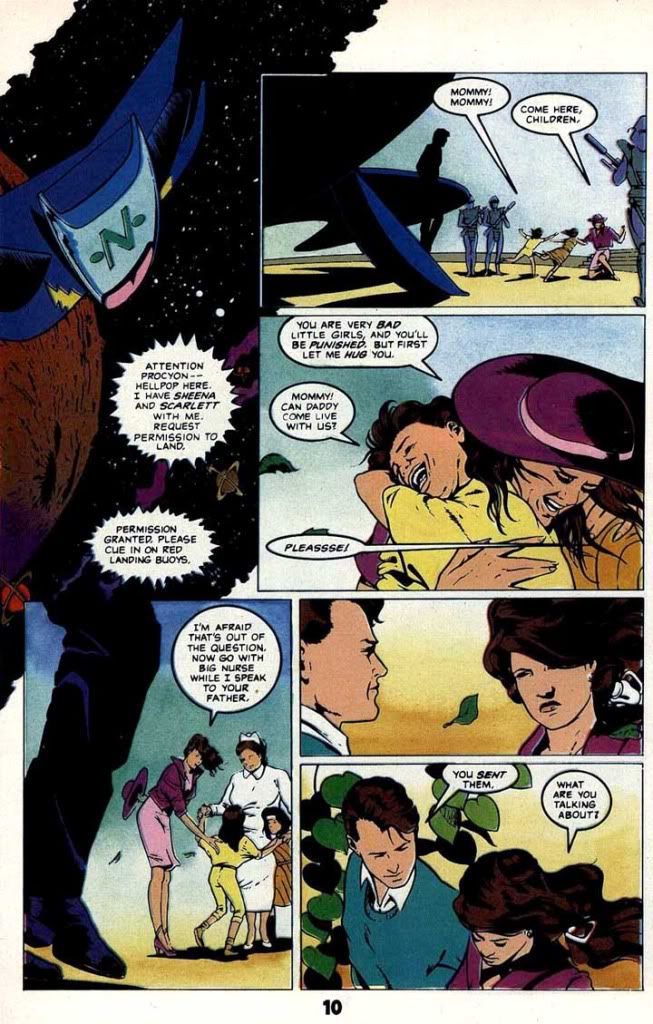
Being a mother isn't an easy job under the best of circumstances. But here's a woman of power, with a demanding career occasionally involving the possible black hole death of as many as 400 billion people, yet also devoted to her children. As mother to the twin daughters of Horatio Hellpop, otherwise known as Nexus, Ursula has developed many effective parenting techniques. But then Scarlett and Sheena are special children with intelligence and abilities far beyond the norm. Sheena, for example, is a telepath. She always knows what Santa's bringing for Christmas, if the jolly ol' elf can maneuver his sleigh past her mother's planetary defenses and infiltrate the well-protected Castle Imada (Imada-jo). Scarlett is a "fusionkaster" (that's fusion-based energy manipulator to you and me, Russ) with powers rivaling her famous father's. If these two are to follow in their illustrious mother's political footsteps, they require more than the usual family dinners and ballet lessons.
| Rude/Eric Shanower, Nexus #9 (First, Nov. 1985) |
Ursula's first and foremost a proponent of being their for your children. Being part of their lives. Although her responsibilities and career as a power-seeker occupies a great deal of her time and concentration, Ursula X.X. Imada makes it a point to be part of her daughters’ lives. When convenient, a physical presence. This includes doing such things as canceling meetings with heads of state and personally breastfeeding (despite taking her own sweet time giving them names) the babes. Yet always a spiritual or psychic one. Even in her absence, she makes her influence felt by providing for their intellectual and emotional well-being.
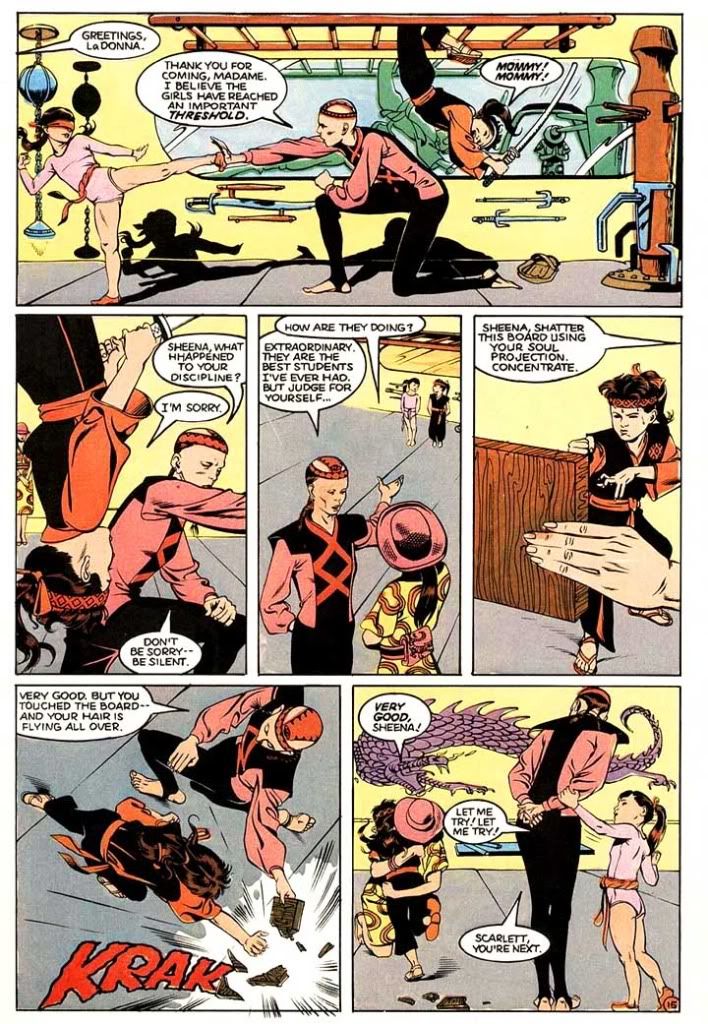
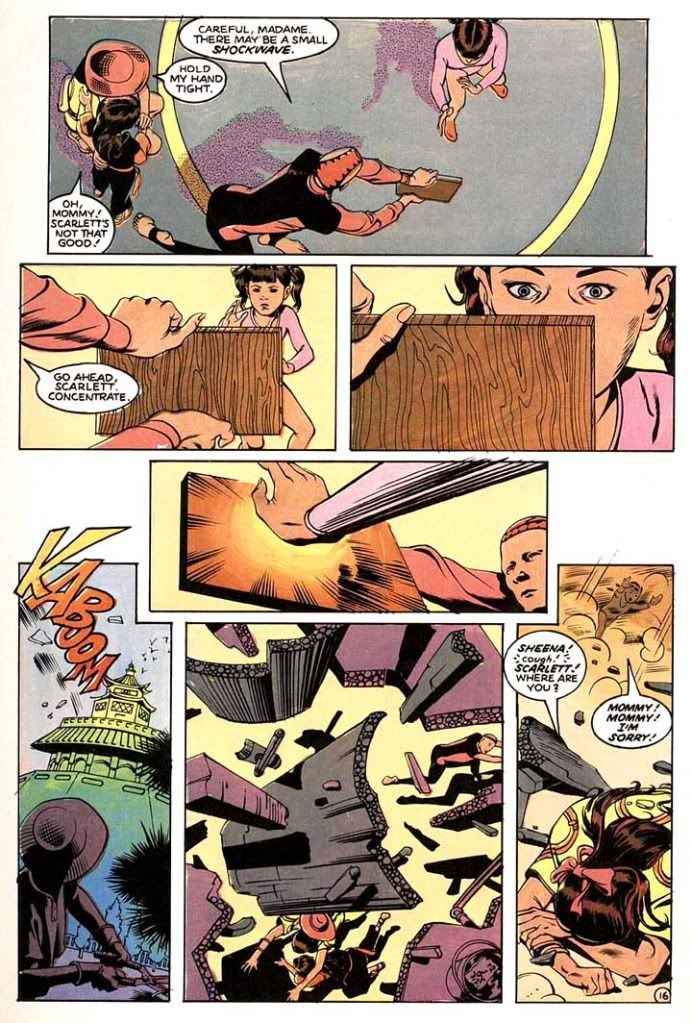
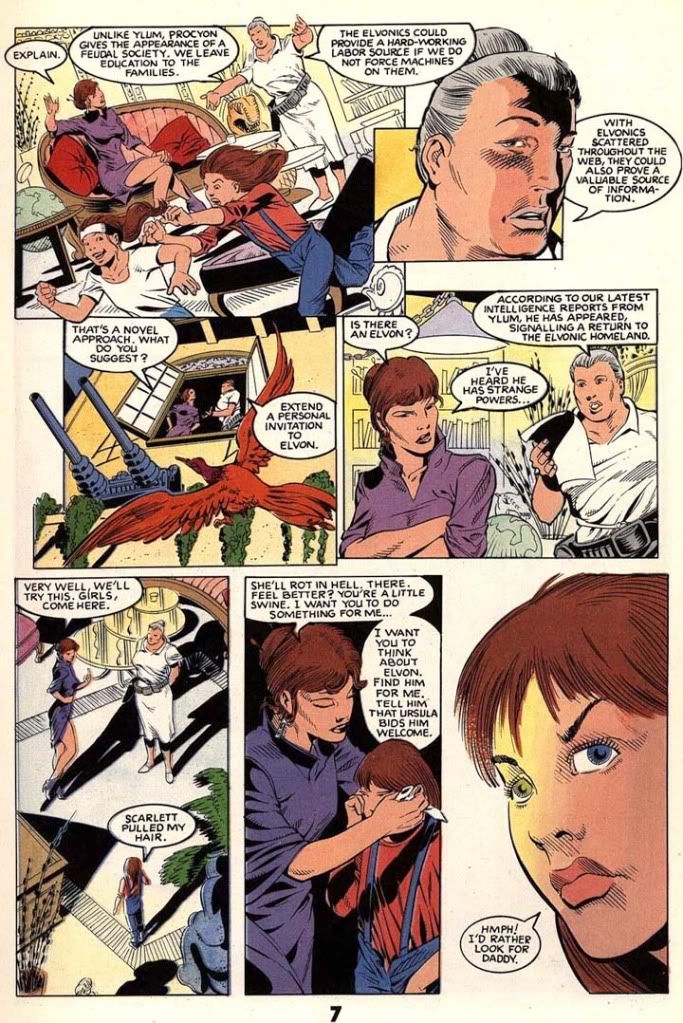
Ursula's parenting techniques have their basis in education. Rigorous education. She has lofty expectations for her daughters' academic progress, sets standards high and demands they perform to the best of their abilities. Special talents require special teachers. As ruler of an entire planet, Ursula has massive resources upon which to draw. This ensures she hires only the best tutors for individualized instruction. While you may not have her deep pockets, do the best you can with what you have. Remember: when you skimp on your children's education now, you pay extra for it later.
| Rude/Shanower, Nexus #15 (First, Dec. 1983) |
| Rude/John Nyberg, Nexus #27 (First, Dec. 1985) |
| Rude/Nyberg, Nexus #27 (First, Dec. 1985) |
| Rude, Nexus #50 (First, Nov. 1988) |
| Jackson Guice/Nyberg, Nexus #32 (First, May 1987) |
| Guice/Nyberg, Nexus #32 (First, May 1987) |
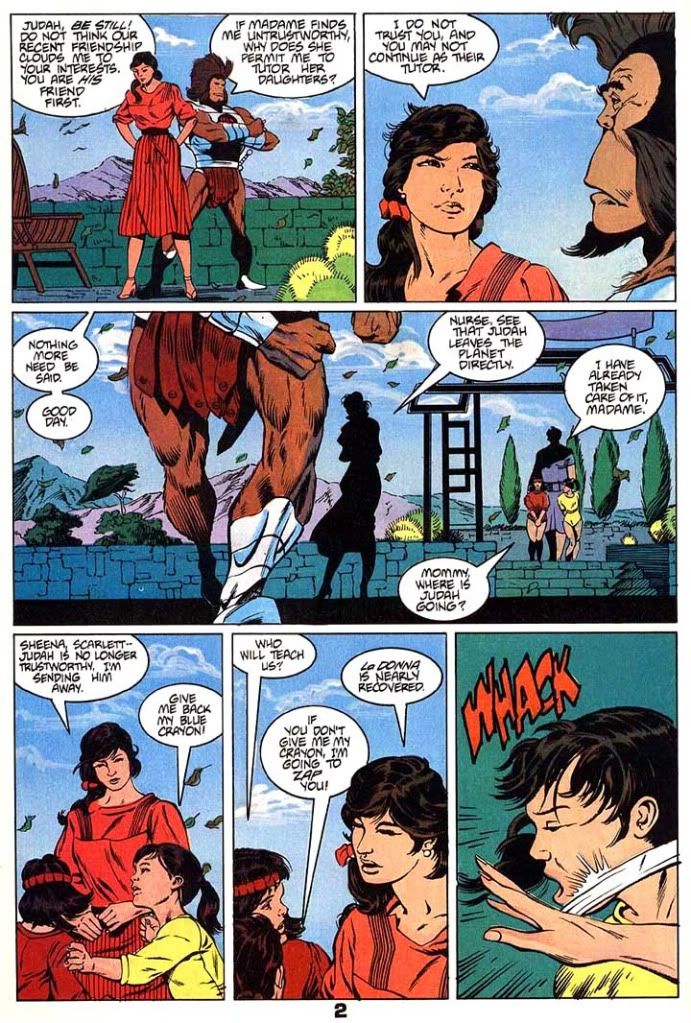
Ursula also shares words of wisdom before she she offers the group hug. When one child is a telepath-- even one as powerful as Sheena-- she may feel overshadowed by sister, who draws her abilities from the heart of a star. Still, as the instigator of this incident, she must still fulfill her sisterly obligations to share. As Ursula often observes, "Sharing is caring, if I say it is." Or she would, if she used simple-minded rhyming aphorisms like some sort of nightclub hilariator.
This comes immediately after her sacking of the aforementioned Judah Maccabee. Ursula will quickly fire recalcitrant or neglectful teachers, even one as highly credentialed as the famed Thune. As always, the children come first unless there's some vital plot afoot that requires they come second. Ursula belives instructors, although ostensibly part of the household, should also refrain from involving themselves in family matters unless otherwised asked, under pain of death. Certain Thunes, who may prove especially troublesome, destructive or useful at a later time, may be exempt from the punitive clauses contained in their contracts. In these cases, a simple sacking will suffice. If the employee in question is a simple human, such as the unfortunate Lonnie Loomis, who succeeded Judah as tutor a few years later, one might resort to torture before dismissal. Either way, like Ursula, do not be afraid to pull the plug!
| Spyder/Bob Dvorak, Nexus #56 (First, May 1989) |
Pet names or other forms of endearment not only make the child feel loved, but may also stimulate his or her own imagination to come up with similar nicknames for the rest of the family. Here's as especially instructive example.
| Mark Heike/Jeff Albrecht, Nexus #69 (First, June, 1990) |
Always remember, your success or failure as a parent will determine whether or not your children become lazy Mezz fanatics, wasting themselves and their lives in some sort of musical caravan forever in pursuit of cheap thrills, or largely benevolent dictators of adoring millions ready to accept the harshest of rule. It's all up to you, the parent. But by studying these examples of super-mom Ursula X.X. Imada and emulating her whenever possible, you, too, might become an award winner!
Wednesday, August 8, 2012
Comic book quest... begins!
If you want my advice-- stay out of Tokyo in summer. Go in spring or fall. I'm just not that bright.
Wednesday, June 20, 2012
Conan the Barbarian #1 and #2: a comic review!
Publisher: Dark Horse
Script: Brian Wood
Art: Becky Cloonan
Colors: Dave Stewart
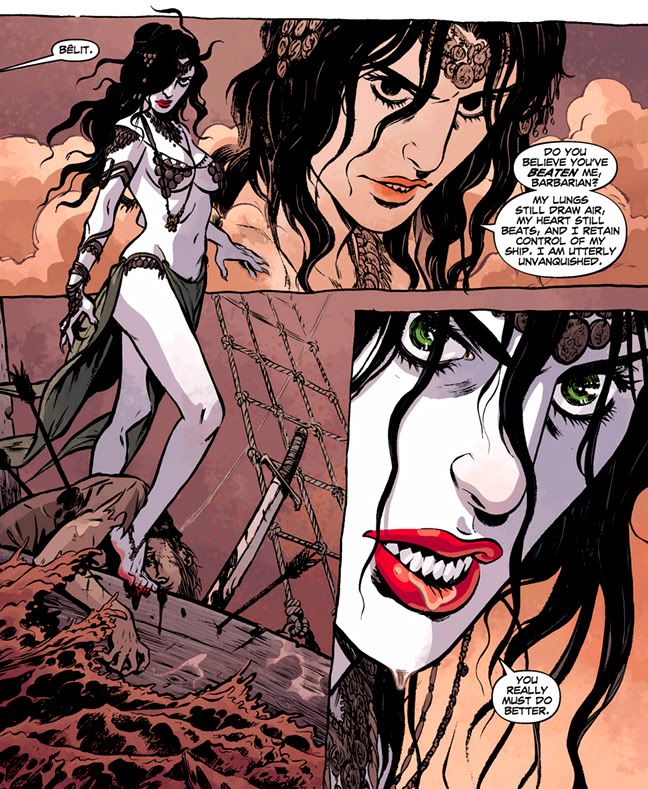
Conan gets run out of town and signs on as bodyguard for the merchant crew of a small trading galley. Well, he actually bullies his way into the job to save his own skin. It doesn't take the young barbarian long to befriend his sailing companions, especially Tito, their boss, but there's troubled waters ahead. The pirate queen Belit haunts these waters and Conan's dreams. One day Conan, Tito and the other sailors sight black sails on the horizon and two who were destined to meet join battle on the open waves. And so scripter Brian Wood and artist Becky Cloonan open this new Conan series from Dark Horse, called, cleverly enough, Conan the Barbarian. They're adapting Robert E. Howard's "Queen of the Black Coast" into comic book perfection.
To continue this nautical theme, there's a typhoon headed our way here in Japan. We're sending our kids home early because many of them have to take buses and trains to outlying communities along the coast. If we didn't, and the winds and rains lash us hard enough, these kids would be spending the night here at the school or at the train station. And w would be in a lot of trouble. And what thrills me almost as much as the darkening skies and quickening winds and an afternoon that looks suddenly like twilight?
Becky Cloonan's arwork! I have to admit I'm partial to this kind of expressionistic linework a la Guy Davis, Paul Pope, Joe Kubert. But it's not simply personal preference for a particular drawing quality or style. Rendering style aside, Cloonan shocks me with how boldly inventive she is in visualizing her action sequences. In the second issue, Conan jumps from a ship and kills a couple of pirates underwater. Cloonan pulls back from the the aftermath into the watery depths to give readers a glimpse of couple of sharks looming for a quick and easy meal. Truly gruesome!
This she follows with two bravura pages where Conan surfaces then cuts his way through some almost inhuman pirates. Cloonan uses stacks of skewed wide panels for a dizzying effect, emphasizing movement then freezes time at the climactic moment with a full-page splash. Why do so many artists refuse to take full advantage of these tricks, rather than relying on static, "widescreen" layouts with inset panels for close-ups and splashes seemingly at random just to show off their detail work?
Cloonan also excels at acting. This is how you make your characters really live in breathe within your story. She doesn't rely on stock poses and her characters never have the same expression from panel to panel. Her young but scarred Conan looks back over his shoulder at his pursuers early in the story and there's a look of pure enjoyment on his face. Later, he and Tito share more sober quiet moments, and they look at each other with manly seriousness. Belit, however, is something else entirely. More on her in a moment!
Whatever inspired Belit, wherever she came from in Howard’s imagination, thanks to the gang at Dark Horse, she prowls the seas again as one of Conan’s most formidable lovers, with a vitality and complexity that’s largely to Howard’s credit as a writer. And this fresh take by Wood and Cloonan makes the Marvel version do a quick fade for her own safety’s sake. According to the Conan Wiki, Conan and Belit spend “1000 days” together. Howard telescopes that into a couple of short paragraphs limned in legendary language. Poul Anderson also gave Belit completely detailed and completely extraneous backstory with the obligatory “out for revenge after a rape” cliché that I could have, in all honesty, done without. That trope is moldy now and it was probably pretty moldy when Anderson slapped it on Belit with Howard too dead to protest.
Now if you'll excuse me, I'm off to educate myself on Becky Cloonan's comic book career. That is, if this typhoon doesn't blow me to Crom's mountain first.*
*Written during Typhoon Guchol, which I seem to have survived.
Tuesday, February 21, 2012
Another Nexus update-- inks and coloring!
Mystery solved thanks to the Rudes themselves. I can't wait to read this! I'm sure Rude and Mike Baron have something amazing in store for us. But then, they usually do! And the Dude inking the Dude sounds good to me!
Sunday, February 19, 2012
Nexus Update!
That's thrilling news for a die-hard Nexus fan like me. Back in 1997 I was pretty sure we'd seen the last of Horation Hellpop, Sundra Peale, Dave, Ursula XX Imada and all the rest-- hundreds of them-- and it truly depressed me. Those were dark times for my favorite titles; just a year before, our beloved Xenozoic Tales faltered and faded away. Nine years later, Rude tried self-publishing. That didn't take and the Dude turned his energies towards fine art and gallery shows. It seemed once again Nexus had gone the way of everything good and fanciful. Because it's all infinite and crisis now. Post-modern irony, graphic violence, massive crossovers full of miserable characters, massive crossovers full of second- and third-hand ideas, crossovers of this, that, and the other. No place for three-legged cyclopes in the South Seas. No place for cucumber trees and oceans of wine. No place for me.
Not that Nexus ever contained cucumber trees or three-legged cyclopes. It never needed them; it has riches aplenty. There are some four-armed aliens, though. So here we are in 2012 and not only is a brand new Nexus story on its way, it's a huge one! The Dude's done it! He's back in comics, which so desperately needs artists like him. And he's brought Baron with him; comics also need writers of his caliber. Isn't it beautiful? It's like a dream come true. It's the dawning of the age of lovely, intimate things.
The Adventures of Baron Munchausen — MOVIECLIPS.com
I wonder who's inking it. Gary Martin has provided a sympathetic brush on Rude's pencils for a number of years now. I really enjoyed their teamwork on The Moth, which Martin wrote as well. He'd be my first choice. But I'm sure they wouldn't pick some incompetent to replace him if he's not available. I suppose I could go do some Google searching and find out if Martin's coming back...
Tuesday, February 14, 2012
The Loomis sisters loom large of late...
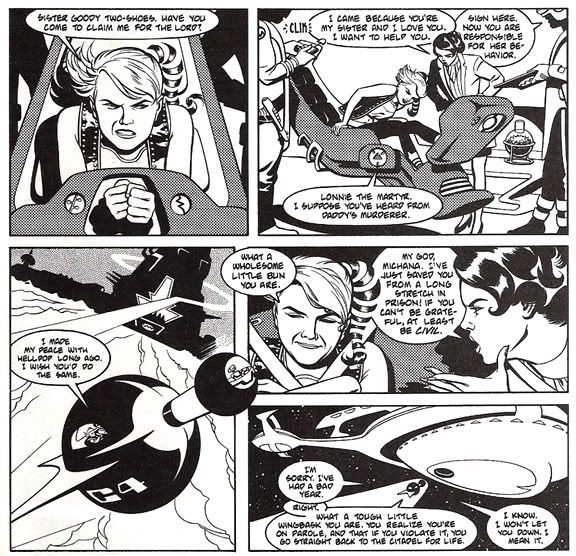
You know the Loomis sisters, right? Creations of that amazing comic duo, writer Mike Baron and artist Steve Rude. Ring a bell? You know, the Loomis sisters! Stacy, Lonnie and Michana Loomis, beloved daughters of General Loomis.
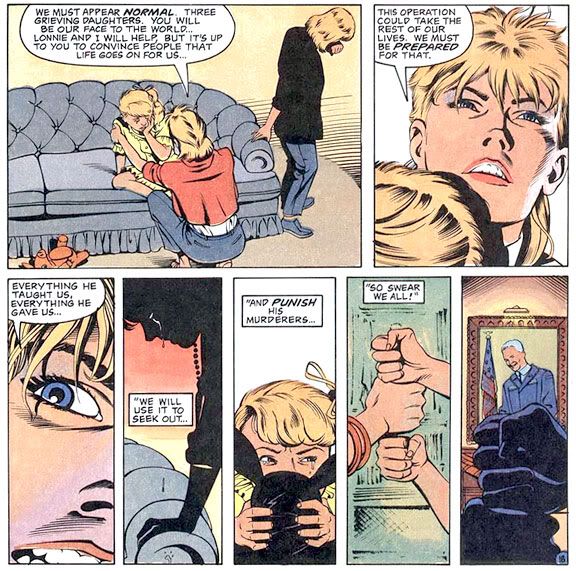
We first meet them in Nexus #25 (First Comics, October 1986). Much like today's developed or industrialized nations, the Web, the galaxy-spanning league of planets of which the Loomis sisters are citizens, requires vast amounts of energy and resorts to ever more dangerous means to gain it. To meet this need, the Web government builds the Gravity Well, a vast Goldbergian machine that uses white dwarf stars to provide almost unlimited energy. With General Loomis as its chief, the project comes at a cost: the destruction of the Planet Periwinkle and its 500,000 sentient inhabitants. Elvonic extremists attempt to assassinate Loomis to stop the Gravity Well, but Horatio Hellpop-- better known as the super-powered executioner Nexus-- gets there first. Despite some misgivings, Nexus executes the general after promising to provide for his girls.
Back home, the seemingly ordinary suburban sisters close ranks and vow revenge on their father's killer. And symbolically, they make this pact in that homeliest yet blandest and most cliched of suburban settings, the living room. Complete with a comfy sofa.
The trust fund he sets up for them and his guilty conscience aside, Nexus soon becomes the Loomis's target. These kids are smart and it was only a matter of time before they realized who did the deed that broke their hearts.
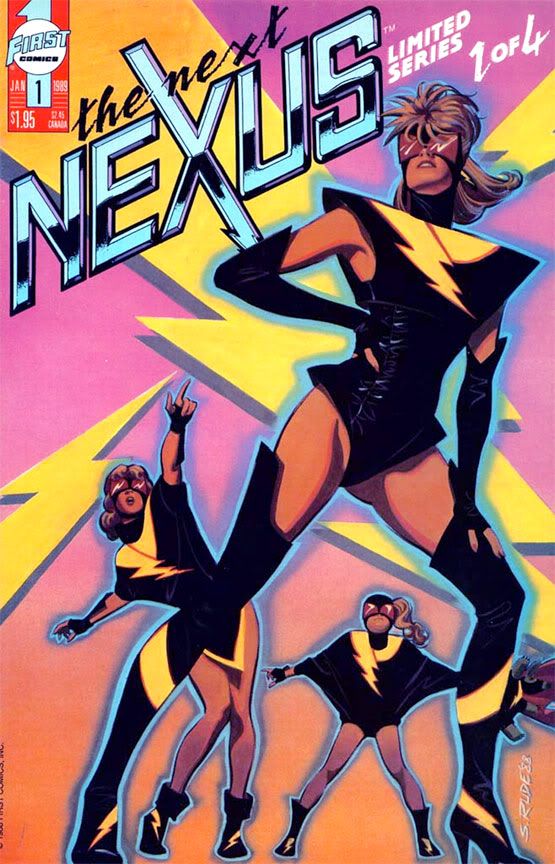
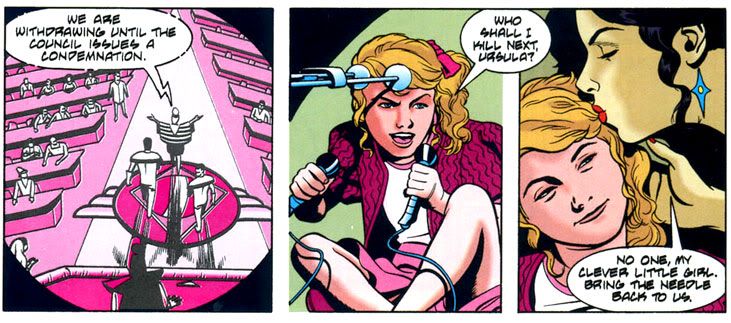
In The Next Nexus miniseries (First Comics, 1989), the sisters receive Nexus's power when he quits being the cosmic avenger for all of humanity. Here Baron plays on the old theme of absolute power corrupting absolutely. The ability to blast people and aliens into atoms has long troubled Nexus, so imagine if you will how it affects his greatest, youngest enemies. Stacy becomes Ahab-like, conscience drives middle sister Lonnie from her siblings and Michana, the youngest, goes kind of batshit.
General Loomis is decent guy, an upstanding officer and widower devoted to his daughters. He offers them stability and discipline with unconditional love, but unknowingly infects them with the darker aspects of his military profession. Nexus kills mass-murderers, but struggles with self-recrimination as his own body count rises. Neither man can escape the consequences of his actions. In the end, can any killing be redeemed by another?
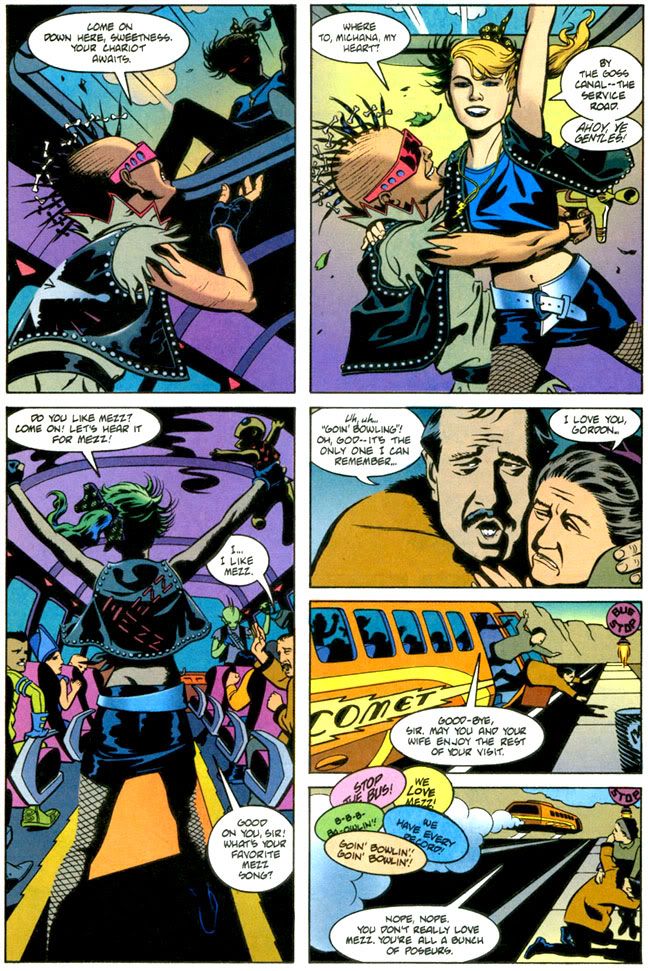
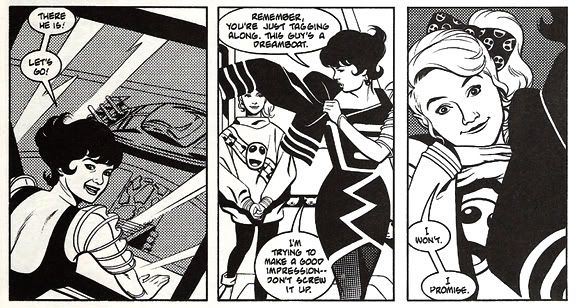
Angelically pretty, clothing herself in punkish leather and fishnets and toting around a small doll to which she's devoted (another symbol of her warped childhood, she communes with it for advice), Michana's a monstrously narcissistic Bonnie Parker and makes Hit Girl from Kick-Ass look like Cindy Brady. She terrorizes ordinary citizens, enchants a dimwitted thug, bedevils Nexus, ends up in jail. In Nexus Nightmare in Blue (Dark Horse, 1997), Michana resurfaces.
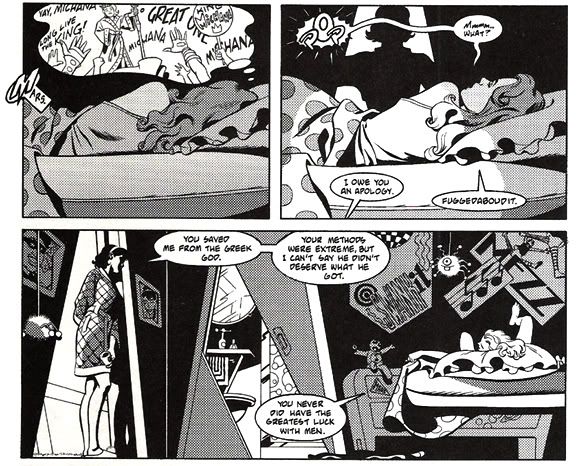
Reconciling with her sister Lonnie, who now holds the somewhat pathetic yet imminently respectable job of "junior assistant to the mayor's secretary," Michana still dreams of power. She drops the punk look and adopts the guise of a typical suburban teen, but sneaks out at night to indulge her wild side and meet up with a member of her former gang. You get the idea it's only a matter of time before she cuts off someone's finger to get a ring.
Biding her time, Michana contents herself with helping Lonnie with her relationships, much to the detriment of sleazy Tom Cruise-lookalike Tom Zeus, a lawyer who specializes in something called "jewelry fraud." Zeus turns out to be the kind of creepy perv who would sleep with an underage girl and video all his other sexual encounters. Hundreds upon hundreds of them. Wealthy, handsome, self-assured and not afraid to get his hands dirty helping out the bouncers of his favorite haunt, a stylish bar, Zeus has it all. A smitten Lonnie breathlessly recites his possessions: "A Lambo, a Slambo and a Pomerini GT," no doubt coached by Zeus himself. I don't know what those things are, but they're probably expensive. Zeus never fails to mention the pride of his fleet, a 250-meter S&J star cruiser that "sleeps twelve."
S&J, by the way, stands for "Sundra and Jil." Sundra is Nexus's lover and Jil is her business partner in their very successful star cruiser venture. A posh, arrogant ass like Zeus would only have a starcruiser from S&J. The ultimate status symbol.
The ultimate lesson taught us by the Loomis sisters is you don't want to mess with the Loomis sisters. Actually, you also don't want to mess with Ursula XX Imada or Scarlett and Sheena.
The Nexus cast consists of hundreds of characters, and the most recent storyline-- the "Space Opera" issues self-published by Rude's Rude Dude Productions-- mostly involve topical religio-political machinations and the birth of Nexus and Sundra's son Harry. Nexus battles the shade of his father and the two weird little aliens who were his companions when he was a child, more of that recurring "sins of the parents" thread that runs through so much of Nexus. That makes me think it's the appropriate time for some more Loomis action.
While Lonnie has forgiven Nexus, how can we be sure Michana has? Various assassins have already targeted the newborn and he seems like a natural target for Michana Loomis. She could continue to be a powerful enemy for Nexus. She's deadly as all get out, but it doesn't seem likely the conscienced Nexus could equal Michana's amorality by killing her. It would mean a powerful ending to her saga, one as horrifying as imagining the psychotic thoughts behind Michana's deceptively sweet countenance. There's still a lot of unfinished business between her and Scarlett and Sheena. On the other hand, maybe the influence of her big sister really does have Michana on the path to rehabilitation and redemption. Or is Lonnie truly as upright as she appears. Could she be hiding something herself?
I'm pretty confident Baron and Rude will wow us when the time comes.
Monday, February 13, 2012
And meanwhile, as an art form, comics have never been better!
The form itself is stronger than ever. You don't have to be concerned with whatever new books come out this month and how they sell. Step back and look at comics as a whole. You can draw from the entire history of comics for your entertainment. You can cross oceans and experience comic culture in Europe and Asia. There are millions of comic book stories out there we haven't even read yet. Dark Horse puts out some amazing books, both new and reprinted, American and international. Fantagraphics publishes all kinds of amazing titles like Love and Rockets, Buddy Does Seattle/Jersey, Wandering Son and huge books containing entire years worth of Peanuts strips. Don't forget Charles Burns's Black Hole from Pantheon. Have you read that yet? Dan Clowes's Ghost World.
There's a new book on Alex Toth coming out, but in the meantime there's Torpedo and Zorro. Viz puts out some fantastic Japanese comics like Nana to name only one. People are putting out their own comics online or through print-on-demand publishers. If you must-- and you know where to look-- you can download practically every comic ever printed for free. People are spending their free time scanning entire runs of books and putting them online and they're not charging anything for this! Others are translating and localizing Asian comics and making them available totally for free, too!
Flesk recently printed an incredible book collecting Al Williamson's entire Flash Gordon-related output, compiled and edited by Mark Schultz. There are Alex Raymond reprints. There are Creepy and Eerie archive books (or even Vampirella if that's your taste), Vanguard Productions has a massive book of Frank Frazetta strips, Fantagraphics put out a softcover version of their Blazing Combat book, there are Hal Foster books, Carl Barks books, books like the amazing Skim by Mariko and Jillian Tamaki, Wendy and Richard Pini have their entire Elfquest saga online for free, Image has tons of stuff available, Drawn and Quarterly with Kate Beaton's Hark! A Vagrant (one of the best things ever to exist in this world or any other) plus books by Lynda Barry, Oni Press, Slave Labor Graphics, Top Shelf Productions, Knockabout Comics, Archie Comics and Checker Book Publishign Group with their Gold Key Star Trek reprints and more.
And more and more and more. I'm just tossing out some things off the top of my head. I love comics. If DC and Marvel went away today, I'd still love comics and I'd still have plenty of comics to read.
Friday, February 10, 2012
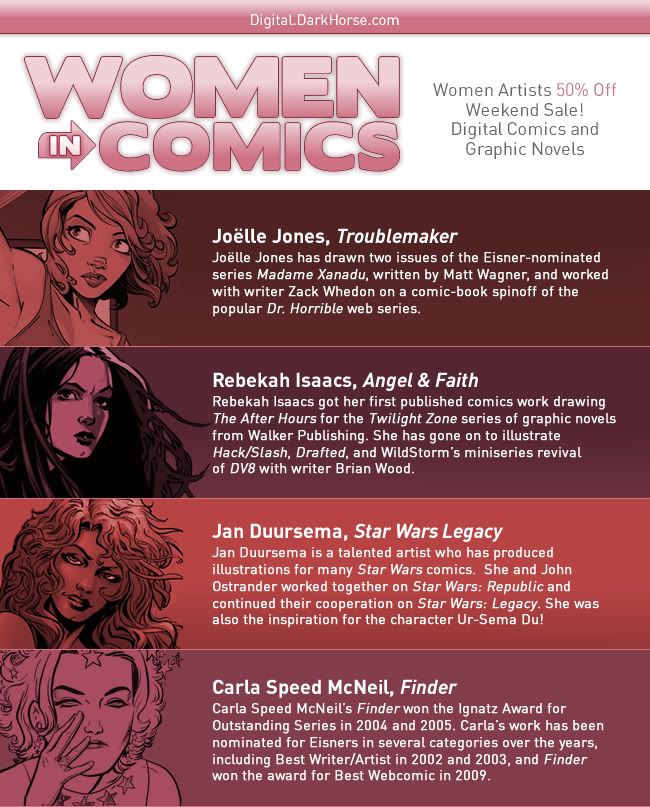
Dark Horse celebrates women in comics with a sale!
It's super appropriate because if there's anything women love more than shopping, it's shopping for 50% off items! Right, ladies?
Oh lord, I'm so, so very sorry for that. Sincerely sorry. I haven't had much sleep lately and I'm starting to hallucinate. I blame a severe serotonin deficiency. And while my lame attempt at ironic humor has more than likely undermined any serious point I wanted to make here let me just say how much I truly respect and admire all the women who make comics. From Marie Severin to Jan Duursema, Lynda Barry to Mariko and Jillian Tamaki, Rumiko Takahashi to Ai Yazawa and Kate Beaton, Misako Rocks!, Sana Takeda, Chika Umino and many, many more-- your work just knocks me out. It thrills me. It makes me happy. You're the best!*
This is how my train of thought has been working lately. As my reader no doubt knows, I've been really getting into Creepy magazine which features some of the early editing work of Louise Simonson who went on to shepherd the books that made me the insanely obsessed comic book fan I am today, namely Uncanny X-Men and especially The New Mutants. As such, it's difficult to overestimate Simonson's impact on my pop culture-lovin' life. This extends even to her hair, which apparently made a cameo appearance atop character Maddy Prior in Uncanny X-Men #168, thanks to artist Paul Smith. And via Simonson's The New Mutants I just started enjoying the amazing artwork of both Mary Wilshire and June Brigman. I would have sooner, but they worked on that book after I'd given up comics in favor of being a rock star.
And we see how well that's worked out for me!
To connect this back to Dark Horse, it's mainly due to Dark Horse's Creepy reprints I owe this belated recognition of some prime movers in my comics consciousness. Dark Horse is the once and future home of my all-time favorite series, Nexus. When I discovered Nexus, the editor of record was the amazing Anina Bennett, whose letter column replies to all sorts of controversies never failed to impress me with her candor, intellect and willingness to mix it up. I always felt confident Mike Baron and Steve Rude were in good hands with Bennett. And she's a creator in her own right, too.
And even though Dark Horse rejected my own little effort at getting into print, that's one comic book company that hasn't disappointed me. From Nexus to Hellboy and points in between, they just keep rocking great product. Publisher Mike Richardson even returned the Nexus rights to Baron and Rude. Think about that during all this talk of boycott and petition signing. A comics publisher that returns rights to comic creators.
* I'm the worst!
Friday, December 30, 2011
New Nexus update!
A longer story? Or a little bit of editing, and a bonus extra-length version for the hardcore Nexus fans (like me) when it's collected as a trade? Either way, it's a win-win situation for those of us who love our comics in flavors of awesome and super-cool.
Look, you don't have to take my word for it! If you have Facebook, you can see for yourself. Isn't that cool? You can look right over his shoulder (it's rude of us to do this to Rude) and if you pay attention, you will see how genius creates a legend. I didn't realize Rude used a blue pencil to lay down his initial lines. I've learned something already. Check out the photo reference of head shadows/lighting, "B&W design" and the little notes and panels scrawled out in what appears to be red marker. Rude's even got the layout for Ylum's "new concourse" up there so he can keep it consistent with the older comics.
I don't know about you, but I'm suddenly excited for this new year!
Monday, December 26, 2011
Baron and Rude return to Nexus!
Not only does this mark Steve Rude's return to sequential comics-- long overdue, since he actually attempted to break back into the business on at least one occasion last year-- but it's a new story starring Horatio Hellpop and his cast of thousands. Nexus is my favorite hero of all and I was disappointed when Dark Horse's previous Nexus series ended and Rude's attempt to self-publish fizzled. The Nexus universe is full of memorable characters-- Judah Maccabee, the happy-go-lucky avenger/pro wrestler/chef and lover of many women; Sundra Peale, Nexus's own lover, former spy, ace business-person and mother of his child; and Ursula X.X. Imada, the ultimate "dragon lady" with surprising depth. She's the iron-fisted ruler of the planet Procyon and also the loving mother of Nexus's other children.
There are hundreds more, some funny, some menacing, all richly written by Baron and gorgeously drawn by Rude. I have to salute Dark Horse for publishing the series, returning the ownership of the characters to Baron and Rude and also keeping the title alive with their lavish hardcover Nexus Archives books.
More Nexus in 2012! Rude doing comics again!
Sunday, November 20, 2011
Comic Report: Japan!
If you're a regular reader of various Western monthly comics, you have to work a bit harder to find them here in Japan. There are online sources and if you happen to live in a large enough city, you might find a few odd titles in the English language section in a bookstore. Just be prepared to pay three to four times the suggested retail price. I haven't tried downloading any digital comics yet, but I'll give that a try later when I'm more settled and have my own Internet connection.
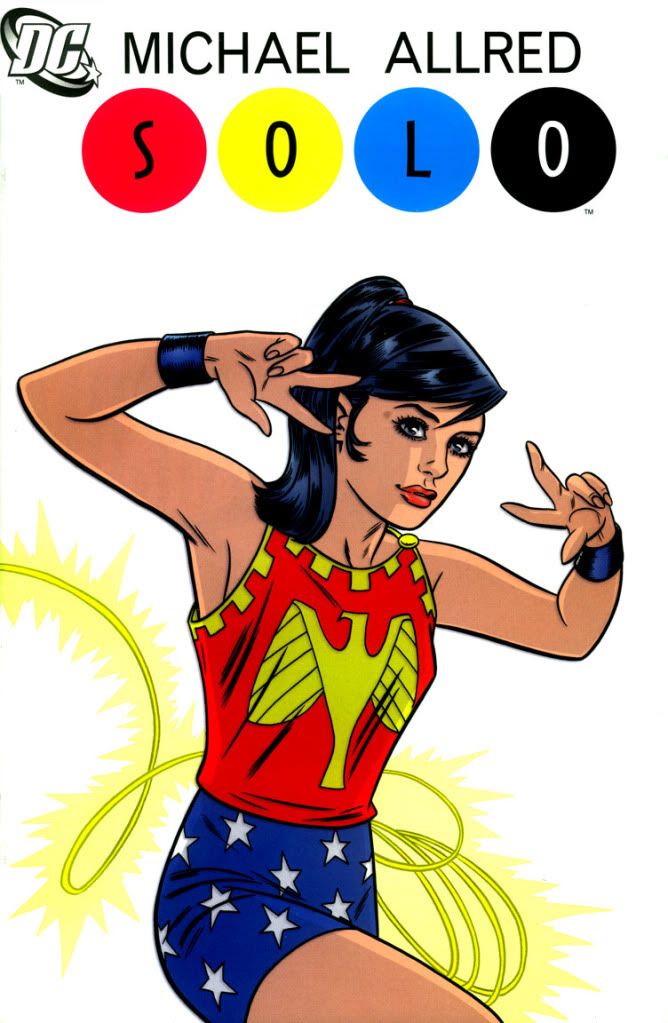
In the meantime, I'm making do with the comics I brought with me: the superb Solo #7 (2005) by Mike Allred and family, and the award-winning Nexus: The Origin (1992) by Mike Baron and Steve Rude.
Solo #7 is one of the best things DC's published in the past ten years. Maybe twenty. It serves as the perfect antidote to all those gloomy, doomy negative portrayals of their own characters DC's dished up in the years since Identity Crisis, and it's a lot more fun than their similarly nostalgic Wednesday Comics. Yeah, not every superhero comic should be this kind of poppy fun. We like our supergods with a touch of realism these days. But as Batman's faithful butler Alfred points out here, "Why is it the good things are never 'real life,' only the bad?"
Who can argue with Allred's winning cover depiction of Wonder Girl doing the batusi?
Nexus: The Origin is a bit darker. It starts with genocide, includes a starvation death and Nexus excusing his own killings by claiming self-defense. This is the comic that hooked me on Horatio Hellpop, Sundra Peale and all the frog-like aliens and hairy Thunes that inhabit their universe. Baron condenses the entirety of Nexus's early years into several poignant vignettes and Rude illustrates with his strong sense of anatomy and page design. Inker Gary Martin perfectly complements Rude's pencils-- I've seen a number of inkers on the Dude, but Martin is far and away my favorite. Rude "re-mastered" this book in 2007.
These are a couple of thick, meaty magazines that invite you to chew slowly and savor their delicious taste. Which I suppose taken literally would mean you should eat them and enjoy some paper. But you know what I mean-- read them over and over again. Both were well worth dragging thousands of miles across an entire continent and ocean.
Well, I promised you a comic report, didn't I? If you happen to be in Minami-Funabashi, Chiba prefecture, go to Vivit Square. The Tsutaya there has a huge selection of Japanese comics, plus a teensy-weensy grouping of some translated ones in their English language book section. Unfortunately, I can't remember which ones. Probably Death Note and Vagabond. The Japanese originals, though, boggle the mind. So varied in genre and style. Why aren't there comics about baseball and basketball teams in America? Where are the simple stories of high school kids falling in love?
I guess they're in the manga section at your local Books-A-Million. Which, combined with their Western graphic novel section, can't hold a candle to what they have at Tsutaya in Minami-Funabashi.
Sunday, October 23, 2011
2nd Annual Spookey Month: Chiaki Kuriyama in an early horror role!
Okay, okay. It's not a comic book, although Miki Rinno later did a manga adaptation-- published in the US by Dark Horse Comics. It's a scene from the original direct-to-video Ju-on (2000) that spawned the movie series, the American remake and its sequels. I have no idea about the Ju-on mythology or back story, but I do know the American release of the first theatrical movie has a redundant title, and the Japanese release of the American version has a silly one.
While we tend to like our ghost stories set in the fall during Halloween season, Japanese culture favors the late summer during Obon time. This scene establishes mood early with the oppressive cicada static in the background; that's the soundtrack of summer there in Japan. They still ring in my ears and the I last experienced Japanese summer two years ago. The school bell briefly heard brings back a lot of memories for me as well. The cellphone is a neat plot device-- a more modern conduit for mysterious messages and voices from the other side, but its size and simplicity instantly date this movie. It's a period piece.
The message with the repeating 4s may not seem particularly chilling to Americans like myself, but the Japanese word for 4 is "shi," which also means death, so this is a pun commonly used in J-horror. Come to think of it, it might not be all that frightening even for a Japanese audience, because it's probably cliche by now. Remind me to ask!
Still, four is just not an auspicious number; I used to go get check-ups at a local hospital that had examining rooms numbered 3 and 5, but not 4. But it must be Kuriyama's lucky number, because she also appeared in a movie called Shikoku, the name of one of Japan's main islands (which uses its more benign meaning), but can also mean "land of the dead."
At least in that one, she gets to play the ghost rather than its victim.
Chiaki Kuriyama is one of the coolest people on earth. Unfortunately, I don't find the little kid ghost anywhere near as creepy as Sadako from the Ringu series, or even Tomie. Heeeeeeeeerrrrrrre's Sadako:
Friday, September 23, 2011
I tried Dark Horse Digital the other day and I didn't die!
That's right. I've entered the digital age of comic book consumption. No more glossy covers and the ever-present danger of receiving a paper cut so severe I have to go to the emergency room and risk contracting that nasty flesh-eating bacteria strain our local hospitals are rife with. The only reflections interfering with the pure joy of reading a comic book are the ones on the monitor glass, instead of on the shiny, coated paper. But I'm only reading Dark Horse's free digital offerings because I'm broke. No money. Zilch.
My first digital comic? The first issue of Gilberto Hernandez's Speak of the Devil, which begins as the mysterious story of a young gymnast who dons a smiling devil mask and black clothes to spy on her neighbors. Why is she doing this? Who are all these people? At first it seems Hernandez has simply created an intriguing little world, kind of insular and suburban with a lot of those bizarre touches he brings to his Love and Rockets stories-- the ones with all the nude sex with naked people having sex with other naked people without any clothes on.
Obviously, there's a lot more to Gilberto Hernandez than just nekkid getting-it-onness. His Palomar stories form a multi-generational epic with dozens of richly developed characters spread out over time and place. Speak of the Devil eventually turns into a story about an ultraviolent crime spree. I know this because I read one other issue of this in print form several years ago. I bought it relatively cheap during the Free Comic Day sale at Blister when it was in Harajuku, something I'd completely forgotten until researching a little more about Speak of the Devil for this blog post and coming across a very negative review. Somehow I'd blocked it out of my mind.
Ordinarily, ultra-violent killings stick with you.
Lesson learned? When you're reading the works of a writer-artist who created as one of his early signature characters a stigmatic punk, did some X-rated work during the early 90s porn comic boom and recently sent a couple of low-rent Martin and Lewis imitators to an alien world, you have to expect dark twists and turns from time to time. Hernandez has never been one to shy away from depicting the lows of human behavior along with the highs. I've never known him to wimp out on a story. Also, along with his more calculated work, he has this kind of experimental, stream-of-consciousness mode where he follows characters all through the various shock corridors down which they care to traipse. I get the idea the stories are telling themselves and Hernandez is only recording them with his brush. And I, for one, love stream-of-consciousness and surrealism.
Speak of the Devil is as twisted as any of the other more experimental stories he's written, those surreal tales of decadence and violence that would make David Lynch go, "Whoa, careful there, buddy" and tug uncomfortably at his collar? The first issue reminds me of Blue Velvet and its small town with so many secret bedroom worlds of drugs and violence uncovered by a protagonist with a strong voyeuristic streak. The other issue was more like Natural Born Killers, with more killing added.
This is particularly fitting because it's also a metatextual tale, the "true story" behind a movie in which one of his characters-- Fritz from High Soft Lisp and other stories-- stars. In his poem "The Two," W.H. Auden writes of a green field coming off like a lid, "revealing what was much better hid," but Gilberto Hernandez has no problem showing us these things in startling clarity with his clean, direct artwork.
But yeah, digital comics. What about those?
It took me a few minutes of clicking back and forth to figure out the interface. This isn't a flaw in the design; it's the product of my technical incompetence. At first I was frustrated with these dark bars covering some of the dialogue at the top of the page. Eventually, I learned these go away when you move the cursor to certain spots on the screen. The drawbacks are eye strain from staring at a computer screen and the intense isolation of each panel which detracts a bit from context and storytelling. When you read a printed comic book, you're still aware of the relationship of the panel you're currently reading to the others around it, and its size and shape within that relationship affects the "cinematic" feel of a page-- that the events are unfolding as actions, rather than as a grouping of related but frozen tableaux. With the Dark Horse interface, this effect is almost-- but not quite-- eliminated, creating a stronger focus on the panel. You end up absorbing more information from it, at the cost of most of what you'd get from the whole page.
You can look at the entire page, but it appears very small and the text is unreadable. I can see this eventually affecting storytelling in much the same way the increasing popularity of trade collections caused writers to telescope their stories into arcs and pace them so the story beats fall with certain financially-desirable page counts. With the best writers and really compelling story arcs, you're not losing a whole lot. With hacks, you're actually getting ripped off if you bother with the monthly magazines because they're padding; you're getting less storytelling for your three bucks. But then again, they're hacks so their stories by definition can be no better than mediocre and therefore aren't worth reading in any format.
When writing print comics that companies will also publish digitally, writers and artists might choose proportional rectangular panels of various sizes for different effect, and asymmetrical or odd-shaped panels-- or in our best-case scenario, even the current lazy-ass "widescreen" pages with lots of squished horizontals-- could become a thing of the past-- who wants to put just a section of a panel on a page? Or two out of an action sequence of four? That would severely inhibit e-readability! But with planning, the skilled creators could still get various pacing and impact effects on the printed page and intensify them for e-version, which would result in something closer to the weird hybrid of literature and movies the best comics usually are. Even now it feels like a failure of imagination to make web comics and constrain yourself with the pretense that you're making a printed page. Although I may do that one day myself.
But how will these new comics that work both in print and digitally come about? Don't look at me! When someone gifted beyond my kindergarten-level artistic skill and thought process decides to pull an Orson Welles and gifts us with the Citizen Kane of digital comics, then we'll all know.
Actually, do look at me! 'Cuz I can dance! Check it! Woo hoo!
Monday, July 18, 2011
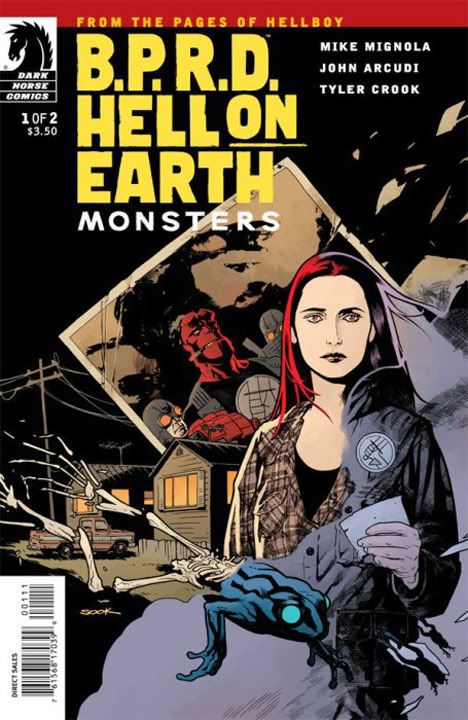
B.P.R.D. Hell on Earth: Monsters #1: A Comic Review
Publisher: Dark Horse Comics
Writers: Mike Mignola and John Arcudi
Art: Tyler Crook
I've missed an issue here or there of Dark Horse's B.P.R.D. series, so I'm not exactly sure why Liz Sherman is hanging out in a trailer park and living with a couple of goobers. But I've never objected to any Liz-centric story, neither this one nor the recently completed "The Dead Remembered" two-parter starring the character as a teen. Liz has always been a troubled and largely unhappy person. Just a guess here, but it probably has something to do with having killed her family via pyrokinesis as a child. Little things like that tend to make one prone to bouts of mopey behavior.
We love her, though. B.P.R.D. stories are full of fanciful freaks like Abe Sapien and Dr. Johann Kraus, but writers Mike Mignola and John Arcudi have never neglected the human element. They make Liz darkly fascinating and each new story reveals previously unimagined facets of her spiky personality.
So why is she living in low-rent exile among a bunch of drunks and wife-beaters? I'd better pick up some back issues, or maybe Mignola and Arcudi will reveal the answer in part two. In the meantime, they delve into a setting right out of one of the better episodes of The X-Files, with the supernatural elements coloring the edges until the gory cliffhanger on the last couple of pages. As far as I know, we've never met any of these secondary characters before, but Mignola and Arcudi bring them to vivid life with just a few lines of dialogue, despite tagging them with names like Jubal and Jeb. What the heck is Liz doing there?
But oh holy moley, we've got a live one here in artist Tyler Crook! While the amazing Guy Davis will certainly be missed, the creative team has recruited someone with a similar aesthetic-- a kind of loose, Alex Tothian look, perfectly attuned to the story's trashy setting and to its ominous undertones of encroaching menace; according to Dark Horse, he lists the great Milt Caniff as an influence and it shows. You can't go far wrong following Caniff, Frank Robbins or Harvey Kurtzman. Crook makes each character a distinct individual, with shabby fashion sense and deadbeat body language-- slumped over while carrying a case of beer, thrusting hands in pockets, angrily kicking at a frog in the rain. With a few impressionistic gestures here and some heavy black-spotting there, Crook's art-- much like that of his art influences-- is both caricatured and yet has an almost documentary-like believability thanks to a sharp eye for details such as cereal boxes on top of refrigerators, magazines downturned on the floor to mark the reader's place and beer cans tossed in the corner. This is my first encounter with Crook's art and I'm already in love with it. Colorist Dave Stewart-- a longtime series stalwart-- gives it a subdued palette that serves Crook well, all drab neutrals except for the red of Liz's hair.
I hope Crook has a long, long run on this series. People need to see the man's work! I'm looking forward to part two for that and to have all these intriguing questions answered. Or not, because much as I enjoy what Mignola and Arcudi do with their scripts, Crook's going to keep me buying B.P.R.D. for as long as he handles the art.
Wednesday, June 22, 2011
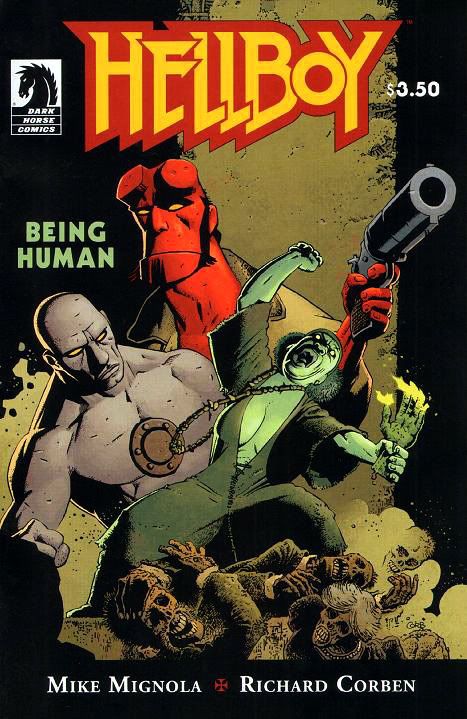
Hellboy: Being Human: Comic Review
Publisher: Dark Horse Comics
Writer: Mike Mignola
Artist: Richard Corben
Mike Mignola and Richard Corben team up for the sixth time* for this touching and gruesome tale in which Hellboy takes his despondent pal Roger to South Caroline so they can investigate a haunted mansion. Roger has every reason to be down—he’s a “15th century homunculus,” which apparently means he’s a big, rock-like naked guy with gray skin, an iron cap riveted into the center of his chest and some kind of block and chain chastity device covering his crotch. Roger appears to be and acts more or less a man, but he’s still figuring out what it means to be human. Hellboy, the human/demon hybrid with a blue collar attitude towards his job of punching folkloric creatures and Lovecraftian space demons, is the perfect guy to give Roger advice on the topic.
The haunting involves animated corpses, a witch and long-held family grudges. Mignola balances the weirdness with an affecting portrayal of a confused Roger, who despite his strange origins possesses an innate decency. He desperately wants to do the right thing, if only he knew what that was. As with "Makoma" and "The Crooked Man," Richard Corben proves to be an ideal match for this kind of moody, dark Hellboy story. He’s not the kind of artist who gets hung up on classical anatomy, but he gives his stumpy characters solidity and presence with his unique method of modeling, a kind of mottling or stippling. Whether it’s Roger’s stonelike skin or the mossy corpses and fungi-covered walls of the mansion, Corben is your go-to guy for sickening textures and miasmic atmospheres. Looking at these pages you can almost smell the damp plant-life and epic decay surrounding Hellboy and Roger. Corben's characters wear facial expressions that are frequently borderline comedic, but then he treats you to a stark panel where someone’s had a hole blown through her chest with gore draining out in a big red gusher. Yeah, unique. There’s not another Corben out there and we should treasure the one we have.
While I certainly don’t begrudge Mignola his forays into comedy, these uneasy tales of generational crimes and identity questions are the ones that stick with me long after I’ve closed the comic. It’s nice to revisit the tragic Roger and find Mignola amplifying those themes by exploring his character. Knowing Roger’s fate makes this story all the more poignant. "Being Human" is touching, grotesque and altogether memorable, the kind of stand-alone issue that's as rich if not richer than most multi-parters. It makes me long for the days when creators knew how to craft a story in one perfect, self-contained unit.
*Correction. Someone pointed out this isn't the third collaboration between Mignola and Corben. With the economy being the way it is and all, I've had to let go a lot of my staff. The fact checkers were the first to get pink-slipped. And while corrections are welcome and appreciated, for future reference only I am allowed to be snotty in this blog.