Years ago, when I was a kid, one of my friends lived on the next street. His house was across the alley from ours, so we used to hang out a lot in our backyards. Either he or his older brother collected all those black and white horror and sci-fi magazines Marvel/Curtis put out back then. I don't remember the titles after all this time, but I do have some vague memories of reading a story about some doomed astronauts who had accidentally landed their spaceship on the sun and couldn't take off again. So they bickered for seven pages, then died on the eighth. My takeaway from this is a feeling of claustrophobia.
I always enjoyed anthology comics, even when they creeped me out or cost me a night's sleep. I rarely bought them, so what I'd do was furtively read them at the store, then put them back on the spinner rack. The perfect crime! Only every so often, my curiosity would cost me. A story would give me a passing chill, warmed by the bright summer day outside. Then I'd forget about it. Sometime after dinner, when I hit the sheets and turned out the light, the story would return, its unsettling qualities magnified by my own imagination.
One such story, which I could have sworn was in the DC book Time Warp, but may have been in the brief early-80s revival of Mystery In Space, featured a luckless space traveler who crash-landed his rocket ship on some desert world where it started leaking some of his nutrient fluid. You know, space food. Whatever our astro-people ate up there where they couldn't get turkey sandwiches or Pop Tarts toaster pastries.
Some space ants started drinking the stuff and would return daily with more and more advanced technology. First, little wheeled wagons. Later, trucks with internal combustion engines. The astronaut, trapped in the wreckage upside down (if I remember correctly, which I doubt), watched in fascination as the ants progressed along our human scientific advancement tree. By the time rescue approached, the astronaut had become the reluctant witness to black-on-red ant warfare, which ended in an atomic blast because the ants had invented the atom bomb. The rescuers chalked it up to the wrecked ship's atomic powerplant blowing up, but the last panel showed them walking away, having failed to notice a teensy-tiny wagon overturned in the dirt.
Or maybe they were earth ants. Or maybe the story was in some Marvel comic or other. Or a Charlton. Or perhaps it never existed at all and I only dreamed it and instead of writing it as a short story and submitting somewhere and making a billion dollars I just gave it away like an idiot. Nah, I'm pretty sure it exists and one day I'll find it and learn the only thing I remember accurately about it is the astronaut. And those others, the ones from the black and white magazine, actually landed on Saturn and had a picnic.
Showing posts with label memories. Show all posts
Showing posts with label memories. Show all posts
Tuesday, April 8, 2014


Tuesday, March 25, 2014
What's the earliest comic book you can remember owning?
 |
| Joe Kubert, August 1974 |
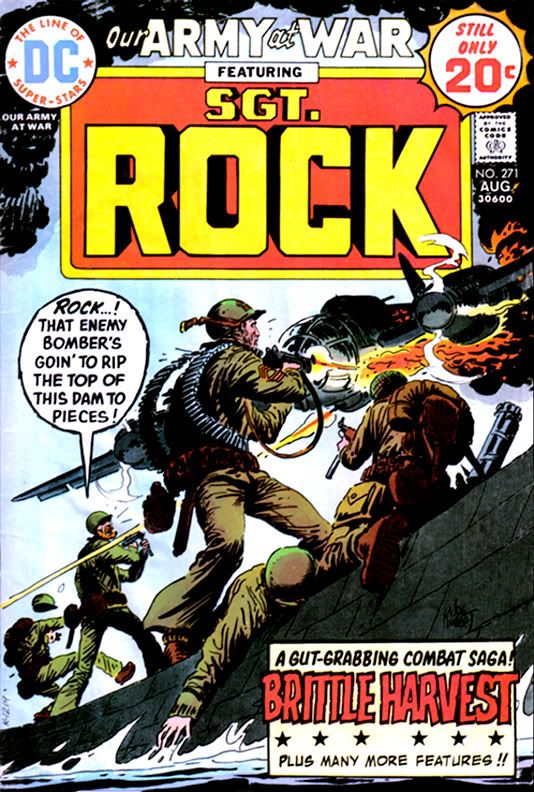
For years, I've had this persistent memory I learned to read from DC's Our Army at War #271, a book with art by the incomparable Russ Heath and a story by the inimitable Robert Kanigher. In the autobiographical film I constantly project in my mind, DC published it when I was three or four and there, on its pages, heretofore ignored ink marks inside the balloons coalesced into words, which formed into sentences and from there, the world of literacy opened to me. Then I looked Our Army at War #271 up online and learned it has a cover date of August 1974, a mere month before I started first grade. I was already six years old, and, according to family lore, I had already been reading for quite a while at that point.
So maybe Robert Kanigher didn't teach me mah letters, but I thought there was still a decent chance his story "Brittle Harvest," the book's Sgt. Rock-starring lead, truly was the first bit of fiction I read that didn't star a persistent weirdo with a fixation on oddly-colored breakfast foods.
But maybe it wasn't...
 |
| Jack Kirby/D. Bruce Berry, August 1974 |
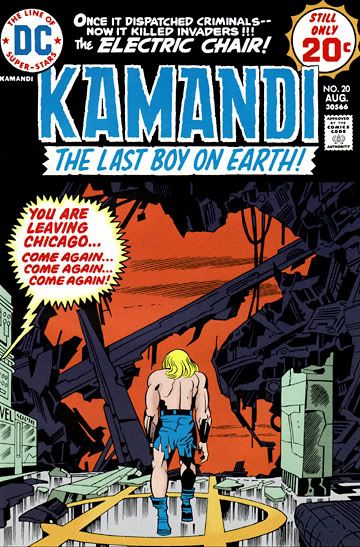
How did I manage to obtain three comics when my income consisted entirely of spare change I found under the sofa cushions or dove for in the deep end of the local Elks' Club pool? Gifts, maybe. I can't imagine what fool would give me three comics at the same time. One, yeah. Two is stretching it. Three invites rumors of decadence, of profligate spending on a scale unheard of in our little clan during the Ford administration days of energy crisis and Whip Inflation Now.
Or else I somehow managed to collect enough pennies to buy them myself. Yet, I have trouble imagining any scenario involving either of my parents allowing me such an extravagance. Again, one comic, maybe two if I'd been especially well-behaved. Three would be, in my mom's words when I bought a second aluminum baseball bat during my "athletic" period years later when I actually had a job and income of my own, "Ostentatious." My parents, both products of hardscrabble Depression-era childhoods, instilled in me a financial caution I maintain even now that I'm as rich as the guy on the Monopoly game box. Even with their permission, buying three comics at the same time back then would have given me the same guilty feelings I get now whenever I pick up a new Rolls or sports franchise.
Whether from false memories of learning to read or from inspiring a lifelong love of Jack Kirby's work, each of these comics has stuck with me in ways I've learned are as foggy and treacherous as some jagged coast in an old sea story. I once again own both Our Army at War and Kamandi, so I've read them recently. In this way I've corrected a number of misconceptions I carried for years about their stories.
A physical copy of Strange Sports Stories, on the other hand, remains elusive and, therefore, its contents a jumbled mishmash of mistaken impressions.
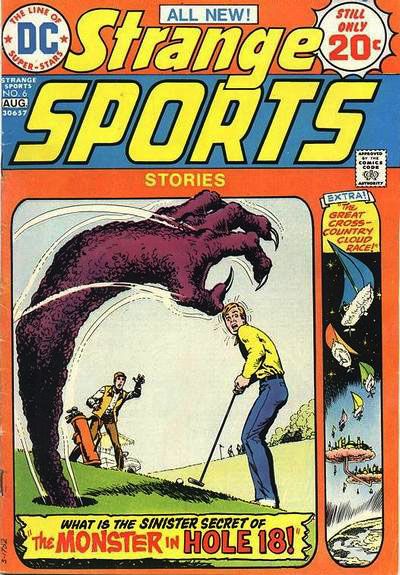
The cover is easy to find online, though. Let's take a look and see what recollections it inspires. Wow! It's by Nick Cardy! What a treat! I've really underestimated myself all these years. Kid me really had good taste in cover artists.
 |
| Nick Cardy, August 1974 |
Let's look at the cover copy. Interesting story titles. I thought so at the time, but I may have been alone there, since this was actually the final book in the series. Another one of those failed DC experiments.
"The Monster in Hole 18!" inspires a vision of someone being pulled through the hole into an alternate dimension, his body grotesquely thinned and stretched in the process, leaving his midsection resembling a great noodle. At least during the transition. I'm pretty sure he came out the other side in whatever state for him passes as normal.
I may be conflating this with the events of "The Great Cross-Country Cloud Race," which I believe is about a couple of young guys seriously into boating who travel into another universe where people race through the skies in little sailboats made from solidified clouds. Perhaps these guys were the ones who went through a physically distorting transportation process of some kind.
The cover suggests the book contains just two stories. So why do I feel so strongly there was a third? One about a young guy who injures his arm in such a way he can throw baseballs at ridiculous velocity, gets signed by a major league team and pitches in a game against a New York Yankees-type powerhouse club before crashing his expensive sports car and losing his magical pitching ability when the doctor re-sets his arm. The same accident injures his hip, and there's a little matter of drop-kicking a football...
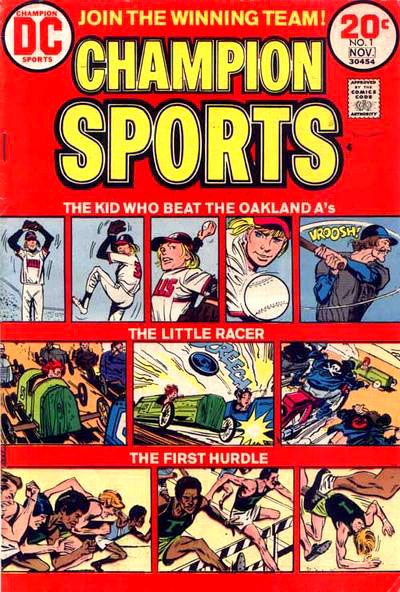 |
| Jerry Grandenetti/Creig Flessel, July 1973 |
And it isn't the New York Yankees he pitches against and wins. It's the Oakland A's.
That brings back a whole lot of memories! The A's of the early 1970s featured a potent line-up centered around a hard-slugging clean-up hitter by the name of Reggie Jackson, and a pitching rotation starring Vida Blue, Ken Holtzman and Catfish Hunter (Rollie Fingers was on the team, too), each of whom won 20 or more games in 1973. They beat the New York Mets in the World Series that year.
My family hated those guys and their evil mustaches because we were National League fans and my oldest brother, a catcher himself, idolized Johnny Bench. This meant we were Cincinnati Reds boosters, and they lost in the Series to the A's the previous year. It didn't matter that my uncle had caught for the A's when they were the Kansas City Athletics and personally knew and greatly respected Hunter.
So, in fact, the story is called "The Kid Who Beat the Oakland A's," and I've just learned it's written by the great Joe Simon, drawn by the nifty Jerry Grandenetti, with inks by Creig Flessel.
And you can read it in all its glory on Diversions of the Groovy Kind, a super-cool website that's one of my favorites. The Groovy Agent must be one of those people with eidetic memory. He knows it all, baby. He took the comic's tag line to heart and joined the winning team!
The "kid" is David Wexler, a would-be writer and sports nut. He ends up enjoying a brief career in the Major Leagues, not as stellar as Catfish Hunter's or Vida Blue's, but still something to be proud of, especially the climactic event, which is spoiled by the title. The most telling detail, though, is the caption towards the end, when the kid's swelled head leads to his comeuppance: "You may have read about that game... What you didn't hear about was the dumb, wild things I did off the diamond." It's a single sentence Simon uses to introduce the off-the-field aspect of big time sports, and gives the story a gritty background verisimilitude to help put across its rather improbable premise. Shades of Jim Bouton's Ball Four (1970) and the stuff the newspapers didn't print about Mickey Mantle.
Which reminds me! I could tell you a rather funny story involving my dad, my uncles, Mantle and Joe Pepitone down at spring training in Florida. Maybe one day I will, but for now let me just tell you my dad swore me to secrecy and I've already told you too much.
What about the other stories? Well, "The Little Racer" is about a soapbox derby kid who gets run over by a one-percenter motorcycle gang who then help him rebuild his racer with stolen parts. He ends up with quite a hotrod, but his innate honesty causes him to revert back to his green wooden crate for the final race, which he loses but fairly and squarely. Then the cycle dudes stomp him good, the same way the Hell's Angels did Hunter S. Thompson when they learned they weren't getting any of the money from the book he wrote about them. Okay, I made that last one up. The story thing, not the Hunter S. Thompson thing, which really happened. The comic may or may not have a happier ending. But even though our theme today is how crappy my memory is, I feel confident about its other details.
On the other hand, "The Last Hurdle" brings absolutely nothing to mind. I'm guessing it has to do with at least one hurdle. Perhaps a final one of some kind. Literal? Symbolic? Shambolic?
No, that's this blog.
This has been a day for shocking revelations, hasn't it? Let's conclude this mess with two more.
First, in December of 1997, the FBI investigated the possible theft of the artwork from this very comic, along with hundreds or even thousands of other pages. The entire sequence of events found near the bottom of the document makes for some interesting (if difficult due to formatting and spelling errors) reading. My oh my! The things you uncover when you take a memory trip. I'm completely flabbergasted.
And second, the answer to that nagging question that provides this post's title. Champion Sports #1. Look at this: it has cover date of November 1973, same year the A's won their second World Series. Diversions of the Groovy Kind puts its actual release date as July, which means, depending on their own street dates, it hit the stands more than a year earlier than Our Army at War #271, Kamandi #20 or Strange Sports Stories #6.
Champion Sports #1. I was five years old when I read it. It's now the earliest comic I can remember owning!
Monday, March 10, 2014
I bought Mike Allred's Red Rocket 7 on Comixology last night...
Man, I remember when Red Rocket 7 came out. 1997. It's right at the tail end of what I consider appropriate for this blog-- pre-2000 stuff. I try to keep to stuff even earlier than that, largely the late 70s through the mid-80s when I was first following comics as a fan rather than an occasional reader. But why not talk about some late 90s/pre-millennial stuff? You know, if it's really funky and cool. Like Red Rocket 7!
Anyway, I'm about to tell you a fun story about buying the original print version of Red Rocket 7. I didn't start buying it until later, much later, than its debut. I believe this. I may be wrong. I think I started buying it in the summer of 1998, after its print run concluded. The reason I think this is I have a strong memory of buying it in Athens, Georgia, and getting into a discussion about its weird dimensions. If I had bought it in Albany, the people there wouldn't have said boo about it. People in Athens have opinions about things and they like to engage with you about said opinions.
I didn't move back to Athens until the summer of 1998. I lived in a one-bedroom apartment off Baxter Street and the A/C was a wall-mounted unit in my bedroom. It sounded as if someone had cranked up a VW Beetle in there, barely put out any cool air at all, caused me to buy two box fans which further contributed to my localized noise pollution and kept me up all night with the sweats.
My job was as a "graphic designer" at the local daily paper and I was supposed to be sort of an on-staff cartoonist as well, but mostly what I did was put together used car ads I had very little say over the design of all day then drive home and read comics and try to draw, draw and draw more at my lovely drafting table in the sweltering sauna I called an apartment.
My salary was dismal, my career prospects even more so. My social life consisted of crashing parties with the few friends I had and eating food out of the refrigerators or popping microwave popcorn and having fights with it in the kitchen. These friends and I sometimes crashed tailgate parties outside Sanford Stadium during football season got on free beer and stuffing our faces with free chicken sandwiches and hamburgers, and, when everyone else had gone to watch the game, stole all the whiskey fifths we could get our hands on and passed them out to homeless people on North Campus like liquored-up, idiot Robin Hoods. My romantic life consisted of mooning over this incredibly cool and well-connected artist and her hair of ever-changing shades of red, who sometimes talked to me and sometimes ignored me depending on her mood or what drugs were influencing her that night.
What little money I had in those days I spent on Chinese buffet, beer and comics. Comics, especially those by Mike Allred and Mark Schultz and Los Bros Hernandez and Peter Bagge, were fast becoming an obsession with me again after years of remission. So of course I wanted to read Red Rocket 7.
But when I bought it, the guy who owned the comic book store told me it pissed him off.
"Why? Why would it piss you off?" I asked.
"The size and shape are totally fucked up!" he told me.
I was standing there thinking what a neat little package Red Rocket 7 was. It had these sturdy covers of some kind of thicker-than-usual stock, and both the graphics and dimensions recalled 45 RPM records, of which I still had a stack of back at my mom's house. The comic book store guy told me he got all that and thought it was pretty clever and would always be enthusiastic about Allred's work, but at the same time, the size and shape it meant the book sat like an oddity on the shelf.
Maybe it affected sales. I don't know. For all I know, Red Rocket 7 sold billions of copies. Maybe the comic book guy was upset at the idea people would reject Red Rocket 7 because they couldn't fit it in their comic book longboxes and that was a downright shame, because it deserved a much wider readership. Maybe I destroyed my memory with a few too many drunken weekends-- god knows I can't remember much about any of them but I hear stories that fill me with shame-- and I'm making up most of this story out of bits and pieces of things that have nothing to do with Mike Allred and Red Rocket 7.
Still, nearly sixteen years later, I'm fairly certain the book's size and shape were at issue. And for some reason, I never bought every issues. I think I bought the first four or five, then stopped. I have no idea how the story ends. And I do know now that it's been digitized, its size and shape no longer matter in the least. It fits right inside my phone and I can take Red Rocket 7 everywhere I go.
Now I do own all of it, and if I feel up to it, I'll post some thoughts about it here. It will probably be the most recent comic we wrestle with on this blog.
Anyway, I'm about to tell you a fun story about buying the original print version of Red Rocket 7. I didn't start buying it until later, much later, than its debut. I believe this. I may be wrong. I think I started buying it in the summer of 1998, after its print run concluded. The reason I think this is I have a strong memory of buying it in Athens, Georgia, and getting into a discussion about its weird dimensions. If I had bought it in Albany, the people there wouldn't have said boo about it. People in Athens have opinions about things and they like to engage with you about said opinions.
I didn't move back to Athens until the summer of 1998. I lived in a one-bedroom apartment off Baxter Street and the A/C was a wall-mounted unit in my bedroom. It sounded as if someone had cranked up a VW Beetle in there, barely put out any cool air at all, caused me to buy two box fans which further contributed to my localized noise pollution and kept me up all night with the sweats.
My job was as a "graphic designer" at the local daily paper and I was supposed to be sort of an on-staff cartoonist as well, but mostly what I did was put together used car ads I had very little say over the design of all day then drive home and read comics and try to draw, draw and draw more at my lovely drafting table in the sweltering sauna I called an apartment.
My salary was dismal, my career prospects even more so. My social life consisted of crashing parties with the few friends I had and eating food out of the refrigerators or popping microwave popcorn and having fights with it in the kitchen. These friends and I sometimes crashed tailgate parties outside Sanford Stadium during football season got on free beer and stuffing our faces with free chicken sandwiches and hamburgers, and, when everyone else had gone to watch the game, stole all the whiskey fifths we could get our hands on and passed them out to homeless people on North Campus like liquored-up, idiot Robin Hoods. My romantic life consisted of mooning over this incredibly cool and well-connected artist and her hair of ever-changing shades of red, who sometimes talked to me and sometimes ignored me depending on her mood or what drugs were influencing her that night.
What little money I had in those days I spent on Chinese buffet, beer and comics. Comics, especially those by Mike Allred and Mark Schultz and Los Bros Hernandez and Peter Bagge, were fast becoming an obsession with me again after years of remission. So of course I wanted to read Red Rocket 7.
But when I bought it, the guy who owned the comic book store told me it pissed him off.
"Why? Why would it piss you off?" I asked.
"The size and shape are totally fucked up!" he told me.
I was standing there thinking what a neat little package Red Rocket 7 was. It had these sturdy covers of some kind of thicker-than-usual stock, and both the graphics and dimensions recalled 45 RPM records, of which I still had a stack of back at my mom's house. The comic book store guy told me he got all that and thought it was pretty clever and would always be enthusiastic about Allred's work, but at the same time, the size and shape it meant the book sat like an oddity on the shelf.
Maybe it affected sales. I don't know. For all I know, Red Rocket 7 sold billions of copies. Maybe the comic book guy was upset at the idea people would reject Red Rocket 7 because they couldn't fit it in their comic book longboxes and that was a downright shame, because it deserved a much wider readership. Maybe I destroyed my memory with a few too many drunken weekends-- god knows I can't remember much about any of them but I hear stories that fill me with shame-- and I'm making up most of this story out of bits and pieces of things that have nothing to do with Mike Allred and Red Rocket 7.
Still, nearly sixteen years later, I'm fairly certain the book's size and shape were at issue. And for some reason, I never bought every issues. I think I bought the first four or five, then stopped. I have no idea how the story ends. And I do know now that it's been digitized, its size and shape no longer matter in the least. It fits right inside my phone and I can take Red Rocket 7 everywhere I go.
Now I do own all of it, and if I feel up to it, I'll post some thoughts about it here. It will probably be the most recent comic we wrestle with on this blog.
Wednesday, July 11, 2012
Is it that time again? Time to re-read Ghost World?
Ghost World. You've seen the movie. You've read the book. So have I. Let's form a club, okay? We'll meet in my tree fort out back and read Ghost World over and over again, and act out the scenes and we won't let anybody join we don't want to join!
That's a stupid idea. Sorry. But the feeling I should read Ghost World one more time is growing deep down inside, a brilliant idea which somehow sprang from the exact same place as that stupid one. To read Ghost World again requires the purchase of Ghost World, which I can easily afford. I have a battered pre-movie version back in the States. Yes, I was into Ghost World before it became a movie. I'm not bragging or trying to pose as some hipster cognoscenti. It's a matter of chronology. Time and setting.
Ghost World just crept up on me in a melancholy, mysterious fashion that seems completely fitting. It was the way back when, during that time we called the mid-90s because we were in the middle of a decade that started 199 and finished with a number somewhere between 3 and 7, Bill Clinton was president, Kurt Cobain had just died and I was in college for the second time, studying art, spending a lot of free time between classes at the student bookstore. I kept finding Ghost World on the shelf among the humor books for some reason. I guess because a lot of them were cartoon-based. Calvin and Hobbes, Bloom County, The Far Side. College faves. And, for some reason, the trade paperback of DC's Camelot 3000, which they probably still have. Every once in a while I'd pick up Ghost World, scan a page, get some kind of misjudged message from it and suddenly feel very alienated.
Which wasn't an unusual feeling. I lived in a party dorm with a series of the most mismatched roommates possible-- first an Eagle Scout/Eagles fan/outdoorsman who littered the room with belongings and food, and over the course of our semester together completely coated the mirror with his sebaceous eruptions but objected my my beard shavings in the sink; then two jocks who pledged frats, one of whom would bring his girlfriend back to the room for strangely chaste yet very loud make-out sessions early in the morning after Date Night or whatever event it was her sorority sponsored that weekend. That I was drunk or high myself most of the time did nothing so smooth our relations.
With 8 a.m. studio classes and an amateur 24-hour a day casino open in the room next door, I developed a hyper-sensitivity to noise which led to several confrontations with other students, culminating in the most excruciating one of all. When you can't ask someone to please close her door or at least make sure she's actually inside her room when she wants to enjoy loud music without being asked later that evening by your RA to fill out a form stating you're not a racist, then you have no place in dormitory life.
But I've always been an Enid Coleslaw. Too smart to accept life at face value, too stupid to do anything about it. It's only in the past few years I've dropped at least some of my cynicism and contempt for pop culture and tried to embrace it. Probably as a result of over-exposure to post-modernism, where ironic enjoyment of the kind Enid and her pal Rebecca Doppelmeyer specialized in has become mainstream. Mass culture has appropriated our outsider stance, leaving us with nowhere to turn except sincerity. Like Enid, I even had a somewhat more popular best friend who shared my sense of alienation and otherness, with whom I could heap mocking scorn on such daring targets as America's Funniest Home Videos and generic dance music. Like Enid, I left town to start a new life.
Unlike Enid, my Rebecca turned out to be even more dysfunctional than I was. Instead of growing into a beautiful young woman, he died of an accidental overdose in 1999, in a hotel room, on a business trip. So maybe I was Rebecca after all and all my Enid-isms-- so Enid I even to this day occasionally wear ugly plastic rimmed glasses and occasionally have for years and years and years-- were just a pose. Well, I don't know what to think about that. I guess I'm just one more of those people.
By the time we buried that guy, I'd finally read Ghost World. Multiple times. Flash forward two years and I was so excited about the movie. I watched the trailer at work-- a private office, a souped-up Mac with the fastest Internet connection available at the time made that possible-- then went with friends to the little shopping center theater where the movie played. Liked the parts that captured the disconnected, ambivalent tone of the book, felt a little let-down by the emphasis on jokes and linear plot. Good performances. Kinda want to see it again, too.
Yes. It is decided. Today, I order Ghost World. After all, if I do produce my own comic, I need something to rip o-- I mean, provide inspiration.
Oh, yeah. I also relate to Clowes's original "Art School Confidential" short story. Hilariously accurate, perfectly acidic take-down of art school. The movie, on the other hand? It stinks. Maybe I need to read that story again, too, while I'm at it.
That's a stupid idea. Sorry. But the feeling I should read Ghost World one more time is growing deep down inside, a brilliant idea which somehow sprang from the exact same place as that stupid one. To read Ghost World again requires the purchase of Ghost World, which I can easily afford. I have a battered pre-movie version back in the States. Yes, I was into Ghost World before it became a movie. I'm not bragging or trying to pose as some hipster cognoscenti. It's a matter of chronology. Time and setting.
Ghost World just crept up on me in a melancholy, mysterious fashion that seems completely fitting. It was the way back when, during that time we called the mid-90s because we were in the middle of a decade that started 199 and finished with a number somewhere between 3 and 7, Bill Clinton was president, Kurt Cobain had just died and I was in college for the second time, studying art, spending a lot of free time between classes at the student bookstore. I kept finding Ghost World on the shelf among the humor books for some reason. I guess because a lot of them were cartoon-based. Calvin and Hobbes, Bloom County, The Far Side. College faves. And, for some reason, the trade paperback of DC's Camelot 3000, which they probably still have. Every once in a while I'd pick up Ghost World, scan a page, get some kind of misjudged message from it and suddenly feel very alienated.
Which wasn't an unusual feeling. I lived in a party dorm with a series of the most mismatched roommates possible-- first an Eagle Scout/Eagles fan/outdoorsman who littered the room with belongings and food, and over the course of our semester together completely coated the mirror with his sebaceous eruptions but objected my my beard shavings in the sink; then two jocks who pledged frats, one of whom would bring his girlfriend back to the room for strangely chaste yet very loud make-out sessions early in the morning after Date Night or whatever event it was her sorority sponsored that weekend. That I was drunk or high myself most of the time did nothing so smooth our relations.
With 8 a.m. studio classes and an amateur 24-hour a day casino open in the room next door, I developed a hyper-sensitivity to noise which led to several confrontations with other students, culminating in the most excruciating one of all. When you can't ask someone to please close her door or at least make sure she's actually inside her room when she wants to enjoy loud music without being asked later that evening by your RA to fill out a form stating you're not a racist, then you have no place in dormitory life.
But I've always been an Enid Coleslaw. Too smart to accept life at face value, too stupid to do anything about it. It's only in the past few years I've dropped at least some of my cynicism and contempt for pop culture and tried to embrace it. Probably as a result of over-exposure to post-modernism, where ironic enjoyment of the kind Enid and her pal Rebecca Doppelmeyer specialized in has become mainstream. Mass culture has appropriated our outsider stance, leaving us with nowhere to turn except sincerity. Like Enid, I even had a somewhat more popular best friend who shared my sense of alienation and otherness, with whom I could heap mocking scorn on such daring targets as America's Funniest Home Videos and generic dance music. Like Enid, I left town to start a new life.
Unlike Enid, my Rebecca turned out to be even more dysfunctional than I was. Instead of growing into a beautiful young woman, he died of an accidental overdose in 1999, in a hotel room, on a business trip. So maybe I was Rebecca after all and all my Enid-isms-- so Enid I even to this day occasionally wear ugly plastic rimmed glasses and occasionally have for years and years and years-- were just a pose. Well, I don't know what to think about that. I guess I'm just one more of those people.
By the time we buried that guy, I'd finally read Ghost World. Multiple times. Flash forward two years and I was so excited about the movie. I watched the trailer at work-- a private office, a souped-up Mac with the fastest Internet connection available at the time made that possible-- then went with friends to the little shopping center theater where the movie played. Liked the parts that captured the disconnected, ambivalent tone of the book, felt a little let-down by the emphasis on jokes and linear plot. Good performances. Kinda want to see it again, too.
Yes. It is decided. Today, I order Ghost World. After all, if I do produce my own comic, I need something to rip o-- I mean, provide inspiration.
Oh, yeah. I also relate to Clowes's original "Art School Confidential" short story. Hilariously accurate, perfectly acidic take-down of art school. The movie, on the other hand? It stinks. Maybe I need to read that story again, too, while I'm at it.
Subscribe to:
Posts (Atom)