As a teen she favored striped tops, loved her father and two sisters and was quite fond of cats. Lonnie Loomis, middle child extraordinaire, caught between the bossy, demanding eldest Stacy and the irrepressible, attention-seeking, somewhat psychotic, baby Michana. I don't get to read many psychological or psychiatric studies (just the abstracts and second hand articles), but from what I can gather Alfred Adler came up with this idea the order of your birth determines your personality
The first born is special, doted upon, grows up feeling closer to authority figures such as parents, becomes a leader. In the Loomis family, it's Stacy. She starts her siblings down the path of vengeance, then burns out. Literally. The youngest gets even more attention and sometimes ends up spoiled rotten. They become class clowns and show-offs. In Michana's case, they become child assassins for Ursula X.X. Imada, then head teen gangs on multi-planet crime sprees. What about the middle child? They make do. That's how you get a Lonnie Loomis. In any event, this is the simple version.
Poor Lonnie. Although her sisters love her, she's the only one among them to doubt their mission. She adored her father as much as Stacy and Michana ever did, but killing a lot of strangers for the alien weirdo the Merk in exchange for the fusion casting power of Nexus doesn't appeal to her. She's too compassionate and uncertain. Her attention wanders because she wants something of a normal life.
Introduced in Nexus #25 (First Comics, 000, 198-) alongside Stacy and Michana, Lonnie mourns the murder of her beloved father, General Loomis. They later learn his killer was the orginal Nexus, in Nexus #3- (000, 198-), and Lonnie is the one who spits in his face. Here's the sequence as illustrated by Mike Mignola, with inks by John Nyberg.
Soon, Lonnie begins actively voicing her doubts and opposition to Stacy's leadership as they risk Michana's life and sanity by holding a seance that allows the young girl to host what's apparently a demon in hopes of learning where to gain enough power to kill Nexus. From this moment on, Lonnie begins to drift from her sisters.
She's still involved enough to accompany them on their visit to the Merk. They arrive on --- in Nexus #3- (000, 198-), but it's in Next Nexus #1 where they actually confront the whimsical extra-dimensional alien and demand Nexus abilities for themselves. The gigantic Merk immediately chooses Michana to invest with these powers. It's a terrifying scene reminiscent of some of the darker elements from the 1971 children's film Willy Wonka and the Chocolate Factory starring Gene Wilder as Wonka. As we all know, the movie is all about obnoxious kids tempting fate and paying the price. And as powerful a figure as Willy Wonka is, he's also just a candy-maker. The Merk is beyond our reckoning. For a moment, one can only imagine what unspeakable horrors the Merk will visit upon fragile human child Michana.
What he does is casually toss her into one of the strange globular tanks Nexus bathes in to have his dreams and recharge his seemingly unlimited powers. Lonnie objects and this causes the Merk to punish her and Stacy with intense headaches. Michana saves her sisters by rebuking the Merk even as he holds her aloft by her ponytail. Lonnie then attempts to reject the Merk's gift outright, and he reacts by lashing out at her again. Michana defends Lonnie again, and the Merk transforms them into fusionkasters.
In the Nexus books, "fusionkasting" is the technical name for Nexus' superpowers, and what a Nexus does is kill mass murderers. This never sits well with Lonnie. Even series hero Horatio Hellpop himself alternates between acceptance and avoidance of his appointed task, and there's the question-- voiced by Lonnie-- of whether or not an alien such as the Merk has the right to judge humanity. Michana argues his alien nature makes him more objective and therefore more qualified for this than humans themselves. Stacy and Michana accept their charge and perform their first killing. They are in effect assassins in the hire of the Merk, a creature whose behavior is erratic at best, and their new powers corrupt them almost at once.
Lonnie adopts a cat against her sisters' wishes and refuses to join them on their vendetta. In a chilling scene, the pair confront Lonnie and cajole her into throwing the cat out the window. At this point, the break between siblings becomes inevitable. While Lonnie pursues a questionable relationship as a way out, the other two court disaster by confronting Nexus himself. With this, Lonnie drops from the narrative until ---- (Dark Horse, --- 199-).
Michana, now a murderous teen and gang leader (after having served an apprenticeship as an assassin under the tutelage of arch-villain Ursula X.X. Imada), ends up arrested and it's Lonnie who assumes custody of the wayward girl. What follows is a hilarious romantic misadventure in which a Tom Cruise lookalike named Tom Zeus (just to make it plain just who Mike Baron and Steve Rude are satirizing) puts some all-too-smooth moves on Lonnie. Feeling protective of her more naïve older sister, the more worldly Michana does her thing.
Her thing involves dressing like a ninja and using a paralyzing poison on Zeus.
What next for good ol' Lonnie? As far as I know, she hasn't reappeared in Nexus, which ended a long hiatus to reappear first as an offering from Rude's own Rude Dude Productions and then as a recurring feature in the new Dark Horse Presents ongoing. Baron and Rude haven't seen fit to update readers on all things Loomis, but it's only a matter of time. Let's hope she finds some kind of happiness.
But not too much.
Friday, January 30, 2015


Friday, October 31, 2014
October is Spookey Month: Happy Halloween from the Twilight Zone!

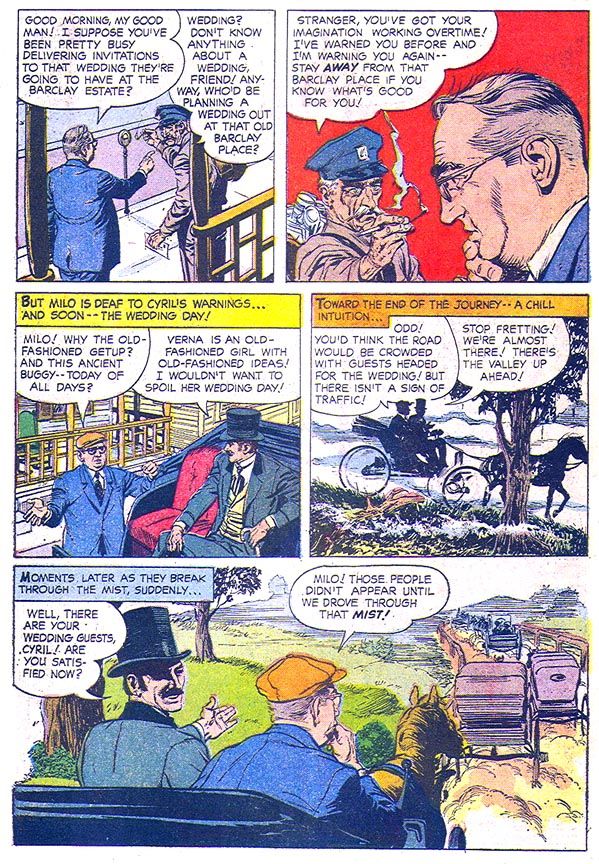
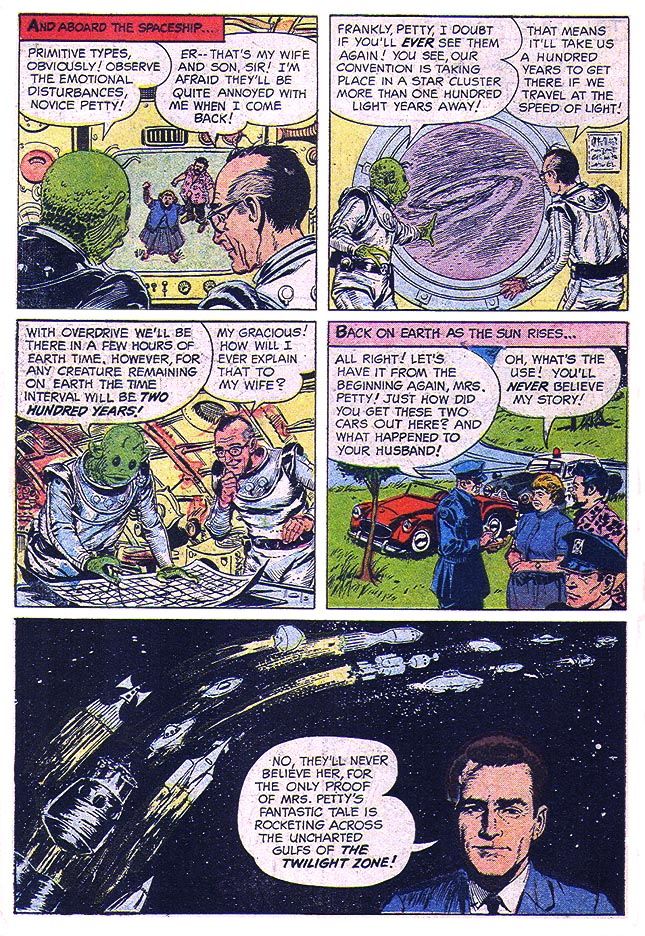
The best thing about it is George Wilson's painted cover, a fairly accurate rendition of "The Joiner," which is also the book's strongest tale. And that's saying a lot when one of the stories is about a renegade Nazi who's used his shrinking gas to turn Hitler and his cronies into suspended animation figurines waiting in a glass case for their time to come around again. In "The Joiner," we meet Alvah Petty, a harassed and pathetic bookkeeper by day and all-powerful Grand Poobah of any number of men's organizations by night. The crazier the headgear and more esoteric rituals the more he likes it, all the better to keep him away from home where his wife and middle-aged beatnik son treat him like dirt. They conspire to humiliate Petty so he'll stay home nights and they can abuse him more but it backfires on them when the fake club the son comes up with-- "Knights of the Galaxy"-- improbably turns out to be the real thing and its alien members spirit a not very reluctant Petty away for a 200 year club meeting in another solar system.
The lead story is a yawner of a ghost story about a conman and his partner (who looks amazingly like great character actor Edward Andrews, who co-starred in The Twilight Zone episode "Third From the Sun") hiding out in a small town. The conman ends up engaged to a woman who may or may not be from the Other Side. You know, where the poltergeists live.
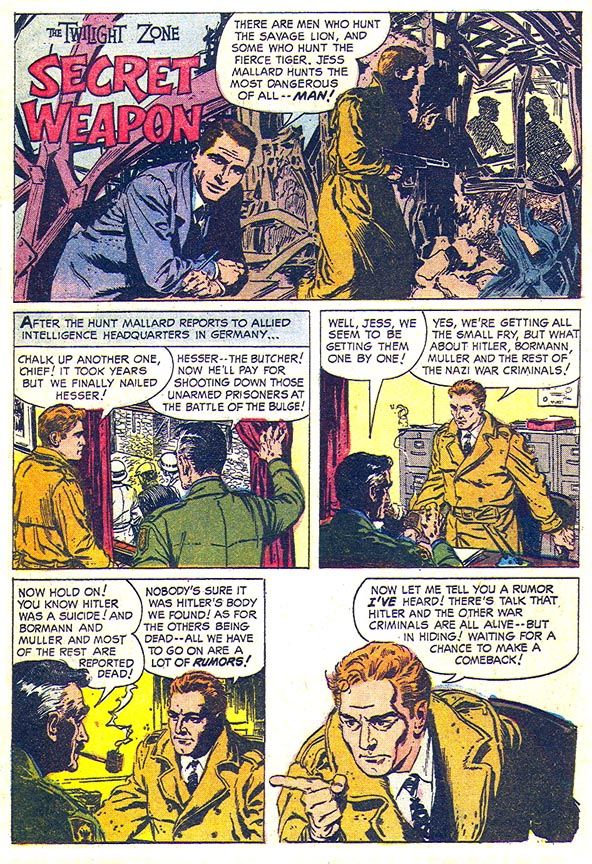
The second tale, "Secret Weapon," otherwise known as "The One with Doll Hitler," features a protagonist who might have been worthy of his own book, one Jess Mallard. Don't let his stupid, duck-like name fool you. The guy is a dogged Nazi hunter who will stop at nothing to capture his prey including offering to pay an exorbitant amount for strangely heavy carved figurines of Adolf Hitler, Martin Bormann and some joker known only as "Muller." Muller, the generic top Nazi. They should have given Mallard a better name then spun him off into his own book. Something like Duke Stone, Nazi-Hunter. It's appropriate because Serling occasionally set up Nazi characters for deserved comeuppances, as in The Twilight Zone episode "Death's-Head Revisited" and in the November 1969 Night Gallery pilot segment "Escape Route." Oh, and don't forget "He's Alive," a The Twilight Zone episode where Dennis Hopper plays a neo-Nazi would-be Hitler who runs afoul of the ghost of the real one with tragic consequences. That episode is kind of muddled and turns campy with its big reveal (don't put your pseudo-Hitler in front of a photo of the actual one, please), but it's still more gripping than the tepid "Secret Weapon," Jess Mallard aside. Mallard would have kicked Hopper's ass two minutes into his story, though, and saved everyone a lot of trouble later. Mallard may look like Leslie Howard by way of William Shatner, but he's all Robert Stack.
And then "The Joiner." The slobby beatnik who appears almost the same age as his dad, friendly green aliens and the final panel with Serling superimposed over what appears to be a highway among the stars are a few more elements that make this one a fun standout.
By now you realize none of these stories will chill you the way Serling's show did at its very best, but the art, which is apparently by EC alums Reed Crandall and/or George Evans solid enough, with caricatures of Serling that look a lot like him. Except for the one that inexplicably resembles a post-auto accident Montgomery Clift leading off "Secret Weapon." I don't know if anyone considers this book an example of either artists' A-level material, but it's easy to look at and occasionally-- especially in "The Joiner"-- has a little bit of that ol' EC magic. I would never begrudge either guy an art job in the lean days between Dr. Wertham and Warren Publications. For the history buff in me they even manage to work in a short recounting of a story I once heard about Abraham Lincoln possibly having a prescient dream about his assassination and for the skeptic who scoffs at such ridiculous notions in me, a back cover that dabbles in something that's almost science fact. All in all, Dell Four Color #1288 The Twilight Zone is a neat little package that probably has its origins more in stuff the contributors had lying around in their studios or offices than anything Serling or guys like Richard Matheson and Charles Beaumont might have come up with.

And that's it for this year's Spookey Month. I hope you enjoyed it as much as I did.
Thursday, October 30, 2014
October is Spookey Month: You can't have Halloween without Bernie Wrightson!
Hello, Halloween hellhounds! Let's enjoy Bernie Wrightson's delightful Creepy magazine frontispieces. I'm not sure when Creepy started running these, and Wrightson didn't do one for every issue. Sometimes they'd run a full-color house ad for Vampirella or spotlight another talented artist. But Wrightson's frontispieces are rich with spooky atmosphere. And ghoulish good humor. These are just a few of my fearvorites...
This next one is a particular joy to behold...
Oh wow! Isn't that beautiful? Okay, a few more... This next one I like because it's one of those Wrightson "spooky stuff happens even during the day" images. Just like in the memorable story "Jenifer" he illustrated. It starts one magical afternoon. Imagine hiking in the forest on a gloomy fall day and...
Egads! Dare we continue? Dare we do!
Here's my favorite, though. It's a collaboration with Walter Simonson, a guy who's best known for Asgardian superheroes but has done a few highly effective fright jobs in his long career, too. Plus, it's specifically Halloween-related.
Love those. But to be honest, the scariest Creepy frontispiece of all wasn't drawn by Wrightson or Simonson. It's this one. Steady on, people. Steady on...
AAAIIIIIEEEEEEEE!!!
We definitely need something to help us recover our wits after that shriek-inducing moment of terror. All of these except the last are available in Dark Horse's gorgeous and essential Creepy Presents Bernie Wrightson hardcover. Now I need to go clean up a little. So calm yourselves and here's something to soothe your jangled nerves.
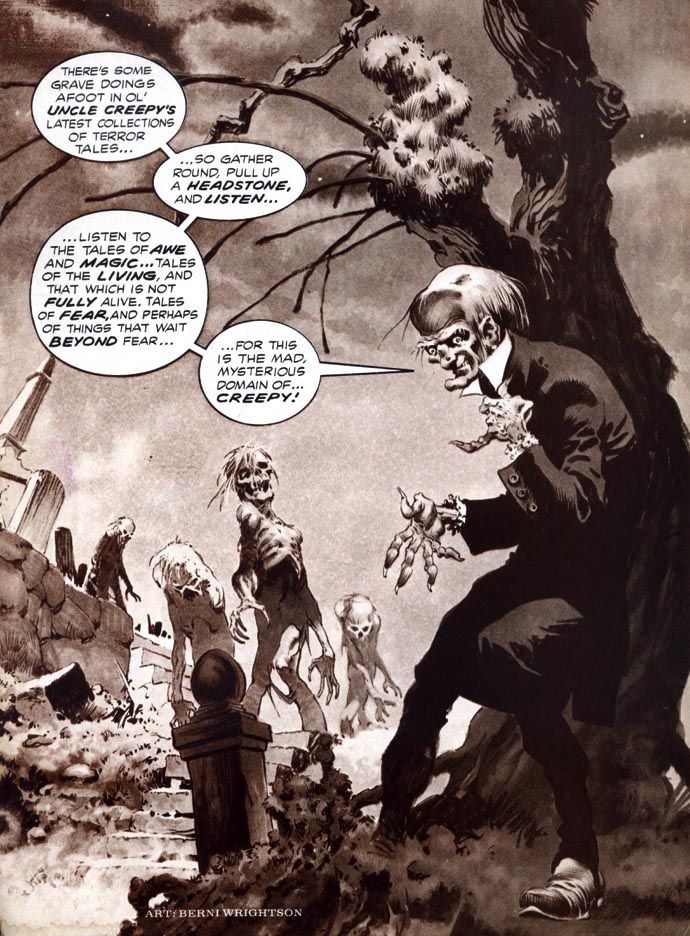 |
| Creepy 66 (November 1974) |
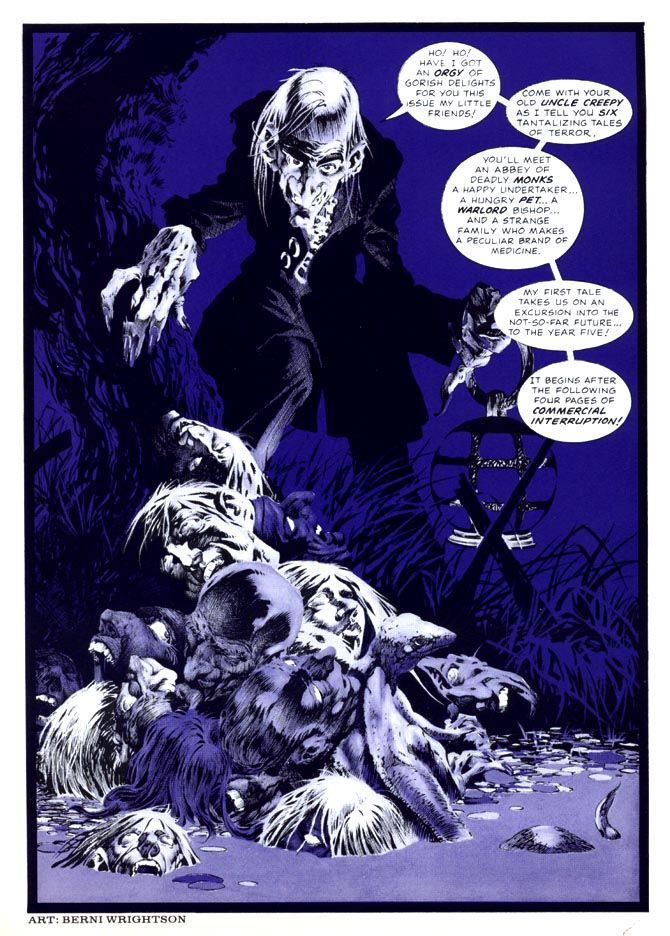 |
| Creepy 67 (December 1974) |
This next one is a particular joy to behold...
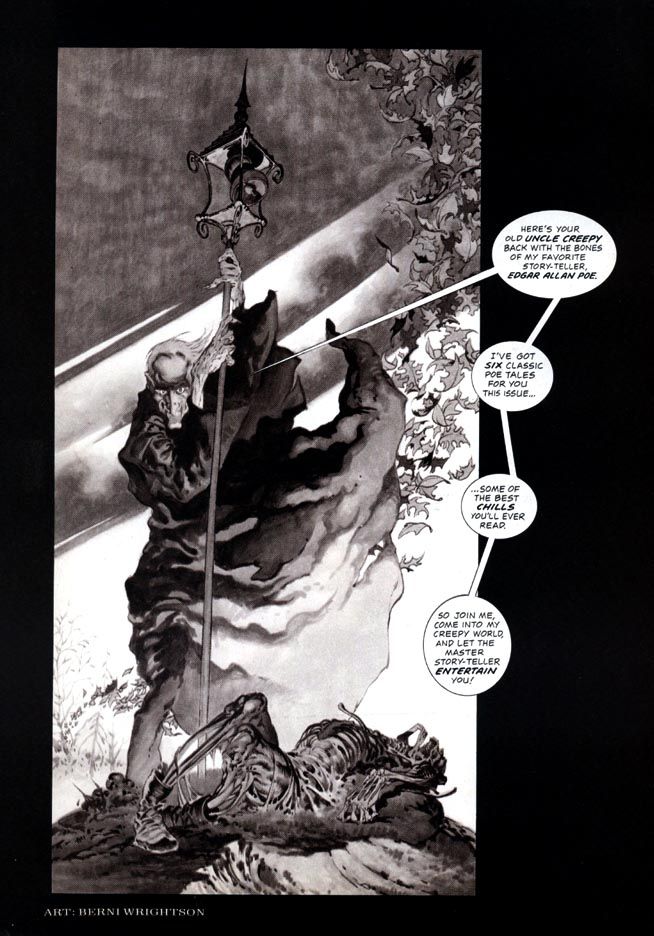 |
| Creepy 70 (April 1975) |
Oh wow! Isn't that beautiful? Okay, a few more... This next one I like because it's one of those Wrightson "spooky stuff happens even during the day" images. Just like in the memorable story "Jenifer" he illustrated. It starts one magical afternoon. Imagine hiking in the forest on a gloomy fall day and...
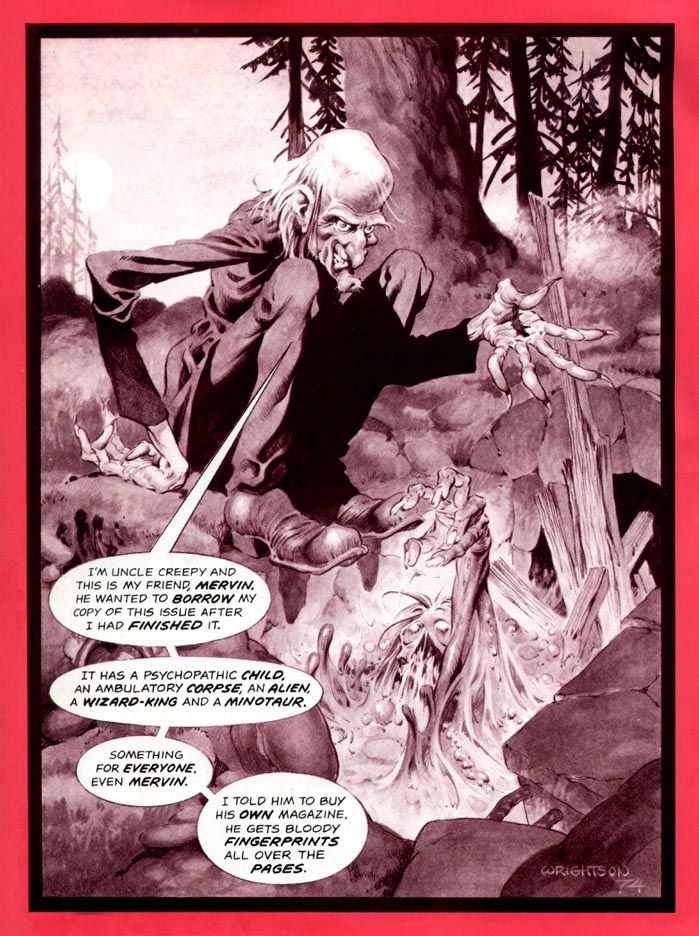 |
| Creepy 71 (May 1975) |
Egads! Dare we continue? Dare we do!
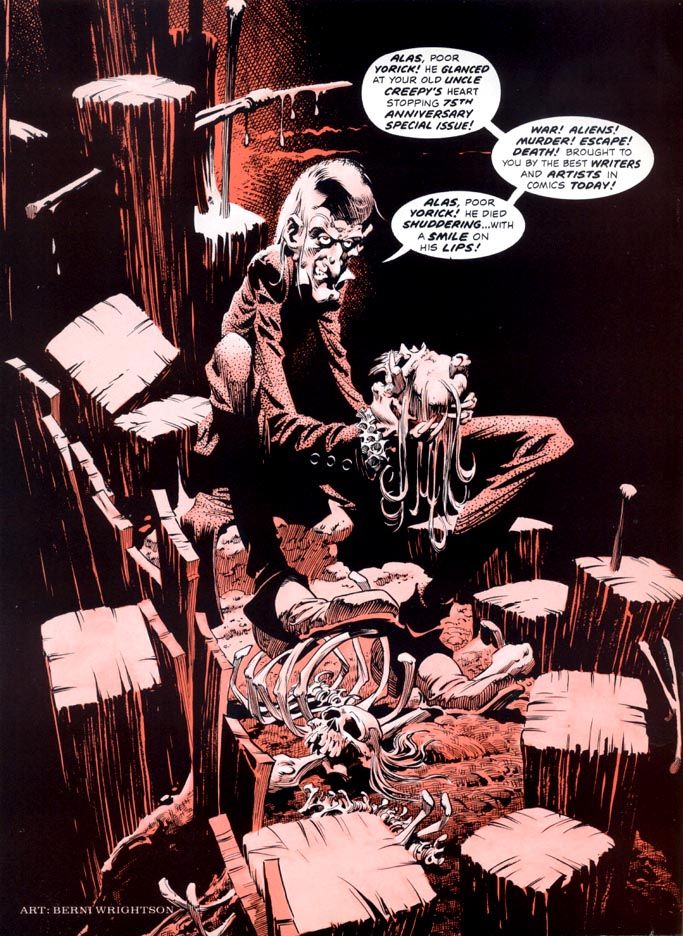 |
| Creepy 75 (November 1975) |
Here's my favorite, though. It's a collaboration with Walter Simonson, a guy who's best known for Asgardian superheroes but has done a few highly effective fright jobs in his long career, too. Plus, it's specifically Halloween-related.
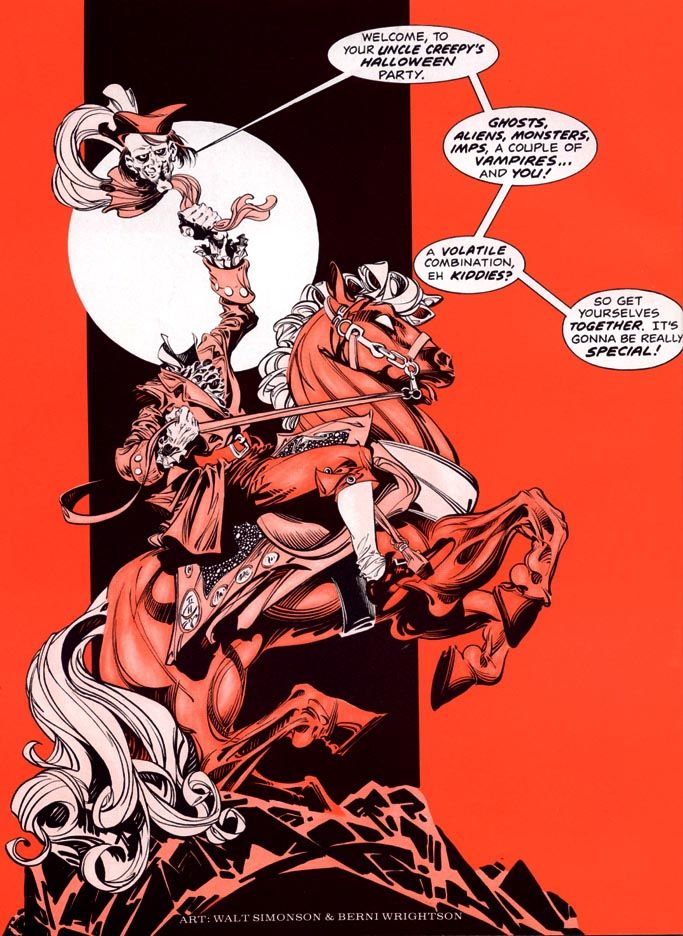 |
| Creepy 76 (January 1976) |
Love those. But to be honest, the scariest Creepy frontispiece of all wasn't drawn by Wrightson or Simonson. It's this one. Steady on, people. Steady on...
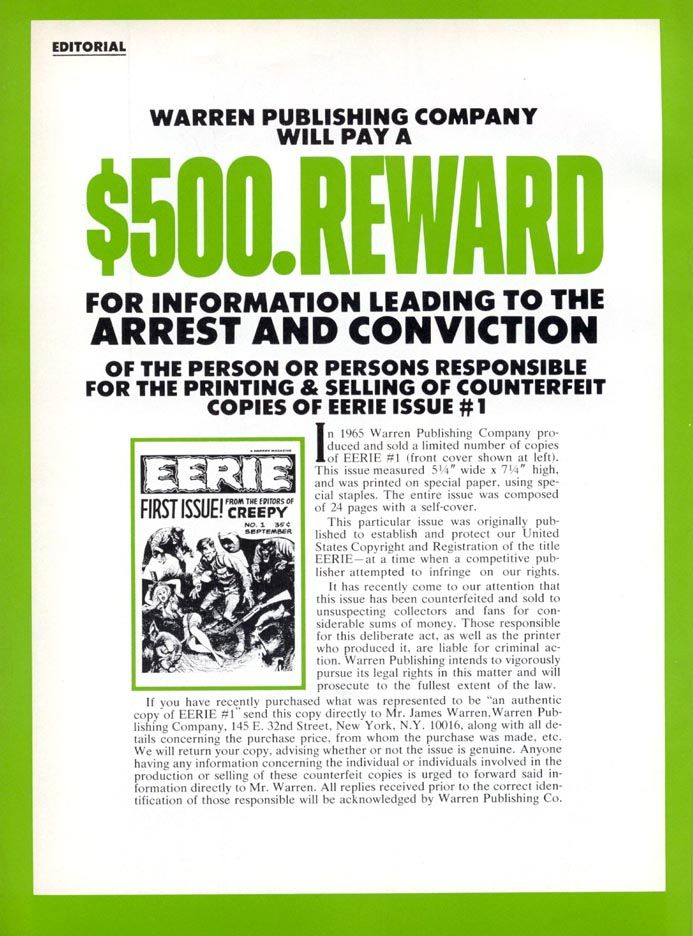 |
| Creepy 81 (July 1976) |
AAAIIIIIEEEEEEEE!!!
We definitely need something to help us recover our wits after that shriek-inducing moment of terror. All of these except the last are available in Dark Horse's gorgeous and essential Creepy Presents Bernie Wrightson hardcover. Now I need to go clean up a little. So calm yourselves and here's something to soothe your jangled nerves.
Wednesday, October 29, 2014
October is Spookey Month: Someone's rockin' list of the "10 Most Frightening Horror Comics Ever!"
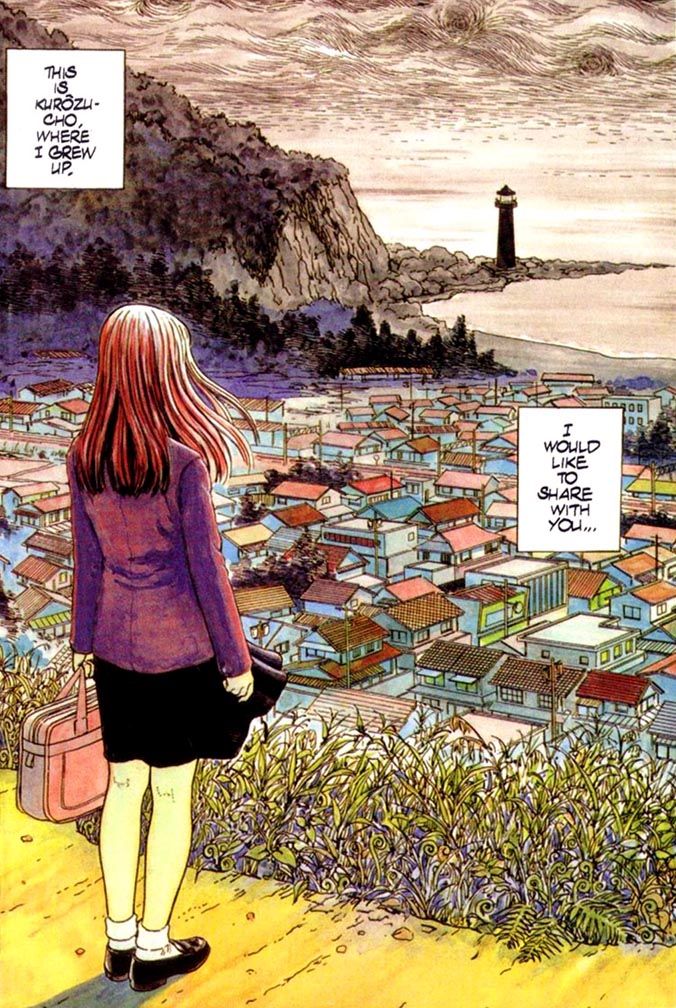
Personal choice is appropriate because our most frightening comic is the one that affects us most regardless of its wider reputation. I found myself exposed to a great many shitty horror comics when I was a kid and quite a few managed to genuinely frighten me even with crude art and strained writing.
Sometimes even genre doesn't matter.
Jack Kirby scared the snot and the buggers out of me with his chilling final image in Kamandi #20 of our long-haired hero alone on a ruined pier. I mean utterly alone, overlooking what I assumed at the time to be a monster-haunted Lake Michigan. No one to help him, not the indifferent gulls circling overhead, certainly not the angry gorillas ravaging the robotic theme park Kamandi had just escaped. No humans, just robots going through the motions of 1920s-era Chicago gangland clichés. Poor lonely Kamandi. The imagery was bleak, the closing copy promised more horrors to come. Shudder!
Another story that gave me the willies was "Evolution's Nightmare" in Marvel/Curtis Planet of the Apes #5. It opens with humans and gorillas fighting El Cid-style in a desert wasteland, then ends with radioactivity-devolved apes and men duking it out with rocks and clubs in a bomb-ruined San Francisco. They even kill the two main characters (who spent the intervening pages painfully learning tolerance) before grunting and screaming in mindless hate at each other from atop wrecked cars full of skeletons and across piles of shattered asphalt. Doug Moench's depressing narrative captions inform us everything moves in circles and those circles stink. Artist Ed Hannigan's (Jim Mooney inks, by the way) double-page spread of piles of dead warriors with their eyes lifelessly open only added to the lingering fear instilled in me by this creepy story.
Obviously, neither of those two are horror stories. They're both rough-house science-fiction adventures. You can find horror-like frights anywhere. In a plot twist in an otherwise innocuous superhero book, gazing at you from a house ad in a humor comic, jumping out at you from behind a brick wall on a sunny street in Riverdale, USA.
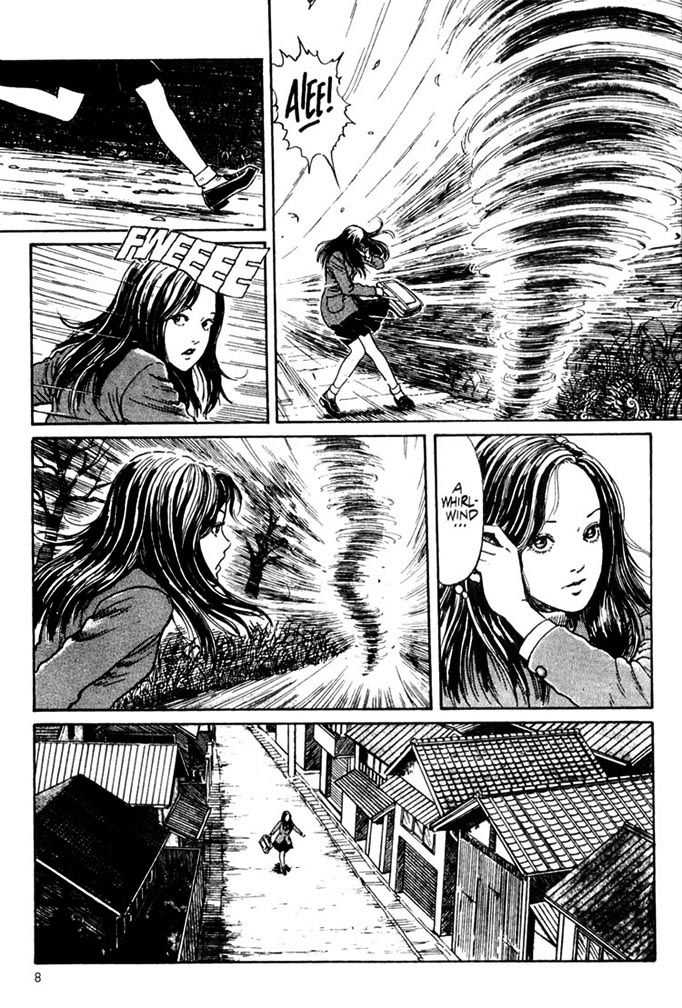
Or in an actual horror comic. Like Uzumaki. Serialized in Big Comic Spirits (it's a seinen manga, or dude's comic, so be careful opening that link) from 1998 to 1999, Ito's Uzumaki is the greatest horror story ever published in comic book form. I'm comparing it to everything from Charles Burns' Black Hole, which made Fantagraphics' list (and is a moody, troubling work in its own right) to EC and every horror comic in between. Out of all the fright fun I've had reading horror comics, only Uzumaki gave me feeling of truly dreading the next development in a story in my life. Of doom. Or of being genuinely grossed out by so many drawings in one place. Uzumaki's dreamlike inevitability remains after you close the book having followed its main characters deep into the heart of ancient fears.
Uzumaki tickles your fright bone the way a cold wind from across the dry grass of graveyard might gooseflesh your arms. Bruised clouds passing overhead like witches, their shadows falling around like concentrated night, on the move, looking for you. Dead leaves hissing at you along the curb. Hurrying you homeward where you face a dark, empty house where the rooms echo only with your voice.
 |
| Story and art by Junji Ito |
And the soft footsteps of another. Though nobody else is home.
Here's something that's not frightening. It's a performance by Hamamatsu's own Spookey!
Tuesday, October 28, 2014
October is Spookey Month: Wally Wood brings you a new path to a life of peace and love in Creepy #38 (March 1971)
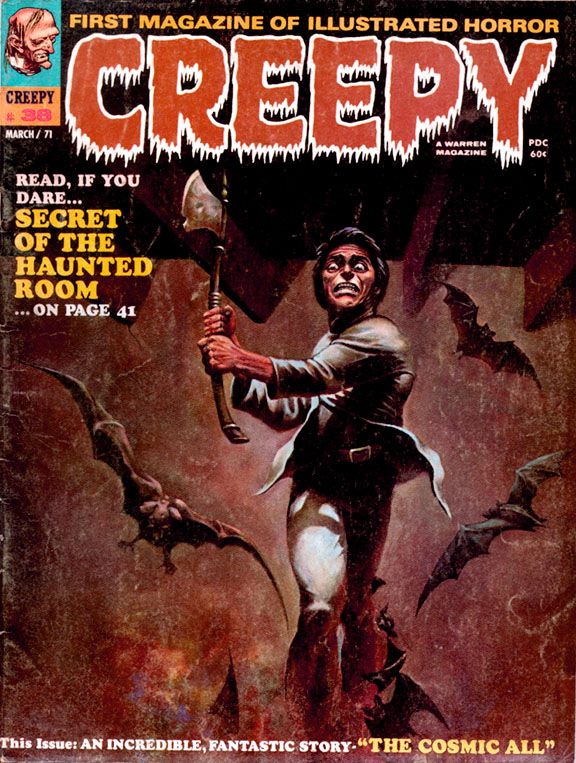
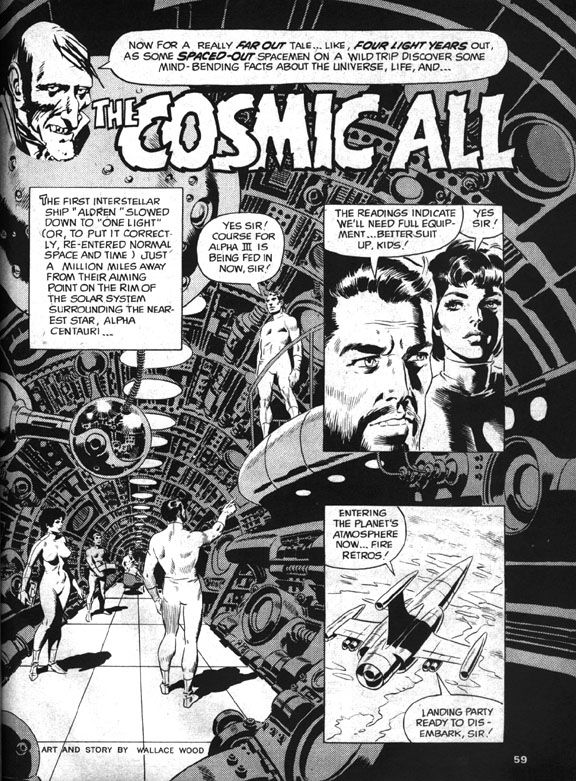
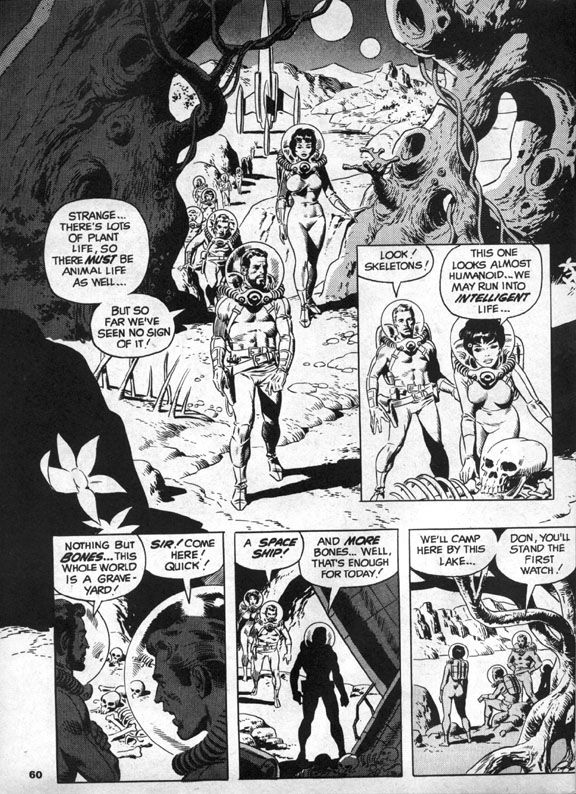
Sometime in earth's future, we've sent an intrepid mixed-gender exploratory mission led by a bearded captain (along with Don! And Sue!) to Alpha Centauri, which is now, more than 40 years after this story's publication, a popular tourist destination. In those days, it was the distant frontier of outer space. After finding bones on their first planetary stop, the explorers anticipate a possible meeting with intelligent life. Which is kind of ironic. I mean, they do meet it. It's just not the kind they were hoping for.
You know how
the hierarchy of space aliens goes—in order from least to most objectionable,
it’s generally humanoids, reptilians, insectoids, cephalopods, non-tentacled
mollusks, blobs and, finally, slimes.
The further its appearance gets from the human template, the more
repulsive the alien. And usually, the
more likely to have philosophies contrary to the kinds we find comforting. So Wood’s slime terrifies the space
explorers by trying to absorb Sue.
 |
| Wally Wood |
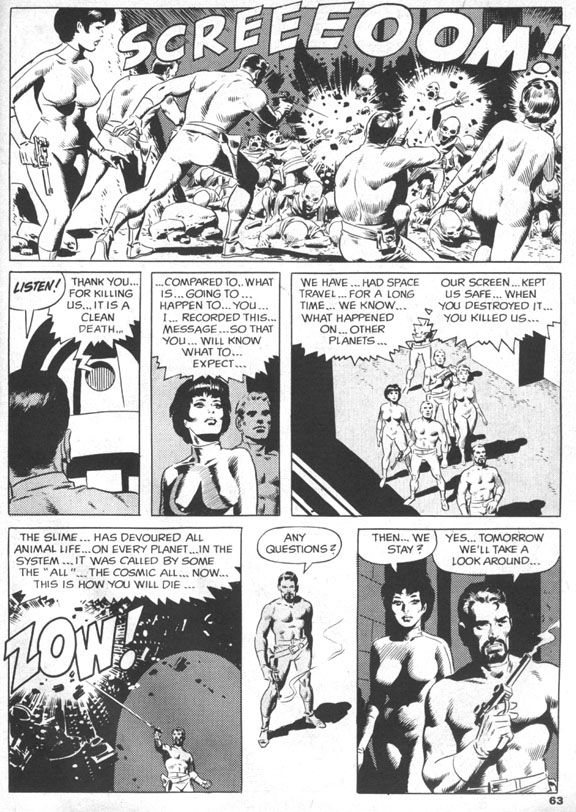
In familiar comic book sci-fi fashion, Don shoots the slime with his phallic laser zapper gun, then everyone flees in their retro-finned rocket ship, only to find the slime on yet another planet. Having achieved what they believe is their due quota of slime-based encounters, they orbit a comfortably earth-like planet that gives them a very rude greeting in the form of more laser beams. In response, the human explorers (And Don! And Sue!) blast through planetary shields and receive a series of puzzling messages. The civilization below no longer seem angry, but rather depressed and resigned to first contact. They invite the astronauts to land, then ambush them in a suicidal rush.
And, ironically enough, they're comfortably humanoid in appearance. Bulbous, bald heads (like my own) and large black eyes notwithstanding. A
recording reveals this was their deliberate self-extinction and a cleaner death
than the one that awaits the astronauts.
Who stand around puzzled, as anyone would be, but the next day all but
two of them are skeletons as well. And those two are Don and Sue!
 |
| Wally Wood |
Which is probably just as well. After all, even if it was a case of suicide-by-human-astronaut, these men and women did commit genocide. Are they any less monstrous than the slime? Perhaps they're precisely as monstrous, as we soon discover. Don and Sue make for earth where they suddenly experience a strange elation and crash the rocket into the ocean.
 |
| Wally Wood |
There Don and Sue slough off their skins and mutate into the now-familiar slime. Everything becomes clear. The humanoid aliens chose to die as a group with each individual’s self-awareness intact because the slime infects other beings and absorbs them into the titular cosmic all, a vast collective without individual thought. The two space travelers become one with the intent of spreading their all-ness to every living thing on earth. Starting with all sea life, I suppose. Uncle Creepy appears at the end and tells us the ultimate twist—they’re glad to be this way, so it’s technically a happy ending. I’m not going to argue with him. It certainly made me happy!
 |
| Wally Wood |
The ending is one reason. The ambiguity of it lingers. So many deaths, but no escape for Don and Sue, just the loss of humanity both physical and mental, a blending of their minds with the vastness of the alien slime, all-knowing and unstoppable. Is their joy at the becoming genuine, or simply an effect the slime has on their minds?
The other is Wood’s artwork. The splash page is a spectacular image, the kind of Woodian spaceship interior he drew regularly during EC’s heyday. Round vents, layers of exposed pipes like the veins in a human arm. Similarly exciting scenes follow, with the explorers trudging across a planetary landscape, the slime attacking like a huge ocean wave and then a space battle followed by an alien-wave attack and the intimate concluding sequence which is equal parts bleak and elating, an uneasy mix that elevates this story to legendary status. It has the feel of a particularly memorable EC tale, but with an expansiveness the larger page size affords.
And that ending! That ending!
Monday, October 27, 2014
October is Spookey Month: Tricks and treats with Creepy #36 (November 1970)
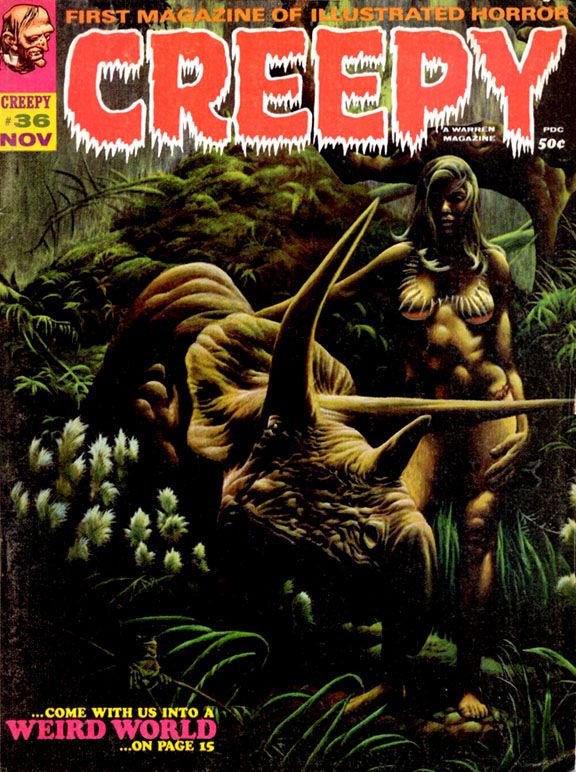
I can't decide which is the treat. Is it the dinosaur or the cheesecake? This is the cover to Creepy #36 (November 1970), naturally. Nature being the operant word here. This painting is by Kenneth Smith, who contributed a few covers to the magazine around this time. It's an image that actually appears as a panel in the story "Weird World" inside.
Nicola Cuti wrote "Weird World" and Tom Sutton illustrated it. It's a story about an astronaut lost on a jungle planet where this woman rides around on a triceratops. The whole thing has a Richard Corben feel to it, and when I first saw this cover that's who I thought painted it. But no, Kenneth Smith. Smith painted a number of science fiction book covers and was one of the artists included in a book that's a particular favorite of mine, Ray Bradbury's Dinosaur Tales along with people like Moebius and William Stout.
Well, here's a dinosaur. You know, because dinosaurs are such an important part of our Halloween traditions. The story itself has a downbeat twist ending and this cover image remains popular among Creepy fans to this day. It was probably pretty popular in 1970, too, but I was only two years old at the time and wouldn't remember anyway.
Friday, October 17, 2014
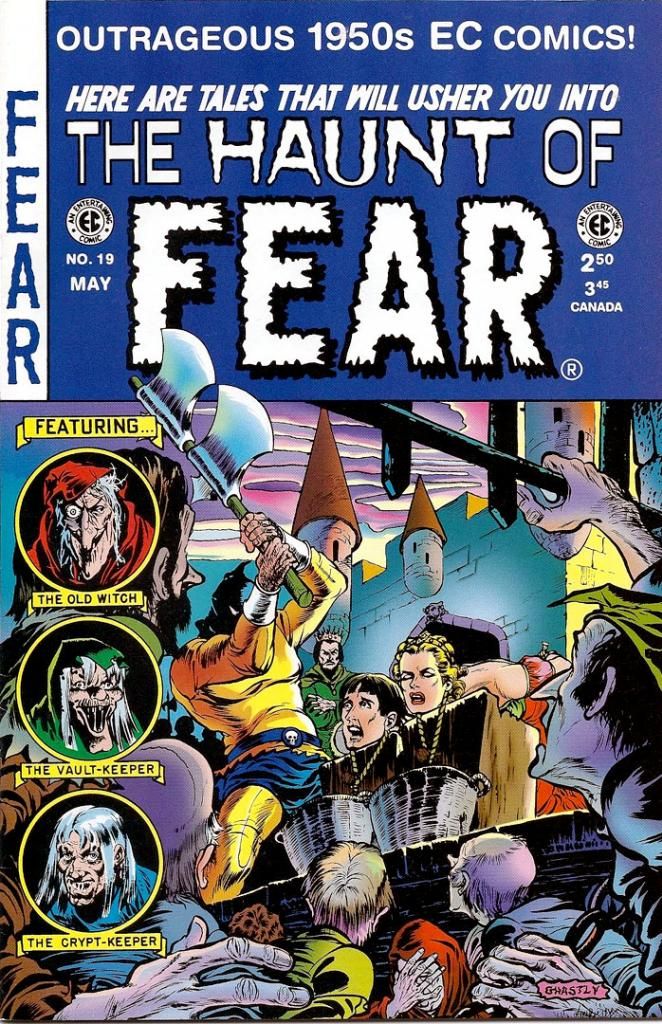
October is Spookey Month: How EC ruined America's pasttime in Haunt of Fear #19 (May-June 1953)
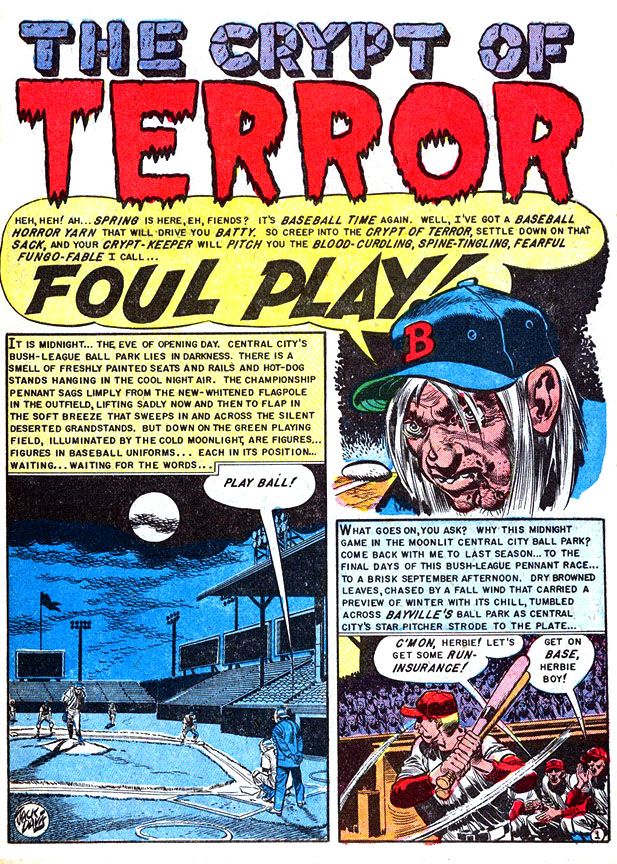
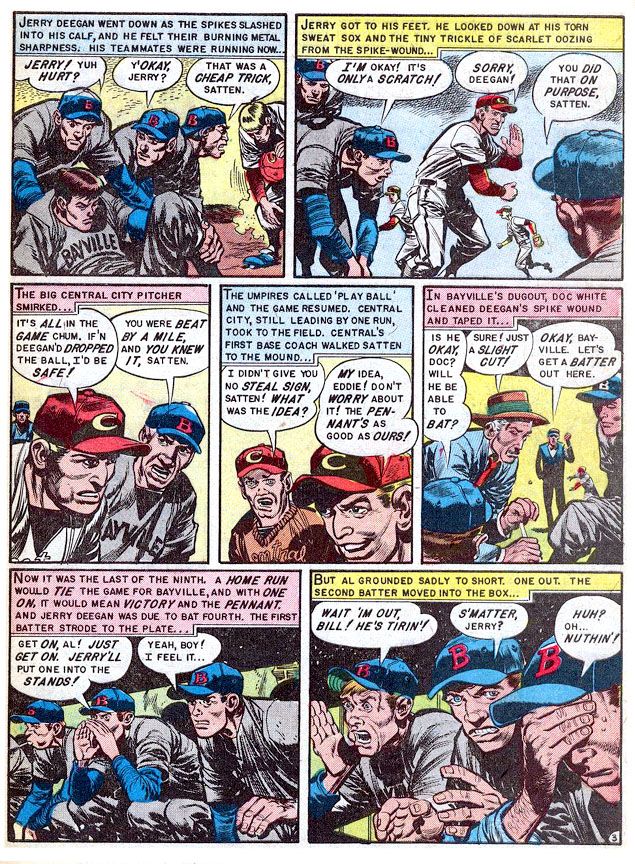
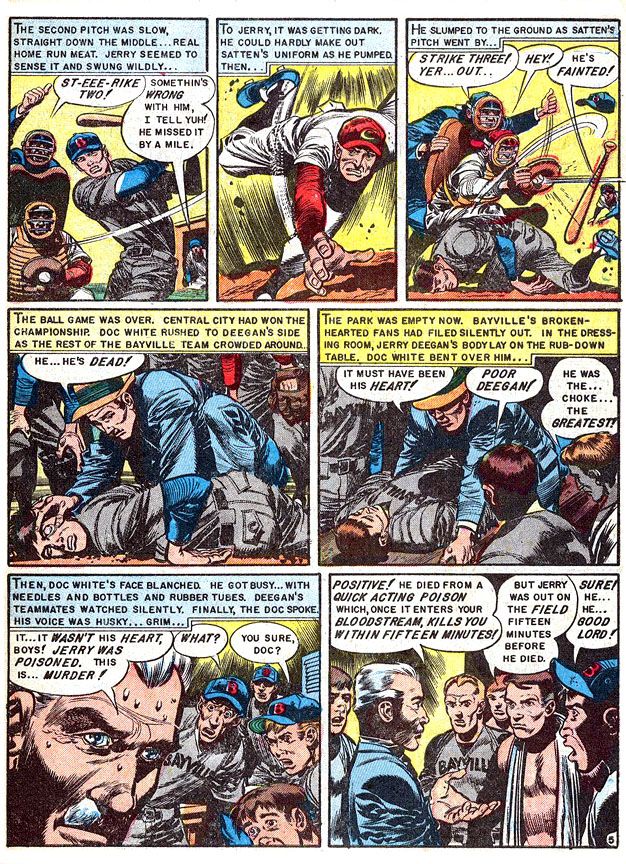
The story is about Central City's Herb Satten, an unscrupulous pitcher who wants to help his team win the pennant by murdering the Bayville's star second baseman, Jerry Deegan. After all, this Deegan slugger led the league in home runs all season and he's up the next inning in a tight game. It stretches credulity a bit. Satten kills Deegan by poisoning his spikes, then allowing himself to get hit with an inside pitch so he can get on first, attempt a steal then slide spikes-high and slash his victim. He's thrown out and it looks like a bonehead play, but it all works out. Satten kills his man and Central City wins. This leads to the pitcher's grisly comeuppance the night before the next season's opening day.
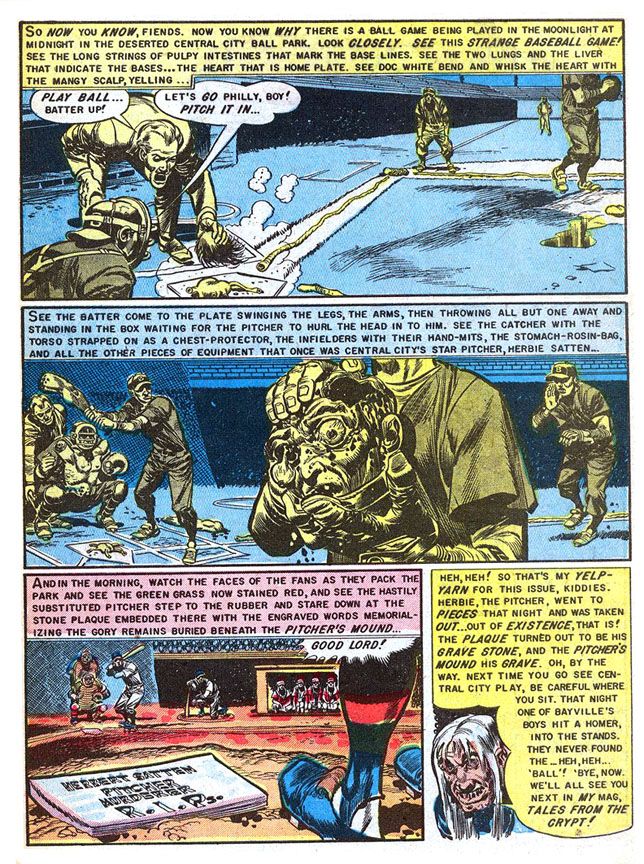
And one of the all-time great gross-out scenes in horror comics history. The murdered man's teammates literally rip Satten apart late one night and use his body parts to play a moonlit intrasquad game. Complete with a complicit umpire. That also stretches believability, but not so far as the poor pitcher's intestines, which serve as foul lines up the first and third base paths. The grisliest detail is the catcher's using the Satten's chest as his own chest protector. You wanna wear part of a human body even if he is a sorry murdering cheat? What is this, the Ed Gein League?
They also incriminate themselves by burying him under the pitcher's mound and inscribing the rubber there with "Herbert Satten. Pitcher. Murderer. R.I.P."
Rest in pieces, baby. Rest in pieces.
 |
| Writer: Al Feldstein/Artist: Jack Davis |
Well, they were angry ballplayers and probably didn't think through the consequences. The ironic thing about "Foul Play" is, it may have been notorious at the time but the guy who drew it is one of the nicest, most gentlemanly people you'll ever have the privilege of meeting. If you're so lucky. I had a chance to phone interview him way back in 1996 for a class project and I came away in such a good mood because he was so jolly and generous. He answered even my stupidest questions with patience and good cheer.
 |
| Writer: Al Feldstein/Artist: Jack Davis |
I'm talking Jack Davis, the dean of American caricaturists. This story is right in his wheelhouse, so to speak. Davis is a master of sports cartooning, able to twist his loose-limbed figures into whatever pose necessary to show the physicality of sports. Baseball, basketball, football, late night murder, these are things Davis visualizes so well. Obviously made a huge impact on Dr. Wertham and the guys up on Capitol Hill, huh?
 |
| Writer: Al Feldstein/Artist: Jack Davis |
I loved Davis' work before I ever read this story (although I'd heard rumors of it for years and they always chilled me to the bone). He drew magazine covers, movie posters. His art came into our house on television in the form of character designs for the Jackson 5ive Saturday morning cartoon. As a University of Georgia graduate, I've seen dozens, if not hundreds, of Davis-drawn Bulldog athletes in motion, with his characteristic lanky body language and large, articulated hands. Gorgeously rendered in loose, appealing brushstrokes and then watercolored to pop from the page of whatever book, calendar or postcard they adorn. His 1950s horror work benefits from the Davis approach, one that exaggerates reality for comic effect. So when you see a Davis severed head, it's not grotesque no matter how decayed it might be. It's sick... but in a tasteful way.
 |
| Writer: Al Feldstein/Artist: Jack Davis |
The Senate Subcommittee Hearing people must not have felt that way, although I believe William Gaines explained it quite well in his testimony. This is gore in just the right amount. There's nothing gratuitous about it, but it has to have impact. If you'll notice, too, colorist Marie Severin gives those panels a blue-yellow complementary color scheme rather than one that emphasizes its fleshy or bloody qualities. This makes it explicit without going over the top. Not for the squeamish, certainly. But it's right in my wheelhouse, too. Jack Davis is an American treasure, baby. And so is Marie Severin. No doubt about that.
Subscribe to:
Posts (Atom)