Showing posts with label D. Bruce Berry. Show all posts

Sunday, November 10, 2013

Part Two: "Kirby’s Unfinished Opera" by Gary Chapin (another guest essay!)

(Here's the second part of Gary Chapin's epic look at Jack Kirby's Fourth World...er... epic.  Part one is here.  You're really going to enjoy this!)

Now’s the Time

Mark Evanier, in the closing essay for Volume 3 of the Kirby’s Fourth World Omnibus, points out the critical reaction to Kirby’s treatment of Deadman. Kirby, said this critic (I paraphrase), clearly did not get the Neal Adams Memo. Graceful lines, art school realism, and noir subtlety “were” the way of “now.” Kirby represented “the past.” Adams and company represented the future. This is a point of view I would have heartily, and stupidly, embraced at the time.  “The future” is not a fixed point, however. And even the present is a bit slippery.  My “now” is different from your “now.” There’s a joke that says, “The golden age of music is 12.” My golden age of Kirby is 45. This is my “now.”

But Then Was Not

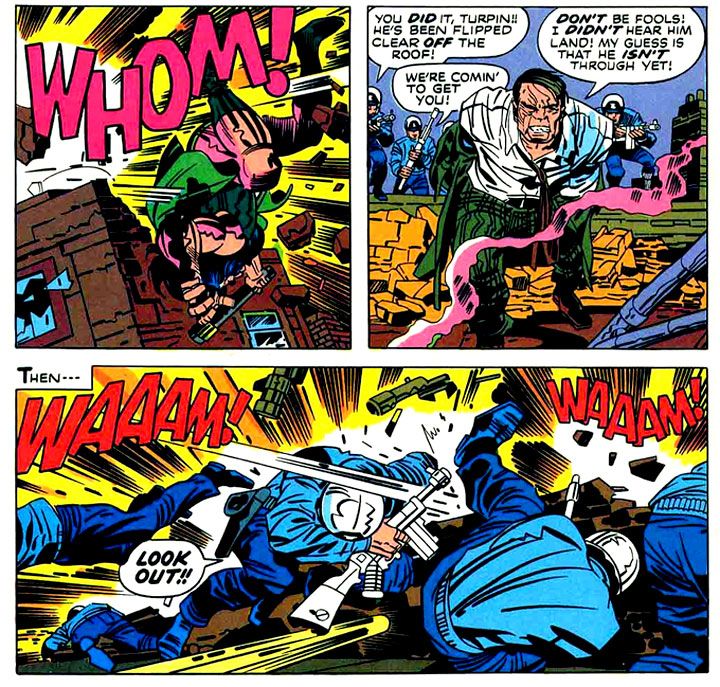
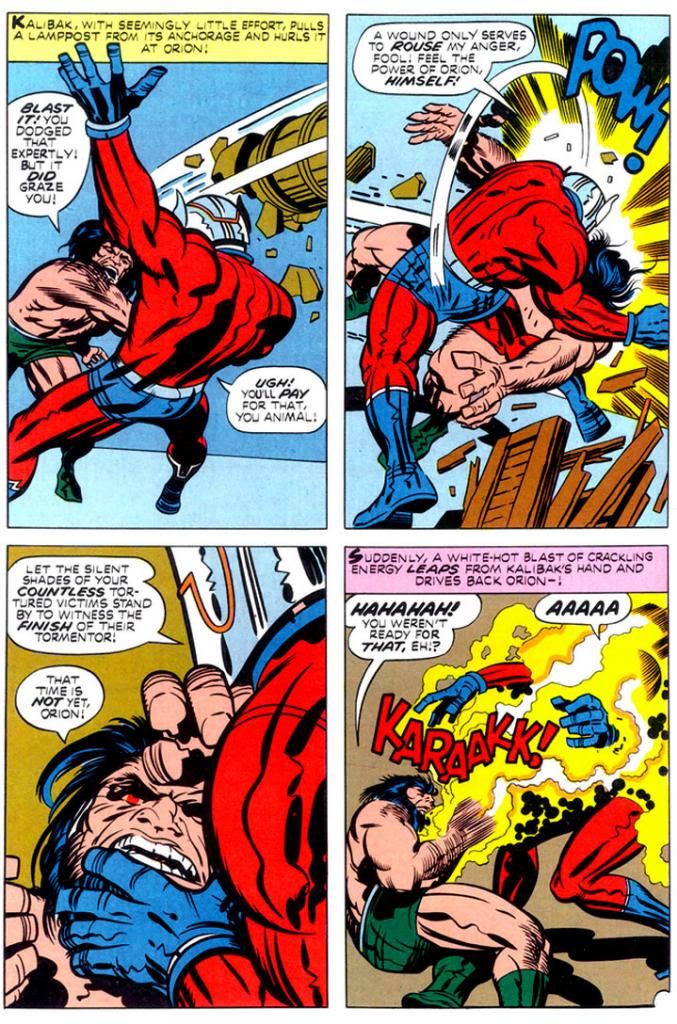
After around a year, the wheels came off the bus (or super cycle) of the Fourth World. Sales dipped, and books were canceled. The remarkable achievements that were “The Pact” (New Gods #7) and “Himon” (Mister Miracle #9) and “The Death Wish of Terrible Turpin” (New Gods #8) were not seen as masterpieces at the time.  The combat between Orion and Kalibak in the Turpin story will remind you what sort of glory can be found in a slugfest. 

New Gods #7, March 1972 (Jack Kirby with inks by Mike Royer)
 
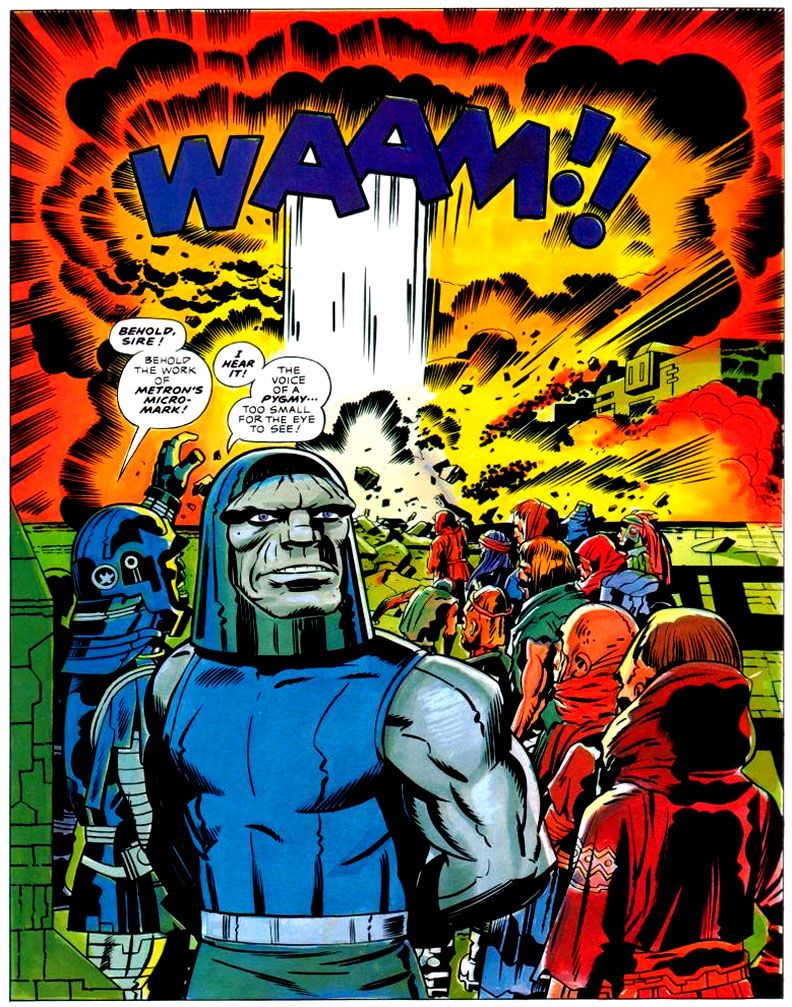
But then it ended. The last issue of the New Gods (“Darkseid and Sons,” #11) was, in fact, brilliant (the run from #7 through the end is worth everyone’s time). The story didn’t end as Kirby wanted it to, but it was a very effective stopping point with a lot of “What?? What just happened???” moments. It was very satisfying. The end of the Forever People was much more of a mess, possibly because their action was always peripheral to the New Genesis/Apokolips story being told in NG and Miracle.  “The Kids” end up stranded on a paradise planet in a faraway dimension when the Pursuer’s lance blows up, “destroying” the Infinity Man. While it technically makes sense, the pretext is as weak as it sounds.
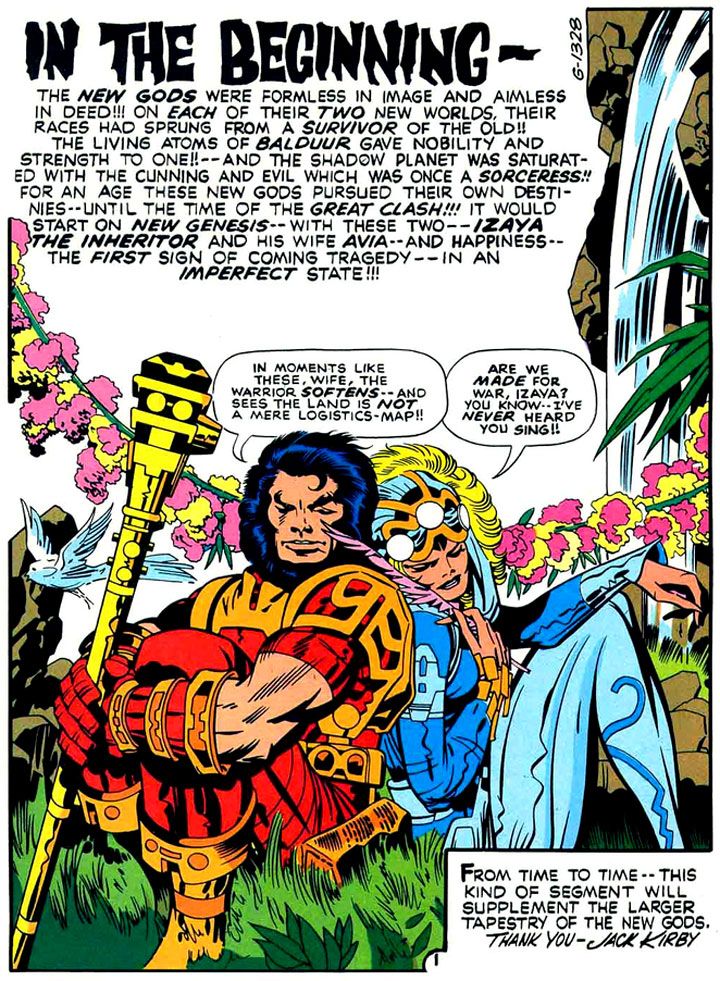
Mister Miracle lasts a bit longer than the other two, but when the Big Story falls away, it becomes a series of one-off monster stories. This didn’t have to be a problem. Kirby spent the ‘50s being the master of one-off monster stories.

New Gods #8, May 1972 (Jack Kirby with inks by Mike Royer)

According to Evanier’s essay, though, Kirby was feeling demoralized and his heart wasn’t quite in it. You only have to notice that one of the stories begins with Miracle and Barda stumbling on a “haunted” house while walking in the woods near their house. Yeah, time for a new direction (which took him to the Demon, Kamandi, et many al., so one can’t entirely complain).
The Problem with Endings

Kirby’s vision from the beginning of the Fourth World was an enclosed story that reached through a number of books and ended in a Fourth World Ragnarok, closing the book on these characters for good. I don’t know how he ever thought that was going to happen. 
New Gods #11, November 1972 (Kirby with inks by Mike Royer)
 
It seems almost quaint, looking back from the other side of the graphic novel naissance, but in 1972, DC Comics was not going to let Kirby develop amazing properties – which is what he was brought in for – and then have them succumb to irrevocable destruction.

This may have been the one place where Kirby – a man preternaturally in synch with comic book aesthetic – may have had an ambition for something that can never exist in the superhero-comic book medium: an ending. This wasn’t a function of the times Kirby was writing in, but a function of the medium. Just consider the New Gods. We’ve had The Hunger Dogs, Kirby’s own imperfect – but beautiful! – attempt at an ending. We’ve had Death of the New Gods. We’ve had Final Crisis, where Darkseid is “finally” killed. 
 
Wait, who was that who was featured in the new Justice League 23.1?
 
To butcher Fitzgerald, “There are no last acts in comic book superhero lives.” Even characters who are never brought back, are constantly being brought up (e.g., Jor-El, Gwen Stacy). I wouldn’t be the first to suggest that while Crisis of This, That, and the Other Thing had all the hallmarks of a Ragnarok, they lacked the one key element:  the end of the world. They weren’t resetting the DC universe, they were resetting the DC stylebook.

DC Graphic Novel #4: The Hunger Dogs, January 1985 (Kirby with inks by D. Bruce Berry)

I think Kirby really wanted the end of the world for his characters. He had the Wagnerian urge. But like so many great creators he was an inventor, not a destroyer. He began things. He began great things. And not a single one of them – not Cap, not the FF, not the New Gods – has ended. And even if they fall into a space where they seem to have ended – books get cancelled – there is always a new issue coming down the line.
But this is not the problem with endings. The problem with endings is that our experience of the work is shaped by “how things turn out.” Forget how things turned out. These are astonishingly rich stories, executed to a ridiculously high degree; the creation of a visual aesthetic that’s analogous to Tolkien’s linguistic aesthetic. This will always be true, no matter how things turn out. Kirby could not achieve his operatic ambition, but that’s irrelevant. I love these books.

Gary Chapin usually blogs about French accordion music over at www.accordeonaire.blogspot.com.

Saturday, June 1, 2013

Oh man, were my first impressions of "The Exorcist!" ever wrong!

That's fine.  I'm used to being wrong.  In my muzzy, sleep-deprived state I could have sworn Kamandi runs into a group of talking humans-- the first he's met since losing Flower and ditching Ben Boxer-- but now that I've taken the time to read it all the way through, what he meets are actually some kind of talking monkey and some mute kids.  Now things make a lot more sense.

Anyway, Kamandi #24 (December, 1974) is a breezy little story about a pre-Disaster ESP experiment wreaking havoc in the post-Disaster world just because he's a mean little bastard.  It doesn't involve Satanic possession, though Kirby teases the readers with that possibility early on before settling on the more prosaic explanation of science run amok... again.  Kamandi's shattered world is full of secret bases and laboratories where government-sponsored jerks did jerky things to other jerks it seems.  Not as epic as a Prohibition-era Chicago populated by robots or a war between gorillas and tigers, but it's good to focus on smaller stories every once in a while.  Leave it to Kirby to take something like pop culture's brief fascination with possession and demonic themes and put his own sci-fi spin on the concept while folding it neatly into his Kamandi narrative.

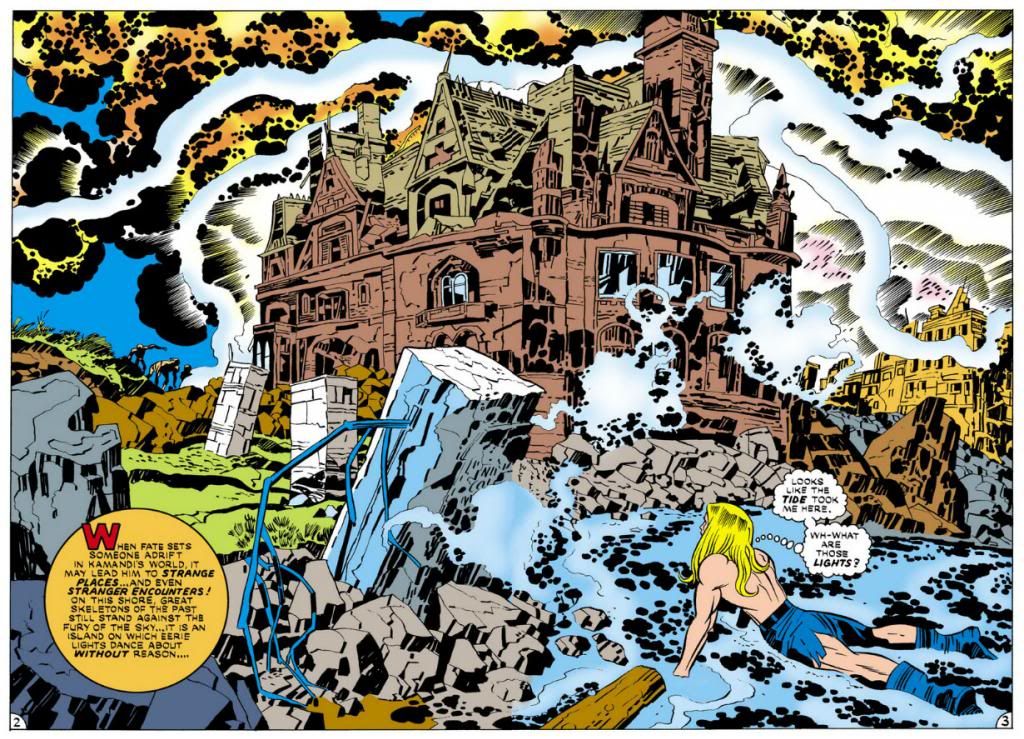
Here's that amazing double-page spread by Kirby and inker D. Bruce Berry.  Enjoy!


Thursday, May 30, 2013

Is Kamandi selling pretty well these days?

The reason I ask is Comixology keeps adding Kamandi to their DC catalog.  The reason (I feel sure) is DC is providing the material they've already prepared for their Kamandi reprints and it isn't costing them much money above what they've already spent to offer the issues digitally as well.  But what I like to imagine is those of us who are Kamandi fans are also at the forefront of a pro-Kamandi wave swelling through comics and both DC and Comixology are responding to massive demand.

I also like to imagine I helped inspire this movement.  Yeah, my month devoted to that wonderful Kamandi series kind of skidded off a cliff and exploded (driving too fast for conditions, swerved to avoid work and hydroplaned on a wet mountain road read the accident report) but that doesn't mean my love for Kamandi has dimmed by any means.

We're up to #24 (December 1974) on Comixology.  It showed up this week and I bought it.  Kamandi washes up on some rocky shore and meets a group of what I'm guessing right now are people.  Some of them look human; others, I'm not so sure.  It's heavily influenced by William Peter Blatty and all those Satanic possession movies the kids were crazy about during the mid-70s.  I swear if it wasn't Pazuzu possessing some poor little rich girl it was some poor little rich boy as the Anti-Christ.  Even Carl Kolchak went mano-a-paw-o with a demon dog on Kolchak:  The Night Stalker.  Okay, other than its title, "The Exorcism!" and a cover promising supernatural mayhem of the ultimate evil kind, this Kamandi may not be about Satan or devils after all.  Just some ugly guy called the Curse.

In the interest of honesty, the reason I'm hedging on the whole Satan thing after being such a clown about it anyway is I've only skimmed the first five or so pages of "The Exorcist!"  No time.  No time for sergeants, no time for Kirby.  That's a sad state of affairs.  I've got two years of Kamandi on my computer and my iPhone and no time to read them.

But I've formed some hasty early impressions.  Because where would this blog be without half-assed judgments?  "The Exorcist!" does feature a truly spectacular double-page spread of the most haunted looking haunted house you've ever seen.  Jack Kirby and D. Bruce Berry really outdid themselves with that drawing.  I'll try to find time to show you this weekend.  Besides my takeaway vision of the haunted house, I really love how Kirby draws water.  Clumps of black ovals.  I've never seen water that consists of clumps of black ovals, and yet it reads as water.  Also, I think it's kind of weird that Kamandi, who has recently escaped from a lot of human-looking robots-- a major disappointment for the "last boy on earth," forever searching for others of his kind-- and after an experience with talking killer whales, doesn't immediately demand to know who these new characters are.  Especially the ones who look human.

I'm sure part of the reason is their opening gambit is to attack the poor kid and start whaling the tar out of him, but I have a feeling the main reason is Kirby just isn't wasting any time with a lot of chit-chat in these stories.  It's action first, characterization second.  Nothing wrong with that.

Anyway, if I get some breathing room I'll read the whole thing and see if I'm right or wrong!  Or, alternately, you could go buy it and read it and tell me if I'm right or wrong!*

*I get no money at all for this shilling.  I'm doing it out of the kindness of my withered little heart.  I really love Kamandi and think people should read it, and this is where they can do that.  Legally, anyway.

Tuesday, April 16, 2013

April is Kamandi Month: Who gash? Ugash!

Script/pencils:  Jack Kirby, inks: D. Bruce Berry
(
Kamandi #18, June 1974)
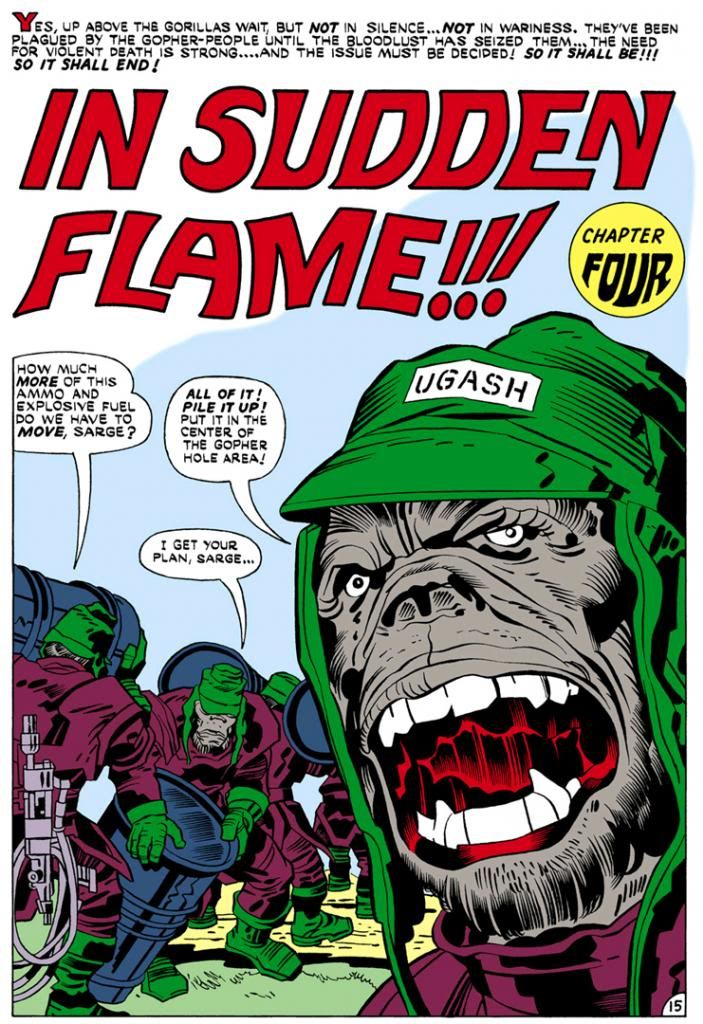
That's Sgt. Ugash to you, ya lousy animal!  Jack Kirby must have had a love for angry tough guys.  I imagine he knew some real life versions of these bombastic characters growing up on the Lower East Side in New York, and he must have encountered more than a few during his wartime army stint.  Look at all the variations on this theme he created or co-created-- Brooklyn, from the Boy Commandos; Scrapper, of the Newsboy Legion; Dum Dum Dugan, one of Sgt. Fury's Howling Commandos; Ben Grimm, the Thing; Detective Dan "Terrible" Turpin, with a death wish in New Gods #5 (later revealed by other sources to be a grown-up Brooklyn, a truly terrible idea and one we'll ignore since we operate under the "If Kirby Didn't Write It, It Never Happened Theory" around these parts).

Those are just the ones I know by heart.  You could usually identify these guys by their ubiquitous derby hats or well-chewed cigars, or both.  Or, in the case of Sgt. Ugash, a green cap (with his name printed on it!), purple jumpsuit and lots and lots of hair.

Sgt. Ugash first appears in Kamandi #17 (May 1974) and he's as rambunctious from the get-go as any of those other classic Kirby creations.  He's not only fighting the tiger army, but he's also having trouble keeping his troops supplied because the gopher people keep tunneling up under the ape bivouac and stealing everything they can get their clawed hands on.  Pumping water, bullets and fire into the holes doesn't solve the problem, so Ugash sends Kamandi down like a ferret with bombs strapped to his back.  That rascally Kamandi, of course, turns on Ugash, so the sergeant and his ape soldiers spend the next couple of issues pursuing the Last Boy on Earth, who fights back using a giant worm, the likes of which would make Maud'Dib's mouth water at the thought of riding it against the Harkonnen hordes.  We might consider this some kind of phallic symbolism.  If big apes represent masculinity run amok, then it takes a really big dick to beat a really big ape.

By Kamandi #20 (August 1974), however, Kirby has abandoned the tiger-gorilla war and forced Sgt. Ugash and Kamandi into an unfriendly alliance against the Roaring Twenties-style robots inhabiting Chicagoland.  Some chump years before the Great Disaster decided it would be a hoot to build a theme park based on Chicago's violent Prohibition days and equip the various factions with real bullet-spraying tommy guns.  This theme park-designing asshole must not have watched Westworld; I'm guessing Kirby did, or at least absorbed a little of it from television commercials.

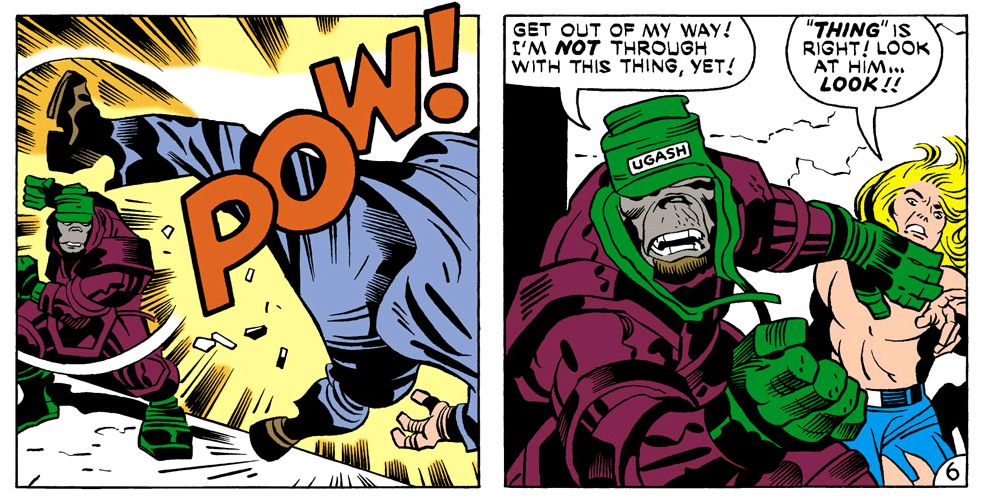
Kamandi #20, "The Electric Chair!!!"  This was my first Kirby comic, my first encounter with Sgt. Ugash.  This single issue of Kamandi came my way and as far as I knew, Ugash co-starred in all the others as well.  As a Planet of the Apes fan, I immediately liked him more than the kid who gave his name to the comic.  Plus, Kamandi reminded me of the filthy hippies we saw on the news, or one of my oldest brother's baseball teammates who sometimes teased me or got drunk at our house and barfed in my bedroom when my parents went away for the weekend.  Throughout the story, Kamandi tries to use reason and puzzle out what's happening, a rational but-- to a child reader-- unsatisfactorily unassertive way of dealing with the situation.  Ugash couldn't care less about the whys of Chicagoland; he simply starts smashing the place.  But for me, Ugash had another thing going for him besides ape-appeal and hands-on approach to problem solving.

Kirby/Berry (Kamandi #20, August 1974)
The pre-programmed robots ram Ugash through a nightmare parody of the US justice system as if he were just another anachronistic hoodlum, and the gorilla's baffled rage at this railroading by mysterious, implacable authority figures who will not listen to reason was an all-too-familiar experience for a lot of us who were about to start elementary school.  Adults and their bizarre ideas and arbitrary rules!  We were already sick of them.  As a comic book reading six-year-old, it made more sense to go down swinging like Ugash.  Ugash got his licks in for all us kids, even though he could never win.

Even then, we understood the futility of those kinds of grand gestures (rebellion in the 1970s meant spankings both at home and at school, or at least the dreaded "writing lines" in the principal's office, which kept us trapped well past the final bell), but what Kamandi did seemed shameful.  In retrospect, it makes a lot more sense--  Kamandi splits.