Showing posts with label good writing. Show all posts

Friday, July 26, 2013

Let's take a moment to appreciate Alien: the Illustrated Story

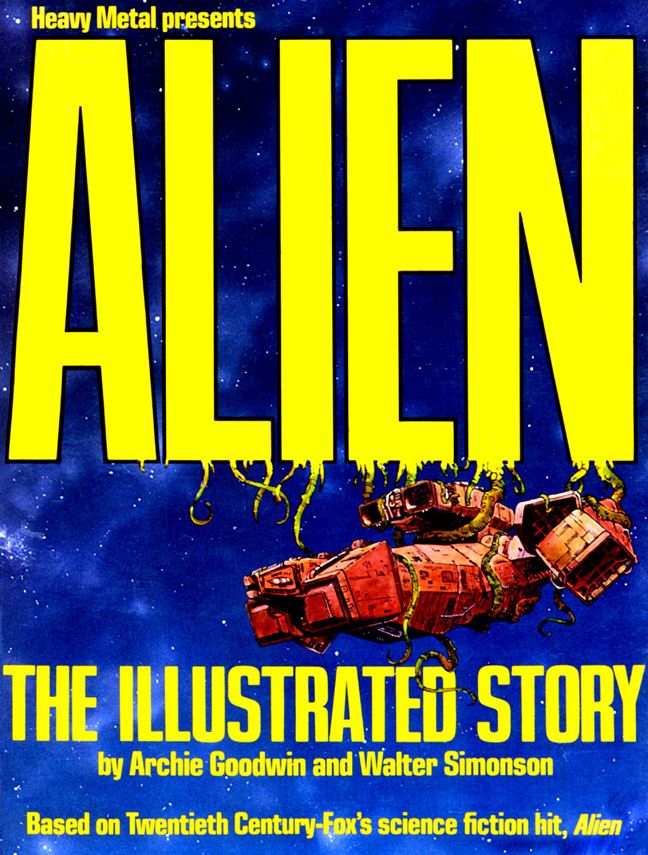
Years before Dark Horse introduced the infamous xenomorphs into comics, Heavy Metal had Archie Goodwin and Walter Simonson team up for Alien: The Illustrated Story, an adaptation of the first Alien movie.  Kind of a strange item.  While its publishers aimed Heavy Metal magazine at adults, I'm not sure how much of an audience existed at the time for what amounted to a full-color graphic novel based on an R-rated film.  People read Heavy Metal, people went to see Alien.  Were these the same people?  Or, if not, could they be brought together in the bookstore for a book self-consciously eschewing the comic book label in favor of this "illustrated story" invention?  Someone thought so, hence this book.

Somehow its existence escaped me the first go-around-- and I've been a huge fan of Ridley Scott's sci-fi horror flick since I was approximately ten years old.  I was a fan of it even before I was old enough actually to see it, mainly because one of my brothers saw it and liked it enough to buy a book about its production, which he passed on to me.  And which thoroughly grossed me out and fascinated me at the same time.  Even stranger, there were Alien action figures in the toy store at the mall.  The point is, much like the unfortunate John Hurt character in the movie, I was exposed to the spore and it grew inside me.  It wasn't until a couple of years later, on an appropriately stormy night while I was home alone that I was finally able to watch the film on HBO.  It didn't scare me (and I'm easy to scare), but I enjoyed the horror elements and the funky, shabby-looking spaceship.

Years passed and I found out about Alien: The Illustrated Story, probably from one of the TwoMorrows magazines.  Since I'm also a fan of both Goodwin and Simonson (but not Heavy Metal magazine itself or the Dark Horse series for some reason) I went to Ebay and there it was.  Even though it was out of print at the time, I bought a nice, clean copy for a fairly cheap price.  It's probably not mint, but then I bought it to read not to file away in some climate-controlled vault.

But what a book!  It exceeded my expectations in every way.

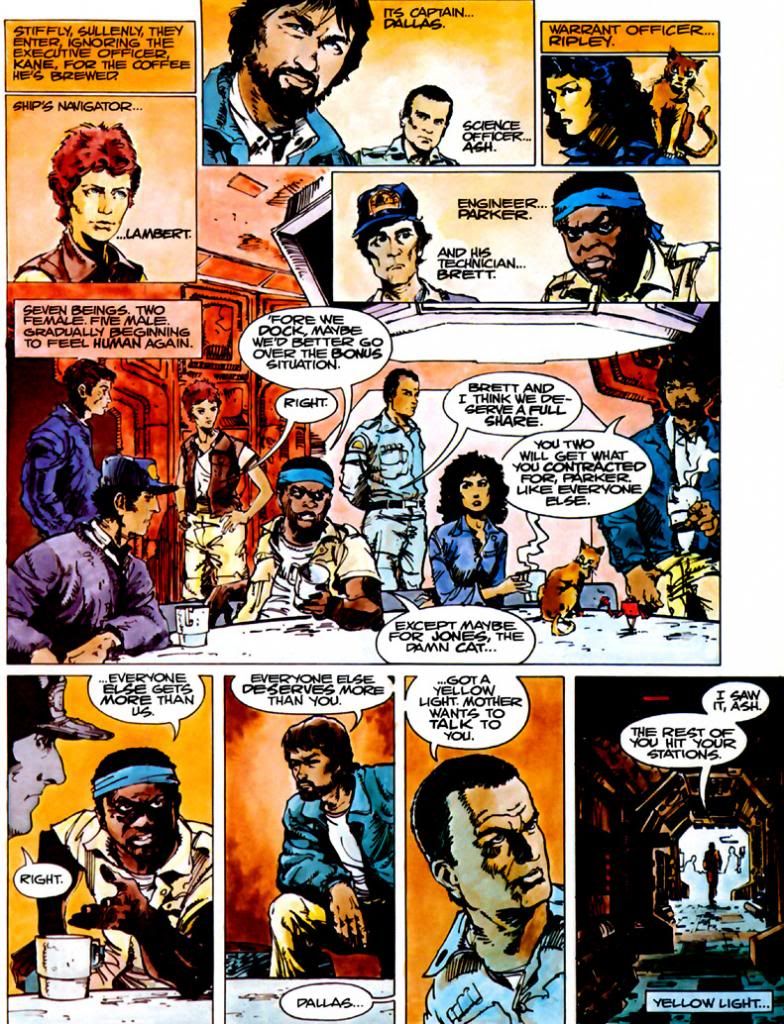
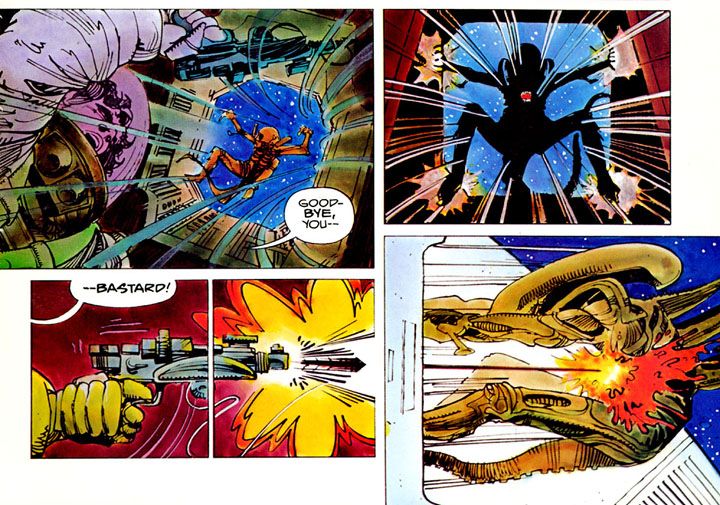
Goodwin confines himself largely to dialogue, with just a few tersely-worded captions here and there, most prominently on the first and last pages bookending the story.  He provides just enough information to get us started, then smartly leaves Simonson to carry the narrative load.  Simonson does an absolutely smashing job.  It's obvious from the way he stages certain sequences and from the accurate costuming he had access to a lot of studio-provided material, but Simonson doesn't let himself get too involved with photo reference.  If he had, it would have resulted in some dull storytelling.  His likenesses are more along the lines of caricatures rather than portraits, which is another canny decision from a guy who flat-out knows how to play to his own strengths.  Simonson has long had a loose approach to anatomy matched with a kind of abstract, angular take on shadows and wrinkles.  More in the Noel Sickles-Milt Caniff school of impressionist-style cartooning rather than flashy photorealism.  If you want photorealism, you might as well just use stills and do a fumetti book.  You get Simonson for an illustrative approach.


Because it follows the film very closely, there's a lot of talk in this book, with characters discussing the "bonus situation" and what to do about the alien.  The movie has some memorable gore-- the chest-bursting scene, for example-- but for the most part it's a masterpiece of claustrophobic tension and production design.  There's not a lot of comic book-style action.   Rather than allow this to hamper his storytelling, Simonson finds ways to mimic Giger's "biomechanical" design sense with alienesque panel borders and then the occasional torrents of blood.  It's some of his finest work, a little bit Moebius (a frequent Heavy Metal contributor who spent a short time working on the Alien film) and a touch Cam Kennedy, who was doing some fine work for Fleetway around this time and later  did some of the most visually distinctive Dark Horse Star Wars comics.


Another amazing aspect of this book is the lettering by John Workman.  This is the kind of stuff where the lettering is fully integrated into the artwork itself rather than just covering up parts of it.  And finally, the coloring.  I haven't seen the "re-mastered" version from Titan Books, so I don't know if they preserved the watercolor appearance, but back in the day, this is how the high-end graphic novels all looked (although few others really looked as good as this).  The coloring style allows for extremely subtle gradients and blends so it's richer and more sumptuous than computer coloring.

Tuesday, April 16, 2013

April is Kamandi Month: Who gash? Ugash!

Script/pencils:  Jack Kirby, inks: D. Bruce Berry
(
Kamandi #18, June 1974)
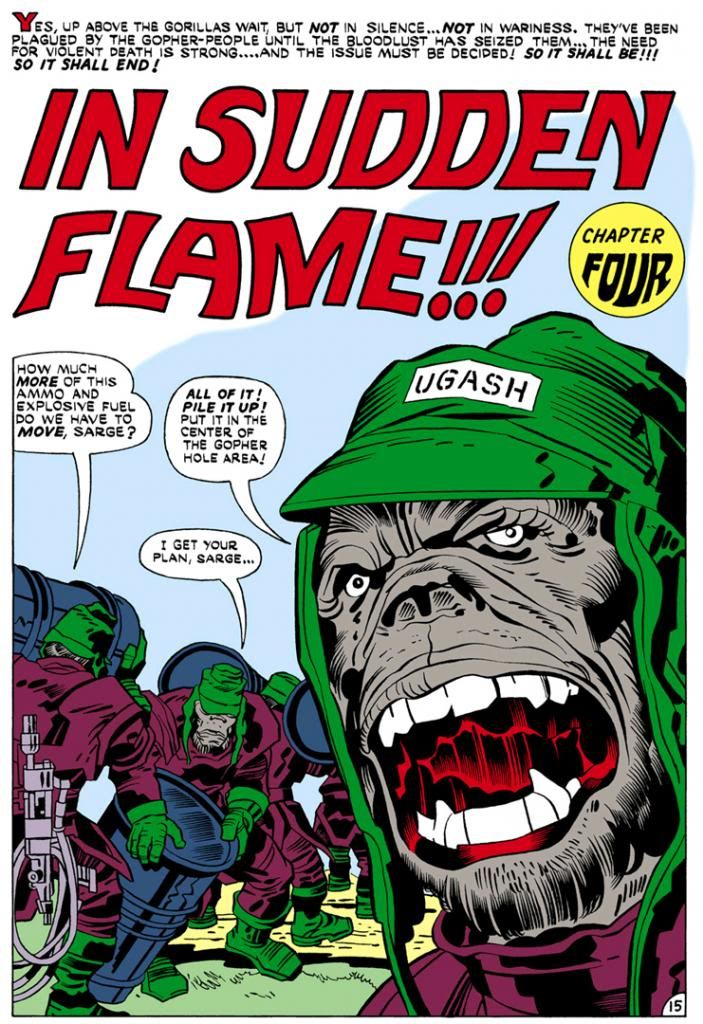
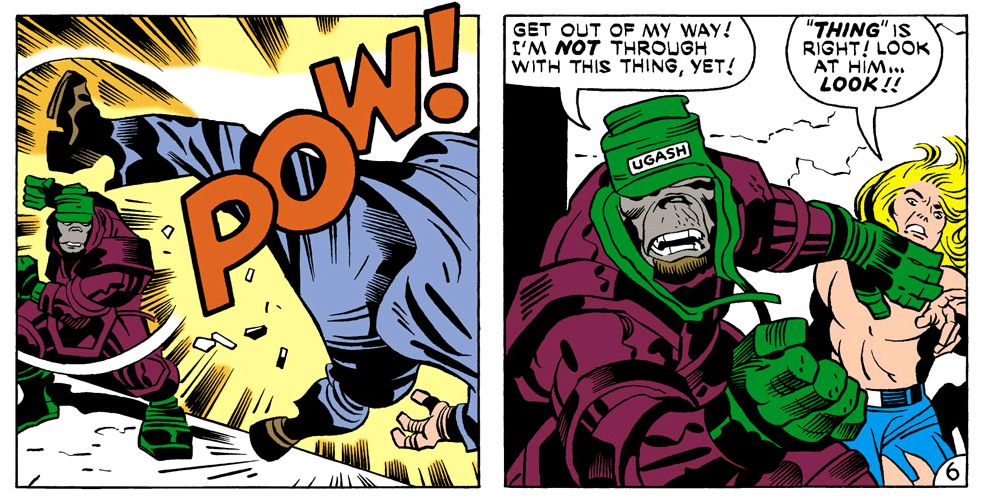
That's Sgt. Ugash to you, ya lousy animal!  Jack Kirby must have had a love for angry tough guys.  I imagine he knew some real life versions of these bombastic characters growing up on the Lower East Side in New York, and he must have encountered more than a few during his wartime army stint.  Look at all the variations on this theme he created or co-created-- Brooklyn, from the Boy Commandos; Scrapper, of the Newsboy Legion; Dum Dum Dugan, one of Sgt. Fury's Howling Commandos; Ben Grimm, the Thing; Detective Dan "Terrible" Turpin, with a death wish in New Gods #5 (later revealed by other sources to be a grown-up Brooklyn, a truly terrible idea and one we'll ignore since we operate under the "If Kirby Didn't Write It, It Never Happened Theory" around these parts).

Those are just the ones I know by heart.  You could usually identify these guys by their ubiquitous derby hats or well-chewed cigars, or both.  Or, in the case of Sgt. Ugash, a green cap (with his name printed on it!), purple jumpsuit and lots and lots of hair.

Sgt. Ugash first appears in Kamandi #17 (May 1974) and he's as rambunctious from the get-go as any of those other classic Kirby creations.  He's not only fighting the tiger army, but he's also having trouble keeping his troops supplied because the gopher people keep tunneling up under the ape bivouac and stealing everything they can get their clawed hands on.  Pumping water, bullets and fire into the holes doesn't solve the problem, so Ugash sends Kamandi down like a ferret with bombs strapped to his back.  That rascally Kamandi, of course, turns on Ugash, so the sergeant and his ape soldiers spend the next couple of issues pursuing the Last Boy on Earth, who fights back using a giant worm, the likes of which would make Maud'Dib's mouth water at the thought of riding it against the Harkonnen hordes.  We might consider this some kind of phallic symbolism.  If big apes represent masculinity run amok, then it takes a really big dick to beat a really big ape.

By Kamandi #20 (August 1974), however, Kirby has abandoned the tiger-gorilla war and forced Sgt. Ugash and Kamandi into an unfriendly alliance against the Roaring Twenties-style robots inhabiting Chicagoland.  Some chump years before the Great Disaster decided it would be a hoot to build a theme park based on Chicago's violent Prohibition days and equip the various factions with real bullet-spraying tommy guns.  This theme park-designing asshole must not have watched Westworld; I'm guessing Kirby did, or at least absorbed a little of it from television commercials.

Kamandi #20, "The Electric Chair!!!"  This was my first Kirby comic, my first encounter with Sgt. Ugash.  This single issue of Kamandi came my way and as far as I knew, Ugash co-starred in all the others as well.  As a Planet of the Apes fan, I immediately liked him more than the kid who gave his name to the comic.  Plus, Kamandi reminded me of the filthy hippies we saw on the news, or one of my oldest brother's baseball teammates who sometimes teased me or got drunk at our house and barfed in my bedroom when my parents went away for the weekend.  Throughout the story, Kamandi tries to use reason and puzzle out what's happening, a rational but-- to a child reader-- unsatisfactorily unassertive way of dealing with the situation.  Ugash couldn't care less about the whys of Chicagoland; he simply starts smashing the place.  But for me, Ugash had another thing going for him besides ape-appeal and hands-on approach to problem solving.

Kirby/Berry (Kamandi #20, August 1974)
The pre-programmed robots ram Ugash through a nightmare parody of the US justice system as if he were just another anachronistic hoodlum, and the gorilla's baffled rage at this railroading by mysterious, implacable authority figures who will not listen to reason was an all-too-familiar experience for a lot of us who were about to start elementary school.  Adults and their bizarre ideas and arbitrary rules!  We were already sick of them.  As a comic book reading six-year-old, it made more sense to go down swinging like Ugash.  Ugash got his licks in for all us kids, even though he could never win.

Even then, we understood the futility of those kinds of grand gestures (rebellion in the 1970s meant spankings both at home and at school, or at least the dreaded "writing lines" in the principal's office, which kept us trapped well past the final bell), but what Kamandi did seemed shameful.  In retrospect, it makes a lot more sense--  Kamandi splits.

Sunday, March 31, 2013

Dani Moonstar, the Early Years 4! The UnBEARable Lightness of Being Dani

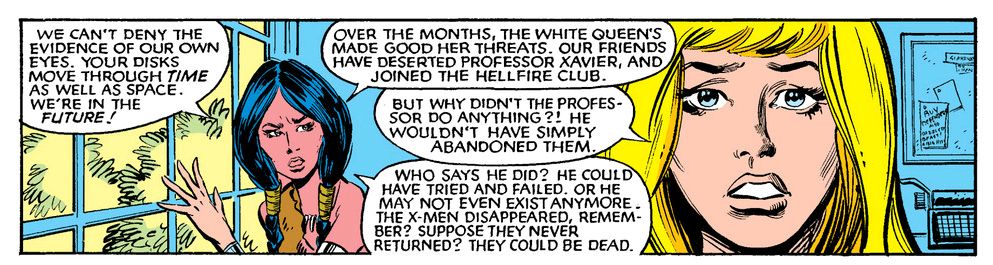
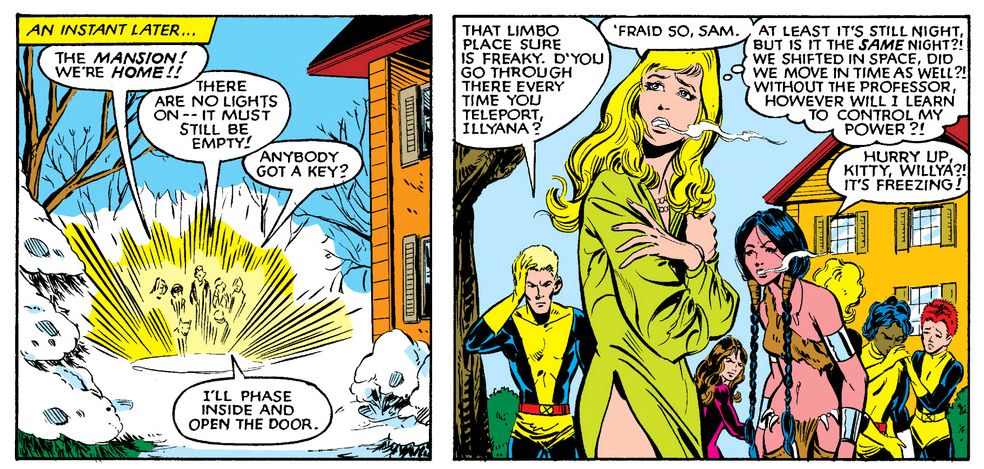
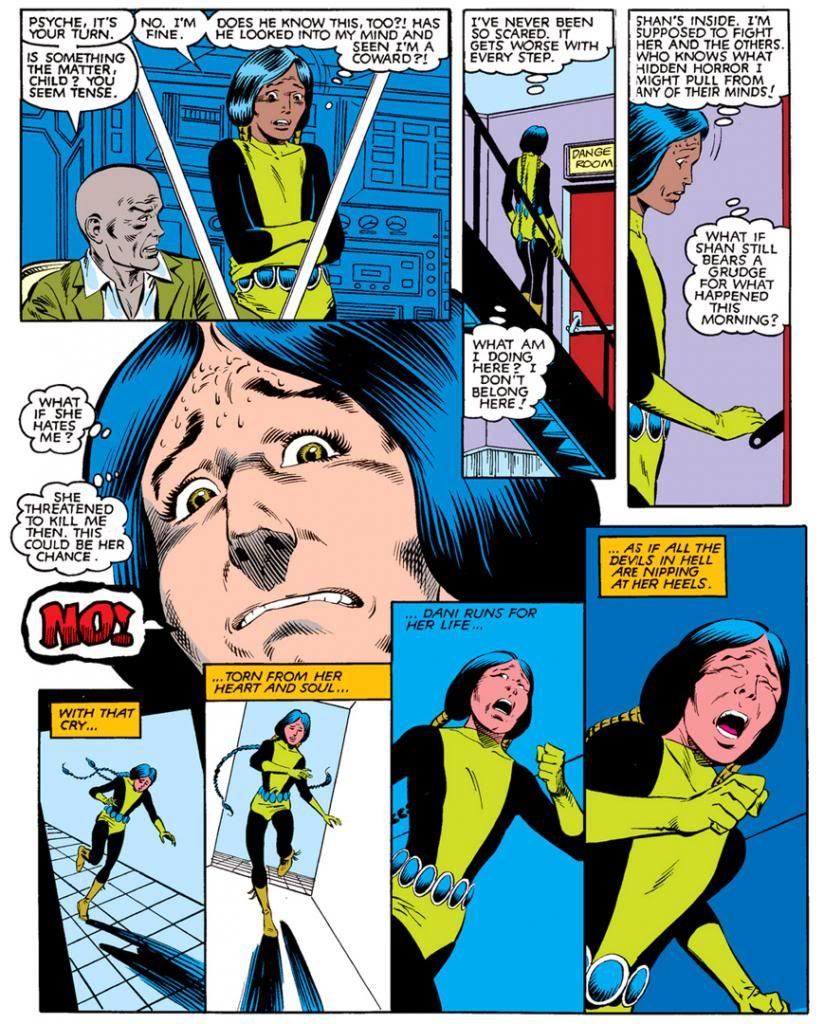
Then came the Second Golden Age of the Dani Moonstar.  And yet it was a dark age, as well.  With the addition of Bill Sienkiewicz on art-- a guy who combined Neal Adams and Ralph Steadman in almost equal measures-- The New Mutants became one of Marvel's most visually distinctive books.  Chris Claremont's writing took a great leap forward stylistically as well, the language becoming ornate and the plots ever more complex, with characterizations to match.  Finally, Dani Moonstar would have a story worthy of her, albeit one where she'd spend a good portion of it in a coma while her new friend Magik did the heavy lifting.

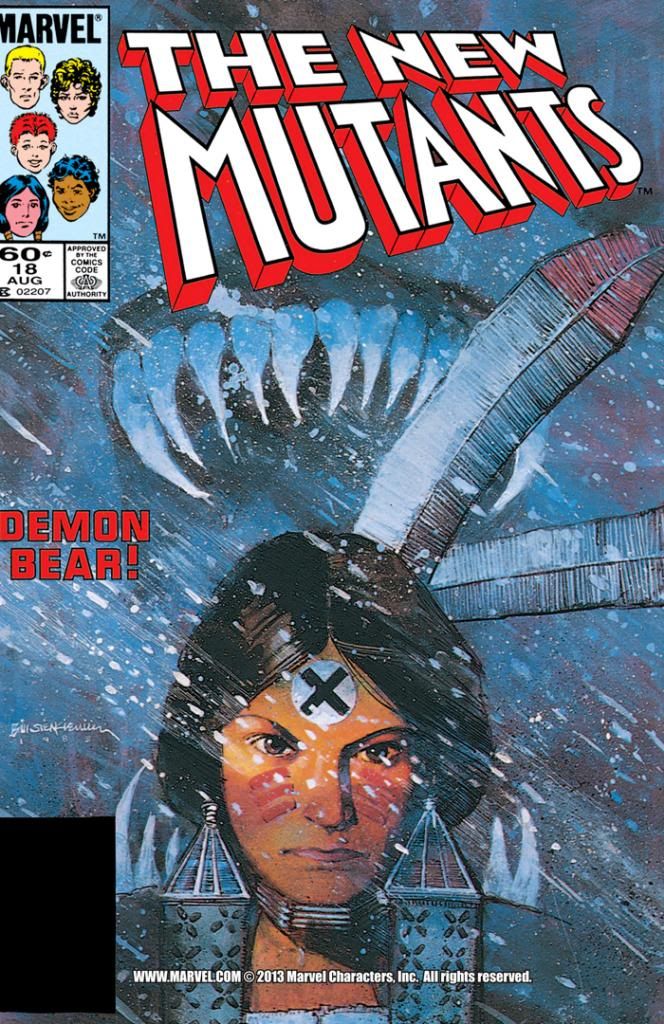
It kicks off in The New Mutants #18 (August 1984) with a painted Sienkiewicz cover that wastes no time announcing the book is something special.  Not the one you've been used to and slightly disappointed by for the last six months or so.  The Sienkiewicz Dani gazes intently at the reader, with a face recognizable as the Bob McLeod character, but now with thin-lipped determination and more culture-specific accessorizing (the forehead X is especially clever).  Behind her, however, the fangs of discord.  Danger in the snow.  Sienkiewicz brings a painterly approach with a strong design sense as well.

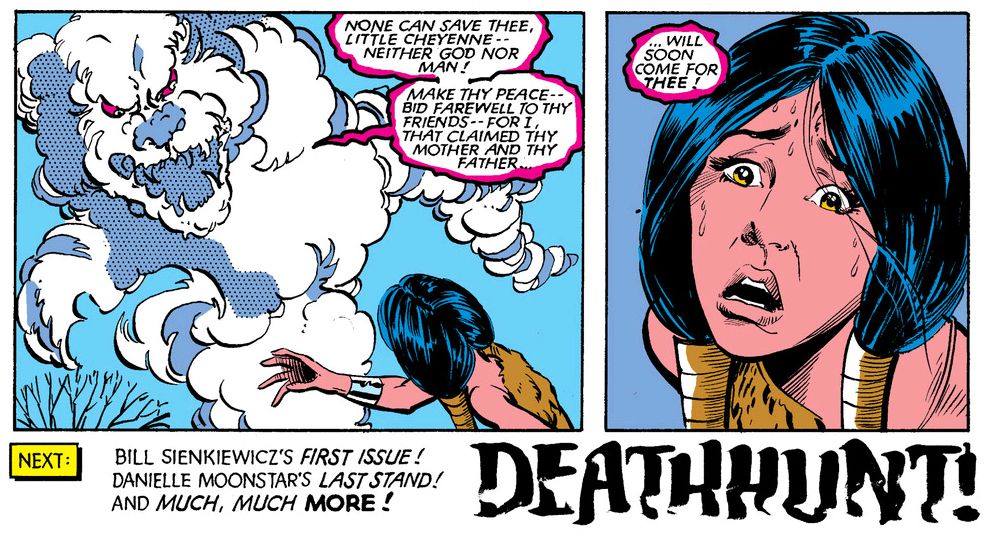
If you'll remember, way back in the first issue, Dani told Rahne a little bit about herself and the story of how her parents vanished while possibly fighting a mystical bear.  It was one of Dani's earliest moves towards becoming the book's standout character.  Then, in the third issue, we got to see the bear itself.  Kind of.  It was more than likely a mind-game the Brood-infected Professor X was playing on Dani, drawing out her worst fears.  Then the book went off on a Team America-Romans-living-in-South-America-Magik tangent and no one mentioned Dani's magic bear for a while.

Well, readers might have forgotten the exact details, but rest assured, Claremont did not.  A master of the slowly developing subplot, Claremont returned to this little biographical tidbit and spun it into a unique tale as psychological as it was action-packed, a genre-stretcher that took the kids out of their cozy heroic adventure home and tossed them into the deep, dark woods we like to call horror.  If this had been a DC book and Vertigo had existed in 1984, "The Demon Bear Saga" with its dripping blood and ever-shifting dreamscapes would have been a perfect fit.  And Seinkeiwicz, who must have bought india ink by the tanker truck-full, was just the guy to illustrate it.

Why a bear?  What am I, a cultural anthropologist?  What little I know about Native American culture comes from a single university folklore class, reading a few histories and novels like Tom Berger's novel Little Big Man and the essay  They Have Not Spoken:  American Indians in Films by Dan Georgakas.  In short, I know just enough to make an ass of myself.  To make matters worse, I'm going to rely on the Internet.  Apparently, bears are very powerful animals.  Magically powerful.  There's a wonderful story in which a great bear chased some girls (perhaps Lakota, not Cheyenne, but many tribes tell variants of this one), who took refuge on a rock.  They prayed that the rock would grow and save them from the bear.  It did and they took to the sky as the Pleiades (also known in Greek myth as the "Seven Sisters").  The bear in its hunger and rage clawed the sides of the rock, leaving it scarred.  Today we know this rock as the Devils Tower, Wyoming.

The point is, bears figure in a lot of myths and stories, so a bear makes an excellent choice for Dani's spirit antagonist.

One aspect of Marvel's mutant books is how mutant powers and the reactions of those manifesting them and by society at large as a response to these powers can be read as an allegory on race, gender, sexuality, or any kind of "othering."  The sexuality reading has ascendancy these days, especially in light of its treatment in the X-Men films, where Iceman's parents ask him if he's tried not being a mutant (X2: X-Men United, 2003)  and where Mystique anachronistically tells Beast to be "mutant and proud" in 1962 (X-Men: First Class, 2011).  The scene where Beast has his mutant status inadvertently revealed is especially evocative of an outing.  Reinforcing this is the trope within the comics themselves that mutant powers typically manifest at puberty.

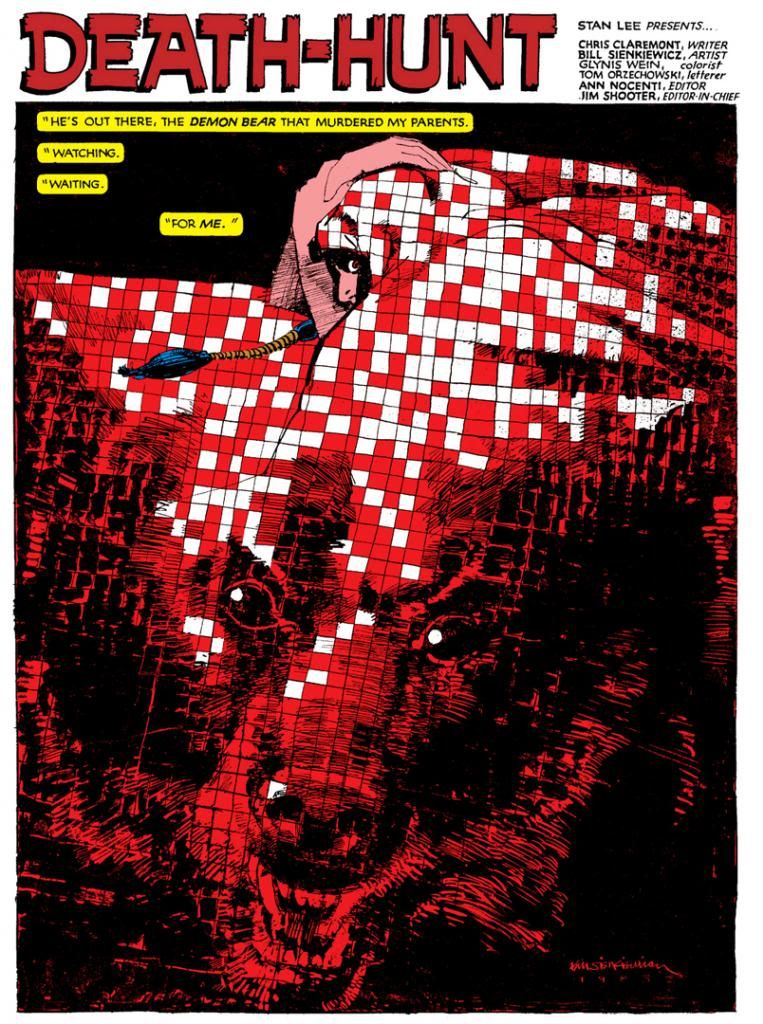
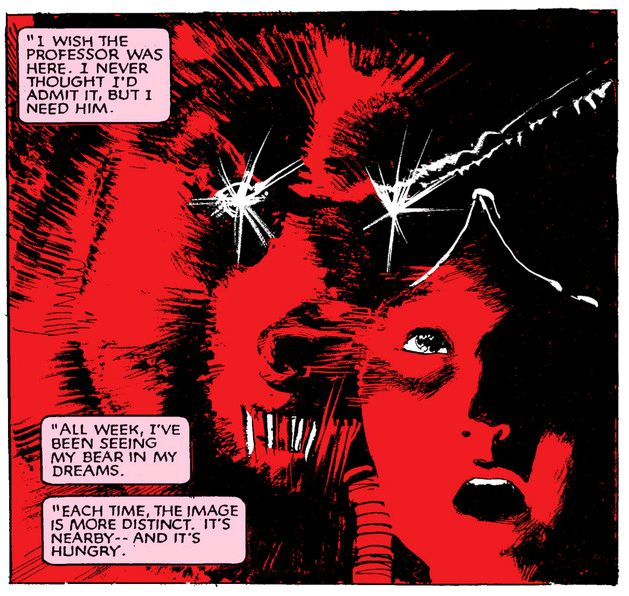
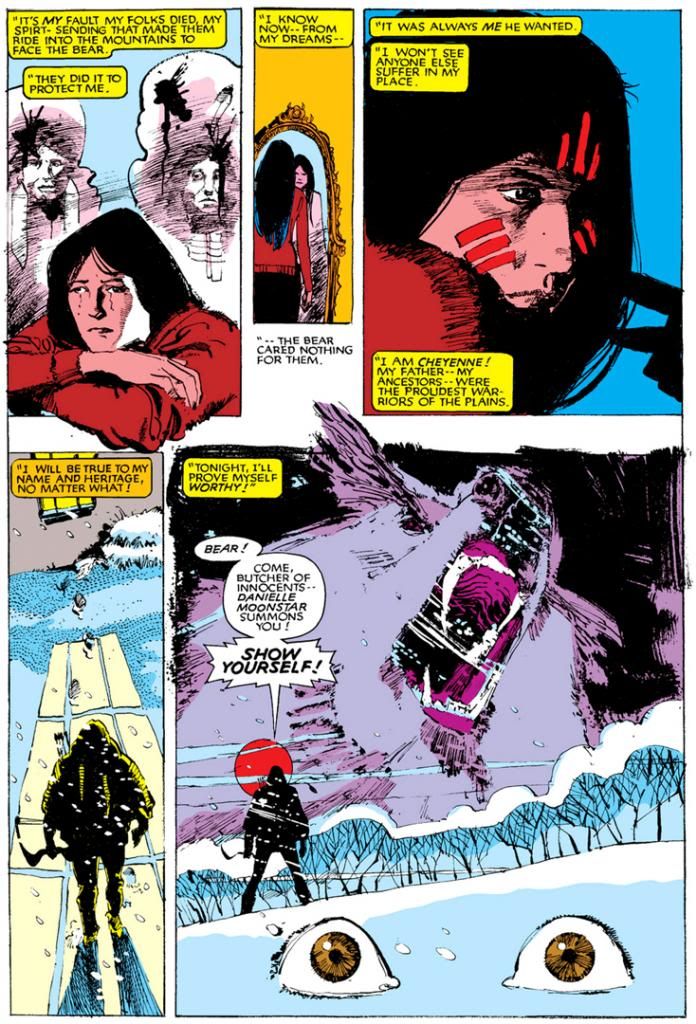
Appropriately, “The Demon Bear Saga” is a story rife with sexual symbolism, no doubt resulting from a happy synergy between Claremont, operating at the utmost of his considerable skills as a writer and an insightful artist in Sienkeiwicz, one open to expanding the literary vocabulary of superhero comics through experimental techniques.  In the opening splash page, Dani cowers in bed while Claremont has her narrate her plight and Sienkeiwicz and colorist Glynis Wein cover her in a red sheet imprinted with a dream image of the demon bear.  It’s a shocking image, our favorite mutant swaddled in what appear to be blood-soaked sheets and the red motif would recur, reappearing with the bear imagery as Dani thinks about her most recent dreams involving her foe in a later scene and again when Dani ritualistically paints her face as she prepares for the climactic confrontation.

Chris Claremont, scipt/Bill Sienkiewicz, art/Glynis Wein, colors (The New Mutants #18,  August 1984)

Significantly, the bear enters Dani’s life at the same time her mutant powers appear, roughly around puberty as per Marvel's mutant mythology—one of her first acts as a full-fledged mutant is to show her parents their apparent deaths at the bear’s claws, which becomes a self-fulfilling prophecy.  In the real world, there is another power, another type of becoming, of a great and personal change, that fulfills itself at puberty through blood.  You can find it providing one subtextual reading of the fairy tale "Little Red Riding Hood" and horror authors and creators before Claremont and since have used it more overtly to add resonance to their works.  Steven King and Brian DePalma used this theme to great effect in both the novel Carrie (1974) and its classic film adaptation (1976).  More recently, screenwriter Karen Walton explored these associations in the werewolf film Ginger Snaps (2001), directed by John Fawcett.  Dani’s horrified response to developing a power she lacks the experience and understanding to control, and one that causes her parents’ deaths is ultimately a signifier of her ambivalent response to having matured sexually in a patriarchal society that marginalizes her as a woman.  Dani's real struggle is to overcome this ambivalence and the shame and self-loathing that results.

Chris Claremont, scipt/Bill Sienkiewicz, art/Glynis Wein, colors (The New Mutants #18,  August 1984)

Unfortunately for Dani, her parents were unable to protect her at a time when these changes were at their most intense.  In fact, the root of Dani's guilt is that this maturation, this physical change, visited in her desires or thoughts she equates with the bear's utter destruction of her parents.  Feeling betrayed by her body, she has taken responsibility at having violated the nuclear family.  But because she is essentially a strong, brave young woman, after an initial period of understandable dread, she will attempt to attack the problem head-on.  It won't be easy, and requires an elaborately ritualistic preparatory regimen. 

Chris Claremont, scipt/Bill Sienkiewicz, art/Glynis Wein, colors (The New Mutants #18,  August 1984)

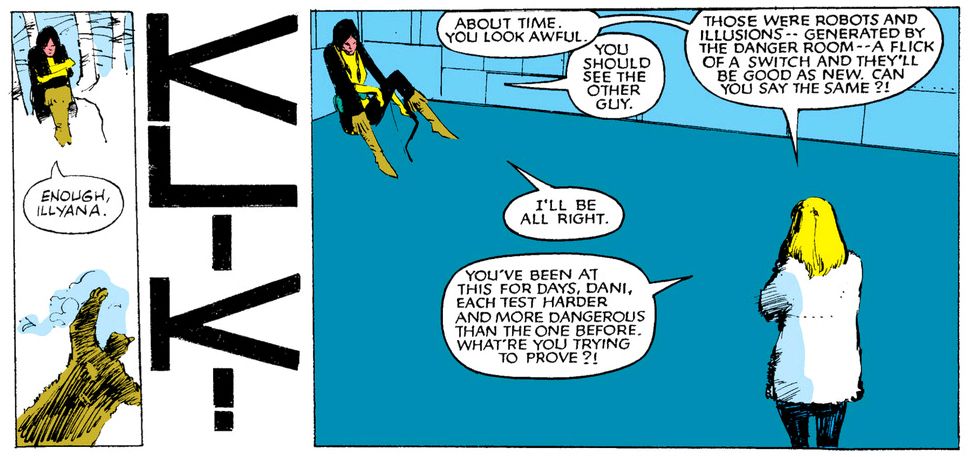
In preparing herself to contest the bear, Dani turns not to her chaste and inexperienced friend Rahne, but to the wiser-- and therefore, no longer innocent-- Magik.  Magik, having spent her formative years in Limbo, is an enigmatic figure, and an outsider.  She is also symbolically corrupt in the same way Dani believes herself to be.  Not quite human, not quite mutant, not quite demon.  Dani reveals through her narration that she's not even particularly close to Magik-- Illyana is best friends with Kitty Pryde-- so this makes her choice of confidante all the more telling.  But such is Dani's confused acquiescence to the cultural idea there is shame and uncleanliness in having become fertile that she is unable to tell even Magik her true motivation.  The more experienced Magik provides Dani an outlet for exploration and experimentation as she seeks to understand the nature of her new-found desires and physically ability to feel and act upon them.

Chris Claremont, scipt/Bill Sienkiewicz, art/Glynis Wein, colors (The New Mutants #18,  August 1984)

Bears are largely masculine figures, and in order to confront hers, and with Magik playing the role of sexual agent, Dani must cross genders (at one point she jokes with Magik, "You should see the other guy," guy being sometimes gender neutral, but generally a masculine noun; Dani clearly identifies herself here as a guy at least in a symbolic sense), or at least add male characteristics to her own innate female identity.  In the Cheyenne tradition, men acted as hunters and warriors, but one might reject this path and begin living as a woman.  Dani subverts, or rather, inverts this by taking on the role of hunter-warrior, but not without symbolically daubing herself with her own menstrual blood (I'm also reminded of the scene in Sylvia Plath's The Bell Jar, where her protagonist, Esther, bloodies the nose of her attempted-rapist and he similarly paints her face with it), represented as red war paint.  Only then is she prepared to do more than cower in bed or react in fear.  Thus cloaked in the accouterments of maleness, Dani is free to act, to slay the bear.  

For this, Dani uses a weapon associated with Native Americans by history and custom, the bow and arrow.  The arrow is phallic.  It penetrates and Dani has made herself expert in its use thanks to her training sessions with Magik.  And yet Dani is also reminiscent of Diana of Roman myth, from the similar names, to the choice of weapon, to the time at which she forces this confrontation-- that is, night time.  Diana has associations with the moon.  She is also the goddess of the hunt.  And of chastity.  It's worth noting, too, that Artemis, the Greek version of Diana, is goddess of childbirth as well.  In order to battle the bear, Dani requires herself to embody both sides of the gender dichotomy.  In this way she becomes both her own father and mother.
 
Chris Claremont, scipt/Bill Sienkiewicz, art/Glynis Wein, colors (The New Mutants #18,  August 1984)

The confrontation with this male presence occurs in snowy woods.  The snow, of course, is white.  This can be seen as purity, but snow may also be representative of death.  Woods hide mysteries and figure in many fairy tales as places where terrible things may happen to children.  Here, Dani-- drawn by Sienkiewicz as a silhouette, all her sexual characteristics blotted out or hidden-- calls out the bear as "butcher of innocents," which we can also understand as "butcher of innocence."  The dialogue here is artificial and lacks the voice of a teenage girl.  It's more in the epic tradition, something Beowulf might say to Grendel in translation.  The bear then appears, and Wein colors it various shades of purple, representing pain or bruising, while on the next page it's a more naturalistic brown as it has fully manifested before Dani.  Its threat is no longer confined to the subjective space of Dani's dreams but rather has become real and potent. 

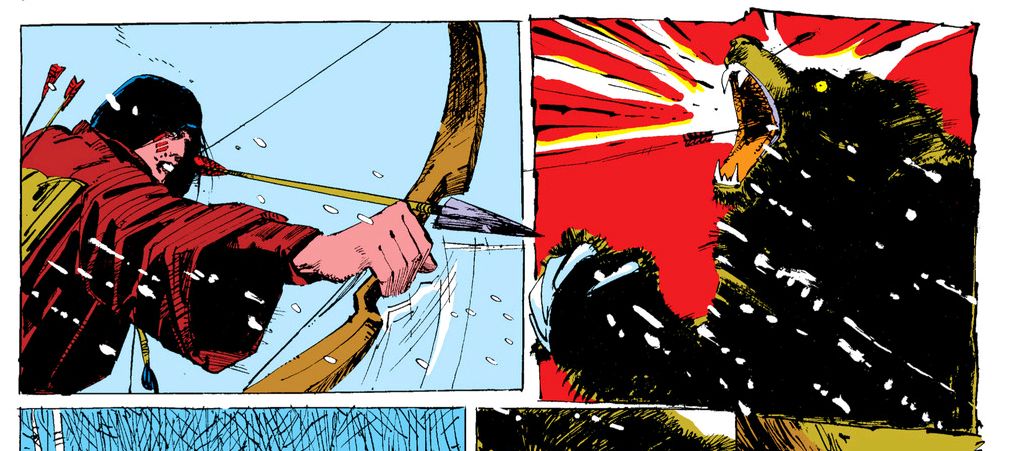
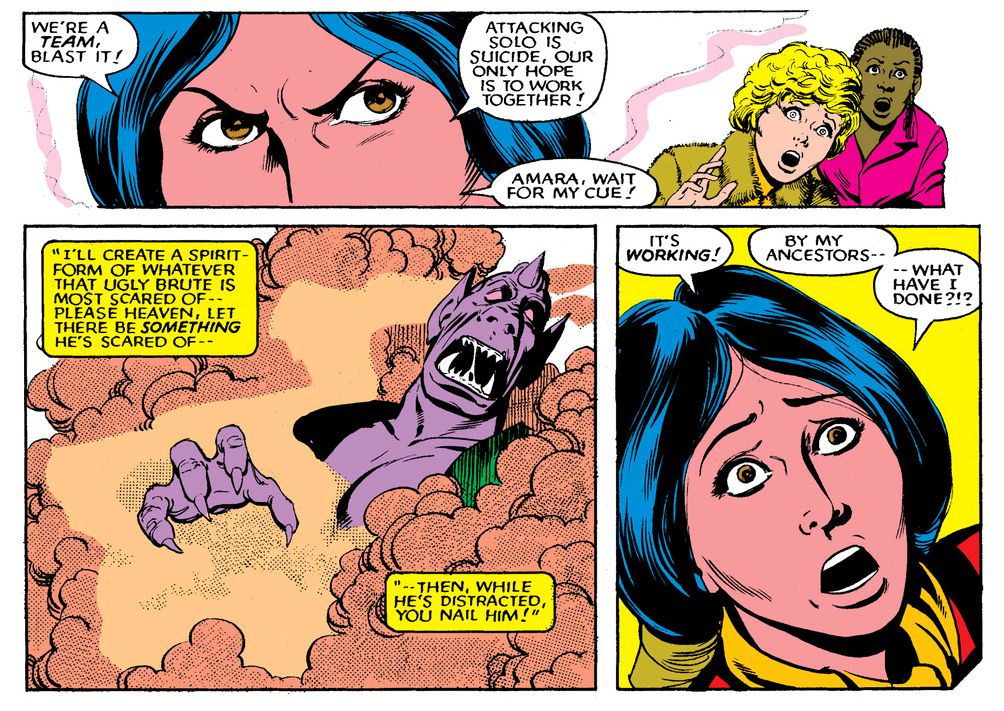
Dani first uses her mutant power-- which she has always found problematic-- to attack the creature with its greatest fear.  Which turns out to be Dani herself.  The masculine power fears the feminine one.  The basis of gender relationships in Western culture is an unequal power dichotomy in which female strength is denied and negated in favor of the male out of fear and loathing, which includes a belief that menstruating women are somehow unclean.  Here, using her innate strength, Dani comes closest to achieving victory.  Dani, however, does not attempt to derive any deeper understanding of why the bear fears her as much as she fears it.  Instead, she reverts to using the phallic arrow, striking the bear harmlessly in the neck, though she describes it as a "killing shot."  If she intends to use the patriarchy's weapons against it, this proves to be a fatal decision.  The bear easily sweeps the bow from her hands and batters Dani.  She's able to injure the bear with a handheld arrow and earn a brief respite.

Escaping the bear's clutches, Dani retrieves her bow and fires another phallus into the one vulnerable opening the bear presents-- its mouth.  Here, having penetrated the bear at last, she achieves a false victory and turns from her foe in premature triumph.  In relying on a substitute penis, and denying herself the use of her own power-- despite its tantalizing glimpse of deeper wisdom-- Dani has not dealt fully with her own ambivalence towards her sexual maturation and gender role.  As she walks away into the night, the bear's eyes open. 

Chris Claremont, scipt/Bill Sienkiewicz, art/Glynis Wein, colors (The New Mutants #18,  August 1984)

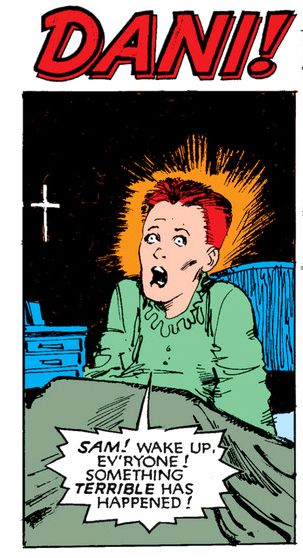
And, importantly, it's the virginal Rahne (Sienkiewicz clothes her in a prim, ruffled nightgown and places a cross behind her) who senses the danger and alerts the others.  Dani has been struck down by the complexities and ambiguities of adulthood, but it's the most child-like of the New Mutants who reacts, having felt it psychically.  Dani's friends run to help her-- Sam, the oldest boy, carries yet another phallus, what appears to be a shotgun-- and find Dani's gutted body staining white the snow of innocence with the red of her secret knowledge, which she is now in no shape to parse.


Not to equivocate, but simply as a response to the richness of Claremont’s writing, I want to offer some alternate readings to the “Demon Bear Saga.”  The jumbled mess above—no more than a B- effort if I were to turn it in to one of my old lit professors—is just one way of reading the subtext.  Here are some others, probably equally as confused.


Hm.  That is equivocation.  Oops!

In another reading, the bear isn’t a stand-in for the patriarchy, but rather Dani’s rage at the patriarchy and her enforced role within a system devised to limit her choices.  Just as Dani’s mutant power allows her to call forth the images of anyone’s greatest fears, her mutation allows her to project her rage as a monstrous, destructive creature.  This is supported by her guilt pangs at having to carry the weight of her parents’ deaths.  Why would Dani’s rage have struck them down?  Because they were—however protective they meant it—participating in Dani’s diminution, the limiting of her spirit. 

Let’s also consider the bear as representing Dani’s sexual maturation in another way.  At some point, Dani violated the incest taboo by involving her parents—one or the other, or both—in a masturbatory fantasy.  Remember—she lives in guilt because of transgression against her parents, not the other way around.  She had what was essentially a fleeting, blameless thought, one that’s probably quite common at the onset of sexual yearnings, but one fraught with shame, and was perhaps caught by her parents during the act.  Humiliated, and with no one to turn to, Dani becomes confused and self-loathing.  Hence the bear, a stern, punishing father figure she creates in reaction to these negative feelings.  In this reading we can view Dani’s Danger Room preparations also as a form of masturbation.  The X-Men use the unreal world of the Danger Room to rehearse real world scenarios in much the same way we prepare ourselves sexually by self-exploration and fantasization.  To this end, as we’ve already discussed, Dani seeks the counsel of the (sexually) experienced Magik.

In a related reading, the bear is sexual maturation itself as loss of innocence.  Corruption of an innocent is a recurring Claremont theme—Magik is the prime example, so much so he wrote an entire miniseries about just that.  In Uncanny X-Men #160 (August 1982) and the Magik (December 1983-March 1984) series, the devilish Belasco abducts child Illyana into Limbo where she literally loses her soul by gaining premature knowledge of the world.  Her innocence becomes corrupted by this knowledge—one cover by John Buscema shows what’s essentially an underwear-clad Illyana given diabolic aspect complete with horns and a phallic knife—and she literally loses her soul.  As a result, Illyana instantly returns to the real world miraculously the immediately post-pubertal age of thirteen years old.  It’s hard to think of another genre story that examines these themes so overtly.

And not just Illyana.  For whatever reason, Claremont visits this theme most frequently (but not exclusively… it just seems that way sometimes) upon female characters.  Jean Grey becomes Dark Phoenix, Illyana becomes Magik, Selene attempts to seduce Dani into becoming her evil sorcerer’s apprentice, super-innocent Rahne turns into a nearly mindless avatar of light under the influence of drugs in a story involving adult predators victimizing teen runaways, Storm from a powerful yet naïve goddess into the worldly punk-look leader of the Morlocks, Madelyn Pryor becoming the Goblin Queen, Dani again in Asgard going from high-flying Valkyrie to evil, skeletal Odin-slaying version thanks to Hela.  And those are just the ones I know by heart.  We can approach the bear as another version of this theme, with Dani’s war against it a struggle of innocence versus knowledge, supported by the use of Magik as her teacher/helper, the red versus white color scheme and the setting of the main confrontation within snowy woods.

So Dani responds negatively to this knowledge, which, as it did with Magik, comes much too soon.  Unready or unwilling, she rejects it, literally and figuratively fights against it.  Through this struggle, she comes to terms with it and assimilates it within her healing psyche thanks to the intervention of guide Magik and the others.  This saves Dani and reaffirms her friendships, but as many do to gain wisdom, Dani pays a heavy price—as do others; this is a transformative wisdom in a literal sense—and temporarily loses the ability to walk.

Then there’s the matter Dani’s gendering.  While Dani may or may not be transgender, she does have an ambivalent response to her biological gender.  When we first see her in Marvel Graphic Novel #4:  The New Mutants, she’s a solitary figure, free from the misperceptions of others and, thus, allowed to clad herself in attire that codes as male or, at most, ambiguously female.  Throughout the subsequent comics, Dani frequently wields her grandfather’s knife (a specific provenance it’s important to note, as well as the knife’s phallic nature) and invokes the Cheyenne warrior tradition and Claremont gives her clipped, militaristic speech at times.  As she frequently casts off her clothes, she is casting off the coding of the gender role in which she’s largely perceived by her friends and the larger society in which she operates.  In The New Mutants #5 (July 1983), Dani essentially becomes a man when, under the influence of the exclusively male gestalt Team America, she transforms into Dark Rider, with a firm and powerful machine between her legs.  Motorcycles traditionally code as male, both in movies and in literature.  For a woman to ride one is seen as transgressive and empowering, tropes exploited by B-movies and genre TV shows like James Cameron’s Dark Angel.  

In the biker world, women are largely constrained to the subsidiary role of “mama,” and the spot behind the motorcycle’s rider is colloquially and dismissively referred to as the “bitch seat.”  But Dani becomes neither supporting player, nor domme a la Russ Meyer.  She's the Dark Rider and so characters see Dani as a man.  It’s not until she tumbles from the motorcycle-- suffered a figurative castration-- that they can strip away the male disguise and reveal her true gender.  Which is also a matter of perception in absence of any definitive identification by Dani herself.  And yet we must ask ourselves, why did this male gestalt power single out Dani among the thousands of people attending the Team America performance, including the biologically male members of the New Mutants and bystanders?

As we’ve already seen, in the “The Demon Bear Saga,” Dani symbolically genders herself largely male—albeit with elements of the female-- in order to fight the bear.  Once again, the menstrual imagery comes into play as Dani struggles to come to terms with her sexual maturation as a biologically functioning woman, a limiting of options and something she dreads and fears in the same way young transmen and transwomen struggle with their own unwelcome bodily changes and processes.  If we accept her Danger Room sessions as symbolic masturbation, then we read the arrow as a phallus and Magik as her fantasy-partner as Dani assumes the masculine, if not outright male, role.  While there are plenty of story elements suggesting a largely heterosexual female identification for Dani, Claremont introduces enough ambiguity to suggest Dani may not occupy any definitive place within the gender or sexuality spectrum and the struggle with the bear is a struggle with either herself or with society at large to establish her own gender and sexual identity, free from all these imposed concepts.

And all this is without even getting into Dani’s frequent association with horses and horse imagery and symbolism!  That’s a term paper unto itself.


While supporting multiple readings and interpretations-- the psychological, the mythic, as a gender critique and the literary-- this story also functions as a straightforward action narrative.  Because this is a comic book, the bear isn't just a manifestation of Dani's psyche.  It's also a very real external threat.  What makes "The Demon Bear Saga" such a rich work (even though it does have a few of those terse Claremontian couplets in the narration-- "The bear misses.  I don't."-- that lend themselves so easily to parody) is how well it assimilates all these aspects of storytelling while presenting a compelling and genuinely frightening read.   While Marvel made good use of Claremont's "Dark Phoenix Saga" and "Days of Future Past" storylines, and similarly considered important enough for a graphic novel collected edition to call its very own, I rank this particular tale ahead of them because it digs deeper for its themes and motivations than simply "absolute power corrupts absolutely" or "prejudice is a bad thing."

And we're talking largely about the first half of the story.  The second can no doubt be mined for just as much meaning.  It takes place largely within a dreamscape and features the transformation of two minor characters into Native Americans.  What can we make of this?  Well, we'll just have to think about it for a while and see what we come up with.  

Time to turn our gaze towards the future and another of my favorite characters...

Wednesday, March 27, 2013

Dani Moonstar, the Early Years 3! Mutants in Rivalry

By the time the first year of The New Mutants drew to a close, Dani Moonstar had assumed leadership of the team.  Co-leadership, but come on, obviously Sam Guthrie was a mere figurehead, there to rubberstamp Dani's decisions and give the others a sense of false security that they were in anything other than a benevolent dictatorship headed by the Coolest Comic Character Ever Created.

Unfortunately, the comic itself had become lethargic, with lackluster plots and art to match.  While it had once promised to become the platonic ideal of a Chris Claremont book-- ostensibly empowered teen girls repeatedly finding themselves bound and gagged and forced to wear skimpy costumes, a couple well-meaning but vaguely dim-witted dudes, all of them awash in a frothy mix of soap opera-ish personal drama, mundane daily events and superheroic adventure complete with overwrought dialogue filling each panel with dense word-walls-- The New Mutants had become simply generic, a timid tag-along to its older, wiser sibling, Uncanny X-Men.

Dani had earned her starring role in what was supposed to be an ensemble book by defeating all comers-- her creators, teammates, the Hellfire Club, an alien insect, a space empress, a Mr. T rip-off, holdovers from the Roman Empire, some kind of soul-sucking witch who wanted to adopt her as an apprentice.  All had challenged Dani's supremacy and all had fallen before her strength of character and force of will.  While writer Claremont made a few efforts to re-establish the team dynamic, Dani was having none of it.  Until Claremont presented her with her most dangerous foe.

Chris Claremont, script/Sal Buscema, Tom Mandrake, art (The New Mutants #14,  April 1984)

Illyana "Magik" Rasputin had been around for a few years as a minor X-Men character, little sister to metal man Colossus.  In fact, she made her first, albeit nameless, appearance in Giant-Size X-Men #1 (April 1975), the legendary issue that showed the world international stereotypes could be forged into a top-selling comic book fighting force.  The first time we see Illyana, she's practically an infant, and Soviet agricultural technology being what it was at the height of the Cold War, her big bro has to use his mutant powers to save her from a runaway tractor on their collective farm.  This could not have happened at a privately-owned farm here in the Free World.  Our tractors are the flawless product of a capitalist system, where the invisible hand of the free market has already weighed and rejected any farm machinery that doesn't work exactly as advertised.  Illyana survives her brush with the ineptly-manufactured product of a flawed, atheistic political system only to grow up into a young woman best described as...

Semi-evil.

Chris Claremont, script/Sal Buscema, Tom Mandrake, art (The New Mutants #14,  April 1984)

Claremont's crafty plan to undermine Dani and wrest control of his comic from her originates in Uncanny X-Men #160 (August 1982), where Claremont and art team Brent Anderson and Bob Wiacek have a demon named Belasco spirit the child away to a timeless limbo called, conveniently if unimaginatively, Limbo.  At the end of the issue, Illyana pops back in, only now she's thirteen years old and she's not only a mutant, but also a demonic sorcerous with a magical sword that manifests itself from time to time.  Flash-forward two years and, with Dani putting pressure on editor Louise Jones to have her book re-named Moonstar and the Other Mutants, Claremont knew it was time to take decisive action.  He tossed Illyana, now code-named Magik, into The New Mutants and instantly changed the book's power structure.

While no scheme or villain the increasingly desperate creative team could devise would force Dani completely into the background, she would now have to learn to share the spotlight with Magik, who appears to have been especially beloved by Claremont, possibly because she embodied a number of his characteristic tropes of this era-- a young girl with vaguely BDSM leanings, a penchant for transformations and inner turmoil lending itself to verbose internal monologues.  Plus frequent opportunities to indulge himself in baroque adjectives like "eldritch" and the creation of portmanteau words like "Darkchild" and "Soulsword."

Chris Claremont, script/Sal Buscema, Tom Mandrake, art (The New Mutants #14,  April 1984)

Not one to underestimate Dani, Claremont and Jones knew they had to do more than simply foist Magik off on the New Mutants.  They had to further enhance Magik's position as prime Dani-challenger.  Rather than dole out Illyana's Limbo experience through the occasional flashback or multi-panel thought bubble reverie, Claremont teamed with artists John Buscema, Ron Frenz, Sal Buscema and Tom Palmer to produce Storm and Illyana: Magik, a four-issue mini-series, from December 1983 to March 1984.  Wow, Marvel was really pushing Magik on their readers, weren't they?  What Dani did organically by inhabiting the book with her own innate awesomeness, Magik would do through corporate strategy.  Top that, Dani!

In fact, under the aegis of Claremont and with the approval of Marvel's upper echelon-- specifically, editor-in-chief Jim Shooter, who feared Dani might supplant the Amazing Spider-Man as the company's flagship character and force them to produce a whole slew of new promotional materials as well as wreck their deal with toy manufacturer Mattel (the company licensing Marvel's heroes for a line of action figures and play-sets based on Shooter's Marvel Super Heroes Secret Wars title, due to hit the shelves in May of that year)-- Magik gets to do something Dani never could: she actually narrates her very first The New Mutants issue, #14 (April 1984), in a story called "Do You Believe in Magik?" (Marvel certainly did!) which is all about how her twisted minions journey to Xavier's school to steal her back. Claremont and Sal Buscema even gift Magik with those solo pages once accorded to Dani.  Oh, you know Dani felt the sting.

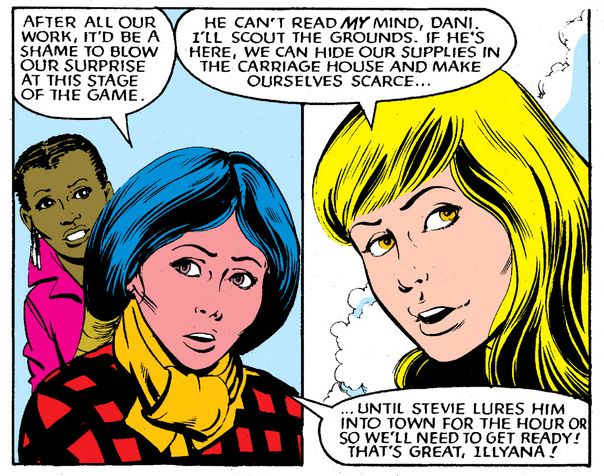
So, how did Dani handle this upstart?  Actually, the career-savvy Dani was smart enough to cozy up to Magik almost from the start, quickly becoming her partner in crime.  Mild crimes, like planning a party for Professor X and trying to figure out how to surprise a guy who can read your merest thoughts.  And adding Magik to the group proved to be a move of pure Claremontian genius, because it was at this point The New Mutants began to develop its own voice, becoming darker and more mysterious.

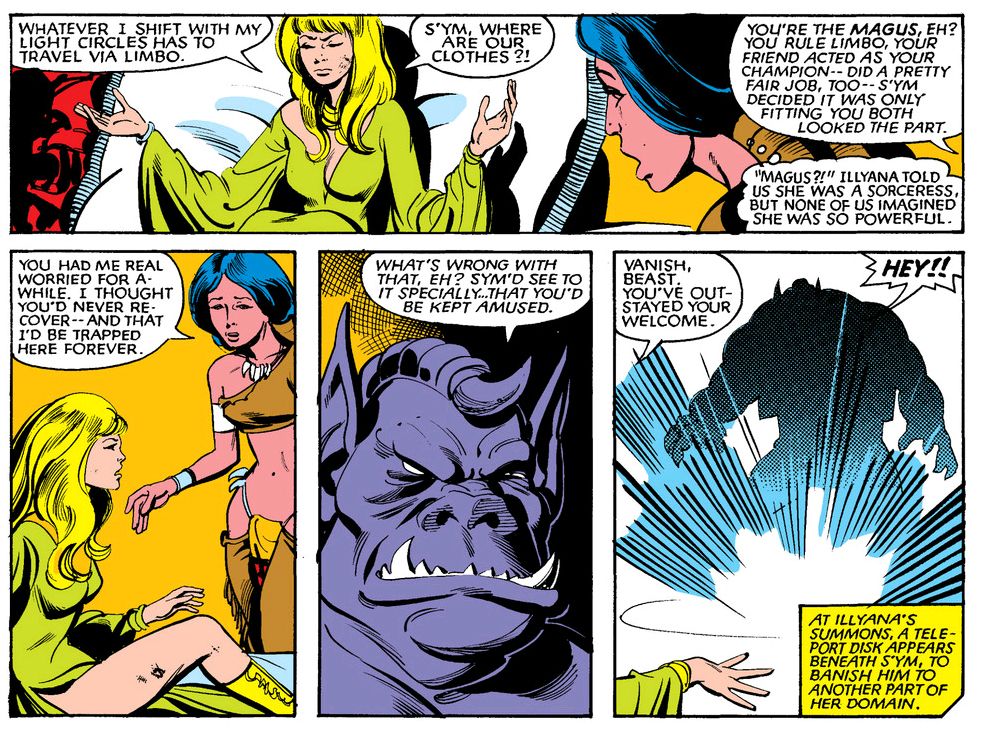
Much as the artistic tension between Paul McCartney and John Lennon fueled some of the Beatles' finest albums, the strange dichotomy between the straight-forward Dani and the shadow-motivated Magik recharged Claremont's creative batteries.  The first pairing between these visual and philosophical opposites comes during the Mutants' multi-part battle with Emma Frost's Hellion team (caused by that snobby Kitty Pryde) in The New Mutants #15-17 (May-July 1984).  While this kind of story-- where the stakes are nothing more than deciding which fake philosophy will triumph while people wearing different-colored clothes clash meaninglessly-- never impressed me, it does provide us with a glimpse of better things to come when Magik takes Dani to her personal hell-dimension and introduces her to leather vest and ass-less chaps.

Chris Claremont, script/Sal Buscema, Tom Mandrake, art (The New Mutants #16,  June 1984)

Oh, and S'ym, one of those Claremont touches where he pays homage to whatever comic book he happened to be a fan of at the time because the world of comics in the Eighties was just one big, happy family of like-minded creatives making fabulous art.  So you'd see a poster featuring certain properties hanging in Kitty Pryde's room, or one of Dani's friends would gushingly mention a sci-fi/fantasy writer you just know Claremont had dinner with on a regular basis or at least hung out with after hours at some comic convention or another and you'd go, "Wow!  Even though I'm a dork, I'm validated because a fictional teen who has amazing adventures across space and time also likes the same weird things I love that everyone in my real life thinks are a waste of time!"

I mock, but I really have to thank Claremont sincerely for that because it did keep me going during those lonely, masturbatory years.

What point was I making?  Oh yeah.  S'ym.  S'ym is Magik's demon assistant, but his name is curiously similar to a particular Canadian independent comic book creator's and he just happens to somewhat resemble that creator's famous aardvarkian-barbarian creation right down to his vest.  His lurid interest in "amusing" Dani is probably reminiscent as well, but it's been years since I last read anything about earth pigs.

Chris Claremont, script/Sal Buscema, Kim DeMulder, art (The New Mutants #17,  July 1984)

Well, whatever his inspirations, the now fully-engaged Claremont has both girls work together to save the team this time (from a nasty future in which they've become Hellions) for almost two full issues.  And throughout, Dani refrained from plunging her knife into Magik's semi-evil heart and Magik didn't transform Dani into a toadstool and sit on her.  Progress of a sort, I guess.

Chris Claremont, script/Sal Buscema, Kim DeMulder, art (The New Mutants #17,  July 1984)

 Speaking of progress, the success of the Magik-gambit led Claremont to inaugurate phase two of his plan.  This involved the arrival of Bill Sienkiewicz on art duties, and would see The New Mutants become more consistently interesting and genre-expanding than the book it spun-off from.  Which in turn benefitted Dani, because without Magik giving Claremont the impetus to start experimenting and moving away from stale Uncanny X-Men cast-off plots and toy line team-ups, Dani might not have achieved her greatest victory, over a plot element introduced way back in the very first issue and all but forgotten since.

Which would very nearly prove Dani's untimely death, leaving Magik the undisputed lead character.

Chris Claremont, script/Sal Buscema, Kim DeMulder, art (The New Mutants #17,  July 1984)

Monday, March 25, 2013

Dani Moonstar, the Early Years 2! The Era of Continued Dominance

After almost turning The New Mutants monthly into Marvel Presents Dani Moonstar and Some Largely Useless Goobers, writer Chris Claremont seems to have tried his best to prevent The House of Idea's Greatest Character from completely overshadowing the other players in what was ostensibly a team book.  Having Professor X-- himself one of the Marvel universe's premiere minds-- mentally dominated by a Brood creature to draw these kids together and then torture poor Dani pretty much negates some of his more emotive writing in Marvel Graphic Novel #4:  The New Mutants (at least to those of us obsessed with all things X), but Claremont never let consistency of characterization or motivation get in the way of telling a ripping tale.

A ripping tale in which Dani refuses to play by Professor X's-- and by extension, Claremont's-- rules.

Chris Claremont, script/Sal Buscema and Bob McLeod, art (New Mutants #4, June 1983)

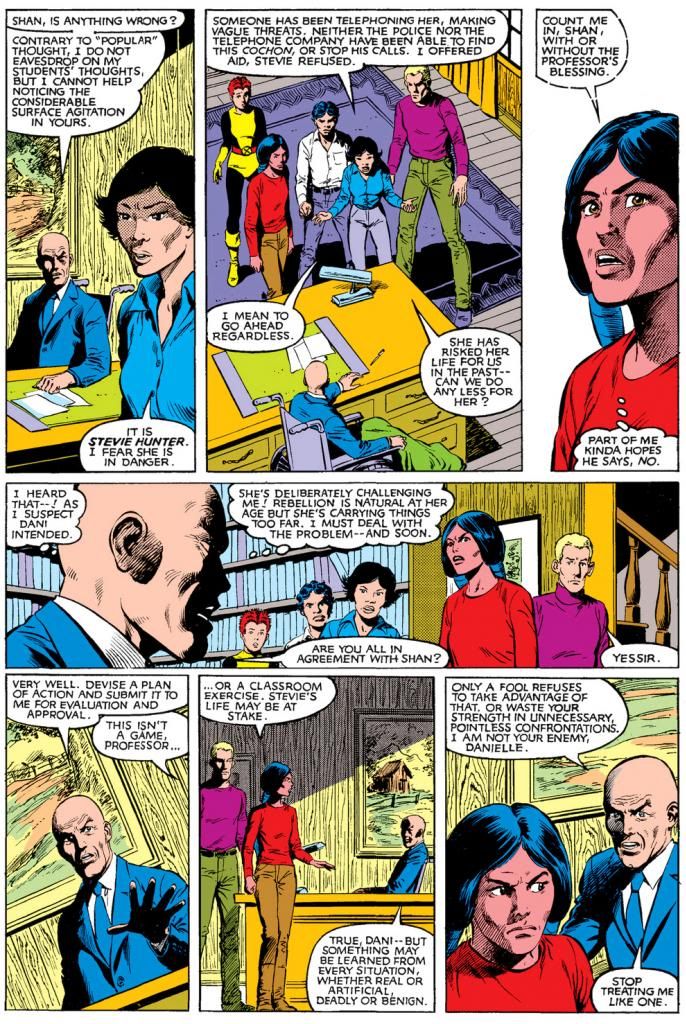
The Brood are Claremont's homage to Ridley Scott's nightmare-inducing Geiger-designed "xenomorph" from the film Alien (this was before James Cameron's expansion of the idea in Aliens and way before the travesty of the later sequels and dimbulb involvement with the Predator franchise).  Claremont and co-plotter/artist John Byrne had already relied heavily on Alien for a Kitty Pryde story in Uncanny X-Men #143 (March 1981) and like all the greats, they knew to steal from the best.  When the xeno-Brood inside Professor X failed to drive Dani insane or turn her into a host for its spoor, Claremont turned to a completely new storyline, one that promised to take the book in a more earthbound direction.  In The New Mutants #4 (June 1983), Dani and the rest tackle a more mundane menace.  Someone is stalking their dance teacher, Stevie Hunter.

I remember excitedly reading "Who's Scaring Stevie?"* in study hall at good ol' Albany Junior High and hoping Claremont and company were taking the book in a less superheroic direction, one that would see the team using their powers less and dealing with teen concerns and social issues more.  Or investigating haunted houses and breaking up smuggling rings dealing in old pirate gold a la Nancy Drew and the Hardy Boys.  With the older, more powerful X-Men back, I didn't see any reason why a bunch of kids my age needed to fight aliens or save the world when there were so many smaller threats around few comics at the time addressed but were the central stuff of many S.E. Hinton and Judy Blume books-- not to forget J.D. Salinger, William Golding or even Anthony Burgess, for pretention's sake.  As a junior high schooler with "outsider" status much like the New Mutants themselves (largely caused by reading comic books in study hall), I wanted stories that used the superheroic genre to comment directly on real-life concerns of the kinds my friends and I dealt with every day.

Years later, I'd write a letter to Image asking that they do something similar with Gen13 (why waste a chance to explore the dichotomy between being a super-being and a party-crazed college student by blatantly rehashing The New Mutants plots?) and they nicely told me to keep my stupid ideas to myself.

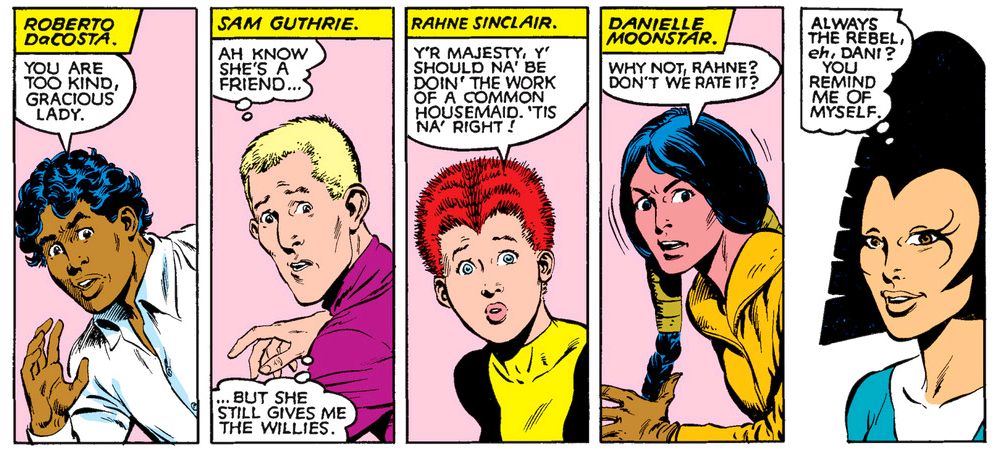
In setting up this story, Claremont tries valiantly to re-establish The New Mutants as an ensemble piece.  Gone are the extended solo Dani sequences as Claremont and new penciller Sal Buscema reduce her "screen" time and plump up the roles of Roberto, Sam, the Other One and Whatsherface.   After a playful romp in the snow where Dani treats poor, naive Rahne like a canine pet and Sam once again displays his winning propensity for spectacular power failures, the kids have to report to Professor X for a heart-to-heart.

Claremont, Buscema, McLeod (New Mutants #4, June 1983)

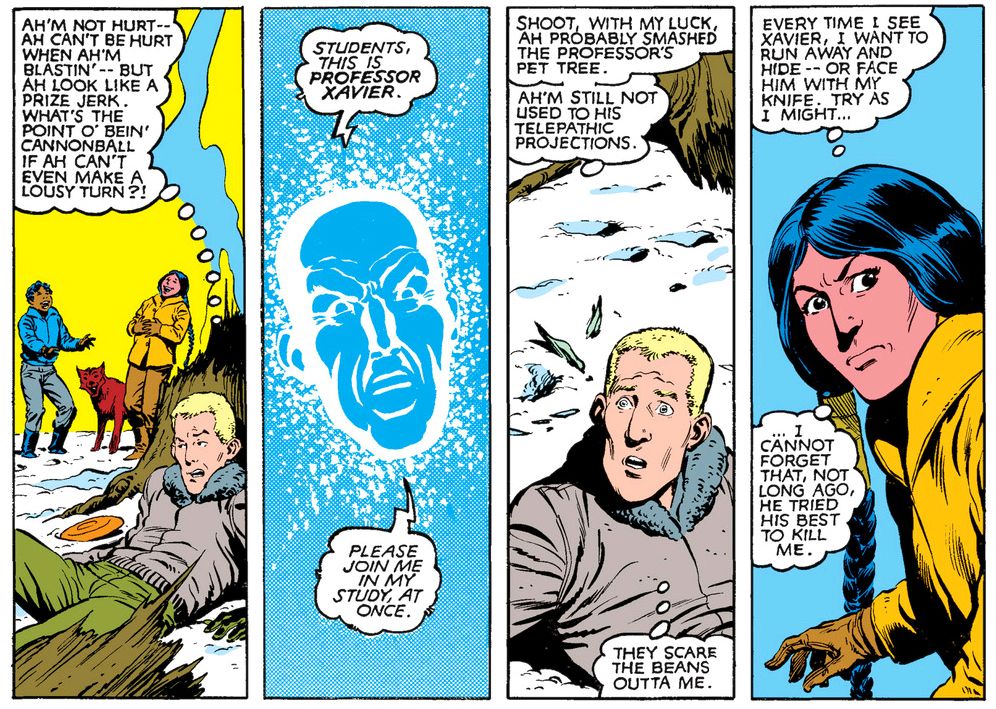
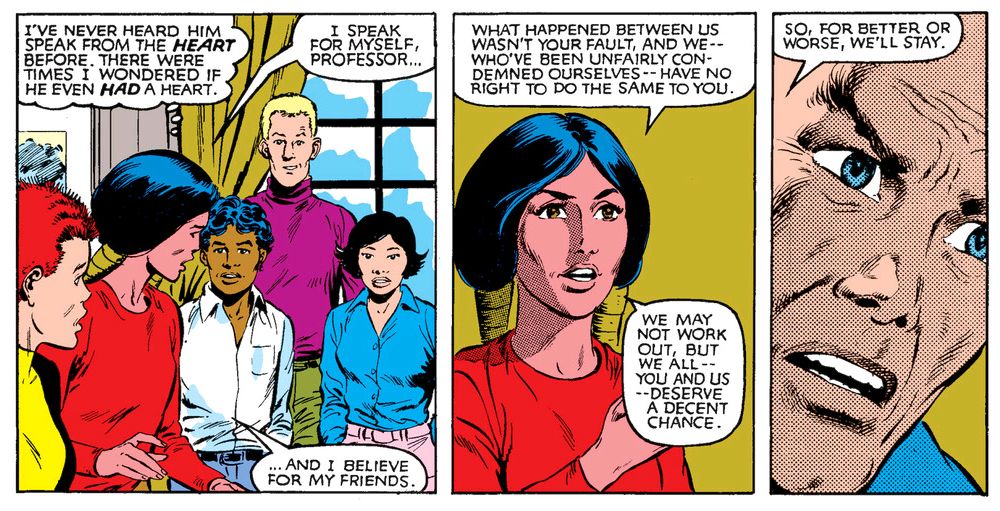
But Claremont can't help giving rebellious Dani the best lines and most memorable moments.  On the way to the Professor's study, Dani refuses to back down-- giving Claremont a chance to use some of his classic arch dialogue to make Dani sound more like Scott "Cyclops" Summers or one of Sgt. Fury's Howling Commandos than any teen we've ever encountered, fictional or real-- from Lilandra, the pointy-headed empress of a vast space empire.  That's right.  Dani sasses a SPACE EMPRESS, which earns her Lilandra's (and this reader's) admiration in the process.  As a follow-up, Dani then presumes to speak for the entire team without even taking a moment to do something democratic like listen to their opinions.  Buscema and inker Bob McLeod give Professor X a brilliant close-up panel where the look on his face registers sheer horror and dismay at Dani's obvious power play.  The world's most powerful psychic is scared shitless of this pig-tailed girl and her red t-shirt.

Claremont, Buscema, McLeod (New Mutants #4, June 1983)

And while Xi'an does her expository best to get the plot rolling, Dani has other ideas-- she turns this scene into a moratorium on Professor X's leadership which ends with the poor exasperated guy practically begging her to stop making his life miserable and get with the program, please.

Claremont, Buscema, McLeod (New Mutants #4, June 1983)

While the rest of the story is given over to the team as a whole investigating Stevie's stalker, it's Dani who makes the strongest impact.  Again.  She won't shut up, won't back down, won't take guff from anyone.  Oh yeah, and when they find the kid, it's Dani who reduces him to a sniveling wreck by blasting the shit out of him with her powers.  She tells Xi'an she can't help it, but we suspect the real reason is she's taking out her frustration at not getting the center spot on this issue's cover or a double-page spread all her own where she interacts with squirrels and chipmunks while plotting Professor X's ultimate downfall and renaming his school Danielle Moonstar's Academy of Ass-Kicking.

Then my hoped-for emphasis on well-meaning kids solving their peers' social issues turned into a Saturday morning TV commercial for Ideal Toys.  I'm not sure how this happened-- it smacks of editorial interference in an attempt to create synergy for a licensed product-- but in The New Mutants #5 (July1983), the team suddenly finds itself involved with Team America.  Not those delightfully profane marionettes who savaged both Bush-era jingoism and Hollywood liberalism in equal measures but the motorcycle riding dullards you could buy at K-Mart if you didn't have the simple human decency to collect G.I. Joe.

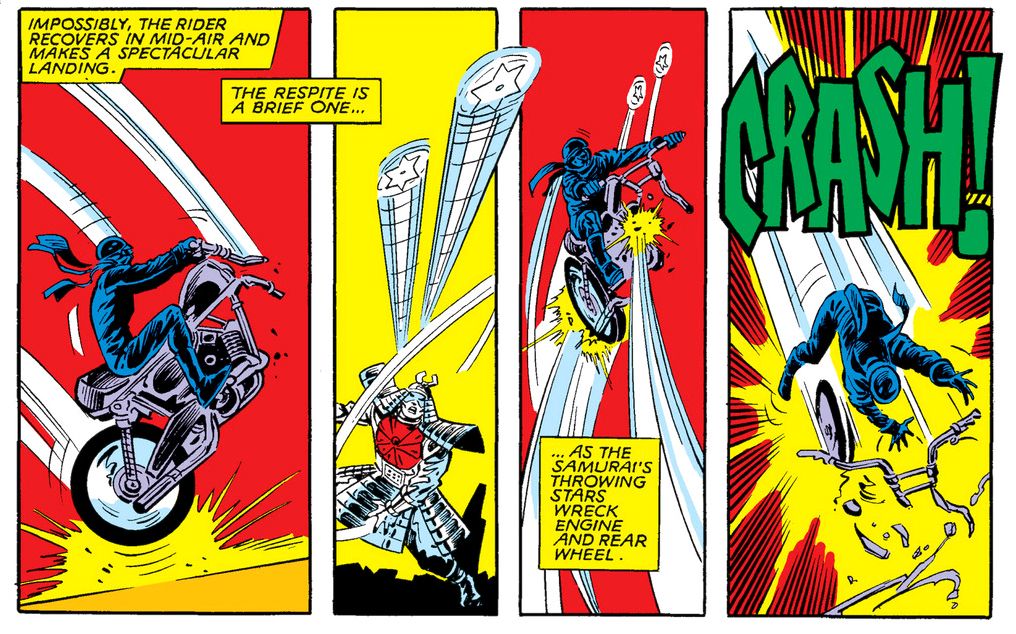
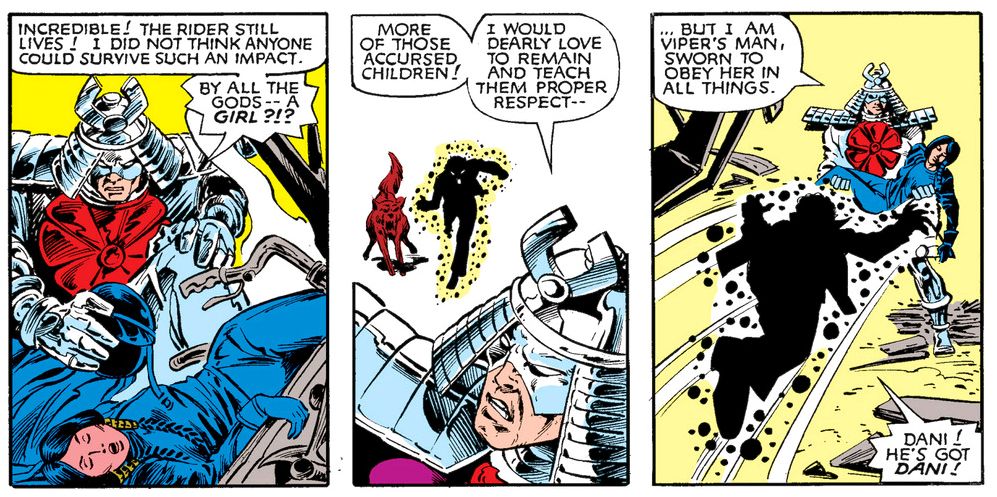
Incredibly, this spins itself into a two-issue tussle with Hydra and, even more nonsensically, the Silver Samurai where even Claremont can't generate enough enthusiasm to do more than phone in the rotest of rote plots.  Yes, Hydra had its glory moments in quite a few stories, but here their involvement smacks of "Well, we need some bad-guys and Hydra doesn't take much effort: they're always doing crazy world-domination shit."  And what the heck does Hydra have to do with the New Mutants anyway?  Then there's the art.  Oh brother, the art!

In this era, most pencillers didn't do the completely finished drawings they do these days and inkers usually played a more important role in maintaining a book's consistent look.  If a penciller felt concerned about how an inker might interpret the pages, then he or she might render things more completely, or "tightly."  But these tight pencils took time and time was something many of these deadline-oriented books could not spare.  Some pencillers would simply do layouts, which were just roughly blocked-in panels with figures in outline or quickly sketched; these could go either to another penciller for clean-up and finish and then to an inker, or simply to an inker.  Masters like John Buscema drew loosely and it was up to the inkers to clean things up and actually draw in ink.

Bob McLeod is one of those inkers who flat-out knows how to draw.  On The New Mutants, if I'm remembering what he told us on Facebook correctly, McLeod was knocking himself out with tight pencils to try to control the book's look (after all, he co-created these characters), but couldn't maintain the brutal pace and keep up the quality.  So they brought in John's brother Sal Buscema because he could provide clean-reading pages for McLeod to work over.  It worked beautifully in The New Mutants #4, which looks more or less like a McLeod solo job.  But what happened here?  Armando Gil excelled at inking Michael Golden on The 'Nam, but he and Buscema are a lethal mix.  The art in the book's latter stages is as ugly and slapdash as its plot.

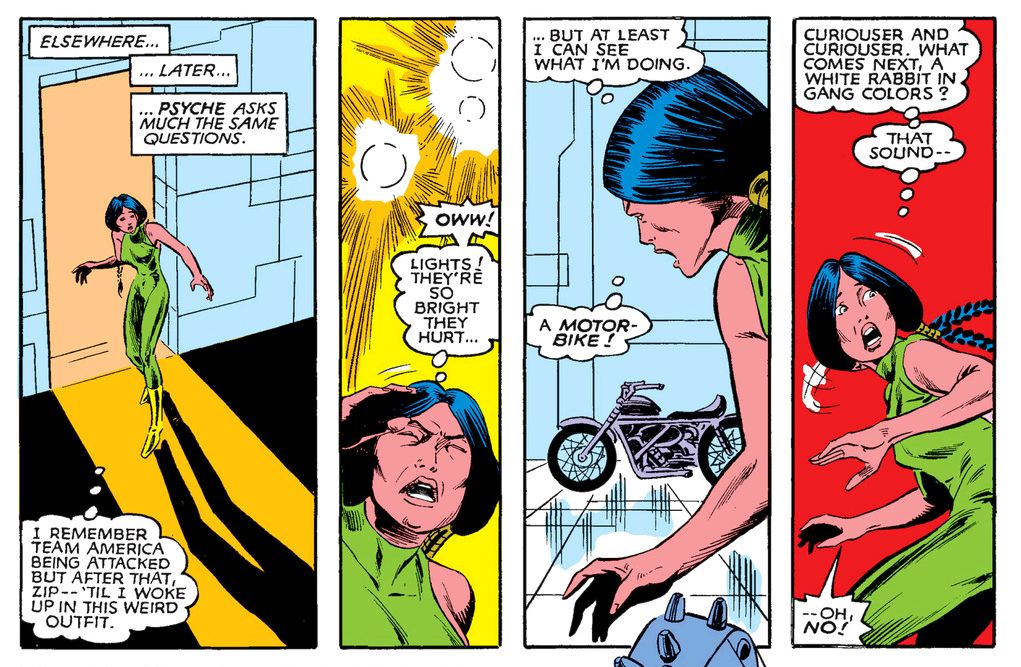
Anyway, Team America.  Oh, they turn out to be mutants.  How convenient!  This half-assed connection is enough for the kids to get themselves entangled with these motorcycle stunt riders (led by a guy with the admittedly awesome name R.U. Reddy).  And it's here where Dani begins to take things into her own hands.

Claremont, Buscema, and probably Armando Gil (New Mutants #5, July 1983)

Some fictional characters take on a life of their own.  Their mass within the plot tends to deform narratives much in the way gravity bends lightwaves.  At this point, with Claremont seemingly phoning in these issues and the art going wonky, Dani makes her move.  Whose headstrong nature finds her kidnapped and dressed in a green catsuit?  Who is the vessel for the manifestation of Team America's gestalt mutant power and gets to tear-ass around on a dirtbike as the Dark Rider?  Of course it's Sam Guth-- no.

Dani Moonstar.

Claremont, Buscema, probably Gil (New Mutants #5, July 1983)

As we've seen through five issues, anything interesting is happening in any given The New Mutants, it's happening to Dani.  Well, until Xi'an finally gets a storyline in #6 (August 1983).  But even that is mostly an excuse to bump her off so Dani can assume leadership of the team.  Claremont hedges his bets by having her share the honors with Sam, but we all know who's the weaker in their partnership.  There's no way Sam's good-natured country boy manner can stand up against Dani's hotheaded ways.

Claremont, Buscema, definitely Armando Gil (New Mutants #5, July 1983)

Notice, too, that even though they're ostensibly mourning the loss of Xi'an, the true reason for the kids' detour to Rio de Janeiro in The New Mutants #7 (September 1983)  is so Dani can indulge herself in the wearing of a skimpy Carnival outfit.  I've already written at length about Dani's clothing-optional lifestyle so I won't go into that here.  Suffice it to say, Dani is at home in her skin and thinks nothing of flaunting it.

And why not?  She's Dani Moonstar, for cripes' sake!  She's defeated the Hellfire Club, Professor X, the Brood, Hydra and Chris Claremont.

Soon, however, she would face her greatest challenge.

*The answer to that question-- if you care-- is Peter Bristow.

Sunday, March 24, 2013

Dani Moonstar, the Early Years! A Look at How Moonstar Stole the Spotlight in the First Issues of The New Mutants

Arguably the greatest comic book character ever created, Dani Moonstar just made her debut as a team member in Fearless Defenders, having survived the cancellation of the most recent New Mutants series. It's not luck.  She demands to be in books.  Created by Chris Claremont and Bob McLeod, Dani Moonstar has been flying around the Marvel universe on her magical winged horse for more than thirty years now and no matter how they change her-- new powers, no powers-- she just keeps on doing her thing.  With sheer grit and determination, she elbows others aside and takes over entire narratives.  The other characters in Fearless Defenders had better watch out lest they find themselves mere sidekicks to Dani Moonstar.  It's been so from the very beginning, and I will prove it.  Mathematically.  Scientifically.  Magically.

Chris Claremont, script/Bob McLeod, art (Marvel Graphic Novel #4, October 1982)

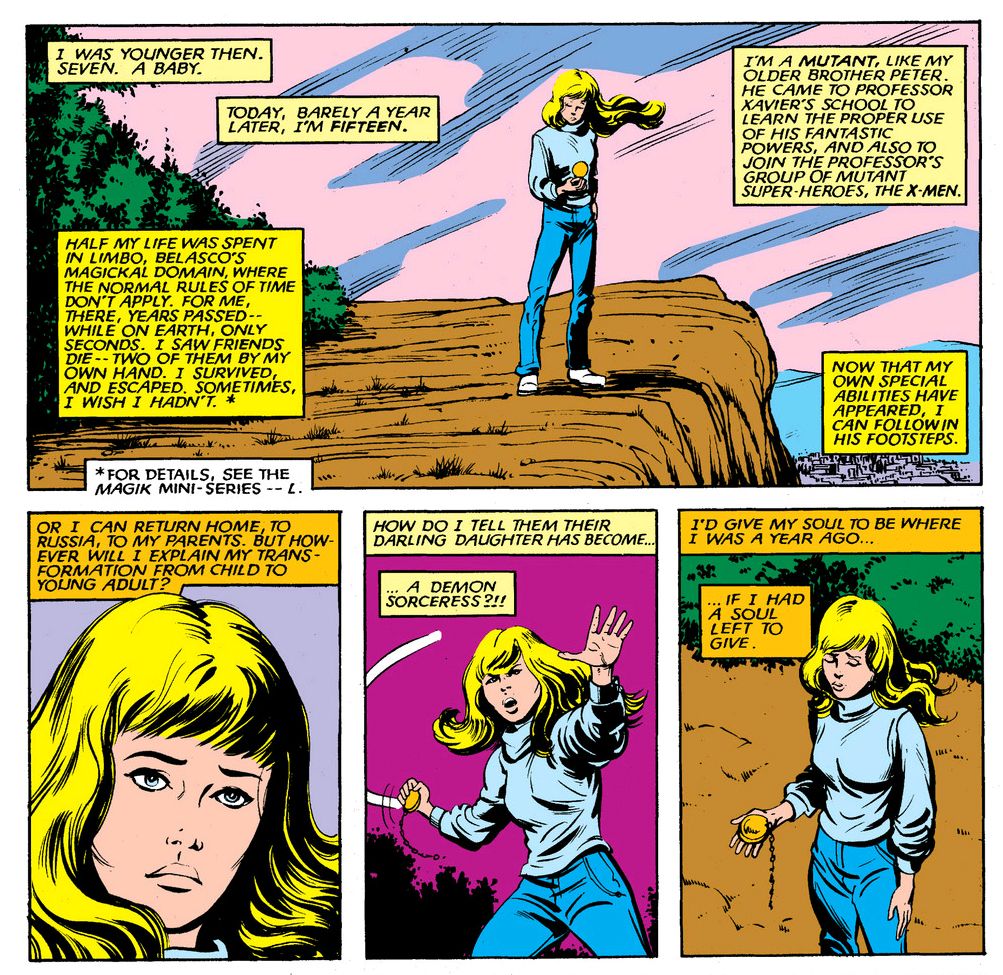
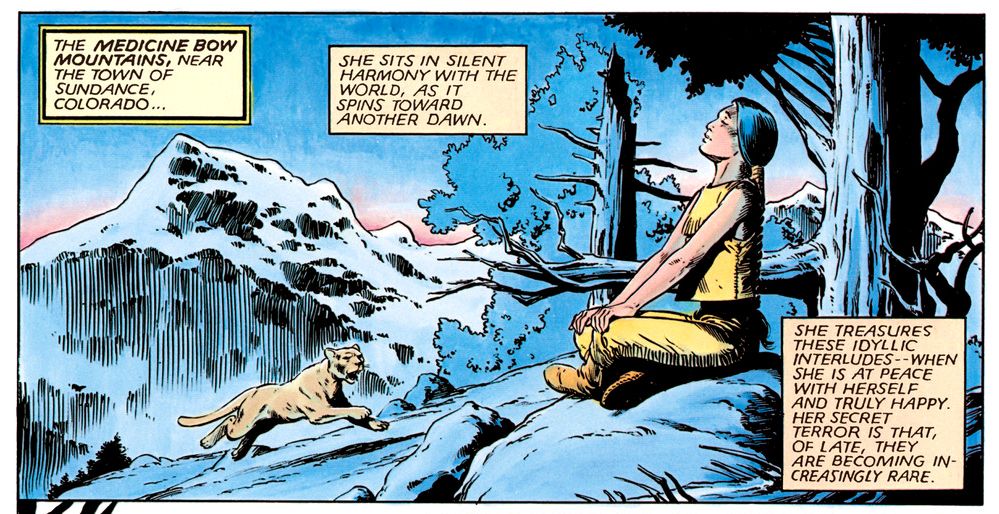
Our girl Dani debuted in Marvel Graphic Novel #4:  The New Mutants, way back in October of 1982, the fourth of the new... er... mutants in order of appearance, but first by far in order of kick-assness.  Her first moment in the book sees her chilling out on a mountainside after essentially reducing herself to a recluse because her mutant power of drawing out a person's worse fears has alienated her from her peers.  Yeah, as if Dani has peers.  A Native American of the Cheyenne people, pre-heroic Dani likes to sport some kind of deerskin outfit that's probably more comic book than real world, but with her black hair in braids, it's enough to visually imprint the idea of her cultural origins.  Chris Claremont's economical narrative captions serve only to emphasize what Bob McLeod's art has already made obvious, but in those days, at the height of his creative powers, Claremont excelled at adding depth and shading to characters that are essentially stereotypes, drawing in readers with his sympathetic take on their personalities.  Like with Dani.

In a graphic novel full of introductions and kind of crowded with incident and scene changes-- the locale shifts from Scotland to Brazil to the United States to Brazil again before returning to the good ol' US of A to wrap things up-- Dani's volcanic temper, rebelliousness and single-minded quest for vengeance set her apart from the other characters.  While Rahne is shy, Roberto kind of stiff, Sam dopey and X'ian a bit uptight, Dani emerges as the most well-defined and charismatic.

Chris Claremont, script/Bob McLeod and Mike Gustovich, art (The New Mutants #1, March 1983)

Claremont and McLeod must have known they were on to something, because Dani becomes the star almost immediately in The New Mutants monthly comic, repeatedly getting solo spotlight moments while the other kids are out at the mall or practicing their moves.  Look at it this way-- in the first three issues, she gets the central position on a cover, 12 and a half solo pages-- two of them title page splashes-- and fifteen story pages devoted either to her problems or actions in which she's the main participant in some way.

No one else comes close.  Roberto gets a nice double-page spread at one point.  Sam and Rahne get one solo page each.  Poor Xi'an gets zero, and her most dramatic story moments relate to something Dani did to her.  Out of sixty-six interior pages over one-third of them-- slightly more than one complete comic-- are Dani-centric.  When the story features the other kids, they're usually sublimating their individuality to the group dynamic.

Chris Claremont, script/Bob McLeod and Mike Gustovich, art (The New Mutants #2, April 1983)

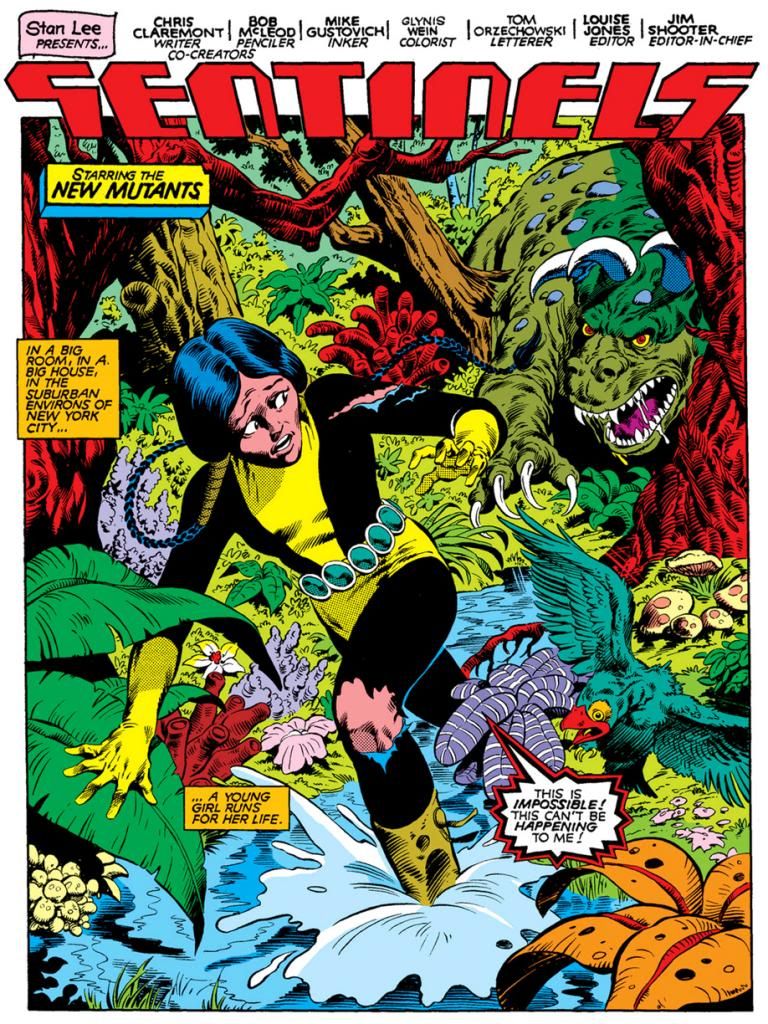
Not Dani.  She's all about the awesomeness of being Dani.  Humiliated by her cowardly failure to confront the Danger Room the first time in The New Mutants #1 (March 1983), she takes it on all by her lonesome and ends up stalked through a jungle landscape by a fabulous creature out of McLeod's imagination in #2 (April 1983).

One underappreciated aspect of McLeod's long comic book career is his ability to draw really cool jungle environments.  Look at all those strange fronds and bizarre polyps sprouting all over the place, plus that crazy bird in the foreground that seems as frightened of Dani as she is of that three-horned behemoth-- so powerful it can knock down fully-mature trees-- coming up behind her.  Run, Dani, run!

McLeod takes advantage of the Danger Room's holographic capabilities to go absolutely nuts with the forest primeval, which leads directly to one of Claremont's own specialties-- the development of the hints and intimations of a mysterious subplot into an action-and-dialogue packed main plot.  An unknown miscreant is manipulating Dani's emotions for some nefarious end.  And attempting to murder her.

Claremont tells us a great deal about Dani during this period, more so than of any of the other characters other than perhaps Xi'an (again, only because Dani draws out a lot of this info).  For example, not only is she full of self-reproachment for failing to live up to her own standards (she calls herself a coward), but she also tells Rahne about her parents' apparently supernatural death and that her father was Horse Clan and her mother was Eagle Clan.  While Claremont never elaborates on the meaning of these clan affilitions, Dani's parents play an important role in a later storyline that wraps up this aspect of her history.  By contrast, we haven't learned Rahne's parents' names at this point (I still don't know them!), and all we know about Sam's family is they're a bunch of Kentucky coal miners and he should be writing sad honky-tonk songs about them instead of wasting his time trying to learn how to change directions in mid-air while blasting fire out of his ass like a human rocket.

Chris Claremont, script/Bob McLeod and Mike Gustovich, art (The New Mutants #3, May 1983)

We also learn there's a chance Dani might be mentally ill.  This is a lot for readers to absorb about a single character in what's supposed to be an ensemble this early in a series, and it renders the book more or less Dani Moonstar and Her Amazing Friends!  Screw Sam, Rahne and the rest-- this is Dani's book and they're merely supporting players.

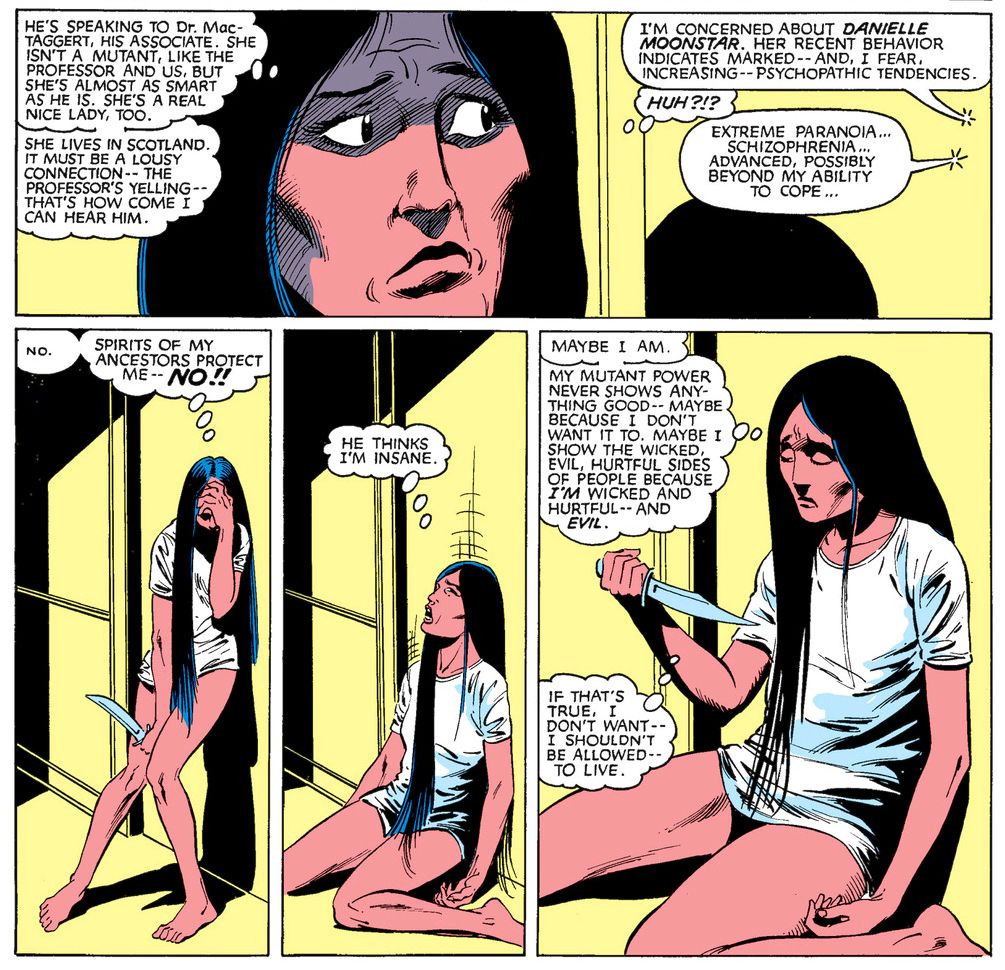
In The New Mutants #3 (May 1983), Dani gets another dramatic solo moment as she dreams of the demon bear that she believes killed her parents and the deaths of her new friends.  In the aftermath-- and while clutching a wicked-looking knife-- Dani overhears Professor X himself on the phone telling Moira McTaggart the incident represents a psychotic break, that's it's nothing more than paranoia, symptomatic of schizophrenia.  I think the proper medical term is "losing her shit."  She doesn't take it well.  I mean, what thirteen-year-old girl wants to be diagnosed as schizophrenic by a seemingly all-knowing authority figure?  Dani's young mind conflates having a mental health issue with being broken and unworthy, confirming her growing tendency towards self-loathing.  Her thoughts turn towards the suicidal.

Okay, stop and think about how genius this is.  At this point, having shown us all of Dani's fears-- that Xi'an wants to kill her, that her cowardice is out of character, that she's being persecuted by some strange dream-like figure, that her powers are somehow some manifestation of inner evil-- and having no reason to doubt the usually reliable Professor X, Claremont makes us doubt her sanity.  Just enough.  Claremont's obviously building to something here-- either the demonic creature is real or we're going to have a very dramatic storyline about a teen losing her hold on reality.

Chris Claremont, script/Bob McLeod and Mike Gustovich, art (The New Mutants #3, May 1983)

And McLeod reinforces very distinct possibility it's the latter by posing Dani-- her hair unkempt, wearing only a sleep shirt that's a signifier of dream-states and other levels of consciousness, or perhaps even a hospital gown one might wear at a mental health facility-- with the business end of her knife ominously towards her own heart.  Out of all the characters in this book, of course it's Dani who's the most at-risk.  A cliff-hanging end to issue #3, with the entire direction the series in the balance... and it's all about Dani Moonstar.

For now, let's leave young Dani slumped against Professor X's office door out of respect and come visit her again when she's feeling better...

Sunday, March 3, 2013

Teen Titans #3: And then they beat up "Big Daddy" Ed Roth on government orders

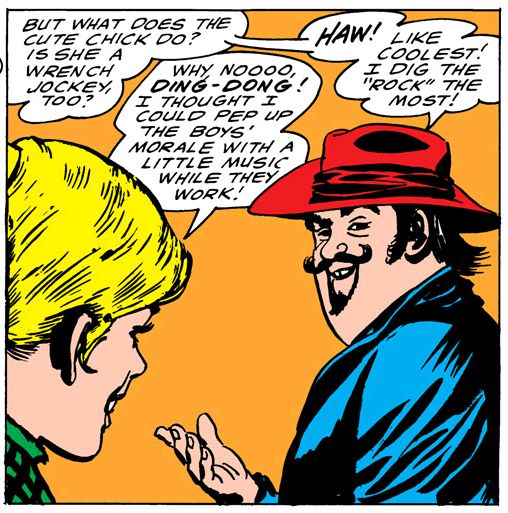
Why, Titans?  Why?  I love "Big Daddy" Ed Roth, but apparently the President's Commission on Education has a gripe with the creator of Rat Fink.  That son of a bitch Lyndon Johnson!  Oh... you mean it's really Ding-Dong Daddy Dowd and not Roth?  Well, that's okay then!

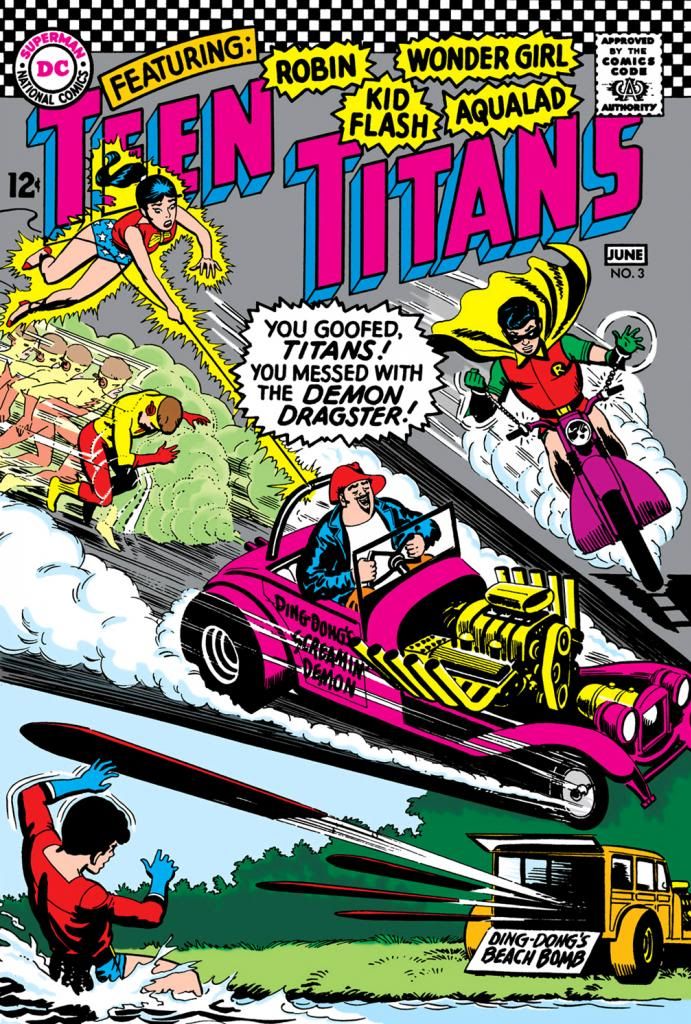
Anyway, "The Revolt at Harrison High," from Teen Titans #3 (June 1966), finds the Johnson administration trusting its anti-drop out initiative to a group of costumed kids who, if we measured IQ in houses, would have to climb up out of the basement to get to stupid.  The Teen Titans in this issue are ultra-establishment types who believe when Uncle Sam says "Jump!" you jump, right across the Pacific into Southeast Asia where, if you're lucky, you come back minus just your innocence or part of your leg.  Or in this case, to Harrison, USA, where statistically average teen David Robinson has dropped out of school and taken to spinning around town in a souped-up jalopy while working for Ding-Dong Daddy, who just happens to be a dead ringer for Ed Roth.

The Titans don't do much to prove me wrong about their intelligence in this issue.  As soon as Robin hears about David's employer, he has the team check out Ding-Dong Daddy's Hot Rod Hive, which is a pretty obvious move.  There Dowd-- a mountain of a man much like his real-world inspiration-- comes on way too strong with hip cat talk and his refusal to show anyone his secret room.  Once again, the barely-sentient Robin senses something amiss-- I mean, secret room!-- and sends Kid Flash vibrating through the steel door to find a group of teen-aged boys doing what teen-aged boys do best.

No, not that.  Are you kidding me?  They'd go blind!  Plus, that's more a hygiene issue and this is about societal ills.  What these out of sight groovesters are doing is equipping an ice cream cart with a machine gun to kill cops.  Robin knows this is all kinds of wrong, so he has the Titans beat a hasty yet nonchalant retreat so they can plan the next step.  After tangling with a trio of Ding-Dong Daddy's hot rods and losing, the Titans disguise themselves as some less-than-convincing motorcycle toughs so they can help Danny and his no-good pals fight an even worse scourge of wholesome American highways-- an honest-to-goodness motorcycle gang called the Scorchers.  The Scorchers wouldn't survive ten seconds in a rumble with the Hell's Angels.  I doubt they'd last much longer against the Black Widows.  Our favorite teens soon subdue the Scorchers and impress David and pals enough they help the heroes infiltrate the Hot Rod Hive where Wonder Girl-- her hair bleached blond-- entertains Ding-Dong Daddy by dancing away in his office and the boys fight some goons and a robotic gas pump.

You sleaze!  You're more than twice her age! (Bob Haney, script/Nick Cardy, art, Teen Titans #3)

There's even a nasty little double-entendre a few moments earlier when Ding-Dong Daddy asks, "But what does the cute chick do?  Is she a wrench jockey, too?"  This sets up a scene where Wonder Girl leads Ding-Dong Daddy by the arm to his office-- both figures largely silhouetted in a sinisterly suggestive way-- to "keep him occupied" (Robin's phrase, not mine).  Once in the office, our bold young Amazon gyrates away while Ding-Dong Daddy, obviously middle-aged, leers at her and declares, "Haw!  I like it, babe!"  But the creep soon gets his as Wonder Girl takes him down herself and everyone agrees to return to school.  Two years later, David Robinson gets his draft notice and it's off to Cu Chi with the 25th Infantry Division.  But that's a Titans tale for another time!

Of course, there are few things less cool than middle-aged men trying desperately to capture the youth zeitgeist, but paradoxically, there are also few things cooler.  Stan Lee somehow managed to do it with ease by using a lot of WW II-era GI slang ("Hang tough!" and "Face front!" come to mind), but DC never quite got with it despite their best efforts.  Bob Haney lays on the teen-talk pretty thick throughout this issue, which dates it (along with its super square, pro-establishment naivete, which no doubt dated it even in 1966), but it's that very product-of-its-time quality that makes these early Teen Titans issues such fun.  Like, baby, I dig Teen Titans the most!  And that includes the pop-art checkerboard design on the cover.

That and the use of a Roth stand-in as the villain.  Which, my friends, is inspired.  The only thing that could have been better would have been a Bob Dylan-esque folk singer pushing pot to Robinson and pals.  Okay, Haney never would have gotten that one past the Comics Code.  Roth and his hot rod culture were pretty popular around this time-- DC comics frequently included ads for toys based on his designs-- and he was such a colorful figure in his own right.  Plus, using a Roth avatar gives Nick Cardy the chance to go absolutely nuts with crazy custom car designs- one has bank-robbing mechanical tentacles, even-- and whacky motorcycle gang outfits.

Come to think of it, if Ding-Dong Daddy hadn't been a villain, he would have made the perfect protagonist for his own title.  That is, if you took away his pervy "barely legal" predilections.  Of course, it would have flopped like a lot of DC's youth-pandering efforts did later in the 60s and early 70s when they got ever more desperate to stem the Marvel tide and capture some of those Baby Boomer bucks, but then we'd have more Ding-Dong Daddy material to talk about and there's nothing wrong with that.

It's just too bad they couldn't have worked in some version of Rat Fink as Dowd's side-kick in place of some unfortunately generic thugs-- so dull I initially mistook one for David, who sports a white tee and jeans throughout.  Yawn!-- who beat up Robin.

These early Titans issues are nothing if not socially conscious, as well.  Which is fitting considering the book's young cast and the tumultuous times in which these books first appeared.  Even though it's handled less subtly than in one of those classroom films we used to watch in PE on rainy days during junior high, Haney and Cardy don't let their preachy anti-drop out message get in the way of a lot of frantic action, with the dread Batman in his Batmobile getting his ass handed to him by Ding-Dong Daddy's technologically superior automotive stylings, Robin handcuffed to a "hot Honda" (a phrase which tickled Haney so much he uses it again later in the book), which nearly speeds him to his death, Kid Flash running in place to save a school bus full of teens and Aqualad falling prey to a car that shoots flying surfboards.  They just awkwardly toss the message into the dialogue and let the story continue on its rambunctious way.

We're having fun, but I can't shake the feeling Haney really hoped he might reach a few at-risk kids with this comic and do some real-world good.  That kind of kind heartedness counts a lot with me, especially looking back from a vantage point where so many of today's books seem simply negative for negativity's sake, crass, the results of lowest-common-denominator thought, or cynical attempts to exploit headlines for controversy.  Haney probably wrote this with an eye on the headlines as well, but his mission wasn't simply to profit from them.  Instead, I get the idea he hoped to find some constructive way for silly superheroes to have a positive impact on their readership, rather than just confirm them in their downbeat pessimism.

Realistically, this comic probably did little if anything to convince readers to stay in school or trust the Johnson administration.  On the other hand, it must have sent more than a few of them in search of CARtoons magazine.

Wednesday, September 12, 2012

If you're looking for an economical way to hop aboard the Nexus bus...

Dark Horse Comics has you covered:  Nexus Omnibus Volume 1 TPB :: Profile :: Dark Horse Comics.  For only $24.99 (USD), you get #1-3 of the first volume of Nexus and #1-11 of the color series that started at Capital Comics then moved to First Comics.  That's 14 comic books at about $1.78 each.  Superhero comics don't get any better than this.  From Mike Baron's literate and witty scripts-- involving all sorts of heady science-fiction concepts like gravity wells, bowl-shaped planets, fusion-based superpowers sought by politicians as a limitless energy source, plus good old fashioned love-- to Steve Rude's gorgeous artwork and fun character designs, Nexus has everything.  Everything!

Epic storylines, tender moments.  A hero struggling with his mission.  A cast of hundreds, if not thousands.  Occasional background appearances by Jack Kirby, Capt. Kirk and Mr. Spock.  Humor, heartbreak.  Thunes. Quatros.  Ursula X.X. Imada.  The Loomis Sisters.

Well, hold on.  The Loomis Sisters don't appear until Nexus #25, so they won't be in this book.  But if you buy it, you'll be hooked and become filled with anticipation at their inevitable appearance.  The Dude's art starts a little crude and unformed, but very quickly develops into the recognizable brilliance that once made him a top name mentioned alongside all those other top names back when being a top name in comics meant something.  I'd buy this myself, but I'm already locked into collecting the hardcover Nexus Archives series, which is much pricier.  I'd give it up in favor of this more affordable option but I already have the stories in this thing, plus I don't want my bookself to look disorganized or poorly planned.  Consistency.  That's what I want.  But to you, who have been champing at the bit to get into Nexus only to suffer from sticker shock or price intimidation, this is your chance.

Read it from the beginning.  And maybe Dark Horse will see fit to collect all those Nexus issues they put out in the 1990s, plus the more recent Rude Dude Productions books, into one fat volume as well.  Oh, and the series running in Dark Horse Presents which I haven't read because I'm in Japan without a credit card.

This series won SIX Eisner Awards.  That's six more than I've even been nominated for.  Buy it this November.  You won't regret it.