Showing posts with label Mike Royer. Show all posts

Sunday, March 30, 2014

A little Jack Kirby juxtapositioning in Silver Star #1 (February 1983)

Here is a very cinematic scene where Jack Kirby uses juxtapositioning for emotional effect you can read in Silver Star #1 (February 1983).  One can easily visualize it as a movie, complete with an actual song on the soundtrack, which is appropriate since Silver Star began as a screenplay with artwork attached in hopes of selling it to Hollywood.  I won't show you the entire thing, just the framing pages and one from the middle.  That should be enough to get across the point. 

And, I hope, cause you to buy this book.

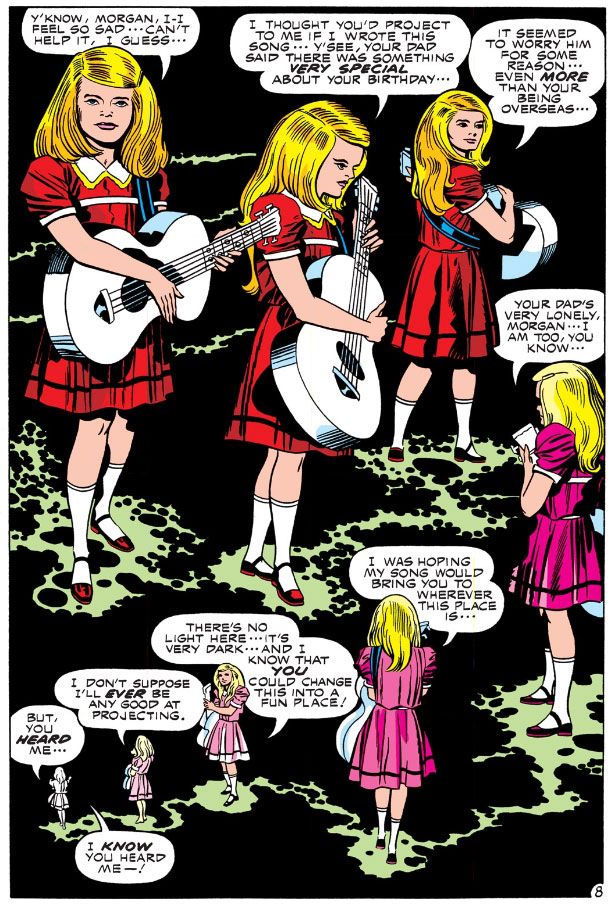
Kirby starts with a panel-free backgroundless sequence as Tracy Coleman, a young girl with a guitar, prepares to play a birthday song she’s written.  By dispensing with both panels and backgrounds Kirby liberates this moment from the more concrete reality of the narrative-driven panel-bordered pages.  This takes place outside time, within the mental realm, and Kirby uses his imaginary camera's eye to circle the girl in a dreamy, clockwise direction and a slow zoom to close-up, and careful placement of word balloons and a kind of sparkly path to direct the reader sequentially.  The in-story reason for all these effects is Tracy isn't simply performing a song, she's also “reaching out,” or attempting telepathic contact with Morgan Miller, the titular character.  Kirby allows the readers to float ever closer to Tracy's face as if we're a ghostly presence, zooming in there in the lower right-hand corner in order to set up a spatial change with the turn of the page.
 
Kirby with Mike Royer

On the next page, we are back in the "real world," where the sequence is ordered by the traditional black panel borders and white gutter spaces.  Here we discover Morgan is in combat in Vietnam, fighting the very battle where he'll win the medal that provides him with his superhero codename and this comic its title.  Conventional narrative boxes contain the girl’s words, a simple celebratory verse.  Juxtapositioning this song and its simple, straight-forward celebration of birth and life with dynamic visuals of chaotic violence and death allows Kirby to achieve an emotional effect, with the song functioning as a critique of the adult world and its adherence to destruction.

This is the comic book equivalent of Carl Foreman's use of sentimental Christmas songs on the soundtrack while GIs are trucked through the snow to witness a prisoner’s execution by firing squad in his 1963 war film The Victors.  The tragic commentary is similar, but Kirby isn’t exploiting sentimentality to make a cynical point.  The contrast here is in complete sincerity, the girl’s wistful song representing the purity of love as only an innocent can express it, the combat displaying the worst of which we’re capable of once experienced in the ways of the world.
 
Kirby/Royer

This kind of "flesh-against-steel" pitched battle imagery strikes me as more WWII than Vietnam, though, the sort of desperate combat action Kirby was intimately acquainted with from his service as a scout in the 5th Infantry Division in 1944.  I’m not sure how often American troops came up against North Vietnamese armor in Vietnam.  I did some research today and could only find some scant references to our tanks blasting a couple of PT-76s (a Soviet-built amphibious tank) and a BTR-50 at Ben Het in early March 1969.  The enemy tanks in Silver Star appear to be a Kirby-version of the Soviet T-34, a WWII-era design which the NVA had in stock.  There’s a reason Kirby deploys enemy armor and it has to do with genetic mutation and superhuman strength, which we see as the fighting reaches its climax:  it's scary and effective!  In his most desperate moment, Morgan Miller experiences a battlefield transformation into something more than human.

I can't help but wonder if the scene where he tosses a T-34 as if it were a football had its origin in some of Kirby's own fantasies born while facing down Wehrmacht tanks.  GIs probably wished they could turn into nigh-invulnerable superman in times like that.

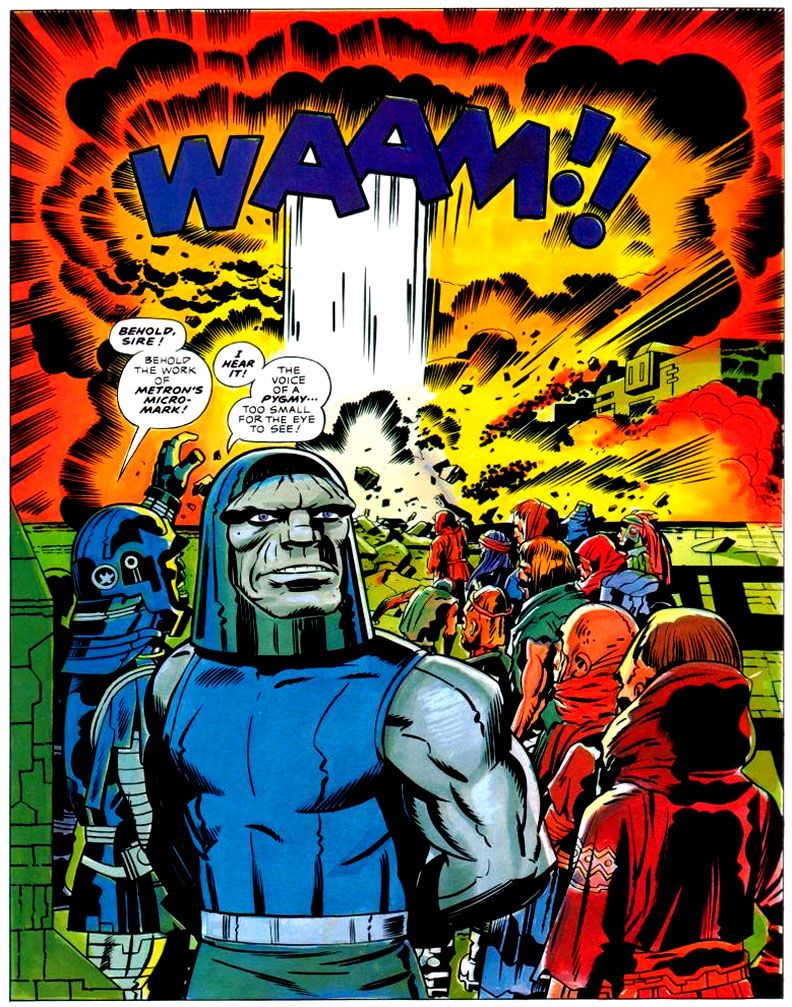
Note the wild special effects in the fourth panel as Morgan's mutational powers activate themselves.  This is the Kirby equivalent of solarized photographic imagery of the sort we've seen during the "psychedelic" mind-warp climax to Stanley Kubrick's 2001:  A Space Odyssey.  Only in Kirby's usage, the cosmos that create an evolutionary leap are contained within the individual, rather than as an external force.  It's worth noting Kirby adapted Kubrick's film for Marvel a few years prior to working on Silver Star.

Afterwards, Kirby cuts back to Tracy and her borderless dark space, the area of the mind.  We drift away from her, circling clockwise once more but slowly zooming out as she shrinks away in the left-hand corner to end the sequence.
Kirby/Royer

That in itself is unusual, since we're used to reading comics in a Z-pattern, left-to-right and this is an S.  The top tier proceeds along the expected direction, but then Kirby reverses flow for the lower tier.  Ending the page on the left is counter to our long-established Western reading mode.  It only adds to the dreamlike unreality of the framing pages, but Kirby keeps things under control and avoids confusion.  It's very easy to follow this flow.

Image Comics has made Jack Kirby's original Silver Star six-issue series available on Comixology.  I believe there's a print version as well.  While I had a few issues of Captain Victory and his Galactic Rangers, for some reason I don't think I ever bought Silver Star.  Very odd, since I enjoyed Captain Victory and was a big supporter of everything Pacific put out back in the 1980s.  It probably had something to do with economics, since these comics were one dollar at a time when others were half that price.  And also the ephemerality of comic book shops in my hometown.  Two came and went in just about the time it takes you to finish reading this sentence!

Thursday, March 6, 2014

Mike Royer and Chic Stone: My two favorite Jack Kirby inkers...

Someone asked Kirby fans their favorite inkers.  You know the usual suspects:  Joe Sinnott, Frank Giacoia, Mike Royer, Wally Wood.  I always enjoy reading those names.  They evoke the wonder and joy of discovery that comes when you're a youngster reading comics and the credits begin to mean something to you.  The writers and artists become characters in your imagination just like the superheroes whose stories they tell.  Many people gave very thoughtful, insightful responses, and there are few things more pleasing to me than people talking about art they love and giving reasons why they love it.  It puts me in a good mood.

I'm not going to complain about anyone here.  There aren't any inkers whose work on Kirby I absolutely reject.  I can think of good things to say about all of them, lots of positives.  But like anyone, I have my own favorites.  The ones that ring my bell more than others.  And I don't think my choices are particularly avant garde.  But since I have a blog and a big mouth, I'm going to share them with you right now.

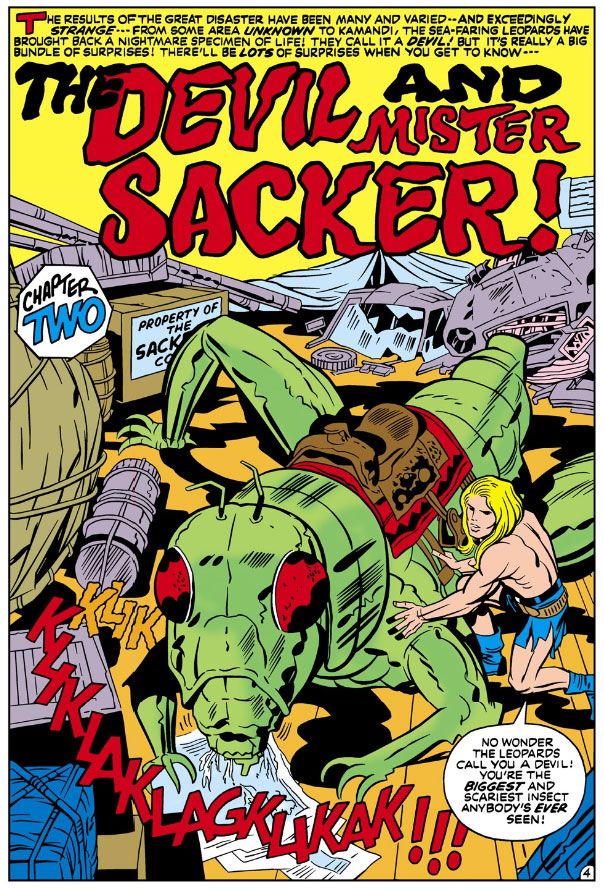
Mike Royer is my top Kirby inker.  This isn't any big surprise.  He's a top pick of a lot of Kirby fans.  It's not enough simply to show fidelity to the pencil lines.  A lot of pros and amateurs can run ink over Kirby's pencils and come out with passable finishes.  But simple tracing in ink can flatten forms sometimes kills the energy and Kirby, if anything, is all about kinetics and energy.  While Royer is very true to Kirby's lines, I think he gets the intent right, and his own top-notch drawings skills means he understands the roundness of physical form and can fix little things where Kirby goes astray.


Kamandi #12 (December 1973) by Kirby and Royer
 
And face it, Kirby's take on anatomy is peculiar to Kirby.  It approaches the abstract at times, with flattened s-forms standing in for all kinds of muscle shapes and drapery folds.  Royer has the ability to make sense of it and give us something that's very Kirby on one hand, and very "readable" on the other.  I've seen some complaints about his lettering-- especially the bold, display "fonts"-- but I dig that stuff the most.  It all goes together into a complete package, very of its time but, as a result, timeless in that it's not faddish.

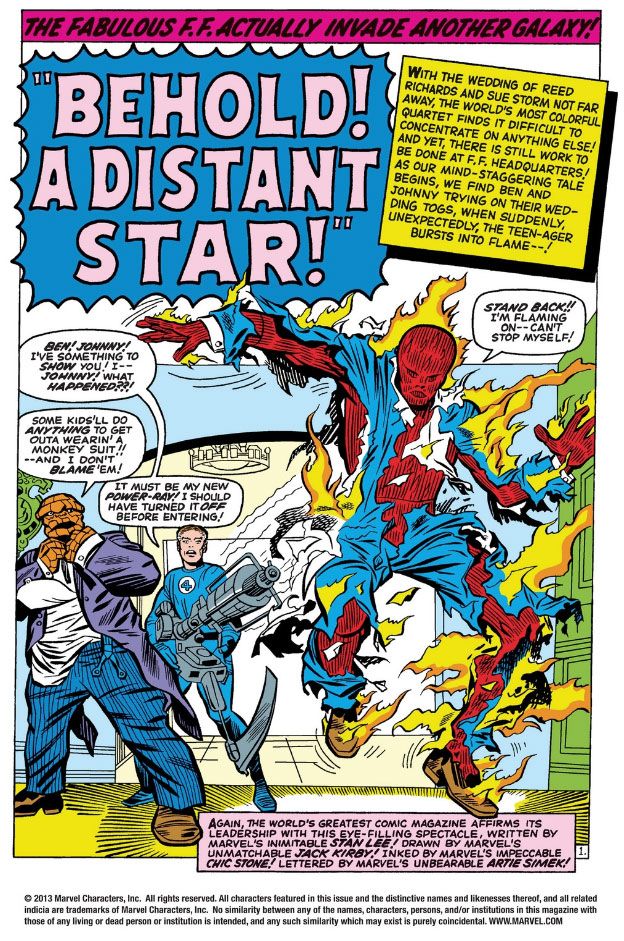
My second favorite is a little bit of an oddball choice, ever so slightly.  It's Chic Stone.  While Joe Sinnott slots in at #2 for a lot of people who also put Royer at #1 (and Giacoia is also a popular second choice), I find Chic Stone's cartoony interpretation of Kirby's pencils to have the most of that elusive concept we call "appeal" of any Kirby inker.  Stone's inks bring out the pop art fun inherent in Kirby's mid-60s Fantastic Four work.  He, like Royer (and Sinnott and Giacoia), could actually draw on his own, so he's not simply tracing the lines.


Fantastic Four #37 (April 1975) by Kirby and Stone

It's not that I find him "better" than Sinnott or Giacoia and I'm not trying to argue anyone out of those as their choices.  It's that my sense of aesthetics responds more joyously to Stone's interpreting Kirby through an almost animation-art lens.  So we get these thick contour lines and finer details within them, and large, open areas for color.  Stone is a master of creating depth of field this way.  It's not as slick or as pretty as Sinnott, but that only adds to its charm.  Sinnott inked my single favorite Fantastic Four issue, which is #51 with the classic "This Man, This Monster" story, but Stone inked my favorite extended run of issues.  Again, while the Stone look places the work very much in its mid-60s timeframe, it's successful both as a historical document and as something that exists outside of time. 

Like a Sean Connery Bond flick (which, along with this era's Marvel comics, are the epitome of 60s cool), or the Beatles or anything from Motown.  These are things to which artists return every generation or so for inspiration.  Each time they do, they energize their own works with the good feelings associated with these classics.  Jack Kirby is that guy for comics, especially with Stone finishes.

Sunday, November 10, 2013

Part Two: "Kirby’s Unfinished Opera" by Gary Chapin (another guest essay!)

(Here's the second part of Gary Chapin's epic look at Jack Kirby's Fourth World...er... epic.  Part one is here.  You're really going to enjoy this!)

Now’s the Time

Mark Evanier, in the closing essay for Volume 3 of the Kirby’s Fourth World Omnibus, points out the critical reaction to Kirby’s treatment of Deadman. Kirby, said this critic (I paraphrase), clearly did not get the Neal Adams Memo. Graceful lines, art school realism, and noir subtlety “were” the way of “now.” Kirby represented “the past.” Adams and company represented the future. This is a point of view I would have heartily, and stupidly, embraced at the time.  “The future” is not a fixed point, however. And even the present is a bit slippery.  My “now” is different from your “now.” There’s a joke that says, “The golden age of music is 12.” My golden age of Kirby is 45. This is my “now.”

But Then Was Not

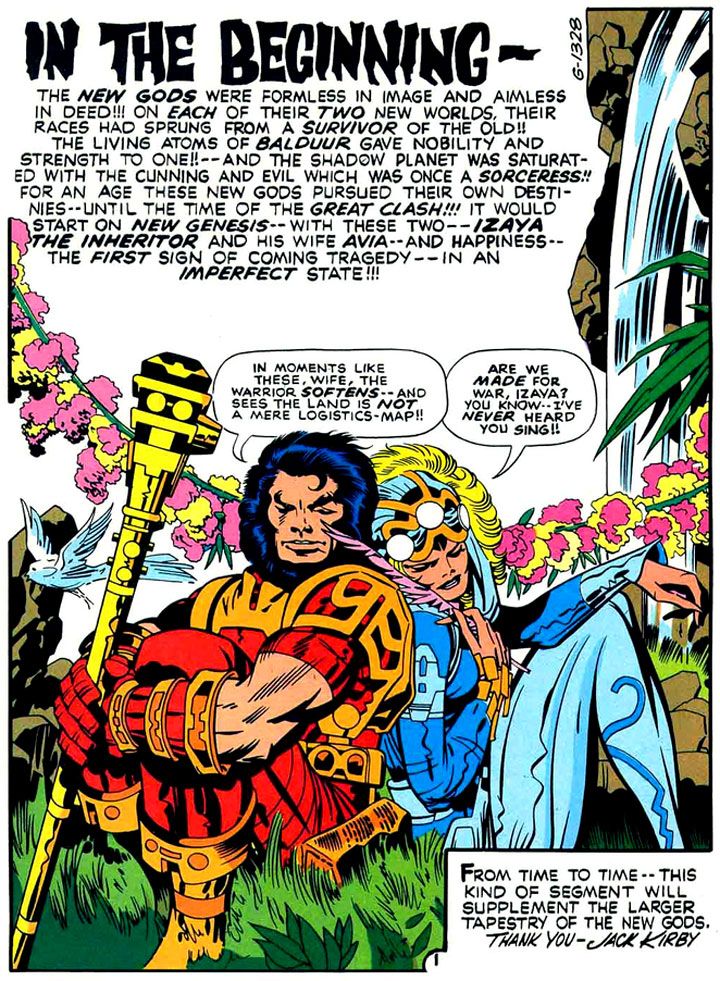
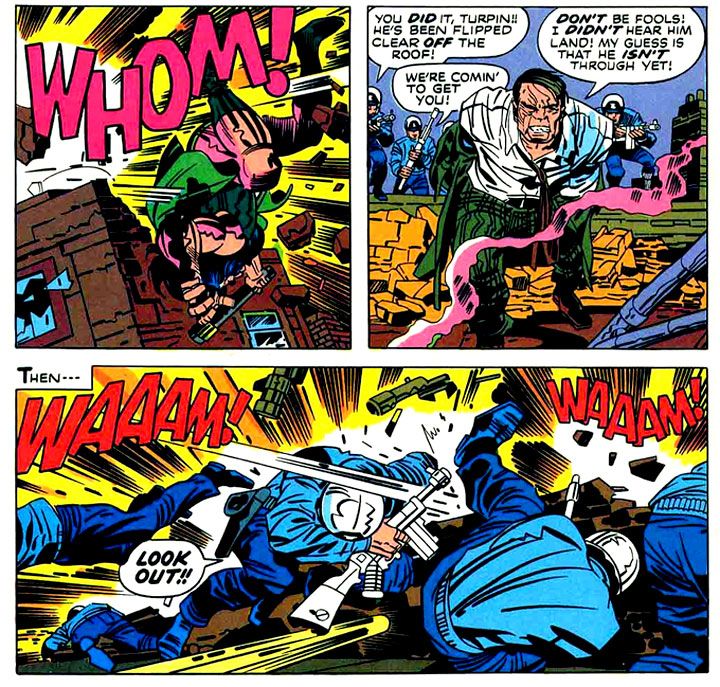
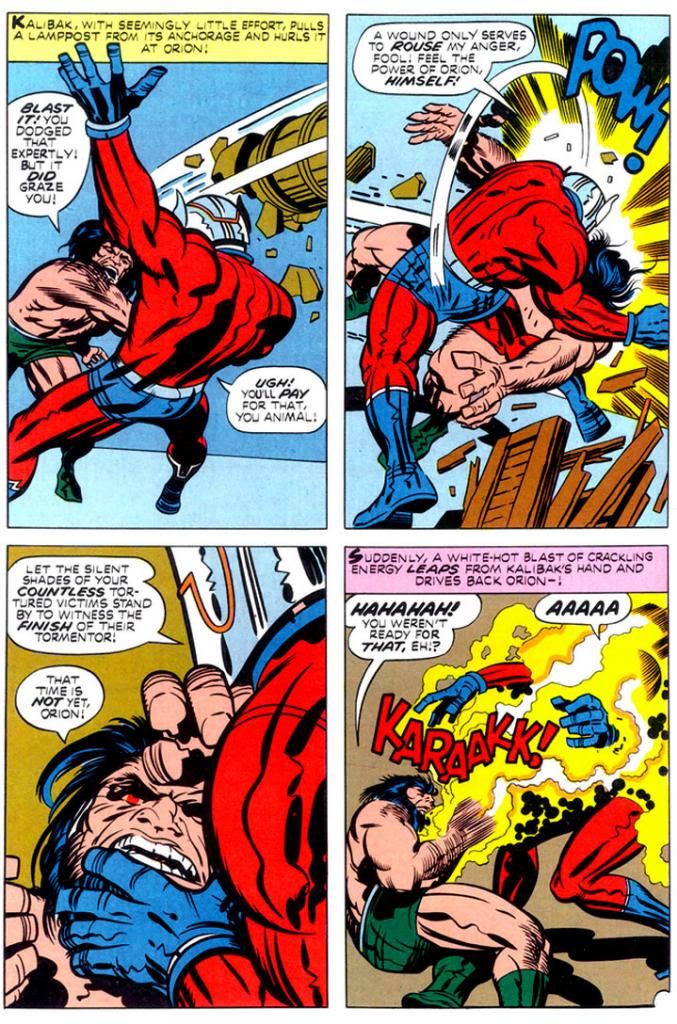
After around a year, the wheels came off the bus (or super cycle) of the Fourth World. Sales dipped, and books were canceled. The remarkable achievements that were “The Pact” (New Gods #7) and “Himon” (Mister Miracle #9) and “The Death Wish of Terrible Turpin” (New Gods #8) were not seen as masterpieces at the time.  The combat between Orion and Kalibak in the Turpin story will remind you what sort of glory can be found in a slugfest. 

New Gods #7, March 1972 (Jack Kirby with inks by Mike Royer)
 
But then it ended. The last issue of the New Gods (“Darkseid and Sons,” #11) was, in fact, brilliant (the run from #7 through the end is worth everyone’s time). The story didn’t end as Kirby wanted it to, but it was a very effective stopping point with a lot of “What?? What just happened???” moments. It was very satisfying. The end of the Forever People was much more of a mess, possibly because their action was always peripheral to the New Genesis/Apokolips story being told in NG and Miracle.  “The Kids” end up stranded on a paradise planet in a faraway dimension when the Pursuer’s lance blows up, “destroying” the Infinity Man. While it technically makes sense, the pretext is as weak as it sounds.

Mister Miracle lasts a bit longer than the other two, but when the Big Story falls away, it becomes a series of one-off monster stories. This didn’t have to be a problem. Kirby spent the ‘50s being the master of one-off monster stories.

New Gods #8, May 1972 (Jack Kirby with inks by Mike Royer)

According to Evanier’s essay, though, Kirby was feeling demoralized and his heart wasn’t quite in it. You only have to notice that one of the stories begins with Miracle and Barda stumbling on a “haunted” house while walking in the woods near their house. Yeah, time for a new direction (which took him to the Demon, Kamandi, et many al., so one can’t entirely complain).

The Problem with Endings

Kirby’s vision from the beginning of the Fourth World was an enclosed story that reached through a number of books and ended in a Fourth World Ragnarok, closing the book on these characters for good. I don’t know how he ever thought that was going to happen. 

New Gods #11, November 1972 (Kirby with inks by Mike Royer)
 
It seems almost quaint, looking back from the other side of the graphic novel naissance, but in 1972, DC Comics was not going to let Kirby develop amazing properties – which is what he was brought in for – and then have them succumb to irrevocable destruction.

This may have been the one place where Kirby – a man preternaturally in synch with comic book aesthetic – may have had an ambition for something that can never exist in the superhero-comic book medium: an ending. This wasn’t a function of the times Kirby was writing in, but a function of the medium. Just consider the New Gods. We’ve had The Hunger Dogs, Kirby’s own imperfect – but beautiful! – attempt at an ending. We’ve had Death of the New Gods. We’ve had Final Crisis, where Darkseid is “finally” killed. 
 
Wait, who was that who was featured in the new Justice League 23.1?
 
To butcher Fitzgerald, “There are no last acts in comic book superhero lives.” Even characters who are never brought back, are constantly being brought up (e.g., Jor-El, Gwen Stacy). I wouldn’t be the first to suggest that while Crisis of This, That, and the Other Thing had all the hallmarks of a Ragnarok, they lacked the one key element:  the end of the world. They weren’t resetting the DC universe, they were resetting the DC stylebook.

DC Graphic Novel #4: The Hunger Dogs, January 1985 (Kirby with inks by D. Bruce Berry)

I think Kirby really wanted the end of the world for his characters. He had the Wagnerian urge. But like so many great creators he was an inventor, not a destroyer. He began things. He began great things. And not a single one of them – not Cap, not the FF, not the New Gods – has ended. And even if they fall into a space where they seem to have ended – books get cancelled – there is always a new issue coming down the line.

But this is not the problem with endings. The problem with endings is that our experience of the work is shaped by “how things turn out.” Forget how things turned out. These are astonishingly rich stories, executed to a ridiculously high degree; the creation of a visual aesthetic that’s analogous to Tolkien’s linguistic aesthetic. This will always be true, no matter how things turn out. Kirby could not achieve his operatic ambition, but that’s irrelevant. I love these books.

Gary Chapin usually blogs about French accordion music over at www.accordeonaire.blogspot.com.

Friday, June 7, 2013

Every month is Kamandi Month: A brief on Ben Boxer

Not long after his capture by Great Caesar's tiger troops in Kamandi #1 (October 1972), Kamandi meets and befriends Dr. Canus, a dog with an advanced degree of some kind and his good pal, the apparently human Ben Boxer.  Except Boxer has to wear an old NASA spacesuit to keep from going Chernobyl and killing thousands.  Kamandi decides beggars can't be choosers when they're looking for people to talk to and tags along with Boxer for an adventure among the rats who scavenge along the outskirts of the Tiger Empire.

Since Kamandi is subtitled "The Last Boy on Earth" rather than "The Last Boy Sidekick on Earth," his relationship with Boxer proves intermittent.  They're always finding themselves separated.  Kind of like Gene Wilder from the train in the movie Silver Streak.  You hope poor Wilder would just stay on the damned thing for once, and that Kamandi and Boxer would stick together for Kamandi's sake because this book is downright scary when he's alone against all kinds of talking animals and weird little rat-things that want to kill him just for having incredible hair.  I can't imagine any of their other adventures topping their second escapade, though.  It reduces Syd Barrett's post-Floyd lyrics to the banality of corporate sales reports by comparison.

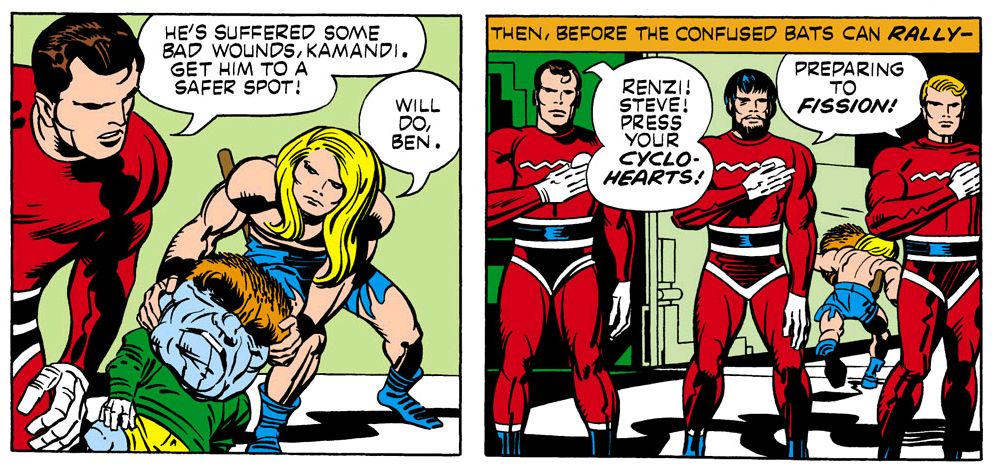
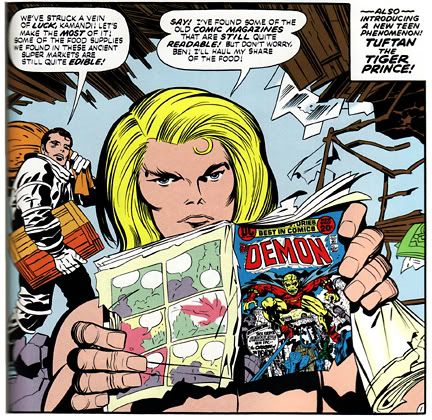
Before that happens, Boxer and his companions Steve and Renzi take a powder in Kamandi #4 (March 1973).  They leave our hero to fend for himself (and read old Kirby comics he finds lying around outside Las Vegas) and for the next few issues we follow along as Kamandi finds a new friend in Prince Tuftan, falls in love, loses said love, battles apes, lives through Kirby's take on the classic 1933 film King Kong and then runs into Ben Boxer and buddies again in #8 (August 1973).  This time they take Kamandi along with them to their home and things become epic. Not Internet epic, but truly epic.  Behold:


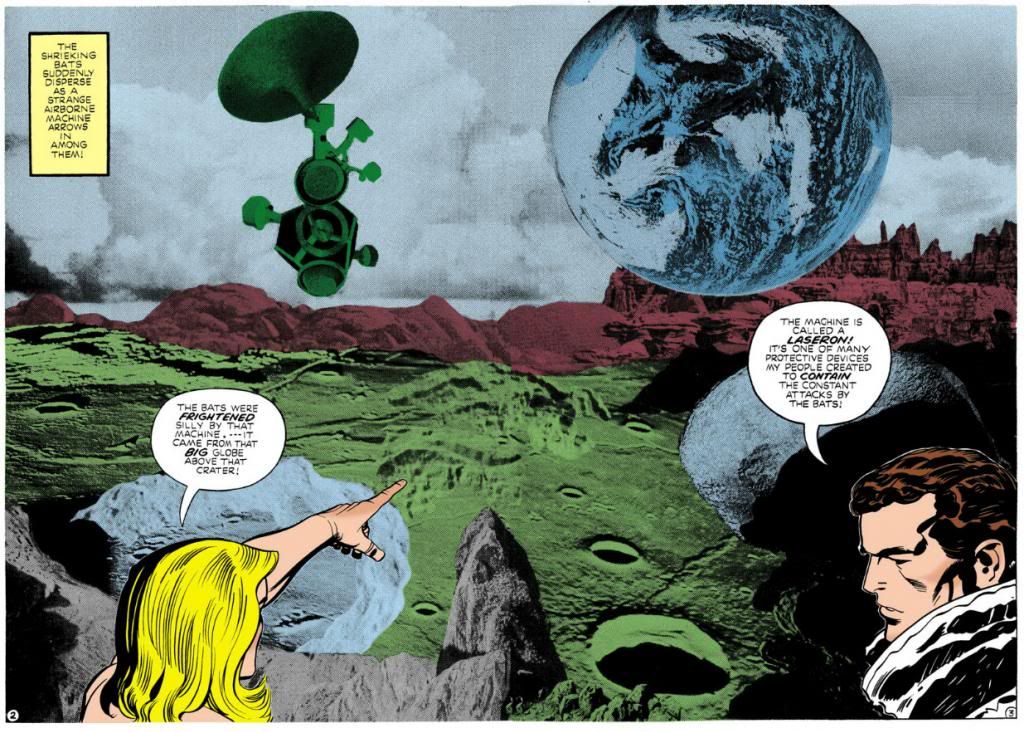
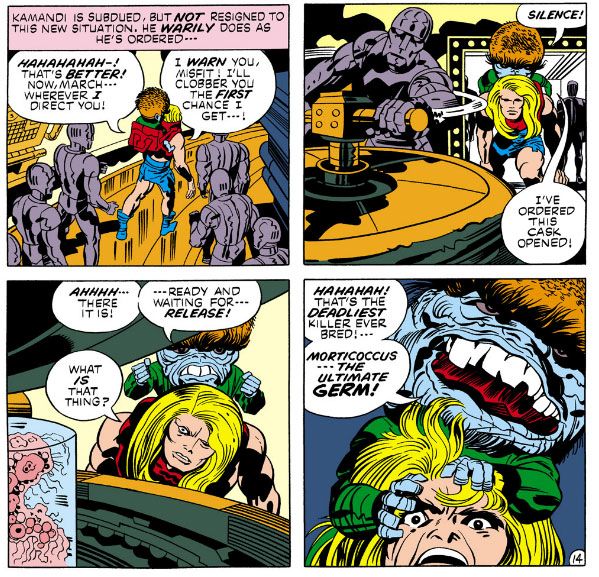
We find out in Kamandi #9 (September 1973) Boxer, Steve and Renzi live in a floating sphere called simply Tracking Site, no definite article.  Like Boxer, Steve's a clean-cut guy who looks like he should be playing first base for the 1961 New York Yankees.  Renzi, however, resembles a refugee from Swingin' London with his Paul McCartney pudding bowl hair and George Harrison beard.  They don't live at Tracking Site alone, however.  They share the immediate neighborhood with a lot of rabid human-sized bats who wear clothes but otherwise appear to be completely feral.  And for some reason there's a freaky little homunculus called the Misfit (he gets a definite article) who rooms there with them, too.

About the Misfit.  His name recalls Flannery O'Connor's short story "A Good Man is Hard to Find," but in appearance and behavior he also seems related in some way to Phillip K. Dick's malignant mutant character Hoppy Harrington in his novel Dr. Bloodmoney, or How We Got Along After the Bomb (1965).  In a flashback from Kamandi #10 (October 1973), we see Boxer, Steve, Renzi and the Misfit (their brother?) as youngsters.  The Misfit lives inside some kind of artificial external womb and begs to be freed.  As an adult, with his stunted arms, his blue skin and stunted limbs hint at some oxygen-deprived gestation period-- but that doesn't explain his fuzzy orange cranium.


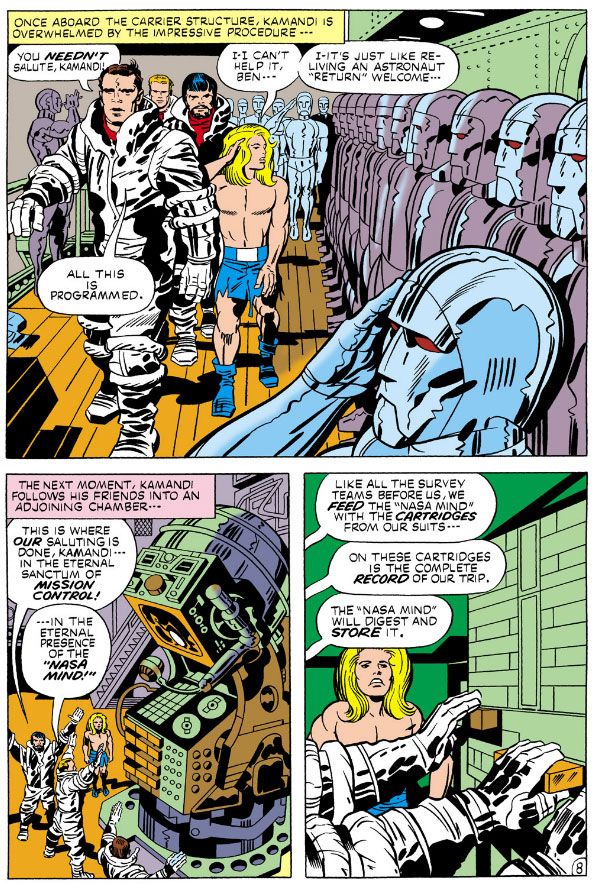
How does one get to Tracking Site?  By balloon.  Tracking Site hangs suspended over a cratered area that once was Central America.  The three amigos travel the world gathering info and plugging it into the NASA Mind, a huge computer charged with collating this data (for reasons Kirby never completely goes into) and they always come back by balloon.  Their return from these each of these missions invariably involves an elaborate recreation of an Apollo-era splashdown, complete with a replica aircraft carrier and an all-robot welcome from the Serviteks, humanoid robots who see to the daily operations of Tracking Site.  It's to honor their NASA ancestors, according to Boxer.

But all is not well at Tracking Site and we see Kamandi has picked the wrong time to visit.  The Misfit has reprogrammed the Serviteks into his personal army and sics them on Kamandi and chums.  He has the most adorable little baby-carrier strapped to Kamandi's neck and hops right in.  At the same time he hectors Kamandi with a sinister monologue and lasciviously paws his captive's luxuriant golden locks.  Obviously, with a name like the Misfit, he was predestined to create problems.  In fact, his plan is to make life not just difficult but literally impossible for everyone on earth by releasing the Morticoccus germ, a huge slimy organism responsible for wiping out all the NASA scientists who once lived at Tracking Site, including Boxer's father.  Then the bats break in and things degenerate into the comic book equivalent of the LSD-fueled (was there ever any other kind?) Hunter S. Thompson road trip to the Mint 400 from Fear and Loathing in Las Vegas.

I wonder if Kirby hadn't meant Boxer, Steve and Renzi for a book of their own and decided to plug them into Kamandi.  You know, just some idea he'd been toying around with before putting it back in the pile of about ten thousand others.  Somehow it caught his attention again one day and he couldn't contain himself.  There's certainly more than enough set-up here for a series, yet Kirby confidently disposes with it in two issues before making up even more wild situations and talking critters.  Think about it-- three radioactive astronauts with technology so advanced it could almost pass for magic.  Plus they can turn themselves into metal.  They live in a floating super-science wonderland and spend their days searching the world for even more knowledge.  That's a solid concept with a lot of story potential.  Of course, Kirby had already done something with at least a passing similarity in New Gods, but with quasi-mythical/sci-fi demi-gods instead of astronauts.  Maybe Kirby felt astronauts were too prosaic to carry their own book even if they do have hearts that emit pure atomic energy.


Anyway, with the end of the Morticoccus story, Ben Boxer and Kamandi part ways for a while.  But we haven't seen the last of Boxer.  There's a little matter of Superman's underwear Kirby would have the two of them investigate in a later issue of Kamandi.

Tuesday, May 24, 2011

For Kamandi -- With Love and Squalor

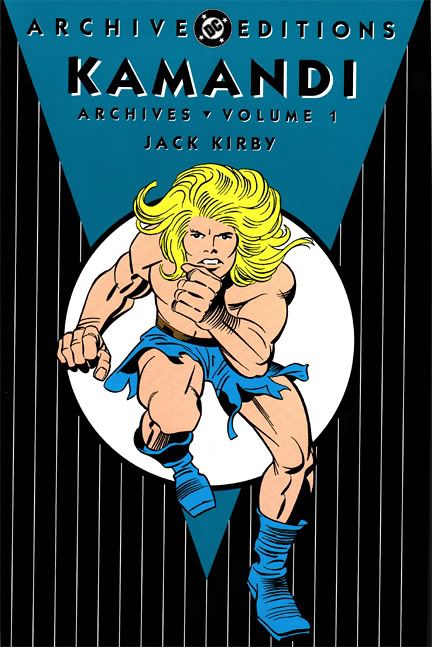
What do you get when you’re DC publisher Carmine Infantino and you float the idea that Jack Kirby should rip off Planet of the Apes? Not a Planet of the Apes rip-off, that’s for sure. If Infantino expected Kirby to content himself with mere talking simians, he was sorely mistaken. And yet that’s pretty much how it happened, and how approximately 65 million years later, we lucky fools ended up with this slick and weighty DC Archives edition of Kamandi.

Or, as I like to call it, Kamandi: The Last Boy on Earth, because that’s the series’ title and I’m clever that way.

Chapter One: The Last Boy on Earth!

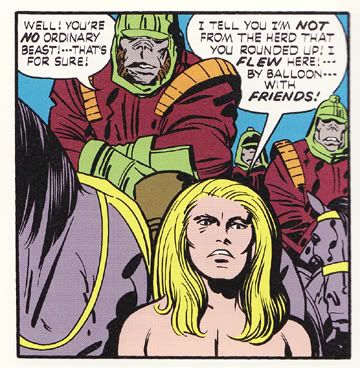
Kamandi is a futuristic, roughneck young hippie in a time where barbers have gone extinct, but cut-off denim and motorcycle boots are all the fashion rage. He’s the Charlton Heston surrogate for this madhouse world where not only do gorillas talk and ride horses, but lions and tigers tool around on three-wheelers and radioactive scientists float overhead in helium balloons.

Because it’s Kirby, Kamandi can scarcely contain itself. While he was always possessed of a febrile creativity, as soon as Kirby hit DC, his imagination went into some sort of turbocharged overdrive. His Fourth World stories are over stuffed with incident and new characters, and Kamandi features a similar breathlessly paced narrative. Reading a DC-era Kirby comic like reading ten stories in one.

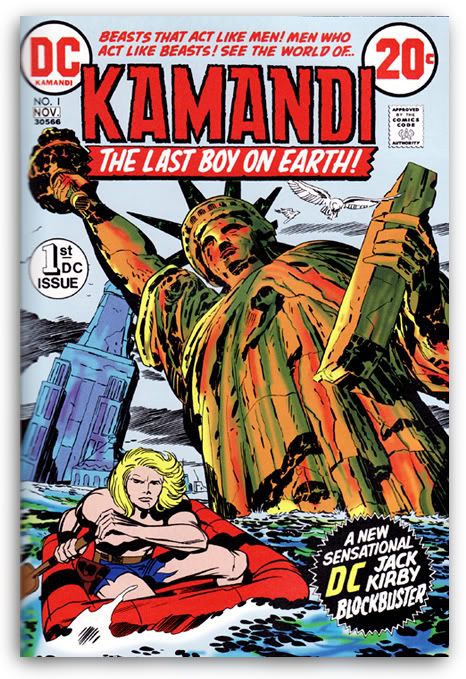
Kirby himself was busy then, too. I believe he was simultaneously producing Jimmy Olsen, Orion, Mr. Miracle and Forever People, spackling his living room wall in preparation for repainting it and mediating the Paris Peace Talks between the United States and the Democratic Republic of Vietnam (DRVN). And just as he saved our world in reality, Kirby destroys it in the pages of Kamandi. It's the post-apocalypse with a new status quo of underground bunker-dwelling and scavenging for food. Kirby destroys that almost as soon as he introduces it, too. When we first meet Kamandi, he's rafting through a flooded New York with a Statue of Liberty as majestically ruined as the one in the Apes film series, its obvious antecedent. Kirby leads with a splash page followed by a double-page spread no less!

DC... next time you destroy
the Statue of Liberty in a story,
do it the Kirby way.

Six pages in and Kamandi’s guardian/mentor is dead (he barely gets any dialogue), Kamandi’s battling a talking wolf who foolishly beckons, “Here! Give me that gun! --- Come on ---! I won’t hurt’cha!” and then Jolly Jack decides he needs to do something to pick up the pace before reader ennui sets in.

The second sees Kamandi’s new-found radioactive buddy Ben reminding him “Don’t forget Ben Boxer, boy! I’m not like the other humans you’ve seen!” As if Kamandi or the readers could forget- Ben Boxer is a man who has to wear an astronaut suit in order not to kill everyone around him with deadly radiation. Oh, and he turns into steel then deals out ass-whuppin’s. Just like the X-Men's Colossus, only not Russian. And a couple of years earlier.

Then we get yet another double page spread, this time of anthropomorphic rats looting the wreckage of the George Washington Bridge.

Kirby's gorillas are cooler than
the ones from 20th Century Fox.
Just keep Timothy Burton away
from them.

It’s not until #3 that the Planet of the Apes similarities fully emerge as roughneck gorillas (are there any other kind?) in green hunting caps and purple jumpsuits capture Kamandi. The cover blurbs come backing more hyperbolic bombast than a decade’s worth of today’s comics:

Welcome to a buried Las Vegas! Once a playground for men – now, a sinister hunting ground for gorillas!

So the apocalypse didn’t change much. And then this:

Complete in this issue! “The Thing That Grew on the Moon!”

A thing! And it grew… on the moon! As if the loincloth-sporting gorilla on the cover wasn’t enticement enough. Comics today could use more of this kind of cover copy-- at once hucksterish and tongue-in-cheek, and instantly appealing.

Who says this isn't the Age of
Kirby Self-Promotion? Kirby
works in a little plug for another
of his comics. "Quite readable,"
Kamandi? Quite readable indeed!

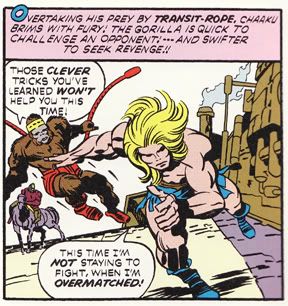
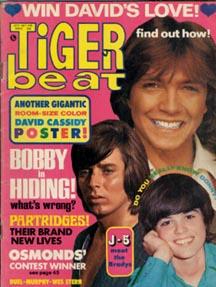
I think Kirby may have had bigger plans for Tuftan, the Tiger Prince. He comes on the scene in #4, heralded by a splash page text box labeling him a “new teen phenomenon.” I’m not sure if Kirby means Tuftan is a teenager (and more to the point, a tiger), or that he hopes Tuftan catches on with 70s teens the way David Cassidy and his half-brother Sean did, or Kristy McNichol, or skateboarding, or discotheques or feathered hair. After all, the kids loved Tiger Beat magazine; how could they not love Tiger Prince?

In the post-apocalyptic future,
half-naked neo-hippies will frolic
with headband and loincloth wearing
gorillas on transit ropes!

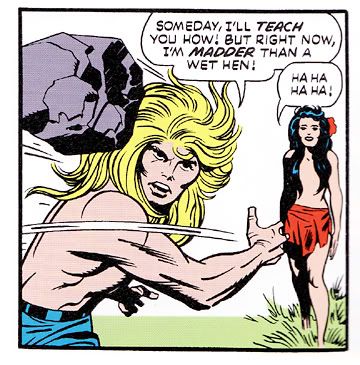
Kamandi and Tuftan get caught between the warring tiger and gorilla armies, and Kamandi gains a talking human girlfriend named Flower… who shamelessly goes around shirtless! Which is only fair, since Kamandi also flaunts bare-chestedness. Flower’s hair gives her some Lady Godiva-style modesty but Kirby’s notion of upper-body nudity is amazingly egalitarian.

In Kirby's future anyone may go
topless without shame! Viva la difference!

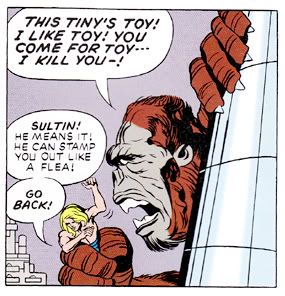
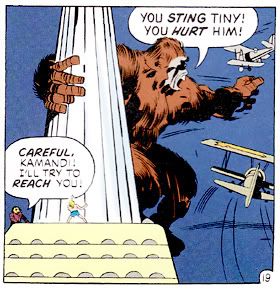
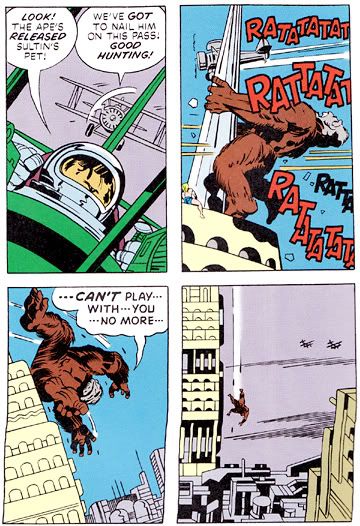
Almost as soon as Kirby establishes the romance between Kamandi and Flower and hints at the eventual reestablishment of some sort of humancentric society, tragedy strikes our young lovers. Kirby examines its aftermath in Kamandi #7, with a chapter intriguingly titled “The United States of Lions." Surprisingly, it has little if anything to do with unions, states and only tangentially features lions. Beginning with a funeral and ending with a skyscraper battle, it's actually Kirby’s parody of King Kong, substituting a massive gorilla; Kong’s equal in stature but superior in conversational skill.

And that’s just a quick overview of the first seven issues! I’m too exhausted to tell you all the details about the last three in this book, in which we visit “Tracking Site,” battle the savage flying bats and the freakish, sinister homunculus who dwells there, intent on unleashing a world-ending bacterium for some obscure reason Kirby can barely take time to explain to us in the breathless rush of his futuristic narrative.

Chapter Two: The Waiting Secret!!

If you haven't guessed by now, Kirby goes pretty far afield, given the series’ original mandate. And while Kirby wasn’t above rehashing classic movie plots he never failed to add twists the original wouldn’t dare. Imagine how insane Beneath the Planet of the Apes would’ve been if, instead of skinless mutants, the gorilla army had encountered talking lions on three-wheelers.

While suffering from an over-reliance on capture, escape and evasion plotting (it becomes repetitive), Kamandi is a sterling example of Kirby’s off-the-wall and unrestrained storytelling, honed over decades of professional work. While he may not have been as interested in the book as he was in his New Gods, the fact remains the man just could not half-ass things even if he tried.

Who else would engineer an entire future Earth, populate it with talking animals of nearly every species, continually hint at a central mystery that unravels intermittently throughout the adventures and introduce brand new characters practically on a page-by-page basis?

From reading these, I can’t help but see Kirby as a mostly intuitive storyteller. Certainly the man was a sponge, soaking in bits of science, legend and myth, and good old Hollywood movies; all of this he'd combine and alter to suit his story needs. Mike Evanier's recollections give me the impression Kirby would frequently come up with a particular direction for a story... then produce something almost totally counter to his original intent. Creating on the fly, always bubbling over with ideas. With that in mind, I don’t see an overall plan here, just incidents piled on incidents.

Groovy incidents. With the intent to entertain the bejeezus out of anyone who buys Kamandi.

And while Kirby may never have written the Great American Novel, it’s probably no accident Kamandi’s adventures take place in the western regions of the former United States. As soon as he departs his underground bunker near New York, Kamandi becomes the classic American pilgrim, sojourning in locales near Las Vegas, Yellowstone Park, even ranging as far as South America in a tip of the hat to Butch Cassidy and his partner in crime, the Sundance Kid.

From James Fenimore Cooper to Mark Twain and Brett Hart, to the relatively more recent Jack Kerouac and Thomas Berger plus many others, American novels frequently explore western migration as related to rugged individualism, which Kamandi certainly personifies. In fact, this is probably the most important defining traits of what we characterize as American literature, at least in the 19th century, and much of the 20th.

The west is the quintessential setting for American literature, with Kamandi the descendant of Huckleberry Finn by way of Col. George Taylor. And like Huck, and Berger’s Jack Crabb, Kamandi rebels against unjust societal expectations, cannot tolerate a life in either literal or figurative captivity. He must remain in motion, forever restless, the personification of our nation in its youth. Unable to relate to most surviving humans, Kamandi remains apart from each culture he encounters. Kirby reinforces this by repeatedly separating Kamandi from Ben Boxer's scientists and having Kamandi assert his human identity and equality to his animal overlords who insist on treating him condescendingly as either a pet, a mascot or an enemy.

As science fiction, technological themes abound in Kamandi, but these are traditionally conflated with western ones in more mainstream American literature as well. While Cooper might bog down the narrative of his 1823 novel The Pioneers to describe a stove in almost Luciferian terms, Kirby, the once and future king of his four-color milieu, creates bizarre flying vehicles and war machines with a gestural whim, yet never slackens the story's pace.

The series has a strange dichotomy-- for humans, advanced technology is of the past, and there’s a nostalgia for what humanity has lost, but along with it, an implied criticism of the queasy, mindless consumerism and complacency that led to this outcome in Kirby’s use of imagery featuring the detritus of a lost civilization: familiar shopping mall signage and weathered sculptures of American presidents (even significantly including one of Richard M. Nixon, never a Kirby favorite) whose identities have been lost to history.

Still, in order to reclaim mastery over the world, which Kamandi sees as a human birthright, he must solve these archaeological mysteries. To this end, Ben Boxer and his scientific comrades are forever seeking the lost “Apollo Project” in an effort to understand this disordered reality.

And while technology is used to destroy (being a Kirby action-fest, violence and weapons-based imagery predominate), there’s also a hopeful quality. If one can defeat the barbarian bat-creatures and the horrific human-created bacterium that can kill all life… one might at the very least, as in "The United States of Lions," find a peaceful place where one might belong.

If, that is, Kamandi can overcome his temper and tendency towards violence. Then again, to Kirby these were also human qualities. To create and destroy, our recurring pattern, even among animals with anthropomorphic qualities. Kamandi lives in a world ruled by violence, both casual and institutionalized- rowdy fistfights, warfare and gladitorial games coexist. Kirby might remind us these, too, are human inventions.

Kirby does Kong. Get Peter
Jackson on the phone! We need
an epic Kamandi movie!

Franklin Schaffner never thought
to put his apes in biplanes, but it
would've been cool if he did. These
are actually lions. Lions in biplanes,
attacking a giant, talking ape who
calls himself Tiny. God, we need
another Jack Kirby.

Chapter Three: The Monster Fetish!

We’re lucky enough of the art exists for DC to gather it all into this hefty and cleanly-designed hardcover. We can enjoy its prime Kirbyness, where his stylistic flourishes, unhindered by the slick ink work from Joe Sinnott at Marvel and the scratchy, unfinished line of Vince Colletta at DC, erupt. Kirby's use of splashes backed by innovative gutter-crossing double spreads on pages 2 and 3 gives the stories a wide-screen feel, opening up the scope and dazzling the reader with Cineramic imagery like a ruined Nevada town, preserved for animal archaeologists by the dry desert air, an Ozymandian image at once humorous and melancholy.

Sic semper Tiny! "Can't play---
with --- you --- no more." He's not
even angry at the lions who killed him.
Isn't that the saddest comic panel ever?

In the Kamandi Archives reprint, the blacks are crisp, the colors smooth. The reconstruction is akin to looking at a restored print of a Cecil B. DeMille epic. These stories were originally printed on grey-toned newsprint which almost immediately began to yellow. And they featured line screens that were practically planet-sized compared to today’s. Now we can see the art on glossy white, with screens so fine they allow the color fields to appear as smooth, flat areas. While this takes away some of the immediacy and ephemeral quality of the originals, it allows us to study the line work unobscured by cheap paper and indifferent printing.

This is especially educational because Mike Royer’s inks always bring out the Kirbyness of Jack Kirby’s pencils. From interviews I’ve read with Royer in the Jack Kirby Collector (a product of the wonderfully nice people at TwoMorrows), it seems his intent was always to preserve the pencils as much as possible. I love this approach, because the attraction of a Kirby comic is its uniqueness. He’s oft-imitated, but no one has ever fully captured the intangibles of the true Kirby.

The most others can do is provide the bombast and overkill, without the humane qualities. Kirby strikes me as having a genuine love for people, be they the shirtless, blonde hippie kid type or the kind hidden in an animal’s fur and sinew.

Friday, April 29, 2011

Hi, Crystal! My totally random appraisal of Fantastic Four #82

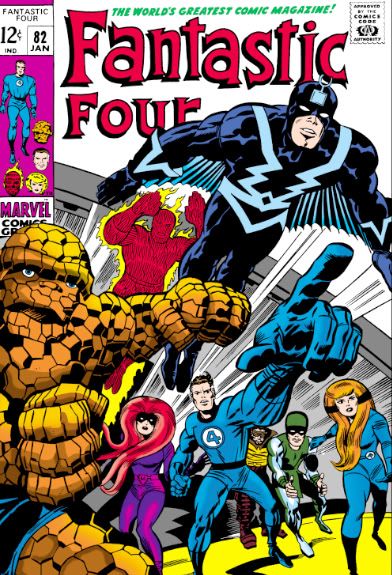
It's Fantastic Four #82 here to entertain us with jokes and repartee and perhaps some juggling and then some name-dropping anecdotes about meeting John and Yoko at a gallery opening, staying in a hotel suite next door to Mick and Bianca, guest-hosting The Tonight Show during the Carson Era before feuding with Johnny and being banned for life, growing a long beard and attempting to oil paint in the south of France...

Yes, Fantastic Four #82 has seen it and done it all. What a life it's lived! Oh, Fantastic Four #82! If only you'd finish those memoirs.

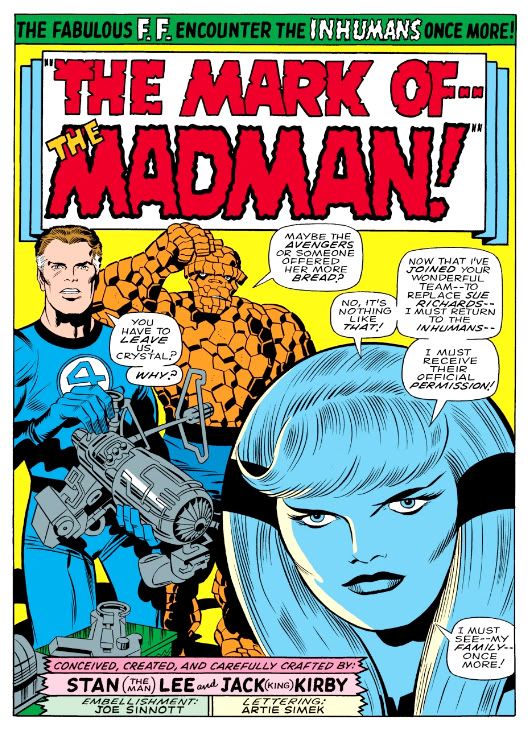
I've forgotten why I found these images from Fantastic Four #82. The story inside is titled "The Mark of-- The Madman!," which is pretty generic for something by Stan Lee. Little bombast, other than the exclamation point. Sue Richards has left the team and Crystal of the Inhumans has joined to replace her. We all know Sue as the Invisible Girl/Woman, with powers of invisibility. But what of Crystal? She can control the basic elements-- fire, air, earth and water. While invisibility has some obvious uses in terms of stealth and defense (especially Sue's famous invisible force fields), Crystal can move water and earth, combine elements to create weather. And she's stronger and more resilient than a normal human. Pretty useful as well. And yes, I know Sue later learned to use her invisible force field offensively as well. My point is, if you can't have one, the other will suffice.

I'm not sure I understand the whole "four elements" limitation. Why would her command of molecules stop merely with the ones that make up those particular things? Probably due to some literary reason haphazardly borrowed from Greek myth or something, but one wishes Stan Lee had thought through the implications of Crystal's powers. She might be more formidable than anyone-- including herself-- even suspects. Forgive me if some clever writer eventually worked this idea into Crystal's narrative. I haven't read a story with Crystal as a major player in it in years. But I do know Crystal also has a cool black headband.

Unfortunately, as a subject of Black Bolt, king of the Inhumans, Crystal isn't free to choose her own life. So despite the FF's kind membership offer, she has to run back to the Hidden Land to ask her monarch for permission. As for me, I prefer democracy. And since there's a madman promised in the story's title, of course the whole gang has to tangle with Maximus. This is a Fantastic Four issue from late in Stan's and Jack Kirby's run where they were recycling ideas that once seemed so fresh. Imagine how mindblowing the Inhumans were when they were introduced in Fantastic Four #45, "Among Us Hide... the Inhumans!"

Even the title is cooler, slightly ominous. Sinister, even! They're inhuman. They're among us. And they're hiding, no doubt for some nefarious purpose. Your neighbors might be one of them! Or a family member. This is why you must do as I do and call the Department of Homeland Security every day at 10pm and report any and all suspicious activity you might have observed in your workplace, your school, your church and even your very home.

Here we are, almost 40 issues later and the Inhumans are still having to deal with Maximus the Mad. This time he's got a gun that can hypnotize the entire earth and make slaves of everyone. In the next issue, it ends as lamely as you might imagine. Seems like Stan at the time was losing interest.

But Jack Kirby's art is still pretty sweet. Joe Sinnott is not my favorite Kirby inker, though.

Don't get me wrong. I like Sinnott's finishes a lot. They're super slick and they really pretty up Kirby's pencils. This is how comics tend to look in my mind when I'm making up my own (then when I try to draw them they look exactly like Alex Toth and Al Williamson got together and drew them holding pencils with their feet). It's just that I prefer the "purer" Kirby that resulted when Mike Royer inked him and followed his pencils more closely, without "fixing" things. I also love Chic Stone on Kirby. Stone-inked Kirby is a lot of visual fun, with thick contour lines around the characters and thinner interior lines for contrast-- not a lot of feathering or those zig-zag Kirby shadows Royer so ably brought out, but a funky, low-tech Kirby.

So it's more a matter of my own peculiar sense of what's appealing. If I had to rank Kirby inkers, I'd list Royer first, then Stone and then Sinnott. I believe Kirby once said he liked Wally Wood best among his inkers. I hate to disagree with the King, but I find too much Wood there and not enough Kirby. I'd rather see Wally Wood inks on Wally Wood pencils than an awkward melding of two different approaches to figure construction and lighting. Kirby's figures are more lit from within, they provide their own light. Not exactly conducive to Wood's "double lighting" feathered chiaroscuro work.