As a teen she favored striped tops, loved her father and two sisters and was quite fond of cats. Lonnie Loomis, middle child extraordinaire, caught between the bossy, demanding eldest Stacy and the irrepressible, attention-seeking, somewhat psychotic, baby Michana. I don't get to read many psychological or psychiatric studies (just the abstracts and second hand articles), but from what I can gather Alfred Adler came up with this idea the order of your birth determines your personality
The first born is special, doted upon, grows up feeling closer to authority figures such as parents, becomes a leader. In the Loomis family, it's Stacy. She starts her siblings down the path of vengeance, then burns out. Literally. The youngest gets even more attention and sometimes ends up spoiled rotten. They become class clowns and show-offs. In Michana's case, they become child assassins for Ursula X.X. Imada, then head teen gangs on multi-planet crime sprees. What about the middle child? They make do. That's how you get a Lonnie Loomis. In any event, this is the simple version.
Poor Lonnie. Although her sisters love her, she's the only one among them to doubt their mission. She adored her father as much as Stacy and Michana ever did, but killing a lot of strangers for the alien weirdo the Merk in exchange for the fusion casting power of Nexus doesn't appeal to her. She's too compassionate and uncertain. Her attention wanders because she wants something of a normal life.
Introduced in Nexus #25 (First Comics, 000, 198-) alongside Stacy and Michana, Lonnie mourns the murder of her beloved father, General Loomis. They later learn his killer was the orginal Nexus, in Nexus #3- (000, 198-), and Lonnie is the one who spits in his face. Here's the sequence as illustrated by Mike Mignola, with inks by John Nyberg.
Soon, Lonnie begins actively voicing her doubts and opposition to Stacy's leadership as they risk Michana's life and sanity by holding a seance that allows the young girl to host what's apparently a demon in hopes of learning where to gain enough power to kill Nexus. From this moment on, Lonnie begins to drift from her sisters.
She's still involved enough to accompany them on their visit to the Merk. They arrive on --- in Nexus #3- (000, 198-), but it's in Next Nexus #1 where they actually confront the whimsical extra-dimensional alien and demand Nexus abilities for themselves. The gigantic Merk immediately chooses Michana to invest with these powers. It's a terrifying scene reminiscent of some of the darker elements from the 1971 children's film Willy Wonka and the Chocolate Factory starring Gene Wilder as Wonka. As we all know, the movie is all about obnoxious kids tempting fate and paying the price. And as powerful a figure as Willy Wonka is, he's also just a candy-maker. The Merk is beyond our reckoning. For a moment, one can only imagine what unspeakable horrors the Merk will visit upon fragile human child Michana.
What he does is casually toss her into one of the strange globular tanks Nexus bathes in to have his dreams and recharge his seemingly unlimited powers. Lonnie objects and this causes the Merk to punish her and Stacy with intense headaches. Michana saves her sisters by rebuking the Merk even as he holds her aloft by her ponytail. Lonnie then attempts to reject the Merk's gift outright, and he reacts by lashing out at her again. Michana defends Lonnie again, and the Merk transforms them into fusionkasters.
In the Nexus books, "fusionkasting" is the technical name for Nexus' superpowers, and what a Nexus does is kill mass murderers. This never sits well with Lonnie. Even series hero Horatio Hellpop himself alternates between acceptance and avoidance of his appointed task, and there's the question-- voiced by Lonnie-- of whether or not an alien such as the Merk has the right to judge humanity. Michana argues his alien nature makes him more objective and therefore more qualified for this than humans themselves. Stacy and Michana accept their charge and perform their first killing. They are in effect assassins in the hire of the Merk, a creature whose behavior is erratic at best, and their new powers corrupt them almost at once.
Lonnie adopts a cat against her sisters' wishes and refuses to join them on their vendetta. In a chilling scene, the pair confront Lonnie and cajole her into throwing the cat out the window. At this point, the break between siblings becomes inevitable. While Lonnie pursues a questionable relationship as a way out, the other two court disaster by confronting Nexus himself. With this, Lonnie drops from the narrative until ---- (Dark Horse, --- 199-).
Michana, now a murderous teen and gang leader (after having served an apprenticeship as an assassin under the tutelage of arch-villain Ursula X.X. Imada), ends up arrested and it's Lonnie who assumes custody of the wayward girl. What follows is a hilarious romantic misadventure in which a Tom Cruise lookalike named Tom Zeus (just to make it plain just who Mike Baron and Steve Rude are satirizing) puts some all-too-smooth moves on Lonnie. Feeling protective of her more naïve older sister, the more worldly Michana does her thing.
Her thing involves dressing like a ninja and using a paralyzing poison on Zeus.
What next for good ol' Lonnie? As far as I know, she hasn't reappeared in Nexus, which ended a long hiatus to reappear first as an offering from Rude's own Rude Dude Productions and then as a recurring feature in the new Dark Horse Presents ongoing. Baron and Rude haven't seen fit to update readers on all things Loomis, but it's only a matter of time. Let's hope she finds some kind of happiness.
But not too much.

Showing posts with label First Comics. Show all posts
Showing posts with label First Comics. Show all posts
Friday, January 30, 2015


Wednesday, May 22, 2013
Series I have loved: My comic fan biography
What titles made me the idiot I am today? Let’s take a look at some
of the series I made it a point to buy whenever I found them back there in my distant past,
the titles that entranced me the most and made me spend way too much time
thinking about and guessing what would happen next. I’m going to try to put these in
chronological order, but I’ll probably screw it up. Oh well, what the hell? Let's go!
1)
Sgt. Rock/Our Army at War. Both of the Sgt. Rock-starring titles. As far as I know—and until we get the results
of my hypnotic regression sessions-- these were literally the first comics I
read.
2)
Richie Rich. Any title with Richie. I went through an intense Richie Rich period
at one point. Also, to a lesser extent,
Casper.
3)
Archie. Any of the Archie titles. Since they all pretty much featured the same
cast of characters, I didn’t differentiate between them. But I generally preferred the digests because
they packed more value and featured cool stories from the characters’ earliest
days and I liked that art more than the newer stuff. I also got into Little Archie in a big way.
4)
Planet of the Apes. The Curtis/Marvel black and whites. I liked the color series but it didn’t last
long, while these showed up at the grocery store fairly frequently and for a
few years. Although they were pricey and
scary, I managed to talk my parents into buying them for me one a few magic
occasions. I’d have bought them all if
they’d had better distribution and we were a little better off financially.
5)
Batman. This was more off and on, but I never turned
down a chance to read either Batman or Detective Comics starring Batman.
6)
Superman. The original. The greatest of the superheroes. If you don't dig Superman, you probably should go read another blog. Or keep reading this one. Either way. I don't mind. Much like with Batman, I bought Superman and Action Comics whenever the
need to read about the Man of Steel struck me. Sometimes I could go for over a year without seeing what he was up to. When the Christopher Reeve movies came out, I started buying these whenever I could.
7)
Spider-Man. Starting with Amazing, and then, when I was a
teenager, the Spectacular. My intro was
the Gil Kane era, and I had the first appearance of the Punisher. Left it out in the rain and it fell
apart. This is a character whose books
would really catch on with me from time-to-time depending on the creative team.
During the 1980s, I had a massive run of
them, with over 100 issues at one point, including some major milestones of
that era.
8)
Star Trek. The Gold Key series. Since I was a huge fan of the TV show, I
tried to get my hands on as many of these as I could. But, like a lot of Gold Key books, they only
showed up intermittently and everyone ended up with huge gaps in their Star
Trek collections. I read the two or
three I had until they fell apart.
9)
Teen Titans. The first volume. I have vivid memories of borrowing a lot of
these from a friend of mine and reading them at dinner, forever associating the
Titans with steak and dinner rolls in my mind.
10) Justice League of America.
All the heroes in one title! A
bargain! Plus it was a little like Superfriends. When you're a kid and your income derives mainly from change found between sofa cushions or near the drain at the deep end of the local swimming pool, you tend to economize and look for more heroes for your money. Justice League was a wallet-saver. I got into this book thanks to
a reprint paperback I had of the team taking on the Adaptoids or some such
thing.
11) The Incredible Hulk. Of
course I bought this. The TV was a
must-watch weekly event.
12) Micronauts. All the coolness
of Star Wars but with better artwork.
Plus, my friends and I were really into the toys. This is one of the first books I seriously
collected, searching for back issues and new issues no matter where we were—at
home, at the beach, in the mountains.
13) Conan the Barbarian. And
Savage Sword of Conan. My middle brother
introduced me to this character and I was hooked. A monthly buy, especially when drawn by
either John Buscema or Gil Kane. Conan the Barbarian marked the beginning of my serious comic book fandom, when I began reading
comics almost obsessively and began dreaming of becoming a comic book artist.
14) Uncanny X-Men. I got into this title around the same time. A friend of mine had a run of issues starting
with #94 and I bought them all for about a buck each, plus one-time use of my
left-handed baseball glove. I had no
idea I was risking addiction. Through this comic I became a fan of Chris
Claremont, Dave Cockrum, John Byrne and Paul Smith. I didn’t like John Romita, Jr.’s art on the
X-people; I much preferred him on Spidey.
15) New Teen Titans. At one point
the new Titans were more popular than the X-Men around my parts. I started reading this title with #1 mostly
because of the slick George Perez art.
16) Daredevil. The Frank Miller
run, naturally. Friends kept telling me
about it but it wasn’t until I bought a couple of issues—including the first
one Miller wrote and drew—at a flea market that I realized what they were
talking about. The panel-to-panel
storytelling was a revelation, as was Miller’s wonky, slapdash anatomy. I decided if I could just learn how to tell
comic book stories cinematically it wouldn’t matter that I couldn’t draw for
squat.
17) E-Man. A couple of comic book
shops opened in our town at almost the same time, one in a small storefront and
the other at an indoor flea market. The
owners of the former were a middle-aged married couple, super friendly people
who often commissioned me to do artwork for their store and paid in posters and
comics. The owner of the latter was a
skinny, loud guy who wasn’t shy about mocking the other store’s name. But they all gave me sterling recommendations
for reading material and broadened my comic book horizons considerably. E-Man was the first of the indie comics I
latched onto, the First Comics version. Man, I thought it was the funniest
thing I’d ever read, especially when Martin Pasko and Joe Staton took potshots at Uncanny X-Men, a title I was still very much in love with at the time, so much so I
even enjoyed parodies of it.
18) Judge Dredd. The Eagle Comics
color versions. Could you ever go wrong
with Brian Bolland covers? His interior art
blew my mind, too, but I also came to appreciate Ron Smith and Mike McMahon as
well. The coloring on these books was
gorgeous, too. And Dredd himself, never
suspecting the joke was on him, made a compelling figure with his perpetual
scowl and his big green boots.
19) American Flagg. I probably
shouldn’t have been reading this because of all the double entendres and the
lingerie-clad women, but read it I did and I loved it. The typography was really catchy and I dug
Howard Chaykin’s art and writing. This
book made me feel smart.
20) Cerebus. This was before the
whole misogyny rap. At this point, it
was just a cleverly-written series with some laugh-out-loud moments and
obviously something deeper going on.
21) The New Mutants. The X-Men,
but my age. Dani Moonstar quickly took
over the lead spot in the book and as my favorite superhero character.
22) Alpha Flight. Byrne goes back
to his Canadian roots and puts together a pretty cool team from the crumbs
Claremont left on the table. Puck was,
and is, filled with more awesome than most characters twice his height. I really like Marina, too. When she turned into a savage version of
herself, I ached for her.
23) Fantastic Four. The John
Byrne era. It was the last book I
latched onto and very possibly the last I let go of when I decided I’d outgrown
comics. These books really captured the excitement
of the superhero genre, plus I could never grow tired of looking at Byrne’s
art. The stories were smart, too. Maybe not as smart as Byrne thought they
were, but smart nevertheless. Remember
when the moon fell apart like an anthill and that sideways issue? Byrne's issues inspired me to read the Stan Lee/Jack Kirby originals and to this day I'm a dedicated 1960s-era Fantastic Four fan.
One title I liked but didn't collect? Wonder Woman. I loved the TV show and occasionally read the comic but I considered my enjoyment of it something of an embarrassment. Why was that? It didn't come naturally; I learned it. I lived in the conservative Deep South and entertainment, as with many other aspects of life, tended to be severely gender segregated. Wonder Woman was, well, a woman, and therefore her comic was for girls. Whenever I expressed any interest in "girly" things, I got my hand slapped metaphorically by my peers and well-intentioned adults who happened to be complete dopes. So my love for Wonder Woman, just like my enjoyment of Charlie's Angels for their cool adventures rather than their physical appearance or skimpy undercover outfits, remained top secret.
And then I grew up. Kinda. Liking any comic book became an embarrassment to me, so I sold off a lot of my collection—most of those early Uncanny X-Men and New Teen Titans, plus my Cerebus and even the first two issues of Marvel’s Conan the Barbarian—which I traded for a ton of Kitchen Sink The Spirit reprints, which I still have. Reading comics in high school and junior college wasn’t considered cool, not even when the first Batman movie came out. I had to escape my hometown to shrug of the snobbery. And then came…
And then I grew up. Kinda. Liking any comic book became an embarrassment to me, so I sold off a lot of my collection—most of those early Uncanny X-Men and New Teen Titans, plus my Cerebus and even the first two issues of Marvel’s Conan the Barbarian—which I traded for a ton of Kitchen Sink The Spirit reprints, which I still have. Reading comics in high school and junior college wasn’t considered cool, not even when the first Batman movie came out. I had to escape my hometown to shrug of the snobbery. And then came…
24) EC. The Gladstone/Gemstone
reprints. When I wasn’t spending my
student money on pizza, booze and live shows, I bought every one of these I
could find.
25) Namor. Byrne again. Namor as a suit-wearing multi-billionaire? Sign me up!
26) Nexus. Post-college, with a
little spending money, I could afford to indulge myself a little. So when Dark Horse brought back Mike Baron and
Steve Rude’s Nexus with a run of fantastic mini-series, I was there. I still
am. It broke my heart when the Dark Horse run ended, so I'm thrilled Baron and Rude have taken up the story again, first as a self-published effort and then back at Dark Horse. Here's hoping we get to visit Ylum again.
27) John Byrne’s Next Men. Byrne telescoped the storytelling, which frustrated me, but I found his
science-based approach to superpowers fascinating, as well as the way he
tortured his poor cast.
28) Harbinger. Jim Shooter shoots…
he scores! Imagine the X-Men with more of a low rent real-world vibe.
29) Archer and Armstrong. More
Valiant goodness. A team book, kind of
an action comedy.
30) Doctor Solar, Man of the Atom.
Who am I to argue with Barry Windsor-Smith?
31) Xenozoic Tales. I discovered
this one via Marvel’s color Epic reprints, then started buying the black and
white albums whenever I could afford them.
Yes, I was back in college, studying graphic design this time. Mark Schultz re-introduced me to an old
friend of mine, a certain Al Williamson.
And also classic adventure storytelling and lush artwork. The stories started off as EC-rips and soon
evolved into something epic unto themselves.
32) Gen13. And then things got stoopid. This is a book that cheered me up when life
took an extended downward turn, just the kind escapist nonsense I desperately
needed at the time. Hard to believe this
book was once so popular it spun off into an experimental title where some of
the top names in comics took chances with the characters the creative team
behind the regular monthly wouldn’t dare.
But my biggest obsession was—I freely admit—with the dumber-than-dumb
but still quite fun main title. I even drew
a couple of pages of continuity with a mind towards submitting them in the hopes
of getting hired. I ended up simply
sending in a fan letter. J. Scott
Campbell’s art improved exponentially in each issue even if the plots consisted
of recycled elements of better comics.
Later writers and artists turned this into a real comic, but by then the
craze was over and nobody cared. Except me! I cared. I care.

33) Hellboy. Mike Mignola’s Bram
Stoker’s Dracula adaptation was another one of the wow moments where I knew I’d
found something I’d been missing without even being aware I’d been missing
it. So when he launched Hellboy, I was
ready. Still one of the best franchises
out there.
34) Hate. Peter Bagge’s signature
title is one of those “funny because it’s true” titles, especially if you’ve
ever lived in a music-oriented college type town. You can transpose a lot of the cast’s antics
to my friends and me. I’m not
bragging. It’s embarrassing to read this
book. Really cringe-inducing. Because we lived it.
35) Love and Rockets. Working as
a graphic designer/illustrator at a newspaper allowed me to buy a few comics
every once in a while and I chose these.
I can’t remember what inspired me to pick up Love and Rockets Volume 2
#5, but it was love at first read. I
very quickly bought all the collections and back issues. Still one of my all-time faves. Hopey is an obsession with me.
36) Kirby's Fourth World. New Gods, Mister Miracle, Forever People and, to a lesser extent, Jimmy Olsen. Love 'em to pieces. I didn't see many of these as a kid, but I've long been a Jack Kirby fan. His books just didn't come my way very often. Case in point, Kamandi. Kamandi (while not part of the Fourth World epic) is another series I'm into in a major way, but I only ever owned that single issue. Most of what I knew of Kirby I discovered in various reprint collections at the local library or bookstore. None of these were Fourth World stories, just his early work with Joe Simon or some of his Marvel creations. A few years ago, DC started repackaging Kirby and I was finally able to read some of his greatest stories in their proper order.
37) Tomb of Dracula. Gene Colan. Marvel collected a few issues as specials back in the 90s, which is when I first caught up with a book whose art I'd been in love with for years because of the panels reproduced in How To Draw Comics the Marvel Way. But it wasn't until the Essential Tomb of Dracula books came out that I was finally able to fully indulge myself in Marv Wolfman's deliciously purple prose and Gene Colan's nigh-flawless art.
38) Warren. Whether it's Creepy or Eerie or Blazing Combat, I cannot get enough of those old Warren books. Big thanks to Dark Horse and Fantagraphics for putting these babies back into print in hefty, expensive hardcover form.
And now we’ve reached the end of the list. It's longer than I expected, and I'm pretty sure I've left out a few things. Some of
them I still read, some I’ve long since given up on. I’ve gotten into a few newer titles in the
years since, but these are the ones I concentrate on in this nostalgia
blog. Anything that started post-1996
goes elsewhere!
Tuesday, September 11, 2012
Ursula X.X. Imada: Motherhood Hall of Fame Inductee for 2512!
 |
| Steve Rude, Nexus #4 (Capital, Nov. 1983) |
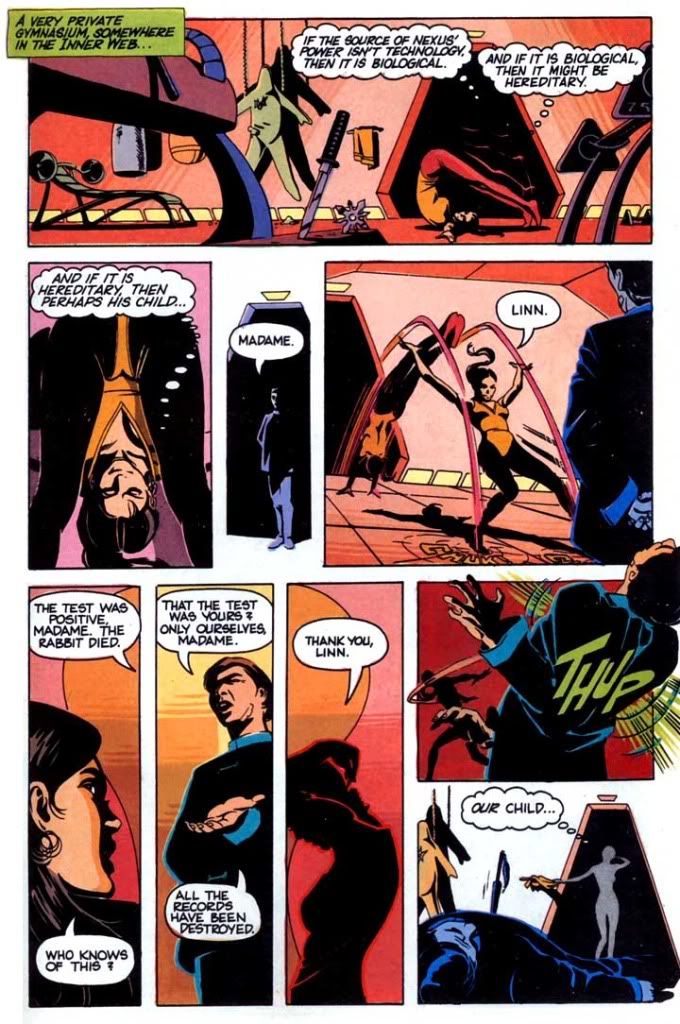
Being a mother isn't an easy job under the best of circumstances. But here's a woman of power, with a demanding career occasionally involving the possible black hole death of as many as 400 billion people, yet also devoted to her children. As mother to the twin daughters of Horatio Hellpop, otherwise known as Nexus, Ursula has developed many effective parenting techniques. But then Scarlett and Sheena are special children with intelligence and abilities far beyond the norm. Sheena, for example, is a telepath. She always knows what Santa's bringing for Christmas, if the jolly ol' elf can maneuver his sleigh past her mother's planetary defenses and infiltrate the well-protected Castle Imada (Imada-jo). Scarlett is a "fusionkaster" (that's fusion-based energy manipulator to you and me, Russ) with powers rivaling her famous father's. If these two are to follow in their illustrious mother's political footsteps, they require more than the usual family dinners and ballet lessons.
 |
| Rude/Eric Shanower, Nexus #9 (First, Nov. 1985) |
Ursula's first and foremost a proponent of being their for your children. Being part of their lives. Although her responsibilities and career as a power-seeker occupies a great deal of her time and concentration, Ursula X.X. Imada makes it a point to be part of her daughters’ lives. When convenient, a physical presence. This includes doing such things as canceling meetings with heads of state and personally breastfeeding (despite taking her own sweet time giving them names) the babes. Yet always a spiritual or psychic one. Even in her absence, she makes her influence felt by providing for their intellectual and emotional well-being.
Ursula's parenting techniques have their basis in education. Rigorous education. She has lofty expectations for her daughters' academic progress, sets standards high and demands they perform to the best of their abilities. Special talents require special teachers. As ruler of an entire planet, Ursula has massive resources upon which to draw. This ensures she hires only the best tutors for individualized instruction. While you may not have her deep pockets, do the best you can with what you have. Remember: when you skimp on your children's education now, you pay extra for it later.
 |
| Rude/Shanower, Nexus #15 (First, Dec. 1983) |
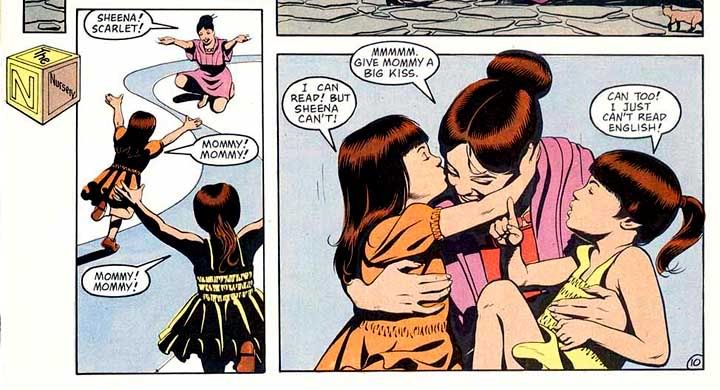
She has seen to their early childhood education with staples such as
various Earth-based and intergalactic languages, plus advanced Calculus, which both girls
quickly master. The need for a solid base in math and the sciences is
obvious. But languages play and important role in a child's
development, especially if they are to read historical texts in the
original languages; this allows the young mind to absorb information
within its proper cultural context as some concepts do not translate
into English, Japanese or Interlac. Let's spy as Ursula discovers to her delight just how talented her twins are. Hope she doesn't spot us!
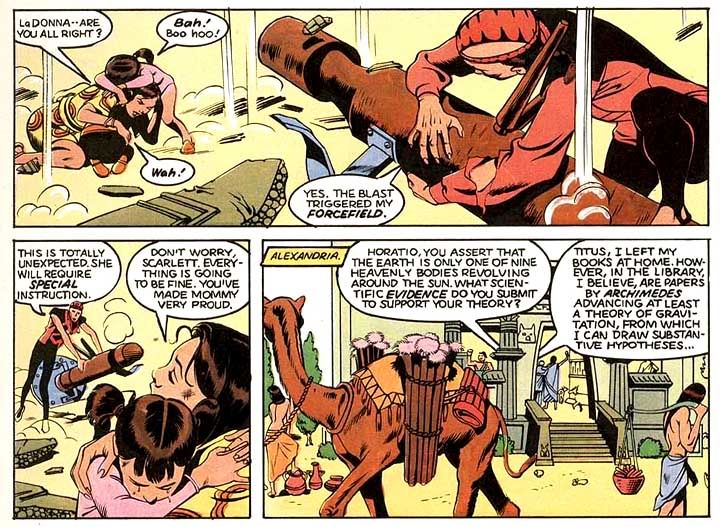 |
| Rude/John Nyberg, Nexus #27 (First, Dec. 1985) |
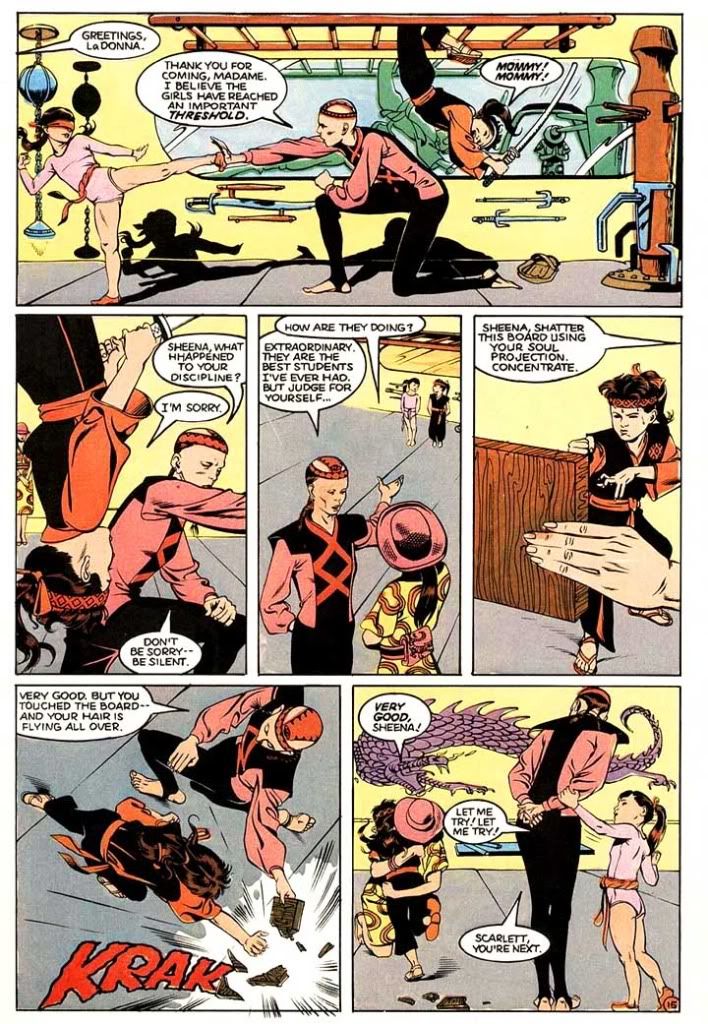
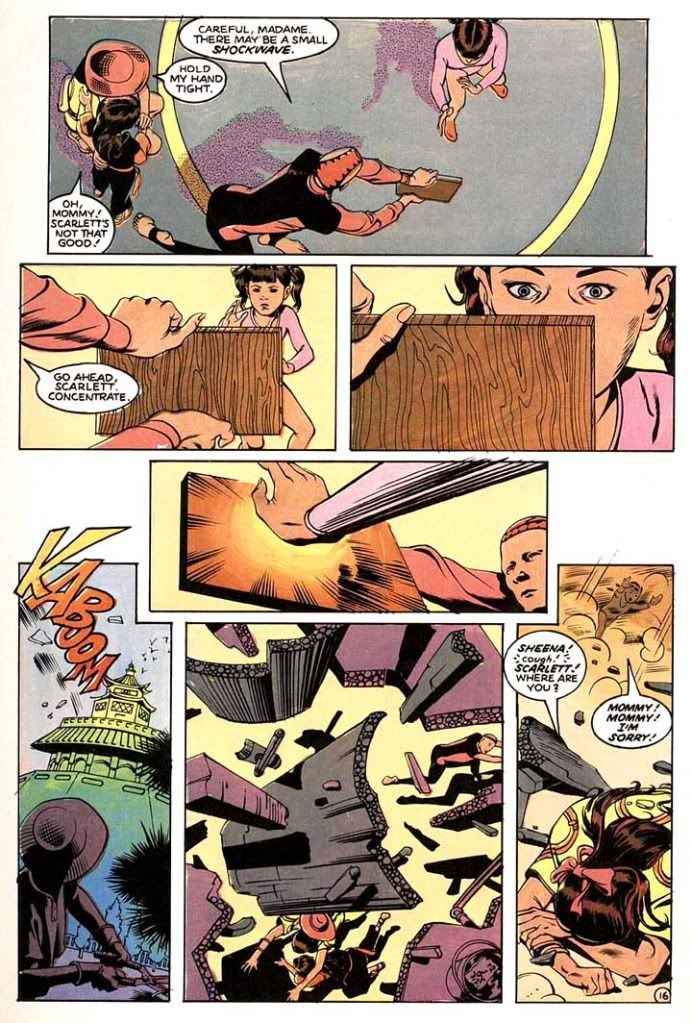
Note here Ursula's use of praise. Positive reinforcement plays a crucial role in developing your child's potential both in the classroom and without. And here we see the arrival of one of the girls' instructors, the fusionkasting professional wrestler, martial artist and galaxy-famous chef and raconteur Judah Maccabee. While she was skeptical of Judah due to his closeness with Hellpop, she allows him to stay because of his obvious expertise. Ursula would counsel you not to neglect your children's physical development.
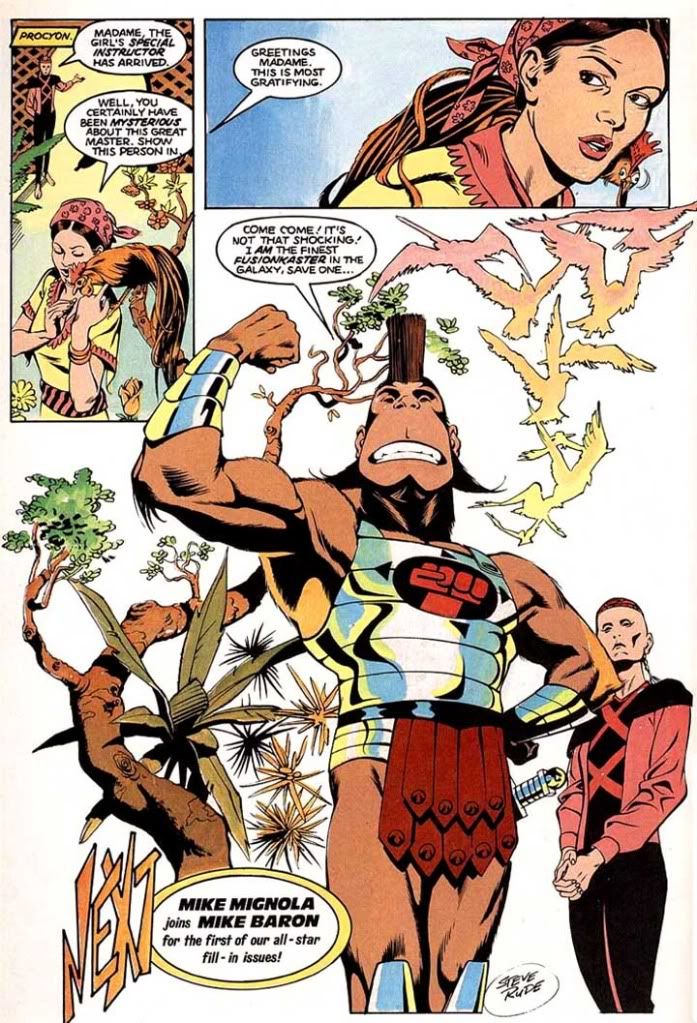 |
| Rude/Nyberg, Nexus #27 (First, Dec. 1985) |
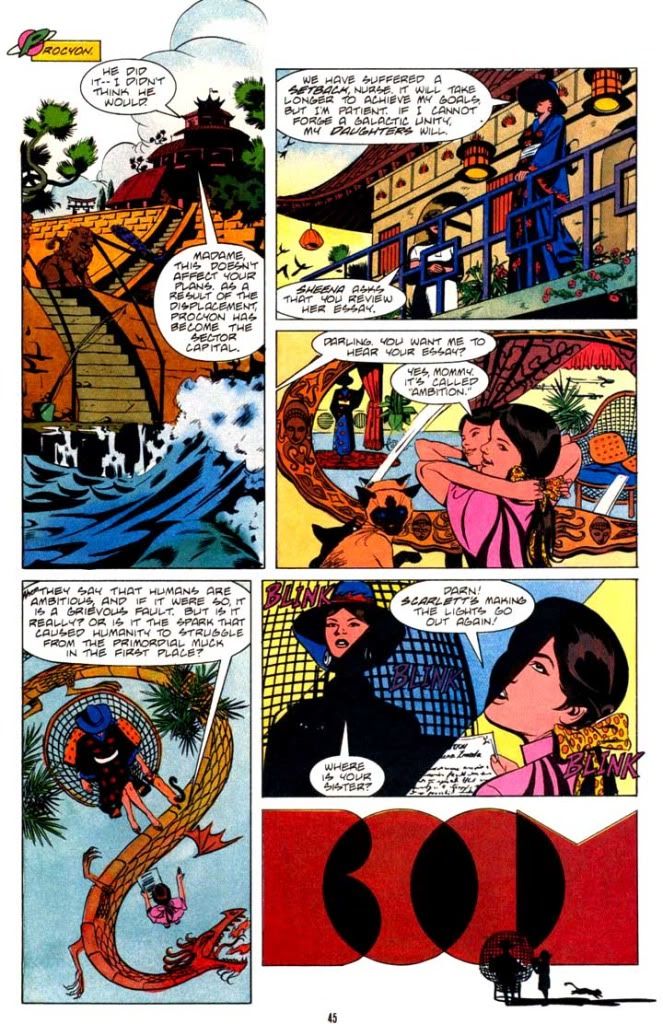 |
| Rude, Nexus #50 (First, Nov. 1988) |
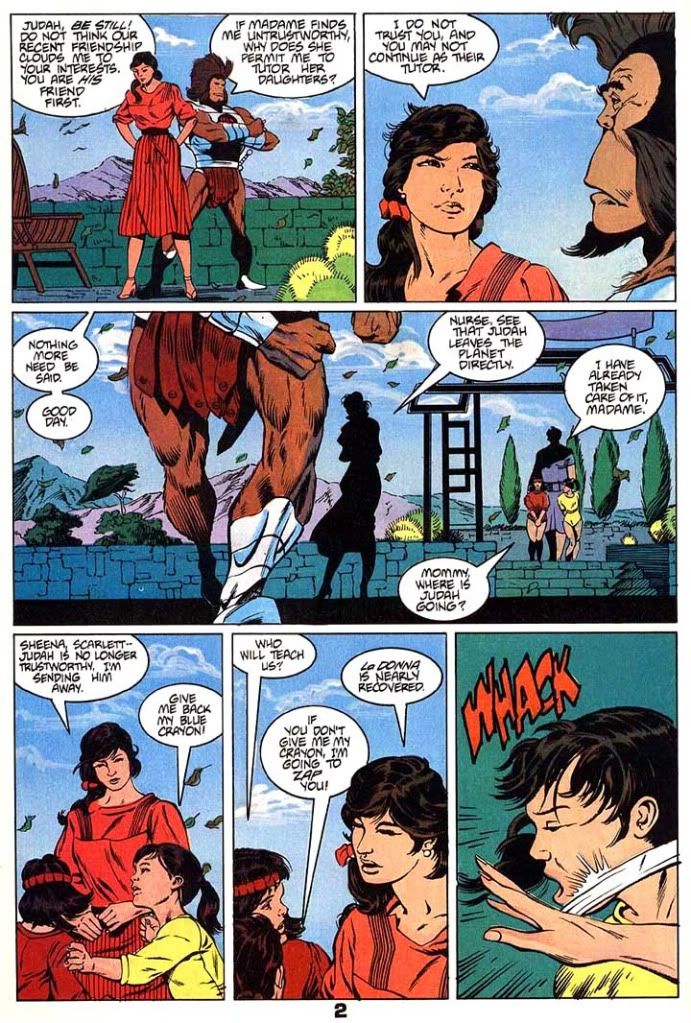 |
| Jackson Guice/Nyberg, Nexus #32 (First, May 1987) |
 |
| Guice/Nyberg, Nexus #32 (First, May 1987) |
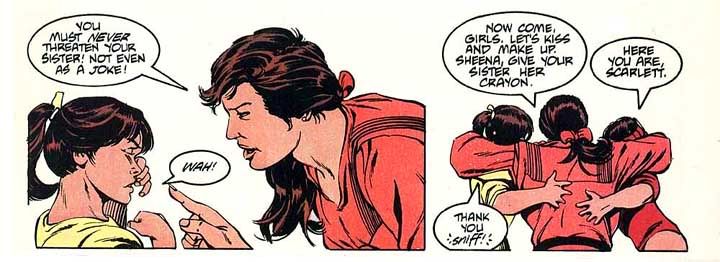
Ursula also shares words of wisdom before she she offers the group hug. When one child is a telepath-- even one as powerful as Sheena-- she may feel overshadowed by sister, who draws her abilities from the heart of a star. Still, as the instigator of this incident, she must still fulfill her sisterly obligations to share. As Ursula often observes, "Sharing is caring, if I say it is." Or she would, if she used simple-minded rhyming aphorisms like some sort of nightclub hilariator.
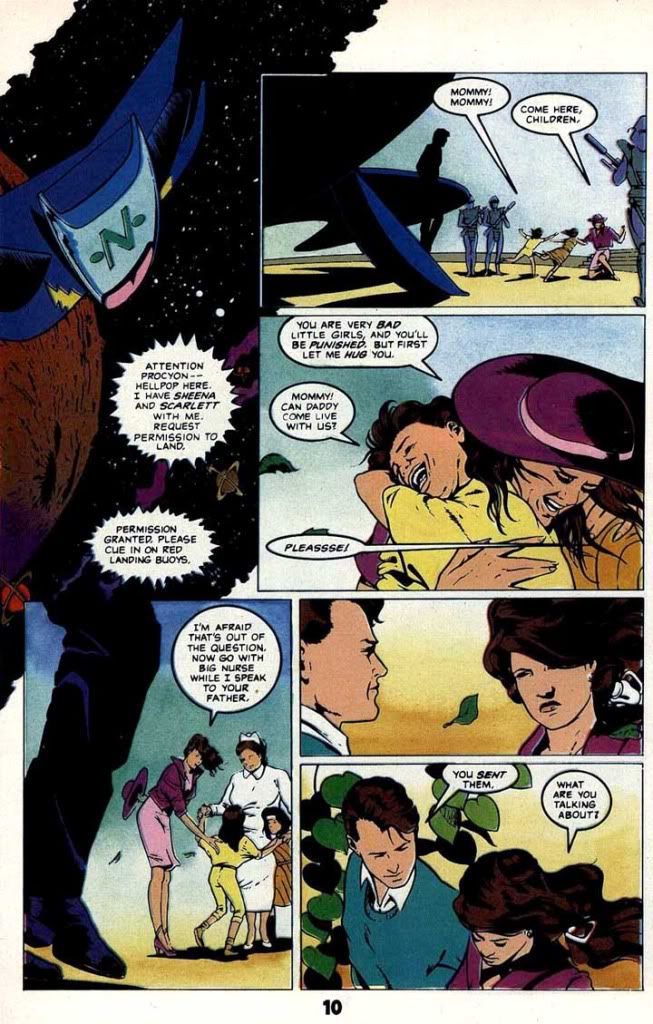
This comes immediately after her sacking of the aforementioned Judah Maccabee. Ursula will quickly fire recalcitrant or neglectful teachers, even one as highly credentialed as the famed Thune. As always, the children come first unless there's some vital plot afoot that requires they come second. Ursula belives instructors, although ostensibly part of the household, should also refrain from involving themselves in family matters unless otherwised asked, under pain of death. Certain Thunes, who may prove especially troublesome, destructive or useful at a later time, may be exempt from the punitive clauses contained in their contracts. In these cases, a simple sacking will suffice. If the employee in question is a simple human, such as the unfortunate Lonnie Loomis, who succeeded Judah as tutor a few years later, one might resort to torture before dismissal. Either way, like Ursula, do not be afraid to pull the plug!
 |
| Spyder/Bob Dvorak, Nexus #56 (First, May 1989) |
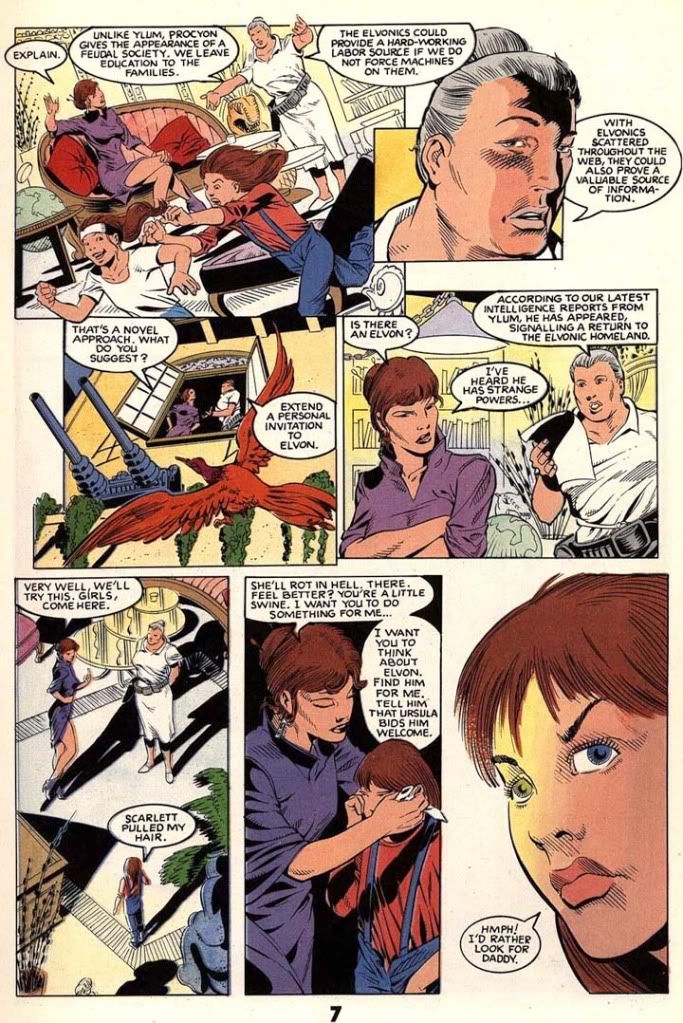
Pet names or other forms of endearment not only make the child feel loved, but may also stimulate his or her own imagination to come up with similar nicknames for the rest of the family. Here's as especially instructive example.
 |
| Mark Heike/Jeff Albrecht, Nexus #69 (First, June, 1990) |
Always remember, your success or failure as a parent will determine whether or not your children become lazy Mezz fanatics, wasting themselves and their lives in some sort of musical caravan forever in pursuit of cheap thrills, or largely benevolent dictators of adoring millions ready to accept the harshest of rule. It's all up to you, the parent. But by studying these examples of super-mom Ursula X.X. Imada and emulating her whenever possible, you, too, might become an award winner!
Tuesday, February 14, 2012
The Loomis sisters loom large of late...
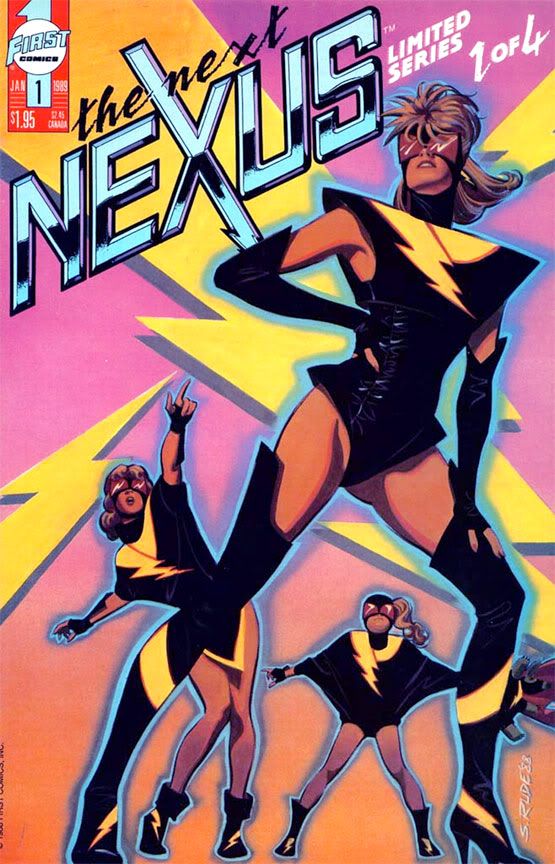
You know the Loomis sisters, right? Creations of that amazing comic duo, writer Mike Baron and artist Steve Rude. Ring a bell? You know, the Loomis sisters! Stacy, Lonnie and Michana Loomis, beloved daughters of General Loomis.
We first meet them in Nexus #25 (First Comics, October 1986). Much like today's developed or industrialized nations, the Web, the galaxy-spanning league of planets of which the Loomis sisters are citizens, requires vast amounts of energy and resorts to ever more dangerous means to gain it. To meet this need, the Web government builds the Gravity Well, a vast Goldbergian machine that uses white dwarf stars to provide almost unlimited energy. With General Loomis as its chief, the project comes at a cost: the destruction of the Planet Periwinkle and its 500,000 sentient inhabitants. Elvonic extremists attempt to assassinate Loomis to stop the Gravity Well, but Horatio Hellpop-- better known as the super-powered executioner Nexus-- gets there first. Despite some misgivings, Nexus executes the general after promising to provide for his girls.
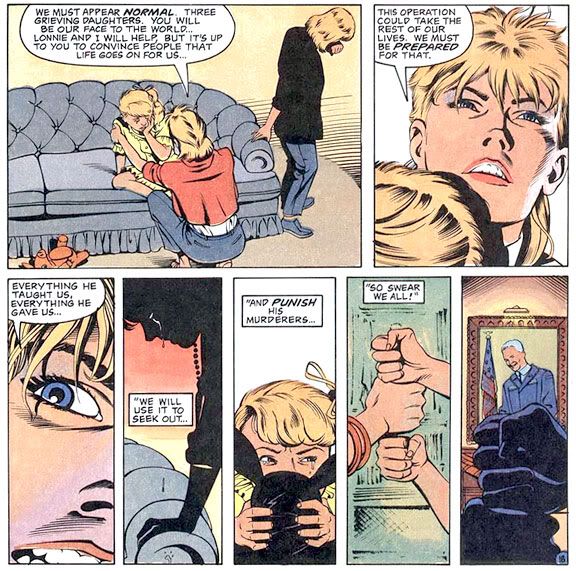
The trust fund he sets up for them and his guilty conscience aside, Nexus soon becomes the Loomis's target. These kids are smart and it was only a matter of time before they realized who did the deed that broke their hearts.
In The Next Nexus miniseries (First Comics, 1989), the sisters receive Nexus's power when he quits being the cosmic avenger for all of humanity. Here Baron plays on the old theme of absolute power corrupting absolutely. The ability to blast people and aliens into atoms has long troubled Nexus, so imagine if you will how it affects his greatest, youngest enemies. Stacy becomes Ahab-like, conscience drives middle sister Lonnie from her siblings and Michana, the youngest, goes kind of batshit.
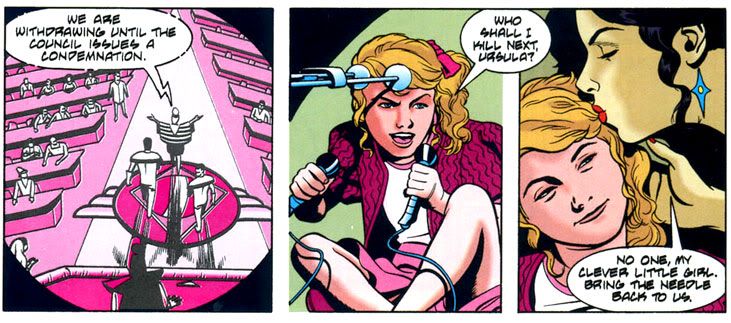 When Stacy and Michana finally meet a largely helpless and disillusioned Nexus, they have to fight Scarlett and Sheena, his own daughters by the delightfully formidable despot Ursula X.X. Imada. It's classic generational warfare, a story as old as the concept of family itself. This is how the crappy things parents do live on in their children, who repeat them, an object lesson in the way our past continually returns to us in a new shape that's really just a reflection of the old shape.
General Loomis is decent guy, an upstanding officer and widower devoted to his daughters. He offers them stability and discipline with unconditional love, but unknowingly infects them with the darker aspects of his military profession. Nexus kills mass-murderers, but struggles with self-recrimination as his own body count rises. Neither man can escape the consequences of his actions. In the end, can any killing be redeemed by another?
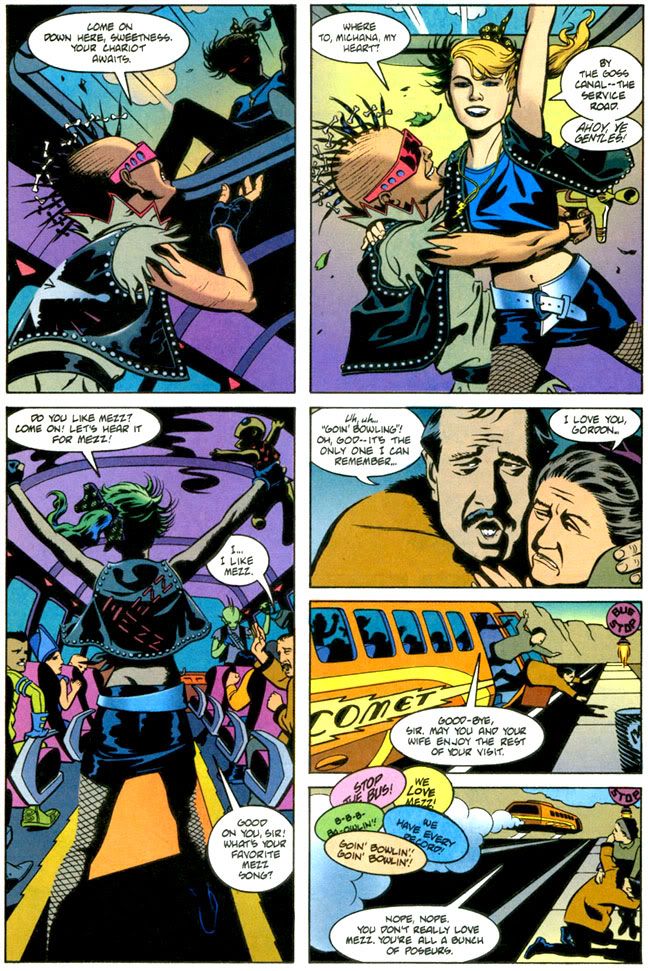 The Loomis sisters would suggest violence in response to violence only creates a cycle of destruction that corrupts as much as power. Their revenge invites a change that would horrify the father they seek to honor, something especially embodied by Michana whose adorable exterior can barely contain her lust for destruction. While Lonnie eventually settles into the life of a single woman making her own way in the world, Michana spends her childhood assassinating Ursula XX Imada's enemies and when she screws that up, runs a highly successful teen gang on a mass murder and armed robbery spree.
Angelically pretty, clothing herself in punkish leather and fishnets and toting around a small doll to which she's devoted (another symbol of her warped childhood, she communes with it for advice), Michana's a monstrously narcissistic Bonnie Parker and makes Hit Girl from Kick-Ass look like Cindy Brady. She terrorizes ordinary citizens, enchants a dimwitted thug, bedevils Nexus, ends up in jail. In Nexus Nightmare in Blue (Dark Horse, 1997), Michana resurfaces.
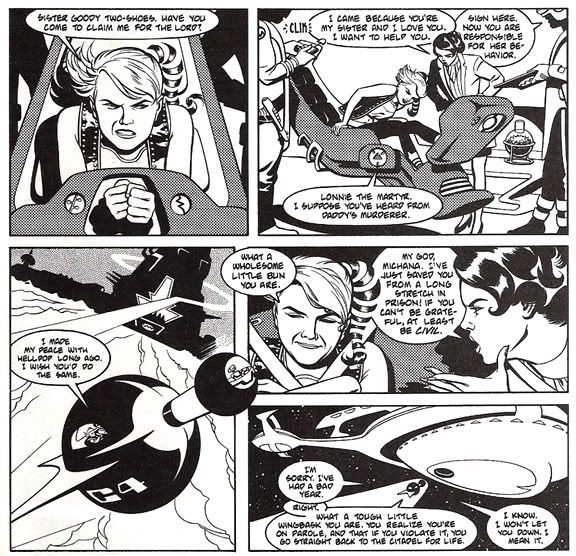 Instead of violent mayhem, Baron involves her in an amusingly sitcomish digression from the main narrative, expertly drawn in all its domestic splendor by Rude. While Nexus struggles to decide his next mission-- eventually turning to the readers for help-- the surviving Loomis sisters set up housekeeping on Mars.
Reconciling with her sister Lonnie, who now holds the somewhat pathetic yet imminently respectable job of "junior assistant to the mayor's secretary," Michana still dreams of power. She drops the punk look and adopts the guise of a typical suburban teen, but sneaks out at night to indulge her wild side and meet up with a member of her former gang. You get the idea it's only a matter of time before she cuts off someone's finger to get a ring.
Biding her time, Michana contents herself with helping Lonnie with her relationships, much to the detriment of sleazy Tom Cruise-lookalike Tom Zeus, a lawyer who specializes in something called "jewelry fraud." Zeus turns out to be the kind of creepy perv who would sleep with an underage girl and video all his other sexual encounters. Hundreds upon hundreds of them. Wealthy, handsome, self-assured and not afraid to get his hands dirty helping out the bouncers of his favorite haunt, a stylish bar, Zeus has it all. A smitten Lonnie breathlessly recites his possessions: "A Lambo, a Slambo and a Pomerini GT," no doubt coached by Zeus himself. I don't know what those things are, but they're probably expensive. Zeus never fails to mention the pride of his fleet, a 250-meter S&J star cruiser that "sleeps twelve."
S&J, by the way, stands for "Sundra and Jil." Sundra is Nexus's lover and Jil is her business partner in their very successful star cruiser venture. A posh, arrogant ass like Zeus would only have a starcruiser from S&J. The ultimate status symbol.
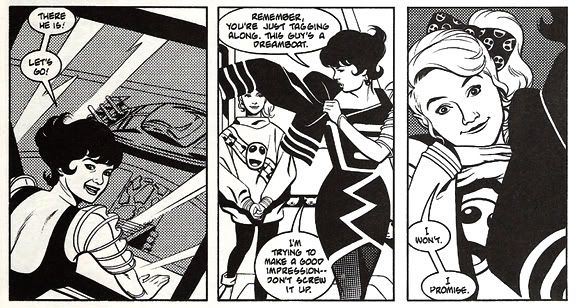 Zeus never ran into someone versed in military tactics, assassination, spycraft and crime of every type before, though. Michana learned from the best; that Ursula is no joke and there's probably a bit of her father mixed in as well, plus Nexus. In the aftermath, Lonnie tells Michana her methods are "extreme," but she's grateful to baby sister for putting Zeus in his place. The Greek God will no doubt survive to seduce another night, but in the future he may be a bit wiser about how he does it and more honest with his partners. We hope he learned his lesson well.
The ultimate lesson taught us by the Loomis sisters is you don't want to mess with the Loomis sisters. Actually, you also don't want to mess with Ursula XX Imada or Scarlett and Sheena.
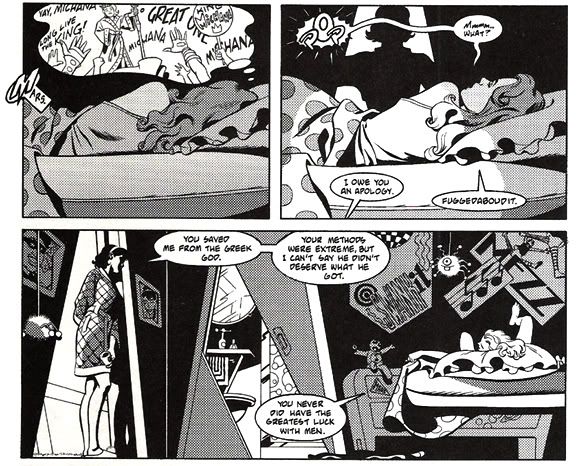 As Baron and Rude prepare a new Nexus story for Dark Horse, I can't help but wonder if Lonnie and Michana will make another appearance. It doesn't seem all that likely, but one can always hope.
The Nexus cast consists of hundreds of characters, and the most recent storyline-- the "Space Opera" issues self-published by Rude's Rude Dude Productions-- mostly involve topical religio-political machinations and the birth of Nexus and Sundra's son Harry. Nexus battles the shade of his father and the two weird little aliens who were his companions when he was a child, more of that recurring "sins of the parents" thread that runs through so much of Nexus. That makes me think it's the appropriate time for some more Loomis action.
While Lonnie has forgiven Nexus, how can we be sure Michana has? Various assassins have already targeted the newborn and he seems like a natural target for Michana Loomis. She could continue to be a powerful enemy for Nexus. She's deadly as all get out, but it doesn't seem likely the conscienced Nexus could equal Michana's amorality by killing her. It would mean a powerful ending to her saga, one as horrifying as imagining the psychotic thoughts behind Michana's deceptively sweet countenance. There's still a lot of unfinished business between her and Scarlett and Sheena. On the other hand, maybe the influence of her big sister really does have Michana on the path to rehabilitation and redemption. Or is Lonnie truly as upright as she appears. Could she be hiding something herself?
I'm pretty confident Baron and Rude will wow us when the time comes.
Subscribe to:
Posts (Atom)