Showing posts with label good stories. Show all posts

Monday, February 17, 2014

Uncanny X-Men #168 (April 1983): My first subscription comic!

Did you ever love a comic so much you subscribed to it?  Sure, people have "pull lists" these days.  We had those back in the antediluvian days of comic book fandom, too.  I mean, my antediluvian days, which were the early 1980s.  I had a pull list at two different comic book shops, but both of them went out of business fast.  There were not enough people like me to support them in our small southern town.  So to primitive me, subscribing to a comic for a year and getting issues in the mail was the sign of true love.  Like offering a sweater or a ring to that special someone.  My special someone was Uncanny X-Men.  And Uncanny X-Men #168 (April 1983) was the first issue that came straight from Marvel to my mailbox.  What a day that was!  I was always the first person home, so my responsibilities included running out and checking the mail.  And there was a brown wrapper with a battle-damaged Kitty Pryde inside.

"PROFESSOR XAVIER IS A JERK!" Kitty exclaims in the splash panel, pointing accusingly back at the readers as if we don't believe her. 

I remember this as a shocking moment, a new, upstart character badmouthing an old school stalwart.  Apparently, others felt the same about it because Joss Whedon and John Cassaday would recreate it as a Kitty memory when she returns to the mansion during the first moments of their initial Astonishing X-Men story arc.  What had Xavier done to piss off Kitty?  He refused to let her be an X-Man because it was too dangerous.  To add insult to injury, he also forced her to join the New Mutants trainee team, which is like being demoted from the Majors to low A ball in the middle of the season.
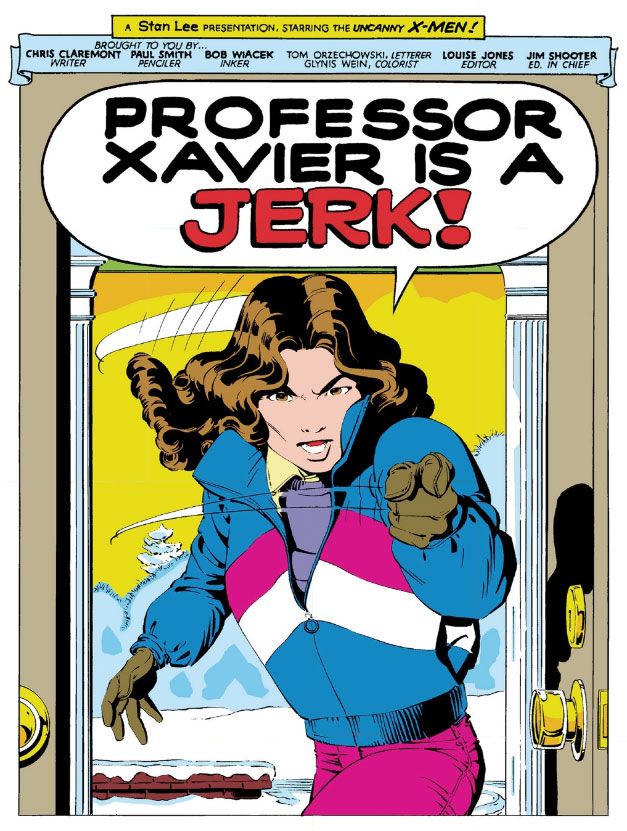
Uncanny X-Men #168 (April 1983), Script: Chris Claremont, Pencils: Paul Smith, Inks: Bob Wiacek

Kitty does her best to prove Xavier wrong throughout the issue, but at first, her attitude is pretty much what you'd expect from a disappointed fourteen year old.  She flips.  Her calmer, cooler friend Illyana immediately calls her out for acting like the child Xavier already thinks she is.  And Illyana should be the one to show maturity.  She and Kitty are roughly the same age, but Illyana is also the demon queen of the Limbo dimension.  Being a demon queen gives one a more advanced perspective. 

Ah, the art!  There is some excellent acting throughout this book and it's all just so clean, so slick, so easy on the eyes.  Paul Smith took over Uncanny X-Men after Dave Cockrum left the book for a second time to write and draw his own property, The Futurians. While I really dug his return, Smith immediately piqued my interest with his ultra-sleek linear style.  With Bob Wiacek finishes, practically everything in the book seems made of polished metal.  Okay, I'm exaggerating, but Kitty's hair certainly has a metallic look.  And good portions of the story take place in the X-Mansion's lower levels where the walls actually are polished metal.  The Smith-Wiacek team is my third art team on this book and the last to capture my imagination.  I copied their Kitty-hair and style of drawing noses for months, but the Smith-Wiacek Storm is the character at her most goddess-like.  Absolutely beautiful.  Then they gave her a Mohawk.

Dubious fashion choices aside, the father-daughter dynamic Chris Claremont works in this issue is a lot of fun.  Professor Xavier has the dad role, of course, and Kitty is the typical teen who wants to prove to her parents she's grown up enough to make her own choices about risk taking.  For most of Kitty's contemporaries, this would mean going un-chaperoned to a Duran Duran or Michael Jackson concert.  Everyone else is going!  Why can't I?  Since Illyana is apparently Kitty's only age-appropriate friend and the rest of the people she hangs out with rarely attend pop concerts but instead have superpowers and enjoy dressing in colorful leotards to launch into space and fight insectoids, that's what she wants to do.

After she realizes throwing a tantrum isn't going to help, Kitty calms down and puts her intellect to work on the problem.  She tries various strategies to change the Professor's mind, from whipping him at chess while explaining her considerable advantages to shouting to shameless brown-nosing.  The progression Claremont presents is just so believable.  Who hasn't tried each of these with parents?

Then, unlike those of us who never got to see the Go-Gos or the Replacements until we were out of the house and in college, Kitty gets lucky, because some space cockroaches who shoot magenta ray beams from their eyes have infiltrated the mansion's creepy-crawly basement.  This is all very reminiscent of the time Kitty faced off against a N'Garai demon by herself, but provides another, very convenient way for Kitty to present her case.  And out of all the things Kitty's tried, it's the most effective, because she gets to showcase a number of her intrinsic capabilities and all those extra things she's learned so far from people like Xavier, Cyclops, Storm and even Wolverine.  Yeah, as if Wolverine knows anything about fighting.
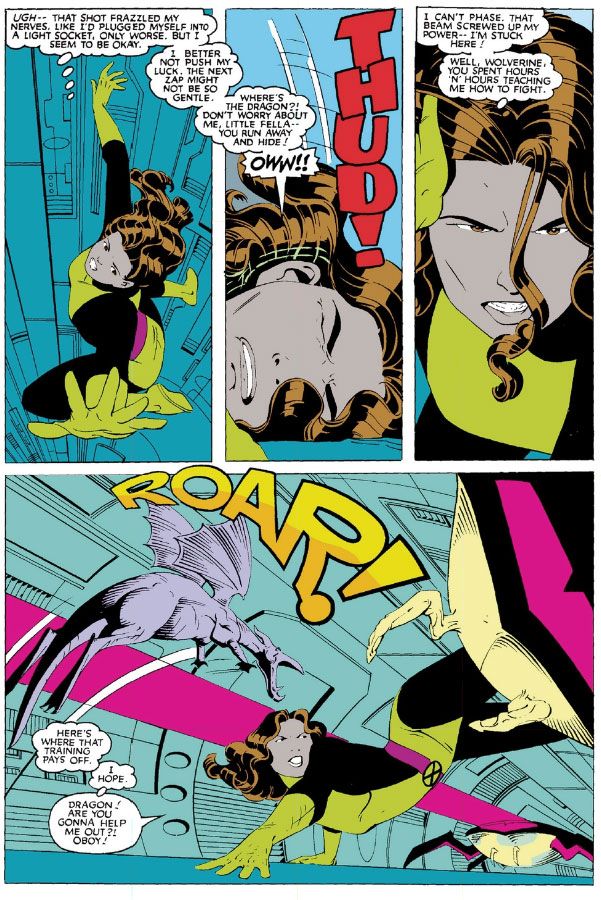
Claremont, Smith, Wiacek

And that brings us back to the cover, because fighting these bugs is how Kitty ended up in the bruised, ripped and still defiant pose I first saw after slipping the comic out of the wrapper.  Colossus turns up just in time to save our gutsy Kitty, but she's finally made her point.  Professor X puts her back on the team, with a probationary proviso which Kitty sensibly agrees to.  She also gets a pet dragon, which is like the ultimate wish fulfillment fantasy.  Imagine for a moment what it's like to be Kitty Pryde.  You're young, you're a genius, you're spunky and heroic, you've got hair so shiny people in shampoo commercials turn weepy with envy, you get your fondest wish... and you get to have the coolest pet ever.

As an added bonus, you also get your own fan page:
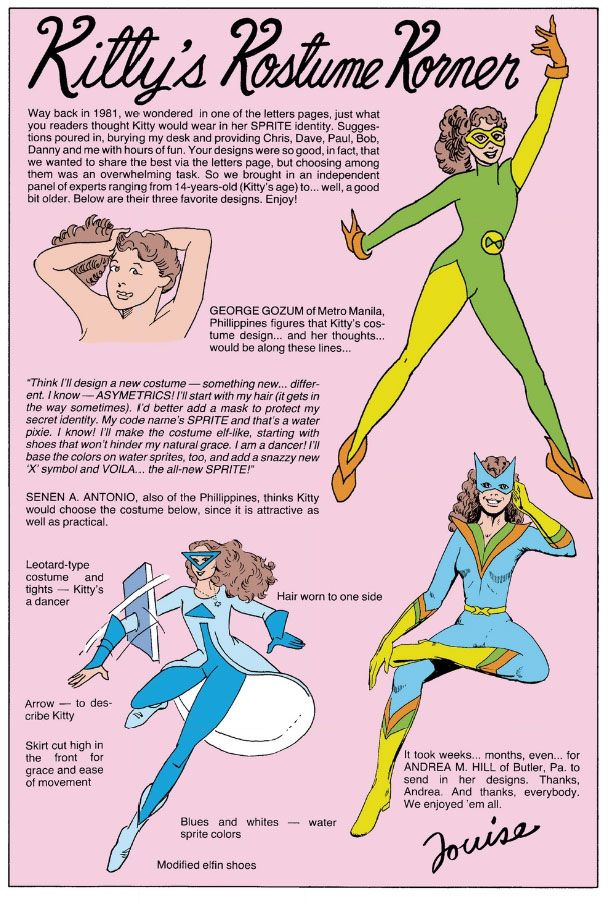
Uncanny X-Men #168 (April 1983):  Alliteration sometimes leads to adverse accidental acronyms


Nobody did all that for me when I was 14!  Oh well, shoot, after all that, she deserves it.

Monday, February 3, 2014

Hell's Angel: The Strange and Terrible Saga of the Outlaw New Mutants and the Time They Adopted Bird Brain

From the vantage point of our current mass media, where its characters permeate the zeitgeist, it may seem ridiculous, even the stuff of lunacy, but there came a time in the late 1980s when America's comics-hungry masses turned away from New Mutants.  As interest in the comic fell and sales flagged and talking heads hit the airwaves to postulate almost hysterically on the reasons-- anxiety over the ending of the Reagan era? Pre-millennial jitters?-- series star Dani Moonstar phoned the home office and demanded someone at Marvel do something. The Marvel solution as scripted by Louise Simonson was to honor that most wonderful and time-tested of sitcom traditions with the addition of a cute tagalong to the familiar cast.

In the human world, this new character would most likely be a baby or even Ted McGinley (already having done sterling work on Happy Days, The Love Boat and at the time coming off a stint revitalizing Dynasty as Clay Fallmont on his way to achieving legendary status as Jefferson D'Arcy on Married With Children).  Or a bespectacled blond-headed moon-faced boy susceptible to both pies in the face and Bobby Brady's ridiculous detective schemes.  In the world of teen mutant super-beings, the ideal Cousin Oliver proved to be a hideous feathered freak, the very antithesis of the almost supernaturally handsome McGinley.

And while The Brady Bunch failed to escape the event horizon of its particular ratings black hole, adding Bird Brain to the cast gave New Mutants enough of a lift to carry on for a few more years.  Bird Brain, the lovable weirdo.  Bird Brain, who made Gonzo the Great look like Cary Grant and the Chicken Lady from Kids in the Hall resemble his To Catch a Thief co-star Grace Kelly.  Bird Brain, who ate fish and probably smelled something awful. 

New Mutants #55 (September 1987), script: Louise Simonson, pencils: Bret Blevins, inks: Terry Austin

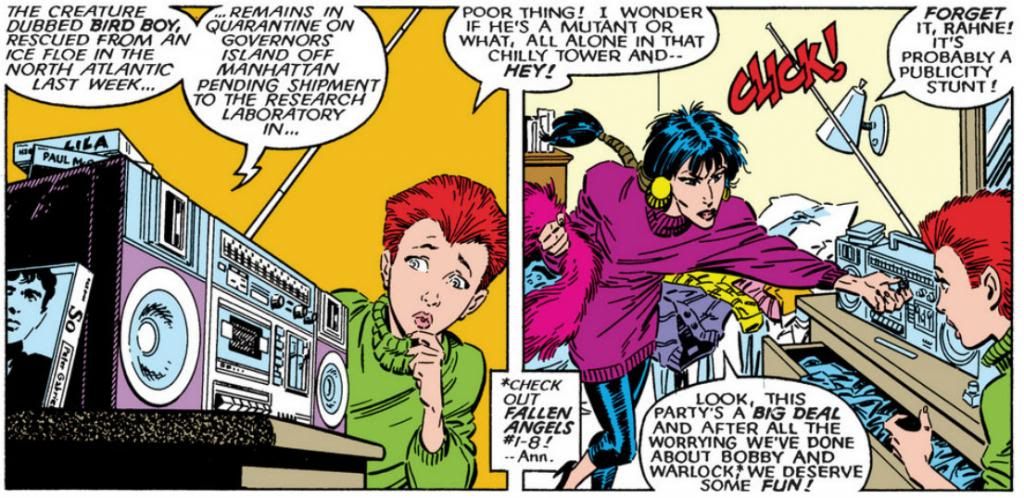
Online sources list New Mutants #55 (September 1987) as Bird Brain’s first appearance, and that's technically correct, although it's a mere cameo.  We do feel his presence throughout, starting early in the issue when the kids learn about Bird Brain from a radio news story.  Remember radio?  Artist Bret Blevins reminds of what this obsolete technology looks like with a highly detailed rendering that will no doubt become useful for future historians and archeologists as they try to recreate our late 20th century society. 

To you, highly advanced people of the future:  Yes, we primitives once used these devices to listen to music and learn about the world around us. 

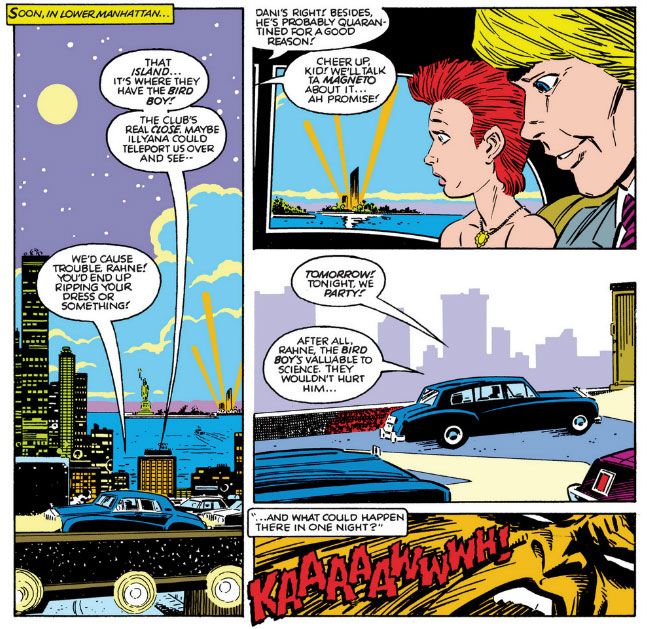
Later, Rahne urges her friends to do something about Bird Brain's plight, and Bird Brain himself appears in an insert panel soon afterwards.  All we see is his beaked face.  Most of the story involves Sam Guthrie taking drugs at a party to impress his sometimes lover Lila Cheney, a space-thief who spends her down time rocking earth as a kind of Patti Smith/Pat Benatar/Joan Jett stand-in. 

For the record, I would fully support a Lila Cheney solo series.

New Mutants #55 (September 1987), script: Simonson, pencils: Blevins, inks: Austin

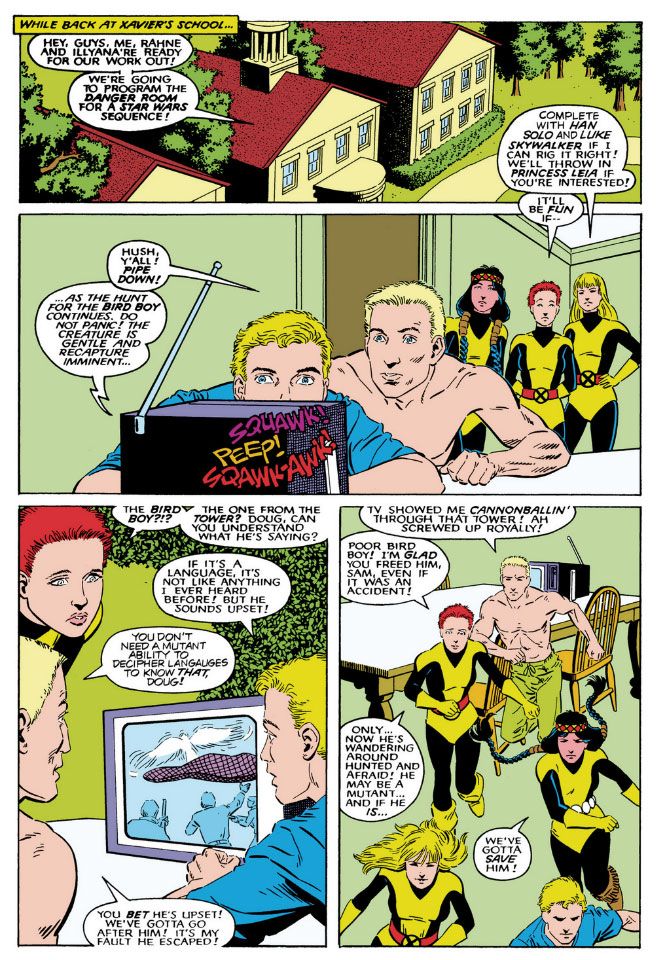
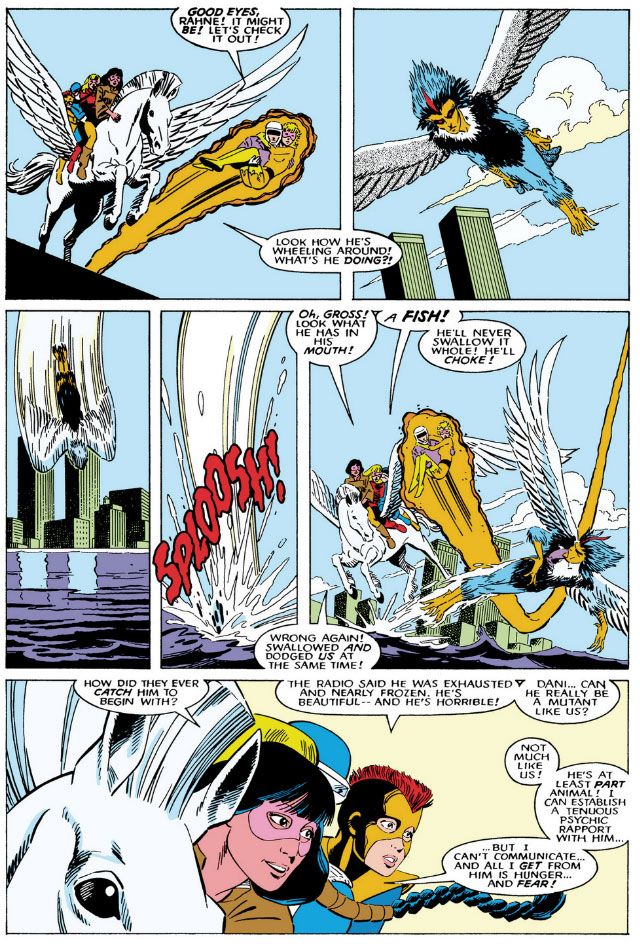
Anyway, Bird Brain.  New Mutants #56 (October1987) is the first comic truly to be all about his birdness and his brain.  We learn Sam has somehow inadvertently freed Bird Brain from his imprisonment in a research lab—it must have happened while he was groggily flying around trying to avoid some aliens who have it in for Lila.  For unknown reasons, we don’t actually see this happen in the story.  Just take Dani's word for it.  Or Sam’s.  Or Rahne’s.  Whether or not he's truly responsible, Sam feels so and goes to find the fugitive freak while Dani involves the entire team.  She even makes them wear their hideous “graduation uniforms,” for disguise purposes.  See, if they wore their New Mutant garb, everyone would know them, but a group of teens with identical powers and similar appearance in different clothes constitute a mystery even Reed Richards couldn’t solve.  And that guy is a genius, but obviously not as much so as Dani Moonstar. 
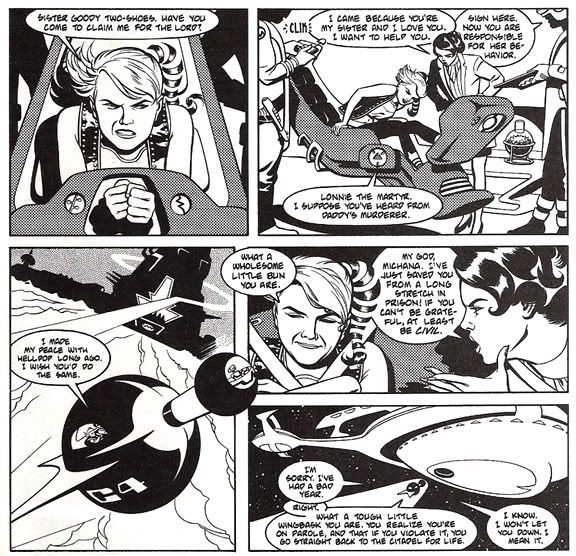
New Mutants #56 (October 1987), script: Simonson, pencils: June Brigman, inks: Austin
 
Let me just take a moment to express how much I wish June Brigman had penciled more New Mutants.  She did this issue and annual #4 (September 1988), but Marvel should have given her the monthly assignment.  She’s gold on this team, especially with Simonson's scripting.  Regular artist Blevins has an edgy, sketchy style with a lot of energy, but he makes Dani look about fifty years older than her supposed age (and kind of mean!), which is an unforgiveable lapse (although his Rahne Sinclair is cute as a button).  So while I admire Blevins' cartoony body language, with bent knock-kneed poses and dramatic gestures, I prefer Brigman's cleaner visuals and more controlled rendering.  Brigman, with the able assistance of inker Terry Austin, provides a sleek look that's a cool alternative to Blevins' more jittery work.  Her storytelling is fine, but it's the way she draws figures with lifelike proportions and impeccable facial “acting”  that grounds the book in some much-needed reality.  This gives outré characters like Bird Brain a bit more believability.  And this is without relying on the crutch of photorealism.

New Mutants #56 (October 1987), script: Simonson, pencils: Brigman, inks: Austin

Also, Louise Simonson has a way with naturalistic teen-speak that I find superior to Chris Claremont's more stilted dialogue.  Claremont crafted some dark classics during his run on the characters, particularly the "Demon Bear Saga," which received its own trade paperback collection (something that can't be said for the "Bird Brain Saga"), but Simonson's teens "sound" more like actual teens.  Especially when combined with Brigman's art, where they look like actual teens as well. 

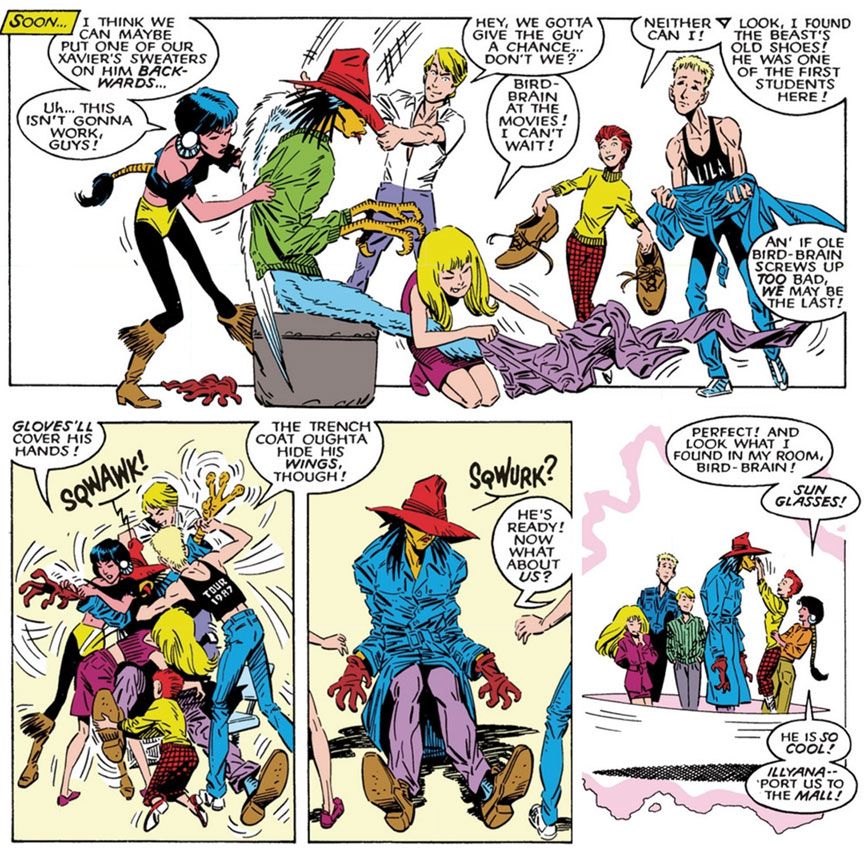
Also, Simonson's Bird Brain certainly is a bird brain!  It doesn't take Dani and the rest long to teach him the importance of dressing well.

New Mutants #57 (November 1987), script: Simonson, pencils: Blevins, inks: Austin

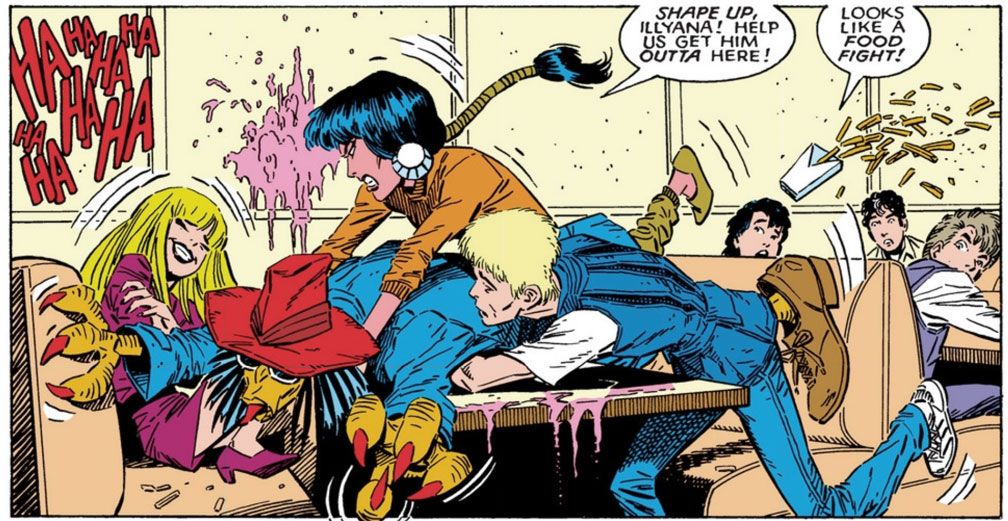
And the deliciousness of fast food.

New Mutants #57 (November 1987), script: Simonson, pencils: Blevins, inks: Austin

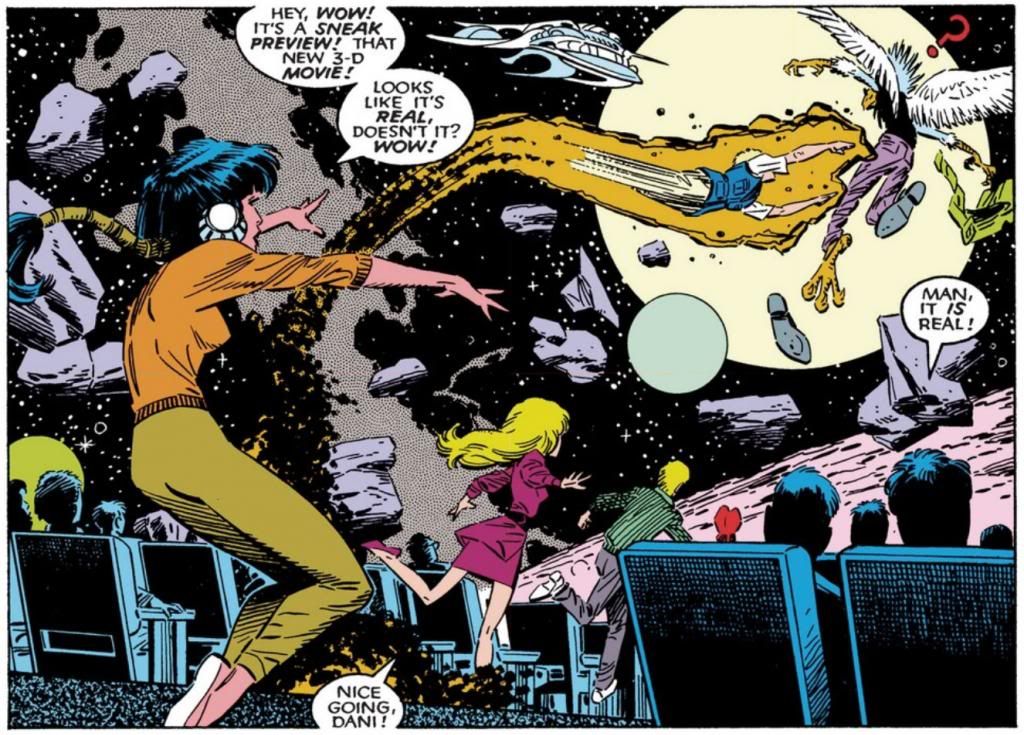
And the wonders of modern cinema.
 
New Mutants #57 (November 1987), script: Simonson, pencils: Blevins, inks: Austin

At this point, I will excuse you for asking,  "Just what in the name of Bill Sienkiewicz is going on here?"  In fact, ask me that.  Right now.

I don't know!  As a minor character Bird Brain would have been slightly annoying, but Simonson spotlights him over Dani Moonstar and other, more pressing plotlines like Sam's romance with Lila, Magneto's taking over the team and Amara's love-hate for one of the Hellions and her resulting arguments with Dani.  The kids' clumsy attempts at assimilating so alien a creature into teen society are amusing, but this is also a comic co-starring a girl who's literally from Hell and characters just one mistake away from death.  And the "Bird Brain Saga" isn't just a one or two issue romp.  It lasts approximately seven issues and for most of those seems little more than slapstick sit-com fodder, a bizarre digression for the series as a whole.

Okay, actually, I do know.  Because just when you've had about all the Bird Brain you can stand, Simonson ups the dramatic stakes by adroitly shifting tonally from comedy to sci-fi horror and the plot into a Moonstar-starring H.G. Wells' The Island of Dr. Moreau.  This happens in New Mutants #58 (December 1987) when the kids journey to a mysterious island to finally learn the true origin of Bird Brain.  After all, Bird Brain had to come from somewhere, so why not an island of animal-human hybrids presided over by a mad scientist with a skull for a hat?  By #59 (January 1988), the New Mutants are themselves captives and their humanity at risk.  

From there, the jeopardy growing from this development leavens the oddball comedy of the preceding issues.  The Moreau-style plotline is also particularly apt when dealing with characters on the cutting edge of human evolution.  Wells' themes--- including cruelty to animals (in Moreau, it's vivisection, in this story it's updated for the 80s to a more generalized laboratory research and then genetic splicing), which the Bird Brain story addresses obliquely from the beginning-- jibe quite well with Simonson's take on the team as concerned young people trying to make the world a better place.  By providing a classic literary explanation for this bizarre Bird Brain character, she finishes strongly, with a tragedy with lasting ramifications for the team in #60 (February 1988). 

Which I won't share with you because you owe it to yourself to read the entire Bird Brain saga in all its strangeness.   It's not exactly a "Demon Bear Saga," but on the other hand, it does feature Bird Brain.

Friday, October 11, 2013

October is Spookey Month: Tomb of Dracula #12 teaches us most accidents happen at home

Is it controversial to say Tomb of Dracula was Marvel's best comic of the 1970s?  It has some strong competition from Conan the Barbarian where Barry Windsor-Smith displayed exponential artistic growth; from X-Men/The Uncanny X-Men with Chris Claremont, Dave Cockrum and then John Byrne creating a mythos that won all those Eagle Awards and underpins the entire Marvel universe to this day; and from Howard the Duck where Steve Gerber and artists like Frank Brunner, Val Mayerik and Gene Colan inspired Marvel's first movie adaptation (an infamously lousy one, but still a big budget, George Lucas-produced film released to theaters in the belief it would be a big hit). 

Those are all fine series, and I've enjoyed each of them.  But Tomb is just something else entirely.  Tomb is like wow times wowee for a little "wowee-wow-wow." Tomb took an exhausted public domain property-- good ol' Count Dracula, star of dozens of movies, TV shows and comic books in one form or another-- and gave it a compelling, new un-life.  Writer Marv Wolfman's melodramatic prose perfectly matches Gene Colan's shadowy visuals, the two elements working in tandem like peanut butter and chocolate in a Reese's.  When Marvel finally teamed Colan with inker Tom Palmer, the two produced what I will argue was consistently the most breathtakingly beautiful color monthly of the entire decade.


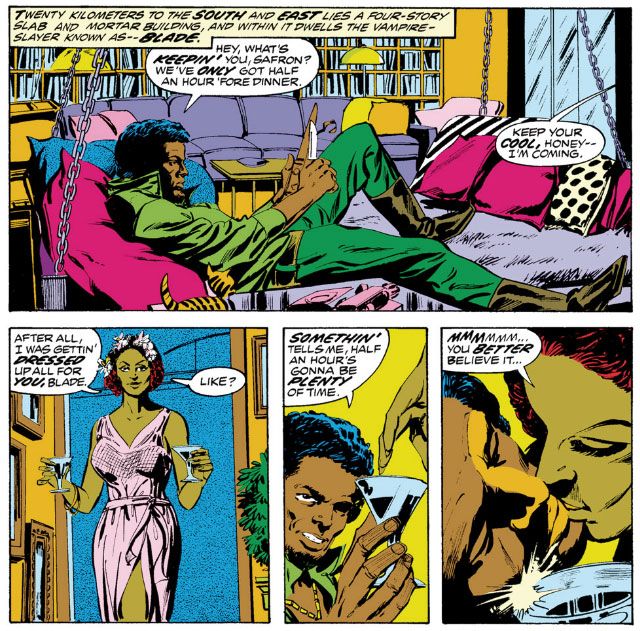
Operating on the fringes of the Marvel universe, Tomb functions as a sequel and expansion of Bram Stoker's novel.  In fact, lead good guy Frank Drake is a descendant of Dracula himself, his last name an Americanized version of the original.  Quincy Harker comes right out of the original book, the first born child of Jonathan and Mina (nee Murray) Harker, conceived and born after the novel's main events and named after one of Dracula's victims, the Harkers' courageous American cowboy friend Quincy Morris.  Wolfman casts Harker in the Dr. Van Helsing role.  More troubled than his Stokerian prototype, Harker rides around in a weaponized wheelchair the likes of which James Bond's pal Q would envy, and he uses it to save himself and others several times throughout the stories.  His hardboiled protégé (and later, Drake's lover), Rachel van Helsing, is the grand-daughter of the Stoker character.  Both Taj Nital, devoted companion to Rachel, and-- most significantly-- Blade, the ultra-cool, Blaxploitation-style member of the group, are wholly original.  At least I don't remember Stoker having watched Shaft, Super Fly or Hammer, but he could very well have despite having died about 60 years before the birth of the film genre.


Every October, I turn to Tomb of Dracula and it helps put me in that spooky, haunted Halloween mood.  It has its funky idiosyncrasies-- too many scenes where Rachel, Frank and Blade confront Dracula and all they do is trade arch insults and a whole lotta plots where Dracula almost dies, only to escape at the last moment.  After all, how many times can our vamp-slaying crew almost destroy Dracula before they start to seem completely incompetent to the point they lose our sympathies and incur our scorn, like that bumbling Gilligan?  Tomb of Dracula ends rather abruptly with issue #70 before it has a chance to devolve into self-parody, but even when things turn silly as they occasionally do, the overall atmosphere remains one of effectively updated gothic horror, and there are still plenty of genuinely creepy moments to restore our faith.  Which finally brings us to tonight's topic, Tomb of Dracula #12 (September 1973) and a little story we like to call "Night of the Screaming House."  Because that's what Marv Wolfman named it.
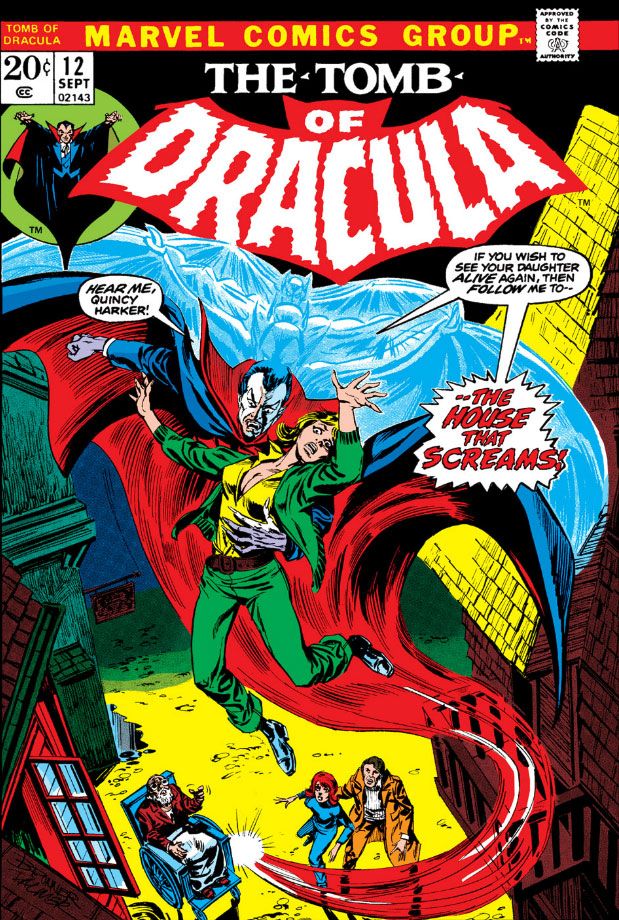
Oh, on the Frank Brunner-illustrated cover, Dracula calls it the "House that Screams," but you should never believe anything the king of the vampires tells you.  He has his own agenda and will lie when it suits him.

Okay, forget Dracula before... er... remembering him again.  Because Wolfman and Colan throw us right into the action with the main characters locked in a ferocious show-down with none other than Dracula, who has caught himself a delicious dinner, but can't catch a moment to eat in peace.  It's not a holdover from a cliffhanger ending to the previous issue (in which Dracula fought some motorcycle guys who aren't quite as menacing as the Sons of Anarchy bunch, although they do their best).  It's more like, "Open the book, here we are!"

Unfortunately one of them, Harker's daughter Edith, is ill-equipped for the life of a fearless vampire hunter.  Edith Harker was simply born to find herself in jeopardy.  Wolfman and Colan introduce her to the series that way in Tomb #7 (March 1973), and in "Screaming House" (as its friends call it; the rest of you must refer to it in full, with an honorific of your choice), she really finds herself in a mess, the likes of which no heart-felt talk with Sheriff Andy Taylor, Mrs. Garret or Mr. Belvedere can solve.  After a lot of posturing on both sides and some ineffectual hand-to-hand, Dracula spirits Edith away to a shabby old house so he can toy with his adversaries rather than just kill them outright.
With his mastery of vertigo-inducing camera angles, Colan expertly depicts the abduction, which is quite alarming as Dracula transforms only partially into his bat-form.  This emphasizes his otherworldly aspects by making him a grotesque hybrid creature, plus it gives him enough strength to carry Edith through the air.  He needs those membranous arm-wings to do two things at once.

And the titular screaming house is foe unto itself.  It's full of rotten floorboards that give way at inopportune times and Dracula's hidden away traps of his own, like the black widow cages he slips around the corner beneath Frank Drake's feet at one point.  The good guys split up to cover more ground and render themselves even less effective against Dracula and it all comes to a tragic conclusion.


While the story itself is pretty straightforward, at least compared to later issues (which would feature adversaries such as a Communist Chinese brain in an aquarium, Dracula's hated vampire daughter, a faceless dead man and, later, his own weirdo son, an angelic/demonic pretty boy calling himself Janus) it has some important character development.

Once he plunges his cast into Dracula's fun house, Wolfman depicts Drake as scared almost out of his wits to the point of stuttering as he speaks.  And yet the guy still pushes on alone.  While Drake is in a state of transition from callow rich jerk to bumbling vampire avenger to intrepid daredevil hero, it helps reinforce the danger Dracula personifies.  Remember, when you go against a vampire it's not just your life that's in hazard; it's your very soul.  And with Dracula the series anti-hero, there's always the chance over-familiarity with the character and his motivations will weaken his menace and turn him into just another ineffective Marvel villain fond of soliloquys in the dark.  This is especially true if the characters in the book come to view him as ho-hum.


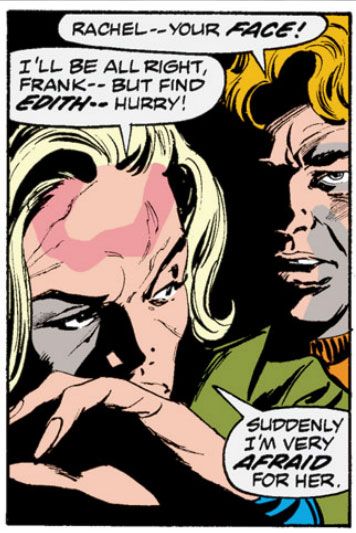
Another important character point is the scarring of Rachel's face.  Bats, released by Dracula, attack the group and Rachel gets a makeover.  These scars become part of her character and eventually symbolize the hardening of her spirit.  So important are these scars, when Wolfman and Colan resurrect Rachel years later in their Tomb of Dracula miniseries, it's through a kind of possession that involves a brand-new character tearing at her own face until she resembles Rachel and loses her own identity.


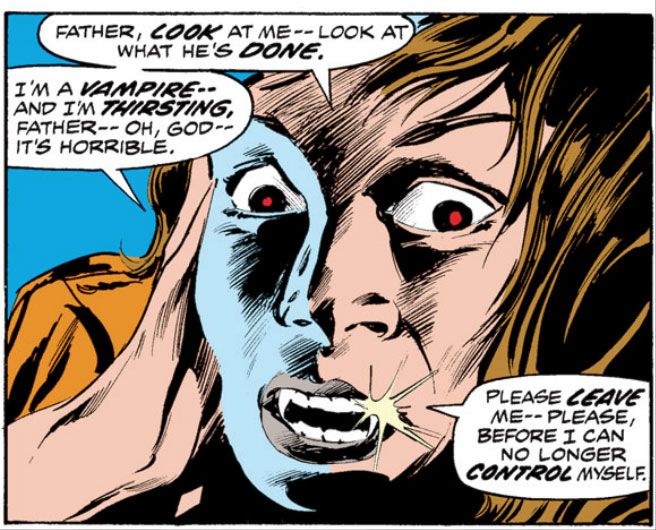
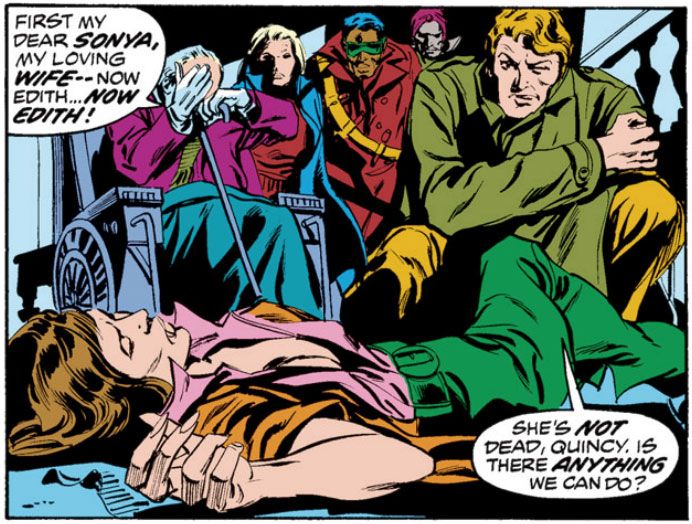
The final and most poignant element is Edith's fate and the matter-of-fact way Quincy deals with it.  While Frank reacts with very human but misguided compassion and hopefulness, Quincy Harker knows from experience there is only one thing to do.  Wolfman could easily cop out at this point and offer a last-minute reprieve in the form of some never-before-heard-of cure, but no.  Instead, he sacrifices a character to the betterment of the story.  It's a moment reminiscent of the scene from Stephen King's 1976 novel 'Salem's Lot where protagonist Ben Mears is forced to drive a stake through Susan Norton's (his vampirized girlfriend) heart.  King changes viewpoint characters throughout his story, spending a great deal of time and care making readers empathize with Susan by allowing them to see events from her perspective.  Her loss in the narrative gains impact because we think of her loss as tragic unto itself rather than merely something that incites Ben's actions towards the climax.


Wolfman hasn't had enough time to do as much for Edith.  Because her fictional career ends so abruptly, she remains something of a punching bag of a character.  And yet, Harker's coldly pragmatic method of dealing with her is chilling.  This is what separates a true horror story from an adventure that uses horror trappings.  Horror forces characters into painful choices, the loss of sanity, of limbs, of life, of loved ones.

Wednesday, October 31, 2012

October is Spookey Month: Let Doug Moench and Richard Corben show you how to trick-or-treat!


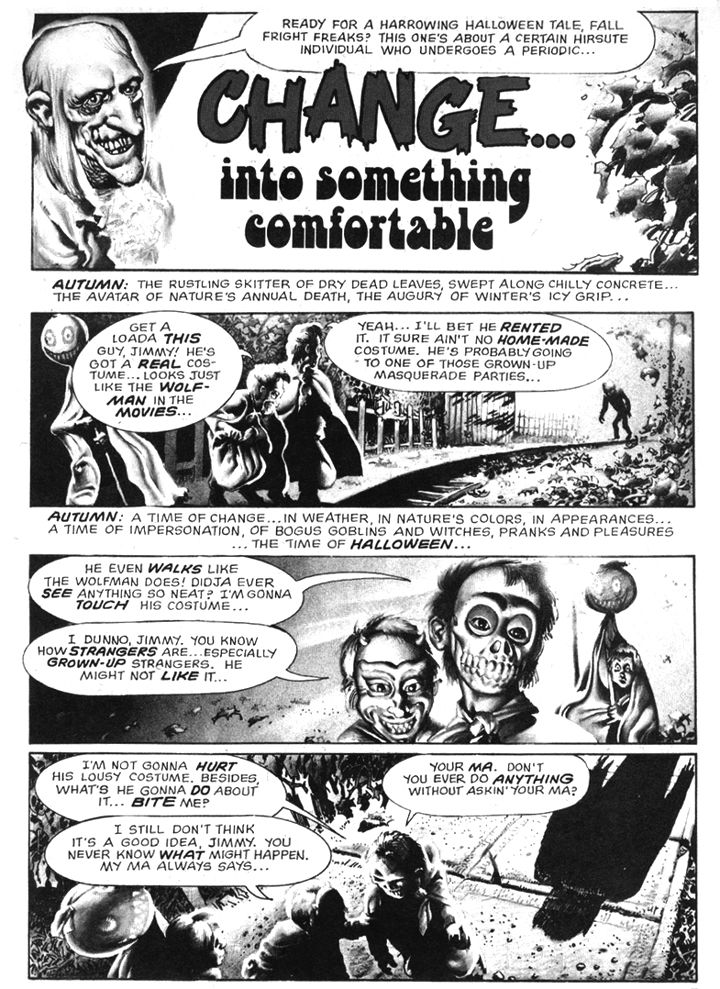
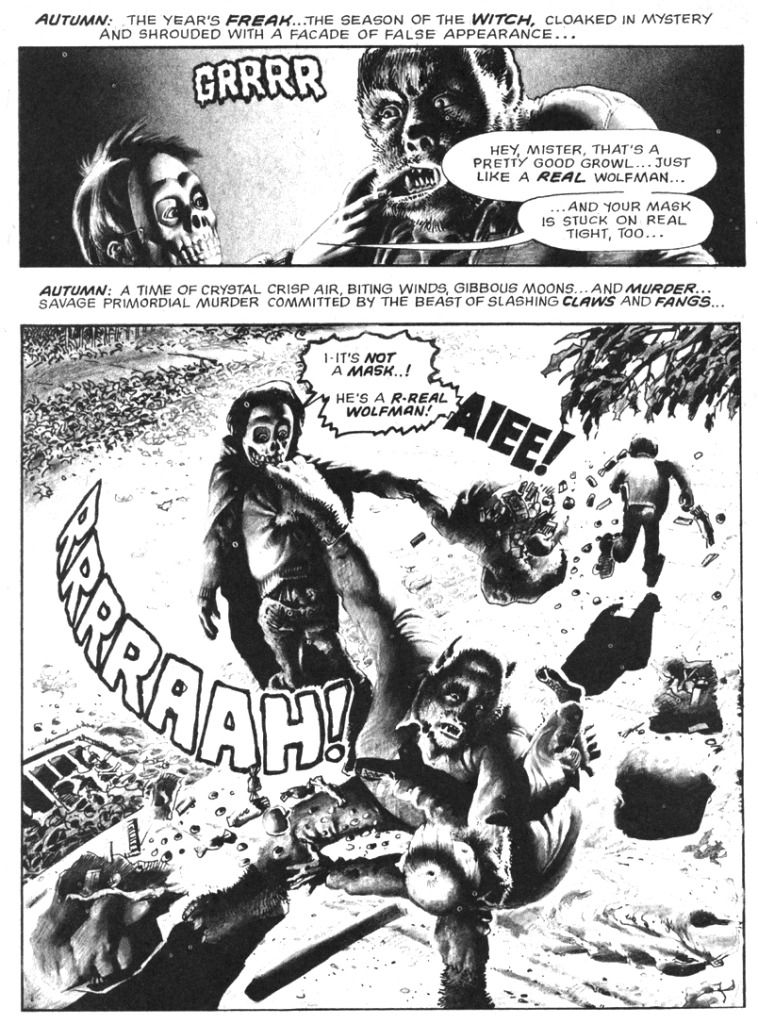
Yes, Halloween is a fun holiday, but you should exercise at least a little caution when out trick-or-treating.  Go in a group, wear a costume with reflective tape so motorists can spot you, go only to well-lit houses.  And most importantly-- don't pull on a werewolf's lip.  These are a few simple safety tips brought to you by Doug Moench and Richard Corben in their horror-comedy classic, "Change... into Something Comfortable," which appeared in Creepy #58 (December 1973), a "special Halloween horror issue" (so it says right there on the cover).  While I didn't particulary enjoy "The Slipped Mickey Click-Flick," I'm a huge fan of this little seasonal-flavored gem.

It starts with a real werewolf ripping some smart ass kids to shreds and ends with a sweet twist I find both irresistible and hilarious.  I mean if you've ever wondered what creatures of the night disguise themselves as on Halloween, here's your chance to find out.  "Comfortable" is sort of a companion piece to Corben's even more hilarious "Lycanklutz" from Creepy #56 (September 1973).  That earlier full-color romp features a somewhat luckier werewolf in a medieval setting with some surprisingly anachronistic products available for sale.  By contrast, our contemporary, kid-killing monster in "Comfortable" strays into EC territory with tragic results.  I could have hit you with "Lycanklutz," but this one is all about Halloween and disguises and has those melodramatic Moench narrative captions.  You can read it in the Dark Horse Creepy Archive Volume Twelve.

Come to think of it, you can read them both in that book.

Sunday, October 28, 2012

October is Spookey Month: John Severin's zombie soldiers


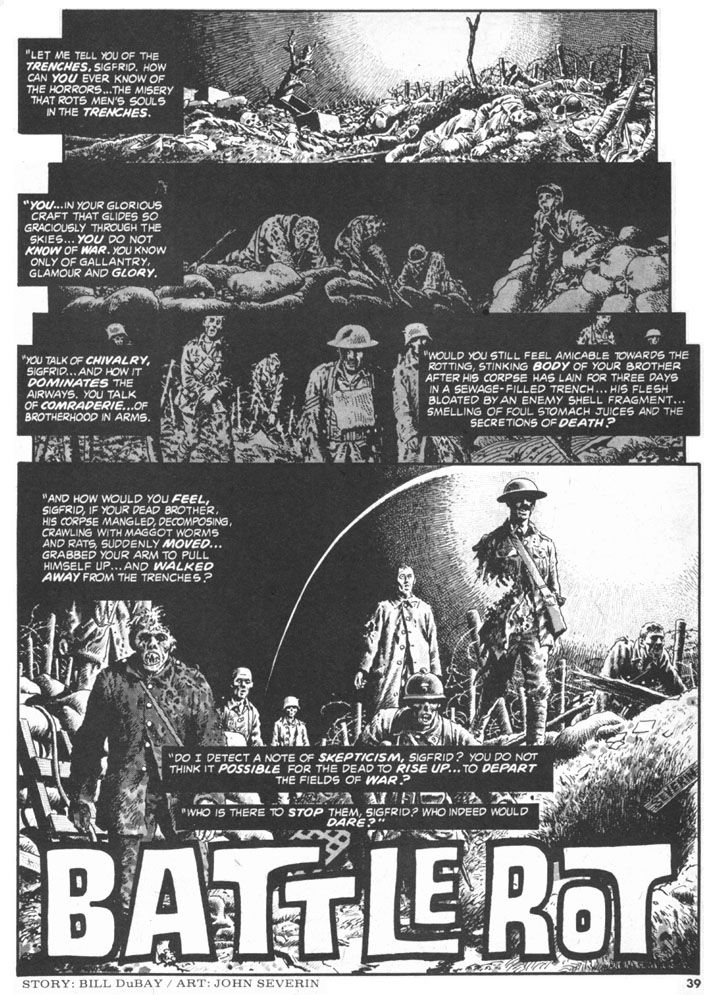
Personally, I'm sick of zombies.  Well, I thought I was, anyway.  Turns out I'm sick of zombies unless they're WWI soldier zombies drawn by John Severin.  Severin could draw anything.  Zombies, war comics, westerns, horror.  Horror-war.  This is the first page of "Battle Rot," a genre-bending tale from Creepy #81 (July 1976).  Written by Bill DuBay, it's the story of a German flyer who holds his ground-based fellow officers in contempt, especially when one of them starts rambling on about undead soldiers wandering around the trenches at the front.  Later, while villainously attempting to bomb a hospital, the arrogant pilot learns this story has its basis in fact.

"Battle Rot" would fit right in with DC's similarly themed Weird War Tales anthology comic.  The final page packs a wallop, and I was tempted to share it.  But I prefer the title page because it's just so haunting, evoking the climaxes of both versions of J'Accuse, the pacifist films French director Abel Gance (later a Petain supporter, unfortunately) made and re-made in 1919 in 1937 in which the war dead return; the earlier film features actual war footage and both have maimed veterans as the walking corpses, back to lay the blame for war on everyone equally.  All war is terrible, but WWI with its rolling artillery barrages, frontal assaults into fortified positions bristling with machine guns, mass gassings, filthy, diseased-ravaged trenches, No Man's Land full of unburied corpses and satiated rats must have been a special level of Hell unto itself.  Its mechanized, technology-based slaughter convinced a number of artists and writers life itself was absurd, was without no meaning and gave rise to Dadaism, an anti-art movement that's had a profound impact on my own sensibilities (I believe life is very meaningful, yet still absurd).  It would inform the horror genre in film and literature throughout the 1920s and 1930s as well, and we can extrapolate a similar reaction to the atomic bomb in the giant bug and lizard monster films of the 1950s.

Especially here in Japan.

Thursday, October 18, 2012

October is Spookey Month: "Pavane for an Undead Princess!" (Tomb of Dracula Magazine #5, June 1980)

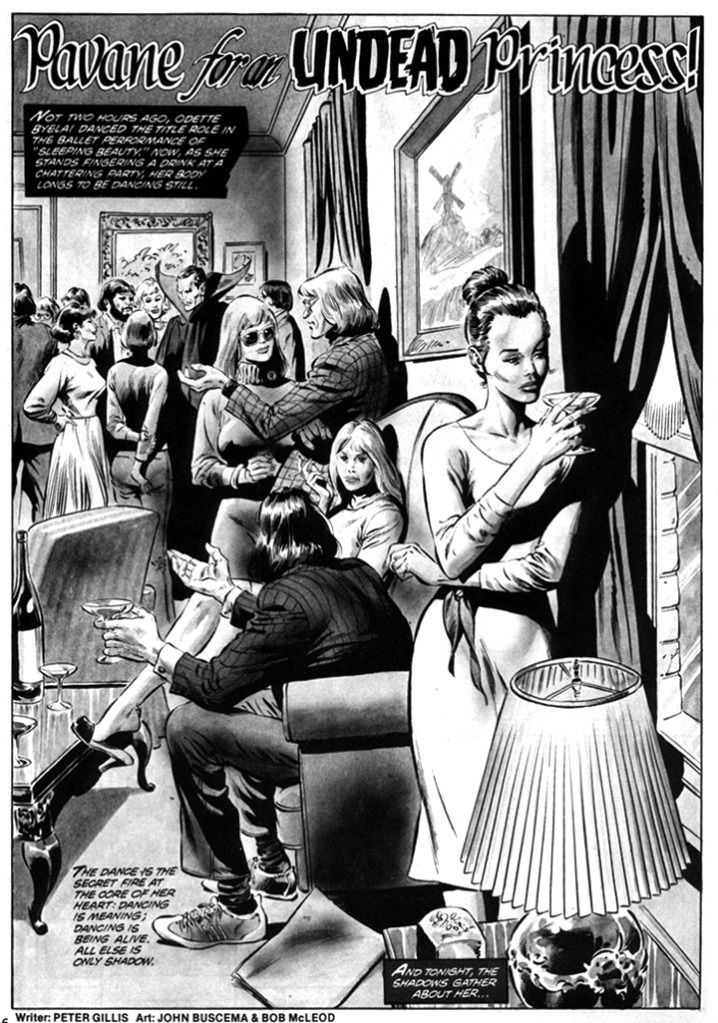
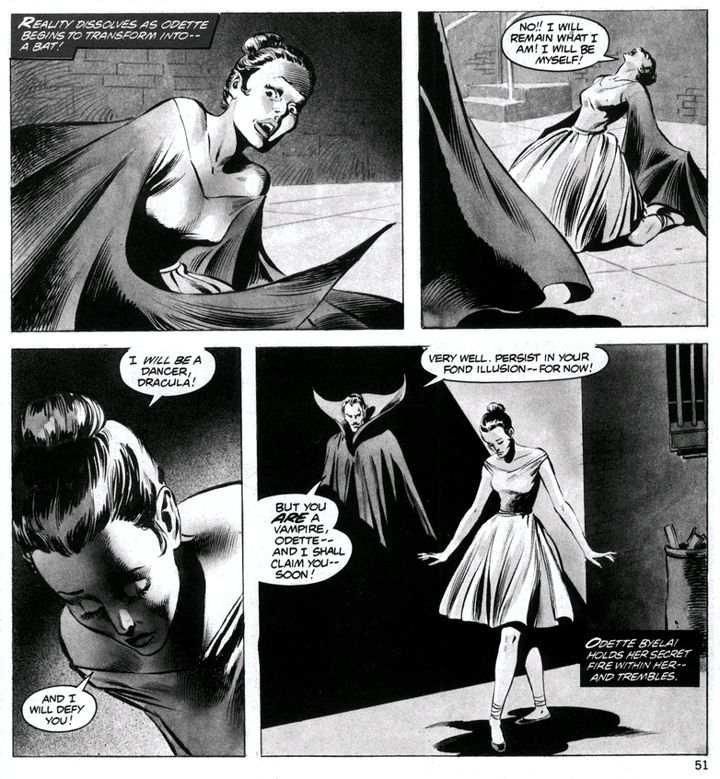
If it takes a soul to appreciate music truly and deeply, what happens when a prima ballerina, whose very being is dance and music, becomes a vampire?  That's the question brilliantly asked and answered in "Pavane for an Undead Princess!," which, despite its flaws remains a short, tragic gem.  Peter Gillis's story reminds me of a vampire Black Swan and I can easily see Natalie Portman essaying the starring role of Odette.

Yes, the ballerina character's name is Odette.

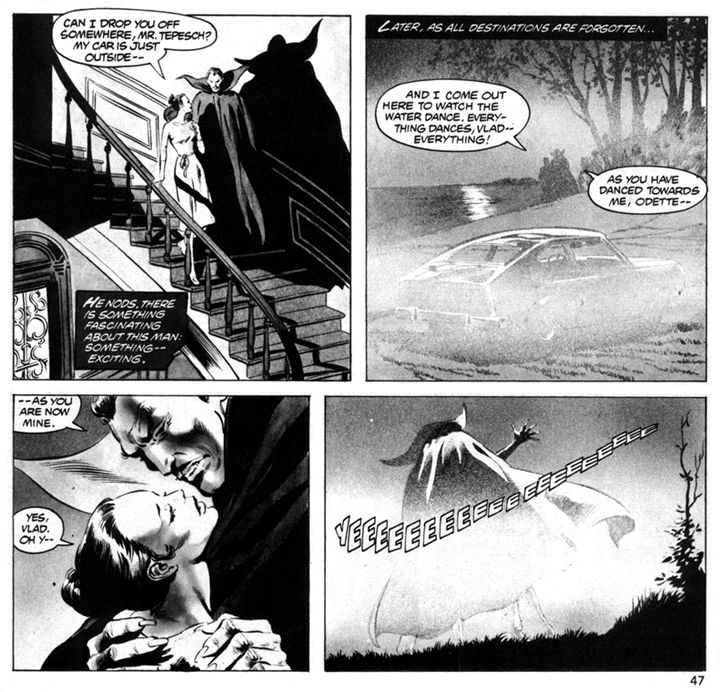
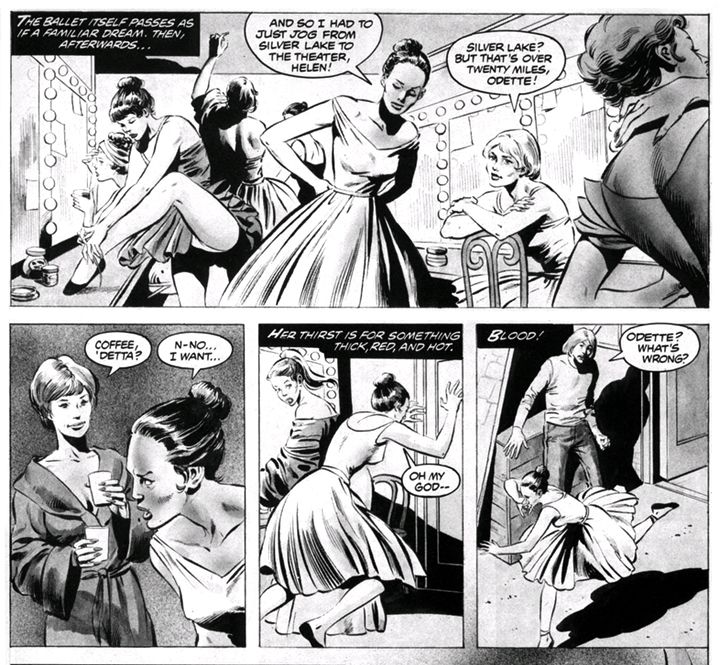
Odette, as Gillis tells us, lives to dance.  We first see her standing aloof against a windowsill, gazing moodily into the night.  She's not a snob or some sort of arrogant pseudo-princess.  It's that she can't even enjoy an after-party with her snooty artsy friends because her muscles "long to be dancing still."  Then she makes the mistake of leaving the party with a cloaked gentleman calling himself Vladimir Tepesch.  If only she'd spent more time watching In Search Of... and less time mastering her art, she might have avoided her fate-- waking up later in the woods with her car missing and having to run 20 miles back to the theater where Greg, the poor man's Alexander Godunov (who had defected from the USSR just a year before this story saw publication), gapes at her and wants to know where she's been for three whole days.  Remember those three days in case you ever find yourself in Odette's pointe shoes-- in classic vampire lore, the vampire's resurrection mocks Christ's; Gillis knows his stuff.

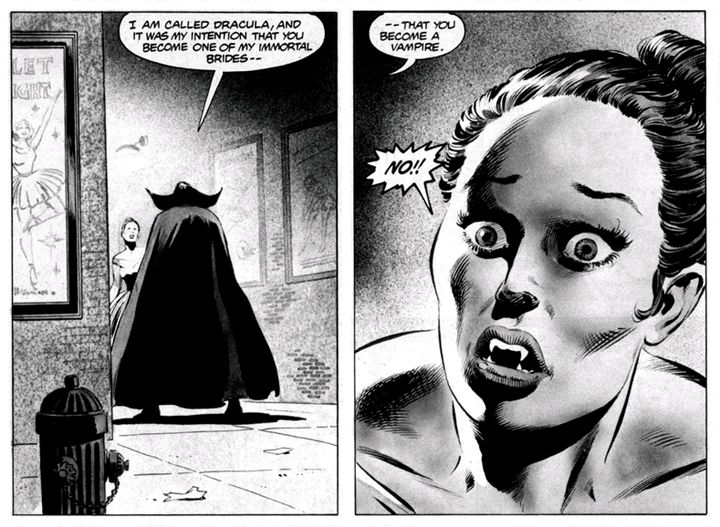
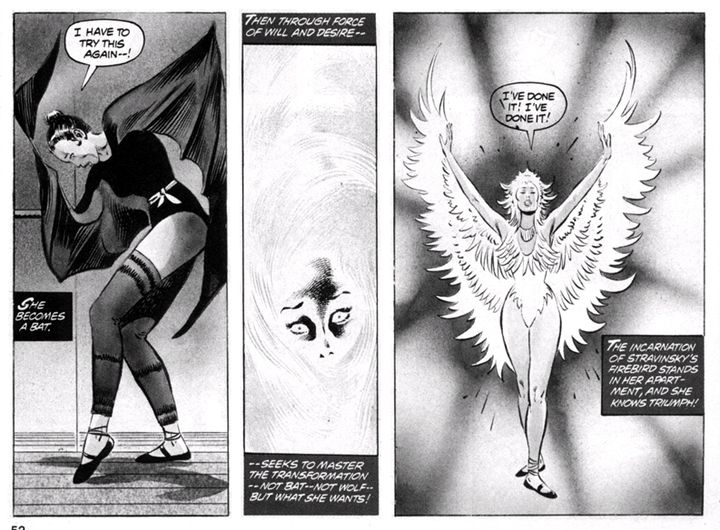
Anyway, Odette learns she's undead.  She refuses to accept it even when Dracula transforms her partially into a bat.  No, she has to spend her nights dancing rather than skulking around in the shadows sucking blood.  I'll have you know Isadora Duncan simply adored skulking and sucking.  But not our Odette.  She goes on an extended dance tour, then returns to her apartment and throws herself into practice, only to discover as a soulless monster she no longer has an ear for her favorite composers.  First Prokofiev, then Tchaikovsky devolve into "NOISE!  NOISE!  NOISE!!"  This is the kind of reaction that puts a bit of a crimp in your dance career.  Odette reminds me of some friends of mine who, when they turned 30, suddenly told me they couldn't relate to any of the new music and were becoming interested in blues and soft jazz.  In other words, "I'm old now, so I hate music."

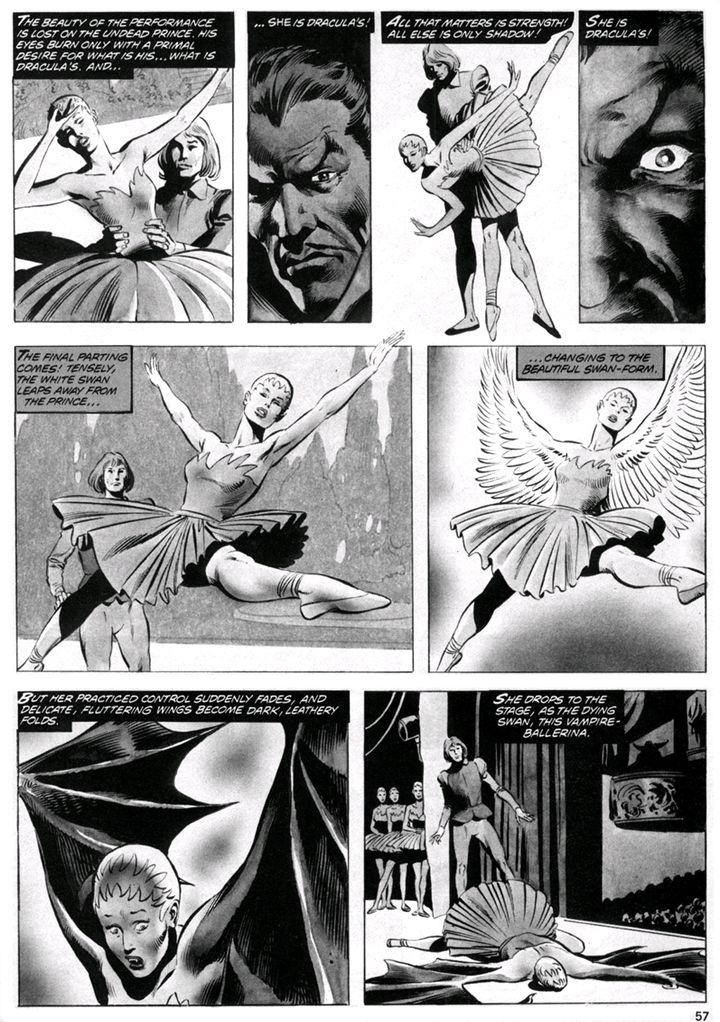
Actually, I'm a little puzzled as to how Odette was able to perform to their music for weeks before this breakdown.  Maybe this particular symptom of being a vampire takes a few weeks to present.  We never find out, but that's a relatively minor plot hole we have no time to investigate because Gillis quickly covers for himself with a brilliant inspiration, possibly the source image for the entire story:  Odette finds she can use her vampiric powers to morph not only into a bat but also into a half-swan... or even a full one.  She gets Anatoly (sounds like a Commie name if you ask me), her company's choreographer, to help her reconfigure great ballets into showcases for her amazing new abilities, but she can't escape the vampiric curse and it all ends pretty much the way Black Swan ended but with more self-impaling and none of the self-pleasuring.

And it also requires us to ignore that losing the spirit of music thing again, but maybe Odette comes up with some way to compensate.  Earplugs and strictly counted beats or whatever.  It's not as if music is all that important to dance, anyway.

While the page count reduces Gillis to telling rather than showing Odette's obsession with dance and her posthumous performance rebirth-- first a collage-like panel and later, after she starts using her metamorphic powers, a single panel with just the ballet titles-- the prima ballerina's plight still moves.  She's truly done nothing to bring this curse upon herself and then she's propelled along a tragic path similar to the characters she danced during life, damning herself in a moment of weakness and rage.  And ol' Dracula is a complete bastard.  He cares only for beauty only so much as he can possess it, but his touch inevitably corrupts and destroys.  Like the parasite he is, he'll move on to other victims.  But Odette loses more than her soul, and even her ultimate triumph is couched in death and her sad isolation from that which she loves most.

John Buscema provides his usual sold storytelling, largely confining his layouts to the three-tier format.  Each page is a little miracle of panel-to-panel continuity, but the real star here is Bob McLeod.

If I remember correctly, Buscema usually worked pretty loose and left a lot for the inkers to finish.  As a result, this art job looks a lot more like McLeod's solo work than a strictly Buscema job might, or one inked by Tom Palmer, Ernie Chua or even Big John's preferred partner, his brother Sal.  I've always admired McLeod's work on his solo efforts, and his figure construction and detail work-- such as how he deals with cheeks-- was always a bit Buscema-esque anyway, so they make a fine team here.  I don't know how much of the black-spotting Buscema indicated in his pencils, but McLeod's use of dark shadows pooling around the characters or climbing the walls behind them works wonders in creating a subtle menacing mood.  Dracula himself seems to loom out of darkness or carry his own shadows with him wherever he goes throughout this story, setting him somewhat apart as a malevolent force crawling up from Odette's own id as the vampire's power over her grows and distorts her life's work.  McLeod also lays down gray tones and creates lighting effects during Odette's transformations with what appears to be airbrush.  Reading some of these later Marvel mags, a lot of inkers seem to have been enchanted with the airbrush for tonal work as opposed to doing the traditional ink washes.  I wonder if there's some Richard Corben influence going on there, or if the airbrush lent itself to faster turnaround times, or perhaps a little of both.

Bob Mackie vampire.
Whatever the reason, the end result is lovely to look at.  A minor classic.  Kind of like that ballet I wrote back in 1994, Who's Watching the Kids, based on the 1978 NBC television comedy starring Caren Kaye, Linda Goodfriend and Scott Baio-- where Jim Belushi made his national debut.  I myself danced the Belushi role.  We would have taken it to larger venues but I pulled a calf muscle and we had to cancel the final performance.  After that, funding for the arts just dried up and it was back to working retail.  Now I'm prepping a ballet based on the Kaye-starring sitcom classic It's Your Move, where she played a scheming Jason Bateman's mom opposite Married With Children's David Garrison as her love interest.  La danse, c'est le mouvement, et le mouvement!

Thursday, October 4, 2012

October is Spookey Month: Johnny Craig's "... And All Through the House..."

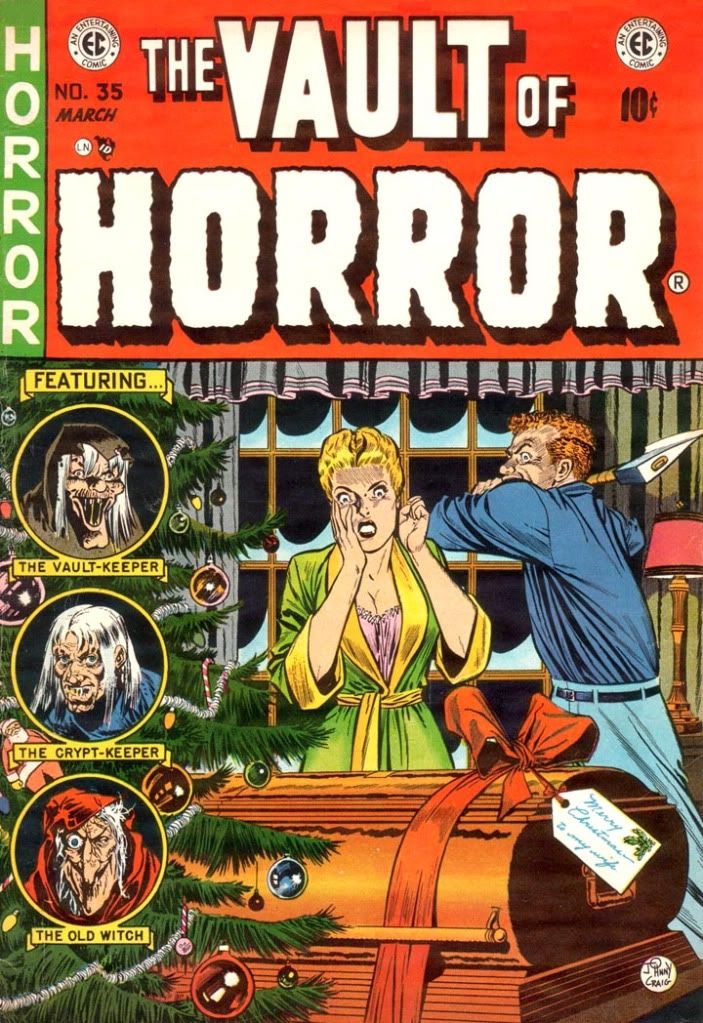
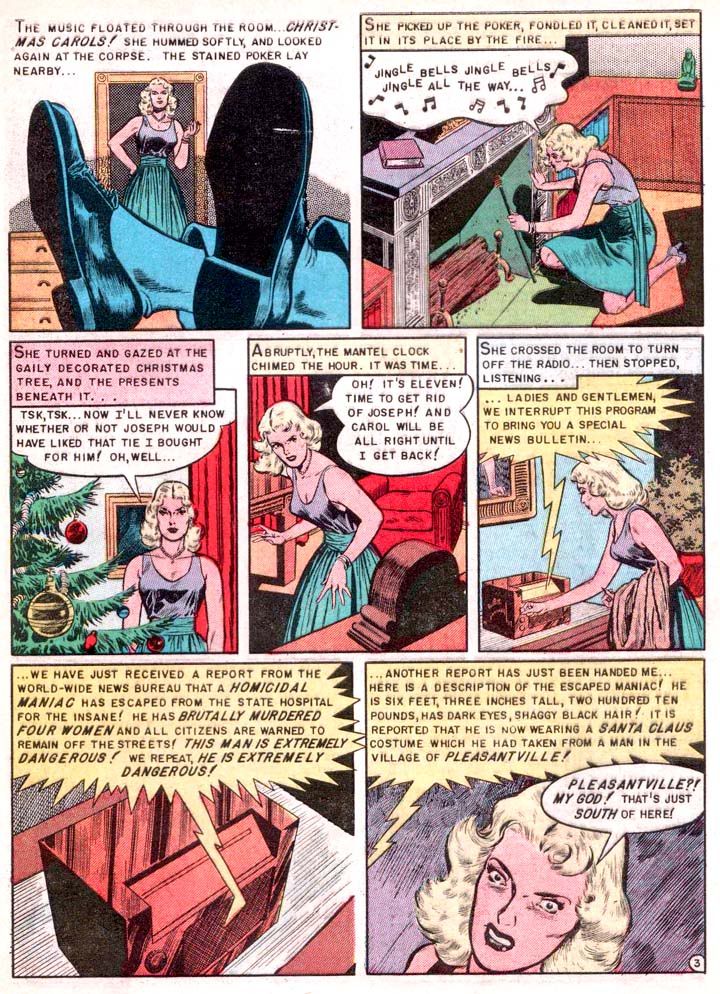
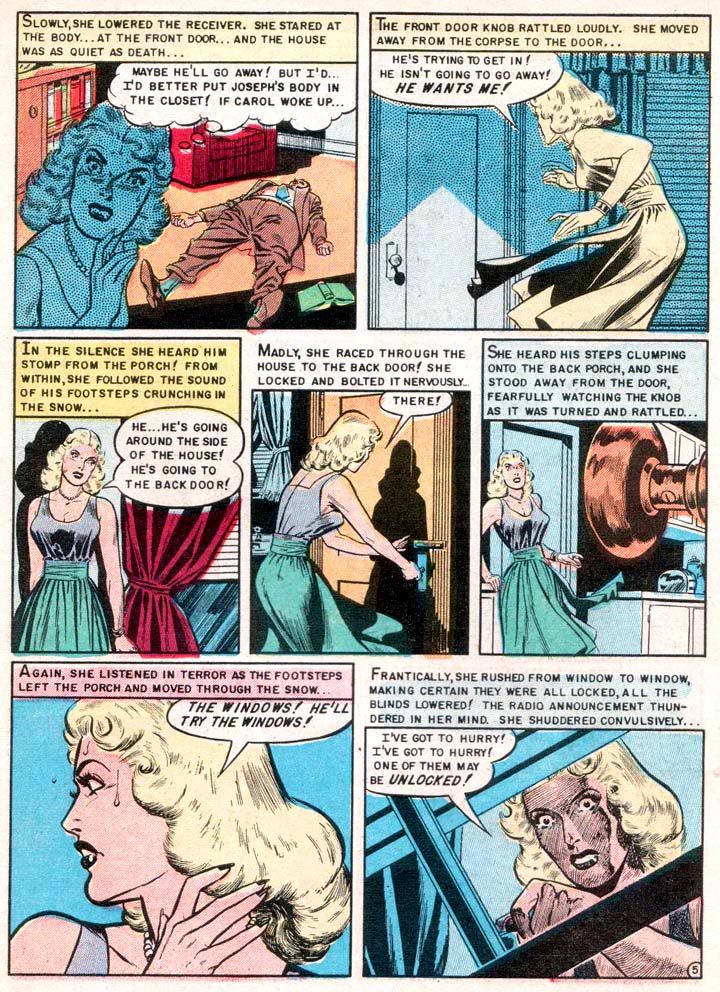
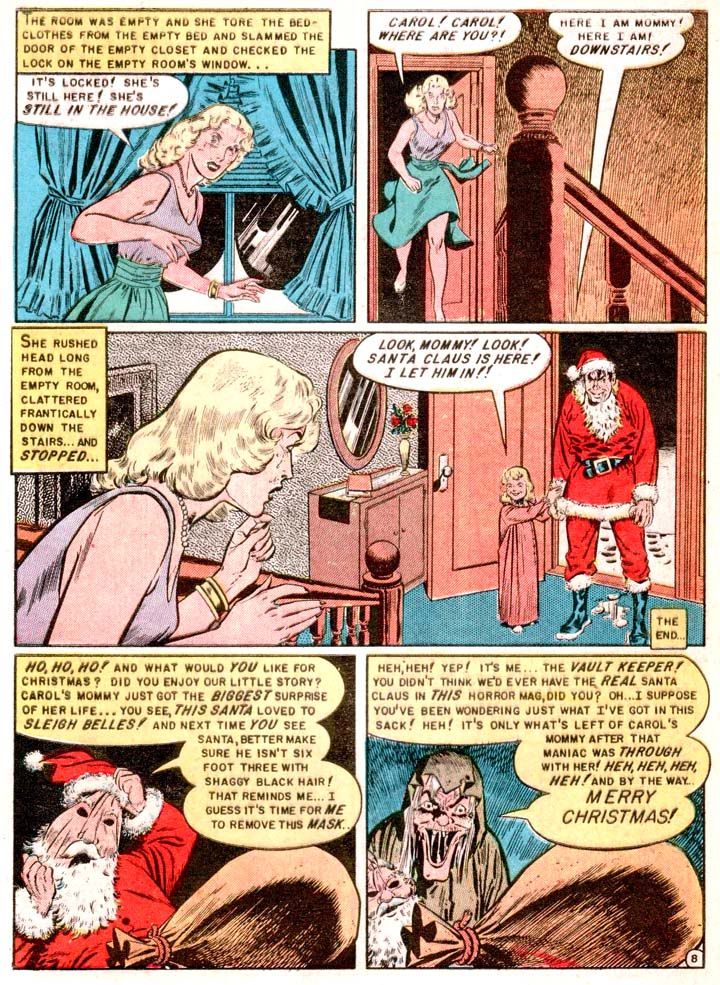
A few weeks ago we took a hard-hitting look at the 1972 Amicus Productions horror anthology flick Tales from the Crypt, specifically the segment starring Joan Collins, "... And All Through the House...."  It's a piece for which I won several journalism awards and received an offer to pen the film re-adaptation of the Dell Comics adaptation of the classic Andy Griffith service comedy No Time for Sergeants, which itself was an adaption of a stage play drawn from a novel.  Unfortunately, my dedication to this blog forced me to turn down that guaranteed six-figure paycheck in favor of fulfilling a threat-- er--- promise I made to you, my loyal reader.

So to that end, let's revisit Johnny Craig's original story from The Vault of Horror #35 (EC Comics, March 1954).  And here... we... goooo!

The film's version is a very close adaptation (they even kept the daughter's name the same, and the dialogue in scenes with her is almost word-for-word from the comic), but the Craig's story is pretty taut and doesn't lend itself to a lot of padding.  Sure, a few differences crop up here and there.  For example, the comic story is red white and blue in its all-American look at Christmas-related murder.  The movie transplants the story to the UK, where it gains Collins, with Sir Ralph Richardson as the Crypt-Keeper.  In the comic, the protagonist is a blond, while Collins is famously a brunette, a quality that would serve her and her stunt double well on ABC's night time soap opera Dynasty during the infamous Krystle-Alexis fight.  In the movie, the Santa-suit wearing madman throttles the Collins character for a violent comeuppance.  It's a movie and movies rely on action. Otherwise, they might just as well be photographs.  And instead of photographs, drawings.  Which brings us right back to comic books again, where it's just as effective to have un-jolly old St. Nick simply stand there in the final panel.  The reader's imagination supplies the killing.  Or, if you're of a less sanguinary persuasion, the murmured discussion followed by a night of gentle love-making.

Since there's not a lot to say about the story I haven't already written about at great length while blathering on in my usual sub-moronic way about the film, here are some choice moments from the comic.  Get ready to enjoy a little bit of Johnny Craig-style holiday cheer...

Tuesday, February 14, 2012

The Loomis sisters loom large of late...


You know the Loomis sisters, right?  Creations of that amazing comic duo, writer Mike Baron and artist Steve Rude.  Ring a bell?  You know, the Loomis sisters!  Stacy, Lonnie and Michana Loomis, beloved daughters of General Loomis.

We first meet them in Nexus #25 (First Comics, October 1986).  Much like today's developed or industrialized nations, the Web, the galaxy-spanning league of planets of which the Loomis sisters are citizens, requires vast amounts of energy and resorts to ever more dangerous means to gain it.  To meet this need, the Web government builds the Gravity Well, a vast Goldbergian machine that uses white dwarf stars to provide almost unlimited energy.  With General Loomis as its chief, the project comes at a cost:  the destruction of the Planet Periwinkle and its 500,000 sentient inhabitants.  Elvonic extremists attempt to assassinate Loomis to stop the Gravity Well, but Horatio Hellpop-- better known as the super-powered executioner Nexus-- gets there first.  Despite some misgivings, Nexus executes the general after promising to provide for his girls.

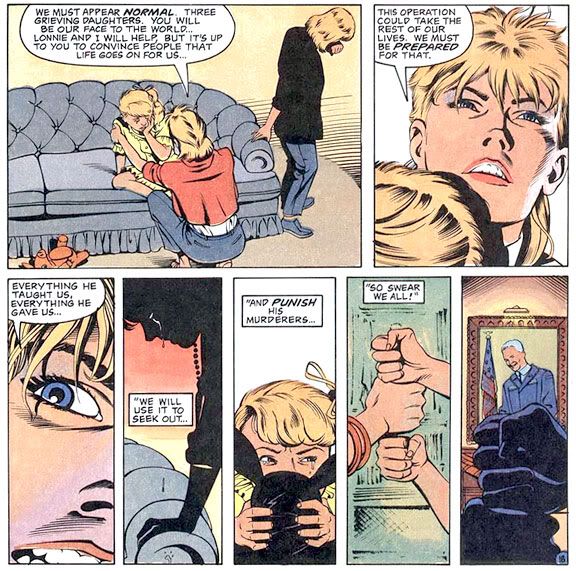
 Back home, the seemingly ordinary suburban sisters close ranks and vow revenge on their father's killer.  And symbolically, they make this pact in that homeliest yet blandest and most cliched of suburban settings, the living room.  Complete with a comfy sofa.

The trust fund he sets up for them and his guilty conscience aside, Nexus soon becomes the Loomis's target.  These kids are smart and it was only a matter of time before they realized who did the deed that broke their hearts.

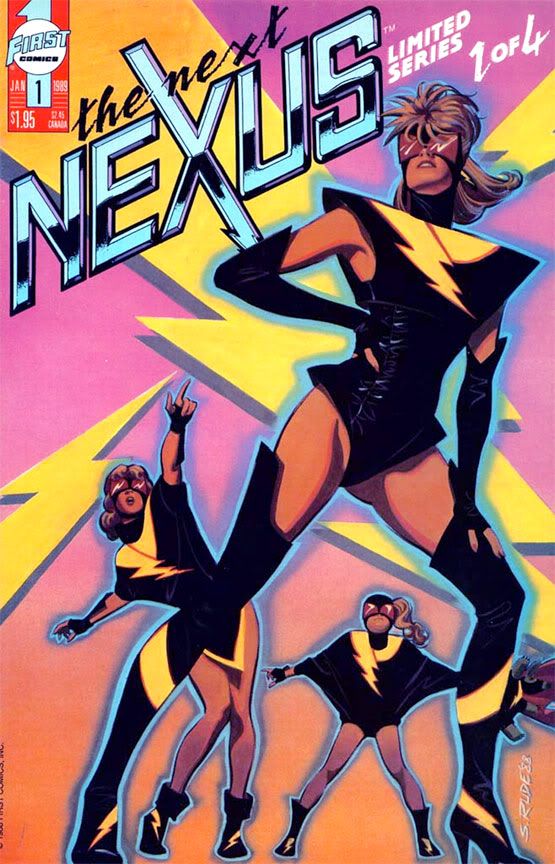
In The Next Nexus miniseries (First Comics, 1989), the sisters receive Nexus's power when he quits being the cosmic avenger for all of humanity.  Here Baron plays on the old theme of absolute power corrupting absolutely.  The ability to blast people and aliens into atoms has long troubled Nexus, so imagine if you will how it affects his greatest, youngest enemies.  Stacy becomes Ahab-like, conscience drives middle sister Lonnie from her siblings and Michana, the youngest, goes kind of batshit.

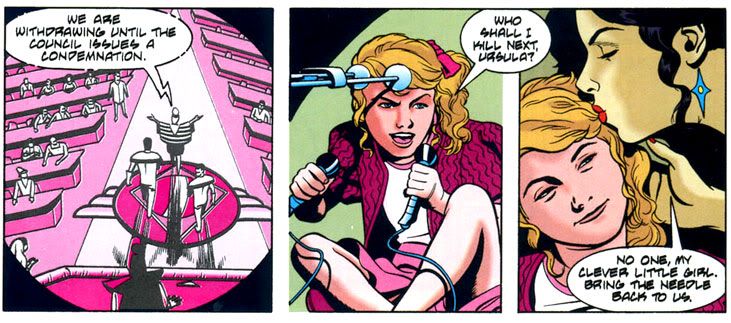
When Stacy and Michana finally meet a largely helpless and disillusioned Nexus, they have to fight Scarlett and Sheena, his own daughters by the delightfully formidable despot Ursula X.X. Imada.  It's classic generational warfare, a story as old as the concept of family itself.  This is how the crappy things parents do live on in their children, who repeat them, an object lesson in the way our past continually returns to us in a new shape that's really just a reflection of the old shape.

General Loomis is decent guy, an upstanding officer and widower devoted to his daughters.  He offers them stability and discipline with unconditional love, but unknowingly infects them with the darker aspects of his military profession.  Nexus kills mass-murderers, but struggles with self-recrimination as his own body count rises. Neither man can escape the consequences of his actions.  In the end, can any killing be redeemed by another?

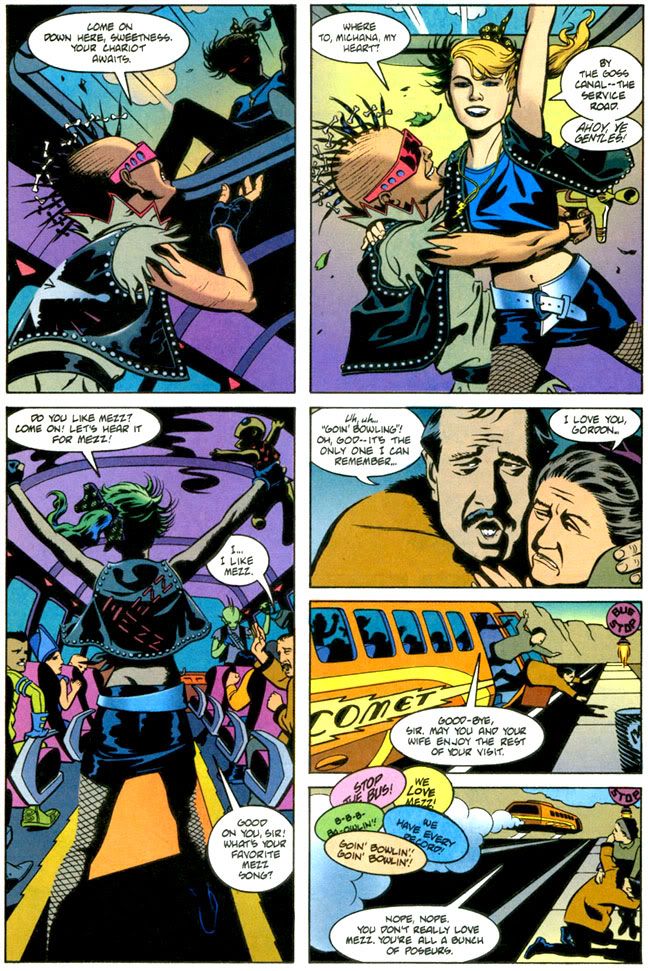
The Loomis sisters would suggest violence in response to violence only creates a cycle of destruction that corrupts as much as power.  Their revenge invites a change that would horrify the father they seek to honor, something especially embodied by Michana whose adorable exterior can barely contain her lust for destruction.  While Lonnie eventually settles into the life of a single woman making her own way in the world, Michana spends her childhood assassinating Ursula XX Imada's enemies and when she screws that up, runs a highly successful teen gang on a mass murder and armed robbery spree.

Angelically pretty, clothing herself in punkish leather and fishnets and toting around a small doll to which she's devoted (another symbol of her warped childhood, she communes with it for advice), Michana's a monstrously narcissistic Bonnie Parker and makes Hit Girl from Kick-Ass look like Cindy Brady.  She terrorizes ordinary citizens, enchants a dimwitted thug, bedevils Nexus, ends up in jail.  In Nexus Nightmare in Blue (Dark Horse, 1997), Michana resurfaces.

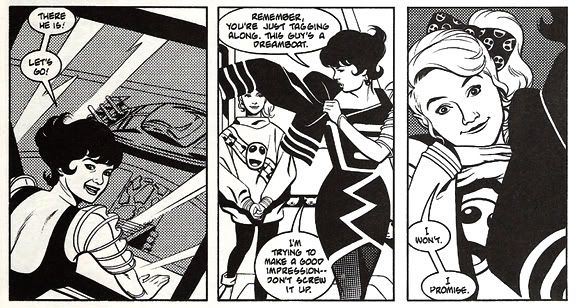
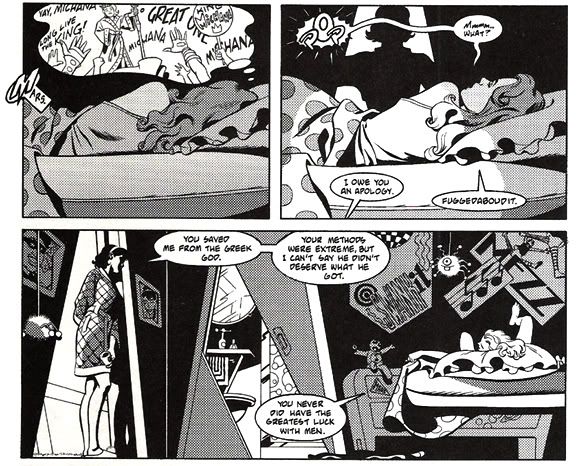
 Instead of violent mayhem, Baron involves her in an amusingly sitcomish digression from the main narrative, expertly drawn in all its domestic splendor by Rude.  While Nexus struggles to decide his next mission-- eventually turning to the readers for help-- the surviving Loomis sisters set up housekeeping on Mars.

Reconciling with her sister Lonnie, who now holds the somewhat pathetic yet imminently respectable job of "junior assistant to the mayor's secretary," Michana still dreams of power.  She drops the punk look and adopts the guise of a typical suburban teen, but sneaks out at night to indulge her wild side and meet up with a member of her former gang.  You get the idea it's only a matter of time before she cuts off someone's finger to get a ring.

Biding her time, Michana contents herself with helping Lonnie with her relationships, much to the detriment of sleazy Tom Cruise-lookalike Tom Zeus, a lawyer who specializes in something called "jewelry fraud."  Zeus turns out to be the kind of creepy perv who would sleep with an underage girl and video all his other sexual encounters.  Hundreds upon hundreds of them.  Wealthy, handsome, self-assured and not afraid to get his hands dirty helping out the bouncers of his favorite haunt, a stylish bar, Zeus has it all.  A smitten Lonnie breathlessly recites his possessions:  "A Lambo, a Slambo and a Pomerini GT," no doubt coached by Zeus himself.  I don't know what those things are, but they're probably expensive.  Zeus never fails to mention the pride of his fleet, a 250-meter S&J star cruiser that "sleeps twelve."

S&J, by the way, stands for "Sundra and Jil."  Sundra is Nexus's lover and Jil is her business partner in their very successful star cruiser venture.  A posh, arrogant ass like Zeus would only have a starcruiser from S&J.  The ultimate status symbol.

Zeus never ran into someone versed in military tactics, assassination, spycraft and crime of every type before, though.  Michana learned from the best; that Ursula is no joke and there's probably a bit of her father mixed in as well, plus Nexus.  In the aftermath, Lonnie tells Michana her methods are "extreme," but she's grateful to baby sister for putting Zeus in his place.  The Greek God will no doubt survive to seduce another night, but in the future he may be a bit wiser about how he does it and more honest with his partners.  We hope he learned his lesson well.

The ultimate lesson taught us by the Loomis sisters is you don't want to mess with the Loomis sisters.  Actually, you also don't want to mess with Ursula XX Imada or Scarlett and Sheena.

As Baron and Rude prepare a new Nexus story for Dark Horse, I can't help but wonder if Lonnie and Michana will make another appearance.  It doesn't seem all that likely, but one can always hope.

The Nexus cast consists of hundreds of characters, and the most recent storyline-- the "Space Opera" issues self-published by Rude's Rude Dude Productions-- mostly involve topical religio-political machinations and the birth of Nexus and Sundra's son Harry.  Nexus battles the shade of his father and the two weird little aliens who were his companions when he was a child, more of that recurring "sins of the parents" thread that runs through so much of Nexus.  That makes me think it's the appropriate time for some more Loomis action.

While Lonnie has forgiven Nexus, how can we be sure Michana has?  Various assassins have already targeted the newborn and he seems like a natural target for Michana Loomis.  She could continue to be a powerful enemy for Nexus.  She's deadly as all get out, but it doesn't seem likely the conscienced Nexus could equal Michana's amorality by killing her.  It would mean a powerful ending to her saga, one as horrifying as imagining the psychotic thoughts behind Michana's deceptively sweet countenance.  There's still a lot of unfinished business between her and Scarlett and Sheena.  On the other hand, maybe the influence of her big sister really does have Michana on the path to rehabilitation and redemption.  Or is Lonnie truly as upright as she appears.  Could she be hiding something herself?

I'm pretty confident Baron and Rude will wow us when the time comes.