As a teen she favored striped tops, loved her father and two sisters and was quite fond of cats. Lonnie Loomis, middle child extraordinaire, caught between the bossy, demanding eldest Stacy and the irrepressible, attention-seeking, somewhat psychotic, baby Michana. I don't get to read many psychological or psychiatric studies (just the abstracts and second hand articles), but from what I can gather Alfred Adler came up with this idea the order of your birth determines your personality
The first born is special, doted upon, grows up feeling closer to authority figures such as parents, becomes a leader. In the Loomis family, it's Stacy. She starts her siblings down the path of vengeance, then burns out. Literally. The youngest gets even more attention and sometimes ends up spoiled rotten. They become class clowns and show-offs. In Michana's case, they become child assassins for Ursula X.X. Imada, then head teen gangs on multi-planet crime sprees. What about the middle child? They make do. That's how you get a Lonnie Loomis. In any event, this is the simple version.
Poor Lonnie. Although her sisters love her, she's the only one among them to doubt their mission. She adored her father as much as Stacy and Michana ever did, but killing a lot of strangers for the alien weirdo the Merk in exchange for the fusion casting power of Nexus doesn't appeal to her. She's too compassionate and uncertain. Her attention wanders because she wants something of a normal life.
Introduced in Nexus #25 (First Comics, 000, 198-) alongside Stacy and Michana, Lonnie mourns the murder of her beloved father, General Loomis. They later learn his killer was the orginal Nexus, in Nexus #3- (000, 198-), and Lonnie is the one who spits in his face. Here's the sequence as illustrated by Mike Mignola, with inks by John Nyberg.
Soon, Lonnie begins actively voicing her doubts and opposition to Stacy's leadership as they risk Michana's life and sanity by holding a seance that allows the young girl to host what's apparently a demon in hopes of learning where to gain enough power to kill Nexus. From this moment on, Lonnie begins to drift from her sisters.
She's still involved enough to accompany them on their visit to the Merk. They arrive on --- in Nexus #3- (000, 198-), but it's in Next Nexus #1 where they actually confront the whimsical extra-dimensional alien and demand Nexus abilities for themselves. The gigantic Merk immediately chooses Michana to invest with these powers. It's a terrifying scene reminiscent of some of the darker elements from the 1971 children's film Willy Wonka and the Chocolate Factory starring Gene Wilder as Wonka. As we all know, the movie is all about obnoxious kids tempting fate and paying the price. And as powerful a figure as Willy Wonka is, he's also just a candy-maker. The Merk is beyond our reckoning. For a moment, one can only imagine what unspeakable horrors the Merk will visit upon fragile human child Michana.
What he does is casually toss her into one of the strange globular tanks Nexus bathes in to have his dreams and recharge his seemingly unlimited powers. Lonnie objects and this causes the Merk to punish her and Stacy with intense headaches. Michana saves her sisters by rebuking the Merk even as he holds her aloft by her ponytail. Lonnie then attempts to reject the Merk's gift outright, and he reacts by lashing out at her again. Michana defends Lonnie again, and the Merk transforms them into fusionkasters.
In the Nexus books, "fusionkasting" is the technical name for Nexus' superpowers, and what a Nexus does is kill mass murderers. This never sits well with Lonnie. Even series hero Horatio Hellpop himself alternates between acceptance and avoidance of his appointed task, and there's the question-- voiced by Lonnie-- of whether or not an alien such as the Merk has the right to judge humanity. Michana argues his alien nature makes him more objective and therefore more qualified for this than humans themselves. Stacy and Michana accept their charge and perform their first killing. They are in effect assassins in the hire of the Merk, a creature whose behavior is erratic at best, and their new powers corrupt them almost at once.
Lonnie adopts a cat against her sisters' wishes and refuses to join them on their vendetta. In a chilling scene, the pair confront Lonnie and cajole her into throwing the cat out the window. At this point, the break between siblings becomes inevitable. While Lonnie pursues a questionable relationship as a way out, the other two court disaster by confronting Nexus himself. With this, Lonnie drops from the narrative until ---- (Dark Horse, --- 199-).
Michana, now a murderous teen and gang leader (after having served an apprenticeship as an assassin under the tutelage of arch-villain Ursula X.X. Imada), ends up arrested and it's Lonnie who assumes custody of the wayward girl. What follows is a hilarious romantic misadventure in which a Tom Cruise lookalike named Tom Zeus (just to make it plain just who Mike Baron and Steve Rude are satirizing) puts some all-too-smooth moves on Lonnie. Feeling protective of her more naïve older sister, the more worldly Michana does her thing.
Her thing involves dressing like a ninja and using a paralyzing poison on Zeus.
What next for good ol' Lonnie? As far as I know, she hasn't reappeared in Nexus, which ended a long hiatus to reappear first as an offering from Rude's own Rude Dude Productions and then as a recurring feature in the new Dark Horse Presents ongoing. Baron and Rude haven't seen fit to update readers on all things Loomis, but it's only a matter of time. Let's hope she finds some kind of happiness.
But not too much.

Showing posts with label great characters. Show all posts
Showing posts with label great characters. Show all posts
Friday, January 30, 2015


Thursday, January 9, 2014
Whatever happened to Josie's friend Pepper?
They were perfect for rainy days during beach trips or keeping my imagination occupied during my oldest brother's weekend baseball tournaments, which meant getting up before sunrise, six-hour car rides, broiling days at ballparks and nights with the entire family crowded into a single motel room. As the youngest in the family, I had no choice in the matter so I, too, became a baseball migrant. Archie Andrews and his gang, with an occasional appearance by their friend Sabrina, the Teen-Aged Witch, helped me survive those summers.
Archie was a pal, Sabrina an acquaintance... but Josie and her band were something else entirely. They were a personal phenomenon. While I enjoyed the ever-popular boy redhead who provided a name for their publishing company, I was an even bigger Josie and the Pussycats fanatic back then. I was completely in love with Josie, Melody and Valerie. There was something more appealing about Josie and her musical adventures, some quality that really captivated me above and beyond either Sabrina's witchcraft or Archie's misadventures.
I'm referring to the TV cartoon here. Because the tragic thing is, I don't think I ever dared step outside of gender-segregated reading to own a single issue of anything with Josie's name on the cover. I watched the TV show every Saturday we were home, but I was too insecure about my gender expression as a sports-averse artsy-fartsy kid to dare buying the actual comic. Therefore, despite how important the television series was to my early childhood and how influential, my present knowledge of Josie's backstory and her cast of characters is sadly lacking.
I can sing the hell out of the show's theme song, though!
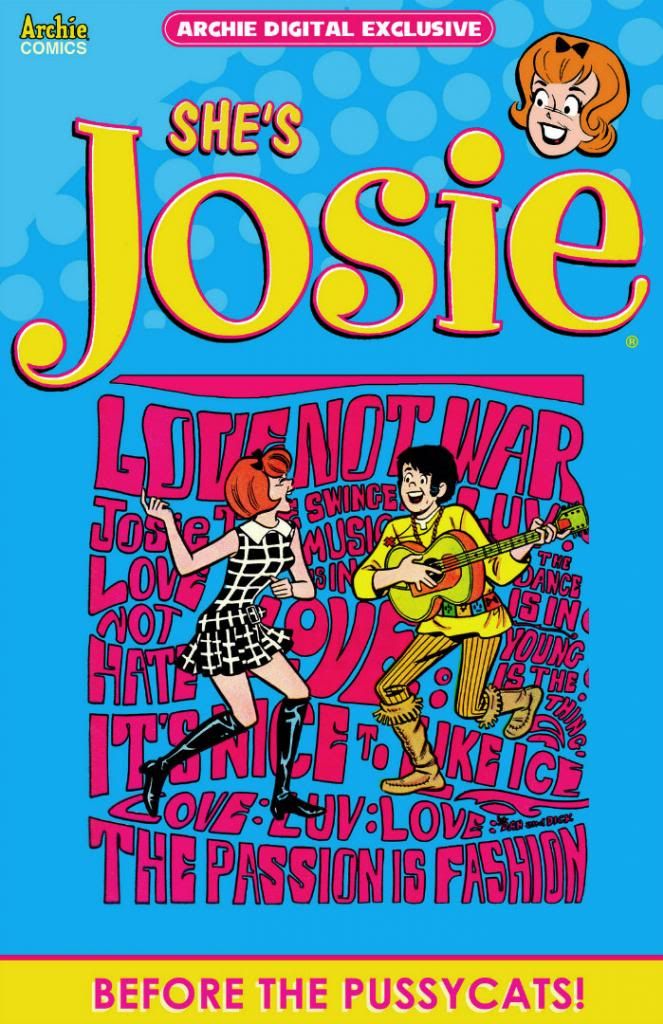
Well, times have changed, and help is here because Archie Comics just released She's Josie, an all-digital 100-page collection of Josie stories before the rock-and-roll storyline made the character a childhood sensation. At $3.99, just like its supermarket check-out line dwelling ancestors, it also provides some major entertainment bang for buck, especially compared to the similarly-priced new superhero angst that takes about five minutes to read being put out by a couple of larger companies I could name.
And there's no denying the power of that black and white checked minidress and stacked boots outfit Josie's sporting on the cover. That is some full-blown 1960s fashionista magic. The outfits inside are all pretty spectacular, too, and they should be since they're largely drawn by the masterful Dan DeCarlo.
 | |||
| She's Josie #1 (February 1963); script: Frank Doyle; art: Dan DeCarlo and Rudy Lapick |
While the cover flaunts the psychedelic looks of a few years later, throughout these stories Josie and Melody sport some adorable and hip Kennedy-era girl threads. You know-- Patty Duke as identical cousins and Mary Tyler Moore on The Dick Van Dyke Show. Leg hugging capris and white canvas sneakers. Stuff like that. And Josie bops around with a bouffant variation on the Jackie Kennedy flip, all Connie Stevens or Sandra Dee with a cute black bow. But the coolest clothes have to be the ones worn by Josie's friend, Pepper. She rocks a prep school look with a v-neck sweater and plaid skirt ensemble which she improves by adding cat-frame glasses and knee socks. Today's so-called hipsters have nothing on her.
The best part about Pepper is she's not just a smart dresser-- she's also a smart-ass who's already fighting the battle of the sexes years before it became the basis for a full-blown political movement. With Melody all but oblivious to her effect on boys and Josie occupying the middle ground, Pepper demonstrates an awareness and a willingness to comment directly on gender roles and expectations. You can easily imagine Betty Friedan in her personal library at home and maybe a bootlegged copy of Sylvia Plath novel that wouldn't see publication in the US until 1971. Or that she even has a personal library (actually, so does Josie, as evidenced by the sequence in her bedroom that leads off this collection). Armed with this knowledge, Pepper provides wry, knowing commentary throughout, contrasted with Melody who creates chaos wherever she goes but blitheringly chalks it up to the boys being clumsy. Pepper would certainly experience an expansion of her social and gender consciousness as she travels through the rest of the Sixties. Pepper would have involved herself. She would have been the woman asking, "And what did it do for the consciousness of the chick?"
Okay, that's a obviously a flight of fancy. More than likely, if she'd made the transition to music star with the rest of the cast, Pepper would have continued to provide the same (very) mildly subversive presence she does in these stories, a vehicle for the comic to address changing times in a shallow way, kind of like how Bewitched, The Beverly Hillbillies or even The Brady Bunch would spend an episode clowning around about "women's lib" by having some kind of boys versus girls or women versus men competition where everyone learns a very soft lesson about how we all need to get along and play fair so we can make babies together. Still, I can't help but lament the creative team gave Pepper the axe when the book made the transition to hard-rockin' Josie and her music industry/crime-fighting career.
The least they could have done was spin her off into her own title. She's Pepper.
NOTE-- Not long after posting this, I actually bothered to do a little research and found a very informative and well-written article about Pepper and how and why Archie dropped her. It only serves to make me wish we had more stories about Pepper in the 1970s, or Pepper today.
Thursday, November 21, 2013
Dani Moonstar versus Sarah Rainmaker (or How I learned to stop worrying and love Gen13)
Epitomizing 90s fluff, Gen13 was a kind of MTV Real World look at superheroics on one hand, an excuse for near-nudity and fart jokes on the other, and just some guys good-naturedly riffing on their favorite New Mutants and Uncanny X-Men storylines, plus throwing in a Trent Reznor clone as a villain for good measure on the third. Or one of your feet, if you're not an alien or mutant creature. Outrageously derivative, cluttered with pointless storylines that go nowhere, at times little more than a vehicle for J. Scott Campbell's "good girl" art-- and also so light and breezy entertainment I couldn't get enough of, so much so I even wrote a fan letter. That's something I had done only once years before, to the fine folks responsible for making Sgt. Rock.
And a lot of other readers felt the same way, at least for a while, because Gen13 inspired Gen13 Bootleg, a spin-off series with stories and art by the likes of Alan Davis, James Robinson, Walt and Louise Simonson, Adam Warren and even a two-issue miniseries by Adam Hughes which I think of as a largely forgotten near classic. No less than Warren Ellis himself took a hand at writing the team's adventures in one regular series annual and one for Bootleg. Image/Wildstorm also published DV8 and a number of mini-series. Then the fun stopped. Writer Brandon Choi and Campbell decamped and new creative teams came aboard. They tried to use the comic's powers for good, but its zeitgeist had passed and subsequent attempts at revival in the years since have failed.
But back in those days, most Gen13 readers wanted to read about super-strong, super-smart, super-bodied team leader Caitlin Fairchild and the various ways she would lose her clothes, the "youngest and spunkiest member of the team" Roxy Spaulding and gross-out comedic relief -- with a code name dated even then-- Percival Edmund "Grunge" Chang. There was also Bobby "Burnout" Lane, who had kind of an emo personality and a soul patch but otherwise made little impression on anybody.
But I, being forever contrary, preferred little-regarded Sarah Rainmaker, who was slightly more popular than Burnout only because, well, the main purpose of Gen13 wasn't beefcake. I liked her because the creative team didn't seem to, and because she was more than a little similar to my beloved early-teens hero Dani Moonstar. I mean, besides both being Native Americans.
Poor Sarah Rainmaker. The original writers used her mostly as a straw-figure to mock feminism, campus activists and also to do a bit of that MTV-style "amorphous sexuality tease aimed at hetero boys" stuff that later made such a star of Kate Perry. But written sympathetically by Hughes in Gen13: Ordinary Heroes a more interesting, deeper character comes through and makes me wish they'd tweaked Rainmaker in the monthly to something a bit less... well... insulting. Sometimes they did. Often they didn't. Anyway, maybe what I really I liked all along was this alternate Hughes-inspired version of Sarah Rainmaker I had in my mind. One more righteous and less of a strident punching bag with a lot of "Take that, Political Correctness!" dudebro-humor wear and tear.
Still, if you're going to do your own version of The New Mutants, of course you're going to do your own version of that book's most vital character and obvious star. You know who I'm talking about from the title of this post, so with no further ado, here are some Dani Moonstar moments echoed by Sarah Rainmaker.
1. Fabulous footwear. In Marvel Graphic Novel #4 New Mutants (September 1982), Dani makes damn sure Professor X recognizes not just her individuality but her cultural heritage by accessorizing her one-size fits all uniform to something more unique. The Gen13 kids received their own super suits right from the start, but obviously Rainmaker was paying attention when Dani set a precedent. Because I'm about as Native American as Vladimir Putin, I have no idea how appropriate Rainmaker's boots are-- Dani is Cheyenne, Sarah is Apache and those are two distinct cultures-- but I do know when things look similar because I watched Sesame Street growing up.
Dani:
Sarah:
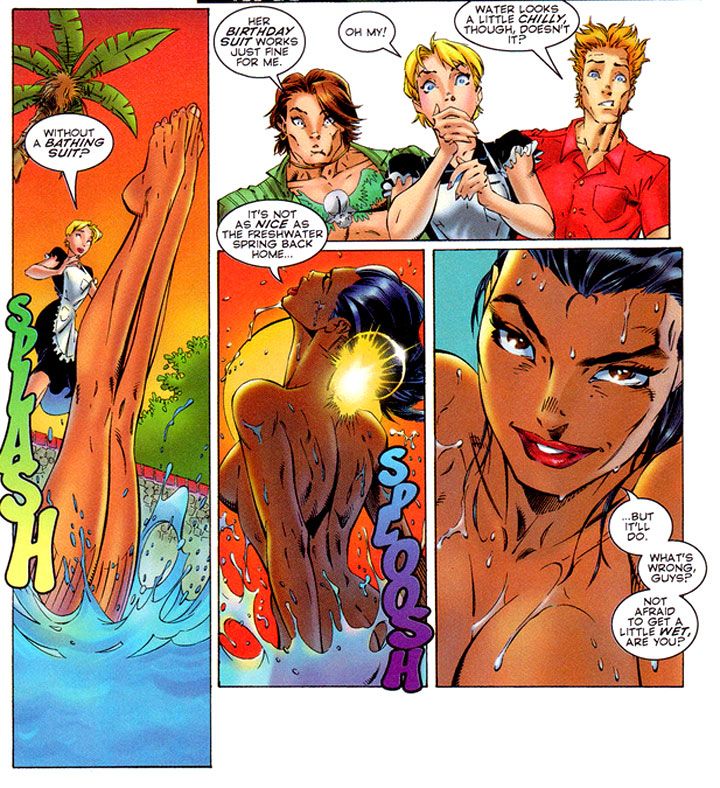
2. Swimming nude. Dani makes a point to swim au natural in New Mutants #3 (May 1983) and Rainmaker follows (birthday) suit in Gen13 #1 (March 1995). Chris Claremont treats this moment seriously and tastefully and it leads to a revealing (personality, not body) moment between Dani and her friend Xi'an Coy Manh where they bond and we get to know both of them better. When Rainmaker takes a dip, Choi and Campbell play it as a striptease and while we do get to know a little more about the cast from this (Sarah likes to show off, the guys are pantingly hetero-sexist), the characterizations are roughly at the level of a beer commercial.
Dani:
Sarah:
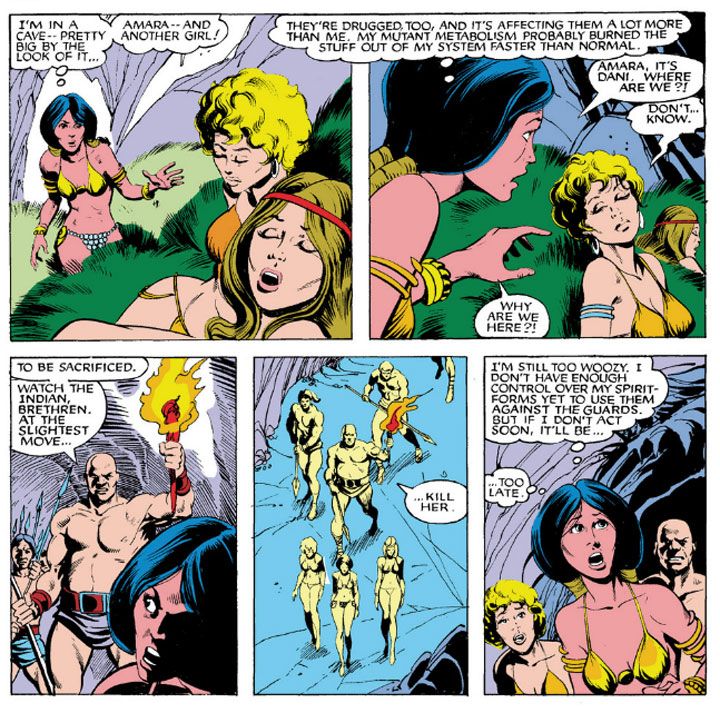
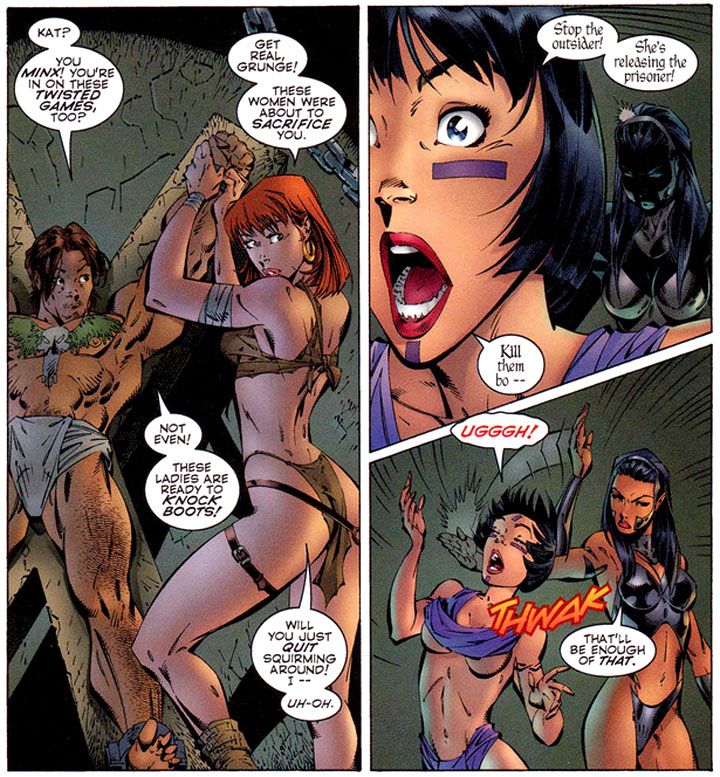
3. Jungle adventures with anachronistic cultures that result first in wearing rags and then even more revealing outfits. In New Mutants #8 (October 1983), the kids travel to the Amazon rainforest, have a lot of misadventures in which Dani first has to wear a swimsuit and then torn clothing. When she and the rest of her team end up in Nova Roma, a hold out from the days of Imperial Rome, they adopt cultural-appropriate clothing. Then a sorceress shows up and tries to sacrifice Dani, which requires her to wear a chain-mail bikini outfit stolen from a Red Sonja comic and then a low-cut evil sorceress gown. When the Gen13 gang takes a similar journey to Africa in issues 3 through 5 of their comic (July-October 1995), they come across an all-female society of supermodel Amazonians who favor skimpy metal swimwear of their own. Rainmaker quickly goes from ragged prisoner to shiningly metallic masturbatory fantasy warrior before you can say "Psyche-Mirage-Moonstar-Spellbinder-Dark Rider."
Dani:
Sarah:
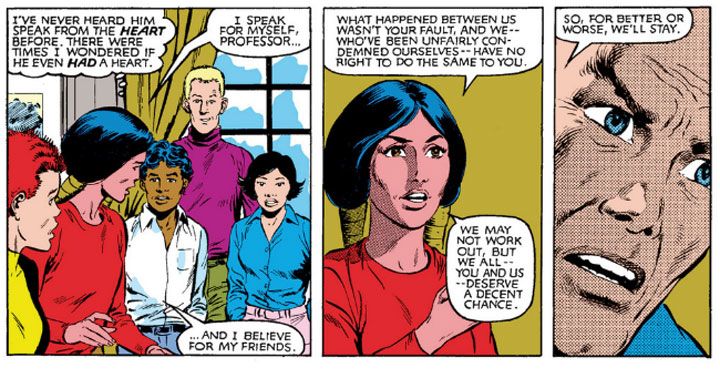
4. That leadership thing. Despite being a year or two younger than Sam Guthrie, the more capable Dani quickly takes over the top spot in the New Mutants team after first leader Xi'an Coy Manh goes missing. In fact, she's already pushing Xi'an out of the top slot as early as New Mutants #4 (June 1983), with her friend standing right beside her! When leader Caitlin Fairchild temporarily quits, Rainmaker makes an attempt to do the same in Gen13 #12 (August 1996), only to have mentor John Lynch (supposedly this ultra-tough black ops veteran) appoint his own dopey son over the smarter, more mature and combat-skilled Rainmaker in what's obviously a decision based solely on nepotism. Burnout has shown absolutely zero leadership skills to that point, and kind of a mopey, shrinking-violet personality, while Rainmaker's intelligence is second only to Caitlin's, plus she's much wiser and more self-assured in many ways. No wonder she reacts unfavorably to Lynch's completely illogical move (although in Lynch's defense, he may be pitting the two against each other in a "survival of the fittest" competition-- although that could also wreck team morale and field effectiveness in the long run as well, so maybe he is an idiot after all). This also positions Sarah as the Dani-style team rebel. In the same vein, both characters seem to have an innate talent for combat tactics, as well, with the New Mutants becoming more of a fighting force to be reckoned with under Dani's command, and with Sarah frequently barking out orders of her own during the many confrontations in Gen13.
Dani:
Sarah:
5. Tussles with teammates. I seem to remember Dani doing this a lot more, but I must be more than a little mixed up and fully conflating her with Sarah at this point. I'm surprised Dani didn't beat up those two idiots Sam and Bobby two or three times a day with that temper of hers. Instead, she seemed to take out her aggressions more on inanimate objects. And despite frequently referencing the martial heritage of her Cheyenne people, she wasn't all that adept at fighting. Oddly enough, in New Mutants #1 (March 1983), it was Xi'an who first went fisto-a-fisto with Dani-- well, actually, she choked the hell out of Dani and slammer her head against the floor with good reason: Dani had accidentally used her powers to pull images of her Xi'an's violent, tragic past out for all to see. While the New Mutants had their share of inter-team arguments, it would be more than a year later, in New Mutants #14 (April 1984), before we'd see another instance of Dani-on-friend violence, this time a playful shove into the snow for Roberto DaCosta. Sarah, on the other hand, goes full on kung fu queen on Bobby Lane after he made a poorly-timed snide remark at her expense during their leadership crisis. It happens in Gen13 #12.
Dani:
Sarah:
Okay, now I'm obviously reaching. But I believe I've made my point-- there are certainly parallels, enough so Sarah Rainmaker became my favorite Gen13er. What's been fun for me looking for these little moments is contrasting the writing on both series. While Claremont's dialogue is sometimes stilted and a bit advanced for his characters' ages, his stories and characterizations are nothing if not sincere. He genuinely cares about his cast and immersing the readers in their world. Plus he displays the literary chops of a true writer's writer, someone in love with language. If any of his work here is derivative, it's of real life or novels. And occasionally movies.
By comparison, the Gen13 characters-- scripted by no less than two writers at a time!-- usually speak casually and naturally (unless there's need for some hard expository dialogue, that is). Actually, their dialogue is almost exclusively made up of then-current catchphrases and youth lingo. While as individuals they're amusing enough, they're more tongue-in-cheek, broadly-sketched types owing most of their personalities to television shows and other comics (and not just New Mutants).
There are some interesting comic book characters in Gen13, but it would take other writers to flesh them out into real characters, especially under Warren who managed to make the book as smart as it was funny and sexy. And, oddly enough, that's when the Gen13 finally died.
And a lot of other readers felt the same way, at least for a while, because Gen13 inspired Gen13 Bootleg, a spin-off series with stories and art by the likes of Alan Davis, James Robinson, Walt and Louise Simonson, Adam Warren and even a two-issue miniseries by Adam Hughes which I think of as a largely forgotten near classic. No less than Warren Ellis himself took a hand at writing the team's adventures in one regular series annual and one for Bootleg. Image/Wildstorm also published DV8 and a number of mini-series. Then the fun stopped. Writer Brandon Choi and Campbell decamped and new creative teams came aboard. They tried to use the comic's powers for good, but its zeitgeist had passed and subsequent attempts at revival in the years since have failed.
But back in those days, most Gen13 readers wanted to read about super-strong, super-smart, super-bodied team leader Caitlin Fairchild and the various ways she would lose her clothes, the "youngest and spunkiest member of the team" Roxy Spaulding and gross-out comedic relief -- with a code name dated even then-- Percival Edmund "Grunge" Chang. There was also Bobby "Burnout" Lane, who had kind of an emo personality and a soul patch but otherwise made little impression on anybody.
But I, being forever contrary, preferred little-regarded Sarah Rainmaker, who was slightly more popular than Burnout only because, well, the main purpose of Gen13 wasn't beefcake. I liked her because the creative team didn't seem to, and because she was more than a little similar to my beloved early-teens hero Dani Moonstar. I mean, besides both being Native Americans.
Poor Sarah Rainmaker. The original writers used her mostly as a straw-figure to mock feminism, campus activists and also to do a bit of that MTV-style "amorphous sexuality tease aimed at hetero boys" stuff that later made such a star of Kate Perry. But written sympathetically by Hughes in Gen13: Ordinary Heroes a more interesting, deeper character comes through and makes me wish they'd tweaked Rainmaker in the monthly to something a bit less... well... insulting. Sometimes they did. Often they didn't. Anyway, maybe what I really I liked all along was this alternate Hughes-inspired version of Sarah Rainmaker I had in my mind. One more righteous and less of a strident punching bag with a lot of "Take that, Political Correctness!" dudebro-humor wear and tear.
Still, if you're going to do your own version of The New Mutants, of course you're going to do your own version of that book's most vital character and obvious star. You know who I'm talking about from the title of this post, so with no further ado, here are some Dani Moonstar moments echoed by Sarah Rainmaker.
1. Fabulous footwear. In Marvel Graphic Novel #4 New Mutants (September 1982), Dani makes damn sure Professor X recognizes not just her individuality but her cultural heritage by accessorizing her one-size fits all uniform to something more unique. The Gen13 kids received their own super suits right from the start, but obviously Rainmaker was paying attention when Dani set a precedent. Because I'm about as Native American as Vladimir Putin, I have no idea how appropriate Rainmaker's boots are-- Dani is Cheyenne, Sarah is Apache and those are two distinct cultures-- but I do know when things look similar because I watched Sesame Street growing up.
Dani:
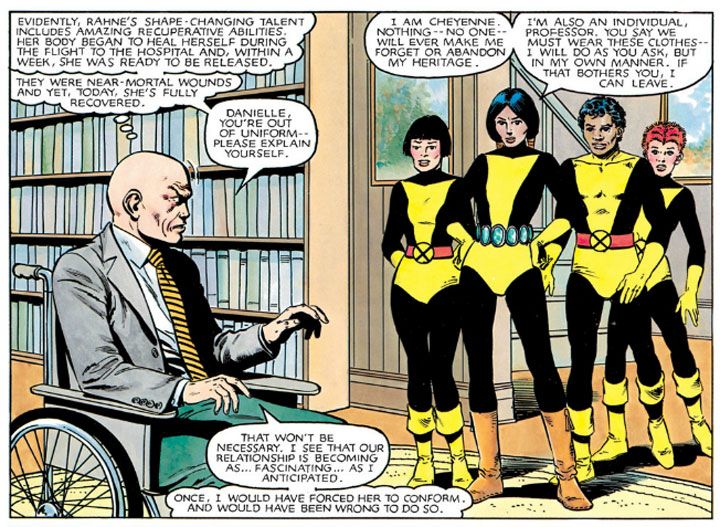 |
| Marvel Graphic Novel #4: Script by Chris Claremont, art by Bob McLeod |
Sarah:
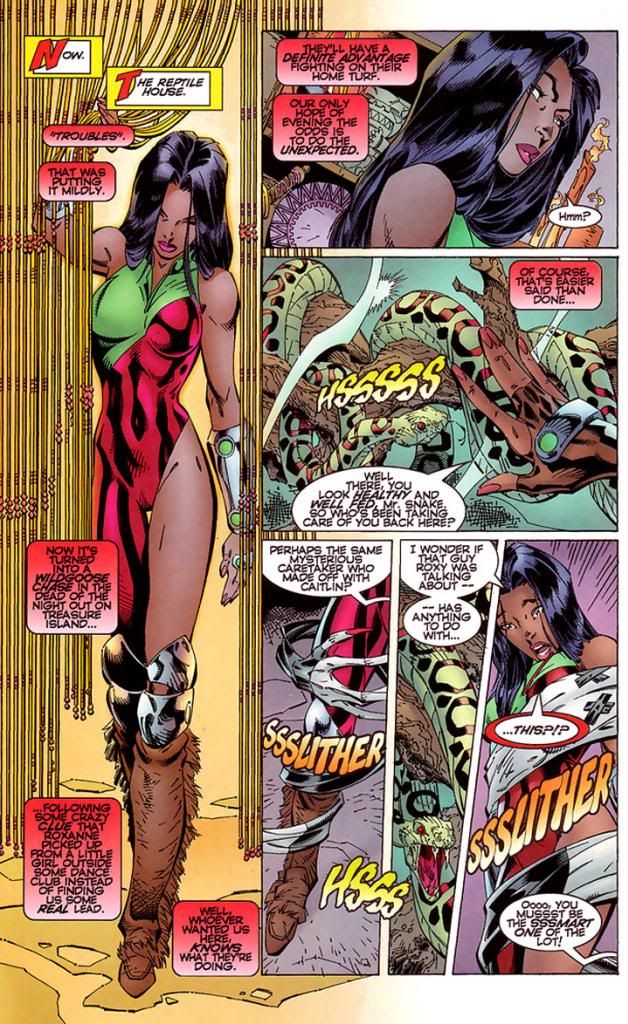 |
| Gen13 #8: Script by Brandon Choi, Jim Lee and J. Scott Campbell, art by Campbell and Alex Garner... or Richard Friend! |
2. Swimming nude. Dani makes a point to swim au natural in New Mutants #3 (May 1983) and Rainmaker follows (birthday) suit in Gen13 #1 (March 1995). Chris Claremont treats this moment seriously and tastefully and it leads to a revealing (personality, not body) moment between Dani and her friend Xi'an Coy Manh where they bond and we get to know both of them better. When Rainmaker takes a dip, Choi and Campbell play it as a striptease and while we do get to know a little more about the cast from this (Sarah likes to show off, the guys are pantingly hetero-sexist), the characterizations are roughly at the level of a beer commercial.
Dani:
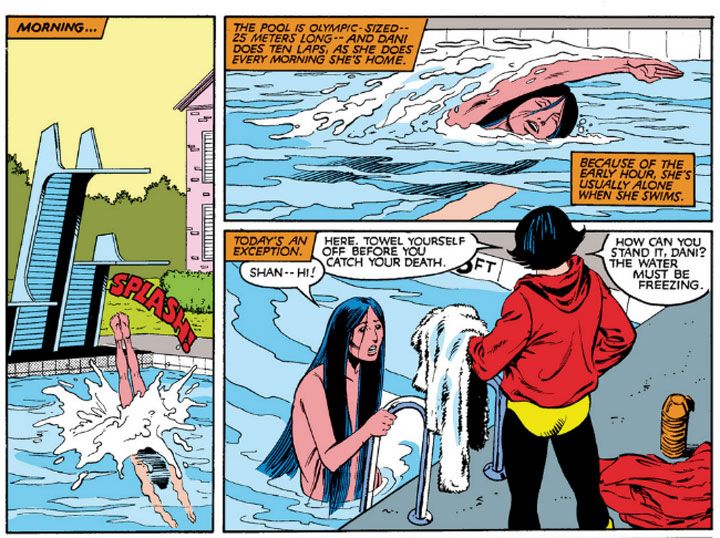 |
| New Mutants #3: Script by Claremont, art by McLeod and Mike Gustovich |
Sarah:
 |
| Gen13 #1: Script by Choi and Campbell, art by Campell and Alex Garner... or Sandra Hope! |
3. Jungle adventures with anachronistic cultures that result first in wearing rags and then even more revealing outfits. In New Mutants #8 (October 1983), the kids travel to the Amazon rainforest, have a lot of misadventures in which Dani first has to wear a swimsuit and then torn clothing. When she and the rest of her team end up in Nova Roma, a hold out from the days of Imperial Rome, they adopt cultural-appropriate clothing. Then a sorceress shows up and tries to sacrifice Dani, which requires her to wear a chain-mail bikini outfit stolen from a Red Sonja comic and then a low-cut evil sorceress gown. When the Gen13 gang takes a similar journey to Africa in issues 3 through 5 of their comic (July-October 1995), they come across an all-female society of supermodel Amazonians who favor skimpy metal swimwear of their own. Rainmaker quickly goes from ragged prisoner to shiningly metallic masturbatory fantasy warrior before you can say "Psyche-Mirage-Moonstar-Spellbinder-Dark Rider."
Dani:
 |
| New Mutants #10: Script by Claremont, art by Sal Buscema and Tom Mandrake |
Sarah:
 |
| Gen13 #5: Script by Choi, Lee and Campbell, art by Campbell and Garner, Friend and Scott Williams |
4. That leadership thing. Despite being a year or two younger than Sam Guthrie, the more capable Dani quickly takes over the top spot in the New Mutants team after first leader Xi'an Coy Manh goes missing. In fact, she's already pushing Xi'an out of the top slot as early as New Mutants #4 (June 1983), with her friend standing right beside her! When leader Caitlin Fairchild temporarily quits, Rainmaker makes an attempt to do the same in Gen13 #12 (August 1996), only to have mentor John Lynch (supposedly this ultra-tough black ops veteran) appoint his own dopey son over the smarter, more mature and combat-skilled Rainmaker in what's obviously a decision based solely on nepotism. Burnout has shown absolutely zero leadership skills to that point, and kind of a mopey, shrinking-violet personality, while Rainmaker's intelligence is second only to Caitlin's, plus she's much wiser and more self-assured in many ways. No wonder she reacts unfavorably to Lynch's completely illogical move (although in Lynch's defense, he may be pitting the two against each other in a "survival of the fittest" competition-- although that could also wreck team morale and field effectiveness in the long run as well, so maybe he is an idiot after all). This also positions Sarah as the Dani-style team rebel. In the same vein, both characters seem to have an innate talent for combat tactics, as well, with the New Mutants becoming more of a fighting force to be reckoned with under Dani's command, and with Sarah frequently barking out orders of her own during the many confrontations in Gen13.
Dani:
 |
| New Mutants #4: Script by Claremont, art by Bucema and McLeod |
Sarah:
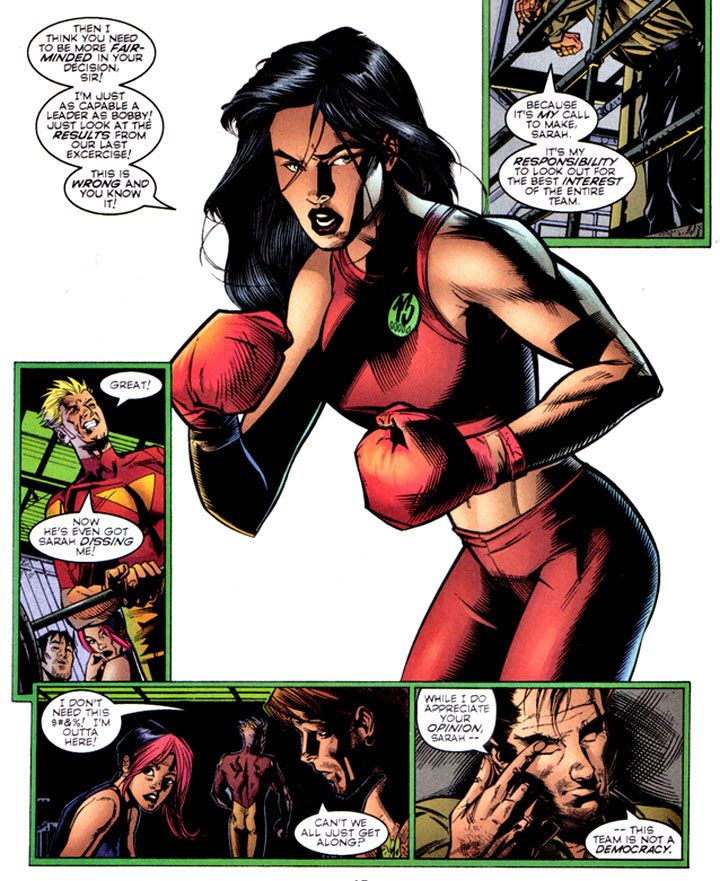 |
| Gen13 #12: Script by Choi, Lee and Campbell, art by Michael Lopez and Troy Hubbs (I think) |
5. Tussles with teammates. I seem to remember Dani doing this a lot more, but I must be more than a little mixed up and fully conflating her with Sarah at this point. I'm surprised Dani didn't beat up those two idiots Sam and Bobby two or three times a day with that temper of hers. Instead, she seemed to take out her aggressions more on inanimate objects. And despite frequently referencing the martial heritage of her Cheyenne people, she wasn't all that adept at fighting. Oddly enough, in New Mutants #1 (March 1983), it was Xi'an who first went fisto-a-fisto with Dani-- well, actually, she choked the hell out of Dani and slammer her head against the floor with good reason: Dani had accidentally used her powers to pull images of her Xi'an's violent, tragic past out for all to see. While the New Mutants had their share of inter-team arguments, it would be more than a year later, in New Mutants #14 (April 1984), before we'd see another instance of Dani-on-friend violence, this time a playful shove into the snow for Roberto DaCosta. Sarah, on the other hand, goes full on kung fu queen on Bobby Lane after he made a poorly-timed snide remark at her expense during their leadership crisis. It happens in Gen13 #12.
Dani:
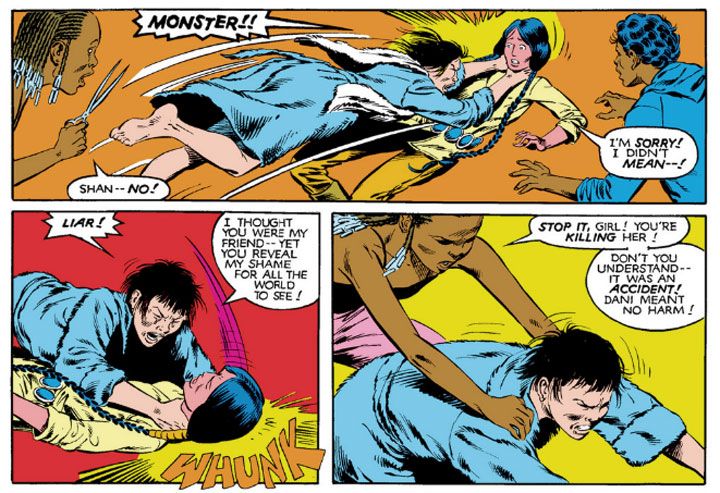 |
| New Mutants #1: Script by Claremont, art by McLeod and Gustovich |
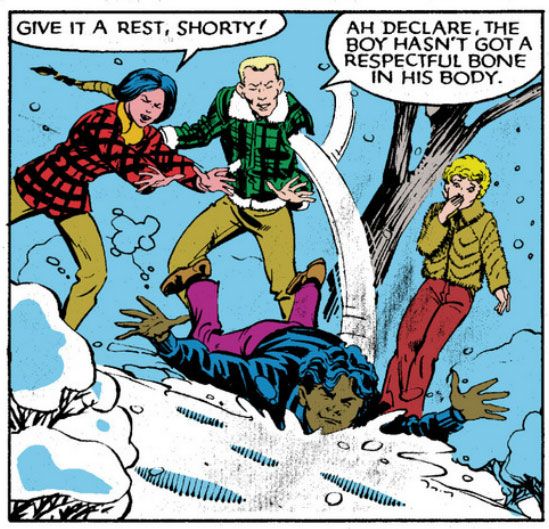 |
| New Mutants #14: Script by Claremont, art by Buscema and Mandrake |
Sarah:
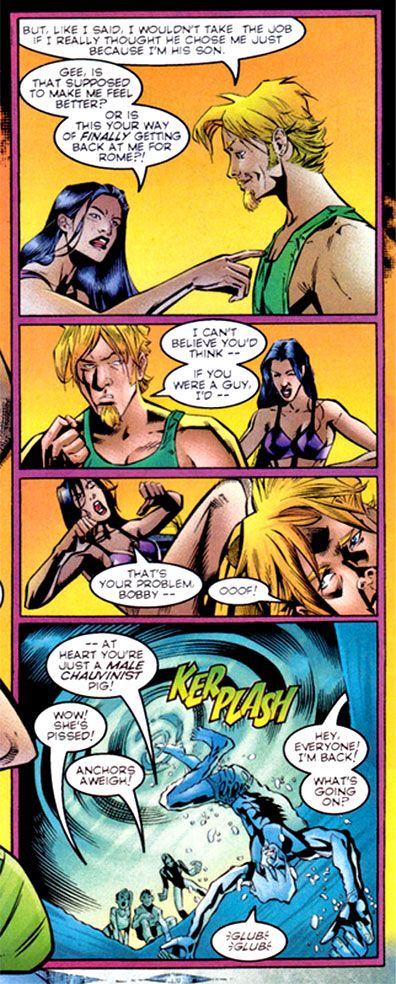 |
| Gen13 #12: Script by Choi, Lee and Campbell, art by Lopez and Hubbs (I still think) |
Okay, now I'm obviously reaching. But I believe I've made my point-- there are certainly parallels, enough so Sarah Rainmaker became my favorite Gen13er. What's been fun for me looking for these little moments is contrasting the writing on both series. While Claremont's dialogue is sometimes stilted and a bit advanced for his characters' ages, his stories and characterizations are nothing if not sincere. He genuinely cares about his cast and immersing the readers in their world. Plus he displays the literary chops of a true writer's writer, someone in love with language. If any of his work here is derivative, it's of real life or novels. And occasionally movies.
By comparison, the Gen13 characters-- scripted by no less than two writers at a time!-- usually speak casually and naturally (unless there's need for some hard expository dialogue, that is). Actually, their dialogue is almost exclusively made up of then-current catchphrases and youth lingo. While as individuals they're amusing enough, they're more tongue-in-cheek, broadly-sketched types owing most of their personalities to television shows and other comics (and not just New Mutants).
There are some interesting comic book characters in Gen13, but it would take other writers to flesh them out into real characters, especially under Warren who managed to make the book as smart as it was funny and sexy. And, oddly enough, that's when the Gen13 finally died.
Thursday, February 28, 2013
My Ten Favorite Wonder Girl Moments (old school version)!
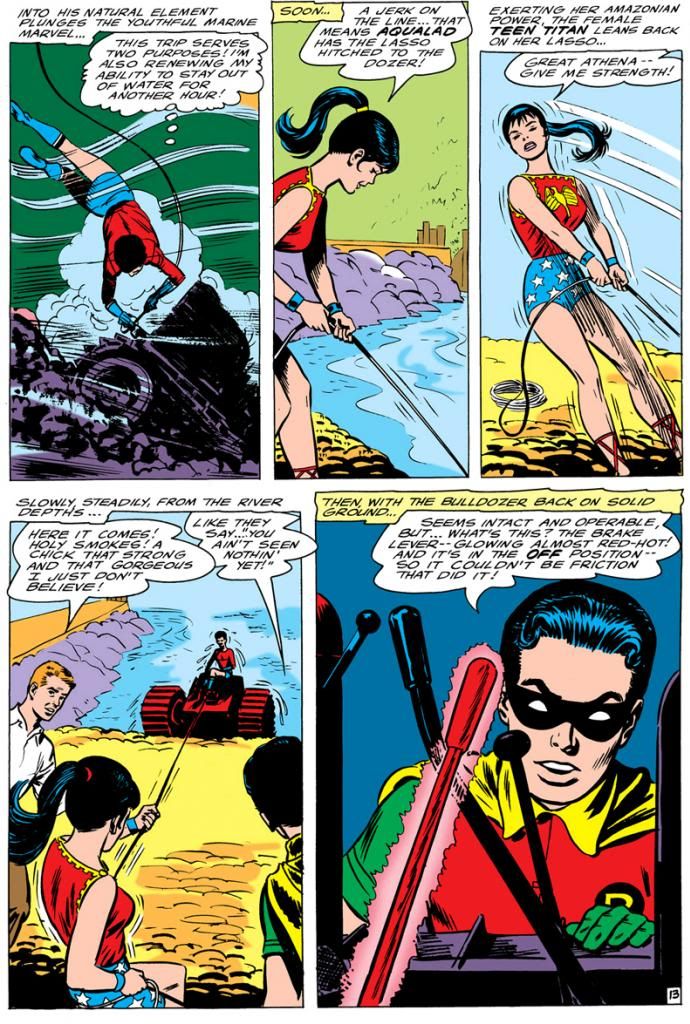 |
| Bob Haney, script/Nick Cardy, art |
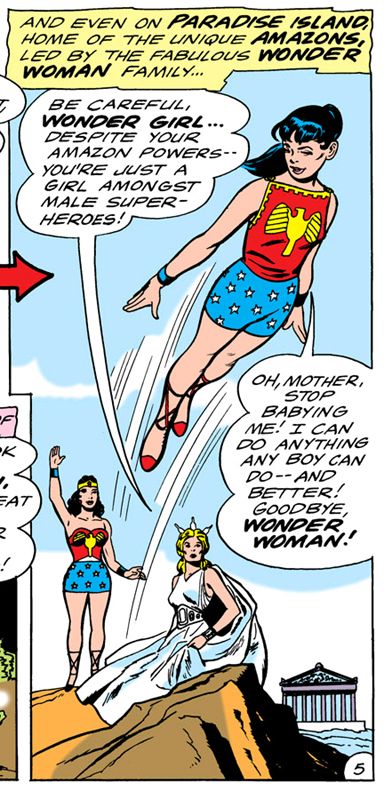 |
| Bob Haney, script/Bruno Premiani, art |
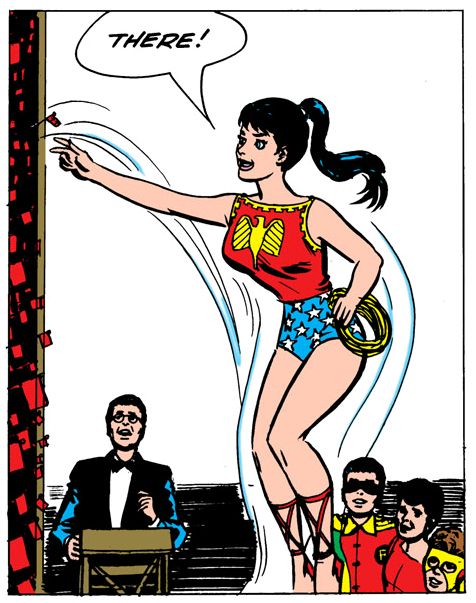 |
| Bob Haney, script/Nick Cardy, art |
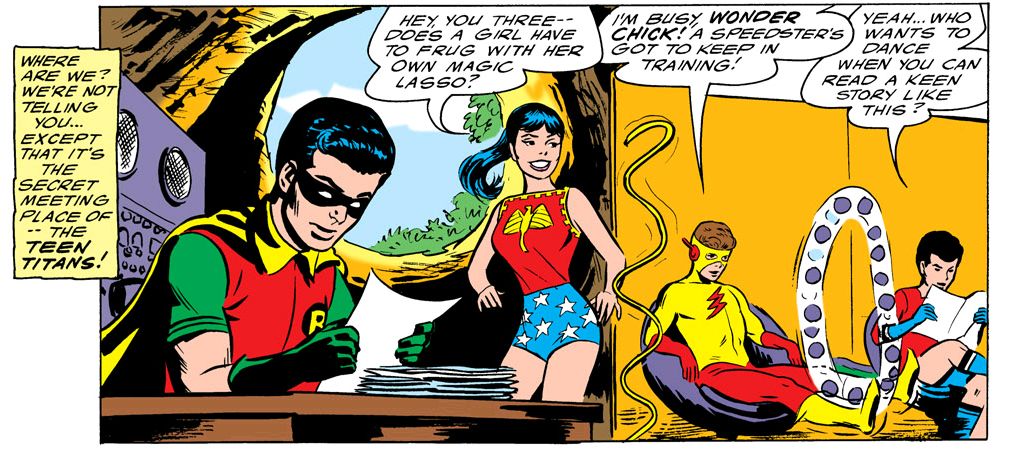 |
| Bob Haney, script/Nick Cardy, art |
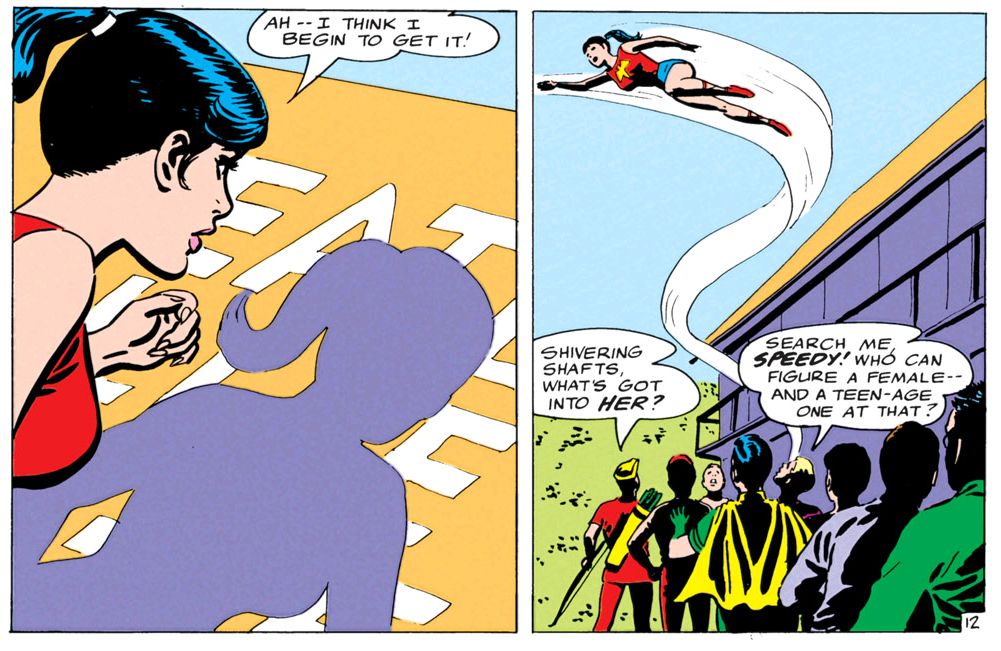 |
| Bob Haney, script/Nick Cardy, art |
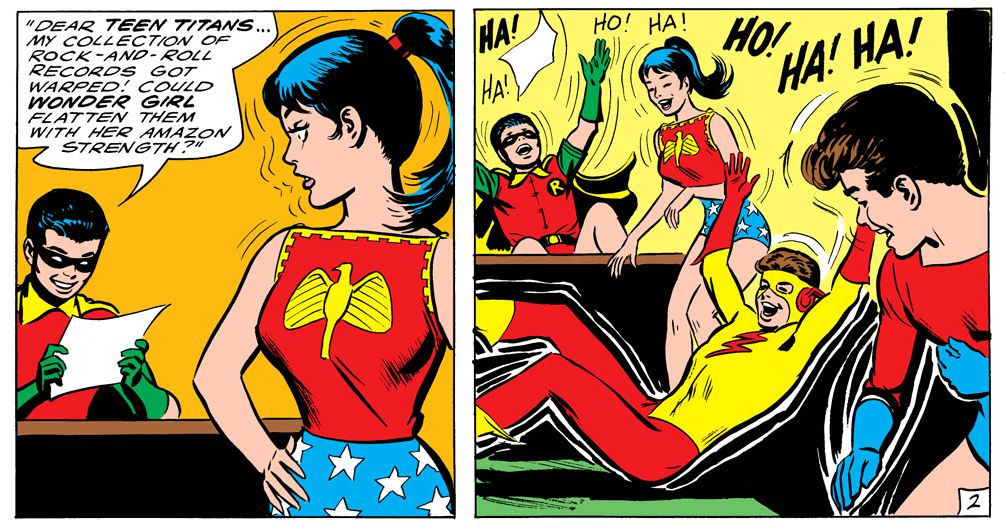 |
| Bob Haney, script/Nick Cardy, art |
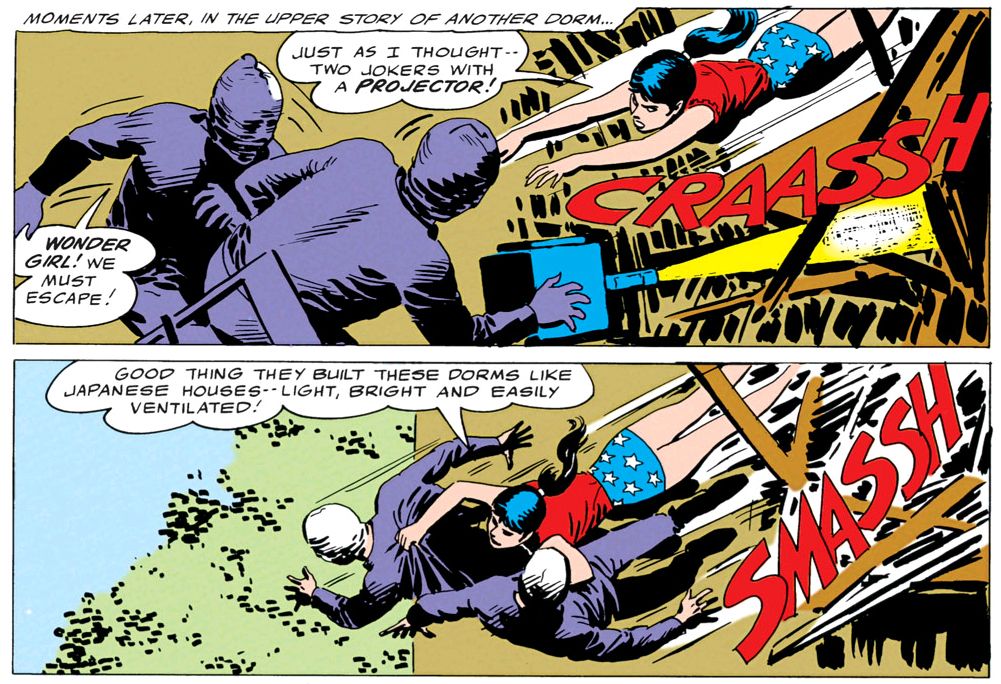 |
| Bob Haney, script/Nick Cardy, art |
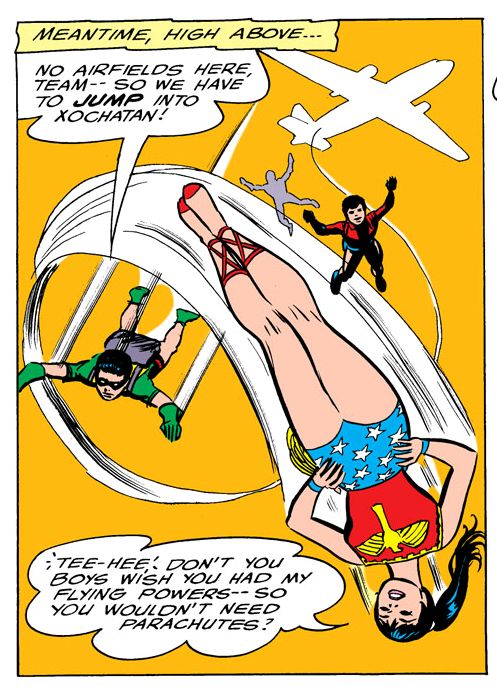 |
| Bob Haney, script/Nick Cardy, art |
 |
| Bob Haney, script/Nick Cardy, art |
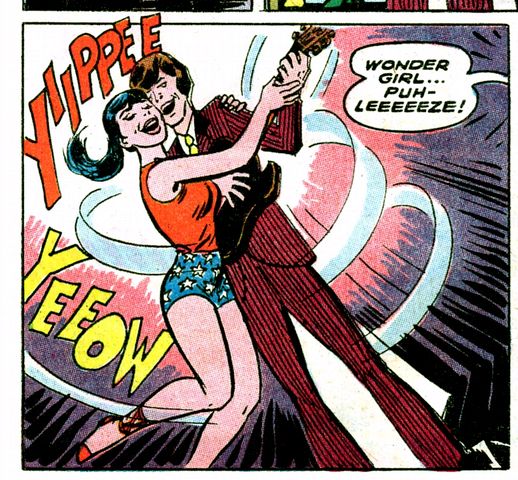
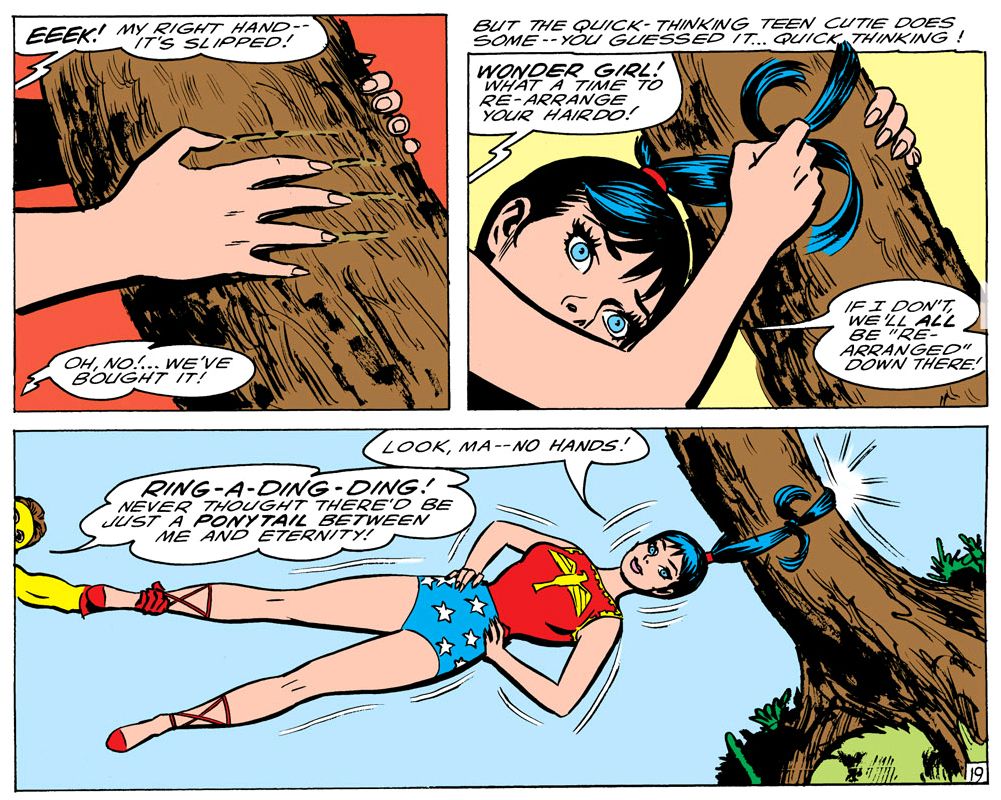
And now for the single greatest moment in Wonder Girl history-- or DC Comics history, for that matter--
 |
| Bob Haney, script/Nick Cardy, art |
Monday, February 18, 2013
Wonder Girl: Best of all the Teen Titans!
 |
| Nick Cardy, Teen Titans #1 (February 1966) |
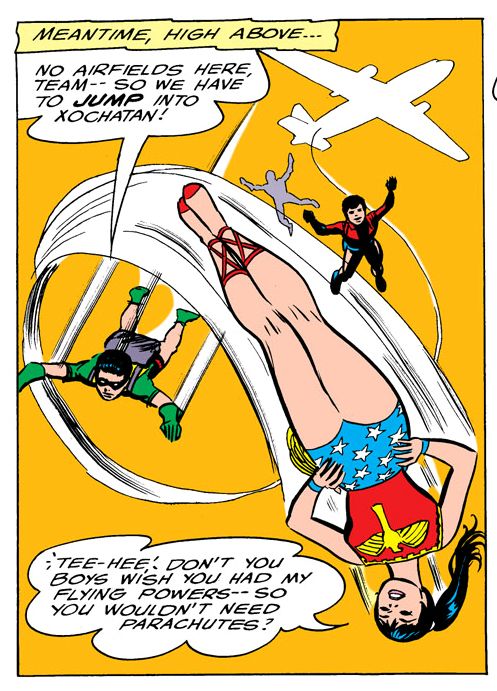
This gorgeous Nick Cardy panel of Wonder Girl showing up the rest of the Teen Titans appeared in Teen Titans #1, way back in February of 1966. Those were not simpler times. John F. Kennedy had been assassinated almost three years earlier, the Vietnam War raged in Southeast Asia (the same month this comic came out saw both the Tay Dinh and the Go Dai massacres), John Lennon made his infamous claim that the Beatles were "bigger than Jesus" and a gunshot felled James Meredith during the March Against Fear to encourage African Americans to register to vote. War, assassinations and riots lay ahead in the next few years as a nation threatened to tear itself apart. Above it all soared Wonder Girl, held aloft by the hopes of youth in post-war America, amid the fast-fading ghosts of Camelot, the dreams of the Civil Rights Movement, the high-tech hopes of the Space Race, and the attempt at making a Great Society.
How could you not love Wonder Girl? In fact,* will fist fight at high noon on the corner of 3rd Avenue and Pine Street any sucker who doesn’t like her. All right, I’m just kidding. I never get up that early. We’ll have to fight sometime later in the afternoon, or perhaps just before dinner time.
No, really, Wonder Girl really is a
wonder. Out of all the Teen Titans, she
gets the biggest kick out of having powers, being young, being a girl. The latter would be difficult for the others
as they’re all boys, but all gender considerations aside, the 1960s Wonder Girl
is pure joy. She’s a pleasure seeker who
finds pleasure almost everywhere, in the smallest things. Like simply being able to fly. That’s the kind of true happiness that doesn’t
require a lot of extraneous elements; the rest of us—those who aren’t vivacious
young Amazons capable of flight-- can get that a similar feeling from running
(if we’re runners) or drawing (if we’re artists). Or whatever it is we like to do with the
least fuss.
Her self-confidence is refreshing, as
well. Being a Titan means she’s probably
not the smartest person you’re likely to meet.
She’s more into dancing than reading, for example. She probably favors Frankie and Annette beach
musicals over French Nouvelle Vague cinema, the British invasion over minimalist
composers. There’s nothing wrong with
any of that. It all just goes to show
Wonder Girl is comfortable within herself.
And that makes her a positive role model in my book. A girl to learn from. Love who you are, love what you do, love life
itself.
In the vintage Teen Titans, which are
generally easy, breezy, carefree reads about teens who want to help the world
rather than tear it apart, Wonder Girl is by far my favorite character. If DC should ever bring her back, they need
to bring back this version or someone similar.
More light. That’s what’s
needed. More light, fewer shadows.
*Not in fact. But you can treat me to lunch.
Subscribe to:
Posts (Atom)