Jack Kirby drew comics in just about every genre. Which is a pretty conservative way of putting it when you consider he actually invented or co-invented some of them. As a Kirby fanatic, I wanted to link him to my annual Halloween celebration here, and rather than talk about Spirit World (Kirby does the paranormal) or some of his straight-up horror work (you can find it scattered about in various reprints, Archives, Essentials and Showcases and IDW's Haunted Horror), I have decided to once again explore his early-70s DC years. We love those book here.
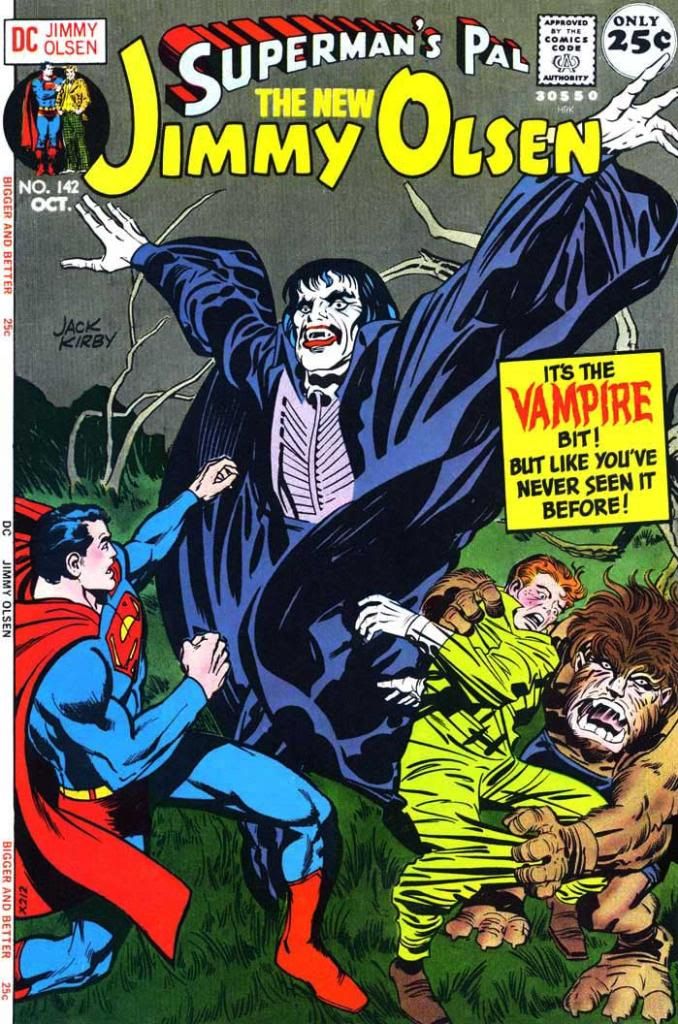
In Superman's Pal Jimmy Olsen #142 and #143 (October-November 1971), Kirby gives the then-corny vampire routine a science-fiction/superhero twist. Nowadays we have scary vampires again, and romantic, sparkling vampires and vampires that fight werewolves with Matrix-style kung-fu, but when Kirby wrote this story, movie vampires were pretty much still tuxedo-wearing noblemen and the occasional lesbian baroness in a Victorian-style negligee. Comics in particular had worn out the theme, despite years of a Comics Code ban on vampires. Once EC had modern-day vampires put taps in their victims' necks and Warren saw an old school county-style vampire take a spaceship to a planet of perpetual night, the concept had been stretched past recognition, like Dick Tracy's face imprinted on Silly Putty (I used to love distorting that guy). The only things left were parody and deconstruction. Kirby's story tends towards the latter, although the self-aware cover copy hints at the former.
That's as close to tongue-in-cheek as this story gets. The rest of it is as sincere as Linus' pumpkin patch in It's the Great Pumpkin, Charlie Brown. Kirby expends a lot of energy here trying to make readers buy this concept and he's not playing around or being cutesy.
Count Dragorin, the man from Transilvane, does everything you've come to expect from a vampire, up to and including having a werewolf as a best friend. Kirby wastes no time kickstarting the plot as Dragorin and his beastly companion slip into the city one night and put the bite on a sleeping receptionist by the name of Laura Conway. Kirby's updated answer to the age-old vampiric transformation scene is to have Dragorin accomplish this via some kind of twin yellow power emanations from his eyes. They leave the tradition double bite mark on the receptionist's neck and "change her body chemistry." Within a couple of pages we have Clark Kent and Jimmy Olsen fighting Dragorin for Laura Conway's soul-- or at least her free will-- right there in broad daylight inside the GBS (Galaxy Broadcasting System) offices. Dragorin is after a former NASA scientist named Dabney Donovan, and Conway was once Donovan's personal secretary. Intercut with this is a subplot with the Newsboy Legion trying to escape from the Cadmus Project (they're not prisoners; their fathers work there and they're just up to their usual independent-minded mischief), so these are some really busy issues.
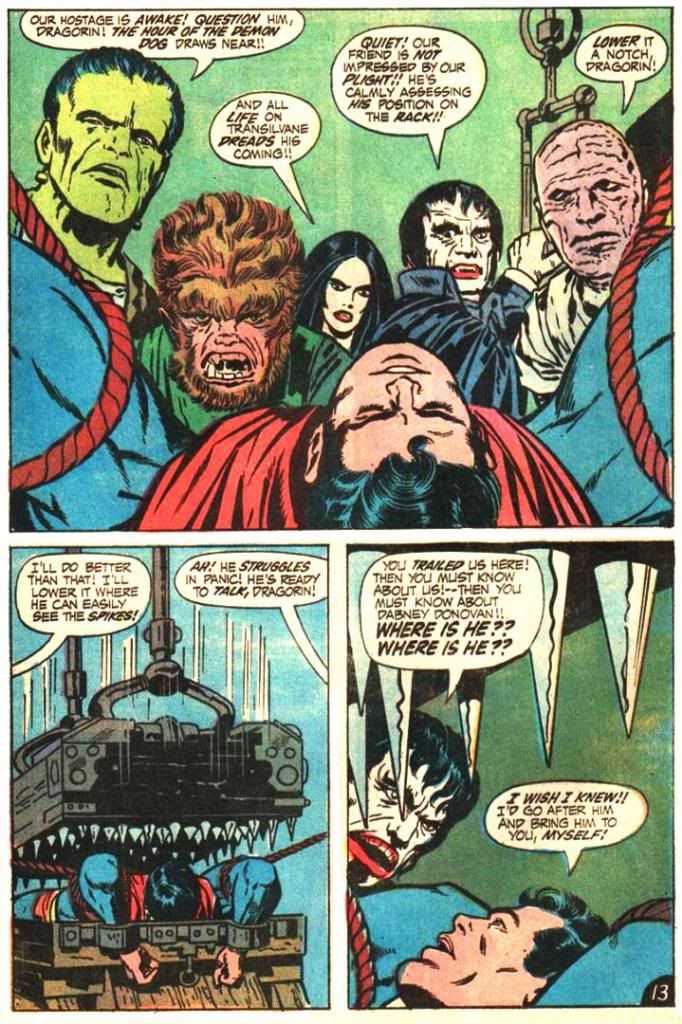
When Superman and Jimmy Olsen track down the scientist's lab (beneath a mausoleum in the pleasantly-named Bloodmoor Cemetery), they find they're not dealing only with a vampire and werewolf couple. There are all kinds of familiar creatures. So what does Kirby do to explain these Space Age vampires, werewolves and the like within the science fiction setting? Well, it turns out Dragorin and company are microscopic aliens from an artificial planet. That floats inside a room that looks like a creepy castle set where James Whale would have put Boris Karloff through his paces, or Todd Browning would have put Bela Lugosi through his. And if that wasn't enough, the aliens on that world have developed a society based on old horror movies as well thanks to the bizarre experiments of Dr. Donovan, who must be a real piece of work himself.
For some reason known but to himself (and, I think, NASA), Donovan didn't just make a world. He also chose those horror movies from his vast personal collection of films and projected them into its clouds. The sentient life there turns out to have remarkable adaptive and imitative properties, kind of like those gangster guys and the Nazis the Star Trek crew dealt with on their old TV show. Some of the people there turned into vampires, some into Frankenstein's monsters and others into mummies and werewolves. They travel from their planet to ours by riding inside coffins that grow or shrink depending on which way they're transiting.
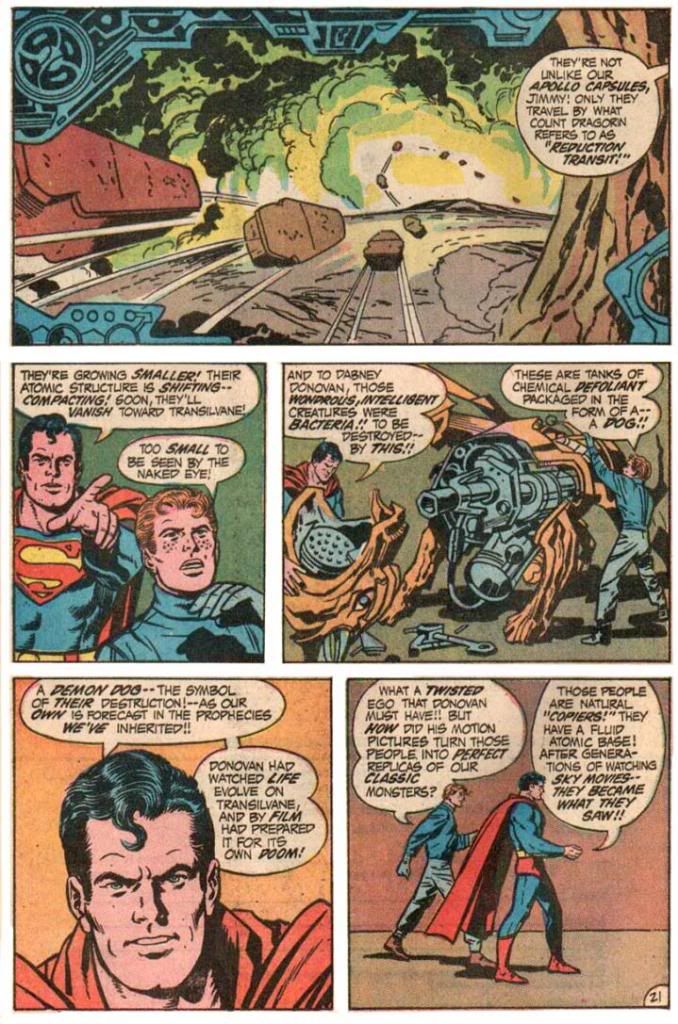
Kirby doesn't really bother to explain Donovan's scientific motivation. After all, what could he have hoped to gain from such an experiment? Certainly if he had published his results, the idea that we as a species could create an entire miniature world full of intelligent, evolving life, would result in a philosophical or even a religious sea change. But Donovan seems to have added these rather baroque flourishes for his own personal enjoyment, and then to destroy via a robotic dog filled with a chemical defoliant.
The horror and science fiction aspects create a dissonance that's fun but, like Frankenstein's monster, reveal some of the stitching Jack Kirby did to make the story work. Because Kirby's trying to assemble this creature in a way that gives it life and makes sense, some of the details are a bit too on-the-nose-- the space coffins compared to the Apollo re-entry process, for example-- while others remain shadowy, as if they're inexplicable. Why did Donovan use old horror movies in the first place? And we not only never meet the nutty scientist who did this, but he never receives a comeuppance for what amounts to attempted genocide.
I love that after all this oversized craziness-- even if it's also about miniature creatures as well-- Kirby chooses to end it on a minor note, with two pals sitting down together to watch Oklahoma! It's just so human. They're not even nonplussed about letting Donovan get away scot free, or having encountered human-created sentient life that could potentially affect life on earth in horrific ways, like some kind of virus escaping from a weapons lab.
But maybe Superman is completely aware of this and downplaying it for Jimmy's sake as he renders the Transilvanians harmless in his own inimitable way. From what I've read, writers and artists later extended the Transilvane concept and finally had Donovan make a story appearance as a full-blown villain, but a true sequel to this story would have Dragorin and friends transformed into good-natured cowboys and farm girls, and singing about a surrey with a fringe on top.
Oh, and be sure to note the Superman figure on the cover to #142. Neal Adams re-touch. And check out all the Al Plastino faces in the interior art. Occasionally some Kirby comes through, but I really wish DC hadn't felt the need to do this.
Showing posts with label Neal Adams. Show all posts
Tuesday, October 29, 2013
Tuesday, September 20, 2011
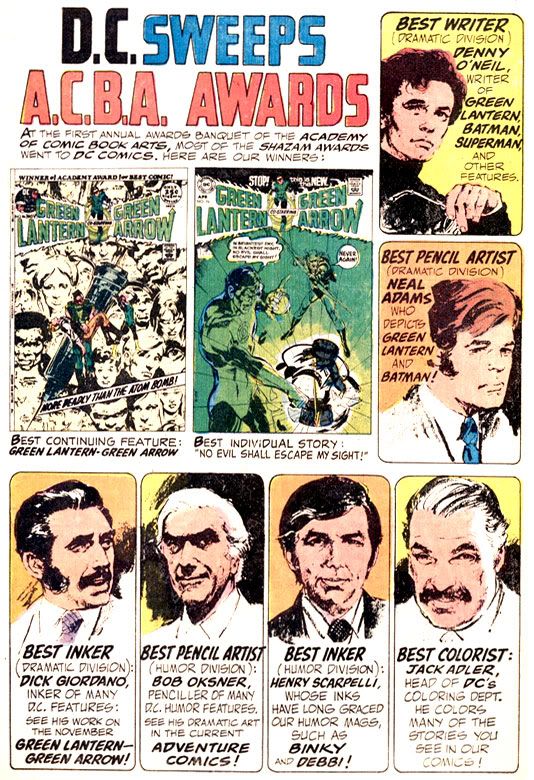
Congratulations, DC! I knew you could do it!
In the olden days, the people who made your comics were all middle-aged and wore ties, except for Denny O'Neil, who wore a turtleneck. He's thinking, "Hurry up and draw me. I've got stories to write. But first let me take off my glasses for a slightly casual, candid look." I'm going to steal that pose for my author's portrait, only I'm going to hold a pipe. Why a pipe instead of glasses? Why not? Why so glum, Neal Adams? Is it because in order to fit the copy in your panel, you weren't able to draw the back of your own head? Someone just said, "Hey, Dick! Have you finished that job for Detective?" Bob Oksner looks cool; kind of a Doc Brown vibe, but snappy and not disheveled. I'd like to think his hair was really that startlingly white in real life. Henry Scarpelli later added his actor son, Glenn, to the Archie universe. Jack Adler started working at DC in 1946 and retired in 1981.
PS: Blogger wouldn't allow me to add "Denny O'Neil" to my tags. Guess I'll never write about his work again.
Labels:
awards,
Bob Oksner,
DC Comics,
Dick Giordano,
Green Arrow,
Green Lantern,
house ads,
Neal Adams,
vintage comics
Monday, March 7, 2011
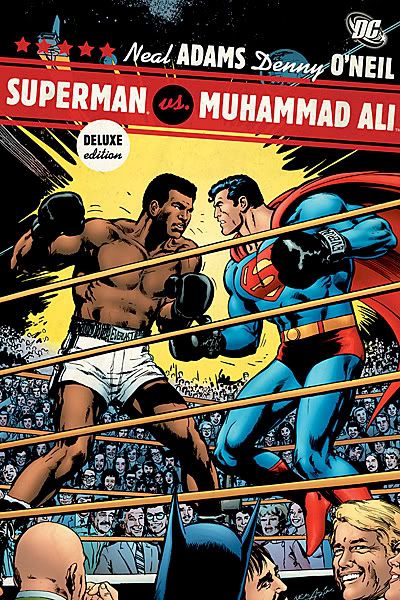
Superman vs. Muhammad Ali Deluxe Edition: A Comic Review
Publisher: DC
Script: Denny O’Neil
Pencils: Neal Adams
Inks: Dick Giordano and Terry Austin
This is the big one we were all waiting for! I remember seeing the tabloid-sized original at our mall's Waldenbooks way back in 1978 and, as a major fan of both Muhammad Ali and Superman, wanting desperately to buy it. But $2.50 was beyond my price range at the time and there was a question of just where to keep the damned thing. It was monstrous and wouldn't fit easily on any of our bookshelves. In time, I came to think I'd dreamed it all. Superman versus Muhammad Ali? Why would those two ever fight?
Here we are decades later and thanks to our perceived hunger for overblown hardcover "archival" reprints of beloved childhood stories, Superman once more floats like a butterfly while Muhammad Ali stings like a bee. Two pop culture icons take on aliens with the stupidest name—the Scrubb. From the planet Bodace. I was kind of hoping it would be the planet Bonaduce and the erstwhile Danny Partridge might make a guest appearance as Jimmy Olsen, but no such luck.
That disappointment aside, where else can you see Superman punch his mighty fists together to stop a tsunami caused by plasma missiles from outer space? Or Muhammad Ali explain the sweet science from jabs and uppercuts to rope-a-dope tactics to the Man of Steel, then use his famous psych-out pre-fight patter on a bunch of star warriors? Or Superman disguise himself as Bundini Brown before battling an entire armada of enemy starships?
This is an outlandish and at times extremely silly epic-- witness Superman sheepishly explaining to Muhammad Ali why the Fortress of Solitude is full of so much junk and Jimmy Olsen's laughable ringside commentary to a crowd that includes anthropomorphized chickens-- that breathlessly spans light years and features crowd scenes that would have blown Cecil B. DeMille’s mind and bankrupted George Lucas. Neal Adams dazzles with double-page layouts full of space freaks and bizarre interplanetary vistas, and his Muhammad Ali caricature is spot-on.
Preserved in his beautiful prime-- the book apparently was so late in hitting the stores Ali was actually slightly past it in reality-- and transformed into a comic book hero by Adams and inker Dick Giordano, Ali may be the only real life person who could go mano-a-mano with Superman (convenient red sun pocket universes or not); he was and remains that much a legend, a towering figure of the 20th century sports/pop culture scene along with Babe Ruth. I wouldn't be surprised to find this story somehow entering mythological status a couple of thousand years from now (when I'm very old) and Ali's become some sort of demi-god figure whose factual existence academics debate at good ol' Mars University's Classics Department. Okay, I'm stretching things, but not by much.
For his part, Denny O’Neil provides fevered captions with appropriately purplish prose and nails Ali’s distinctive speech patterns. Confronted by an armored green alien, Ali is definitely not nonplussed-- not that you'd expect him to be:
ALIEN: We intend to prove ourselves you superior by showing our standard-bearer is the greatest!
ALI: WHOA... Right there, Dog-face! I AM-- the Greatest! Man... They rank me with Joe Louis... Sugar Ray Robinson.. Ezzard Charles... Archie Moore... Rocky Marciano... Gene Tunney... Jack Dempsey! I ain't agreein' to fight... but if I did, I'd whup your man. I'd stomp him--
If you grew up with Ali on TV and at the movies, you can "hear" this dialogue in your head in the man's distinct cadence; Ali's working himself up and preparing to do some real ass whuppin'.
It seems to take place outside of regular DC continuity. There's no Justice League satellite to warn Superman of the alien armada; he has to fly up into space to look for himself. And while some sort of Athena being makes an appearance at the fight itself to observe (over at Marvel, Stan the Man would've given us the Watcher with appropriately lofty nonsense dialogue, no doubt), there's no sign of Batman or the Green Lantern Corps. It's almost as if Ali's powerful charisma crowded them right out of the universe. So if you're a hardcore geek who has to fit every story into some sort of overarching narrative-- well, you probably should seek psychological help. Here it helps to lighten up and enjoy the weird.
Why? Because there's a sense of the creative team just knocking themselves out (otherwise Ali might have done it for them) to produce something special, an event reminiscent of one of those “Battle of the Network Stars” specials or a Bob Hope holiday show with everyone in his Rolodex invited and then some. And because they manage to convey such a sense of fun, the book works both as a tribute to Ali and as a curious artifact of the 70s, the latter emphasized especially by the inclusion of Adams’s famous wraparound cover featuring such leisure suit era luminaries as Jimmy Carter, Pele, Sonny Bono, Johnny Carson, the entire Jackson 5 (man, they got some shitty seats!), a couple of Sweathogs from Welcome Back, Kotter and a young Ron Howard. If you look closely, you can make out a reunion of sorts for the Fab Four-- that's right; John, Paul, George and Ringo are there in the crowd. No sign of Linda or Yoko. You can also see a few famous faces with mustaches slapped on them because, as Jenette Kahn relates in her afterward, a few celebs balked at making a ringside appearance. And in what kind of world does George C. Scott turn down DC Comics only to be replaced by Kurt Vonnegut?
All this and a selection of Adams's surprisingly tight layout thumbnails. Just buy it and dig it, my babies.
Subscribe to:
Posts (Atom)