Showing posts with label Vince Colletta. Show all posts

Wednesday, August 27, 2014

Marvel's Marvelous Movies #8: For Your Eyes Only (Marvel Super Special #19, June 1981)

For your eyes only, can see me through the night
For your eyes only, I never need to hide
You can see so much in me, so much in me that's new
I never felt until I looked at you 

--Sheena Easton

Bond.  James Bond.  I've read many of Ian Fleming's books, I own Sean Connery's films on Blu-Ray (except the silly Diamonds Are Forever, which has never appealed to me beyond a few moments here or there involving Wint and Kidd) and I even own a 12-inch Connery doll.  He's in a nice black pullover sweater and matching slacks, the way he appeared in Goldfinger, a film many (myself included) consider the series' 1960s apex, although I'm slowly being swayed by the growing From Russia With Love heresy and I get my biggest kick from Thunderball.

Roger Moore was the big screen Bond when I was a kid and teenager, and looking back, I don't remember being as excited about a Bond flick as I was for For Your Eyes Only, which promised to bring James Bond back to earth after his over-the-top space adventure in Moonraker.  It was supposed to mark a return to the series' earlier, glory days when Bond relied on his physicality more than Q's inventions and those of the special effects team.  A more "realistic" Bond. 

Of the two, I still prefer the over-the-top Moonraker.  It was the reason I was so excited about this new Bond, because Moonraker had blown me away when I saw it with my parents one New Year's Eve.  Wow!  Zow!  Moonraker has space!  John Barry!  Shirley Bassey!  Jaws in love!
Script: Larry Hama/Pencils: Howard Chaykin/Inks: Vince Colletta

What does For Your Eyes Only have?  A visual style on par with a particularly well-made episode of Magnum, P.I.  A creepy subplot where an underage ingĂ©nue makes moves on a Bond who appears positively grandfatherly by contrast.  Carole Bouquet, a woman I consider the most glacially lovely Bond girl, but completely lacking in chemistry with Moore.  Their low-energy romance comes across as something both actors have to endure rather than the cheerful hedonism we've come to expect from Bond couplings.  Slapstick fights and chase scenes, the former featuring a hockey team, the latter on skis.  The reliance on so much comedy really undermines the supposed return to realism, especially with Moore's increasingly detached portrayal of the famed super spy as a character content merely to stroll onto the set after his stunt double takes a pounding then offer a quip or a pun.  At this point, Moore seems to have settled on the idea Bond's role is to point out for the audience in as placid a manner as possible the absurdity of all these busy little people putting forth so much effort over some preposterous gadget or other.  And then to get a manicure or a relaxing massage.

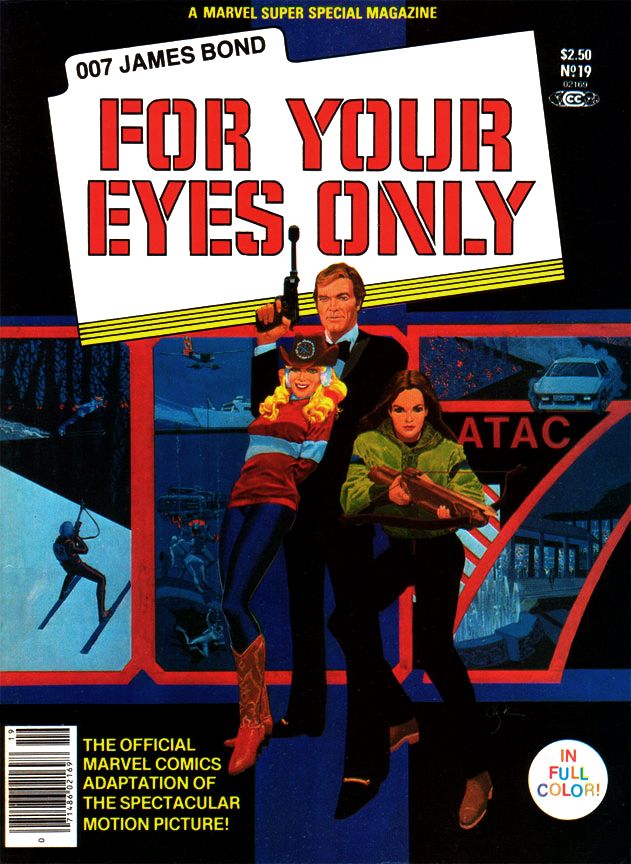
But it also has Marvel Super Special #19 (June 1981), written by Larry Hama and penciled by Howard Chaykin.
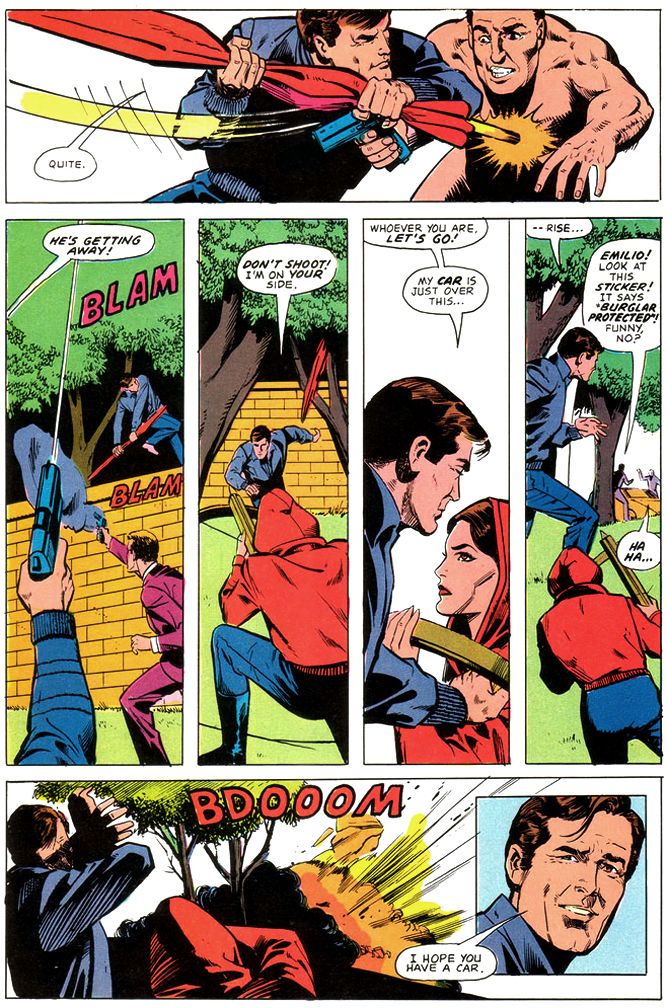
Script: Larry Hama/Pencils: Howard Chaykin/Inks: Vince Colletta

These two make an ideal team for doing James Bond's more "realistic" escapade chasing after a lost code machine wanted by everyone's favorite Cold War enemies, the Soviets.  Remember them?  They're still around, just under a different name. 
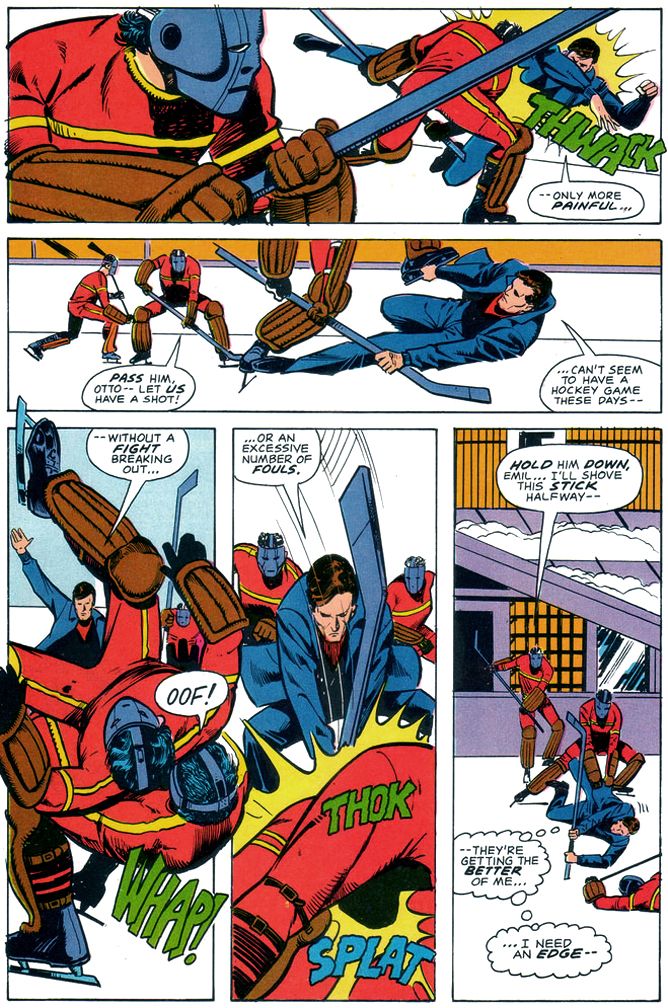
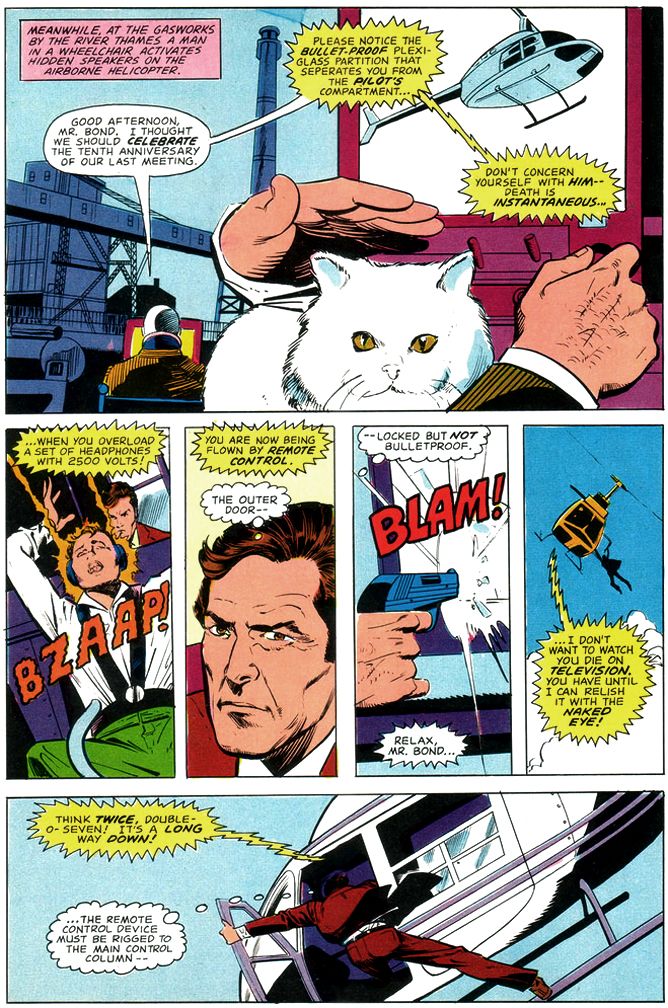
Script: Larry Hama/Pencils: Howard Chaykin/Inks: Vince Colletta

Hama largely eschews the caption-heavy approach of previous film adapters for a tighter focus on action and dialogue.  Hama even includes Moore's little quips, with Chaykin emphasizing most of them with inset close-ups that match Moore's tongue-in-cheek Bond portrayal.  This makes for a fast-paced read that provides some much-needed energy to the familiar Bond schtick.  Chaykin draws some mean fight scenes, too, chopping the action into small vertical panels within pages opening and closing with larger establishing shots and you don't have to worry about spotting a stunt-Bond.  This gives them added verisimilitude.  Chaykin's page designs are top-notch throughout.  Bursts of panels that read fast when Bond leaps into action, then large panels that allow us to savor the ritzy locales and beautiful people.  Roger Moore in particular appears made to become a Chaykin hero, and while the artist doesn't spend a lot of time with the bikini girls in the early going, his Carole Bouquet is worth spending time with as you zip along between the chases and underwater fights. 

If ever I wanted a late period Moore Bond transferred from the big screen to the pages of a comic book magazine-- and I did and still do-- I'd pick Hama and Chaykin to do the honors once again.
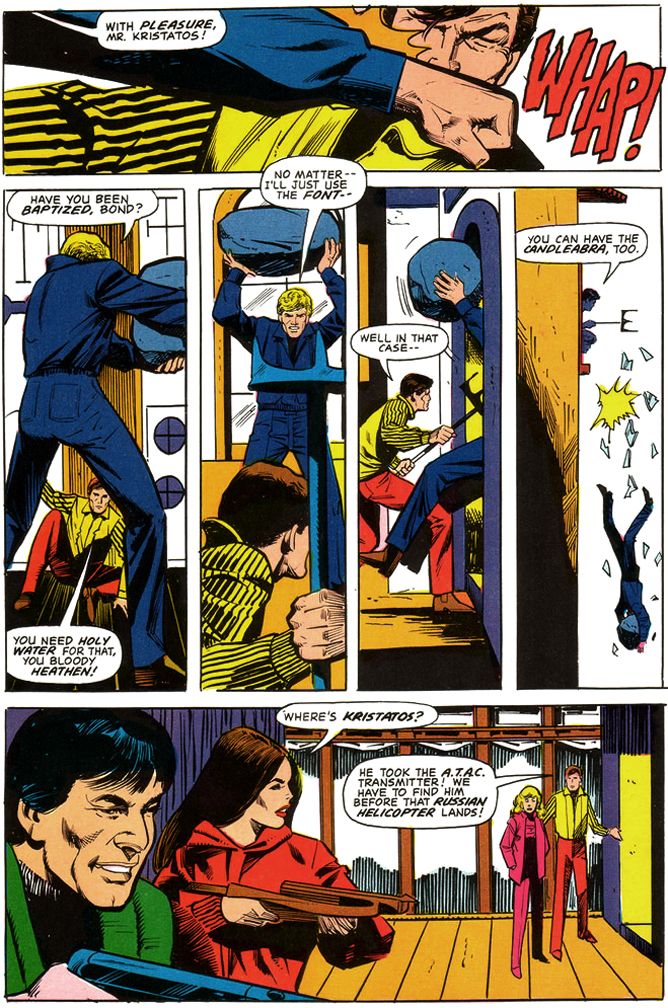
Script: Larry Hama/Pencils: Howard Chaykin/Inks: Vince Colletta

Ah, and Vince Colletta.  His inks here are adequate, the comic book equivalent of director John Glen's workmanlike take on the movie's James Bond festivities.  Glen's lack of visual panache means there's nothing distinctive about the look of the films in this Bond era (the films are in focus, they're clearly lit and the camera doesn't jitter all over the place, so there's that), and Colletta similarly gives us some clean lines if little else, and still allows some of Chaykin's distinct eyebrows and facial constructions to bleed through.  Without having seen Chaykin's original pencils, I can't tell if Colletta used his eraser more than he did his brushes this time out, but some of the backgrounds remain featureless voids, and others are rendered minimally.  This in itself isn't a necessarily wrong, because simplicity in art can be a virtue, but with the colorist simply leaving so much of it white-- you know, possibly because there's so much ice and snow due to the ski resort setting-- there's something a little skimpy about the finishes.  So, much like director Glen's bland framing of events and the movie's photography, the inks and colors do the job, if not in an especially memorable way.

After reading this, I think it would have been an entertaining book if Marvel had sprung for the license and had Hama pen a monthly Bond.  As it stands, Marvel would take one more crack at Bond and we'll be taking a look at that one as well.  Of course I bought it despite my disappointment with For Your Eyes Only, because, as you now know, I'm a Bond enthusiast.

Saturday, November 9, 2013

Fantastic Four Annual #3: Stan and Jack can't catch a break

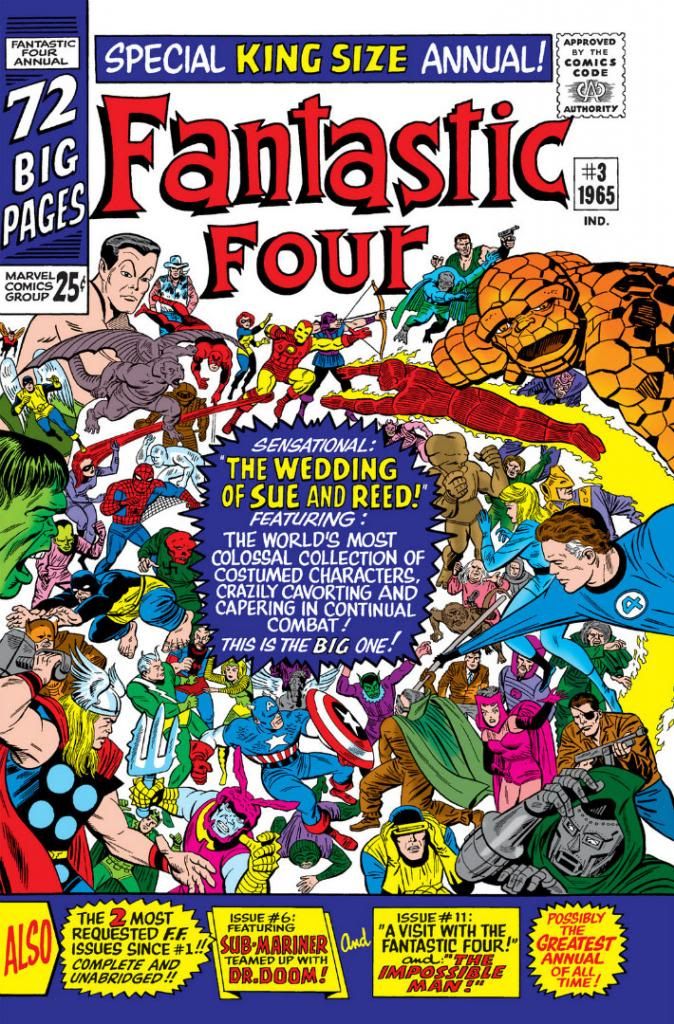
I've always felt ambivalent about annuals.  The best are the ones where the regular creatives use the extra room to tell an epic story that's either too large an idea for an ordinary issue or else climaxes a storyline, or someone you've wanted to see handle the characters shows up to write or draw the book.  The worst are when some ill-suited guest team butts in with crap that's essentially filler or else it's simply part of a storyline from some other book.  Back in the 1960s, the gang at Marvel really knew how to put together an annual, although Fantastic Four Annual #3 (October 1965) consists of a regular-length story and some "most requested" reprints.  It's just the main story is nothing less than the long-awaited wedding of Reed Richards and Sue Storm.

And lemme tell ya, brothers and sisters, everyone who is everyone shows up and it is fun, fun, fun from panel one!  Captain America, Thor, Iron Man, Spider-Man, Daredevil, Dr. Strange and all the X-Men, plus Patsy and Hedy, (at least rumor has it) Millie the Model and possibly Irving Forbush headline a stellar guest list, with Nick Fury and SHIELD providing security.  The only problem is, with such a major event there are bound to be crashers.  The Puppet Master, the Red Ghost and his apes, Mole Man and the Super-Skrull all cause problems, because Dr. Doom himself has some kind of crazy emotion ray controlling their minds.

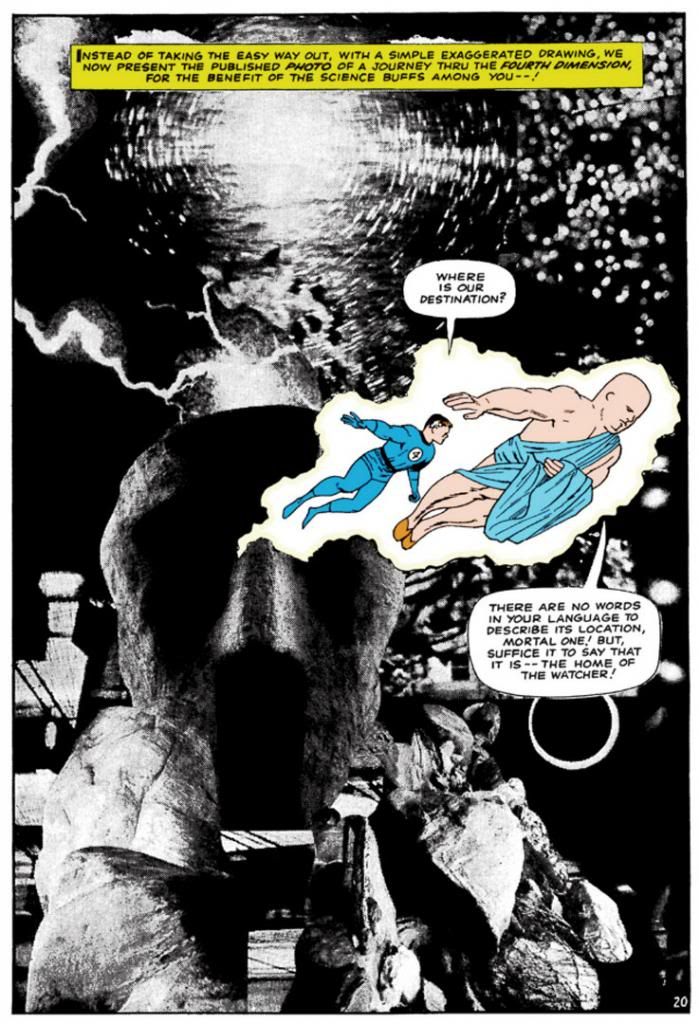
The heroes prove capable of handling the initial wave, but more and more villains attack so we get the like of the Mandarin and Hydra plus a lot of other clowns whose names escape me barging in and smashing up the place (kind of like Owen Wilson's mescaline-addled Eli Cash in The Royal Tenenbaums only without the death of a single Buckley), giving Fury a raging headache.  When Attuma and his Atlantean armies emerge from the harbor (Doom meant to call Namor, but the King himself was on some deeper quest according to Stan Lee's little editor's note; he also tells us why the Hulk isn't there) and Richards puzzles out what's behind it all, even the Watcher has to take a hand.  He takes Richards on a dazzling yet possibly superfluous trip through the "fourth dimension" (isn't that time?) to retrieve a device that beams all the baddies backwards in time to a moment where they would forget the whole thing happened.

Kirby uses one of his patented collages to depict the dimensional trip and we have to take a moment to gaze upon its wonders.


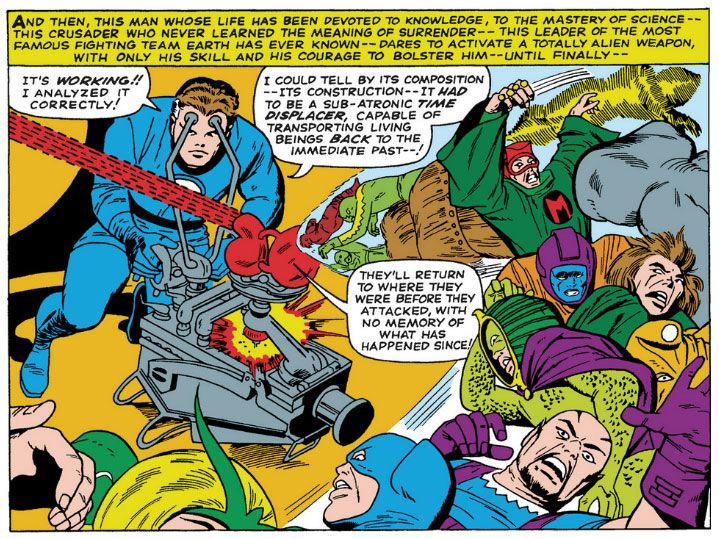
And here's that aforementioned device in action.


My god, Reed Richards is so smart, he could tell just by looking at it what it is and what it's used for!  I'm looking at it and all I can think is maybe I could use it to project transparencies onto some kind of fabric screen or perhaps even the wall itself as a visual aid for one of my classes.

This panel sums up the whole of the rather jangled plot, which is almost entirely given over to fight scenes, as you can imagine.  Kirby's on fire with some incredibly energetic poses as he presents practically an encyclopedia of Marvel's contemporaneous characters and we get a lot of villainous monologues and heroic wise-cracks from Lee.  Vince Colletta's inks are typically scratchy and rushed-looking, but I also recognize the herculean task faced by the art team here in working with this many characters on deadline.  They're serviceable finishes and a few odd figures and faces actually have a becoming elegance (others look kinda haphazardly slapped together), but certainly this book would have looked slicker with Chic Stone doing the honors, or Joe Sinnott.  Then again, Reed and Sue might have had to delay their ceremony another year or two waiting for this issue.

Another thing to consider is we're looking at restored art here.  I'm not sure what process Marvel puts their back catalog through to produce these color reprints, but I doubt they used the original inked pages or old separations (if any of that still exists).  I'm guessing they cleaned up some stats or decent-quality printed books as best they could,  retouched things here and there but said, "Eh, good enough" at the loss of finer lines after the digital coloring.  And these lines look like they were thin enough to begin with.

On with the wedding!  Here comes the--

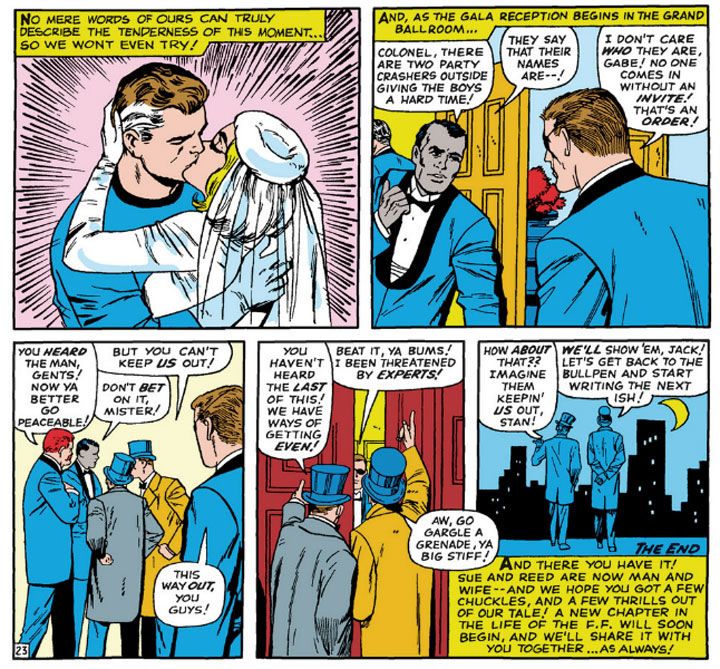
Stop the music!  Stop the music!  Hold the sub-atronic time displacer!  What's this?  Two more wedding crashers?


In the immortal words of a certain bashful, blue-eyed boy, "Wotta revoltin' development!"

Tuesday, October 29, 2013

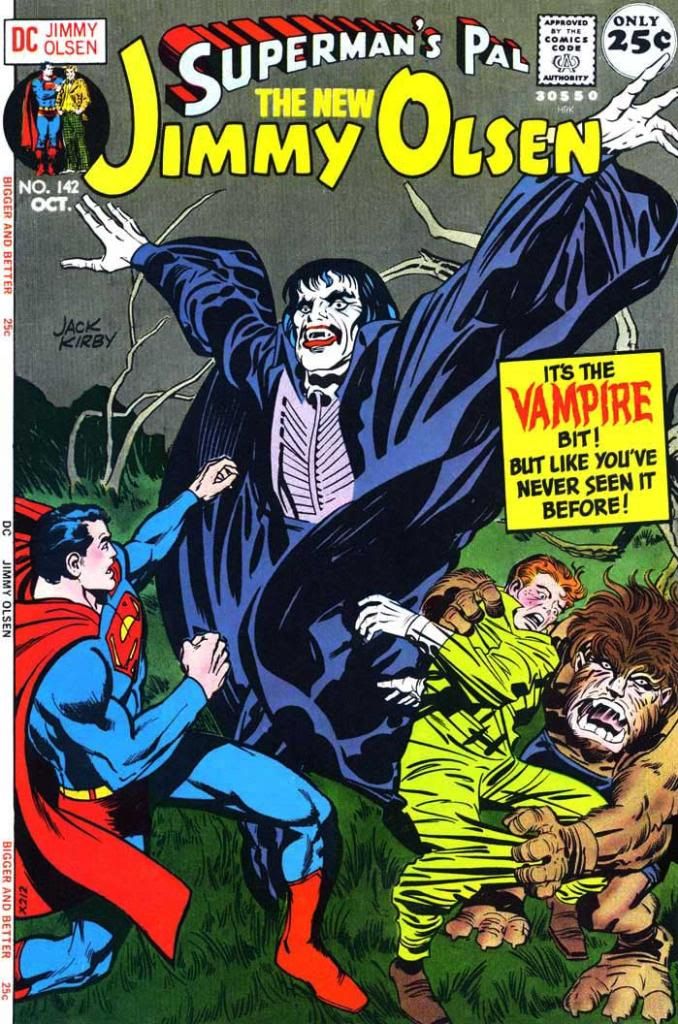
October is Spookey Month: Jack Kirby pits Jimmy Olsen and his pal, Superman, against a vampire. The winner? Anyone who reads it!

Jack Kirby drew comics in just about every genre.  Which is a pretty conservative way of putting it when you consider he actually invented or co-invented some of them.  As a Kirby fanatic, I wanted to link him to my annual Halloween celebration here, and rather than talk about Spirit World (Kirby does the paranormal) or some of his straight-up horror work (you can find it scattered about in various reprints, Archives, Essentials and Showcases and IDW's Haunted Horror), I have decided to once again explore his early-70s DC years.  We love those book here.

In Superman's Pal Jimmy Olsen #142 and #143 (October-November 1971), Kirby gives the then-corny vampire routine a science-fiction/superhero twist.  Nowadays we have scary vampires again, and romantic, sparkling vampires and vampires that fight werewolves with Matrix-style kung-fu, but when Kirby wrote this story, movie vampires were pretty much still tuxedo-wearing noblemen and the occasional lesbian baroness in a Victorian-style negligee.  Comics in particular had worn out the theme, despite years of a Comics Code ban on vampires.  Once EC had modern-day vampires put taps in their victims' necks and Warren saw an old school county-style vampire take a spaceship to a planet of perpetual night, the concept had been stretched past recognition, like Dick Tracy's face imprinted on Silly Putty (I used to love distorting that guy). The only things left were parody and deconstruction.  Kirby's story tends towards the latter, although the self-aware cover copy hints at the former.

That's as close to tongue-in-cheek as this story gets.  The rest of it is as sincere as Linus' pumpkin patch in It's the Great Pumpkin, Charlie Brown.  Kirby expends a lot of energy here trying to make readers buy this concept and he's not playing around or being cutesy.


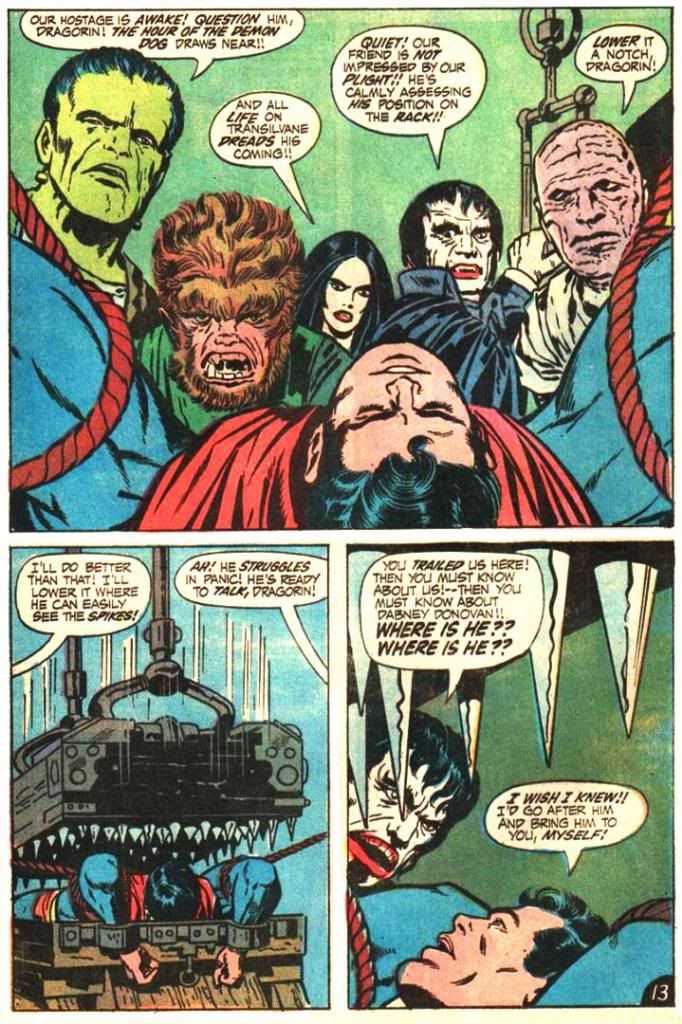
Count Dragorin, the man from Transilvane, does everything you've come to expect from a vampire, up to and including having a werewolf as a best friend.  Kirby wastes no time kickstarting the plot as Dragorin and his beastly companion slip into the city one night and put the bite on a sleeping receptionist by the name of Laura Conway.  Kirby's updated answer to the age-old vampiric transformation scene is to have Dragorin accomplish this via some kind of twin yellow power emanations from his eyes.  They leave the tradition double bite mark on the receptionist's neck and "change her body chemistry."  Within a couple of pages we have Clark Kent and Jimmy Olsen fighting Dragorin for Laura Conway's soul-- or at least her free will-- right there in broad daylight inside the GBS (Galaxy Broadcasting System) offices.  Dragorin is after a former NASA scientist named Dabney Donovan, and Conway was once Donovan's personal secretary.  Intercut with this is a subplot with the Newsboy Legion trying to escape from the Cadmus Project (they're not prisoners; their fathers work there and they're just up to their usual independent-minded mischief), so these are some really busy issues.


When Superman and Jimmy Olsen track down the scientist's lab (beneath a mausoleum in the pleasantly-named Bloodmoor Cemetery), they find they're not dealing only with a vampire and werewolf couple.  There are all kinds of familiar creatures.  So what does Kirby do to explain these Space Age vampires, werewolves and the like within the science fiction setting?  Well, it turns out Dragorin and company are microscopic aliens from an artificial planet.  That floats inside a room that looks like a creepy castle set where James Whale would have put Boris Karloff through his paces, or Todd Browning would have put Bela Lugosi through his.  And if that wasn't enough, the aliens on that world have developed a society based on old horror movies as well thanks to the bizarre experiments of Dr. Donovan, who must be a real piece of work himself.
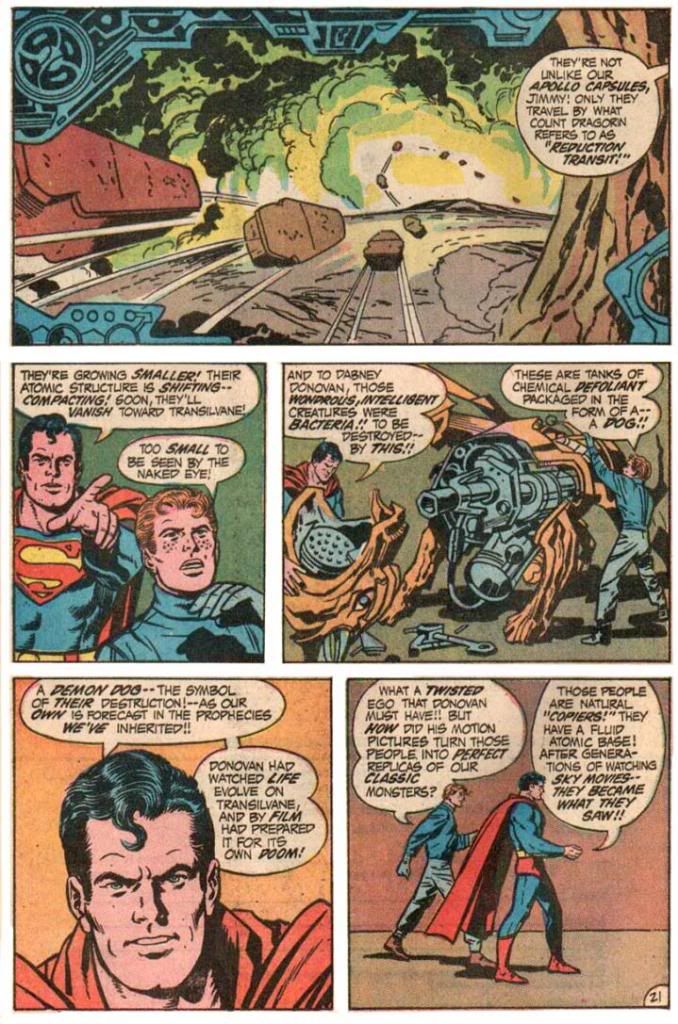
For some reason known but to himself (and, I think, NASA), Donovan didn't just make a world.  He also chose those horror movies from his vast personal collection of films and projected them into its clouds.  The sentient life there turns out to have remarkable adaptive and imitative properties, kind of like those gangster guys and the Nazis the Star Trek crew dealt with on their old TV show.  Some of the people there turned into vampires, some into Frankenstein's monsters and others into mummies and werewolves.  They travel from their planet to ours by riding inside coffins that grow or shrink depending on which way they're transiting.


Kirby doesn't really bother to explain Donovan's scientific motivation.  After all, what could he have hoped to gain from such an experiment?  Certainly if he had published his results, the idea that we as a species could create an entire miniature world full of intelligent, evolving life, would result in a philosophical or even a religious sea change.  But Donovan seems to have added these rather baroque flourishes for his own personal enjoyment, and then to destroy via a robotic dog filled with a chemical defoliant.


The horror and science fiction aspects create a dissonance that's fun but, like Frankenstein's monster, reveal some of the stitching Jack Kirby did to make the story work.  Because Kirby's trying to assemble this creature in a way that gives it life and makes sense, some of the details are a bit too on-the-nose-- the space coffins compared to the Apollo re-entry process, for example-- while others remain shadowy, as if they're inexplicable.  Why did Donovan use old horror movies in the first place?  And we not only never meet the nutty scientist who did this, but he never receives a comeuppance for what amounts to attempted genocide.

I love that after all this oversized craziness-- even if it's also about miniature creatures as well-- Kirby chooses to end it on a minor note, with two pals sitting down together to watch Oklahoma!  It's just so human.  They're not even nonplussed about letting Donovan get away scot free, or having encountered human-created sentient life that could potentially affect life on earth in horrific ways, like some kind of virus escaping from a weapons lab. 

But maybe Superman is completely aware of this and downplaying it for Jimmy's sake as he renders the Transilvanians harmless in his own inimitable way.  From what I've read, writers and artists later extended the Transilvane concept and finally had Donovan make a story appearance as a full-blown villain, but a true sequel to this story would have Dragorin and friends transformed into good-natured cowboys and farm girls, and singing about a surrey with a fringe on top.

Oh, and be sure to note the Superman figure on the cover to #142.  Neal Adams re-touch.  And check out all the Al Plastino faces in the interior art.  Occasionally some Kirby comes through, but I really wish DC hadn't felt the need to do this.

Thursday, March 7, 2013

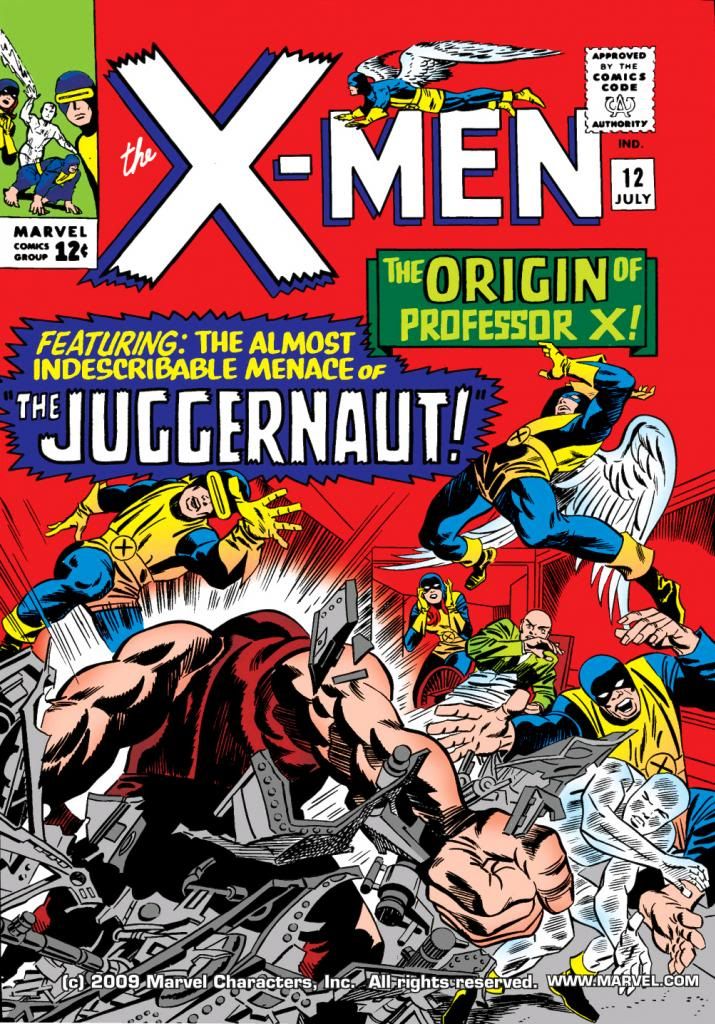
X-Men #12: Kirby and Toth, two great tastes that don't taste great together!


Jack Kirby and Alex Toth are tops of the pops as far as I’m concerned.  When I found out Alex Toth penciled X-Men #12 (July 1965), I had to track it down.  When I read he did this over Kirby layouts, I grew a little concerned.

You know, the two artists had almost diametrically opposed approaches to the page.  Toth practiced an elegant minimalism, with poses largely naturalistic.  Heavy black-spotting, cinematic.  Kirby drew in a more expressionistic way, his figures displaying emotions and actions at their most extreme.  Statue-like figures surrounded by crackling force fields and radiating forces, as if their struggles produce an energy that threatens to consume the paper they’re printed on.  

But then I thought, why not combine Toth and Kirby?  This kind of artistic dissonance can produce in collaboration an energy of its own, like unstable two radioactive molecules exchanging electrons and we get an artistic nuclear reaction producing a startling, never-before-thought-of beauty.  Or, in this case, X-Men #12, a comic book China syndrome.  A Three Mile Island in print.

Flash back to 1965.  Stan Lee, always on the hunt for artists (a number of DC regulars did Marvel jobs under assumed names back then), gave Alex Toth a call-- or mailed him a letter for all I know-- and offered him an issue of X-Men.  I'm no comic book historian, but I think Kirby was spread pretty thin at this point and dropping X-Men to concentrate on Marvel's better-selling titles.  But as to why Lee would offer this particular book to Toth in particular-- well, that's for people who know more about the inner workings at the House of Ideas.  Suffice it to say, Lee offered and Toth accepted.

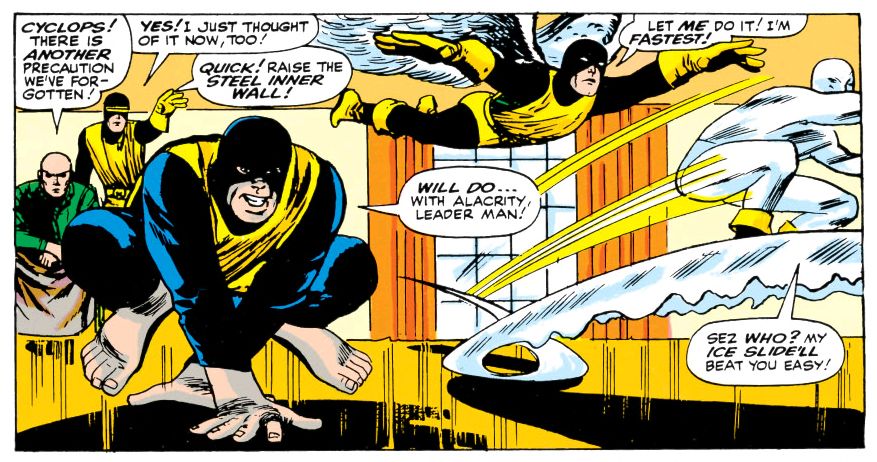
So far, so good.  As so many other artists had to at Marvel, Toth went to work on pages previously laid out by Kirby, the creator of the Marvel house style.  Maybe this was meant to smooth the art transition for the readers.  Maybe Toth asked for this arrangement himself.  After all, he was used to working from full scripts, not from Stan Lee posing on his desk.  To make sure Toth's work became fully Marvel-ized, Lee then assigned inker Vince Colletta, a frequent Kirby collaborator, to...


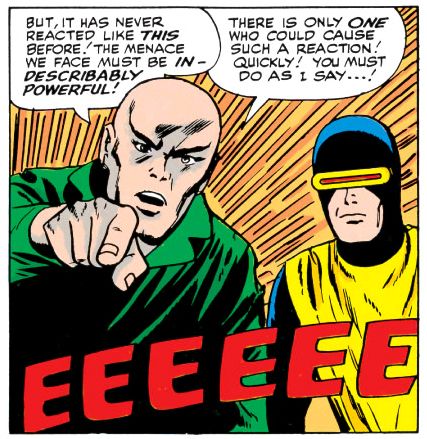
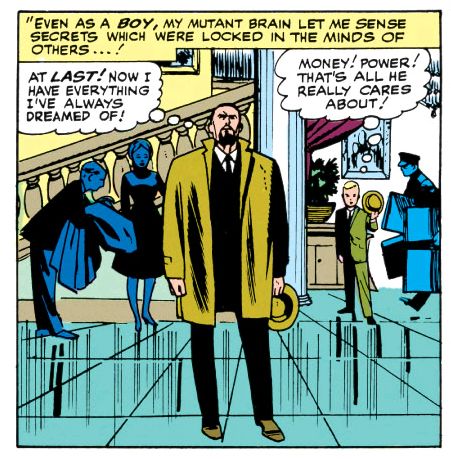
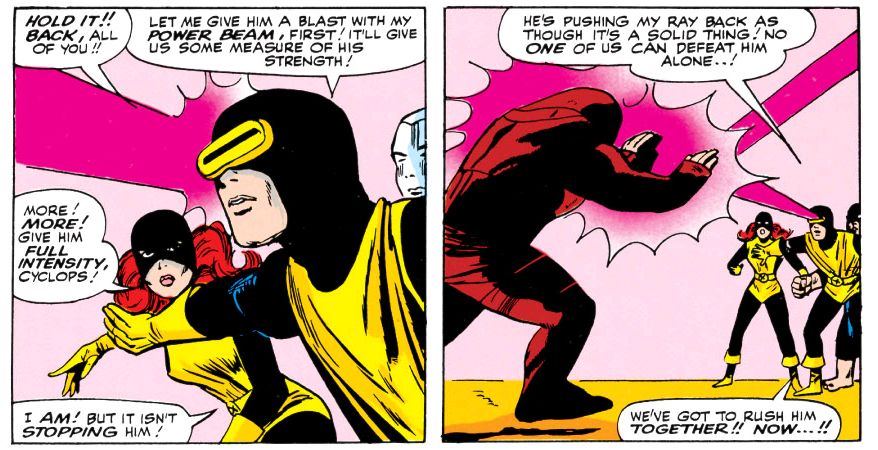
"Fix" isn't quite the word for what Colletta did.  While Colletta certainly has his shortcomings-- a cursory Google search will come up with ample listings of them, especially in conjunction with his inks on Kirby-- nowhere are they more on display than in this ham-fisted job on top of Toth pencils.  Gone are the smooth, graceful lines of Toth and instead, we find crinkly, crabby scrawlings, wonky faces and malformed hands galore, plus trange interpretations of light and shadow that show Colletta wasn't quite sure of what Toth was getting at.  Toth was known for drawing handsome men and beautiful women.  Kirby drew them as powerhouses seemingly carved from stone or molded from steel.  The mutants on display in this book are the kind you find preserved in alcohol in dark closets in abandoned madhouses.


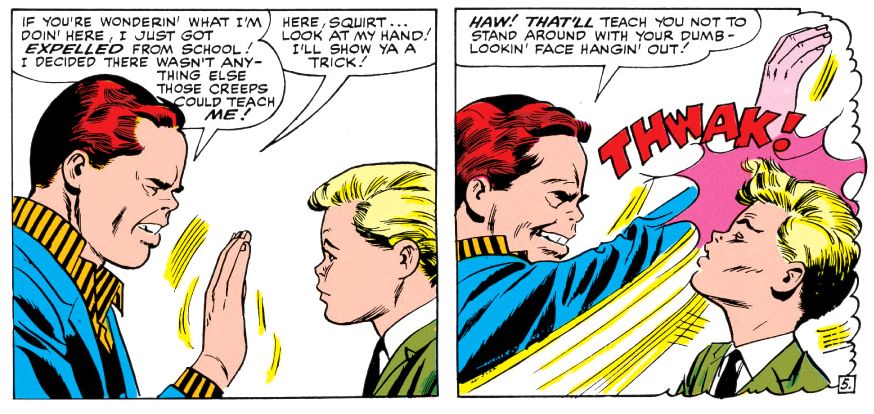
Joe Sinnott might have salvaged this job with his slick line, confident black-spotting and willingness actually to draw with ink and fix proportions, but it's pretty obvious Colletta just isn't up to the task.  Check this out:


Lumpy Rutherford-- NOOOO!!!  This looks like the worst comic book adaptation of a secret Leave it to Beaver episode ever.  That red-haired jerk is Cain Marko, Charles Xavier's step-brother.  They don't get along, as you can see.  While Cain has a pert Toth-style nose, his hand looks like someone shoved sausages into a latex glove.  That's neither a Toth hand nor a Kirby hand-- it's a hand no one bothered to finish drawing.

In Colletta's defense, I really doubt Toth gave him all that much to work with.  They'd team together again at DC on Hot Wheels with much better results-- although Toth might dispute that if he were still around.  The difference there might have been Toth being more engaged with the material than he is here and unencumbered by another artist's layouts.

Anyway, a few panels in this book look very Tothian, as if he took his time to really shape the image, but for whatever reason, throughout most of this book Toth appears to have largely traced Kirby's figures without adapting them to his own naturalistic proportions and scale.  While he uses a lot of those parallel ray bursts that make the characters look as though they're exploding with strange energy-- but never seems to have reconciled the Kirby approach to these kind of abstracted effects with his own minimalism and Colletta spent about two seconds puzzling them out before slapping down the ink.  There's also a chance Toth might not have drawn any of these effects and Lee, dissatisfied with too much negative space in the panels, either added those lines himself or had someone in the art department do it.

Here's another unfinished hand:


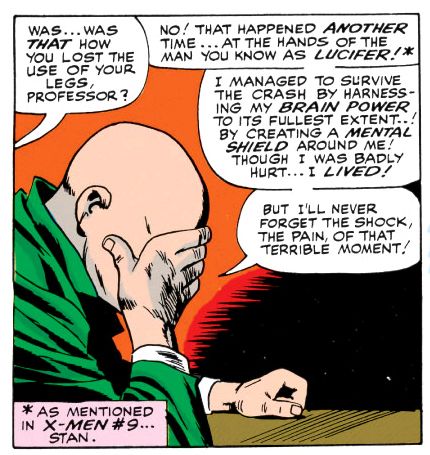
Another problem is the color reconstruction is lousy.  This comic was never meant to be printed on slick, glossy paper with modern line-screens.  Despite a growing serious fandom and popularity on college campuses and with the heads, comics in the mid-60s were still disposable rags printed on the cheapest paper.  Lee, Kirby, Toth and Colletta all knew this.  This didn't necessarily mean they hacked it out without a care, although X-Men #12 seems to stink of that.  It just means they were under no illusions of creating something of lasting impact.  They weren't dreaming history here or anticipating bloggers deconstructing every aspect of every panel on one page out of the hundreds they touched that month.  They were working to support families or pay alimony and they knew, as professionals, how to get the most out of the shoddy materials they had to work with in the time allotted-- they didn't have the luxury of blowing deadlines like superstar artists of today do-- so the end result, there on the newsstand, would be attractive enough to tempt readers into spending their twelve cents.

People didn't preserve the original artwork-- they had paste-up jobs done on them with glue that soon yellowed or browned, people used old pages to clean brushes or tossed them in files and later shredded them when the company needed more space.  I've seen some pages from this job for sale online, but I doubt Marvel spent the money necessary for full access to them in order to start from scratch.  What's more likely is they scanned decent printed copies, then used Photoshop to eliminate as much of the colors and old-timey fat line-screens-- a process which also takes away the edges of the black areas and a lot of the fine line work.  And, in the case of Colletta, serving to make an already sketchy line quality even sketchier.  Re-colored then printed slickly, or blown up on Comixology (which is where I read this), all the original flaws become glaring and a lot of new ones show up as well.

In this case, there are pages where Cain Marko's face appears a bizarre pink as if he's suffering from extreme embarrassment or some kind of disfiguring rash.  Poor guy. No wonder he went mad with power when he found the Cyttorak Ruby.


What I don't understand is why Toth took this job in the first place.  If Lee wasn't shy about expressing his artistic opinions, Toth was the original let 'em have it guy.  He must have looked at these layouts and thought, "Oh balls!"  Plus, Xavier's backstory is cliched and melodramatic (although these guys make a pretty good case for it even while pointing out Stan Lee's apparent difficulty with psychic terminology).  It's rather talky for a book so packed with characters, too.  And, as part one of two, it's all build-up and no climax.

Toth liked to draw airplanes and cars and he was aces on period pieces.  Portions of this story take place in flashback, but there's nothing setting it in any particular era visually, and just one sequence featuring a car that looks pretty contemporary to me, a mid-60s model in a scene that takes place sometime in the 1940s.  Toth preferred classic Errol Flynn-style swashbuckling heroism, but there's not a single sword-fight anywhere in this story.

My best guess is the Warren and DC jobs weren't coming frequently enough and publishers like Dell didn't pay high enough a page rate, so he gave Marvel a shot in hopes of picking up some much-needed money.   I don't know.  Who can fathom genius, especially one as mercurial as Alex Toth?

He must have had his reasons because here's Toth working over Kirby layouts.  It's not as if Toth never drew superheroes-- we have a classic Flash and Atom team-up from the year before which cuts X-Men #12 to shreds, a run on Black Canary and an often-reprinted Batman story, plus some other gems scattered throughout his bibiography.  This should have been one of those.


Anyway, if the lack of any other Toth Marvel work is any indication, Stan Lee wasn't too pleased with the outcome of his little science experiment.  Werner Roth would pencil part two, similarly working over Kirby lay-outs with happier results, as "Jay Gavin" before becoming the regular penciller under his own name.  Toth would go on to do sterling work in Warren's Blazing Combat, and for DC's horror and war titles in the 70s, but never again would he draw Marvel's heroes for comic books.  For TV, yeah.  A couple of years later, he did designs for Hanna-Barbera's Fantastic Four cartoon.  But we never got to see Toth's take on The Avengers or Doctor Strange.  I, for one, would have loved to have read a Toth Amazing Spider-Man or Daredevil.  I can't help but think if Lee had just trusted Toth to do his thing-- the way he seems to have let Gene Colan-- and come up with a plot playing to his strengths rather than trying to merge him with Kirby, we might have had a stand-out issue, an oddity nonetheless, but something really special.  Maybe it wouldn't have sold, though.  Whatever else you can say about Lee, the man knew how to move books.

Now if someone can explain to me why Cyclops's famous ruby-red eye beam is magenta.

Sunday, September 23, 2012

Cindy Lee loves parties, boating alone in storms and scavenger hunts!

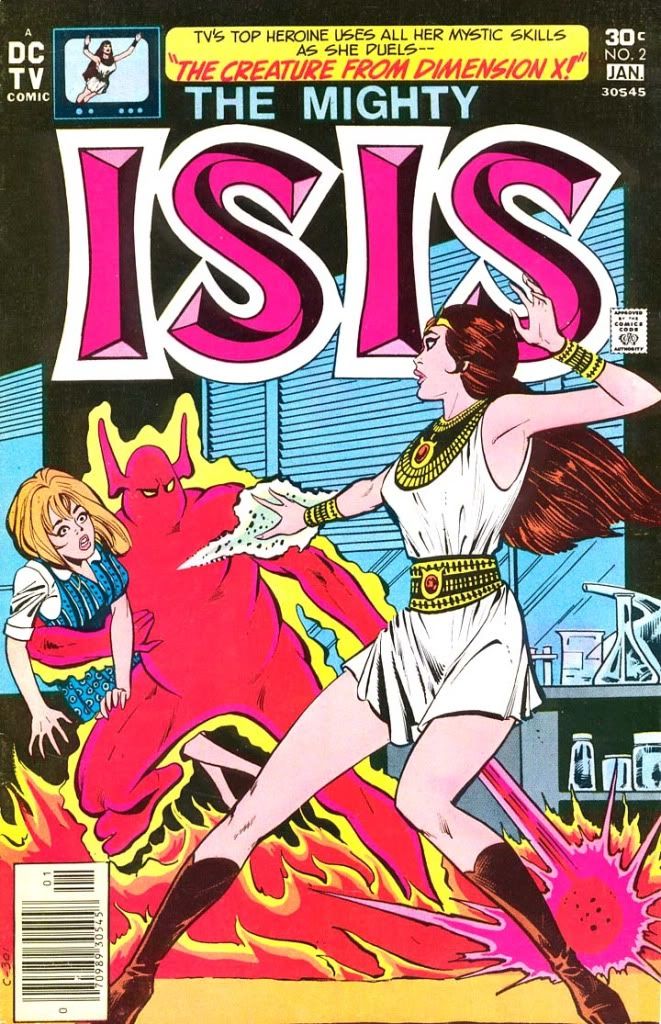
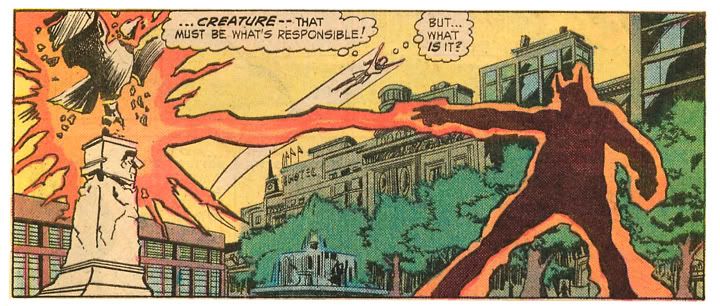
Now for some comic book history.  Cindy Lee fans were devastated when they bought Isis #2 (December-January, 1976-1977) and discovered she's barely in the lead story, "The Creature from Dimension X."   

"Say, what's the rumpus?" they asked of DC, using then-current vernacular.  "Give us the scoop, the low-down, the straight dope, and none of the high hat, ya palookas."  DC's official answer:  "Creative decision."

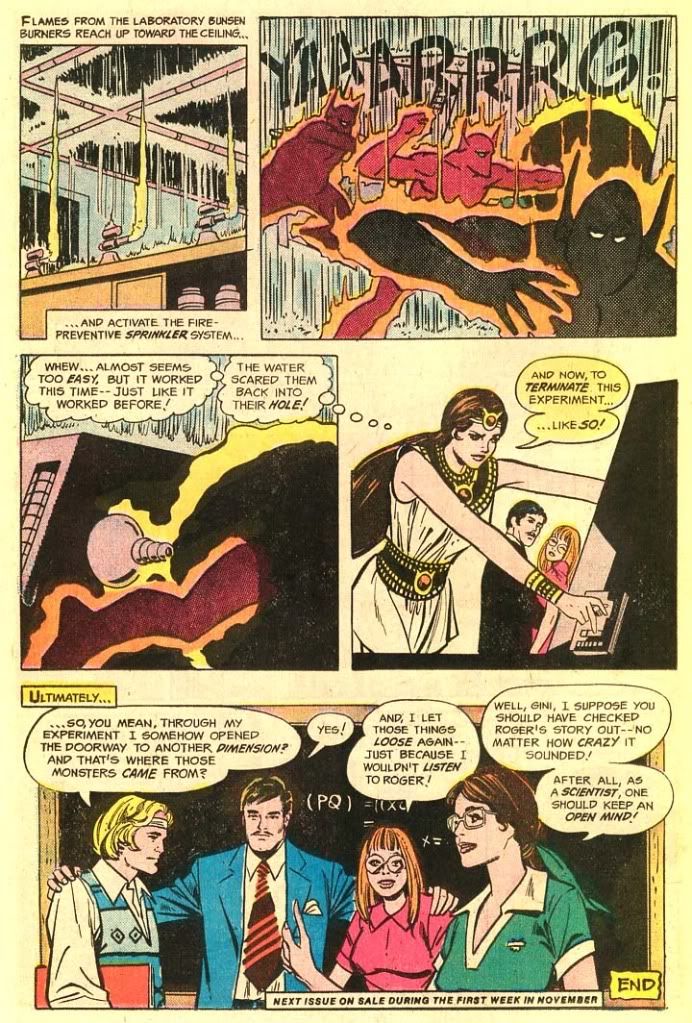
 Writer Steve Skeates conjures up in her place a clever lad named Roger who uses Rick Mason's high school science equipment to create a pocket black hole that turns out to be a doorway into another dimension.  Instead of earning himself a Nobel Prize for creating a limitless energy source from what's essentially an overgrown Erector set, Roger allows some kind of red monster to lurch out of it into our reality.  Isis chases the destructive bugger back home, but Roger's friend Gini-- who looks a lot like Jan Smithers as Bailey Quarters from the early episodes WKRP in Cincinnati, by the way-- makes a special visit to the junior genius' hospital room so she can scoff at his wild monster story.  Gini (who really should have been Cindy) vows to continue the experiment, this time with Mr. Mason supervising.

Nothing can possibly go wrong recreating the exact circumstances that unleashed a destructive creature on our world, right?  Within minutes Isis has to contend with four of these monsters.  John, Paul, George and It's Only Ringo.  She defeats them simply by activating the school's sprinkler system, then turning off the machine.  Gini admits her empiricism was a mistake, and Andrea Thomas tells her a scientist should always keep an open mind.  And yet Cindy Lee isn't involved in the action in any way.  She doesn't rush into a room to raise the alarm, doesn't bear witness to the wonders of science. She's not even menaced by the extra-dimensional creatures and doesn't get to help Isis deliver the moral.  Instead, in an almost-criminal act of story self-sabotage, Skeates confines Cindy to two measly panels, with no dialogue.  Name checked by Gini, some star-student-come-lately, then forgotten.

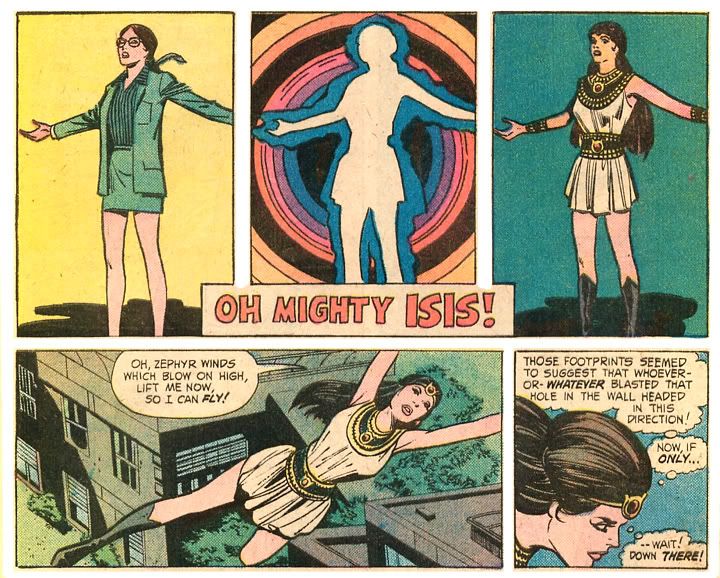
While they do give us a psweetly psychedelic Isis transformation, artists Mike Vosburg and Vince Colletta manage further the injury by whitewashing Dr. Barnes.  Skeates strips him of his advanced degree and calls him mister instead of doctor, too.  Why, it's almost as if no one working on this book had never seen a single episode of the show and merely relied on Shazam! #25 (Sept.-Oct. 1976) and Isis #1 (Oct.-Nov. 1976), and possible a couple of flippant remarks at an editorial meeting as their reference sources for all the characters.  But that would be artistically irresponsible, right?

Hundreds of fans read this story, then tore their comics in disappointment and despair (ready to wait 20-odd years until the invention of the Internet and comic book blogging to vent their rage more fully), the remnants fluttering to the shag carpet like so many colorful autumn leaves—but wait! On a tattered shred from somewhere in the back of the comic.  Could it be?  Yes!  It’s Cindy Lee!  And what kind of trouble has she gotten herself into this time?  Let's find out!


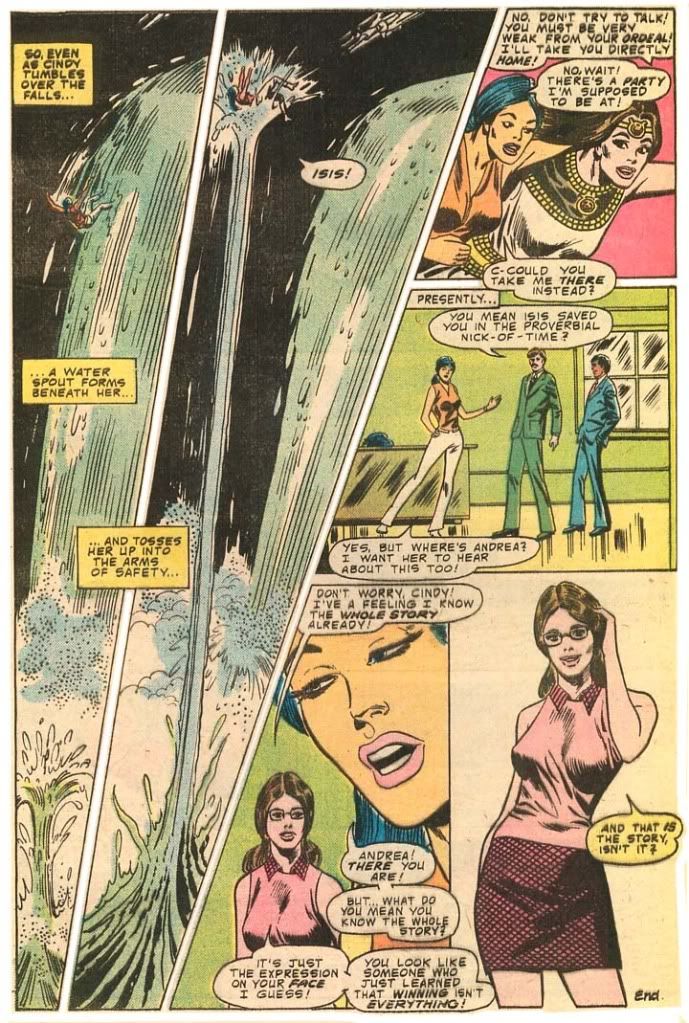
That torn panel is from "Lost and Found," the back-up story, which is much more Cindy-centric.  It begins with bad weather and the heroic Isis doing that thing she does so well: rescuing young people from danger.  In this case, shes saves two teens who went boating in the storm, only to capsize.  Isis lectures them, takes them home, changes back into science teacher Andrea Thomas and heads to a swingin’ party…

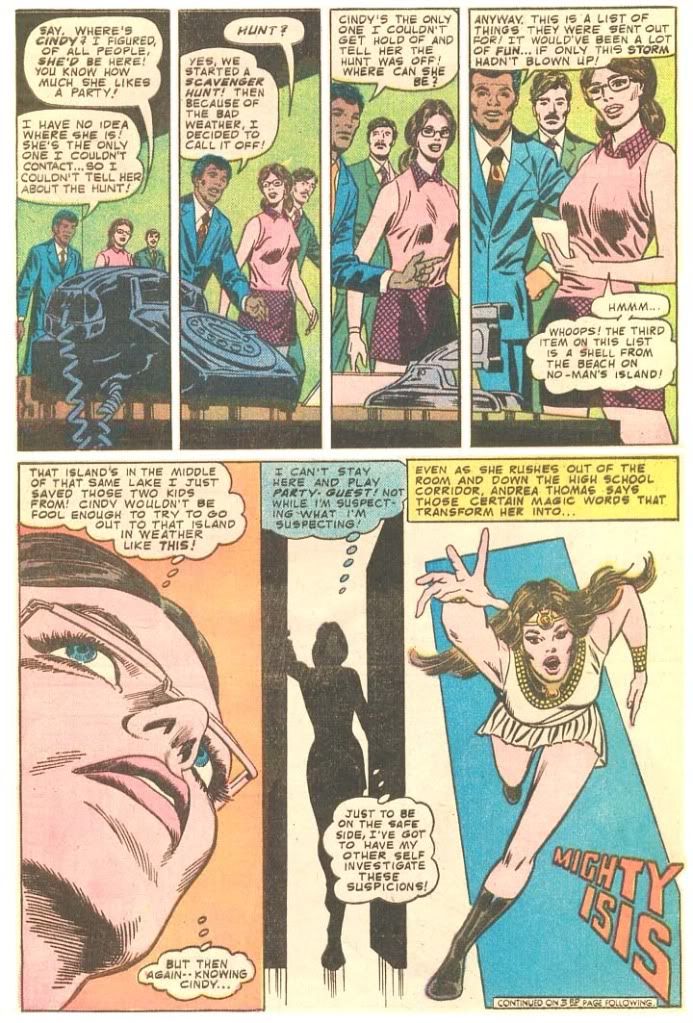
Where the main topic of conversation is none other than Cindy Lee herself.  She's not there.  It's almost a meta-commentary on the lead story.  Thomas is surprised and immediately asks about her, because she of all people Cindy “likes a party.”  School, her teachers, pyramids, danger, parties.  These are the things Cindy Lee loves so well.  

From what we now know of Cindy it's obvious would never miss a chance to hang out at school with her favorite teachers barring earthquake or death itself.  In her DVD interview, actor Joanna Pang confirms at least some of my more rational Cindy Lee theories-- she's the kind of girl who always volunteers to stay after school, has her permission slips signed first and is unfailingly positive and go-getting.  She's into anything and everything about school life, whether it's academics or just spending all day there soaking up the atmosphere and offering to help out wherever she can.  So it's pretty believable people would remark on her absence from a school event.

But what about everyone else?  Another unrecognizable Mr. Barnes, apparently drunk to the point of hallucination (although he seems rational enough) insists he organized a scavenger hunt, then cancelled it due to the bad weather.  But there's no sign of would-be scavenger hunters.  Truth, alcohol-induced daydream or is Mr. Barnes just making this all up so Ms. Thomas won't think he and Rick Mason are pathetically hanging out by themselves?  

Maybe Skeates didn't specify a lavish attendance of students and faculty, but the very least art team Mike Nasser and Frank Giacoia could have done was infer from the dialogue more than three people in the room so Barnes doesn't look like either the saddest clown in the circus or a complete madman.  We know the Filmation TV show was low-budget, but I'm pretty sure they had a few scenes with more than three people.  After all, they created a fairly convincing school picnic for the "Bigfoot" episode.  What was the budget DC allowed this comic for extras and supporting characters?  Did Skeates and company blow it all on the science experiments in the lead story and have to skimp here?

We could ask Rick Mason, but he refuses to speak for most of this story.

Mr. Barnes (he's a PhD on the TV show, by the way) must have convinced Cindy, at least, because the only explanation anyone can come up with for her absence is she's off trying to win the scavenger hunt.  And yet they still expected to call her up and tell her the event was off.  This is Cindy Lee in the era before cell phones.  You send her on an errand, don't expect to ring her at home and find her there.  If you even float the vaguest idea for a school activity, before you can say, "Nah, on second thought," she's organized the decorating and refreshments committees, nominated herself for vice-president of both, requisitioned petty cash from the school's general fund, bought five miles of colorful bunting and booked REO Speedwagon as the entertainment.

Of course you're not going to reach her, Mr. Barnes.  She's Cindy Lee and you sent her looking for item number three, "a shell from the beach of No-Man's Island," you fool!  Thank Isis you didn't think it would be funny to add "a golden apple from the Garden of the Hesperides" as item number two.

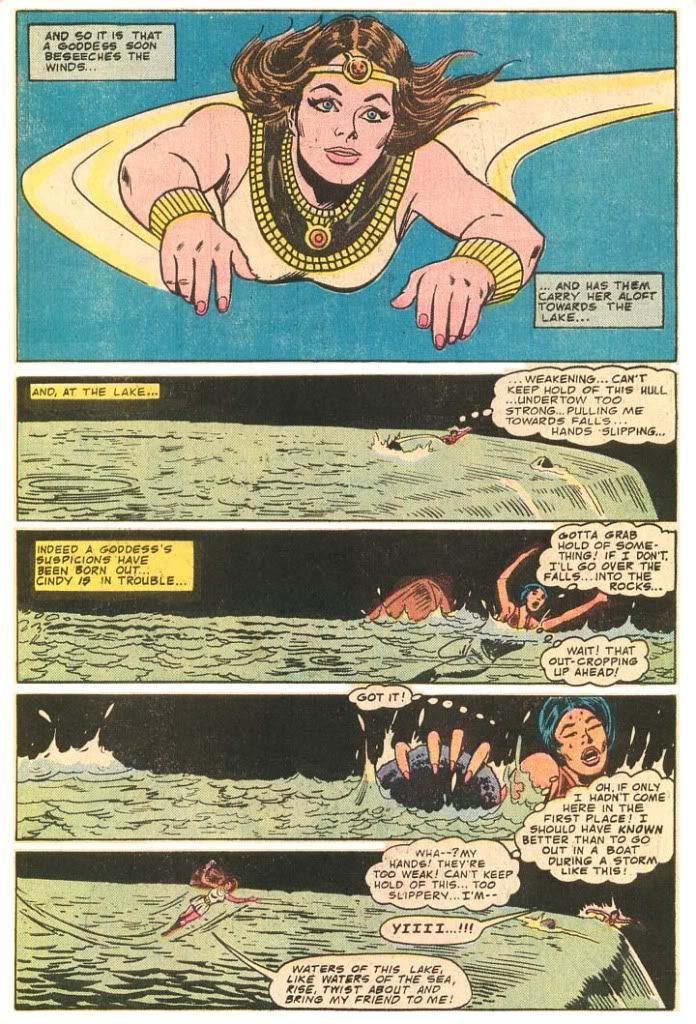
Perhaps in an editorial meeting with Denny O'Neil, Skeates learned it's not an Isis story unless Cindy Lee finds herself facing death.  No-Man's Island is on the same lake where those other kids nearly came to grief.  Worried that her star pupil is even now intrepidly sailing to her doom, Ms. Thomas dashes out into the rain and transforms.  Isis confirms her alter-ego's suspicions when she flies back over the storm-tossed lake only to find Cindy Lee clinging desperately to a tiny rock.  Cindy is thinking to herself going boating alone in a gale might not have been the wisest of decisions, even had she possessed the nautical skills of Popeye himself.  

In terms of Cindy Dilemmas, where do we rank this?  Somewhat worse than jumping a junkyard fence to spy on car thieves?   Not as rash as using Rick Mason's car to chase coin thieves?  On my patented Cindy Dilemma Scale, with one being the least dangerous and ten being the most, I give this an eight. 

Over the waterfall she goes, our little daredevil, but Isis uses her Egyptian goddess magic to conjure up a life-saving waterspout.  Anyone else would be traumatized, but all the resilient Cindy can think of is getting to that sparsely-attended party.  What school spirit!  What joie de vivre!  Is there extra credit involved, or perhaps a letter of recommendation to go in her records?

Once at the school and thoroughly dried-- although she's wearing the same outfit-- Cindy regales the party-goers (Rick Mason, Mr. Barnes and Andrea Thomas, again) with the hair-raising tale of her brush with death.  Andrea Thomas makes a veiled allusion to being Isis, Cindy responds in confusion, Thomas somehow intuits Cindy's boating mishap had something to do with her desperation at winning the scavenger hunt which I'm still not convinced hasn't taken place solely within the confines of Mr. Barnes's mind.

Tuesday, May 24, 2011

For Kamandi -- With Love and Squalor

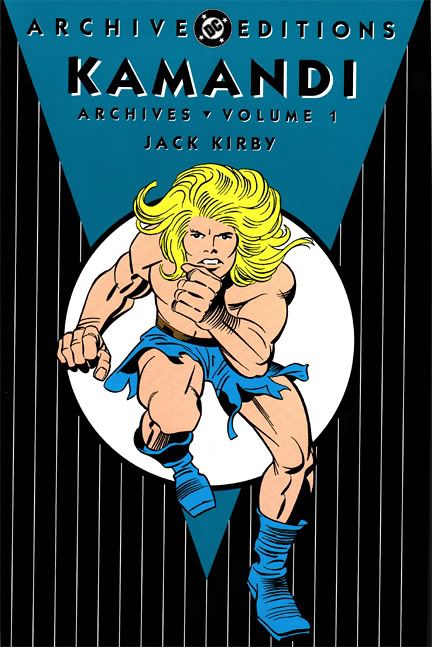
What do you get when you’re DC publisher Carmine Infantino and you float the idea that Jack Kirby should rip off Planet of the Apes? Not a Planet of the Apes rip-off, that’s for sure. If Infantino expected Kirby to content himself with mere talking simians, he was sorely mistaken. And yet that’s pretty much how it happened, and how approximately 65 million years later, we lucky fools ended up with this slick and weighty DC Archives edition of Kamandi.

Or, as I like to call it, Kamandi: The Last Boy on Earth, because that’s the series’ title and I’m clever that way.

Chapter One: The Last Boy on Earth!

Kamandi is a futuristic, roughneck young hippie in a time where barbers have gone extinct, but cut-off denim and motorcycle boots are all the fashion rage. He’s the Charlton Heston surrogate for this madhouse world where not only do gorillas talk and ride horses, but lions and tigers tool around on three-wheelers and radioactive scientists float overhead in helium balloons.

Because it’s Kirby, Kamandi can scarcely contain itself. While he was always possessed of a febrile creativity, as soon as Kirby hit DC, his imagination went into some sort of turbocharged overdrive. His Fourth World stories are over stuffed with incident and new characters, and Kamandi features a similar breathlessly paced narrative. Reading a DC-era Kirby comic like reading ten stories in one.

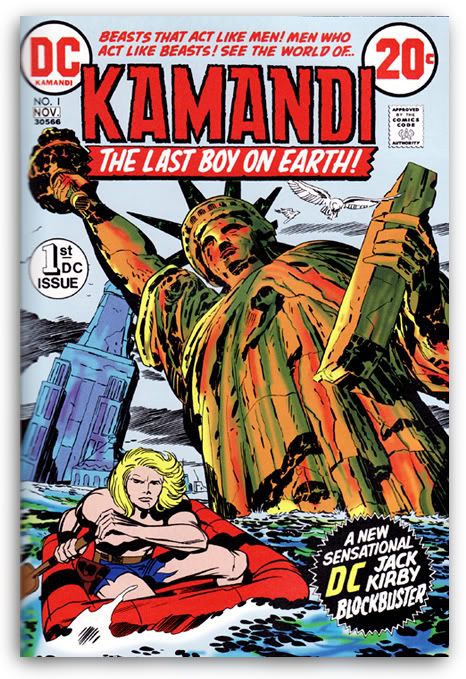
Kirby himself was busy then, too. I believe he was simultaneously producing Jimmy Olsen, Orion, Mr. Miracle and Forever People, spackling his living room wall in preparation for repainting it and mediating the Paris Peace Talks between the United States and the Democratic Republic of Vietnam (DRVN). And just as he saved our world in reality, Kirby destroys it in the pages of Kamandi. It's the post-apocalypse with a new status quo of underground bunker-dwelling and scavenging for food. Kirby destroys that almost as soon as he introduces it, too. When we first meet Kamandi, he's rafting through a flooded New York with a Statue of Liberty as majestically ruined as the one in the Apes film series, its obvious antecedent. Kirby leads with a splash page followed by a double-page spread no less!

DC... next time you destroy
the Statue of Liberty in a story,
do it the Kirby way.

Six pages in and Kamandi’s guardian/mentor is dead (he barely gets any dialogue), Kamandi’s battling a talking wolf who foolishly beckons, “Here! Give me that gun! --- Come on ---! I won’t hurt’cha!” and then Jolly Jack decides he needs to do something to pick up the pace before reader ennui sets in.

The second sees Kamandi’s new-found radioactive buddy Ben reminding him “Don’t forget Ben Boxer, boy! I’m not like the other humans you’ve seen!” As if Kamandi or the readers could forget- Ben Boxer is a man who has to wear an astronaut suit in order not to kill everyone around him with deadly radiation. Oh, and he turns into steel then deals out ass-whuppin’s. Just like the X-Men's Colossus, only not Russian. And a couple of years earlier.

Then we get yet another double page spread, this time of anthropomorphic rats looting the wreckage of the George Washington Bridge.

Kirby's gorillas are cooler than
the ones from 20th Century Fox.
Just keep Timothy Burton away
from them.

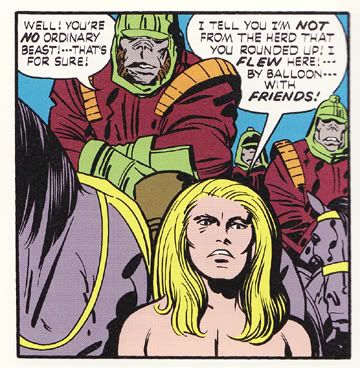
It’s not until #3 that the Planet of the Apes similarities fully emerge as roughneck gorillas (are there any other kind?) in green hunting caps and purple jumpsuits capture Kamandi. The cover blurbs come backing more hyperbolic bombast than a decade’s worth of today’s comics:

Welcome to a buried Las Vegas! Once a playground for men – now, a sinister hunting ground for gorillas!

So the apocalypse didn’t change much. And then this:

Complete in this issue! “The Thing That Grew on the Moon!”

A thing! And it grew… on the moon! As if the loincloth-sporting gorilla on the cover wasn’t enticement enough. Comics today could use more of this kind of cover copy-- at once hucksterish and tongue-in-cheek, and instantly appealing.

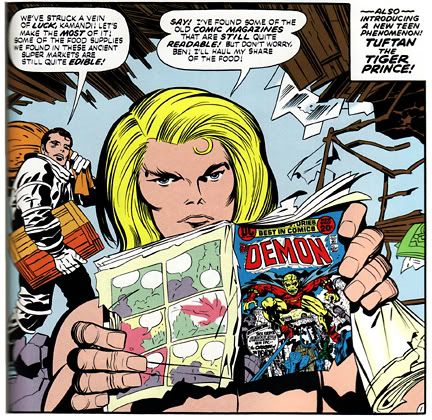
Who says this isn't the Age of
Kirby Self-Promotion? Kirby
works in a little plug for another
of his comics. "Quite readable,"
Kamandi? Quite readable indeed!

I think Kirby may have had bigger plans for Tuftan, the Tiger Prince. He comes on the scene in #4, heralded by a splash page text box labeling him a “new teen phenomenon.” I’m not sure if Kirby means Tuftan is a teenager (and more to the point, a tiger), or that he hopes Tuftan catches on with 70s teens the way David Cassidy and his half-brother Sean did, or Kristy McNichol, or skateboarding, or discotheques or feathered hair. After all, the kids loved Tiger Beat magazine; how could they not love Tiger Prince?

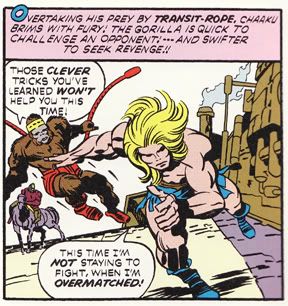
In the post-apocalyptic future,
half-naked neo-hippies will frolic
with headband and loincloth wearing
gorillas on transit ropes!

Kamandi and Tuftan get caught between the warring tiger and gorilla armies, and Kamandi gains a talking human girlfriend named Flower… who shamelessly goes around shirtless! Which is only fair, since Kamandi also flaunts bare-chestedness. Flower’s hair gives her some Lady Godiva-style modesty but Kirby’s notion of upper-body nudity is amazingly egalitarian.

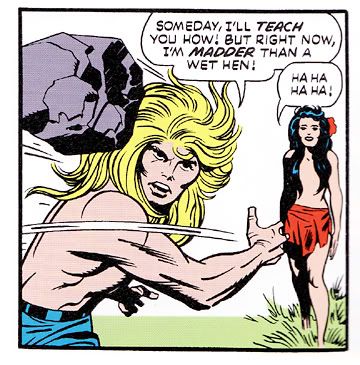
In Kirby's future anyone may go
topless without shame! Viva la difference!

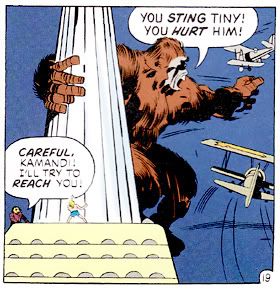
Almost as soon as Kirby establishes the romance between Kamandi and Flower and hints at the eventual reestablishment of some sort of humancentric society, tragedy strikes our young lovers. Kirby examines its aftermath in Kamandi #7, with a chapter intriguingly titled “The United States of Lions." Surprisingly, it has little if anything to do with unions, states and only tangentially features lions. Beginning with a funeral and ending with a skyscraper battle, it's actually Kirby’s parody of King Kong, substituting a massive gorilla; Kong’s equal in stature but superior in conversational skill.

And that’s just a quick overview of the first seven issues! I’m too exhausted to tell you all the details about the last three in this book, in which we visit “Tracking Site,” battle the savage flying bats and the freakish, sinister homunculus who dwells there, intent on unleashing a world-ending bacterium for some obscure reason Kirby can barely take time to explain to us in the breathless rush of his futuristic narrative.

Chapter Two: The Waiting Secret!!

If you haven't guessed by now, Kirby goes pretty far afield, given the series’ original mandate. And while Kirby wasn’t above rehashing classic movie plots he never failed to add twists the original wouldn’t dare. Imagine how insane Beneath the Planet of the Apes would’ve been if, instead of skinless mutants, the gorilla army had encountered talking lions on three-wheelers.

While suffering from an over-reliance on capture, escape and evasion plotting (it becomes repetitive), Kamandi is a sterling example of Kirby’s off-the-wall and unrestrained storytelling, honed over decades of professional work. While he may not have been as interested in the book as he was in his New Gods, the fact remains the man just could not half-ass things even if he tried.

Who else would engineer an entire future Earth, populate it with talking animals of nearly every species, continually hint at a central mystery that unravels intermittently throughout the adventures and introduce brand new characters practically on a page-by-page basis?

From reading these, I can’t help but see Kirby as a mostly intuitive storyteller. Certainly the man was a sponge, soaking in bits of science, legend and myth, and good old Hollywood movies; all of this he'd combine and alter to suit his story needs. Mike Evanier's recollections give me the impression Kirby would frequently come up with a particular direction for a story... then produce something almost totally counter to his original intent. Creating on the fly, always bubbling over with ideas. With that in mind, I don’t see an overall plan here, just incidents piled on incidents.

Groovy incidents. With the intent to entertain the bejeezus out of anyone who buys Kamandi.

And while Kirby may never have written the Great American Novel, it’s probably no accident Kamandi’s adventures take place in the western regions of the former United States. As soon as he departs his underground bunker near New York, Kamandi becomes the classic American pilgrim, sojourning in locales near Las Vegas, Yellowstone Park, even ranging as far as South America in a tip of the hat to Butch Cassidy and his partner in crime, the Sundance Kid.

From James Fenimore Cooper to Mark Twain and Brett Hart, to the relatively more recent Jack Kerouac and Thomas Berger plus many others, American novels frequently explore western migration as related to rugged individualism, which Kamandi certainly personifies. In fact, this is probably the most important defining traits of what we characterize as American literature, at least in the 19th century, and much of the 20th.

The west is the quintessential setting for American literature, with Kamandi the descendant of Huckleberry Finn by way of Col. George Taylor. And like Huck, and Berger’s Jack Crabb, Kamandi rebels against unjust societal expectations, cannot tolerate a life in either literal or figurative captivity. He must remain in motion, forever restless, the personification of our nation in its youth. Unable to relate to most surviving humans, Kamandi remains apart from each culture he encounters. Kirby reinforces this by repeatedly separating Kamandi from Ben Boxer's scientists and having Kamandi assert his human identity and equality to his animal overlords who insist on treating him condescendingly as either a pet, a mascot or an enemy.

As science fiction, technological themes abound in Kamandi, but these are traditionally conflated with western ones in more mainstream American literature as well. While Cooper might bog down the narrative of his 1823 novel The Pioneers to describe a stove in almost Luciferian terms, Kirby, the once and future king of his four-color milieu, creates bizarre flying vehicles and war machines with a gestural whim, yet never slackens the story's pace.

The series has a strange dichotomy-- for humans, advanced technology is of the past, and there’s a nostalgia for what humanity has lost, but along with it, an implied criticism of the queasy, mindless consumerism and complacency that led to this outcome in Kirby’s use of imagery featuring the detritus of a lost civilization: familiar shopping mall signage and weathered sculptures of American presidents (even significantly including one of Richard M. Nixon, never a Kirby favorite) whose identities have been lost to history.

Still, in order to reclaim mastery over the world, which Kamandi sees as a human birthright, he must solve these archaeological mysteries. To this end, Ben Boxer and his scientific comrades are forever seeking the lost “Apollo Project” in an effort to understand this disordered reality.

And while technology is used to destroy (being a Kirby action-fest, violence and weapons-based imagery predominate), there’s also a hopeful quality. If one can defeat the barbarian bat-creatures and the horrific human-created bacterium that can kill all life… one might at the very least, as in "The United States of Lions," find a peaceful place where one might belong.

If, that is, Kamandi can overcome his temper and tendency towards violence. Then again, to Kirby these were also human qualities. To create and destroy, our recurring pattern, even among animals with anthropomorphic qualities. Kamandi lives in a world ruled by violence, both casual and institutionalized- rowdy fistfights, warfare and gladitorial games coexist. Kirby might remind us these, too, are human inventions.

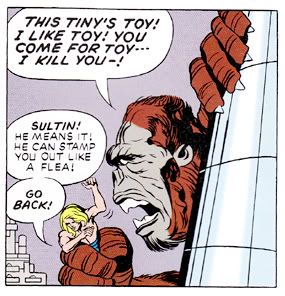
Kirby does Kong. Get Peter
Jackson on the phone! We need
an epic Kamandi movie!

Franklin Schaffner never thought
to put his apes in biplanes, but it
would've been cool if he did. These
are actually lions. Lions in biplanes,
attacking a giant, talking ape who
calls himself Tiny. God, we need
another Jack Kirby.

Chapter Three: The Monster Fetish!

We’re lucky enough of the art exists for DC to gather it all into this hefty and cleanly-designed hardcover. We can enjoy its prime Kirbyness, where his stylistic flourishes, unhindered by the slick ink work from Joe Sinnott at Marvel and the scratchy, unfinished line of Vince Colletta at DC, erupt. Kirby's use of splashes backed by innovative gutter-crossing double spreads on pages 2 and 3 gives the stories a wide-screen feel, opening up the scope and dazzling the reader with Cineramic imagery like a ruined Nevada town, preserved for animal archaeologists by the dry desert air, an Ozymandian image at once humorous and melancholy.

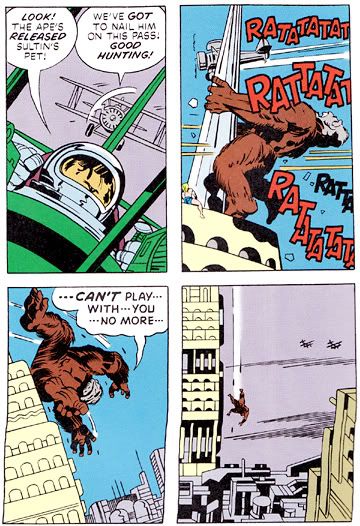
Sic semper Tiny! "Can't play---
with --- you --- no more." He's not
even angry at the lions who killed him.
Isn't that the saddest comic panel ever?

In the Kamandi Archives reprint, the blacks are crisp, the colors smooth. The reconstruction is akin to looking at a restored print of a Cecil B. DeMille epic. These stories were originally printed on grey-toned newsprint which almost immediately began to yellow. And they featured line screens that were practically planet-sized compared to today’s. Now we can see the art on glossy white, with screens so fine they allow the color fields to appear as smooth, flat areas. While this takes away some of the immediacy and ephemeral quality of the originals, it allows us to study the line work unobscured by cheap paper and indifferent printing.

This is especially educational because Mike Royer’s inks always bring out the Kirbyness of Jack Kirby’s pencils. From interviews I’ve read with Royer in the Jack Kirby Collector (a product of the wonderfully nice people at TwoMorrows), it seems his intent was always to preserve the pencils as much as possible. I love this approach, because the attraction of a Kirby comic is its uniqueness. He’s oft-imitated, but no one has ever fully captured the intangibles of the true Kirby.

The most others can do is provide the bombast and overkill, without the humane qualities. Kirby strikes me as having a genuine love for people, be they the shirtless, blonde hippie kid type or the kind hidden in an animal’s fur and sinew.