Showing posts with label Spookey. Show all posts

Friday, October 31, 2014

October is Spookey Month: Happy Halloween from the Twilight Zone!

Well, Dell Four Color #1288's version of The Twilight Zone (April 1962).  It lacks the social conscience, deep insight into the darker elements of human nature and frequent ironic twist endings we all know and love the TV show for.  It has none of Serling's poetic introductions and closings so fondly parodied over the years.  The Serling voice is hardly present at all, save for a faint echo in one story.  Instead, this book is more reminiscent of DC's anthology horror books from a decade later with a comic book version of the brilliant (and much needed these days) Rod Serling as host instead of Cain or Abel or the Three Witches.  The stories themselves play out like very mild DC horror stories, too, like some of the post-Comics Code 1950s reprints they salted among the Bernie Wrightson or Alex Nino gems.

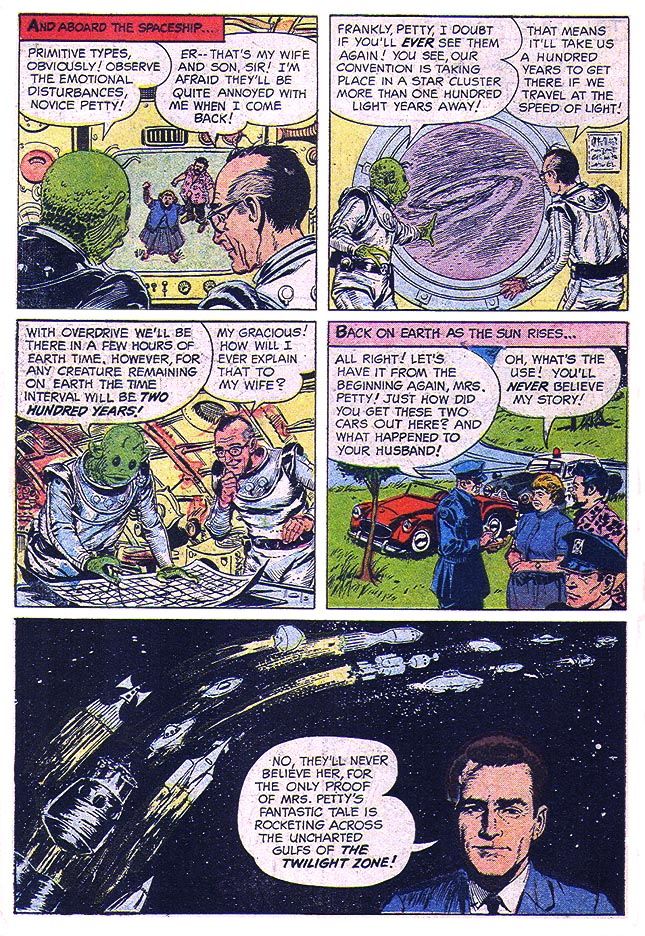
The best thing about it is George Wilson's painted cover, a fairly accurate rendition of "The Joiner," which is also the book's strongest tale.  And that's saying a lot when one of the stories is about a renegade Nazi who's used his shrinking gas to turn Hitler and his cronies into suspended animation figurines waiting in a glass case for their time to come around again.  In "The Joiner," we meet Alvah Petty, a harassed and pathetic bookkeeper by day and all-powerful Grand Poobah of any number of men's organizations by night.  The crazier the headgear and more esoteric rituals the more he likes it, all the better to keep him away from home where his wife and middle-aged beatnik son treat him like dirt.  They conspire to humiliate Petty so he'll stay home nights and they can abuse him more but it backfires on them when the fake club the son comes up with-- "Knights of the Galaxy"-- improbably turns out to be the real thing and its alien members spirit a not very reluctant Petty away for a 200 year club meeting in another solar system.

 The lead story is a yawner of a ghost story about a conman and his partner (who looks amazingly like great character actor Edward Andrews, who co-starred in The Twilight Zone episode "Third From the Sun") hiding out in a small town.  The conman ends up engaged to a woman who may or may not be from the Other Side.  You know, where the poltergeists live.
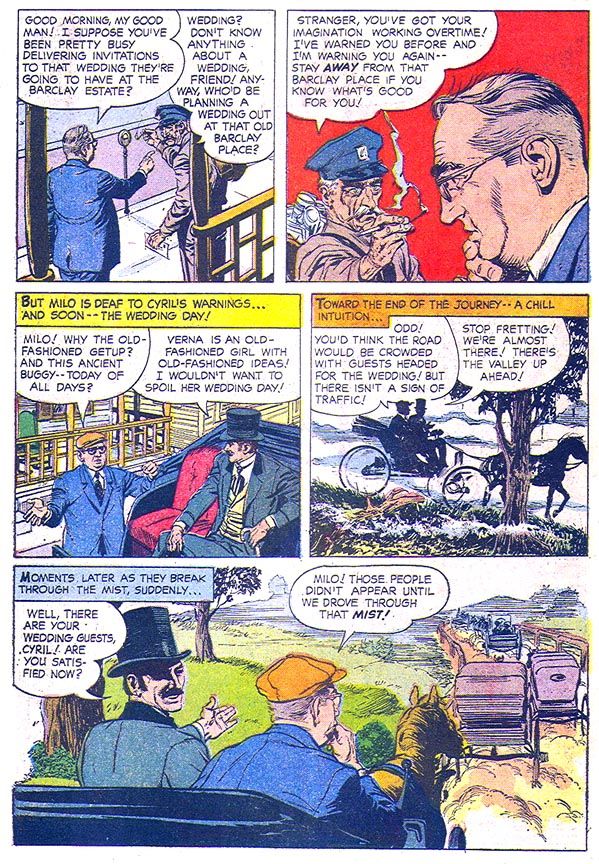

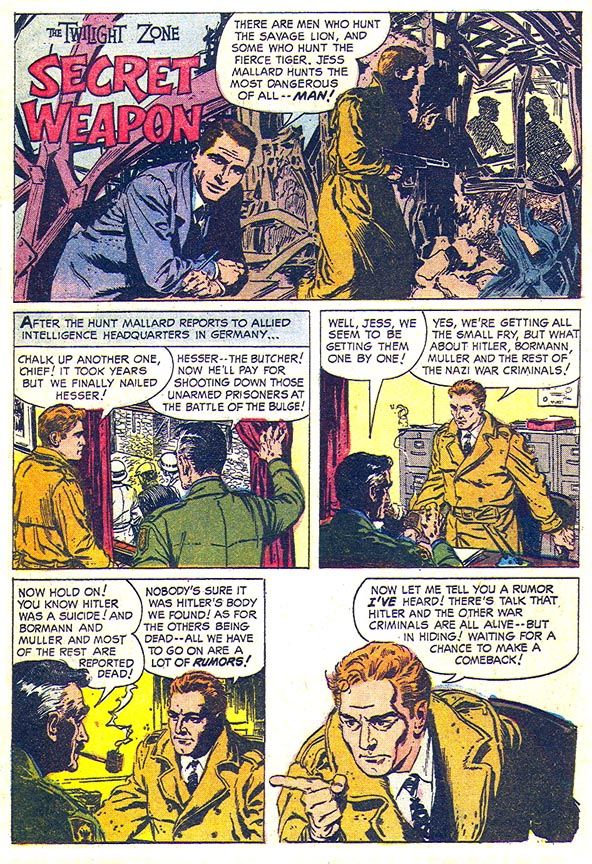
The second tale, "Secret Weapon," otherwise known as "The One with Doll Hitler," features a protagonist who might have been worthy of his own book, one Jess Mallard.  Don't let his stupid, duck-like name fool you.  The guy is a dogged Nazi hunter who will stop at nothing to capture his prey including offering to pay an exorbitant amount for strangely heavy carved figurines of Adolf Hitler, Martin Bormann and some joker known only as "Muller."  Muller, the generic top Nazi.  They should have given Mallard a better name then spun him off into his own book.  Something like Duke Stone, Nazi-Hunter.  It's appropriate because Serling occasionally set up Nazi characters for deserved comeuppances, as in The Twilight Zone episode "Death's-Head Revisited" and in the November 1969 Night Gallery pilot segment "Escape Route."  Oh, and don't forget "He's Alive," a The Twilight Zone episode where Dennis Hopper plays a neo-Nazi would-be Hitler who runs afoul of the ghost of the real one with tragic consequences.  That episode is kind of muddled and turns campy with its big reveal (don't put your pseudo-Hitler in front of a photo of the actual one, please), but it's still more gripping than the tepid "Secret Weapon," Jess Mallard aside.  Mallard would have kicked Hopper's ass two minutes into his story, though, and saved everyone a lot of trouble later.  Mallard may look like Leslie Howard by way of William Shatner, but he's all Robert Stack.

And then "The Joiner."  The slobby beatnik who appears almost the same age as his dad, friendly green aliens and the final panel with Serling superimposed over what appears to be a highway among the stars are a few more elements that make this one a fun standout.

By now you realize none of these stories will chill you the way Serling's show did at its very best, but the art, which is apparently by EC alums Reed Crandall and/or George Evans solid enough, with caricatures of Serling that look a lot like him.  Except for the one that inexplicably resembles a post-auto accident Montgomery Clift leading off "Secret Weapon."  I don't know if anyone considers this book an example of either artists' A-level material, but it's easy to look at and occasionally-- especially in "The Joiner"-- has a little bit of that ol' EC magic.  I would never begrudge either guy an art job in the lean days between Dr. Wertham and Warren Publications.  For the history buff in me they even manage to work in a short recounting of a story I once heard about Abraham Lincoln possibly having a prescient dream about his assassination and for the skeptic who scoffs at such ridiculous notions in me, a back cover that dabbles in something that's almost science fact.  All in all, Dell Four Color #1288 The Twilight Zone is a neat little package that probably has its origins more in stuff the contributors had lying around in their studios or offices than anything Serling or guys like Richard Matheson and Charles Beaumont might have come up with.


And that's it for this year's Spookey Month.  I hope you enjoyed it as much as I did.

Thursday, October 30, 2014

October is Spookey Month: You can't have Halloween without Bernie Wrightson!

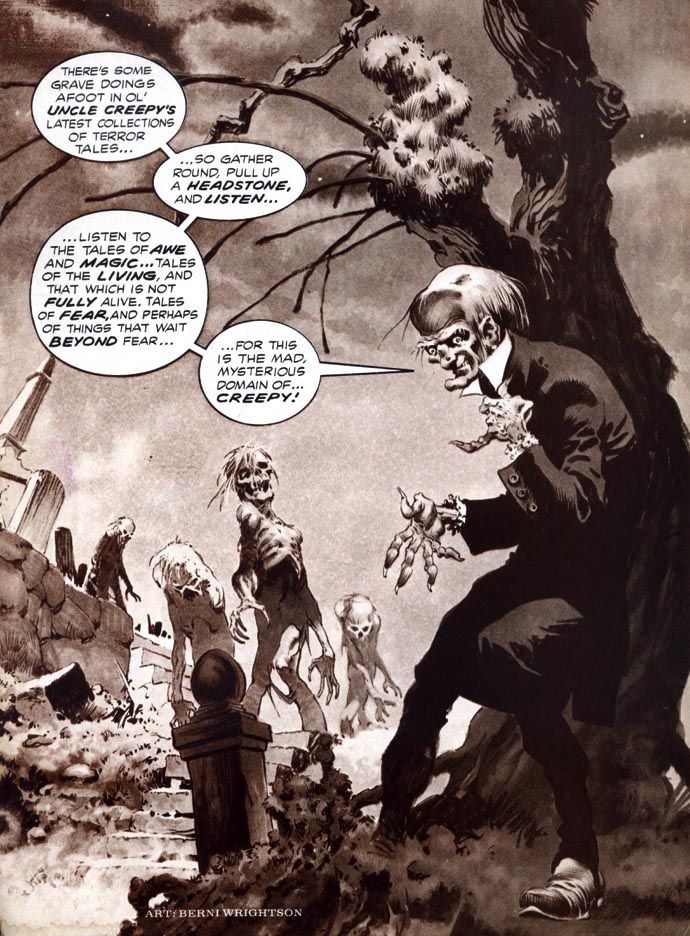
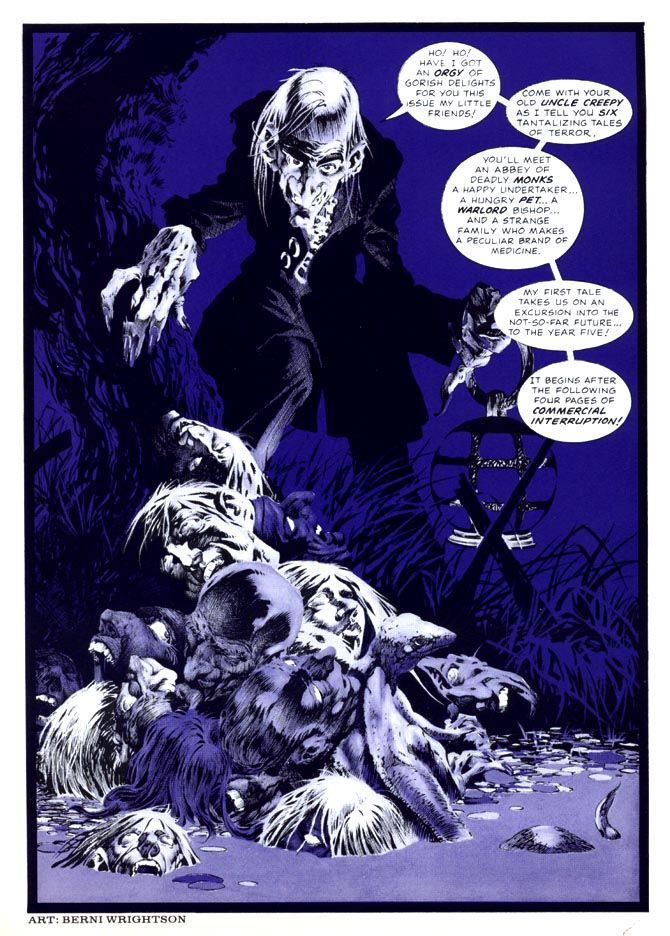
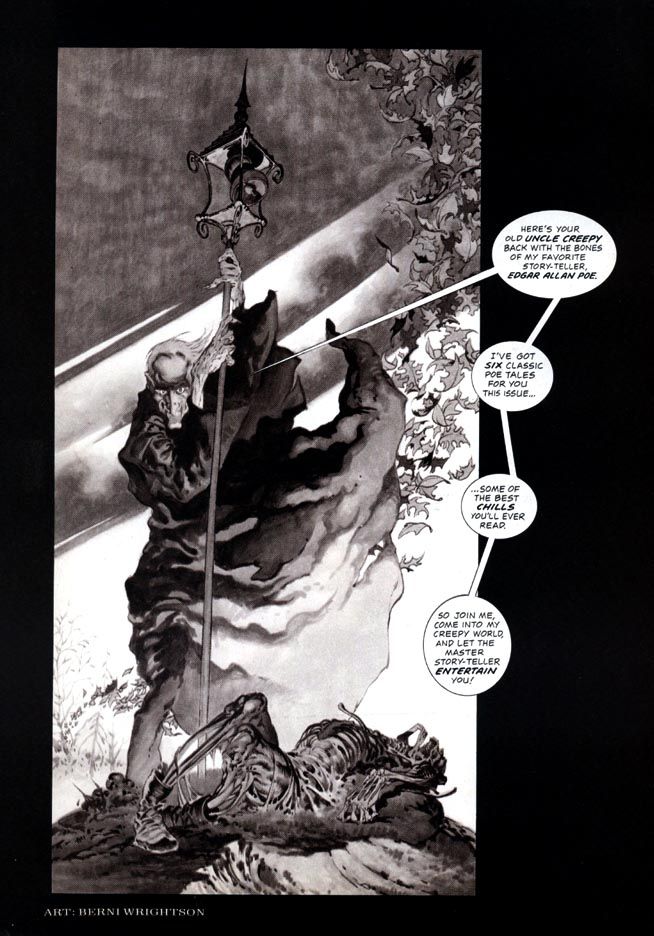
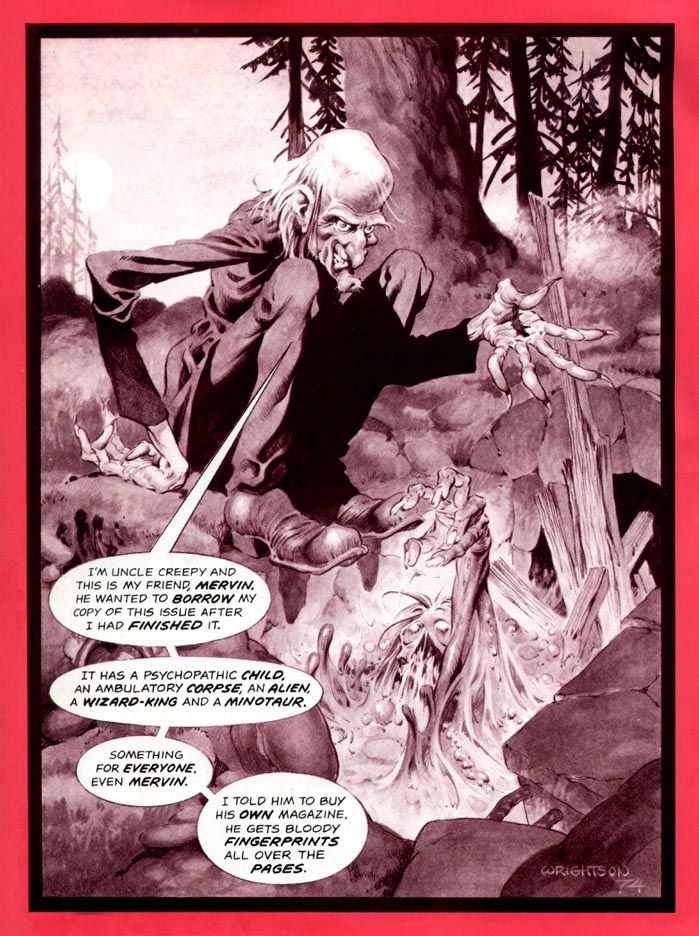
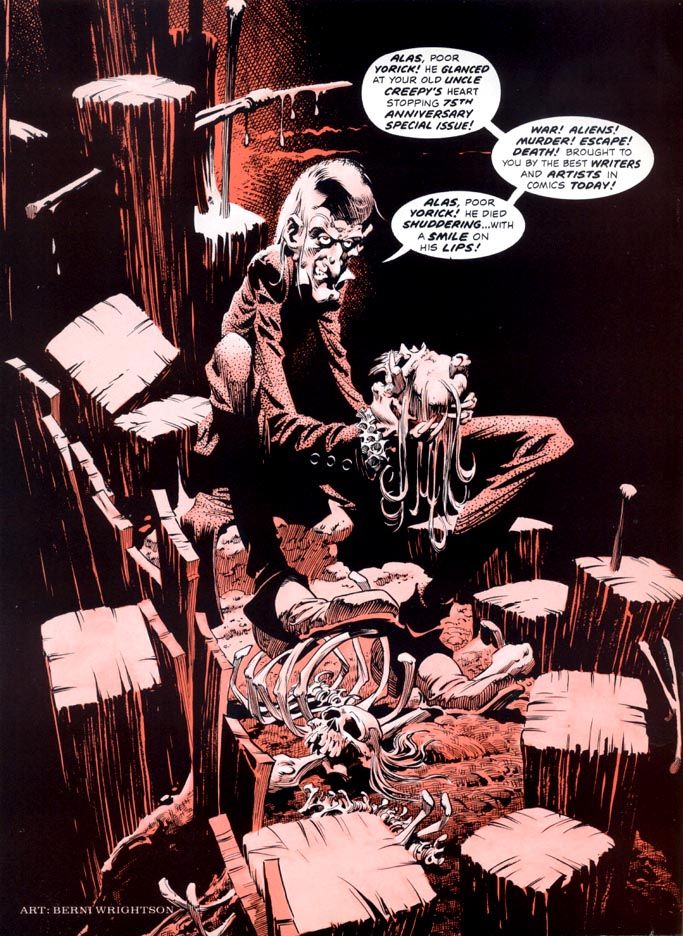
Hello, Halloween hellhounds!  Let's enjoy Bernie Wrightson's delightful Creepy magazine frontispieces.  I'm not sure when Creepy started running these, and Wrightson didn't do one for every issue.  Sometimes they'd run a full-color house ad for Vampirella or spotlight another talented artist.  But Wrightson's frontispieces are rich with spooky atmosphere.  And ghoulish good humor.  These are just a few of my fearvorites...

Creepy 66 (November 1974)


Creepy 67 (December 1974)

This next one is a particular joy to behold...


Creepy 70 (April 1975)


Oh wow!  Isn't that beautiful?  Okay, a few more...  This next one I like because it's one of those Wrightson "spooky stuff happens even during the day" images.  Just like in the memorable story "Jenifer" he illustrated.  It starts one magical afternoon.  Imagine hiking in the forest on a gloomy fall day and...


Creepy 71 (May 1975)

Egads!  Dare we continue?  Dare we do!


Creepy 75 (November 1975)


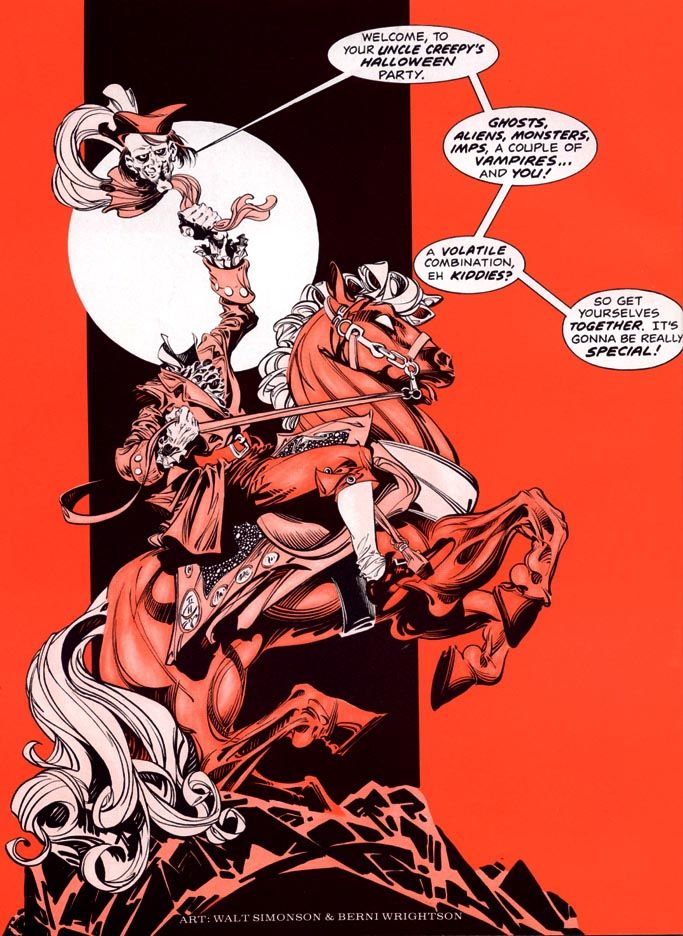
Here's my favorite, though.  It's a collaboration with Walter Simonson, a guy who's best known for Asgardian superheroes but has done a few highly effective fright jobs in his long career, too.  Plus, it's specifically Halloween-related.


Creepy 76 (January 1976)


Love those.  But to be honest, the scariest Creepy frontispiece of all wasn't drawn by Wrightson or Simonson.  It's this one.  Steady on, people.  Steady on...


Creepy 81 (July 1976)


AAAIIIIIEEEEEEEE!!!

We definitely need something to help us recover our wits after that shriek-inducing moment of terror.  All of these except the last are available in Dark Horse's gorgeous and essential Creepy Presents Bernie Wrightson hardcover.  Now I need to go clean up a little.  So calm yourselves and here's something to soothe your jangled nerves.


Wednesday, October 29, 2014

October is Spookey Month: Someone's rockin' list of the "10 Most Frightening Horror Comics Ever!"

I know nothing of this Herald Scotland site, but I salute the good (or foul, depending on your perspective and whether or not you go through life talking like one of EC Comics' horror hosts) taste of Graphic Content writer Teddy Jamieson.  Not only does Jamieson quote Halloween III: Season of the Witch, but he manages to include Junji Ito's horror masterwork Uzumaki on the list.  At Paste Magazine you can read a similar 13 item list called "13 Terrifying Modern Horror Comics," which I saw posted by Fantagraphics on Facebook earlier this week.  That one is very Western comic-centric and the choices more conventional than Jamieson's, but they overlap, too.  I admire Jamieson for having the guts to lead off the list with a most personal choice.  He also puts Jack Chick tracts on his list.  I remember coming across those from time to time when I was a kid and he's right.  They're scary!  At least they were when the threat of hell or running into a hippie mocking my religious beliefs with a dismissive "HAW HAW!" were the worst things I could imagine.

Personal choice is appropriate because our most frightening comic is the one that affects us most regardless of its wider reputation.  I found myself exposed to a great many shitty horror comics when I was a kid and quite a few managed to genuinely frighten me even with crude art and strained writing. 

Sometimes even genre doesn't matter.

Jack Kirby scared the snot and the buggers out of me with his chilling final image in Kamandi #20 of our long-haired hero alone on a ruined pier.  I mean utterly alone, overlooking what I assumed at the time to be a monster-haunted Lake Michigan.  No one to help him, not the indifferent gulls circling overhead, certainly not the angry gorillas ravaging the robotic theme park Kamandi had just escaped.  No humans, just robots going through the motions of 1920s-era Chicago gangland clichés.  Poor lonely Kamandi.  The imagery was bleak, the closing copy promised more horrors to come.  Shudder!

Another story that gave me the willies was "Evolution's Nightmare" in Marvel/Curtis Planet of the Apes #5.  It opens with humans and gorillas fighting El Cid-style in a desert wasteland, then ends with radioactivity-devolved apes and men duking it out with rocks and clubs in a bomb-ruined San Francisco.  They even kill the two main characters (who spent the intervening pages painfully learning tolerance) before grunting and screaming in mindless hate at each other from atop wrecked cars full of skeletons and across piles of shattered asphalt.  Doug Moench's depressing narrative captions inform us everything moves in circles and those circles stink.  Artist Ed Hannigan's (Jim Mooney inks, by the way) double-page spread of piles of dead warriors with their eyes lifelessly open only added to the lingering fear instilled in me by this creepy story.

Obviously, neither of those two are horror stories.  They're both rough-house science-fiction adventures.  You can find horror-like frights anywhere.  In a plot twist in an otherwise innocuous superhero book, gazing at you from a house ad in a humor comic, jumping out at you from behind a brick wall on a sunny street in Riverdale, USA.

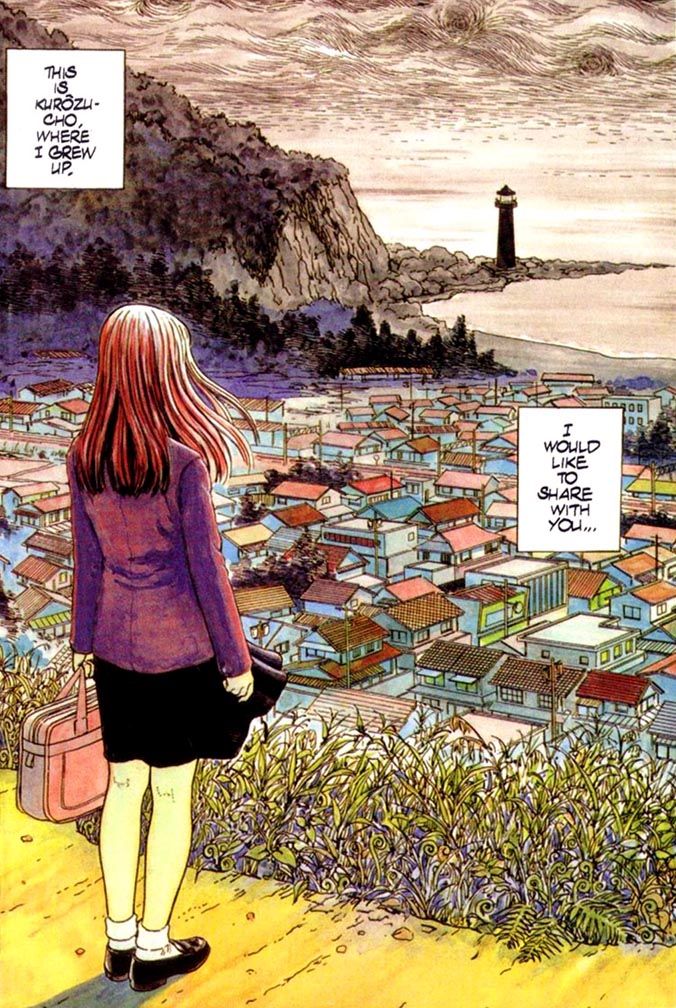
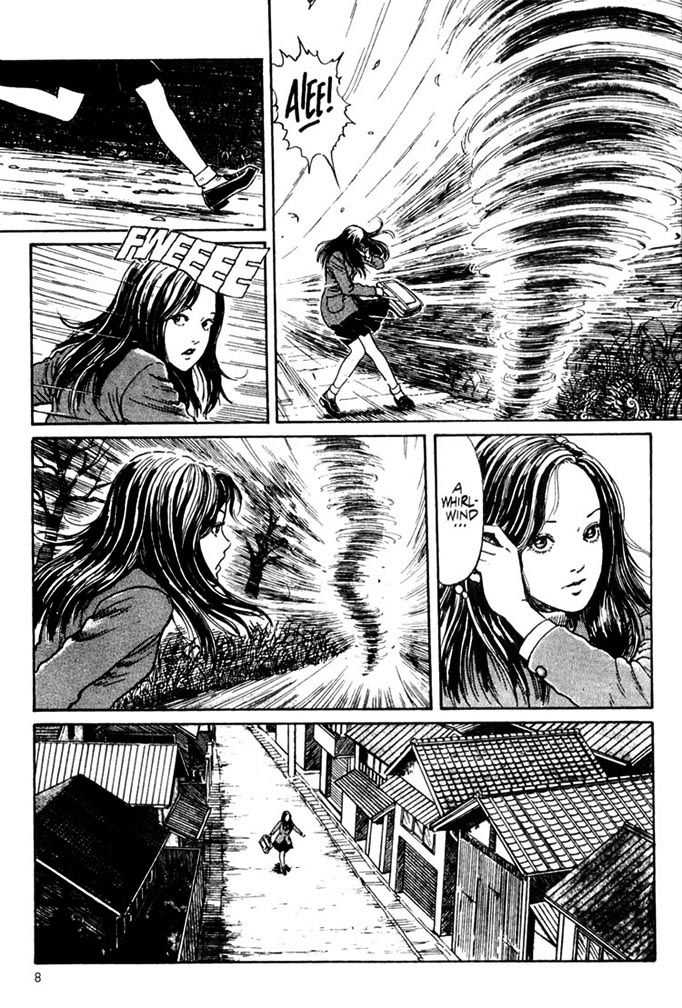
Or in an actual horror comic.  Like Uzumaki.  Serialized in Big Comic Spirits (it's a seinen manga, or dude's comic, so be careful opening that link) from 1998 to 1999, Ito's Uzumaki is the greatest horror story ever published in comic book form.  I'm comparing it to everything from Charles Burns' Black Hole, which made Fantagraphics' list (and is a moody, troubling work in its own right) to EC and every horror comic in between.  Out of all the fright fun I've had reading horror comics, only Uzumaki gave me feeling of truly dreading the next development in a story in my life.  Of doom.  Or of being genuinely grossed out by so many drawings in one place.  Uzumaki's dreamlike inevitability remains after you close the book having followed its main characters deep into the heart of ancient fears.

Uzumaki tickles your fright bone the way a cold wind from across the dry grass of graveyard might gooseflesh your arms.  Bruised clouds passing overhead like witches, their shadows falling around like concentrated night, on the move, looking for you.  Dead leaves hissing at you along the curb.  Hurrying you homeward where you face a dark, empty house where the rooms echo only with your voice.

Story and art by Junji Ito

And the soft footsteps of another.  Though nobody else is home.

Here's something that's not frightening.  It's a performance by Hamamatsu's own Spookey!

Friday, October 17, 2014

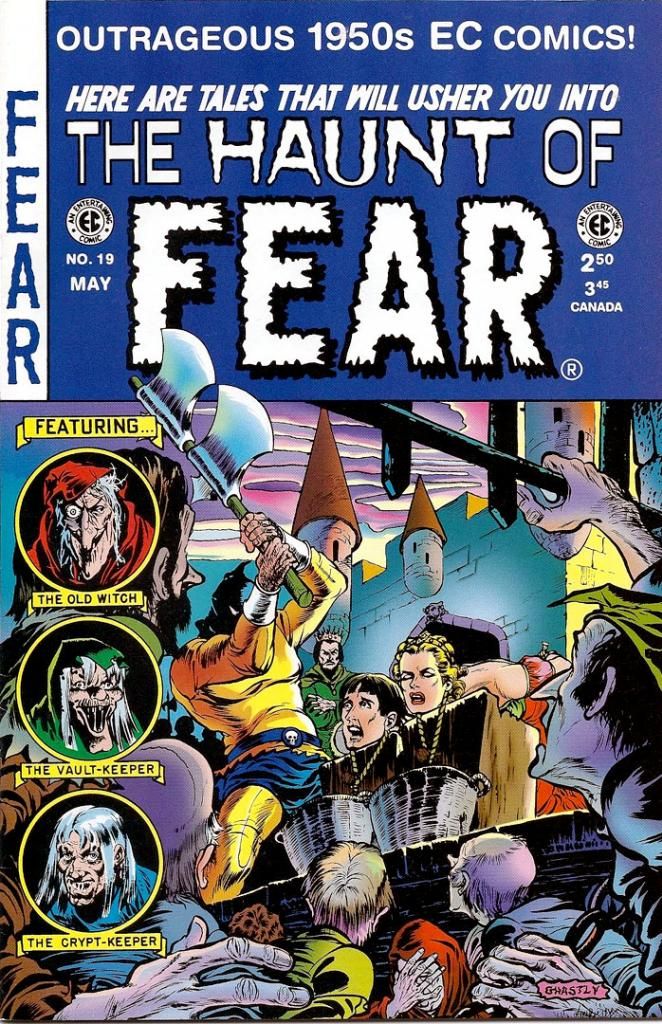
October is Spookey Month: How EC ruined America's pasttime in Haunt of Fear #19 (May-June 1953)

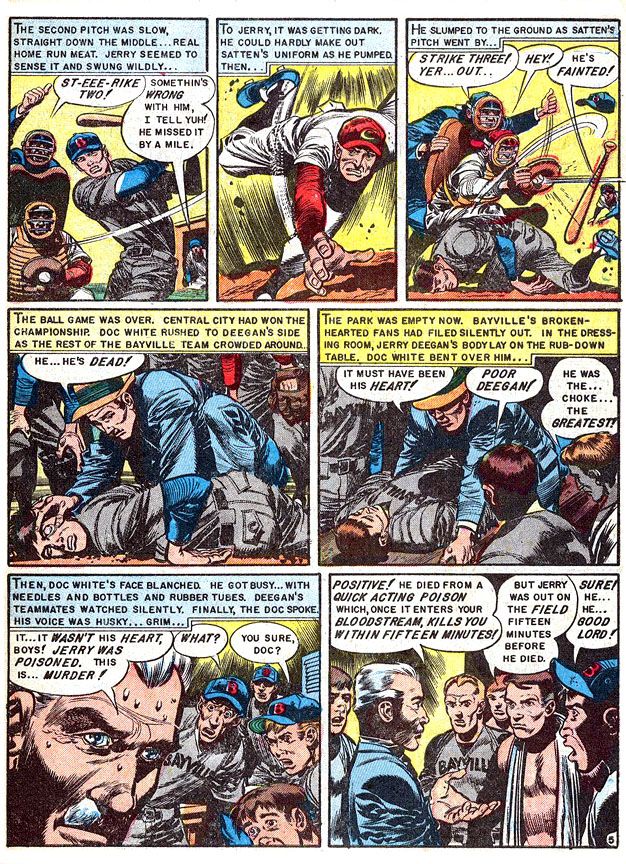
No, they didn't ruin baseball.  That's just me trying to have a little fun and shake things up a bit.  If anything, they made baseball better!  But EC did get itself into hot water with the government over "Foul Play," a story appearing in Haunt of Fear #19 (May-June 1953).  Dr. Frederic Wertham used it as an example of horror comic nastiness in his book Seduction of the Innocent and then did it again during his afternoon session testimony to the 1954 Senate Subcommittee Hearing on Juvenile Delinquency

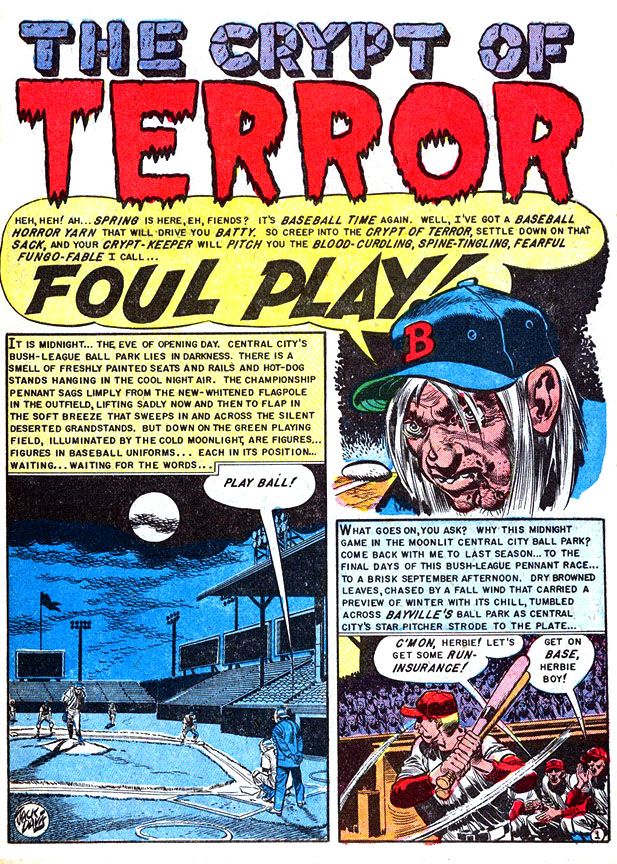
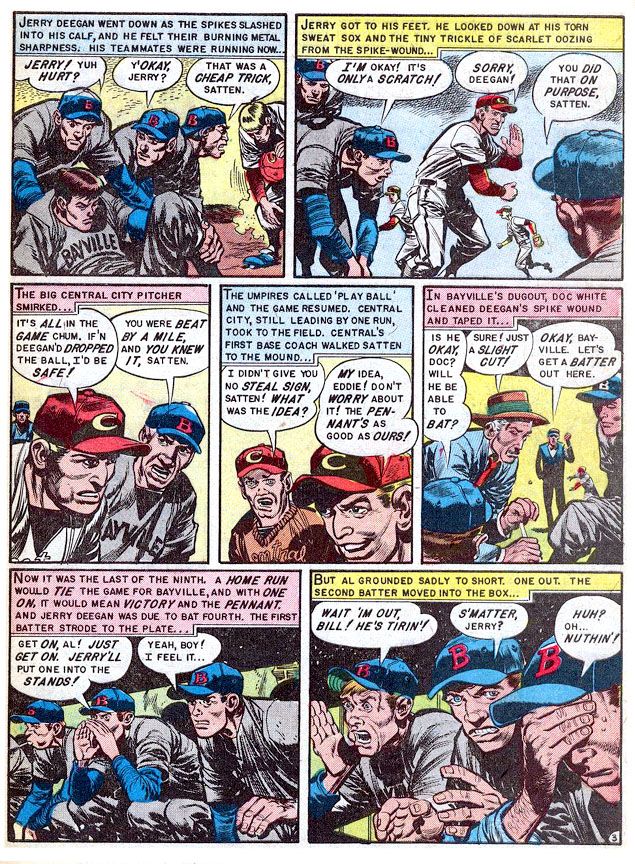
The story is about Central City's Herb Satten, an unscrupulous pitcher who wants to help his team win the pennant by murdering the Bayville's star second baseman, Jerry Deegan.  After all, this Deegan slugger led the league in home runs all season and he's up the next inning in a tight game.  It stretches credulity a bit.  Satten kills Deegan by poisoning his spikes, then allowing himself to get hit with an inside pitch so he can get on first, attempt a steal then slide spikes-high and slash his victim.  He's thrown out and it looks like a bonehead play, but it all works out. Satten kills his man and Central City wins.  This leads to the pitcher's grisly comeuppance the night before the next season's opening day.

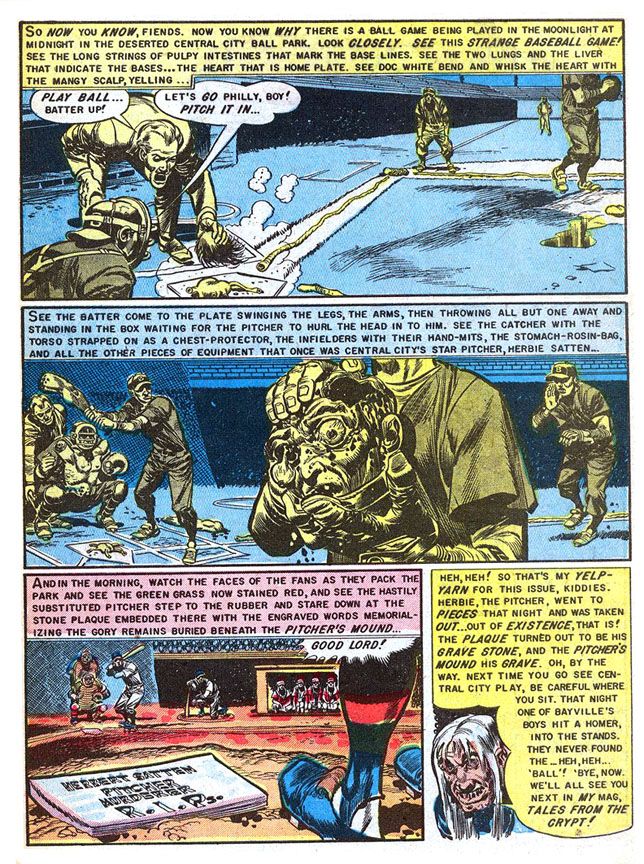
And one of the all-time great gross-out scenes in horror comics history.  The murdered man's teammates literally rip Satten apart late one night and use his body parts to play a moonlit intrasquad game.  Complete with a complicit umpire.  That also stretches believability, but not so far as the poor pitcher's intestines, which serve as foul lines up the first and third base paths.  The grisliest detail is the catcher's using the Satten's chest as his own chest protector.  You wanna wear part of a human body even if he is a sorry murdering cheat?  What is this, the Ed Gein League?

They also incriminate themselves by burying him under the pitcher's mound and inscribing the rubber there with "Herbert Satten.  Pitcher.  Murderer.  R.I.P."

Rest in pieces, baby.  Rest in pieces.

Writer:  Al Feldstein/Artist: Jack Davis

Well, they were angry ballplayers and probably didn't think through the consequences.  The ironic thing about "Foul Play" is, it may have been notorious at the time but the guy who drew it is one of the nicest, most gentlemanly people you'll ever have the privilege of meeting.  If you're so lucky.  I had a chance to phone interview him way back in 1996 for a class project and I came away in such a good mood because he was so jolly and generous.  He answered even my stupidest questions with patience and good cheer.

Writer:  Al Feldstein/Artist: Jack Davis


I'm talking Jack Davis, the dean of American caricaturists.  This story is right in his wheelhouse, so to speak.  Davis is a master of sports cartooning, able to twist his loose-limbed figures into whatever pose necessary to show the physicality of sports.  Baseball, basketball, football, late night murder, these are things Davis visualizes so well.  Obviously made a huge impact on Dr. Wertham and the guys up on Capitol Hill, huh?

Writer:  Al Feldstein/Artist: Jack Davis

I loved Davis' work before I ever read this story (although I'd heard rumors of it for years and they always chilled me to the bone).  He drew magazine covers, movie posters.  His art came into our house on television in the form of character designs for the Jackson 5ive Saturday morning cartoon.  As a University of Georgia graduate, I've seen dozens, if not hundreds, of Davis-drawn Bulldog athletes in motion, with his characteristic lanky body language and large, articulated hands.  Gorgeously rendered in loose, appealing brushstrokes and then watercolored to pop from the page of whatever book, calendar or postcard they adorn.  His 1950s horror work benefits from the Davis approach, one that exaggerates reality for comic effect.  So when you see a Davis severed head, it's not grotesque no matter how decayed it might be.  It's sick... but in a tasteful way.

Writer:  Al Feldstein/Artist: Jack Davis

The Senate Subcommittee Hearing people must not have felt that way, although I believe William Gaines explained it quite well in his testimony.  This is gore in just the right amount.  There's nothing gratuitous about it, but it has to have impact.  If you'll notice, too, colorist Marie Severin gives those panels a blue-yellow complementary color scheme rather than one that emphasizes its fleshy or bloody qualities.  This makes it explicit without going over the top.  Not for the squeamish, certainly.  But it's right in my wheelhouse, too.  Jack Davis is an American treasure, baby.  And so is Marie Severin.  No doubt about that. 

Thursday, October 9, 2014

October is Spookey Month: Batman #319 (January 1980)

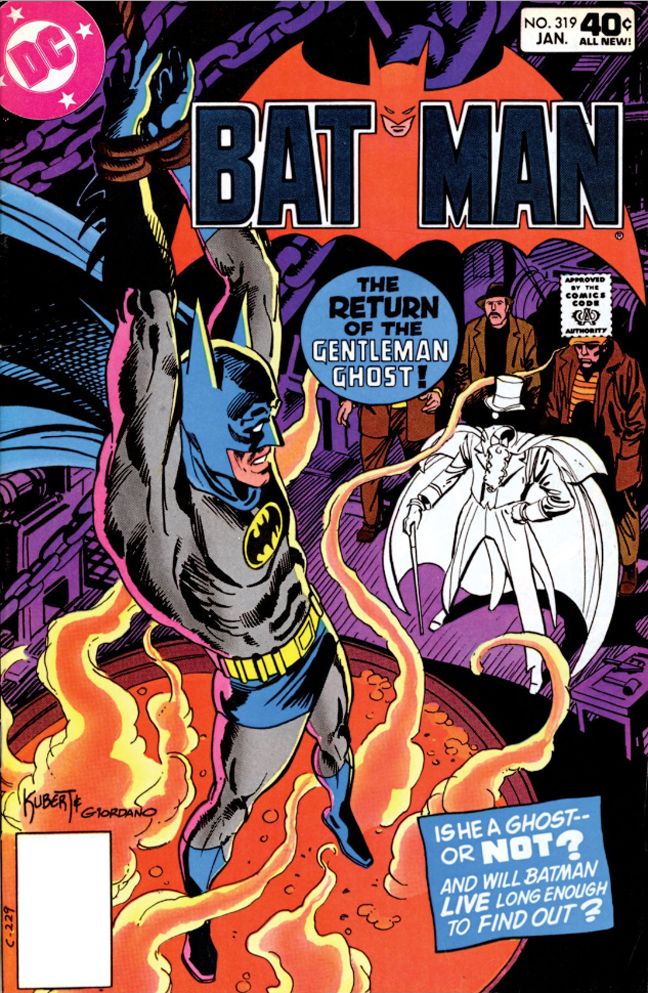
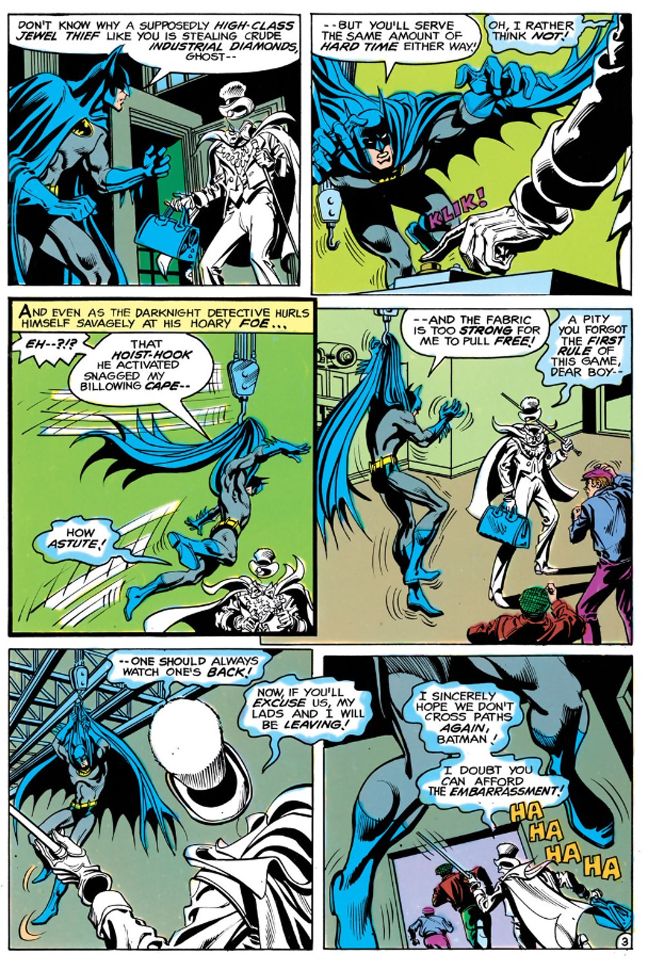
Batman #319 (January 1980) sees Batman and Gentleman Ghost battling once again.  This mean we get a Halloween treat in the form of a spectacular Joe Kubert cover with Batman in pulpy danger, suspended over a bubbling vat of wholesome Campbell's Tomato Soup with milk added.  Just like my dad loved to do!  Dick Giordano inks and the result is as rich and creamy as the soup Gentleman Ghost plans to dip Batman into.  Eerie underlighting and a line quality that's recognizably Kubert but somewhat cleaner and not as expressionistic.

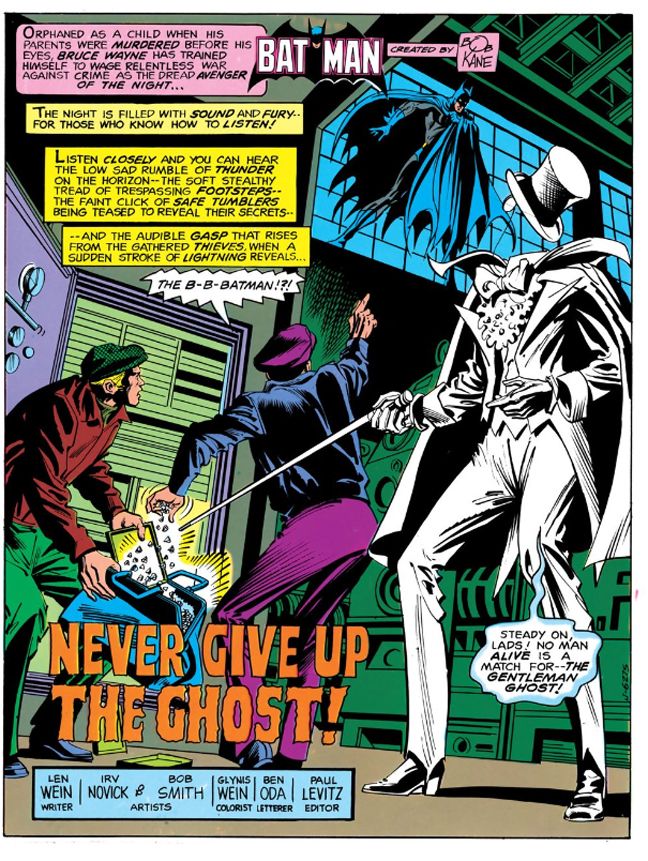
The story starts in mid-action, just like the previous Gentleman Ghost appearance.  Batman once again interrupts the Ghost and his henchpeople in mid-heist and ends up hoisted by his own cape.  While starting stories like this instantly ups the energy level and leads us to expect something rapid-fire and thrilling, there's a danger of this approach devolving into formula.  But Batman's dilemma-- which writer Len Wein points out is self-inflicted due to Batman's cape being rip-resistant, a helpful quality in most situations but not when you need it to tear so you can free yourself from a dangling hook-- proves startling and original in its details.  Wein also uses it to show that Batman, while fallibly human, is also resourceful and dangerous even when apparently helpless.  Never count out the Caped Crusader, as Gentleman Ghost finds before cleverly making his own escape.

Script: Len Wein/Pencils: Irv Novick/Inks: Bob Smith

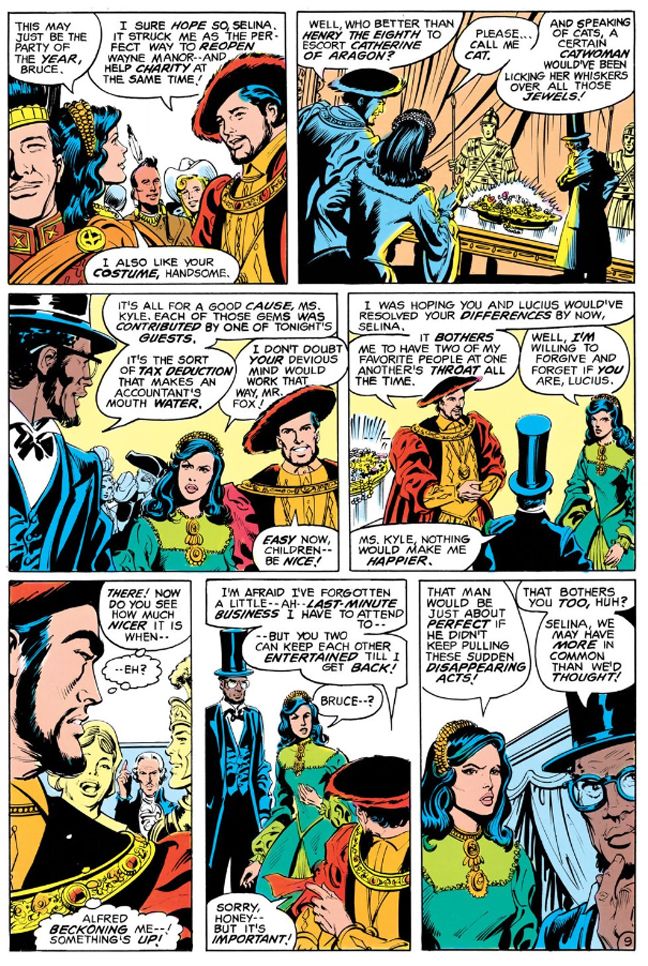
From there we find Batman setting a trap for the Ghost, with a Halloween-appropriate setting.  He plans a costume ball at Wayne Manor with jewels on display as bait.  Gentleman Ghost finds this irresistible, and once again Batman ends up dangling from a hook.  This time over boiling soup.  I mean acid.  It's not tomato soup.  It's a vat of acid, a wicked comic book convention.  This time Wein shows us the mechanics of a Batman escape.  The story has the feel of someone working through all those classic Batman tropes.  The death traps, the fist fights, goofy henchpeople (somehow the very British Gentleman Ghost has found a couple of very British oafs to help him, one named, fittingly enough, Alfie) and another ambiguous ending.

Script: Len Wein/Pencils: Irv Novick/Inks: Bob Smith

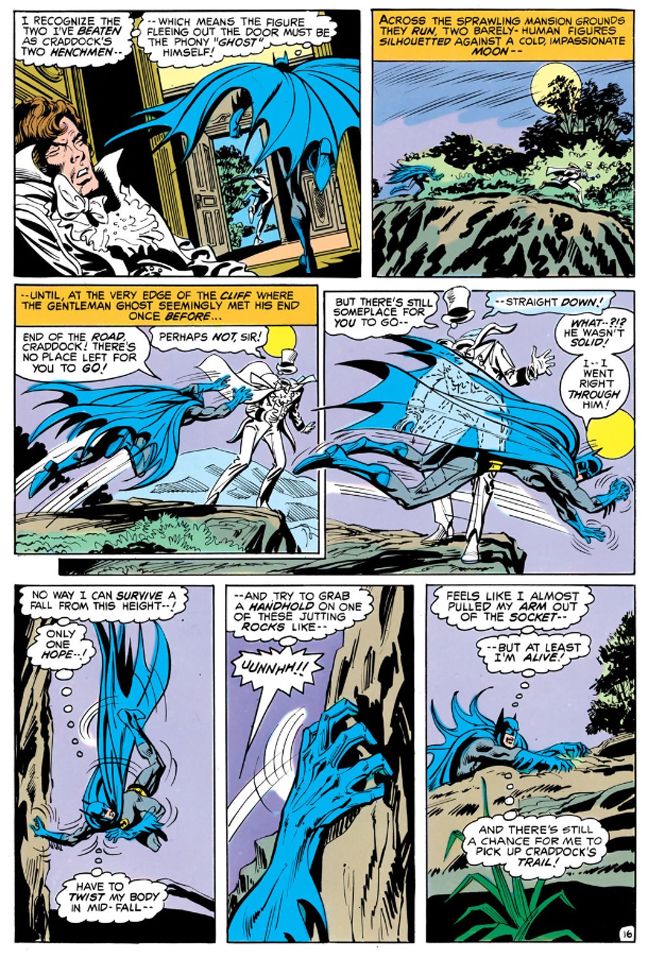
We still never learn if Gentleman Ghost is a real ghost or not.  His lackies disguise themselves as the Ghost as a distraction and Wein suggests the headless quality is mere fakery when one of them is revealed to be merely hunching down.  That doesn't explain the floating top hats or monacles.  Later there's a bit with a convenient hologram projector which also seems to tell us the Ghost is more technological trick than supernatural treat, but Wein leaves the truth of the matter hanging, kind of like his Batman this issue.  You can have it either way.  He's a clever illusionist with a creepy gimmick or he's a creepy ghost with a penchant for high-tech chicanery.

Script: Len Wein/Pencils: Irv Novick/Inks: Bob Smith


It's up to you!

Irv Novick once again pencils, but this time Bob Smith inks.  Smith's line is thinner, sharper, more angular than Giordano's.  Well-defined figures and clarity of action make this issue very appealing throughout.  Batman is almost always on the left side of the panels, inciting things in the proper reading order so you get this forward thrust and momentum that carries through all the way to the end.  With Novick and Smith the crowded costume party has focus and detail, with one wide panel that's a treat to linger on.  Batman comes as Henry VIII, Selina Kyle as Catherine of Aragon ("Please... call me Cat," she quips) and Lucius Fox is Abraham Lincoln.  You can make out a plethora of other historical personages surrounding them and even when the Gentleman Ghost and friends gate-crash, Novick and Smith maintain a clear sense of where everyone is relative to each other.  Even when Selina Kyle and Lucius Fox abruptly switch sides so Fox can occupy the foreground with his thoughtful countenance you're not likely to freak out with the change and fall out of the story.  Good, solid stuff.
Script: Len Wein/Pencils: Irv Novick/Inks: Bob Smith

The issues I've read of this Wein run are sleekly enjoyable reads.  He drops exposition into dialogue and gives us meaty narrative captions to chew on while we enjoy the visual banquet Novick and Smith provide.  Very tasty stuff, the kind that satisfies.

Thursday, October 2, 2014

October is Spookey Month: Batman #310 (April 1979)

Batman #310 (April 1979) is a comic I bought solely for its cover.  Even back then I was a big Joe Kubert fan, and I believed the cover artist always did the interior art.  I was wrong.

Choosing Kubert as cover artist makes perfect sense because he and Robert Kanigher co-created Gentleman Ghost as a Hawkman/Hawkgirl adversary.  Gentleman Ghost debuted in Flash Comics #88 (August or October 1947, take your pick) but I’d never heard of him.  Why?  Because I never read any Hawkman comics.  Never had anything against Hawkman, just wasn’t my thing. 

Joe Kubert, on the other hand, certainly was and still is very much my thing.  Being 11 years old when this comic book came out I had no idea he’d ever done anything other than war comics and Tarzan.  A chance to see him draw a Batman story piqued my interest, but I can’t say the Irv Novick-Dick Giordano team that actually did the inside art disappoints.  They do a bang-up job.  Theirs is my ideal visual representation of Batman.  He has human proportions and he's not always gritting and grinding his teeth to the point where his molars must be just about gone.  He's a serious guy, but he has recognizably human emotions!
 
Here we are 35 years later and I’m still not particularly into Hawkman and my knowledge of Joe Kubert’s long comics career remains spotty at best.  I love his art and still adore this attractive, exciting cover, though.  I just find it odd I’d have an Irv Novick comic and never have it click with me despite coming to appreciate his solid Bat-work from all the reprints I’ve read over the years.  Maybe it’s not so odd.  I once had a Russ Heath Sgt. Rock and didn’t realize it until much later.  Same with a Rich Buckler-Bernie Wrightson Batman book.  I’m kind of an idiot.


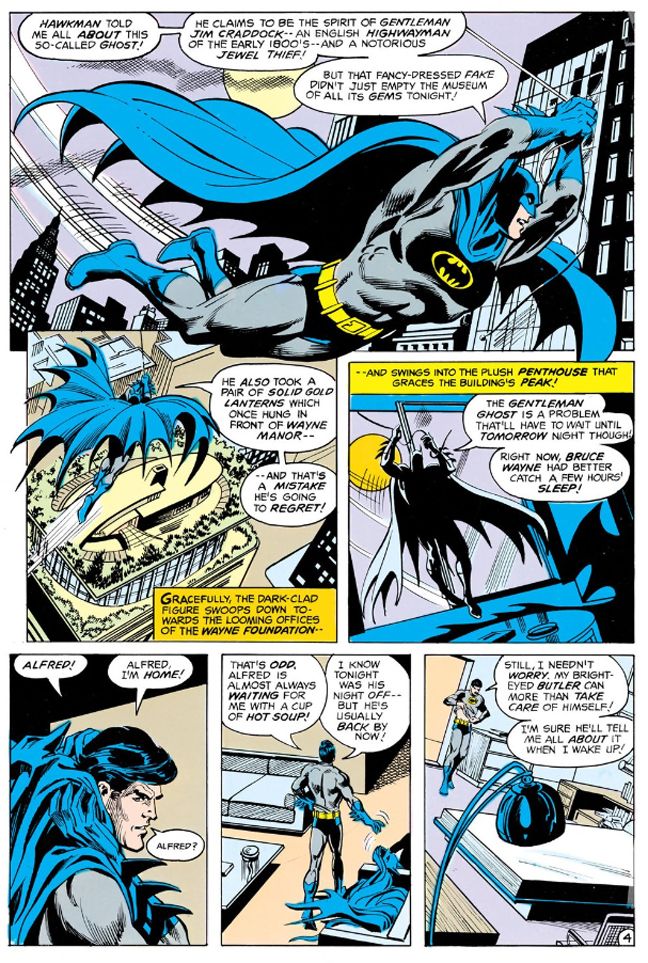
Script: Len Wein/Pencils: Irv Novick/Inks: Dick Giordano

The story, titled "The Ghost Who Haunted Batman," is a jaunty, assured effort by all involved.  It would have made an excellent episode of the 1990s Batman: the Animated Adventures TV series.  Len Wein's script sets up a neat double mystery and wraps it all up in a single issue.  One one hand we want to know why is Gentleman Ghost, known for stealing jewels, suddenly after things like antique lanterns and furniture?  And on the other, where did Bruce Wayne's loyal butler Alfred Pennyworth disappear to?  Wein also plays the whole "is Gentleman Ghost a real ghost, or is he just some clever illustionist with a gimmick?" routine to great effect.  Batman remains pretty skeptical of the supernatural throughout, and when his bat-rope falls ineffectively between Gentleman Ghost's cuffs and gloves, he's disturbed.  But not enough to stop scoffing, as when he sneers, "Mister, you're about as supernatural as my shoe."

No doubt like Batman himself, I distinctly remember expecting some kind of prosaic explanation at story's end.  A special effects artist or magician revealed in an unmasking...

What I admire about this book is how every moment moves the story forward or reinforces the then-current Batman status quo.  There's no waste.  Even for a reader like me, who bought books based on whim and might go months between Batman purchases, could pick this issue up and learn all its players and how Batman relates to each of them.  There's a quick bit of Catwoman romance, a Lucius Fox appearance and even a return visit to Wayne Manor, and yet the central plot remains at the fore.  It's a quick read and certainly no gyp for being self-contained and short.

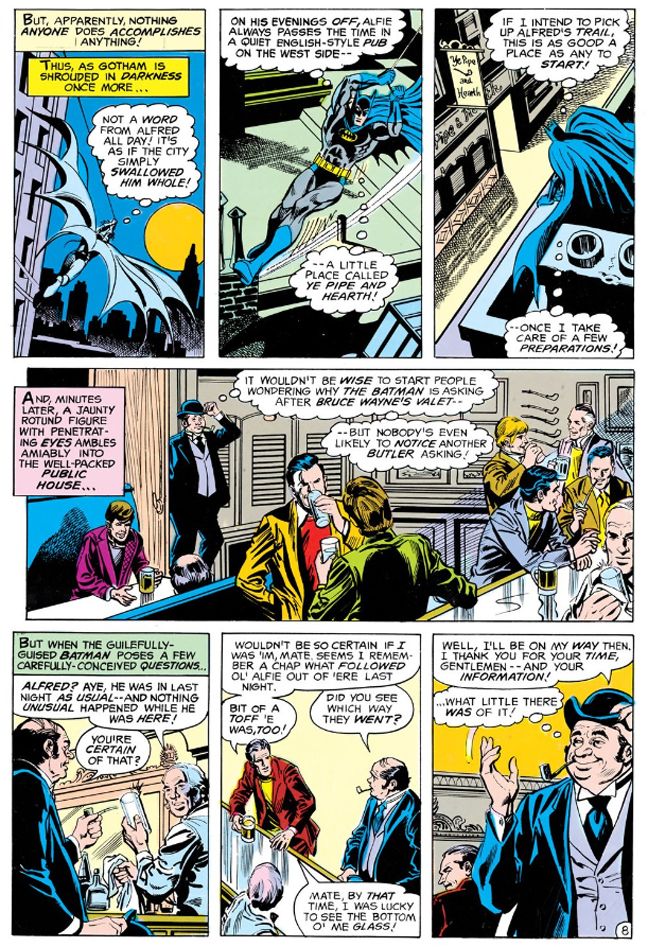
One of my favorite scenes in this book comes when Batman disguises himself as a portly fellow butler to infiltrate a UK-themed bar where Alfred likes to hang out on his nights off and brag to anyone who will listen and buy him a pint about his awesome job with the Waynes.  In the interest of blending in, Batman goes for the old school stereotype complete with bowler and crooked little pipe.  He kind of goes from one panel in his Batman jammies staring down at the pub to the next walking-- the caption tells us it's a mere few minutes later-- in all dressed up with a waistcoat and padded suit.  I'm not sure how Batman pulls this off so quickly when he doesn't even have his Batmobile around to carry things for him, but Wein doesn't let a little detail like this slow the story's pace.

Script: Len Wein/Pencils: Irv Novick/Inks: Dick Giordano

I like to imagine Batman spouting off with a Dick Van Dyke-quality accent and all the ex-pat Brits mocking him after he leaves.  For the story's purposes, Batman probably puts on an accent not only dead-perfect for some particular region of the UK, but also a specific neighborhood.  Came up with a complete biography for this one-off character and everything.  He is a master of disguise, after all.  He's right that it would be odd for Batman to go around asking about Bruce Wayne's butler-- but why doesn't he go in as Wayne?  Because subterfuge is fun!
 
Novick and Giordano lovingly create a creepy, fog-bound mood throughout, turning Gotham City into a vast haunted house.  The atmosphere compares favorably with that ultimate night-bound comic, Marvel's Tomb of Dracula.  And Gentleman Ghost makes an excellent Batman foil.  I’ve always enjoyed Batman stories where he comes up against the supernatural and he’s left a bit befuddled in the end.  Batman benefits from being depicted as vulnerable and not as hyper-competent.  Nowadays he’d anticipate Gentleman Ghost’s every move and have some kind of pre-built anti-ghost device.  In 1979, a hypnotized Alfred could sneak up behind him and knock him out with a heavy gold lamp and he could be deked by an empty suit, then try and fail to save Gentleman Ghost from a carriage crash.  The final scene certainly lives up to the story's title as Batman is left there with the Ghost’s mocking laughter ringing in his ears in one of those ambiguous “just what the heck was that guy?” endings. 
 
Batman and Gentleman Ghost would tangle again shortly and we'll talk about that one when I get the time to read it and react to it.

Tuesday, September 30, 2014

It's October is Spookey Month time again!

I know, I know, you're excited about this annual tradition here at When Comic Books Ruled the Earth where we take all of October and examine various horror comics.  We're going to take a break from Marvel movies and spend some time chilling with some chillers.  The eccentric spelling of "spookey" is in tribute to a local rock band called SpookeyThey once did a Halloween-themed live show-- a video of which you can find on YouTube-- and I bought one of their albums after watching it.  The album features a fun cover of a fun cover of the Banana Splits Adventure Hour theme song and some other feel-good pop-punk rockers.  They don't seem to be very active at the moment but that doesn't mean we have to stop being fans of cool local music and cool local musicians.

And it has nothing to do with mylove for horror comics, but this is my blog and I can do whatever I want with it.  I haven't decided on an itinerary for this month's journey through the darker realms of four-color fantasy.  I imagine it will lean heavily on Creepy, Eerie and EC once again.  A smattering of Batman, my go-to Halloween superhero.  In fact, I have a certain issue of Batman in mind for my first Spookey Month post.  Or maybe it's an issue of Detective Comics.

Friday, November 1, 2013

October is Spookey Month: Swamp Thing fights male and female werewolves!

To end our month-long celebration of Halloween, horror comics and all-girl Japanese pop punkers Spookey, here are a couple of stories where Swamp Thing fights that old school monster favorite, the werewolf.  Male and female varieties.

The first one, Swamp Thing #4 (May 1973) is by Len Wein and  Bernie Wrightson.  They lean on the familiar Universal Studios style, setting their tale in the Scottish moors and within a creepy old mansion.  Their werewolf is the tragically cursed son of some very worried parents.  They're in luck when Matt Cable and Abby Arcane crashland their plane close to their ancestral home, but definitely unlucky in that Swamp Thing is also on board.  This means their plans to use Cable's blood to cure their boy of his lycanthropy (and give it to Cable; but isn't this what any concerned parents would do for their child?) is doomed from the start.

While the werewolf on the cover looks more like a satyr to me, inside the comic itself Wrightson uses heavy black silhouetting for its first appearance, which gives his beastie a very Frazetta-ian touch, almost amorphous in the night fog.  It's very reminiscent in its first appearance of Frank Frazetta's aptly-titled "Werewolf!" from Creepy #1 (1964).  Kind of impressionistic.  Shoot, why am I telling you all this when I can just shut my fool mouth and show you?  Here:


There is nothing not to like about this comic and its classical approach. 

But what a difference a decade makes!   We hear a lot of talk about the "curse of the werewolf," and writer Alan Moore and his merry art crew of Steve Bissette and John Totleben set out to explore what this means both literally and metaphorically-- because there's also this other monthly thing sometimes referred to as a curse.

In Swamp Thing #40 (September 1985), Brit Moore unspools an episode in "American Gothic," an extended story arc where Swamp Thing battles traditional horror creatures suffused darker elements of the United States' national narrative-- the unintended consequences of progress, the preponderance of gun violence, the genocide of Native Americans and the lingering effects of slavery and the Civil War.  This time, perennial fan favorite character John Constantine pits Swamp Thing against something more personal-- the perpetual state of war between the genders, specifically the daily battles waged by a typically American suburban couple.

As with the Len Wein-Bernie Wrightson werewolf tale, "The Curse" is very concerned with blood.  It's just Moore is interested in a deeper exploration of this sanguine symbolism.  Our werewolf this time is a modern woman so empathetic to the anger and resentment felt by long-ago Pennamaquot tribeswomen sequestered in a special lodge (she and her husband live in a house built on the site) while they menstruate she turns into a massive wolf creature and goes on a rampage.  Male privilege has finally loosed a beast, and after a brief fight, Swamp Thing comes to as much of an understanding of the woman's plight as a male-gendered plant elemental can.

Tragically, our tragic werewolf is a stand-in for all of womankind, so she learns there's another aspect to this blood curse-- women are bound by it to men and vice versa.  As a result, she cannot bring herself to kill her husband (even though she contemptuously notes he's "soiled himself" from fear).  Giving in completely to her primal, savage anger, she crashes through the front window of a pornography shop where a customer has just asked the cashier to show him something he euphemistically refers to as more "unusual."  Perhaps as a matter of tastefulness, we aren't permitted to see the resulting carnage.  In the end, Swamp Thing cannot offer succor and the werewolf impales herself on the knives in a supermarket display, ironically labeled, "Here's good news for housewives!"  The supermarket setting itself represents the sterilizing effect consumerism has on our lives and its place in the continuing subjugation of female power, having been referenced satirically in the same vein by Ira Levin's 1972 novel The Stepford Wives and its 1975 film adaptation.


And with our tale of two lycanthropes, we bring this year's Spookey Month to a close!

Wednesday, October 30, 2013

October is Spookey Month: The Joker versus the Scarecrow!

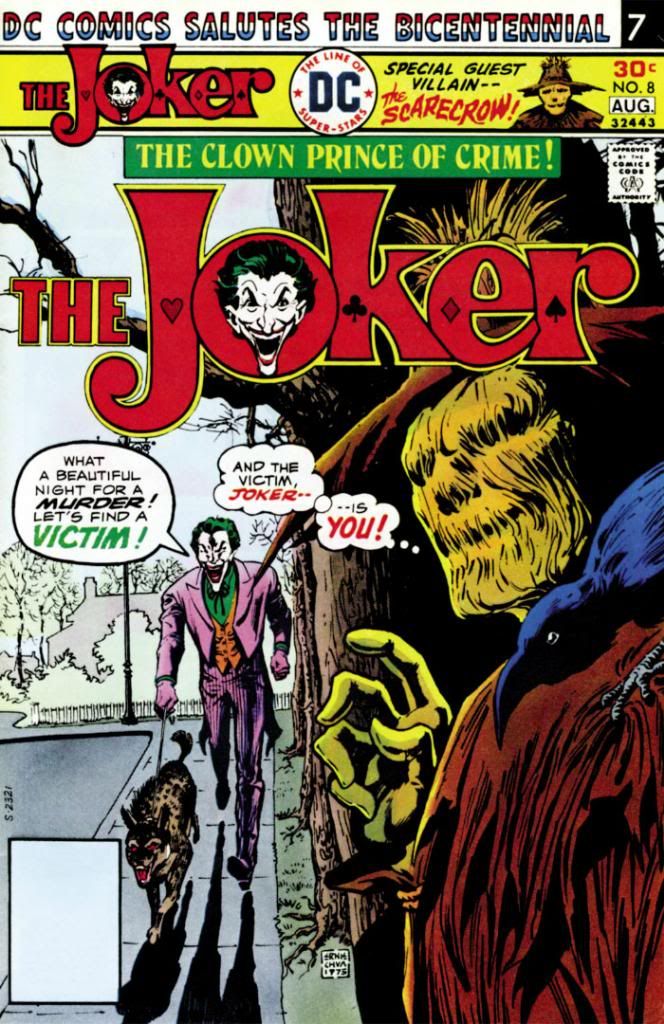
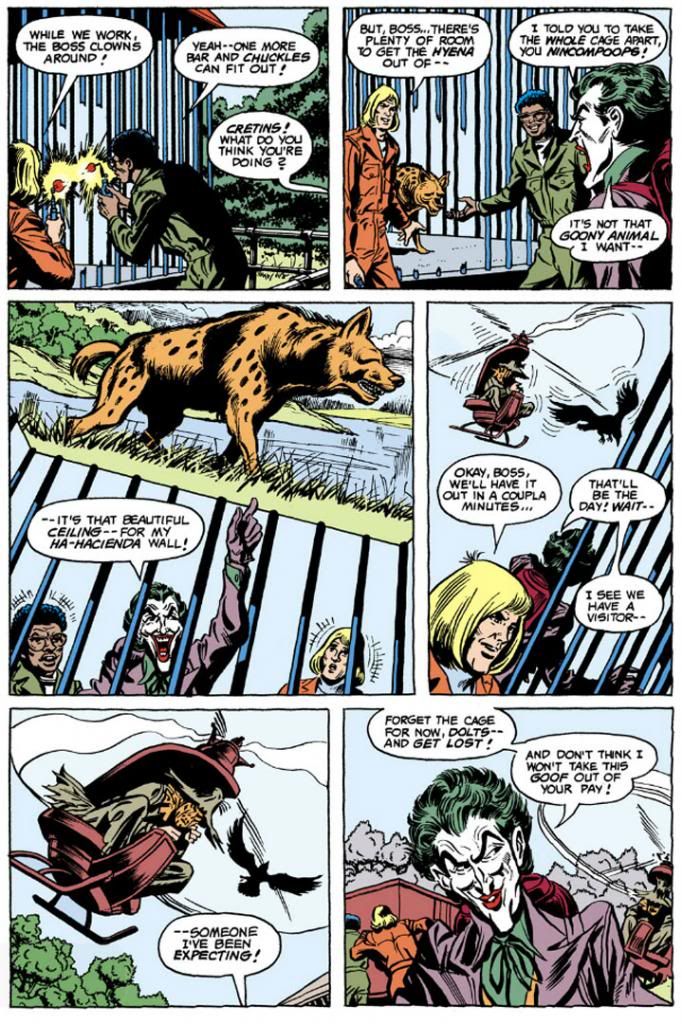
If there's a DC super-villain made for Halloween, it must be the Scarecrow.  He likes to scare people, people like to be scared on Halloween.  The Joker #8 (August 1976) pits him against our titular anti-hero over a batch of new-fangled fear gas developed by those happy-go-lucky chemical warfare specialists down at S.T.A.R. Laboratories.  What's startling about this book is despite its sunnily appealing Irv Novick-Tex Blaisdell art, there's a body count.  I'm simply fascinated by this dichotomy, which gives the book a mood of joyful nihilism.  Innocent people die, and so does a not-so-innocent.  The Joker himself says it best right there on the cover, "What a beautiful night for a murder.  Let's find a victim!"

While we're looking at it, that's a nice Ernie Chan cover.  Once again, Chan had to sign it "Chua," thanks to some kind of bureaucratic goof involving his work visa.  Whoever colored it didn't quite capture the essence of night, though.  No matter.  The lurking Scarecrow provides a lot of menace that's missing in the cheerful story itself.  I mean despite all the killing.

And now a special message to you, the reader!

Dear Reader,

How have you been?  Did you have a nice summer?

Okay, let's discuss something perhaps you can help me with.  This story brings up something that's troubled me for a long time.  I just can't imagine why your average, ordinary, work-a-day criminal would ever join the Joker's gang. 


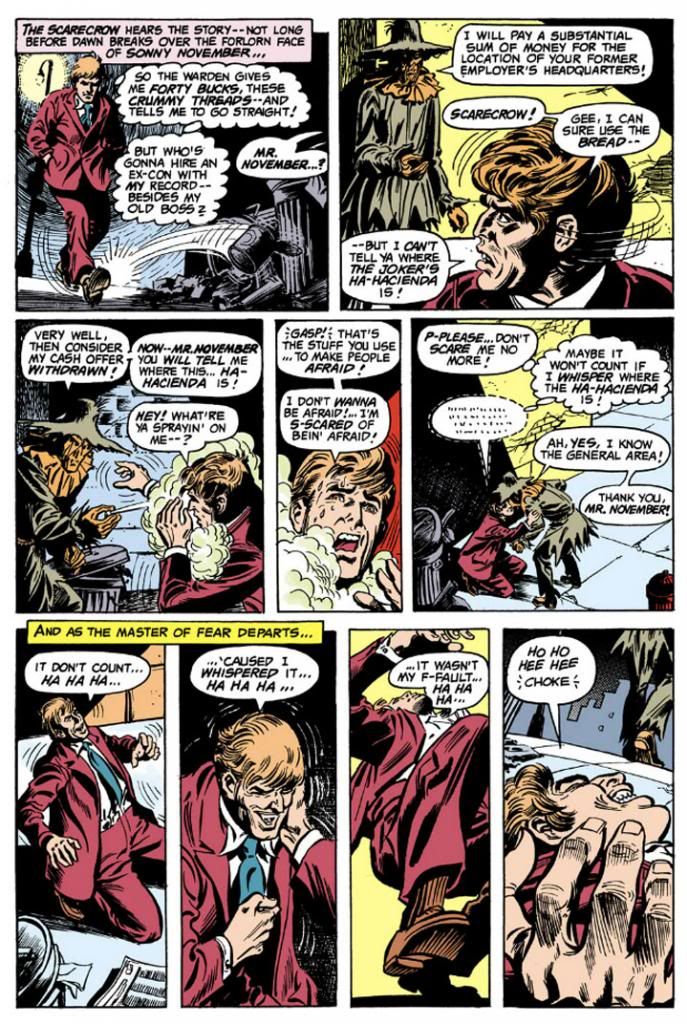
Being a Joker henchperson has such a high fatality rate.  One touch you can almost count on in any Joker story is when the writer decides to present the Joker's bona fides as a dangerous lunatic by having him off a henchman.  This time writer Eliot S. Maggin floats the clever idea the Joker instills a post-hypnotic killing suggestion in all his employees.  If any of his gang rats him out, that person laughs himself or herself to death.  Good deal for the Joker, but a terrible burden for his lackeys.

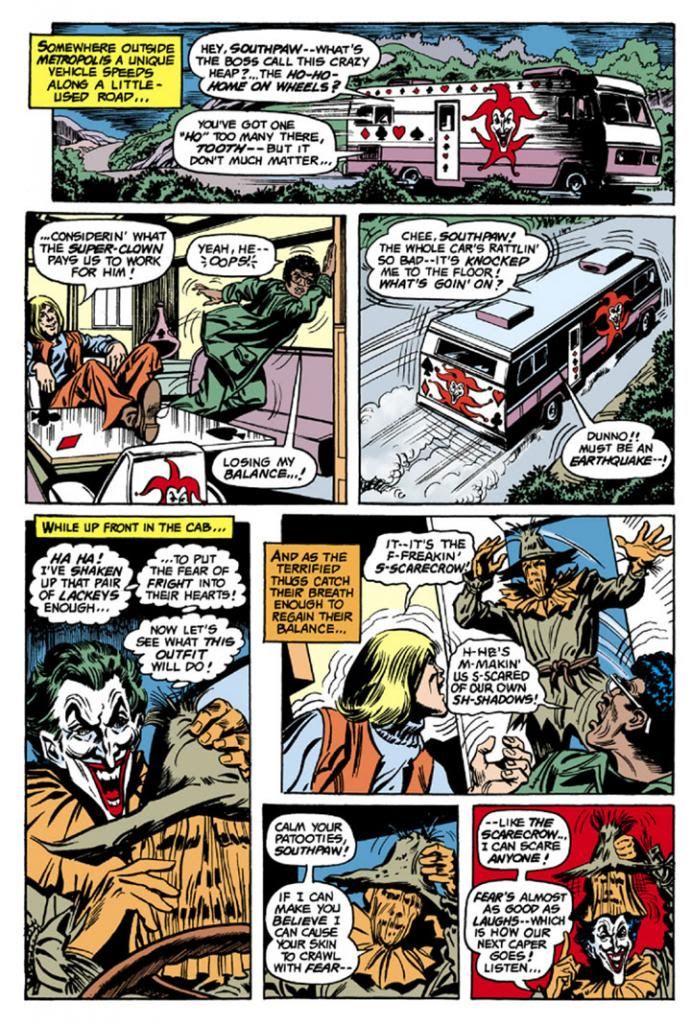
While there's no riskier occupation in the DC universe than Joker henchperson, there is virtually no reward in it.  Most of us grow up with the idea of risk versus reward.  The greater the risk, the greater the expected reward.  What's the reward for members of a Joker gang?  Even if the Joker decides to steal, say, a solid gold statue of famous clown Emmett Kelly, he's not doing it to melt the metal down and sell it off and split the profit equitably, or even to remove it from the market in hopes of increasing the value of his own stockpile (although a single statue would hardly do that) as when Auric Goldfinger colluded with communist China to irradiate the United States' gold reserves at Fort Knox.  The Joker operates whimsically.  He steals that statue because Emmett Kelly appeals to him in some personal way and he just wants to look at it.  In this story, the Joker takes the fear gas so he can use it to steal the ceiling out of a hyena cage because the painting on it would make a pretty decoration for his "Ha-Hacienda," a kind of Winnebago of crime he and his gang drive around in.  


Yet the Joker never seems to lack for lackeys, does he?  It's easy to understand why the Joker would appeal to anarchists, weirdos, cultists and anti-social types.  Even Charles Manson has fans.  But as far as I know, no writer has attempted to explain the attraction of working for the Joker to the Rockos and Leftys out there in Gotham City and Metropolis.  The blue-collar professionals-- safe-crackers, strong-arms, grifters, B&E boys (and girls) and car-thieves-- with families to feed. 

Here's where you come in, loyal reader.  Has any DC writer addressed this in a story?  I know Alan Moore had the Joker employ carnival freaks in Killing Joke-- which makes a lot of sense-- but never explained their motivation for taking part in his spree.  Every other Joker story I can think of features more conventional criminal types.  What's their attraction to the Joker?  I can only conclude lawbreakers in the DC universe must be even bigger idiots than real-world criminals.

Thanking you in advance!

Sincerely,
A Dope

Oh yeah!  I forgot all about the Scarecrow!


He flies into the comic in a teensy-tiny helicopter with his knees jutting skyward as if he's Disney's Ichabod Crane (a partial inspiration, I believe) on his horse at the end of the classic The Legend of Sleepy Hollow segment from their 1949 package film The Adventures of Ichabod and Mr. Toad.  He and the Joker engage in a duel right there in the zoo, and Scarecrow makes a complete ass of himself.  Oh well, to hell with him.  Here's Der Bingle singing about the Headless Horseman...


Here's Thurl Ravenscroft doing the same...


Happy Halloween, everyone!

Tuesday, October 29, 2013

October is Spookey Month: Jack Kirby pits Jimmy Olsen and his pal, Superman, against a vampire. The winner? Anyone who reads it!

Jack Kirby drew comics in just about every genre.  Which is a pretty conservative way of putting it when you consider he actually invented or co-invented some of them.  As a Kirby fanatic, I wanted to link him to my annual Halloween celebration here, and rather than talk about Spirit World (Kirby does the paranormal) or some of his straight-up horror work (you can find it scattered about in various reprints, Archives, Essentials and Showcases and IDW's Haunted Horror), I have decided to once again explore his early-70s DC years.  We love those book here.

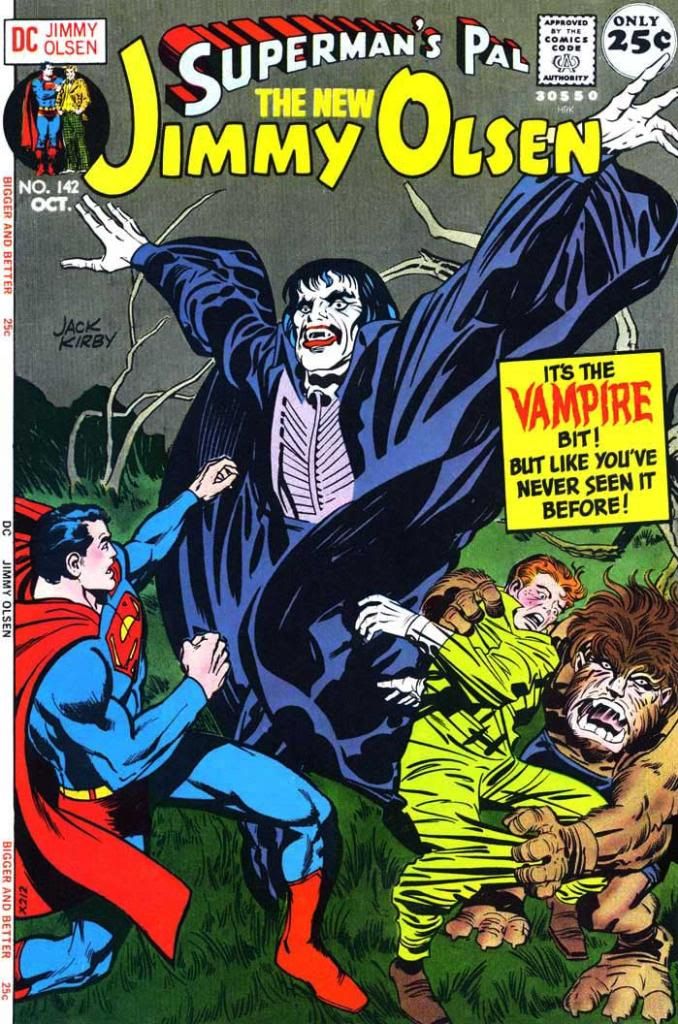
In Superman's Pal Jimmy Olsen #142 and #143 (October-November 1971), Kirby gives the then-corny vampire routine a science-fiction/superhero twist.  Nowadays we have scary vampires again, and romantic, sparkling vampires and vampires that fight werewolves with Matrix-style kung-fu, but when Kirby wrote this story, movie vampires were pretty much still tuxedo-wearing noblemen and the occasional lesbian baroness in a Victorian-style negligee.  Comics in particular had worn out the theme, despite years of a Comics Code ban on vampires.  Once EC had modern-day vampires put taps in their victims' necks and Warren saw an old school county-style vampire take a spaceship to a planet of perpetual night, the concept had been stretched past recognition, like Dick Tracy's face imprinted on Silly Putty (I used to love distorting that guy). The only things left were parody and deconstruction.  Kirby's story tends towards the latter, although the self-aware cover copy hints at the former.

That's as close to tongue-in-cheek as this story gets.  The rest of it is as sincere as Linus' pumpkin patch in It's the Great Pumpkin, Charlie Brown.  Kirby expends a lot of energy here trying to make readers buy this concept and he's not playing around or being cutesy.


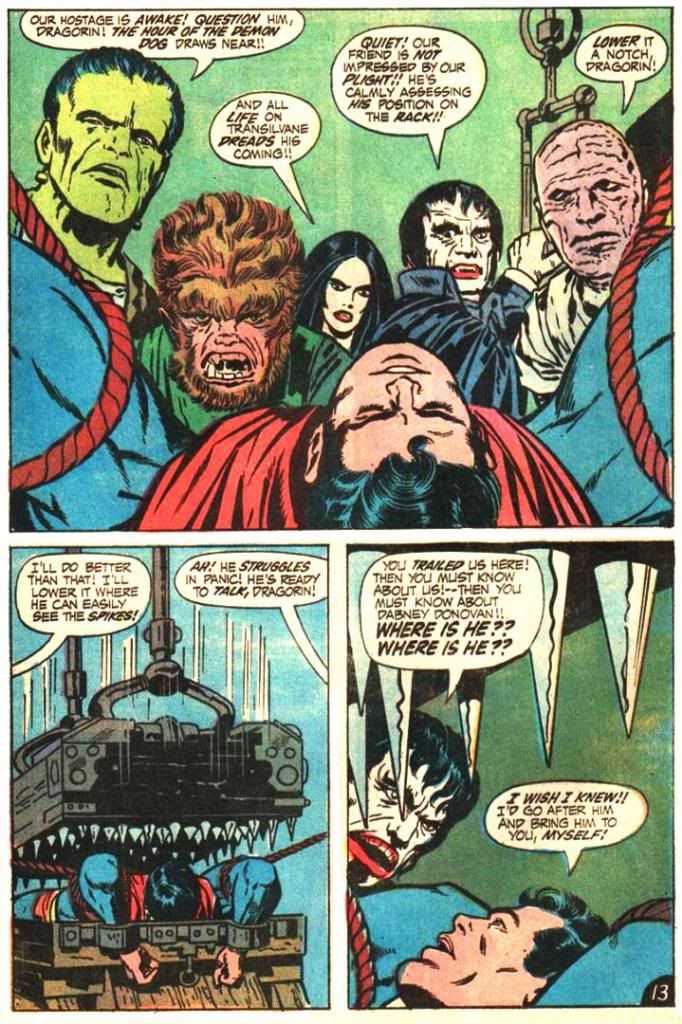
Count Dragorin, the man from Transilvane, does everything you've come to expect from a vampire, up to and including having a werewolf as a best friend.  Kirby wastes no time kickstarting the plot as Dragorin and his beastly companion slip into the city one night and put the bite on a sleeping receptionist by the name of Laura Conway.  Kirby's updated answer to the age-old vampiric transformation scene is to have Dragorin accomplish this via some kind of twin yellow power emanations from his eyes.  They leave the tradition double bite mark on the receptionist's neck and "change her body chemistry."  Within a couple of pages we have Clark Kent and Jimmy Olsen fighting Dragorin for Laura Conway's soul-- or at least her free will-- right there in broad daylight inside the GBS (Galaxy Broadcasting System) offices.  Dragorin is after a former NASA scientist named Dabney Donovan, and Conway was once Donovan's personal secretary.  Intercut with this is a subplot with the Newsboy Legion trying to escape from the Cadmus Project (they're not prisoners; their fathers work there and they're just up to their usual independent-minded mischief), so these are some really busy issues.


When Superman and Jimmy Olsen track down the scientist's lab (beneath a mausoleum in the pleasantly-named Bloodmoor Cemetery), they find they're not dealing only with a vampire and werewolf couple.  There are all kinds of familiar creatures.  So what does Kirby do to explain these Space Age vampires, werewolves and the like within the science fiction setting?  Well, it turns out Dragorin and company are microscopic aliens from an artificial planet.  That floats inside a room that looks like a creepy castle set where James Whale would have put Boris Karloff through his paces, or Todd Browning would have put Bela Lugosi through his.  And if that wasn't enough, the aliens on that world have developed a society based on old horror movies as well thanks to the bizarre experiments of Dr. Donovan, who must be a real piece of work himself.

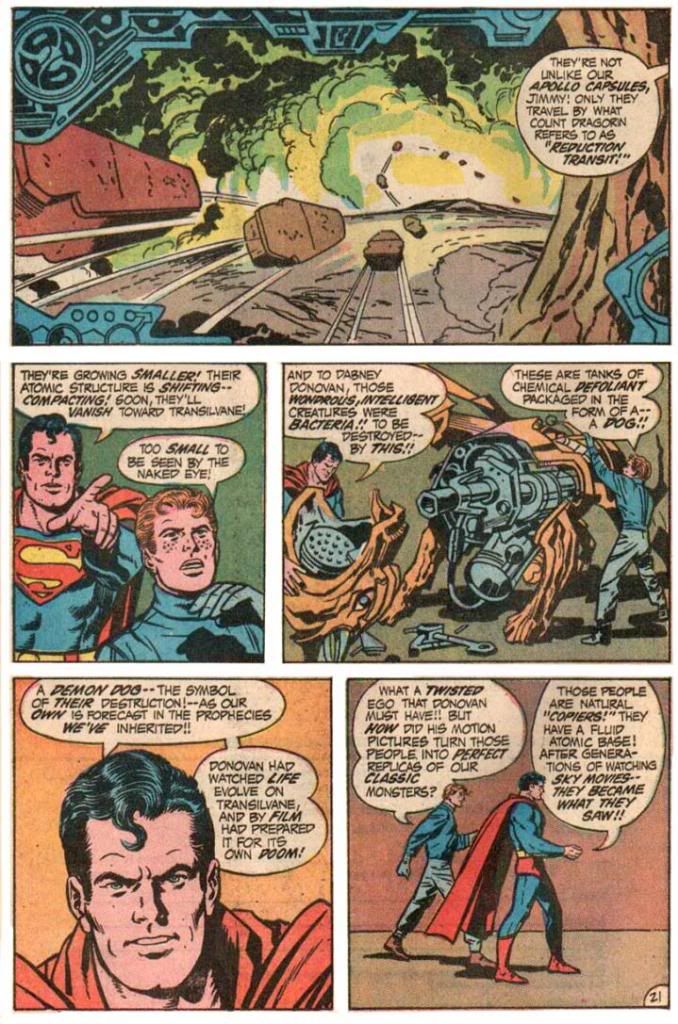
For some reason known but to himself (and, I think, NASA), Donovan didn't just make a world.  He also chose those horror movies from his vast personal collection of films and projected them into its clouds.  The sentient life there turns out to have remarkable adaptive and imitative properties, kind of like those gangster guys and the Nazis the Star Trek crew dealt with on their old TV show.  Some of the people there turned into vampires, some into Frankenstein's monsters and others into mummies and werewolves.  They travel from their planet to ours by riding inside coffins that grow or shrink depending on which way they're transiting.


Kirby doesn't really bother to explain Donovan's scientific motivation.  After all, what could he have hoped to gain from such an experiment?  Certainly if he had published his results, the idea that we as a species could create an entire miniature world full of intelligent, evolving life, would result in a philosophical or even a religious sea change.  But Donovan seems to have added these rather baroque flourishes for his own personal enjoyment, and then to destroy via a robotic dog filled with a chemical defoliant.


The horror and science fiction aspects create a dissonance that's fun but, like Frankenstein's monster, reveal some of the stitching Jack Kirby did to make the story work.  Because Kirby's trying to assemble this creature in a way that gives it life and makes sense, some of the details are a bit too on-the-nose-- the space coffins compared to the Apollo re-entry process, for example-- while others remain shadowy, as if they're inexplicable.  Why did Donovan use old horror movies in the first place?  And we not only never meet the nutty scientist who did this, but he never receives a comeuppance for what amounts to attempted genocide.

I love that after all this oversized craziness-- even if it's also about miniature creatures as well-- Kirby chooses to end it on a minor note, with two pals sitting down together to watch Oklahoma!  It's just so human.  They're not even nonplussed about letting Donovan get away scot free, or having encountered human-created sentient life that could potentially affect life on earth in horrific ways, like some kind of virus escaping from a weapons lab. 

But maybe Superman is completely aware of this and downplaying it for Jimmy's sake as he renders the Transilvanians harmless in his own inimitable way.  From what I've read, writers and artists later extended the Transilvane concept and finally had Donovan make a story appearance as a full-blown villain, but a true sequel to this story would have Dragorin and friends transformed into good-natured cowboys and farm girls, and singing about a surrey with a fringe on top.

Oh, and be sure to note the Superman figure on the cover to #142.  Neal Adams re-touch.  And check out all the Al Plastino faces in the interior art.  Occasionally some Kirby comes through, but I really wish DC hadn't felt the need to do this.

Saturday, October 26, 2013

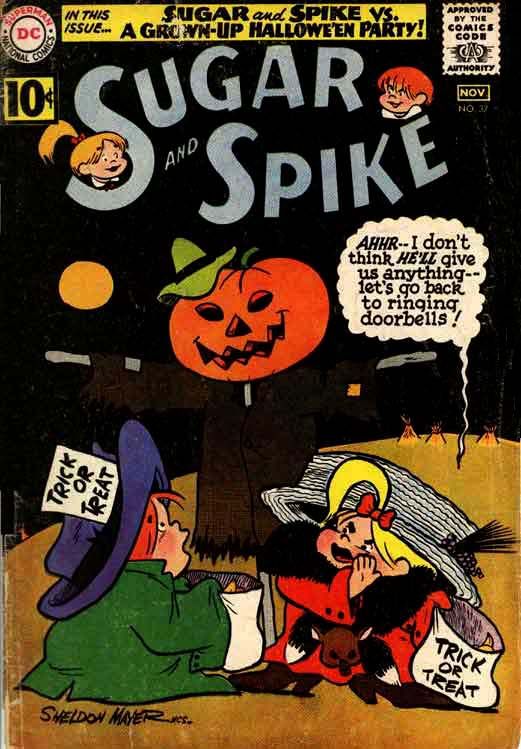
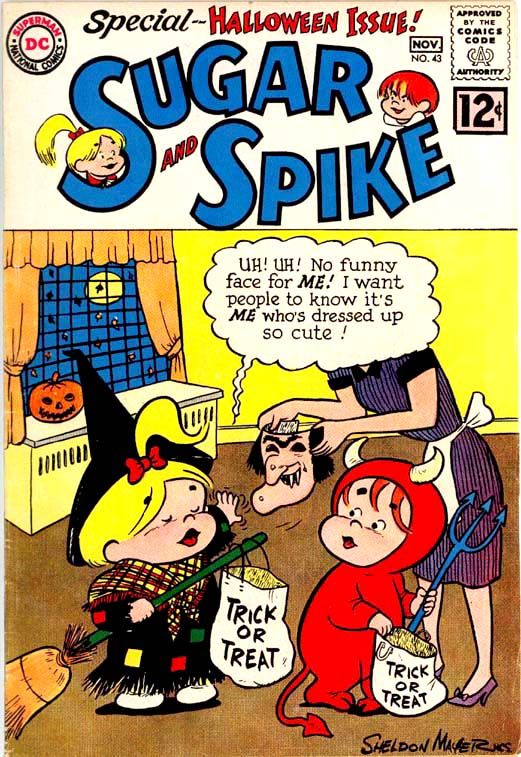
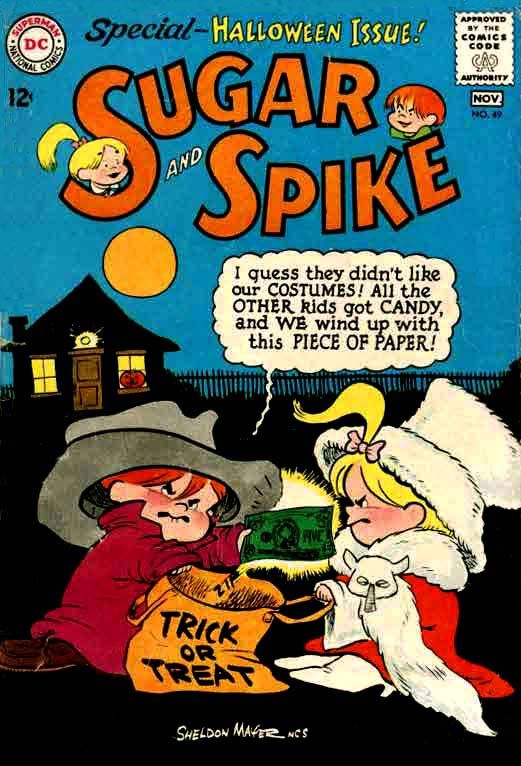
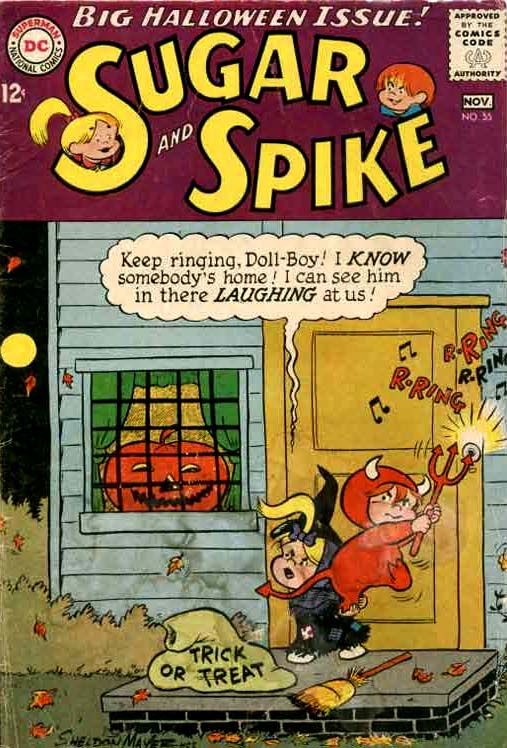
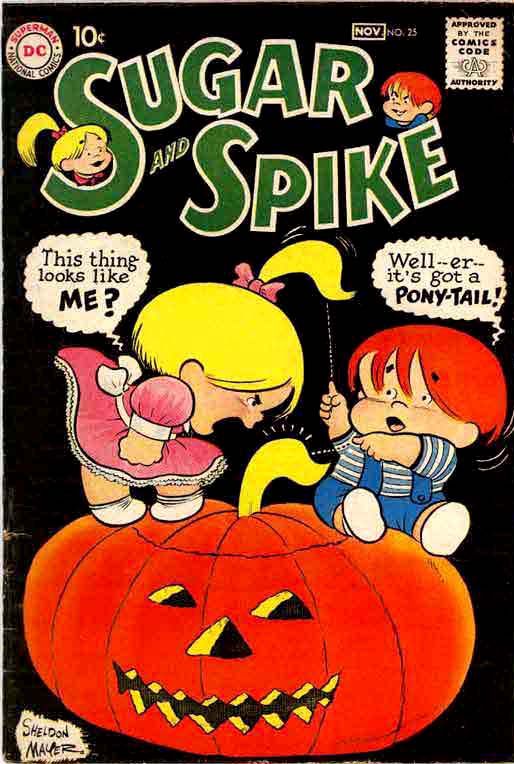
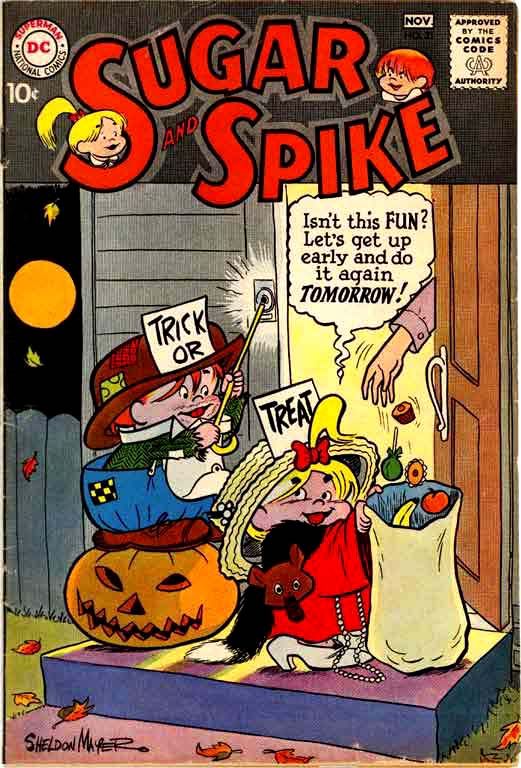
October is Still Spookey Month: Sugar and Spike's Halloween-themed covers!

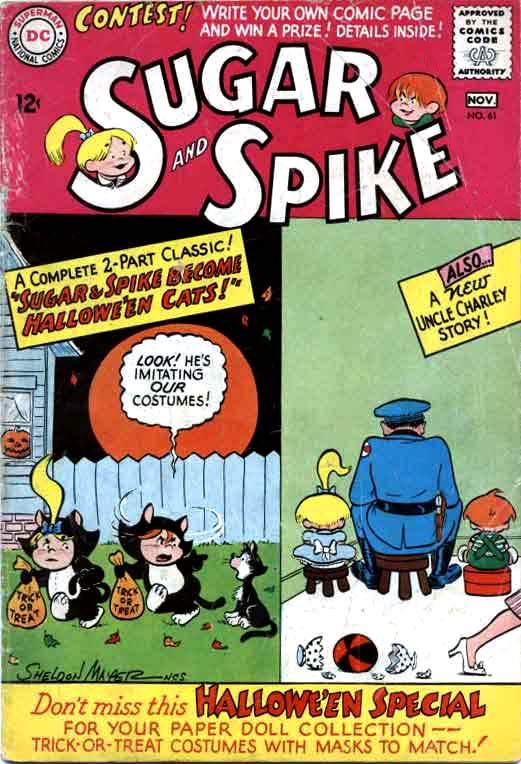
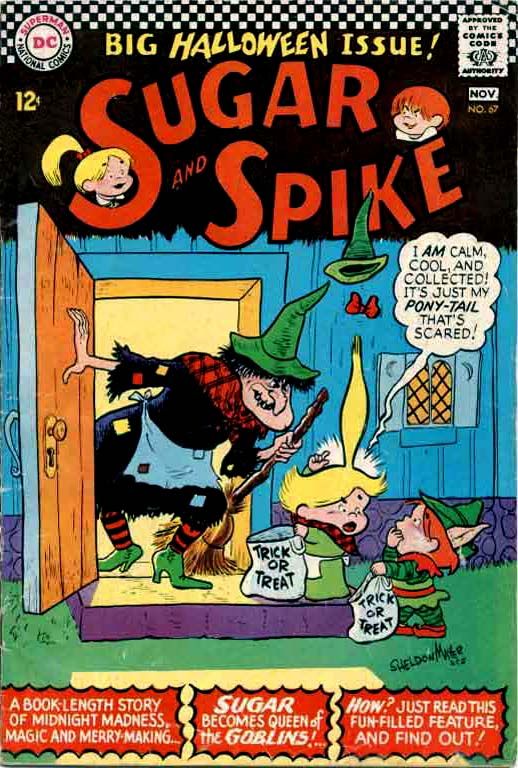
These are pure joy.  I really don't have anything to say about any particular cover in this collection, so we'll let Sheldon Mayer's work speak for itself and fill you with the spooky, fun Halloween spirit.

Sugar and Spike #25 (Oct.-Nov. 1959)


Sugar and Spike #31 (Oct.-Nov. 1960)

Sugar and Spike #37 (Oct.-Nov. 1961)

Sugar and Spike #43 (Oct.-Nov. 1962)

Sugar and Spike #49 (Oct.-Nov. 1963)

Sugar and Spike #55 (Oct.-Nov. 1964)

Sugar and Spike #61 (Oct.-Nov. 1965)

Sugar and Spike #67 (Oct.-Nov. 1966)

There!  I'm ready to go trick or treating and it's only October 27th.  I've only read one or two Sugar and Spike stories, but the Comic Book Artist #11 (January 2001) flip side devoted to Mayer and his kids made me a believer.  I wish DC and Comixology would make this entire series available so I could put up some better scans instead of ones I had to scour the web to find and then clean up a little for you.  I did as good a job as time (little) and money (zero) would allow and it's our good fortune Sugar and Spike fans put them out there for all of us to enjoy.

And now you also enjoy my favorite Spookey video!

Wednesday, October 23, 2013

October is Spookey Month: Haunted Horror, in which you can find 1950s pre-Code horror that's sometimes disgusting

A comic book Halloween wouldn't be complete without a few 1950s fear-fests.  Man, those Fifties cats really knew how to horror things up, how to jive and jazz and wail!  Then the Comics Code came and the music stopped.  For a while.  The jam moved over to the Warren black and white mags but full-color monthly comics ended up stunted.  By time I was a comic book-reading kid, we had a few cool DC anthology series, but the granddaddy of them all was simply a legend.  I'm talking EC.  You could order expensive hardcover, slip-cased reprints, but those were for the old guys with their disposable income, brandy snifters and smoking jackets.  It wasn't until Russ Cochran and Gladstone Publishing started reprinting Tales from the Crypt, Vault of Horror and The Haunt of Fear and selling them through newsstands that I was finally able to read those fabled classics in color. 

But I soon learned EC wasn't the only publisher doing sick horror in the 50s.  You know how it went with comics back then-- if something proved a money-maker, everyone in the business flooded the market with their own versions.  Heck, I don't even know who published the original horror hit.  EC just did it best, and they're the ones who took the blame when Uncle Sam cracked down on too much of a good thing.  Those other publishers doing the EC thang back in the day interested me greatly because of my appetite for pre-Code horror, but those remained fleeting phantoms that haunted the periphery of the whole tragic tale.  Until now.

IDW's Yoe Comics packages this book they call Haunted Horror where you can find stories from a lot of those non-EC guys.  I just bought a bunch of them on Comixology (.99!), and I'm loving them.  Some of them feature art by recognizable names-- the Iger Shop, Joe Simon and Jack Kirby (Whatever happened to him?  He showed real promise!), Jack Cole and a guy by the name of Ditko who later did some kind of bug-related hero the kids seemed to like.  Some of them are just crude and weird and even a little off-putting at times.  But yeah, I'm loving all of them.

It's just...

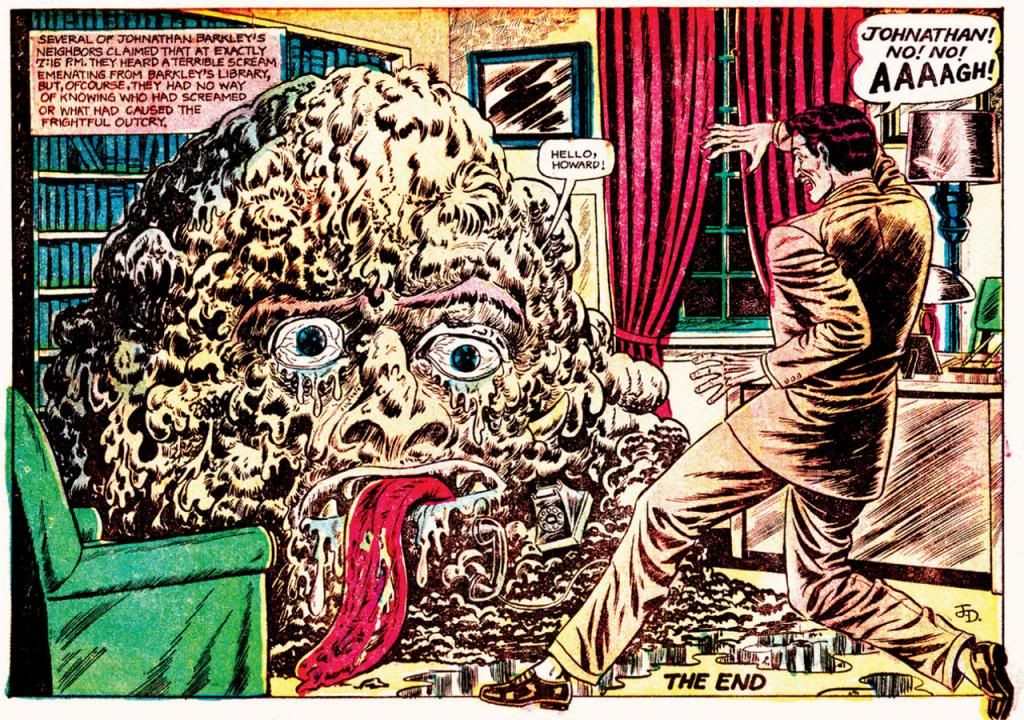
Every so often if you read enough horror comics, you will run into an image that just burns through your eyeballs into your brain, charring part of it and pretty much leaving you a shambling wreck.  A lumbering zombie, if you will.  And so I will now present one of those...


EEK!!  It's Jay Disbrow's version of Mel Brooks' Pizza the Hutt, only 33 years early.


The long tongue is an especially nice detail.  To add a little context, the guy screaming is the blob's doctor.  Or he was, when the blob was a man.  If you'll look closely-- dare it-- you'll see a rotary-dial telephone kind of sloughing off the blob's side.  The doctor came in response to a call from that very phone, and if you're puzzling out how something like this mass of what appears to be melted flesh could manage to spin that old-fashioned dial, I refer you back to the tongue.

I wonder how many kids saw this story when it was first printed.  Thousands?  If so, those were some lucky kids, but I doubt their parents appreciated the loss of appetite that no doubt accompanied the reading of this story.  Right about dinnertime, across America, little people with coonskin caps and skinned knees turned up their collective noses at Mom's radar-ranged glazed ham and peas and carrots, then got the spankings of a lifetime when they refused to eat.  They were incapable.  I read this three days ago and I haven't eaten so much as a crumb or speck of food.*

That's what a good horror comic should do for you.  Put you off your feed.  Junji Ito's Uzumaki is a more recent example of a horror comic that turned my stomach.  Another old one is the story "Tight Grip!" illustrated by Jack Davis.  In that one, a murderer stupidly hides inside the sentient trunk belonging to his victim and it compresses him.  His meaty parts stream out in thin ribbons through bullet holes he shoots in the trunk and investigators find nothing inside the tiny trunk but a cube of powdered bone.  Grotesque.  Gives me a chill just thinking about it.  "Tight Grip!" ran in EC's Tales From the Crypt #38 (October-November 1953) and you can read it today in the Fantagraphics volume devoted to Davis' horror work, 'Taint the Meat... It's the Humanity! 

And now we have Disbrow's blob.

Anyway, a big thanks to Craig Yoe, Steve Banes, Clizia Gussoni and all the people at Yoe! Studio and IDW for putting all this effort into putting these stories back into print and broadening my experience of 1950s horror comics.  And also making me sick.

*A blatant lie.  I've been making a pig of myself.

Sunday, October 20, 2013

October is Spookey Month: Cindy Lee's scary alien encounter!

What is Halloween without creepy aliens from space?  My close friend, the late Orson Welles, forever linked the holiday to space invasions with his infamous 1938 radio broadcast of H.G. Wells' War of the Worlds.  Orson (or Mr. Welles, as we used to call him during our monthly poker games/discussions of magic and illusion) once confided in me-- while we were in Morocco shooting some footage for his proposed film version of Jules Verne's Around the World in Eighty Days-- the panicked public reaction gave him quite a thrill and his supposedly chagrined mea culpa the next day was largely tongue-in-cheek. 

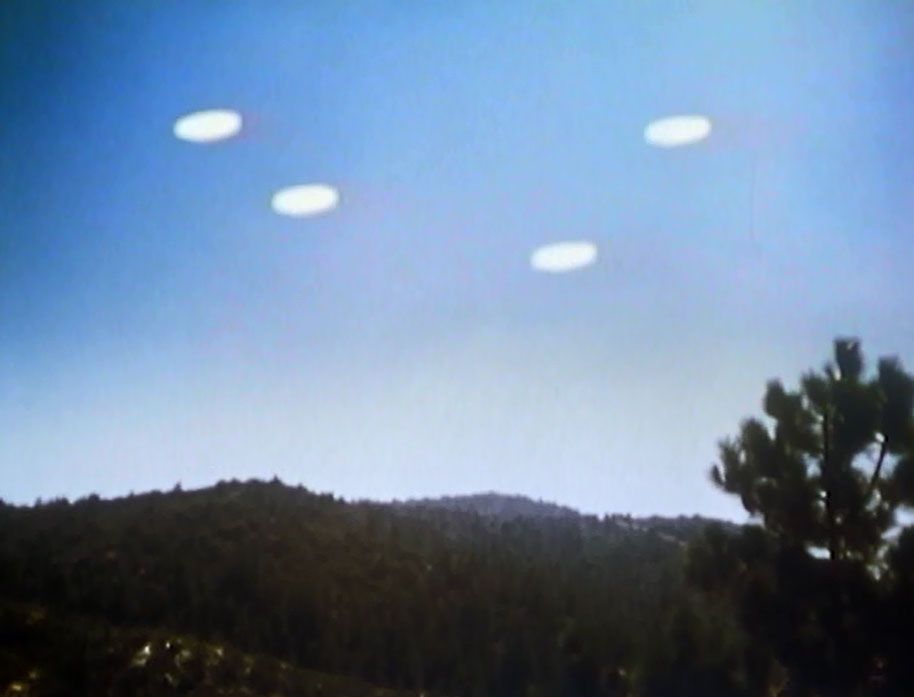
Welles was always fond of hoaxes and trickery (witness his F For Fake), so it's quite fitting to present once again a little look at the very first episode of that ever-popular Saturday morning children's show Isis, "The Lights of Mystery Mountain.  This one features spooky UFOs, or as they're popularly known, "flying saucers."  Just in time for Halloween and a million re-broadcasts of War of the Worlds!

This particularly Isis installment, which aired on the comfortably non-Halloween date of September 6, 1975, probably comes closest to eliciting anything approaching genuine fright, or at least menace, than any of the others.  While a later Isis would feature an Old West ghost town-- but nary a ghost-- this program was not given to horror or even weird themes.  Plots usually involved more down-to-earth elements such as troubled students, automobile safety, horseback riding and SCUBA safety.

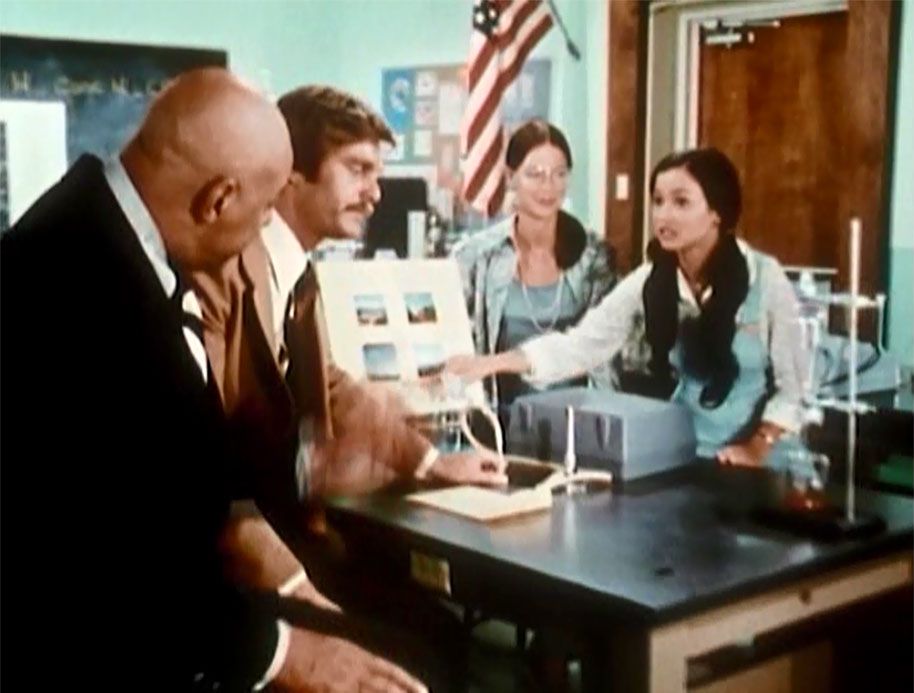
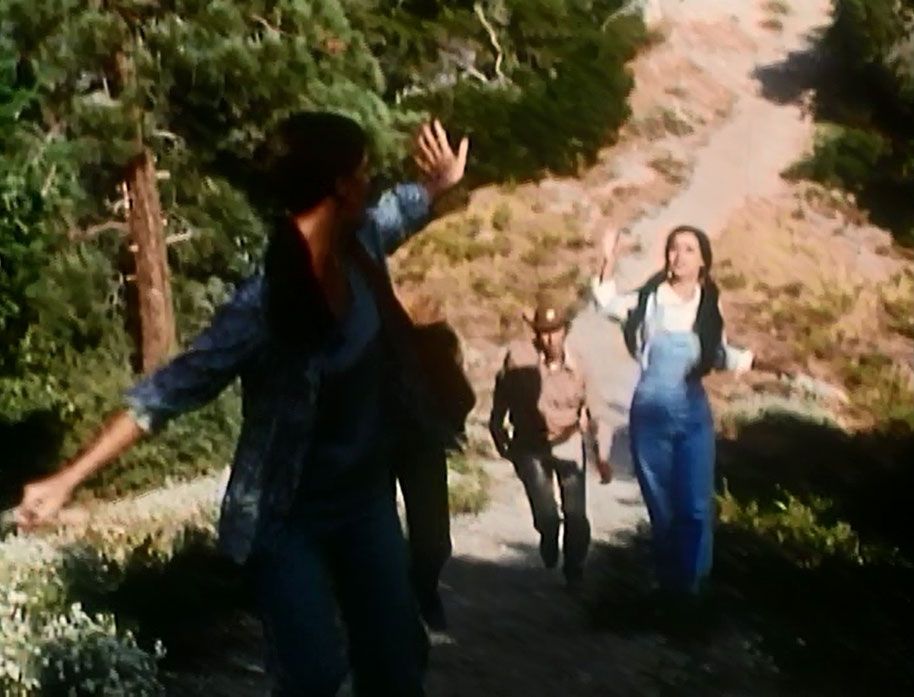
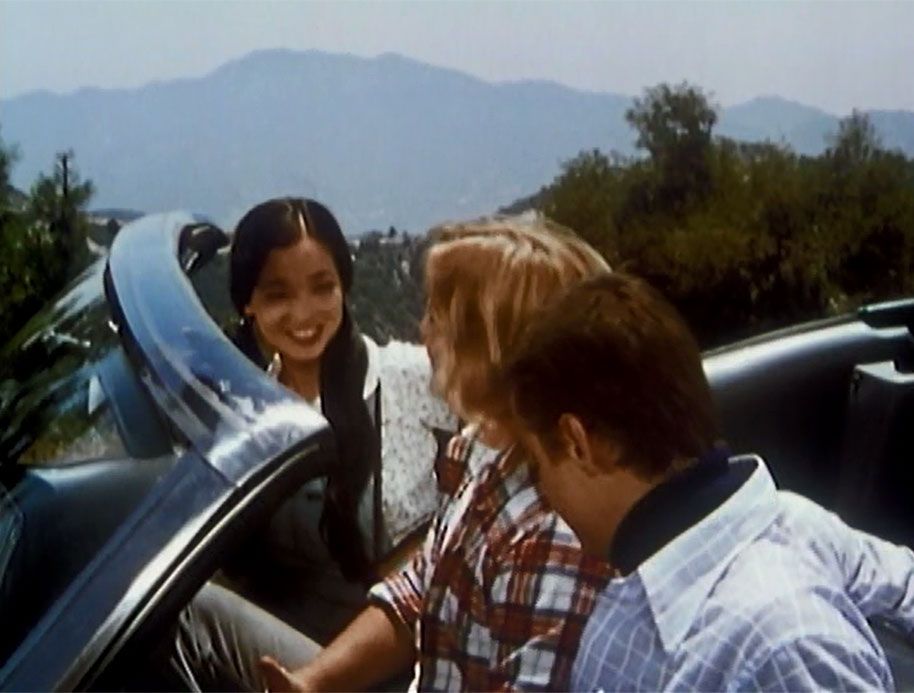
Unlike the writer of this blog, the Isis folk don't waste any time getting down to business.  In the opening scene, Larkspur High School's star student Cindy Lee displays rather alarming photographic evidence of eerie lights of unknown origin.  She took them herself on a hiking trip and breathlessly relates the story to school principal Dr. Barnes and her favorite teachers Andrea Thomas and Rick Mason.  After a discussion of the UFO phenomenon during which Mason scoffs at the idea of alien visitation and both Barnes and Thomas remind him they're not necessarily talking about interstellar spacecraft but simply the more general term "unidentified flying objects."  But it's Thomas who ties the lights to the strange disappearances of two campers and a tourist.


His curiosity piqued, Dr. Barnes asks the two teachers to accompany Cindy back to the rustic mountain town of Mountain Park adjacent to the aptly named Mystery Mountain and there undertake a thorough investigation.  As scientists and educators and proponents of rationalism, Thomas and Mason demand empirical evidence before accepting the rather outrageous hypothesis suggested by the wild stories and rumors surrounding the recent incidents.  Extraordinary claims, they declare, require extraordinary proof.  Well, they don't declare this so much as they kind of hint at it.  With Cindy Lee acting as their more open-minded foil, the group journeys up the mountain, quite like the trio led by the character Professor Armitage in H.P. Lovecraft's 1929 tale "The Dunwich Horror." 

Armitage and company soon reach the inescapable conclusion there are indeed supernatural forces at work and engage them in a life-or-death struggle to prevent their entering our world or dragging it into their own dimension to serve their unspeakable ends.  The events recounted in "Lights" are their Saturday morning analogue.  For once atop Mystery Mountain, Cindy Lee experiences a moment of terror so stark I feel compelled, as if by the memory of my late friend Mr. Welles, to present here.  Witness then, the most shocking events of "Lights" as they unfold in front of Cindy Lee's very eyes!

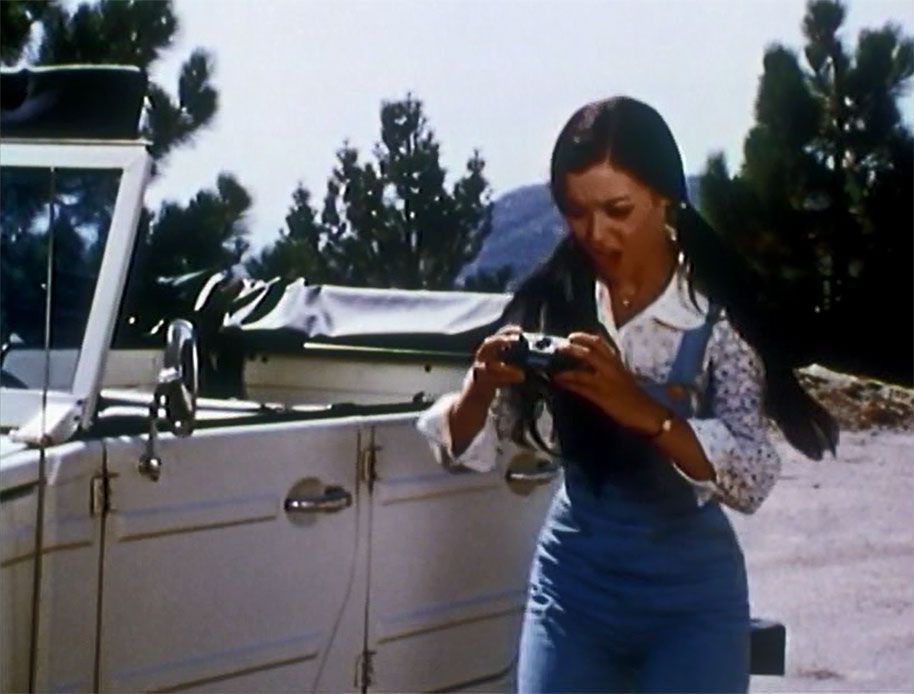
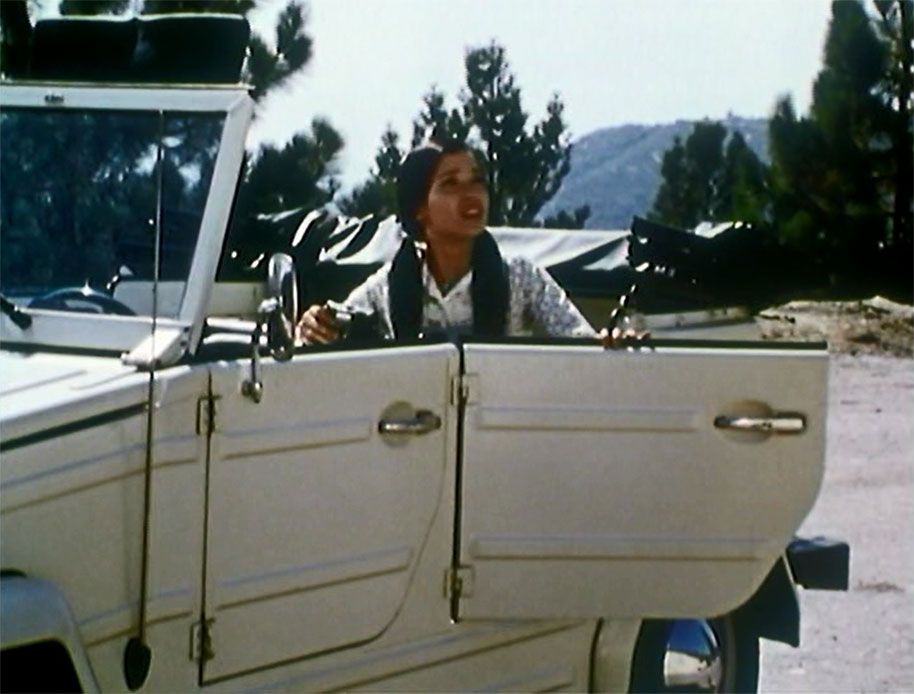
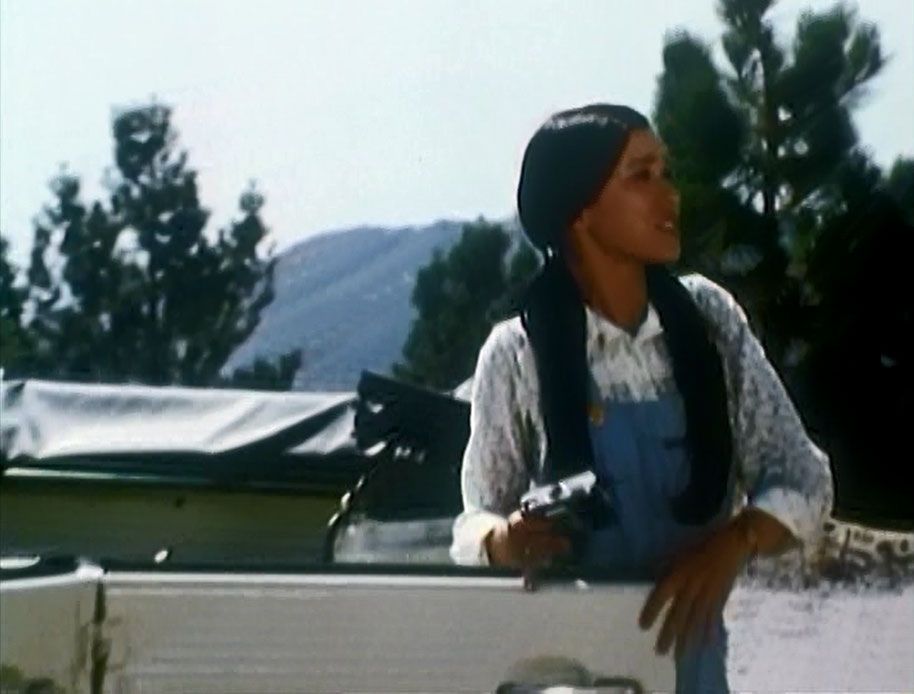
Cindy Lee remembers her camera is still in the car...
The mysterious lights over the mountain.
Gotta snap some photos!
Oh no!  I'm out of film!
The frightening alien tones continue.
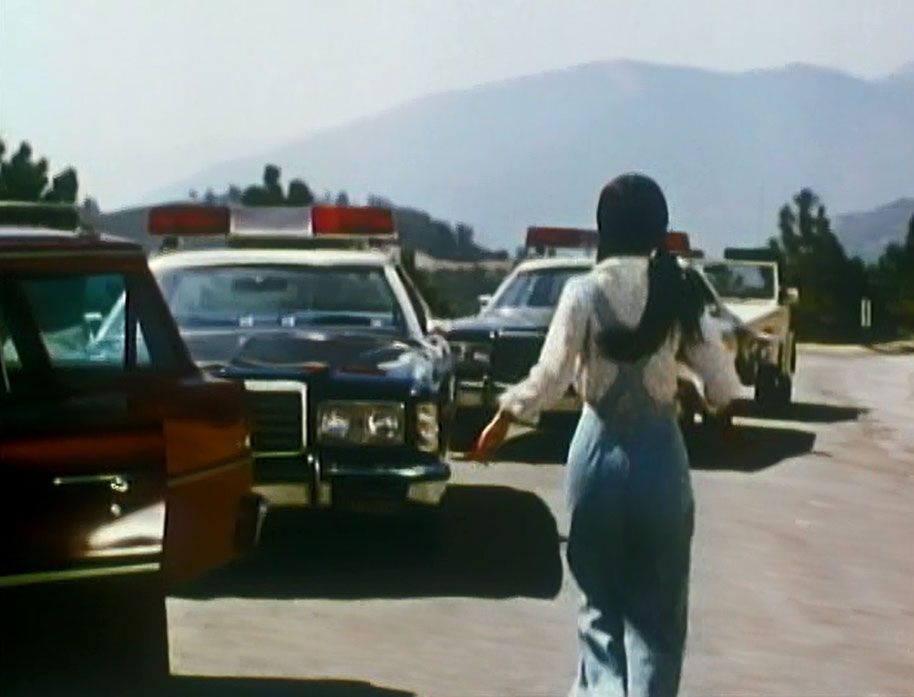
Ms. Thomas!  Mr. Mason!  Where are you?
I need you!

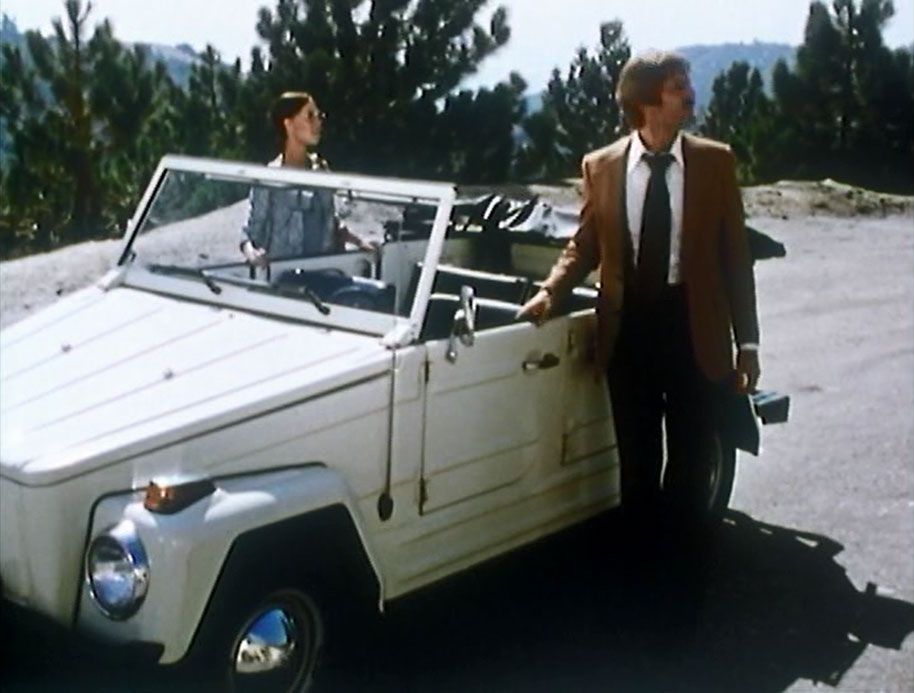
A few moments later and Thomas and Mason sense something amiss.  They parked the cars only a few yards away.  Cindy should have returned by now.  The teachers clamber down the mountain trail after her only to find...


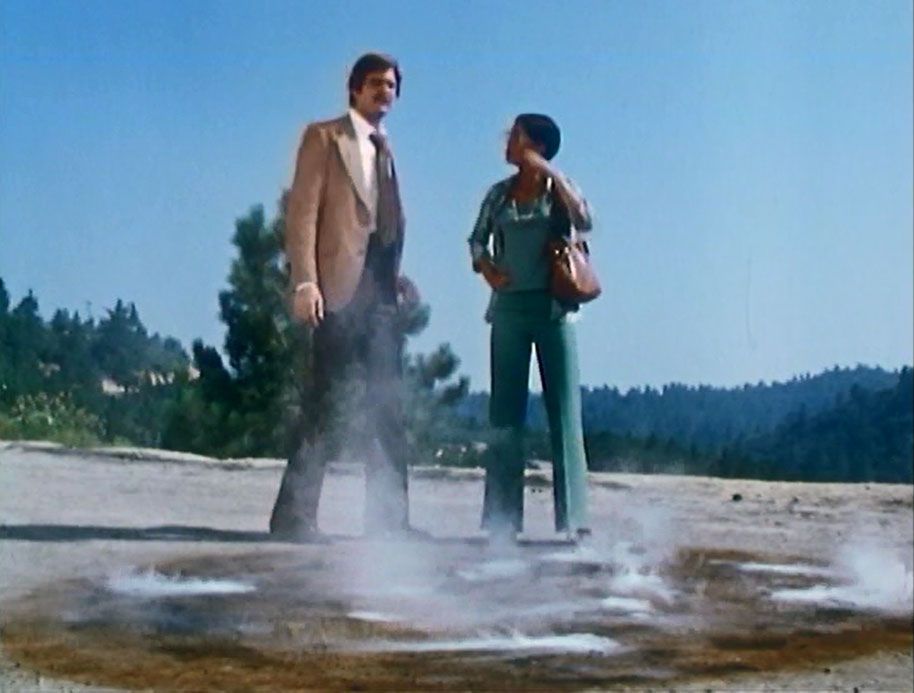
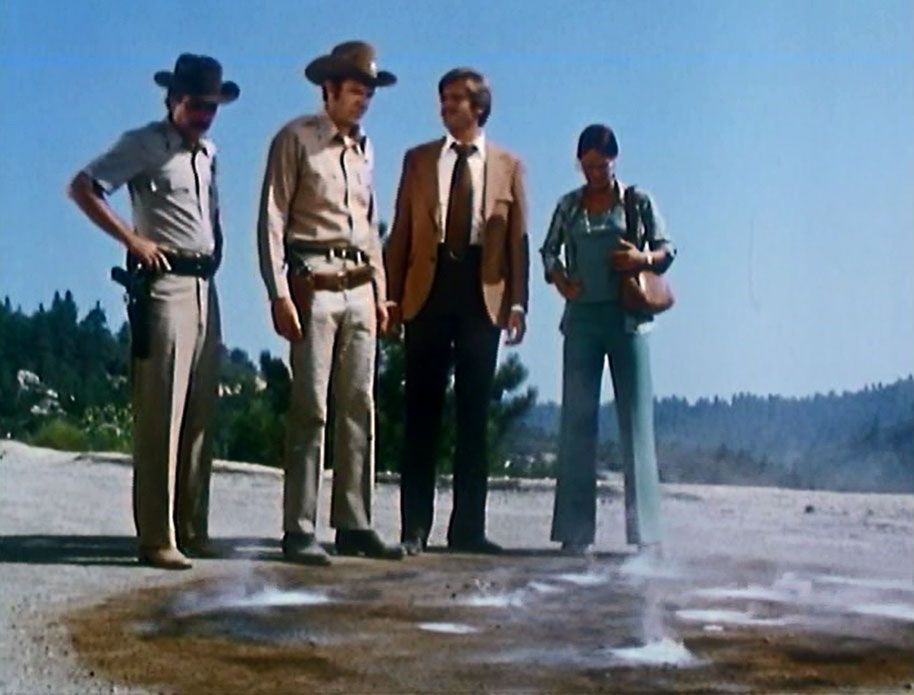
No one.  No Cindy Lee.  A moment later, Thomas comes across this...


It's just like the burned spots found at sites where the campers and tourist disappeared.  Have bizarre, inhuman beings from another world spirited Cindy Lee away?  Kind of...


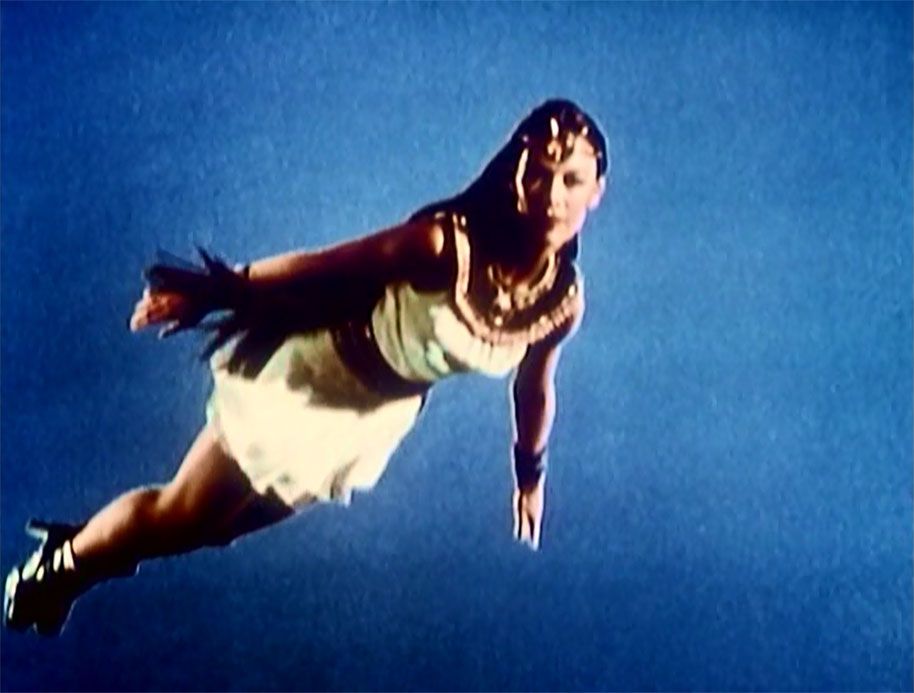
It looks as if this is a job for...


Isis eventually presents a prosaic explanation for all these strange happenings, but not before our favorite goddess swoops to the rescue and uses her magic to give a mean old real estate baron a fright of his own.  Of course, one might expect a universe that allows for the existence of magic and ancient Egyptian goddesses living dual lives entwined with 20th century pedagogues to also allow for the existence of life on other planets, and to posit this life as a regular, if secretive, visitor to our own humble world.  Indeed, Isis does leave open this very possibility even while suggesting what we must chiefly concern ourselves with are terrestrial threats-- corrupt old men who would employ fun-loving pranksters to help them achieve nefarious goals.  And scare nice kids like Cindy Lee.