Showing posts with label Jimmy Olsen. Show all posts

Friday, January 24, 2014

Kirby's Kustoms! A selection of Jack Kirby's creative conveyances...

Jack Kirby created so many wonderful characters in his long career, but he also came up with all sorts of wild contraptions to get those characters to and from their adventures.  Your typical Kirby vehicle is somewhat outlandish, certainly futuristic, but also surprisingly plausible at a glance, as if he generated detailed plans before inserting them into his stories.  You're likely to find jet fans, air intakes and plexiglass cockpits along with all kinds of valves and pipes.  A Kirby vehicle is as instantly recognizable as one of his muscular, almost steel-like heroes.

Let's start with a one of his first from the fabled Fantastic Four comic.  Whatever happened to that?  Are they still publishing it?  Anyway, here we go--
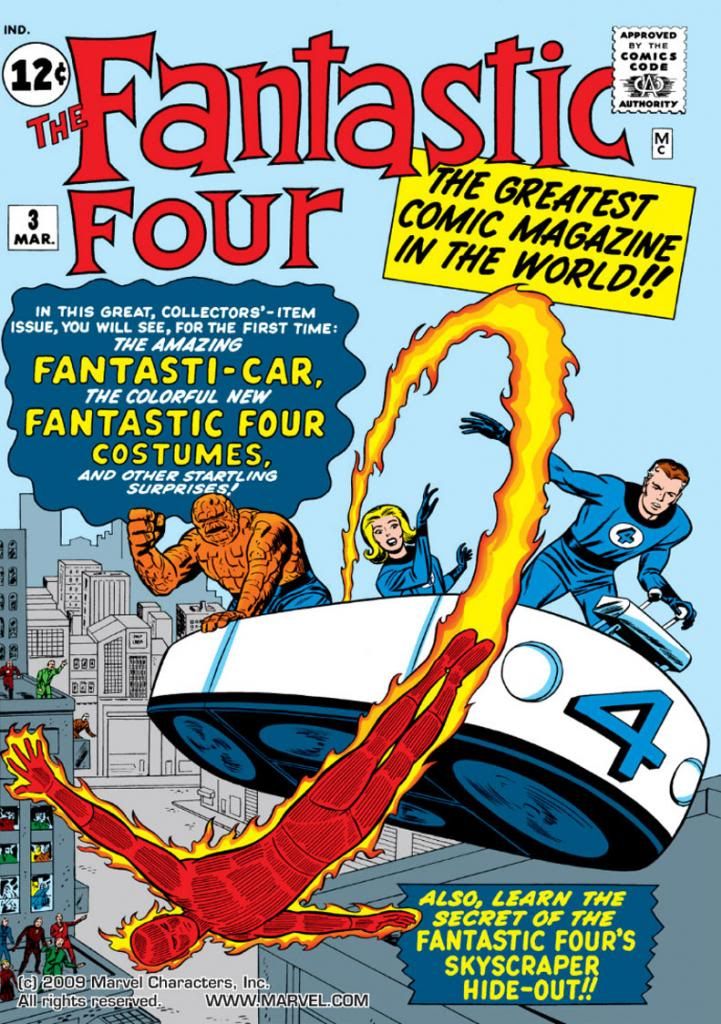
Fantastic Four #3 (March 1962), inks by Dick Ayers

The Fantasti-Car!  The Fantasti-Car debuts in Fantastic Four #3 (March 1962), which also saw the adventuresome quartet donning their blue costumes for the first time.  Like those plain but functional-appearing duds, the Fantasti-Car is a simple design, just a tub with headlights for safety and what appear to be four fans underneath for generating lift.  I'm not sure how Reed Richards controls pitch and yaw or generates forward thrust in this version of the Fantasti-Car, but I'm sure Kirby could have explained it if I'd been around in 1962 to ask him.  Unfortunately, this isn't the most visually impressive design, and I'm guessing Kirby must have been a little dissatisfied with it, because about a year later, the Fantastic Four upgrade to a hotter version.
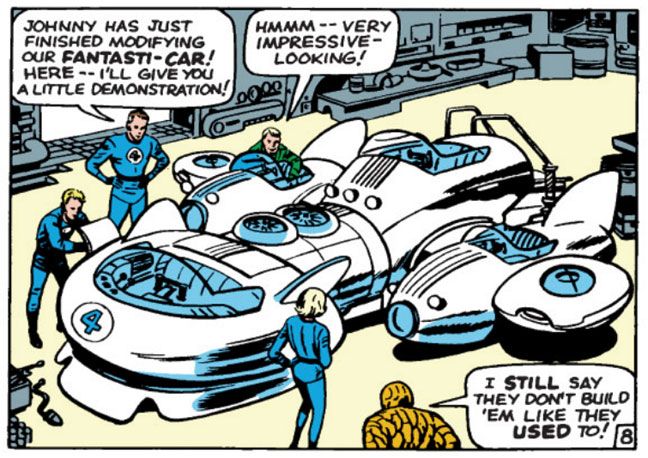
Fantastic Four #12 (March 1963), words by Stan Lee, inks by Dick Ayers

Yeah!  That's more like it!  The Fantasti-Car, Mark II made its debut in Fantastic Four #12 (March 1963).  This one has aerodynamic styling and possibly a much greater range.  Ignore Ben Grimm's little griping remark.  Some people just aren't pleased with anything.  The Fantastic Four use this Fantasti-Car to travel cross-country and take on the Hulk.  But what about ocean-hopping, when the team needs to cross hemispheres, date lines and other such geographic demarcations?

That's where this baby comes in--
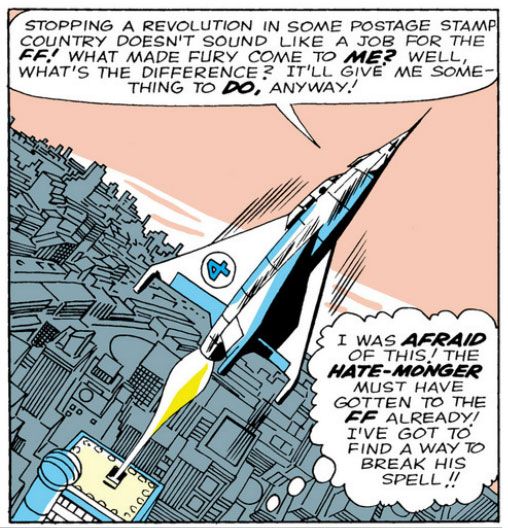
Fantastic Four #21 (December 1963),  words by Lee, inks by George Roussos

The Pogo Plane.  The Pogo Plane previously appeared in issue #3, but it really gets to strut its strato-stuff here as the FF prepare to face the Hate-Monger in Fantastic Four #21 (December 1963).  Kirby gives this aircraft a state-of-the-art appearance (at least for the 1960s), like something the USAF or NASA might have been toying around with in the early days of space exploration.  The X-51 or  the Lifting Body.  Man In Space Soonest.  The Flying Flapjack.  The Apollo Applications Program.  Somebody stop me or I'll go on forever.  I love aviation history!

This could be a wild, right-off-the-drawing-board design lifted from a Popular Mechanics article of the time.  It's got huge stabilizing fins and even flaps.  Plus it's a tail-landing VTOL aircraft.  That's "vertical take-off and landing," to you and me, Russ.  I'm no aeronautical engineer, but Reed Richards has that skill set among his many, and you can imagine he saw this one through from the initial design phase to wind-tunnel testing with a scale model to prototype production to flight test with none other than Ben Grimm at the controls.

Now that we're on the topic of his piloting skills, here's a little Ben Grimm-related aside-- Ben generally plays the fool with his gruff street-style patois, but he's actually vastly intelligent himself, the kind of guy who would have made the Mercury Seven if he'd actually existed.  Ben was a highly-regarded test pilot with a fighter background before he became a superheroic freak, which means he's got quite the expertise in engineering.  Tom Wolfe in his book The Right Stuff describes how Ben's closest real-world analog Chuck Yeager (no mean engineer himself) influenced not only aviation history but also how pilots of the era spoke-- I don't know if it's true or not, but Wolfe makes a hilarious and compelling case for airline pilots of the time doing their cockpit announcements in pseudo-West Virginia drawls in imitation of the man at flying's apex.  I can imagine in the Marvel world the same thing happening, only with pilots shouting, "It's clobberin' time!" when pushing the outside of that o' envelope, or making reference to their Aunt Petunias in put-on Brooklyn accents. 

If not for that fateful rocket flight...

Coming up next is a stripped-down sport model--
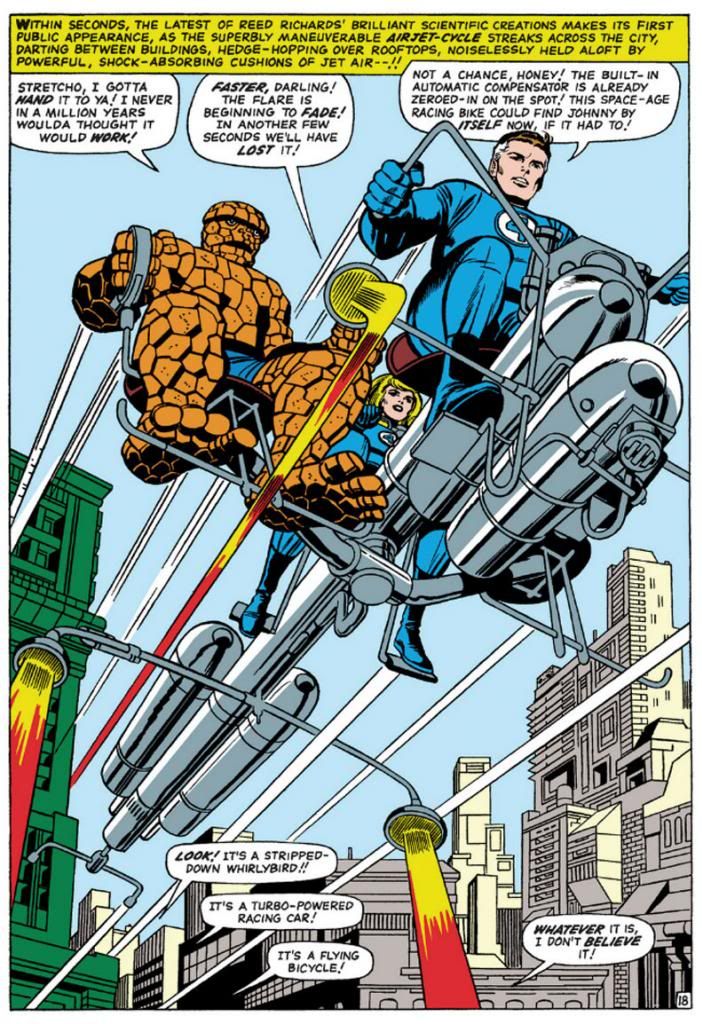
Fantastic Four #45 (December 1965),  words by Lee, inks by Joe Sinnott

The Airjet-Cycle.  This one has neat nozzles and tanks, but it's mostly just pipes and doesn't really look capable of lifting Reed alone, much less Ben and Sue as well.  Not the most practical of earthly designs, although it looks like something NASA might have considered for lunar mobility.  Leaves the passengers kind of exposed and vulnerable, too-- I love the look of sheer embarrassment on the Thing's ever-lovin', blue-eyed face as he holds on for his very life.   The Airjet-Cycle probably comes in handy for jetting to the supermarket, or getting little Franklin to school when he misses the bus.  Not as spectacular as either the Fantasti-Car or the Pogo Plane, the Airjet-Cycle nevertheless makes further appearances in Fantastic Four #46 (January 1966), #48 (March 1966) and #57 (December 1966), to name three.  The Avengers also use a version.  You can look it up.  I did!

And now--
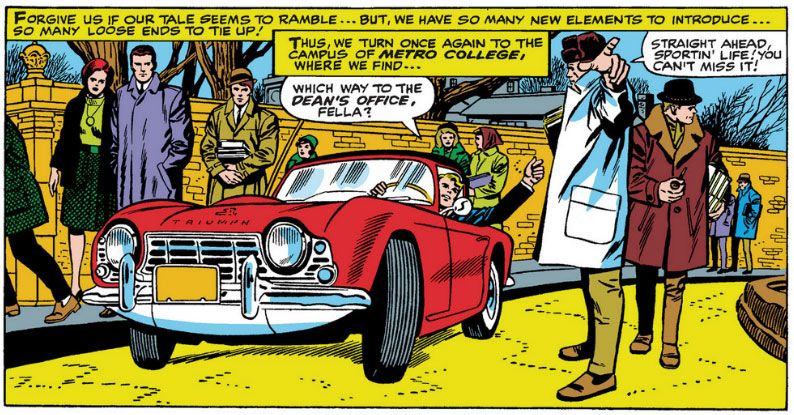
Fantastic Four #50 (May 1966), words by Lee, inks by Sinnott

Oops!  A ringer!  Don't ever think Jack Kirby couldn't bring things down to earth (relatively speaking-- Johnny's got one unearthly ride there) and draw realistic cars.  This one reminds me of the classic 1967 film The Graduate, directed by Mike Nichols.  Dustin Hoffman actually drives a 1966 Alfa Romeo Spider 1600 "Duetto" in that movie, but Johnny Storm here has a 1966 Triumph GT6.  Yeah, a Spitfire might have been more appropriate for the Human Torch, but Triumph introduced the GT6 the year Marvel published Fantastic Four #50 (May 1966), so leave it to Johnny to pick up the latest thing in sports cars.  Maybe he's auditioning for a part in The Undergraduate.

Let's leave behind the fast and the furious for the slow and reliable--
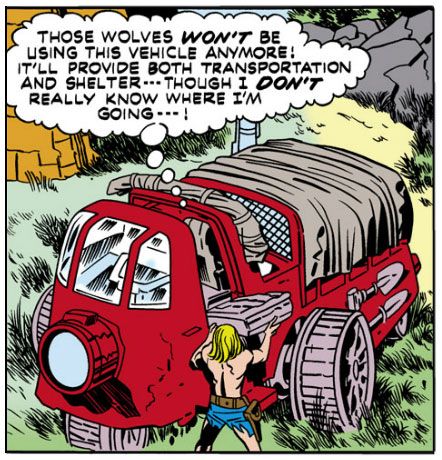
Kamandi #1 (November 1972), words by Jack Kirby, inks by Mike Royer

We're also ditching one comic company for another.  Just as Kirby and family left New York for California and Marvel for DC, in the first issue of his eponymous book (November 1972), Kamandi leaves his bunker home in this utilitarian military contraption with a very interesting outboard wheel arrangement.  They're heavy duty wheels, too.  Probably made of some kind of metal or composite alloy for years of wear.  Shovels clamped to the side, weatherproof tarp over the back.  This is a very appropriate get-about for Kamandi, and just the kind of thing you'd expect to find at a former military outpost.

Even after the Great Disaster, off-roading offers thrills and spectacle.  Witness--
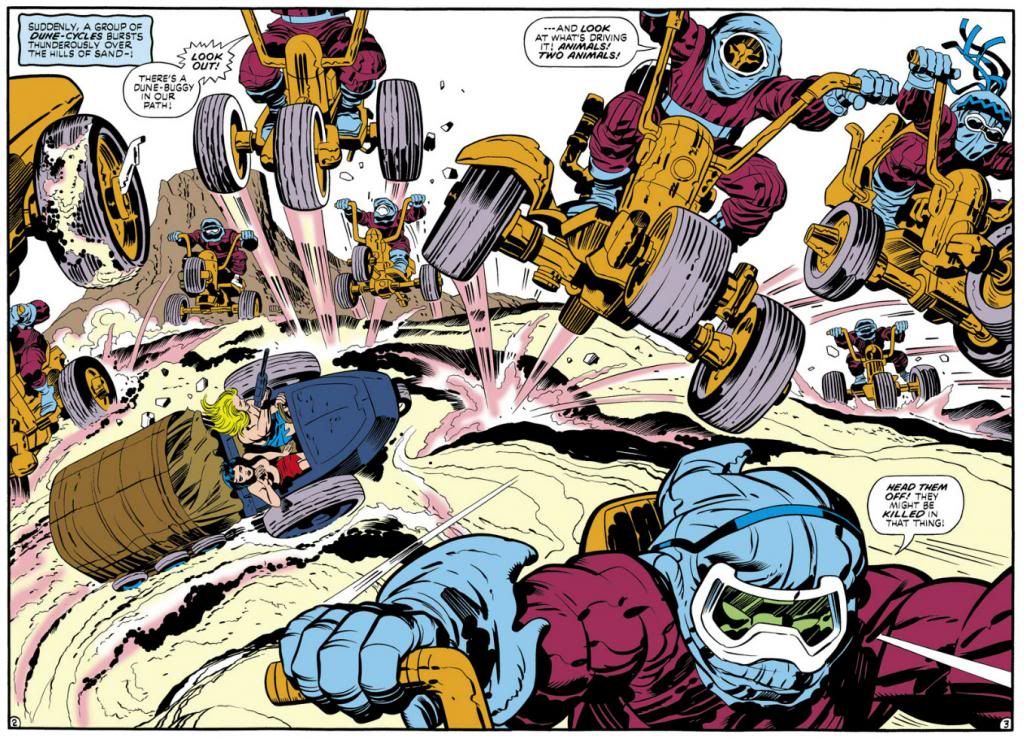
Kamandi #6 (June 1973), words by Kirby, inks by Royer

As you can see, Kirby anticipated the ATV craze.  For a while there in south Georgia, you couldn't take a drive without a three- or four-wheeler loaded with people in camouflage barreling out in front of your car from a side road or a trailer park entrance.  In fact, you still can't.  They're a menace, I tell you, and in this panel from Kamandi #6 (June 1973), you can see why.  Kamandi and his tragic girlfriend Flower have found yet another hard-working cargo carrier to explore the world, but suddenly they're capsized by a gang of three-wheeling lions!  They're huge, too.  Look how they dwarf Kamandi and Flower in their little cart.  These hot-doggin' felines think they own the dunes.  They're wrong.

Because there's one vehicle that's gonna shut 'em down, just like that little Cobra from a long ago Rip Chords song--
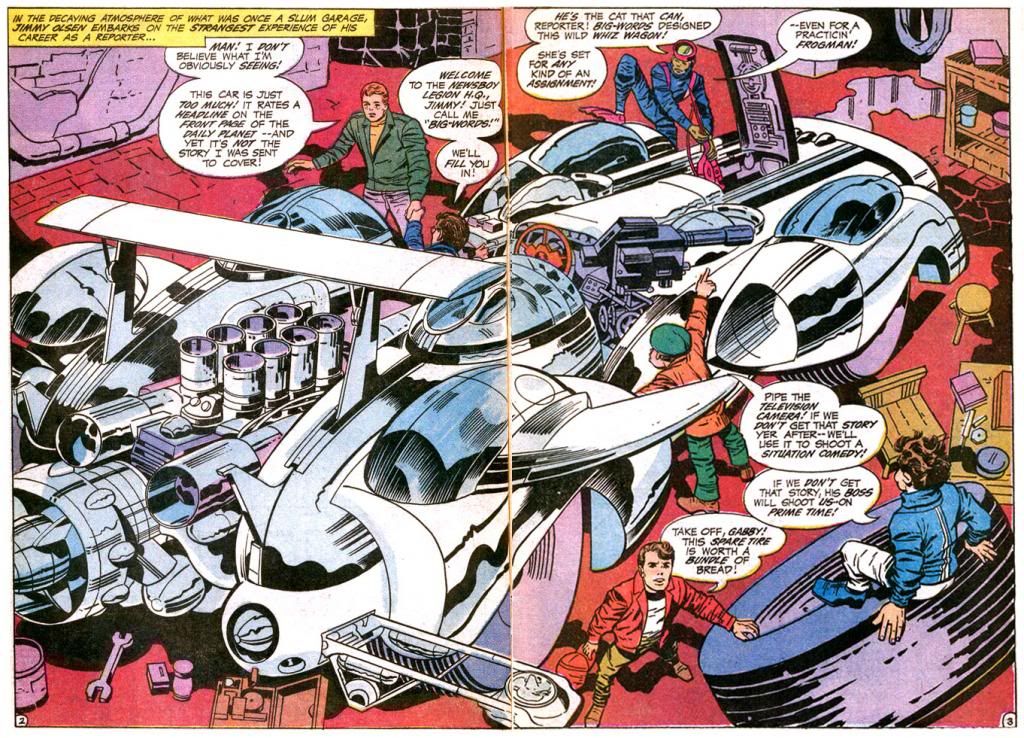
Jimmy Olsen #133 (October 1970), words by Kirby, inks by Vince Colletta

The best is last, but not for long!  In this spectacular image from Superman's Pal, Jimmy Olsen #133 (October 1970), we first greet the Whiz Wagon, custom-built by the Newsboy Legion just in time to explore the Wild Area with a certain cub reporter.  Or photographer.  Whatever the hell job it was Olsen did when he wasn't driving Perry White to distraction.  Look at the rear spoiler and those crazy intake pipes.  Is that a hint of a jet turbine beneath them?  Looking like the love child of the second Fantasti-Car and Speed Racer's fabulous Mach 5 by way of a maternity ward in the deepest, darkest, most top secret ward of Area 51, there's almost nothing the Whiz Wagon can't do.  The Newsboy Legion uses it to roar down the highway, chase after the Mountain of Judgment with the Hairies from the Habitat, fly, even travel underwater.  This is the ultimate in Kirby vehicle design. 

The Whiz Wagon by itself is an amazing visual, but Kirby doesn't simply fill two pages with a car and call it a day.  He loads this spread with details to help you believe in this phantasmagorical creation.  There's the spare tire with Newsboy Gabby perched on it (where do they buy those?), Flipper-Dipper and the forward cargo-hatch, plus tools galore and even some kind of liquid draining away in the background.  Hydraulic fluid?  Oil?  Tears from other artists who saw this and realized they'd never create anything even half so cool?

Tuesday, October 29, 2013

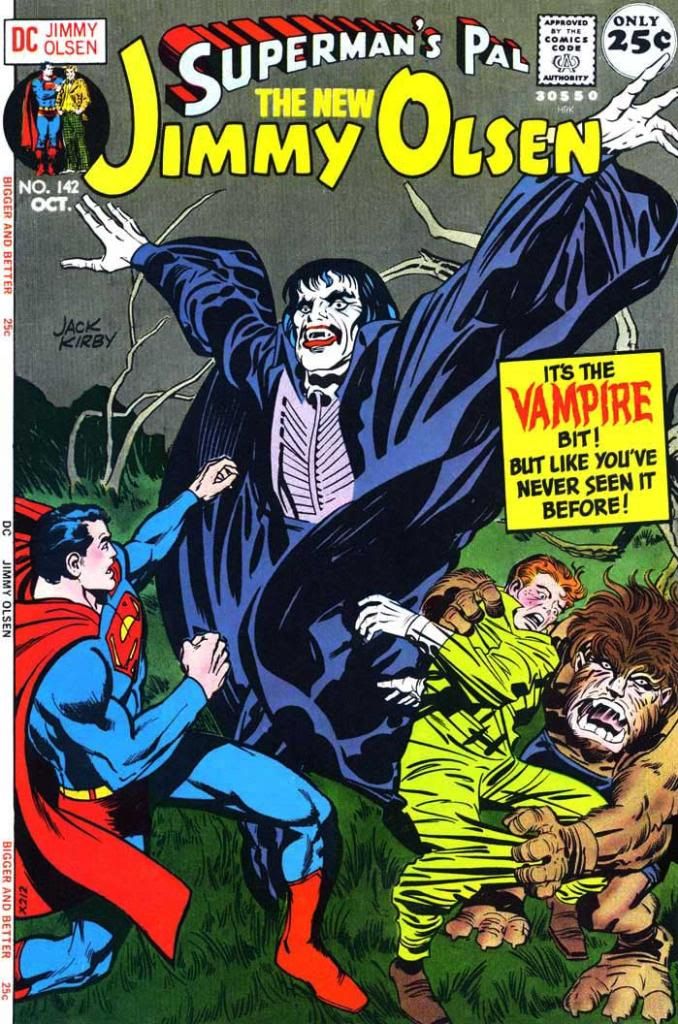
October is Spookey Month: Jack Kirby pits Jimmy Olsen and his pal, Superman, against a vampire. The winner? Anyone who reads it!

Jack Kirby drew comics in just about every genre.  Which is a pretty conservative way of putting it when you consider he actually invented or co-invented some of them.  As a Kirby fanatic, I wanted to link him to my annual Halloween celebration here, and rather than talk about Spirit World (Kirby does the paranormal) or some of his straight-up horror work (you can find it scattered about in various reprints, Archives, Essentials and Showcases and IDW's Haunted Horror), I have decided to once again explore his early-70s DC years.  We love those book here.

In Superman's Pal Jimmy Olsen #142 and #143 (October-November 1971), Kirby gives the then-corny vampire routine a science-fiction/superhero twist.  Nowadays we have scary vampires again, and romantic, sparkling vampires and vampires that fight werewolves with Matrix-style kung-fu, but when Kirby wrote this story, movie vampires were pretty much still tuxedo-wearing noblemen and the occasional lesbian baroness in a Victorian-style negligee.  Comics in particular had worn out the theme, despite years of a Comics Code ban on vampires.  Once EC had modern-day vampires put taps in their victims' necks and Warren saw an old school county-style vampire take a spaceship to a planet of perpetual night, the concept had been stretched past recognition, like Dick Tracy's face imprinted on Silly Putty (I used to love distorting that guy). The only things left were parody and deconstruction.  Kirby's story tends towards the latter, although the self-aware cover copy hints at the former.

That's as close to tongue-in-cheek as this story gets.  The rest of it is as sincere as Linus' pumpkin patch in It's the Great Pumpkin, Charlie Brown.  Kirby expends a lot of energy here trying to make readers buy this concept and he's not playing around or being cutesy.


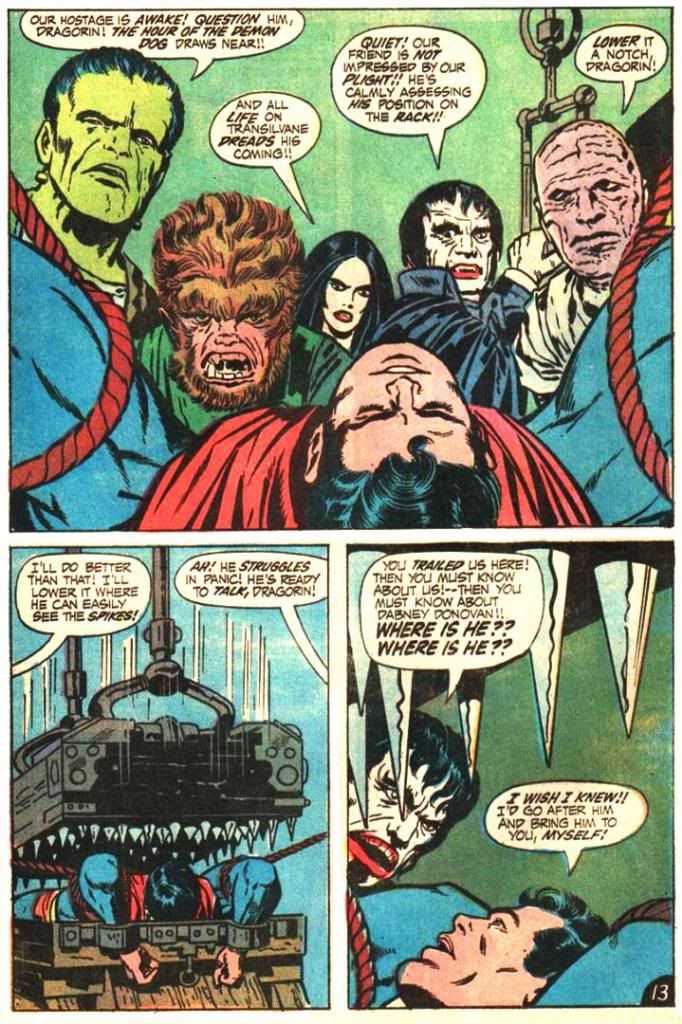
Count Dragorin, the man from Transilvane, does everything you've come to expect from a vampire, up to and including having a werewolf as a best friend.  Kirby wastes no time kickstarting the plot as Dragorin and his beastly companion slip into the city one night and put the bite on a sleeping receptionist by the name of Laura Conway.  Kirby's updated answer to the age-old vampiric transformation scene is to have Dragorin accomplish this via some kind of twin yellow power emanations from his eyes.  They leave the tradition double bite mark on the receptionist's neck and "change her body chemistry."  Within a couple of pages we have Clark Kent and Jimmy Olsen fighting Dragorin for Laura Conway's soul-- or at least her free will-- right there in broad daylight inside the GBS (Galaxy Broadcasting System) offices.  Dragorin is after a former NASA scientist named Dabney Donovan, and Conway was once Donovan's personal secretary.  Intercut with this is a subplot with the Newsboy Legion trying to escape from the Cadmus Project (they're not prisoners; their fathers work there and they're just up to their usual independent-minded mischief), so these are some really busy issues.


When Superman and Jimmy Olsen track down the scientist's lab (beneath a mausoleum in the pleasantly-named Bloodmoor Cemetery), they find they're not dealing only with a vampire and werewolf couple.  There are all kinds of familiar creatures.  So what does Kirby do to explain these Space Age vampires, werewolves and the like within the science fiction setting?  Well, it turns out Dragorin and company are microscopic aliens from an artificial planet.  That floats inside a room that looks like a creepy castle set where James Whale would have put Boris Karloff through his paces, or Todd Browning would have put Bela Lugosi through his.  And if that wasn't enough, the aliens on that world have developed a society based on old horror movies as well thanks to the bizarre experiments of Dr. Donovan, who must be a real piece of work himself.

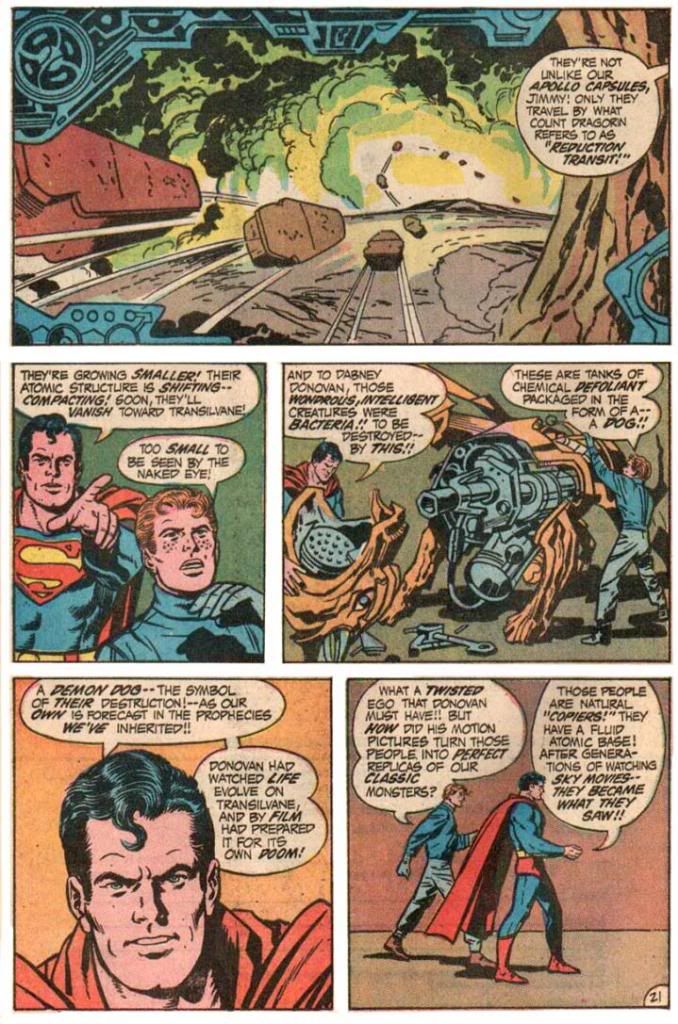
For some reason known but to himself (and, I think, NASA), Donovan didn't just make a world.  He also chose those horror movies from his vast personal collection of films and projected them into its clouds.  The sentient life there turns out to have remarkable adaptive and imitative properties, kind of like those gangster guys and the Nazis the Star Trek crew dealt with on their old TV show.  Some of the people there turned into vampires, some into Frankenstein's monsters and others into mummies and werewolves.  They travel from their planet to ours by riding inside coffins that grow or shrink depending on which way they're transiting.


Kirby doesn't really bother to explain Donovan's scientific motivation.  After all, what could he have hoped to gain from such an experiment?  Certainly if he had published his results, the idea that we as a species could create an entire miniature world full of intelligent, evolving life, would result in a philosophical or even a religious sea change.  But Donovan seems to have added these rather baroque flourishes for his own personal enjoyment, and then to destroy via a robotic dog filled with a chemical defoliant.


The horror and science fiction aspects create a dissonance that's fun but, like Frankenstein's monster, reveal some of the stitching Jack Kirby did to make the story work.  Because Kirby's trying to assemble this creature in a way that gives it life and makes sense, some of the details are a bit too on-the-nose-- the space coffins compared to the Apollo re-entry process, for example-- while others remain shadowy, as if they're inexplicable.  Why did Donovan use old horror movies in the first place?  And we not only never meet the nutty scientist who did this, but he never receives a comeuppance for what amounts to attempted genocide.

I love that after all this oversized craziness-- even if it's also about miniature creatures as well-- Kirby chooses to end it on a minor note, with two pals sitting down together to watch Oklahoma!  It's just so human.  They're not even nonplussed about letting Donovan get away scot free, or having encountered human-created sentient life that could potentially affect life on earth in horrific ways, like some kind of virus escaping from a weapons lab. 

But maybe Superman is completely aware of this and downplaying it for Jimmy's sake as he renders the Transilvanians harmless in his own inimitable way.  From what I've read, writers and artists later extended the Transilvane concept and finally had Donovan make a story appearance as a full-blown villain, but a true sequel to this story would have Dragorin and friends transformed into good-natured cowboys and farm girls, and singing about a surrey with a fringe on top.

Oh, and be sure to note the Superman figure on the cover to #142.  Neal Adams re-touch.  And check out all the Al Plastino faces in the interior art.  Occasionally some Kirby comes through, but I really wish DC hadn't felt the need to do this.

Monday, September 23, 2013

Part One: The Epic Rhythm of Kirby by Gary Chapin (a guest essay!)

Note: This is a guest essay by Gary Chapin, and I am honored to run it here.  I think after you read it, you'll be as excited about Gary's ideas as I am! And here... we... go...

Part One: The Epic Rhythm of Kirby

I picked up Jack Kirby’s Fourth World Omnibus after reading Joel’s write-ups about the Kamandi sets. I would like to be able to say I was revisiting old favorites, but the truth was I had never cottoned to Kirby during my developmental collecting days. I had preferred the clean lines of Byrne and the baroque richness of Perez and Jim Starlin. The expressionistic outbursts of Kirby (and Carmine Infantino and Steve Ditko) were wasted on the feckless youth that I was.

So, lame though it was, at the age of forty-five I finally found my way into Kirby via this set collecting The New Gods, The Forever People, Mister Miracle, and Superman’s Pal, Jimmy Olsen. I’ve read through volumes one and two and part of volume three. My mind is blown.

Jack Kirby, words and pencils/Vince Coletta, inks (New Gods #2, April-May 1971)

Something different is happening here. Part of it is timeless. We call things “epic” all the time these days. If something is loud, long, and spectacular it’s an epic. The Fourth World Omnibus is intentionally and genuinely epic – sharing traits with the first epics, The Iliad and The Odyssey.

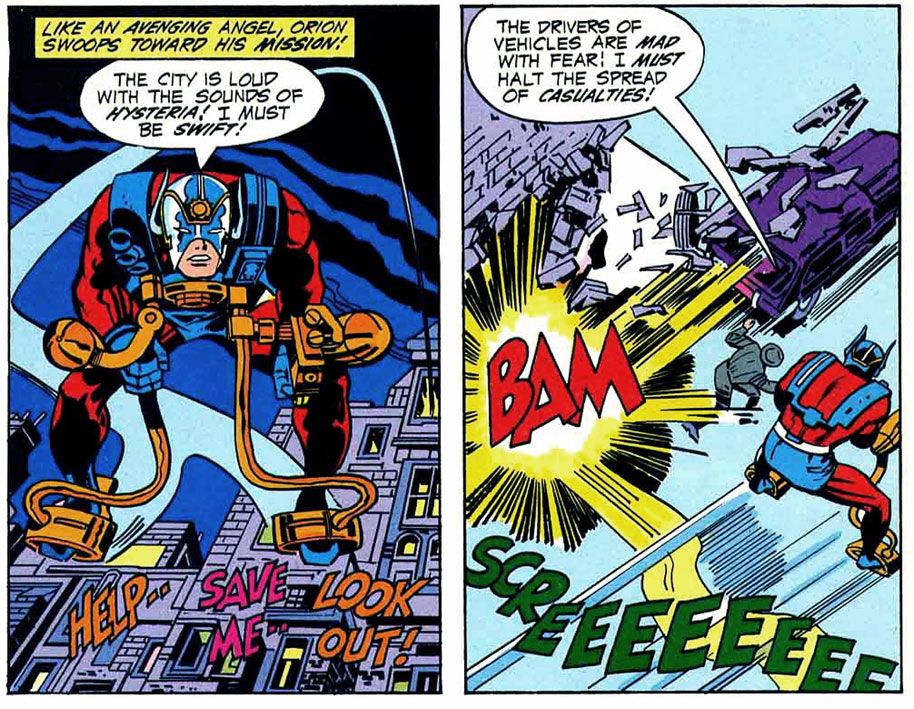
The characters are extraordinarily broad. Orion is war. Scott Free, like Odysseus, is cleverness. They have no inner life. There is no psychology going on here, no soap opera. That may seem like a criticism – “The characters have no inner life?” – but within this context, the stories and characters ring absolutely true. Just as the ancients were entranced by their own epics, these stories are completely engaging. Like, I’m falling asleep reading them because I can’t intentionally put them down to go to sleep. I haven’t liked a comic that much in years.

Other similarities to the epics? There is a complete absence of irony in Kirby’s work. It’s playful, absolutely. There’s plenty of humor. But there’s no knowing sarcasm, world-weary snarking, or irony. Also, the geography of these books is mythologically general. We find out at some point that the New Gods stories are taking place in Metropolis, but throughout, it’s simply referred to as “the city.” Which city? I don’t know, reader, could it be your city.

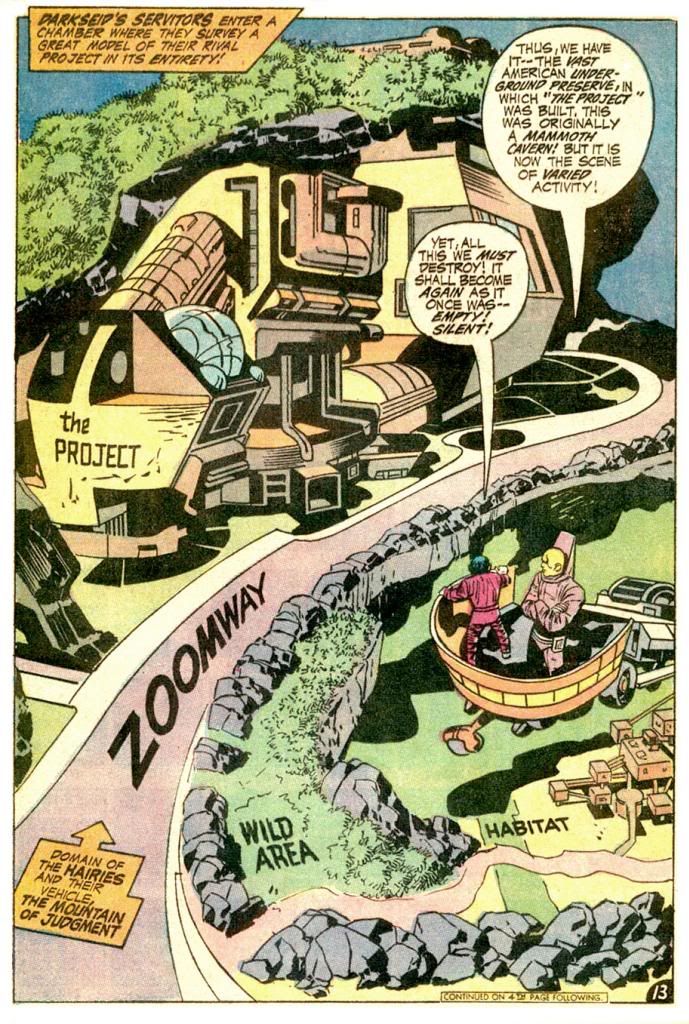
The Jimmy Olsen stories take place in a cavern underneath Metropolis that is so large that it has a number of distinct regions (the Wild Area, the Habitat), and a highway (the Zoomway) so lengthy that an RV the size of an apartment block can drive the highway perpetually. That sounds like something out of Paul Bunyon stories. The writers of the epics knew about the rule of cool, and so did Kirby.

Jack Kirby, words and pencils/Vince Coletta, inks (Superman's Pal, Jimmy Olsen #136, March 1971)

But they weren’t writers; they were singers, and here’s where I’m going to go out on a limb about Jack Kirby. His work has rhythm. His lines, more than any artist I know, create the illusion of motion, and that motion – within a panel, from panel to panel, page to page – drags you along like a great dance tune, or an extravagant opera, or an epic being sung by a blind poet – a blind, maybe heavy metal poet.

And it is the lines that carry the rhythm for Kirby. It isn’t the events of the story, or the pace of his plots. It’s the drawings themselves. The Fourth World stories, really, are relentlessly violent. Kirby loves his fight scenes, and so do we. His characters are a troupe executing a very distinct choreography.

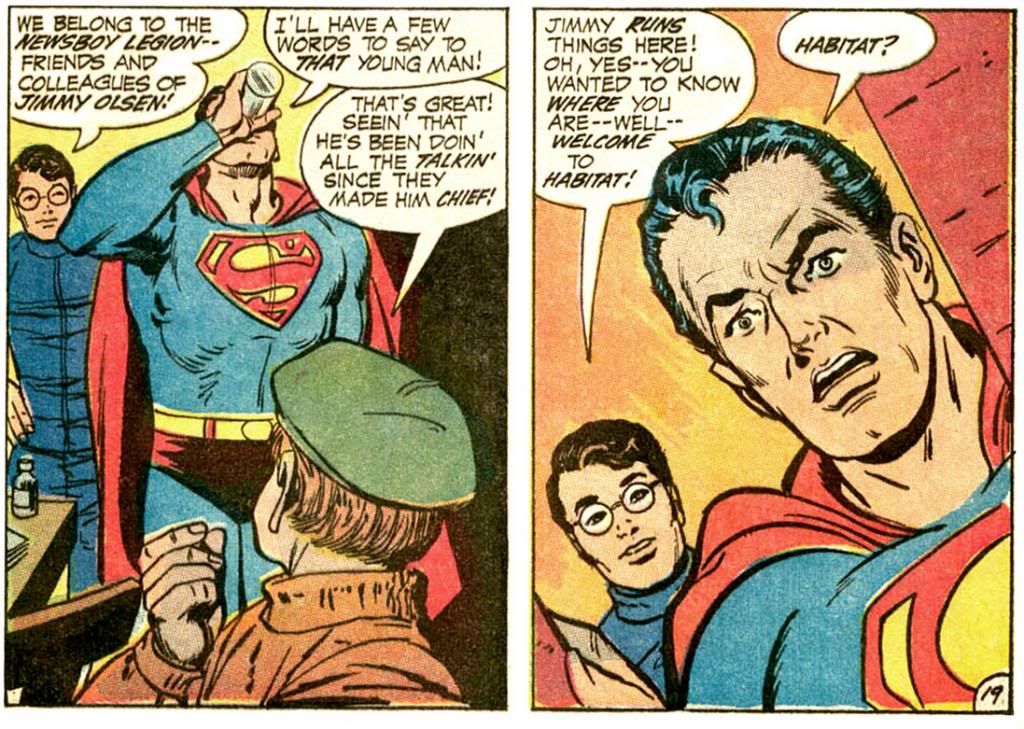
You can witness the truth of it when the rhythms of his lines are interrupted. In the Jimmy Olsen stories, DC had another artist re-draw the face of Superman over Kirby’s pencils so that this Superman would match the “typical” DC-brand Superman. It throws off the entire panel! It inserts a bland and lifeless and boring (in a Kirby work!) element into something wild and spectacular; a dollop of oatmeal in the middle of a bowl of kick-ass curry. Look at the un-inked pages, included as an appendix in volume 2. The Superman panels take on a new life. The Superman content suddenly makes sense in the Kirby context.

Jack Kirby, words and pencils/Vince Coletta, inks (Superman's Pal, Jimmy Olsen #133, October 1970)

Kirby’s epic rhythm became even more vibrant when Mike Royer took over inks from the indifferent Vince Colletta. Is this akin, maybe, to production value? As I move through the third volume I am drawn further and further into this story in which, when the Gods finally come to Earth, it’s a complete disaster. I’m drawn by the events, by the writing, the characters, the amazing well-spring of ideas – something new every issue – but I’m mostly drawn in by Kirby’s lines and their rhythm.

Part Two is here!

Gary Chapin usually blogs about French accordion music over at www.accordeonaire.blogspot.com.

Saturday, June 15, 2013

Lois Lane is tough and smart... and completely amoral

We've talked about what a gutsy woman reporter Lois Lane is.  She takes no guff but freely gives it because she's hardcore.  She's also incredibly intelligent, able to see through complex ruses like a Sherlock Holmes in a luscious, backless red evening dress.  Where can we find a prime example of just how brainy a person she is?  Why, look no further than Action Comics #6 (November 1938), a fast-paced tale by Superman creators Jerry Siegel and Joe Shuster along with inker Leo O'Mealia.

It all starts one day at the Daily Star (yes, the Star, not the Planet-- and the nameless editor is definitely not his graying eminence Perry White, but a much younger brown-haired man), where Clark Kent, the "meek ace" reporter meets Nick Williams, who bills himself as Superman's personal manager.  This comes as a shock to Kent, because he's secretly Superman.  Then Kent receives another shock-- Williams is using Superman's good name to make money!  Suddenly there's a Superman radio show, a Superman brand gasoline and even a Superman automobile, plus.any number of other shoddy products bearing the familiar S-logo, all illegally licensed by Williams.  Most alarmingly, Williams openly threatens the world with what he claims is a deal for comic book appearances (and movies based on them, no doubt).  Kent quickly arranges a meeting with Williams's client Superman, but he doesn't count on Lois Lane, who soon finds out about it and makes a plan of her own.

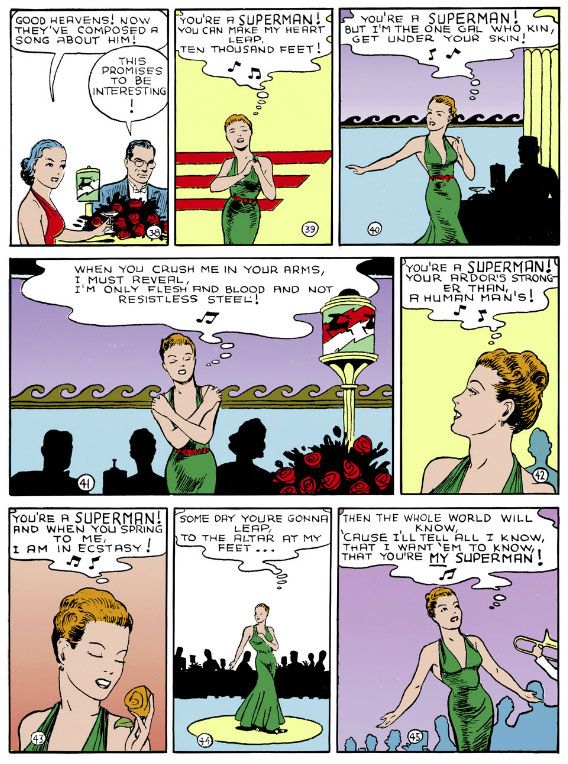
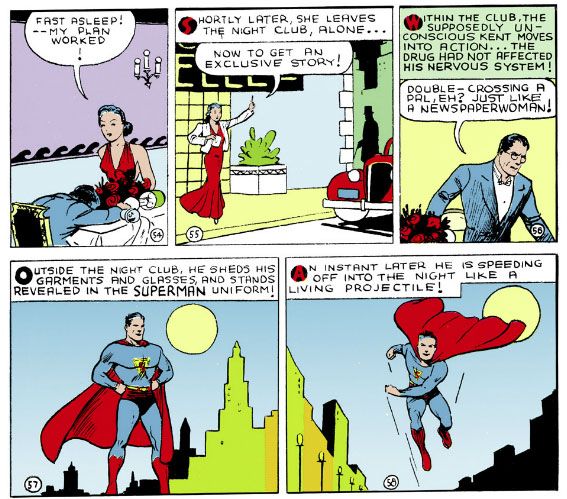
The first step involves allowing Kent to take her on a date to what we're told is a "famous night spot," so hoity-toity Kent has to wear a top hat.  It's in the rarefied atmosphere of big city nightlife among the elite they witness this spectacle:


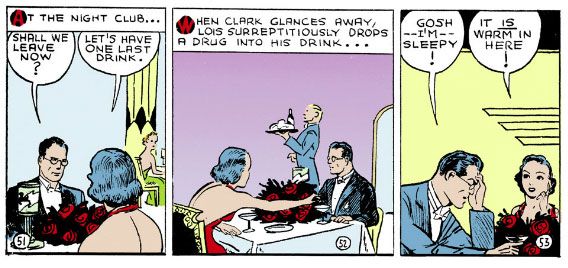
The second step involves this:


Yes, you just witnessed Lois Lane slip Clark Kent a mickey finn.  She doesn't even know his body weight or what other medications he might be taking (both Marilyn Monroe and Anna Nichole Smith had chloral hydrate, the traditional "knock out" drug, among others in their systems when they died and it was a component of the lethal Kool-Aid at Jonestown; Lane would have been familiar with chloral hydrate from her police reportage even in the 1930s), so there's a small but very real chance she's killed him with an accidental overdose.


Of course Superman is just pretending.  The drug doesn't work on his alien physiology (not that Lois knows this-- she's completely unconcerned she might succeed in her plan and still wind up facing a murder rap).  While Superman's understandably miffed at having been drugged, that's no excuse for his sexist generalization.  Unless in the 1930s all newspaper women actually did go around drugging their dates for reasons of professional gain and personal curiosity.  If so, this was a dark era in American journalism.

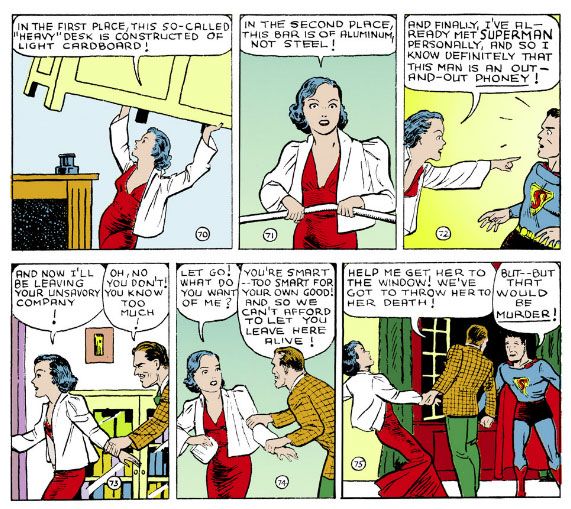
Once she meets Williams and his ersatz Superman, it takes Lois Lane about two seconds to see through their lies.  This woman is not only scary, she's scary-smart.


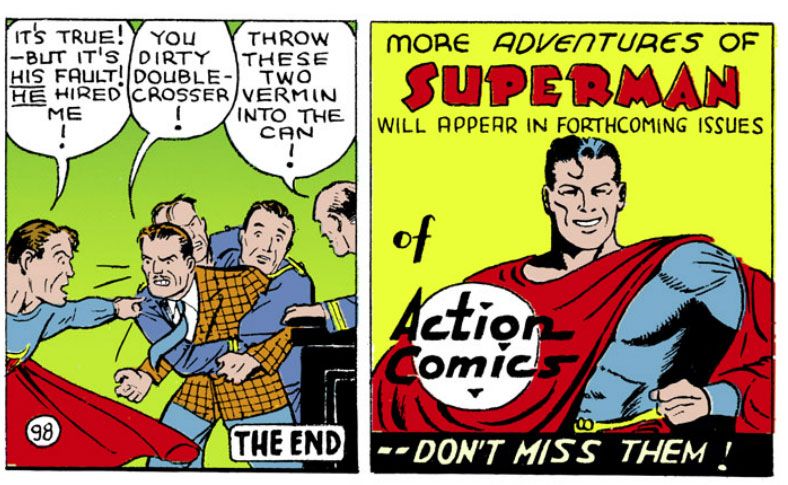
As unscrupulous as Lois is, Williams outdoes her with his willingness to commit outright murder.  She lacks morals, he's actively immoral.  Not for him Lois Lane's involuntary manslaughter.  She threatens his finances, so out the window she goes.  Well, we all know how this ends.  Not with Lois Lane pulped on the sidewalk, but with her safely enfolded in Superman's mighty arms.  And he treats her sneeringly.

Hmm.  I'm starting to believe it's not just Lois.  Despite its bright primary and secondary colors, Superman's world is in fact a noirish cesspool full of desperate, hateful people who would be right at home among the compromised denizens of James Ellroy's behaviorally miasmic Los Angeles.  It seems no one is to be trusted and everyone possesses suspect motives and moral relativism.  But that can't be true, right?  These are adults.  What of the young?  Can we look to them to restore our belief in humanity's basic goodness?  Let's go back to the story's beginning and find out.


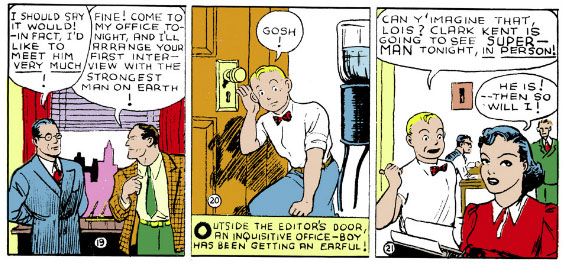
Office boy Jimmy Olsen!*  You eavesdropping imp!  Behavior no doubt learned from his elders.  But these are reporters and con artists, society's lowest echelon, of like kind right down there with pirates and mimes.  What of its highest, our legal authorities?  Surely writer Siegel will portray them in a positive light and balance out all these depressingly sordid people.  As paragons of virtue, protectors of our mores and the angels of our better nature.  This was the Golden Age, a time where we placed unwavering trust in a government that so recently assured us the only thing we had to fear was fear itself and our adventure comics told simplistic tales of the stark dichotomy between good and evil...


*Comixology and a few other sources list Action Comics #6 as Olsen's first appearance, but as far as I can tell this little spying bastard is as nameless as the paper's editor.  Factor in his blonde hair, and he's more like Jammy Olson or Jackie Olaff than the more familiar cub reporter of Superman legend.  This punk isn't even wearing a checked jacket.  And he has a disturbingly infantile face.  I conclude this isn't Jimmy Olsen at all, just a prototype character used to get Lois into the story, then discarded.