First we're going to talk about 1981's Dragonslayer and the Marie Severin-illustrated comic book based on it, and then I'm going to tell you why I'm including Eddie Deezen (who had nothing to do with the making of either) in this sentence.
Dragonslayer is, I suppose, a cult favorite these days. Maybe it was a little too obvious the spawn of Star Wars (naïve young man on a hero's quest, spunky love interest, old mentor, pre-dating George Lucas but owned by him after May 1977) ever to strike box office riches. But ten of us like it. We don't have any cultish rites as yet, but we're working all that out at our monthly meetings that always take place at the stroke of midnight during the new moon period.
Dragonslayer has so many wonderful qualities, it's long overdue for nostalgia-hungry Internet people to brave its shadowy, flame-scorched lair and bring it forth into the dawn of its new age of popularity. There are winning performances from Peter MacNicol (later one of the best things about Ghostbusters 2, and an absolute riot as an enthusiastically boneheaded camp counselor in Addams Family Values), Caitlin Clarke and, in the role of wise wizard, Sir Ralph Richardson (doing that Obi-Wan thing Star Wars made a requirement of older British actors in the 70s and 80s). It has a powerful score by Alex North (a movie music master who also scored Stanley Kubrick's Spartacus and worked on the director's 2001: A Space Odyssey before Kubrick decided to use classical pieces). Not the least among all these estimable qualities is its dragon, the mighty Vermithrax Pejorative, brought to fierce, fiery life by Phil Tippett and a lot of talented special effects geniuses at ILM through the magic of their "go motion" process and some full-sized body parts. Vermithrax Pejorative is the movie dragon by which all others must be judged and found wanting.
The story takes place in the Dark Ages (which weren't really as dark as modern myth makes out; we prefer to call those days the early Middle Ages). A kid named Galen is a sorcerer's apprentice and Urland, a nearby kingdom, has a nasty dragon infestation consisting of our friend Vermithrax and her babies. The king there has instituted a lottery whereby they randomly choose a maiden to dress like a bride and feed the dragon. As in, the dragon feeds on her. A deputation from Urland comes to visit Galen's boss, the renowned wizard Ulrich. A mouthy boy Valerian in the party turns out to be a spunky girl in disguise and it's not long before she and Galen are making goo-goo eyes at each other. Eventually, the youngsters have to confront Vermithrax and put an end to the death and destruction even if it means also eliminating the last vestiges of magic and fun in the world.
Let's wait for a minute or two while pop culture rights itself and this movie gets the acclaim it deserves. There. Now Dragonslayer has ascended to its rightful place as one of the great films.
After striking riches Jed Clampett-style with its Star Wars adaptation, Marvel wasn't about to let any other comic company join in the fun and profit so they started licensing practically every sci-fi or fantasy movie out there and releasing them in deluxe magazine format they called the Marvel Super Special. The bigger, prettier print jobs favored instant classics like my beloved Close Encounters of the Third Kind and the lushly beautiful Archie Goodwin-Al Williamson adaptation of The Empire Strikes Back.
This also led to some really strange and wonderful comic freakshows like Marvel Super Special #17: Xanadu, the Illustrated Story. Imagine that-- a whimsical Olivia Newton-John musical as a comic book! I guess having missed out on the Grease lucre really burned Marvel's collective bums. Too bad Xanadu became a notorious flop as a film and an oddity of a comic book.
Dragonslayer, on the other claw (whoa, steady there, boy, don't get too stupid too fast), was a natural choice to make into a comic. For one thing, it has few, if any, song and dance numbers to translate into pen and ink and scattered prose. And for another, witness Marvel's success with fantasy properties like Conan the Barbarian, Kull the Conqueror and Red Sonja. Conan was making semi-regular appearances in Marvel Super Special and Marvel had previously devoted three whole issues to their homegrown Doug Moench fantasia Warriors of the Shadow Realm, also known as Weirdworld.
Denny O'Neil's charming script hits the proper story beats, as expected. But what O'Neil also does so well is illuminate the film's underlying themes of changing ages. He doesn't miss the subtle tragedy of both Ulrich and Vermithrax being the last of their respective kinds.
But here's the best part. Marie Severin is an absolutely inspired choice for art duties on Dragonslayer. Among her many scattered Marvel art jobs penciling and inking characters like Namor and Spider-Man, Severin had already provided interiors for Marvel's Kull comics, and covers for that series and Conan the Barbarian. Strong prep for Dragonslayer.
This art is pure joy. Maybe it's due to her humor comics background, but Marie Severin absolutely aces the "acting," which I find many artists ignore or else botch completely. In comics, true masters of acting are rare. Comic book artists tend to pose their characters in weird, inhuman ways with every muscle tensed rather than develop unique body language. And blank expressions when nothing much is happening, or downcast eyes when characters feel sad, or clenched teeth with neck tendons and veins bulging to the point of bursting for every other emotion. Big, simplistic takes on big, simplistic feelings. There are action scenes and plenty of screams and curses in Dragonslayer, but there are also a lot of moments where quirky people simply talk to each other. If the characters turn into blank-faced nothings seemingly reproduced from clothing store mannequins, readers miss out on the mood and character personalities. An artist is responsible for this stuff, too, not just the punches and kicks.
On Dragonslayer, Severin takes time to draw individual expressions and well-observed poses for every character on the page and really brings them to life. Especially vivid is the unearned cockiness Galen displays right before the king tosses him in a dungeon as a big phony. But even the kids Galen entertains at a celebration each have unique facial expressions that tell us what they're thinking and enrich the moment. Some are delighted, some are a bit more dubious. Are they important? Maybe not, but Severin apparently felt it was necessary to go above and beyond, and I applaud.
She also does a lot to build the world these people inhabit. Aided by some ornate inking by John Tartaglione, Severin packs the pages with images that recreate in two dimensions the film's funky, lived-in production design. Dragonslayer's Dark-- er-- early Middle Ages were not those of fairy tale or chivalrous legend, despite the scaly menace of Vermithrax and the magical story elements. It's more like the one from Monty Python and the Holy Grail: dirty and smoky, with tumble-down castles falling to ruin. Especially spectacular are the pages inside Vermithrax's lair-- Severin colored the book as well, and the lighting effects she manages on these pages raise the room temperature. You can almost feel the heat and smell the stink of burning oil and sulphur.
The only flaw in her storytelling is she tends to minimize Vermithrax. We get one massive head as the dragon glares at Galen but for the most part Severin confines the great beast to smaller panels. A full-page panel of Vermithrax in flight, spewing flame, would have been perfection. As if to make up for that, Severin and Tartaglione do a knock out job on Vermithrax's baby dragons. Valerian calls them basilisks, but I prefer the term kittens. Dragon young should be called kittens. The artists render the dragon kittens in loving close up so we get to see every bump and scale.
Anyway, it's a good looking book. The Earl Norem triptych cover pretty much sums up the magic that is Dragonslayer. Maybe if they'd used it as the movie's one sheet it might have fared better at the box office. Or not. Such visual riches shouldn't be hoarded and hidden away by dragons-- it needs a reprinting at once. Casiordorus Rex demandeth it! Snap to it, people! Chop chop and lickety-split! Handle it, Roy, handle it! Handle it! As long as there isn't a joyless, rote, CGI-heavy remake with Sam Worthington as Galen and Megan Fox as Valerian. Or some CW Network refugees. There's no way some sullen-faced former underwear models could compete with the charms of MacNicol and Clarke.
Okay, back to Eddie Deezen. Dragonslayer director Matthew Robbins also directed 1978's Corvette Summer, the movie where Mark Hamill builds a custom Corvette Stingray only to lose it to a sleazy auto shop owner/car theft ringleader played by Kim Milford, who essayed lead schlub Billy Duncan in Laserblast, a low-budget sci-fi revenge flick (mocked impressively by Mystery Science Theater 3000 at the end of its seventh season). Laserblast is where Eddie Deezen made his film debut.
Marvel Super Special #4 The Beatles Story is a comic book biography of those four lads from Liverpool. Eddie Deezen knows more about the Beatles than you and I put together ever will. Eddie Deezen turned down a role in the Bill Murray-starring hit Meatballs for a part in the John Belushi-and-Dan Akyroyd-starring flop 1941. Eddie Deezen voiced Mandark on Dexter's Laboratory.
The Beatles, Marvel Comics, Laserblast, Corvette Summer, Dragonslayer, Dexter's Laboratory: they all come around in the end to Eddie Deezen. We like Eddie Deezen as much as we like Marie Severin.
Showing posts with label Denny O'Neil. Show all posts
Wednesday, December 4, 2013
Tuesday, March 5, 2013
On Jerry Ordway...
I'm sure a lot of comic fans and professional comic book mouths (like me, only smarter and with connections) have already seized on Jerry Ordway's recent blog essay about being over fifty and under-employed in comics. Shocking. A talent of his stature. The state of comics today. Give this man work, DC. All of that. Which I happen to agree with. Ordway is too damned talented and capable not to be drawing a book, especially when the company he's most associated with puts out 52 of the rascals every month. Fifty-two comics and no room for Jerry Ordway?
Anyway, I don't want to use Ordway's essay as a starting point for slamming DC or their product. I don't think he'd appreciate that, and as he wrote later, that's actually not what he was trying to express. What I want to point out is the cast of professionals who showed up in the comments. Gail Simone! Chuck Dixon! Jimmy Palmiotti! Joe Rubinstein! Mark Verheiden! Michael Manley! Graham Nolan! Others!
The part that feels directed at me personally-- as a buyer of collected editions and archival hardcovers-- is where Ordway discusses how little he gets paid for those things. That's very upsetting. One reason I spend money on them is to support financially old school artists whose work I enjoy and the style of comic art and writing I love best. I'm talking mostly superheroes. That's not to say there isn't some good new caped stuff out there, but when I buy new comics these days they tend to be manga or small publisher books. Not from the Big Two. Their products I consume in the form of reprints.
It made me happy to buy a Showcase Presents in the hopes Nick Cardy, Denny O'Neil or Neal Adams got a cut. Or a New Mutants Classic for the sake of Bob McLeod (another underemployed pro who seems to have gone out of style). Now I'm not so sure. If Jerry Ordway and his peers are getting a pittance for their work while the publishers reap the bulk of the profits-- and bear in mind they already turned these comics into profit years ago so this is just extra gravy (and don't forget the movies coming out this summer and next and next and next that borrow liberally from these old stories and coin hundreds of millions in more profits while the people who originally dreamed up these ideas get both jack and shit)-- then I'm not sure I'm spending my comic book dollars as wisely as I'd imagined.
I think revenue sharing needs to be revisited and greater parity achieved. I'm not saying overturn the entire system, but a lot of these older pros don't have health insurance and 401K plans and the like. If companies are turning their ideas into library editions on the basis that this work has some kind of intrinsic value beyond the merely monetary-- that it is important enough to be preserved for as long as the paper lasts as if it's something by Tacitus or Suetonius-- and if they're further basing "tentpole" event movies on these works and building billion-dollar multi-media franchises, then the people whose talent made it all possible in the first place deserve a little more for their efforts. A somewhat greater share than they've been getting.
At the very least, they need the opportunity to do more work for these companies, if after all of that, this is where their hearts remain. I mean, fifty-two books and most of them are being cancelled left and right anyway. You could hardly do worse than to get someone like Jerry Ordway to draw for you again. Actually, let me rephrase that-- you could hardly do better. The guy's stuff still rocks. I see a lot of good artists at work for DC right now, but few of them can touch Ordway.
Anyway, I don't want to use Ordway's essay as a starting point for slamming DC or their product. I don't think he'd appreciate that, and as he wrote later, that's actually not what he was trying to express. What I want to point out is the cast of professionals who showed up in the comments. Gail Simone! Chuck Dixon! Jimmy Palmiotti! Joe Rubinstein! Mark Verheiden! Michael Manley! Graham Nolan! Others!
The part that feels directed at me personally-- as a buyer of collected editions and archival hardcovers-- is where Ordway discusses how little he gets paid for those things. That's very upsetting. One reason I spend money on them is to support financially old school artists whose work I enjoy and the style of comic art and writing I love best. I'm talking mostly superheroes. That's not to say there isn't some good new caped stuff out there, but when I buy new comics these days they tend to be manga or small publisher books. Not from the Big Two. Their products I consume in the form of reprints.
It made me happy to buy a Showcase Presents in the hopes Nick Cardy, Denny O'Neil or Neal Adams got a cut. Or a New Mutants Classic for the sake of Bob McLeod (another underemployed pro who seems to have gone out of style). Now I'm not so sure. If Jerry Ordway and his peers are getting a pittance for their work while the publishers reap the bulk of the profits-- and bear in mind they already turned these comics into profit years ago so this is just extra gravy (and don't forget the movies coming out this summer and next and next and next that borrow liberally from these old stories and coin hundreds of millions in more profits while the people who originally dreamed up these ideas get both jack and shit)-- then I'm not sure I'm spending my comic book dollars as wisely as I'd imagined.
I think revenue sharing needs to be revisited and greater parity achieved. I'm not saying overturn the entire system, but a lot of these older pros don't have health insurance and 401K plans and the like. If companies are turning their ideas into library editions on the basis that this work has some kind of intrinsic value beyond the merely monetary-- that it is important enough to be preserved for as long as the paper lasts as if it's something by Tacitus or Suetonius-- and if they're further basing "tentpole" event movies on these works and building billion-dollar multi-media franchises, then the people whose talent made it all possible in the first place deserve a little more for their efforts. A somewhat greater share than they've been getting.
At the very least, they need the opportunity to do more work for these companies, if after all of that, this is where their hearts remain. I mean, fifty-two books and most of them are being cancelled left and right anyway. You could hardly do worse than to get someone like Jerry Ordway to draw for you again. Actually, let me rephrase that-- you could hardly do better. The guy's stuff still rocks. I see a lot of good artists at work for DC right now, but few of them can touch Ordway.
Labels:
DC Comics,
Denny O'Neil,
Jerry Ordway,
Nick Cardy,
Showcase Presents
Saturday, September 15, 2012
Shazam! #25: Cindy Lee Loves Danger!
"She's magical... She's mysterious... She's magnificent-- and she's more exciting than any other super heroine! Part human, part goddess, all wonderment-- with the most unusual powers anyone ever possessed! She uses them now in a desperate race to save her friend Cindy Lee from certain doom as Andrea Thomas becomes-- ISIS... AS IN CRISIS!"
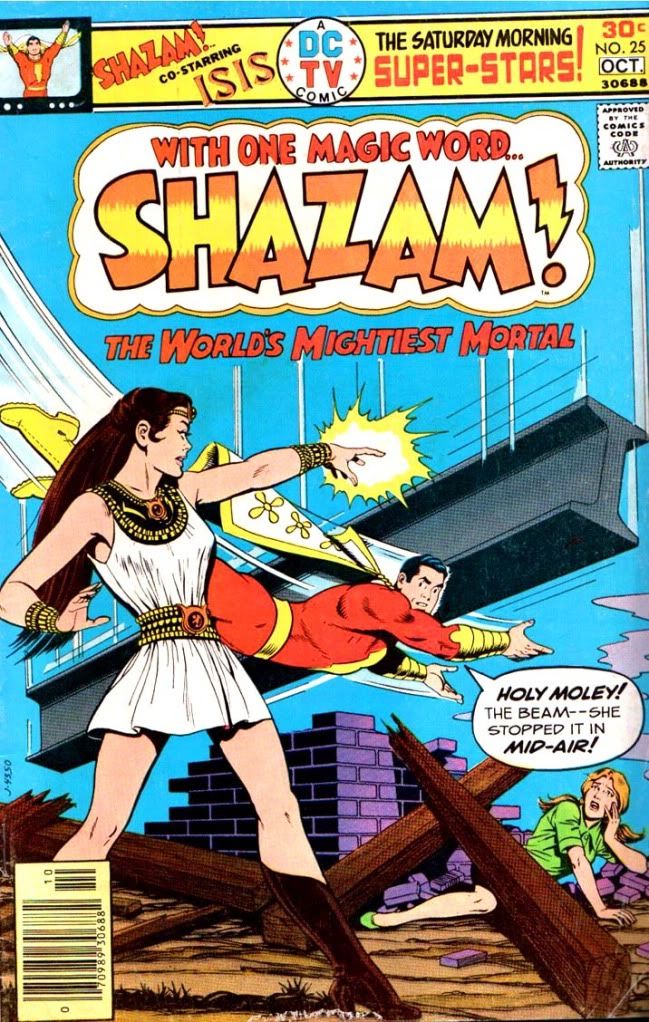
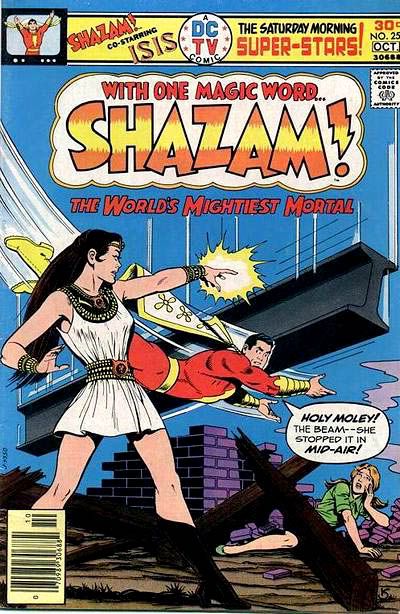
Ah, Shazam! #25 (DC Comics, September-October 1976). This is what feel-good comics are all about. It's also a breakthrough moment enshrined forever in comic book history. Why?
Because even though cover artist Kurt Schaffenberger seems to have little or no idea who she is, this book marks the sizzling debut of our favorite sidekick and teacher's pet from the CBS Saturday morning live action television show Isis (also know as The Secrets of Isis), Cindy Lee. Oh yeah, and if the introduction didn't clue you in enough, this is the first comic book appearance of Cindy's co-star Isis, too. She's okay, too. I guess. I mean, if you're interested in such things. But we know the real draw is Cindy Lee.
And what a splash she makes! Editor Julie Schwartz must have known he had something special in Cindy, because he put his varsity team on this story. It's written by Denny O'Neil, with art by none other than Dick Giordano himself. I do miss Giordano. His art in this story is just so smooth, so appealing. Rik Estrada and Wally Wood do a bang-up job on The Mighty Isis #1, but after reading this, Giordano is forever my artist pick for these characters. And I prefer O'Neil as writer. After all, O'Neil and Giordano are the team-- along with some guy you may have heard of named Neal Adams-- that brought to life some of the most influential and memorable Batman stories of all time.
O'Neil quickly and brilliantly seizes on the little-known fact that the future valedictorian and resident pyramid enthusiast of Larkspur High School (class of 1978) is a sensation-seeker. Dare you doubt me? I have proof-- in "Fool's Dare," (September 13, 1975), the second episode of Isis, Cindy enters a dangerous junkyard in answer to some hurtful words from a classmate and tangles with car thieves wearing pitted-out shirts.
Back here in the four-color world, our secret thrill-junkie was once again doing some sleuthing of her own and followed a couple of suspicious creeps right into danger's maw. She's so intrepid she'll chase them round Good Hope, and round the Norway Maelstrom, and round perdition's flames before she'll give them up... if that's what it takes to bring them to justice. Whatever it was they did. Which we don't know yet. We'll find out later, thanks to Cindy.
Ah, Shazam! #25 (DC Comics, September-October 1976). This is what feel-good comics are all about. It's also a breakthrough moment enshrined forever in comic book history. Why?
Because even though cover artist Kurt Schaffenberger seems to have little or no idea who she is, this book marks the sizzling debut of our favorite sidekick and teacher's pet from the CBS Saturday morning live action television show Isis (also know as The Secrets of Isis), Cindy Lee. Oh yeah, and if the introduction didn't clue you in enough, this is the first comic book appearance of Cindy's co-star Isis, too. She's okay, too. I guess. I mean, if you're interested in such things. But we know the real draw is Cindy Lee.
And what a splash she makes! Editor Julie Schwartz must have known he had something special in Cindy, because he put his varsity team on this story. It's written by Denny O'Neil, with art by none other than Dick Giordano himself. I do miss Giordano. His art in this story is just so smooth, so appealing. Rik Estrada and Wally Wood do a bang-up job on The Mighty Isis #1, but after reading this, Giordano is forever my artist pick for these characters. And I prefer O'Neil as writer. After all, O'Neil and Giordano are the team-- along with some guy you may have heard of named Neal Adams-- that brought to life some of the most influential and memorable Batman stories of all time.
Here's how it starts:
CINDY LEE?! OH NO! The last thing you expect to see when the wrecking ball crashes into your old high school is your star pupil in mortal danger. This is one of those moments where you can almost see O'Neil's script showing through the drawings. He has ten pages, needs Isis in action as soon as possible, so he puts Cindy Lee in harm's way. She's from the TV show, right? Stick her inside the school as it comes tumbling down, explain it later.
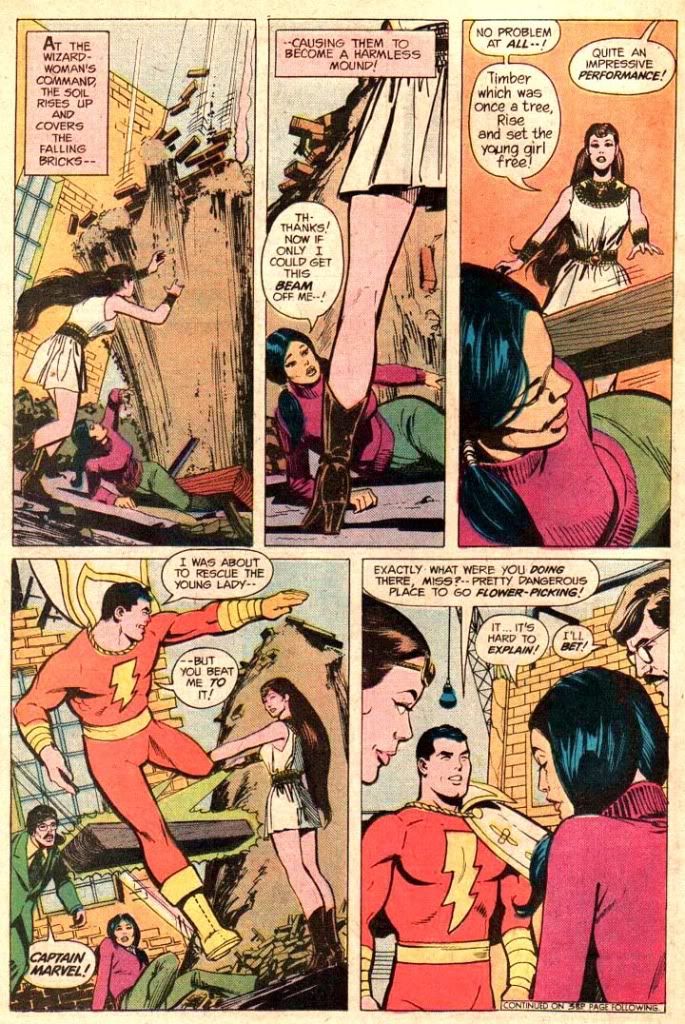
As you can see, science teacher Andrea Thomas and her colleague Rick Mason are a little concerned because they know damn well Cindy's parents didn't sign the school's special permission slip with the indemnity clause regarding any and all Cindy-related fatalities, including her own. So much for their raises for the next several years. So much for any more field trips to Egypt. So much for the computer lab. So much for art supplies.
The football stadium will still get its new scoreboard and the team its new uniforms, however. And they can't cut the head coach's pay. In fact, they can't even fire the guy without buying out his contract to the tune of four or five language, visual arts and home ec faculty members. Fortunately for the school system, Andrea Thomas has a secret power beyond that of any two or three thousand lawyers. She's the "dual person" known as Isis. A quick change and some rhyming magic...
And then this muscle-headed guy shows up all, "Uh-- er-- Well, I was about to do that, but since you already did it for me..." Nice try, Captain Marvel. You zoom in a few long moments after too late and try to make Isis feel less special. Well, he does exert his male authority figure privilege to get Cindy's explanation of why she thought it would be a good idea to hang out in a building during its demolition. And here we go...
O'Neil quickly and brilliantly seizes on the little-known fact that the future valedictorian and resident pyramid enthusiast of Larkspur High School (class of 1978) is a sensation-seeker. Dare you doubt me? I have proof-- in "Fool's Dare," (September 13, 1975), the second episode of Isis, Cindy enters a dangerous junkyard in answer to some hurtful words from a classmate and tangles with car thieves wearing pitted-out shirts.
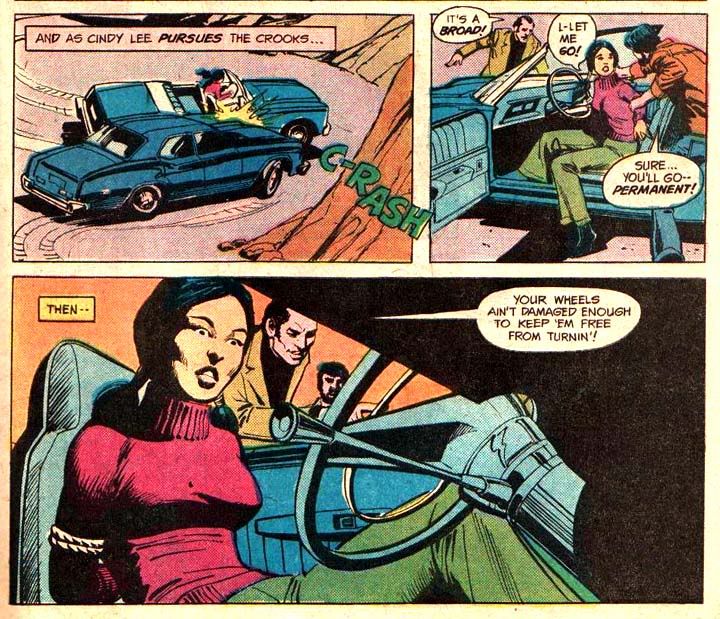
Back here in the four-color world, our secret thrill-junkie was once again doing some sleuthing of her own and followed a couple of suspicious creeps right into danger's maw. She's so intrepid she'll chase them round Good Hope, and round the Norway Maelstrom, and round perdition's flames before she'll give them up... if that's what it takes to bring them to justice. Whatever it was they did. Which we don't know yet. We'll find out later, thanks to Cindy.
There's a flashback to Isis's origin at this point in the story, too. Boring. And, his work finished, the Big Red Cheese soars away feeling self-satisfied at having patronized Isis. Back to The Simply Awesome Misadventures of Cindy Lee!
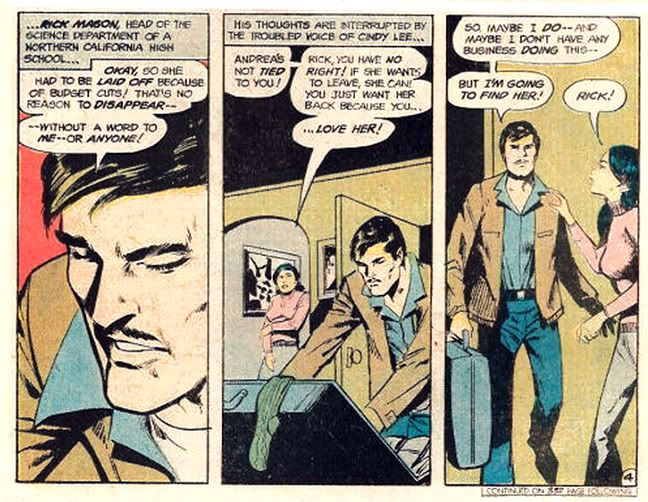
Wow! Check that out! She actually puts moves on Rick Mason! Cindy Lee, bold seeker of dangerous, age-inappropriate love. Certainly can't blame her. In life, if you want something, you have to go right for it. It's good Cindy understands this, and of course, we all know Rick Mason is one swell fella. At least he's not married. Cindy is no Tracy Flick. However, for her well being, I really think Cindy should go for someone more in her peer group. A student. Like photographer/budding cryptozoologist Lee Webster.
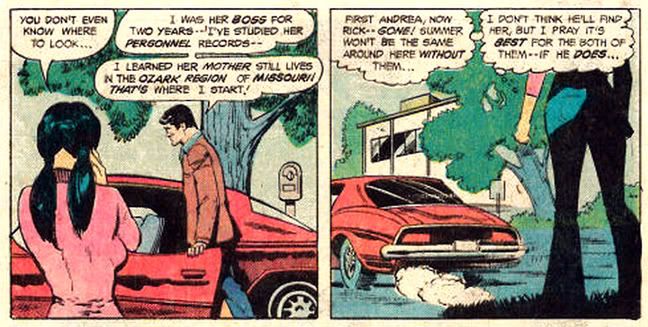
What a guy, that Rick Mason. He's right to quash Cindy's romantic notions. While it's natural for a student-- especially one we now know harbors a hell-bent streak-- to confuse admiration for an authority figure with love, as a dedicated educator Rick Mason knows even giving Cindy the slightest--- WHAT THE HELL? Loaning her his car? What kind of responsible teacher does something like that? I take it all back. Rick Mason is a mixed-signal sending bastard.
And look how nonchalantly he does it. It's the ol' over the shoulder "I'm godlike in my lack of concern whether you live or die" keys toss. It's not even a decent throw because Cindy has to lunge into a semi-crouch to catch them. The least Rick Mason could have done-- since even this much is wildly beyond the bounds of proper teacher-student interaction-- is place the keys in her hand. Once the school officials get wind of this, he's out on his guitar-strumming ass faster than you can say, "Matthew Broderick as Mr. McAllister" anyway. Show some class while you simultaneously destroy a girl's feelings and your career. Instead, our ostensibly nice guy teacher puts on this smug, superior act as if to tell her, "You can't have me, but take my car for a spin, you baby."
Down in the dumps, sitting on a pile of rubble that visually symbolizes her fractured heart, Cindy soon finds another adrenaline-pumping adventure. I'm so impressed with this characterization I'd buy a Cindy Lee monthly. No superheroics. Just Cindy Lee and her pals getting themselves into all kinds of crazy scrapes. You know what this comic is starting to remind me of? A mid-70s kiddie version of David Lynch's Blue Velvet.
Now there's a thought. In fact, Cindy prefigures Kyle MacLachlan's Jeffrey Beaumont in many ways. He finds an ear, becomes involved with an older woman and discovers an underworld of crime and perversion in his little town, Cindy Lee sees the aftermath of a crime, wants to become involved with an older man and finds a tame young-readers version of the Lynchian paradigm right there in whatever town it is she lives in. And much like Jeffrey, Cindy's involvement nearly results in her death.
"When the green field comes off like a lid/Revealing what was much better hid," wrote W.H. Auden in his poem "The Two." Some things you and I-- and Cindy Lee-- are just not meant to know. But characters like Jeffrey Beaumont and Cindy are impelled to pull off that lid and reveal the sinister, sordid things happening all around us. There are no gas-huffing Dennis Hoppers or lip-synching, make-up wearing Dean Stockwells in Cindy's world. Just vaguely menacing thugs in leisure jackets Luckily for Cindy her planet orbits a sun a bit brighter and friendlier than the one in Blue Velvet.
But Cindy and pals would easily update to modern, darker storytelling. Lynch famously described his film as "The Hardy Boys Go to Hell." Well, apparently O'Neil's take-- which I'm guessing he based largely on "Fool's Dare"-- on Cindy Lee is she's a 21st century Nancy Drew with a knack for getting herself into trouble of the same sort. We could build on that and have her enthusiastically investigate crimes, her optimism and incorruptible innocence contrasted with the sick, perverse things she uncovers and reveals to the world. Meth labs, porn rings, bizarre blackmail plots, public figures who are secret degenerates. Narrow escapes without an Isis there to bail her out, forcing Cindy to rely on her own pluck and quick wits.
Or not. Maybe she'll always need an Isis for advice and guidance. Cindy is smart and spunky but she is, after all, a risk taker. She's lucky to have a friend and guardian like Isis. Solve a crime and win Rick Mason's heart? Oh, Cindy...
As a special bonus, here's Captain Marvel beating up a bear.
Saturday, September 8, 2012
"Sengoku Batman:" Great Batman or GREATEST Batman?
I snagged this from TokyoPop's Facebook feed. It's Sengoku Batman by Scott Wade. DC needs to snag this concept and put it into production like yesterday, with Wade handling the art. This is my favorite Batman since the Batman the Animated Series version, which I liked because of the sweet Bruce Timm designs and the Denny O'Neil-inspired characterization of Batman. More human than the one in the comics and a lot more likable.
Sengoku, in case you don't know, is a Japanese word meaning the "Warring States period." This was the nearly 200-year era starting with Hojo Soun and ending with the three unifiers Nobunaga Oda, Toyotomi Hideyoshi and Tokugawa Ieyasu, a time of high drama when various warlords vied to forge Japan into a single nation rather than a lot of fiefdoms or domains, and invaded Korea twice. Lots of great stories from that time, plenty of intrigue, schemes, betrayals, set-piece battles and bold personalities. This Batman would fit right in there.
Yes. It's good!
Sengoku, in case you don't know, is a Japanese word meaning the "Warring States period." This was the nearly 200-year era starting with Hojo Soun and ending with the three unifiers Nobunaga Oda, Toyotomi Hideyoshi and Tokugawa Ieyasu, a time of high drama when various warlords vied to forge Japan into a single nation rather than a lot of fiefdoms or domains, and invaded Korea twice. Lots of great stories from that time, plenty of intrigue, schemes, betrayals, set-piece battles and bold personalities. This Batman would fit right in there.
Yes. It's good!
Labels:
Bruce Timm,
DC Comics,
Denny O'Neil,
good art,
Japan,
Scott Wade,
Sengoku Batman
Saturday, September 1, 2012
Cindy Lee really digs pyramids!
Something she is not shy about sharing with anyone and everyone within earshot.
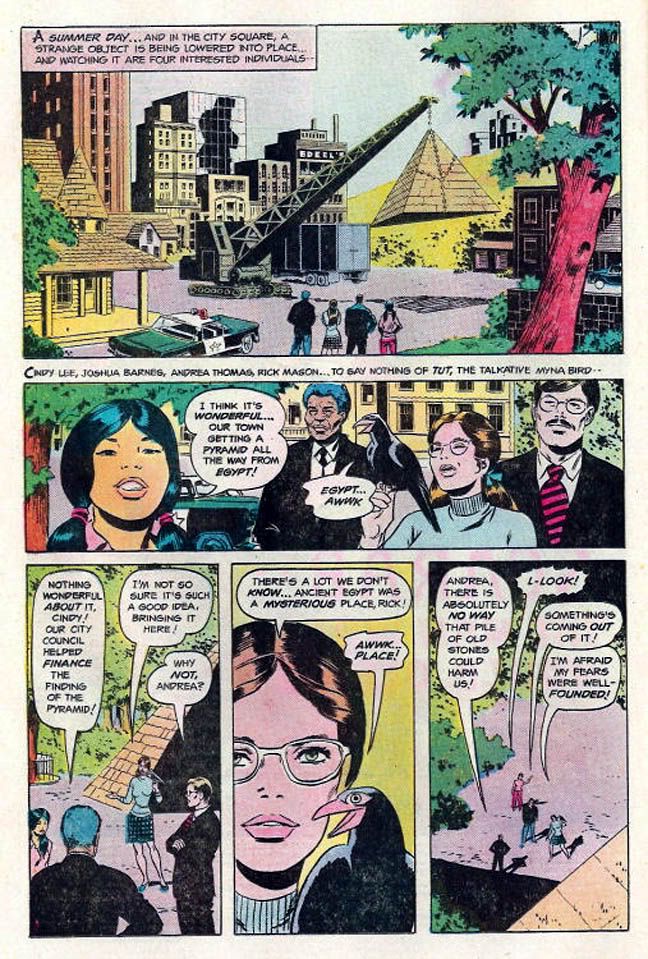
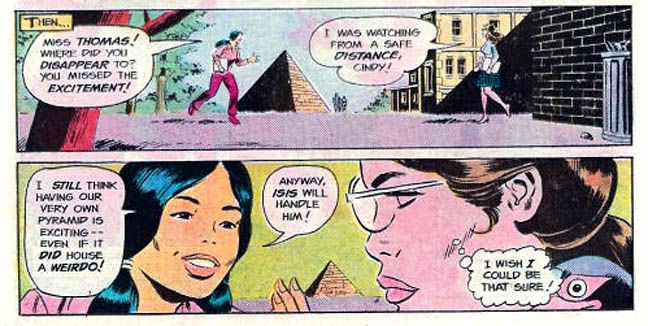
Pyramids! Specifically, Egyptian pyramids rather than the Aztec versions (although she approves of those in a diffused sort of way). Cindy Lee is absolutely nuts about Egyptian pyramids. She goes for them majorly. The kid can't get enough.
It started in kindergarten after she read an article in National Geographic magazine about the building of the Great Pyramids of Giza. She began dreaming of them, of the powers of the pharaohs who commissioned them, their inner passageways and burial chambers, the heavy limestone blocks making up their outer shells. While she finds each charming, Cindy has her favorite. She imagines most would prefer the largest of the pyramids, the one commissioned by the Pharaoh Khufu. But Cindy, unpretentious herself, favors the Red Pyramid of Pharaoh Snefru. Its smaller size and sleek acute angles appeal to her, this girl without ostentation, who keeps her hair in simple ponytails.
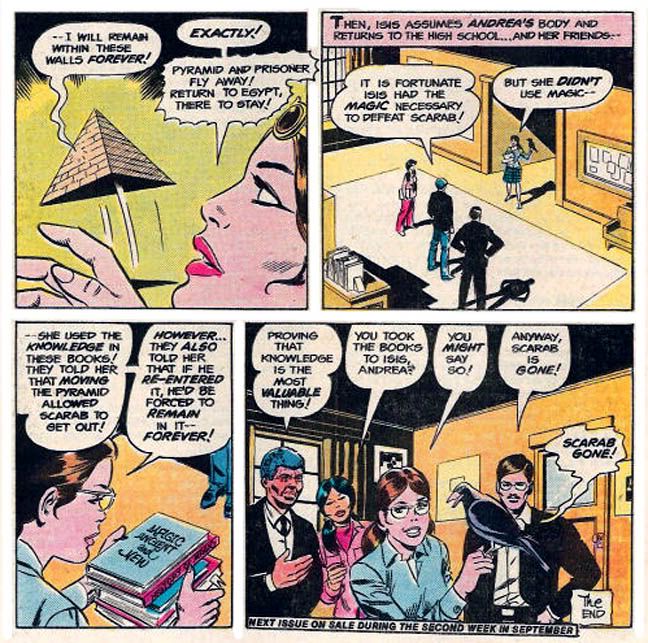
Indomitably cheerful girl that she is, she could only contain her pro-pyramid exuberance for so long. A few weeks later and her grades began to climb again. As we can see in DC's The Mighty Isis #1 (October-November, 1976), as a teen, Cindy Lee allows it full flower and such is her enthusiasm for pyramids even the emergence of a dangerous magical freak calling himself Scarab from inside one can't dampen Cindy's spirits.
The dastardly Scarab attempts to conquer the United States and force its government to declare war on France and the United Kingdom to satisfy his lust for destruction, but the heroic Isis is having none of it. Cindy Lee finds herself happily involved in the goddess' eventual triumph over evil by supplying her with informative books on magic and pyramid power, books Cindy herself has frequently checked out of the library as evidenced by the multiple stamps on the due date slip inside their front covers. With Scarab dispatched by the very pyramid he arrived in, Isis returns to the school and resumes her civilian identity only to encounter a breathless Cindy Lee, who asks the deathless question, "You took the books to Isis, Andrea?"
Be not shocked by Cindy's casual familiarity with her elders! She wouldn't dream of being cheeky or impertinent. In the mid-1970s, teachers at Larkspur High used such relaxed relationships to build trust with their students, to "rap" with them and learn what "made them tick," to use the vernacular of youth. Cindy, as Ms. Thomas's protege and favored pupil, certainly would warrant such privilege.
It may be strange to you to think of one so young and ostensibly inexperienced providing advice to Rick Mason, decades her senior, yet another teacher who permits Cindy to address him by his given name. But the faculty and staff at Larkspur High, being somewhat naive in these things no matter their advanced years, have come to trust Cindy's superior insights and advice. And if she gushes a bit more than is seemly about both Isis and pyramids-- the one black mark on her permanent record a reprimand for doing an impromptu dance move and loudly singing, "PYRAMID POWER-- YEAH, YEAH, YEAH!" coming out of the gym after P.E. class-- they're more than willing to put up with these quirks if it means smoothing the path to true love.
Pyramids and love advice. And also The Banana Splits Adventure Hour show. These are the things Cindy Lee adores. Cubes and Greco-Roman architecture. These are the things that fill her with disgust. She once abruptly ended a date with Lee Webster when he made the mistake of praising the Parthenon. Poor guy foolishly, yet understandably, thought it would impress her.
This is all we know of Cindy Lee, and some of it has been extrapolated from partial records. Further information is difficult to glean. But I have learned the following: Cindy (portrayed winningly by the completely awesome Joanna Pang) has her origins in the Filmation-produced Isis and/or The Secrets of Isis live-action Saturday morning TV show. Filmation introduced in the series' premiere episode, "The Lights of Mystery Mountain," which aired in the fall of 1975. A full year later, DC brought the character into their comic narrative via a crossover in Shazam, vol. 1 #25 (October, 1976), where she was menaced by falling building materials on both the comic's cover and interior story. For some reason, artist Kurt Schaffenberger and the anonymous cover colorist have white-washed her into a generic strawberry blonde.
Jeez. Right on the cover! She makes the cover for her inaugural adventure and they botch it. I'm guessing at the time DC considered her too insignificant to bother consulting the source material for a more accurate portrayal. Fortunately, the later, more conscientious writers and artists of The Mighty Isis #1-- none other than legendary talents Denny O'Neil(!!), Ric Estrada and Wally Wood(!!!)-- made incredibly precise efforts to match their comic book version with Pang's video appearance and performance, thus giving DC a show-accurate Cindy subsequent creative teams were contractually obligated to match under pain of immediate dismissal and blacklisting from the industry for life. I assume. No, that's too harsh. They probably wouldn't have been allowed the last jelly doughnut in the DC break room. Sadly, later developments consigned Cindy, her world along with everyone she ever knew and loved to non-existence following the Crisis on Infinite Earths series... and she hasn't been heard of in comics since.
If you Cindy Lee fans out there would like to see her in the New 52 universe, perhaps you should send model pyramids to Dan Didio. But leave my name out of it. I like Cindy Lee a lot, but I ain't starting no revolution over this. Plus I have no desire to see what horrors they'd force this wholesome minor character to endure in the name of appealing to today's audience of jaded hipsters and people who scorn pyramids.
Monday, March 7, 2011
Superman vs. Muhammad Ali Deluxe Edition: A Comic Review
Publisher: DC
Script: Denny O’Neil
Pencils: Neal Adams
Inks: Dick Giordano and Terry Austin
This is the big one we were all waiting for! I remember seeing the tabloid-sized original at our mall's Waldenbooks way back in 1978 and, as a major fan of both Muhammad Ali and Superman, wanting desperately to buy it. But $2.50 was beyond my price range at the time and there was a question of just where to keep the damned thing. It was monstrous and wouldn't fit easily on any of our bookshelves. In time, I came to think I'd dreamed it all. Superman versus Muhammad Ali? Why would those two ever fight?
Here we are decades later and thanks to our perceived hunger for overblown hardcover "archival" reprints of beloved childhood stories, Superman once more floats like a butterfly while Muhammad Ali stings like a bee. Two pop culture icons take on aliens with the stupidest name—the Scrubb. From the planet Bodace. I was kind of hoping it would be the planet Bonaduce and the erstwhile Danny Partridge might make a guest appearance as Jimmy Olsen, but no such luck.
That disappointment aside, where else can you see Superman punch his mighty fists together to stop a tsunami caused by plasma missiles from outer space? Or Muhammad Ali explain the sweet science from jabs and uppercuts to rope-a-dope tactics to the Man of Steel, then use his famous psych-out pre-fight patter on a bunch of star warriors? Or Superman disguise himself as Bundini Brown before battling an entire armada of enemy starships?
This is an outlandish and at times extremely silly epic-- witness Superman sheepishly explaining to Muhammad Ali why the Fortress of Solitude is full of so much junk and Jimmy Olsen's laughable ringside commentary to a crowd that includes anthropomorphized chickens-- that breathlessly spans light years and features crowd scenes that would have blown Cecil B. DeMille’s mind and bankrupted George Lucas. Neal Adams dazzles with double-page layouts full of space freaks and bizarre interplanetary vistas, and his Muhammad Ali caricature is spot-on.
Preserved in his beautiful prime-- the book apparently was so late in hitting the stores Ali was actually slightly past it in reality-- and transformed into a comic book hero by Adams and inker Dick Giordano, Ali may be the only real life person who could go mano-a-mano with Superman (convenient red sun pocket universes or not); he was and remains that much a legend, a towering figure of the 20th century sports/pop culture scene along with Babe Ruth. I wouldn't be surprised to find this story somehow entering mythological status a couple of thousand years from now (when I'm very old) and Ali's become some sort of demi-god figure whose factual existence academics debate at good ol' Mars University's Classics Department. Okay, I'm stretching things, but not by much.
For his part, Denny O’Neil provides fevered captions with appropriately purplish prose and nails Ali’s distinctive speech patterns. Confronted by an armored green alien, Ali is definitely not nonplussed-- not that you'd expect him to be:
ALIEN: We intend to prove ourselves you superior by showing our standard-bearer is the greatest!
ALI: WHOA... Right there, Dog-face! I AM-- the Greatest! Man... They rank me with Joe Louis... Sugar Ray Robinson.. Ezzard Charles... Archie Moore... Rocky Marciano... Gene Tunney... Jack Dempsey! I ain't agreein' to fight... but if I did, I'd whup your man. I'd stomp him--
If you grew up with Ali on TV and at the movies, you can "hear" this dialogue in your head in the man's distinct cadence; Ali's working himself up and preparing to do some real ass whuppin'.
It seems to take place outside of regular DC continuity. There's no Justice League satellite to warn Superman of the alien armada; he has to fly up into space to look for himself. And while some sort of Athena being makes an appearance at the fight itself to observe (over at Marvel, Stan the Man would've given us the Watcher with appropriately lofty nonsense dialogue, no doubt), there's no sign of Batman or the Green Lantern Corps. It's almost as if Ali's powerful charisma crowded them right out of the universe. So if you're a hardcore geek who has to fit every story into some sort of overarching narrative-- well, you probably should seek psychological help. Here it helps to lighten up and enjoy the weird.
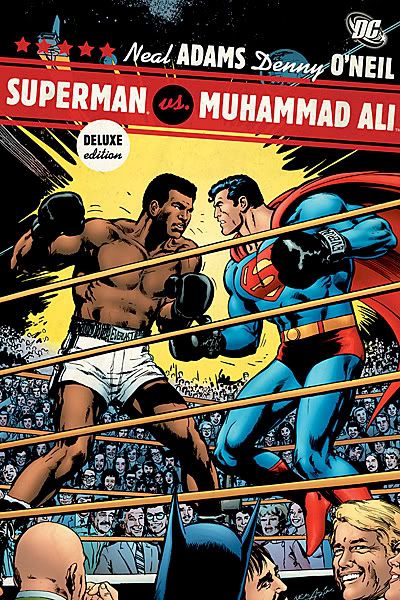
Why? Because there's a sense of the creative team just knocking themselves out (otherwise Ali might have done it for them) to produce something special, an event reminiscent of one of those “Battle of the Network Stars” specials or a Bob Hope holiday show with everyone in his Rolodex invited and then some. And because they manage to convey such a sense of fun, the book works both as a tribute to Ali and as a curious artifact of the 70s, the latter emphasized especially by the inclusion of Adams’s famous wraparound cover featuring such leisure suit era luminaries as Jimmy Carter, Pele, Sonny Bono, Johnny Carson, the entire Jackson 5 (man, they got some shitty seats!), a couple of Sweathogs from Welcome Back, Kotter and a young Ron Howard. If you look closely, you can make out a reunion of sorts for the Fab Four-- that's right; John, Paul, George and Ringo are there in the crowd. No sign of Linda or Yoko. You can also see a few famous faces with mustaches slapped on them because, as Jenette Kahn relates in her afterward, a few celebs balked at making a ringside appearance. And in what kind of world does George C. Scott turn down DC Comics only to be replaced by Kurt Vonnegut?
All this and a selection of Adams's surprisingly tight layout thumbnails. Just buy it and dig it, my babies.
Subscribe to:
Posts (Atom)