To end our month-long celebration of Halloween, horror comics and all-girl Japanese pop punkers Spookey, here are a couple of stories where Swamp Thing fights that old school monster favorite, the werewolf. Male and female varieties.
The first one, Swamp Thing #4 (May 1973) is by Len Wein and Bernie Wrightson. They lean on the familiar Universal Studios style, setting their tale in the Scottish moors and within a creepy old mansion. Their werewolf is the tragically cursed son of some very worried parents. They're in luck when Matt Cable and Abby Arcane crashland their plane close to their ancestral home, but definitely unlucky in that Swamp Thing is also on board. This means their plans to use Cable's blood to cure their boy of his lycanthropy (and give it to Cable; but isn't this what any concerned parents would do for their child?) is doomed from the start.
While the werewolf on the cover looks more like a satyr to me, inside the comic itself Wrightson uses heavy black silhouetting for its first appearance, which gives his beastie a very Frazetta-ian touch, almost amorphous in the night fog. It's very reminiscent in its first appearance of Frank Frazetta's aptly-titled "Werewolf!" from Creepy #1 (1964). Kind of impressionistic. Shoot, why am I telling you all this when I can just shut my fool mouth and show you? Here:
There is nothing not to like about this comic and its classical approach.
But what a difference a decade makes! We hear a lot of talk about the "curse of the werewolf," and writer Alan Moore and his merry art crew of Steve Bissette and John Totleben set out to explore what this means both literally and metaphorically-- because there's also this other monthly thing sometimes referred to as a curse.
In Swamp Thing
#40 (September 1985), Brit Moore unspools an episode in "American Gothic," an extended story arc where Swamp Thing battles traditional horror creatures suffused darker elements of the United States' national narrative-- the unintended consequences of progress, the preponderance of gun violence, the genocide of Native Americans and the lingering effects of slavery and the Civil War. This time, perennial fan favorite character John Constantine pits Swamp Thing against something more personal-- the perpetual state of war between the genders, specifically the daily battles waged by a typically American suburban couple.
As with the Len Wein-Bernie Wrightson werewolf tale, "The Curse" is very concerned with blood. It's just Moore is interested in a deeper exploration of this sanguine symbolism. Our werewolf this time is a modern woman so empathetic to the anger and resentment felt by long-ago Pennamaquot tribeswomen sequestered in a special lodge (she and her husband live in a house built on the site) while they menstruate she turns into a massive wolf creature and goes on a rampage. Male privilege has finally loosed a beast, and after a brief fight, Swamp Thing comes to as much of an understanding of the woman's plight as a male-gendered plant elemental can.
Tragically, our tragic werewolf is a stand-in for all of womankind, so she learns there's another aspect to this blood curse-- women are bound by it to men and vice versa. As a result, she cannot bring herself to kill her husband (even though she contemptuously notes he's "soiled himself" from fear). Giving in completely to her primal, savage anger, she crashes through the front window of a pornography shop where a customer has just asked the cashier to show him something he euphemistically refers to as more "unusual." Perhaps as a matter of tastefulness, we aren't permitted to see the resulting carnage. In the end, Swamp Thing cannot offer succor and the werewolf impales herself on the knives in a supermarket display, ironically labeled, "Here's good news for housewives!" The supermarket setting itself represents the sterilizing effect consumerism has on our lives and its place in the continuing subjugation of female power, having been referenced satirically in the same vein by Ira Levin's 1972 novel The Stepford Wives and its 1975 film adaptation.
And with our tale of two lycanthropes, we bring this year's Spookey Month to a close!
Showing posts with label Steve Bissette. Show all posts
Friday, November 1, 2013
Friday, June 28, 2013
A look back with Swamp Thing: Careful! Scientists at work!
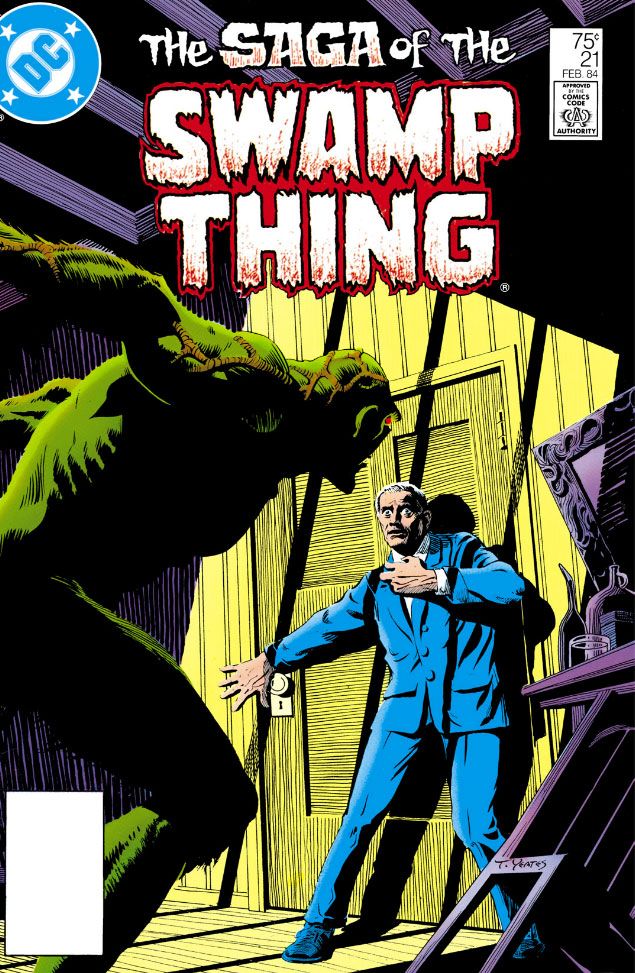
The Saga of the Swamp Thing #21 (February 1984), huh? This is where our old pal Alan Moore made his American reputation by doing that Alan Moore thing of taking a previously existing character, picking it apart and figuring out what it's all about, then putting it back together in a startling new configuration. Figuring out those implications previous writers either hadn't considered or considered and didn't know how to deal with. Which character am I talking about? General Avery Carlton Sunderland, CEO of the Sunderland Corporation.
Just joking. Sunderland was a bastard before this issue and he continues being a bastard all through it. But Moore had Sunderland make a little suggestion that got me to thinking about Alec and Linda Holland and just what kind of scientists they were.
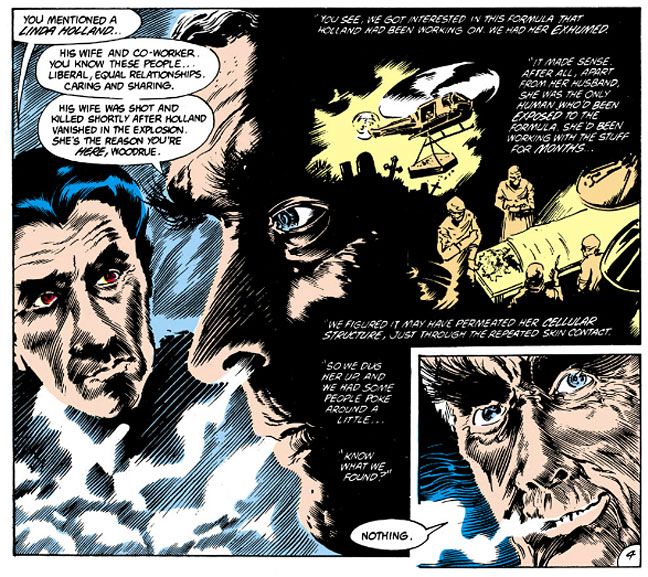
Introduced by Martin Pasko and Tom Yeates way back in The Saga of the Swamp Thing #6 (October 1982), Sunderland bedevils the hell out of Swamp Thing and his friends. Somewhere along the way, Sunderland became interested in the biorestorative formula Alec and Linda Holland were working on-- the one that led to their deaths and the creation of Swamp Thing. Conventional wisdom at the time said Alec Holland's cells were saturated with the formula by a lab explosion and this is what transformed him into a plant creature when his burned body fell into the biologically-rich environment of the swamp. Since Swamp Thing is a little difficult to come by in order to gain a sample of the formula, Sunderland goes to another source and has Linda Holland's body exhumed and examined. His researchers find the formula "had collected in her body as well."
People's bodies pick up chemicals all the time from their environment. If you work around toxins (for example, at an asbestos manufacturer or for the Kardashians), you take precautions, but there's always a risk you're going to introduce into your system dangerous chemicals. And even if you don't, you may be highly exposed to substances you've never imagined right now simply due to your lifestyle.
Both Hollands knew the hazards of working with chemicals-- you treat any chemical as potentially dangerous and attempt to limit your exposure; I've had to read OSHA forms just to work with photocopiers-- and would have taken at least basic precautions. And even if they considered the chemicals completely safe, they would be concerned about contaminating their work. At the very least they would have worn goggles, smocks and gloves. If the chemicals were toxic enough, they would have worn respirators or air-tight suits. And if the substances were even more dangerous than that, the Hollands would have worked from behind protective glass of some kind. But apparently, all of this was just not enough.
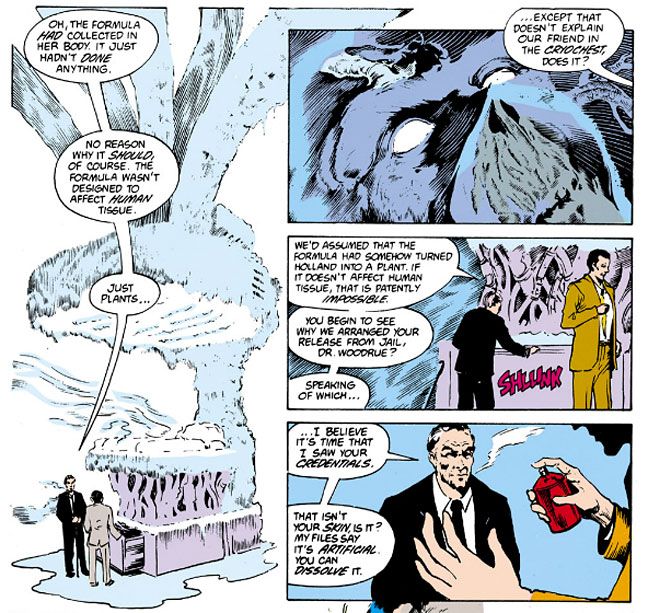
And it lead to tragedy. That aforementioned conventional wisdom-- what Sunderland and associates are operating under as this story begins-- states the formula transformed Holland. Moore quickly disposes of this by having Sunderland remark there was no reason the formula would have affected Linda or, by extension, Alec. It doesn't matter that Alec underwent a violent chemical reaction involving large amounts of the formula or that Linda had some in her cells as well when she was merely shot, embalmed and buried. Their magic formula wasn't designed to work on human or animal tissue, only plant. This sets up a major revelation partway through this issue, one that changes almost everything about Swamp Thing. However Swamp Thing emerged, the central tragedy of this doomed couple always comes back to the biorestorative formula they worked so hard to create in hopes of feeding a hungry world.
And because Sunderland's piqued my curiosity, I'm wondering just how much of the biorestorative formula Linda's body contained. Can we find out? Of course. Maybe not the exact amount, but we can at least make a rough estimate by engaging in a little time travel, a power unfortunately denied all the poop heads working for King Hell Poophead General Sunderland.
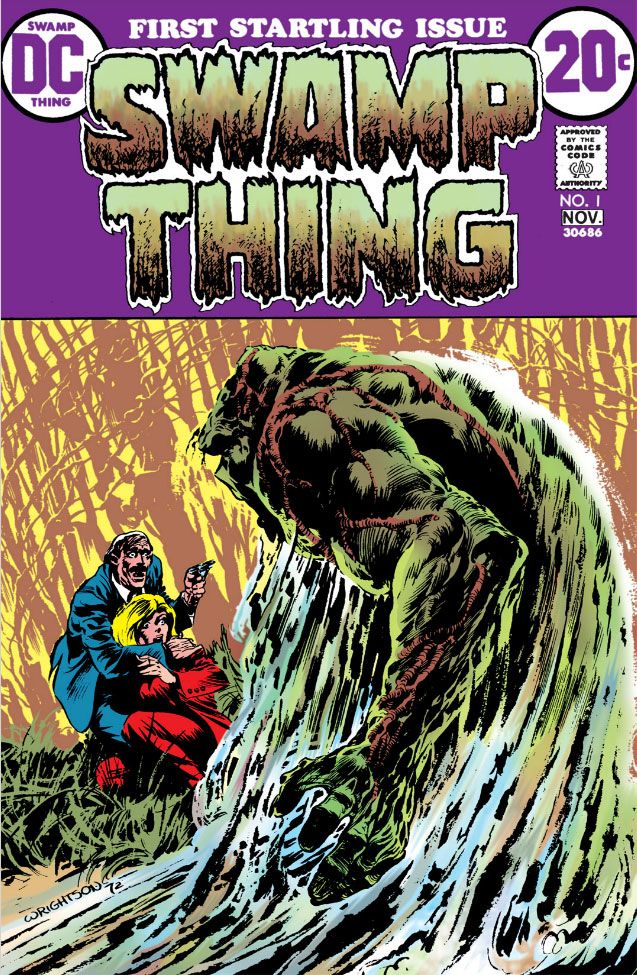
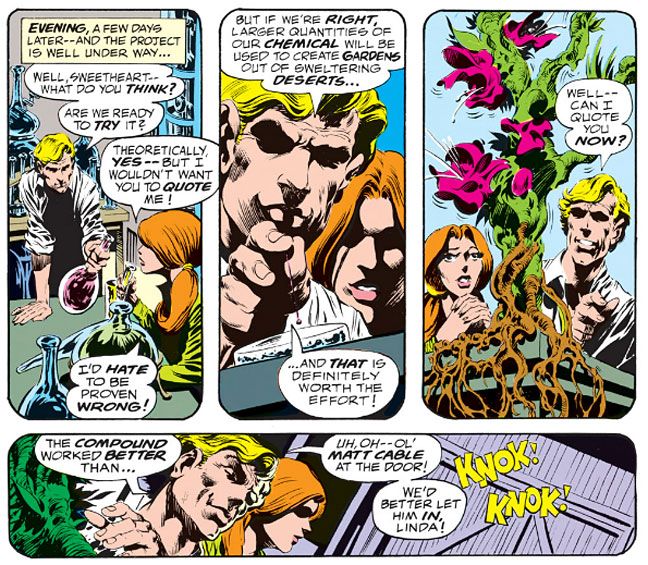
So let's journey back to November 1972 and look at Swamp Thing #1 by Len Wein and Bernie Wrightson. Before we see what conditions the Hollands operated under, allow me to point out just how stupid it was of the government to put the two of them out in a swamp in the first place... for security purposes. The government was so worried about the biorestorative formula falling into the wrong hands, they sent its creators to an easily-accessed farm house in a remote swamp and then protected them with a single police car. In the DC universe, the Manhattan Project took place at a Mardi Gras party in New Orleans.
Okay, now lets see how these two genius smarty brain people carry out their research. Wrightson probably drew a ton of cool-looking safet-- GOOD LORD! Look at that!
They may have gotten results, but clearly the Hollands were an accident waiting to happen. I'm surprised they didn't just eat or drink the stuff-- give it a grape flavor, add carbonation and throw themselves a Biorestorative Soda love-in on live television. Now I'm thinking Linda Holland had LOTS of this junk in her system. And when you think about all the fungi and microscopic plant life the human body contains--
It's probably just as well Alan Moore didn't put much thought into those gruesome possibilities!
Just joking. Sunderland was a bastard before this issue and he continues being a bastard all through it. But Moore had Sunderland make a little suggestion that got me to thinking about Alec and Linda Holland and just what kind of scientists they were.
Introduced by Martin Pasko and Tom Yeates way back in The Saga of the Swamp Thing #6 (October 1982), Sunderland bedevils the hell out of Swamp Thing and his friends. Somewhere along the way, Sunderland became interested in the biorestorative formula Alec and Linda Holland were working on-- the one that led to their deaths and the creation of Swamp Thing. Conventional wisdom at the time said Alec Holland's cells were saturated with the formula by a lab explosion and this is what transformed him into a plant creature when his burned body fell into the biologically-rich environment of the swamp. Since Swamp Thing is a little difficult to come by in order to gain a sample of the formula, Sunderland goes to another source and has Linda Holland's body exhumed and examined. His researchers find the formula "had collected in her body as well."
People's bodies pick up chemicals all the time from their environment. If you work around toxins (for example, at an asbestos manufacturer or for the Kardashians), you take precautions, but there's always a risk you're going to introduce into your system dangerous chemicals. And even if you don't, you may be highly exposed to substances you've never imagined right now simply due to your lifestyle.
Both Hollands knew the hazards of working with chemicals-- you treat any chemical as potentially dangerous and attempt to limit your exposure; I've had to read OSHA forms just to work with photocopiers-- and would have taken at least basic precautions. And even if they considered the chemicals completely safe, they would be concerned about contaminating their work. At the very least they would have worn goggles, smocks and gloves. If the chemicals were toxic enough, they would have worn respirators or air-tight suits. And if the substances were even more dangerous than that, the Hollands would have worked from behind protective glass of some kind. But apparently, all of this was just not enough.
And it lead to tragedy. That aforementioned conventional wisdom-- what Sunderland and associates are operating under as this story begins-- states the formula transformed Holland. Moore quickly disposes of this by having Sunderland remark there was no reason the formula would have affected Linda or, by extension, Alec. It doesn't matter that Alec underwent a violent chemical reaction involving large amounts of the formula or that Linda had some in her cells as well when she was merely shot, embalmed and buried. Their magic formula wasn't designed to work on human or animal tissue, only plant. This sets up a major revelation partway through this issue, one that changes almost everything about Swamp Thing. However Swamp Thing emerged, the central tragedy of this doomed couple always comes back to the biorestorative formula they worked so hard to create in hopes of feeding a hungry world.
And because Sunderland's piqued my curiosity, I'm wondering just how much of the biorestorative formula Linda's body contained. Can we find out? Of course. Maybe not the exact amount, but we can at least make a rough estimate by engaging in a little time travel, a power unfortunately denied all the poop heads working for King Hell Poophead General Sunderland.
So let's journey back to November 1972 and look at Swamp Thing #1 by Len Wein and Bernie Wrightson. Before we see what conditions the Hollands operated under, allow me to point out just how stupid it was of the government to put the two of them out in a swamp in the first place... for security purposes. The government was so worried about the biorestorative formula falling into the wrong hands, they sent its creators to an easily-accessed farm house in a remote swamp and then protected them with a single police car. In the DC universe, the Manhattan Project took place at a Mardi Gras party in New Orleans.
Okay, now lets see how these two genius smarty brain people carry out their research. Wrightson probably drew a ton of cool-looking safet-- GOOD LORD! Look at that!
It's probably just as well Alan Moore didn't put much thought into those gruesome possibilities!
Thursday, October 6, 2011
2nd Annual Spookey Month: Swamp Thing tells you what comes with fall
Whenever I read Swamp Thing, I think of chocolate chip cookies, thanks to Mad Libs. I had a monster-themed Mad Libs book that featured some Swamp Thing art by Bernie Wrightson, only Swampy was made out to be some kind of chocolate chip-based life form. I also think of how incredible Alan Moore's work on the series in the 1980s was. Early in his run, Moore wrote a three-part story guest-starring the Demon that is one of the two comic books to scare me after I got into the double digits in age. The other is Ito Junji's Uzumaki, the scariest and most disturbing comic ever published by mainstream companies.
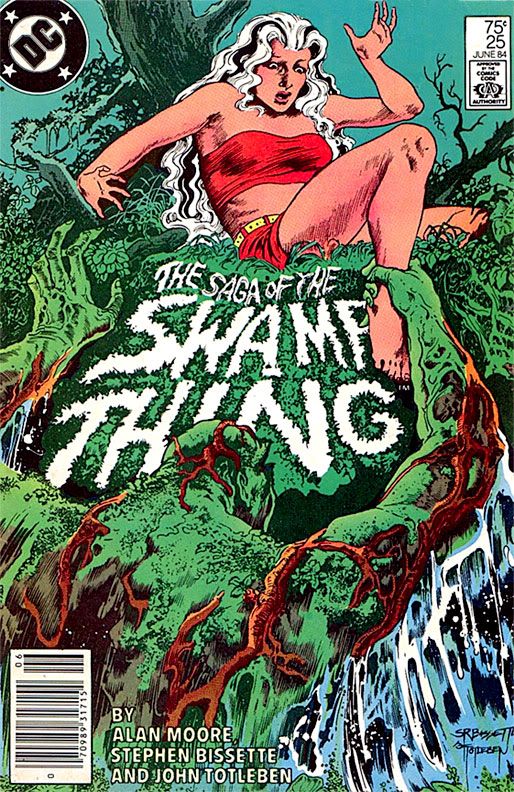
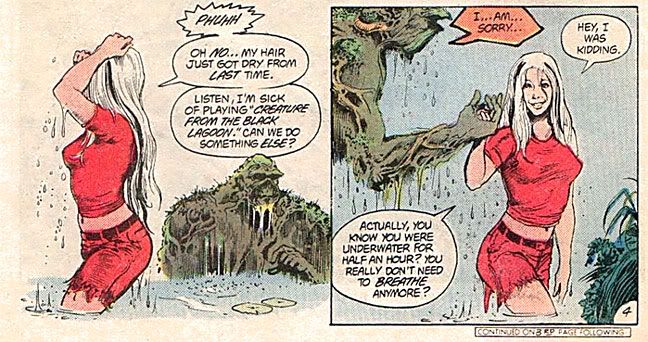
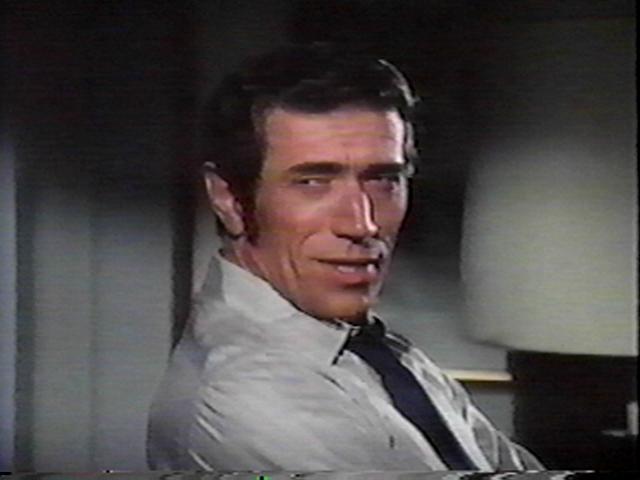
The fun starts in Swamp Thing #25 (1984). A mysterious guy (who looks a lot like the long-lost sibling of actors Joseph Campanella and Robert Lansing or maybe just Roy Thinnes) shows up in Baton Rouge, Louisiana, and starts talking in riddles-- which probably drives everyone around him batty. I know he's Jason Blood, but Moore inserts him into the story with some cutesy moments where he blows people's minds by hinting at things a stranger couldn't possibly know. Like who's going to jail for manslaughter, things like that. Somewhere in the nearby swamp, Swamp Thing and his friend Abby Cable share some fun together.
One thing Moore has always excelled at is taking other people's characters and taking them apart, only to put them together again in fascinating new ways based on all their original implications. While most writers had been content to write Swamp Thing as a guy who turned into a plant, Moore decided he was actually a plant that mistook itself for a man. Once Swampy got over that shock, he found himself becoming more attuned to nature and capable of more than anyone had ever thought possible. In fact, he was another in a long line of "plant elementals," protector of the "Green," a kind of collective soul-region for all of earth's flora.
Still in a naive state Swamp Thing starts discovering some exciting new abilities. Moore keeps it light and amusing, allowing the readers to react through Abby. Abby, in the meantime, is also coming into her own, having taken a job helping disturbed children while her husband, Matt Cable, sinks into alcoholism and despair. Cable also has this sick ability to conjure up all kinds of bugs and ugly little critters-- sick in that he seems to get off on it. You know what I'm saying, right?
It turns out Riddlin' Roy Thinnes and Abby have some business together-- protecting the children from a demon monkey that came from a misused Ouija board. Moore allows the horror to seep into the story gradually, as he plays with time sequences to build suspense. But what makes this story so appropriate for Halloween is how Moore uses Swamp Thing to examine the essence of horror itself. Horror is autumnal, both a way of dealing with death and a celebrating it. Through horror, we take something incomprehensible and make it into something we can deal with. It's fun to be scared in the dark. Halloween is a festival of frights, held during the time of year when the wind blows colder and the trees become skeletons.
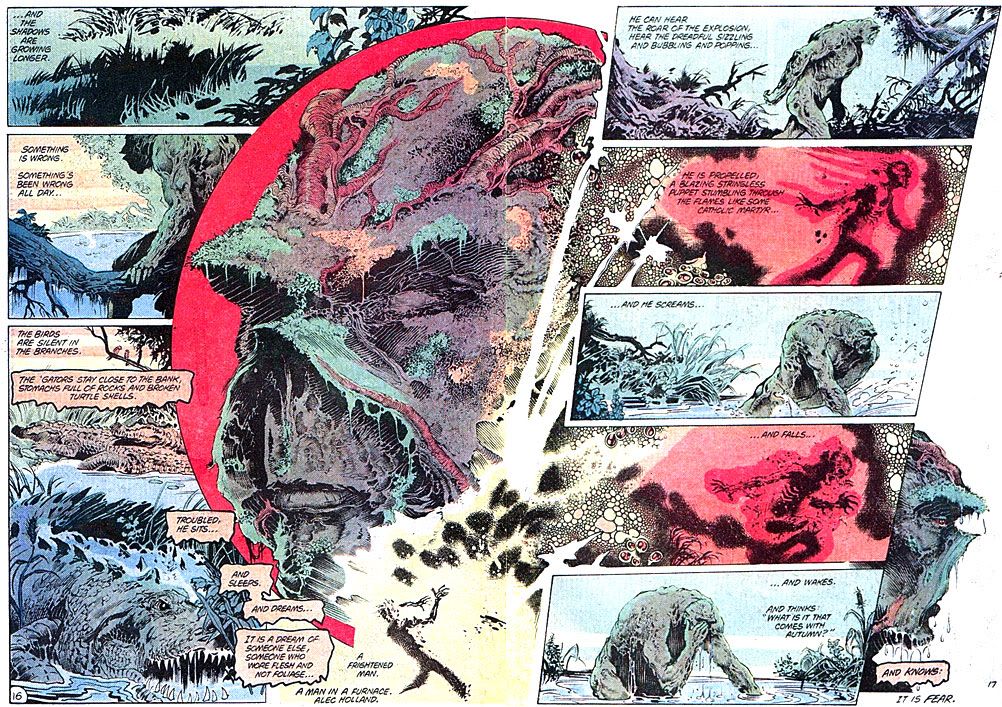
For Swamp Thing, the season cycle isn't merely symbolic; he is now part of it, as he senses-- although his consciousness at this time is still very much over-printed with humanity. Moore and artists Steve Bissette and John Totleben showcase this in a gorgeous double-page spread, complete with a call-back to Swamp Thing's origin. I also have to point out how lovely Tatjana Wood's coloring is here; her work complements and enhances the art in a few colorists can match. Wood was just outstanding throughout this series.
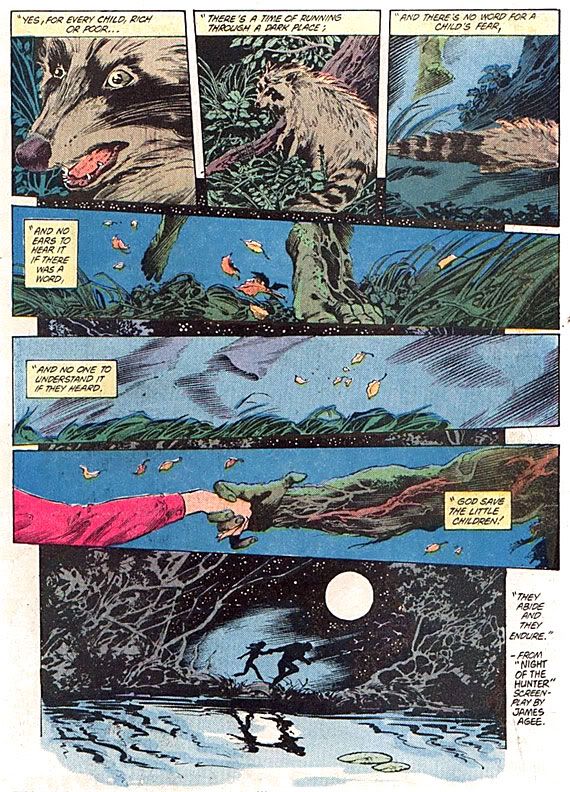
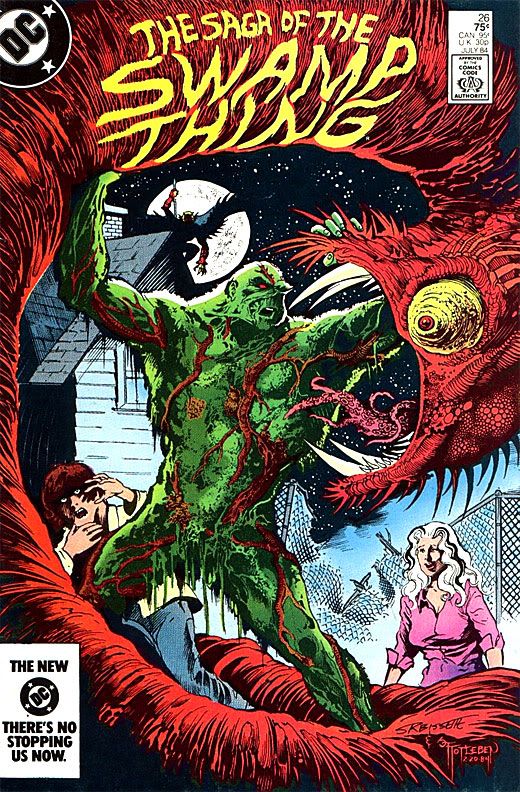
The thing that comes with fall isn't merely fear. Fear is just its symptom, a rational reaction to the idea of non-existence. Because what really comes is death. Or in this case, little spiky monkeys that feed on your worst nightmares. As Abby and Swamp Thing realize this, they run through the night towards the children's home. The quote from James Agee's screenplay for Night of the Hunter is evocative, but no more so than the amazing aspect-to-aspect sequence that opens Swamp Thing #26. Here, Moore, Bissette, Totleben, Rick Veitch, and Wood fully realize the cinematic possibilities of the comic book page.
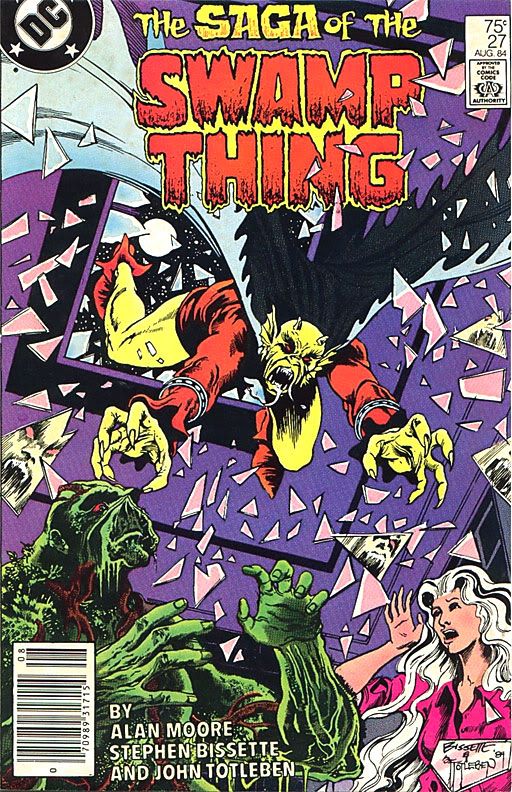
Yeah, yeah, yeah. Total Moore butt-kissing, right? Wrong! You're out of order, the whole system's out of order! My Al Pacino impression is atrocious and inappropriate here! Moore can't quite maintain the high level he set for himself during the slow-burning first and second acts. The let-down comes in the third when Etrigan bursts in and the story turns into a fight scene cliche. Moore's rhyming dialogue for Etrigan is impressive, but the plot ends anti-climatically. Hey, you're not so scary after all, you scummy monkey! It's abrupt and doesn't quite pay off Moore's elaborate set-up. Etrigan's method of disposing of the monkey is good for a laugh, though.
Moore does redeem #27 with an ominous postscript. After fighting with Abby, Cable smashes himself to bits in a drunk driving accident, then saves himself-- he thinks-- by making a deal with a talking fly. It's a gross-out sequence, Cable having knocked out all of his teeth and crushed himself in the mangled steel of his wrecked car. It's eerie when he appears apparently no worse for wear and we watch him drive Abby into the distance of the last frame, Etrigan's closing narration fraught with foreshadowing. Swamp Thing and Abby may have re-established order, but it's merely a truce. It gives them some breathing room-- not that Swamp Thing needs to breath anymore-- before the horrors to come.
We're almost 30 years past this story now, and in all that time, few releases from the major publishers have brought all true possibilities of comics to bear. Not that there haven't been some great stories, and some fun ones. It's just that with Swamp Thing, Moore's prose is novelistic, the visuals are vivid, the storytelling all encompassing. Although it's ultimately something of a let-down, considered as an artifact of it's time, it's amazing Moore and company got away with doing all of this. There wasn't a contemporary comic at either DC or Marvel that could touch it, not The Uncanny X-Men or the New Teen Titans. Sure, it's pretentious at times (almost as pretentious as my writing right here in this very entry), and overwrought on occasion, but as you read it, you realize there's still something unprecedented going on-- a creative team juiced on its own brilliance, telling stories that aren't simple rehashes of old comic book ideas, but genuine literary statements unto themselves. A writer with something to say, artists who can match his vision.
In literature and cinema, you expect these kinds of things, but with a comics, you're left wondering why all of them can't be this good. And lately, it's a shame people are satisfied with what the big companies dole out, most of which seem a huge step backwards in craft and voice. Batman still contends with Catwoman, but showing them actually having the sex that used to be merely hinted at isn't some great accomplishment when the story itself is just as tired and familiar and as blandly told as any that have come before it. The same stakes, the same solutions. Comics based on other comics, comics as marketing tools for multi-media campaigns, with nothing more to say than, "Look who's hitting whom this month!"
Maybe that's also what comes with fall-- the death of creativity. That and lots of chocolate candy and caramel corn. Plus amazing Japanese bubblegum-garage-power-pop-punk like Spookey!
The fun starts in Swamp Thing #25 (1984). A mysterious guy (who looks a lot like the long-lost sibling of actors Joseph Campanella and Robert Lansing or maybe just Roy Thinnes) shows up in Baton Rouge, Louisiana, and starts talking in riddles-- which probably drives everyone around him batty. I know he's Jason Blood, but Moore inserts him into the story with some cutesy moments where he blows people's minds by hinting at things a stranger couldn't possibly know. Like who's going to jail for manslaughter, things like that. Somewhere in the nearby swamp, Swamp Thing and his friend Abby Cable share some fun together.
One thing Moore has always excelled at is taking other people's characters and taking them apart, only to put them together again in fascinating new ways based on all their original implications. While most writers had been content to write Swamp Thing as a guy who turned into a plant, Moore decided he was actually a plant that mistook itself for a man. Once Swampy got over that shock, he found himself becoming more attuned to nature and capable of more than anyone had ever thought possible. In fact, he was another in a long line of "plant elementals," protector of the "Green," a kind of collective soul-region for all of earth's flora.
Still in a naive state Swamp Thing starts discovering some exciting new abilities. Moore keeps it light and amusing, allowing the readers to react through Abby. Abby, in the meantime, is also coming into her own, having taken a job helping disturbed children while her husband, Matt Cable, sinks into alcoholism and despair. Cable also has this sick ability to conjure up all kinds of bugs and ugly little critters-- sick in that he seems to get off on it. You know what I'm saying, right?
It turns out Riddlin' Roy Thinnes and Abby have some business together-- protecting the children from a demon monkey that came from a misused Ouija board. Moore allows the horror to seep into the story gradually, as he plays with time sequences to build suspense. But what makes this story so appropriate for Halloween is how Moore uses Swamp Thing to examine the essence of horror itself. Horror is autumnal, both a way of dealing with death and a celebrating it. Through horror, we take something incomprehensible and make it into something we can deal with. It's fun to be scared in the dark. Halloween is a festival of frights, held during the time of year when the wind blows colder and the trees become skeletons.
For Swamp Thing, the season cycle isn't merely symbolic; he is now part of it, as he senses-- although his consciousness at this time is still very much over-printed with humanity. Moore and artists Steve Bissette and John Totleben showcase this in a gorgeous double-page spread, complete with a call-back to Swamp Thing's origin. I also have to point out how lovely Tatjana Wood's coloring is here; her work complements and enhances the art in a few colorists can match. Wood was just outstanding throughout this series.
The thing that comes with fall isn't merely fear. Fear is just its symptom, a rational reaction to the idea of non-existence. Because what really comes is death. Or in this case, little spiky monkeys that feed on your worst nightmares. As Abby and Swamp Thing realize this, they run through the night towards the children's home. The quote from James Agee's screenplay for Night of the Hunter is evocative, but no more so than the amazing aspect-to-aspect sequence that opens Swamp Thing #26. Here, Moore, Bissette, Totleben, Rick Veitch, and Wood fully realize the cinematic possibilities of the comic book page.
Well, it functions both as aspect-to-aspect and action-to-action. With these horizontal panels, there's not much room for the artists to do more than give us fragments of the action in what's almost a collage. The racoon's appearance is an aspect, but it flees, its final, truncated appearance giving way to a close-up of Swamp Thing's running feet. The quick cut to Swamp Thing and Abby's hands gives us yet another aspect of the chase, a hint of the attraction growing between them and the desperation of their race. I love aspect-to-aspect storytelling.
While it isn't always appropriate-- I'm not sure Superman needs mood as much as he does grandeur-- there just isn't enough of it in mainstream comics. Action-to-action if fine, but all too often that means punch punch kick. Actually, with the advent of photorealism and the au courant long horizontal panel (similar to these, but poorly used to frame entire actions), there's not much storytelling of any kind in superhero comics these days, just lovingly rendered static poses, like photographs bereft of context. Moore is famous for writing massive scripts detailing everything he wants to see in each panel. When he's on his game, Moore is as close to a film director as you'll find in comics, as attentive to the visuals as he is the story, plot, characterization and dialogue.
We're almost 30 years past this story now, and in all that time, few releases from the major publishers have brought all true possibilities of comics to bear. Not that there haven't been some great stories, and some fun ones. It's just that with Swamp Thing, Moore's prose is novelistic, the visuals are vivid, the storytelling all encompassing. Although it's ultimately something of a let-down, considered as an artifact of it's time, it's amazing Moore and company got away with doing all of this. There wasn't a contemporary comic at either DC or Marvel that could touch it, not The Uncanny X-Men or the New Teen Titans. Sure, it's pretentious at times (almost as pretentious as my writing right here in this very entry), and overwrought on occasion, but as you read it, you realize there's still something unprecedented going on-- a creative team juiced on its own brilliance, telling stories that aren't simple rehashes of old comic book ideas, but genuine literary statements unto themselves. A writer with something to say, artists who can match his vision.
In literature and cinema, you expect these kinds of things, but with a comics, you're left wondering why all of them can't be this good. And lately, it's a shame people are satisfied with what the big companies dole out, most of which seem a huge step backwards in craft and voice. Batman still contends with Catwoman, but showing them actually having the sex that used to be merely hinted at isn't some great accomplishment when the story itself is just as tired and familiar and as blandly told as any that have come before it. The same stakes, the same solutions. Comics based on other comics, comics as marketing tools for multi-media campaigns, with nothing more to say than, "Look who's hitting whom this month!"
Maybe that's also what comes with fall-- the death of creativity. That and lots of chocolate candy and caramel corn. Plus amazing Japanese bubblegum-garage-power-pop-punk like Spookey!
Subscribe to:
Posts (Atom)