Showing posts with label Tatjana Wood. Show all posts

Monday, October 31, 2011

2nd Annual Spookey Month: Hoppy Halloween!

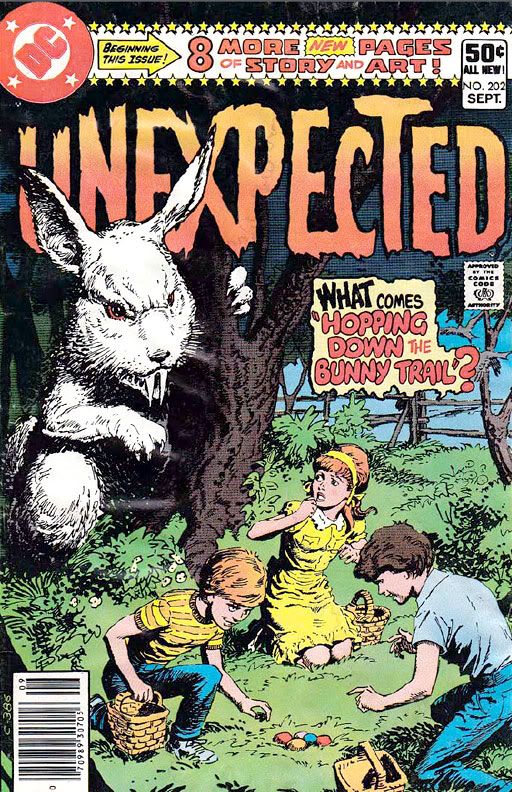
Some stories just stick with you.  Take "Hopping Down the Bunny Trail" from DC's Unexpected #202 (1980), for example.  I read this in a supermarket in Brevard, North Carolina, while visiting my grandparents.  On Easter, three ordinary kids die at the fangs of human-sized, talking rabbit they mistake for the Easter Bunny, their only crimes gleefully biting the heads off chocolate bunnies and being slightly dim-witted.  It gave me the creeps in broad daylight, and while I didn't buy the comic, it never completely left my thoughts.  Through the years, I'd occasionally remember it, slightly altered over time thanks to the transformative power of an imperfect mind.

Apparently, I'm not the only one who found it impressive, because someone made it into neat little .pdf with a short analysis.  Finally, after 30 years, I was able to read it again.  It's still a nasty little tale that should have wider acclaim. 

Some horror tales-- especially the ones in those old EC comics, the early Creepy and Eerie magazines and most of DC's titles-- rely on an ironic twist where some jerky moron gets his or her comeuppance.  The philandering murderer can't get rid of the betrayed spouse, even in rotted corpse form; the abusive parent suffers a more horrific version of the abuse heaped on the child; the greedy boss hoists himself by his own petard, usually fatally; the blowhard suffers blowback; the foolhardy self-appointed expert destroys himself and those who foolishly believe in him.  No matter what gruesomeness occurs, we're usually reassured in some way that cosmic justice has been served, scales have been balanced and the underlying order has been reaffirmed.  We get a kick out of what happens at least partially because these stories play into our sense of moral superiority.
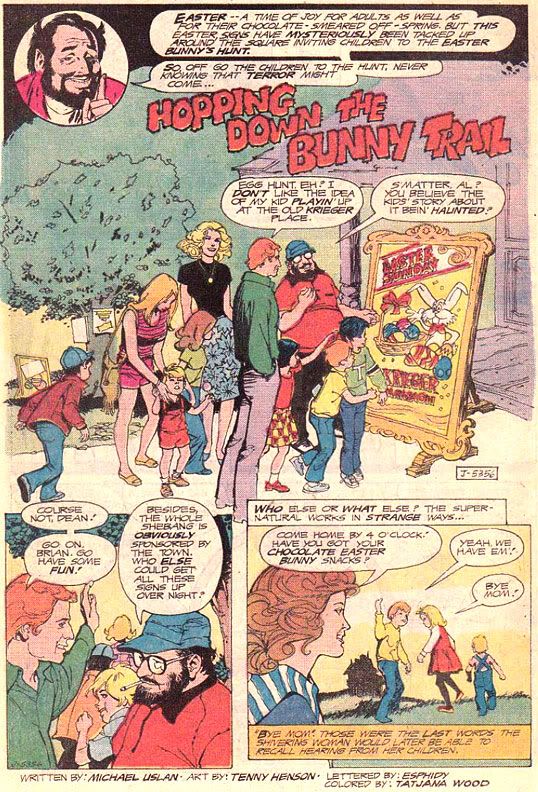

But in this Michael Uslan-scripted story, the worst you can say about the characters is they're all a little dim-witted and unimaginative. The parents fail in their responsibility to protect their children because they just assume the city's somehow behind the Easter egg hunt that's been completely unpublicized until colorful signs appear overnight. Sure, it's at the local haunted house, which is probably firetrap or at the very least a tetanus shot and a lawsuit just waiting to happen. Send the kids!

These jokers are pretty blase, aren't they? This was the era before the ominously narrated news stories intended to stoke every parent's more morbid prescient fantasies, before 9/11, the anthrax letters, terror alerts and Dateline NBC and Inside Edition. This was two years before the Chicago Tylenol poisonings. And yet as we've seen so many times, even today's supposedly hyper-vigilant adults slip up. They leave kids locked in daycare vans in the middle of summer, fail to recognize or simply ignore the warnings signs before school massacres, leave the gate to the backyard swimming pool unlocked. Even if they're frequently driven to complete paranoia by stories about Internet perverts, Satanic cults and poisoned candy, they-- just like the parents in this story-- can be lulled into complacency by the promise of colorful eggs and treats for the kids.  After all, nothing bad ever happens on holidays!
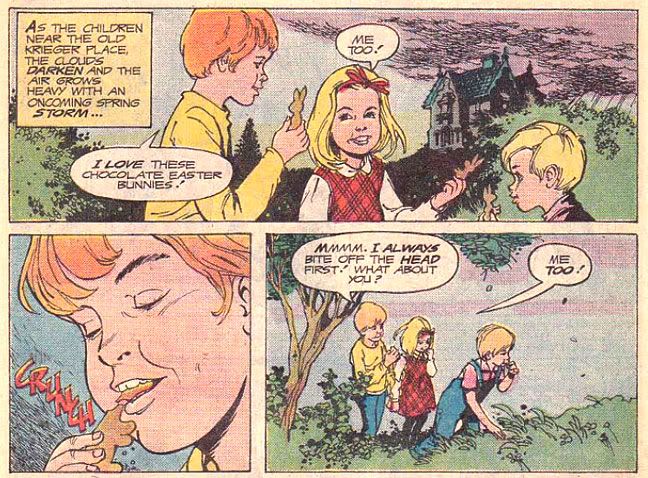

The kids are pretty dull themselves. They walk right up to the "Old Krieger Place" despite Tenny Henson's having drawn storm clouds looming over it menacingly. I suppose their imaginations have been dulled by too much mediocre television and brain-rotting Saturday morning cartoons. Here's a human-sized talking rabbit and rather than recognize something completely bizarre and even threatening about it-- shoot, some kids bawl at the sight of Santa Claus-- these little chocolate lovers just assume it's Old Man Snyder in a costume. That's some costume! To sweeten the deal, the Easter Bunny offers toys and candy. If that isn't a tip-off, I don't know what is. But these numbskull kids take the offer at face value.
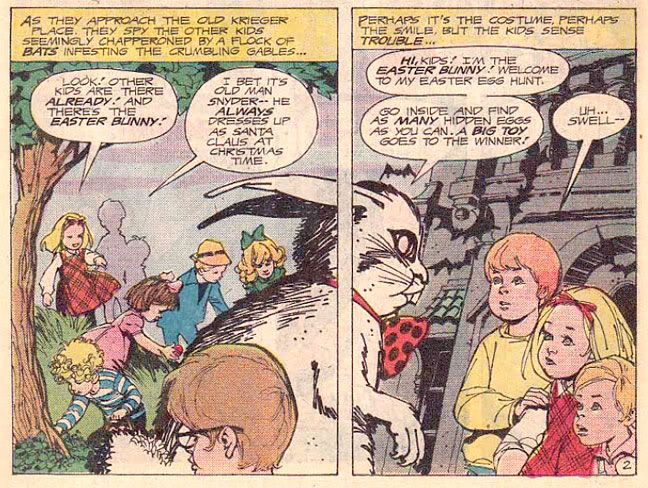

They only start to wise up when the other kids vanish and they find themselves all alone in a perfectly creepy house. And then only a little. They're so confident that everything's fine, that they're going to grow up and go to college and get married and have kids just like themselves one day.  And should something bad happen, Mom and Dad will be right there to save them.  Right?
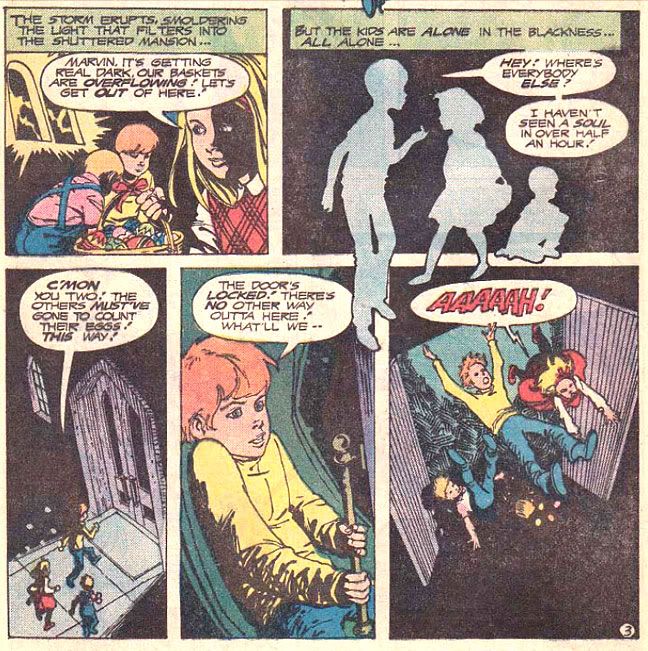

Well, the universe doesn't really work that way.  Not only to bad things happen to good people, horrors beyond horrors happen to them.  Cars and planes crash, nuclear plants leak, cancers strike, young dudes accept odd jobs from John Wayne Gacy.  In the face of the ongoing tragedy we call living, we'd love to believe someone benevolent is in charge, that there's some underlying order to it.  Certainly there are natural laws and forces at work.  We can calculate the orbit of the earth around the sun with precision because we've figured the most obvious of them out.  But they also guide bombs onto blameless schools and hospitals and bullets into innocent spines.
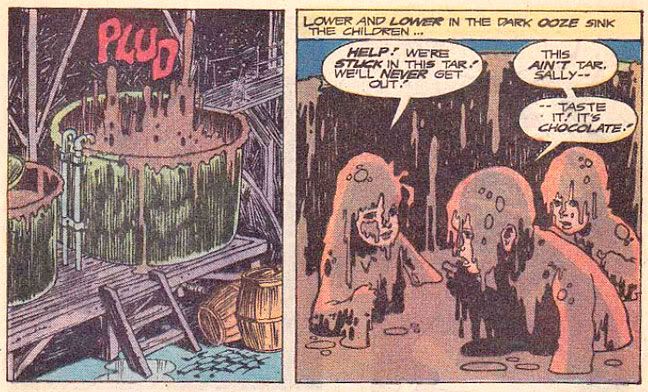

Some horror stories offer a glimpse of a universe of limitless chaos where we are all in immediate danger.  They tell us order is an illusion, that good intentions invite catastrophe.  People are punished far out of proportion to their wrongs, or become victims of circumstance.  You bite the head off a chocolate rabbit.
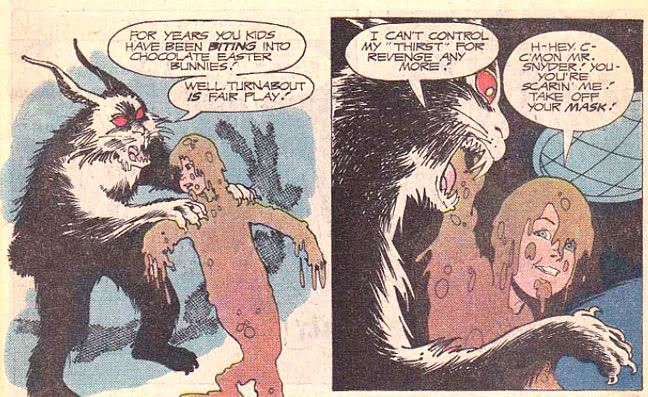

A demonic rabbit bites off your head.  Note the complete lack of gore.  Just a transition from the brightly colored world of a sunny Easter Sunday to a dark and stormy place where wicked things happen to kids because they and their parents are careless and sort of dumb.  When I was 12, I could easily imagine myself as one of these dopey kids.  I was a dopey kid.  "Hopping Down the Bunny Trail" lifted the lid off the field and revealed something much better hidden.  And that was terrifying.


Now close the comic and try to sleep.  Happy Halloween!

No! I can't leave you on a downbeat note like that. Here's Spookey to cheer you up again and reassure you the world's a loving place!

Thursday, October 6, 2011

2nd Annual Spookey Month: Swamp Thing tells you what comes with fall

Whenever I read Swamp Thing, I think of chocolate chip cookies, thanks to Mad Libs.  I had a monster-themed Mad Libs book that featured some Swamp Thing art by Bernie Wrightson, only Swampy was made out to be some kind of chocolate chip-based life form.  I also think of how incredible Alan Moore's work on the series in the 1980s was.  Early in his run, Moore wrote a three-part story guest-starring the Demon that is one of the two comic books to scare me after I got into the double digits in age.  The other is Ito Junji's Uzumaki, the scariest and most disturbing comic ever published by mainstream companies.

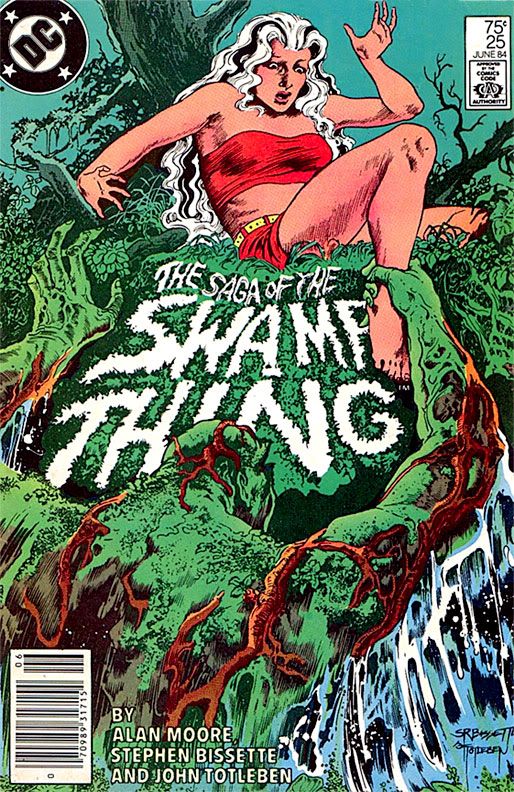
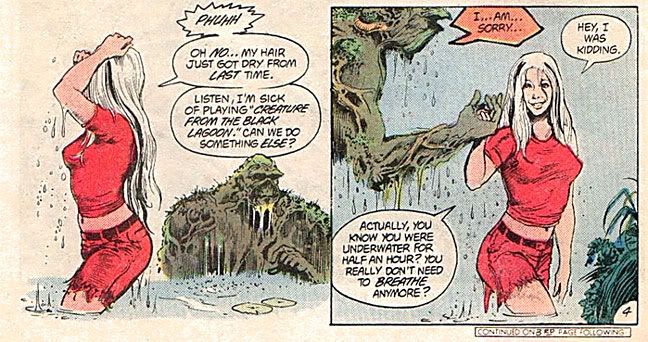
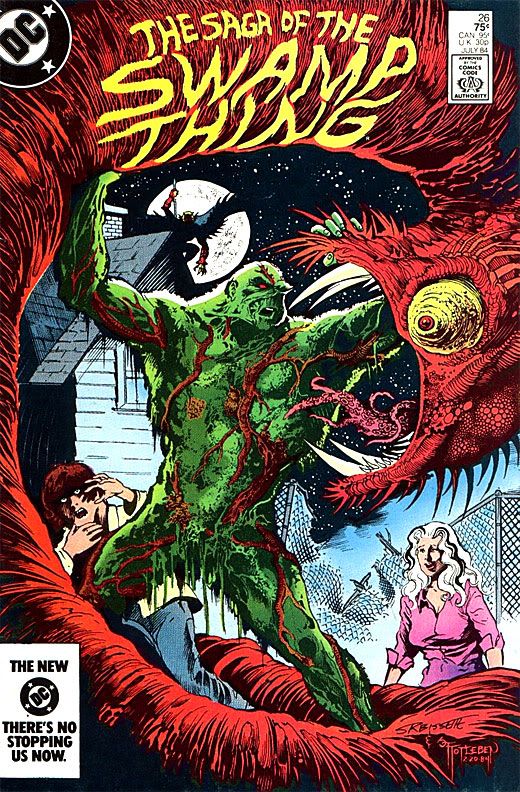
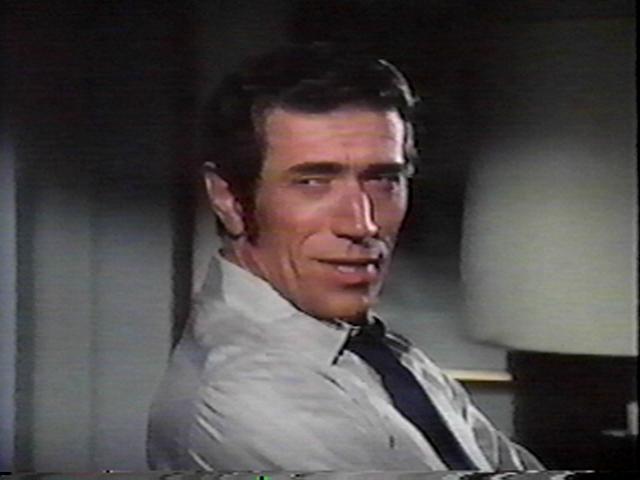
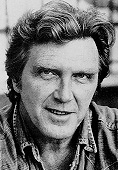
The fun starts in Swamp Thing #25 (1984).  A mysterious guy (who looks a lot like the long-lost sibling of actors Joseph Campanella and Robert Lansing  or maybe just Roy Thinnes) shows up in Baton Rouge, Louisiana, and starts talking in riddles-- which probably drives everyone around him batty.  I know he's Jason Blood, but Moore inserts him into the story with some cutesy moments where he blows people's minds by hinting at things a stranger couldn't possibly know.  Like who's going to jail for manslaughter, things like that.  Somewhere in the nearby swamp, Swamp Thing and his friend Abby Cable share some fun together.

One thing Moore has always excelled at is taking other people's characters and taking them apart, only to put them together again in fascinating new ways based on all their original implications.  While most writers had been content to write Swamp Thing as a guy who turned into a plant, Moore decided he was actually a plant that mistook itself for a man.  Once Swampy got over that shock, he found himself becoming more attuned to nature and capable of more than anyone had ever thought possible.  In fact, he was another in a long line of "plant elementals," protector of the "Green," a kind of collective soul-region for all of earth's flora.


Still in a naive state Swamp Thing starts discovering some exciting new abilities.  Moore keeps it light and amusing, allowing the readers to react through Abby.  Abby, in the meantime, is also coming into her own, having taken a job helping disturbed children while her husband, Matt Cable, sinks into alcoholism and despair.  Cable also has this sick ability to conjure up all kinds of bugs and ugly little critters-- sick in that he seems to get off on it.  You know what I'm saying, right?

It turns out Riddlin' Roy Thinnes and Abby have some business together-- protecting the children from a demon monkey that came from a misused Ouija board.  Moore allows the horror to seep into the story gradually, as he plays with time sequences to build suspense.  But what makes this story so appropriate for Halloween is how Moore uses Swamp Thing to examine the essence of horror itself.  Horror is autumnal, both a way of dealing with death and a celebrating it.  Through horror, we take something incomprehensible and make it into something we can deal with.  It's fun to be scared in the dark.  Halloween is a festival of frights, held during the time of year when the wind blows colder and the trees become skeletons.

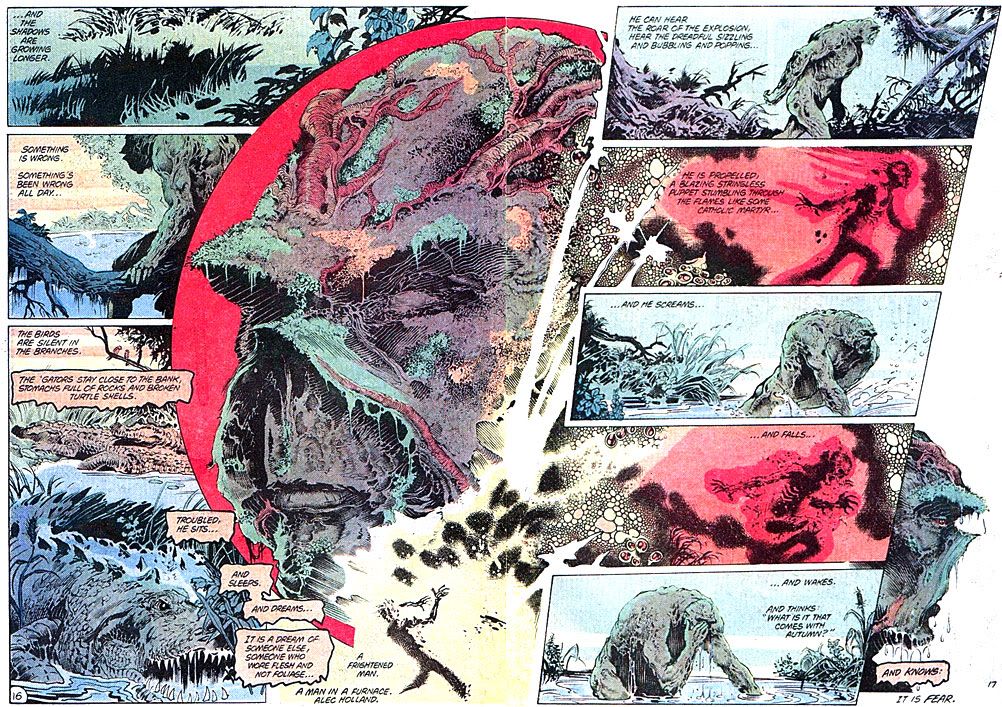
For Swamp Thing, the season cycle isn't merely symbolic; he is now part of it, as he senses-- although his consciousness at this time is still very much over-printed with humanity.  Moore and artists Steve Bissette and John Totleben showcase this in a gorgeous double-page spread, complete with a call-back to Swamp Thing's origin.  I also have to point out how lovely Tatjana Wood's coloring is here; her work complements and enhances the art in a few colorists can match.  Wood was just outstanding throughout this series.


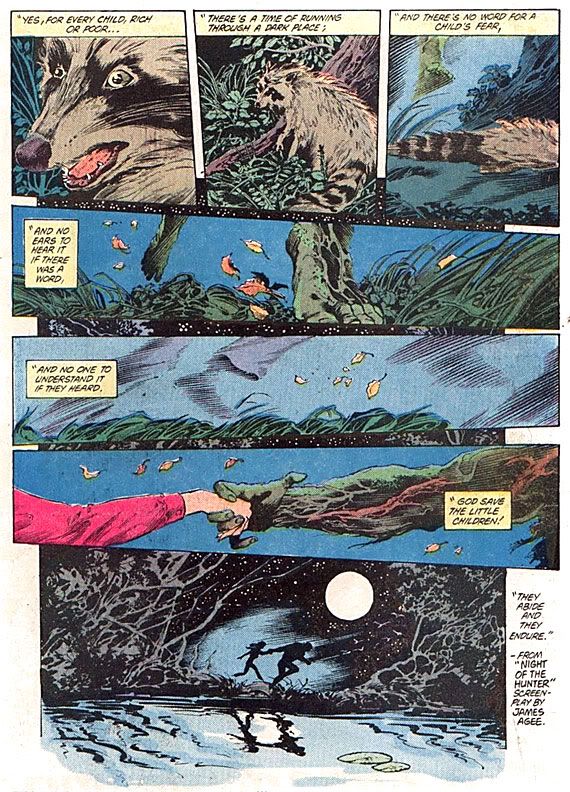
The thing that comes with fall isn't merely fear.  Fear is just its symptom, a rational reaction to the idea of non-existence.  Because what really comes is death.  Or in this case, little spiky monkeys that feed on your worst nightmares.  As Abby and Swamp Thing realize this, they run through the night towards the children's home.  The quote from James Agee's screenplay for Night of the Hunter is evocative, but no more so than the amazing aspect-to-aspect sequence that opens Swamp Thing #26.  Here, Moore, Bissette, Totleben, Rick Veitch, and Wood fully realize the cinematic possibilities of the comic book page.


Well, it functions both as aspect-to-aspect and action-to-action.  With these horizontal panels, there's not much room for the artists to do more than give us fragments of the action in what's almost a collage.  The racoon's appearance is an aspect, but it flees, its final, truncated appearance giving way to a close-up of Swamp Thing's running feet.  The quick cut to Swamp Thing and Abby's hands gives us yet another aspect of the chase, a hint of the attraction growing between them and the desperation of their race.  I love aspect-to-aspect storytelling.  

While it isn't always appropriate-- I'm not sure Superman needs mood as much as he does grandeur-- there just isn't enough of it in mainstream comics.  Action-to-action if fine, but all too often that means punch punch kick.  Actually, with the advent of photorealism and the au courant long horizontal panel (similar to these, but poorly used to frame entire actions), there's not much storytelling of any kind in superhero comics these days, just lovingly rendered static poses, like photographs bereft of context.  Moore is famous for writing massive scripts detailing everything he wants to see in each panel.   When he's on his game, Moore is as close to a film director as you'll find in comics, as attentive to the visuals as he is the story, plot, characterization and dialogue.

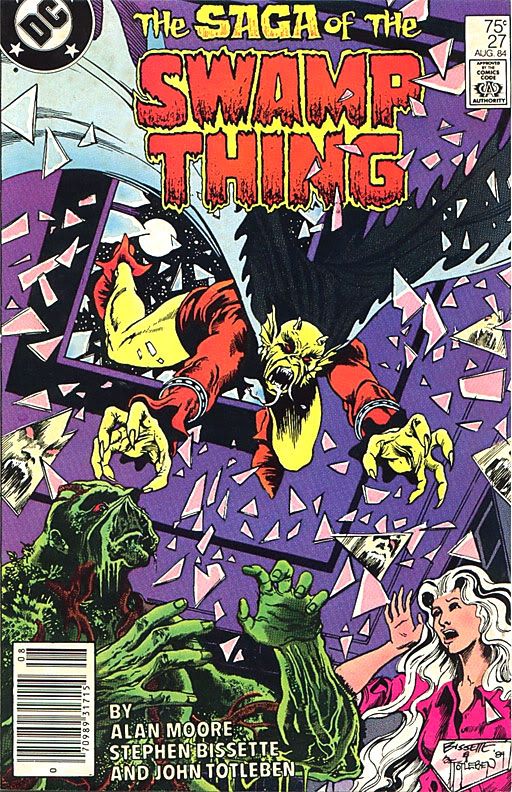
Yeah, yeah, yeah.  Total Moore butt-kissing, right?  Wrong!  You're out of order, the whole system's out of order!  My Al Pacino impression is atrocious and inappropriate here!  Moore can't quite maintain the high level he set for himself during the slow-burning first and second acts.  The let-down comes in the third when Etrigan bursts in and the story turns into a fight scene cliche.  Moore's rhyming dialogue for Etrigan is impressive, but the plot ends anti-climatically.  Hey, you're not so scary after all, you scummy monkey!  It's abrupt and doesn't quite pay off Moore's elaborate set-up.  Etrigan's method of disposing of the monkey is good for a laugh, though.

Moore does redeem #27 with an ominous postscript.  After fighting with Abby, Cable smashes himself to bits in a drunk driving accident, then saves himself-- he thinks-- by making a deal with a talking fly.  It's a gross-out sequence, Cable having knocked out all of his teeth and crushed himself in the mangled steel of his wrecked car.  It's eerie when he appears apparently no worse for wear and we watch him drive Abby into the distance of the last frame, Etrigan's closing narration fraught with foreshadowing.  Swamp Thing and Abby may have re-established order, but it's merely a truce.  It gives them some breathing room-- not that Swamp Thing needs to breath anymore-- before the horrors to come.

We're almost 30 years past this story now, and in all that time, few releases from the major publishers have brought all true possibilities of comics to bear.  Not that there haven't been some great stories, and some fun ones.  It's just that with Swamp Thing, Moore's prose is novelistic, the visuals are vivid, the storytelling all encompassing.  Although it's ultimately something of a let-down, considered as an artifact of it's time, it's amazing Moore and company got away with doing all of this.  There wasn't a contemporary comic at either DC or Marvel that could touch it, not The Uncanny X-Men or the New Teen Titans.  Sure, it's pretentious at times (almost as pretentious as my writing right here in this very entry), and overwrought on occasion, but as you read it, you realize there's still something unprecedented going on-- a creative team juiced on its own brilliance, telling stories that aren't simple rehashes of old comic book ideas, but genuine literary statements unto themselves.  A writer with something to say, artists who can match his vision.

In literature and cinema, you expect these kinds of things, but with a comics, you're left wondering why all of them can't be this good.  And lately, it's a shame people are satisfied with what the big companies dole out, most of which seem a huge step backwards in craft and voice.  Batman still contends with Catwoman, but showing them actually having the sex that used to be merely hinted at isn't some great accomplishment when the story itself is just as tired and familiar and as blandly told as any that have come before it.  The same stakes, the same solutions.  Comics based on other comics, comics as marketing tools for multi-media campaigns, with nothing more to say than, "Look who's hitting whom this month!"

Maybe that's also what comes with fall-- the death of creativity.  That and lots of chocolate candy and caramel corn.  Plus amazing Japanese bubblegum-garage-power-pop-punk like Spookey!