To end our month-long celebration of Halloween, horror comics and all-girl Japanese pop punkers Spookey, here are a couple of stories where Swamp Thing fights that old school monster favorite, the werewolf. Male and female varieties.
The first one, Swamp Thing #4 (May 1973) is by Len Wein and Bernie Wrightson. They lean on the familiar Universal Studios style, setting their tale in the Scottish moors and within a creepy old mansion. Their werewolf is the tragically cursed son of some very worried parents. They're in luck when Matt Cable and Abby Arcane crashland their plane close to their ancestral home, but definitely unlucky in that Swamp Thing is also on board. This means their plans to use Cable's blood to cure their boy of his lycanthropy (and give it to Cable; but isn't this what any concerned parents would do for their child?) is doomed from the start.
While the werewolf on the cover looks more like a satyr to me, inside the comic itself Wrightson uses heavy black silhouetting for its first appearance, which gives his beastie a very Frazetta-ian touch, almost amorphous in the night fog. It's very reminiscent in its first appearance of Frank Frazetta's aptly-titled "Werewolf!" from Creepy #1 (1964). Kind of impressionistic. Shoot, why am I telling you all this when I can just shut my fool mouth and show you? Here:
There is nothing not to like about this comic and its classical approach.
But what a difference a decade makes! We hear a lot of talk about the "curse of the werewolf," and writer Alan Moore and his merry art crew of Steve Bissette and John Totleben set out to explore what this means both literally and metaphorically-- because there's also this other monthly thing sometimes referred to as a curse.
In Swamp Thing
#40 (September 1985), Brit Moore unspools an episode in "American Gothic," an extended story arc where Swamp Thing battles traditional horror creatures suffused darker elements of the United States' national narrative-- the unintended consequences of progress, the preponderance of gun violence, the genocide of Native Americans and the lingering effects of slavery and the Civil War. This time, perennial fan favorite character John Constantine pits Swamp Thing against something more personal-- the perpetual state of war between the genders, specifically the daily battles waged by a typically American suburban couple.
As with the Len Wein-Bernie Wrightson werewolf tale, "The Curse" is very concerned with blood. It's just Moore is interested in a deeper exploration of this sanguine symbolism. Our werewolf this time is a modern woman so empathetic to the anger and resentment felt by long-ago Pennamaquot tribeswomen sequestered in a special lodge (she and her husband live in a house built on the site) while they menstruate she turns into a massive wolf creature and goes on a rampage. Male privilege has finally loosed a beast, and after a brief fight, Swamp Thing comes to as much of an understanding of the woman's plight as a male-gendered plant elemental can.
Tragically, our tragic werewolf is a stand-in for all of womankind, so she learns there's another aspect to this blood curse-- women are bound by it to men and vice versa. As a result, she cannot bring herself to kill her husband (even though she contemptuously notes he's "soiled himself" from fear). Giving in completely to her primal, savage anger, she crashes through the front window of a pornography shop where a customer has just asked the cashier to show him something he euphemistically refers to as more "unusual." Perhaps as a matter of tastefulness, we aren't permitted to see the resulting carnage. In the end, Swamp Thing cannot offer succor and the werewolf impales herself on the knives in a supermarket display, ironically labeled, "Here's good news for housewives!" The supermarket setting itself represents the sterilizing effect consumerism has on our lives and its place in the continuing subjugation of female power, having been referenced satirically in the same vein by Ira Levin's 1972 novel The Stepford Wives and its 1975 film adaptation.
And with our tale of two lycanthropes, we bring this year's Spookey Month to a close!
Showing posts with label Alan Moore. Show all posts
Friday, November 1, 2013
Friday, June 28, 2013
A look back with Swamp Thing: Careful! Scientists at work!
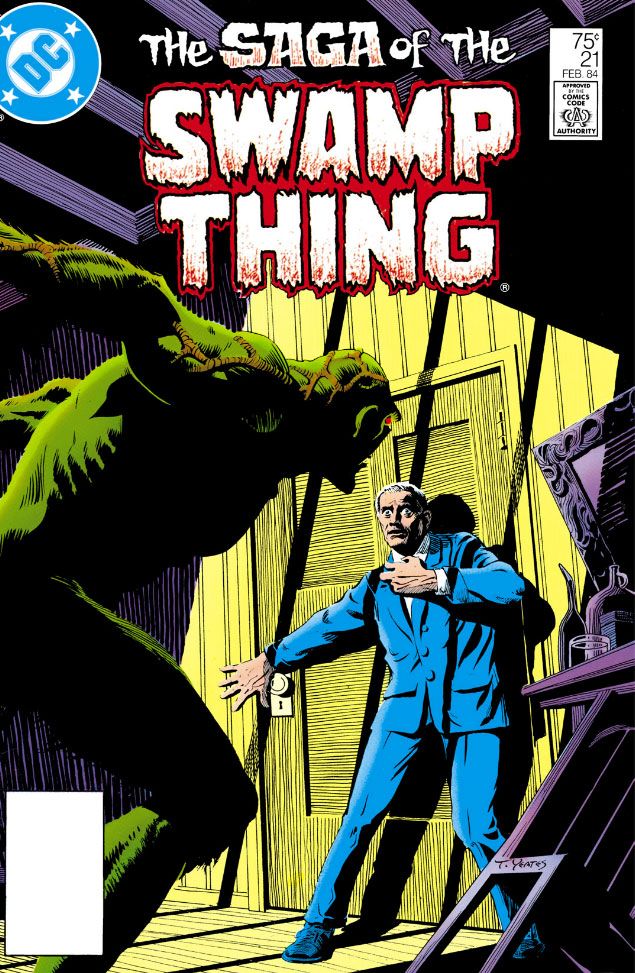
The Saga of the Swamp Thing #21 (February 1984), huh? This is where our old pal Alan Moore made his American reputation by doing that Alan Moore thing of taking a previously existing character, picking it apart and figuring out what it's all about, then putting it back together in a startling new configuration. Figuring out those implications previous writers either hadn't considered or considered and didn't know how to deal with. Which character am I talking about? General Avery Carlton Sunderland, CEO of the Sunderland Corporation.
Just joking. Sunderland was a bastard before this issue and he continues being a bastard all through it. But Moore had Sunderland make a little suggestion that got me to thinking about Alec and Linda Holland and just what kind of scientists they were.
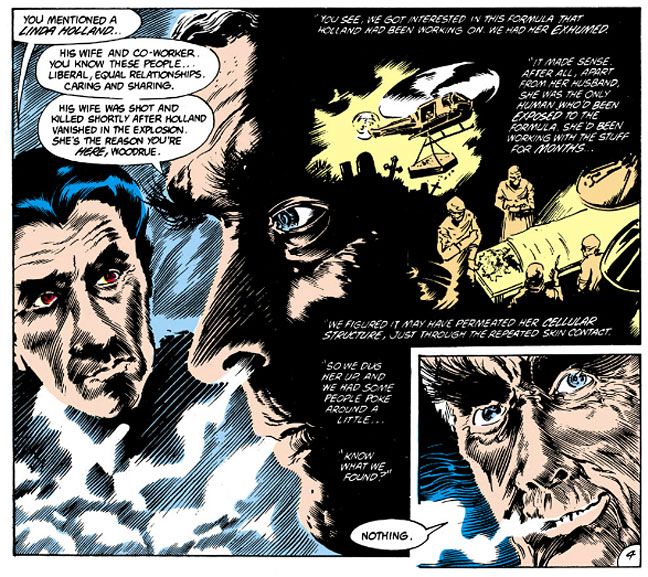
Introduced by Martin Pasko and Tom Yeates way back in The Saga of the Swamp Thing #6 (October 1982), Sunderland bedevils the hell out of Swamp Thing and his friends. Somewhere along the way, Sunderland became interested in the biorestorative formula Alec and Linda Holland were working on-- the one that led to their deaths and the creation of Swamp Thing. Conventional wisdom at the time said Alec Holland's cells were saturated with the formula by a lab explosion and this is what transformed him into a plant creature when his burned body fell into the biologically-rich environment of the swamp. Since Swamp Thing is a little difficult to come by in order to gain a sample of the formula, Sunderland goes to another source and has Linda Holland's body exhumed and examined. His researchers find the formula "had collected in her body as well."
People's bodies pick up chemicals all the time from their environment. If you work around toxins (for example, at an asbestos manufacturer or for the Kardashians), you take precautions, but there's always a risk you're going to introduce into your system dangerous chemicals. And even if you don't, you may be highly exposed to substances you've never imagined right now simply due to your lifestyle.
Both Hollands knew the hazards of working with chemicals-- you treat any chemical as potentially dangerous and attempt to limit your exposure; I've had to read OSHA forms just to work with photocopiers-- and would have taken at least basic precautions. And even if they considered the chemicals completely safe, they would be concerned about contaminating their work. At the very least they would have worn goggles, smocks and gloves. If the chemicals were toxic enough, they would have worn respirators or air-tight suits. And if the substances were even more dangerous than that, the Hollands would have worked from behind protective glass of some kind. But apparently, all of this was just not enough.
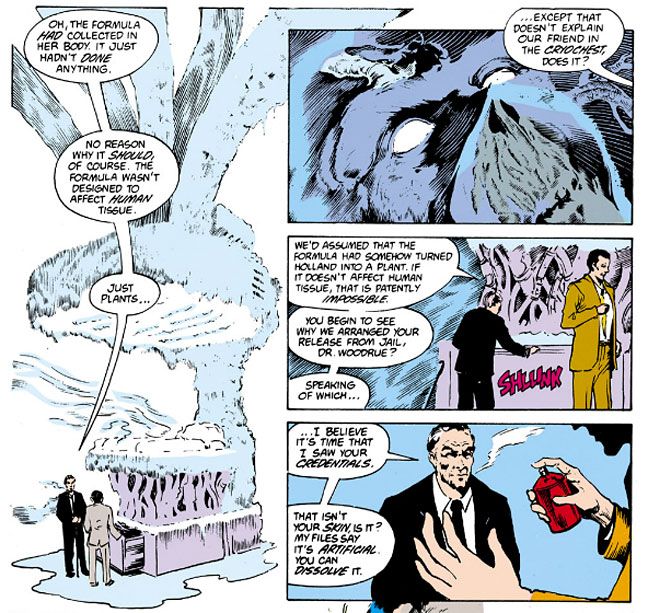
And it lead to tragedy. That aforementioned conventional wisdom-- what Sunderland and associates are operating under as this story begins-- states the formula transformed Holland. Moore quickly disposes of this by having Sunderland remark there was no reason the formula would have affected Linda or, by extension, Alec. It doesn't matter that Alec underwent a violent chemical reaction involving large amounts of the formula or that Linda had some in her cells as well when she was merely shot, embalmed and buried. Their magic formula wasn't designed to work on human or animal tissue, only plant. This sets up a major revelation partway through this issue, one that changes almost everything about Swamp Thing. However Swamp Thing emerged, the central tragedy of this doomed couple always comes back to the biorestorative formula they worked so hard to create in hopes of feeding a hungry world.
And because Sunderland's piqued my curiosity, I'm wondering just how much of the biorestorative formula Linda's body contained. Can we find out? Of course. Maybe not the exact amount, but we can at least make a rough estimate by engaging in a little time travel, a power unfortunately denied all the poop heads working for King Hell Poophead General Sunderland.
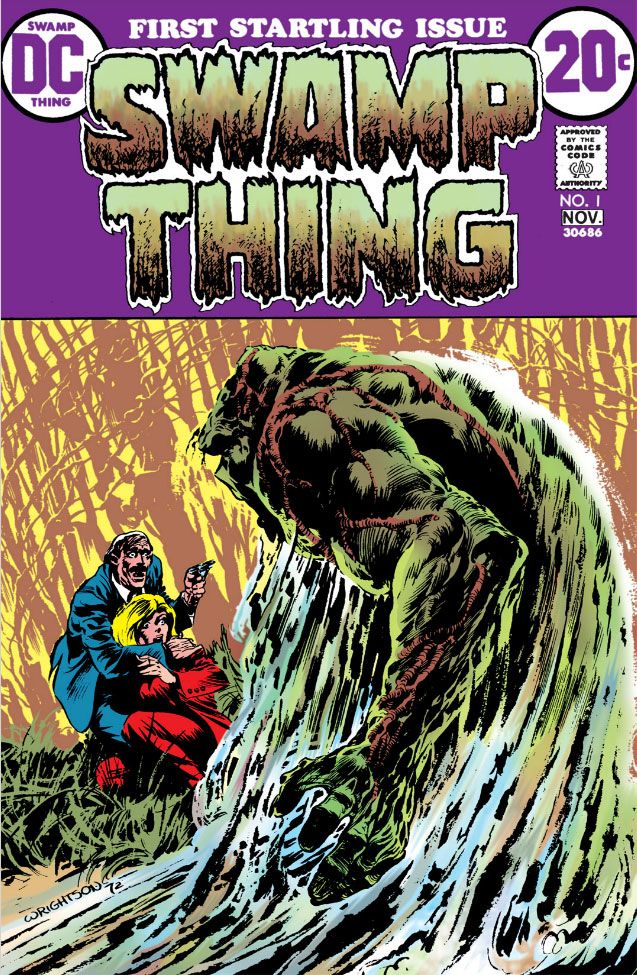
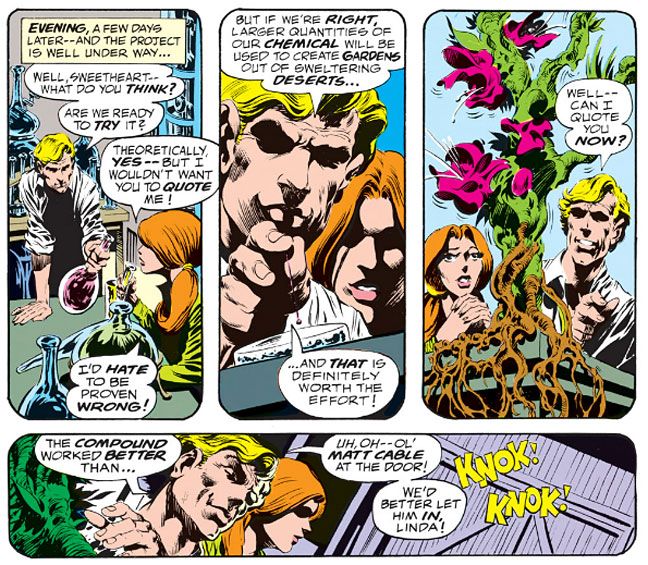
So let's journey back to November 1972 and look at Swamp Thing #1 by Len Wein and Bernie Wrightson. Before we see what conditions the Hollands operated under, allow me to point out just how stupid it was of the government to put the two of them out in a swamp in the first place... for security purposes. The government was so worried about the biorestorative formula falling into the wrong hands, they sent its creators to an easily-accessed farm house in a remote swamp and then protected them with a single police car. In the DC universe, the Manhattan Project took place at a Mardi Gras party in New Orleans.
Okay, now lets see how these two genius smarty brain people carry out their research. Wrightson probably drew a ton of cool-looking safet-- GOOD LORD! Look at that!
They may have gotten results, but clearly the Hollands were an accident waiting to happen. I'm surprised they didn't just eat or drink the stuff-- give it a grape flavor, add carbonation and throw themselves a Biorestorative Soda love-in on live television. Now I'm thinking Linda Holland had LOTS of this junk in her system. And when you think about all the fungi and microscopic plant life the human body contains--
It's probably just as well Alan Moore didn't put much thought into those gruesome possibilities!
Just joking. Sunderland was a bastard before this issue and he continues being a bastard all through it. But Moore had Sunderland make a little suggestion that got me to thinking about Alec and Linda Holland and just what kind of scientists they were.
Introduced by Martin Pasko and Tom Yeates way back in The Saga of the Swamp Thing #6 (October 1982), Sunderland bedevils the hell out of Swamp Thing and his friends. Somewhere along the way, Sunderland became interested in the biorestorative formula Alec and Linda Holland were working on-- the one that led to their deaths and the creation of Swamp Thing. Conventional wisdom at the time said Alec Holland's cells were saturated with the formula by a lab explosion and this is what transformed him into a plant creature when his burned body fell into the biologically-rich environment of the swamp. Since Swamp Thing is a little difficult to come by in order to gain a sample of the formula, Sunderland goes to another source and has Linda Holland's body exhumed and examined. His researchers find the formula "had collected in her body as well."
People's bodies pick up chemicals all the time from their environment. If you work around toxins (for example, at an asbestos manufacturer or for the Kardashians), you take precautions, but there's always a risk you're going to introduce into your system dangerous chemicals. And even if you don't, you may be highly exposed to substances you've never imagined right now simply due to your lifestyle.
Both Hollands knew the hazards of working with chemicals-- you treat any chemical as potentially dangerous and attempt to limit your exposure; I've had to read OSHA forms just to work with photocopiers-- and would have taken at least basic precautions. And even if they considered the chemicals completely safe, they would be concerned about contaminating their work. At the very least they would have worn goggles, smocks and gloves. If the chemicals were toxic enough, they would have worn respirators or air-tight suits. And if the substances were even more dangerous than that, the Hollands would have worked from behind protective glass of some kind. But apparently, all of this was just not enough.
And it lead to tragedy. That aforementioned conventional wisdom-- what Sunderland and associates are operating under as this story begins-- states the formula transformed Holland. Moore quickly disposes of this by having Sunderland remark there was no reason the formula would have affected Linda or, by extension, Alec. It doesn't matter that Alec underwent a violent chemical reaction involving large amounts of the formula or that Linda had some in her cells as well when she was merely shot, embalmed and buried. Their magic formula wasn't designed to work on human or animal tissue, only plant. This sets up a major revelation partway through this issue, one that changes almost everything about Swamp Thing. However Swamp Thing emerged, the central tragedy of this doomed couple always comes back to the biorestorative formula they worked so hard to create in hopes of feeding a hungry world.
And because Sunderland's piqued my curiosity, I'm wondering just how much of the biorestorative formula Linda's body contained. Can we find out? Of course. Maybe not the exact amount, but we can at least make a rough estimate by engaging in a little time travel, a power unfortunately denied all the poop heads working for King Hell Poophead General Sunderland.
So let's journey back to November 1972 and look at Swamp Thing #1 by Len Wein and Bernie Wrightson. Before we see what conditions the Hollands operated under, allow me to point out just how stupid it was of the government to put the two of them out in a swamp in the first place... for security purposes. The government was so worried about the biorestorative formula falling into the wrong hands, they sent its creators to an easily-accessed farm house in a remote swamp and then protected them with a single police car. In the DC universe, the Manhattan Project took place at a Mardi Gras party in New Orleans.
Okay, now lets see how these two genius smarty brain people carry out their research. Wrightson probably drew a ton of cool-looking safet-- GOOD LORD! Look at that!
It's probably just as well Alan Moore didn't put much thought into those gruesome possibilities!
Tuesday, October 30, 2012
October is Spookey Month: Remember when Swamp Thing visited the Winchester Mystery House?
"Bang. Bang. Bang."
You don't remember? How about the time Swamp Thing visited the Cambridge Mystery House, the DC universe version of the same place? Rings a bell, huh? Bangs a nail. Hammers and all that. The Winchester Mystery House is a fascinating place, the life's work of Sarah Winchester, widow of William Winchester and heiress to the Winchester Repeating Arms fortune. Somehow she took it in her head spirits would kill her if she ever completed the mansion where she lived, so construction went on around the clock for nearly 38 years until Mrs. Winchester's death in 1924. Mrs. Winchester was a little eccentric (according to the Winchester House's official website, some of her employees actually thought she herself had supernatural powers), obsessed with the number 13, and her house is equally... er... original. Stairs to nowhere, fake bathrooms, windows on the inside, liberal use of redwood because Mrs. Winchester preferred it-- although it all had to be stained or painted to look like some other kind of wood because she hated its appearance. Given the house's origins and bizarre interior, it's no wonder the Winchester Mystery House has a reputation as a haunted mansion.
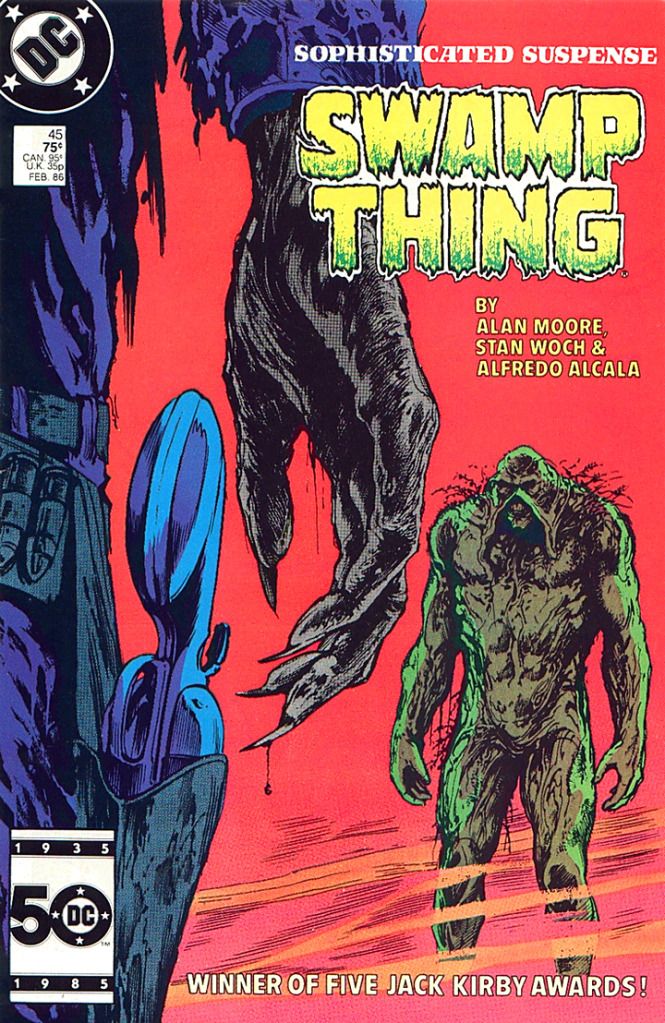
Alan Moore puts the Winchester lore to good use in "Ghost Dance" from Swamp Thing #45 (February 1986) with the help of some evocative art by Stan Woch and Alfredo Alcala. A group of friends enter the dilapidated Cambridge House for a laugh while the reedy, Howard Sprague-with-red-hair-looking one (he proves to be as cuckolded as Jack Dodson's character in The Getaway, as well) explains the backstory, which Moore takes directly from the Winchester House. One character even namechecks the real-life inspiration in case you had any doubts, and the NRA bumper sticker displayed on their car provides a visual clue that we're in for a lecture wrapped inside a horror yarn, one with obvious intent and an anti-gun-- or at least, anti-gun violence-- point of view, but a touch more subtle than the "Nuke-Face" environmental tale from Swamp Thing #35 and #36 (April and May 1985) with its pages full of newspaper-based collages.
This was during one of my favorite Swamp Thing story arcs, in which John Constantine, the British mystic based on Sting, takes Swamp Thing around the world to stop a rising tide of supernatural events culminating in... you guessed it... the end of the world. Moore uses this premise to explore horror mythology, but with his characteristic brilliant improvisations on familiar material. Swamp Thing fights vampires, but they're underwater. He tangles with a werewolf, but it's a woman and a commentary on our patriarchal society. In this issue, Constantine has Swamp Thing facing down the Cambridge ghosts.
And just what are these ghosts? Apparently, they're everyone in North America who ever died from a bullet fired from a gun or rifle manufactured by Cambridge Arms. Dead cowboys blast away at each other in the seance room (Mrs. Winchester would approve of its thirteen Victorian fireplaces), bullets whittling them both down to next to nothing while their battle rages all night. Little girls, murdered on Christmas Day by their father, walk innocently through the spectral carnage, their wounds like red ribbons in their hair. Buffalo stampede from a free-standing wardrobe, apparently all the way from Gunpowder Narnia. Cowards linger in the kitchens, shamed, faces hidden in hands, each back stamped with the red badge of fear. One especially tragic note comes when the narration points out what percentage of the ghosts are Native Americans.
"Ghost Dance" is a melancholy look at our capacity for violence and the tool that truly built our modern American society even more so than the car, the train or the rocket to the moon, as evidenced by Moore's repetition of the phrase, "The sound of hammers must never stop," fraught with double meaning. Guns, the love of guns and gun violence are so engrained in the American psyche, we can't even have a rational discussion about them no matter how many bodies pile up. Moore, though this fiction, might argue the victims wind up in a Mystery House of the American soul, a haunted mansion we're all still guiltily building just like Sarah Winchester and her fictional analogue Amy Cambridge, even as the sound of hammers continues to ring from coast to coast.
They have never stopped.
You don't remember? How about the time Swamp Thing visited the Cambridge Mystery House, the DC universe version of the same place? Rings a bell, huh? Bangs a nail. Hammers and all that. The Winchester Mystery House is a fascinating place, the life's work of Sarah Winchester, widow of William Winchester and heiress to the Winchester Repeating Arms fortune. Somehow she took it in her head spirits would kill her if she ever completed the mansion where she lived, so construction went on around the clock for nearly 38 years until Mrs. Winchester's death in 1924. Mrs. Winchester was a little eccentric (according to the Winchester House's official website, some of her employees actually thought she herself had supernatural powers), obsessed with the number 13, and her house is equally... er... original. Stairs to nowhere, fake bathrooms, windows on the inside, liberal use of redwood because Mrs. Winchester preferred it-- although it all had to be stained or painted to look like some other kind of wood because she hated its appearance. Given the house's origins and bizarre interior, it's no wonder the Winchester Mystery House has a reputation as a haunted mansion.
Alan Moore puts the Winchester lore to good use in "Ghost Dance" from Swamp Thing #45 (February 1986) with the help of some evocative art by Stan Woch and Alfredo Alcala. A group of friends enter the dilapidated Cambridge House for a laugh while the reedy, Howard Sprague-with-red-hair-looking one (he proves to be as cuckolded as Jack Dodson's character in The Getaway, as well) explains the backstory, which Moore takes directly from the Winchester House. One character even namechecks the real-life inspiration in case you had any doubts, and the NRA bumper sticker displayed on their car provides a visual clue that we're in for a lecture wrapped inside a horror yarn, one with obvious intent and an anti-gun-- or at least, anti-gun violence-- point of view, but a touch more subtle than the "Nuke-Face" environmental tale from Swamp Thing #35 and #36 (April and May 1985) with its pages full of newspaper-based collages.
This was during one of my favorite Swamp Thing story arcs, in which John Constantine, the British mystic based on Sting, takes Swamp Thing around the world to stop a rising tide of supernatural events culminating in... you guessed it... the end of the world. Moore uses this premise to explore horror mythology, but with his characteristic brilliant improvisations on familiar material. Swamp Thing fights vampires, but they're underwater. He tangles with a werewolf, but it's a woman and a commentary on our patriarchal society. In this issue, Constantine has Swamp Thing facing down the Cambridge ghosts.
And just what are these ghosts? Apparently, they're everyone in North America who ever died from a bullet fired from a gun or rifle manufactured by Cambridge Arms. Dead cowboys blast away at each other in the seance room (Mrs. Winchester would approve of its thirteen Victorian fireplaces), bullets whittling them both down to next to nothing while their battle rages all night. Little girls, murdered on Christmas Day by their father, walk innocently through the spectral carnage, their wounds like red ribbons in their hair. Buffalo stampede from a free-standing wardrobe, apparently all the way from Gunpowder Narnia. Cowards linger in the kitchens, shamed, faces hidden in hands, each back stamped with the red badge of fear. One especially tragic note comes when the narration points out what percentage of the ghosts are Native Americans.
"Ghost Dance" is a melancholy look at our capacity for violence and the tool that truly built our modern American society even more so than the car, the train or the rocket to the moon, as evidenced by Moore's repetition of the phrase, "The sound of hammers must never stop," fraught with double meaning. Guns, the love of guns and gun violence are so engrained in the American psyche, we can't even have a rational discussion about them no matter how many bodies pile up. Moore, though this fiction, might argue the victims wind up in a Mystery House of the American soul, a haunted mansion we're all still guiltily building just like Sarah Winchester and her fictional analogue Amy Cambridge, even as the sound of hammers continues to ring from coast to coast.
They have never stopped.
Saturday, July 28, 2012
Wednesday, February 29, 2012
The Black Queen of Sogo-- Barbarella's Enemy!
| Stab on, Slupe/Slupe, stab on... |
Barbarella was kind of amusing but even in our chemically-altered state we found it far less decadent than we'd been led to expect. Despite the infamous scene where Barbarella's inexhaustible sexual energy burns out a machine designed to orgasm her to death, these days it's practically tame, hardly even as risque as 1980's Flash Gordon where Ornella Muti wears a skirt slit all the way up... to... there...
Why am I telling you all this? Because this weekend I got on one of my Swingin' Sixties kicks and decided to watch the last scene of Barbarella on YouTube. I've always liked the last little exchange between Fonda and John Phillip Law as they fly into the credits. The last lines of Barbarella are cleverer than the entirety of most sci-fi movies these days-- the Star Wars prequels don't contain a single memorable line through six or so tedious, joyless hours-- and it's possible to enjoy even the seams in it when they show and its retrograde sexual revolution nonsense later spoofed by Mike Myers in his international man of mystery flicks.
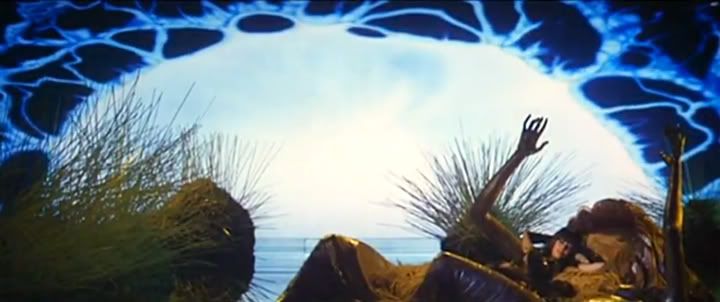
| The movie version! |
So off I scampered to YouTube to get my fix...
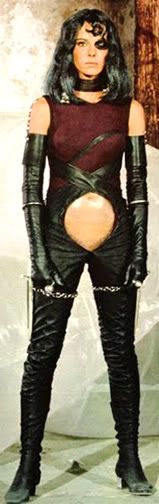
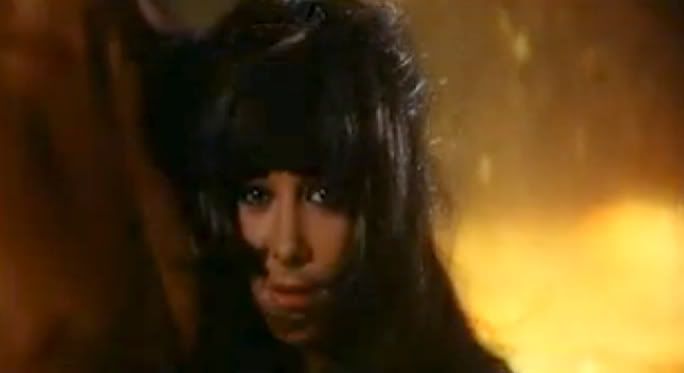
And damned if I wasn't suddenly struck by the thunderbolt that is Anita Pallenberg as the Great Tyrant. As a movie trivia buff, I'd known this but I suppose it had never registered before now. Like the character she portrays, Pallenberg was some kind of formidable woman back in the day. She was born in Italy to German-Italian parents, spoke four languages as a child, studied medicine and graphic design, became a model, an actor, a musician, lover to Rolling Stone Brian Jones. Later she definitely some children with Keith Richards and supposedly had an affair with Mick Jagger. I've also heard she was very into Black Magic, so it's no wonder Jennifer Saunders tapped her to play the Devil opposite Marianne Faithfull's God in an episode of Absolutely Fabulous Then there was the incident in which she had to be cleared of manslaughter charges. She's almost 70 now, younger than my mom but looks ten or even twenty years older.
| Kind of makes me like tyranny... |
Pallenberg was only 23 or 24 when she played the Great Tyrant and when she smiles her face takes on a freshness-- an adorable quality even-- that belies both the character's nastiness and her own reputation. And the frequently idiotic costumes, like the one where they strap a horn to her forehead. Oh, and also the somewhat haggard overdubbed voice they stick her with. I don't know what Pallenberg's own voice sounded like at the time. Was it wispy and too girly for the Black Queen, or was she just not much for line readings? A sweet-voiced villain might have been interesting, especially contrasted along with that smile against the character's depravity.
| Sweet dreams in Studio 27. |
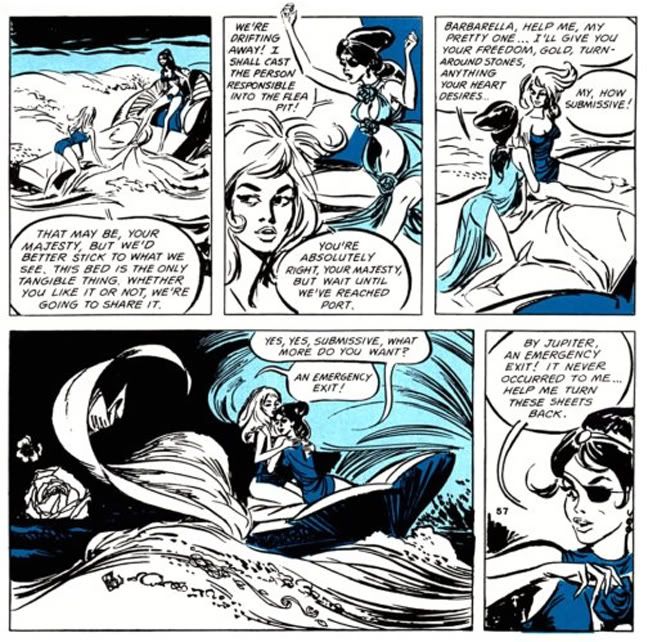
| The Queen isn't friends with it the way she is in the movie. |
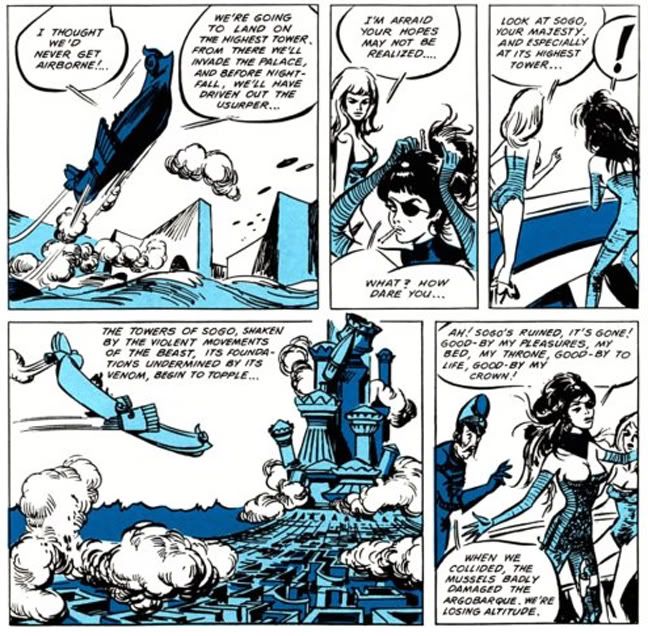
Continuing on her way, Barbarella runs into a couple of creepy "beggers." They intend to do her harm, but a petite one-eyed woman in a skintight black bodysuit stabs them from behind, then tries to put some serious moves on Barbarella herself, despite only speaking broken English. Making her way to the palace, Barbarella gets involved in a revolt and learns her wicked little savior is actually the Queen herself. The Queen throws Barbarella into a giant birdcage where the birds conveniently peck off most of her clothes.
Barbarella learns the evil Queen has her own problems-- when she isn't coming up with new forms of perversion and torturing angels to "extend the frontiers of human pleasure," she's suffering from remorse-driven insomnia. She's like a one-eyed female Caligula. After a busy day making his horse Incitatus consul, torturing prisoners to death, spoofing religious rites, having sex with noblemen's wives right in front of them and dressing up like Venus, Caligula would spend a sleepless night wandering his palace inviting the moon to come to bed with him. Supposedly.
| She just wants to be friends! |
And like both those emperors the Queen has her enemies. Barbarella is one, for righteous reasons, and even her own palace locksmith is completely fine with allowing Barbarella into the Queen's secret room of dreams to assassinate her. He betrays Barbarella as well. He locks her in with the helpless Queen as the deadly dream energy swirls. Waking, the Queen begs Barbarella to save her in exchange for submissive sex. Barbarella turns her down for the second time and they escape through a secret passageway in the Queen's bed.
But this little episode merely showcases one of the major flaws of being evil-- you attract other evil people as your followers and you can never trust them. I don't believe in this concept of evil. Usually the things we end up declaring evil take the form of groups of people convinced of their own virtue. The Nazis were the good guys in their own minds, terrorists of whatever stripe either political or religious feel their murders will improve the world somehow. Only in comic books and movies like Star Wars do we find antagonists who consciously embrace evil, and it almost always blows up in their faces. Sometimes that's even an intrinsic part of the evil system they follow. What Sith Lord hasn't been murdered by his apprentice?
| You can't always get what you want... |
Oh, but she does have Pygar down there with his wings pinioned to what appears to be a giant bowling ball. For some reason, the Queen is especially proud of this detail, but it only succeeds in finally pissing off Barbarella, who attacks her, takes her prisoner and frees Pygar.
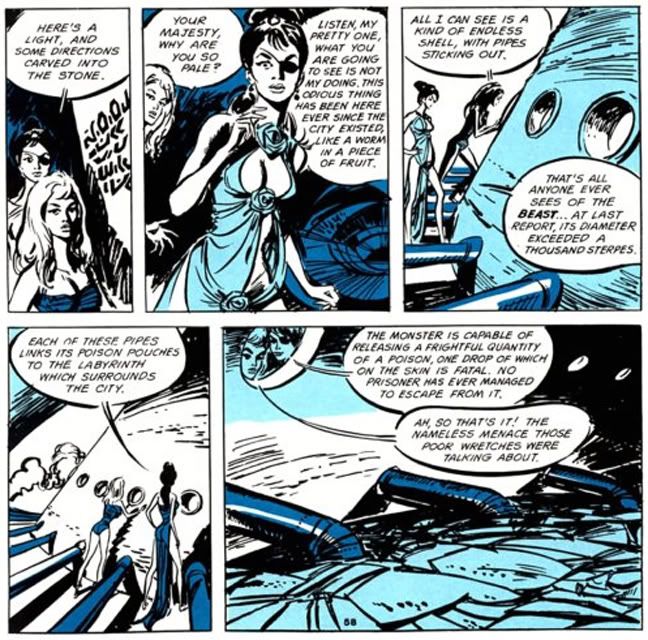
The threesome flies off into the labyrinth only to crash. Barbarella and Pygar reunite with Durand and all hell breaks loose. It seems some idiot-- the obvious suspect is the crazed Queen-- has let loose the watery monster and it's angrily poisoning everyone as it washes through the city and the labyrinth. Trapped, Barbarella and friends engage the city guards in a brief fight before the Queen shows up in what appears to be a flying Venetian gondola. Stepping out of it onto the rampart where the survivors wait, the Queen happily greets them. See, she really likes Barbarella. It's not just sexual attraction but a genuine fondness.
"Barbarella, my pet," the Queen says, cheerfully waving. "I was sure I'd find you safe and sound!"
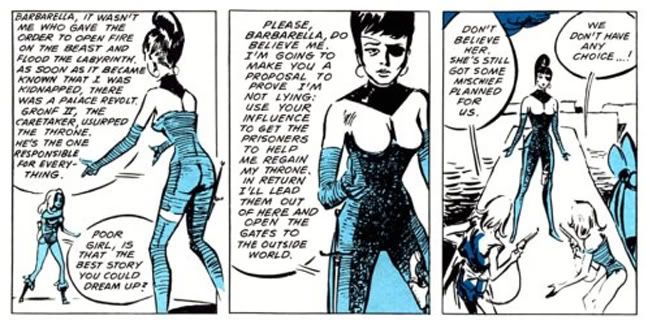
Still miffed by the Queen's mistreatment of Pygar and completely outraged by the wanton destruction of life and property she's now witnessing, Barbarella's ready to finish her off-- "What nerve she has coming here! I'm going to disembowel her," our hero growls-- but the Queen explains this latest madness isn't her doing it all. In fact, although she politely declines to say so, it's kind of Barbarella's fault. Believing the Queen kidnapped by Barbarella, Gronf II, the "caretaker," chose to take advantage of the power vacuum by leading a palace revolt. Then he stupidly unleashed the beast. What a total jerk!
The Queen enlists Barbarella and Pygar to help her take back her throne, but it's too late. Even her mighty palace has collapsed. Beaten, the Queen laments, "Ah! Sogo's ruined, it's gone! Good-by my pleasures, my bed, my throne, good-by to life, good-by my crown!" She declares her end fitting, as "the queen cannot outlive her city" and prepares herself as her flying boat falls from the sky towards the deadly waters.
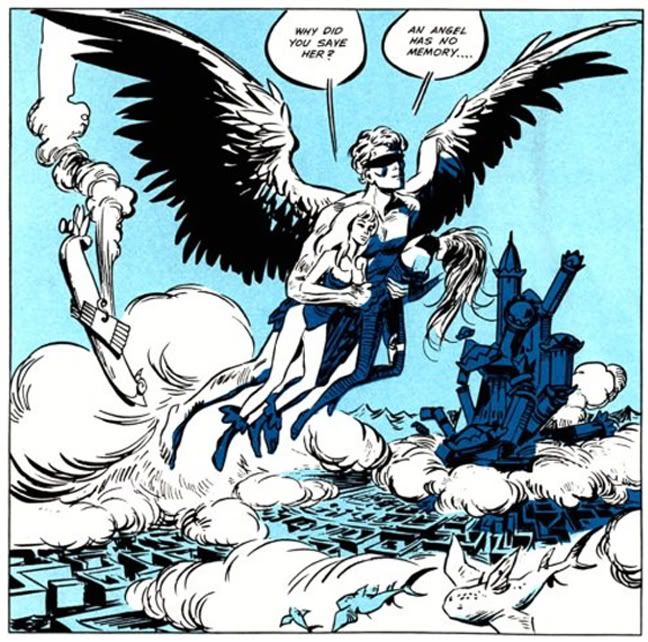
Barbarella turns to Pygar as her last hope and the angel flies her to safety. But he also takes the Queen, who hangs from his arm like a limp doll. Barbarella asks him why he saved her, and Pygar tells her, "An angel has no memory," and Sogo-- like Edgar Allen Poe's House of Usher-- consumes itself.
Like anyone adapting a comic, Vadim made a lot of changes great and small in the story. Durand-Durand becomes a villain, the Queen owns her evil a bit more, being linked to and gaining power from the Matmos beneath her palace rather than somewhat frightened by it. She puts some moves on Pygar in the movie and even dreams of him in her secret chamber, while in the comic she's more into Barbarella and just sort of offhandedly disposes of the angel.
| It's true. We don't. |
Forest makes it quite terrifying, the queen's one attempt at executing her enemy, but in live action it's just Durand-Durand's way of torturing Barbarella for the audience's supposed titillation and to pad the film's running time. It appears vaguely Hitchcockian, like the clumsier moments of The Birds, but without the Master's touch to make it work anyway. While a number of sequences threaten her dignity-- scantily-clad Barbarella spends a great deal of time being tied up-- Fonda usually pulls through by relying on Barbarella's essential positive outlook. She cries for help when things get too bad, but mostly she just seems unfazed by all the insanity. Unfortunately, in the bird cage Fonda only looks ridiculous lying there pretending to be distressed while colorful birds flutter around playfully, completely sans aggression. Plus, she's already been pecked or bitten by tiny dolls once before in the movie; twice is gratuitous even by Barbarella's standards.
But here's the most important thing. Instead of dangling almost comatose from Pygar's arms with her hair in disarray and her face turned from us in abject defeat the way her comic avatar does, despite being measurably a worse person, the Black Queen of the movie gets to look directly into the camera with a kind of enigmatically pleased expression. Sure, she's ruined, but it makes one think she's already plotting a phoenix-like return to power. Or perhaps it's simply the afterglow from some well-played destruction. As played by Pallenberg, the Black Queen will never know true defeat. Fonda's Barbarella can only look on her persistent rival in dismay.
| The look of love... |
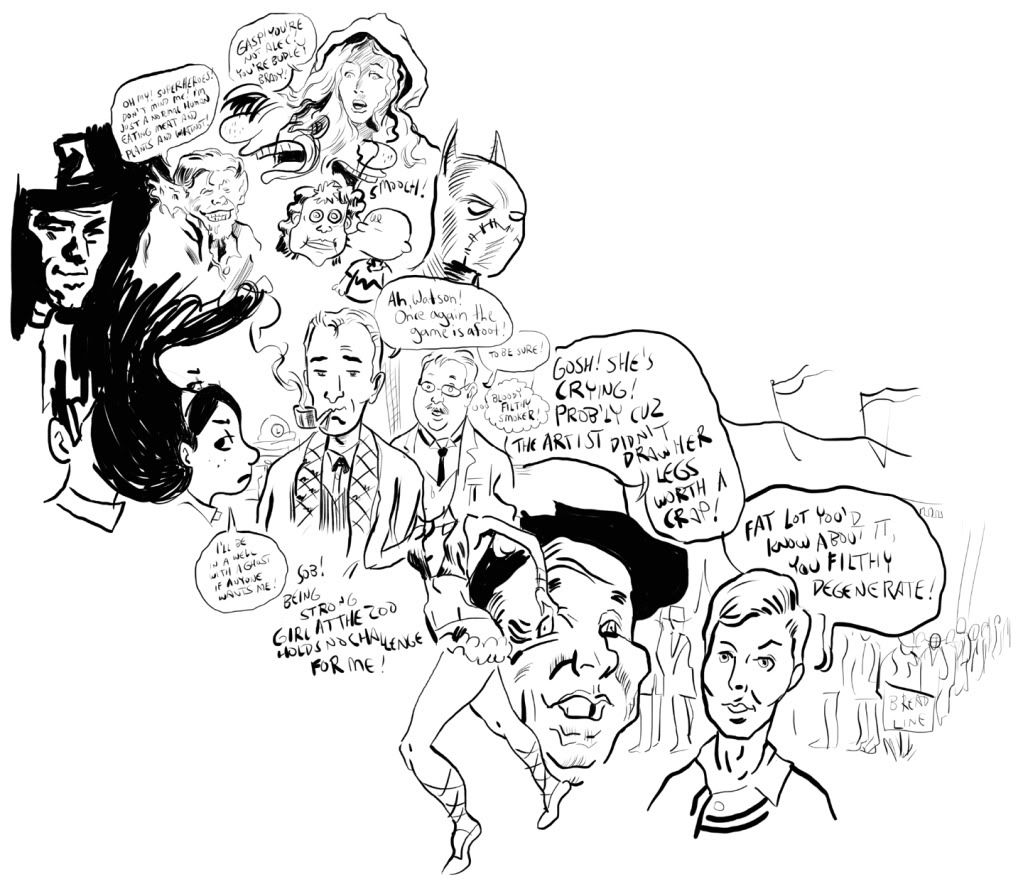
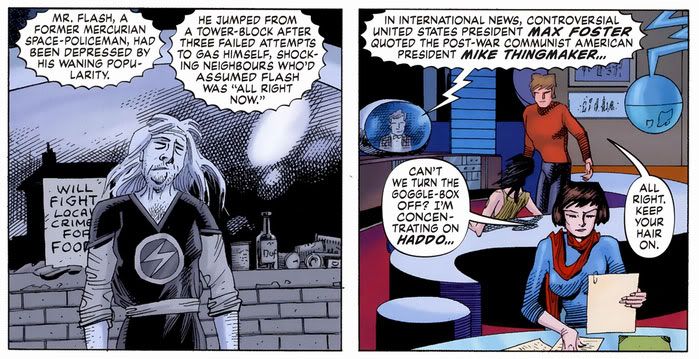
Speaking of... I need to re-read League of Extraordinary Gentlemen: Century #2 - 1969 to see if there are any Pallenberg references. This is the kind of thread-chasing I enjoy. The story opens with a riff on Brian Jones's death, so it just seems natural Alan Moore and Kevin O'Neill would do something with his lover or at least her 1960s image as a kind of real-life Black Queen of Sogo. If not, what a missed opportunity. Then again, she could probably consume the League in less than a page and put that Moon Child to rout. She probably would have cooked the damned thing in a spoon and injected him into her veins.
Wednesday, February 8, 2012
Things I, as a comics blogger, must have an opinion about: DC's Watchmen prequel comics and a pro-Kirby boycott!
Watchmen Prequels
Is Watchmen a sacrosanct text? Maybe, if your frame of reference consists entirely of comic books and graphic novels. Or you just like to get pissed off about things. This is the Internet; that's what we do here. Watchmen is a great book, a fantastic achievement in fiction, but I don't think it's any more untouchable than Catch-22-- one of the most influential novels of the 20th century on impressionable undergrads. Author Joseph Heller went one step beyond and produced a yawn-worthy and largely unnecessary sequel to it, Closing Time.
I rank Watchmen ahead of Mario Puzo's The Godfather as a work of art, yet Francis Ford Coppola adapted that into a classic movie... with an equally-classic sequel. All we got from Watchmen was that shitty Zack Snyder thing. And go ask Michael Winegardner and the suits at Random House if Puzo left anything unsaid about his characters and their lives. For that matter, consult Alexandra Ripley and Warner Books about Scarlett O'Hara and Rhett Butler.
So while I believe Watchmen makes a definitive statement then gracefully ends-- a rarity in American comics where characters are nothing more than trademarked entities to be endlessly recycled-- and even though the word "sequel" only makes me slightly less queasy than the word "prequel," DC's decision to expand the story is genius of a sort. We're talking about it, people will probably buy it and I have to admit the idea of seeing some Adam Hughes sequential artwork has me drooling like a contented baby. I'm not big on either Brian Azzarello or J. Michael Straczynski, but Len Wein has never wronged me and I'm starting to warm up to Lee Bermejo's artwork.
The best thing to do if you don't want more Watchmen is just to ignore the prequels. Then there's no way they can sully the original for you. Especially if your first name isn't Alan and your last name isn't Moore. Moore does have a point about DC being "dependent on ideas [he] had 25 years ago." Speaking of dependent on other people's ideas...
Jack Kirby Boycott
I was going to skip The Avengers anyway, because it takes more than sticking a red white and blue suit on some actor and calling him Captain America to interest me in a film even if you toss in Robert Downey, Jr., Mark Ruffalo (their first work together since Zodiac!) and Samuel L. Jackson. Iron Man was a pleasant surprise and both The Dark Knight and Spider-Man 2 are genre classics.
The rest have been mediocrities at best and most of them have been outright stinkers. Fantastic Four movies, I'm looking at you and your bombastically fakey action sequences, over-abundance of lame humor and crass product placement. Daredevil? Ghost Rider? Thor? X-Men Origins: Wolverine? Kick-Ass? Superman Returns? I'm sure there are people who love these movies and make it a point to see every super-flick that comes out, but I'm not among their number. You've got to wow me with things beyond CGI puppets flying around, a bit of latex and a familiar hero name.
But beyond all that, according to a story on Slate, there's another reason to give The Avengers a miss and extend that to everything Marvel because Jack Kirby's family isn't getting a cut from all these characters he co-created. A Marvel boycott.
I'm absolutely pro-Kirby, but that doesn't mean I'm anti-Stan Lee. These kinds of false dichotomies reign in fandom and I'm not giving into them. Having said that, I do firmly believe the Kirby family should be compensated for what Jack did for Marvel. Without Jack, there would have been no Marvel. That's also true of Stan, but "the Man" sued Marvel successfully, while the Kirbys lost. The decision may have been according to the letter of the law, but it's still one of those painful things where the right thing and the contractual thing don't coincide even in the slightest.
Kirby got screwed. He had to allow the screwing so he could provide for his family, but that doesn't mean the screwing was justified or deserved. Face it, if any one of us had done even a fraction for a company what Kirby did for Marvel but received only his compensation compared to their profit margin past, present and future, we'd be ranting day and night until we get what we feel is equitable. And even then, it would be such a small slice for them and a huge one for us. You may claim to feel differently, but you're not going to convince me you're sincere. Unless you want to sign a piece of paper for me where I own your imagination and can profit from it until the sun consumes the earth while paying you merely a living wage.
We, the fans, whether we're all that aware of Kirby or not, have benefited over the years from all the characters he illustrated and created. Marvel has made an ungodly amount of money of this man's labors-- Disney paid 4 billion dollars for this company based on how much money they can make by exploiting its Kirby-created properties-- but his family gets nothing because he cashed his checks back in the 60s.
I doubt any Marvel boycott will affect The Avengers. The allure of Marvel heroes cavorting together on the big screen is going to prove too much of a lure to the casual fan who is probably only vaguely aware a man named Jack Kirby ever existed. And the rest probably don't read comics at all and will come away only mildly confused as to why Superman and Batman weren't on the roster. As for buying Marvel products-- that's already pretty difficult for me because I'm living in Japan. I can order graphic novels from Amazon.jp or buy digital comics, but getting my hands on an actual monthly magazine is incredibly difficult. I have an Amazon.com associates comic book store of my own, but to date I haven't made a single sale. It's chockablock with Marvel trades. So what would my role in such a boycott be? Skipping a possibly craptacular summer action flick is the easiest step to tak.
What then? Ditch the Marvels from my failure of a comic book shop? Stop writing about Marvel books on my loser blog until the Kirby family gets its due?
Hmm. I think I can do the former this weekend, but the allure of pop culture mockery is too strong for the latter.
Is Watchmen a sacrosanct text? Maybe, if your frame of reference consists entirely of comic books and graphic novels. Or you just like to get pissed off about things. This is the Internet; that's what we do here. Watchmen is a great book, a fantastic achievement in fiction, but I don't think it's any more untouchable than Catch-22-- one of the most influential novels of the 20th century on impressionable undergrads. Author Joseph Heller went one step beyond and produced a yawn-worthy and largely unnecessary sequel to it, Closing Time.
I rank Watchmen ahead of Mario Puzo's The Godfather as a work of art, yet Francis Ford Coppola adapted that into a classic movie... with an equally-classic sequel. All we got from Watchmen was that shitty Zack Snyder thing. And go ask Michael Winegardner and the suits at Random House if Puzo left anything unsaid about his characters and their lives. For that matter, consult Alexandra Ripley and Warner Books about Scarlett O'Hara and Rhett Butler.
So while I believe Watchmen makes a definitive statement then gracefully ends-- a rarity in American comics where characters are nothing more than trademarked entities to be endlessly recycled-- and even though the word "sequel" only makes me slightly less queasy than the word "prequel," DC's decision to expand the story is genius of a sort. We're talking about it, people will probably buy it and I have to admit the idea of seeing some Adam Hughes sequential artwork has me drooling like a contented baby. I'm not big on either Brian Azzarello or J. Michael Straczynski, but Len Wein has never wronged me and I'm starting to warm up to Lee Bermejo's artwork.
The best thing to do if you don't want more Watchmen is just to ignore the prequels. Then there's no way they can sully the original for you. Especially if your first name isn't Alan and your last name isn't Moore. Moore does have a point about DC being "dependent on ideas [he] had 25 years ago." Speaking of dependent on other people's ideas...
Jack Kirby Boycott
I was going to skip The Avengers anyway, because it takes more than sticking a red white and blue suit on some actor and calling him Captain America to interest me in a film even if you toss in Robert Downey, Jr., Mark Ruffalo (their first work together since Zodiac!) and Samuel L. Jackson. Iron Man was a pleasant surprise and both The Dark Knight and Spider-Man 2 are genre classics.
The rest have been mediocrities at best and most of them have been outright stinkers. Fantastic Four movies, I'm looking at you and your bombastically fakey action sequences, over-abundance of lame humor and crass product placement. Daredevil? Ghost Rider? Thor? X-Men Origins: Wolverine? Kick-Ass? Superman Returns? I'm sure there are people who love these movies and make it a point to see every super-flick that comes out, but I'm not among their number. You've got to wow me with things beyond CGI puppets flying around, a bit of latex and a familiar hero name.
But beyond all that, according to a story on Slate, there's another reason to give The Avengers a miss and extend that to everything Marvel because Jack Kirby's family isn't getting a cut from all these characters he co-created. A Marvel boycott.
I'm absolutely pro-Kirby, but that doesn't mean I'm anti-Stan Lee. These kinds of false dichotomies reign in fandom and I'm not giving into them. Having said that, I do firmly believe the Kirby family should be compensated for what Jack did for Marvel. Without Jack, there would have been no Marvel. That's also true of Stan, but "the Man" sued Marvel successfully, while the Kirbys lost. The decision may have been according to the letter of the law, but it's still one of those painful things where the right thing and the contractual thing don't coincide even in the slightest.
Kirby got screwed. He had to allow the screwing so he could provide for his family, but that doesn't mean the screwing was justified or deserved. Face it, if any one of us had done even a fraction for a company what Kirby did for Marvel but received only his compensation compared to their profit margin past, present and future, we'd be ranting day and night until we get what we feel is equitable. And even then, it would be such a small slice for them and a huge one for us. You may claim to feel differently, but you're not going to convince me you're sincere. Unless you want to sign a piece of paper for me where I own your imagination and can profit from it until the sun consumes the earth while paying you merely a living wage.
We, the fans, whether we're all that aware of Kirby or not, have benefited over the years from all the characters he illustrated and created. Marvel has made an ungodly amount of money of this man's labors-- Disney paid 4 billion dollars for this company based on how much money they can make by exploiting its Kirby-created properties-- but his family gets nothing because he cashed his checks back in the 60s.
I doubt any Marvel boycott will affect The Avengers. The allure of Marvel heroes cavorting together on the big screen is going to prove too much of a lure to the casual fan who is probably only vaguely aware a man named Jack Kirby ever existed. And the rest probably don't read comics at all and will come away only mildly confused as to why Superman and Batman weren't on the roster. As for buying Marvel products-- that's already pretty difficult for me because I'm living in Japan. I can order graphic novels from Amazon.jp or buy digital comics, but getting my hands on an actual monthly magazine is incredibly difficult. I have an Amazon.com associates comic book store of my own, but to date I haven't made a single sale. It's chockablock with Marvel trades. So what would my role in such a boycott be? Skipping a possibly craptacular summer action flick is the easiest step to tak.
What then? Ditch the Marvels from my failure of a comic book shop? Stop writing about Marvel books on my loser blog until the Kirby family gets its due?
Hmm. I think I can do the former this weekend, but the allure of pop culture mockery is too strong for the latter.
Wednesday, December 14, 2011
My favorite bits from League of Extraordinary Gentlemen (Vol III): Century #2 - 1969
And by "bits," I don't mean all the boobies and wieners on display. Although there are a lot of those this time out. It's the Swinging 60s and our fab heroes Mina, Allan and Orlando are back in London to tune in, turn on and occasionally have sex with multiple partners across the gender universe. Which is only natural, the 60s being the time of Free Love, and especially with Orlando spending the story slowly transforming into a woman. Mina even adopts youthful slang and Mary Quant-type mini-dress fashions in an effort to stay relevant. It's definitely a tour de force for Alan Moore and Kevin O'Neill this time out-- a regular kandy-kolored tangerine-flake streamline baby.
An electric kool-aid acid test of a comic, if you prefer.
I've been on board with this series from the start. It really tickles the former literature student in me. I consider myself well-read, but obviously Alan Moore has me beat, because there's no way I can keep up with every single reference and cameo appearance. I don't think it's important that I-- or any reader-- do. It's enough to follow the immediate story and later, if you're curious, find one of those websites where they've annotated every player, background element or in-joke. This time out I really felt on top of my game because every page was an experience where I'd go, "Ah ha! That's based on Brian Jones's drowning death, he's Mick Jagger's character from Performance, and there's everyone's favorite drunken spouse-abuser Andy Capp! And that guy is Michael Caine from Get Carter. And look, it's Sean Connery threatening Roger Moore with a golf club for some reason!"
Okay, it's now obvious my frame of reference tends more towards pop ephemera, comic strips, cinema and music than literature, despite my having a worthless piece of paper from a university that says I read more Melville, Shakespeare and Chaucer while drunk than most do sober. I'm just very attuned to the 1960s, which I tend to think of as a very British time-- what with all those Mersey beat bands and bowler-hatted spies running around at the time. Twiggy and Ray Davies and The Who wearing the latest in mod fashion, spending more on clothes and replacing smashed instruments than they earned.
This is the first issue of League where I've felt very much at home, up to and including the punk scene post-script (where the lower eyelashes on some of the characters make O'Neill's art strangely echo Mort Drucker's). What really made me laugh, though, was the silly "Jumping Jack Flash" joke, and the shout-out to one of my oldest brother's favorite movies, the 1968 generation gap sci-fi thriller Wild in the Streets.
Thursday, October 6, 2011
2nd Annual Spookey Month: Swamp Thing tells you what comes with fall
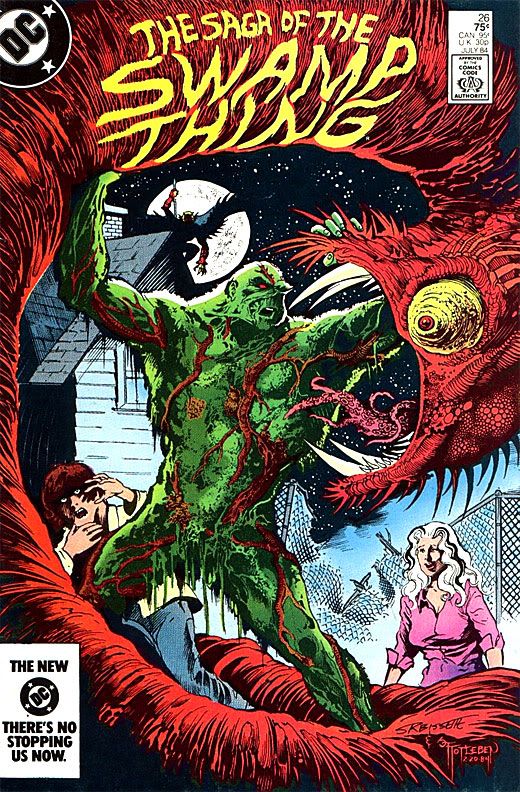
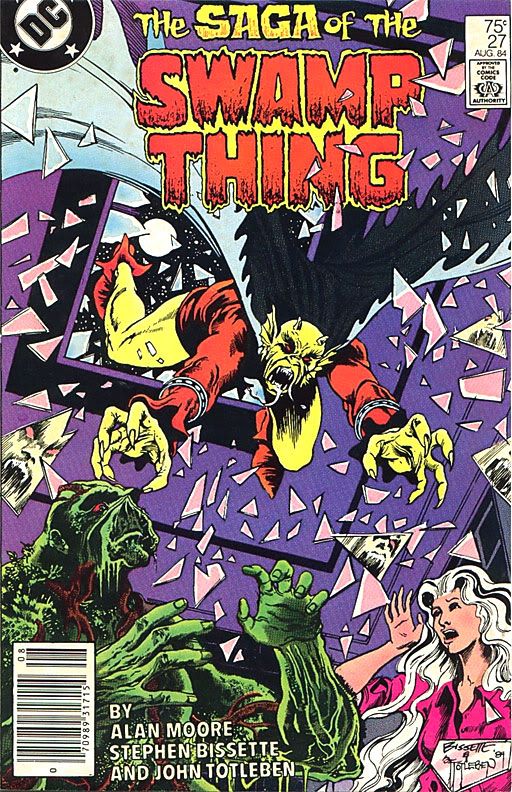
Whenever I read Swamp Thing, I think of chocolate chip cookies, thanks to Mad Libs. I had a monster-themed Mad Libs book that featured some Swamp Thing art by Bernie Wrightson, only Swampy was made out to be some kind of chocolate chip-based life form. I also think of how incredible Alan Moore's work on the series in the 1980s was. Early in his run, Moore wrote a three-part story guest-starring the Demon that is one of the two comic books to scare me after I got into the double digits in age. The other is Ito Junji's Uzumaki, the scariest and most disturbing comic ever published by mainstream companies.
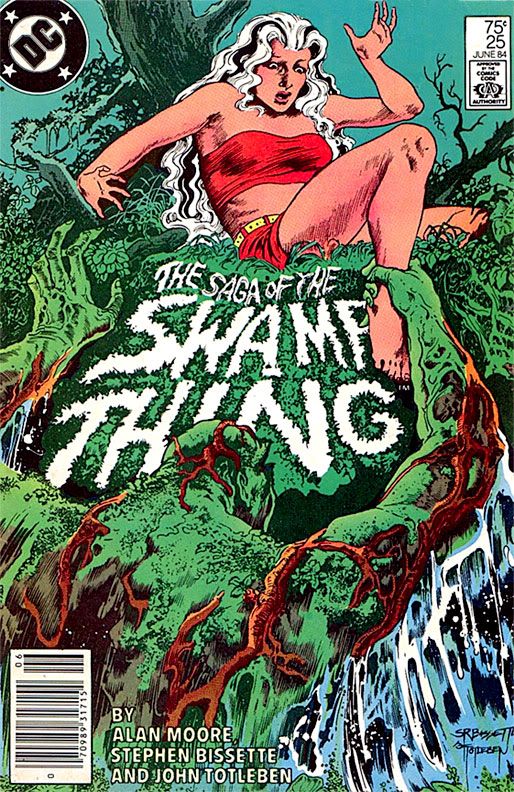
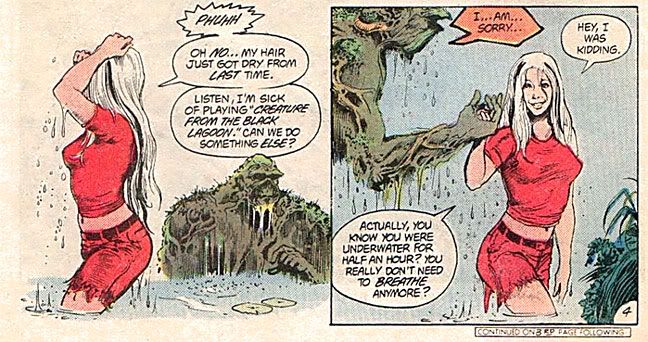
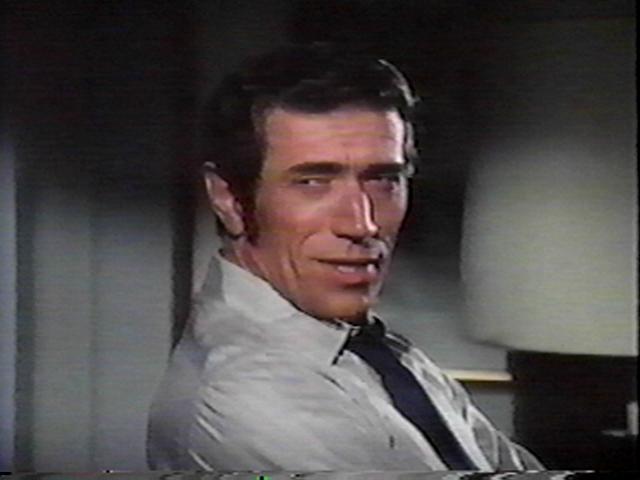
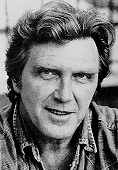
The fun starts in Swamp Thing #25 (1984). A mysterious guy (who looks a lot like the long-lost sibling of actors Joseph Campanella and Robert Lansing or maybe just Roy Thinnes) shows up in Baton Rouge, Louisiana, and starts talking in riddles-- which probably drives everyone around him batty. I know he's Jason Blood, but Moore inserts him into the story with some cutesy moments where he blows people's minds by hinting at things a stranger couldn't possibly know. Like who's going to jail for manslaughter, things like that. Somewhere in the nearby swamp, Swamp Thing and his friend Abby Cable share some fun together.
One thing Moore has always excelled at is taking other people's characters and taking them apart, only to put them together again in fascinating new ways based on all their original implications. While most writers had been content to write Swamp Thing as a guy who turned into a plant, Moore decided he was actually a plant that mistook itself for a man. Once Swampy got over that shock, he found himself becoming more attuned to nature and capable of more than anyone had ever thought possible. In fact, he was another in a long line of "plant elementals," protector of the "Green," a kind of collective soul-region for all of earth's flora.
Still in a naive state Swamp Thing starts discovering some exciting new abilities. Moore keeps it light and amusing, allowing the readers to react through Abby. Abby, in the meantime, is also coming into her own, having taken a job helping disturbed children while her husband, Matt Cable, sinks into alcoholism and despair. Cable also has this sick ability to conjure up all kinds of bugs and ugly little critters-- sick in that he seems to get off on it. You know what I'm saying, right?
It turns out Riddlin' Roy Thinnes and Abby have some business together-- protecting the children from a demon monkey that came from a misused Ouija board. Moore allows the horror to seep into the story gradually, as he plays with time sequences to build suspense. But what makes this story so appropriate for Halloween is how Moore uses Swamp Thing to examine the essence of horror itself. Horror is autumnal, both a way of dealing with death and a celebrating it. Through horror, we take something incomprehensible and make it into something we can deal with. It's fun to be scared in the dark. Halloween is a festival of frights, held during the time of year when the wind blows colder and the trees become skeletons.
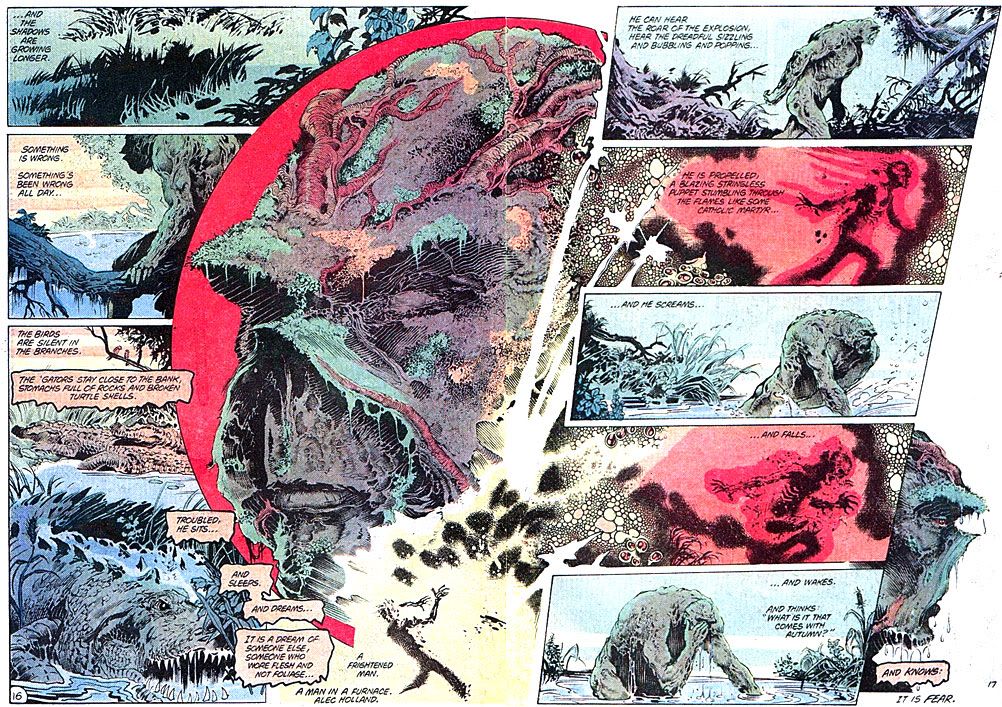
For Swamp Thing, the season cycle isn't merely symbolic; he is now part of it, as he senses-- although his consciousness at this time is still very much over-printed with humanity. Moore and artists Steve Bissette and John Totleben showcase this in a gorgeous double-page spread, complete with a call-back to Swamp Thing's origin. I also have to point out how lovely Tatjana Wood's coloring is here; her work complements and enhances the art in a few colorists can match. Wood was just outstanding throughout this series.
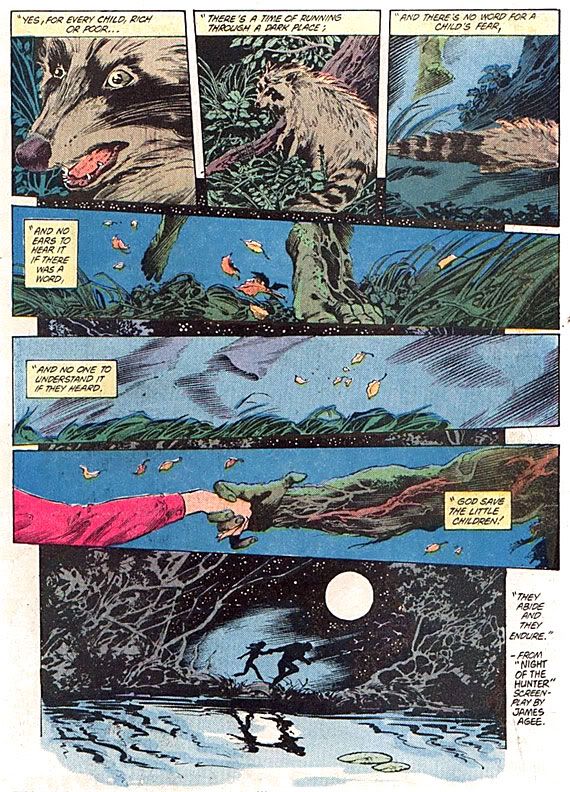
The thing that comes with fall isn't merely fear. Fear is just its symptom, a rational reaction to the idea of non-existence. Because what really comes is death. Or in this case, little spiky monkeys that feed on your worst nightmares. As Abby and Swamp Thing realize this, they run through the night towards the children's home. The quote from James Agee's screenplay for Night of the Hunter is evocative, but no more so than the amazing aspect-to-aspect sequence that opens Swamp Thing #26. Here, Moore, Bissette, Totleben, Rick Veitch, and Wood fully realize the cinematic possibilities of the comic book page.
Yeah, yeah, yeah. Total Moore butt-kissing, right? Wrong! You're out of order, the whole system's out of order! My Al Pacino impression is atrocious and inappropriate here! Moore can't quite maintain the high level he set for himself during the slow-burning first and second acts. The let-down comes in the third when Etrigan bursts in and the story turns into a fight scene cliche. Moore's rhyming dialogue for Etrigan is impressive, but the plot ends anti-climatically. Hey, you're not so scary after all, you scummy monkey! It's abrupt and doesn't quite pay off Moore's elaborate set-up. Etrigan's method of disposing of the monkey is good for a laugh, though.
Moore does redeem #27 with an ominous postscript. After fighting with Abby, Cable smashes himself to bits in a drunk driving accident, then saves himself-- he thinks-- by making a deal with a talking fly. It's a gross-out sequence, Cable having knocked out all of his teeth and crushed himself in the mangled steel of his wrecked car. It's eerie when he appears apparently no worse for wear and we watch him drive Abby into the distance of the last frame, Etrigan's closing narration fraught with foreshadowing. Swamp Thing and Abby may have re-established order, but it's merely a truce. It gives them some breathing room-- not that Swamp Thing needs to breath anymore-- before the horrors to come.
We're almost 30 years past this story now, and in all that time, few releases from the major publishers have brought all true possibilities of comics to bear. Not that there haven't been some great stories, and some fun ones. It's just that with Swamp Thing, Moore's prose is novelistic, the visuals are vivid, the storytelling all encompassing. Although it's ultimately something of a let-down, considered as an artifact of it's time, it's amazing Moore and company got away with doing all of this. There wasn't a contemporary comic at either DC or Marvel that could touch it, not The Uncanny X-Men or the New Teen Titans. Sure, it's pretentious at times (almost as pretentious as my writing right here in this very entry), and overwrought on occasion, but as you read it, you realize there's still something unprecedented going on-- a creative team juiced on its own brilliance, telling stories that aren't simple rehashes of old comic book ideas, but genuine literary statements unto themselves. A writer with something to say, artists who can match his vision.
In literature and cinema, you expect these kinds of things, but with a comics, you're left wondering why all of them can't be this good. And lately, it's a shame people are satisfied with what the big companies dole out, most of which seem a huge step backwards in craft and voice. Batman still contends with Catwoman, but showing them actually having the sex that used to be merely hinted at isn't some great accomplishment when the story itself is just as tired and familiar and as blandly told as any that have come before it. The same stakes, the same solutions. Comics based on other comics, comics as marketing tools for multi-media campaigns, with nothing more to say than, "Look who's hitting whom this month!"
Maybe that's also what comes with fall-- the death of creativity. That and lots of chocolate candy and caramel corn. Plus amazing Japanese bubblegum-garage-power-pop-punk like Spookey!
The fun starts in Swamp Thing #25 (1984). A mysterious guy (who looks a lot like the long-lost sibling of actors Joseph Campanella and Robert Lansing or maybe just Roy Thinnes) shows up in Baton Rouge, Louisiana, and starts talking in riddles-- which probably drives everyone around him batty. I know he's Jason Blood, but Moore inserts him into the story with some cutesy moments where he blows people's minds by hinting at things a stranger couldn't possibly know. Like who's going to jail for manslaughter, things like that. Somewhere in the nearby swamp, Swamp Thing and his friend Abby Cable share some fun together.
One thing Moore has always excelled at is taking other people's characters and taking them apart, only to put them together again in fascinating new ways based on all their original implications. While most writers had been content to write Swamp Thing as a guy who turned into a plant, Moore decided he was actually a plant that mistook itself for a man. Once Swampy got over that shock, he found himself becoming more attuned to nature and capable of more than anyone had ever thought possible. In fact, he was another in a long line of "plant elementals," protector of the "Green," a kind of collective soul-region for all of earth's flora.
Still in a naive state Swamp Thing starts discovering some exciting new abilities. Moore keeps it light and amusing, allowing the readers to react through Abby. Abby, in the meantime, is also coming into her own, having taken a job helping disturbed children while her husband, Matt Cable, sinks into alcoholism and despair. Cable also has this sick ability to conjure up all kinds of bugs and ugly little critters-- sick in that he seems to get off on it. You know what I'm saying, right?
It turns out Riddlin' Roy Thinnes and Abby have some business together-- protecting the children from a demon monkey that came from a misused Ouija board. Moore allows the horror to seep into the story gradually, as he plays with time sequences to build suspense. But what makes this story so appropriate for Halloween is how Moore uses Swamp Thing to examine the essence of horror itself. Horror is autumnal, both a way of dealing with death and a celebrating it. Through horror, we take something incomprehensible and make it into something we can deal with. It's fun to be scared in the dark. Halloween is a festival of frights, held during the time of year when the wind blows colder and the trees become skeletons.
For Swamp Thing, the season cycle isn't merely symbolic; he is now part of it, as he senses-- although his consciousness at this time is still very much over-printed with humanity. Moore and artists Steve Bissette and John Totleben showcase this in a gorgeous double-page spread, complete with a call-back to Swamp Thing's origin. I also have to point out how lovely Tatjana Wood's coloring is here; her work complements and enhances the art in a few colorists can match. Wood was just outstanding throughout this series.
The thing that comes with fall isn't merely fear. Fear is just its symptom, a rational reaction to the idea of non-existence. Because what really comes is death. Or in this case, little spiky monkeys that feed on your worst nightmares. As Abby and Swamp Thing realize this, they run through the night towards the children's home. The quote from James Agee's screenplay for Night of the Hunter is evocative, but no more so than the amazing aspect-to-aspect sequence that opens Swamp Thing #26. Here, Moore, Bissette, Totleben, Rick Veitch, and Wood fully realize the cinematic possibilities of the comic book page.
Well, it functions both as aspect-to-aspect and action-to-action. With these horizontal panels, there's not much room for the artists to do more than give us fragments of the action in what's almost a collage. The racoon's appearance is an aspect, but it flees, its final, truncated appearance giving way to a close-up of Swamp Thing's running feet. The quick cut to Swamp Thing and Abby's hands gives us yet another aspect of the chase, a hint of the attraction growing between them and the desperation of their race. I love aspect-to-aspect storytelling.
While it isn't always appropriate-- I'm not sure Superman needs mood as much as he does grandeur-- there just isn't enough of it in mainstream comics. Action-to-action if fine, but all too often that means punch punch kick. Actually, with the advent of photorealism and the au courant long horizontal panel (similar to these, but poorly used to frame entire actions), there's not much storytelling of any kind in superhero comics these days, just lovingly rendered static poses, like photographs bereft of context. Moore is famous for writing massive scripts detailing everything he wants to see in each panel. When he's on his game, Moore is as close to a film director as you'll find in comics, as attentive to the visuals as he is the story, plot, characterization and dialogue.
We're almost 30 years past this story now, and in all that time, few releases from the major publishers have brought all true possibilities of comics to bear. Not that there haven't been some great stories, and some fun ones. It's just that with Swamp Thing, Moore's prose is novelistic, the visuals are vivid, the storytelling all encompassing. Although it's ultimately something of a let-down, considered as an artifact of it's time, it's amazing Moore and company got away with doing all of this. There wasn't a contemporary comic at either DC or Marvel that could touch it, not The Uncanny X-Men or the New Teen Titans. Sure, it's pretentious at times (almost as pretentious as my writing right here in this very entry), and overwrought on occasion, but as you read it, you realize there's still something unprecedented going on-- a creative team juiced on its own brilliance, telling stories that aren't simple rehashes of old comic book ideas, but genuine literary statements unto themselves. A writer with something to say, artists who can match his vision.
In literature and cinema, you expect these kinds of things, but with a comics, you're left wondering why all of them can't be this good. And lately, it's a shame people are satisfied with what the big companies dole out, most of which seem a huge step backwards in craft and voice. Batman still contends with Catwoman, but showing them actually having the sex that used to be merely hinted at isn't some great accomplishment when the story itself is just as tired and familiar and as blandly told as any that have come before it. The same stakes, the same solutions. Comics based on other comics, comics as marketing tools for multi-media campaigns, with nothing more to say than, "Look who's hitting whom this month!"
Maybe that's also what comes with fall-- the death of creativity. That and lots of chocolate candy and caramel corn. Plus amazing Japanese bubblegum-garage-power-pop-punk like Spookey!
Subscribe to:
Posts (Atom)