Showing posts with label horror comics. Show all posts

Thursday, October 30, 2014

October is Spookey Month: You can't have Halloween without Bernie Wrightson!

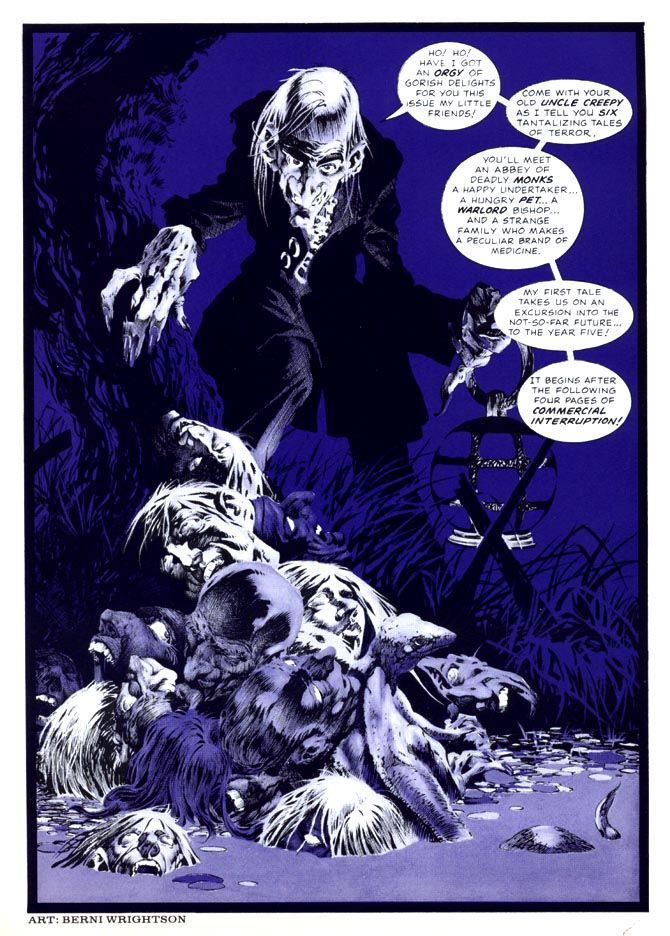
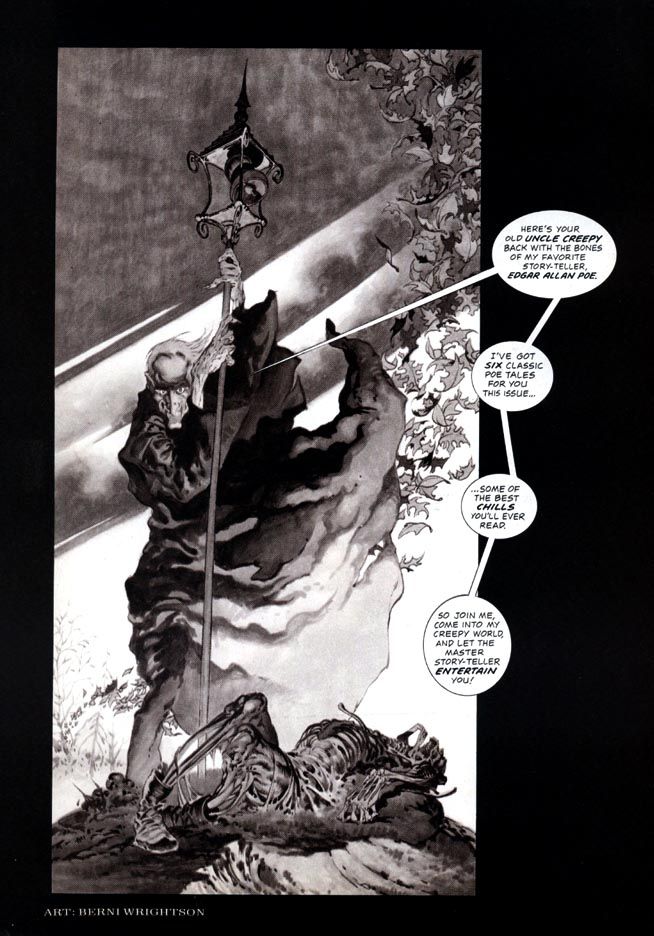
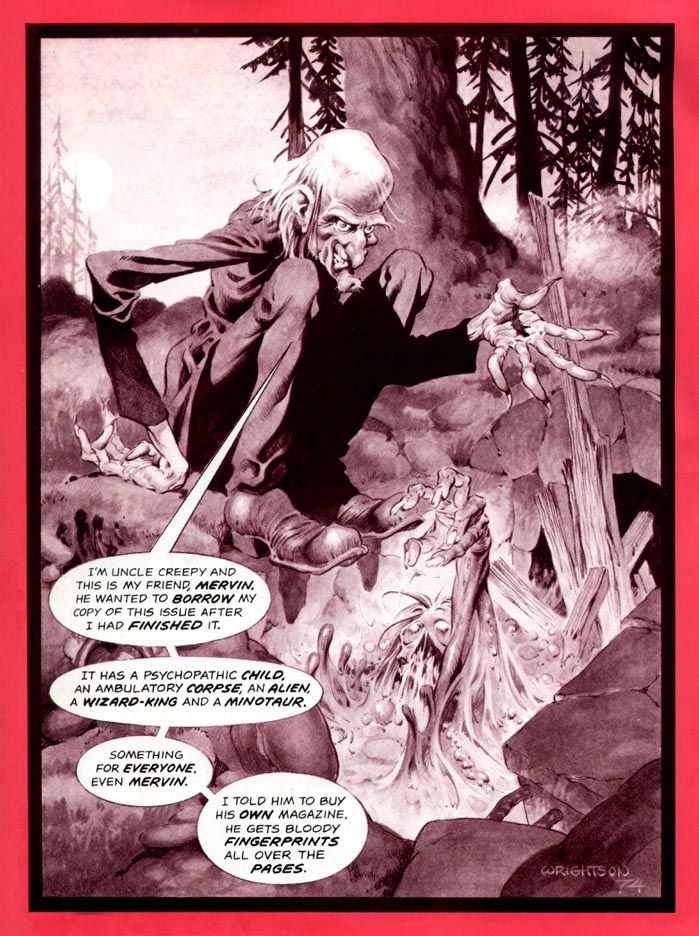
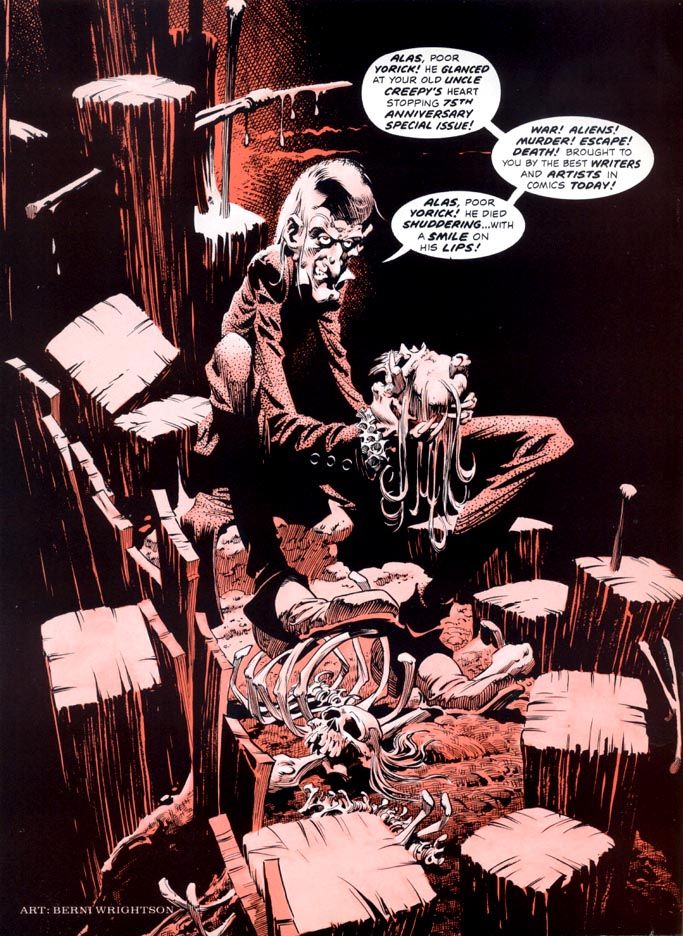
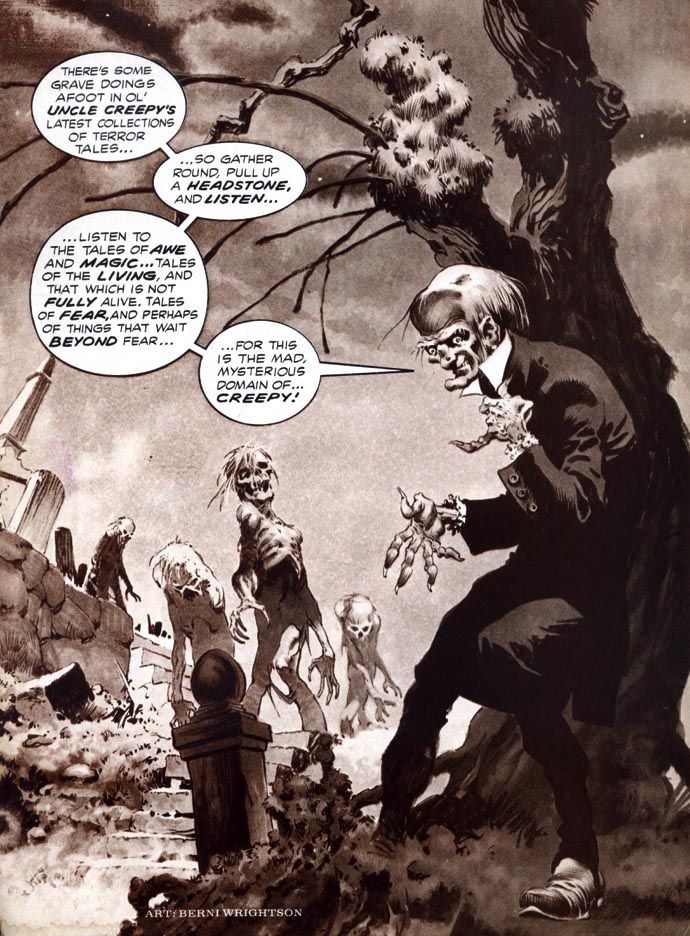
Hello, Halloween hellhounds!  Let's enjoy Bernie Wrightson's delightful Creepy magazine frontispieces.  I'm not sure when Creepy started running these, and Wrightson didn't do one for every issue.  Sometimes they'd run a full-color house ad for Vampirella or spotlight another talented artist.  But Wrightson's frontispieces are rich with spooky atmosphere.  And ghoulish good humor.  These are just a few of my fearvorites...

Creepy 66 (November 1974)


Creepy 67 (December 1974)

This next one is a particular joy to behold...


Creepy 70 (April 1975)


Oh wow!  Isn't that beautiful?  Okay, a few more...  This next one I like because it's one of those Wrightson "spooky stuff happens even during the day" images.  Just like in the memorable story "Jenifer" he illustrated.  It starts one magical afternoon.  Imagine hiking in the forest on a gloomy fall day and...


Creepy 71 (May 1975)

Egads!  Dare we continue?  Dare we do!


Creepy 75 (November 1975)


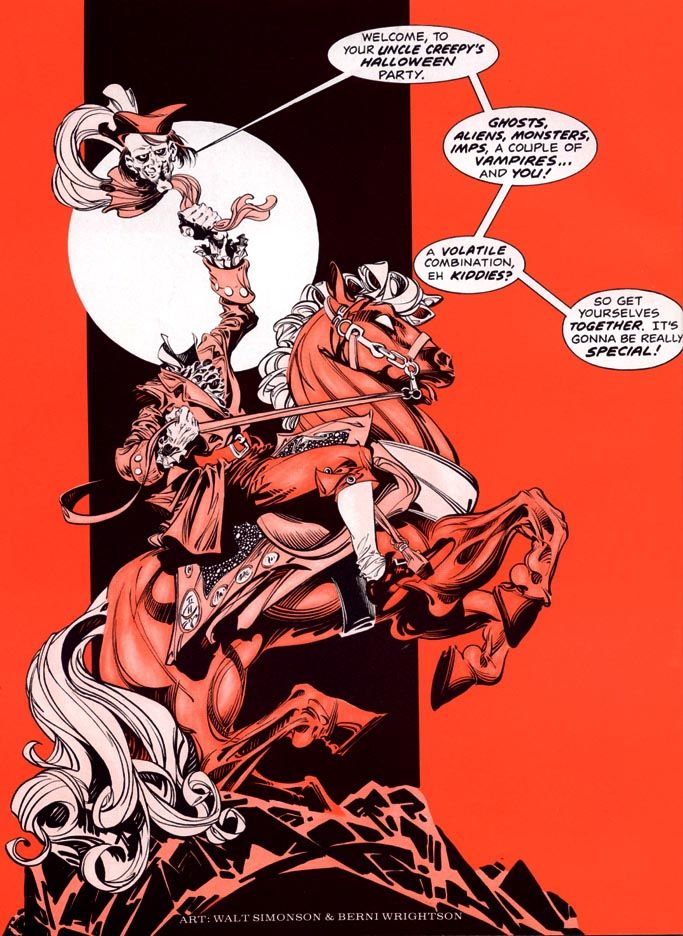
Here's my favorite, though.  It's a collaboration with Walter Simonson, a guy who's best known for Asgardian superheroes but has done a few highly effective fright jobs in his long career, too.  Plus, it's specifically Halloween-related.


Creepy 76 (January 1976)


Love those.  But to be honest, the scariest Creepy frontispiece of all wasn't drawn by Wrightson or Simonson.  It's this one.  Steady on, people.  Steady on...


Creepy 81 (July 1976)


AAAIIIIIEEEEEEEE!!!

We definitely need something to help us recover our wits after that shriek-inducing moment of terror.  All of these except the last are available in Dark Horse's gorgeous and essential Creepy Presents Bernie Wrightson hardcover.  Now I need to go clean up a little.  So calm yourselves and here's something to soothe your jangled nerves.


Wednesday, October 29, 2014

October is Spookey Month: Someone's rockin' list of the "10 Most Frightening Horror Comics Ever!"

I know nothing of this Herald Scotland site, but I salute the good (or foul, depending on your perspective and whether or not you go through life talking like one of EC Comics' horror hosts) taste of Graphic Content writer Teddy Jamieson.  Not only does Jamieson quote Halloween III: Season of the Witch, but he manages to include Junji Ito's horror masterwork Uzumaki on the list.  At Paste Magazine you can read a similar 13 item list called "13 Terrifying Modern Horror Comics," which I saw posted by Fantagraphics on Facebook earlier this week.  That one is very Western comic-centric and the choices more conventional than Jamieson's, but they overlap, too.  I admire Jamieson for having the guts to lead off the list with a most personal choice.  He also puts Jack Chick tracts on his list.  I remember coming across those from time to time when I was a kid and he's right.  They're scary!  At least they were when the threat of hell or running into a hippie mocking my religious beliefs with a dismissive "HAW HAW!" were the worst things I could imagine.

Personal choice is appropriate because our most frightening comic is the one that affects us most regardless of its wider reputation.  I found myself exposed to a great many shitty horror comics when I was a kid and quite a few managed to genuinely frighten me even with crude art and strained writing. 

Sometimes even genre doesn't matter.

Jack Kirby scared the snot and the buggers out of me with his chilling final image in Kamandi #20 of our long-haired hero alone on a ruined pier.  I mean utterly alone, overlooking what I assumed at the time to be a monster-haunted Lake Michigan.  No one to help him, not the indifferent gulls circling overhead, certainly not the angry gorillas ravaging the robotic theme park Kamandi had just escaped.  No humans, just robots going through the motions of 1920s-era Chicago gangland clichés.  Poor lonely Kamandi.  The imagery was bleak, the closing copy promised more horrors to come.  Shudder!

Another story that gave me the willies was "Evolution's Nightmare" in Marvel/Curtis Planet of the Apes #5.  It opens with humans and gorillas fighting El Cid-style in a desert wasteland, then ends with radioactivity-devolved apes and men duking it out with rocks and clubs in a bomb-ruined San Francisco.  They even kill the two main characters (who spent the intervening pages painfully learning tolerance) before grunting and screaming in mindless hate at each other from atop wrecked cars full of skeletons and across piles of shattered asphalt.  Doug Moench's depressing narrative captions inform us everything moves in circles and those circles stink.  Artist Ed Hannigan's (Jim Mooney inks, by the way) double-page spread of piles of dead warriors with their eyes lifelessly open only added to the lingering fear instilled in me by this creepy story.

Obviously, neither of those two are horror stories.  They're both rough-house science-fiction adventures.  You can find horror-like frights anywhere.  In a plot twist in an otherwise innocuous superhero book, gazing at you from a house ad in a humor comic, jumping out at you from behind a brick wall on a sunny street in Riverdale, USA.

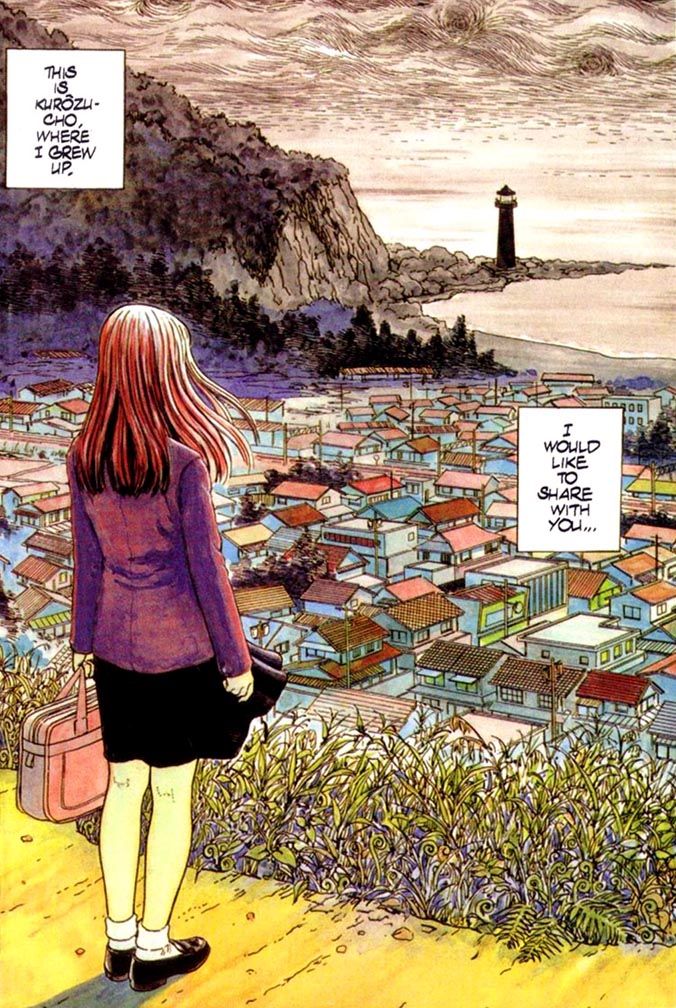
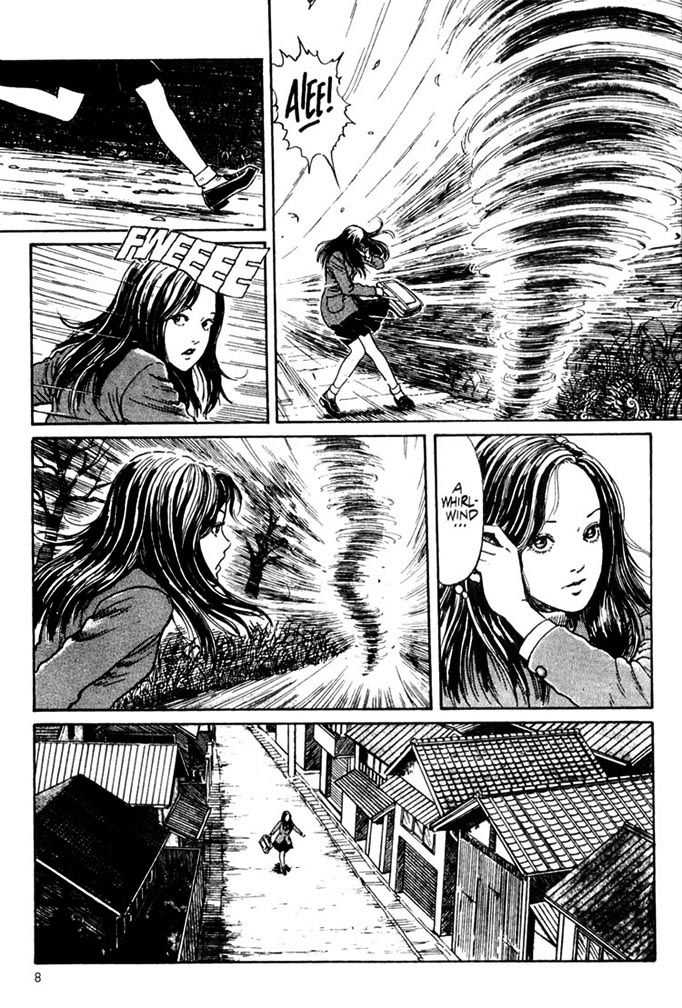
Or in an actual horror comic.  Like Uzumaki.  Serialized in Big Comic Spirits (it's a seinen manga, or dude's comic, so be careful opening that link) from 1998 to 1999, Ito's Uzumaki is the greatest horror story ever published in comic book form.  I'm comparing it to everything from Charles Burns' Black Hole, which made Fantagraphics' list (and is a moody, troubling work in its own right) to EC and every horror comic in between.  Out of all the fright fun I've had reading horror comics, only Uzumaki gave me feeling of truly dreading the next development in a story in my life.  Of doom.  Or of being genuinely grossed out by so many drawings in one place.  Uzumaki's dreamlike inevitability remains after you close the book having followed its main characters deep into the heart of ancient fears.

Uzumaki tickles your fright bone the way a cold wind from across the dry grass of graveyard might gooseflesh your arms.  Bruised clouds passing overhead like witches, their shadows falling around like concentrated night, on the move, looking for you.  Dead leaves hissing at you along the curb.  Hurrying you homeward where you face a dark, empty house where the rooms echo only with your voice.

Story and art by Junji Ito

And the soft footsteps of another.  Though nobody else is home.

Here's something that's not frightening.  It's a performance by Hamamatsu's own Spookey!

Friday, October 17, 2014

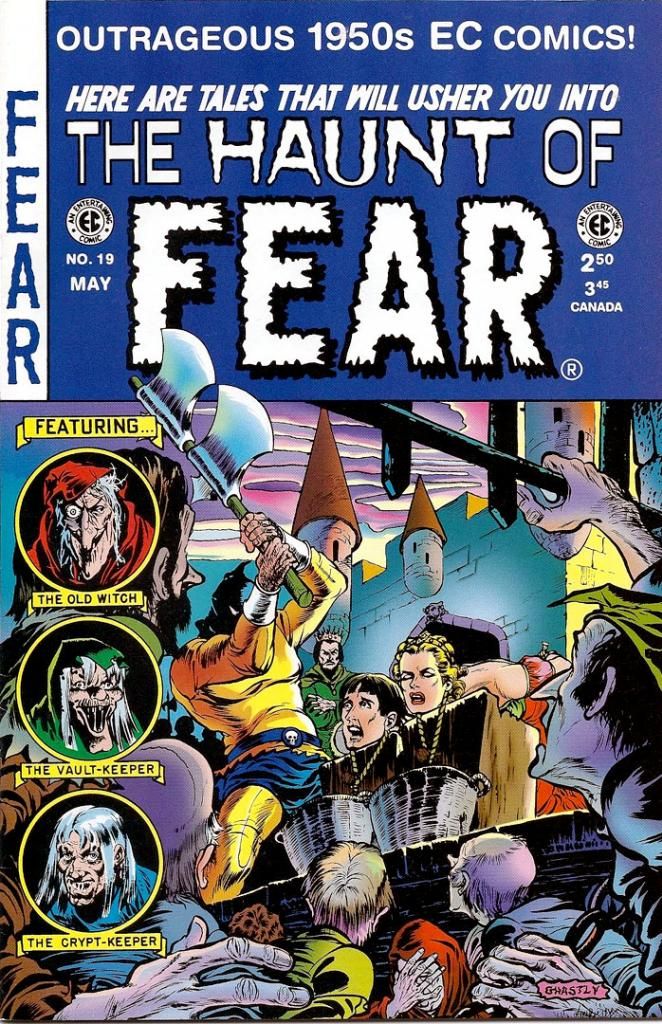
October is Spookey Month: How EC ruined America's pasttime in Haunt of Fear #19 (May-June 1953)

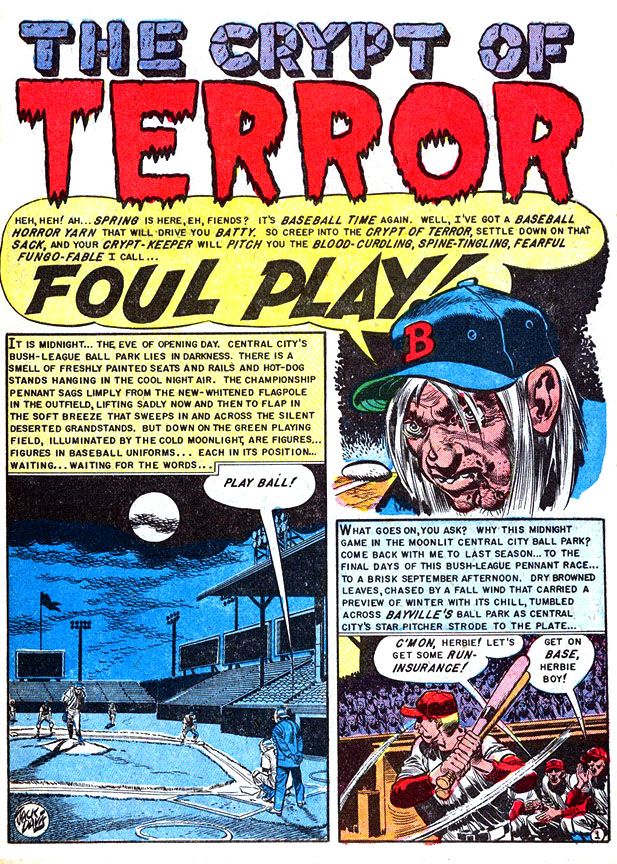
No, they didn't ruin baseball.  That's just me trying to have a little fun and shake things up a bit.  If anything, they made baseball better!  But EC did get itself into hot water with the government over "Foul Play," a story appearing in Haunt of Fear #19 (May-June 1953).  Dr. Frederic Wertham used it as an example of horror comic nastiness in his book Seduction of the Innocent and then did it again during his afternoon session testimony to the 1954 Senate Subcommittee Hearing on Juvenile Delinquency

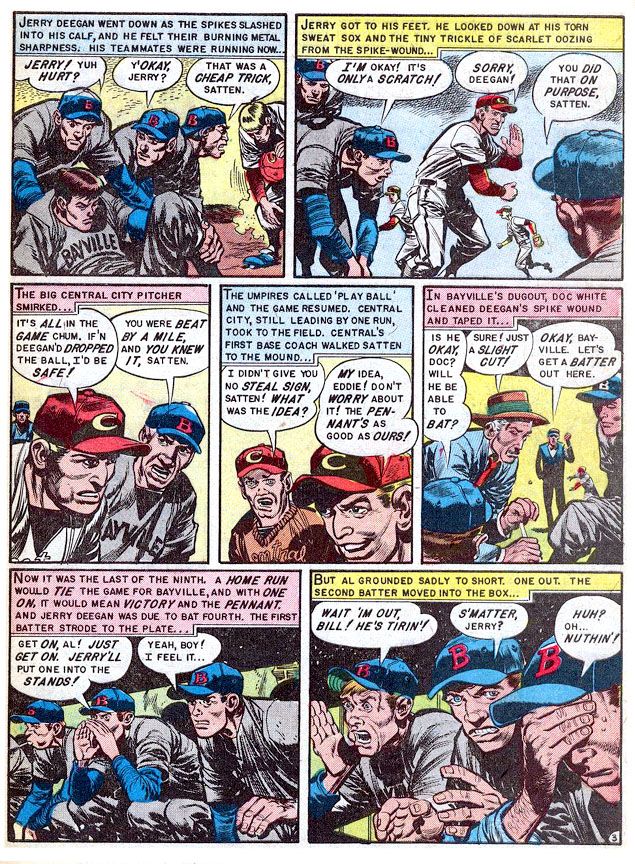
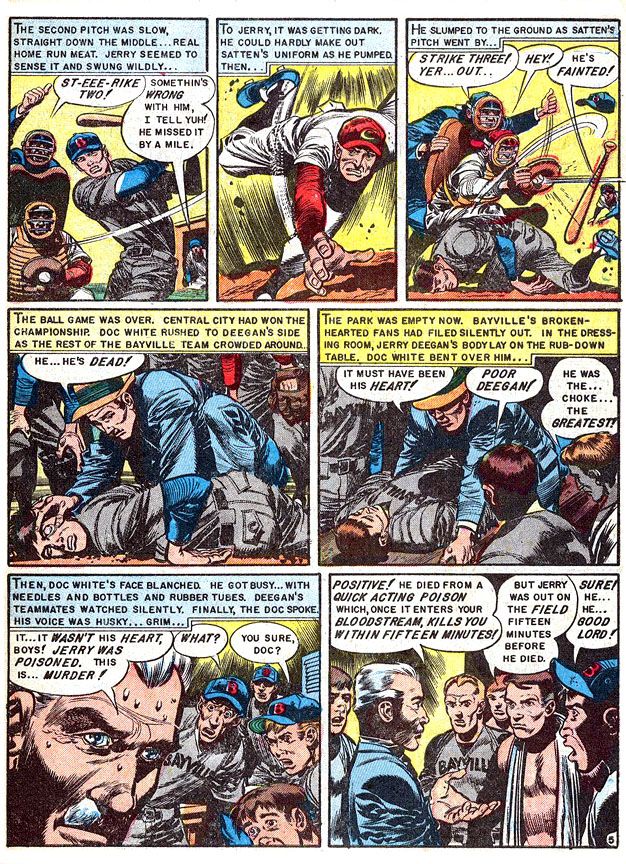
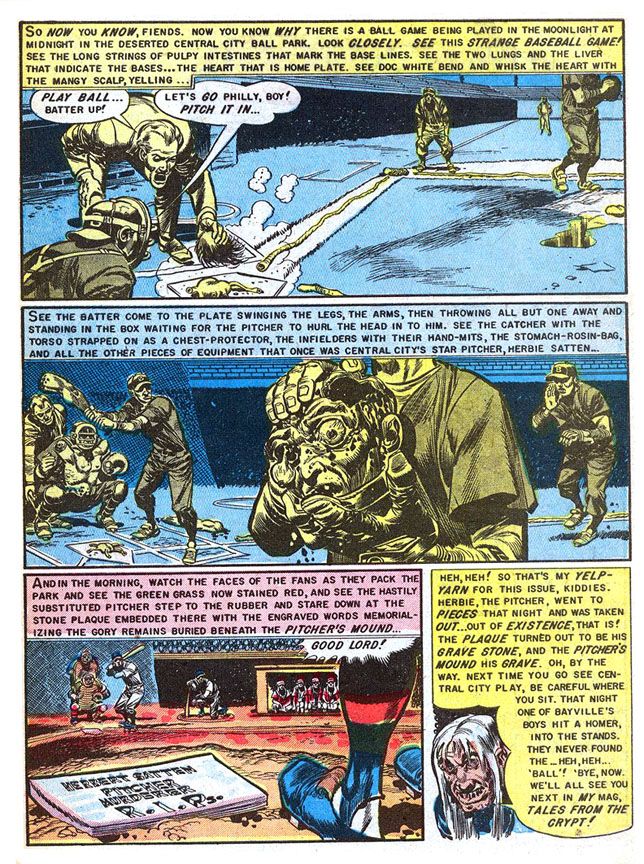
The story is about Central City's Herb Satten, an unscrupulous pitcher who wants to help his team win the pennant by murdering the Bayville's star second baseman, Jerry Deegan.  After all, this Deegan slugger led the league in home runs all season and he's up the next inning in a tight game.  It stretches credulity a bit.  Satten kills Deegan by poisoning his spikes, then allowing himself to get hit with an inside pitch so he can get on first, attempt a steal then slide spikes-high and slash his victim.  He's thrown out and it looks like a bonehead play, but it all works out. Satten kills his man and Central City wins.  This leads to the pitcher's grisly comeuppance the night before the next season's opening day.

And one of the all-time great gross-out scenes in horror comics history.  The murdered man's teammates literally rip Satten apart late one night and use his body parts to play a moonlit intrasquad game.  Complete with a complicit umpire.  That also stretches believability, but not so far as the poor pitcher's intestines, which serve as foul lines up the first and third base paths.  The grisliest detail is the catcher's using the Satten's chest as his own chest protector.  You wanna wear part of a human body even if he is a sorry murdering cheat?  What is this, the Ed Gein League?

They also incriminate themselves by burying him under the pitcher's mound and inscribing the rubber there with "Herbert Satten.  Pitcher.  Murderer.  R.I.P."

Rest in pieces, baby.  Rest in pieces.

Writer:  Al Feldstein/Artist: Jack Davis

Well, they were angry ballplayers and probably didn't think through the consequences.  The ironic thing about "Foul Play" is, it may have been notorious at the time but the guy who drew it is one of the nicest, most gentlemanly people you'll ever have the privilege of meeting.  If you're so lucky.  I had a chance to phone interview him way back in 1996 for a class project and I came away in such a good mood because he was so jolly and generous.  He answered even my stupidest questions with patience and good cheer.

Writer:  Al Feldstein/Artist: Jack Davis


I'm talking Jack Davis, the dean of American caricaturists.  This story is right in his wheelhouse, so to speak.  Davis is a master of sports cartooning, able to twist his loose-limbed figures into whatever pose necessary to show the physicality of sports.  Baseball, basketball, football, late night murder, these are things Davis visualizes so well.  Obviously made a huge impact on Dr. Wertham and the guys up on Capitol Hill, huh?

Writer:  Al Feldstein/Artist: Jack Davis

I loved Davis' work before I ever read this story (although I'd heard rumors of it for years and they always chilled me to the bone).  He drew magazine covers, movie posters.  His art came into our house on television in the form of character designs for the Jackson 5ive Saturday morning cartoon.  As a University of Georgia graduate, I've seen dozens, if not hundreds, of Davis-drawn Bulldog athletes in motion, with his characteristic lanky body language and large, articulated hands.  Gorgeously rendered in loose, appealing brushstrokes and then watercolored to pop from the page of whatever book, calendar or postcard they adorn.  His 1950s horror work benefits from the Davis approach, one that exaggerates reality for comic effect.  So when you see a Davis severed head, it's not grotesque no matter how decayed it might be.  It's sick... but in a tasteful way.

Writer:  Al Feldstein/Artist: Jack Davis

The Senate Subcommittee Hearing people must not have felt that way, although I believe William Gaines explained it quite well in his testimony.  This is gore in just the right amount.  There's nothing gratuitous about it, but it has to have impact.  If you'll notice, too, colorist Marie Severin gives those panels a blue-yellow complementary color scheme rather than one that emphasizes its fleshy or bloody qualities.  This makes it explicit without going over the top.  Not for the squeamish, certainly.  But it's right in my wheelhouse, too.  Jack Davis is an American treasure, baby.  And so is Marie Severin.  No doubt about that. 

Tuesday, September 30, 2014

It's October is Spookey Month time again!

I know, I know, you're excited about this annual tradition here at When Comic Books Ruled the Earth where we take all of October and examine various horror comics.  We're going to take a break from Marvel movies and spend some time chilling with some chillers.  The eccentric spelling of "spookey" is in tribute to a local rock band called SpookeyThey once did a Halloween-themed live show-- a video of which you can find on YouTube-- and I bought one of their albums after watching it.  The album features a fun cover of a fun cover of the Banana Splits Adventure Hour theme song and some other feel-good pop-punk rockers.  They don't seem to be very active at the moment but that doesn't mean we have to stop being fans of cool local music and cool local musicians.

And it has nothing to do with mylove for horror comics, but this is my blog and I can do whatever I want with it.  I haven't decided on an itinerary for this month's journey through the darker realms of four-color fantasy.  I imagine it will lean heavily on Creepy, Eerie and EC once again.  A smattering of Batman, my go-to Halloween superhero.  In fact, I have a certain issue of Batman in mind for my first Spookey Month post.  Or maybe it's an issue of Detective Comics.

Friday, November 1, 2013

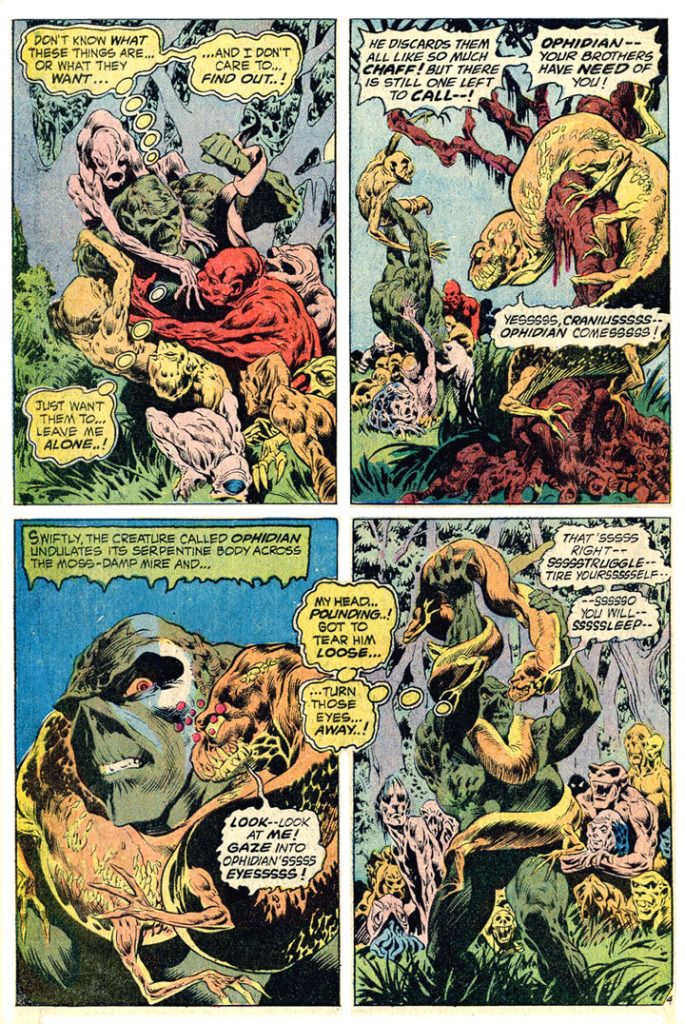
October is Spookey Month: Swamp Thing fights male and female werewolves!

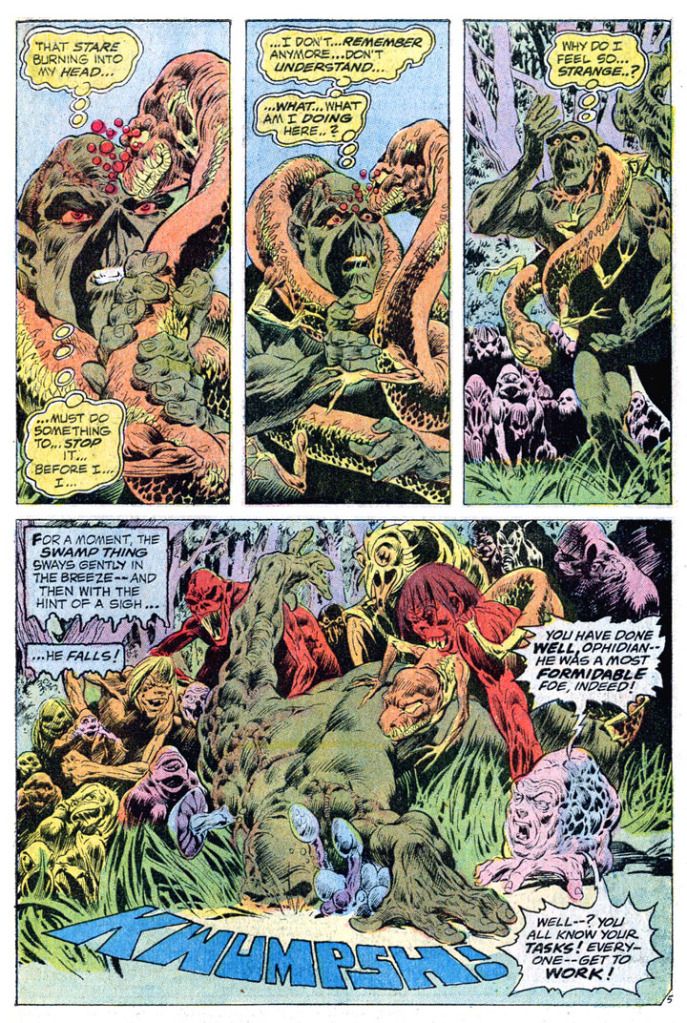
To end our month-long celebration of Halloween, horror comics and all-girl Japanese pop punkers Spookey, here are a couple of stories where Swamp Thing fights that old school monster favorite, the werewolf.  Male and female varieties.

The first one, Swamp Thing #4 (May 1973) is by Len Wein and  Bernie Wrightson.  They lean on the familiar Universal Studios style, setting their tale in the Scottish moors and within a creepy old mansion.  Their werewolf is the tragically cursed son of some very worried parents.  They're in luck when Matt Cable and Abby Arcane crashland their plane close to their ancestral home, but definitely unlucky in that Swamp Thing is also on board.  This means their plans to use Cable's blood to cure their boy of his lycanthropy (and give it to Cable; but isn't this what any concerned parents would do for their child?) is doomed from the start.

While the werewolf on the cover looks more like a satyr to me, inside the comic itself Wrightson uses heavy black silhouetting for its first appearance, which gives his beastie a very Frazetta-ian touch, almost amorphous in the night fog.  It's very reminiscent in its first appearance of Frank Frazetta's aptly-titled "Werewolf!" from Creepy #1 (1964).  Kind of impressionistic.  Shoot, why am I telling you all this when I can just shut my fool mouth and show you?  Here:


There is nothing not to like about this comic and its classical approach. 

But what a difference a decade makes!   We hear a lot of talk about the "curse of the werewolf," and writer Alan Moore and his merry art crew of Steve Bissette and John Totleben set out to explore what this means both literally and metaphorically-- because there's also this other monthly thing sometimes referred to as a curse.

In Swamp Thing #40 (September 1985), Brit Moore unspools an episode in "American Gothic," an extended story arc where Swamp Thing battles traditional horror creatures suffused darker elements of the United States' national narrative-- the unintended consequences of progress, the preponderance of gun violence, the genocide of Native Americans and the lingering effects of slavery and the Civil War.  This time, perennial fan favorite character John Constantine pits Swamp Thing against something more personal-- the perpetual state of war between the genders, specifically the daily battles waged by a typically American suburban couple.

As with the Len Wein-Bernie Wrightson werewolf tale, "The Curse" is very concerned with blood.  It's just Moore is interested in a deeper exploration of this sanguine symbolism.  Our werewolf this time is a modern woman so empathetic to the anger and resentment felt by long-ago Pennamaquot tribeswomen sequestered in a special lodge (she and her husband live in a house built on the site) while they menstruate she turns into a massive wolf creature and goes on a rampage.  Male privilege has finally loosed a beast, and after a brief fight, Swamp Thing comes to as much of an understanding of the woman's plight as a male-gendered plant elemental can.

Tragically, our tragic werewolf is a stand-in for all of womankind, so she learns there's another aspect to this blood curse-- women are bound by it to men and vice versa.  As a result, she cannot bring herself to kill her husband (even though she contemptuously notes he's "soiled himself" from fear).  Giving in completely to her primal, savage anger, she crashes through the front window of a pornography shop where a customer has just asked the cashier to show him something he euphemistically refers to as more "unusual."  Perhaps as a matter of tastefulness, we aren't permitted to see the resulting carnage.  In the end, Swamp Thing cannot offer succor and the werewolf impales herself on the knives in a supermarket display, ironically labeled, "Here's good news for housewives!"  The supermarket setting itself represents the sterilizing effect consumerism has on our lives and its place in the continuing subjugation of female power, having been referenced satirically in the same vein by Ira Levin's 1972 novel The Stepford Wives and its 1975 film adaptation.


And with our tale of two lycanthropes, we bring this year's Spookey Month to a close!

Wednesday, October 23, 2013

October is Spookey Month: Haunted Horror, in which you can find 1950s pre-Code horror that's sometimes disgusting

A comic book Halloween wouldn't be complete without a few 1950s fear-fests.  Man, those Fifties cats really knew how to horror things up, how to jive and jazz and wail!  Then the Comics Code came and the music stopped.  For a while.  The jam moved over to the Warren black and white mags but full-color monthly comics ended up stunted.  By time I was a comic book-reading kid, we had a few cool DC anthology series, but the granddaddy of them all was simply a legend.  I'm talking EC.  You could order expensive hardcover, slip-cased reprints, but those were for the old guys with their disposable income, brandy snifters and smoking jackets.  It wasn't until Russ Cochran and Gladstone Publishing started reprinting Tales from the Crypt, Vault of Horror and The Haunt of Fear and selling them through newsstands that I was finally able to read those fabled classics in color. 

But I soon learned EC wasn't the only publisher doing sick horror in the 50s.  You know how it went with comics back then-- if something proved a money-maker, everyone in the business flooded the market with their own versions.  Heck, I don't even know who published the original horror hit.  EC just did it best, and they're the ones who took the blame when Uncle Sam cracked down on too much of a good thing.  Those other publishers doing the EC thang back in the day interested me greatly because of my appetite for pre-Code horror, but those remained fleeting phantoms that haunted the periphery of the whole tragic tale.  Until now.

IDW's Yoe Comics packages this book they call Haunted Horror where you can find stories from a lot of those non-EC guys.  I just bought a bunch of them on Comixology (.99!), and I'm loving them.  Some of them feature art by recognizable names-- the Iger Shop, Joe Simon and Jack Kirby (Whatever happened to him?  He showed real promise!), Jack Cole and a guy by the name of Ditko who later did some kind of bug-related hero the kids seemed to like.  Some of them are just crude and weird and even a little off-putting at times.  But yeah, I'm loving all of them.

It's just...

Every so often if you read enough horror comics, you will run into an image that just burns through your eyeballs into your brain, charring part of it and pretty much leaving you a shambling wreck.  A lumbering zombie, if you will.  And so I will now present one of those...


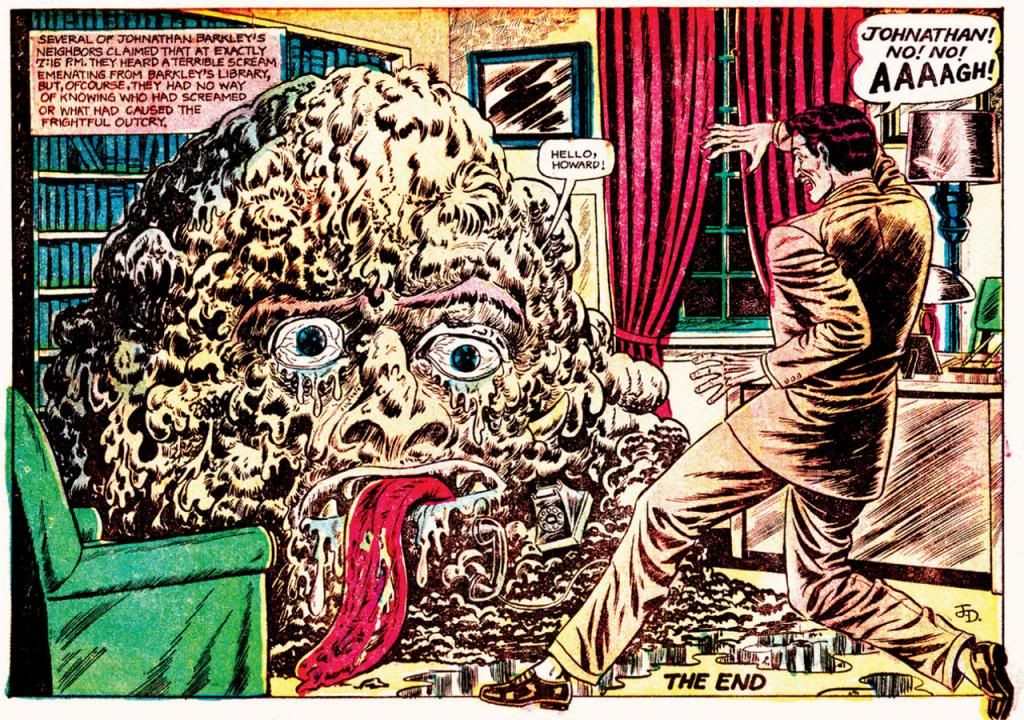
EEK!!  It's Jay Disbrow's version of Mel Brooks' Pizza the Hutt, only 33 years early.


The long tongue is an especially nice detail.  To add a little context, the guy screaming is the blob's doctor.  Or he was, when the blob was a man.  If you'll look closely-- dare it-- you'll see a rotary-dial telephone kind of sloughing off the blob's side.  The doctor came in response to a call from that very phone, and if you're puzzling out how something like this mass of what appears to be melted flesh could manage to spin that old-fashioned dial, I refer you back to the tongue.

I wonder how many kids saw this story when it was first printed.  Thousands?  If so, those were some lucky kids, but I doubt their parents appreciated the loss of appetite that no doubt accompanied the reading of this story.  Right about dinnertime, across America, little people with coonskin caps and skinned knees turned up their collective noses at Mom's radar-ranged glazed ham and peas and carrots, then got the spankings of a lifetime when they refused to eat.  They were incapable.  I read this three days ago and I haven't eaten so much as a crumb or speck of food.*

That's what a good horror comic should do for you.  Put you off your feed.  Junji Ito's Uzumaki is a more recent example of a horror comic that turned my stomach.  Another old one is the story "Tight Grip!" illustrated by Jack Davis.  In that one, a murderer stupidly hides inside the sentient trunk belonging to his victim and it compresses him.  His meaty parts stream out in thin ribbons through bullet holes he shoots in the trunk and investigators find nothing inside the tiny trunk but a cube of powdered bone.  Grotesque.  Gives me a chill just thinking about it.  "Tight Grip!" ran in EC's Tales From the Crypt #38 (October-November 1953) and you can read it today in the Fantagraphics volume devoted to Davis' horror work, 'Taint the Meat... It's the Humanity! 

And now we have Disbrow's blob.

Anyway, a big thanks to Craig Yoe, Steve Banes, Clizia Gussoni and all the people at Yoe! Studio and IDW for putting all this effort into putting these stories back into print and broadening my experience of 1950s horror comics.  And also making me sick.

*A blatant lie.  I've been making a pig of myself.

Friday, October 11, 2013

October is Spookey Month: And now a Spookey video!


As you know, Spookey is from my adopted hometown here in Japan and inspired this annual month-long Halloween celebration They're a lot better than my overwrought prose, right?

October is Spookey Month: Tomb of Dracula #12 teaches us most accidents happen at home

Is it controversial to say Tomb of Dracula was Marvel's best comic of the 1970s?  It has some strong competition from Conan the Barbarian where Barry Windsor-Smith displayed exponential artistic growth; from X-Men/The Uncanny X-Men with Chris Claremont, Dave Cockrum and then John Byrne creating a mythos that won all those Eagle Awards and underpins the entire Marvel universe to this day; and from Howard the Duck where Steve Gerber and artists like Frank Brunner, Val Mayerik and Gene Colan inspired Marvel's first movie adaptation (an infamously lousy one, but still a big budget, George Lucas-produced film released to theaters in the belief it would be a big hit). 

Those are all fine series, and I've enjoyed each of them.  But Tomb is just something else entirely.  Tomb is like wow times wowee for a little "wowee-wow-wow." Tomb took an exhausted public domain property-- good ol' Count Dracula, star of dozens of movies, TV shows and comic books in one form or another-- and gave it a compelling, new un-life.  Writer Marv Wolfman's melodramatic prose perfectly matches Gene Colan's shadowy visuals, the two elements working in tandem like peanut butter and chocolate in a Reese's.  When Marvel finally teamed Colan with inker Tom Palmer, the two produced what I will argue was consistently the most breathtakingly beautiful color monthly of the entire decade.


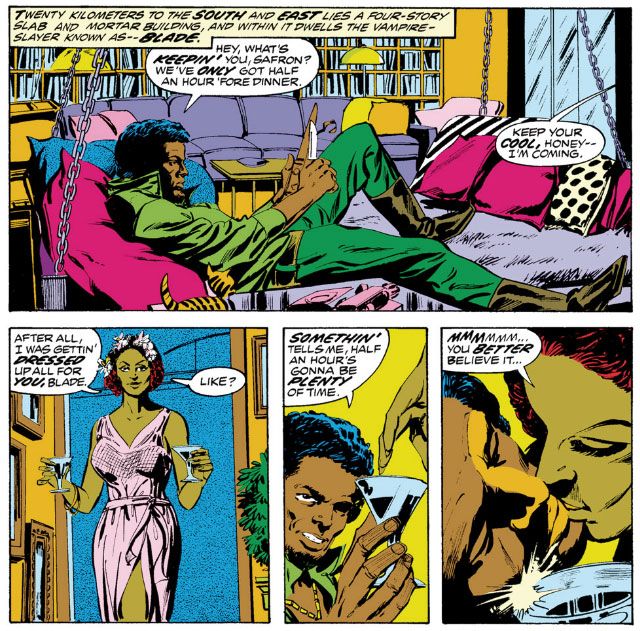
Operating on the fringes of the Marvel universe, Tomb functions as a sequel and expansion of Bram Stoker's novel.  In fact, lead good guy Frank Drake is a descendant of Dracula himself, his last name an Americanized version of the original.  Quincy Harker comes right out of the original book, the first born child of Jonathan and Mina (nee Murray) Harker, conceived and born after the novel's main events and named after one of Dracula's victims, the Harkers' courageous American cowboy friend Quincy Morris.  Wolfman casts Harker in the Dr. Van Helsing role.  More troubled than his Stokerian prototype, Harker rides around in a weaponized wheelchair the likes of which James Bond's pal Q would envy, and he uses it to save himself and others several times throughout the stories.  His hardboiled protégé (and later, Drake's lover), Rachel van Helsing, is the grand-daughter of the Stoker character.  Both Taj Nital, devoted companion to Rachel, and-- most significantly-- Blade, the ultra-cool, Blaxploitation-style member of the group, are wholly original.  At least I don't remember Stoker having watched Shaft, Super Fly or Hammer, but he could very well have despite having died about 60 years before the birth of the film genre.


Every October, I turn to Tomb of Dracula and it helps put me in that spooky, haunted Halloween mood.  It has its funky idiosyncrasies-- too many scenes where Rachel, Frank and Blade confront Dracula and all they do is trade arch insults and a whole lotta plots where Dracula almost dies, only to escape at the last moment.  After all, how many times can our vamp-slaying crew almost destroy Dracula before they start to seem completely incompetent to the point they lose our sympathies and incur our scorn, like that bumbling Gilligan?  Tomb of Dracula ends rather abruptly with issue #70 before it has a chance to devolve into self-parody, but even when things turn silly as they occasionally do, the overall atmosphere remains one of effectively updated gothic horror, and there are still plenty of genuinely creepy moments to restore our faith.  Which finally brings us to tonight's topic, Tomb of Dracula #12 (September 1973) and a little story we like to call "Night of the Screaming House."  Because that's what Marv Wolfman named it.

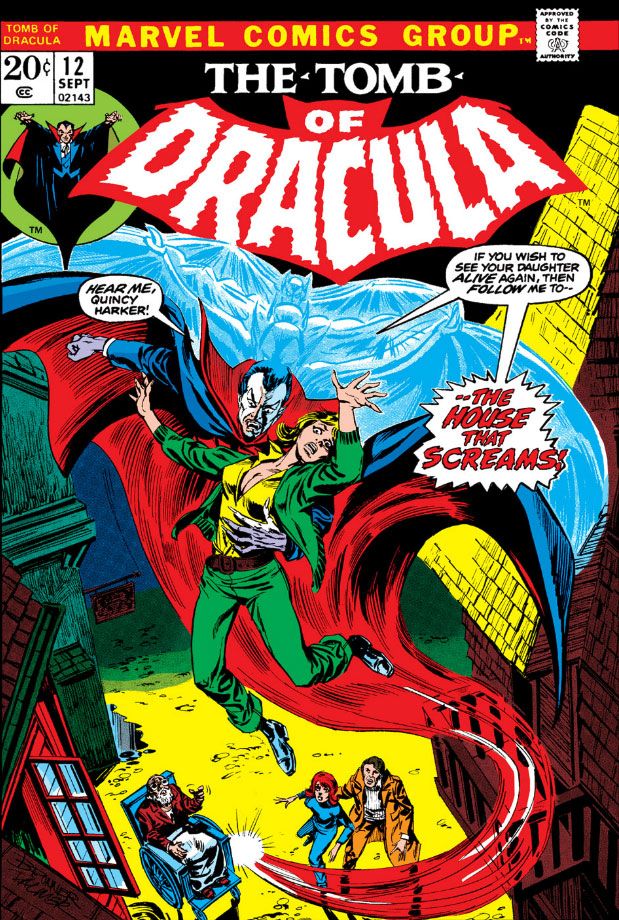
Oh, on the Frank Brunner-illustrated cover, Dracula calls it the "House that Screams," but you should never believe anything the king of the vampires tells you.  He has his own agenda and will lie when it suits him.

Okay, forget Dracula before... er... remembering him again.  Because Wolfman and Colan throw us right into the action with the main characters locked in a ferocious show-down with none other than Dracula, who has caught himself a delicious dinner, but can't catch a moment to eat in peace.  It's not a holdover from a cliffhanger ending to the previous issue (in which Dracula fought some motorcycle guys who aren't quite as menacing as the Sons of Anarchy bunch, although they do their best).  It's more like, "Open the book, here we are!"

Unfortunately one of them, Harker's daughter Edith, is ill-equipped for the life of a fearless vampire hunter.  Edith Harker was simply born to find herself in jeopardy.  Wolfman and Colan introduce her to the series that way in Tomb #7 (March 1973), and in "Screaming House" (as its friends call it; the rest of you must refer to it in full, with an honorific of your choice), she really finds herself in a mess, the likes of which no heart-felt talk with Sheriff Andy Taylor, Mrs. Garret or Mr. Belvedere can solve.  After a lot of posturing on both sides and some ineffectual hand-to-hand, Dracula spirits Edith away to a shabby old house so he can toy with his adversaries rather than just kill them outright.

With his mastery of vertigo-inducing camera angles, Colan expertly depicts the abduction, which is quite alarming as Dracula transforms only partially into his bat-form.  This emphasizes his otherworldly aspects by making him a grotesque hybrid creature, plus it gives him enough strength to carry Edith through the air.  He needs those membranous arm-wings to do two things at once.

And the titular screaming house is foe unto itself.  It's full of rotten floorboards that give way at inopportune times and Dracula's hidden away traps of his own, like the black widow cages he slips around the corner beneath Frank Drake's feet at one point.  The good guys split up to cover more ground and render themselves even less effective against Dracula and it all comes to a tragic conclusion.


While the story itself is pretty straightforward, at least compared to later issues (which would feature adversaries such as a Communist Chinese brain in an aquarium, Dracula's hated vampire daughter, a faceless dead man and, later, his own weirdo son, an angelic/demonic pretty boy calling himself Janus) it has some important character development.

Once he plunges his cast into Dracula's fun house, Wolfman depicts Drake as scared almost out of his wits to the point of stuttering as he speaks.  And yet the guy still pushes on alone.  While Drake is in a state of transition from callow rich jerk to bumbling vampire avenger to intrepid daredevil hero, it helps reinforce the danger Dracula personifies.  Remember, when you go against a vampire it's not just your life that's in hazard; it's your very soul.  And with Dracula the series anti-hero, there's always the chance over-familiarity with the character and his motivations will weaken his menace and turn him into just another ineffective Marvel villain fond of soliloquys in the dark.  This is especially true if the characters in the book come to view him as ho-hum.


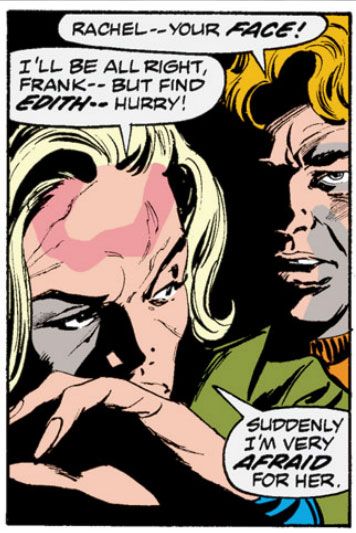
Another important character point is the scarring of Rachel's face.  Bats, released by Dracula, attack the group and Rachel gets a makeover.  These scars become part of her character and eventually symbolize the hardening of her spirit.  So important are these scars, when Wolfman and Colan resurrect Rachel years later in their Tomb of Dracula miniseries, it's through a kind of possession that involves a brand-new character tearing at her own face until she resembles Rachel and loses her own identity.


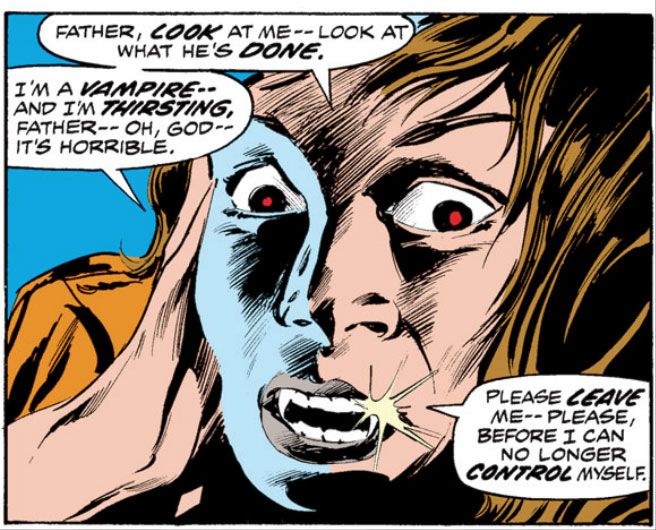
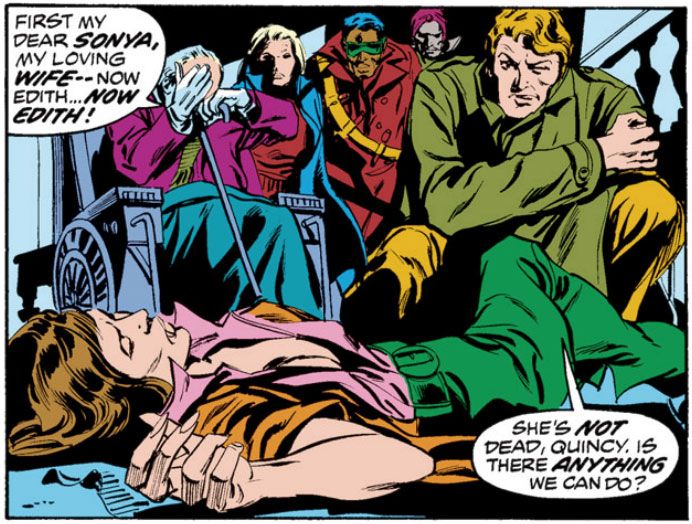
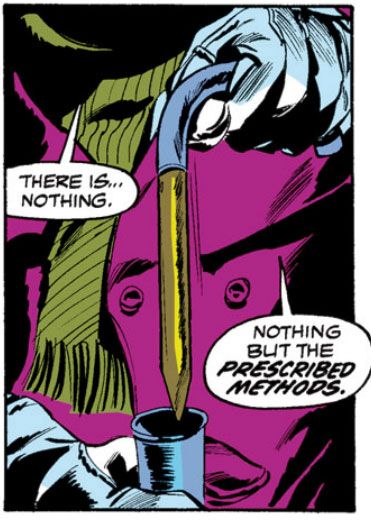
The final and most poignant element is Edith's fate and the matter-of-fact way Quincy deals with it.  While Frank reacts with very human but misguided compassion and hopefulness, Quincy Harker knows from experience there is only one thing to do.  Wolfman could easily cop out at this point and offer a last-minute reprieve in the form of some never-before-heard-of cure, but no.  Instead, he sacrifices a character to the betterment of the story.  It's a moment reminiscent of the scene from Stephen King's 1976 novel 'Salem's Lot where protagonist Ben Mears is forced to drive a stake through Susan Norton's (his vampirized girlfriend) heart.  King changes viewpoint characters throughout his story, spending a great deal of time and care making readers empathize with Susan by allowing them to see events from her perspective.  Her loss in the narrative gains impact because we think of her loss as tragic unto itself rather than merely something that incites Ben's actions towards the climax.


Wolfman hasn't had enough time to do as much for Edith.  Because her fictional career ends so abruptly, she remains something of a punching bag of a character.  And yet, Harker's coldly pragmatic method of dealing with her is chilling.  This is what separates a true horror story from an adventure that uses horror trappings.  Horror forces characters into painful choices, the loss of sanity, of limbs, of life, of loved ones.

Monday, October 7, 2013

October is Spookey Month: Uncle Creepy meets (and possibly eats) the NBC peacock... in color! (Part One)

I don't know how or why this went down, but in 1973, when William DuBay went from art director to managing editor on Warren's Creepy magazine, he introduced full-color comics to its formerly black and white pages.  Creepy had already featured spot color on the inside front and back covers, but this was to be the real four-color deal, trumpeted by house ad copy as "full spectrum" color.

Why end the streak of consecutive black and white issues?  Maybe it had something to do with the company's big roll-out of Dracula, the "horror art magazine," which would feature color (and that's the extent of my Dracula knowledge).  Or DuBay just wanted to freshen up the décor inside Creepy manor, the structure of which had already been under renovation by a group of highly-talented Spanish artists and our old friend Richard Corben.  Or maybe he needed to goose sales in the face of competition from Marvel-- the House of Idea released six magazines that year, five of which were horror, a direct challenge to Warren-- and CarToons.


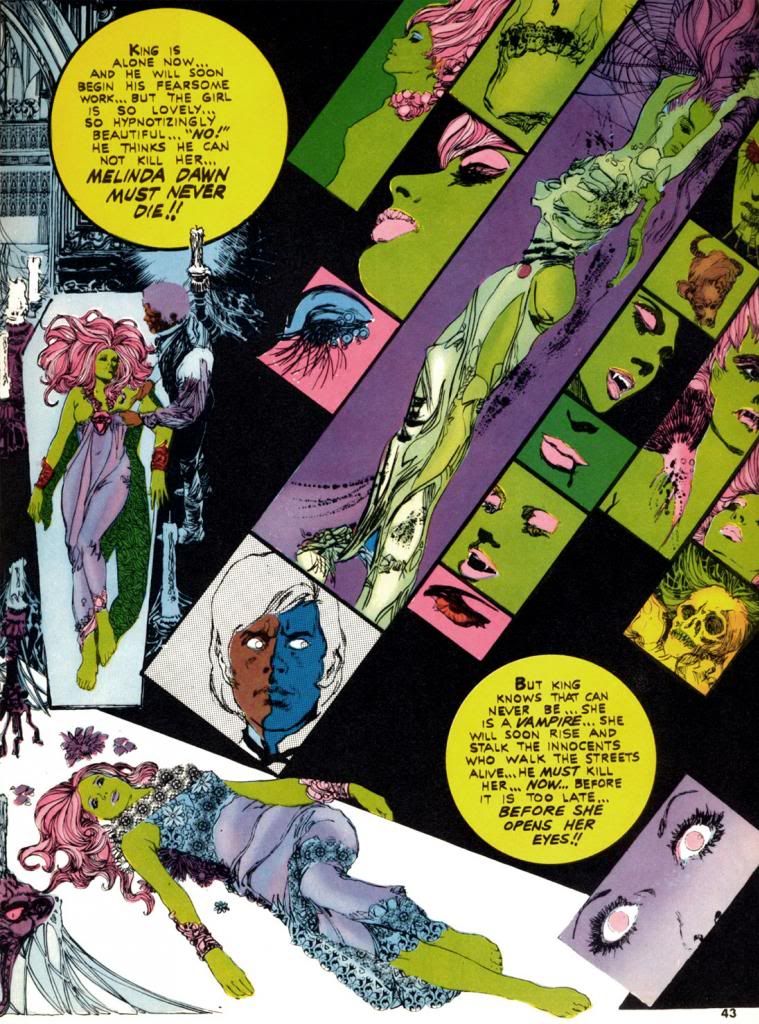
Whatever DuBay's reason (and in the interest of full disclosure, I actually don't even care why he did this; I just love these comics for simply existing in the first place), Esteban Maroto provides "Viyi," five pages of story and art in Creepy #51 (March 1973), DuBay's second issue as editor.  Here, Maroto puts one of his Brigitte Bardot-like females on display, and she's a livid green.  Amazingly, it suits her.  Maroto also wrote the story, but for Creepy's purposes "Viyi" amounts to a glorified house ad for Dracula.  We don't get the complete tale, just a couple of teaser pages telling us all about the new magazine.  The colors in "Viyi" are more subjective than representational and suit Maroto's gorgeous, emotionally-charged linework.  It certainly looks nothing like the monthly four-color superhero fare showing up on the spinner racks.  It hardly resembles the Creepy we'd come to know and love.  Perhaps that was the whole point.

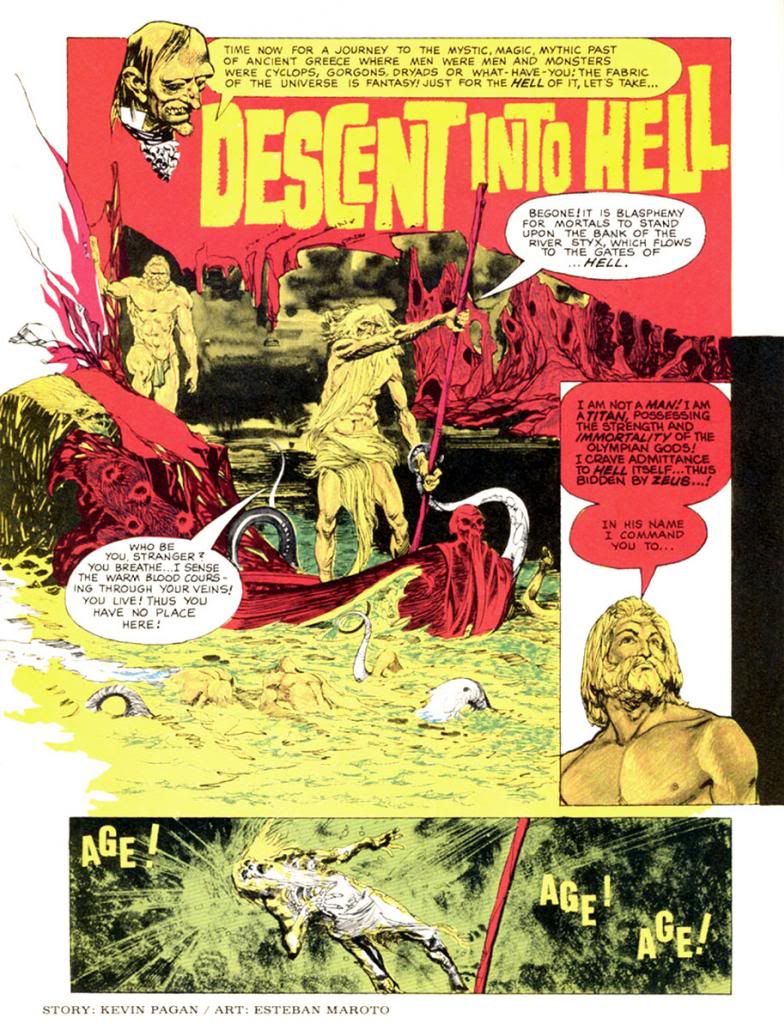
The next color story, "Descent Into Hell," again by Maroto, ran in Creepy #54 (July 1973), which also features Corben's infamous "Slipped Mickey Click-Flip."  Only a black and white story as outrageous as that could hope to compete with Maroto's journey straight to hell in lurids red and yellows.  And some blues.  By then the company must have been jazzed about where this was headed because the cover copy fairly screams, "Now!  Full Color Comics!"  The next issue consists entirely of black and white reprints but does toss in a neat-o full color board game with movement squares made up of a number of the magazine's classic cover paintings.  The credit for it reads, "Game conceived by:  Bill DuBay."


I'm beginning to sense a pattern here...

Corben finally gets his chance to produce some color pages in Creepy #56 (October 1973), where we find his classic "Lycanklutz."  A few issues before this a reader wrote in to complain that horror and comedy don't mix, but I beg to differ.  Corben's story of a flea-plagued werewolf is not only beautifully drawn, it's absolutely hilarious.  It's full of winking references to Universal Studios' Wolf Man movies and some anachronistic humor that anticipates The Princess Bride over a decade later.  Corben's palette is more naturalistic than Maroto's.  Modeled and painterly as opposed to flat and graphic.  Very different looks, but both please me immensely. 

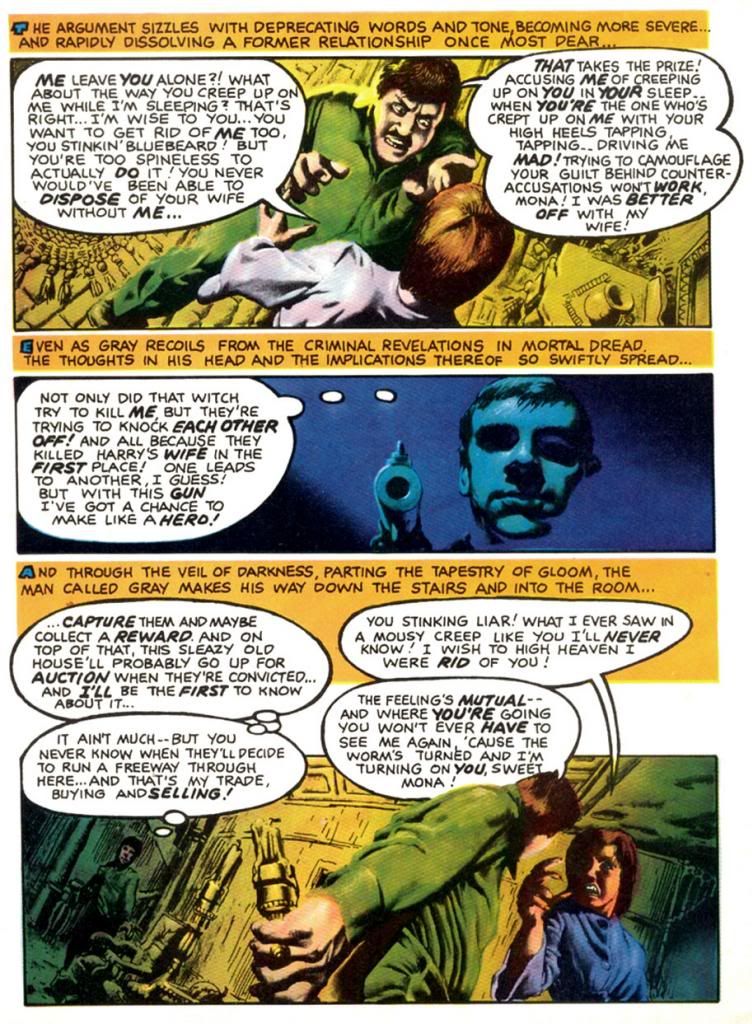
Corben strikes again in #57 (November 1973), this time partnered with write Doug Moench for a story seemingly inspired by the title of Traffic's 1971 album, which zoomed to #7 on the Billboard pop chart.  Do you think Moench owned a copy?  Maybe?  Whatever the title's source, "The Low Spark of High Heeled Noise" kind of strains to make its pun work, but ends up a grisly, effective murder in an old house tale.  Corben's color palette is more idiosyncratic this time out as he experiments with complementary color schemes in the blue/violet-yellow/orange areas of our ever-helpful color wheel.  I write "experiment," but I'm pretty sure the guy knew exactly what he was doing.  I'm not too conversant on what was happening in color magazines around this time, but compared to the still-primitive color printing in typical monthlies this is incredibly sophisticated stuff from color choice to use of subtle gradations in tone.  This wasn't possible in standard news-rack comics in 1973 and it shows Corben's mastery of color reproduction and effects.


Color takes a break until the Christmas-themed #59 (January 1974).  This time DuBay himself writes for Corben and they come up with a holiday story split between two perspectives that come together for a tragic finale.  It's both gruesome and sentimental, no small trick.  In this story, Corben employs a restrained, naturalistic palette for a timeless look.  Kind of like one of those Coca-Cola Santa paintings.  Or Norman Rockwell suffering a psychotic episode.  In #60 (February 1974), Corben teams with Steve Skeates for a story that seems somewhat inspired by the artist's own "Den."  It's a disquieting tale of a squeamish kid who finds a magic rock, turns into some kind of space-barbarian ape on another planet, then comes to a rather pathetic end.  Poor little guy.  More relatively restrained colors on display here in the early going, with some sweet autumnal atmospherics on the first page giving way to otherworldly hues during the fantasy sequence.

In #61 (April 1974), Corben provides his own script again for another comedy-horror turn.  This time, it's "Terror Tomb," with a character named Hardoff Bey and a clumsy mummy tripping the lunkheaded human cast to their doom.  Corben's dispensing of these dopes that way provides a nice chuckle amongst the more nihilistic horrors of the surrounding stories.  If I have one complaint about the guy's work, it's every so often there's a panel so packed with dialogue the balloon obscures most of a face, squeezing the art into a tiny corner.

You may be starting to notice a theme here as Richard Corben really makes the most of the opportunities DuBay provides for him, as we'll see in part two of this epic, rambling and altogether pointless overview.  My favorite of the whole bunch is coming up!

Tuesday, October 1, 2013

October is Spookey Month... again!

And that means horror, horror and more horror here at When Comic Books Ruled the Earth.  Also, I might write something about horror comics.  First up is what I plan as a multi-part look at Creepy's color comics.  That means some Esteban Maroto, a bit of Bernie Wrightson and a whole lotta Richard Corben.  Corben practically owned the color pages in Creepy.  Then, for a change of pace, we're going to take a look at Sugar and Spike's Halloween-themed covers.  I love Halloween-themed covers in general and Sugar and Spike's in specific, even though I have to admit I've read exactly one Sugar and Spike story in my life and it had nothing to do with Halloween.

About Spookey-- they're an all-girl "bubblegum-garage-power-pop-punk" trio from my hometown here in Japan.  A few years back, I wanted to do a Halloween-themed month of my own across all my blogs and they seemed like the perfect hook.  Their music is upbeat and energetic, and they even did a Halloween-themed live performance, which is immortalized on YouTube and linked here numerous times.  I think of October as the most fun of months and Halloween as the most fun of holidays, so linking the whole thing to the most fun of local bands seemed like the most fun thing to do.  It's been a while since Spookey put out any new music, but you should check them out anyway.  Do a Google search.  If you can find their last CD release, by all means buy it.

Tuesday, October 30, 2012

October is Spookey Month: Anton Arcane's Un-Men enjoy the refreshing taste of 7 Up, the Uncola

And in the interest of complete disclosure, I must admit I do, as well.  And why not?  7 Up is crisply delicious.  When one tires of those everyday, commonplace colas, it's pleasing to do what the Un-Men do and indulge one's palate with 7 Up, the Uncola, which isn't made using cola nuts.  7 Up is made using un-cola nuts:  lemons and limes.  So in this, the Un-Men and I are completely in agreement.  In all other things, however...

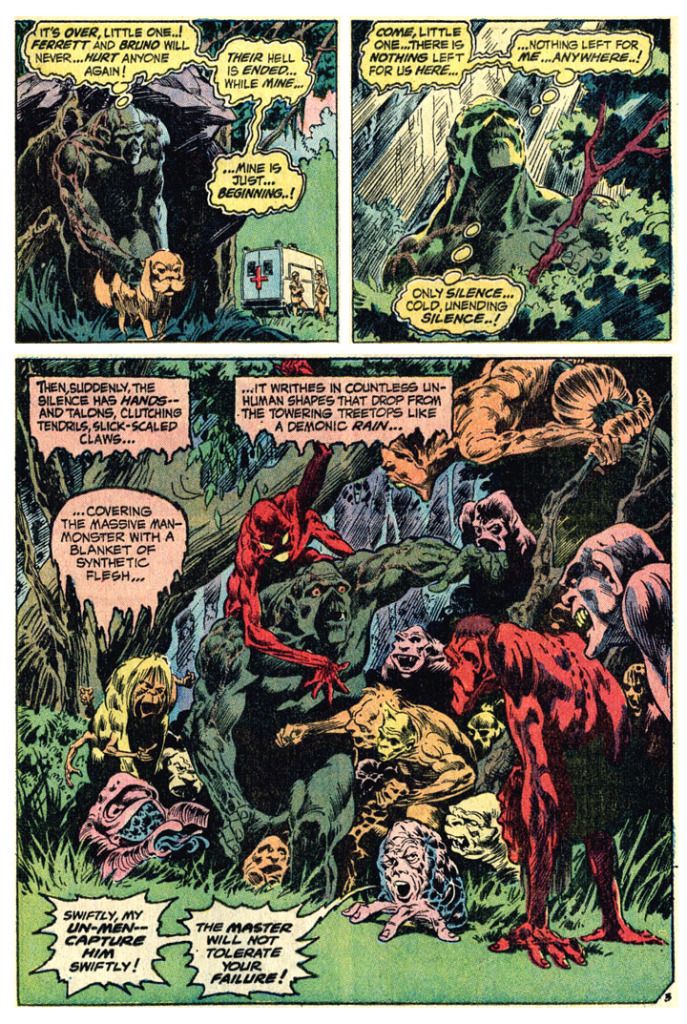
What kind of man deliberately creates monstrosities?  When Dr. Frankenstein attempted to glean the secrets of life, he meant to produce beauty but failed.  Anton Arcane, on the other hand, perversely sets out to make hideous things he then cruelly dubs the "Un-Men."  It's both a parody of the creation story-- God made perfection in 6 days, then rested-- and a misuse of science to tickle the fancy of an egotistical degenerate who wants to achieve immortality.  To this end, Arcane sends the Un-Men to the Louisiana bayou country to capture Alec Holland, who has recently become the Swamp Thing.


Marvelous!  Absolutely marvelous!  Just try making something like that out of a cola nut!  As we see in these exquisitely rendered Bernie Wrightson pages from "The Man Who Wanted Forever" in Swamp Thing #2 (January 1973), they succeed, at least temporarily.  But even this small achievement leaves the Un-Men lost in a world that never desired them.  In some ways, though, they are our children.  The unwanted, the living embodiment of our worst creative impulses, our vanity in thinking we might better nature itself, our ambivalent response to mortality.  In their nakedness, they are as newborns.  In their cruelty, they reflect their treatment at the hands of their twisted creator, as we do with our own petty crimes and misdemeanors.  Neither men nor women, they could only in the end become monsters.


Holland himself, his soul encased in plant matter and mud, provides a further tragic note.  This is before Alan Moore re-created Swamp Thing to suit his own needs-- the creature is not a transformed human, but rather a consciousness mistaken in its belief in that identity; it's a brilliant bit of revisionist storytelling that freed Swamp Thing from his ongoing quest to regain humanity and allowed Moore to take the tales along a more epic path.  But for our purposes-- and those of writer Len Wein-- this is definitely the soul of poor Holland trapped within a hulking, plant-based body, isolated not only from the humanity he desperately hopes to reclaim but also human society.  Lost in the night world of his new life, Holland now has more in common with the Un-Men than he does with Matt Cable, the human government agent searching for Swamp Thing just a few short miles away geographically, but a universe apart existentially.  Holland is also an un-man.

Now, let's all share the delicious taste of 7 Up.  The Uncola.  Why, it's even prettier than a cola.  Nuttier than a cola, actually!  HAHAHAHAHAHA!

Sunday, October 28, 2012

October is Spookey Month: John Severin's zombie soldiers


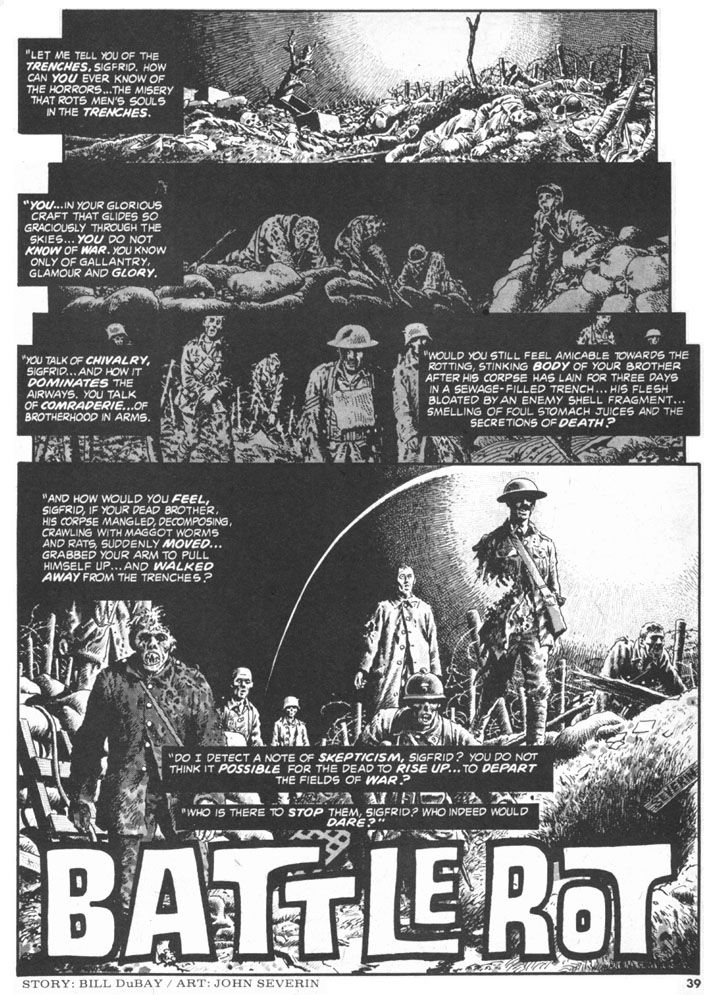
Personally, I'm sick of zombies.  Well, I thought I was, anyway.  Turns out I'm sick of zombies unless they're WWI soldier zombies drawn by John Severin.  Severin could draw anything.  Zombies, war comics, westerns, horror.  Horror-war.  This is the first page of "Battle Rot," a genre-bending tale from Creepy #81 (July 1976).  Written by Bill DuBay, it's the story of a German flyer who holds his ground-based fellow officers in contempt, especially when one of them starts rambling on about undead soldiers wandering around the trenches at the front.  Later, while villainously attempting to bomb a hospital, the arrogant pilot learns this story has its basis in fact.

"Battle Rot" would fit right in with DC's similarly themed Weird War Tales anthology comic.  The final page packs a wallop, and I was tempted to share it.  But I prefer the title page because it's just so haunting, evoking the climaxes of both versions of J'Accuse, the pacifist films French director Abel Gance (later a Petain supporter, unfortunately) made and re-made in 1919 in 1937 in which the war dead return; the earlier film features actual war footage and both have maimed veterans as the walking corpses, back to lay the blame for war on everyone equally.  All war is terrible, but WWI with its rolling artillery barrages, frontal assaults into fortified positions bristling with machine guns, mass gassings, filthy, diseased-ravaged trenches, No Man's Land full of unburied corpses and satiated rats must have been a special level of Hell unto itself.  Its mechanized, technology-based slaughter convinced a number of artists and writers life itself was absurd, was without no meaning and gave rise to Dadaism, an anti-art movement that's had a profound impact on my own sensibilities (I believe life is very meaningful, yet still absurd).  It would inform the horror genre in film and literature throughout the 1920s and 1930s as well, and we can extrapolate a similar reaction to the atomic bomb in the giant bug and lizard monster films of the 1950s.

Especially here in Japan.

Sunday, September 30, 2012

3rd Annual Spookey Month... and a weather-induced scheduling slip-up...

Okay, it's October here in Japan, which means Halloween.  I celebrate Halloween for the entire month.  This means watching horror movies, reading horror novels and short story collections... and horror comics.  But I also love to tie Halloween to Spookey, the all-girl punk band from right here in Hamamatsu.  The problem is, there are only so many Spookey videos available online and we've already seen all of them twice.  But because I love Halloween and I love Spookey, I'm going to trot the old familiars out again along with a series of horror comic-themed blog entries.

This interrupts my plan to post a link to and review of every single episode of Filmation's Isis TV show.  Another problem for me, less so for the millions of people who don't care about this blog or Isis.  Yesterday, I planned to post a review of the episode "Lucky," which is one of the better single episodes of any 70s kid series.  It's really quite amazing.

Then a typhoon blew through and knocked out the electricity in our neighborhood, so I didn't finish editing the review.  Since it deals with a theme related to Halloween, I'm going to slap it with a Spookey Month label, post it sometime this week and then take a break from Isis in favor of EC, Warren and other scary four-color delights.  We'll get back on track with Isis this November.

So... barring another typhoon... bring on When Comic Books Ruled's THIRD ANNUAL OCTOBER IS SPOOKEY MONTH!

Monday, September 17, 2012

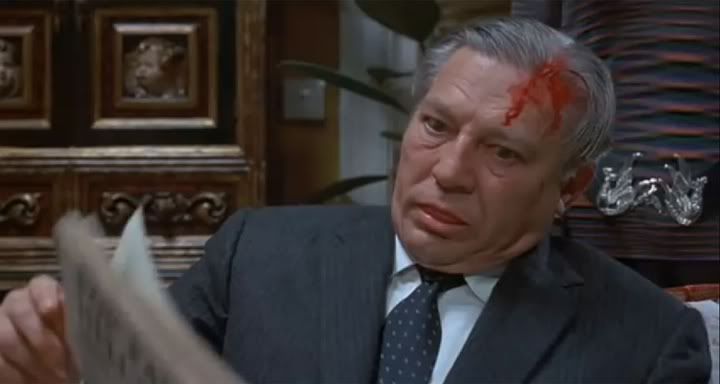
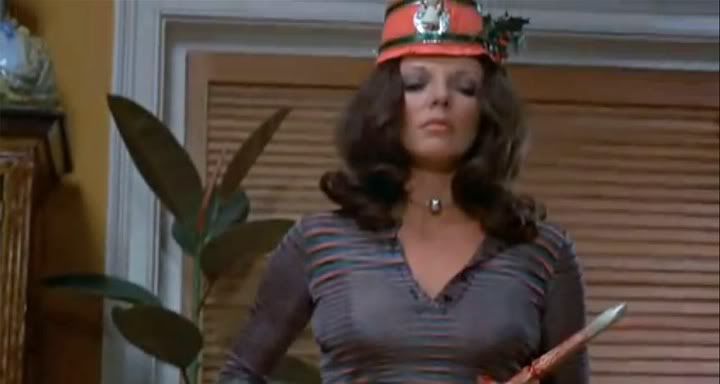
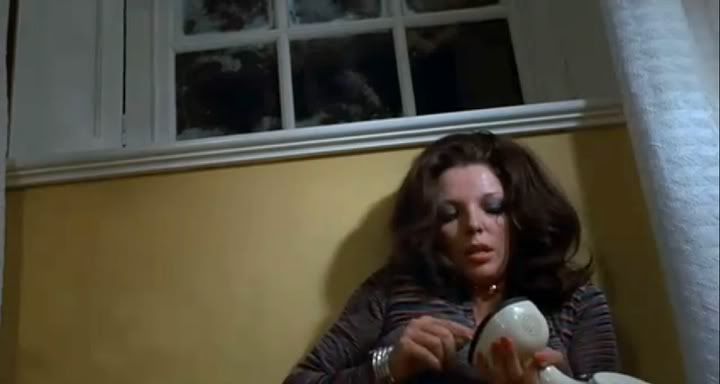
"...And All Through the House:" Joan Collins visits the Cryptkeeper for a merry li'l Christmas murder

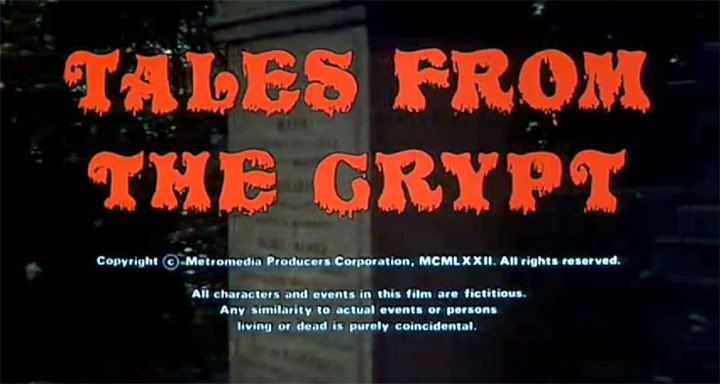
You know what's fun?  Practically anything to do with EC Comics.  Beautifully drawn morality tales with twist endings, black humor and oozing with loads of gore-- EC Comics are pure joy for twisted kids of any age.  This company and its books were the stuff of legends when I was a child.  Comics so freaky and scary the government itself had to step in and shut them down.  I just assumed they were all destroyed or collected and locked away in some case-hardened, nuclear bomb-proof silo in the desert Southwest, a site guarded by unmarried, family-less soldiers near retirement age, a place forever cursed and haunted.  Actually, they mutated into Creepy and Eerie, then migrated across the Atlantic where British Amicus Productions adapted five classics for the 1972 anthology fear-ture (heehee!) Tales from the Crypt.

The sign you're in for some real fun.
My first experience with this movie came at the library an easy bike ride from my house.  The reference section contained these massive volumes on horror movies with photos from flicks like Freaks and London at Midnight.  One of them presented Tales complete with a brief run-down of its origins in those infamous old horror comics and a huge picture of some poor jerk about to make his painful way down a corridor lined with razor blades.  This must have been in the late 1970s, the beginning of my lifelong interest in and love for EC.

"Dare you enter the Crypt-Keeper's Crypt?"
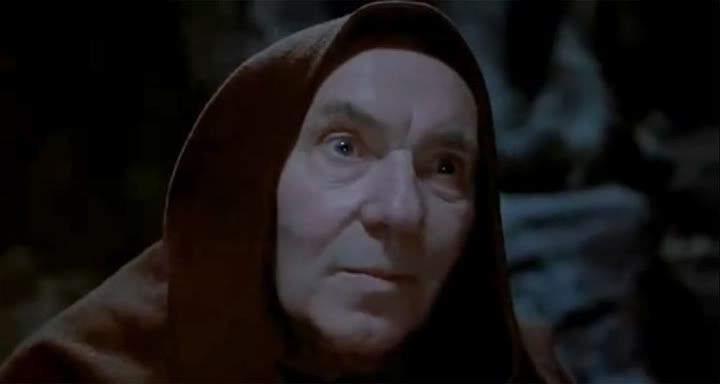
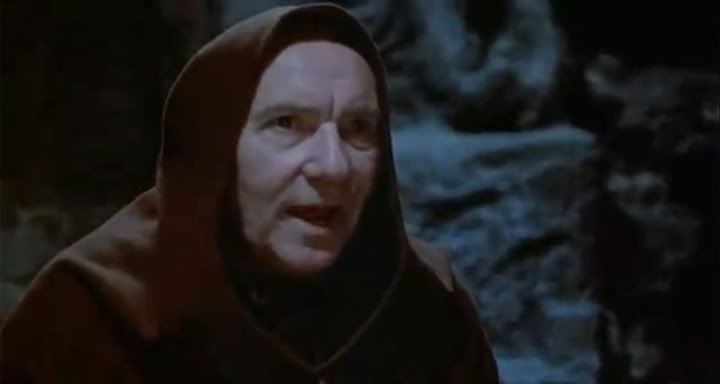
Strangely, the segment I like best among the stories that make the movie's cut (heh heh heh) comes not from any issue of Tales but from Vault of Horror #35 (February-March, 1954).  You know, Vault was the Vault-Keeper's hang-out, and boy was he pissed at that glory-hogging Crypt-Keeper.  Not only does the Crypt-Keeper have the honor of being portrayed by BAFTA-winning, Academy Award- and Tony-nominated Shakespearean actor Sir Ralph Richardson (the Old Witch would have picked Arnold Stang), while the Vault-Keeper only managed to appear on the Saturday-morning cartoon Tales from the Cryptkeeper...  but Crypty also gets to tell Vaulty's prized story.  The Vault-Keeper doesn't even have an origin, just a ratty hooded cloak.  Which Sir Ralph steals for this movie, rather than wear a wig to match the Crypt-Keeper's flowing locks.

"The fu-- ?!"
Yes, you guessed it.  It's "...And All Through the House."  None other than Johnny Craig wrote and illustrated the comic story.  Craig was a sharp plotter-- check out the stories he wrote and drew for Warren a decade later-- and a genius at creating cinematic suspense in two-dimensions, a four-color Hitchcock.  Each panel in this short, fast-paced tale is a masterpiece of lighting effects and rising tension before its inexorable ironic finale.

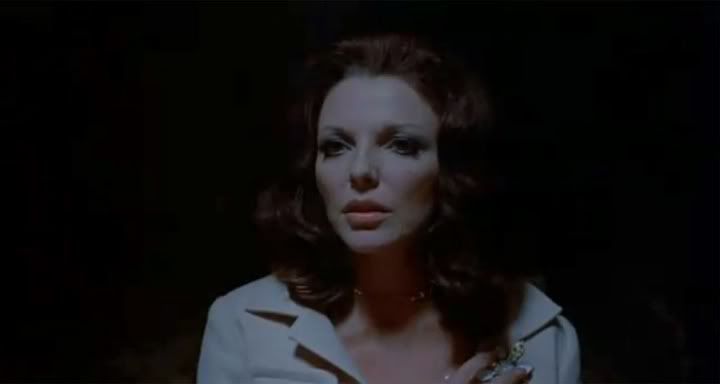
The movie adaptation follows the story note-for-note if not visual-for-visual.  As such, it's virtually a one-woman show starring Joan Collins in kind of role she was seemingly born to play-- a cold-hearted murderer.  She brains her husband with an iron poker on Christmas Eve, just after he's put her gift under the tree and settled in to read the newspaper and listen to some seasonal music on the radio.  He goes down on the rug spilling blood and brains, his eyes bulging grotesquely and his tongue sticking out.  Collins is wearing a party hat is a touch of the morbid humor that ran through each and every EC horror title.

"Hmmm?"
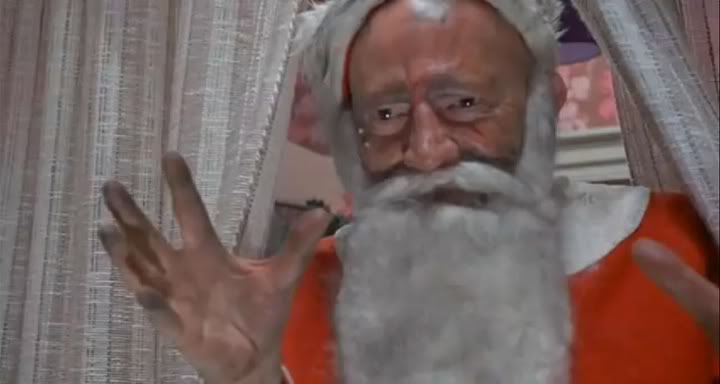
Why does she do kill him?  Well, to collect on is assurance policy (that's insurance to you and me, Russ), but it's probably not that important.  What matters is, it sets up the onrushing situation.  Because it's just her bad luck Collins chooses the one Christmas where an escaped madman in a stolen Santa Claus outfit is part of the the holiday festivities (by order of the town council).

And he's right outside the house!  Out of all the houses he could have picked, he's drawn to the one where the future star of a movie delightfully titled The Bitch and hate-queen of the TV show Dynasty has offed her spouse!  How very coincidental!  How convenient!  How lucky for us!  Now Joan has to dispose of a body and secure the homestead against an unwelcome holiday guest.  The poor woman goes through hell, only to have her innocent daughter let the seasonally-costumed killer right inside where he...

"And down I go..."
Well, it's an EC story.  They don't get giddy on eggnog then kiss under the mistletoe, I assure you.  When he finally appears, the Santa killer is more dopey than deranged, kind of like an alcoholic bell-ringer in need of a shower instead of a maniacal menace.  A visual disappointment.

Director Freddie Francis, a horror veteran who would later provide cinematography for David Lynch and Martin Scorsese, camera-stalks poor Collins... all through the house (boo hoo hoo).  She makes the most of her screen time.  From her satisfied reaction to having committed murder-- with a sneering inflection to her post-poker "Merry Christmas," Collins coolly conveys this in such a way you believe it's been building for a while-- to her growing hysteria as she shutters the windows and locks the doors and tries to figure out what to do about her husband's carcass, it's a performance of perfect pitch.  She makes you loathe yet feel strangely sympathetic to this woman when essentially you're watching a scenario that pits a calculating murderer against one of those old school nutzoids.  He can't help himself.  What's her excuse?  No matter; Francis and Collins have done their work well.

"Merry Christmas..."
So well, in fact, Robert Zemeckis directed another adaptation of this story for an early episode of the TV show, rubbing salt in the Vault-Keeper's wounds by once again letting the Crypt-Keeper-- rather than an august theatrical personage, now a desiccated, nose-less creature with John Kassir's high-pitched voice and memorably maniacal cackle-- introduce one of his best.  Zemeckis tapped Larry Drake (TV's adorable Benny from L.A. Law) to play the killer.  Not the woman; the Santa guy.  Drake puts his hulking, naturally sinister looks to good use, aided and abetted by some effective make-up.  He more closely resembles the Craig's crazy, too, than the dirty old bum from the movie version.

"Blast!  Speed dial won't be invented for years!"
To compare the two a bit, the movie is largely sincere while the HBO series plays the material more for outright laughs, a bit of cheese if you please.  This is a fine approach, one just as close in spirit to EC as Francis's more sober take. EC didn't rely on comedic relief simply so readers could breathe between shocks.  It's all over the comics, from the sometimes startlingly gruesome covers to the letters pages to the house ads, all part of the same gleeful embrace of horror for horror's sake.  A dance held in a drafty tomb, a moonlit frolic among the headstones.   The TV series turns this up a notch for a more jaded audience, but the movie still has a smidge of camp, some cheeky little moments.  Mainly, though, it busts its celluloid buns to gross people out and scare them into wetting their undies along with the winking and the smirking.

"Grandpa!  You're Santa?"
You know, I don't think the Vault-Keeper has ever gotten over this betrayal.  If you should find yourself in a cemetery some cloudy, moonless night, and he beckons you into his vault for a story-telling session, I advise you not to mention "...And All Through the House."  Or if you do, certainly don't let him know I told you all this.

Later we're going to take a look at Craig's original and drool over it like deranged Santa Claus.

Monday, June 18, 2012

How to do horror magazine covers the right way!

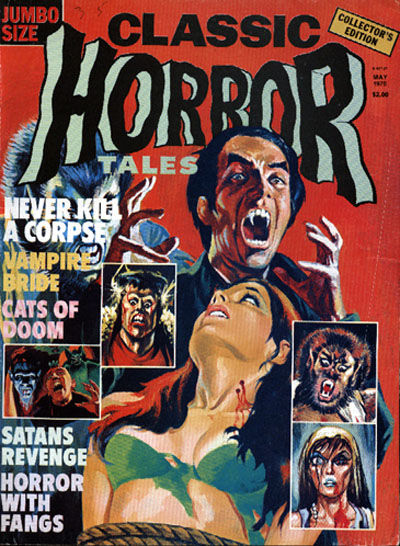
Now that I'm on a 70s horror jag again and because I damaged our imaginations with that Classic Horror Tales monstrosity-- so bad it looks like something I'd do as a joke-- I think it's only fair to share some truly beautiful covers.  I found a neat-o post at Retrospace about Skywald's entries into what soon became a glutted field (thanks to Marvel, who loved to flood markets and squeeze out other publishers).

Skywald never penetrated our market as far as I know because all of these are completely new to me.  Psycho?  I guess if you can have a Creepy or an Eerie, you might as well go whole hog with a Psycho.  It's as though Warren's books promised something slightly off, like that one guy at the comic shop who awkwardly starts a conversation with you but then won't shut up and he's trembling slightly the whole time and won't make eye contact, while Skywald's offerings were more like the guy running around downtown butt-naked who eventually got tazed to death by the cops.  While they're strongly reminiscent of Marvel's B&W line, Skywald's covers have the gothy cheesecake of contemporaneous Warren books along with similar eye-catching gore-- including one called Scream with what appears to be Peter Cushing after having part of his face ripped off in an auto accident.  Because ordinary Peter Cushing just wasn't scary enough.  Behind our disfigured Cushing a woman in a torn negligee looks on in dismay.

"You promised you'd stop fondling skulls after our honeymoon," she seems to be thinking.  It's upset her enough she's about to write Dan Savage who will advise her to "dump the motherfucker already."  She's been GGG enough but Cushing has an obligation to meet her needs, too.

Anyway, that's how you do horror magazine covers.  Your typography can be garish as all get-out, but your illustrations must have strong, uncluttered, well-balanced compositions.  You've got rotten corpses and semi-nude bodies galore, but they're pretty rotten corpses and pretty semi-nude bodies.  I want to read these.  Classic Horror Tales just makes my head hurt.

Sunday, June 17, 2012

Give Me Back My Brain!

Since I was an over-imaginative extra-sensitive wuss of a kid, my parents rarely let me have B&W horror magazines.  After all, even a single panel from a Marvel/Curtis Planet of the Apes could give me a screaming fit at bedtime for two or three nights running.  Actually, the more I think about it, the more I'm convinced their objection was mostly about the price tag.  My parents were, for lack of a better word, cheapskates and 75 cents was a ridiculous amount to pay for a funny book, magazine sized or not.  On the other hand, my mom never practiced literary censorship in the home.  I read John Irving's World According to Garp with its descriptions of masturbation and marital infidelity before I was old enough to masturbate or get married-- remember, I grew up in the Deep South-- myself.

The kid across the alley, on the other hand, had stacks of B&W mags.  All those Marvel zombie and Exorcist-inspired stories, the science-fiction ones, the kung-fu ones.  Every once in a while when we weren't playing with Hot Wheels cars or plastic army men, we'd have a reading session and out would come the financially forbidden magazines of doom and I'd give into the feelings of curiosity inspired by the invariably lurid cover paintings.  I vaguely remember something about astronauts trying to land on Venus and ending up on the sun only to suffocate to death, a story of claustrophobic and apocalyptic despair that depressed me all afternoon.
The one that really scared me, though, was something called "Give Me Back My Brain!"  The plot is your standard EC zombie comeuppance tale.  I think it'ss about some jerky doctor type who removes another guy's brain for reasons I no longer remember.  Why do these comic book characters do the things they do?  Usually there's some sort of gain involved, romantic or financial.  Maybe the doctor just had a thing for brains, a fetish.  Maybe he saw a CAT scan and thought, "Wow, that is one hot brain.  I gotta take it home and do things to it.  Wild, erotic things!"  Probably not.  His motivation wasn't all that clear to me at the time, either.  Just the horrible end result-- the dead man with his skull cap flopping open showing up at the doctor's mansion and demanding, "GIVE ME BACK MY BRAIN!"

That was the story's hook.  The doctor is all, "Wait, dude, I ain't got your brain and even if I did, you're dead and got no use for it no more!" and the zombie is all, "GIVE ME BACK MY BRAIN!"  There was a chase through the tastefully appointed rooms of the doctor's mansion and finally a scene where the zombie shambles back to his grave.  Cut to the dead doctor, his own cranium opened and emptied of its brain.

Jumbo Size!  For jumbo-sized crapitude!
Come to think of it, I'm not even sure the villain was a doctor.  Whatever he was, why ever he did what he did, it's one of those stories that practically write themselves.  You could come up with all sorts of variations, too.  Give me back my sternum/my tattoo/my ear hair.  Creep victimizes sucker, is outcreeped in turn by sucker's corpse.  Satisfied, the corpse lumbers away.  Shock panel ending, lots of gore.

Today I started thinking about "Give Me Back My Brain!" again and decided to use my valuable work time doing a little research.  The story didn't appear in a Marvel magazine, which were relatively classy if not quite as visually compelling as anything from the prime years of Creepy or Eerie-- despite sharing a few name artists like Tom Sutton and Neal Adams.  Instead it appeared in a cheap knock-off apparently called Classic Horror Tales, and it wasn't even an original.  It was a re-write of an older story from Harvey's Chamber of Chills #6 (1952).  Checking the info on GCD, almost all the stories in this mag are re-worked or re-printed from Chamber of Chills.

The cheapness extends to the cover.  Pure ugly.  Why bother to paint figures that will only be covered by copy and inset panels?  It's a poorly planned composition, indifferently executed.  I'd love to find a copy and see if the interior art measures up to my memories, but looking at this cover I have my doubts.  This is one case where my hyperactive imagination must have done a number on my brain.

Give me back my brain, you stupid horror magazine!

Sunday, December 11, 2011

Don't you just love Esteban Maroto's artwork?


I know I do!  I've been really getting into Creepy and Eerie and so I've rediscovered my love for Esteban Maroto's artwork.

When I was a kid back before you were born, I was very into those Lancer/Ace Conan paperback collections. I'd either buy one of those or a Choose Your Own Adventure book with my allowance each week. Most of the Conan covers featured teensy Frazetta paintings, but I remember some of them contained a few Maroto illustrations.  I could be mistaken, but I'm pretty certain I first encountered Maroto's work in the context of Conan's world.

Yeah, the mind plays tricks on you and all that kind of thing.  Well, whatever.  The point is, I liked what I saw and I copied his style in my school notebooks every day for a while. Badly, of course. Maroto never seemed to lift the pen or brush off the paper until he completed the image, leaving one sinuous, amazingly attractive line that formed-- usually-- some lush-lashed (yes, they had Maybelline before the dawn of time) princess or queen naked except for lavish jewelery Conan would probably steal from her after they made savage, prehistoric love or whatever it was barbarians did back in the Hyborean Age when they weren't killing giant snakes, trampling thrones beneath their sandaled feet or hanging out with Sandahl Bergman or Wilt Chamberlain.

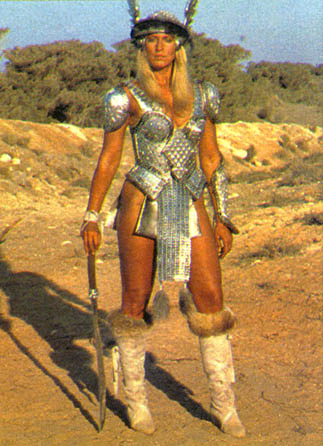
According to Maroto's website, he also designed Red Sonja's metal bikini armor. Not the most practical battle-wear, but it's served to make her a fairly popular character over the years. I can understand Maroto's motivation for drawing her that way, but I can't figure out why the character herself would go around dressed like that. She must be a mass of scar tissue.  Then again, in Marvel's Conan the Barbarian comics our favorite barbarian did his sword thing wearing a fur loincloth and some boots, so he probably wasn't much better off.  They were made for each other, these two legendary warriors, disfigured as they were because they dressed stupidly for battle.  Put some clothes on, fictional people!

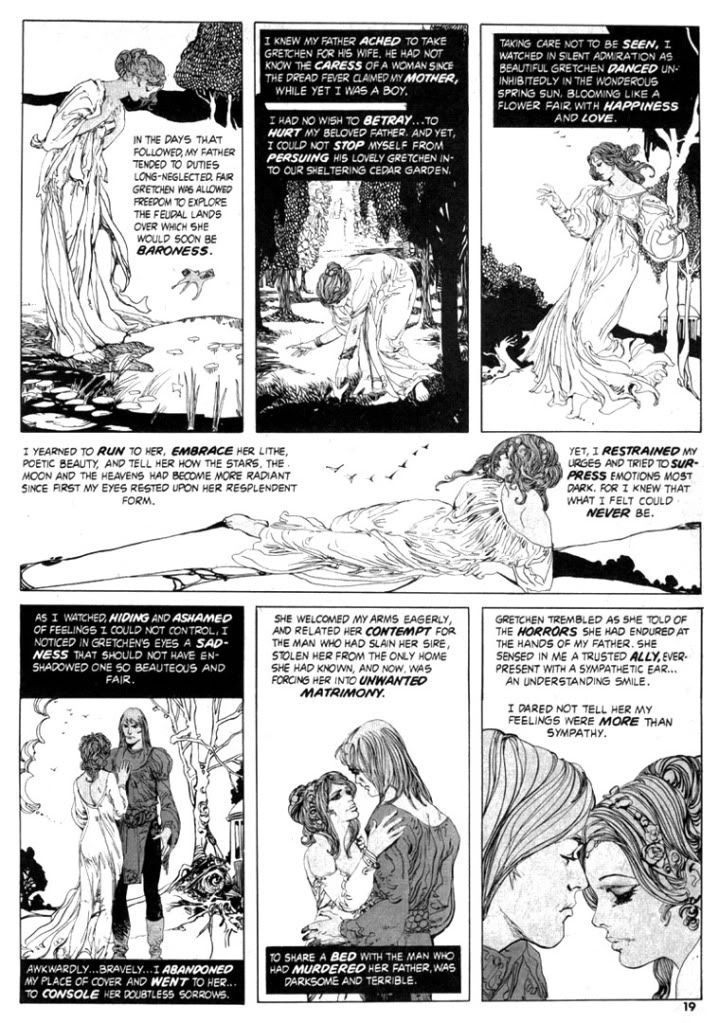
The page above is what re-sparked my Maroto interest.  It's a lovely pastoral scene from "Wings of Vengeance" (Creepy #81, July 1976), which he also co-wrote with Bill DuBay.  I'm very into Art Nouveau, and Maroto's compositions here and his controlled use of negative space and "designy" plant life recall another fave of mine, Aubrey Beardsley.  Specifically, the first four panels.  The single female figure, the framing, the poses are all ultra-Beardsley-esque.  Any of them could be blown up into a poster worthy of adorning an undergraduate's dorm room wall.  This page shares with Beardsley's art the same sense of romantic decadence within a kind of fairy tale atmosphere.  The draped and folded gown the woman wears seems very inspired by Alphonse Mucha as well.  I love the subtle gray tone on their skin, which helps separate them from the from the white backgrounds.  Enjoy this lovely young couple while you can.  She's later tortured to death and he has his face cut off.

If you happened to open a Warren magazine in the 1970s (something I rarely did because the covers were enough to scare me into insomnia), you stood a very good chance of finding Maroto's work.  He was one of their most prolific artists during that period.  Now imagine finding it beside some full-color Richard Corben nightmare, a Russ Heath axe-murder tale, an Al Williamson story with a space hero fighting alien dragons in a jungle, John Severin bringing horror to the Old West and maybe something drawn by Luis Bermejo.  There might even be something set in the 1930s by Alex Toth!  Don't forget Bernie Wrightson's frontispiece!  All packaged by genius editor Louise Jones, who is now Louise Simonson and who also happened to edit and write some nifty comics for DC and Marvel-- including New Mutants.

Which brings us full circle, I suppose.  Anyway, Esteban Maroto!

Monday, October 31, 2011

2nd Annual Spookey Month: Hoppy Halloween!

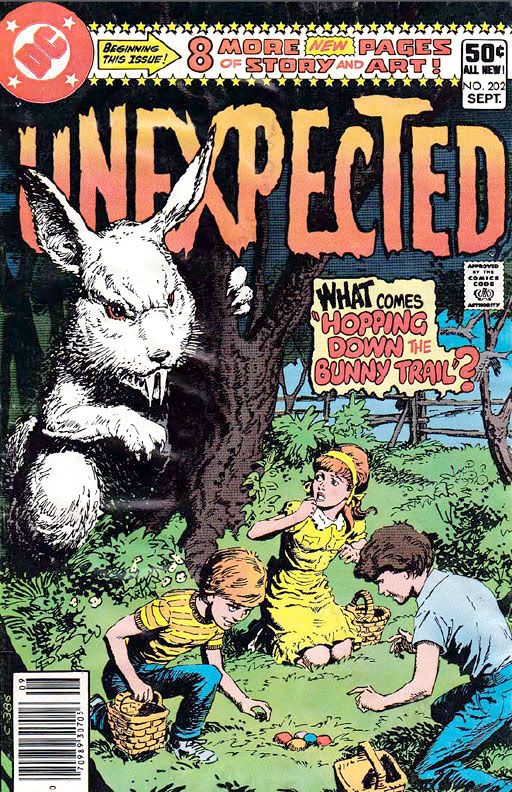
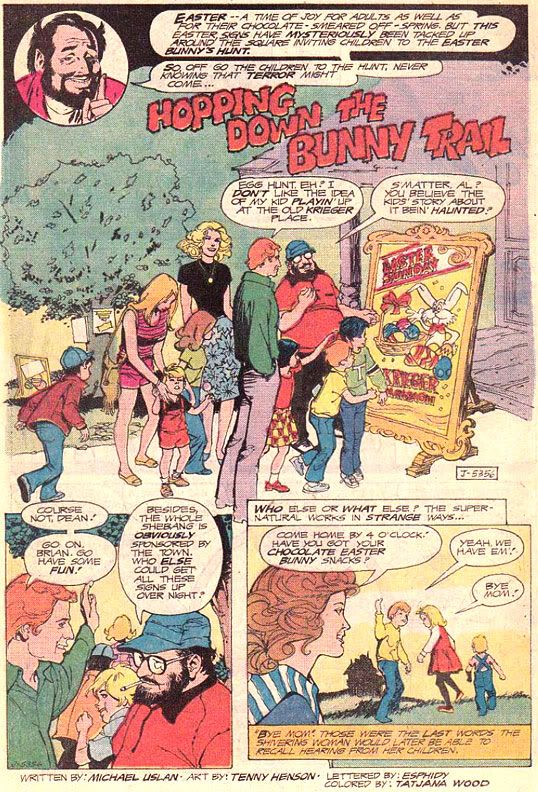
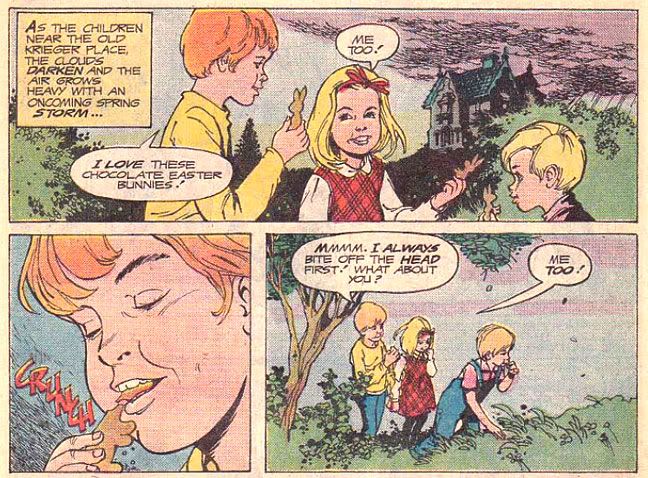
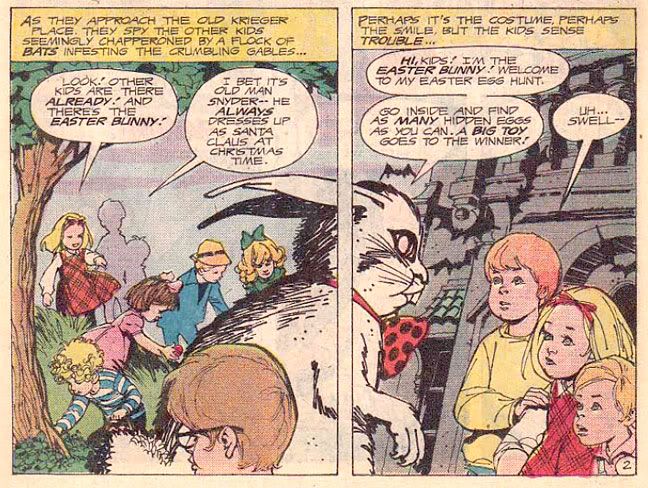
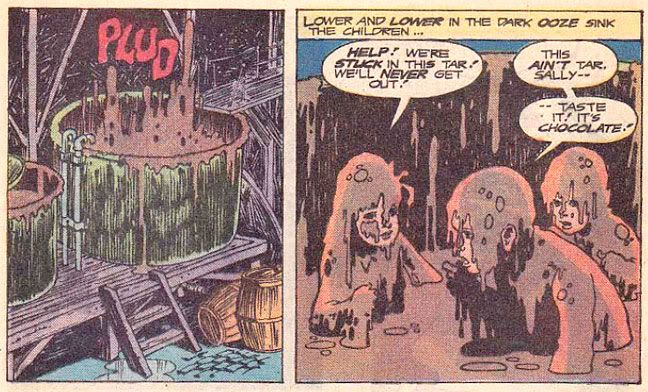
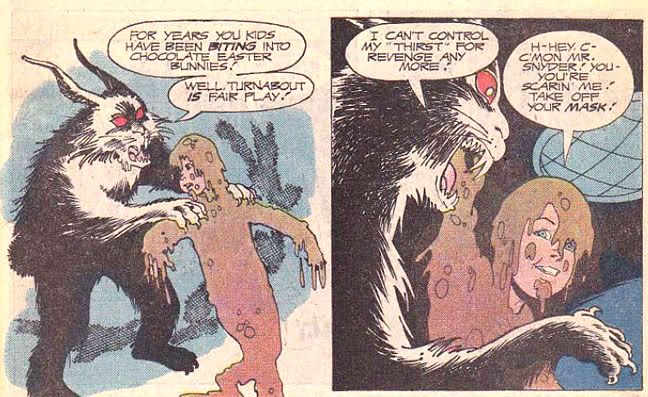
Some stories just stick with you.  Take "Hopping Down the Bunny Trail" from DC's Unexpected #202 (1980), for example.  I read this in a supermarket in Brevard, North Carolina, while visiting my grandparents.  On Easter, three ordinary kids die at the fangs of human-sized, talking rabbit they mistake for the Easter Bunny, their only crimes gleefully biting the heads off chocolate bunnies and being slightly dim-witted.  It gave me the creeps in broad daylight, and while I didn't buy the comic, it never completely left my thoughts.  Through the years, I'd occasionally remember it, slightly altered over time thanks to the transformative power of an imperfect mind.

Apparently, I'm not the only one who found it impressive, because someone made it into neat little .pdf with a short analysis.  Finally, after 30 years, I was able to read it again.  It's still a nasty little tale that should have wider acclaim. 

Some horror tales-- especially the ones in those old EC comics, the early Creepy and Eerie magazines and most of DC's titles-- rely on an ironic twist where some jerky moron gets his or her comeuppance.  The philandering murderer can't get rid of the betrayed spouse, even in rotted corpse form; the abusive parent suffers a more horrific version of the abuse heaped on the child; the greedy boss hoists himself by his own petard, usually fatally; the blowhard suffers blowback; the foolhardy self-appointed expert destroys himself and those who foolishly believe in him.  No matter what gruesomeness occurs, we're usually reassured in some way that cosmic justice has been served, scales have been balanced and the underlying order has been reaffirmed.  We get a kick out of what happens at least partially because these stories play into our sense of moral superiority.


But in this Michael Uslan-scripted story, the worst you can say about the characters is they're all a little dim-witted and unimaginative. The parents fail in their responsibility to protect their children because they just assume the city's somehow behind the Easter egg hunt that's been completely unpublicized until colorful signs appear overnight. Sure, it's at the local haunted house, which is probably firetrap or at the very least a tetanus shot and a lawsuit just waiting to happen. Send the kids!

These jokers are pretty blase, aren't they? This was the era before the ominously narrated news stories intended to stoke every parent's more morbid prescient fantasies, before 9/11, the anthrax letters, terror alerts and Dateline NBC and Inside Edition. This was two years before the Chicago Tylenol poisonings. And yet as we've seen so many times, even today's supposedly hyper-vigilant adults slip up. They leave kids locked in daycare vans in the middle of summer, fail to recognize or simply ignore the warnings signs before school massacres, leave the gate to the backyard swimming pool unlocked. Even if they're frequently driven to complete paranoia by stories about Internet perverts, Satanic cults and poisoned candy, they-- just like the parents in this story-- can be lulled into complacency by the promise of colorful eggs and treats for the kids.  After all, nothing bad ever happens on holidays!


The kids are pretty dull themselves. They walk right up to the "Old Krieger Place" despite Tenny Henson's having drawn storm clouds looming over it menacingly. I suppose their imaginations have been dulled by too much mediocre television and brain-rotting Saturday morning cartoons. Here's a human-sized talking rabbit and rather than recognize something completely bizarre and even threatening about it-- shoot, some kids bawl at the sight of Santa Claus-- these little chocolate lovers just assume it's Old Man Snyder in a costume. That's some costume! To sweeten the deal, the Easter Bunny offers toys and candy. If that isn't a tip-off, I don't know what is. But these numbskull kids take the offer at face value.


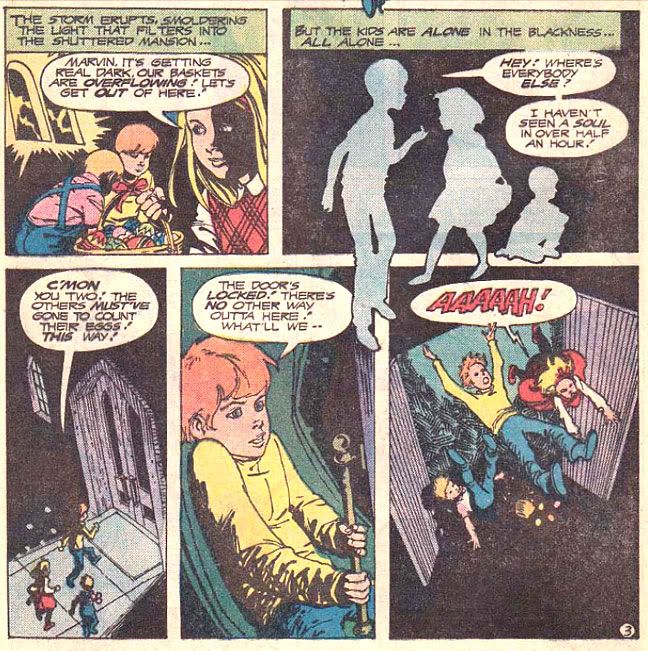
They only start to wise up when the other kids vanish and they find themselves all alone in a perfectly creepy house. And then only a little. They're so confident that everything's fine, that they're going to grow up and go to college and get married and have kids just like themselves one day.  And should something bad happen, Mom and Dad will be right there to save them.  Right?


Well, the universe doesn't really work that way.  Not only to bad things happen to good people, horrors beyond horrors happen to them.  Cars and planes crash, nuclear plants leak, cancers strike, young dudes accept odd jobs from John Wayne Gacy.  In the face of the ongoing tragedy we call living, we'd love to believe someone benevolent is in charge, that there's some underlying order to it.  Certainly there are natural laws and forces at work.  We can calculate the orbit of the earth around the sun with precision because we've figured the most obvious of them out.  But they also guide bombs onto blameless schools and hospitals and bullets into innocent spines.

Some horror stories offer a glimpse of a universe of limitless chaos where we are all in immediate danger.  They tell us order is an illusion, that good intentions invite catastrophe.  People are punished far out of proportion to their wrongs, or become victims of circumstance.  You bite the head off a chocolate rabbit.


A demonic rabbit bites off your head.  Note the complete lack of gore.  Just a transition from the brightly colored world of a sunny Easter Sunday to a dark and stormy place where wicked things happen to kids because they and their parents are careless and sort of dumb.  When I was 12, I could easily imagine myself as one of these dopey kids.  I was a dopey kid.  "Hopping Down the Bunny Trail" lifted the lid off the field and revealed something much better hidden.  And that was terrifying.

Now close the comic and try to sleep.  Happy Halloween!

No! I can't leave you on a downbeat note like that. Here's Spookey to cheer you up again and reassure you the world's a loving place!