Showing posts with label horror. Show all posts

Tuesday, October 15, 2013

October is Spookey Month: Tomb of Dracula #7 introduces Edith Harker

We all know how Quincy Harker's daughter Edith meets her doom-- staked by her own father in Tomb of Dracula #12, "Night of the Screaming House" (September 1973).  But how did she find her way into the pages of Tomb of Dracula in the first place?  It happens in #7 (March 1973) "Night of the Death Stalkers," (lotta "nights" going on here) with her father making his debut a page or two later.

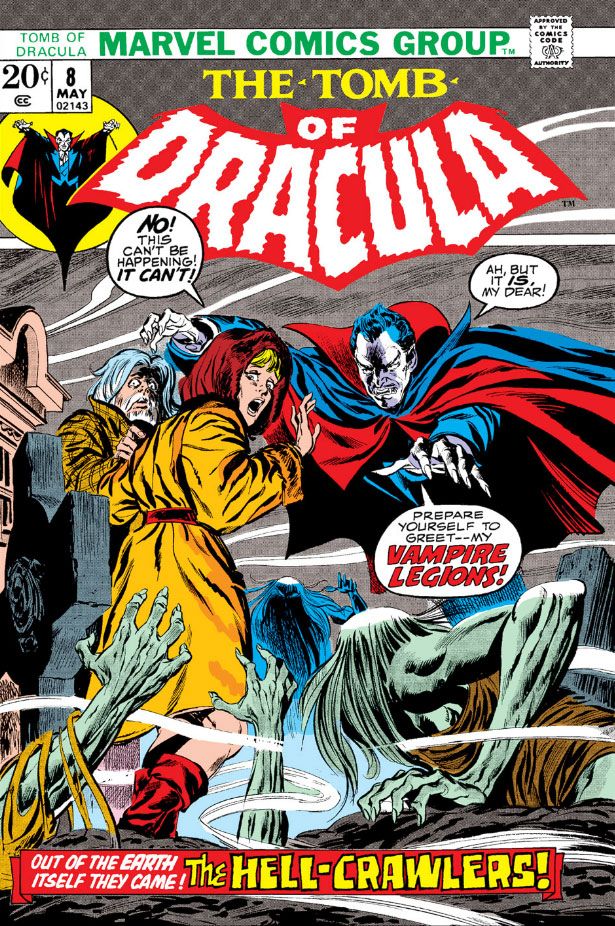
Let's look at the cover before we get into the story.  Doesn't Dracula have a fun sense of humor here?  This is some clever copy and it hooks me immediately.  The drawing is by Larry Lieber, Stan Lee's little brother.  It gives readers a fairly accurate depiction of the story inside.  It's not nearly as dynamic as some of the series' Gil Kane covers, but Kane was one of those "gold standard" cover artists and it's not really fair to compare anyone to him.  And yet I just did, didn't I?  What I like about Lieber's cover, however, is he makes Dracula look a lot like Hammer Studios' own Christopher Lee, the finest of all screen Draculas (and tallest).  I'm going to assume Lieber agrees with me and that in itself is more than enough to recommend this cover.  I'm in favor of Gene Colan's "casting" of Jack Palance as powerhouse, intensely masculine Dracula inside the pages, but the more sinisterly refined Lee played Dracula for a longer period and emerged with dignity intact despite some increasingly silly material like Dracula, A.D. 1972 and Satanic Rites of Dracula, both of which provide prototypes for Tomb of Dracula.  You know, Dracula in the modern age, tooling around London and swingin' hippies and mods and all that.  So Lee is also very appropriate.  Anyway, the cover does its job competently if not spectacularly, but it's still fun.  The issue preceding this one had a Neal Adams cover, by the way!

Take a deep breath, because here... we... go...

In this issue, Rachel van Helsing introduces her pal Frank Drake to the Harkers and they form a vampire-fighting association the likes of which the world had never seen.  Well, not really.  It's a group similar to the one Bram Stoker came up with in his original novel, the one that started this whole Dracula business.  I've always liked vampire-fighting groups, and Tomb of Dracula's is far and away my favorite because everyone is a bit edgy and damaged.  While Marv Wolfman's core cast coalesces, their enemy, the famed count himself, self-styled Lord of the Undead, is busy making new friends of his own.  Because Tomb of Dracula #7 has a lot more going for it than just the first appearance of Edith Harker and her dad.  It also has one of Dracula's most sinister plans-- hypnotizing a bunch of kids into killers.  Kids, killers.  They both start with the letter k, and lemme tell you, there are some kids out there who would just as soon slit your throat as look at you even without a vampire master giving them hypnotic orders.  Slit your throat, then enjoy delicious Honeycombs cereal as a part of any complete breakfast.

Dracula's logic for this is while Harker and company would stop at nothing to kill vampires, they're not about to murder children, not even to save their own lives.  Turns out he's right.

This set-up reminds me of Village of the Damned, that truly disquieting film where time stops in a quaint village and nine months later a cadre of identical blonde babies arrive.  They grow up into sinister children who delight in murder via telepathy and wearing blonde wigs.  It's also reminiscent of those Simon-Kirby kid gangs of yore.  The killer Boy Commandos in Tomb don't wear wigs and they don't engage in any witty repartee, but they do sport some eerie glowing eyes as they silently and relentlessly pursue our heroes.  They do such a good job of it, the story stretches into Tomb of Dracula #8 (April 1973), which has a John Buscema cover.

Getting back to Edith.  Since we've already covered Edith's final moments, let's take a look at her first.


I'm going to assume she works at the chemist (that's "pharmacy" or "drugstore" to us colonials) Colan draws her leaving.  Gosh, it sure is cold.  I hope she gets home all right...


Oops!  No such luck.  Yes, she is the book's jeopardy queen.  Still, a bash in the face is better than a bite on the neck when you're dealing with the undead, and it's Edith Harker's good luck to have come face-to-face with the boss of them all and come away with only a bruise.  Dracula seems kind of a quitter here, though, doesn't he?  Edith's wearing one measly little cross.  Where is Dracula's amazing hypnotic gaze to make her take it off so he can feed on her?  It takes him about two seconds to enthrall those kids.

Speaking of which, here they are:


It looks as though someone at Marvel did a really clumsy art touch-up on Dracula's head in the fourth panel.  The face is Colan/Palmer, but the wonky perspective on the forehead (the widow's peak is turned a few degrees from where it should be both vertically and horizontally and there's no foreshortening despite the slightly low-angle view of Dracula's head) and the hair texture look completely alien.  Why?  Maybe the page passed through the inking and lettering stages with the top balloon coming out too large and covering too much of Dracula.  The editor decided we needed more of Dracula's head in there, which meant reducing the balloon and getting someone on staff to touch up the missing areas.  Just speculating about a hypothesis, but it also looks as if someone mistook Dracula's left hand for one of the background trees and colored it brown as a result.
Here's one of the most disturbing aspects of vampire lore-- the corruption of innocence.  Stoker used this is a major theme in his novel, and Wolfman picks up on it.  In Stoker's book, Dracula's first victim is the virginal Lucy Westenra, the ideal of proper young womanhood in the Victorian Age.  By the time Dracula is through with her, she's feeding on babies in a parody of nurturing motherhood.  Wolfman's Dracula will stop at nothing in his quest for power or whatever he holds as his ultimate goal and a bunch of boys become his weapons.  They're very effective, surprisingly so.  They chase Frank and company right out into the night and trap them in an old-fashioned car and there's not a thing anyone can do about it.

In fact, the hypno-kids do such a fine job of taking Dracula's enemies out of the fight, he finally has a little leisure time on his hands.  The next issue (nicely inked by Ernie Chan-- credited as Chua thanks to a bureaucratic screw-up on his immigration documents) sees Dracula using this free time to recruit some even more sinister allies, a lot of moldy vampires.  I think he should have stuck with kids.  Imagine Dracula getting himself on TV, perhaps taking one of those horror movie host jobs, or showing up at a station where they do one locally and beaming his powers across a wider area, ensnaring hundreds, perhaps thousands, of children and turning them against the adults.  Kind of like Halloween 3, but without that Silver Shamrock rhyme to get into your mind and stay.  And stay.  AND STAY.

And here's where it turns out I owe Edith Harker something of an apology.  She first appears as a typical damsel in distress, and goes out that way as well.  But she gets to come to the rescue herself at least once before Dracula and dear old dad put an end to her once and for all.

And here she is:


You go, Edith!  Sorry they didn't get your hair color right in this, your shining moment.

Sunday, October 13, 2013

October is Spookey Month: Star Trek #19 in which a space criminal is frightened into incontinence...

The original Star Trek series sometimes combined science fiction with straight up horror, maybe softened a bit by a little dialogue about an "energy source" that creates whatever magic Kirk, Spock and the rest come up against.  But the idea was still using the old cliches to fill fifty minutes worth of story without being so obvious about it.  The very first episode to air, "The Man Trap" (September 8, 1966), featured a "salt vampire" that was pretty much just a version of a regular vampire story dressed up a little for a futuristic setting.  The crew met a witch in "Catspaw," written by Psycho author and H.P. Lovecraft protege Robert Bloch.  It ran just in time for Halloween (October 27, 1967, to be exact) and came complete with a black cat and a gothic castle.  And let's not forget "Wolf in the Fold" (December 22 the same year), also written by Bloch.  That's the one where we find out Jack the Ripper was possessed by some kind of immortal, incorporeal entity that feeds on fear.  When it gets into the ship's computer and starts screaming "RED JACK!  RED JACK!" over the intercom, Trek for the first time managed to scare me silly.  Even reading the James Blish short story adaptation of that particular episode frequently gave me the willies, the heebiejeebies, the whimwhams or small pox.


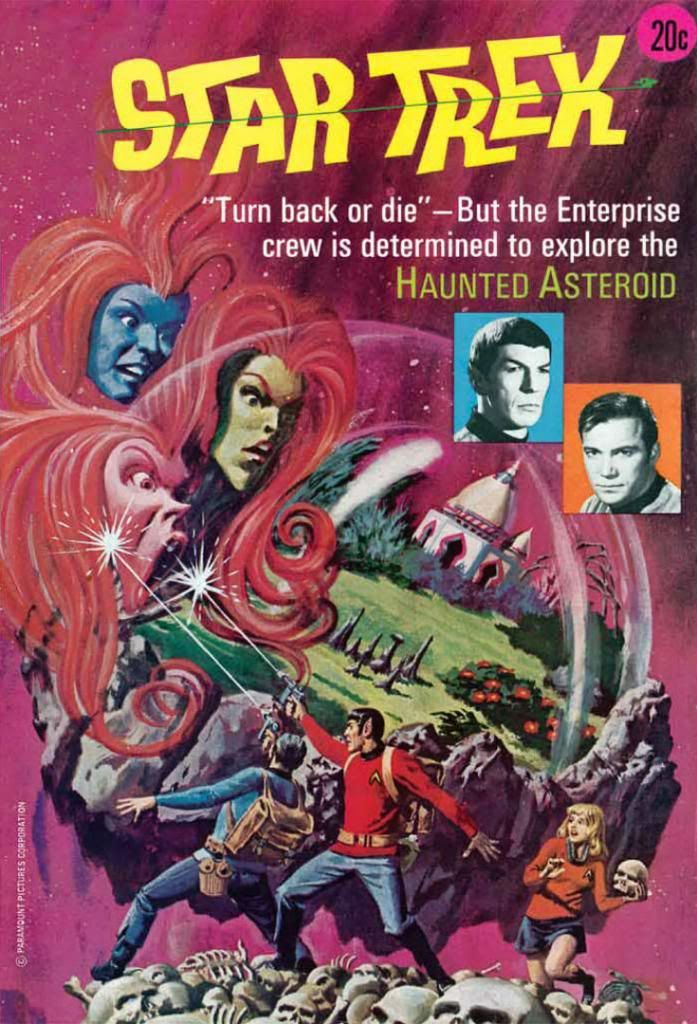
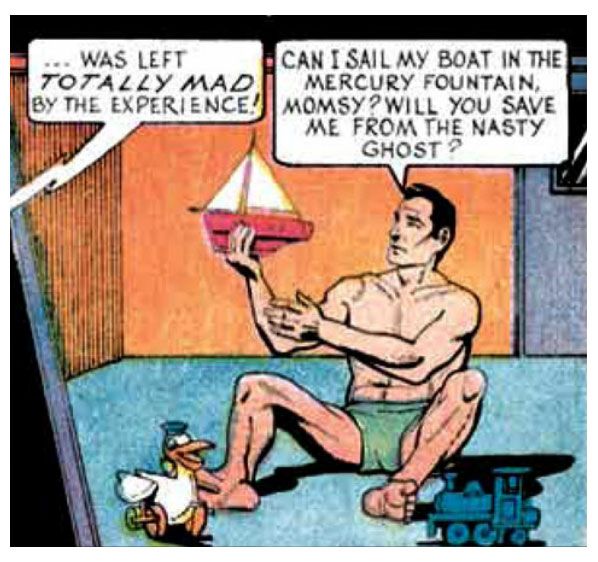
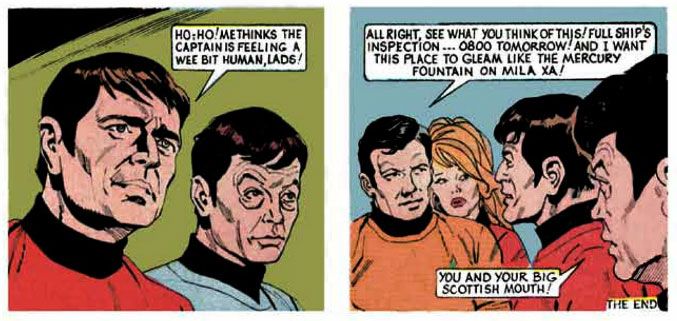
The Gold Key Star Trek comic adds ghosts to the mix in #19 (July 1973) , where (according to Comixology at least) writer Len Wein-- of all new, all different X-Men and Swamp Thing fame-- presents our daring space explorers with a supposedly haunted asteroid where something fearful dwells.  How fearful?  So fearful that after encountering it, this poor guy reverts to childhood and has to wear diapers for the rest of his life:


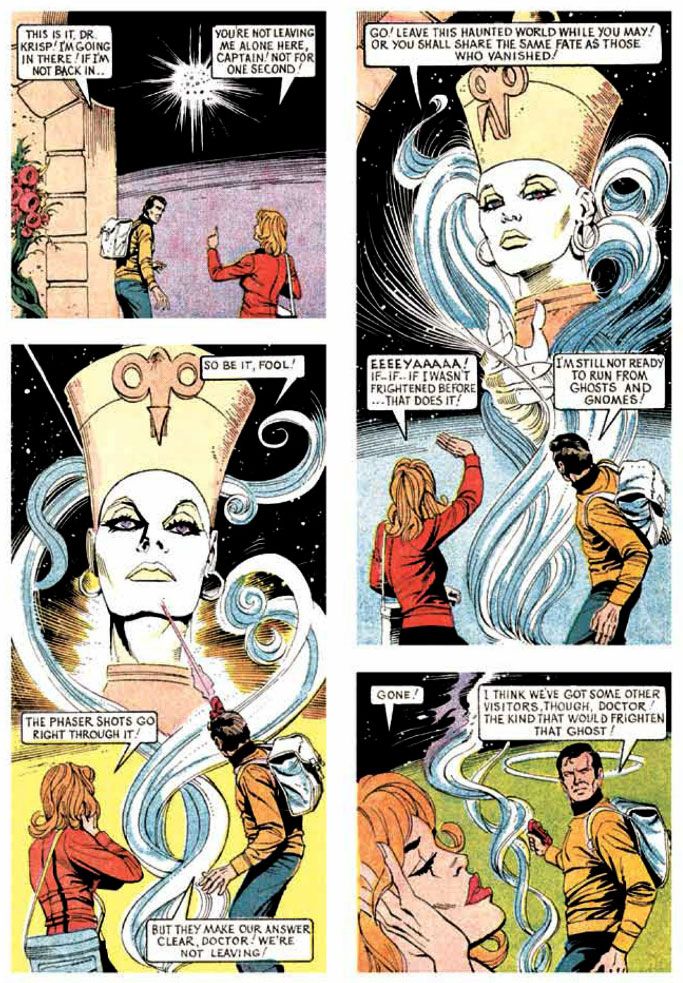
Because Starfleet favors the empirical over the metaphysical, the Enterprise warps to the asteroid for an investigation.  Kirk's old Academy pal Jay Nordyke goes down and comes back with selective amnesia.  Hypnotic regression reveals he's erased from his memory a horrifying encounter with a ghost.  At least he can still function as an adult.  Kirk, Spock, Sulu and some others beam down to check things out and gamble they're mentally tough enough to stay grown ups and in control of their bowels no matter what they face.


Aiding the ghostbusting is Dr. Krisp (first name Cookie) who, despite wearing a smart black skirt, proves a bit shaky in the field.  She and Kirk get down... to business (get your mind out of the gutter, please) and solve the mystery.  It turns out it's more science than supernatural, a variation on the old Scooby Doo, Where Are You? ploy of someone pretending to be a ghost to frighten people away when we all know that would only attract hordes of macho jackasses with night vision video cameras and heat signature detectors and a whole lot of pseudo-scientific bullshit to run around shouting at the walls for SyFy.


By borrowing heavily from the story of the Taj Mahal, Wein does a sweet job of setting up and then explaining the mystery.  There are some characteristically goofy moments because it's Gold Key, like hardened space travelers trained in scientific observation screaming "zombies" when what they're looking at is patently something else with which they should be very familiar given the Federation's technology.  And I love Alberto Giolitti's off-model artwork.  He sometimes all too obviously uses photo reference for some portrait-style panels, but most of the time it just seems like he had only the vaguest idea about the property he was working on.  As a result, a few things have been lost in translation, but a lot of charm has been gained.  Giolitti's art has its own Giolittian flavor, kind of fusion cuisine, some Trek, a side of Flash Gordon, a liberal dollop of European comics.  In the end, it proves a deliciously satisfying yet wild stew of different ingredients.  The exterior of the mausoleum looks Mughal, the interior gothic, the costumes strictly Ancient Egyptian.  At the same time, that's not too far from what the show itself used to do, where the set and costume designers seemed to lean on whatever was available in the prop and wardrobe departments at Desilu.

The ultimate solution is a surprise, but it fits the evidence and it's also made of stuff that's very familiar to Trek fans, so we'll accept it.  Or not.  That is to say, I'm fine with it but you'll have to make up your own mind.  This sets up a more traditional Star Trek dilemma where the crew now knows exactly what it's up against but still has to figure out how to escape an overwhelming power.  It helps that Sulu reveals himself to be a champion gymnast and Scotty a champion weightlifter.  I've always considered myself a solid Trekker, but I can't for the life of me remember either man possessing those skill sets.  I know Sulu is an expert fencer and botanist, and that Scotty can drink anyone under the table be it Klingon or godlike evolutionarily advanced super-being.  Neither of those apply here.

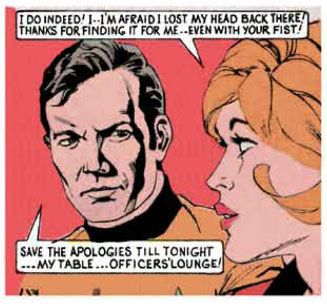
And what is it Kirk is good at, better than any other man?


Being a hard ass.

Wednesday, October 31, 2012

October is Spookey Month: Let Doug Moench and Richard Corben show you how to trick-or-treat!


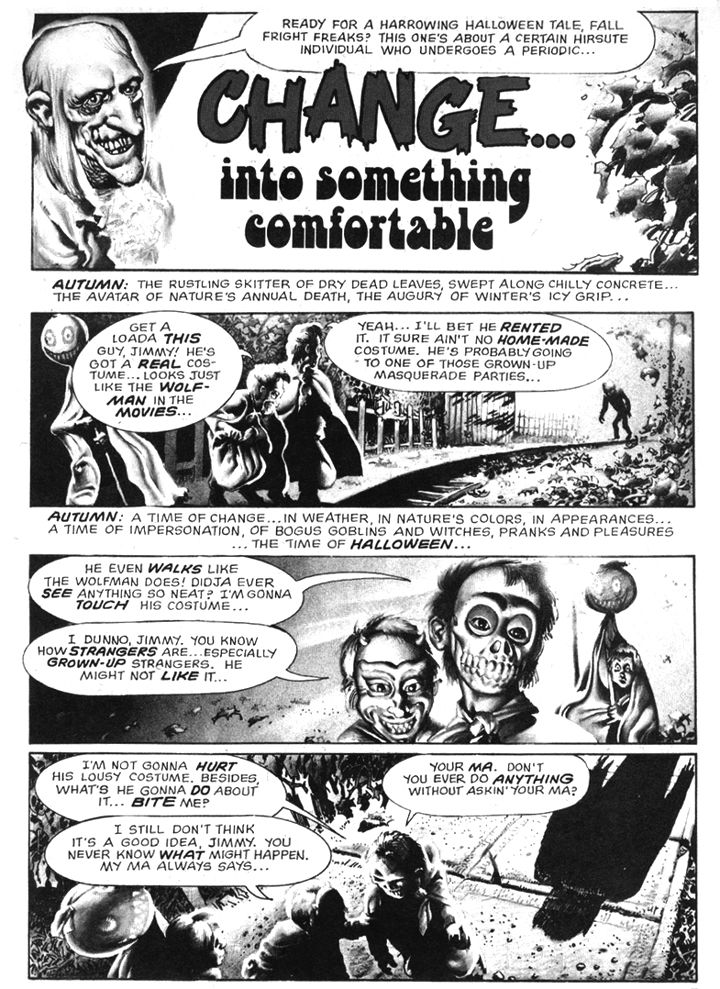
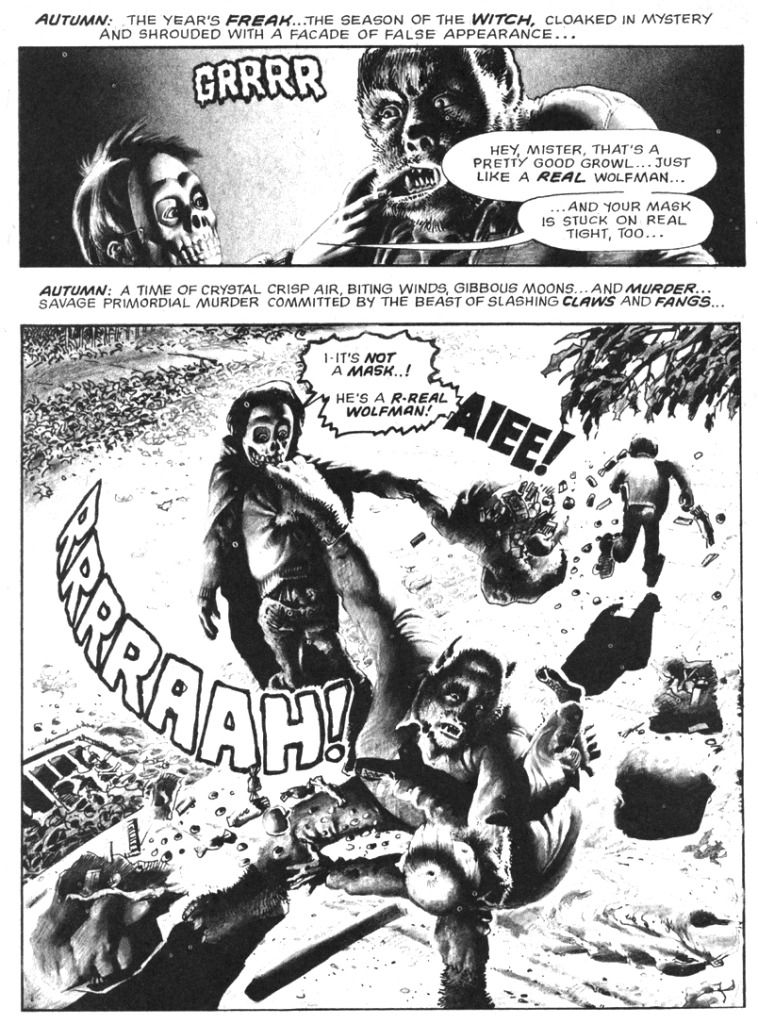
Yes, Halloween is a fun holiday, but you should exercise at least a little caution when out trick-or-treating.  Go in a group, wear a costume with reflective tape so motorists can spot you, go only to well-lit houses.  And most importantly-- don't pull on a werewolf's lip.  These are a few simple safety tips brought to you by Doug Moench and Richard Corben in their horror-comedy classic, "Change... into Something Comfortable," which appeared in Creepy #58 (December 1973), a "special Halloween horror issue" (so it says right there on the cover).  While I didn't particulary enjoy "The Slipped Mickey Click-Flick," I'm a huge fan of this little seasonal-flavored gem.

It starts with a real werewolf ripping some smart ass kids to shreds and ends with a sweet twist I find both irresistible and hilarious.  I mean if you've ever wondered what creatures of the night disguise themselves as on Halloween, here's your chance to find out.  "Comfortable" is sort of a companion piece to Corben's even more hilarious "Lycanklutz" from Creepy #56 (September 1973).  That earlier full-color romp features a somewhat luckier werewolf in a medieval setting with some surprisingly anachronistic products available for sale.  By contrast, our contemporary, kid-killing monster in "Comfortable" strays into EC territory with tragic results.  I could have hit you with "Lycanklutz," but this one is all about Halloween and disguises and has those melodramatic Moench narrative captions.  You can read it in the Dark Horse Creepy Archive Volume Twelve.

Come to think of it, you can read them both in that book.

Tuesday, October 30, 2012

October is Spookey Month: Remember when Swamp Thing visited the Winchester Mystery House?

"Bang.  Bang.  Bang."

You don't remember?  How about the time Swamp Thing visited the Cambridge Mystery House, the DC universe version of the same place?  Rings a bell, huh?  Bangs a nail.  Hammers and all that.  The Winchester Mystery House is a fascinating place, the life's work of Sarah Winchester, widow of William Winchester and heiress to the Winchester Repeating Arms fortune.  Somehow she took it in her head spirits would kill her if she ever completed the mansion where she lived, so construction went on around the clock for nearly 38 years until Mrs. Winchester's death in 1924.  Mrs. Winchester was a little eccentric (according to the Winchester House's official website, some of her employees actually thought she herself had supernatural powers), obsessed with the number 13, and her house is equally... er... original.  Stairs to nowhere, fake bathrooms, windows on the inside, liberal use of redwood because Mrs. Winchester preferred it-- although it all had to be stained or painted to look like some other kind of wood because she hated its appearance.  Given the house's origins and bizarre interior, it's no wonder the Winchester Mystery House has a reputation as a haunted mansion.

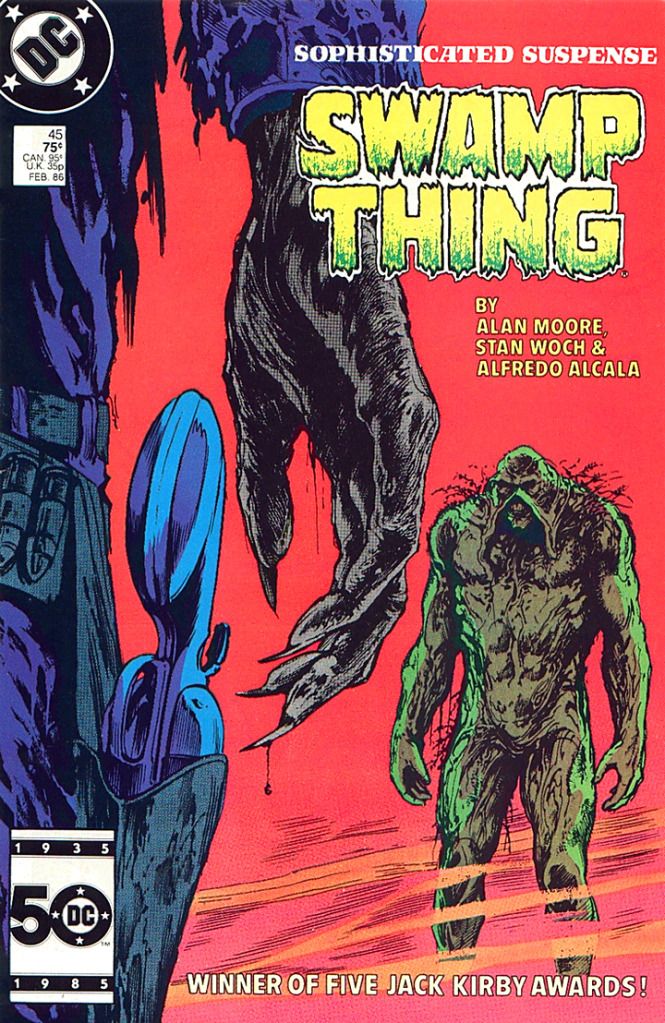
Alan Moore puts the Winchester lore to good use in "Ghost Dance" from Swamp Thing #45 (February 1986) with the help of some evocative art by Stan Woch and Alfredo Alcala.  A group of friends enter the dilapidated Cambridge House for a laugh while the reedy, Howard Sprague-with-red-hair-looking one (he proves to be as cuckolded as Jack Dodson's character in The Getaway, as well) explains the backstory, which Moore takes directly from the Winchester House.  One character even namechecks the real-life inspiration in case you had any doubts, and the NRA bumper sticker displayed on their car provides a visual clue that we're in for a lecture wrapped inside a horror yarn, one with obvious intent and an anti-gun-- or at least, anti-gun violence-- point of view, but a touch more subtle than the "Nuke-Face" environmental tale from Swamp Thing #35 and #36 (April and May 1985) with its pages full of newspaper-based collages.

This was during one of my favorite Swamp Thing story arcs, in which John Constantine, the British mystic based on Sting, takes Swamp Thing around the world to stop a rising tide of supernatural events culminating in... you guessed it... the end of the world.  Moore uses this premise to explore horror mythology, but with his characteristic brilliant improvisations on familiar material.  Swamp Thing fights vampires, but they're underwater.  He tangles with a werewolf, but it's a woman and a commentary on our patriarchal society.  In this issue, Constantine has Swamp Thing facing down the Cambridge ghosts.

And just what are these ghosts?  Apparently, they're everyone in North America who ever died from a bullet fired from a gun or rifle manufactured by Cambridge Arms.  Dead cowboys blast away at each other in the seance room (Mrs. Winchester would approve of its thirteen Victorian fireplaces), bullets whittling them both down to next to nothing while their battle rages all night.  Little girls, murdered on Christmas Day by their father, walk innocently through the spectral carnage, their wounds like red ribbons in their hair.  Buffalo stampede from a free-standing wardrobe, apparently all the way from Gunpowder Narnia.  Cowards linger in the kitchens, shamed, faces hidden in hands, each back stamped with the red badge of fear.  One especially tragic note comes when the narration points out what percentage of the ghosts are Native Americans.

"Ghost Dance" is a melancholy look at our capacity for violence and the tool that truly built our modern American society even more so than the car, the train or the rocket to the moon, as evidenced by Moore's repetition of the phrase, "The sound of hammers must never stop," fraught with double meaning.  Guns, the love of guns and gun violence are so engrained in the American psyche, we can't even have a rational discussion about them no matter how many bodies pile up.  Moore, though this fiction, might argue the victims wind up in a Mystery House of the American soul, a haunted mansion we're all still guiltily building just like Sarah Winchester and her fictional analogue Amy Cambridge, even as the sound of hammers continues to ring from coast to coast.

They have never stopped.

October is Spookey Month: Anton Arcane's Un-Men enjoy the refreshing taste of 7 Up, the Uncola

And in the interest of complete disclosure, I must admit I do, as well.  And why not?  7 Up is crisply delicious.  When one tires of those everyday, commonplace colas, it's pleasing to do what the Un-Men do and indulge one's palate with 7 Up, the Uncola, which isn't made using cola nuts.  7 Up is made using un-cola nuts:  lemons and limes.  So in this, the Un-Men and I are completely in agreement.  In all other things, however...
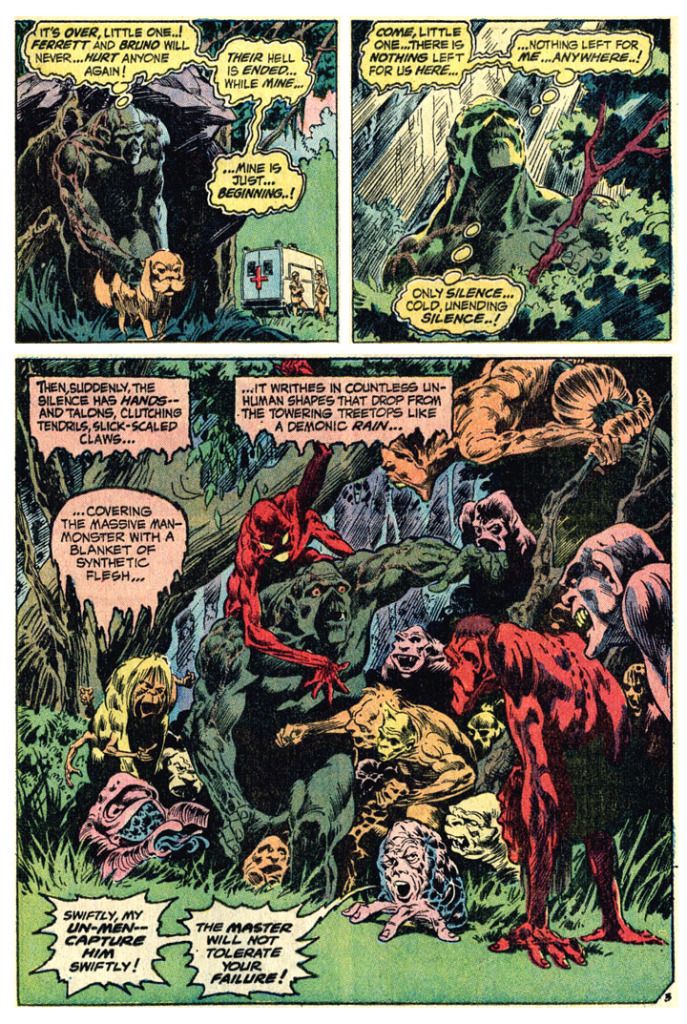
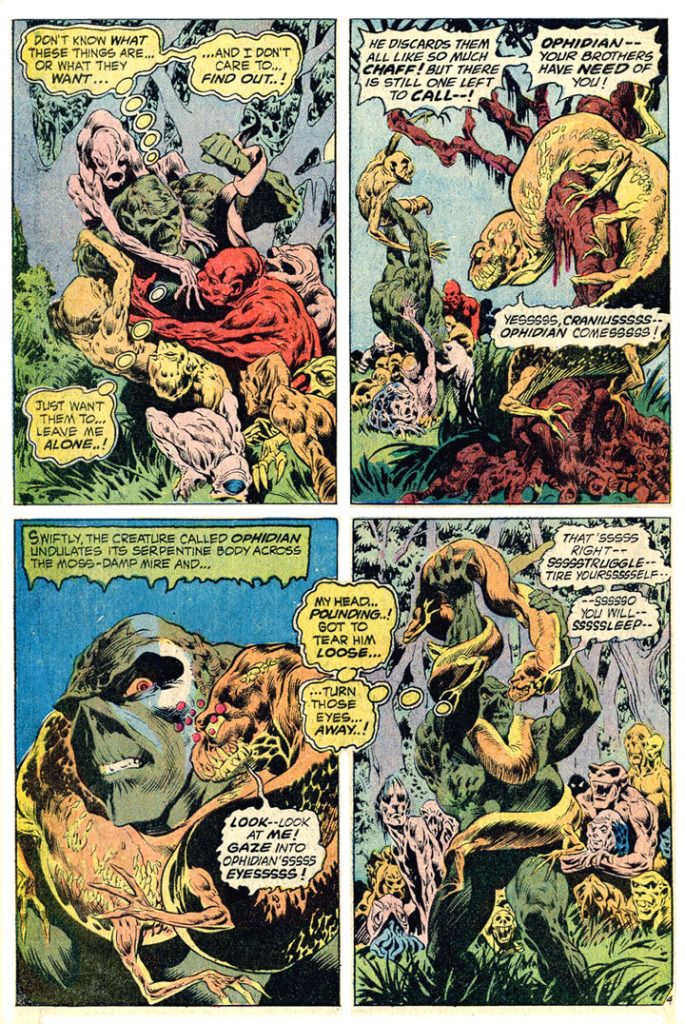
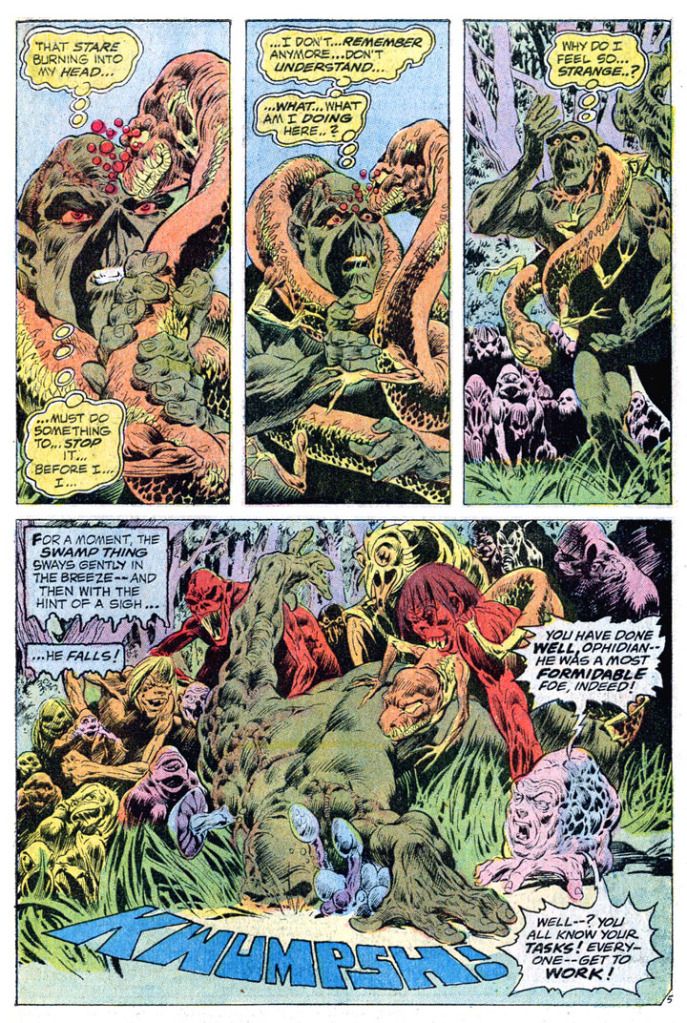
What kind of man deliberately creates monstrosities?  When Dr. Frankenstein attempted to glean the secrets of life, he meant to produce beauty but failed.  Anton Arcane, on the other hand, perversely sets out to make hideous things he then cruelly dubs the "Un-Men."  It's both a parody of the creation story-- God made perfection in 6 days, then rested-- and a misuse of science to tickle the fancy of an egotistical degenerate who wants to achieve immortality.  To this end, Arcane sends the Un-Men to the Louisiana bayou country to capture Alec Holland, who has recently become the Swamp Thing.


Marvelous!  Absolutely marvelous!  Just try making something like that out of a cola nut!  As we see in these exquisitely rendered Bernie Wrightson pages from "The Man Who Wanted Forever" in Swamp Thing #2 (January 1973), they succeed, at least temporarily.  But even this small achievement leaves the Un-Men lost in a world that never desired them.  In some ways, though, they are our children.  The unwanted, the living embodiment of our worst creative impulses, our vanity in thinking we might better nature itself, our ambivalent response to mortality.  In their nakedness, they are as newborns.  In their cruelty, they reflect their treatment at the hands of their twisted creator, as we do with our own petty crimes and misdemeanors.  Neither men nor women, they could only in the end become monsters.


Holland himself, his soul encased in plant matter and mud, provides a further tragic note.  This is before Alan Moore re-created Swamp Thing to suit his own needs-- the creature is not a transformed human, but rather a consciousness mistaken in its belief in that identity; it's a brilliant bit of revisionist storytelling that freed Swamp Thing from his ongoing quest to regain humanity and allowed Moore to take the tales along a more epic path.  But for our purposes-- and those of writer Len Wein-- this is definitely the soul of poor Holland trapped within a hulking, plant-based body, isolated not only from the humanity he desperately hopes to reclaim but also human society.  Lost in the night world of his new life, Holland now has more in common with the Un-Men than he does with Matt Cable, the human government agent searching for Swamp Thing just a few short miles away geographically, but a universe apart existentially.  Holland is also an un-man.

Now, let's all share the delicious taste of 7 Up.  The Uncola.  Why, it's even prettier than a cola.  Nuttier than a cola, actually!  HAHAHAHAHAHA!

Monday, October 22, 2012

October is Spookey Month: "The Slipped Mickey Click-Flip"


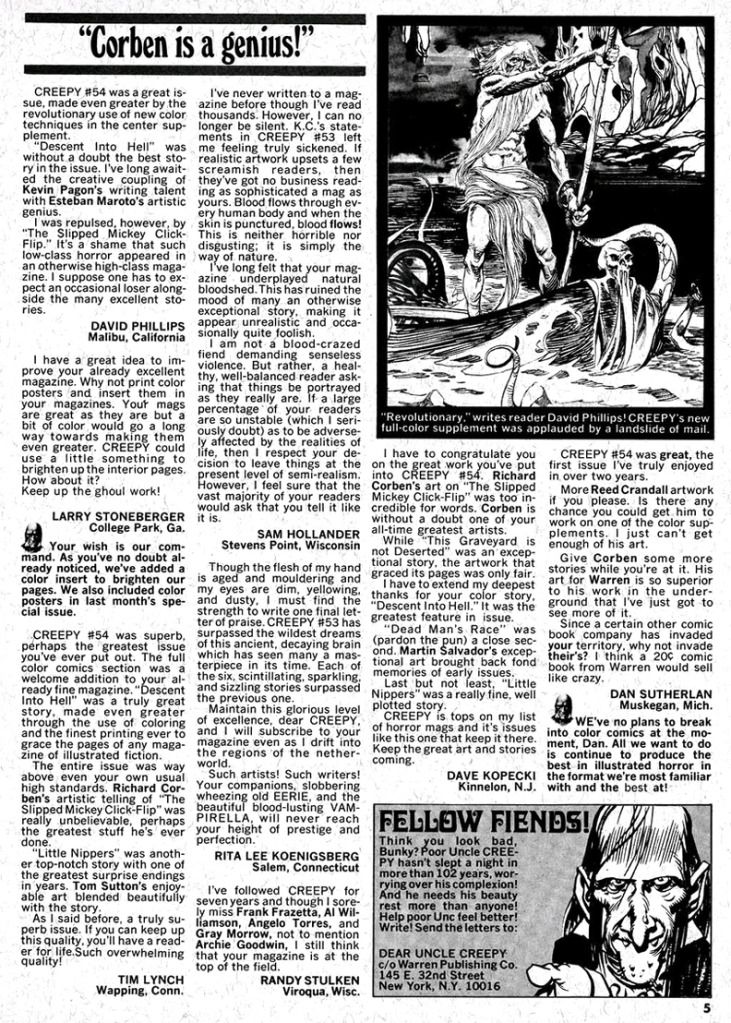
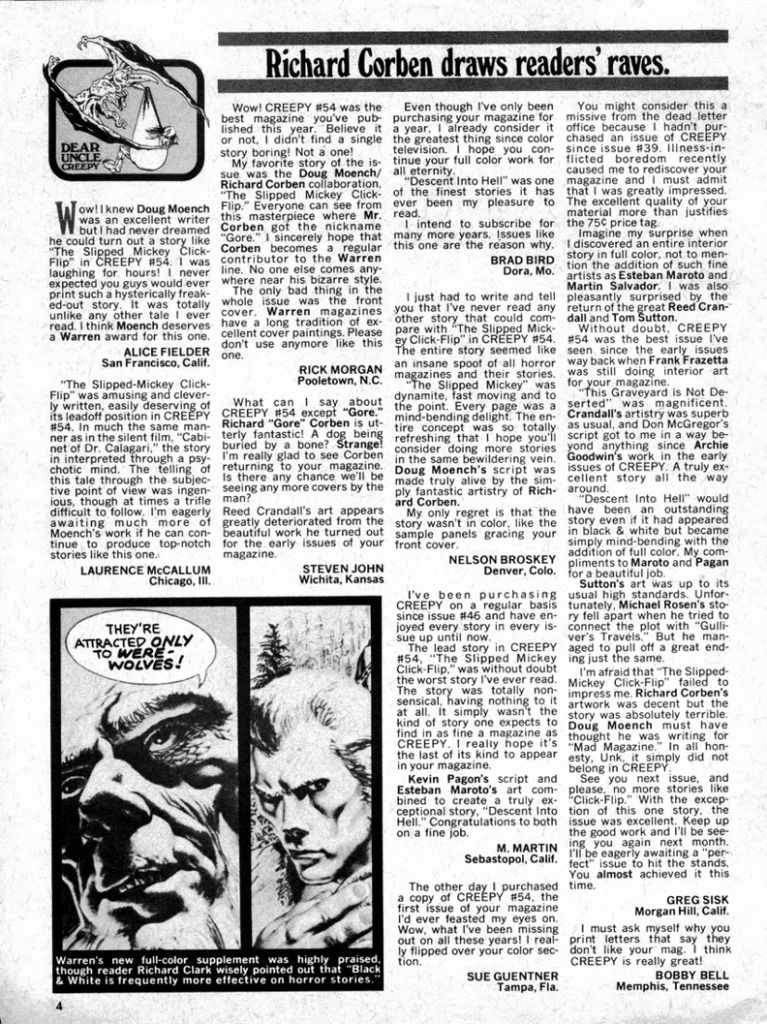
"The Slipped Mickey Click-Flip" by Doug Moench and Richard Corben first appeared in Creepy #54 (July, 1973) and readers seemed either to love it or hate it, if the letters pages for the next two issues are any indication.  And they must be; they're the letters pages for Creepy, which printed the story, for corn's sake.

But I have to admit I don't love this story.  It's a pretty good story, but I don't think it works as well as it could have.


A twisted mutant named Diment (as in "dementia") takes offense at a certain Dr. Nugent for trying to cure him of his insanity.  He takes over Creepy magazine and marginalizes poor, innocent Uncle Creepy himself to punish the doctor.  Diment does this by way of his "Click-Lick" device, the workings of which we never truly learn; he keeps turning away from us before using it.


I'm a fan of both Moench and Corben, and I admire them for their audacity in breaking the fourth wall-- and especially Corben for visually interpreting Moench's feverish, hallucinatory script.  They playfully push the boundaries of good taste-- even by the admittedly lax standards of mid-70s black and white horror magazines-- with gruesome images like eyeball-sucking butterflies and crazy-eyed trains that decapitate people.  Oh, and a woman who explodes into maggots.  I mean, if you like people who explode into maggots, you really need to buy Dark Horse's Creepy Archives #10 so you can experience this singular event rendered by Corben in full loving detail.  Never before have maggots looked so full-fleshed as they explode out of a comic book character's torso.  Gorgeous, gorgeous maggots.  Still, I thank my Uncle Creepy this story wasn't one of their color sections, which the magazine experimented with during this era, usually with Corben's art.

Unfortunately, a lot of the non sequitor dialogue seems forced and ham-fisted, sometimes repetitious ("idiot" is over-worked and begs for a week off in the Bahamas), Nugent and his wife are little more than puppets to the story and we never learn enough about them to develop any sympathy for them or become overly concerned with their plight.  But Diment himself is no prize, either.  I find him repulsive and off-putting.  I could see myself settling down on some moldy divan to listen to Uncle Creepy spin many a yarn, but once is enough with Diment.  More than enough.
Of course, "Slipped Mickey" is psimply a psick psychedelic romp, not meant to be taken seriously by any means, but as a supposedly enlightened 21st century citizen of the world, I can't help but find the depiction Diment's mental illness troubling and retrograde even for its time.  But I have to admit I apply this standard inconsistently.  What bothers me here might not in another story.


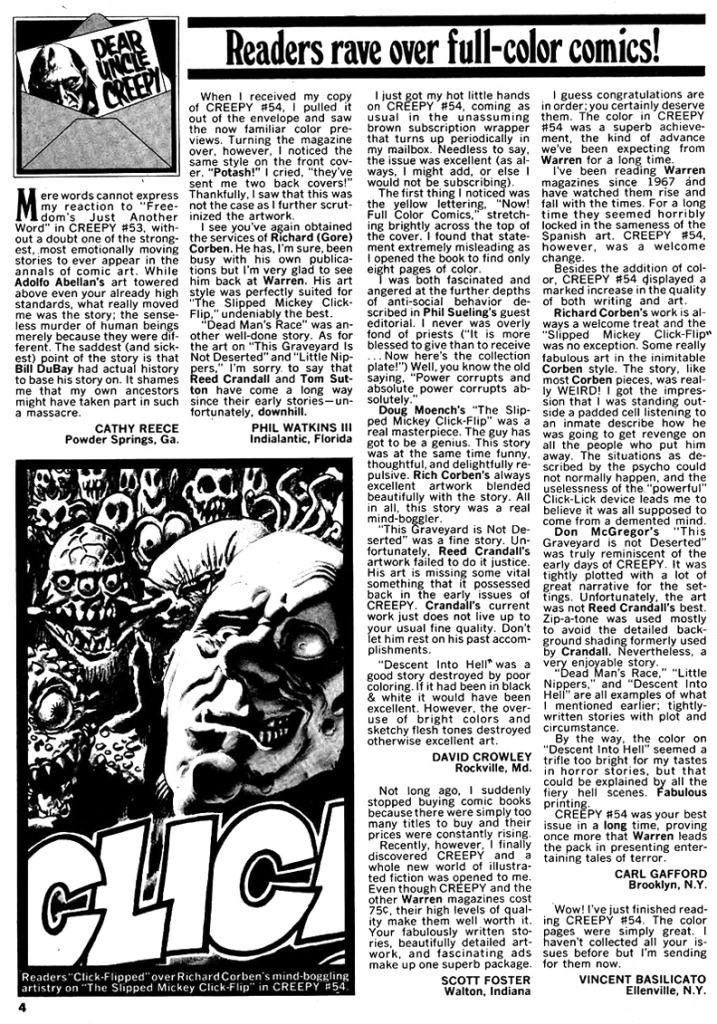
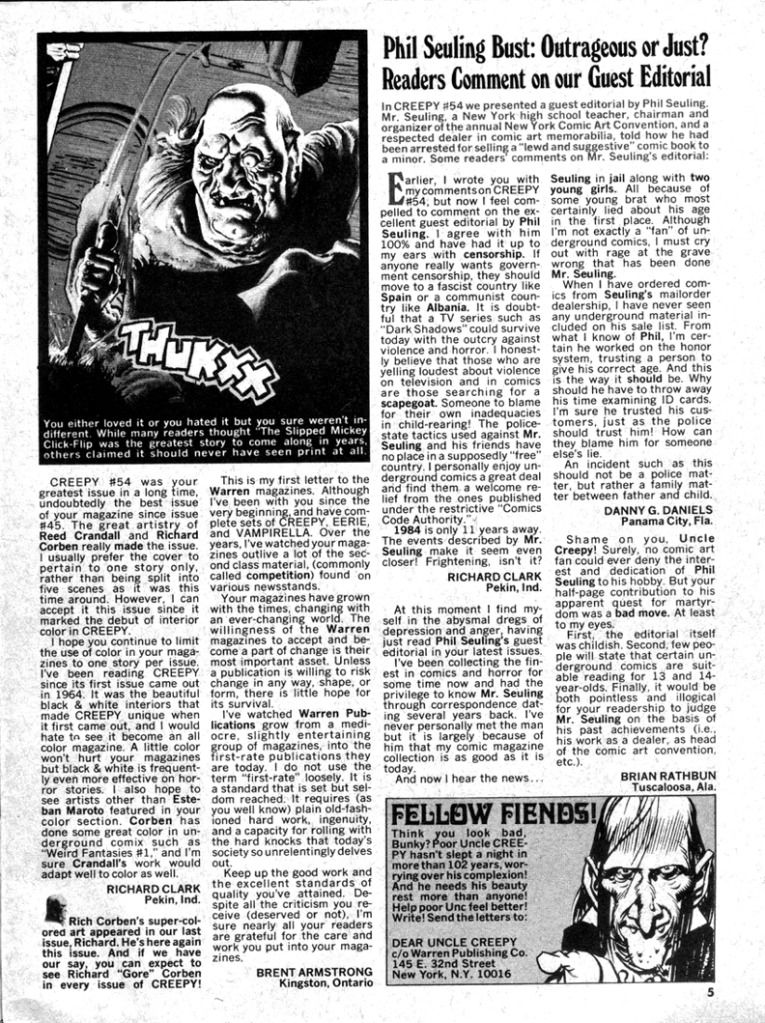
It's memorable as all get out, enough so you can find it in its entirety posted online and a few reminisces about it from fans who read it back in the day or in the years since and fell in love.  After all, for a horror story the only true mark of failure is boring readers to sleep, and "Slipped Mickey" definitely avoids that.  As you can see, the Creepy letters page in issue #56 (September, 1973) features nothing but praise for the story, with one reader calling it a masterpiece and Moench a genius and another praising it before opining it takes place entirely in Diment's mind (which is a comforting reading, I have to admit).  Negative reaction slips into the mix with a lone dissenter, who declares it "low class horror," then intensifies ever so slightly for Creepy #57 (November, 1973) when seven letters (out of 14) mention the months-old story, five praising it and two criticizing it.

One thing I enjoy about reading the Creepy letters pages-- even though we're now years past the point their relevancy died like poor ol' Dr. Nugent, his wife and even their dog-- is the editors weren't afraid to allow some nay-saying, and in this case actually spotlighted it with a sidebar box.  There's a feeling of some real give-and-take and that someone actually read the letters and put some thought into it, but also that the letters page is largely a forum for reader opinion without a lot of defensiveness from the Creepy staff, as if dare the readers to form their own opinions instead of just joining a praise-pack, that it was just as much the fans' comic as it was theirs.  You can imagine what the message boards would have been like had this taken place in today's Internet-savvy comic book society.

Oh, and before I leave you to Google search for this story and read it for yourselves-- to make up your own minds about it, just like Uncle Creepy would have it-- let me tell you this is exactly the kind of story that would have sent me off the rails for a few days if I'd read it as a child.  I had this stupid over-imaginative reaction to horror comics, especially stories as whimsically arbitrary as this one.  I can imagine little-me trying not to think much about Diment for fear of his being real, or somehow making him emerge from the comic book into our world and wreaking havoc on me specifically.  You just do not want to piss Diment off, and disapproving of him would probably be more than enough to earn his wrath

So I would have been sleeping with the lights on in my bedroom, picturing the happy little crazy train running over my head or killing my dog.  DC's House of Secrets and Weird War Tales were bad enough, Marvel's black and white Planet of the Apes magazines scared me as often as they thrilled me with adventure (especially with their house ads for Tales of the Zombie and even Unknown Worlds of Science Fiction, the latter featuring a Michael Moorcock story that crosses the border into blasphemy for those of us in the Bible Belt deep South).  I'm a little nervous even now, writing about it.

Thursday, October 18, 2012

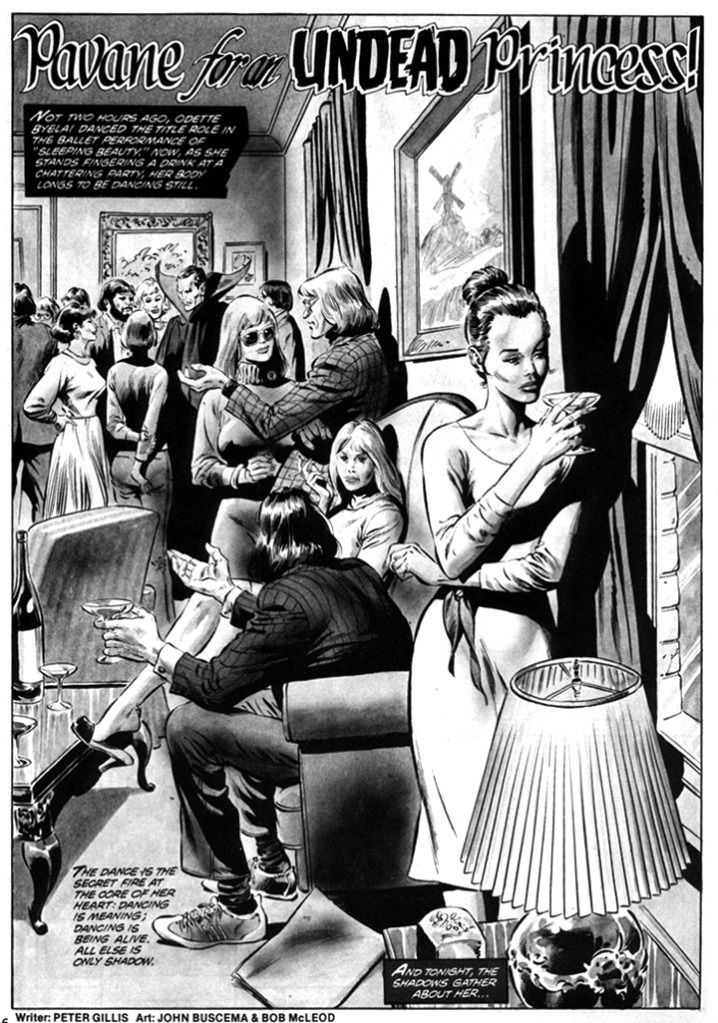
October is Spookey Month: "Pavane for an Undead Princess!" (Tomb of Dracula Magazine #5, June 1980)

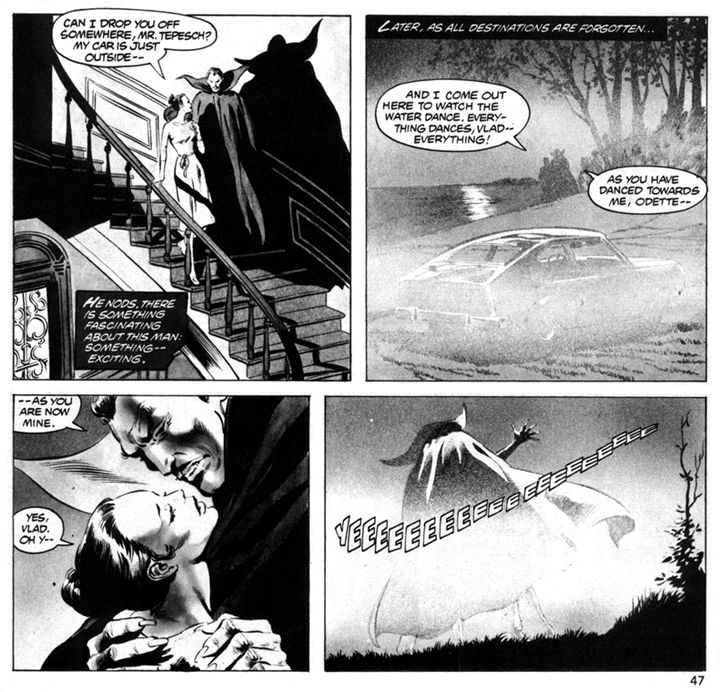
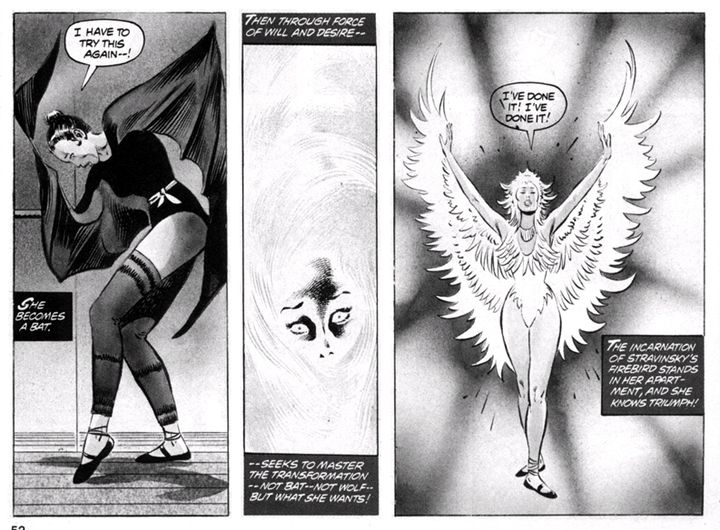
If it takes a soul to appreciate music truly and deeply, what happens when a prima ballerina, whose very being is dance and music, becomes a vampire?  That's the question brilliantly asked and answered in "Pavane for an Undead Princess!," which, despite its flaws remains a short, tragic gem.  Peter Gillis's story reminds me of a vampire Black Swan and I can easily see Natalie Portman essaying the starring role of Odette.

Yes, the ballerina character's name is Odette.

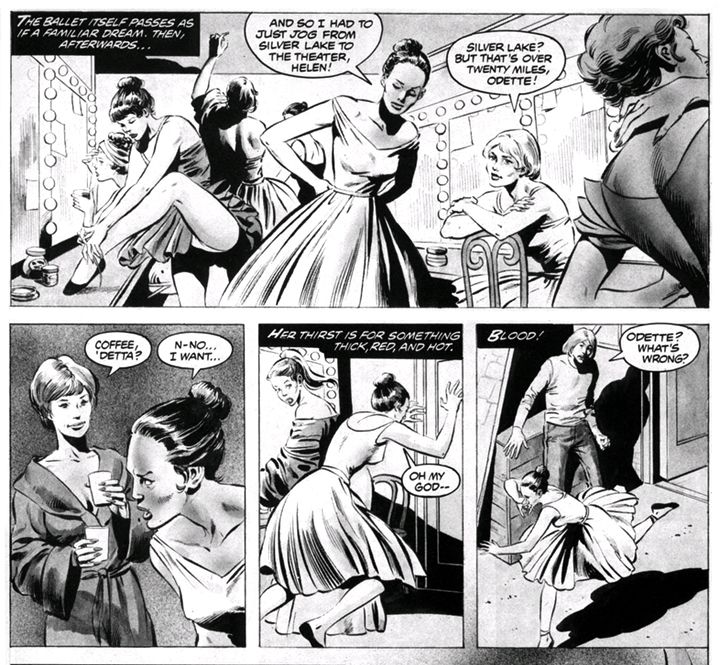
Odette, as Gillis tells us, lives to dance.  We first see her standing aloof against a windowsill, gazing moodily into the night.  She's not a snob or some sort of arrogant pseudo-princess.  It's that she can't even enjoy an after-party with her snooty artsy friends because her muscles "long to be dancing still."  Then she makes the mistake of leaving the party with a cloaked gentleman calling himself Vladimir Tepesch.  If only she'd spent more time watching In Search Of... and less time mastering her art, she might have avoided her fate-- waking up later in the woods with her car missing and having to run 20 miles back to the theater where Greg, the poor man's Alexander Godunov (who had defected from the USSR just a year before this story saw publication), gapes at her and wants to know where she's been for three whole days.  Remember those three days in case you ever find yourself in Odette's pointe shoes-- in classic vampire lore, the vampire's resurrection mocks Christ's; Gillis knows his stuff.

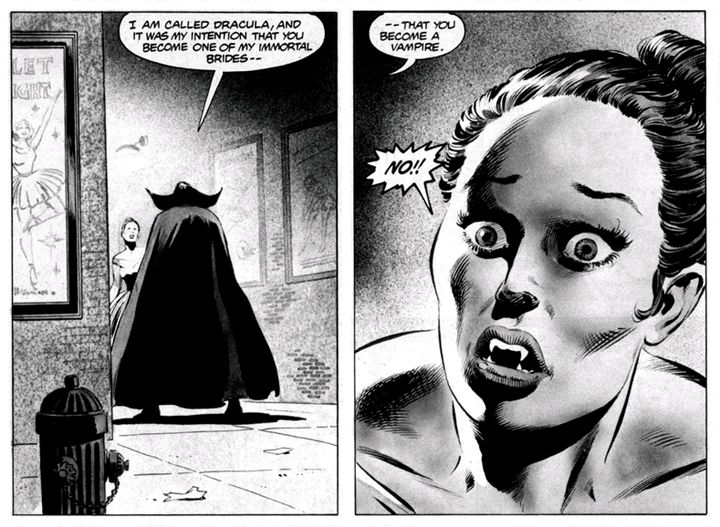
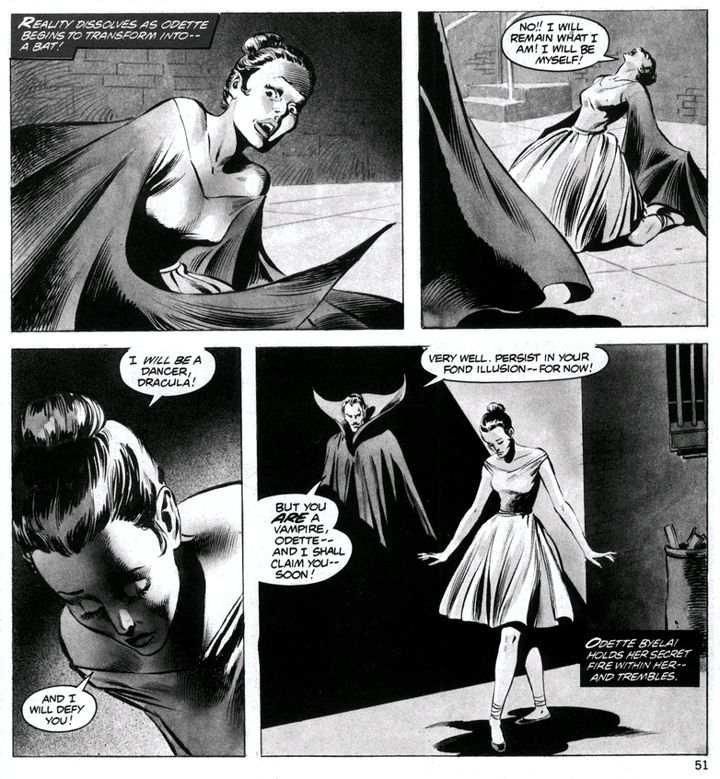
Anyway, Odette learns she's undead.  She refuses to accept it even when Dracula transforms her partially into a bat.  No, she has to spend her nights dancing rather than skulking around in the shadows sucking blood.  I'll have you know Isadora Duncan simply adored skulking and sucking.  But not our Odette.  She goes on an extended dance tour, then returns to her apartment and throws herself into practice, only to discover as a soulless monster she no longer has an ear for her favorite composers.  First Prokofiev, then Tchaikovsky devolve into "NOISE!  NOISE!  NOISE!!"  This is the kind of reaction that puts a bit of a crimp in your dance career.  Odette reminds me of some friends of mine who, when they turned 30, suddenly told me they couldn't relate to any of the new music and were becoming interested in blues and soft jazz.  In other words, "I'm old now, so I hate music."

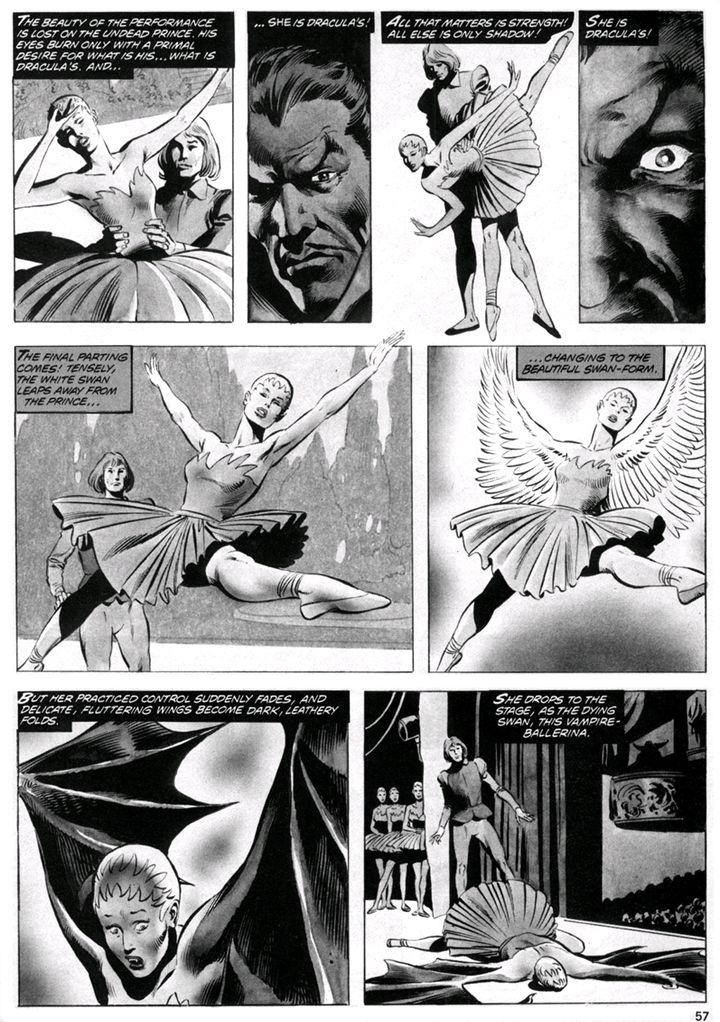
Actually, I'm a little puzzled as to how Odette was able to perform to their music for weeks before this breakdown.  Maybe this particular symptom of being a vampire takes a few weeks to present.  We never find out, but that's a relatively minor plot hole we have no time to investigate because Gillis quickly covers for himself with a brilliant inspiration, possibly the source image for the entire story:  Odette finds she can use her vampiric powers to morph not only into a bat but also into a half-swan... or even a full one.  She gets Anatoly (sounds like a Commie name if you ask me), her company's choreographer, to help her reconfigure great ballets into showcases for her amazing new abilities, but she can't escape the vampiric curse and it all ends pretty much the way Black Swan ended but with more self-impaling and none of the self-pleasuring.
And it also requires us to ignore that losing the spirit of music thing again, but maybe Odette comes up with some way to compensate.  Earplugs and strictly counted beats or whatever.  It's not as if music is all that important to dance, anyway.

While the page count reduces Gillis to telling rather than showing Odette's obsession with dance and her posthumous performance rebirth-- first a collage-like panel and later, after she starts using her metamorphic powers, a single panel with just the ballet titles-- the prima ballerina's plight still moves.  She's truly done nothing to bring this curse upon herself and then she's propelled along a tragic path similar to the characters she danced during life, damning herself in a moment of weakness and rage.  And ol' Dracula is a complete bastard.  He cares only for beauty only so much as he can possess it, but his touch inevitably corrupts and destroys.  Like the parasite he is, he'll move on to other victims.  But Odette loses more than her soul, and even her ultimate triumph is couched in death and her sad isolation from that which she loves most.
John Buscema provides his usual sold storytelling, largely confining his layouts to the three-tier format.  Each page is a little miracle of panel-to-panel continuity, but the real star here is Bob McLeod.
If I remember correctly, Buscema usually worked pretty loose and left a lot for the inkers to finish.  As a result, this art job looks a lot more like McLeod's solo work than a strictly Buscema job might, or one inked by Tom Palmer, Ernie Chua or even Big John's preferred partner, his brother Sal.  I've always admired McLeod's work on his solo efforts, and his figure construction and detail work-- such as how he deals with cheeks-- was always a bit Buscema-esque anyway, so they make a fine team here.  I don't know how much of the black-spotting Buscema indicated in his pencils, but McLeod's use of dark shadows pooling around the characters or climbing the walls behind them works wonders in creating a subtle menacing mood.  Dracula himself seems to loom out of darkness or carry his own shadows with him wherever he goes throughout this story, setting him somewhat apart as a malevolent force crawling up from Odette's own id as the vampire's power over her grows and distorts her life's work.  McLeod also lays down gray tones and creates lighting effects during Odette's transformations with what appears to be airbrush.  Reading some of these later Marvel mags, a lot of inkers seem to have been enchanted with the airbrush for tonal work as opposed to doing the traditional ink washes.  I wonder if there's some Richard Corben influence going on there, or if the airbrush lent itself to faster turnaround times, or perhaps a little of both.

Bob Mackie vampire.
Whatever the reason, the end result is lovely to look at.  A minor classic.  Kind of like that ballet I wrote back in 1994, Who's Watching the Kids, based on the 1978 NBC television comedy starring Caren Kaye, Linda Goodfriend and Scott Baio-- where Jim Belushi made his national debut.  I myself danced the Belushi role.  We would have taken it to larger venues but I pulled a calf muscle and we had to cancel the final performance.  After that, funding for the arts just dried up and it was back to working retail.  Now I'm prepping a ballet based on the Kaye-starring sitcom classic It's Your Move, where she played a scheming Jason Bateman's mom opposite Married With Children's David Garrison as her love interest.  La danse, c'est le mouvement, et le mouvement!

Tuesday, October 9, 2012

October is Spookey Month: "Hellboy," yet another Halloween reading recommendation

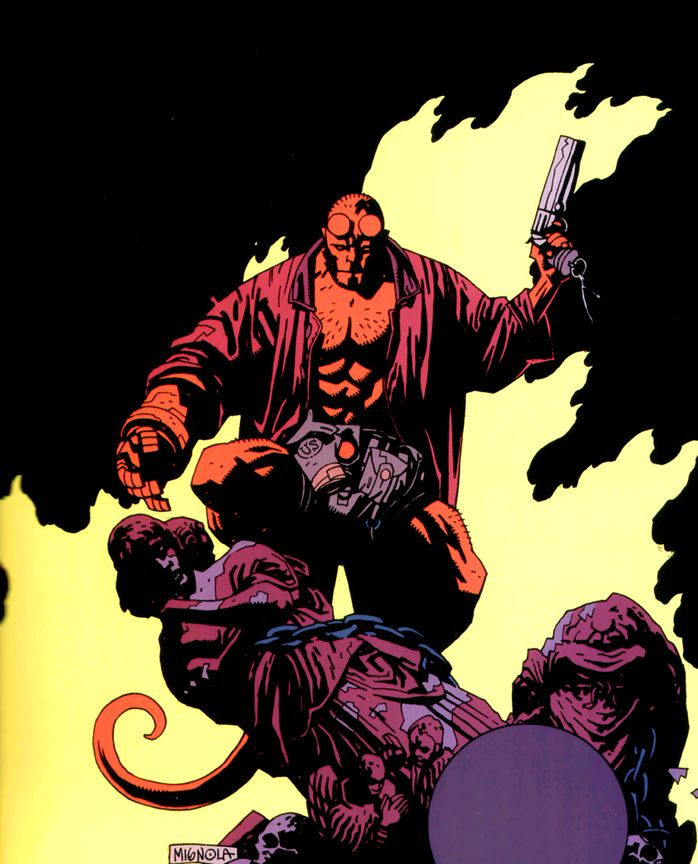
Mike Mignola (1994)
Can you believe Mike Mignola's Hellboy has been around for almost 20 years?  Dark Horse published the debut of four-issue miniseries Hellboy:  Seed of Destruction way back in March, 1994.  In this modest little monster-fighting story artist-creator Mike Mignola and scripter John Byrne introduced us to one Hellboy, the burly half-demon with sawed-off horns and a blue collar approach to the supernatural.  Gruff and something of a smart-ass, Hellboy would just wade in and punch the terror right out of whatever monster, ghost or alien turned up while his buddies at the BPRD (Bureau of Paranormal Research and Defense, the government agency Hellboy works for and housed by) would handle the brain work and clean up afterwards.

After two decades and so many miniseries and titles it can be hard to know where to start with Hellboy.  It doesn't help matters Mignola's chronology jumped around depending on whatever inspired him to write and draw a particular story.  In one book, Hellboy could be in Ireland in 1959 or 1961, then show up in Japan in 1967 for the next, then guest star in an issue of The Goon telling the story about Japan.  Or something like that.  Working it out this way, Mignola and his later collaborators have built a massive narrative spanning decades, continents and even the galaxy, with characters dying and other joining, menaces burbling up from the background, others springing full-blown into the foreground plot.

From his earliest days fighting un-frozen Nazis and their spiritual leader Rasputin-- yes, the historical Rasputin, the one Prince Felix Yusupov, Grand Duke Dmitri Pavlovich and some concerned friends poisoned, shot, beat and drowned in 1916-- to various creatures from European myth, with an underpinning of H.P. Lovecraft, Hellboy now inhabits a sharply defined world with all kinds of incidents and epics.  So how do you jump into this world?

Sorry, I'm not much help there.  I'm not a continuity junkie or obsessed with minutia.  All I ask is whatever story I'm reading to be internally consistent.  And I tend to prefer Mignola's moody, sometimes peculiarly random one-offs with Hellboy himself to the longer apocalyptic tales generally starring the BPRD cast (althought these are good, too).  That's why I say, "Don't worry about a reading order with Hellboy."  My advice is just buy the Seed of Destruction collection and start there.  Move on to whatever story catches your fancy.

In short, you must do as you see fit.

For me, Hellboy pushes a number of buttons.  Let's examine four of them in detail.  Mignola's art is the first.  I love bold, heavily stylized art, the kind where you say, "Now there's a nice drawing, just the essentials" rather than take in something that looks like it was traced from a still frame out of a movie, or a swimsuit magazine.  Mignola's work has become more essentialist and geometrical over time and that's my bag.

The second is my love of the weird and fantastic.  Since earliest childhood, I've read books about cryptid animals, UFOs, alternate dimensions, the Bermuda Triangle, ghosts, urban legends and the like.  I've always loved stories where teams of people investigate the unknown and come to grief, from Kolchak to Venkman, Stantz, Spengler and Zeddmore to Mulder and Scully to Hellboy and company.  I'm a friend to them all.

Folklore and myth make the third.  Mignola draws heavily on European traditions and Lovecraft, but he has broken with this on a few memorable occasions.  Two are team-ups with horror art legend Richard Corben-- Makoma, informed by African folktales and The Crooked Man, set in the Appalachian Mountains of the good ol' U.S. of A.  Both are lovely and strange.  How can anyone not read these?

And the fourth is a specific story.  As an ex-pat living in Japan, "Heads," set in Kyoto, is a lot of fun in a very personal way.  Mignola claims in his introduction to the story not to know a whole lot about Japan.  Yeah, but his art, as influenced by Alphonse Mucha, who himself drew on Japanese ukiyo-e and their extremely linear forms as it is by European woodcuts, Jack Kirby or P. Craig Russell, makes him particularly apt for this kind of material.  I wish Hellboy would revisit Japan sometime in the near future.  If Mignola or any of his collaborators need some first hand experience and reference-- or just want to hang out while doing a research trip-- well, now, I know just the blogger to volunteer his services!

Thursday, October 4, 2012

October is Spookey Month: Johnny Craig's "... And All Through the House..."

A few weeks ago we took a hard-hitting look at the 1972 Amicus Productions horror anthology flick Tales from the Crypt, specifically the segment starring Joan Collins, "... And All Through the House...."  It's a piece for which I won several journalism awards and received an offer to pen the film re-adaptation of the Dell Comics adaptation of the classic Andy Griffith service comedy No Time for Sergeants, which itself was an adaption of a stage play drawn from a novel.  Unfortunately, my dedication to this blog forced me to turn down that guaranteed six-figure paycheck in favor of fulfilling a threat-- er--- promise I made to you, my loyal reader.

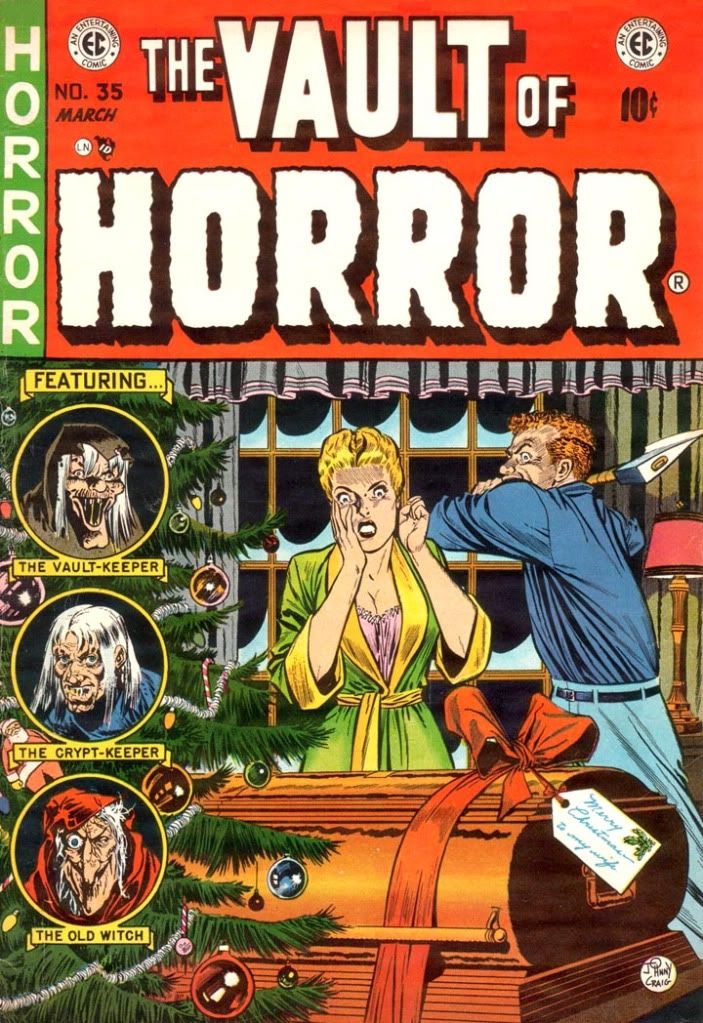
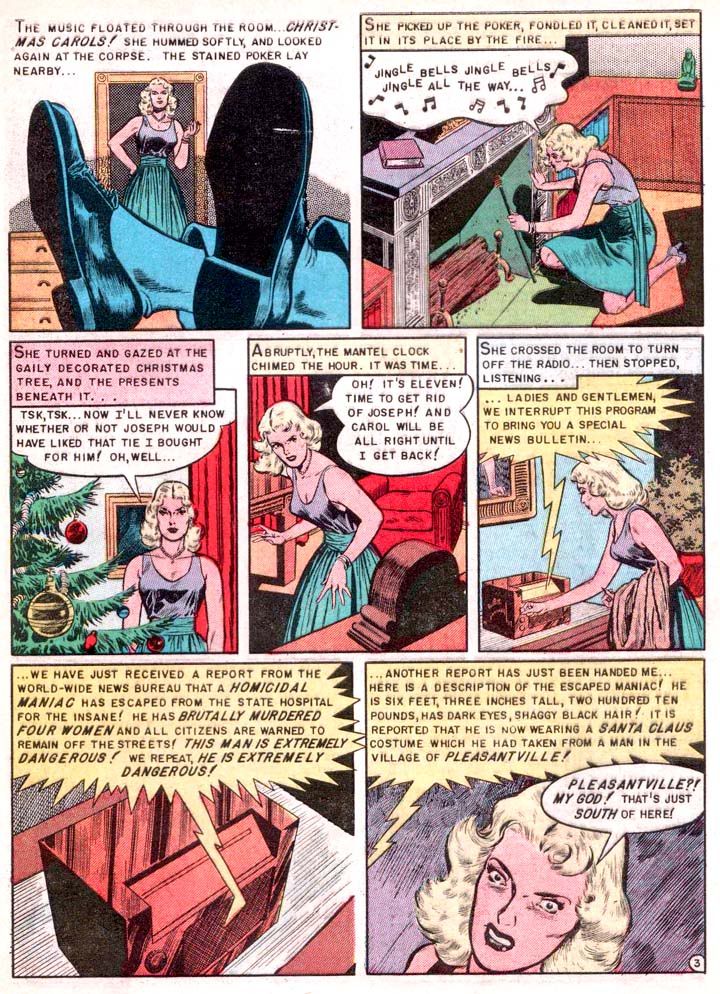
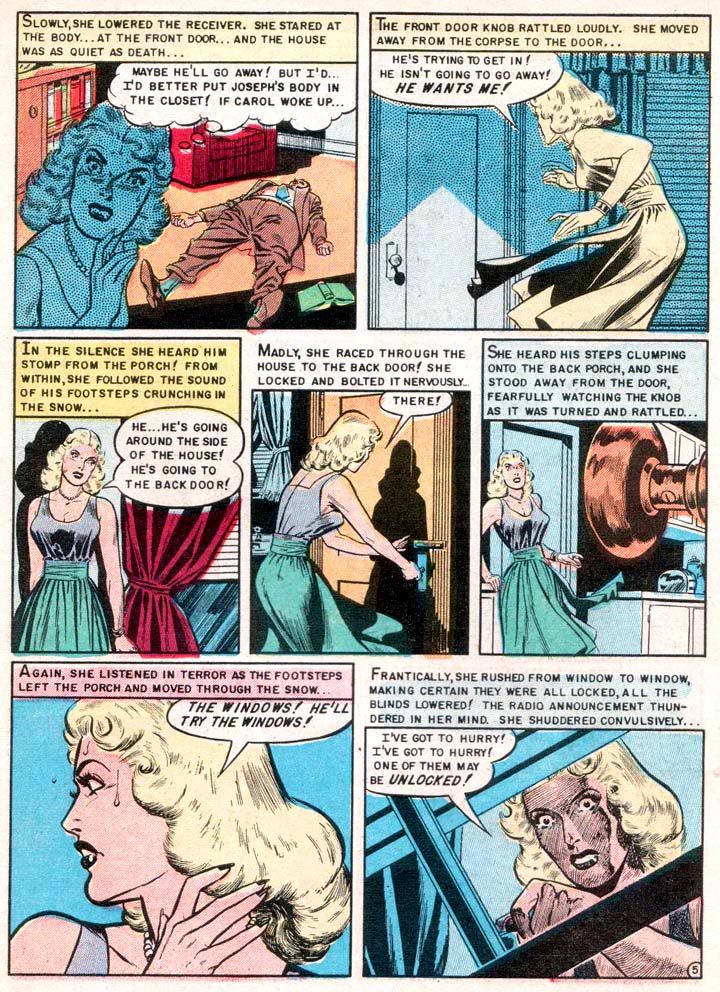
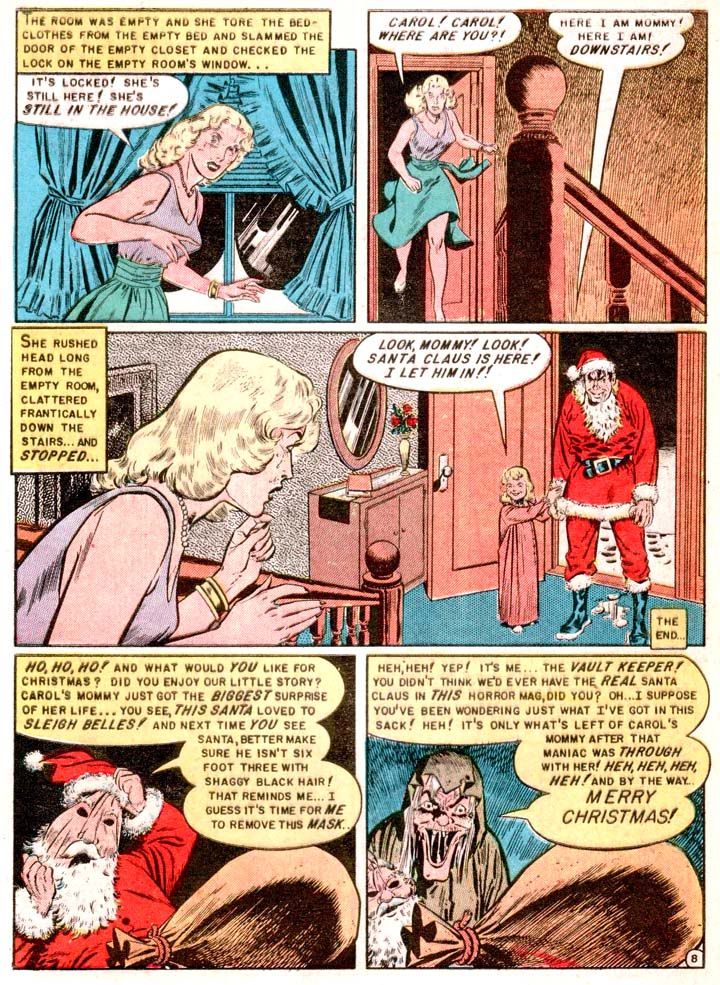
So to that end, let's revisit Johnny Craig's original story from The Vault of Horror #35 (EC Comics, March 1954).  And here... we... goooo!

The film's version is a very close adaptation (they even kept the daughter's name the same, and the dialogue in scenes with her is almost word-for-word from the comic), but the Craig's story is pretty taut and doesn't lend itself to a lot of padding.  Sure, a few differences crop up here and there.  For example, the comic story is red white and blue in its all-American look at Christmas-related murder.  The movie transplants the story to the UK, where it gains Collins, with Sir Ralph Richardson as the Crypt-Keeper.  In the comic, the protagonist is a blond, while Collins is famously a brunette, a quality that would serve her and her stunt double well on ABC's night time soap opera Dynasty during the infamous Krystle-Alexis fight.  In the movie, the Santa-suit wearing madman throttles the Collins character for a violent comeuppance.  It's a movie and movies rely on action. Otherwise, they might just as well be photographs.  And instead of photographs, drawings.  Which brings us right back to comic books again, where it's just as effective to have un-jolly old St. Nick simply stand there in the final panel.  The reader's imagination supplies the killing.  Or, if you're of a less sanguinary persuasion, the murmured discussion followed by a night of gentle love-making.

Since there's not a lot to say about the story I haven't already written about at great length while blathering on in my usual sub-moronic way about the film, here are some choice moments from the comic.  Get ready to enjoy a little bit of Johnny Craig-style holiday cheer...

Monday, October 31, 2011

2nd Annual Spookey Month: Hoppy Halloween!

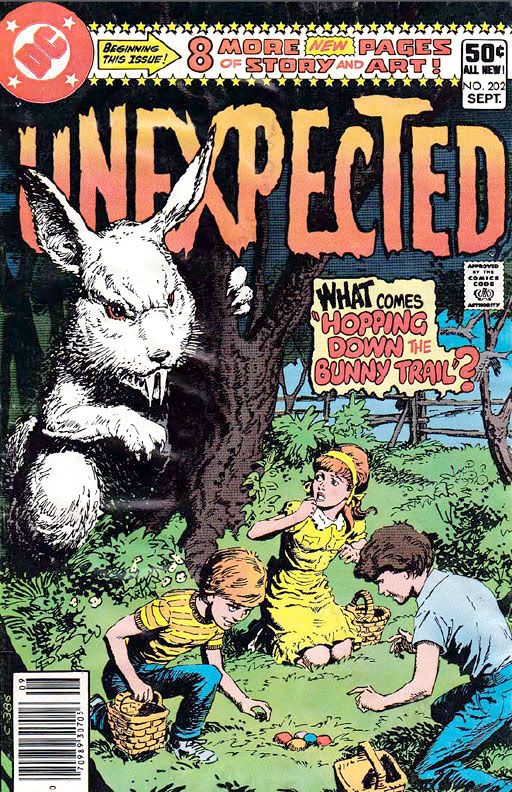
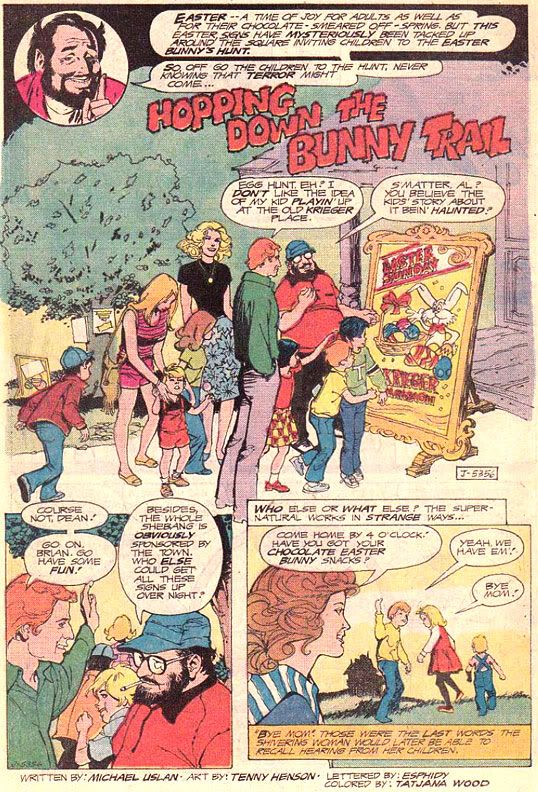
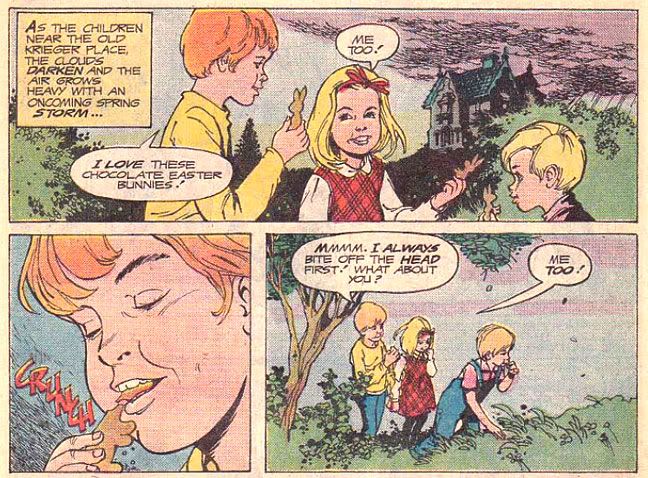
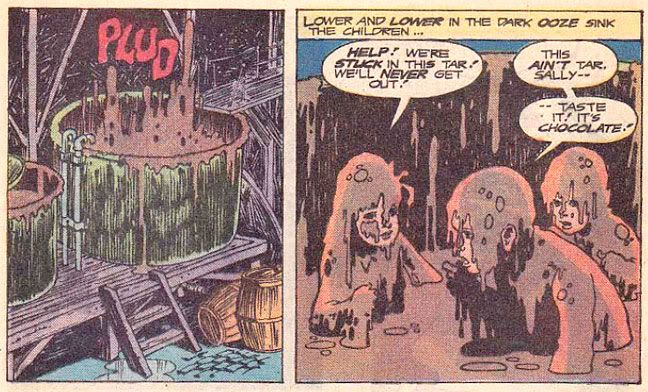
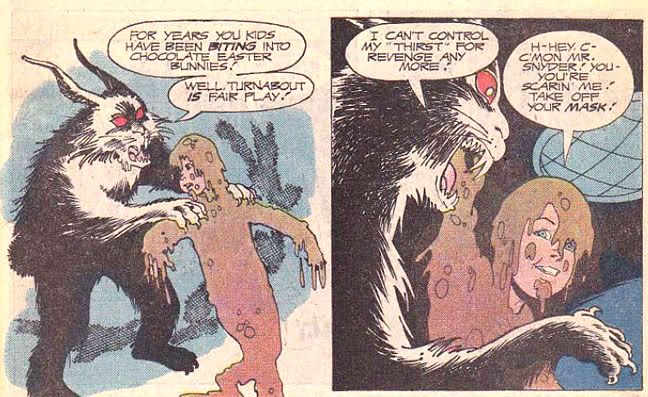
Some stories just stick with you.  Take "Hopping Down the Bunny Trail" from DC's Unexpected #202 (1980), for example.  I read this in a supermarket in Brevard, North Carolina, while visiting my grandparents.  On Easter, three ordinary kids die at the fangs of human-sized, talking rabbit they mistake for the Easter Bunny, their only crimes gleefully biting the heads off chocolate bunnies and being slightly dim-witted.  It gave me the creeps in broad daylight, and while I didn't buy the comic, it never completely left my thoughts.  Through the years, I'd occasionally remember it, slightly altered over time thanks to the transformative power of an imperfect mind.

Apparently, I'm not the only one who found it impressive, because someone made it into neat little .pdf with a short analysis.  Finally, after 30 years, I was able to read it again.  It's still a nasty little tale that should have wider acclaim. 

Some horror tales-- especially the ones in those old EC comics, the early Creepy and Eerie magazines and most of DC's titles-- rely on an ironic twist where some jerky moron gets his or her comeuppance.  The philandering murderer can't get rid of the betrayed spouse, even in rotted corpse form; the abusive parent suffers a more horrific version of the abuse heaped on the child; the greedy boss hoists himself by his own petard, usually fatally; the blowhard suffers blowback; the foolhardy self-appointed expert destroys himself and those who foolishly believe in him.  No matter what gruesomeness occurs, we're usually reassured in some way that cosmic justice has been served, scales have been balanced and the underlying order has been reaffirmed.  We get a kick out of what happens at least partially because these stories play into our sense of moral superiority.


But in this Michael Uslan-scripted story, the worst you can say about the characters is they're all a little dim-witted and unimaginative. The parents fail in their responsibility to protect their children because they just assume the city's somehow behind the Easter egg hunt that's been completely unpublicized until colorful signs appear overnight. Sure, it's at the local haunted house, which is probably firetrap or at the very least a tetanus shot and a lawsuit just waiting to happen. Send the kids!

These jokers are pretty blase, aren't they? This was the era before the ominously narrated news stories intended to stoke every parent's more morbid prescient fantasies, before 9/11, the anthrax letters, terror alerts and Dateline NBC and Inside Edition. This was two years before the Chicago Tylenol poisonings. And yet as we've seen so many times, even today's supposedly hyper-vigilant adults slip up. They leave kids locked in daycare vans in the middle of summer, fail to recognize or simply ignore the warnings signs before school massacres, leave the gate to the backyard swimming pool unlocked. Even if they're frequently driven to complete paranoia by stories about Internet perverts, Satanic cults and poisoned candy, they-- just like the parents in this story-- can be lulled into complacency by the promise of colorful eggs and treats for the kids.  After all, nothing bad ever happens on holidays!


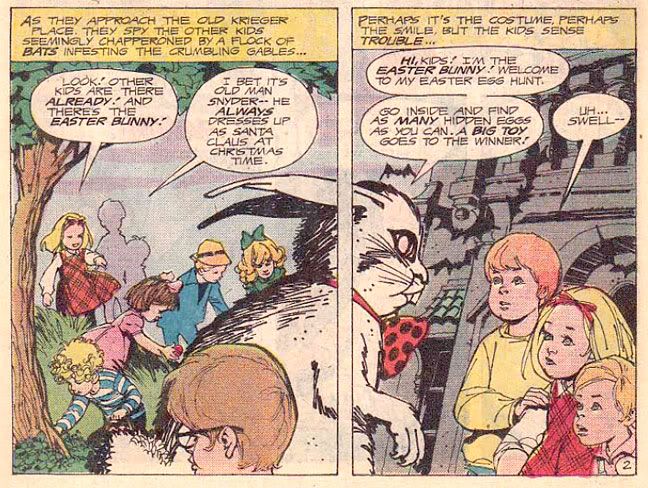
The kids are pretty dull themselves. They walk right up to the "Old Krieger Place" despite Tenny Henson's having drawn storm clouds looming over it menacingly. I suppose their imaginations have been dulled by too much mediocre television and brain-rotting Saturday morning cartoons. Here's a human-sized talking rabbit and rather than recognize something completely bizarre and even threatening about it-- shoot, some kids bawl at the sight of Santa Claus-- these little chocolate lovers just assume it's Old Man Snyder in a costume. That's some costume! To sweeten the deal, the Easter Bunny offers toys and candy. If that isn't a tip-off, I don't know what is. But these numbskull kids take the offer at face value.


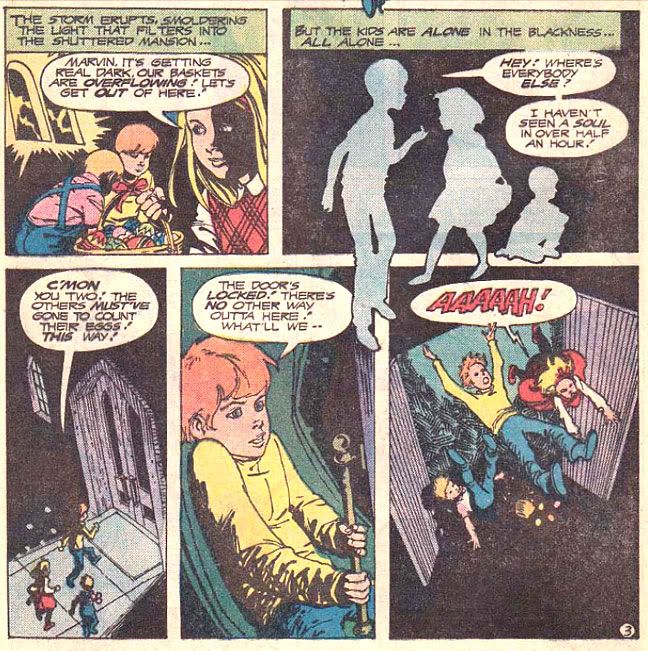
They only start to wise up when the other kids vanish and they find themselves all alone in a perfectly creepy house. And then only a little. They're so confident that everything's fine, that they're going to grow up and go to college and get married and have kids just like themselves one day.  And should something bad happen, Mom and Dad will be right there to save them.  Right?


Well, the universe doesn't really work that way.  Not only to bad things happen to good people, horrors beyond horrors happen to them.  Cars and planes crash, nuclear plants leak, cancers strike, young dudes accept odd jobs from John Wayne Gacy.  In the face of the ongoing tragedy we call living, we'd love to believe someone benevolent is in charge, that there's some underlying order to it.  Certainly there are natural laws and forces at work.  We can calculate the orbit of the earth around the sun with precision because we've figured the most obvious of them out.  But they also guide bombs onto blameless schools and hospitals and bullets into innocent spines.


Some horror stories offer a glimpse of a universe of limitless chaos where we are all in immediate danger.  They tell us order is an illusion, that good intentions invite catastrophe.  People are punished far out of proportion to their wrongs, or become victims of circumstance.  You bite the head off a chocolate rabbit.


A demonic rabbit bites off your head.  Note the complete lack of gore.  Just a transition from the brightly colored world of a sunny Easter Sunday to a dark and stormy place where wicked things happen to kids because they and their parents are careless and sort of dumb.  When I was 12, I could easily imagine myself as one of these dopey kids.  I was a dopey kid.  "Hopping Down the Bunny Trail" lifted the lid off the field and revealed something much better hidden.  And that was terrifying.


Now close the comic and try to sleep.  Happy Halloween!

No! I can't leave you on a downbeat note like that. Here's Spookey to cheer you up again and reassure you the world's a loving place!

Sunday, October 30, 2011

2nd Annual Spookey Month: Bernie Wrightson takes on H.P. Lovecraft


H.P. Lovecraft is strange case. His influence in horror literature is undeniable and yet he was a pretty lousy writer. When you hear one of his stories described or read a synopsis, it sounds exciting, weird and even a little frightening. Malevolent elder gods from beyond Pluto manipulating scholars into plumbing the depths of forbidden knowledge, whispering aliens hiding in the dark forested hills of Lovecraft's native New England states, a city where the inhabitants are devolving into amphibians. Then you actually read it and the experience is like tediously climbing a steep hill made up of adjectives, exclamation marks and racism. And still they fascinate me.

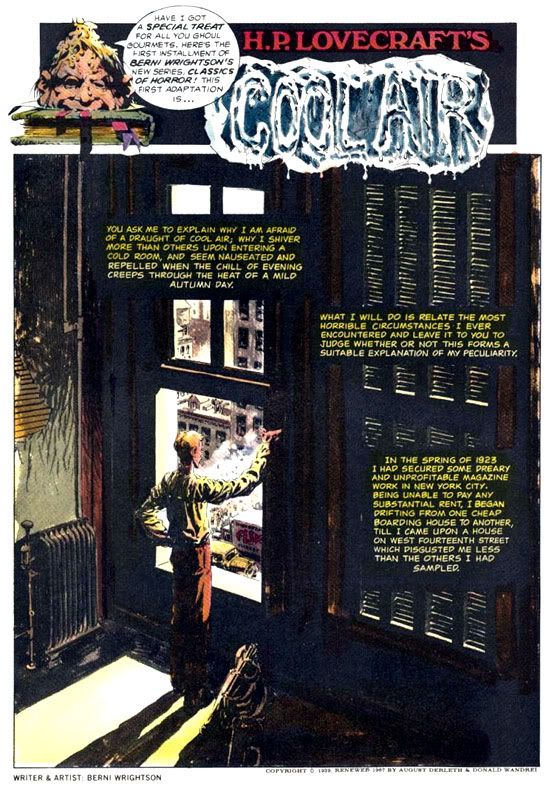
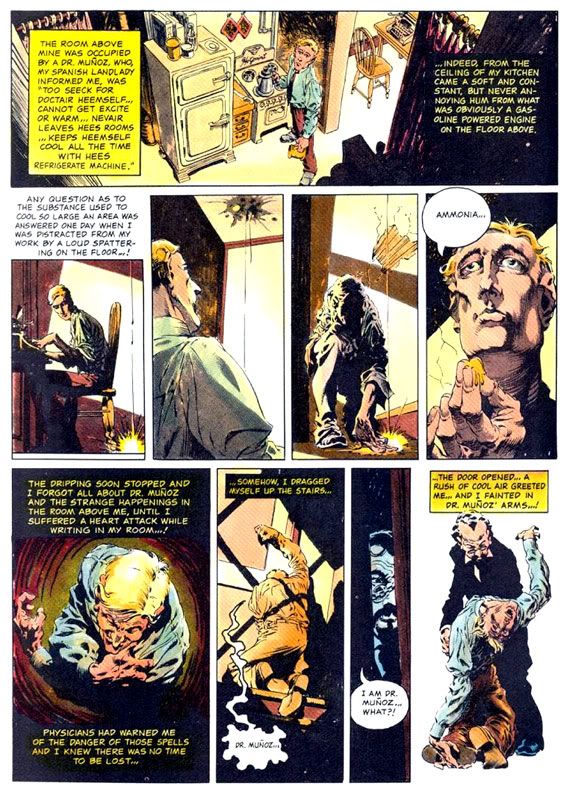
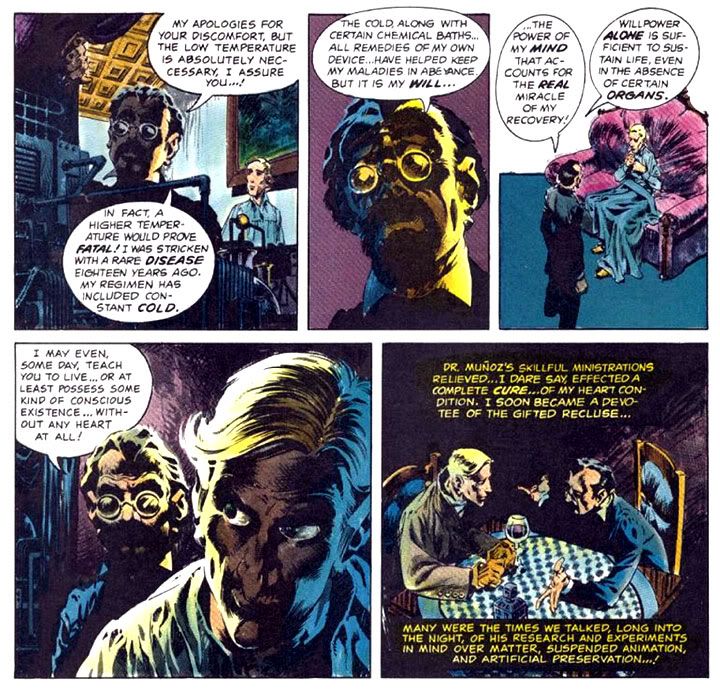
Comic book adaptations of his works are bit easier to take. Skilled writers eliminate the excesses and hone in on the things Lovecraft did well, and when the artist is Richard Corben or Bernie Wrightson-- someone with real imagination and the rendering chops to provide appropriately chilling visuals-- the results often transcend the source material. "Cool Air" is one of Lovecraft's shorter works and heavily derivative of Edgar Allen Poe, but those are two points in its favor. Two points in favor of the comic book version are the script and art by Wrightson, whose vision meshes so well with Lovecraft's he produces a horror fan's delight. A true classic.


It's not one of Lovecraft's mythological tales. There is no Cthulhu and no Yog-Sothoth, just a simple situation that plays itself out to its logical-- but unfortunately predictable-- conclusion. And while it's not scary by any means, Wrightson's expert adaptation make it worthwhile anyway. Lovecraft allows his rather gentlemanly prose to become a bit vague during the final scene, despite his narrator's insistance that "[b]lack terror, however, preceded me" and his use of florid adjectives like "hellish" and "nauseous," characteristic of his writing when he's really straining for effect. Wrightson just shows us, creating a shock Lovecraft might have appreciated while deploring its directness.


This story first appeared in Eerie #62 (1975), and you can see Cousin Eerie's apparently decapitated head serving as a candlestick holder there on the title page. These color images are from Berni Wrightson: Master of the Macabre #2 (1983), which is where I first read it. That comic also contains the infamous "Jenifer," which frightened me so badly I didn't sleep for two nights. You can't ask much more from a comic book than a sleepless night or two. I'm sure H.P. Lovecraft would agree.  Dark Horse just published a volume collecting Wrightson's Warren work and it includes both of those stories.  I don't own it yet, but be assured I will.  Oh yes, I will!

I wonder what Lovecraft would have thought of this:

Tuesday, October 25, 2011

2nd Annual Spookey Month: Enjoy some Japanese horror shorts because I don't feel like writing some long, involved post about Halloween today!


That's a pretty lousy elevator. I don't think I'd enjoy riding that one, either. I rode some creepy elevators during my time in Japan, but I was lucky in that I never had that poor girl's experience. Nice job with those English subtitles by "montecristo73returns," though. What else can we find? How about this one?


Lesson learned? Cram school sucks! Again, great job on the subtitles. But if you stay out of elevators and cram schools, you're completely safe, right?


Yikes! That looks a lot like my old apartment! Nice job, KuljeetChauhan. I have no idea where these short films come from. Shown on television? From a DVD? They're pretty cool and there seem to be dozens of them. Now... here's a movie I made. You may have seen it before!