Showing posts with label new comics. Show all posts

Monday, July 18, 2011

B.P.R.D. Hell on Earth: Monsters #1: A Comic Review

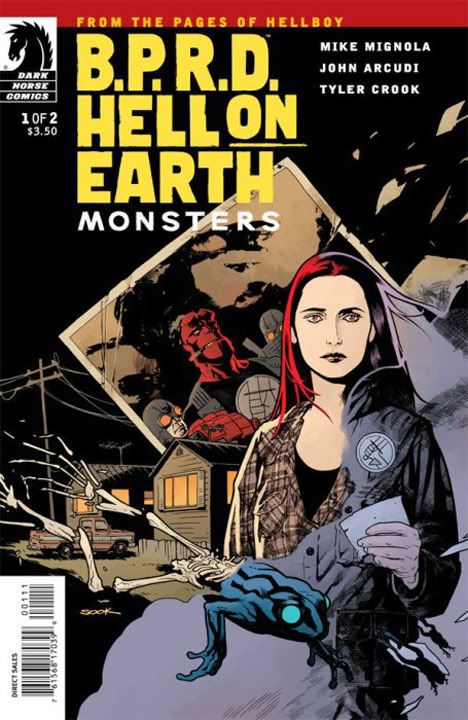
B.P.R.D. Hell on Earth: Monsters #1
Publisher: Dark Horse Comics
Writers: Mike Mignola and John Arcudi
Art: Tyler Crook

I've missed an issue here or there of Dark Horse's B.P.R.D. series, so I'm not exactly sure why Liz Sherman is hanging out in a trailer park and living with a couple of goobers. But I've never objected to any Liz-centric story, neither this one nor the recently completed "The Dead Remembered" two-parter starring the character as a teen. Liz has always been a troubled and largely unhappy person. Just a guess here, but it probably has something to do with having killed her family via pyrokinesis as a child. Little things like that tend to make one prone to bouts of mopey behavior.

We love her, though. B.P.R.D. stories are full of fanciful freaks like Abe Sapien and Dr. Johann Kraus, but writers Mike Mignola and John Arcudi have never neglected the human element. They make Liz darkly fascinating and each new story reveals previously unimagined facets of her spiky personality.

So why is she living in low-rent exile among a bunch of drunks and wife-beaters? I'd better pick up some back issues, or maybe Mignola and Arcudi will reveal the answer in part two. In the meantime, they delve into a setting right out of one of the better episodes of The X-Files, with the supernatural elements coloring the edges until the gory cliffhanger on the last couple of pages. As far as I know, we've never met any of these secondary characters before, but Mignola and Arcudi bring them to vivid life with just a few lines of dialogue, despite tagging them with names like Jubal and Jeb. What the heck is Liz doing there?

But oh holy moley, we've got a live one here in artist Tyler Crook! While the amazing Guy Davis will certainly be missed, the creative team has recruited someone with a similar aesthetic-- a kind of loose, Alex Tothian look, perfectly attuned to the story's trashy setting and to its ominous undertones of encroaching menace; according to Dark Horse, he lists the great Milt Caniff as an influence and it shows. You can't go far wrong following Caniff, Frank Robbins or Harvey Kurtzman. Crook makes each character a distinct individual, with shabby fashion sense and deadbeat body language-- slumped over while carrying a case of beer, thrusting hands in pockets, angrily kicking at a frog in the rain. With a few impressionistic gestures here and some heavy black-spotting there, Crook's art-- much like that of his art influences-- is both caricatured and yet has an almost documentary-like believability thanks to a sharp eye for details such as cereal boxes on top of refrigerators, magazines downturned on the floor to mark the reader's place and beer cans tossed in the corner. This is my first encounter with Crook's art and I'm already in love with it. Colorist Dave Stewart-- a longtime series stalwart-- gives it a subdued palette that serves Crook well, all drab neutrals except for the red of Liz's hair.

I hope Crook has a long, long run on this series. People need to see the man's work! I'm looking forward to part two for that and to have all these intriguing questions answered. Or not, because much as I enjoy what Mignola and Arcudi do with their scripts, Crook's going to keep me buying B.P.R.D. for as long as he handles the art.

Sunday, July 17, 2011

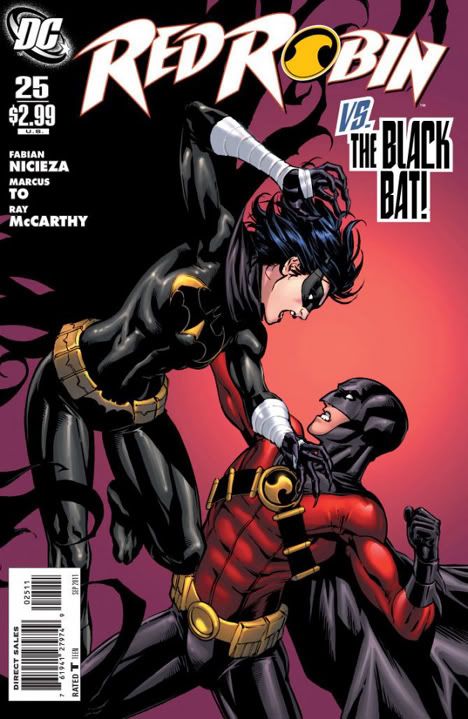
Red Robin #25 and Walking Dead #86: Comics reviews

Red Robin #25
Publisher: DC Comics

Script: Fabian Nicieza

Pencils: Marcus To

Inks: Guy Major


Just the other day I complained in this blog about having aged out of DC's target demographic. Yet it seems for this single issue of Red Robin, I'm the intended audience. Of course I don't really believe that for a second, but something happens early in this book I've often joked about.

As for the rest of the book-- have you ever wondered what a story about Dr. Watson's brother-in-law, with the Great Detective and the Hound of Baskervilles as ancillary elements would be like? Neither have I, but it would probably resemble Red Robin #25. Nicieza and To fill the story with all character beats, action and explosions you could possibly want. Unfortunately, they face the nearly impossible task of generating interest in a generic lead. Peter Parker has girl trouble, Dick Grayson has a tragic past, Bruce Wayne is brilliant and rich. What is Tim Drake but a pastiche of these familiar elements? It doesn't help that a good deal of his narration at the start consists of telling us how awesome his co-star is, thereby reinforcing his own status as a non-entity.

And thanks to Nicieza and To, Cass is indeed awesome again. We know this because she rescues the hero then involves herself in a little comedic background business while Red Robin and an unseen supervillain (why are these guys so gregarious and yet cryptic about their plans?) engage each other in yawn-worthy plot-twaddle. It's funny, effective and much more entertaining than this tired stuff about assassinations, evil geniuses and nebulous and nefarious schemes. Cass has about six lines of dialogue and she could scarcely need more. I love how Nicieza takes away some of her English fluency without turning her into a caricature; she eschews subject nouns like Rorshach from Watchmen without the psychosis. Mostly she expresses herself through physicality and in her wicked black outfit exudes enough charisma to outclass Red Robin in his own book. To's use of splashes and large panels in the action sequences ably display Cass's martial prowess. It's clean-lined and sharply rendered stuff and goes a long way towards soothing the savage Cass-fan that dwells inside.

Because it's so ensconced in the familiar-- one plot element is cribbed from the film The Dark Knight-- the story lacks a sense of danger or urgency. Even the potentially life-altering situation Red Robin finds himself in at the get-go is treated mostly as a joke, dismissed as "'A Very Special Episode' kind of attacked" and "a fate not-quite-worse than death." The taciturn Cass even has a quip of her own for the occasion. This gives the proceedings a detached quality, a kind of ironic distance in which nothing much matters and nothing much is at stake. Later in the book, there's a one page sequence set in Hong Kong that leaves Red Robin battered and bruised. With its bizarre villain-- shades of the killer kid from Kick Ass, the new Damian Wayne Robin and Cass herself-- it might have made for a more compelling or unusual adventure starring Cass with Red Robin as her guest-star.

Instead, it acts as an awkwardly inserted digression that reinforces my feeling DC has an ace creative team in place, but they're hamstrung because they're telling the wrong character's story; when Cass drops out of the narrative, so will I. If Nicieza suddenly finds himself assigned to a Black Bat monthly DC and I might find ourselves meeting somewhere in the middle again.


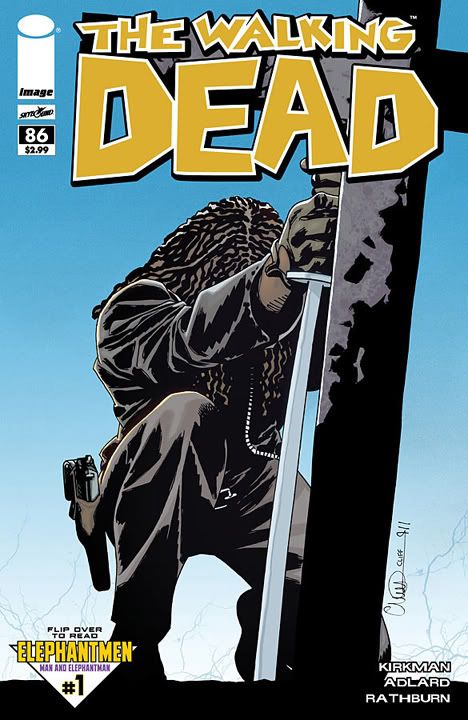
Walking Dead #86
Publisher: Image Comics
Script: Robert Kirkman

Art: Charlie Adlard


And to contrast Red Robin, here's a title which seems aimed at me almost every single issue. First and foremost, as an art geek I can't get enough of Charlie Adlard's gritty line work. I much prefer stylists-- impressionistic or expressionistic, loose and sketchy or clean-lined-- to the photorealists in comic book art. Photorealists excel at the mechanical aspects of their rendering, but they all too often detour through the uncanny valley-- Greg Land's gallery of lovingly detailed pro wrestlers and porn stars in the midst of orgasm come to mind. Adlard's pages ultimately have more believability because his characters aren't copied (or traced) from some easily-recognized celebrity. They inhabit a world of shadows where bodies have weight and presence. Adlard is also an exceptional storyteller who knows how to break up and pace a page, how to pose his figures and direct action sequences for clarity and maximum impact.

Kirkman's script for this issue is heavy on dialogue. Well, to be honest, most of his scripts for The Walking Dead are, but #86 falls between the end of one major storyline and the beginning of another so there's quite a bit of back-and-forth between characters in the form of casually handled exposition. Rick, the deadly Michonne, crackshot Andrea and the rest have found a refuge within a walled suburb, and they've just come through a massed zombie attack that resulted in lots of gruesome deaths and a shocking injury to Carl, Rick's son, depicted by Adlard in a drawing so gruesome it actually disturbed me. I plan never to look at that page again!

Now the cast is just kind of hanging out, working through their emotions. Yes, there are some shambling zombies to dispatch, but it's in the service of showing us where the castmembers are now while they describe to each other where they've been. After so many issues, it's a good point for new readers to jump in and start reading. I can't help but feel Rick's new-found optimism is yet another sign the poor guy's lost his mind, though.

What's most fascinating about this particular issue isn't the story; it's the letter page. The Walking Dead has the best letter page in the business, bar none. Editor Sina Grace and Kirkman himself mix it up with readers, cracking jokes and dealing with the largely endearing weirdness of the rabid fanbase this book has garnered over the years. Lately, they've run some blistering letters from readers upset about what Kirkman did to Carl.

I admire Kirkman's audacity and don't think he has anything to apologize for. This moment elevated the story's climax from a mere "third act action movie fight" to something approaching an operatic emotional intensity. It's also wickedly ironic considering some of the philosophies Kirkman has Rick espouse, a chillingly reductive viewpoint of us versus them, them being not the walking dead but the living families in his adopted community.

Essentially, Kirkman upset these readers by making his fiction do what fiction is supposed to do. A story should be about how and why the protagonist and, in a thickly populated book like this, the secondary characters transform from their initial state to something different. These changes are not always positive ones. A mainstream superhero comic is typically about how they stay the same for years and years and years until financially necessity dictates a new costume, a publicity stunt death-then-resurrection or a forced "new direction."

I'm not sure if Kirkman has an ending in mind for the overall narrative or if it's sustainable at great length without repeating itself-- already one of the book's weaknesses-- but he's not afraid to bring the hammer down on any particular individual character, all the while altering them in drastic ways because of story events. Rick has developed from competent good-guy lawman, husband and father to strong leader to crackpot capable of letting other people's children die to save his own... and now to someone with a potentially deranged evangelical fervor about making his new community work. Or maybe he's just become charged with positive energy and he's on his way to a happy ending. Whatever it is, Kirkman's written this organically rather than arbitrarily, and that's a major reason I've stuck with this book for 80-odd issues.

It is kind of odd, though, to find a line some readers aren't willing to cross in a story that features walking corpses who've devoured almost the entire population of North America, splattering gore, limbs chopped off, rapes and near-rapes and people constantly losing their loved ones. In fact, in the story they're upset about, Rick uses a hatchet to chop off a woman's hand-- just to add some charm, he's been sleeping with her and has convinced her to follow him in a desperate escape attempt that will surely doom any number of other people to horrific deaths-- and allows zombies to devour her and her child. That Rick has his reasons and that a zombie story demands sacrifice perhaps excuse him to a certain extent, but why stick at Kirkman's treatment of Carl in the midst of all these other tragedies?

Expanding on this idea, in order for the entire series to take place these zombies implicitly have to have eaten millions of children, including helpless little babies. Apparently readers can consign all those people to death in the interest of good clean fun. For audiences at large, aliens can disintegrate all of Los Angeles in a genocide of CGI fire in a movie or the entire world can fall apart killing billions because of some nonsensical prophecy in a stone calendar, but make sure there's a scene where a dog leaps to safety or else we're outraged. Outraged, I tells ya! Let Kirkman maim Carl, a character we've suffered along with for years, and it's "HOW DARE YOU, YOU INHUMAN MONSTER?!"

I've come to trust Kirkman, and find I can enjoy The Walking Dead without worrying he'll eventually have to ret-con things to keep his story going for the sake of protecting trademarks and cashing in on merchandise sales ad infinitum. So when he wounds my heart with a development like this, I have to give him his due as an author of substance. Kirkman must be thrilled to know his work impacts people this way, even if a lot of them are calling him names and vowing never to read The Walking Dead again. People care, and that's the mark of a great book.

Wednesday, June 22, 2011

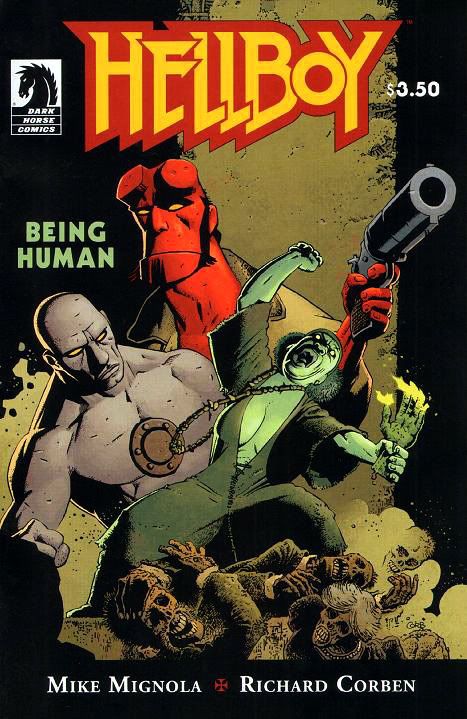
Hellboy: Being Human: Comic Review

Hellboy: Being Human
Publisher: Dark Horse Comics
Writer: Mike Mignola
Artist: Richard Corben

Mike Mignola and Richard Corben team up for the sixth time* for this touching and gruesome tale in which Hellboy takes his despondent pal Roger to South Caroline so they can investigate a haunted mansion. Roger has every reason to be down—he’s a “15th century homunculus,” which apparently means he’s a big, rock-like naked guy with gray skin, an iron cap riveted into the center of his chest and some kind of block and chain chastity device covering his crotch. Roger appears to be and acts more or less a man, but he’s still figuring out what it means to be human. Hellboy, the human/demon hybrid with a blue collar attitude towards his job of punching folkloric creatures and Lovecraftian space demons, is the perfect guy to give Roger advice on the topic.

The haunting involves animated corpses, a witch and long-held family grudges. Mignola balances the weirdness with an affecting portrayal of a confused Roger, who despite his strange origins possesses an innate decency. He desperately wants to do the right thing, if only he knew what that was. As with "Makoma" and "The Crooked Man," Richard Corben proves to be an ideal match for this kind of moody, dark Hellboy story. He’s not the kind of artist who gets hung up on classical anatomy, but he gives his stumpy characters solidity and presence with his unique method of modeling, a kind of mottling or stippling. Whether it’s Roger’s stonelike skin or the mossy corpses and fungi-covered walls of the mansion, Corben is your go-to guy for sickening textures and miasmic atmospheres. Looking at these pages you can almost smell the damp plant-life and epic decay surrounding Hellboy and Roger. Corben's characters wear facial expressions that are frequently borderline comedic, but then he treats you to a stark panel where someone’s had a hole blown through her chest with gore draining out in a big red gusher. Yeah, unique. There’s not another Corben out there and we should treasure the one we have.

While I certainly don’t begrudge Mignola his forays into comedy, these uneasy tales of generational crimes and identity questions are the ones that stick with me long after I’ve closed the comic. It’s nice to revisit the tragic Roger and find Mignola amplifying those themes by exploring his character. Knowing Roger’s fate makes this story all the more poignant. "Being Human" is touching, grotesque and altogether memorable, the kind of stand-alone issue that's as rich if not richer than most multi-parters. It makes me long for the days when creators knew how to craft a story in one perfect, self-contained unit.

*Correction. Someone pointed out this isn't the third collaboration between Mignola and Corben. With the economy being the way it is and all, I've had to let go a lot of my staff. The fact checkers were the first to get pink-slipped. And while corrections are welcome and appreciated, for future reference only I am allowed to be snotty in this blog.

Tuesday, June 21, 2011

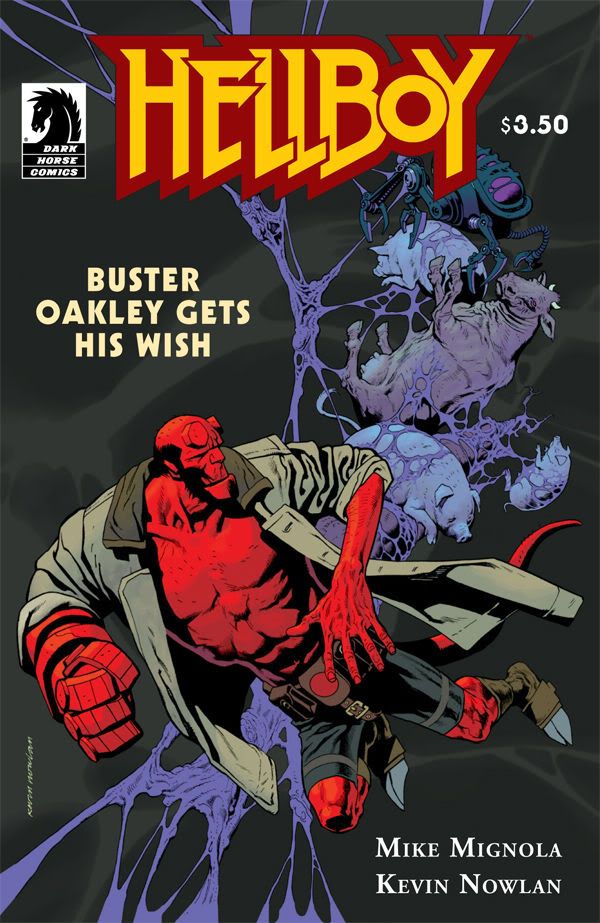
Hellboy: Buster Oakley Gets His Wish: Comic Review

Hellboy: Buster Oakley Gets His Wish
Publisher: Dark Horse Comics
Writer: Mike Mignola
Artist: Kevin Nowlan

Writer Mike Mignola and artist Kevin Nowlan do an EC Comics/50s sci-fi flick riff in this beautifully drawn and colored but somewhat slight and unaffecting story about Hellboy investigating cow mutilations in the American midwest. While the Hellboy has always had its light moments—a quip here, a funky monster there, the main character's name—and a diversion into full-on comedy starring Big Red himself is more than welcome after a spate of stories where he’s suffered horrifically, this one never becomes more than simply that, a diversion. For a title character Buster Oakley remains a cipher; it’s really hard to care much for his wish or whether or not he gets it. In fact, I’m left confused as to what his wish really was. He seems to be a nerdy Satanist, but he ends up the scientific plaything of flying saucer jockeys. The tenderhearted farmer who tears up when confronted with the grotesque carcasses of his beloved livestock has much more substance and the story might have been better served making him and his wife the focus.

The bulk of the plot has Hellboy fist-fighting old school macrocephalic aliens (Nowlan misses out on the chance to make them ultra-grotesque Wally Wood-type octopus creatures). The notion of aliens advanced enough to cross time and space reduced to having to duke it out with an intruder is amusing, and Hellboy's wisecracks are fun. It’s certainly nice to see him doing something other than moping about his destiny or fighting creatures from European folklore. I have to applaud Mignola for changing things up as far as Hellboy's paranormal punching bags go. I love vampires, werewolves, witches and the Fair Folk as much as anyone, but there are still Yetis, skunk apes, lake monsters, Moth Men and Mad Gassers of Mattoon out there as well. How about Hellboy going a round or two with the hodag? Alom-begwi-no-sis? Kuchisake-onna? Hanako in the toilet?

A little more substance would have elevated this team-up of powerhouse creatives. Ultimately, "Buster Oakley Gets His Wish" feels like one of those Gen13 Bootleg out of continuity one-offs; those were generally superior to the actual series, but in this case the expectations are just too high. But hey, sometimes even Hellboys just wanna have fun.

Sunday, June 19, 2011

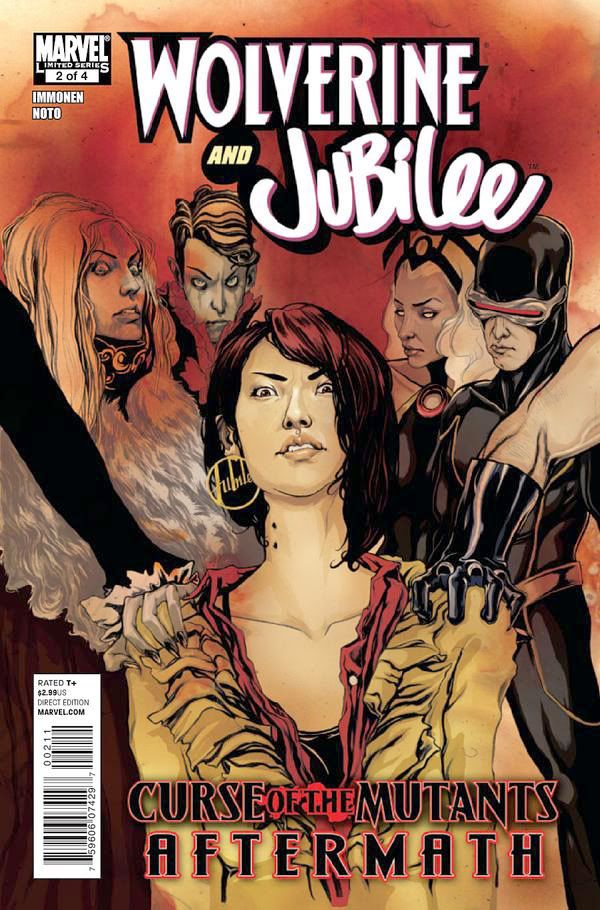
Wolverine and Jubilee 1-4: Comic mini-series review

Wolverine and Jubilee 1-4
Publisher: Marvel
Script: Kathryn Immonen
Art: Phil Noto

Jubilee always was a trend follower. When hanging at the mall all day was in style, that’s what she did. Now sucking blood, staying up all night, hanging out with Bella Swan and burning to ashes when exposed to direct sunlight are the fad, so Jubilee’s become a vampire.

I have no idea when Jubilee became the monster du jour but I believe it must have happened during one of those multi-book crossover events Marvel dumps on us every other month or so, with all the X-people fighting vampires; after all, the cover copy reads "Curse of the Mutants Aftermath." Characters refer to Jubilee's transformation and discuss how she even turned her old pal Wolverine into a vampire as well. This has understandably left the other mutants a bit wary of Jubilee, so they first keep her in a glass box as if she were Hannibal Lector’s favored daughter. After that, she moves into a nice stainless-steel business hotel room complete with a mini-fridge full of bottled Wolverine blood. I'm not sure if vampires prefer their blood chilled or at room or body temperature, but the magical red stuff flowing through Wolverine's veins is the only thing that can keep Jubilee's vampiric bloodlust in check. The X-Men and all their employees want to make sure there's plenty on hand. But what Jubilee doesn't know is they're keeping a running total and adding the charges to her bill.

Despite such apparent expertise, I have to admit my knowledge of Jubilee is kind of spotty. When I lived in Japan my workday ended at 9pm and I tried to get home in time to watch re-runs of Spider-Man and His Amazing Friends on the Disney Channel; more often than not, I came in too late and ended up watching the last few minutes of X-Men, the cult-fave cartoon from the 1990s with Jubilee as a major character. Since then, I've mostly thought of her as the spunky kid archetype, a smart-ass Kitty Pryde substitute; you know how the X-people always have to have an underage girl on the team for Wolverine to mentor. The Jubilee of my mind spends her days at the mall, wearing totally outrageous clothes ten years out of date and talking in the kind of sassy teen slang a middle-aged male comic book writer would come up with having watched a few ABC "TGIF" family sitcoms.


I bought the first issue of Wolverine and Jubilee because there wasn't much on the shelf that day and I simply hate walking out of a comic shop empty handed, especially one that seems to have about 5 customers a week. I read it a few days later, expecting little from it beyond some pretty art. To my amazement, I found myself engaged and interested in Jubilee's dilemma. For the first time in my hardboiled comic reading life, I actually cared about this character.

Writer Kathryn Immonen's achievement becomes all the more impressive because Jubilee's problems stem from the essentially silly premise of a world where superhero mutants can become vampires. Actually, in this world, the idea of mutation itself is mostly a catch-all excuse to create arbitrarily powered characters. Someone might have bird wings, another might look exactly like a frog and exhibit frog-like behaviors. And look, here comes Dracula to drink their blood. Deftly avoiding camp, Immonen crafts an affecting portrait of a young woman possessed of strange new powers, isolated and vulnerable as a result. Jubilee is uncomfortably slung between fight and flight, at war with both her elders and her contemporaries, the very people she once counted on as family.

In the opening scenes, Immonen wisely doesn't try to out-Juno Diablo Cody. Jubilee's quips are witty, but not supernaturally so. After more than half an issue of confrontations with several first- and second tier characters-- including Armor, her own replacement as resident purveyor of underage spunkiness and quips-- Jubilee becomes enchanted with a mysterious woman who also turns out to be a vampire, ever so briefly involves herself in human trafficking, then goes into summer blockbuster heroine mode, with brains to match her vampiric brawn. It turns out she's to be made a hostage so Wolverine will kill something or someone. Never forgetting she's writing a superhero story, Immonen does a fine job in the story's second half with several action-heavy sequences admirable in their weirdness, such as the scene where Wolverine confronts a zombie accountant who has a disarming way of keeping himself fed, or when one of Jubilee's few age-appropriate friends Rockslide-- looking like the lovechild of Ben Grimm and Badrock from Youngblood-- goes to a laundromat and ends up fighting a talkative dragon. Towards the end, Jubilee finds herself climbing down a battleship inside some kind of featureless void full of floating Egyptian pyramids and the Baltimore Hotel.

It's one thing to write about featureless netherworld pawn shops; it's another to make these ideas work as two-dimensional visuals. Fortunately, Noto's art is outstanding as well. While the backgrounds are somewhat sterile-- possibly due to the coloring-- the characters aren't generic heroic types. Wolverine has the doughy face of a barfly air conditioner repairman, while Jubilee sports messy hair and rolls her eyes in exasperation whenever she sees through Wolverine's clumsy attempts to help her regain her footing in the context of her new un-life. Or maybe they're clumsy attempts not to have to kill her. Whatever they are, they irritate Jubilee because they frequently involve either forcing upon her the company of Pixie, a ludicrously conceived character with pink hair, elf ears and fairy wings left over from those crushed Ritalin-snorthing, rave-happy pre-Millennial years we call the late 1990s, or simply stabbing her in the neck with a loaded syringe. But how tall is Jubilee supposed to be? I've always thought of Wolverine as a shorty, topping out around 5'4" or so. Yet he towers over Jubilee during their sparring sessions and heartfelt yet edgy father-daughterish conversations.

There is something of a letdown after the final battle, though. Immonen and Noto forgot to tell us if Jubilee is the sparkly kind of vampire.

Friday, May 27, 2011

Today's lesson: Buying comics is an expensive habit!

Yeah. I'm thinking about giving up comics and taking up cocaine again. Just kidding. I've never used cocaine. As far as you know. But today was payday, so I went to JJ's Comics & Cards, my local comic book store, looking specifically for comics featuring Cassandra Cain in her new costumed identity of Blackbat. Which means-- choke!-- I bought a few DC Bat-books! I even bought some I wasn't sure she was in just to make certain I didn't miss even a fleeting glimpse or hint!

But I spent close to 40 bucks. They had stuff there I didn't even know I wanted until I saw it on the shelves. Here's what I ended up buying:

Batman: Gates of Gotham #1: Cass in civilian clothes, towards the end of the issue, just as promised. The way artist Kyle Higgins draws Cass-- her anatomy, her clothing, her body language-- and the way writer Scott Snyder handles her mode of speech do nothing to define her as anything more than just another generic superhero person, which lead to something of an anti-climax. Here's hoping a closer reading proves me wrong.

Batman Incorporated #5: No discernible traces of Cass in civvies or otherwise, but lots of Batwoman. I like Yanick Paquette's art with these Michel Lacombe inks. Solid figurework, nice facial expressions.

Batman Incorporated #6: Chris Burnham's art combines the thin, scribbly lines of Frank Quitely with the deranged facial expressions of Ito Junji. I'm not sure I like Bruce Wayne looking kind of crazed, but there's Cass as Blackbat more than making up for it with a nearly silent action sequence. Leave it to Grant Morrison to give us Cass doing what she does best-- whomping on people and leaving no room for discussion. Liking the pointy little mask and cape, can't tell much else about her costume.

Conan: Road of Kings #5: I passed on King Conan to pick this up. No Cass whatsoever, just Conan in his warrior prime as written by Roy Thomas. Which reminds me-- I need to turn to the back for "The Adventures of Two-Gun Bob," the biographical Robert E. Howard strip by Jim & Ruthe Keegan. It's always excellent. Cass's appearance in this book cancelled due to licensing difficulties between Dark Horse, Time-Warner and Conan Properties International. Too bad. Thomas's take on her would have been interesting, to say the least.

Hellboy: Being Human: Mike Mignola script, Richard Corben art, complete story in one issue. Of course I bought this! No Cass appearance, Cass not referenced in dialogue.

John Byrne's Next Men #6: The return of one of my favorite-- yet somehow frustrating-- titles from years past. Byrne's telling a convoluted time travel mystery but the story feels somehow beefy. I get that same full-belled satisfaction from reading it I used to get from comics, rather than the sense I've eaten a single cookie a lot the flimsy, underwritten books give me these days. Not saying Next Men is gourmet fare so far, but it does hit the spot. Will I be able to keep it down? Cass appears briefly disguised as a Union soldier. Sure, the figure's tiny and consists of just a couple of ink swirls, but I'd recognize her anywhere.

New Mutants #25: "New Direction!" huh? How about A direction? This is a book I've stuck with because I like Dani and Xi'an so much, but it's been nothing but fragments of crossover stories, frequently with the New Mutants team barely appearing on the pages of their own book. And it got off to such a decent start before being consumed by the needs of modern epic storytelling. I'm not quite ready to give up on it yet, but if this book is just going to be a bump on the ass of the greater X-franchise with no stories to tell of its own, then I'll be bailing soon. Very soon. Rumors of Cass taking over as team leader in this issue prove unfounded.

Red Robin #23: Another false alarm. No Cass.

The Rocketeer Adventures #1: The lead story is all about Cass and explains how she came to choose "Blackbat" as her new super-name. Yeah. I didn't make that up. It's... really... I bought "cover 8," the Dave Stevens variant. I also hate multiple covers. But this one is a beauty. And inside there are stories by Mike Allred, John Cassaday and Kurt Busiek. Busiek's just happens to be illustrated by Michael Kaluta. Are there really people who have to collect each and every variant cover of a single issue? Do those kinds of stunts really help publishers? Or do readers just choose their favorite one and go with that? If it's the latter, I'm all for it because it's kind of interactive. If it's the former-- YUCK. But what a gorgeous book! John CASSaday, but no Cass Cain.

X23 #10: I've always hated this X23 character. Well, not the character, just the concept. To me, you need one Wolverine, one Batman, one Superman, one Wonder Woman, one Spider-Man. Not clones and extras. Which may sound strange coming from someone who bought a bunch of comics based on the erroneous assumption a former Batgirl would be in each and every one of them. And I've always been indifferent towards Jubilee. Then a funny thing happened. One day the comic store had nothing I particularly wanted so I picked up the first issue of the Wolverine and Jubilee miniseries. Jubilee as a vampire? DOUBLE YUCK. DOUBLE SURPRISE! It turned out to be a pretty compelling story, quite well-written by Kathryn Immonen and nicely drawn by Phil Noto. It made me care about Jubilee for the first time. So when I saw a comic featuring vampire Jubilee fighting X23 with art by Sana Takeda? I felt perfectly willing to climb off my high horse and--

Cassandra Cain is back in action!

I'm happy with all these purchases, and I'd openly shill for JJ's Comics & Cards because of the royal treatment the owners have always given me-- and they're just so nice-- but these books cost me around 36 dollars. Actually, if I want to keep up my comic book reading habit, I'm probably going to have to give up a lot of other little things. Like electricity, clothing and food. Or I may have to resolve once again to stick only to collections, trades and archives, and then only very selectively.

But there's that Cass factor. Yes, there is.