Showing posts with label X-Men. Show all posts

Sunday, December 29, 2013

Uncanny X-Men #118 (February 1979): Bad New Mutants Go To Japan!

Script: Chris Claremont; Art:  John Byrne and Ric Villamonte

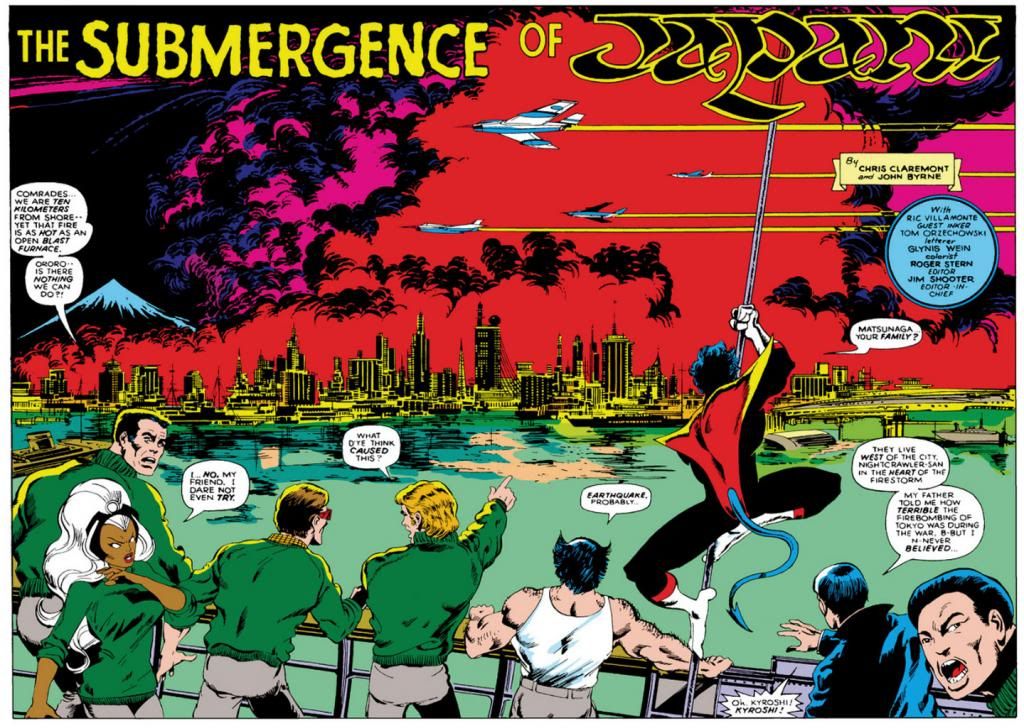
Enjoy this spectacular double-page spread from Uncanny X-Men #118 (February 1979), pencilled by John Byrne and inked by Ric Villamonte.  Maybe Terry Austin was off that month.  Agarashima, the city on fire here, is completely fictional but the visible architecture in Byrne's rendition is plausible enough.

Except for Mt. Fuji in the background.  An online source tells me Agarashima is in Miyagi prefecture, which is way up north along the eastern coast of Honshu.  Actually, that same source reports the city to be "300 kilometers north of Tokyo" and misspells the prefectural name as  "Miyago."  This may be a fictionalized flourish on Chris Claremont's part, freeing him to use his imagination and create a fanciful Marvelized Japan.

Fake Miyago or very real Miyagi, it's a likely location for a medium-sized port city, which is what Agarashima appears to be here.  Mt. Fuji is much farther west, so there's no way if this city resides 300 kilometers north of Tokyo you would see it looming that large in the background because it would be about 500 kilometers away.  I live in a city in the same prefecture as Mt. Fuji, about 116 kilometers away, and even when we can see it from here (it's visible from several vantage points on clear winter days when it's wearing its snow cap), it's only about the same size as my thumb.  So this is more than likely a little artistic license on Byrne's part as well.  We just need some cherry blossoms blown out to sea by the conflagration to achieve perfection.

So, with all that in mind (or better yet, out of it), let's just admire this glorious drawing, huh?  Unfortunately, after this image, there's not a lot of travelogue imagery in this story.  Much smaller panels, and a lot of the action confined to interiors.  By the next issue, the X-Men are on a volcanic island off the coast where they fight a pissed-off nutjob named Moses Magnum, who wants to sink Japan, so we're denied more John Byrne-drawn vistas of late 1970s Japan.  Think what he might have done with Tokyo.  I would love to have seen it.

You know, not on fire.

Monday, November 25, 2013

X-Men #101: Phirst Phoenix... and Wolverine gets all wiggly?

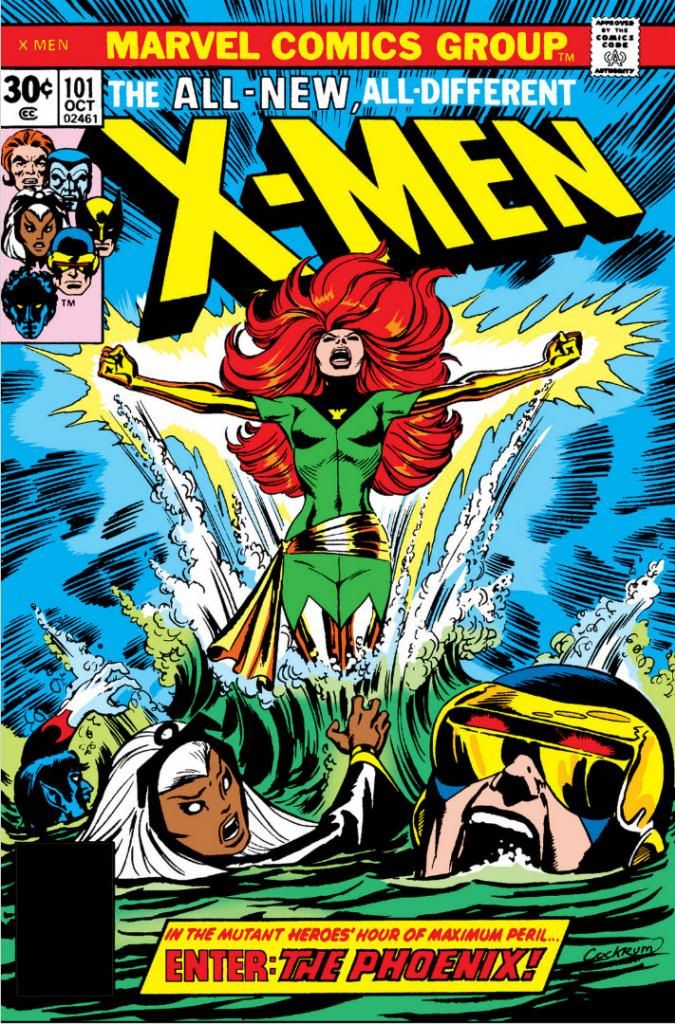
Uncanny X-Men #101 (October 1976) brings a bruised and battered group of X-sters back from a mission into space.  In the preceding issues, they'd taken a Starcore space shuttle-- accurately drawn for the most part (as was the Harrier jet in X-Men #94) by Dave Cockrum, even though NASA's real thing wouldn't get off the earth for another five more years-- to an orbiting space station (nothing like anything anyone's ever put up there, but still pretty cool) where they fought Stephen Lang (or, as some authorities have it, Steven Lang).  Lang is human, but more than that, he's a complete nutjob who hates mutants the way lions and hyenas hate each other. 

Maybe even more so, because Lang stoops to murdering even a non-mutant USAF officer who calls him out on just how insane his schemes are and lions and hyenas only kill each other in their feuds.  I can't think of a single lion who went so far as to bump off a leopard for telling him he's gone around the bend with the anti-hyena robot building enterprise.  Lang captures the team and forces them to fight for their lives in space.  It takes a couple of issues, but the good guys eventually prevail and, on the way home, fly through a solar storm.  Only Jean Grey (or Marvel Girl as she was known then) can pilot them safely back. 

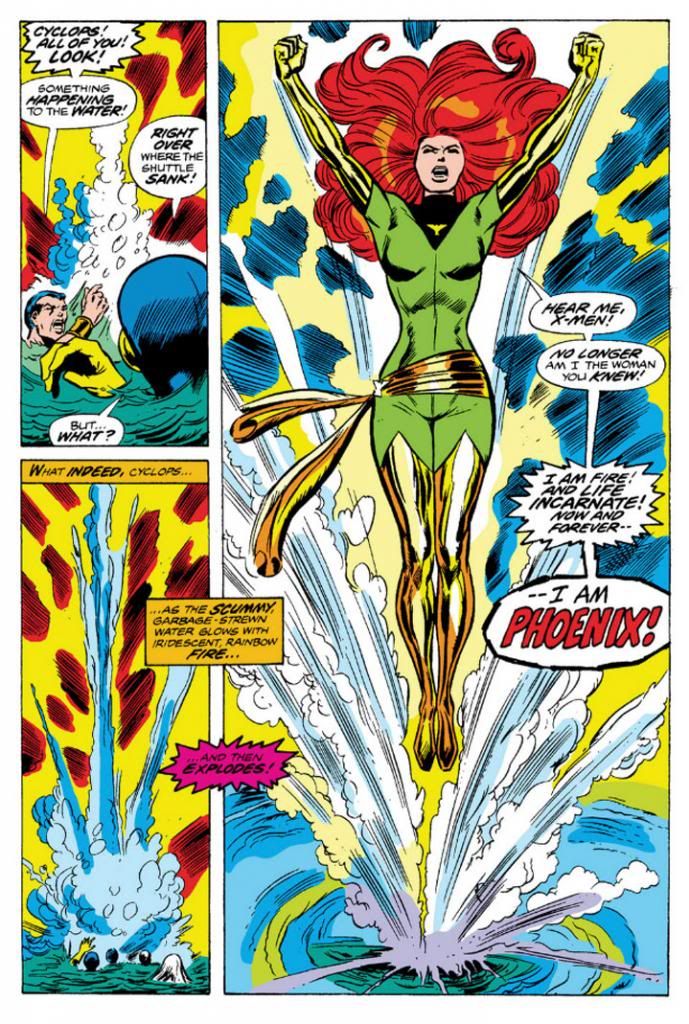
The intense radiation, depicted psychedelically by Cockrum, triggers Jean's transformation into Phoenix, the all-powerful.  But let's let Chris Claremont tell us what the new Jean Grey is all about as only he can:

X-Men #101, script by Chris Claremont, art by Dave Cockrum and Frank Chiaramonte

Ahhhh!  My, that's some good Claremont.  "I am fire!  And life incarnate!" has always struck me as a characteristically Chris Claremont phrasing.  This may be because he was the guy who taught me the word "incarnate" in the first place.  It's certainly not a word one slips into everyday conversation, at least not when I was a southern kid and living in my childhood home, where people were letter carriers, school secretaries and baseball players, not all-powerful mutants.  And so this is the exact moment "incarnate" entered my vocabulary.  To me, "incarnate" and "eldritch" are forever Claremont words, and when I read them in other comics, I always assume the writer has stolen them from Claremont's run on Uncanny X-Men.  And by shouting this phrase, Phoenix lets us know she's here, she's for real, and readers look out!

This is the issue where Claremont found his X-voice.  While he’d already shown a sure hand at characterization, giving each rookie in his cast (and even the previously-established veterans) distinct personalities and moods, the first few issues trot out a tired Avengers villain, a random to the point of being non sequitor demon attack and some story elements from the first X-Men series.  The new faces and the ultra-detailed Cockrum art are the draws, not the stale plots.  I know things were beginning to spark before #101.  Claremont had already started one slow-building subplot about Professor X's strange dreams of distant interstellar conflict.  This has a major pay-off later, and for the moment it meant Professor X gained what he'd largely lacked before-- a personality. 

But the Phoenix story as it begins here is something else altogether.  Claremont allowed it to flicker around the edges of succeeding issues as he dropped clues and intriguing interludes before the whole thing blazed up into major event unto itself, at once epic in scope and intensely personal as well.  Jean Grey’s transformation into the most powerful of all the X-Men also serves notice Claremont’s stories will be about the women as much as the men of the group.  Jean and Storm wouldn’t act as cheerleaders or simple love interests, or worse, damsels in distress, with the stories really being about the boys in the band.  They wouldn’t be co-stars in someone else’s adventures.  They’d be stars, too.  The women would get to drive the narrative as much as anyone.

Cockrum emphasizes this moment in all its drama by having Phoenix dominate the page in a fury steam and lightning, one of those razzle-dazzle comic book light shows.  It's also significant her rebirth takes place as she bursts from water-- both Claremont and Cockrum would have been fully aware of the symbolism.  As she rises we see she's got this startling new costume and even seems to have more hair.  The rest of the team end up crowded into those narrow panels on the left so Phoenix can own the entire space to the right.  If you were holding this comic, this would be the outside part of the page, and this placing promises more Phoenix to come because she's the last thing you see before you turn to the next.  Jean Grey and X-Men would never be the same.

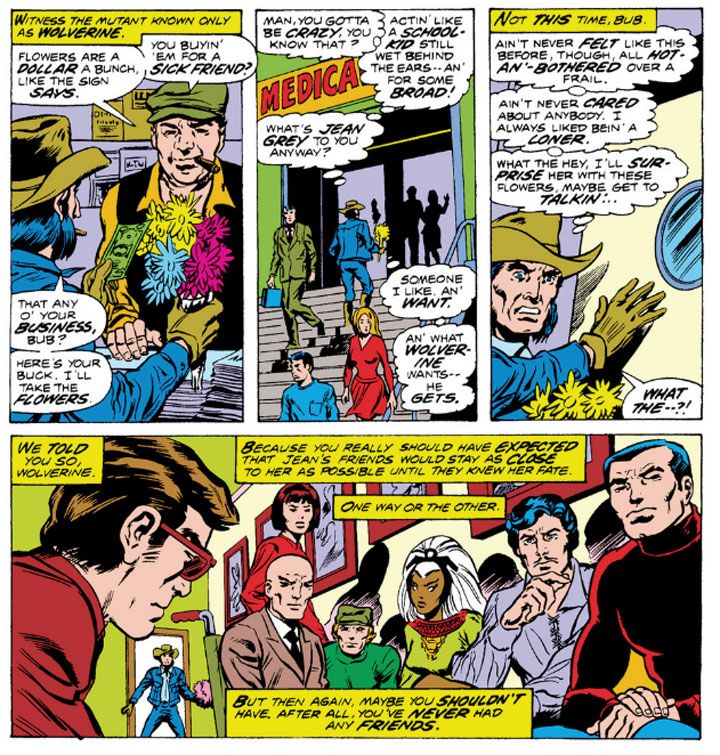
But what's this?  Back in those early, free-wheeling days before the X-Men became one of the major pillars holding up the Marvel cosmology, there was another little subplot happening, one Claremont didn't choose to develop into a major storyline.  Back then, Wolverine wasn't a huge fan favorite and star of every single comic Marvel puts out each month plus his own movie series.  In the first year or so of X-Men, he was just a short asshole mainly known for having fought the Hulk, but Claremont wasn't about to leave him as simple or one-note as all that.  So the team rebel, the loner who doesn't need anyone (needed by no one in return, it seems) turns out to have a bit of a sweet side.  Seems Wolverine has a cute little crushy-crush on none other than Jean "Phoenix" Grey herself.

X-Men #101, script by Claremont, art by Cockrum and Chiaramonte

Aww!  Like a lovestruck high school boy, he's not sure how to go about wooing her, but in his insecurity he plays the arrogant fool in his mind.  Little bit of the caveman, I suppose.  Claremont's narration is pretty harsh on the poor guy, though, don't you think?  I mean, yeah, Wolverine thinks some dickish thoughts while awkwardly trying a tender gesture, but does he deserve the caption box hectoring he gets here?

X-Men #101, script by Claremont, art by Cockrum and Chiaramonte

Probably.

In the last panel Claremont really lets the guy have both barrels, even though everyone involved knows there's a heart inside Wolverine's gruff, hairy, somewhat psychotic exterior.  Actually, I've always thought of the intrusive, judgmental narrator as representing Wolverine's self-recriminations.  That he didn't really like himself.  It would be a while before they humanized him... and then overexposed him... but isn't it fun to see Wolverine getting a case of the goofies over Jean?

Wednesday, October 9, 2013

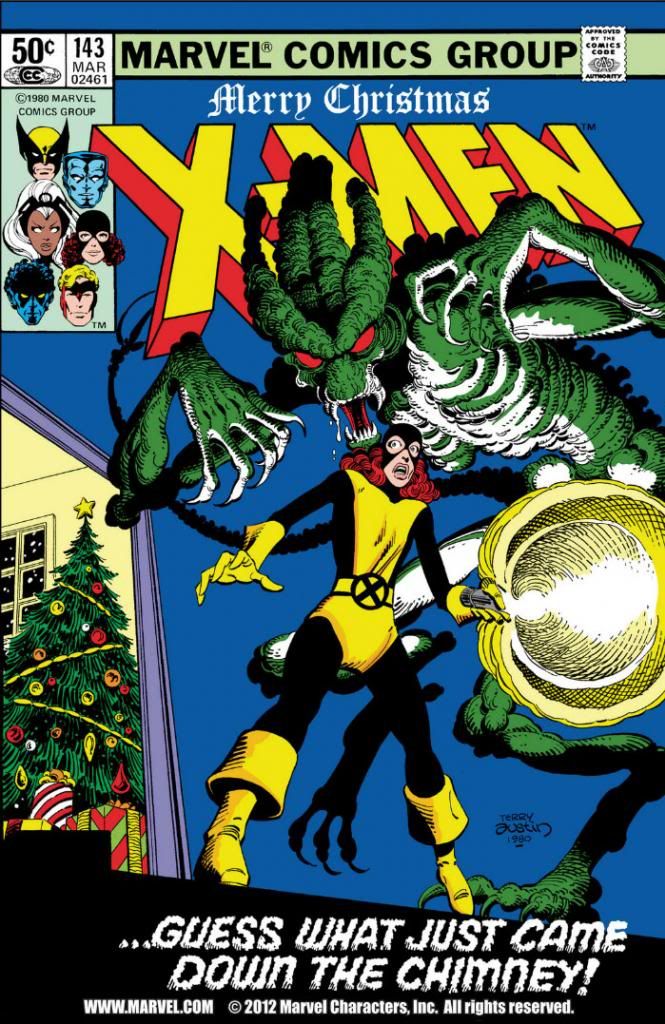
October is Spookey Month: Uncanny X-Men #143 in which Kitty Pryde recreates the movie "Alien" just for kicks

Remember the N'Garai, the H.P. Lovecraft-inspired smoke demons led by that big, energy-draining jerk Kierrok?  One September afternoon and/or evening, they gave the X-Men a lot of trouble until Storm blew their stone cairn apart with a lightning bolt and sent them back to whatever hell-space they crawled out of.  Flash forward a few years and intro Kitty Pryde to the book. 

One Christmas Eve the rest of the gang leave her home alone, just like in that fun holiday movie about being left home alone.  The title escapes me.  Oh yeah-- It's a Wonderful Life.  Unknown to everyone but Chris Claremont and John Byrne (those scamps!), it turns the portal to the N'Garai dimension is still slightly ajar.  One of them, or a close relative, pops out, having visited Swiss surrealist H.R. Giger for a makeover sometime during the intervening years.  The first thing the new, Alien-style N'Garai does is shred an unfortunate couple out poaching a small Christmas tree for their apartment.  Then the poor, lost little demon, as lonely and in need of companionship as Kitty, goes looking for a friend.  After all, it's no fun to be by yourself during the holidays.  Kitty knows this, because this is the first Chanukah she's spent away from home herself.  Unfortunately, thanks to various cultural differences, things don't go the way the demon planned.  Kitty is less than appreciative of its presence, they don't get along, there's a misunderstanding, a fight and a blast from a white-hot jet engine.

This story, called simply, "Demon," ran in Uncanny X-Men #143 (March 1981) a pretty minor work compared to the galaxy-spanning drama that made up the recently-concluded "Dark Phoenix Saga," and it lacks the influence of "Days of Future Past," which took up the previous two issues  It's kind of the Claremont-Byrne team's last little laugh before the team split, and from its title to its monster and most of its plot, it's openly cribbed from Ridley Scott's sci-fi/horror masterpiece.  You know, White Squall.  Claremont must have enjoyed using Scott as much as he did H.P. Lovecraft in the prequel to this issue; he'd later re-homage Alien with his Brood creatures,a kind of otherworldly insect species with a life-cycle that resembles a toned-down version of the Giger creature's.  I don't know if Byrne tried again.  He seemed to content himself with mining Marvel's own history for ideas when he moved over to Fantastic Four as writer and artist.  And tossing in a little Twilight Zone or Invasion of the Body Snatchers for good measure-- remember that issue with the town that drank the cow-Skrull milk and turned into evil shapeshifters?  That one was disquieting in a way this one can't quite match.

The monster itself tries its best, but falls a little short because neither Claremont nor Byrne seem particularly interested in it.  Their main concern is putting Kitty through her paces and making readers adore her.

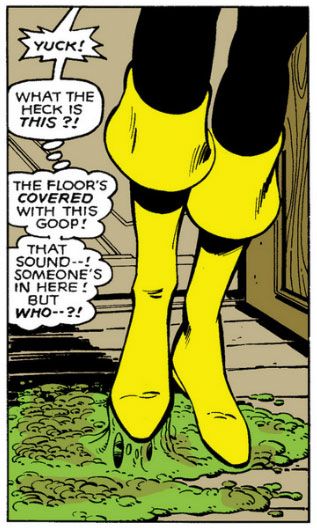
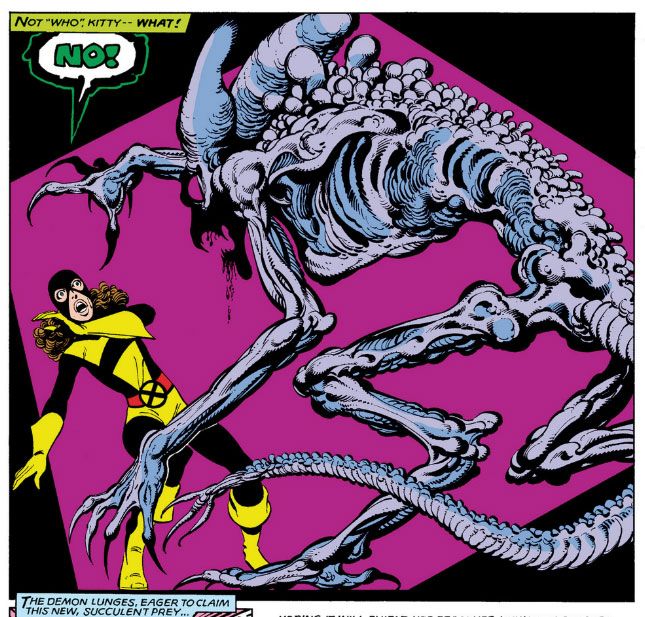
Let's examine our N'Garai for a moment.  In X-Men #96, the story makes the point these smaller demons consist of smoke, and Dave Cockrum makes them more bug-eyed.  Storm is even able to wave one of them away with her hand.  They do, however, sometimes use long spears or lances with which they can stab someone and inflict pain and perhaps drain away life force like Kierrok does with his very presence.  Claremont is almost out of pages with no time to explain it fully, and Storm herself only says something about pain and possible death if she's stabbed again.  In this issue, the lone N'Garai is definitely made up of solid matter of some kind, albeit demonic, and it uses its claws and teeth on the young marrieds before eating their bodies and their souls.  It also leaves Alien slime wherever it goes and crashes through walls.  Essentially, it's an unauthorized guest appearance by the movie monster without any of the icky bio-mechanical sexual reproduction connotations.


Confined within the pages of a single issue and the limits of what the Comics Code would approve, the poor beastie doesn't really get to cut loose and terrify us.  The chase it inspires is chaotic but not as frightening as it needs to be.  Byrne smudges Kity's face and draws some sweat droplets on her brow and Claremont has her tell us through a thought balloon she's scared but "coping," but she comes across as a bit too unflappable throughout most of the comic.

Sigourney Weaver's redoubtable Lt. Ellen Ripley-- for whom Kitty acts as a stand-in and occasionally physically resembles here-- is self-possessed throughout the majority of the film, but frazzles during her frantic escape attempt.  Then she just about loses her shit when she discovers she's accidentally taken the alien with her in her little life pod before she pulls herself together.  Weaver's iconic performance helps, as she's able to convey both Ripley's palpable fear and her agency simultaneously.  This crucial element is missing in Uncanny X-Men #143, despite the tear in Kitty's eye in one close-up.  Also, we haven't really seen the demon do a whole lot beyond kill two people-- both taken by surprise and, as civilians, without even Kitty's ghostly phasing powers-- and a room full of plants.

The story comes close to its full  Alien-esque horror potential when the creature jumps out at Kitty and slashes through her, causing her pain and the temporary loss of feeling in one arm even though she's in her incorporeal "phase state," and in the hyper-kinetic Danger Room sequence as well, but  there's no real feeling Kitty's in serious jeopardy.  After all, this entire issue is more or less a love letter to her, so we seriously doubt from the get-go Claremont and Byrne plan to kill off this kid so soon after the start of her comic book career.

So what we're left with is more a puzzle situation, and the interest is in watching how courageous and clever Kitty solves it.  Which, I suppose, makes it kind of akin to one of those Quinn Martin detective shows.  Barnaby Jones or something.  We see the criminal commit the crime right at the outset and instead of a whodunnit, we get a how-solve-it.

Speaking of how Kitty solves things-- well, if you've seen Alien, you know how it all ends.  Byrne even borrows heavily from the film's visuals to show it, a kind of acknowledgement of just how baldly he and Claremont are riffing on Scott.  To set it up, there's a neat bit of foreshadowing right at the start when we see Professor X teaching Kitty how to start the Blackbird.  I find it really fun to see a young hero's education in process, and who would have thought the day's lesson would pay dividends so quickly?  This premise-- how superheroes learn to be superheroes within a school setting-- is a lot more interesting to me than the demon/Alien stuff.  It's a precursor to The New Mutants and it's almost as if we're watching Claremont inspire himself along those lines, with the genesis of that series appearing right here on these pages.

The weirdly saccharine denouement also foreshadows Claremonts of future past when the team returns to the mansion only to find a tired but otherwise unshaken Kitty sipping hot cocoa in front of the fireplace.  That's right-- she has barely escaped death or even worse at the demon's claws, has no way of knowing if this was a one-time event or the harbinger of a full-scale monster invasion, isn't expecting anyone home for hours... and Claremont has her drowsily lounging about in her robe, as if nothing at all out of the ordinary had happened.

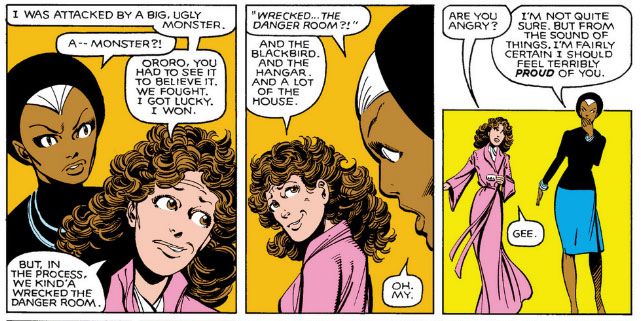
Okay, so Kitty's much tougher than I'd ever imagined, and she's recently returned from the future where she watched everyone die, but don't you think almost being killed by a demon warrants some kind of emotional response beyond the slight embarrassment one gets from denting the family car?  And even if Kitty is too cool to worry, you'd think the older superheroes who almost died fighting Kierrok and supposedly have years of combat experience would do some kind of reconnaissance or go into a defensive posture on the chance there are more demons or enemies lurking around.  They don't even spend much time trying to debrief Kitty.  Storm just gives her the concerned mom act.  After all the mayhem, it turns out nothing more is at stake here than in any given episode of Facts of Life.


This comes dangerously close to making the whole "spunky teen girl joins the team" aspect insufferable.  I guess my tolerance for this stuff was a lot higher when I was Kitty's age.  The New Mutants, which came out a mere year or two later, would consist almost entirely of this kind of tonal dissonance, and I ate it up.  And still do, but then my outright hero worship-love for Dani Moonstar has always overshadowed my liking of Kitty Pryde.  As it is here, everyone's muted reaction further undermines any peril Kitty might have been in earlier in the story and reveals a Claremont a little too in love with his cast.  While it's nice to show Kitty as a teen character able to pull herself together and save herself (a trait she's going to need when the team rockets into space or faces down Dracula himself later on), if you're going to take your superhero story the sitcom route, a better, more appropriate gag for the ending would have been the team coming back to find a pumped up Kitty toting around a baseball bat or that M16 rifle Moira MacTaggert used on Kierrok when these demons first appeared.

And one more thing, gosh darn it-- it's really too bad this wasn't set at Halloween.

Sunday, October 6, 2013

October is Spookey Month: Uncanny X-Men #96 in which the X-Men meet H.P. Lovecraft or a version thereof...

What is your favorite Halloween fright creature?  Is it the ever-popular vampire?  The werewolf?  The ghost?  The demon?  How about the demon who's a riff on H.P. Lovecraft's whole "Old Ones" mythology?  I can't even pretend to understand Marvel's cosmology or theology, but if we're to believe "Night of the Demon" from X-Men #96 (December 1976), we are dealing with a universe where Lovecraftian analogues co-exist with gods and demi gods from just about every religion past and present alongside science both ordinary and extraordinary.

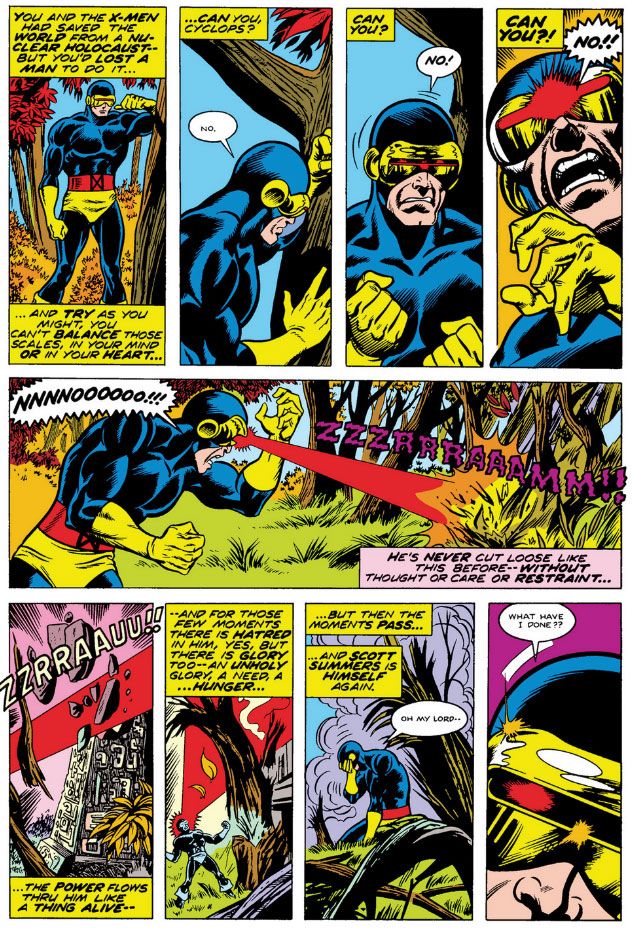
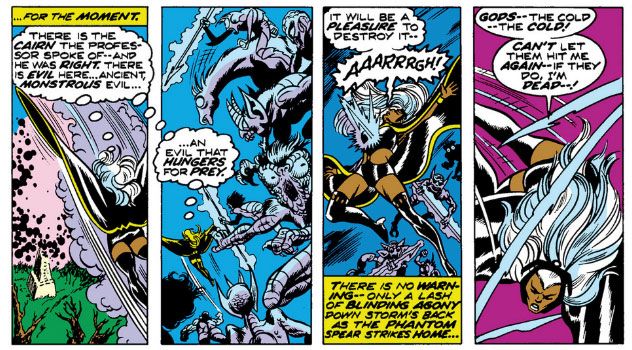
Our story opens on a lovely fall day with text-heavy narrative captions floating in the air.  This is a seasonal tradition in upstate New York, from what I understand.  They do help Chris Claremont establish mood, and the first couple of pages are all about mood.  Guilty over his role in teammate Thunderbird's death in the previous issue, Cyclops broods alone in the woods near the X-Mansion.  The setting proves aptly symbolic:  the recently deceased Thunderbird and the crunchy leaves combine to produce not a winter but an autumn in Cyclops' soul.  Also, it's September, which is close enough to Halloween for our purposes.  Penciller Dave Cockrum and inker Sam Grainger conjure up a tasty forest setting, aided by a crackerjack coloring job by Phil Rachelson.  You can almost hear the wind through those crisp red and orange leaves and feel the dry air.  Then Claremont taunts poor Cyclops so much, the man loses control of his optic blasts.  Cyclops accidentally decapitates an ancient obelisk-shaped cairn with indecipherable hieroglyphics carved on its sides.

This suave move-- I'm wondering how far Cyclops' eye-blasts travel before their energy or force dissipates enough to be harmless to anyone unlucky enough to be caught by one of his indiscriminate outbursts-- frees a demon from a type called "N'Garai" (Claremont was always fond of apostrophes in his monster/demon/alien species names).


The cairn itself is kind of an oddball element.  Sure, Claremont has to introduce this issue's enemy somehow.  It's just hard to suspend disbelief such a spectacular artifact would be undiscovered so close to the X-Mansion.  There must be county roads or even an interstate or something similar running nearby, too.  Plus, this thing is supposed to be thousands of years old.  You can't tell me a hunter, hiker, birdwatcher or Cub Scout pack hasn't stumbled across it before now, with a horde of archaeologists following soon after.  And to have Cyclops blast it open at random stretches belief to the breaking point, even for a book where we have a blue-furred teleporter running around.  But it's in the story, and we all know the gang at Marvel was simply working from reports submitted by the actual superheroes they published comics about, so it must have happened in exactly this way.


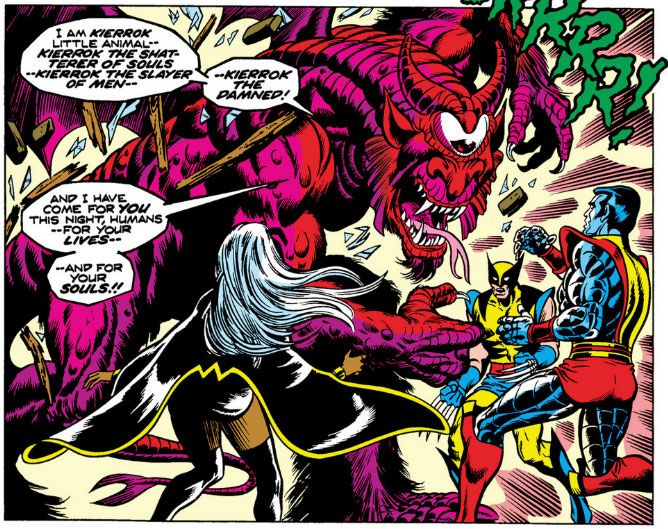
The boss N'Garai is a bat-winged, shaggy, one-eyed dude named Kierrok, and he burst through the mansion's wall like the Kool-Aid Man on a PCP rampage.  As a bit of side trivia, his name is an in-joke because he's portrayed by none other than William Shatner himself in a spectacular costume of someone's design. 

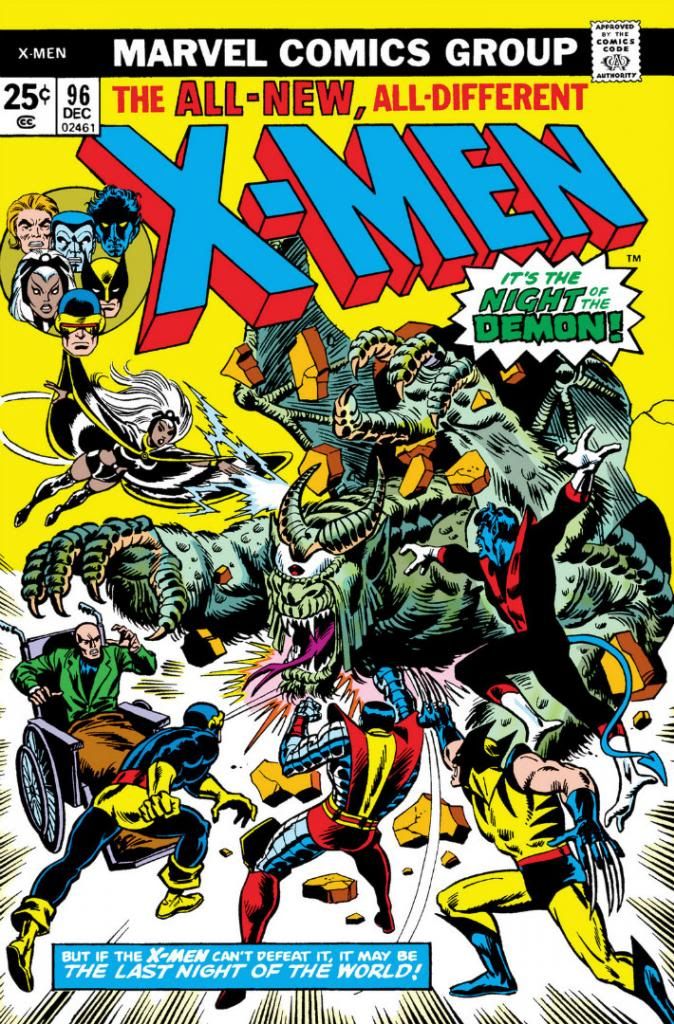
Someone?  I can't say who gets credit as creature-creator here.  Marie Severin and Sal Buscema drew the rather hectic cover instead of Cockrum, and no one has ever told me why.  I read in Comic Book Artist magazine many years ago how Stan Lee used to demand all monstrous enemies be humanoid in appearance to the point where he had Severin re-pencil a dog-like beastie originally drawn by Neal Adams, even if it meant the stupid thing was too big even to stand upright thanks the confines of the page layout.  There may have been a similar situation here, with editorial deciding not to use Cockrum's original design because it didn't fit the Marvel anthro-centric standard.  As you can see, there's also a slight continuity mistake thanks to the cover/interior art duties split.  On the cover, Kierrok is mean and green and pretty far between, but in the story he's kind of reddish or magenta.

Whoever designed him and whatever his color, inside the book Cockrum makes damned sure this nutty Kierrok creature can not only stand on a couple of muscular legs, but also flail about.  Kierrok tosses the heroes around like a big brother lumbering into a little kids' pretend wrestling match.  He also drains their powers and makes Wolverine frown as if he's an offended Sunday School teacher out of some Mark Twain book.  Tom Sawyer, perhaps.  What I love about Kierrok isn't so much that he gives the X-Men all sorts of trouble, but the way he insists in perfect English he's not likely to suffer defeat.  He's like a three-way cross between the Mugatu from Shatner's cult-fave series Star Trek, one of those body-suit Muppets and an enraged pro wrestler in an after-match interview.

As far as I can tell, this is where Claremont starts making his reputation for writing strong women (mostly justified, with caveats extensively covered elsewhere), because Storm comes into her own in this issue.  While the X-Men first attempt to deal with Kierrok one at a time-- which really makes their team training exercises seem useless or Cyclops even a worse leader than he thinks he is-- it takes Storm to shut the magic gateway between our world and wherever it is the N'Garai come from.  While Storm braves the demon hordes alone and also fights off a flashback to her childhood, the male X-Men apparently huddle around Professor X and pray for salvation.


Oh yeah, dig those crazy demons.  They look like something out of Disney's "Night on Bald Mountain" Fantasia sequence.  Cockrum keeps the mayhem contained within some tight, narrow panels that emphasize Storm's ever-growing claustrophobia.


We all know Wally Wood and Gil Kane influenced Cockrum's art.  Well, there's one panel that I swear looks like Cockrum and Grainger channel a little Kane.  Maybe it's Cockrum's choice of camera angles and Storm's clutching hand, both of which are very Gil Kane-like, or the way Grainger inks the demon's scaly texture and Storm's face.  On the other hand, the rest of the drawing elements seem less like Kane, like the double lines on Storm's knuckles and the hatching on the demon's bicep and under Storm's arm.  If Cockrum had chosen a full-figure pose for Storm and the cairn below her in the background, we could blow this image up into a pretty cool cover for this issue.

At this point-- because we only have about a page left before the comic ends-- Storm shrugs off the smoke demons and puts the finishing touch on the events courtesy of a huge lightning bolt.  And so concludes an action-packed one-off that falls one Innsmouth denizen shy of being a full-blown "Cthulhu Mythos" tale.

Claremont and Bill Mantlo share plot credit here, so it's difficult to know who came up with all these events.  The overall characterization and quick flashback to Storm's childhood scream Claremont, but the way Kierrok lumbers into the story without any foreshadowing or much of a set-up is generic comic book stuff that could be by anybody.  I don't know if Mantlo had a Lovecraft fixation-- I can't find much evidence of it in his Micronauts work-- but if you've read Giant Size Dracula #2 (September 1974), you've already encountered Claremont's appropriation of Lovecraftian elements.  That story pits our favorite vampire against a cult led by an Elder God-worshipping demon or warlock or warlock-demon named... wait for it... Y'Garon. 

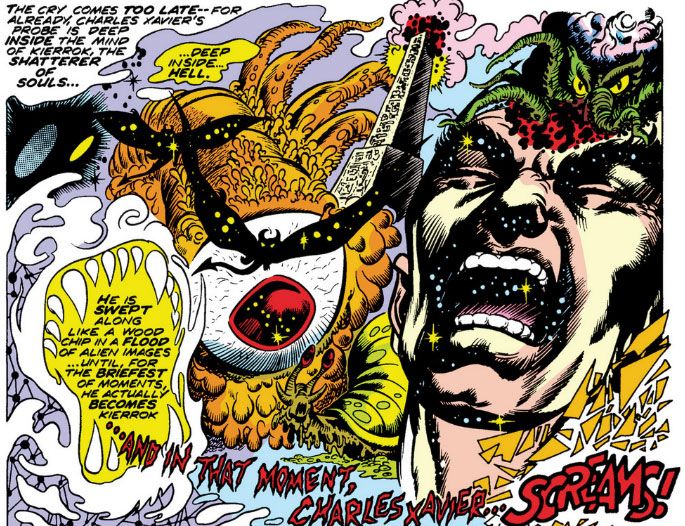
This isn't a criticism by any means.  After all, just about everyone working in creepy genre fiction, film or art cribs from Lovecraft at some point.  Robert E. Howard, Robert Bloch, Stephen King, H.R. Giger, Sam Raimi, Mike Mignola (who does it best, as far as I'm concerned), Frank Sinatra (remember his his hit song, "Fly Me to Yuggoth?"), Tony Bennett, Alan Alda.  I've read Lovecraft's stories dozens of times and enjoy them, but to paraphrase Kurt Vonnegut, "If only he could write!"  Claremont's writing might have some cloying tendencies at times (especially in his post-John Byrne Uncanny X-Men era), but even at his wordiest he's never as awkward as Lovecraft and his rhythms and modern vernacular are much more appealing.  Mix the two writers together and you get Professor X doing a mindmeld and falling straight into the Necronomicon.


Yep.  Ph'nglui mglw'nafh Cthulhu R'lyeh wgah'nagl fhtagn!  Eyeballs, tentacles, winged creatures that fly through the void between planets, geometries unknown on earth.  That's Lovecraft all over, but "... and in that moment, Charles Xavier... screams!" is pure Chris Claremont.

We're not through with the N'Garai by any means.  They make a reappearance a few years later in a story that borrows even more heavily from a more contemporaneous horror source, this time a little movie called Alien.  We'll discuss that in our next installment.

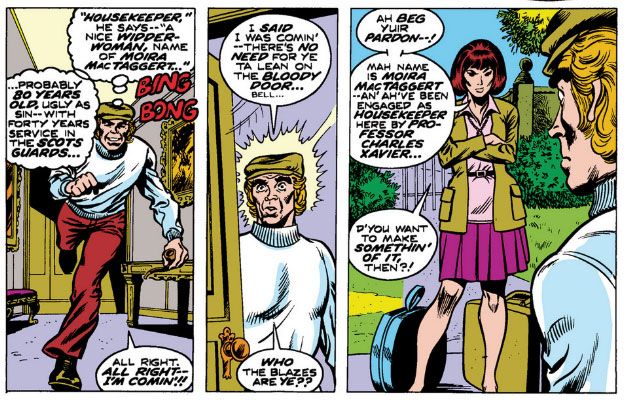
Now I'll share with you my favorite part of this comic.  It has to do with yet another of those strong women, for this is also the issue that introduces Professor X associate Moira MacTaggert, who will play an increasingly important role in stories to come.


That's some advanced Irish-Scottish stereotype-speak, Marvel-style!  All that's lacking is an argument about whether or not leprechauns eat haggis.  She may not have powers, but does Dr. MacTaggart have the toughness to hang with the X-Men?  Check this out:


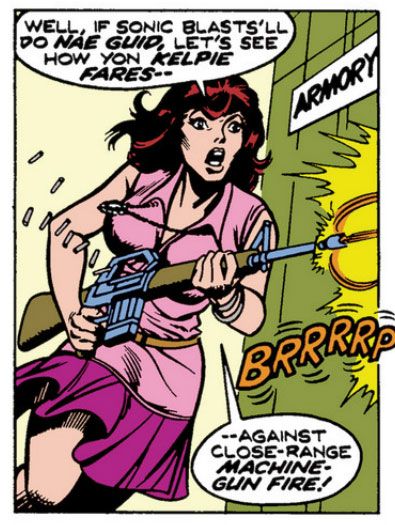
She does what none of those highly-trained military dudes at our Valhalla Mountain NORAD command could manage in X-Men #94, firing from the hip, no less!  And all at once we have an exciting addition to the cast and we know never to mess with her.

Tuesday, September 24, 2013

X-Men #94: Nefarious Nefaria and how he blew a fortune

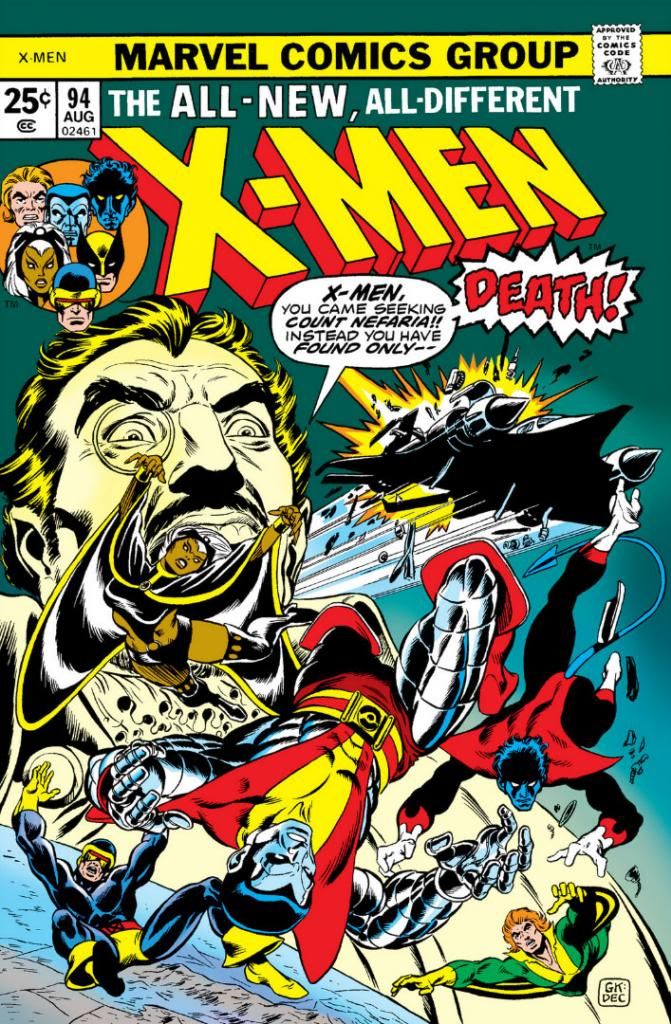
X-Men #94 (August 1975) was the first X-comic I owned.  A friend's mother worked for a regional magazine distributor and he got the leftovers.  This kid had piles of comics in his room, but he kept the X-Men issues in a cabinet in the living room for whatever reason.  Probably anti-mutant bigotry on his part.  After all these years I can't remember why he decided to sell some comics to me that day, nor can I remember why I wanted to buy them.  I liked comics, knew the difference between Jack Kirby and Alex Toth, loved Joe Kubert's art and had already discovered Al Williamson.  I just don't remember being comics crazy, but I was a junior high sequential art connoisseur of sorts because I loved drawing.

So years later, I'm going to claim it was the Gil Kane/Dave Cockrum cover that caught my fancy.  Even now, this cover impresses with its high (literally) drama and contorted heroes hurtling earthward to their deaths.  Well, except for Banshee, who seems to be flying to the rescue.  Poor Storm has completely forgotten she knows how to ride the winds-- and note Wolverine and Thunderbird don't even rate appearances!  Even without those two adding to the excitement, it looks kind of like Count Nefaria (the guy with the giant white head) is barfing mutants.  That characteristic Kane up-the-spout shot of Nefaria's face influenced the heck out of me for the next few years and I drew noses from that angle blacked in so I wouldn't have to work out the difficult low-angled perspective of the various nasal planes.  It seemed an elegantly simple solution to a drawing problem that had me stumped.  And you absolutely cannot beat the energy of Colossus in the foreground, boldly sporting primary colors of red and yellow.  Barfed or falling, that figure practically bursts from the picture plane and lands in your lap.  I probably bought the comics because I wanted to draw this particular cover.  I still do.  Good gravy, I love me some Gil Kane! 

My friend and I worked out a little deal where I paid him all the money I had in my pocket with a promise for more.  I think the original deal was supposed to be twenty bucks for a stack of books that, amazingly (or uncannily, if you will) included the first five or six issues of the "All-New, All-Different" X-Men.  In the end, I forked over a grand total of fourteen dollars and  the use of my left-handed baseball glove in P.E. a couple of weeks later.  By the time my pal and I completed the transaction on that long-ago spring day, I was in completely in goo-goo-ga-ga love with comic books in general and X-Men in particular.
 
Enough biography.  Let's read!

"The Doomsmith Scenario" introduces us to a man who has access to a matter transporter (maybe he invented it; the story never says where it comes from) and has also used some kind of genetic technology to mutate humans into anthropomorphic animal weirdos (which, admittedly, is a process that has fewer immediately-apparent practical applications).  Rather than launch a second Industrial Revolution by transforming the travel, transportation and medical industries and reaping billions, if not trillions, in ongoing profits, all he can think to do with this technology is invade a military base to hold the world hostage for a one-time payoff.  Granted, that involves each nation paying as much as it's capable, but it's still taking a huge risk versus a guarantee of unprecedented wealth if he just patents his tech and sells, sells, sells.


His name is Count Nefaria, and he is one of the most visually boring antagonists I’ve ever seen.  I believe these days he's some kind of immortal energy being, but when this book hit the spinner racks, Nefaria was just a goateed twerp in a suit with a ruffled shirt and evening cloak, a second-rate Bela Lugosi impersonator.  Off-the-rack, ready-to-wear, one-size-fits-all villainy.  His name essentially means Count Bad Guy, just to further illustrate how little effort went into his creation.  We can argue that dumb names are a hallmark of ol' Marvel.  I certainly will... Doctor Doom.  But to look at the magnificent Doom is to understand Nefaria's generic quality.  The Avengers dealt with the Count in #13 (February 1965) of their own book-- the synopsis of which makes the story seem completely interchangeable with just about any found in other Marvel team titles of the era-- and the unfortunate X-Men get stuck with him in the first regular issue of their revamped title. 

Our kid Nefaria and his Ani-Men invade Valhalla Mountain, home of NORAD’s super-sensitive defense center.  Despite looking like refugees from a line of He-Man knock-off toys, the Ani-Morphs or Ani-Men (one of whom is female, by the way) quickly subdue thousands of armed soldiers and military police who don’t simply shoot them on sight. 

The Ani-Men have the advantage of surprise for a few minutes, plus they're fast and strong.  That's more than enough to defeat the first bunch of uniformed slackers.   After that the entire base is on alert, yet the troops commit themselves piecemeal and not one soldier or airman gets off a shot despite being armed to the hilt.  They don't even try to shoot.  They must have been trained to use their rifles as clubs, and badly at that.  After this inexplicably incompetent response by our armed forces, Nefaria gasses everyone else to sleep.  It's just that easy for our tuxedo-wearing criminal genius.  I understand that in 1975, our armed forces were doing some serious soul-searching as the country emerged from the prolonged humiliation of the Vietnam War, but even the Mayaguez incident had a more satisfying military conclusion than this Nefaria deal. 

Of course, if we closed this plot hole we'd have a five page story where the X-Men watch a news report about a strange incident where Nefaria and the Ani-Men died in a hail of gunfire, and the rest of the comic would consist of pre-Thor Journey Into Mystery reprints.  That would never do, so the men and women guarding the United States' most important and secure military installation allow themselves to get their asses handed to them and, with the Avengers conveniently shelved, it’s up to our new X-Men to fly in and try to save the world.

Which they eventually do, but not before Cyclops spends an entire night roaming the halls of the mansion and bellowing his despair to the world, the original X-Men say a tear-filled farewell and a training montage where Thunderbird injures himself and Cyclops plays drill sergeant.  Since Chris Claremont takes a little time in his dialogue and thought-balloons to give both men clear motivations for what they do and how they act (Thunderbird is insecure, Cyclops is seasoned professional who has seen too many deaths and injuries in his time), the conflict between them works better than the seemingly random arguments that plagued Giant Size X-Men #1, where characters sniped at each other on practically every page and with no good reason.  It also pays major dividends in X-Men #95, but that’s a story for another day.

Penciller Dave Cockrum already had experience with group books, having worked on stories featuring the Legion of Superheroes in Superboy over at DC, and he co-created Nightcrawler, Storm and Colossus for this book.  Oh, and he drew the aforementioned Giant Size.  You'd imagine drawing a living island would tax a guy's creative faculties.  Not Cockrum's.  And here?  Wow, the man just absolutely cuts loose.  He must have wrecked his drawing hand filling panels with detailed backgrounds-- his Valhalla features a gargantuan situation room with elevated walkways between digital maps that must be hundreds of feet high to judge by the teensy-tiny antlike figures teeming all over. 

I remember being especially impressed by the training sequence and a collage-like one-page panel centered around Cyclops’s giant shouting head.  I copied that head line-for-line on notebook paper dozens of times over the next few years, always hoping to glean those Cockrum art secrets.  With the fine-lined inking of Bob McLeod giving the figures a bit of roundness and generally introducing a little bit of a Neal Adams-vibe, Cockrum's dynamic art dazzles.  It's pretty.  I mean, X-Men #94 has some of the prettiest art of its era.  I look at it and I feel joy.

Part of that joy comes from the absurdity of it all.  The first half of this book tends towards the talky, which leads to what I think of as a very fun kind of dissonance, like having a company of acrobats in spangled costumes perform Arthur Miller.  At one point, angry Japanese hero Sunfire scolds Professor X starting in the X-Mansion living room, but concludes his rant thousands of feet in the air above it.  All alone.  Well, the Professor is a telepath, so he probably read Sunfire's thoughts or something.  When Dave Cockrum provides the acrobats at least you’re getting a primo Cirque du Soleil version of Death of a Salesman.  Come to think of it, I’d pay good money to see that.

Since these are by far the best and most entertaining parts of the book, I kind of get the idea Chris Claremont would have been content to have his characters actually hang out around the mansion and watch Nefaria die a pathetic death on television while carrying on various conversations about their feelings and why they're sticking with Professor X.  Cyclops may look a little ridiculous expressing his essential dilemma, but at least Claremont gives him one.  All these years later, it's easy (and fun!) to parody Chris Claremont's more precious elements (many have, including this blogger) which would eventually overwhelm the book, but the man knew how to invest his audience in the characters and their dilemmas in a way that obsessed readers as never before.  When I was 14 years old, I was more emotionally involved in Kitty Pryde and Dani Moonstar than I was in the flesh-and-blood kids of the same age surrounding me at school, and Claremont made it good to feel that way.

But oh yeah-- superheroics!  Let's get back to Count Nekot Wafer.  After the tearful goodbyes and character-building, the X-Men finally get the call to action.  With almost all the pages already used up, the story ends on a cliffhanger, the X-Men falling to their apparent deaths as the result of a “sonic disrupter” Count Nefaria finds in Valhalla’s arsenal.  A sonic disrupter is a magical death ray that can disintegrate a supersonic aircraft but leave its passengers intact.  Pretty selective!  And yet we had to settle for a tie in Southeast Asia.

You can’t tell me any country that can produce a weapon like that and surround it with thousands of armed troops is going to tumble its nuclear warfare nerve center to a ragtag group even Dr. Moreau would discard as failures.  Then again, what is Marvel paying all its mutants for?  We’ve got the colorful suits, we’ve got Colossus and Storm and Wolverine.  Might as well use ‘em!

Friday, September 20, 2013

Let's take a fond look back at Soviet-style collective farming with our pal, Piotr Nikolaievitch Rasputin

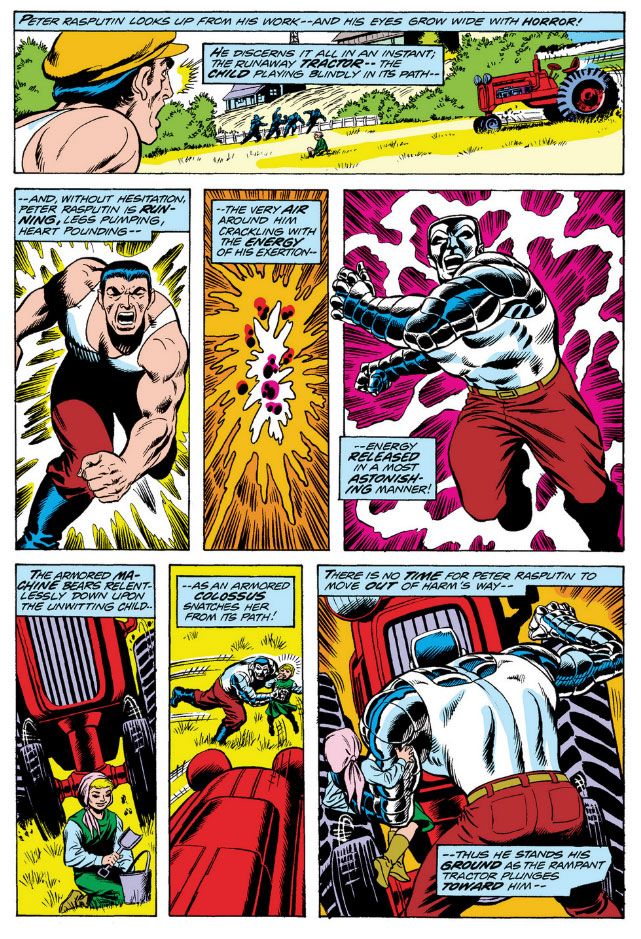
I'm sure many of you out there in Comic Book Land wax nostalgic for the glory years of the Union of Soviet Socialist Republics and its socialist paradise.  From 1920s to the Soviet Union's dissolution in 1991, agriculture there took place on kolkhoz, or farming collectives.  And it was on one of these collectives a true hero of labor was born and lived his early years.  His name is Piotr Nikolaievitch Rasputin, but he is better known under his revolutionary nom de guerre, Colossus.


Piotr Nikolaievitch was born on the Ust-Ordynski collective farm in Siberia.  At some point in his early teens he manifested an unusual power-- he could transmute his flesh to living metal, increasing his strength to that of one hundred Stakhanovites.  Soon the young man began producing several times his daily quota, which benefited his comrades and the state greatly.  And it was there in the beautiful wheat fields of his motherland Piotr Nikolaievitch attracted the attention of noted capitalist psychic Professor Charles Xavier, who, as leader of a team of superheroes and despite his counter-revolutionary upbringing, had become something of a champion of collectivism (albeit allowing his charges to sport outlandish, individualistic garb).  The Professor appealed to young Piotr's desire to learn to harness his powers in the interest of the workers of the world.  And so it was the strapping lad left the farm and dared the decadent West.

 
The state began collectivizing agriculture with the First Five-Year Plan, which called for the organization of 20 percent of arable land into collectives.  The Central Committee decided in 1930 to extend this to most of the country's grain-producing areas.  Stalin took a hand with his Urals-Siberian Method, which essentially forced the farming people of those regions to surrender their grain to the state.  Stalin's civil servants also seized farm equipment and livestock, their slogan being "Eliminate the kulaks as a class!"  The peasantry resisted.  A kind of civil war erupted, with peasants killing livestock rather than surrender it, but forty years later in Giant Size X-Men #1 (May 1975), written by Len Wein and illustrated by Dave Cockrum,  readers find the Rasputins living a Spartan yet idyllic existence.  By then Nikita Khruschev had denounced Stalin himself in his famous 1954 "Secret Speech" to the Communist Party's Twentieth Congress, the Cuban Missile Crisis had come and gone, also Czechoslovakia, the Vietnam War and the world relaxed a little bit during the thaw era under presidents Richard M. Nixon and Gerald Ford.  The time was right for a nice boy like Piotr to leave the collective and make his mark in American superhero funnybooks.
 
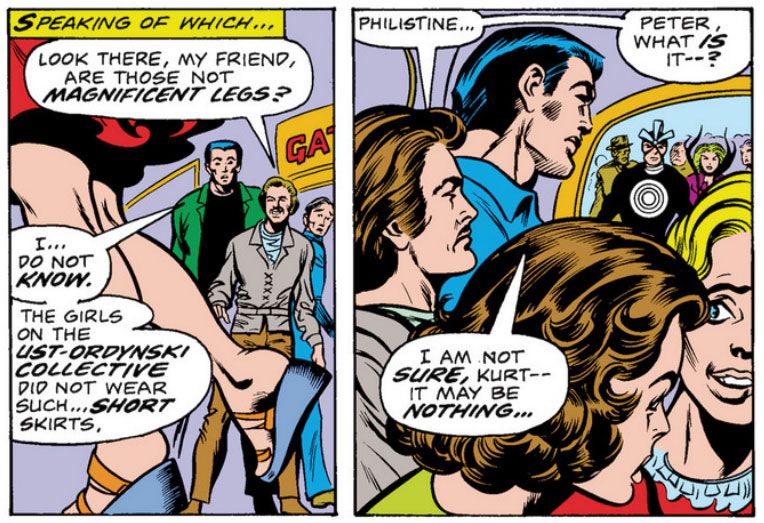
Compared to previous comic book portrayals of communist countries as Orwellian nightmare realms, this new view startles in its National Geographic picturesqueness.  Whether in the west or inside the communist sphere, farming remains a dangerous business, however, and Wein presents a convenient tractor accident by way of demonstrating Colossus' powers.  The raw, farmboy version of Colossus comes across as kind of a Soviet Li'l Abner in his first appearance and again in X-Men 97 (February 1976) where he and his pal Nightcrawler-- who at this point in his character history uses an "image inducer" to disguise his natural blue-furred appearance-- engage in a little girl-watching.  Chris Claremont provides a little fish-out-of-water humor, which artist Cockrum emphasizes with a perfectly chosen "camera" angle.
 
 
It's more a cultural moment rather than a political one.  Claremont doesn't have Colossus denounce western immorality.  Rather, Claremont has the lad make it more personal level, as a young man who has lived a very sheltered sort of existence-- not much different than some guy from a ranch in Montana, for example-- encountering a flash of skin for the first time.  Colossus isn't sure of it, but he's learning. 
 
Colossus' home country lasted just over a quarter century more before its economic and political systems could no longer sustain themselves.  At that point, the USSR collapsed and divided itself into independent nations.  The Cold War had ended, leaving the world with ever-more complex and confusing struggles, but these vintage X-Men comics capture a moment in geopolitical history when two vast powers with ostensibly opposite philosophies faced off through diplomacy and proxy wars across the globe, but the comic book creators from the English-speaking one were willing to humanize the foe and add nuance to their portrayals of our differences.
 
A few years before Piotr Nikolaievitch would more than likely have been a member of some commie bunch of X-Men counterparts the home team would fight to prevent some kind of moon shot sabotage or balance-of-power altering assassination.  Star Trek's Pavel Chekov prefigures Colossus' positive portrayal (even as the show's Klingons exploited the old commie/Cossack/Mongol horde tropes), but during the Seventies and before the Soviet invasion of Afghanistan and the "Evil Empire" rhetoric of the Ronald Reagan administration, Wein and Claremont present their metal-skinned hero as a decent kid.  Chris Claremont would later reveal Colossus as a talented painter in his own right, a nice contrast to the character's hulking appearance and job as team muscle, fully rounding-out Marvel's favorite Red.  His question to Professor X about whether or not his powers should belong to the state shows Colossus is very much a product of his system, but he's basically good-hearted and kind.  Sort of like the submarine crewmembers from Norman Jewison's 1966 comedy The Russians Are Coming, the Russians Are Coming!
 
Once the regular series starts, Colossus doesn't spend a lot of time trying vainly to re-educate his teammates with Leninist dialectics.  Or any at all, if I remember correctly.  The only time his politics really come to the forefront is in The Uncanny X-Men #123 and 124 (July and August 1979).  During a battle with Arcade a mind-controlled Colossus turns into exactly the kind of stereotype Wein and Claremont so carefully avoided-- the Proletarian.  It's a powerful switch, and with it Claremont gives us a satirical taste of the stuff Marvel printed in the 1950s, when Captain America wasn't frozen in ice but actively combating the International Communist Conspiracy and possibly flouridation of water, as well.
 
Since superhero comic book characters age very slowly (if at all), and because I've long since given up following current continuity, I'm not sure how Marvel handled the Soviet Union's dissolution.  The most recent X-Men story I've read-- the Joss Whedon run-- didn't address it at all.  Colossus was just there, as apolitical as he'd always been.  It seems unlikely a guy like Colossus, who was in his late teens when he first appeared and must only be in his twenties or early thirties now, could possibly have grown up under communist rule on a collective farm.  Maybe he's just a simple Siberian farm boy without the political ramifications.  Maybe he always was.

Monday, September 16, 2013

News you can possibly use...

Hello, sports fans!  I mean, comic book fans!  I haven't gone away.  I'm just very busy at work making tests for my students.  Yes, I'm the bald psychic mentor of a group of teens with special powers.  They wear uniforms and work very hard.  What are their powers?  Some can speak English.  Some are very good at sports.  A few can make strange sounds that echo throughout the school.  They're not ready to save the world just yet, but give them time.

In case you're interested, here's what's up at When Comic Books Ruled the Earth.  I'm working on three big posts about the X-Men, communism and Lonnie Loomis.  We're going to have a two-part guest essay coming up soon, and I'm very excited about that.  I hope you are, too.  For now, let's--

What's that?  Cerebro has detected a doughnut in the school cafeteria.  TO ME, MY X-MEN!  AND BRING ME MY WALLET!

Thursday, March 7, 2013

X-Men #12: Kirby and Toth, two great tastes that don't taste great together!


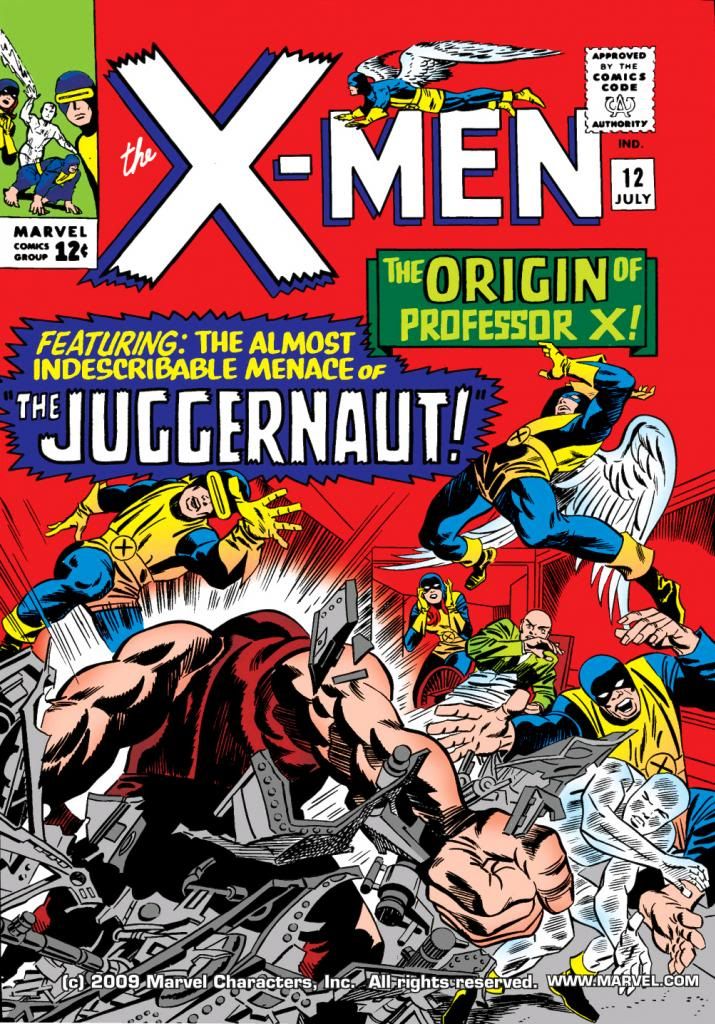
Jack Kirby and Alex Toth are tops of the pops as far as I’m concerned.  When I found out Alex Toth penciled X-Men #12 (July 1965), I had to track it down.  When I read he did this over Kirby layouts, I grew a little concerned.

You know, the two artists had almost diametrically opposed approaches to the page.  Toth practiced an elegant minimalism, with poses largely naturalistic.  Heavy black-spotting, cinematic.  Kirby drew in a more expressionistic way, his figures displaying emotions and actions at their most extreme.  Statue-like figures surrounded by crackling force fields and radiating forces, as if their struggles produce an energy that threatens to consume the paper they’re printed on.  

But then I thought, why not combine Toth and Kirby?  This kind of artistic dissonance can produce in collaboration an energy of its own, like unstable two radioactive molecules exchanging electrons and we get an artistic nuclear reaction producing a startling, never-before-thought-of beauty.  Or, in this case, X-Men #12, a comic book China syndrome.  A Three Mile Island in print.

Flash back to 1965.  Stan Lee, always on the hunt for artists (a number of DC regulars did Marvel jobs under assumed names back then), gave Alex Toth a call-- or mailed him a letter for all I know-- and offered him an issue of X-Men.  I'm no comic book historian, but I think Kirby was spread pretty thin at this point and dropping X-Men to concentrate on Marvel's better-selling titles.  But as to why Lee would offer this particular book to Toth in particular-- well, that's for people who know more about the inner workings at the House of Ideas.  Suffice it to say, Lee offered and Toth accepted.

So far, so good.  As so many other artists had to at Marvel, Toth went to work on pages previously laid out by Kirby, the creator of the Marvel house style.  Maybe this was meant to smooth the art transition for the readers.  Maybe Toth asked for this arrangement himself.  After all, he was used to working from full scripts, not from Stan Lee posing on his desk.  To make sure Toth's work became fully Marvel-ized, Lee then assigned inker Vince Colletta, a frequent Kirby collaborator, to...


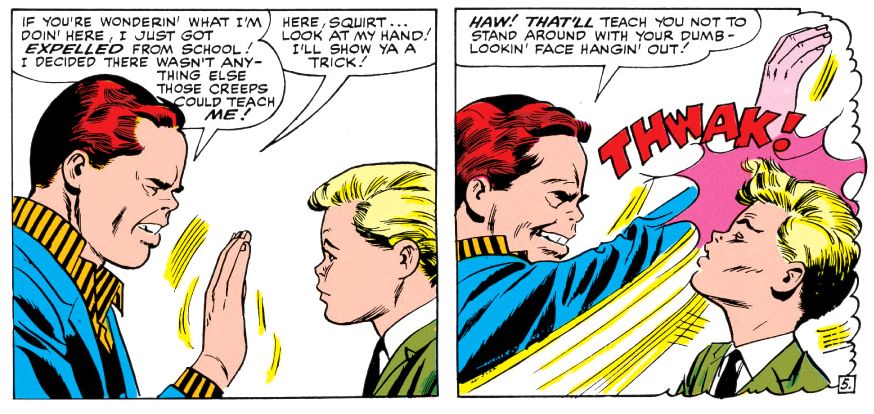
"Fix" isn't quite the word for what Colletta did.  While Colletta certainly has his shortcomings-- a cursory Google search will come up with ample listings of them, especially in conjunction with his inks on Kirby-- nowhere are they more on display than in this ham-fisted job on top of Toth pencils.  Gone are the smooth, graceful lines of Toth and instead, we find crinkly, crabby scrawlings, wonky faces and malformed hands galore, plus trange interpretations of light and shadow that show Colletta wasn't quite sure of what Toth was getting at.  Toth was known for drawing handsome men and beautiful women.  Kirby drew them as powerhouses seemingly carved from stone or molded from steel.  The mutants on display in this book are the kind you find preserved in alcohol in dark closets in abandoned madhouses.


Joe Sinnott might have salvaged this job with his slick line, confident black-spotting and willingness actually to draw with ink and fix proportions, but it's pretty obvious Colletta just isn't up to the task.  Check this out:


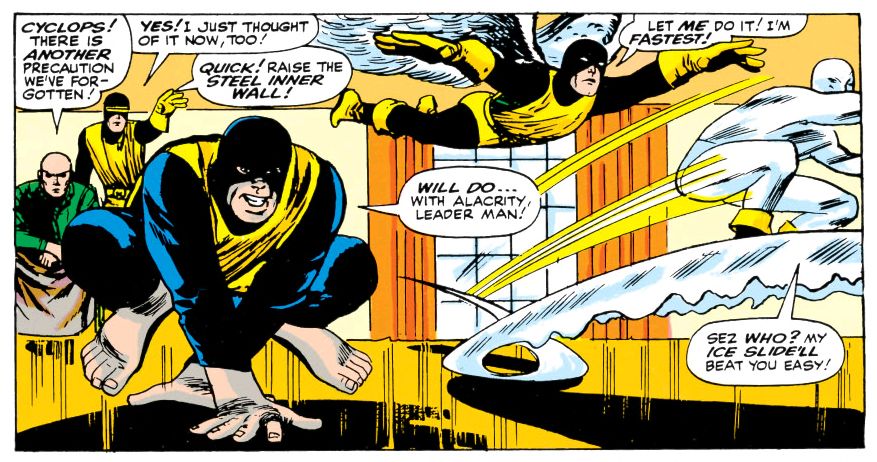
Lumpy Rutherford-- NOOOO!!!  This looks like the worst comic book adaptation of a secret Leave it to Beaver episode ever.  That red-haired jerk is Cain Marko, Charles Xavier's step-brother.  They don't get along, as you can see.  While Cain has a pert Toth-style nose, his hand looks like someone shoved sausages into a latex glove.  That's neither a Toth hand nor a Kirby hand-- it's a hand no one bothered to finish drawing.

In Colletta's defense, I really doubt Toth gave him all that much to work with.  They'd team together again at DC on Hot Wheels with much better results-- although Toth might dispute that if he were still around.  The difference there might have been Toth being more engaged with the material than he is here and unencumbered by another artist's layouts.

Anyway, a few panels in this book look very Tothian, as if he took his time to really shape the image, but for whatever reason, throughout most of this book Toth appears to have largely traced Kirby's figures without adapting them to his own naturalistic proportions and scale.  While he uses a lot of those parallel ray bursts that make the characters look as though they're exploding with strange energy-- but never seems to have reconciled the Kirby approach to these kind of abstracted effects with his own minimalism and Colletta spent about two seconds puzzling them out before slapping down the ink.  There's also a chance Toth might not have drawn any of these effects and Lee, dissatisfied with too much negative space in the panels, either added those lines himself or had someone in the art department do it.

Here's another unfinished hand:


Another problem is the color reconstruction is lousy.  This comic was never meant to be printed on slick, glossy paper with modern line-screens.  Despite a growing serious fandom and popularity on college campuses and with the heads, comics in the mid-60s were still disposable rags printed on the cheapest paper.  Lee, Kirby, Toth and Colletta all knew this.  This didn't necessarily mean they hacked it out without a care, although X-Men #12 seems to stink of that.  It just means they were under no illusions of creating something of lasting impact.  They weren't dreaming history here or anticipating bloggers deconstructing every aspect of every panel on one page out of the hundreds they touched that month.  They were working to support families or pay alimony and they knew, as professionals, how to get the most out of the shoddy materials they had to work with in the time allotted-- they didn't have the luxury of blowing deadlines like superstar artists of today do-- so the end result, there on the newsstand, would be attractive enough to tempt readers into spending their twelve cents.

People didn't preserve the original artwork-- they had paste-up jobs done on them with glue that soon yellowed or browned, people used old pages to clean brushes or tossed them in files and later shredded them when the company needed more space.  I've seen some pages from this job for sale online, but I doubt Marvel spent the money necessary for full access to them in order to start from scratch.  What's more likely is they scanned decent printed copies, then used Photoshop to eliminate as much of the colors and old-timey fat line-screens-- a process which also takes away the edges of the black areas and a lot of the fine line work.  And, in the case of Colletta, serving to make an already sketchy line quality even sketchier.  Re-colored then printed slickly, or blown up on Comixology (which is where I read this), all the original flaws become glaring and a lot of new ones show up as well.

In this case, there are pages where Cain Marko's face appears a bizarre pink as if he's suffering from extreme embarrassment or some kind of disfiguring rash.  Poor guy. No wonder he went mad with power when he found the Cyttorak Ruby.


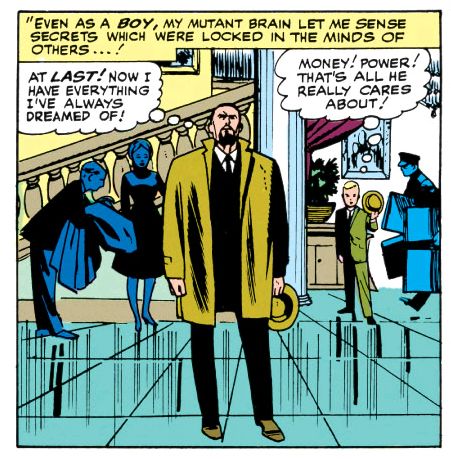
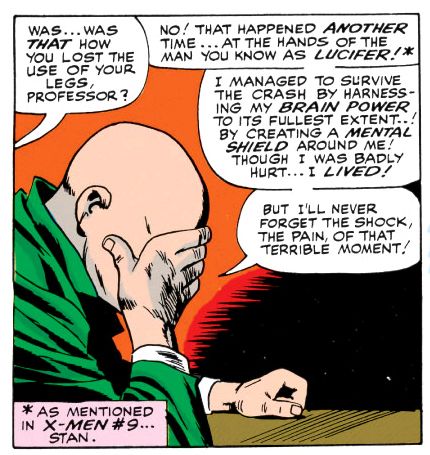
What I don't understand is why Toth took this job in the first place.  If Lee wasn't shy about expressing his artistic opinions, Toth was the original let 'em have it guy.  He must have looked at these layouts and thought, "Oh balls!"  Plus, Xavier's backstory is cliched and melodramatic (although these guys make a pretty good case for it even while pointing out Stan Lee's apparent difficulty with psychic terminology).  It's rather talky for a book so packed with characters, too.  And, as part one of two, it's all build-up and no climax.

Toth liked to draw airplanes and cars and he was aces on period pieces.  Portions of this story take place in flashback, but there's nothing setting it in any particular era visually, and just one sequence featuring a car that looks pretty contemporary to me, a mid-60s model in a scene that takes place sometime in the 1940s.  Toth preferred classic Errol Flynn-style swashbuckling heroism, but there's not a single sword-fight anywhere in this story.

My best guess is the Warren and DC jobs weren't coming frequently enough and publishers like Dell didn't pay high enough a page rate, so he gave Marvel a shot in hopes of picking up some much-needed money.   I don't know.  Who can fathom genius, especially one as mercurial as Alex Toth?

He must have had his reasons because here's Toth working over Kirby layouts.  It's not as if Toth never drew superheroes-- we have a classic Flash and Atom team-up from the year before which cuts X-Men #12 to shreds, a run on Black Canary and an often-reprinted Batman story, plus some other gems scattered throughout his bibiography.  This should have been one of those.


Anyway, if the lack of any other Toth Marvel work is any indication, Stan Lee wasn't too pleased with the outcome of his little science experiment.  Werner Roth would pencil part two, similarly working over Kirby lay-outs with happier results, as "Jay Gavin" before becoming the regular penciller under his own name.  Toth would go on to do sterling work in Warren's Blazing Combat, and for DC's horror and war titles in the 70s, but never again would he draw Marvel's heroes for comic books.  For TV, yeah.  A couple of years later, he did designs for Hanna-Barbera's Fantastic Four cartoon.  But we never got to see Toth's take on The Avengers or Doctor Strange.  I, for one, would have loved to have read a Toth Amazing Spider-Man or Daredevil.  I can't help but think if Lee had just trusted Toth to do his thing-- the way he seems to have let Gene Colan-- and come up with a plot playing to his strengths rather than trying to merge him with Kirby, we might have had a stand-out issue, an oddity nonetheless, but something really special.  Maybe it wouldn't have sold, though.  Whatever else you can say about Lee, the man knew how to move books.

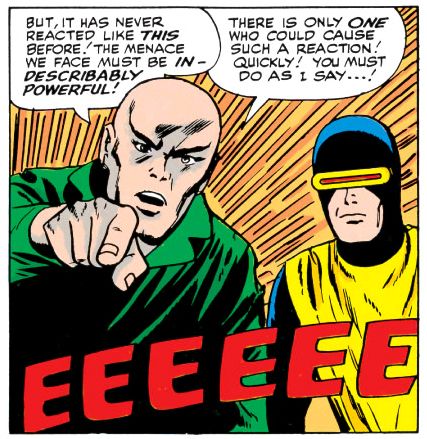
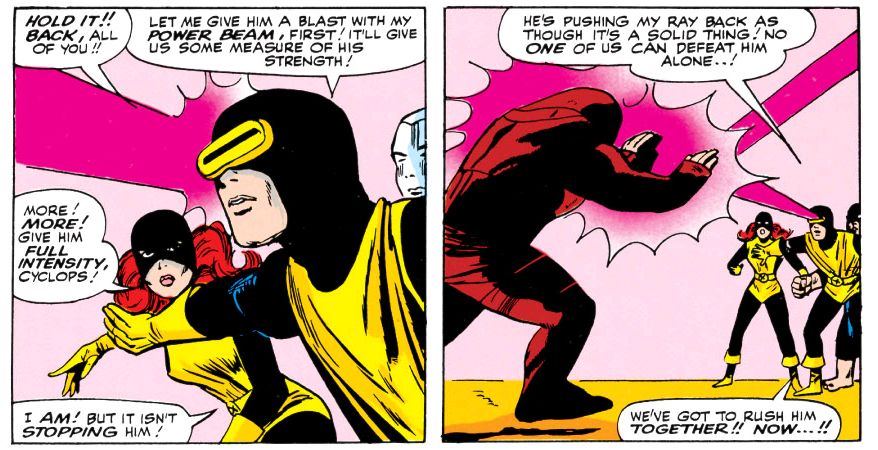
Now if someone can explain to me why Cyclops's famous ruby-red eye beam is magenta.

Thursday, August 30, 2012

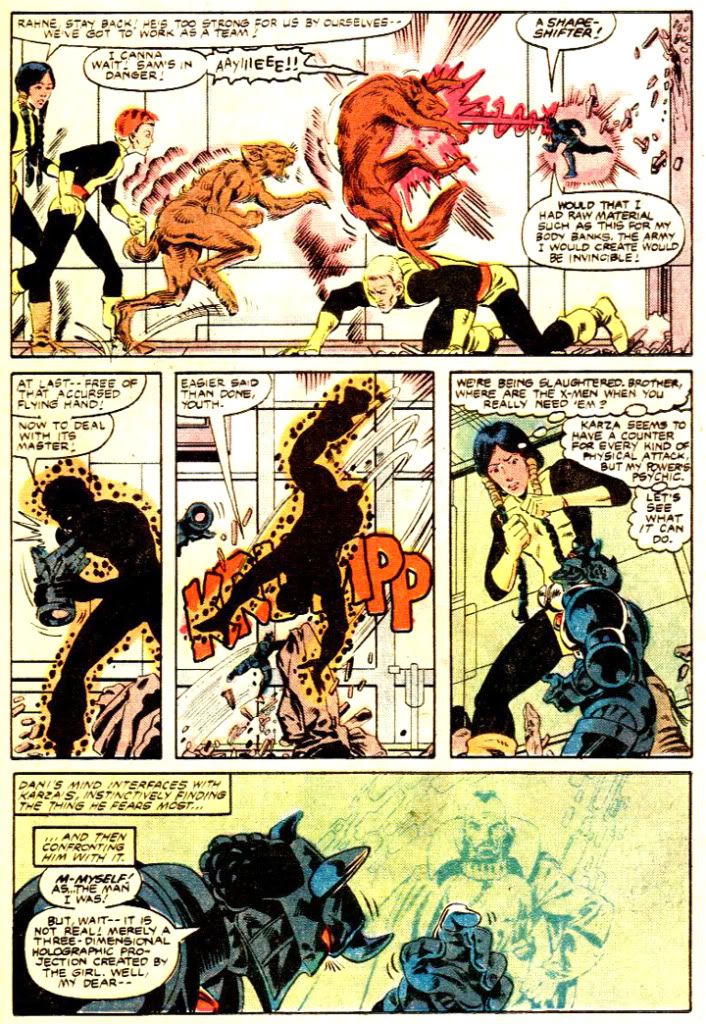
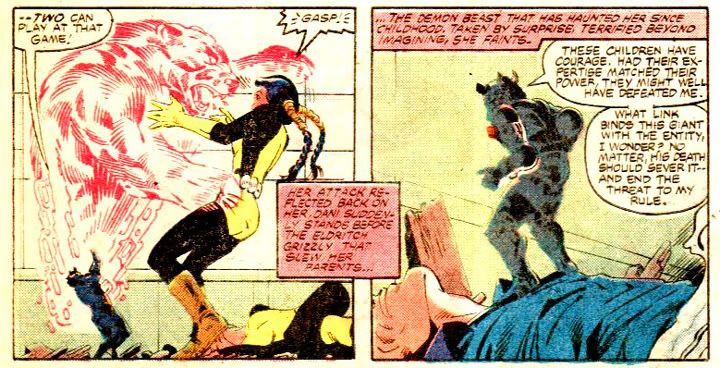
Dani Moonstar and Baron Karza. I take care of both of 'em, which ain't easy, 'cuz when they met... it was moider!
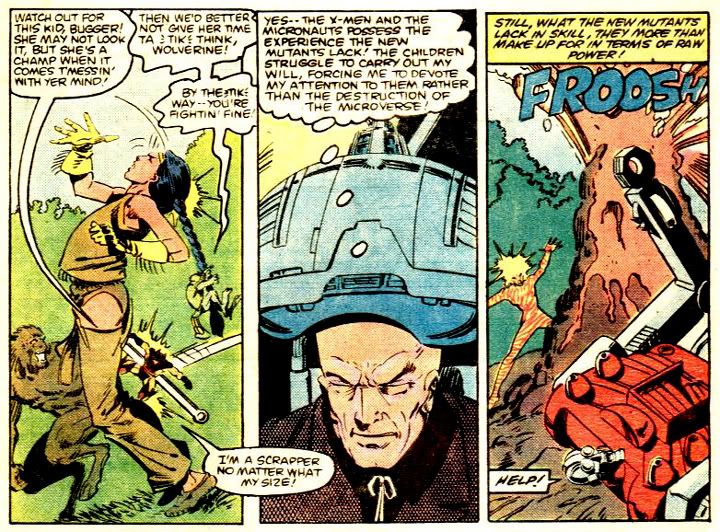
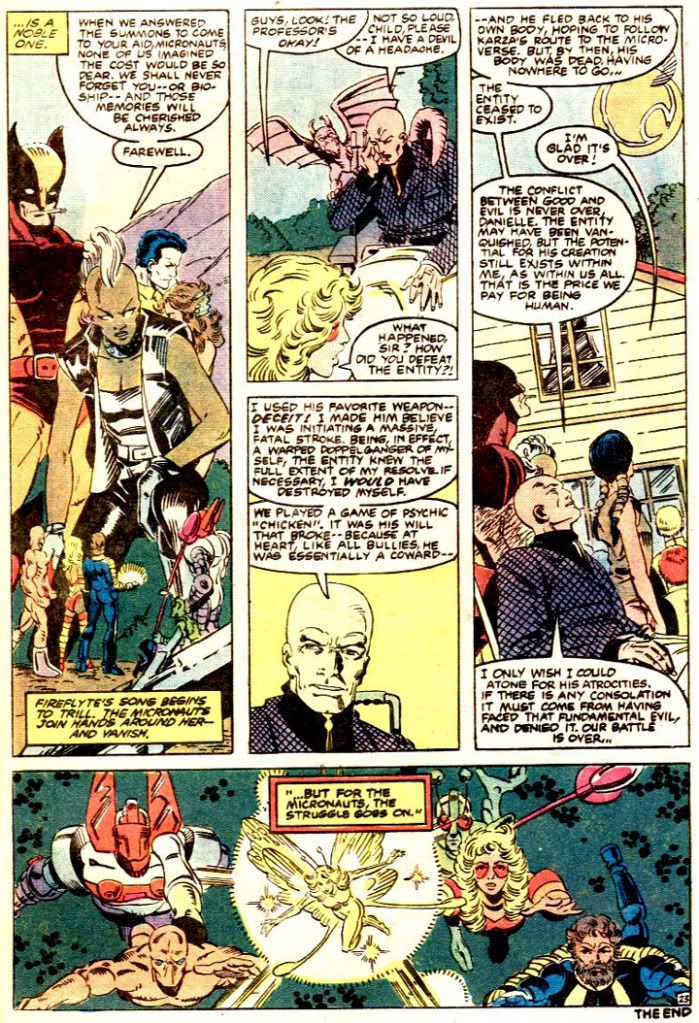
For a moment, I had hope...
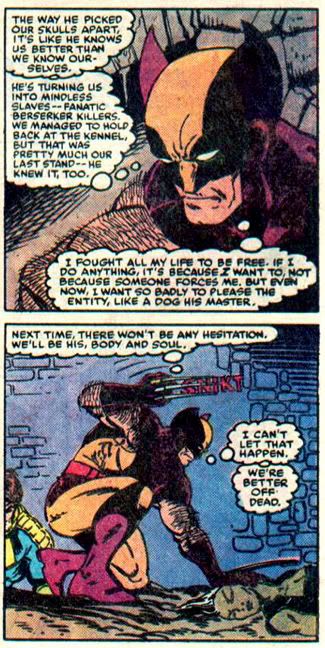
You'd probably expect something called The X-Men and the Micronauts (January-April 1984) to be a light romp, a bit on the silly side. After all, one group is known for its various underage members while the other is based on a toy line.  You'd also expect with Chris Claremont and Bill Mantlo handling the script it'd be a worthy reflection of their considerable writing talents.  Wrong, wrong and wrong.  It's a queasy slog through some fetishy set-pieces before it finally devolves into a ludicrous mess.

It starts pleasantly enough, with space opera.  Who doesn't love space opera?  The Micronauts lead a lot of clunky-looking spaceships into battle with an unknown invader with a starfleet of his own.  It turns out this mysterious enemy is so terrible our familiar characters, the Micronauts, have even joined forces with their recurring nemesis, Baron Karza.  Karza is a deposed tyrant, a mass-murderer, a thief of bodies and souls.  That his lifelong enemies have teamed up with him-- he's the lesser of two evils-- shows just how nasty a foe this mysterious invader truly is.

I truly did.
Who is this nefarious being, so terrible he causes the Micronauts to compromise years of anti-Karza activism?  The Entity.  With a name like the Entity you wonder why his parents didn't just call him the Being or the Guy.  No, he's the Entity and what the Entity is, is a maniacal mesomorph in a golden gladiator helmet.  He wreaks all this havoc simply because he gets off on it.  Not metaphorically, or in the sense he enjoys causing trouble for its own sake.  It sexually arouses him.  His male member becomes rigid.

Start with Storm.  Of course.
We know this because if there's one thing the Entity enjoys as much as destroying and enslaving, it's talking about destroying and enslaving.  He captures the Micronauts with ludicrous ease and straps them to rocks so he can tell them all about himself, his plans, and his desires.  He's like a celebrity who gives interviews where he can't shut up about his sexual encounters.  The Entity is so lascivious with his captive audience he doesn't stop blabbing about this stuff even when he finally notices Baron Karza.  Karza, being smarter than the Micronauts, takes that as his cue to get the hell out of Dodge.  He jumps in the Bioship, a living robot/spaceship and escapes.

Cut to... Earth.  It's the X-Mansion in Westchester, NY, and the X-Men are lounging about in various states of undress.  Storm poses in a bikini, Nightcrawler juggles because he's an ex-circus performer and Kitty Pryde complains about having to study while wearing only a top and a body suit.  Professor X and the New Mutants are hard at work in the Danger Room when Baron Karza pops in to say hello and borrow a cup of underwear.

That's when Dani Moonstar, with her new codename "Spellbinder," uses her powers on Karza and for her trouble gets beaten up by a toy.  Actually, her entire team loses to teensy-tiny Karza.  I know Karza is practically all-powerful within the framework of this narrative, but the sight of a miniscule figure manhandling normal sized teenagers illustrated in a semi-realistic/slightly heroically-exaggerated style is absolutely hilarious.  At this point you can almost forget the villain's motivation isn't anything so prosaic as conquest or revenge but sexual perversion.  Almost.  It's going to be rubbed in your face later, and considering the Entity's tastes in fun, if he had his way that would be literal.  He would literally rub his genitals in your face.  He no doubt does this to several of the characters in this story at various off-screen moments.

Like a mid-90s chatroom.
Where were we?  Oh yeah...  Karza beats up the New Mutants, fights the fully-grown X-Men to a stalemate, then switches bodies with Kitty Pryde for some reason.  Since he has mental powers enough to control both bodies, he keeps it a secret and Kitty spends most of the following three issues of The X-Men and the Micronauts being puppeted around by an evil dictator from another dimension.  Their personalities start to merge, too, so that Kitty slowly begins to enjoy acting out ruthlessly from inside her black armored prison and Karza, in her body, learns to say things like, "He has a point, Storm.  I... am kinda scared."

It turns out the Entity isn't just some sadistic cosmic outsider come to subjugate both super-teams for concupiscent kicks (thanks, Wallace Stevens).  He's the "evil side" of good ol' Professor X.  Not only is this convenient for involving the ever-popular X-Men in the story, but also Professor X's evil side likes to involve everyone around him in bondage scenarios.

When the idiotic interrupts the disturbing.
In the third issue, we get to see bearded, beefy Commander Rann simper before being killed and resurrected, then stammering, "T-thank you, Father!  I-I'll be good from now on!" while the Entity playfully strokes the poor bastard's chin.  Later in the same issue, Wolverine, in despair at being subjugated so thoroughly and comparing himself to an eager-to-please dog, attempts to murder his teammates then commit suicide as a means of escape.  And if Wolverine hasn't already made the point, formerly proud warrior-king Acroyear falls to his knees and details his similarly ambivalent reaction to complete emasculation while tears stream down his face.  I mean, if you love the idea of mind-controlled heroes fully aware of their debasement and endless pages of them bemoaning it as entertainment, then you’ve come to the right comic.  Okay, we get the point mind control is kind of invasive.  But the book drubs you with this concept to the point where it goes past that mark only to circle around to where the story really seems to be reveling in it.  I just wanted to read about the time Dani Moonstar fought a toy.  Have a few laughs with a little light-hearted entertainment.

But allow me share with you the two most magical moments of all.  

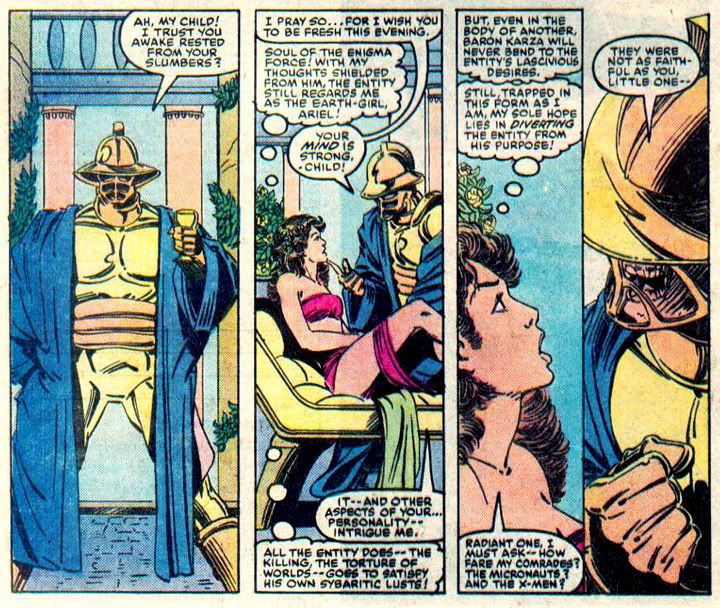
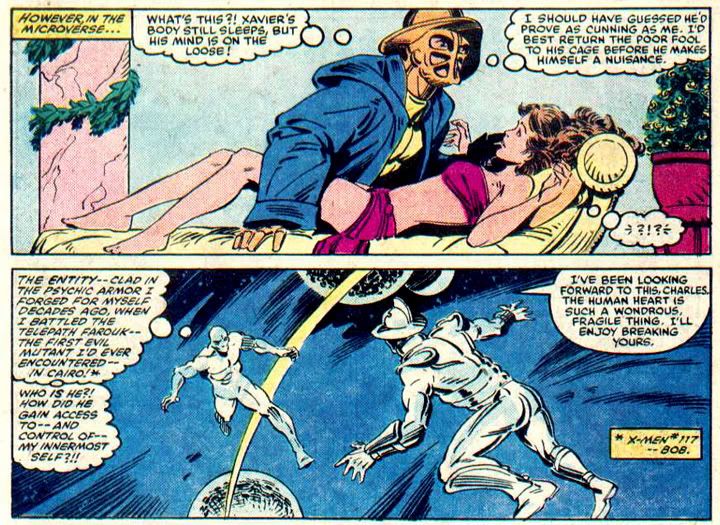
Halfway through this issue (wittily entitled "Mine Eyes Have Seen the Glory!"), the Entity, after having dressed Kitty Pryde in some kind of chiffony harem girl outfit, attempts to seduce her.  He's even wearing a Hugh Hefner-style robe over his armor and has a snifter of fine liquor.  Courvoisier, perhaps?  Doesn't bother to take his helmet off, though.  I suppose knowing it’s Baron Karza’s thousand year old consciousness inside Kitty’s underage body makes it slightly less creepy—until you once again face the fact that the Entity is the dark id of her trusted mentor and teacher and thinks he's about to score with a teen.  This takes the power exchange to a new level of wrongness—really, you have to wonder just what the hell was going through the writers’ heads when they scripted this—because here, revealed for all to see, are Professor X’s secret fantasies.  This is the stuff that goes on in the recesses of his brilliant mind when it’s idling.  I’m sure we’ve all had passing inappropriate thoughts at one time or another.  That’s human.  This, however, is a comic that uses those micro-fancies as not only the fuel for its villain’s scheme, but also his existence.

Unfortunate implications, indeed.
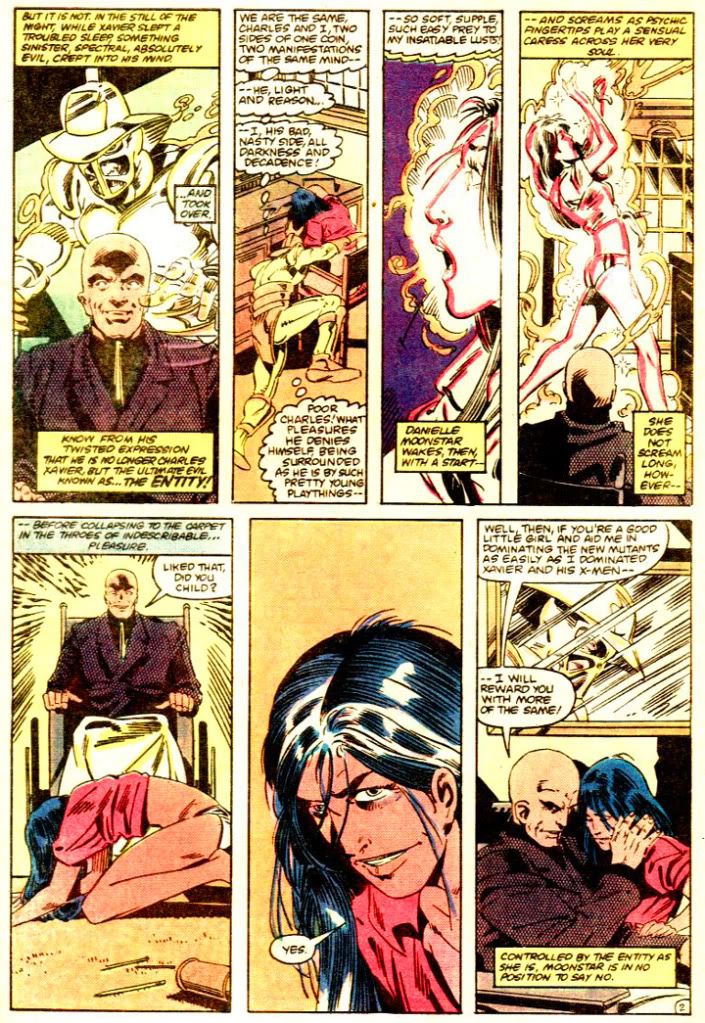
This leads to a mind-boggling scene in #4 where the Entity, in the guise of his normal self Professor X, Dani's trusted mentor and the man her grandfather specifically chose to look out for her wellfare, literally orgasms Dani Moonstar into joining his ever-growing harem.

On panel.

That's all it takes:  a single super-duper psychic climax and the promise of more to come and Dani immediately tosses aside everything she believes in and the very person she was up until that moment.  Sure, there's mind control involved as well.  Gotta have a little of that for seasoning.  She's no longer herself, but there's no getting past that it comes as the result or some kind of side-effect of the sexual assault.  The new Dani wants more of this treatment, too.  Also note when Dani loses herself, she alone among her teammates doesn't put on her regular team uniform.  Everyone else turns evil but they keep their ordinary, non-evil fashion sense.  New, improved evil-Dani, on the other hand, decides to wear some variation on what's supposed to be Native American clothing.  I thought she was going for the Dani Pornstar look she sports in New Mutants #17 when she joins Illyana in Limbo and dons a torn deerskin halter top and ass-less chaps, but that book is cover-dated July, three months after this book.

Well, I don't know why she doesn't just put on her New Mutants uniform like the rest of the kids.  The story, which will belabor explanations at its end, doesn't see fit to spend any time telling us.  There may be a real-world reason, though.

The X-Men and Micronauts isn't the first mainstream superhero comic to fill itself with barely sublimated sexual subtext-- or text, in this case.  A more honest comic would actually acknowledge there's more to Professor X's duality than just some split-personality villainy that leaves his usual benign self blameless.  It would deal with Dani's mind-rape by her trusted teacher as something more than just an extra-sleazy way-- both in-story and, inadvertently, at the script level-- to add a layer of difficulty to the final battle. A better story would probably would just leave it out altogether since, as a plot detail, it's completely gratuitous.  After all, it wouldn't have been that difficult to simply have Entity-Professor X use his position of trust to talk Dani, Sam and the others into fighting the Micronauts.  But that wouldn't have been as decadently fun as involving Dani with a sex fiend, right?

Still, all the darkness and humiliation might be worth it if this story had anything interesting to say about betrayal of trust, loss of self or built towards some kind of revelatory moment.  But no such luck.


Why isn't she wearing her regular costume?
Mantlo and Claremont separately wrote some fantastic stories, which means it’s reasonable to assume together they’d work up some kind of synergistic magic.  Unfortunately, X-Men and Micronauts once again proves the old adage about making assumptions.  Have you ever been watching a Major League baseball game when a top pitcher uncorks something so wild you think, “Jesus, you actually have to be a pretty damn good athlete to throw something that erratic?”  Any fool can bounce one to the plate.  It takes a top flight hurler to wing something off at such a cock-eyed angle that leaves everyone goggling in disbelief.  This is the comic book equivalent of that kind of wild pitch, a misfire so wrong it could only have come from a couple of men working in such complete confidence of their mechanical writing skills no one thought to say, “Uh… no.”

Don't worry, Prof.  Not your fault, huh?
Essentially, after they’ve exhausted all the readers with these padded-out scenes of tops and bottoms, Mantlo and Claremont abruptly end it all with a song-and-dance number.  Arbitrary metaphysics and the ridiculous rules of comic book psychic warfare.  Oh, and a whole lot of body-switching plus some perfunctory fisticuffs-- Dani gets her ass whipped again, this time by a teensy-tiny Bug and Wolverine-- and then a sequence where Professor X and the Entity in their naked ghost forms writhe around in some nether region. Fortunately, for no discernable reason, while in the Microverse-- where presumably the laws of physics are completely different thanks to the whims of plot device-- Professor X’s Entity-self has the ability to alter reality with a snap of the fingers, while in our universe he’s only an orgasm-inducing mind-reader and susceptible to naked ghost-wrestling on the astral plane.

I truly feel for Jackson Guice and Bob Wiacek (Kelley Jones is in there somewhere, too), because they draw their asses off in the service of this mess.  Starships and superheroes, exploding planets and naked ghosts.  As far as Michael Golden impersonations go, this is one of the better ones.  And for their efforts, they get to illustrate the last couple of pages which consist of characters standing around like a bunch of idiots while Professor X fills their heads with a huge wheelbarrow-full of complete horse shit.  This lets the poor readers know what they just witnessed because it doesn't make much sense otherwise and the writers need to wrap it all up before the page count runs out.


Marionette of the Micronauts, as confused and disappointed as anyone else, asks, “How’d we beat that all-powerful godlike pervert?” and Professor X helpfully explains, “Well, I tricked him.”  With the script already badly stressed, the seams finally come undone, groaning in protest.  And if you're wondering just how empty of substance this tedious exhibition of soft-core fetishism has been, the final proof comes with Professor X’s conclusion where he blames the whole mess on the darkness inside us all, then says words to the effect of, “It’s too bad I can’t resurrect all those micro-people I murdered or un-rape all of you, but I can’t, so let’s never speak of this incident again.”  And they never did.

I'm so very sorry to have done this to you.  Here, this will make you feel better:

Friday, June 8, 2012

Giant-Size X-Men #1: A retrospective look back in anger at a remembrance of things past!


Gil Kane and Dave Cockrum create
a classic image!

Giant-Size X-Men #1 (May 1975)
Publisher:  Marvel
Story/Script:  Len Wein
Art: Dave Cockrum

This is where it all began.  The X-Men legend.  This is where the title began its rise from obscure Fantastic Four knock-off to Marvel’s flagship franchise.  Hugely influential and source material for a lucrative film series that helped jump-start the idea of “superhero movies” as we now know the genre--  yet its characters remain fairly obscure outside the comic book world.  We insiders—damned as we are-- may know how Banshee lost his sonic scream and chuckle knowingly at the strange concept of Nightcrawler’s being able to turn invisible in shadow yet have a face that’s always shadowed, but our moms and dads probably couldn’t tell Wolverine from tangerine if you spotted them a tree, a juice squeezer and six Hand ninja.

But hoooo baby, they love that singin’, dancin’ man Hugh Jackman!

Anyway, here we are at the beginning at last.  Giant-Size X-Men #1.  Years ago I bought a run of early X-Men from a friend for the grand total of 20 dollars and the use of my left-handed outfielder’s glove one day in P.E.  In return I had X-Men numbers 94, 95, 96, 97, 98, 101, 107 and 112.  And I read them.  I took them to school, passed them around to my friends and we read them until they were wrinkled and puckered at the staples.  Take that, graded mint collectors!  But I didn’t have Giant-Size X-Men #1 and by the time I realized what I had that foolish friend of mine was on drugs and would rather trade his back issues for white powder and green leaf, neither of which I could easily obtain and transport back into the States despite possessing diplomatic clearance through customs thanks to a childhood spent overthrowing Communist-friendly regimes in Central and South America.  I was a precocious child and I will soon publish my memoirs detailing my cover story as a violin prodigy on a perpetual world tour that just happened to intersect certain geopolitical hotspots.  That is, if I’m not assassinated first!

I digress.  Eventually Marvel reprinted this story and I’ve since read it too many times.  And last night, I read it again.  The cover—by Gil Kane and Dave Cockrum—is a classic image, one copied and homage many times.  Led by—of all things—a filthy, atheistic Red made entirely of metal, including his filthy, atheistic genitalia, the new internationally stereotyped X-Men burst through the old homogenously white American X-Men.  The cover copy promises something it calls “Deadly Genesis!” but the title page introduces a story calling itself, “Second Genesis!”  What the hell?  Can’t you people get it together?  Plus, that title sounds a little like a new herbal shampoo, superior to the previous formulation.

Herbal shampoos—I mean, getting it together is what this story is all about.  I’m speaking of the super-team.  With the original X-Men missing after an ill-advised trip to a tropical island in search of an all-powerful mutant, Professor X travels the globe and recruits his new students.  There’s Nightcrawler, who finds himself pursued by angry Germans—the inverse of what my great-uncle did to the lousy Hun with one of Patton’s tanks during the Big One.  There’s Storm, who flies around topless with her startling white hair conveniently covering her breasts no matter how many howling thunderstorms of wind and rain she calls up with her magical mutant abilities.  There’s the aforementioned Red, a beefy simpleton from a collective farm.  He’s later called Colossus and wonders aloud if his powers are everything Professor X claims, shouldn’t they belong to the State?  Not on my watch, Pinko!  Professor X also recruits a trio of ringers, three characters who had already appeared in Marvel continuity.  I’m referring to the Impossible Man, Flash Thompson and Irving Forbush.

Okay, okay.  He signs Sunfire, Banshee and Wolverine.  We all know Banshee thanks to the many movies made about him in the last few years, but Wolverine remains an obscure piece of comic book trivia.  Sunfire is one of those arrogant, angry, ultra-traditional “I hate the West” Japanese guys beloved by American comic book writers.  Because you can never have too much racial animosity in your superhero group where teamwork is at a premium and cooperation can mean the difference between life or death in heavy combat, Professor X also brings in Thunderbird, an Apache who beats up buffalo with his bare hands, feels “ashamed of his people” and has to be persuaded with the old reverse psychology trick.

This is probably my favorite storytelling moment in the entire book, because artist Dave Cockrum has Thunderbird walking away in a huff, only to stop and rub the back of his neck with his hand.  It’s reminiscent of my beloved Billy Jack movies, one of those moments I used to anticipate with my little heart all a-flutter where Billy Jack finally has had enough redneck bullshit and prepares to lay aside his pacifism in favor of kung fu mayhem.  Wein’s dialogue—Thunderbird says, “Ho-kay… that does it!” and you can almost hear his slow, husky, exasperated voice—only makes the moment more Billy Jack-ish.  Billy Jack-ish? 

Anyway, the Professor’s mind game works on the proud, angry Thunderbird and soon the petty squabblers find themselves at the X-Mansion where Cyclops shows up and starts barking at them like an army officer and addressing them as “people” in a clipped voice. People, the X-Men are missing!  Only you can save them!  Cyclops is curt and snappish because he’s a professional and time is of the essence.  But despite sharing a flashback with the newcomers, he fails to explain why they should care about his problems, much less participate in them. 

Take Colossus, for example.  Two days ago, Colossus had never heard of X-Men or capitalism or honkytonk music or Peyton Place.  Suddenly, he’s expected to go off on some dangerous, possibly lethal mission with a group of strangers, all of whom appear to despise each other and aren’t exactly shy about expressing it, to risk his metal neck for another group of strangers who, to hear Cyclops explain it, are just as hateful as the ones he’s with.  If I were him, I’d be heading back to the land of vodka and women with five o’clock shadows.  If I were Storm, I’d take off my shirt and go flying back to Africa where people worship me as a goddess.  Sunfire has that sweet castle and kimono-clad wife to go home to, Banshee can score sweet seats to the Tom T. Hall concert at the Grand Ol’ Opry.  If I had their lives, I wouldn’t be mucking around with this junk, either.  As for Nightcrawler and Thunderbird…

Well, if I were either of those guys, I guess I’d be stuck because their lives seem to have the least purpose, unless being chased by angry mobs or manhandling buffalo while seething with contempt for your own tribe count as purposes.

Len Wein was and continues to be a fine writer and editor—I point you to his run on the original Swamp Thing, various stories in DC’s horror titles and hundreds of fantastic stories over the years plus his editorship of Watchmen, but reading Giant-Size X-Men #1, I’m struck by how shrill and unpleasant he makes his cast.  Character conflict is one thing—the Fantastic Four used to bicker a lot-- but having Professor X deliberately court this particular group of truly unpleasant people is quite another.  There’s no reason for their snappish behavior other than the transparent mandate they flaunt “individuality,” and because conflict adds interest.  With almost 40 years of comic book reading hindsight, I can’t think of a reason why Wein couldn’t have used a little subtlety or at least balanced out the nastiness with a little sympathy. 

In the classic days of Marvel, Human Torch would needle the Thing until they came to blows or at least fireballs and angry threats, but there was always sense of brotherly love beneath it all.  And they were likable.  You could go to the movies with them, if you could ever get them to agree on what picture to see.  Human Torch has always favored those Judd Apatow comedies, while the Thing prefers anything with Steve McQueen in it.  At this point in the X-Men narrative we barely know any of these jokers, but I can’t imagine spending more than a minute listening to their lame cracks and randomly vicious insults, if even that long.  It’d be like hanging out with the Let It Be Beatles without ever having experienced A Hard Day’s Night.

Because she only throws one fit—and off-panel at that-- Storm retains the most dignity, despite wearing a cape, a monokini and thigh-high go-go boots.  By the time they’re all fighting for their lives against the menace of a living island that calls itself Krakoa— Shocking twist!  The ISLAND is the mutant, thanks to that catch-all explanation for anything that doesn’t other make any sense, magi—er—radiation— I was just sick of them as individuals and collectively.  By the end, I was rooting for the island.

Dave Cockrum’s art on this job isn’t as slick as the guy he’s imitating, Neal Adams.  Cockrum’s characters pose dramatically but stiffly, lacking the Adams fluidity.  Adams’s superpeople might run around with every muscle in their bodies tensed, but they’re flexible and sinuous.  Cockrum’s figures here are dynamic but awkwardly constructed.  They also seem to be shouting a lot, even when they’re alone—as Cyclops does when he finds himself on the X-Jet minus his teammates and his powers, or Sunfire when he’s flying along outside the very same jet well beyond earshot of whoever it is he’s supposedly addressing.  That’s probably due to their being a bunch of jerks.  Cockrum confines himself to traditional panel shapes for the most part, and the result is a bit cramped.  He didn’t really hit his artistic stride until the regular series, especially #94 where he and Bob McLeod teamed up to produce one of the sweetest superhero art jobs I’ve ever seen, the one that made me want to draw superhero funny books for a living way back when before life sent me off on a more punk rock filled course that led me to Japan for some reason.

On the other hand, Cockrum shows the one thing that really matters—artistic charisma.  Appeal.  You want to look at these pages.  And you have to admire the man’s effort.  He even manages to draw the impossible.  There’s a very strange moment where Cockrum has to depict magnetic waves descending to the ocean floor as the team finally comes together with a typically silly comic book solution to the the Krakoa situation.  Who knew islands actually float, kind of like icebergs?  In Cockrum’s defense, it’s easy for a writer like Wein to describe this kind of thing.  I just did it, and I’m a complete idiot. 

But as an artist, I can’t think of another way to depict visually one of the prime forces of the universe which is difficult enough to account for in physics theories, much less as the work of a team of superpowered human beings.  It’s best to think of this panel as symbolic, like an editorial cartoon where the inner workings of various congressional committees are turned into a visual metaphor so the kind of idiots who still read newspapers, much less their editorial pages, can understand how they’re getting shafted this week.  Unless you disagree with the artist’s politics, of course, in which case you need to know enough to write an angry blog entry about it or at least comment on a political message board thread about it.

No one can see magnetic force itself, only its effects, and no one really knows what goes on in committee.  It’s all guesswork on the artist’s part.  I don’t know what Cockrum’s politics were at this time.  Perhaps a kind of pro-mutant, anti-sentient island stance that manifested itself in that remarkable panel. 

He certainly made the ridiculous look ridiculously cool.  I miss him.