
Showing posts with label Black Bat. Show all posts
Showing posts with label Black Bat. Show all posts
Monday, August 13, 2012
Well, that about wraps things up with Cass Cain...
Unless she's a zygote in the New 52. In the meantime, a small group of dedicated Cass-fans are attempting to organize a mass buy of the digital Batgirl #1.


Tuesday, November 1, 2011
Back when she was Batgirl...
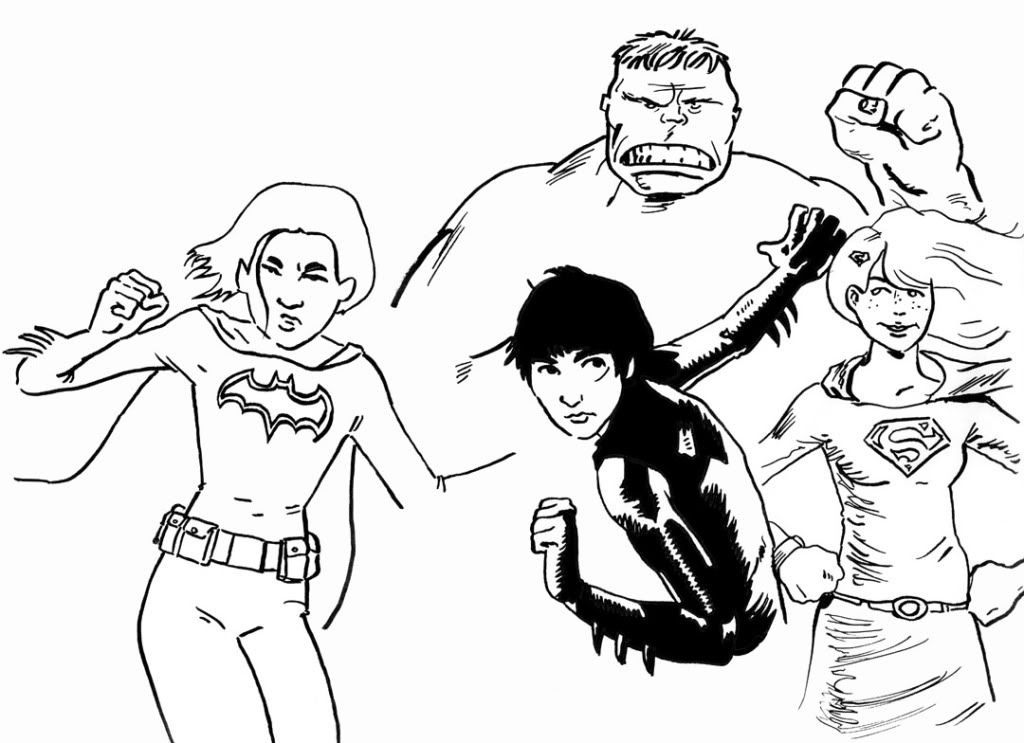
Here's another sketchbook page. I seem to draw Cassandra Cain, Supergirl and the Hulk pretty often. I did this freehand with a Kuretake Fudegokochi brush pen on a sheet of marker paper. Batgirl on the left is apparently pitching some kind of fit; she's really angry about something. The center Batgirl shows a zen-like calm, but I'm not sure about the weird feathery line I gave her shadowed areas. What inspired that? The Hulk looms overhead like something she's dreaming. The way I attached his hand to his beefy wrist isn't really working. And then there's a cheerful, freckle-faced Supergirl with goofed-up shoulders. All that modeling I did on her right side (left to us!) was my attempt at emulating the awesome Nick Cardy; it came out vaguely Dr. Seussian, though.
Cass is in her DC Batgirl suit rather than the one I made up for her. Slap a pointed mask on her and she's practically Black Bat. I'm happy DC has their sales up, and I'm pretty pleased Cass will "appear in Batman, Incorporated in a very big way" along with Stephanie "Spoiler/Robin/Batgirl" Brown. Whether or not I'll bother to read it is another story. The overall aesthetic of what they're doing these days just doesn't interest me and I find I can't really get excited about it, and we're always a year or two away from a new universe-changing Crisis. I'll be in Japan where American monthlies are hard to come by, but maybe I'll download a digital copy of Batman, Incorporated from DC when Cass reappears. Then again, maybe I'll forget.
Friday, September 30, 2011
When Batgirl Discovered Art

Batgirl and the homeless guy. This is from Batgirl #51 where Dylan Horrocks introduced the concept of Cassandra Cain shocking people by saying inappropriate things. The story containing these moments is a two-parter in which Poison Ivy has tricked this goofball artist wannabe into helping her create a mind-controlling garden the heart of Gotham City. It opens with your standard comic book action sequence-- Gotham police chasing some generic criminal scumbags in cars, Batgirl swoops in from some impossible angle and saves a homeless man from being run over. It's not really integrated into the plot, so it's more just a framing device that sets up an interesting concept only to give it up in favor of a standard and somewhat stale super-villain plot.
The book's artist uses a chalk-line device to outline each panel featuring the homeless man because his thing is making lines on the sidewalk with a piece of chalk. These frames-- reminiscent of some of the stuff the art team on Alan Moore's Swamp Thing series used to play with-- set him apart spatially and conceptually from the chase, in much the same way he's extraneous to the main story, with quick cuts from oblivious artist to the car chase, right up until Batgirl appears. Then Batman shows up and explains to her the man is creating a map of a fantasy Gotham City, one from out of his head. Batman sympathizes with him, describing him as "an old man who should be in the hospital," and telling Batgirl he also wishes the real city could be like the man's pretend one.

It's pretty neat thinking of Batman as being so aware of Gotham City he knows all about the psychosis of one of its street people. There's almost an element of caring on his part. And truly, Gotham is Batman's city.
Digression-- Batgirl sports enormous breasts during this sequence. Later, she's shown wearing only a towel, and after that a little black dress; by this time, her breasts are a more natural proportion compared to the rest of her body. Perhaps her costume has some sort of breast-enhancement padding. I suppose it could be some kind of armor, but it apparently cups, lifts and separates. It's as if Batgirl gets her armor from the Combat Goddess collection at Victoria's Secret. It's not a superhero comic with a female protagonist if it doesn't feature at least some objectification, I suppose. The towel scene is more than a little gratuitous-- okay, Batgirl showers after she fights crime, hooray for hygiene, but the conversation could have taken place at any point before or after she cleaned herself up. As ridiculous as this is, I'm much more horrified by the bizarre facial construction throughout. The rendering is so hit-or-miss, Cass's forehead also changes sizes frequently. If this were a movie, they'd have hired six different actors to play each role. Digression ends.
The chalk guy disappears until the end of #52, after Batgirl, Oracle and Batman defeat Poison Ivy and return Gotham City to its normal, overrun-with-crime-hellhole state. On her way home or to fight more criminals, Batgirl swoops over the guy, and he's still at it, making his chalk map. Batgirl, a little wiser in the ways of art, gazes down at him in passing, an ever-so-slight and enigmatic smile showing through her mask. The Rick Leonardi art is a major improvement, more consistent with character appearance and with stronger storytelling.

What was the purpose of the chalk artist? Was he there to contrast with Poison Ivy's "art?" Just symbolic of a more pleasant Gotham that can never be? Perhaps if the story had been more about Batgirl's reaction to this concept and a deeper exploration of the nature of art itself, with the Poison Ivy plot tied more into that, he might have had more of an organic fit. More of a story-driven purpose. As it is, he serves as a marker for another idea that really demands a more thorough investigation, rather than more super punch-outs and rope-swinging.
Can you imagine what it would be like to explain art to Cassandra Cain? I wonder if Barbara took her to an art museum following this adventure. I really wish that had formed the crux of the next issue. It would have done more for her mental health and development as a well-rounded person than that time Barbara took her on a cruise, made her wear a bikini and exposed her to the male gaze like one of those parents who teach their kids to swim by tossing them into the deep end without warning.
It's not certain art would register on Cass, the purpose of it all. Try to explain to her the concept of "art for art's sake," for example. Much less the whole of art history. Would she prefer abstraction to the representational, or vice versa? As someone who can "read" people's movements, would she read the artist's intent? Could she look at visible brushstrokes on a canvas and "see" the artist's technique, or the moment pigment hit pigment?
What would Cass's own art look like? Would she draw something childish, yet disturbing? Two crude stick figures, one with pointed ears and a cape and the other toting a gun, a small figure cowering between them, in response to Barbara's request to "Draw your family?" Maybe a looming Barbara, threatening to crowd a smaller figure completely off the page. Or would she be able to recreate the physical movements making up the art methods she saw in the museum? Or how about action painting?
I can see Cass getting really into Jackson Pollock. Flicking paint on a huge canvas on the floor, pouring it, splashing it.
Something violent, something savage, paint splashed and slashed across the canvas.
Too bad we'll never get to see that.
Monday, September 26, 2011
When Batgirl Said "Sweet Patootie"
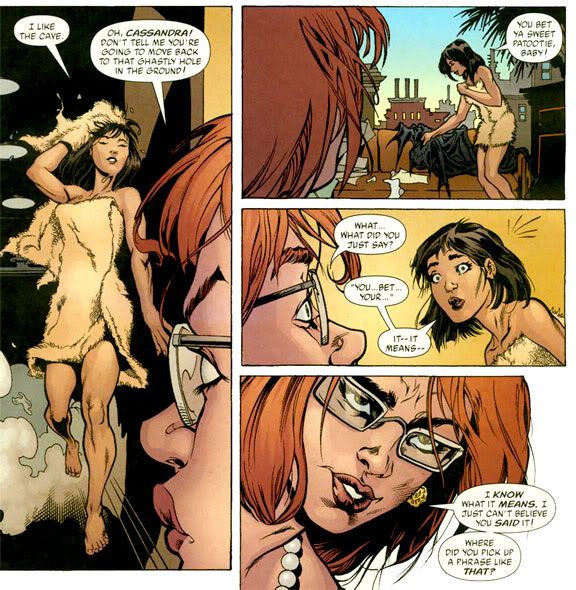
Dylan Horrocks wrote some of my favorite Batgirl issues and some of my least favorite. He often had some wonderful ideas, like Batman and Batgirl working out their father-daughter issues in the way that works best for them-- brutally beating up on each other. These are people who believe in tough love in its most literal sense. He also had some crappy ideas, like Barbara Gordon constantly enforcing gender stereotypes on Cassandra. It helped a lot when he had a seasoned pro like Rick Leonardi to make solid storytelling choices; landing him on pencils was a big plus for the title. If only some of the fill-in artists had been up to the task...
Having Cass shock her friends as she experiments with language learned from television in #51, "The City is a Garden," (2004) is a pretty clever notion. Horrocks didn't do a whole lot to develop it in subsequent issues, and what little it appears in the comic could have been handled a whole lot better in the artwork.
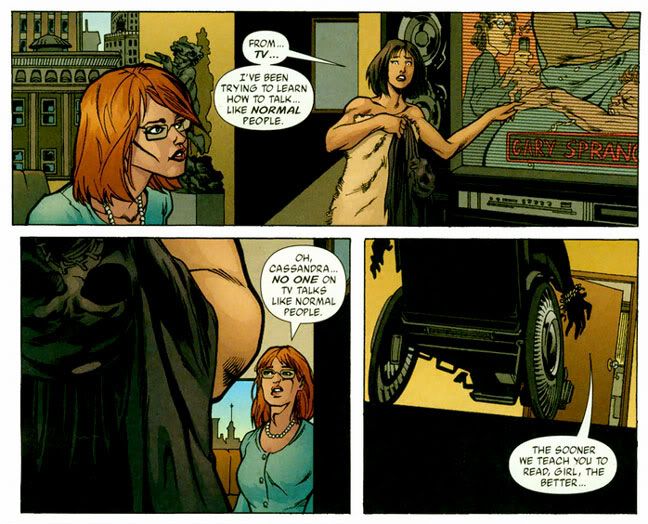
The clumsy storyelling here really murders the gag. The artist has to think in terms of acting-- read John K's blog entries about this in animated cartoons; it's almost the same thing-- and Cass's shocked, silly, scared expression, doesn't match up with Barbara's fairly mild remonstration. It adds a forced quality to the joke. It's oversold, and previous artists characterized her as fairly unemotional even when baldly lying face-to-face with Batman.
So this response rings false. After all, it's not as if she's being screamed at, which would be a huge mistake on Barbara's part anyway. Conversation with someone like Cass would be like running with scissors-- you might get away with taking chances 9 times out of 10, but that last time will spill some blood. Why not have Cass respond with a serious, determined look on her face: "That's what they said on TV, how could it be wrong?" Or a mere inattentive shrug, as if to say she doesn't really care that much, talking is such a useless burden anyway. Which would leave Barbara exasperated and at a loss, thinking over more strategies to get through to this girl. After all, how do you deal with someone like Cass, explaining things that would be self-evident to someone more conventional in comprehension and response?
Also, I find Barbara's insistence that no one on TV talks like normal people pretty ironic coming from a character in a superhero comic. Horrocks deserves extra points for that, at least.
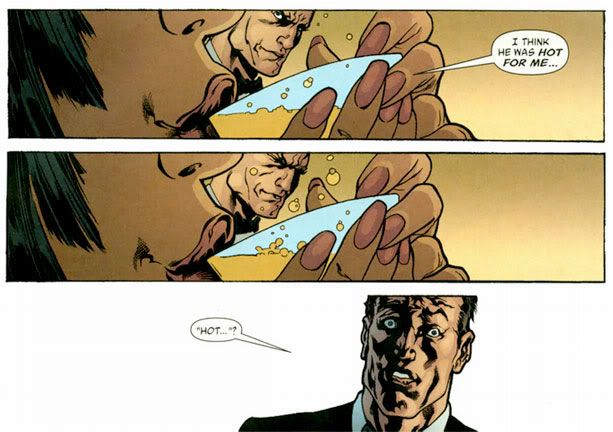
The second instance is more successful. Instead of showing Cass's reaction, we only get Bruce Wayne's. And he's flabbergasted. Why does it work this time? Because it's easy to imagine Cass, experimenting with language, not realizing the impact of word choice. If this comic really had the strength of its convictions, she might even have said, "I think he wants to fuck me." To that end, we really don't need to see her full face because the dialogue is enough to convey her naivete. Batman's reaction is a little over the top-- I think it's much more likely he'd just grunt or narrow his eyes and make a mental note to have Barbara instruct Cass later-- but at least it's appropriate.
I only hope that's apple juice in that glass. Isn't Cass only about 18 or 19 at the most in this issue?
Well, Cass-the-language-shocker is right on. As a once-and-future ESL teacher, I often noted the difficulty English learners have with nuance. A friend of mine-- whose English is actually pretty good-- once responded to a compliment I paid her by blurting, "It's a LIE!" She meant it as a humble deflection of my flattery (which I meant sincerely), but it came out much stronger than she intended, without modulation. We both ended up laughing about it. Another time I was dating a girl with a somewhat lower fluency. One night, we had to walk in a driving rain to a convenience store to bring back snacks for her friend. The entire length of that walk, my semi-girlfriend griped, "Fuck the selfish bitch! Fuck the selfish bitch!"
And that's the kind of thing I can see Cass doing without her even realizing it. I wish writers had done a bit more thinking about this. They really missed a chance at enriching her character, adding some comedic flourishes to her personality. But hey, DC, it's not too late. Fabian Nicieza handled her dialogue pretty well in two issues of Red Robin in which he got to use Cass, before the reboot. It still works even with the more language-experienced Black Bat. Or inexperienced, if she's going to be 5 years younger or whatever the heck's going on over there right now.
Besides picking up on the usages of friends, where else would an illiterate increase her vocabulary besides movies and TV? Imagine if Cass gets into Batman's Complete Laugh-In DVD set. We might get some hilarious scenes where she tells villains to "Sock it to me," or stuns Batgirl-Barbara by demanding she "Bet [your] sweet bippy." Or catching a little TV Land and telling Damian Wayne to "Kiss mah grits!" or "Sit on it!" What if she caught an HBO comedy special and started working a little blue?
One second thought...
Monday, August 8, 2011
Dangerous Ladies Cass Cain Black Bat cosplay is awesome even in an unfinished state!
Thanks to Nathaniel, my source for all the best Cass Cain news, is this link to a video for some fantastic Black Bat cosplay. Yeah, that's how good cosplay is born. They did a Cass Batgirl at some point, too. All their costumes are eye-poppingly good. Comic accurate and well-portrayed. Cos-artists. That's what they are. Cos-ARTISTES.
DC may toss the character in the garbage, but the cosplay lives on...
DC may toss the character in the garbage, but the cosplay lives on...
Sunday, August 7, 2011
Is this the first Cassandra Cain as Black Bat cosplay ever?
Well, is it? I'm a fan of well-done cosplay. For that matter, I'm also a fan of crappily-done cosplay. But I'd rather praise the cosplayers who get it right and creatively embody the characters they portray than make fun of those who choose poorly. Let's praise, shall we?
These two look fantastic and obviously I couldn't be more thrilled with this person's decision to go as Black Bat. She looks better than most of the comic book depictions I've seen so far. The Robin's snazzy, too. The photo description lists Damian Wayne among its tags, so I'm going to guess this young woman is portraying that particular version-- but I prefer her in the role to the hateful little comic book character.
My suggestion to DC? Kill off the comic kid right at the start of your relaunch, loosely base the new Robin on this cosplayer, and then do a team-up book featuring her as a neophyte hero being mentored by Cass. Obviously, I'd buy it.

These two look fantastic and obviously I couldn't be more thrilled with this person's decision to go as Black Bat. She looks better than most of the comic book depictions I've seen so far. The Robin's snazzy, too. The photo description lists Damian Wayne among its tags, so I'm going to guess this young woman is portraying that particular version-- but I prefer her in the role to the hateful little comic book character.

My suggestion to DC? Kill off the comic kid right at the start of your relaunch, loosely base the new Robin on this cosplayer, and then do a team-up book featuring her as a neophyte hero being mentored by Cass. Obviously, I'd buy it.
Sunday, July 17, 2011
Red Robin #25 and Walking Dead #86: Comics reviews
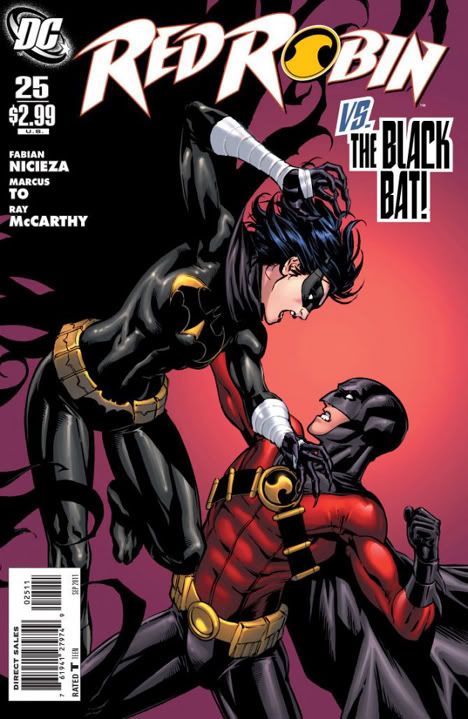 Red Robin #25
Publisher: DC Comics
Script: Fabian Nicieza
Pencils: Marcus To
Inks: Guy Major
Just the other day I complained in this blog about having aged out of DC's target demographic. Yet it seems for this single issue of Red Robin, I'm the intended audience. Of course I don't really believe that for a second, but something happens early in this book I've often joked about.
As for the rest of the book-- have you ever wondered what a story about Dr. Watson's brother-in-law, with the Great Detective and the Hound of Baskervilles as ancillary elements would be like? Neither have I, but it would probably resemble Red Robin #25. Nicieza and To fill the story with all character beats, action and explosions you could possibly want. Unfortunately, they face the nearly impossible task of generating interest in a generic lead. Peter Parker has girl trouble, Dick Grayson has a tragic past, Bruce Wayne is brilliant and rich. What is Tim Drake but a pastiche of these familiar elements? It doesn't help that a good deal of his narration at the start consists of telling us how awesome his co-star is, thereby reinforcing his own status as a non-entity.
And thanks to Nicieza and To, Cass is indeed awesome again. We know this because she rescues the hero then involves herself in a little comedic background business while Red Robin and an unseen supervillain (why are these guys so gregarious and yet cryptic about their plans?) engage each other in yawn-worthy plot-twaddle. It's funny, effective and much more entertaining than this tired stuff about assassinations, evil geniuses and nebulous and nefarious schemes. Cass has about six lines of dialogue and she could scarcely need more. I love how Nicieza takes away some of her English fluency without turning her into a caricature; she eschews subject nouns like Rorshach from Watchmen without the psychosis. Mostly she expresses herself through physicality and in her wicked black outfit exudes enough charisma to outclass Red Robin in his own book. To's use of splashes and large panels in the action sequences ably display Cass's martial prowess. It's clean-lined and sharply rendered stuff and goes a long way towards soothing the savage Cass-fan that dwells inside.
Because it's so ensconced in the familiar-- one plot element is cribbed from the film The Dark Knight-- the story lacks a sense of danger or urgency. Even the potentially life-altering situation Red Robin finds himself in at the get-go is treated mostly as a joke, dismissed as "'A Very Special Episode' kind of attacked" and "a fate not-quite-worse than death." The taciturn Cass even has a quip of her own for the occasion. This gives the proceedings a detached quality, a kind of ironic distance in which nothing much matters and nothing much is at stake. Later in the book, there's a one page sequence set in Hong Kong that leaves Red Robin battered and bruised. With its bizarre villain-- shades of the killer kid from Kick Ass, the new Damian Wayne Robin and Cass herself-- it might have made for a more compelling or unusual adventure starring Cass with Red Robin as her guest-star.
Instead, it acts as an awkwardly inserted digression that reinforces my feeling DC has an ace creative team in place, but they're hamstrung because they're telling the wrong character's story; when Cass drops out of the narrative, so will I. If Nicieza suddenly finds himself assigned to a Black Bat monthly DC and I might find ourselves meeting somewhere in the middle again.
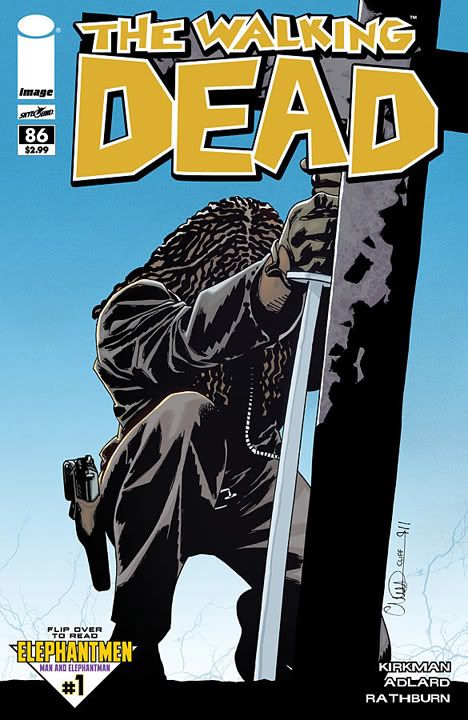 Walking Dead #86
Publisher: Image Comics
Script: Robert Kirkman
Art: Charlie Adlard
And to contrast Red Robin, here's a title which seems aimed at me almost every single issue. First and foremost, as an art geek I can't get enough of Charlie Adlard's gritty line work. I much prefer stylists-- impressionistic or expressionistic, loose and sketchy or clean-lined-- to the photorealists in comic book art. Photorealists excel at the mechanical aspects of their rendering, but they all too often detour through the uncanny valley-- Greg Land's gallery of lovingly detailed pro wrestlers and porn stars in the midst of orgasm come to mind. Adlard's pages ultimately have more believability because his characters aren't copied (or traced) from some easily-recognized celebrity. They inhabit a world of shadows where bodies have weight and presence. Adlard is also an exceptional storyteller who knows how to break up and pace a page, how to pose his figures and direct action sequences for clarity and maximum impact.
Kirkman's script for this issue is heavy on dialogue. Well, to be honest, most of his scripts for The Walking Dead are, but #86 falls between the end of one major storyline and the beginning of another so there's quite a bit of back-and-forth between characters in the form of casually handled exposition. Rick, the deadly Michonne, crackshot Andrea and the rest have found a refuge within a walled suburb, and they've just come through a massed zombie attack that resulted in lots of gruesome deaths and a shocking injury to Carl, Rick's son, depicted by Adlard in a drawing so gruesome it actually disturbed me. I plan never to look at that page again!
Now the cast is just kind of hanging out, working through their emotions. Yes, there are some shambling zombies to dispatch, but it's in the service of showing us where the castmembers are now while they describe to each other where they've been. After so many issues, it's a good point for new readers to jump in and start reading. I can't help but feel Rick's new-found optimism is yet another sign the poor guy's lost his mind, though.
What's most fascinating about this particular issue isn't the story; it's the letter page. The Walking Dead has the best letter page in the business, bar none. Editor Sina Grace and Kirkman himself mix it up with readers, cracking jokes and dealing with the largely endearing weirdness of the rabid fanbase this book has garnered over the years. Lately, they've run some blistering letters from readers upset about what Kirkman did to Carl.
I admire Kirkman's audacity and don't think he has anything to apologize for. This moment elevated the story's climax from a mere "third act action movie fight" to something approaching an operatic emotional intensity. It's also wickedly ironic considering some of the philosophies Kirkman has Rick espouse, a chillingly reductive viewpoint of us versus them, them being not the walking dead but the living families in his adopted community.
Essentially, Kirkman upset these readers by making his fiction do what fiction is supposed to do. A story should be about how and why the protagonist and, in a thickly populated book like this, the secondary characters transform from their initial state to something different. These changes are not always positive ones. A mainstream superhero comic is typically about how they stay the same for years and years and years until financially necessity dictates a new costume, a publicity stunt death-then-resurrection or a forced "new direction."
I'm not sure if Kirkman has an ending in mind for the overall narrative or if it's sustainable at great length without repeating itself-- already one of the book's weaknesses-- but he's not afraid to bring the hammer down on any particular individual character, all the while altering them in drastic ways because of story events. Rick has developed from competent good-guy lawman, husband and father to strong leader to crackpot capable of letting other people's children die to save his own... and now to someone with a potentially deranged evangelical fervor about making his new community work. Or maybe he's just become charged with positive energy and he's on his way to a happy ending. Whatever it is, Kirkman's written this organically rather than arbitrarily, and that's a major reason I've stuck with this book for 80-odd issues.
It is kind of odd, though, to find a line some readers aren't willing to cross in a story that features walking corpses who've devoured almost the entire population of North America, splattering gore, limbs chopped off, rapes and near-rapes and people constantly losing their loved ones. In fact, in the story they're upset about, Rick uses a hatchet to chop off a woman's hand-- just to add some charm, he's been sleeping with her and has convinced her to follow him in a desperate escape attempt that will surely doom any number of other people to horrific deaths-- and allows zombies to devour her and her child. That Rick has his reasons and that a zombie story demands sacrifice perhaps excuse him to a certain extent, but why stick at Kirkman's treatment of Carl in the midst of all these other tragedies?
Expanding on this idea, in order for the entire series to take place these zombies implicitly have to have eaten millions of children, including helpless little babies. Apparently readers can consign all those people to death in the interest of good clean fun. For audiences at large, aliens can disintegrate all of Los Angeles in a genocide of CGI fire in a movie or the entire world can fall apart killing billions because of some nonsensical prophecy in a stone calendar, but make sure there's a scene where a dog leaps to safety or else we're outraged. Outraged, I tells ya! Let Kirkman maim Carl, a character we've suffered along with for years, and it's "HOW DARE YOU, YOU INHUMAN MONSTER?!"
I've come to trust Kirkman, and find I can enjoy The Walking Dead without worrying he'll eventually have to ret-con things to keep his story going for the sake of protecting trademarks and cashing in on merchandise sales ad infinitum. So when he wounds my heart with a development like this, I have to give him his due as an author of substance. Kirkman must be thrilled to know his work impacts people this way, even if a lot of them are calling him names and vowing never to read The Walking Dead again. People care, and that's the mark of a great book.
Subscribe to:
Posts (Atom)