Showing posts with label Wolverine. Show all posts

Monday, January 13, 2014

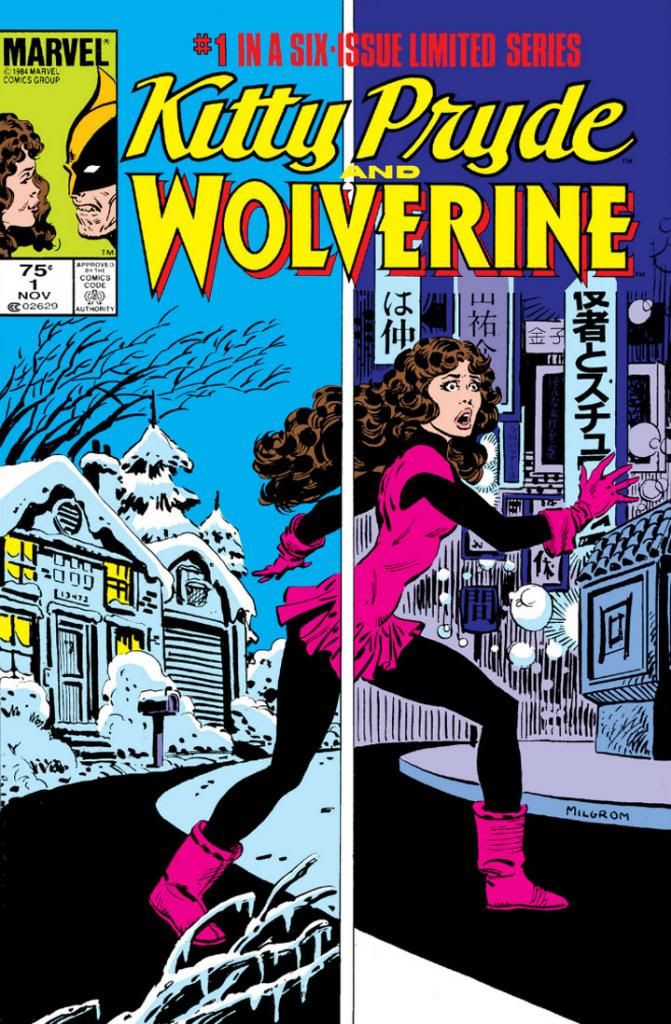
Kitty Pryde and Wolverine #1 (November 1984): Bad News Mutants Go (Back) to Japan!

When I was a much younger comic book fan Japan was mostly just that place Speed Racer and Pink Lady came from.  Then at some point, I must have gone insane because I moved there to start a new life and go to Melt-Banana shows whenever I damn well feel like it.  While it's not nearly as exciting a place as Pink Lady and Jeff would have you believe, Japan is still a pretty cool place to live.  I've had a lot of misconceptions corrected since I was a young comic book reader living in south Georgia, and I've probably formed more than a few new ones now that I'm an old comic book reader living in south Shizuoka.  This is why I love taking a look at American comics depicting my adopted home.

Marvel Japan!  I can't know for certain (since I wasn't working for them), but I get the feeling Japan was Marvel's go-to country for remaking characters back in the 1980s.  In their classic and influential 1982 Wolverine mini-series, Chris Claremont and Frank Miller sent Wolverine there, tore him apart, put him back together again and cemented his place as one of Marvel's top draws.  Along the way, they created a fabulous fantasy Japan (we've discussed this already), where the high-tech marvels of modern Tokyo form a backdrop for a lot of pseudo-mystical martial arts tough guy nonsense.  In the Marvel Japan Claremont and Miller invoked you could still encounter hordes of ninja and stoic old people still living the ways of bushido in their ancestral castles.  It's silly, but it's the best kind of silly.  I dug it, you dug it, lots of people dug it, so much so this story recently formed the basis for The Wolverine (in Japan it's called Wolverine: Samurai) starring Hugh Jackman.

In Kitty Pryde and Wolverine (November 1984-April 1985), it's Kitty Pryde's turn to visit Japan and experience life-changing events.  And you couldn't ask for a better protagonist, or one more in need of a fresh start than 1984 Kitty Pryde.  Lovingly written here by Claremont, our heartbroken yet smart'n'spunky (TM) Kitty is plenty interesting on her own to have headlined a two or three issue romp through 1980s-era Tokyo, capital of a country then enjoying a huge resurgence in economic prowess, self-confidence and cultural energy-- Shinjinrui!  Visual kei!  Para Para!  With New Wave artists already appropriating its looks and imagery, Japan's youth culture stood poised to conquer the pop culture world, and this could have provided plenty of material without anyone resorting to martial arts clichés.  Instead, in the second issue, Wolverine muscles his hairy way into the plot and the series becomes a deadly serious remake of his solo story, only with Kitty fighting ninja and yakuza for redemption.  Those aspects just don't provide the same kick or appeal the second time around. 

But rather than shoot my figurative BB gun at a comic for not doing what I want it to do, I'd rather focus a positive spotlight on the way-cool first issue, which has Kitty lost in translation all by herself, desperately in over her head.  So let's take a long, loving look at Kitty Pryde and Wolverine #1.  How do Claremont and artist Al Milgrom depict Japan?  Is it believable?  Does it make a reader feel as if he or she has been there?  That's what you're asking me right now, isn't it? 

No?  Well, okay!  I'll tell you anyway!

First, there's the trip journey itself.  To get to Tokyo, Kitty stows aboard a JAL flight from Chicago, and I can promise you there absolutely is such a flight, known as JAL Flight 9.  These days, the aircraft flying the route is a Boeing 777-300ER, but Kitty hops a 747-400 (I think).  That's the same plane I took, only I didn't phase onto it through the cargo bay.  I had a ticket, so my arrival at Narita Airport was a lot smoother (and drunker, thanks to JAL's liberal free drinks policy at the time) than Kitty's.  Not having my good luck, Kitty then spends a page or so escaping Narita.  Today's Narita doesn't look much like the one Milgrom draws, but I first visited it some twenty years after Kitty, so it probably underwent a renovation or two in the interim.  Oh, there's a funny bit where Kitty phases onto a bus and accidentally slaps a salaryman on the ass as she solidifies.  Today we're more likely to get to Tokyo proper by way of the Narita Express, because Narita is actually way out in the rice fields of rural Chiba prefecture, a fair distance from the urban neighborhoods the where the rest of the story takes place.

Now we come to the meat of this post:  Tokyo.  Godzilla's Stomping Ground.  Where the Bears played the Japanese Little League champs.  Kitty visits Tokyo in winter and let me tell you-- Japanese winters are cold!  Cold and windy!  Because her trip is on the spur of the moment with no time to pack or dress more appropriately, Kitty's skater costume is cute but hardly practical for running around outdoors here.  And to top it off, she gets soaked by the rain.
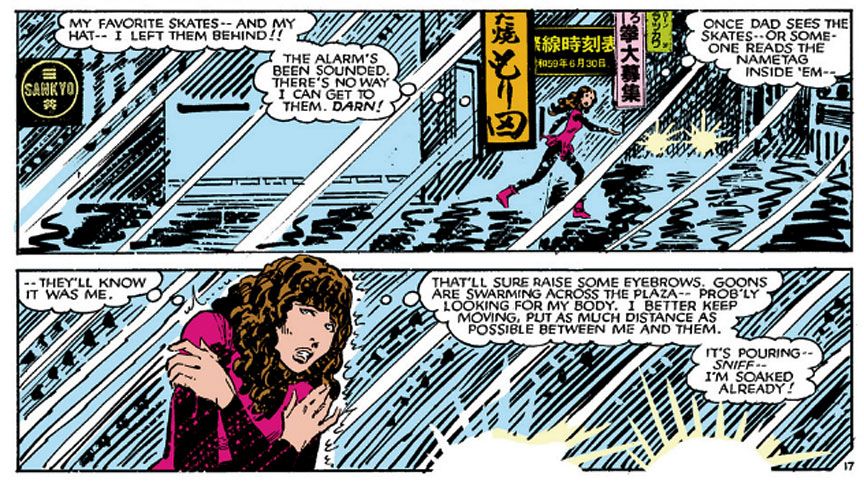
Script by Chris Claremont, art by Al Milgrom

Claremont's Kitty may be impulsive at times due to her youth and naiveté, but she's also a thinker.  During this sequence, she's sizing up her situation after receiving a pretty heavy duty system shock and already figuring out not only has she made a sizable error in judgment trying to help her dad, she'll also be lucky just to stay out of jail herself.  Then the weather takes a dump on her, too.  It actually rains a lot in Japan (while Kitty can't because she lacks money, less desperate visitors should buy a cheap umbrella at a convenience store; the wind's just going to destroy an expensive one anyway), so this vaguely Blade Runner-esque cityscape looks pretty accurate.  Milgrom inks his pencils with a bold, energetic line and spends more time on the rain shower than the surroundings, but those squiggly blacks Kitty's running across are reasonable visual shorthand for the wet streets and reflective lighting of a rainy Tokyo evening.  The vertical signage creates a convincing Tokyo look as well.

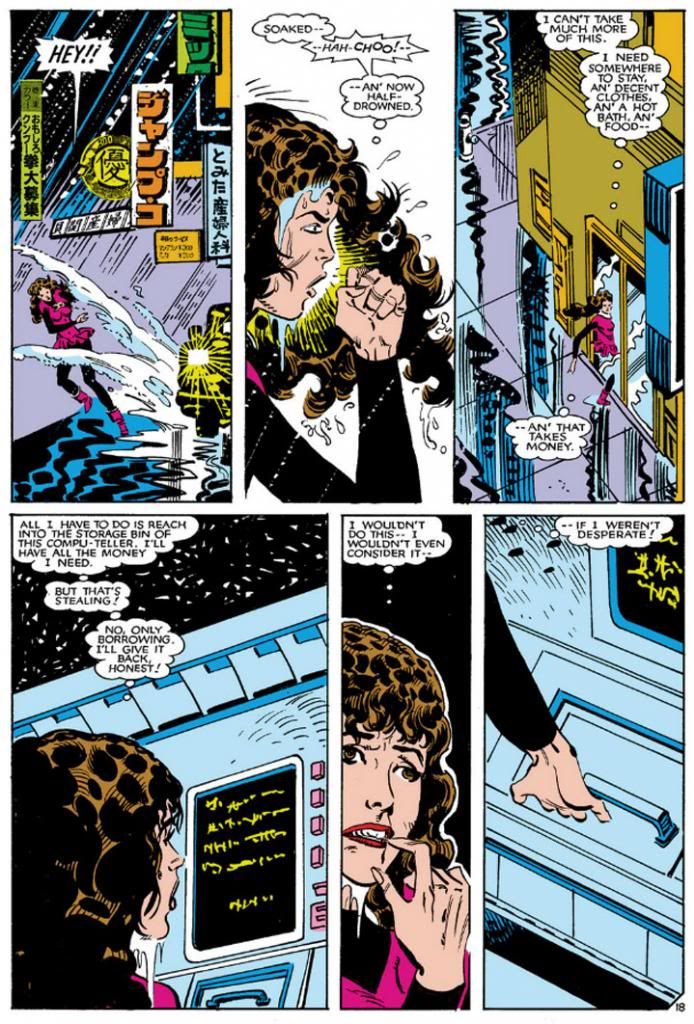
In the next sequence, the rain lets up a little so Milgrom shows us more of the city.
Claremont, Milgrom

It looks as though Milgrom uses some paste-up lettering here, possibly clipped from Japanese newspapers or magazines, or even actual photos of Tokyo.  That's a smart idea.  All that lettering would have been a pain for either him or the book's letterer to recreate, and they would have had to hire a translator to make sure they weren't just slapping down squiggles and squares or accidentally writing something rude.  Plus, Japanese comic book artists sometimes paste up entire pre-drawn backgrounds from special manga-tool artbooks, or use half-tone photographs.  Milgrom does the last, too, but I forgot to capture a screen image of it so you'll just have to take my word here.

Milgrom's version of a Japanese ATM is fun.  Since it's the 1980s, Kitty can't quite decide what to call it.  "Compu-teller," huh?  Now you find ATMs all over the place in Japan-- in banks, post offices, malls and convenience stores.  Inconveniently, some of them are not open 24 hours so sometimes you have to be prepared to wait until business hours the next day to withdraw money.  Imagine Kitty's dilemma here when she needs cash, it's after hours... and she doesn't have an ATM card or even a bank account.

Don't do it, Kitty!  Don't steal that money!  Not only is it illegal, but it's also not worth the guilty feelings and depression!

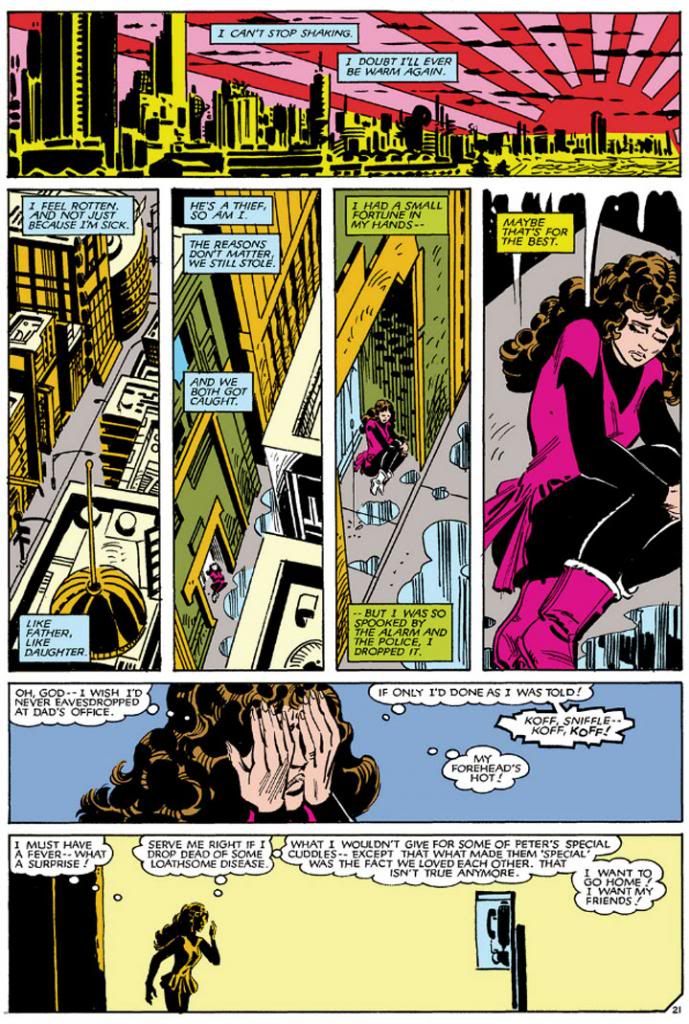
Milgrom waits until almost the end of the issue to give us a widescreen Tokyo cityscape.
Claremont, Milgrom

Ah!  The "Rising Sun" motif!  How Buckaroo Banzai, baby!  Now we really know we're in 1980s Japan.  Milgrom enjoyed this effect so much he used it again in the fourth issue, rising behind a Japanese castle.  After a spectacular overview of the big city, Milgrom zooms in on a neighborhood, finding a sick and miserable Kitty huddles in a doorway.  And she hasn't even hit bottom yet.  Kitty's back alley/sidestreet hideaway in the second panel tier looks reasonable to me.  Granted I spend most of my time in the hip, upscale districts hobnobbing with trendsetting fashionistas like Chiaki Kuriyama and Kyary Pamyu Pamyu, but I've occasionally glanced at just these kinds of lowly city spaces as we've swept by in our motorcycle-escorted limousine motorcades.  That pay phone looks pretty generic, but a phone is a phone, I guess.

"I can't stop shaking.  I doubt I'll ever be warm again."  I get the feeling Chris Claremont visited Japan himself some winter prior to writing this.  Anyway, welcome to a country where few buildings feature insulation or central heating even now.  Think how rare that must have been almost thirty years ago when Kitty came.  These days, I pile on the layers starting with Uniqlo Heat-Tech and ending with a quilted hanten, and my wife and I run an electric heater in the mornings when we get up.  I still shiver all winter.  And Kitty spent the night outdoors with only her wet skater dress and some tights to protect her.  She also swam through a sewer pipe a few hours before.  No wonder she's in no mood to enjoy the sunrise.

The rest of the mini-series stages fights inside office buildings or on rooftops (Tokyo Tower makes a background appearance as Wolverine's friend and sometimes lover Yukio dangles an unfortunate oaf over the distant street) and martial arts training sessions at secluded castles right out of Akira Kurosawa flicks.  Claremont and Milgrom score high marks on the Japan scene-setting throughout, and while I wish they had kept things Kitty-centric and lighthearted, at least she comes out of it with a spiffy new costume (a softer version of a leather outfit she wears as part of a disguise later in the story), some boss fighting skills and a grown-up codename:  Shadowcat.

She does get an ugly New Wave haircut, though.

Monday, November 25, 2013

X-Men #101: Phirst Phoenix... and Wolverine gets all wiggly?

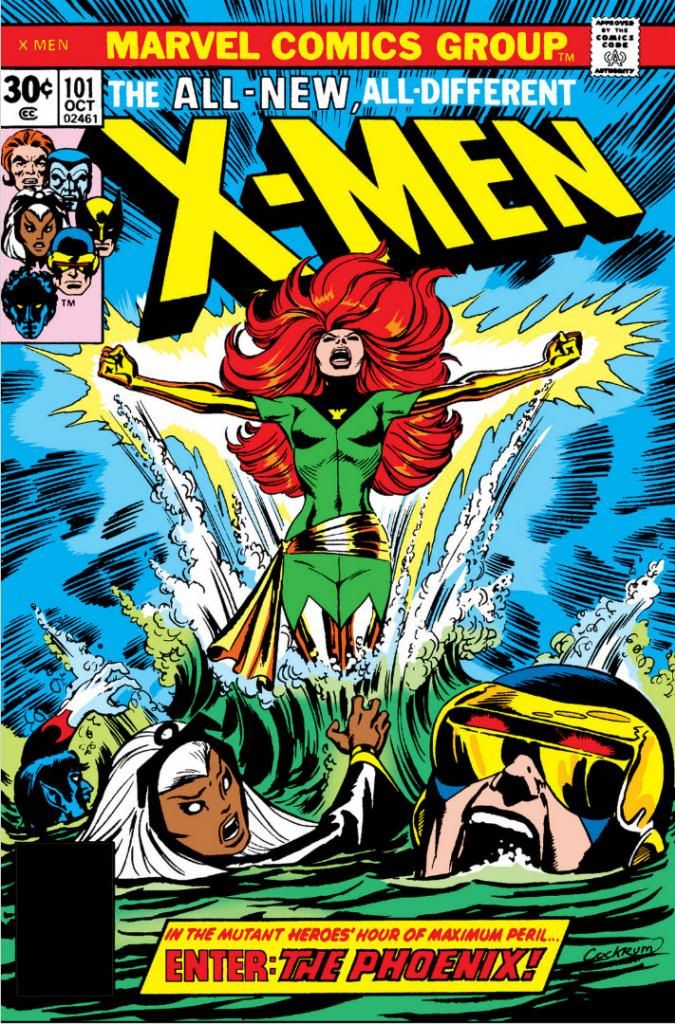
Uncanny X-Men #101 (October 1976) brings a bruised and battered group of X-sters back from a mission into space.  In the preceding issues, they'd taken a Starcore space shuttle-- accurately drawn for the most part (as was the Harrier jet in X-Men #94) by Dave Cockrum, even though NASA's real thing wouldn't get off the earth for another five more years-- to an orbiting space station (nothing like anything anyone's ever put up there, but still pretty cool) where they fought Stephen Lang (or, as some authorities have it, Steven Lang).  Lang is human, but more than that, he's a complete nutjob who hates mutants the way lions and hyenas hate each other. 

Maybe even more so, because Lang stoops to murdering even a non-mutant USAF officer who calls him out on just how insane his schemes are and lions and hyenas only kill each other in their feuds.  I can't think of a single lion who went so far as to bump off a leopard for telling him he's gone around the bend with the anti-hyena robot building enterprise.  Lang captures the team and forces them to fight for their lives in space.  It takes a couple of issues, but the good guys eventually prevail and, on the way home, fly through a solar storm.  Only Jean Grey (or Marvel Girl as she was known then) can pilot them safely back. 

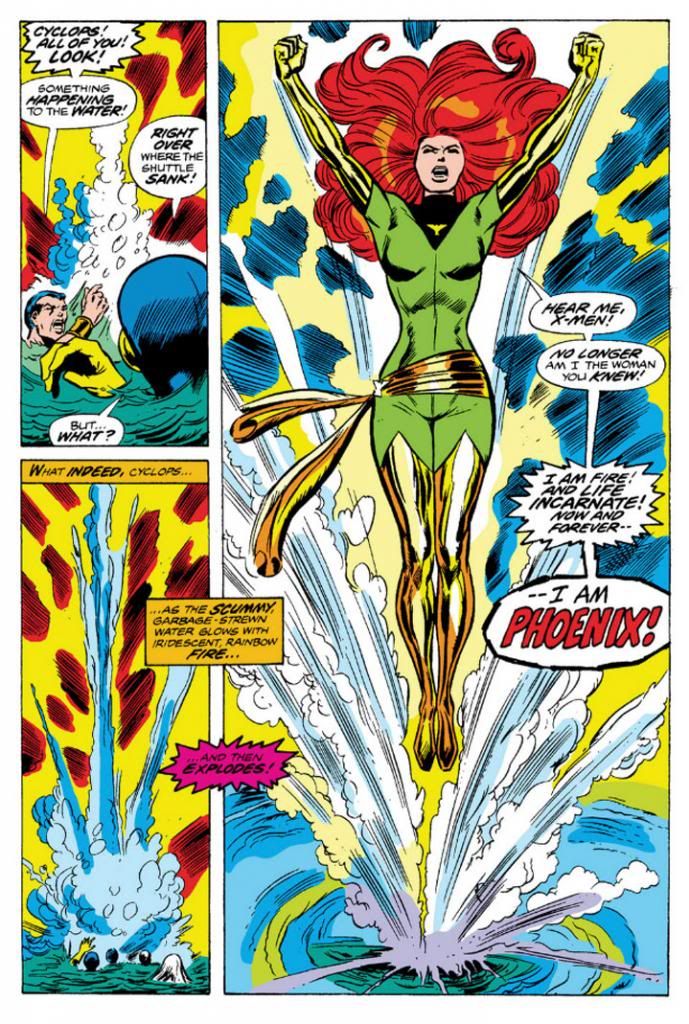
The intense radiation, depicted psychedelically by Cockrum, triggers Jean's transformation into Phoenix, the all-powerful.  But let's let Chris Claremont tell us what the new Jean Grey is all about as only he can:

X-Men #101, script by Chris Claremont, art by Dave Cockrum and Frank Chiaramonte

Ahhhh!  My, that's some good Claremont.  "I am fire!  And life incarnate!" has always struck me as a characteristically Chris Claremont phrasing.  This may be because he was the guy who taught me the word "incarnate" in the first place.  It's certainly not a word one slips into everyday conversation, at least not when I was a southern kid and living in my childhood home, where people were letter carriers, school secretaries and baseball players, not all-powerful mutants.  And so this is the exact moment "incarnate" entered my vocabulary.  To me, "incarnate" and "eldritch" are forever Claremont words, and when I read them in other comics, I always assume the writer has stolen them from Claremont's run on Uncanny X-Men.  And by shouting this phrase, Phoenix lets us know she's here, she's for real, and readers look out!

This is the issue where Claremont found his X-voice.  While he’d already shown a sure hand at characterization, giving each rookie in his cast (and even the previously-established veterans) distinct personalities and moods, the first few issues trot out a tired Avengers villain, a random to the point of being non sequitor demon attack and some story elements from the first X-Men series.  The new faces and the ultra-detailed Cockrum art are the draws, not the stale plots.  I know things were beginning to spark before #101.  Claremont had already started one slow-building subplot about Professor X's strange dreams of distant interstellar conflict.  This has a major pay-off later, and for the moment it meant Professor X gained what he'd largely lacked before-- a personality. 

But the Phoenix story as it begins here is something else altogether.  Claremont allowed it to flicker around the edges of succeeding issues as he dropped clues and intriguing interludes before the whole thing blazed up into major event unto itself, at once epic in scope and intensely personal as well.  Jean Grey’s transformation into the most powerful of all the X-Men also serves notice Claremont’s stories will be about the women as much as the men of the group.  Jean and Storm wouldn’t act as cheerleaders or simple love interests, or worse, damsels in distress, with the stories really being about the boys in the band.  They wouldn’t be co-stars in someone else’s adventures.  They’d be stars, too.  The women would get to drive the narrative as much as anyone.

Cockrum emphasizes this moment in all its drama by having Phoenix dominate the page in a fury steam and lightning, one of those razzle-dazzle comic book light shows.  It's also significant her rebirth takes place as she bursts from water-- both Claremont and Cockrum would have been fully aware of the symbolism.  As she rises we see she's got this startling new costume and even seems to have more hair.  The rest of the team end up crowded into those narrow panels on the left so Phoenix can own the entire space to the right.  If you were holding this comic, this would be the outside part of the page, and this placing promises more Phoenix to come because she's the last thing you see before you turn to the next.  Jean Grey and X-Men would never be the same.

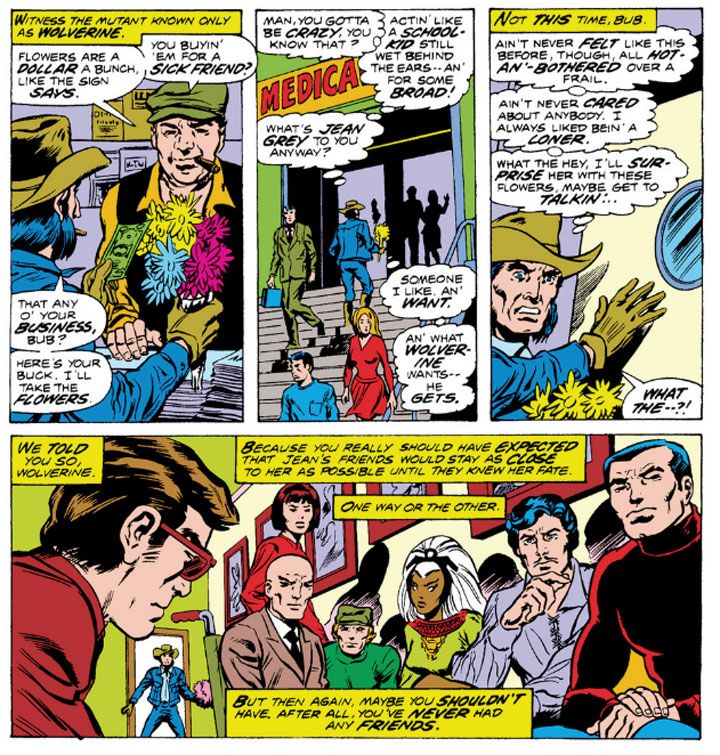
But what's this?  Back in those early, free-wheeling days before the X-Men became one of the major pillars holding up the Marvel cosmology, there was another little subplot happening, one Claremont didn't choose to develop into a major storyline.  Back then, Wolverine wasn't a huge fan favorite and star of every single comic Marvel puts out each month plus his own movie series.  In the first year or so of X-Men, he was just a short asshole mainly known for having fought the Hulk, but Claremont wasn't about to leave him as simple or one-note as all that.  So the team rebel, the loner who doesn't need anyone (needed by no one in return, it seems) turns out to have a bit of a sweet side.  Seems Wolverine has a cute little crushy-crush on none other than Jean "Phoenix" Grey herself.

X-Men #101, script by Claremont, art by Cockrum and Chiaramonte

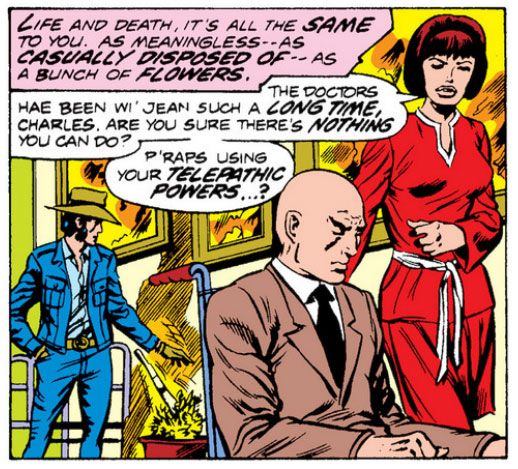
Aww!  Like a lovestruck high school boy, he's not sure how to go about wooing her, but in his insecurity he plays the arrogant fool in his mind.  Little bit of the caveman, I suppose.  Claremont's narration is pretty harsh on the poor guy, though, don't you think?  I mean, yeah, Wolverine thinks some dickish thoughts while awkwardly trying a tender gesture, but does he deserve the caption box hectoring he gets here?

X-Men #101, script by Claremont, art by Cockrum and Chiaramonte

Probably.

In the last panel Claremont really lets the guy have both barrels, even though everyone involved knows there's a heart inside Wolverine's gruff, hairy, somewhat psychotic exterior.  Actually, I've always thought of the intrusive, judgmental narrator as representing Wolverine's self-recriminations.  That he didn't really like himself.  It would be a while before they humanized him... and then overexposed him... but isn't it fun to see Wolverine getting a case of the goofies over Jean?

Sunday, June 19, 2011

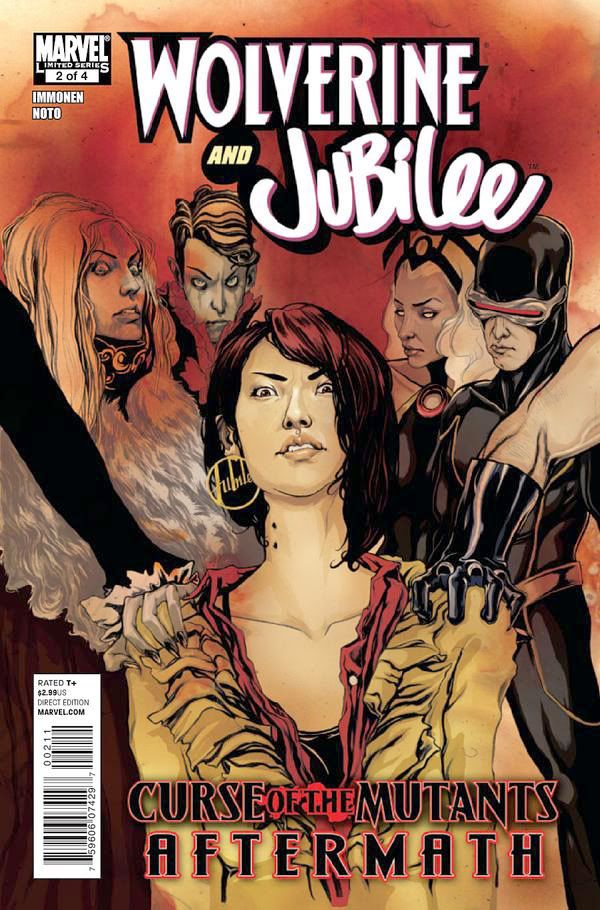
Wolverine and Jubilee 1-4: Comic mini-series review

Wolverine and Jubilee 1-4
Publisher: Marvel
Script: Kathryn Immonen
Art: Phil Noto

Jubilee always was a trend follower. When hanging at the mall all day was in style, that’s what she did. Now sucking blood, staying up all night, hanging out with Bella Swan and burning to ashes when exposed to direct sunlight are the fad, so Jubilee’s become a vampire.

I have no idea when Jubilee became the monster du jour but I believe it must have happened during one of those multi-book crossover events Marvel dumps on us every other month or so, with all the X-people fighting vampires; after all, the cover copy reads "Curse of the Mutants Aftermath." Characters refer to Jubilee's transformation and discuss how she even turned her old pal Wolverine into a vampire as well. This has understandably left the other mutants a bit wary of Jubilee, so they first keep her in a glass box as if she were Hannibal Lector’s favored daughter. After that, she moves into a nice stainless-steel business hotel room complete with a mini-fridge full of bottled Wolverine blood. I'm not sure if vampires prefer their blood chilled or at room or body temperature, but the magical red stuff flowing through Wolverine's veins is the only thing that can keep Jubilee's vampiric bloodlust in check. The X-Men and all their employees want to make sure there's plenty on hand. But what Jubilee doesn't know is they're keeping a running total and adding the charges to her bill.

Despite such apparent expertise, I have to admit my knowledge of Jubilee is kind of spotty. When I lived in Japan my workday ended at 9pm and I tried to get home in time to watch re-runs of Spider-Man and His Amazing Friends on the Disney Channel; more often than not, I came in too late and ended up watching the last few minutes of X-Men, the cult-fave cartoon from the 1990s with Jubilee as a major character. Since then, I've mostly thought of her as the spunky kid archetype, a smart-ass Kitty Pryde substitute; you know how the X-people always have to have an underage girl on the team for Wolverine to mentor. The Jubilee of my mind spends her days at the mall, wearing totally outrageous clothes ten years out of date and talking in the kind of sassy teen slang a middle-aged male comic book writer would come up with having watched a few ABC "TGIF" family sitcoms.


I bought the first issue of Wolverine and Jubilee because there wasn't much on the shelf that day and I simply hate walking out of a comic shop empty handed, especially one that seems to have about 5 customers a week. I read it a few days later, expecting little from it beyond some pretty art. To my amazement, I found myself engaged and interested in Jubilee's dilemma. For the first time in my hardboiled comic reading life, I actually cared about this character.

Writer Kathryn Immonen's achievement becomes all the more impressive because Jubilee's problems stem from the essentially silly premise of a world where superhero mutants can become vampires. Actually, in this world, the idea of mutation itself is mostly a catch-all excuse to create arbitrarily powered characters. Someone might have bird wings, another might look exactly like a frog and exhibit frog-like behaviors. And look, here comes Dracula to drink their blood. Deftly avoiding camp, Immonen crafts an affecting portrait of a young woman possessed of strange new powers, isolated and vulnerable as a result. Jubilee is uncomfortably slung between fight and flight, at war with both her elders and her contemporaries, the very people she once counted on as family.

In the opening scenes, Immonen wisely doesn't try to out-Juno Diablo Cody. Jubilee's quips are witty, but not supernaturally so. After more than half an issue of confrontations with several first- and second tier characters-- including Armor, her own replacement as resident purveyor of underage spunkiness and quips-- Jubilee becomes enchanted with a mysterious woman who also turns out to be a vampire, ever so briefly involves herself in human trafficking, then goes into summer blockbuster heroine mode, with brains to match her vampiric brawn. It turns out she's to be made a hostage so Wolverine will kill something or someone. Never forgetting she's writing a superhero story, Immonen does a fine job in the story's second half with several action-heavy sequences admirable in their weirdness, such as the scene where Wolverine confronts a zombie accountant who has a disarming way of keeping himself fed, or when one of Jubilee's few age-appropriate friends Rockslide-- looking like the lovechild of Ben Grimm and Badrock from Youngblood-- goes to a laundromat and ends up fighting a talkative dragon. Towards the end, Jubilee finds herself climbing down a battleship inside some kind of featureless void full of floating Egyptian pyramids and the Baltimore Hotel.

It's one thing to write about featureless netherworld pawn shops; it's another to make these ideas work as two-dimensional visuals. Fortunately, Noto's art is outstanding as well. While the backgrounds are somewhat sterile-- possibly due to the coloring-- the characters aren't generic heroic types. Wolverine has the doughy face of a barfly air conditioner repairman, while Jubilee sports messy hair and rolls her eyes in exasperation whenever she sees through Wolverine's clumsy attempts to help her regain her footing in the context of her new un-life. Or maybe they're clumsy attempts not to have to kill her. Whatever they are, they irritate Jubilee because they frequently involve either forcing upon her the company of Pixie, a ludicrously conceived character with pink hair, elf ears and fairy wings left over from those crushed Ritalin-snorthing, rave-happy pre-Millennial years we call the late 1990s, or simply stabbing her in the neck with a loaded syringe. But how tall is Jubilee supposed to be? I've always thought of Wolverine as a shorty, topping out around 5'4" or so. Yet he towers over Jubilee during their sparring sessions and heartfelt yet edgy father-daughterish conversations.

There is something of a letdown after the final battle, though. Immonen and Noto forgot to tell us if Jubilee is the sparkly kind of vampire.

Wednesday, June 17, 2009

Tokyo Visionaries: Images of Japan from Western Comics

As an American comic book fan living in Japan, I'm fascinated by depictions of my adopted home in my old favorites. My inspiration for living here is more pop cultural than spiritual or financial. I'm more of a live show and contemporary Tokyo person than a temple and garden type. And I'm not all that into manga or anime; I have a few favorites. No, my earliest imaginings of Japan consisted of images drawn from Speed Racer, Ultraman, Space Giants, Sonny Chiba movies, James Clavell's Shogun and-- for some reason-- Pink Lady.

As I got older, I became enamored of Japanese noise rock and street fashion, cinema and subcultures. I'd be lying, however, if I said in all of that I didn't find some inspiration from American comics and depictions of Japan found in them. These were and remain heavily reliant on Clavell-esque storylines of Westerners getting deeply involved with modern-day samurai, ninja or, in a more recent switch, yakuza gangsters seemingly born from both Michael Crichton's anti-Japanese paranoia-laced Rising Sun and Kitano Takeshi's ultra-violent films, among others-- the yakuza film is a longterm genre in Japan, just as gangster films have been in America for decades. Lots of arrogant, angry, high-strung characters like Silver Samurai, Katana, the female Dr. Light and occasional X-Men ally Sunfire, references to revered ancestors and "losing face" and "retaining honor" and life debts and all that junk...

Well, the chances of encountering genuine ninja in contemporary Japan are just about nil, and meeting up with yakuza thugs with ancestral castles only slightly more likely. But if the storylines are somewhat ridiculous, how do their visuals match up to the real thing? Let's take a look at some carefully selected examples. It's by no means a comprehensive overview because it consists only of comics I've actually read.

First up is the Chris Claremont-scripted, John Byrne-illustrated The Uncanny X-Men #118, "The Submergence of Japan." In this story, the X-people have escaped the Savage Land and traveled by the research ship Jinguichi Maru to Japan, where they find the ship's "home port of Agarashima," a fictional seaport ablaze in a fire so hot they can feel it from "ten kilometers from shore." Byrne treats us to an epic double-page splash with our heroes in the foreground, a backdrop of the devastated cityscape spewing massive, lurid red flames and billowing smoke, Air Self-Defense Force fighter jets streaking overhead and with a snow-covered Mt. Fuji off in the distance, as if gazing impassively at the destruction. The buildings are a little exotic-shaped, but it does give one a feeling of place; Agarashima, if it existed, would probably be somewhere on the southern coast of Honshu, somewhere between Shizuoka prefecture and Tokyo, an area where there are plenty of coastal cities hugged to the Pacific by mountains.

Coming ashore, the X-Men make their way through the ruins. Neither Claremont's narrative captions nor Byrne's art dwell much on travelogue, so we miss a chance to see if Byrne can match his ultra-detailed North American settings-- that counterfeiting of reality that adds so much verisimilitude to the X-Men's superheroic antics during this classic period-- with some postcard-perfect Japanese backgrounds, albeit ones crumbled by an earthquake. Byrne gives us just enough to make the setting at least seem real:

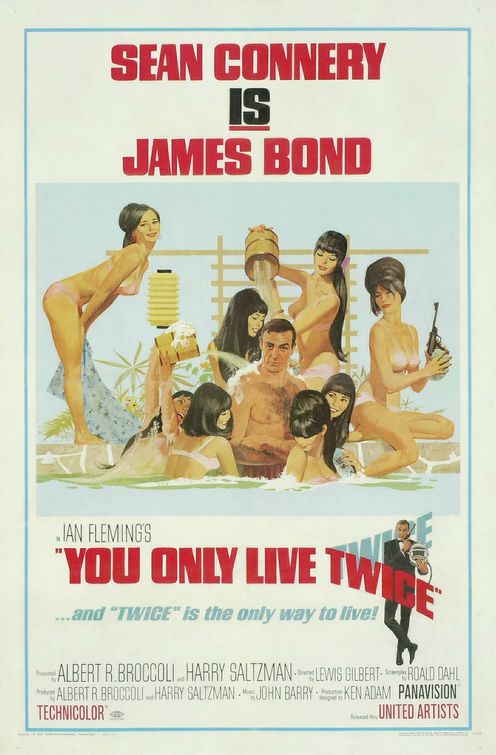
The story quickly replaces modern Japan with more James Clavell-style fantasies, and Byrne deftly draws all the shoji (paper sliding door) and wooden walkways you could desire in a comic book story before he and Claremont send their protagonists off to some secret island base to fight Moses Magnum, a nut who wants to sink Japan. Interestingly, this idea of Japan's submergence has been a theme in Japanese science fiction literature. Magnum's hideaway is right out of the 1967 James Bond adventure You Only Live Twice, also set in Japan and the poster for which carries Western sexual fetishization of subservient Japanese women to ludicrous extreme.

Sorry... I digress...

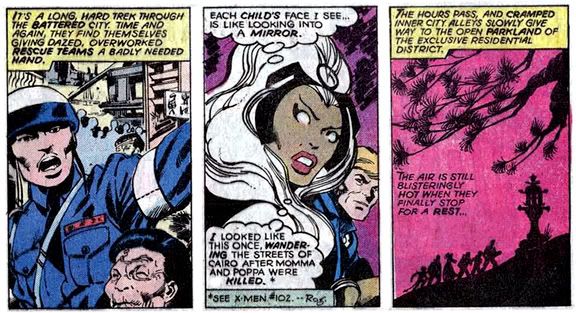
Even in such a fast-paced story, Wolverine finds time to meet and begin wooing a character who would become intrinsically linked with him, at least throughout the 1980s, Lady Mariko Yashida. He even presents her with a chrysanthemum and displays a heretofore unknown ability to speak perfectly fluent Japanese!

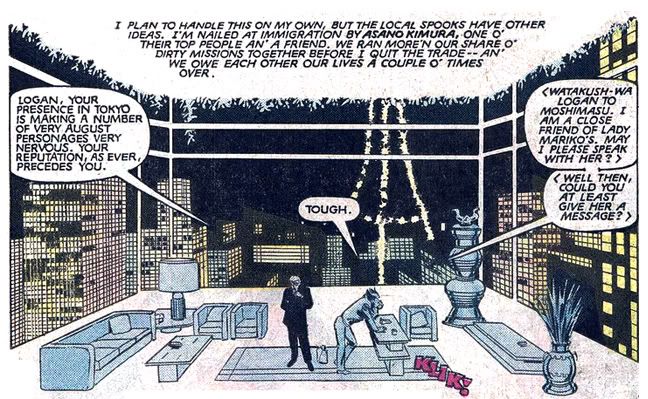
In the 1982 Wolverine miniseries, Claremont teams up with the artist most known in America for the influence of Japanese comics and cinema on his stories, Frank Miller. Together, they send Wolverine on a very Bond-like adventure in a modern day Japan practically overrun by crazed ninja assassins. This story is like a compendium of the American popular mythologizing of Japanese culture-- all samurai honor and Asian exoticism but set against the sleek electric cityscapes of the late 20th century. Clavell meets William Gibson, with Sonny Chiba as interlocutor.


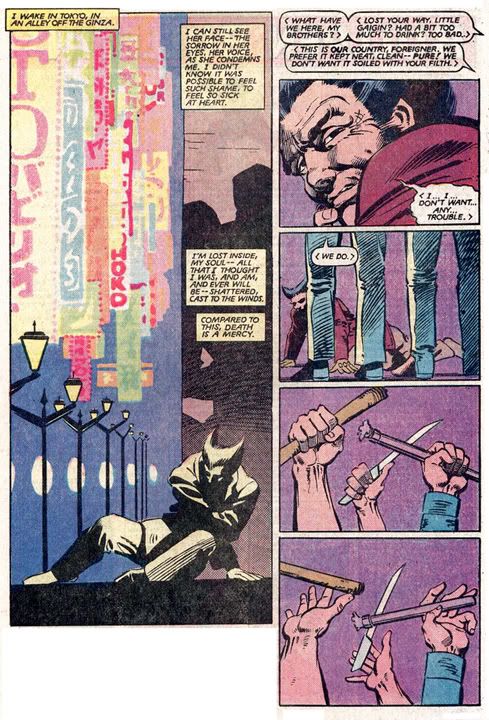
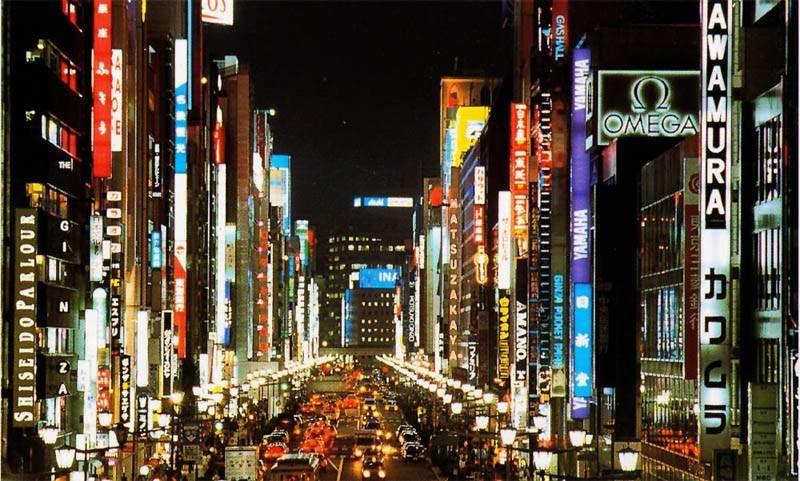
In this image, Wolverine has checked into either an upscale apartment or the fanciest hotel on earth. It appears to be in Minato ward, because that's Tokyo Tower in the background. Minato is home to Roppongi and Roppongi Hills and in places is pretty much the skyscraper forest Miller illustrates here. Later, Wolverine finds himself drunk in an "alley off the Ginza." Ginza is a shopping district within the Chuo ward. I've never heard it referred to as "the Ginza," but who knows?

While I'm doubtful about the presence of anti-foreigner thugs in that particular area of Tokyo, again Miller's backgrounds prove surprisingly accurate:


Not too shabby, eh? He even appears to have gotten the streetlamps correct. Still, I think if Wolverine were really looking to get his drunk on in a seedy part of Tokyo, he would have been better off hitting Kabuki-cho in Shinjuku. Ginza features its share of hostess bars, but is a bit more upscale and pricey. Kabuki-cho is often referred to by my students and friends here as the "most dangerous place in Japan." It's a down-and-dirty fun zone where at night you can see prostitutes, street-level yakuza, Nigerian gangsters and perhaps even members of Chinese tongs if you're lucky. They'll be mixed in with lots of businesspeople doing the after-work drinking thing and young couples in search of exciting nightlife so you may not even notice them. Sounds more like a Wolverine kind of place.

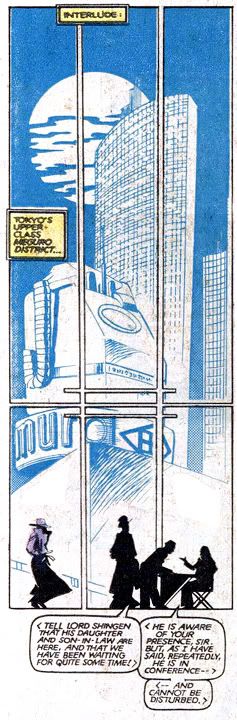
This is interesting:

As Claremont describes it in the caption, Meguro is indeed an "upper class" area. A number of celebrities make their homes there. What you need to remember, however, is the phone-shaped building. It will become important later.

The story's climax and closing actions take place within the castle-like Yashida family "ancestral stronghold." Miller's architecture even more accurate here, but given the unfortunate destruction of most castles during the Meiji Period and flattening of Japan's major cities during WWII, it's pretty unlikely any private family would be living in something so... historical. In comic books as in life, sometimes coolness must trump accuracy. Would you want to read a story where a vengeful Wolverine scales the less-than-impressive walls of a fancy apartment building?

Perhaps, but Wolverine in a Edo-style castle is a bit more visually compelling.

The 1980s were prime time for Japanese influences in American pop culture. The decade began with the hugely successful TV miniseries adaptation of Clavell's Shogun and the major failure of Pink Lady and Jeff, a bizarre yet energetic attempt to make two talented J-Pop singers variety stars in the States. Later American television audiences would pretty much ignore The Master, an absolute bullshit adventure TV series starring Lee Van Cleef as a blue-eyed ninja; it would last a mere thirteen episodes and become Mystery Science Theatre 3000 fodder. This probably says as much about Western cultural misappropriation as having Canadian-born Wolverine described as "more truly Japanese than any Westerner I have ever known" by one of his allies. At least Claremont qualifies it somewhat. Wolverine can master the language and cultural mores, defeat the yakuza boss and win the hand of the nigh-unreachable Lady Mariko, but as a mutant as well as gaijin, he remains an outsider in Japan as well as in the West. Lee Van Cleef bests even the Japanese at their own martial arts, then walks away for personal reasons.

But I digress yet again...

Perhaps inspired by Wolverine's Japan sojourn, Batman would take his Outsiders to Tokyo in 1984's Batman and the Outsiders #11. In this story writer Mike W. Barr and penciller Jim Aparo tackle the increasingly cliche story themes of the Japanese concept of honor and family loyalty as native-born Japanese Katana (described the following issue as the "She-Samurai") confronts her past and we learn all about her magical sword. The story is heavy on the ninja tropes but how do Aparo's Tokyo cityscapes fare as accurate depictions of that particular megalopolis?
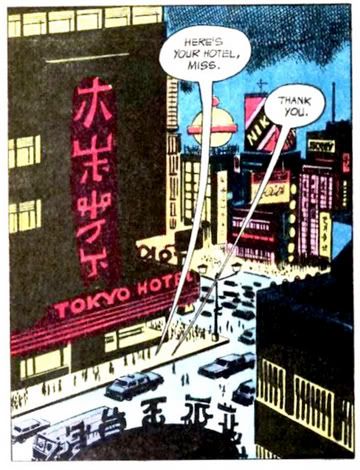
Not too badly, if this image is any clue:


He gets the omnipresent advertising signs correct. Many buildings here do feature giant signage on their rooftops and various kanji and katakana or hiragana running down their sides. This particular panel is somewhat reminiscent of the Kabuki-cho side of Shinjuku Station, although there's no "Tokyo Hotel" in the station, and there'd be a small plaza to the right instead of what appears to be a parking lot of some kind. Those types of lots are extremely rare here in land-starved Japan; more likely would be a high-rise parking deck looking like a big steel Rubik's Cube, but not nearly so colorful.

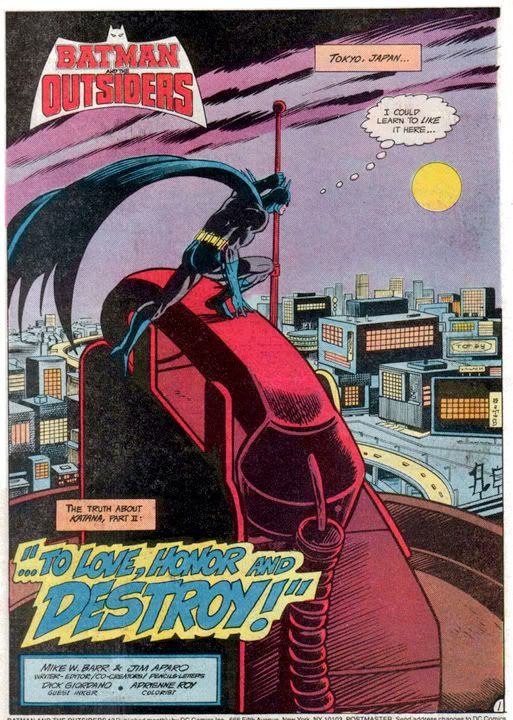
And again:


I have no idea if there is now or if there ever was a building with a gigantic telephone on top, but Frank Miller and Jim Aparo seem to insist upon its existence. Maybe it was a famous landmark of the 1970s and 1980s and both artists saw it on some kind of comic book publicity junket here. Or else Aparo is paying homage to the work Miller did with Chris Claremont. Since this story hits some of the same cultural notes, that's a distinct possibility. Aparo's buildings are a far cry from the Meguro seen in Wolverine, though. This looks more industrial (and generic) than "upper class," so perhaps the phone building is merely a fantasy.

A more recent comic book look at Tokyo comes courtesy Vertigo Pop: Tokyo! by Jonathan Vankin and Seth Fisher. Vankin's story is another "Japan-as-other" fantasia, this time seen not through the eyes of superheroic adventurers but those of an ordinary American electronics geek. To that end, Vankin's protagonist is somewhat dull and colorless, his Japanese are laughable flakes and the story is a vibrant romp through newer paradigms of our outsider's view of contemporary Japan. As someone who actually lived in Japan, Vankin obviously has an encyclopedic knowledge of Japanese pop culture and presents it in a comically extreme form for our amusement. Gone are the samurai and ninja, replaced by ditzy fashion girls and would-be flight attendants, incompetent gangsters, sci-fi pop stars, perverted old men and fast food restaurants. Candy-colored Japan.
I don't know if it's exacly an improvement, but it is closer to what you might actually find if you came here.

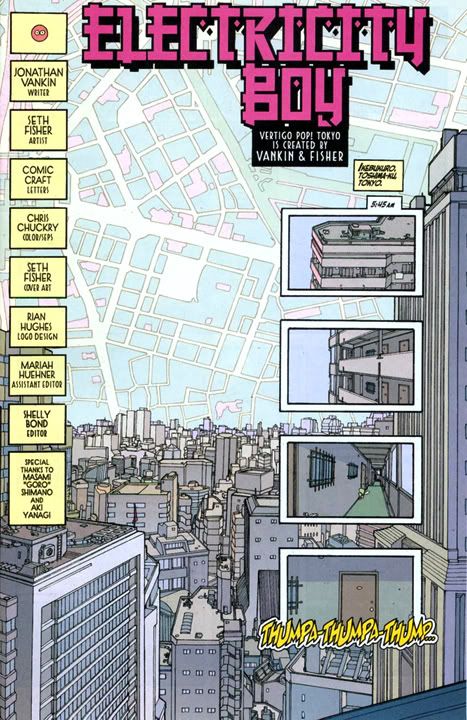
Like Vankin, Fisher (who tragically passed away much too young) actually lived in Japan, so I imagine he was able to do a lot more first-hand location scouting than Byrne, Miller or Aparo. Consequently, despite the story's comedic exaggeration, Fisher's Tokyo is almost documentarian in its accuracy. Oh, like Vankin, Fisher takes some license here and there, but only in the service of the narrative. Here's his version of Ikebukuro, one of Tokyo's busiest but somewhat second-rate districts. Sorry, Ikebukuro! I love you but I mean "second-rate" compared to trendier wonderlands like Shinjuku, Shibuya and Harajuku:


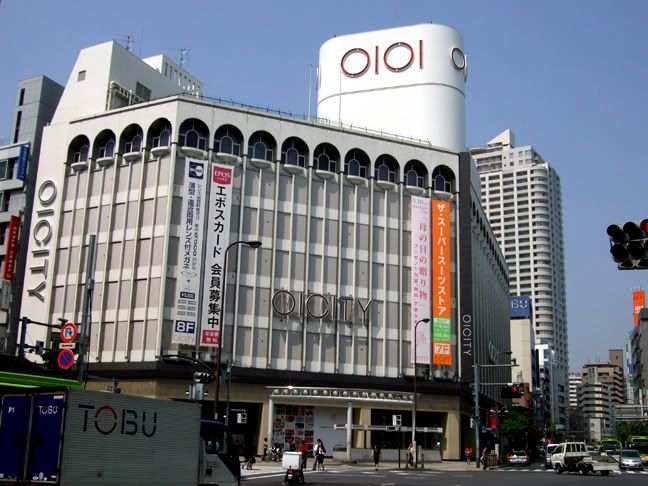
To my eyes, the backstreets of Tokyo-- the places where people actually work and live as opposed to shop and play-- look like this. A bewildering jumble of high-rise buildings in dull concrete, stretching from horizon to horizon. No comic book story (and few movies) can prepare you for Tokyo's immense scale. Once inside, you are in an artificial world of steel and glass and after a while, it's hard to imagine there are any other environments on earth.

Here's a photo I took in Ikebukuro:


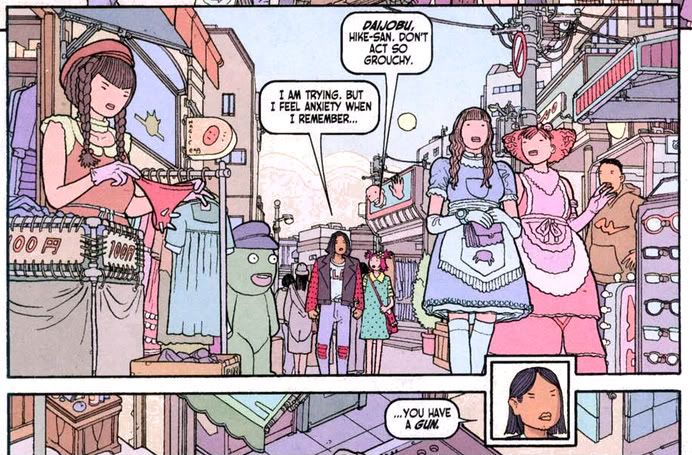
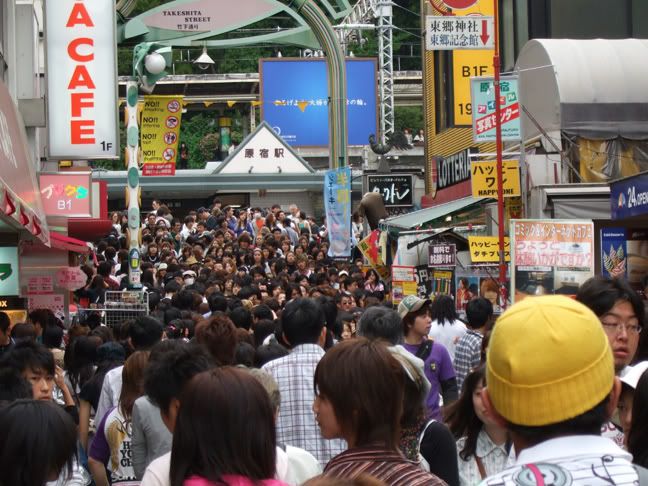
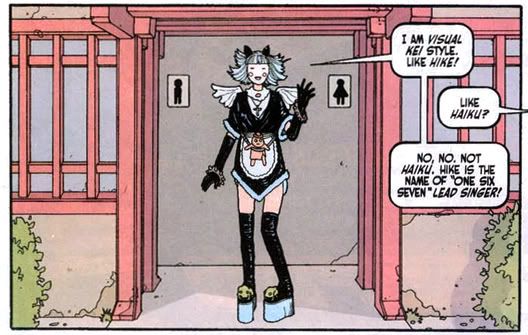
As Vankin's story unfurls, Fisher treats us to backdrops of some of the coolest places on earth. Here's a panel where crazed schoolgirl (another trendy stereotype) Maki has kidnapped her idol Hike to show him off to her Harajuku girl friends. This is more than likely Takeshita-dori, which during the 1990s was the epicenter of Japanese youth fashion culture:


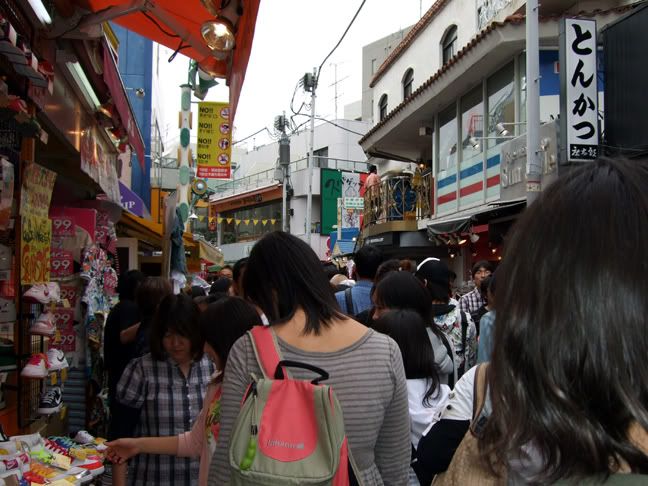
That's one problem with Vertigo Pop: Tokyo!-- Japan's trends change so fast what was current as recently as 2002 is practically antediluvian now. And a lot of the elements in the story seem more contemporaneous with the mid- to late-1990s. Well, perhaps not a problem, per se, but more a transmuting it to a kind of literary time capsule or period piece. Jidai geki for the visual-kei set. And here's the real Takeshita-dori as it appears today:


As you can see, Fisher pretty much nails it and I was standing in almost the exact same spot the panel appears to depict. If an artist draws Takeshita-dori as crowded as it truly is, we wouldn't be able to see the main characters at all. Behold Takeshita-dori in all its glory:


It can take you thirty minutes to an hour to walk its length on the weekend. Unfortunately for this story (and Gwen Stefani), the classic Maki-style "Harajuku Girl" doesn't really exist in that form anymore. She's been name-branded out of existence in Harajuku, subsumed by gothic lolitas and cosplayers and driven by photo-happy tourists to quieter, trendier neighborhoods like Kichijoji (where my own personal version of Maki eventually settled). But FRUiTS magazine continues to document her colorful, creative stylistic heirs faithfully so there's still some hope. Here's an image set just outside Yoyogi Park proper, crossing the Yamanote Line rails in Harajuku:

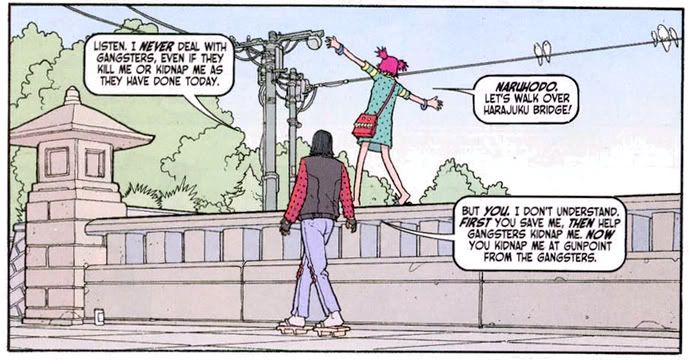
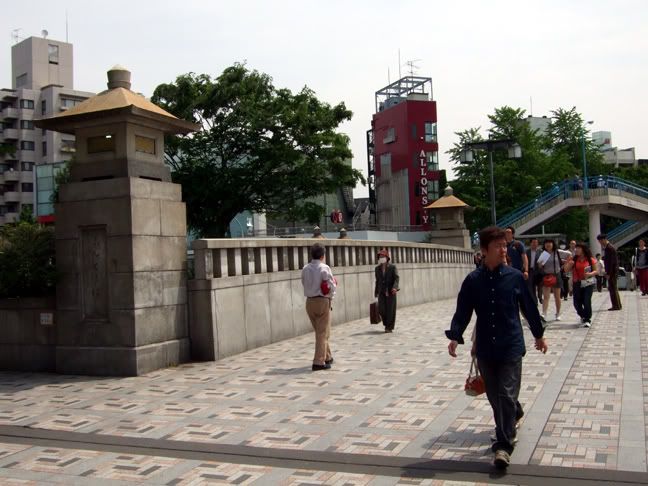
Here's the park itself, in reality. Fisher almost perfectly matches the real-life location. The lower wall is bit taller in the real world and there are some slight differences in the end caps, but it's instantly recognizable:


You can even spot the exact location crazy-pops Maki daringly tightrope walks along the wall. It's roughly between the guy in the light shirt and khaki slacks and the person in the face mask in this photo:


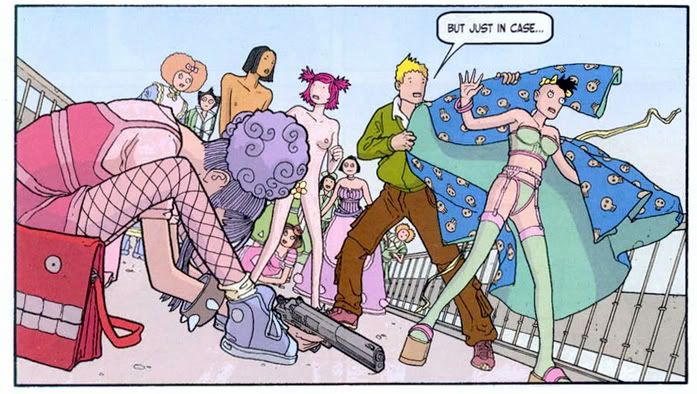
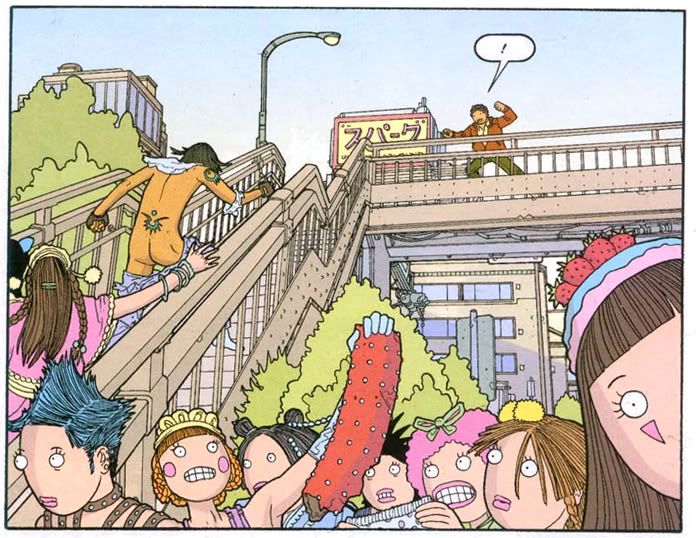
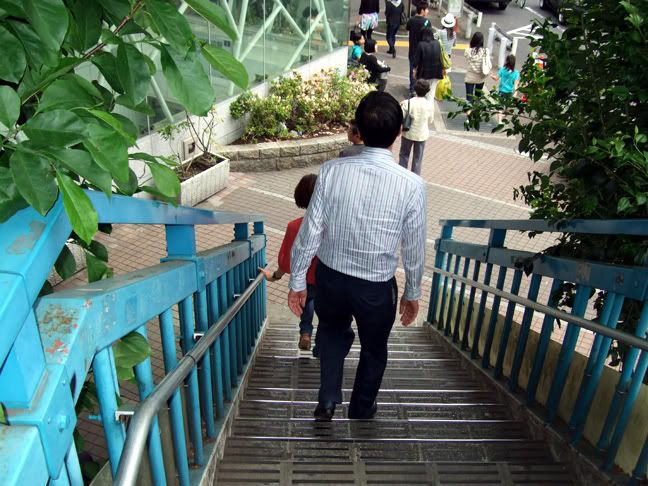
But I don't advise you to duplicate her stunt. If you fell and were injured or killed, I'd feel somewhat responsible and your friends and family would sorely miss you. Part of the action takes place on the pedestrian bridge overlooking the park:


I end up on this bridge every time I visit Tokyo so I can attest to Fisher's accuracy, even with a bit of artistic license. While the color is wrong (although it may have changed from 2002, the year the story is set, to today), Fisher gets the basic look of the bridge itself down, and even includes some of the surrounding greenery:


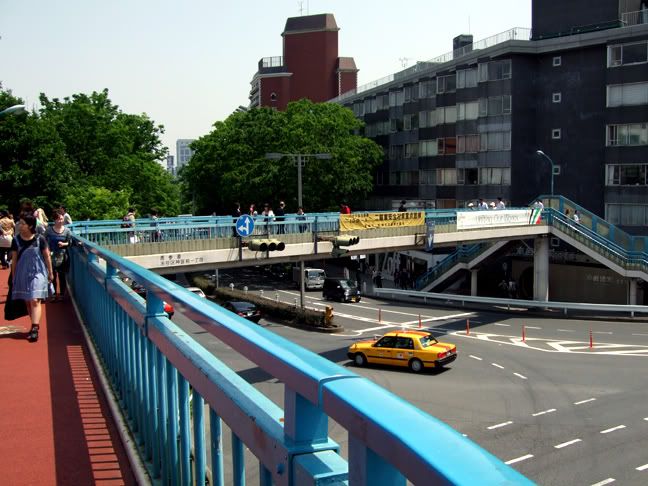
There's one moment where two characters fall off the bridge and land in the park plaza below, which is almost impossible. The bridge doesn't span the park; it crosses the street over a busy intersection. If they'd have fallen, they would've instantly been run over by cars, as you can see here:


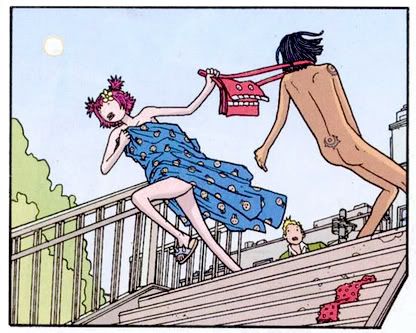
Also, notice that it's not a single span but several, in a rectangular shape. Here's in interesting scene where a nearly naked Maki attempts to escape the chaos she herself has caused, dragging a completely nude Hike behind:

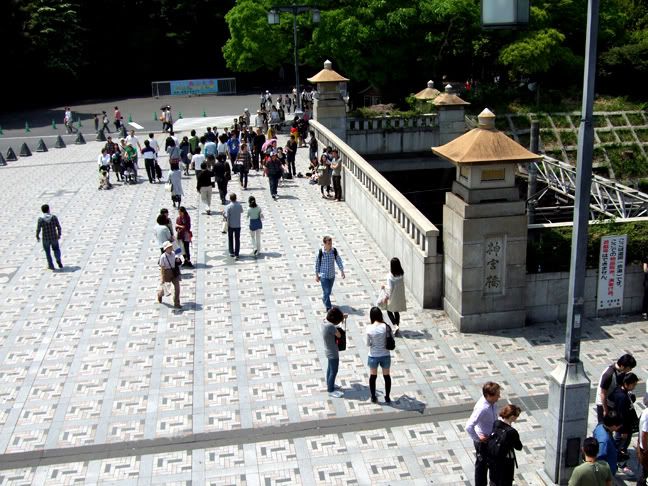
And this is my best guess as to where this event occurs:

I stupidly shot this photo from the top rather than matching the comic book panel's lower angle from the bottom. Oh well, maybe next time.

So how do our comic book artists fare with their depictions of Tokyo? Not bad at all. Fisher obviously takes the prize, but the old school dudes pleasantly surprised me. In my memory, they were all much less accurate but I'm gratified to be wrong and actually able to praise these guys for how "right" they got Tokyo rather than rag on them for falling far short. Sure, each could've done a bit more research and gotten it exact, but I doubt either Marvel or DC were willing to spend that kind of money for location sketching. Plus deadlines and all.

Remember-- it's pretty easy for a writer to type "Wolverine hops a jet and lands in Tokyo, then takes a taxi to Shinjuku. On the way there, fighting jet lag, he marvels at his own face gazing down at him from various advertisements in the wild neon lights down the sides of buildings along the street," but the artist has to take those words and make them at least somewhat visually plausible. And Byrne, Miller, Aparo and Fisher accomplish that with their work in these books.

I still have this desire to find some of the actual locations from Yazawa Ai's glorious comic book creation Nana, including Jackson Hole where I plan to try a Jackson Burger (Hachi swears by 'em). Yazawa gets around the accuracy and time constraint issues by using actual photographs as her backgrounds.

Until then:

Bai-bai!